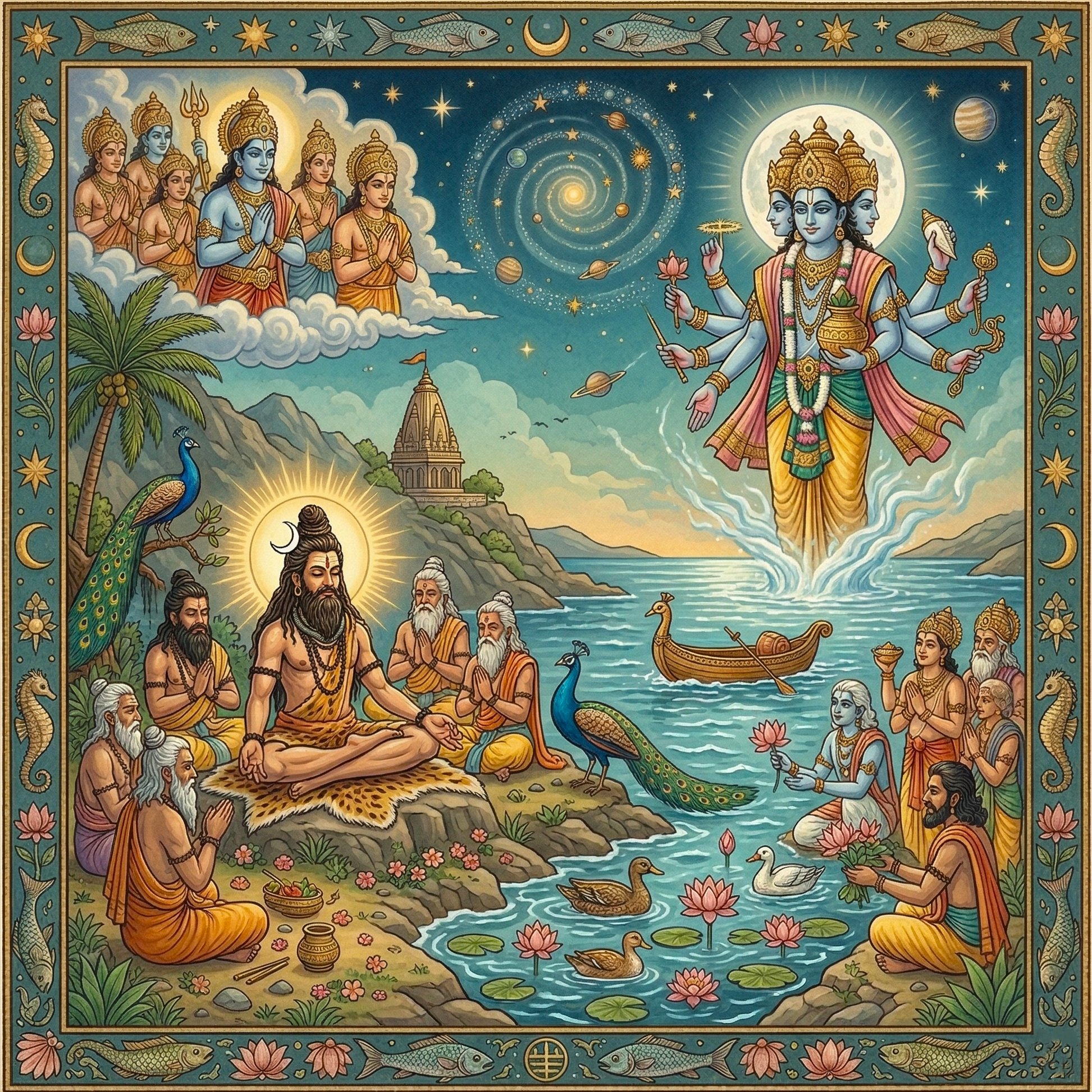
Prabhasa Kshetra Mahatmya
Prabhasa Kshetra Mahatmya
This section is centered on Prabhāsa-kṣetra, a coastal pilgrimage region in western India traditionally associated with Somnātha/Someśvara worship and a dense network of tīrthas. The text treats the landscape as a ritual field where travel (yātrā), bathing, and recitation function analogously to Vedic rites, while also embedding the site in a broader purāṇic memory-map through genealogies of teachers and narrators.
Adhyayas in Prabhasa Kshetra Mahatmya
366 chapters to explore.
Adhyaya 1
प्रभासक्षेत्रमाहात्म्ये प्रस्तावना (Prologue: Invocation, Authority, and Eligibility)
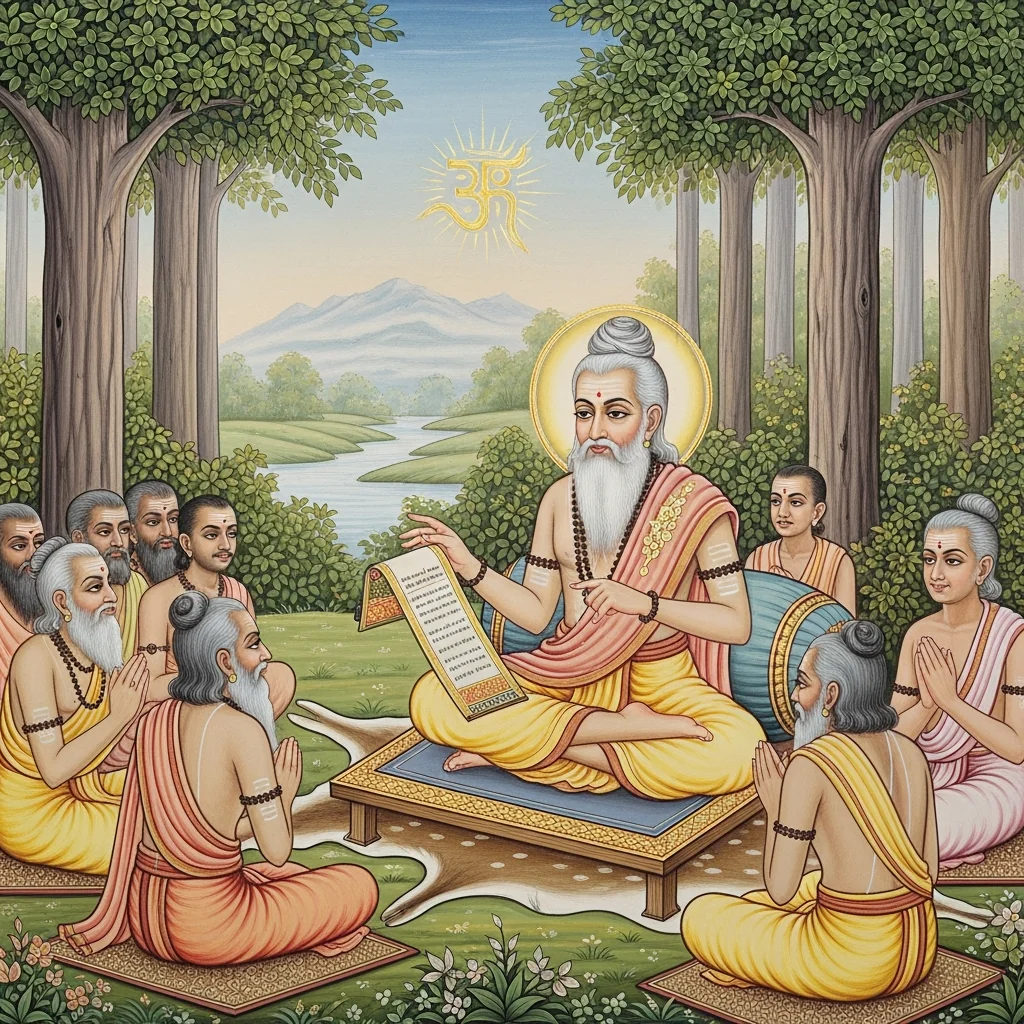
Chapter 1 sets the scene of the discourse and establishes the authority-chain for the Prabhāsa portion of the Skanda Purāṇa. Vyāsa is recalled as the foundational knower and teacher of purāṇic meaning, and the sages of Naimiṣa request Sūta (Romaharṣaṇa) to narrate the Prabhāsa-kṣetra māhātmya—asking especially about the Vaiṣṇavī and Raudrī yātrās, after noting an earlier Brahmī yātrā tradition. It opens with invocatory verses praising Someśvara and a metaphysical salutation to pure consciousness (cinmātra), followed by a protective motif contrasting amṛta and viṣa. Sūta then offers a theological eulogy of Hari as the form of Omkāra, transcendent yet immanent, and describes the ideal qualities of the coming kathā as orderly, ornamented, and purifying. Ethical guidelines are stated: the teaching is not to be given to nāstikas; it should be recited for the faithful, peaceful, and qualified (adhikārin), with emphasis on brāhmaṇa eligibility defined through life-cycle ritual competence and conduct. The chapter concludes by recounting the transmission lineage from Śiva on Kailāsa down to Sūta, legitimizing this section as a tradition-bearing record.
Adhyaya 2
Purāṇa-lakṣaṇa, Purāṇa-anuक्रम, and Upapurāṇa Enumeration (पुराणलक्षण–पुराणानुक्रम–उपपुराणनिर्देश)
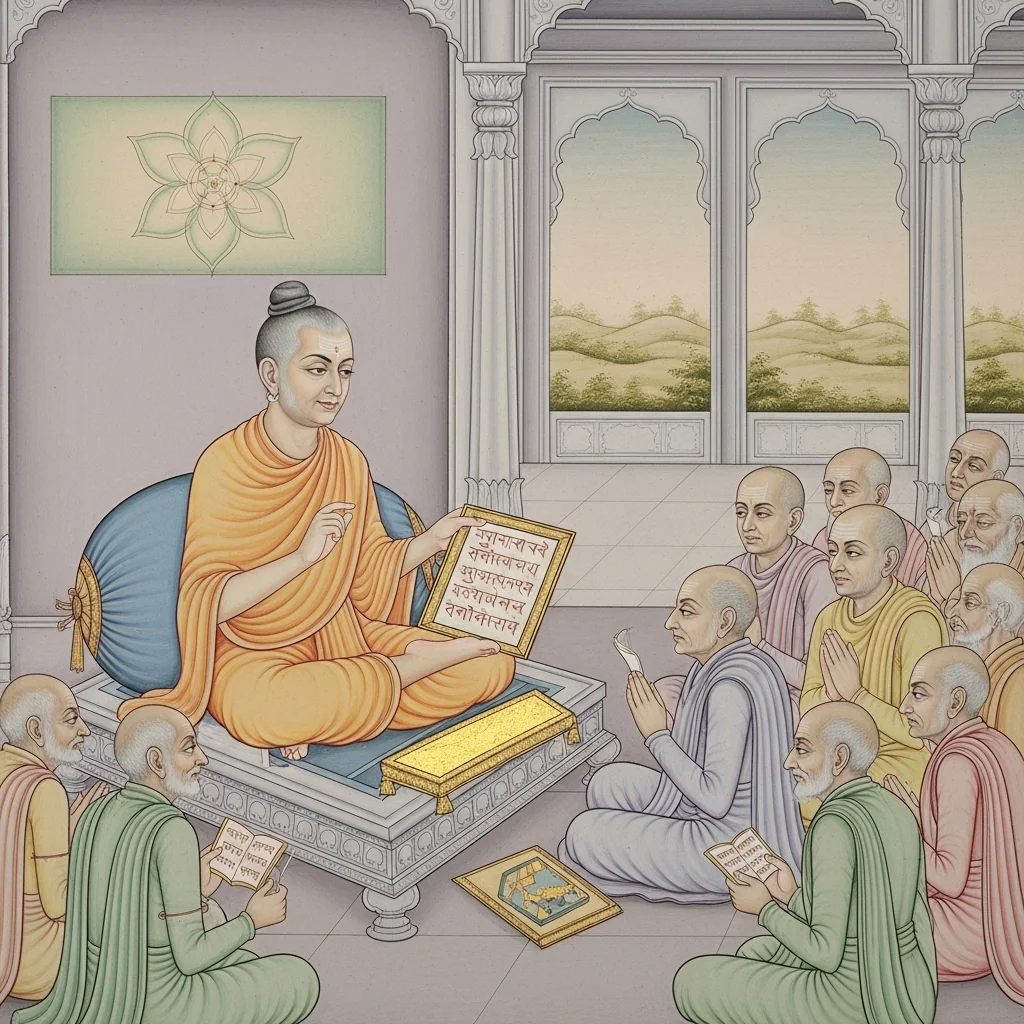
Chapter 2 proceeds as a technical dialogue in which the ṛṣis ask for standards to judge kathā (narrative discourse): its identifying marks, virtues and faults, and the means of discerning an authoritative composition. Sūta replies with a compressed account of Purāṇic literature—its primordial emergence alongside the Veda, the belief in an originally vast Purāṇa corpus, and Vyāsa’s periodic redaction and division of it into eighteen Mahāpurāṇas. The chapter then lists major Purāṇas and Upapurāṇas, often pairing each with an approximate verse-count and with dāna-focused injunctions—copying, gifting, and attendant rites—thus linking textual transmission to meritorious practice. It specifies the classical fivefold definition of a Purāṇa (pañcalakṣaṇa: sarga, pratisarga, vaṃśa, manvantara, vaṃśānucarita) and introduces a broad typology by guṇa orientation (sāttvika/rājasa/tāmasa) with corresponding deity-emphasis. In closing, it reaffirms the Purāṇas as stabilizing supports for Vedic meaning through itihāsa–purāṇa traditions, and situates the Prābhāsika division within the Skanda Purāṇa’s internal sevenfold segmentation, preparing the reader for the section’s place-based sacred geography.
Adhyaya 3
तीर्थविस्तरप्रश्नः प्रभासरहस्यप्रकाशश्च (Inquiry into the Spread of Tīrthas and the Revelation of Prabhāsa’s Secret)
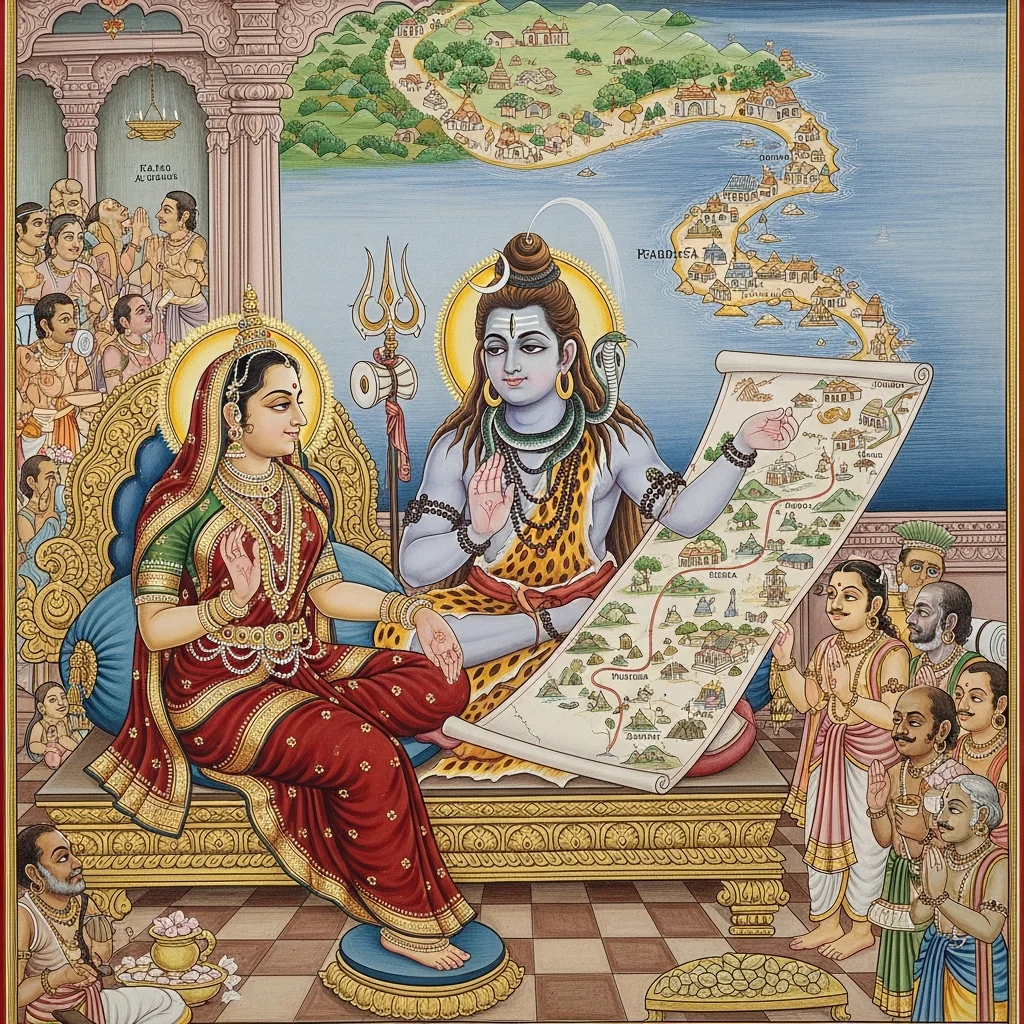
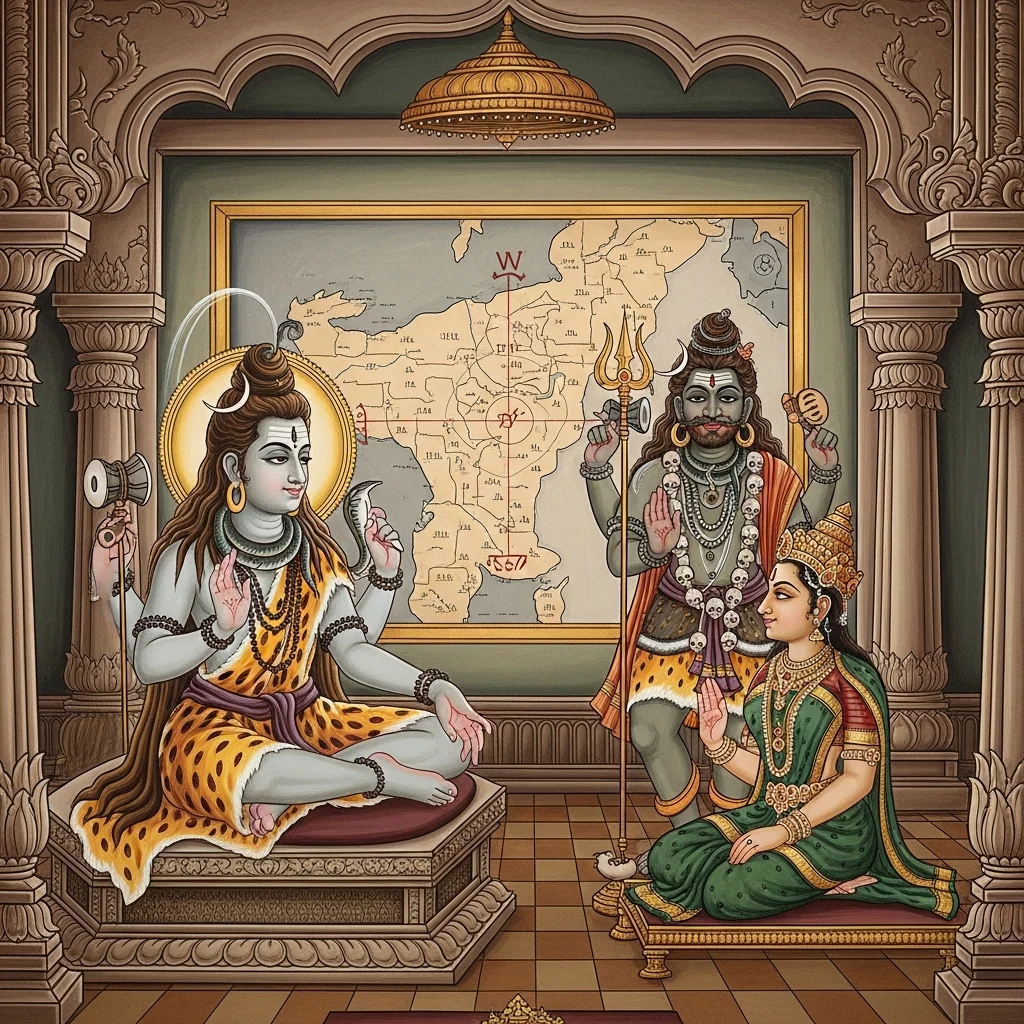
Chapter 3 opens with the sages asking Sūta for a systematic account of tīrthas, following the earlier cosmological discussions. Sūta recalls a former dialogue on Kailāsa, where Devī beholds a magnificent divine assembly and praises Śiva in an extended stotra. Śiva replies by affirming the radical non-separation of Śiva and Śakti through a sweeping litany of identity, spanning ritual roles, cosmic functions, measures of time, and forces of nature. Devī then requests a practical teaching for beings afflicted in Kali Yuga: a single tīrtha whose darśana grants the fruit of all tīrthas. Śiva lists the great pilgrimage sites across India and then exalts Prabhāsa as a hidden, supreme kṣetra. The chapter adds an ethical warning: hypocritical, violent, or nihilistic travelers do not obtain the promised results, for the kṣetra’s power is deliberately guarded. It culminates in the revelation of the divine liṅga Someśvara and its cosmogonic role, as three śaktis—icchā, jñāna, and kriyā—arise for the world’s functioning. A concluding phala statement promises purification and heavenly attainment to those who listen attentively with reverence.
Adhyaya 4
प्रभासक्षेत्रप्रमाण-त्रिविधविभाग-श्रीसोमेश्वरमाहात्म्य (Prabhāsa: Measurements, Threefold Division, and the Somēśvara Discourse)
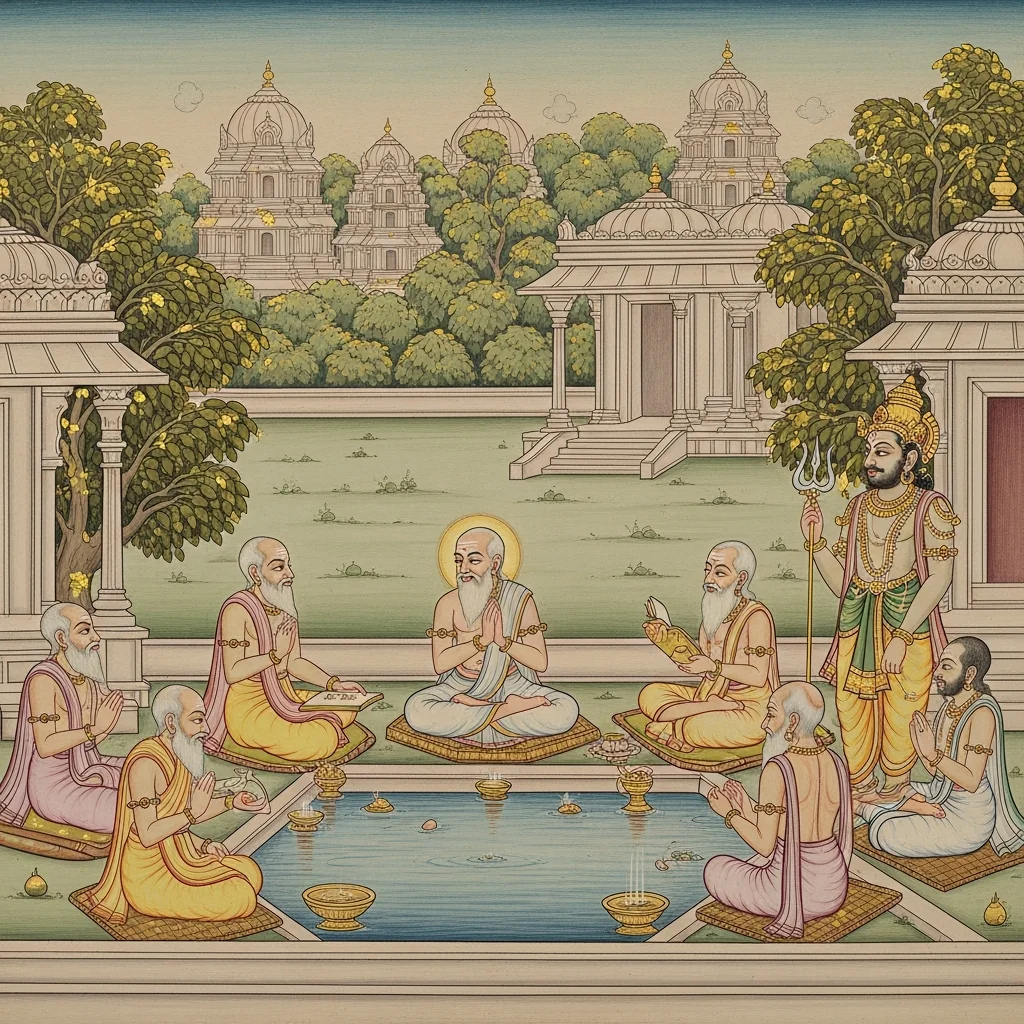
Chapter 4 unfolds as a structured theological dialogue. Devī asks for a fuller account of why Prabhāsa is supreme among tīrthas and why deeds performed there yield inexhaustible merit. Īśvara replies that Prabhāsa is a uniquely beloved (priya) kṣetra where He is perpetually present. He then sets out a three-tier sacred geography—kṣetra, pīṭha, and garbhagṛha—each granting progressively greater fruit. The chapter defines boundaries and cardinal markers, and explains an inner threefold division aligned with Rudra/Viṣṇu/Brahmā, including tīrtha counts and corresponding yātrā types (Raudrī, Vaiṣṇavī, Brāhmī) matched to śakti modes (icchā, kriyā, jñāna). Its soteriological claims intensify: disciplined residence and devoted worship at Prabhāsa are said to surpass other famed pilgrimage sites. A major doctrinal focus centers on Somēśvara and Kālabhairava/Kālāgnirudra—protective roles, principles of purification, and the Śatarudriya as a paradigmatic Śaiva liturgical text. The narrative also lists guardians (Vināyaka, Daṇḍapāṇi, gaṇas) and prescribes pilgrimage etiquette, such as honoring threshold deities and offering specific gifts (e.g., ghṛta-kambala) on calendrically significant nights.
Adhyaya 5
प्रभासक्षेत्रस्य अतिविशेषमहिमा — The Supreme Eminence of Prabhāsa-kṣetra
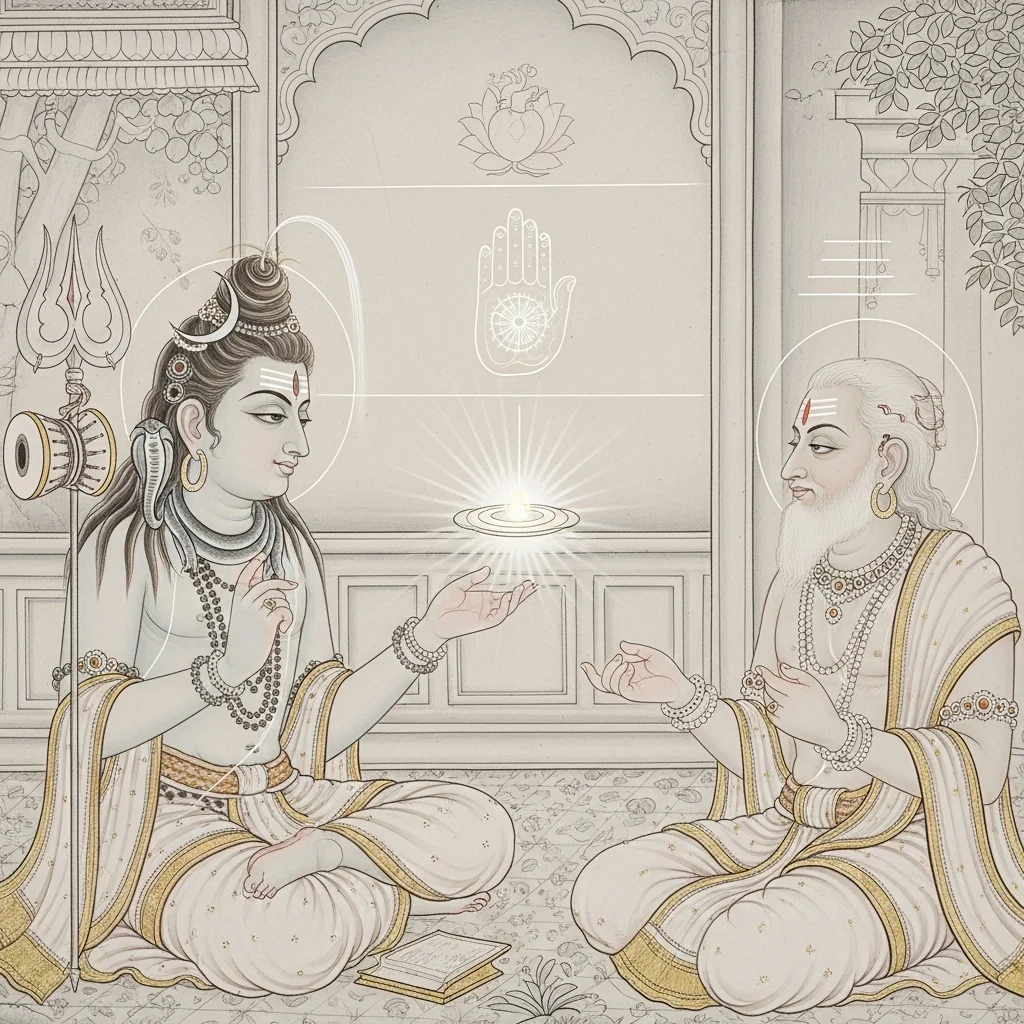
Chapter 5 unfolds as a theological dialogue: after Sūta’s framing, Devī asks for a fuller account of Prabhāsa-kṣetra’s greatness. Īśvara replies with an origin-and-merit teaching, declaring Prabhāsa to be his beloved kṣetra and a place of supreme attainment (para-gati) for yogins and the detached who relinquish life there. The chapter lists renowned ṛṣis—Mārkaṇḍeya, Durvāsas, Bharadvāja, Vasiṣṭha, Kaśyapa, Nārada, Viśvāmitra—who do not leave the kṣetra, stressing unbroken liṅga-worship. It also describes vast gatherings engaged in japa and worship at sacred sites such as Agni-tīrtha, Rudreśvara, Kampardīśa, Ratneśvara, Arka-sthala, Siddheśvara, Mārkaṇḍeya, and Sarasvatī/Brahma-kunda, using numbers to convey ritual abundance and sanctity. In phalaśruti fashion it proclaims that darśana of the “moon-crested” Lord yields the full fruit praised in Vedānta; snāna and pūjā grant yajnaphala; piṇḍa/śrāddha greatly uplift ancestors; and even casual contact with the waters is efficacious. It notes protective and obstructive agencies (gaṇas Vibhrama and Sambhrama, Vināyaka-like upasargas and “ten faults”) and prescribes devoted sight of Daṇḍapāṇi as the cure for obstacles. The conclusion universalizes access: all varṇas, whether desire-driven or desireless, who die in Prabhāsa attain Śiva’s divine realm, while Mahādeva’s qualities remain beyond speech.
Adhyaya 6
सोमेश्वरलिङ्गस्य परमार्थवर्णनम् (Theological Description of the Someshvara Liṅga at Prabhāsa)
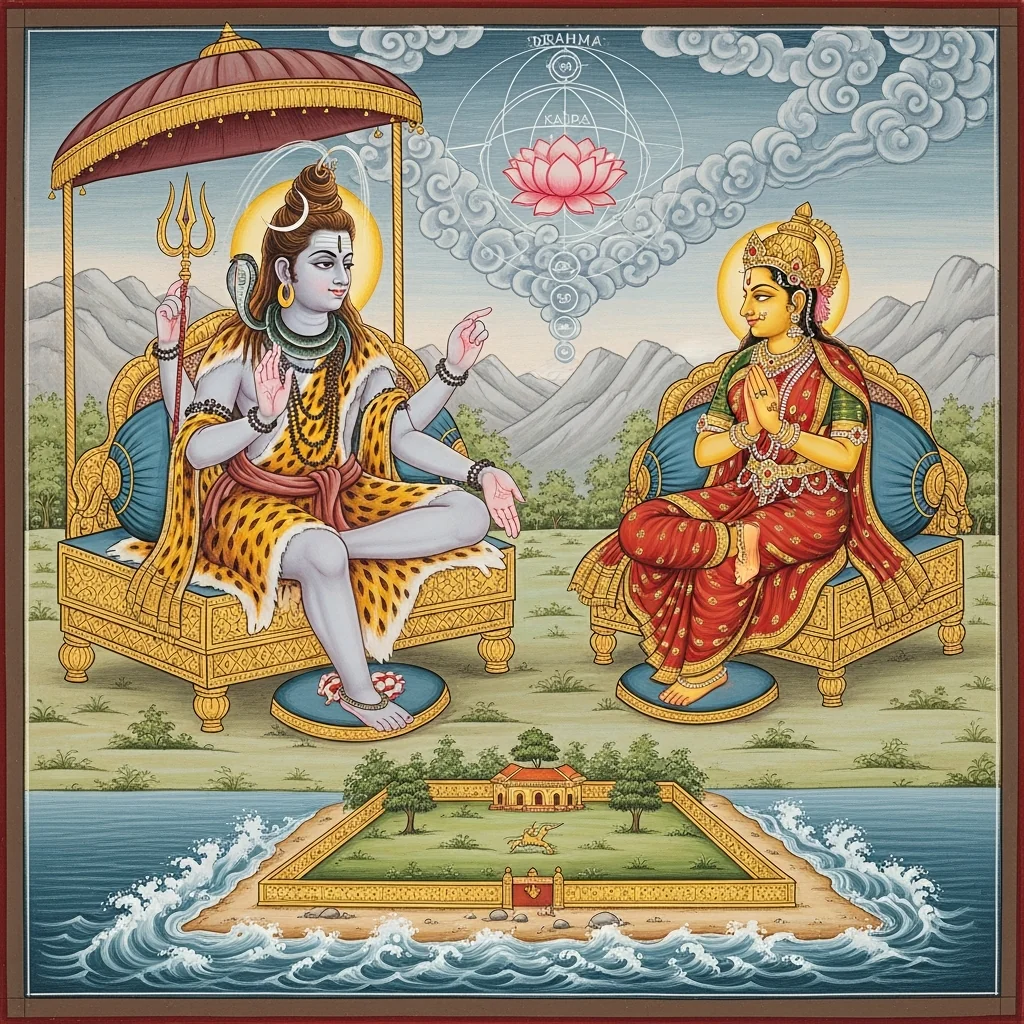
Chapter 6 unfolds as a carefully ordered theological dialogue. Devī affirms the wonder of what has been narrated and asks why Someshvara’s efficacy surpasses other cosmically praised liṅgas, and what distinctive power belongs to the Prabhāsa-kṣetra. Īśvara replies that the teaching to follow is a supreme rahasya, and exalts the Prabhāsa-māhātmya as highest among all tīrthas, vows, recitations, meditations, and yogas. The discourse then shifts from praise of place to a dense apophatic and metaphysical portrayal of the Someshvara liṅga: it is steadfast, imperishable, and unchanging; free from fear, stain, dependence, and conceptual proliferation. Though beyond ordinary praise and discursive speech, it is revealed as a manifest “lamp of knowledge” for realization. Sound-metaphysics (praṇava/śabda-brahman), inner-location imagery (heart-lotus, dvādaśānta), and non-dual descriptors (kevala, dvaita-varjita) are interwoven throughout. A Vedic anchoring is added through a verse on knowing the Mahān Puruṣa beyond darkness, followed by the admission that Someshvara’s full greatness cannot be expressed even over thousands of years. The phalaśruti concludes inclusively: anyone of any varṇa who reads or recites this becomes freed from sins and attains the desired aims.
Adhyaya 7
सोमेश्वरनाम-प्रभाव-वर्णनम् | Someshvara: Names Across Kalpas, Boon of Soma, and the Sacred Topography of Prabhāsa
Chapter 7 unfolds as a theological dialogue between Devī and Śaṅkara. After hearing earlier praises, Devī asks how the name “Som(e)śvara/Somnātha” arose, whether it is truly stable, and how it can vary with time; she also inquires into the liṅga’s former and future names. Īśvara answers by placing the liṅga within cyclical cosmology: across successive Brahmā-epochs it bears different names, which he lists in sequence, culminating in the present “Somnātha/Som(e)śvara” and a future designation, “Prāṇanātha.” Devī’s forgetfulness is explained through her repeated avatāras across many kalpas; Śiva recounts her names and forms through multiple cycles, linking embodiment and memory-loss to prakṛti and cosmic function. The seeming fixity of “Somnātha” is then clarified through Soma/Candra’s tapas and worship of the liṅga (here invoked with a fierce epithet), and the boon that the name “Somnātha” remain renowned throughout the Brahmā-cycle for all future lunar incumbents. The chapter then turns to sacred topography: Śiva defines Prabhāsa’s extent, the central sanctum zone, directional boundaries, and the liṅga’s placement near the sea. It proclaims salvific results for beings who die within the holy circle, warns strongly against wrongdoing in that field, and introduces Vighnanāyaka’s protective governance to restrain grave transgressors. It closes with heightened praise of Som(e)śvara’s liṅga as uniquely beloved, a confluence of tīrthas and liṅgas, and a means to liberation through devotion, remembrance, and disciplined recitation.
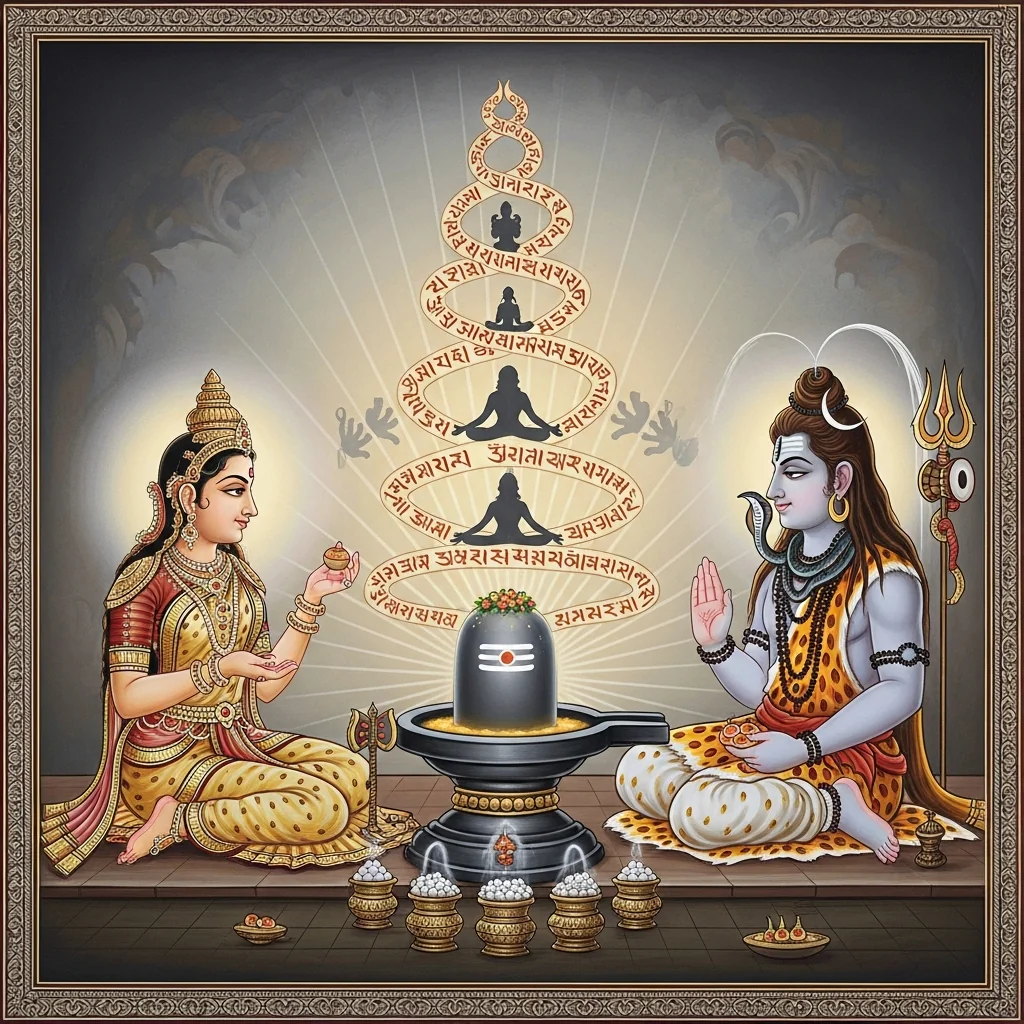
Adhyaya 8
श्रीसोमेश्वरैश्वर्यवर्णनम् (Description of the Sovereign Powers of Śrī Someśvara)
Chapter 8 unfolds as a Devī–Īśvara dialogue. Devī asks to hear again of Śrī Someśvara’s purifying greatness and the triadic theological frame of Brahmā–Viṣṇu–Īśa. Īśvara replies by describing marvels of the Someśvara-liṅga: vast hosts of ascetic ṛṣis are said to have entered or merged into the liṅga, and from it arise personified prosperities and stabilizing powers—siddhi, vṛddhi, tuṣṭi, ṛddhi, puṣṭi, kīrti, śānti, and lakṣmī. The chapter then catalogs mantra-siddhis, yogic attainments, medicinal/alchemical rasas, and specialized knowledge streams—Garuḍa lore, bhūta-tantra, and khecarī/antarī traditions—as emanations linked to this sacred locus. It names groups of siddhas (including Pāśupata-associated figures) who gained accomplishment at Someśvara in Prabhāsa across the yugas, while noting that ordinary beings often fail to recognize the site’s worth due to unwholesome karma. A detailed register of afflictions—planetary faults, spirit disturbances, and diseases—is presented as being neutralized through Someśvara-darśana. Someśvara is identified with epithets such as Paścimo Bhairava and Kālāgnirudra, and the chapter closes by reaffirming the condensed praise: Someśvara’s māhātmya is “sarva-pātaka-nāśana,” the tīrtha-theological doctrine of comprehensive moral purification.
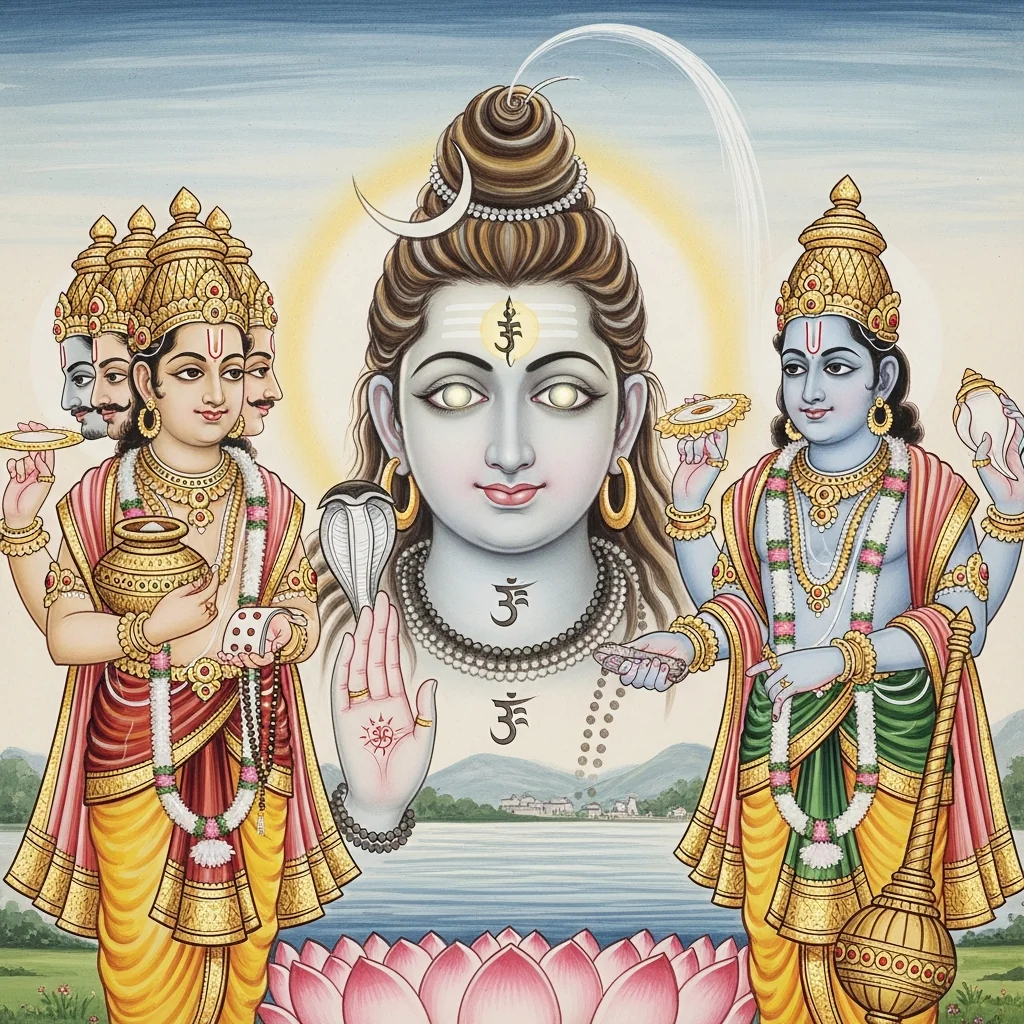
Adhyaya 9
मुण्डमालारहस्यं तथा प्रभासक्षेत्रतत्त्वनिर्णयः (The Secret of the Skull-Garland and the Tattva-Doctrine of Prabhāsa)
Chapter 9 unfolds as a structured theological dialogue. Devī reverently addresses Śaṅkara at Prabhāsa, naming Somēśvara and recalling a vision of a form centered on Kālāgni. She then raises a doctrinal doubt: how the beginningless Lord, who transcends dissolution, can bear a garland of skulls. Īśvara answers with a cosmological account: innumerable cycles of creation and dissolution bring forth successive Brahmās and Viṣṇus, and the skull-garland signifies Śiva’s lordship over these recurring worlds. The chapter then iconographically describes Śiva’s Prabhāsa form—peaceful and radiant, beyond beginning–middle–end; with Viṣṇu on the left and Brahmā on the right; the Vedas within; and the cosmic luminaries as eyes—thereby resolving Devī’s doubt. Devī offers an extended hymn of praise and asks for a fuller account of Prabhāsa’s greatness, including why Viṣṇu leaves Dvārakā and meets his end at Prabhāsa, posing many questions about his cosmic roles and avatāras. Framed by Sūta’s narration, Īśvara begins the “secret” teaching: Prabhāsa surpasses other tīrthas in efficacy and uniquely unites Brahma-, Viṣṇu-, and Raudra-tattva, with explicit tattva counts (24/25/36) mapped to the presence of Brahmā, Viṣṇu, and Śiva. The chapter closes by proclaiming the fruit: death at Prabhāsa is said to grant elevated states even to beings of every social standing and species, including those burdened by grave transgressions, emphasizing the kṣetra’s purifying power.
Adhyaya 10
तत्त्वतीर्थ-निरूपणम् (Mapping of Tattva-Tīrthas and the Sanctity of Prabhāsa)
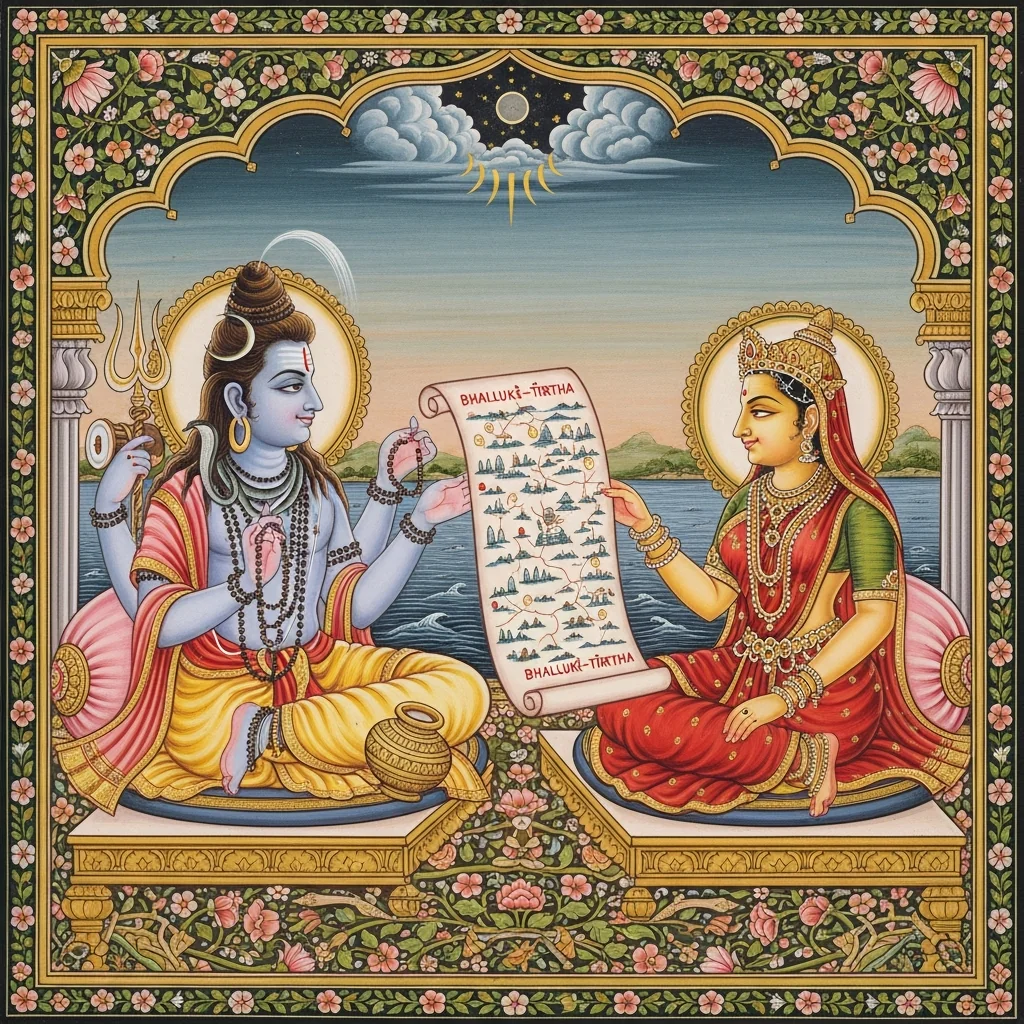
Chapter 10 is framed as Īśvara’s instruction to Devī, turning metaphysical doctrine into a pilgrimage map of Prabhāsa. It first correlates the cosmic elemental domains—earth, water, tejas (fire/radiance), wind, and space—with their presiding deities (Brahmā, Janārdana, Rudra, Īśvara, Sadāśiva), declaring that tīrthas within each domain partake of that deity’s presence. It then lists grouped tīrtha-sets (notably octads) aligned to water, tejas, wind, and space, and clarifies that the water-principle is especially dear to Nārāyaṇa, praised as “Jalaśāyī,” the One who reclines upon the waters. A pivotal site is introduced: Bhallukā-tīrtha—subtle and hard to recognize without śāstra—yet granting fruits equal to extensive liṅga-worship through mere darśana. The chapter expands into calendrical and astronomical contexts—monthly observances, the 8th and 14th lunar days, eclipses, and the Kārttikī season—when Prabhāsa liṅgas are worshipped with special intensity, and it describes the gathering of many tīrthas at the Sarasvatī–ocean confluence. It proceeds with a long sequence of the kṣetra’s alternate names across kalpas and details the abundance of sub-kṣetras of varied shapes and measures. The closing reaffirms Prabhāsa as a sacred field abiding even after dissolution (pralaya), extols listening and recitation as ethically purifying, and ends with a phalaśruti promising an elevated post-mortem destiny to those who hear this “rauddra” divine narrative.
Adhyaya 11
प्रभासक्षेत्रनिर्णयः — Cosmography of Bhārata and the Etiology of Prabhāsa
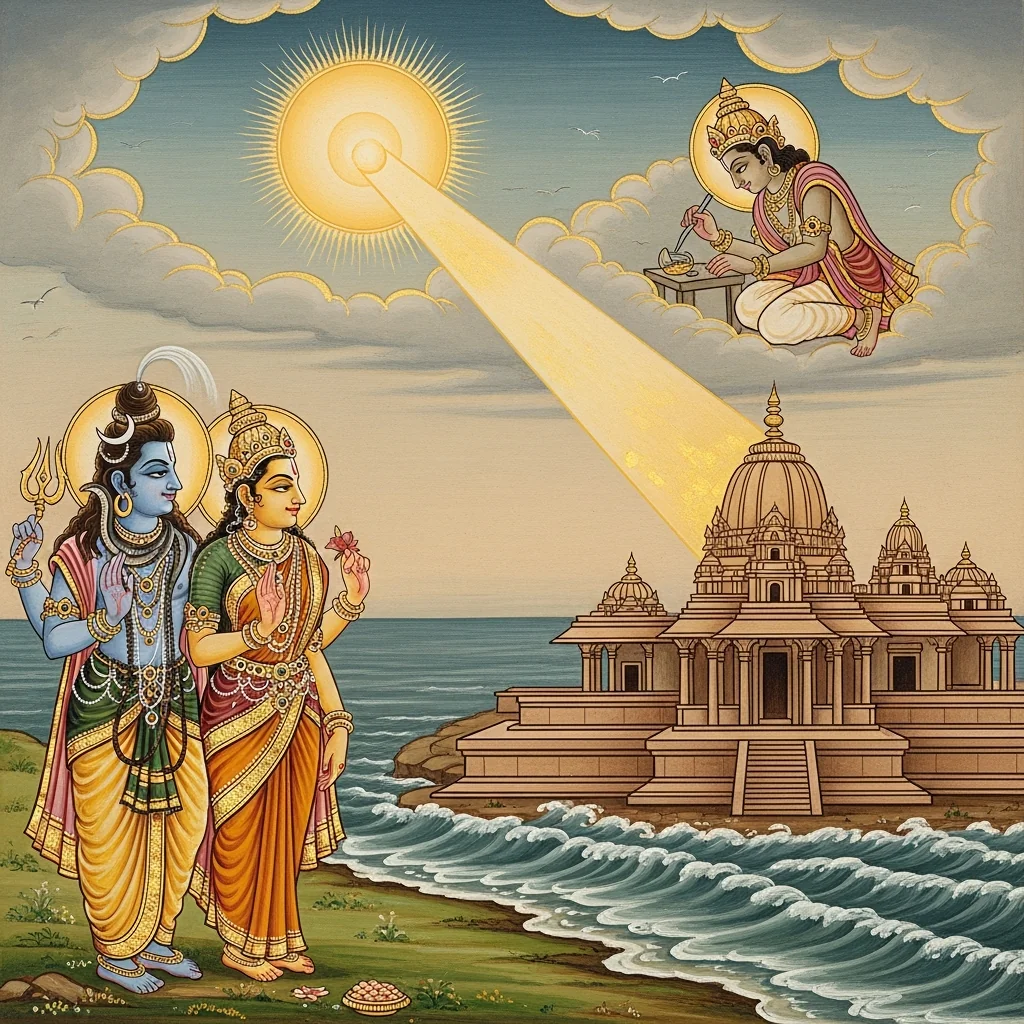
Chapter 11 proceeds as a theological dialogue. Devī, pleased yet still inquisitive, asks for a fuller account of Prabhāsa-kṣetra. Īśvara first sets a cosmographic frame, describing Jambūdvīpa and Bhārata-varṣa with their measures and boundaries, and declaring Bhārata the chief karmabhūmi where puṇya and pāpa become concretely effective. He then overlays astral order upon the land through the kūrma (tortoise) model: nakṣatra groupings, rāśi placements, and graha lordships are mapped onto the “body” of Bhārata, yielding a diagnostic rule—when a graha or nakṣatra is afflicted, the corresponding region is afflicted, and tīrtha-observances are prescribed as remedy. Within this sacred mapping Saurāṣṭra is located, and Prabhāsa is singled out as an eminent ocean-near tract with a central pīṭhikā where Īśvara abides in liṅga-form, dearer than Kailāsa and guarded as a secret. The name “Prabhāsa” is explained in several ways—radiance, primacy among lights and tīrthas, solar presence, and regained brilliance. Devī then asks for the origin story in the present kalpa, and Īśvara begins the mythic causation: Sūrya’s marriages (Dyauḥ/Prabhā and Pṛthivī/Nikṣubhā), Saṃjñā’s distress at Sūrya’s unbearable tejas, the substitution by Chāyā, births including Yama and Yamunā, the disclosure to Sūrya, and Viśvakarmā’s “shaving/attenuation” of solar radiance. The account culminates in a decisive localization: a portion of solar, ṛk-maya radiance is said to fall at Prabhāsa, grounding the kṣetra’s exceptional sanctity and the logic of its name.
Adhyaya 12
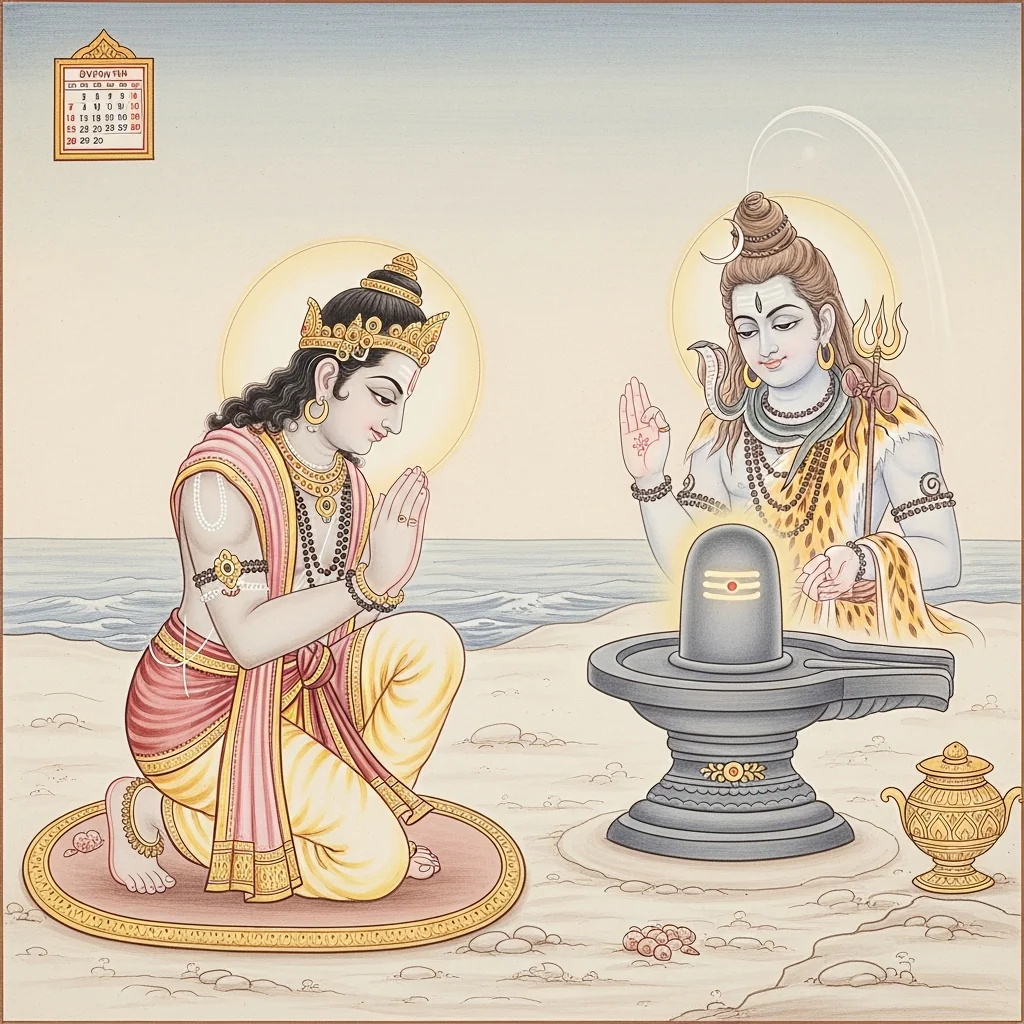
Yameśvarotpatti-varṇanam (Origin Account of Yameśvara)
Spoken by Īśvara, this chapter blends etymological exposition with the authorization of a tīrtha. It first explains terms tied to kingship and queenship (rājā/rājñī) and the idea of “shadow” (chāyā), using dhātu-based derivations to show that names and identities carry theological meaning. The narrative then places the present Manu within a lineage and introduces a figure bearing Vaiṣṇava iconographic marks (śaṅkha-cakra-gadā-dhara), while Yama is simultaneously portrayed as afflicted, described as “hīna-pāda,” creating a problem needing ritual remedy. Yama goes to Prabhāsa-kṣetra and undertakes prolonged tapas, worshiping a liṅga over an immense span of time. Pleased, Īśvara grants many boons and establishes an enduring cult-title: the place is remembered as “Yameśvara.” A phalaśruti-like assurance concludes the chapter: on Yama-dvitīyā, beholding Yameśvara is said to avert the vision/experience of Yama-loka, highlighting the chapter’s soteriological and calendrical importance in Prabhāsa pilgrimage practice.
Adhyaya 13
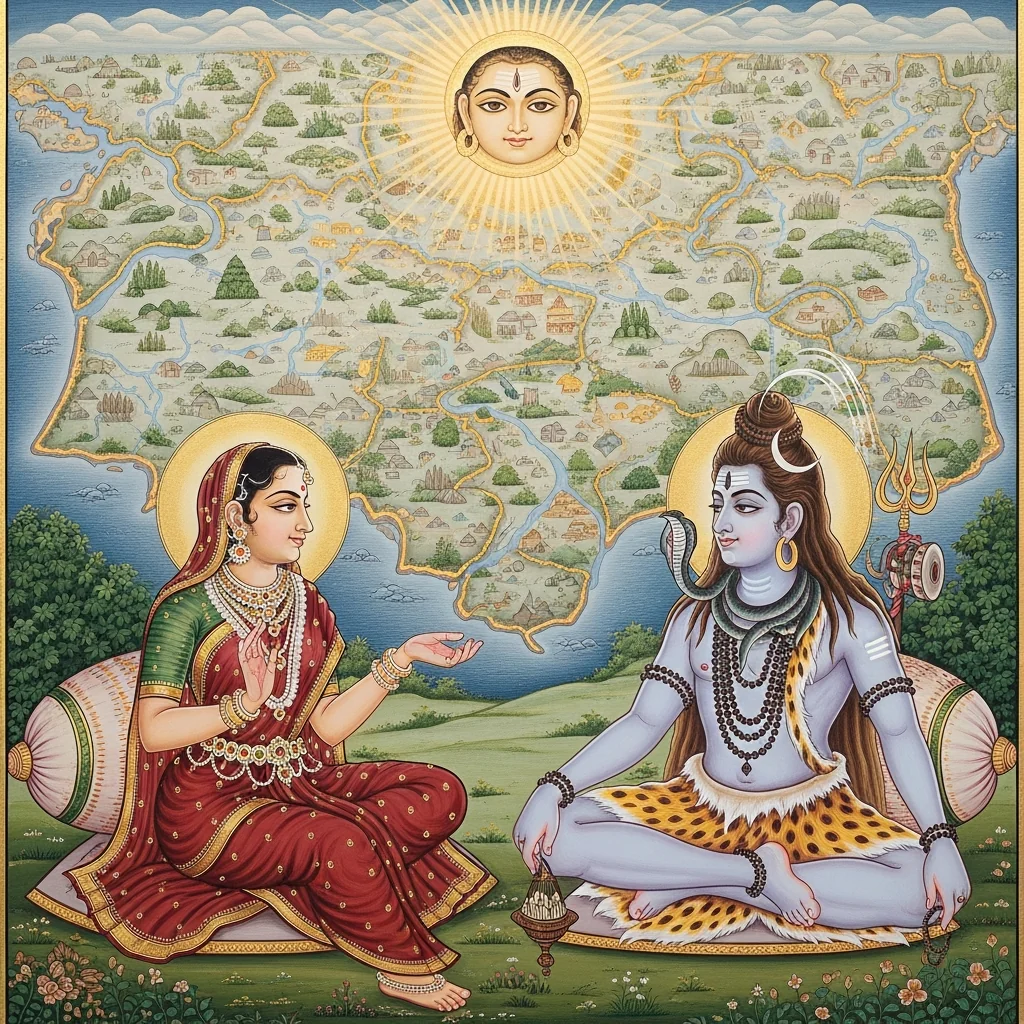
Arka-sthala-prādurbhāva and Prabhāsa-kṣetra-tejas (Origin of Arkāsthala and the Radiant Sanctification of Prabhāsa)
Chapter 13 is framed as a Devī–Īśvara dialogue. Devī asks about an earlier incident in which the Sun, moving in Śākadvīpa, is “pared/cut” by a razor-like edge linked with the divine father-in-law motif, and what became of the great tejas that fell at Prabhāsa. Īśvara replies by teaching an “excellent Sūrya-māhātmya,” whose hearing is said to destroy sins. He explains that the Sun’s primordial portion of radiance fell at Prabhāsa and took on a place-form (sthālākāra): first golden like jāmbūnada, later becoming mountain-like through the power of the māhātmya; there the Sun manifests in an arka-formed icon for the welfare of beings. A yuga-based naming is given—Hiraṇyagarbha (Kṛta), Sūrya (Tretā), Savitā (Dvāpara), and Arkāsthala (Kali)—and the descent is dated to the era of the second Manu, Svārociṣa. The chapter then delineates the sacred field by the spread of tejas-dust (reṇu) across measured yojanas and named boundaries (rivers and the sea), distinguishing a broader subtle radiance zone. Īśvara identifies his own abode as centered within this tejas-maṇḍala, like the pupil within the eye, and explains the prominence of “Prabhāsa” because his house is illumined by solar tejas. The phalaśruti declares that beholding the Sun in arka-form grants freedom from sins and exaltation in Sūrya-loka; such a pilgrim is equated with one who has bathed at all tīrthas and performed major sacrifices and gifts. Ethical and regulatory injunctions follow: eating upon arka-leaves at Arkāsthala is strongly condemned as bringing grave impurity and must be avoided. Pilgrimage protocol includes gifting a buffalo to a learned brāhmaṇa upon first darśana of Arkabhāskara, with mention of copper hue/red cloth and a nearby fire-corner; the Siddheśvara liṅga (famed in Kali, formerly Jaigīṣavyeśvara) is also said to bestow accomplishments upon sight. Finally, a nearby subterranean opening is described, tied to rākṣasas burned by solar radiance; in Kali it remains as a “door” guarded by yoginīs and mother-goddesses, with a Māgha kṛṣṇa caturdaśī night rite of offerings (bali, flowers, upahāra) to gain siddhi. The chapter closes by reaffirming that those who heed and practice this teaching attain the Sun’s world at life’s end.
Adhyaya 14
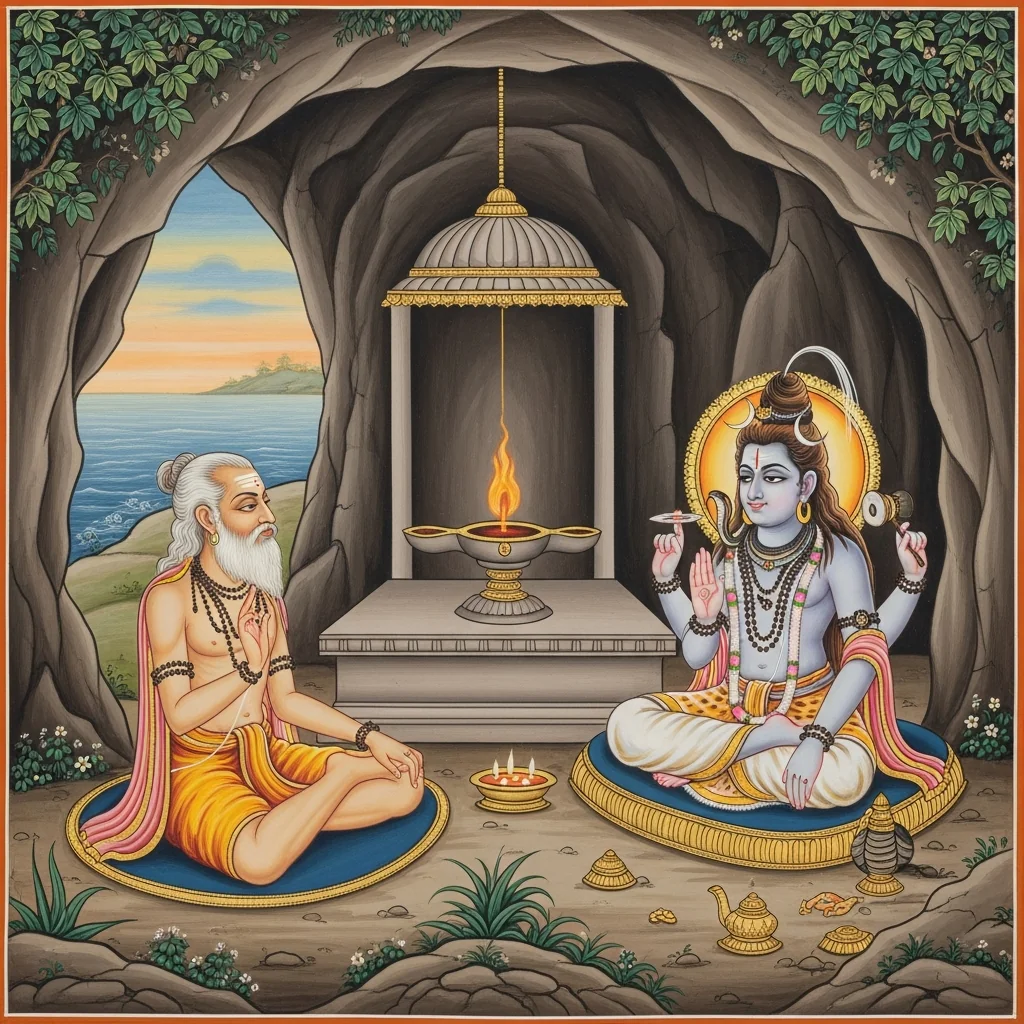
जैगीषव्यतपः–सिद्धेश्वरलिङ्गमाहात्म्य (Jaigīṣavya’s Austerities and the Glory of the Siddheśvara Liṅga)
This chapter unfolds as a Devī–Īśvara dialogue, in which Devī asks for a detailed account of Prabhāsa’s Sun-linked sanctity, the origin-status of Arka-sthala as an ornament of the region, and the proper standards of worship—mantras, procedures, and festival timings. Īśvara replies by recounting an ancient precedent from the Kṛta-yuga. The sage Jaigīṣavya, son of Śatakalāka, comes to Prabhāsa and performs graded austerities across vast spans of time: living on air alone, then water alone, then a leaf-diet, and observing lunar-vow cycles. He culminates in intense ascetic discipline and devoted worship of a liṅga. Śiva appears, grants “knowledge-yoga” that severs saṃsāra, bestows ethical stabilizers—humility, forbearance, and self-control—and promises yogic sovereignty and future access to divine vision. The chapter then extends the site’s efficacy through the yugas: in the Kali-yuga the liṅga is famed as Siddheśvara; worship and yogic practice in Jaigīṣavya’s cave are said to yield swift transformative fruits, purification, and benefits for ancestors. A concluding phalaśruti proclaims that worship of the Siddha-liṅga produces extraordinary merit, praised in cosmic comparative terms.
Adhyaya 15
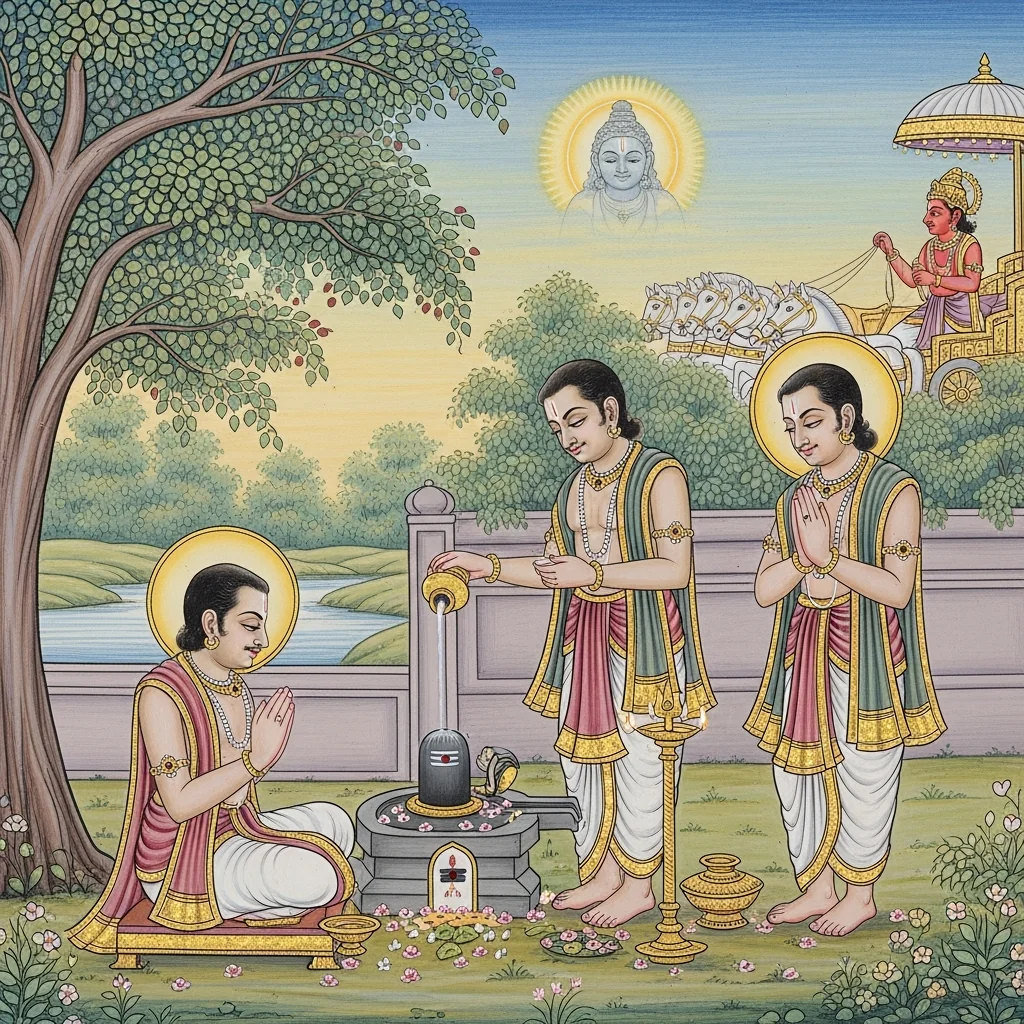
पापनाशनोत्पत्तिवर्णनम् | Origin Account of the Pāpa-nāśana Liṅga
This chapter offers a concise theological and ritual account of a liṅga famed as “pāpa-hara/pāpa-nāśana,” the remover of sins. Spoken in the divine voice of Īśvara, it places the liṅga within the sacred micro-topography of Prabhāsa-kṣetra: it is said to be established (pratiṣṭhita) near the Siddha-liṅga and connected with Aruṇa, the dawn figure associated with Sūrya. Another tradition attributes its establishment to Sūrya’s charioteer, strengthening the solar link while keeping the Śaiva liṅga as the ritual center. A clear calendrical rule is then given: worship should be performed on the bright fortnight’s thirteenth day (śukla trayodaśī) in the month of Caitra, duly (vidhivat) and with devotion (bhaktyā). The promised fruit is compared to, or equated with, the “Puṇḍarīka” merit, serving as a standard measure of sacred-site reward. The closing colophon identifies this as the fifteenth chapter of the first Prabhāsa-kṣetra-māhātmya within the Prabhāsa Khaṇḍa.
Adhyaya 16
पातालविवरमाहात्म्यं (Glory of the Pātāla Fissure near Arkasthala)
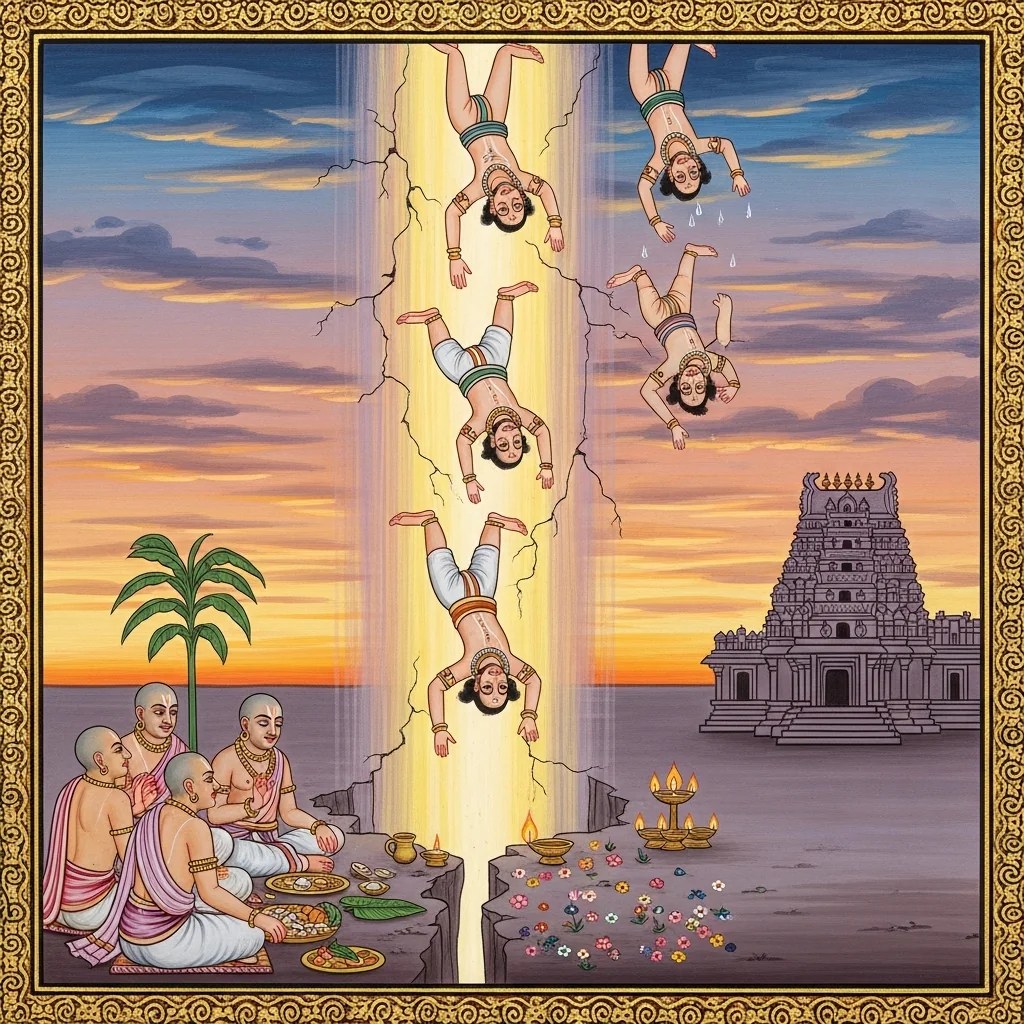
Īśvara instructs Devī on the māhātmya of a great pātāla-vivara (a fissure leading to the nether realms) near Arkasthala at Prabhāsa. The origin is first set forth: in a time of darkness, innumerable powerful rākṣasas arise, hostile to Sūrya. They mock the rising Divākara, and the Sun replies with righteous, dharma-born wrath; by the intensification of his gaze the rākṣasas fall from the sky like weakened planets—likened to fallen fruit or stones released—showing that adharma loses its footing and collapses. Driven by wind and impact, they shatter the earth and descend to rasātala, eventually reaching Prabhāsa; their fall is linked to the fissure’s becoming manifest and visible. Arkasthala is praised as a divine locus granting “all siddhis,” with this pātāla-vivara as its great adjacent feature; many other such openings have been hidden by time, but this one remains revealed. The place is called the middle portion of Sūrya’s tejas, golden in nature, guarded by Siddheśa, and especially potent on solar festival occasions; it also points to a tri-saṅgama—Brāhmī, Hiraṇyā, and the ocean—yielding koṭi-tīrtha-like merit. Finally, a regulated worship is prescribed at the gateway named Śrīmukha-dvāra: on caturdaśī, for a year, one should worship the Mātṛgaṇas (beginning with Sunandā) with offerings in the older ritual idiom (animals/food), along with flowers, incense, and lamps, and by feeding brāhmaṇas—promising siddhi. Hearing this māhātmya is said to free an excellent person from adversities.
Adhyaya 17
Arkasthala-Sūryapūjāvidhi: Dantakāṣṭha, Snāna, Arghya, Mantra-nyāsa, and Phalaśruti (अर्कस्थल-सूर्यपूजाविधिः)
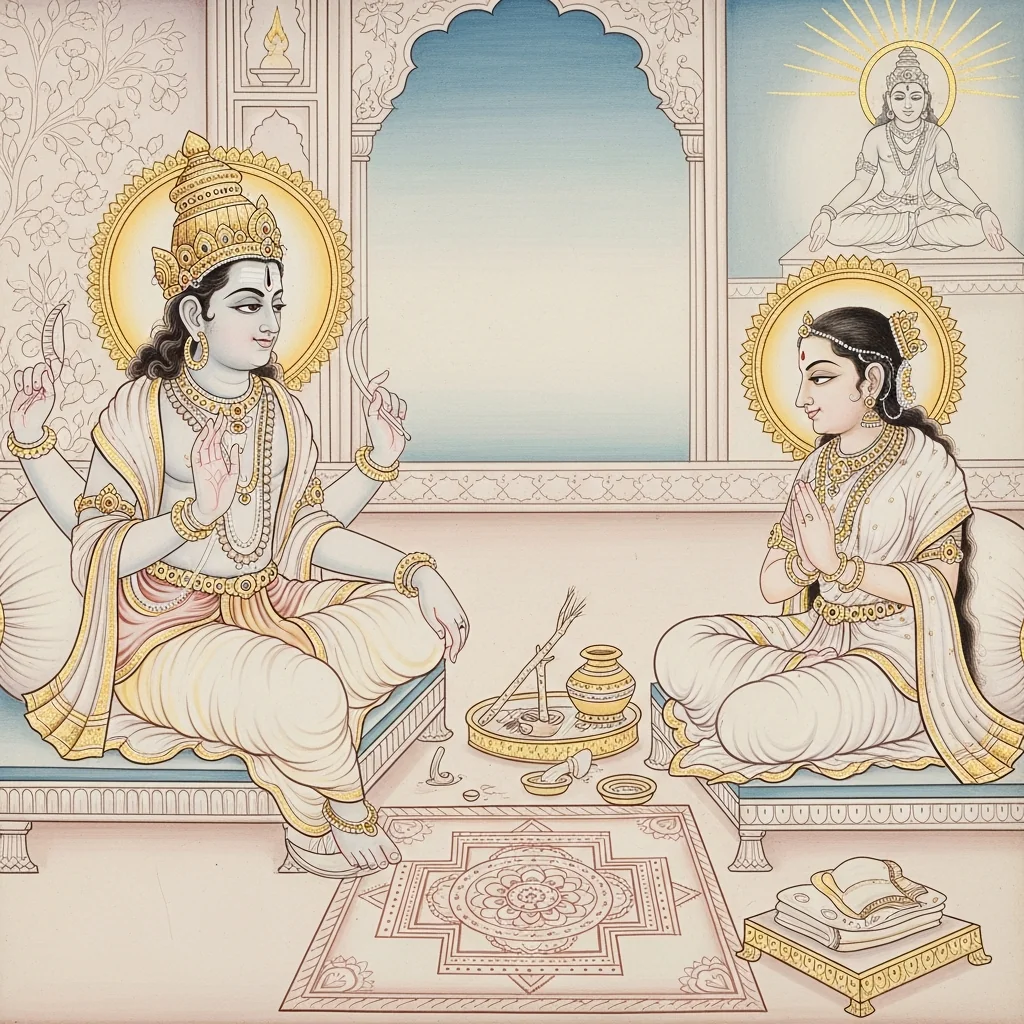
Chapter 17 is a ritual-theological instruction in which Īśvara teaches Devī the worship-system (pūjāvidhi) for Bhāskara/Sūrya at Arkasthala in Prabhāsa. It first grounds the rite in cosmology, praising Āditya as primordial among the gods and as the sustainer, creator, and dissolver of the moving and unmoving world. A graduated discipline is then set out: preliminary purity of mouth, cloth, and body; detailed rules for dantakāṣṭha (permitted woods and their results, prohibitions, posture, tooth-cleaning mantra, and disposal); and bathing with consecrated earth and water through mantra-ordered actions. Tarpaṇa, sandhyā, and offering arghya to the Sun are explained with strong phalaśruti promises of sin-removal and multiplied merit. For those unable to perform expanded initiatory procedures, a “Veda-mārga” alternative is given, listing Vedic mantras for invocation and worship. The chapter also describes a maṇḍala-based installation with aṅga-nyāsa, placement and worship of grahas and dikpālas, and a dhyāna portrayal of Āditya’s iconography. It continues with mūrti-pūjā, naming abhiṣeka substances and sequential offerings (upavīta, cloth, incense, unguents, lamps, ārātrika), preferred flowers, fragrances, and lamps, and items that must not be offered, with ethical cautions against greed and mishandling of offerings. The conclusion explains Rahu and eclipses as occlusion rather than literal devouring, sets norms of confidentiality in transmission, and extols the merits of listening and recitation for social welfare, prosperity, and protection across communities.
Adhyaya 18
चन्द्रोत्पत्तिवर्णनम् — Origin of the Moon and Śiva as Śaśibhūṣaṇa (Moon-adorned)
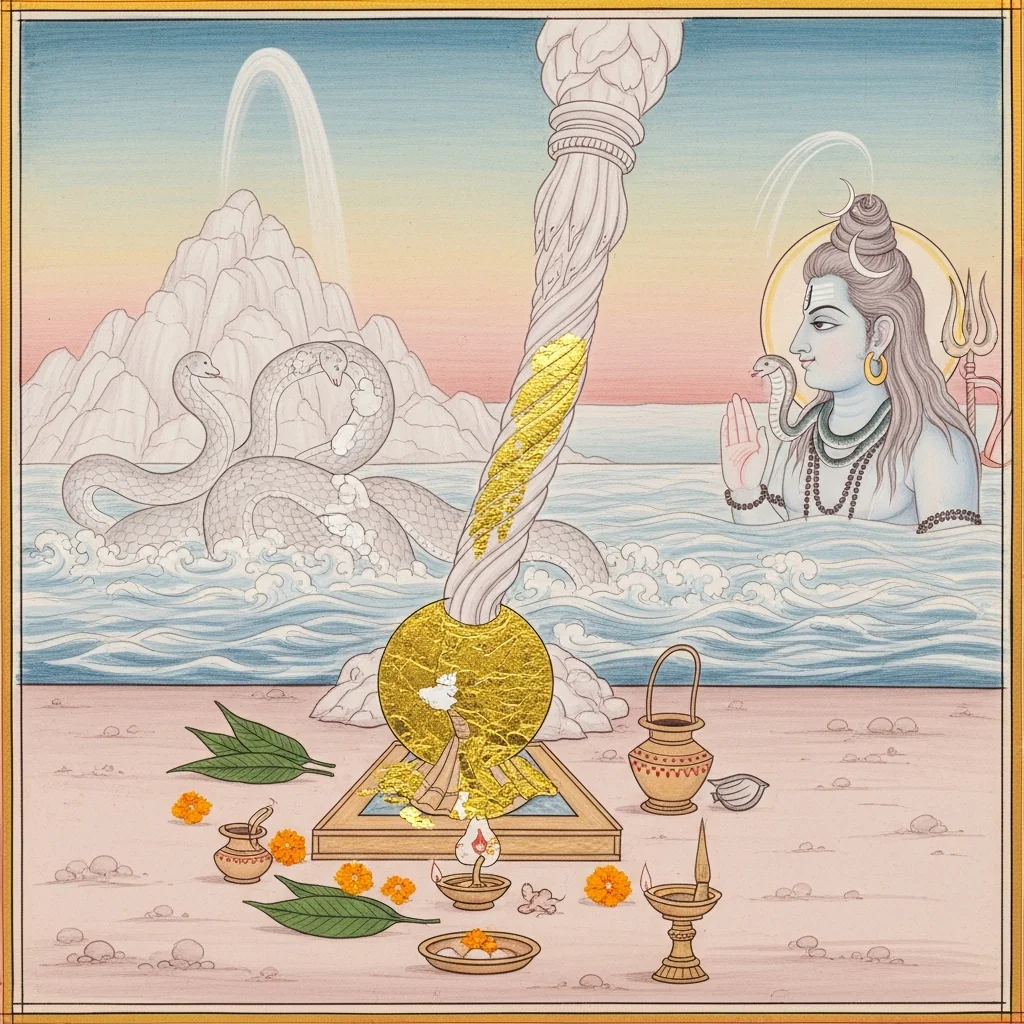
Chapter 18 continues Sūta’s framed narration. After hearing at length the greatness of Prabhāsa-kṣetra, Devī declares the saving and clarifying change she attributes to Śaṅkara’s teaching: doubt and confusion cease, the mind becomes steady in Prabhāsa, and her tapas is fulfilled. She then asks a precise question of origin: when and how did the moon (candra) that rests upon Śiva’s head arise? Īśvara answers with cosmological and calendrical setting, placing the account in the Varāha Kalpa and the early phases of creation, and linking the moon’s emergence to the churning of the Milk Ocean (kṣīroda-manthana), from which fourteen treasures appeared, the moon among them as a radiant product. Śiva affirms that he bears the moon as an ornament and connects this emblem with the episode of drinking poison (viṣa-pāna), explaining the moon-adornment as a liberation-oriented symbol. The chapter concludes by affirming Śiva’s abiding presence there as a self-manifest liṅga (svayaṃbhū), bestower of all siddhis, enduring throughout the kalpa.
Adhyaya 19
कला-मान, सृष्टि-प्रलय-क्रम, तथा चन्द्र-लाञ्छन-कारण (Measures of Time, Creation–Dissolution Sequence, and the Cause of the Moon’s Mark)
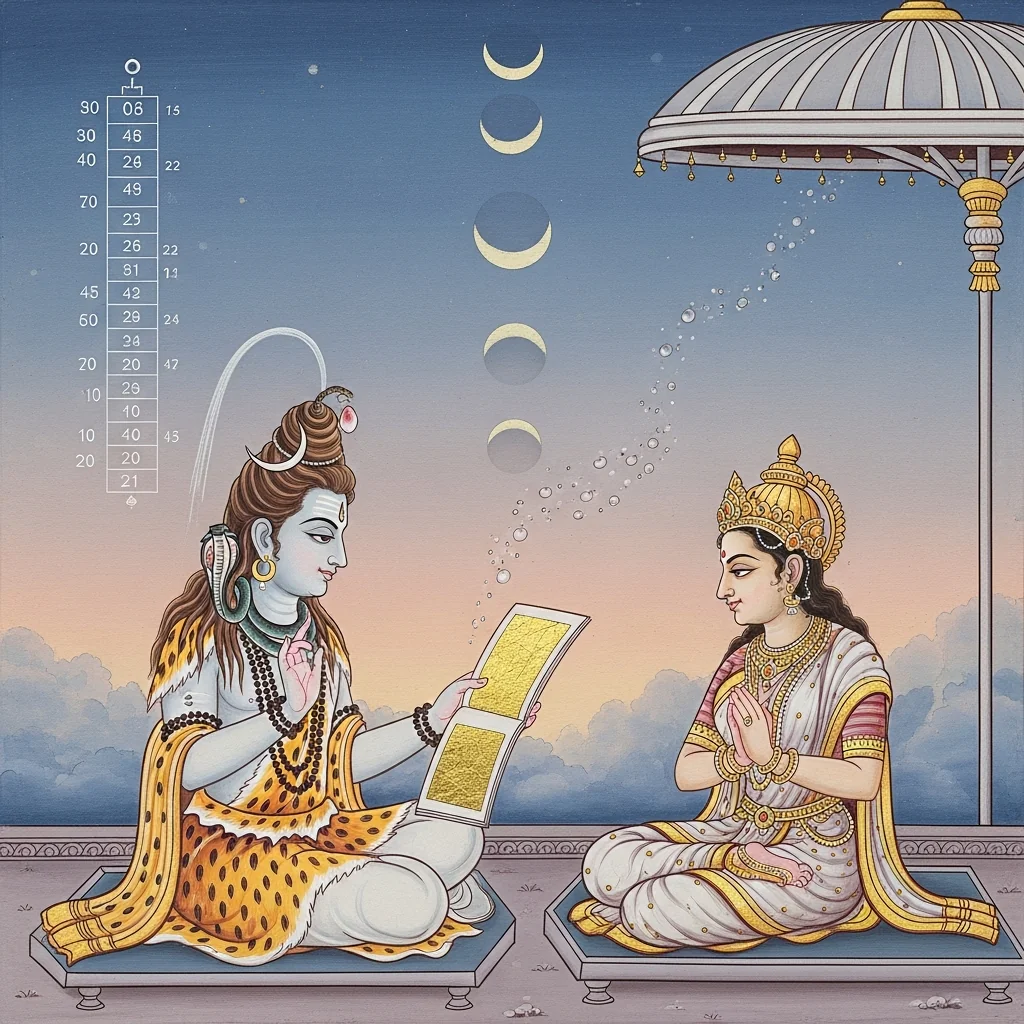
Chapter 19 unfolds as a technical dialogue: Devī asks why the moon is not always full, and Īśvara explains the sixteenfold structure of time and lunar phases, from amā (new moon) to pūrṇimā (full moon), as the ṣoḍaśa kalā/tithi divisions. In this way, ritual timing is aligned with the cosmic rhythm. Īśvara then sets out a graded system of time-measures—from truṭi, lava, nimeṣa, kāṣṭhā, kalā, and muhūrta, up through day and night, fortnight, month, ayana, year, yuga, manvantara, and kalpa—showing the continuity between sacred observance and vast cosmic duration. He places these measures within a metaphysical teaching in which māyā/śakti is the operative power enabling creation, maintenance, and dissolution, and affirms the cyclic return of all that arises to its source. The discourse turns to Devī’s question about Soma’s lāñchana (mark) despite his amṛta-origin and devotional honor. Īśvara attributes the mark to Dakṣa’s curse and frames it within immense cosmological recurrence: countless moons, brahmāṇḍas, and kalpas arise and dissolve, while the supreme Īśvara alone is singular as the governor of sarga and saṃhāra. The latter portion lists temporal placements across kalpas and manvantaras, recalls earlier manifestations, and sketches the sequence of Viṣṇu’s avatāras—including Kalki as a future corrective force—within the logic of dharma’s restoration through cosmic time.
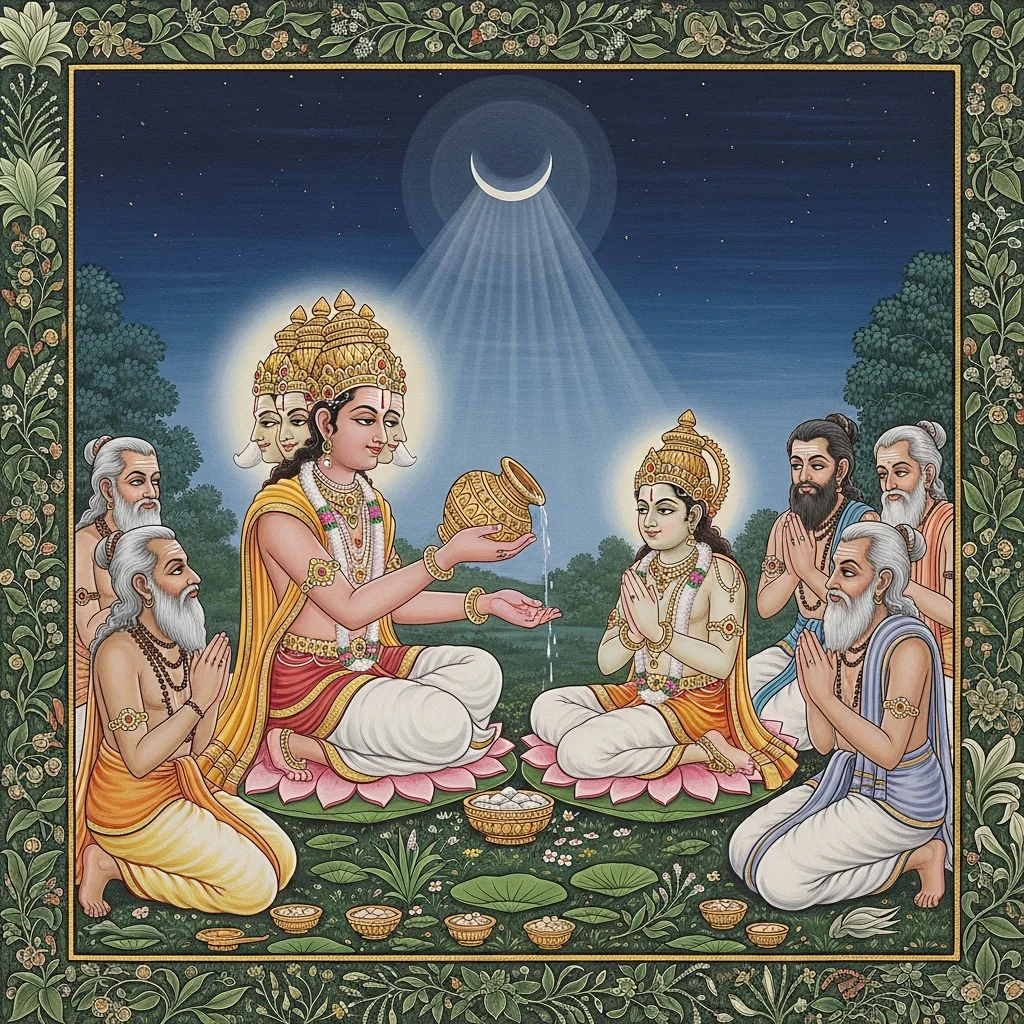
Adhyaya 20
दैत्यावतारक्रमः—सोमोत्पत्तिः—ओषधिनिर्माणं च (Order of Asura Incarnations, Soma’s Emergence, and the Origin of Plants)
In this chapter, Īśvara speaks to Devī of the long succession of asura and rākṣasa-linked dominions across vast stretches of time, naming Hiraṇyakaśipu and Bali as emblematic rulers and placing their ascendancy within yuga-like cycles in which power rises, wanes, and dharma is restored. The discourse then turns to royal and genealogical accounts, touching the Pulastya line and the births of key figures such as Kubera and Rāvaṇa, with descriptive signs used to clarify their names and identities. A major pivot follows: the emergence of Soma (Chandra) in connection with Atri’s tapas, the cosmic handling of Soma’s “fall,” Brahmā’s intervention, and Soma’s establishment in kingship and ritual eminence, framed by a rājasūya setting and the bestowal of dakṣiṇā. Finally, the text offers an origin-catalogue of oṣadhis (plants, grains, legumes), portraying Soma as sustaining the world through moonlight (jyotsnā) and as lord of vegetation, thus linking cosmology with agrarian life and sacred rite.
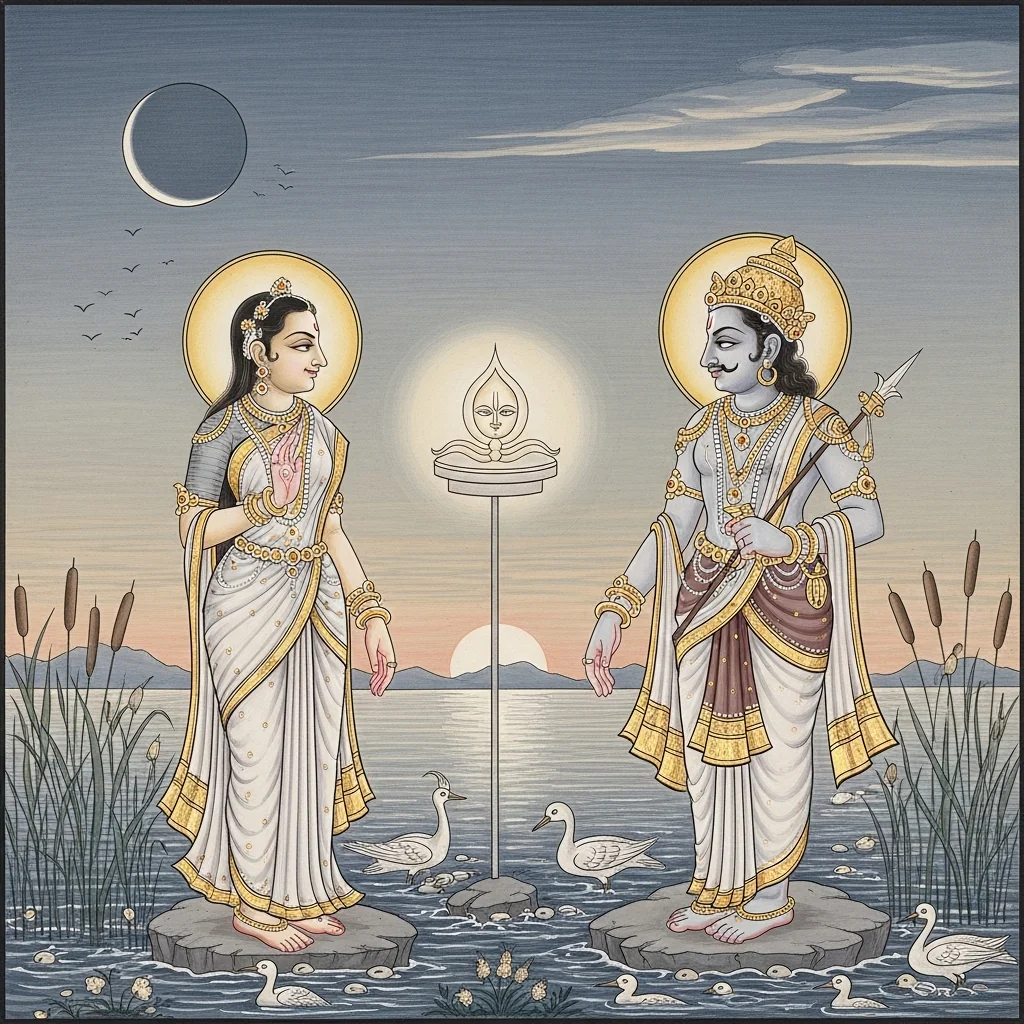
Adhyaya 21
Dakṣa-śāpa, Soma-kṣaya, and Prabhāsa-liṅga Upadeśa (दक्षशाप–सोमक्षय–प्रभासलिङ्गोपदेशः)
Chapter 21 presents a theological dialogue between Devī and Īśvara, weaving together genealogy, moral causality, and guidance to a sacred site. Devī asks about Soma’s distinctive condition and its cause. Īśvara recounts Dakṣa’s progeny and the marriages of his daughters to Dharma, Kaśyapa, Soma, and others, then expands into lineage lists: Dharma’s wives and children, the Vasus and their descendants, the Sādhyas, the twelve Ādityas, the eleven Rudras, and select asura lines (such as that of Hiraṇyakaśipu). The narrative then turns to Soma’s marriages with the twenty-seven Nakṣatras, emphasizing his special favor toward Rohiṇī. Neglected, the other wives appeal to Dakṣa. Dakṣa warns Soma to be impartial; Soma agrees but returns to exclusive attachment to Rohiṇī. Dakṣa therefore utters a curse: yakṣmā, a wasting disease, will seize Soma, and his radiance will progressively diminish (kṣaya). Afflicted and dimmed, Soma seeks counsel; Rohiṇī advises him to take refuge first in the authority who pronounced the curse and ultimately in Mahādeva. Soma begs Dakṣa for release, but Dakṣa declares the curse cannot be undone by ordinary means and directs Soma to propitiate Śaṅkara. He also gives a crucial locative instruction: in Varuṇa’s direction, near the ocean and marshland (anūpa), stands a self-manifest, supremely potent liṅga marked by luminous and physical signs; worshiping it with devotion brings purification and restoration of Soma’s splendor. Thus the chapter unites a lesson on partiality and its consequences with cosmological indexing and a navigable sacred-geographic goal in the Prabhāsa region.
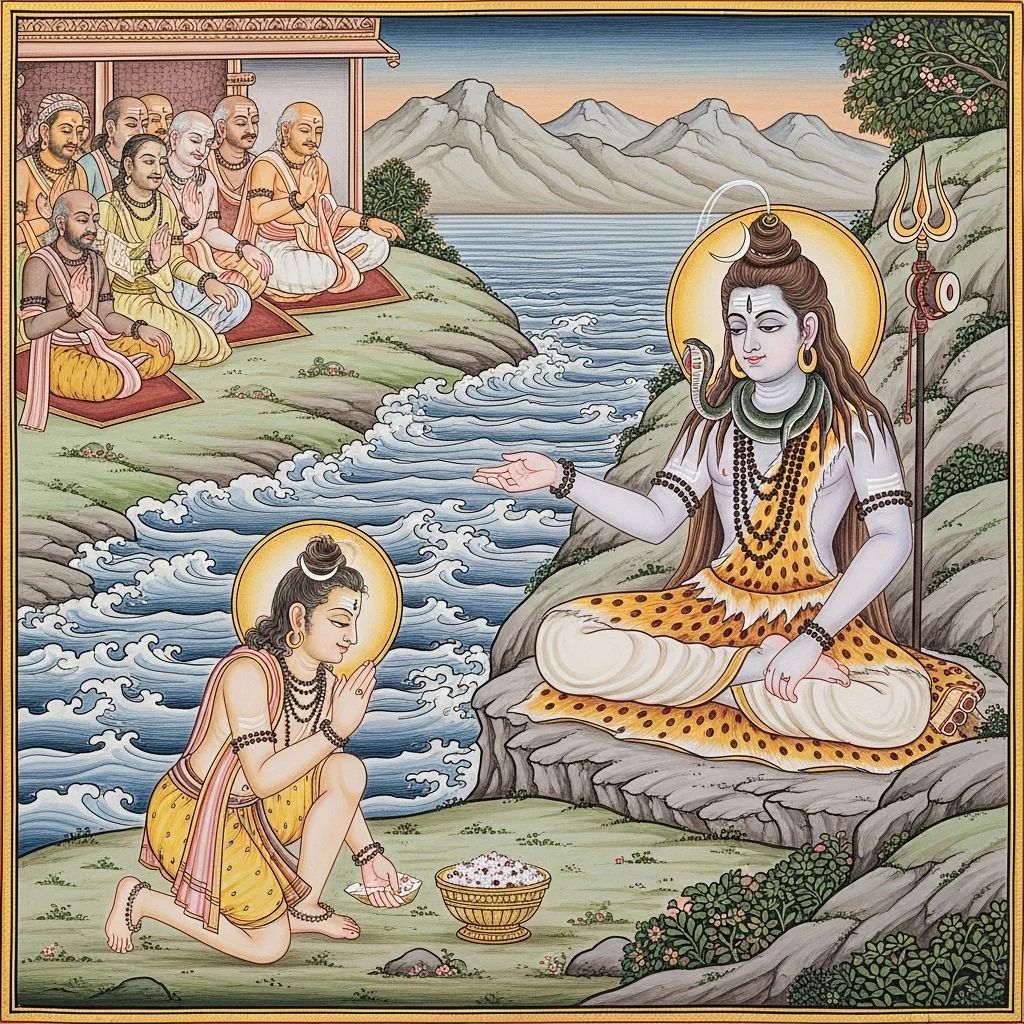
Adhyaya 22
कृतस्मरपर्वत-वर्णनम् तथा सोमशापानुग्रहः (Description of Mount Kṛtasmar(a) and Soma’s Curse–Boon Resolution)
Chapter 22 traces Soma’s (the Moon’s) passage from affliction to restoration within the sacred ritual landscape of Prabhāsa. Though granted Dakṣa’s permission, Soma remains grief-stricken, reaches Prabhāsa, and beholds the renowned Mount Kṛtasmar(a), portrayed with auspicious flora, birds, celestial musicians, and gatherings of ascetics and Vedic experts. Turning to devotional discipline, Soma repeatedly circumambulates and worships with focused mind near the sea at a liṅga associated with “Sparśa” (touch/encounter). Living on fruits and roots, he performs prolonged tapas and offers a structured hymn praising Śiva’s transcendent nature and many epithets, including a doctrinal sequence of divine names across cosmic ages. Pleased, Śiva grants a boon: Soma’s waning and waxing will alternate by fortnights, preserving Dakṣa’s spoken curse while softening its severity. A lengthy ethical excursus affirms brahminical authority as vital to cosmic stability and ritual efficacy. The chapter ends with directions about a liṅga concealed in the ocean and its installation, and explains “Prabhāsa” as the place where radiance (prabhā) is restored to Soma, once bereft of luster.
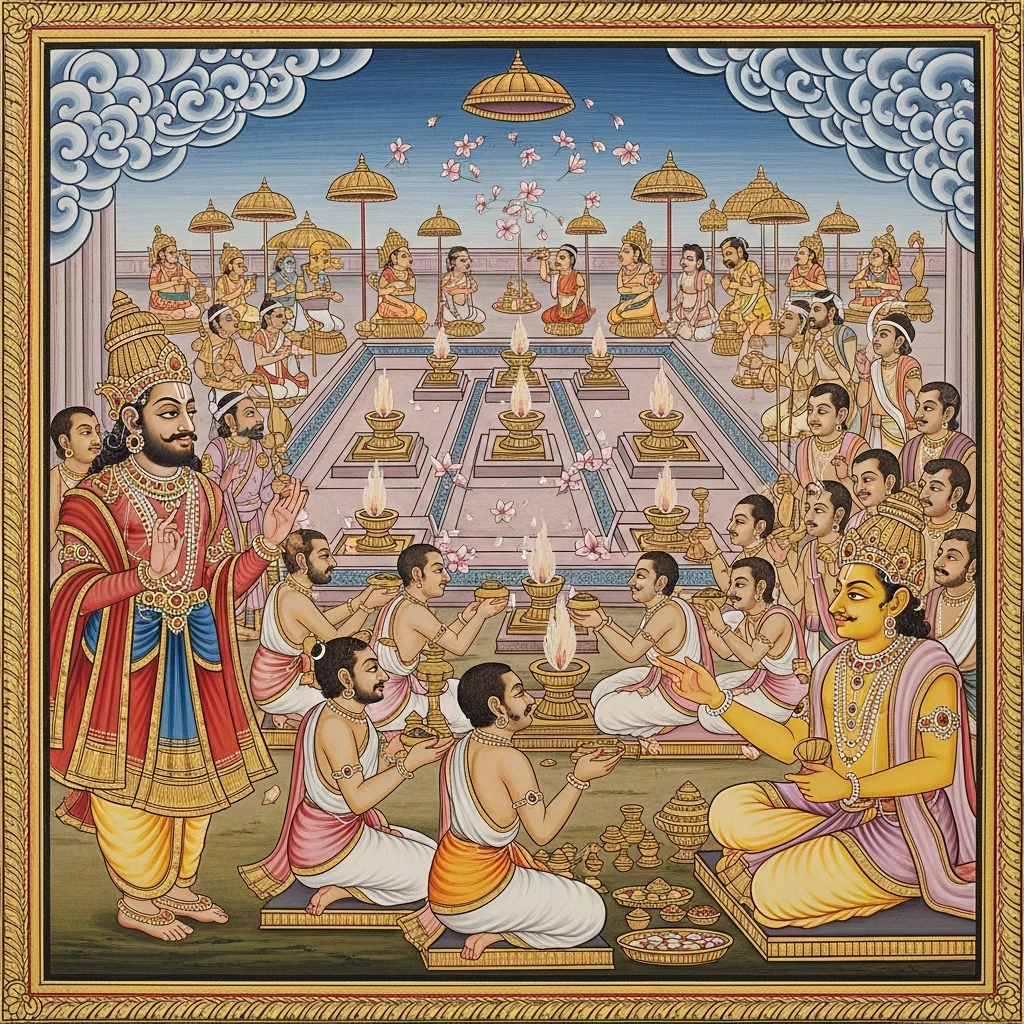
Adhyaya 23
Somēśa-liṅga Pratiṣṭhā at Prabhāsa: Soma’s Yajña Preparations and Brahmā’s Consecration
Chapter 23 recounts a ritual-historical sequence at Prabhāsa-kṣetra. Soma (Candra), having received an exalted liṅga from Śambhu, settles at Prabhāsa in devotion and wonder. He entrusts Viśvakarman (Tvaṣṭṛ), the divine artisan, to guard the liṅga and determine its proper site, while he returns to Candraloka to marshal vast resources for a great yajña. The minister Hemagarbha manages the arrangements: he summons brāhmaṇas with their sacred fires, secures vehicles and abundant gifts, and proclaims a universal invitation extending to devas, dānavas, yakṣas, gandharvas, rākṣasas, the kings of the seven islands, and dwellers of the nether realms. At Prabhāsa, ritual structures rise swiftly—maṇḍapas, yūpas, and many kuṇḍas—followed by standard preparations (samid fuel, kuśa grass, flowers, ghee, milk; golden ritual vessels) in festival-like plenty. Hemagarbha reports readiness to Soma and to Brahmā. Brahmā arrives with sages, with Bṛhaspati as purohita, explains his recurring role at Prabhāsa across kalpas (and its name-variants), and directs the brāhmaṇas to assist the consecration, noting a prior fault and the need for restoration. A detailed liturgical ordering then unfolds: multiple maṇḍapas, assignment of ṛtvij offices, Soma’s dīkṣā with Rohiṇī as patnī, distribution of mantra-japa by Vedic branches, construction of kuṇḍas in prescribed geometries by direction, and the raising of dhvajas and sacred trees. In the climax, Brahmā enters the ground, reveals the liṅga, sets it upon a brahma-śilā, performs mantra-nyāsa, and completes the pratiṣṭhā of Somēśa. Auspicious signs appear—smokeless fire, divine drums, a rain of flowers—followed by lavish dakṣiṇā, royal grants and gifts, and Soma’s continuing thrice-daily worship of the installed deity.
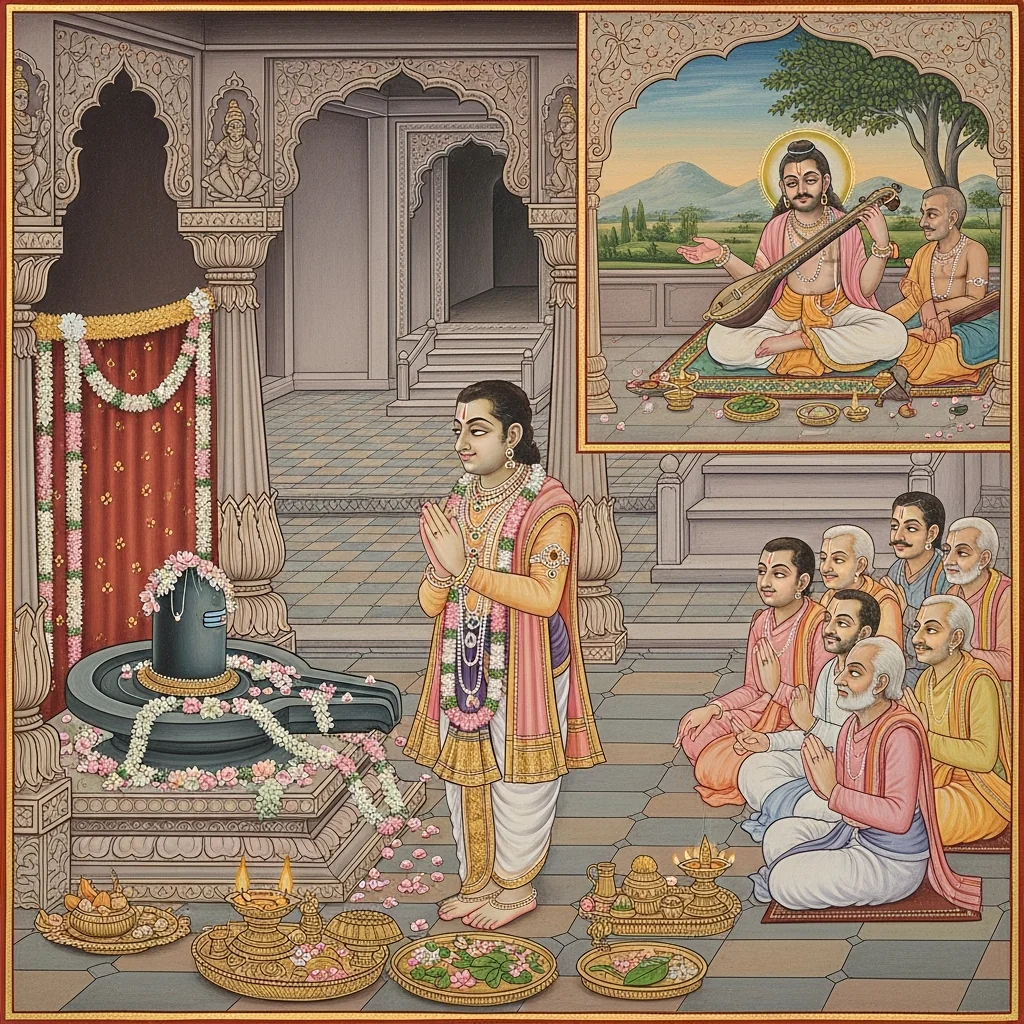
Adhyaya 24
सोमनाथलिङ्गप्रतिष्ठा, दर्शनफलप्रशंसा, पुष्पविधान, तथा सोमवारव्रतप्रस्तावना (Somnātha Liṅga स्थापना, merits of darśana, floral regulations, and the prelude to the Monday-vrata)
Chapter 24 is cast as a Devī–Īśvara dialogue that places the Somnātha liṅga within a sacred chronology (in the Tretā-yuga) and grounds its authority in Soma’s tapas and sustained worship. Soma offers a many-epithet stuti to Śiva—self as knowledge, yoga, tīrtha, and yajña—after which Śiva grants the boon of perpetual nearness in the liṅga and formally establishes the names “Prabhāsa” for the place and “Somnātha” for the deity. The teaching then turns to phala in a structured way: Somnātha-darśana is declared equal to, or surpassing, extensive austerities, gifts, pilgrimages, and major rites, thus exalting devotional encounter within the kṣetra. The chapter also supplies a technical list of flowers and leaves fit or unfit for worship, with rules about freshness, night/day usage, and specific exclusions. After Soma’s healing, it narrates his building of a temple-city—prāsāda complexes and civic endowments. Brahmins then worry about impurity from handling Śiva’s nirmālya, prompting a doctrinal excursus (via Nārada recalling a Gaurī–Śaṅkara discourse) on devotion, guṇa-shaped dispositions, and the ultimate non-dual relation of Śiva and Hari. The chapter closes by moving into the Somavāra-vrata (Monday vow) as a decisive practice, introducing an illustrative Gandharva-family episode that leads to a cure prescribed through Somnātha worship.
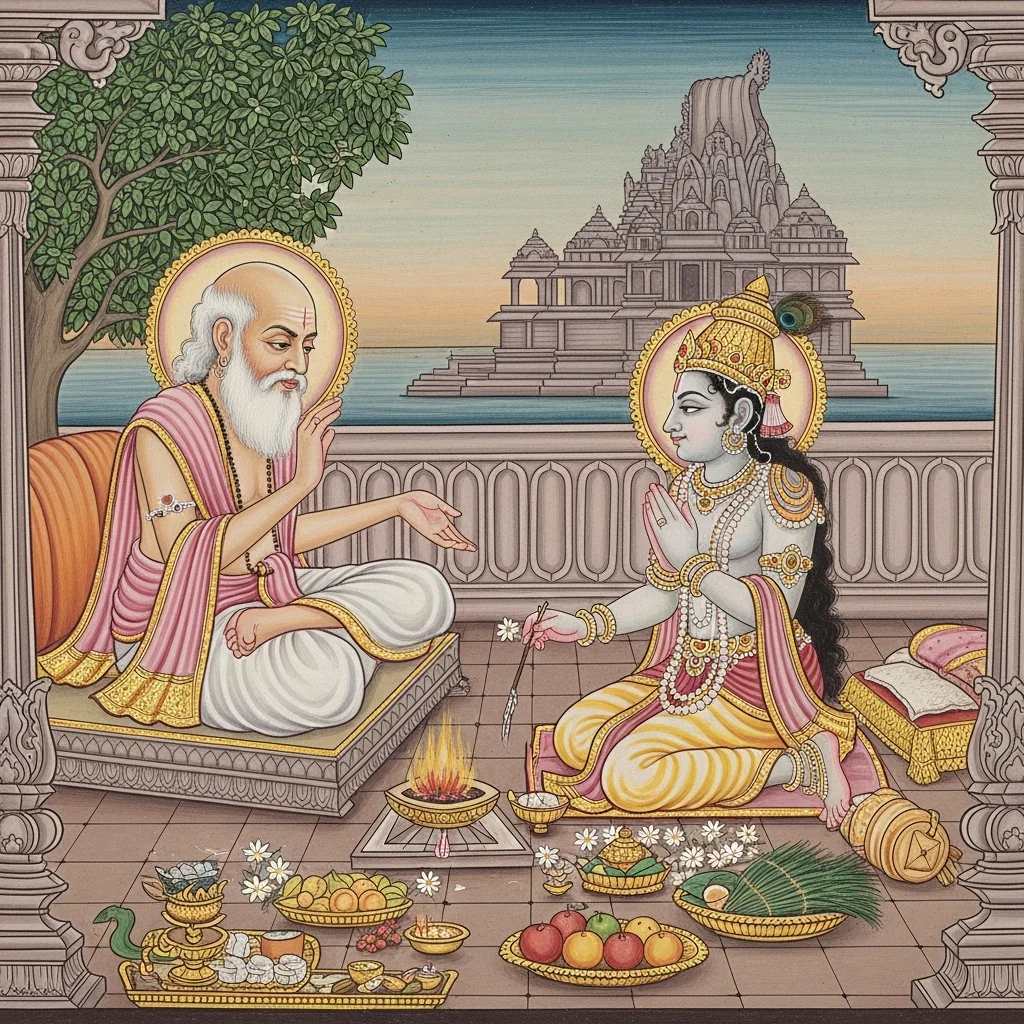
Adhyaya 25
सोमवारव्रतविधानम् — The Ordinance of the Monday Vow (Somavāra-vrata)
This chapter teaches ritual and theology through dialogue. Īśvara presents a Gandharva who longs to propitiate Bhava (Śiva) and asks about the Somavāra-vrata, the Monday vow. The sage Gośṛṅga extols it as universally beneficial and recounts its sacred precedent: Soma, stricken by Dakṣa’s curse and disease, worships Śiva in sustained meditation; Śiva, pleased, grants the establishment of a liṅga that will endure as long as the sun, moon, and mountains remain, and Soma is freed from illness and regains his radiance. The chapter then lays out a vrata-manual: choose a Monday in the bright fortnight, perform purification, set up a decorated kalaśa and ritual space, and worship Someśvara with Umā and the directional forms. Offer white flowers and prescribed foods and fruits, and recite the named mantra to Śiva—multi-faced and multi-armed—united with Umā. A sequence of Monday observances follows (varying dantakāṣṭha, offerings, and night disciplines such as sleeping on darbha and occasional vigil), culminating in a ninth-day udhyāpana with maṇḍapa, kuṇḍa, lotus-maṇḍala, eight directional kalaśas, a golden image, homa, guru-dāna, feeding brāhmaṇas, and gifts of cloth and a cow. The phalāśruti promises removal of disease, prosperity, benefits to one’s lineage, and attainment of Śiva-loka; the Gandharva performs the vow at Prabhāsa/Someśvara and receives boons.
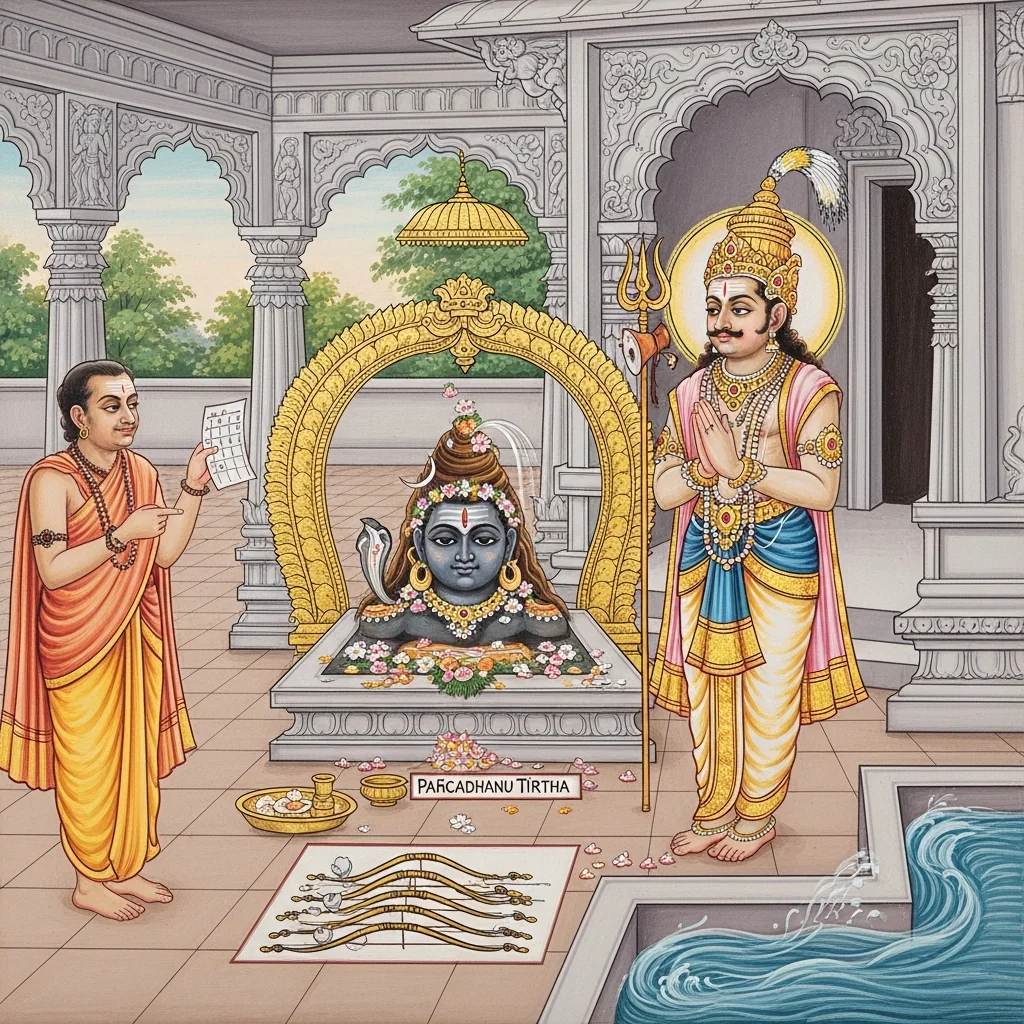
Adhyaya 26
गन्धर्वेश्वरमाहात्म्यवर्णनम् | Gandharveśvara Māhātmya (Description of the Glory of Gandharveśvara)
This chapter presents a local shrine-origin account in a Śaiva, instructional voice. Īśvara narrates how the Gandharva named Ghanavāhana, having received a boon, becomes “kṛtārtha” (fulfilled) and steadfast in devotion, and then establishes a liṅga. That liṅga is known as Gandharveśvara, explicitly praised as the giver of Gandharva-related fruits and benefits. Its sacred location is fixed by clear markers: north of Someśa and near Daṇḍapāṇi. The chapter also gives a practical worship instruction tied to ritual geography: in the Varuṇa-associated quarter (varuṇa-bhāga), at a spot described as lying amid a “pañcaka” of bows, worship on the fifth lunar day (pañcamī) is said to keep the worshipper free from suffering and distress. The closing colophon anchors the chapter within the 81,000-verse Skanda Mahāpurāṇa, in the seventh Prabhāsa Khaṇḍa and the Prabhāsa-kṣetra-māhātmya section, placing it as a small node in the wider pilgrimage landscape.
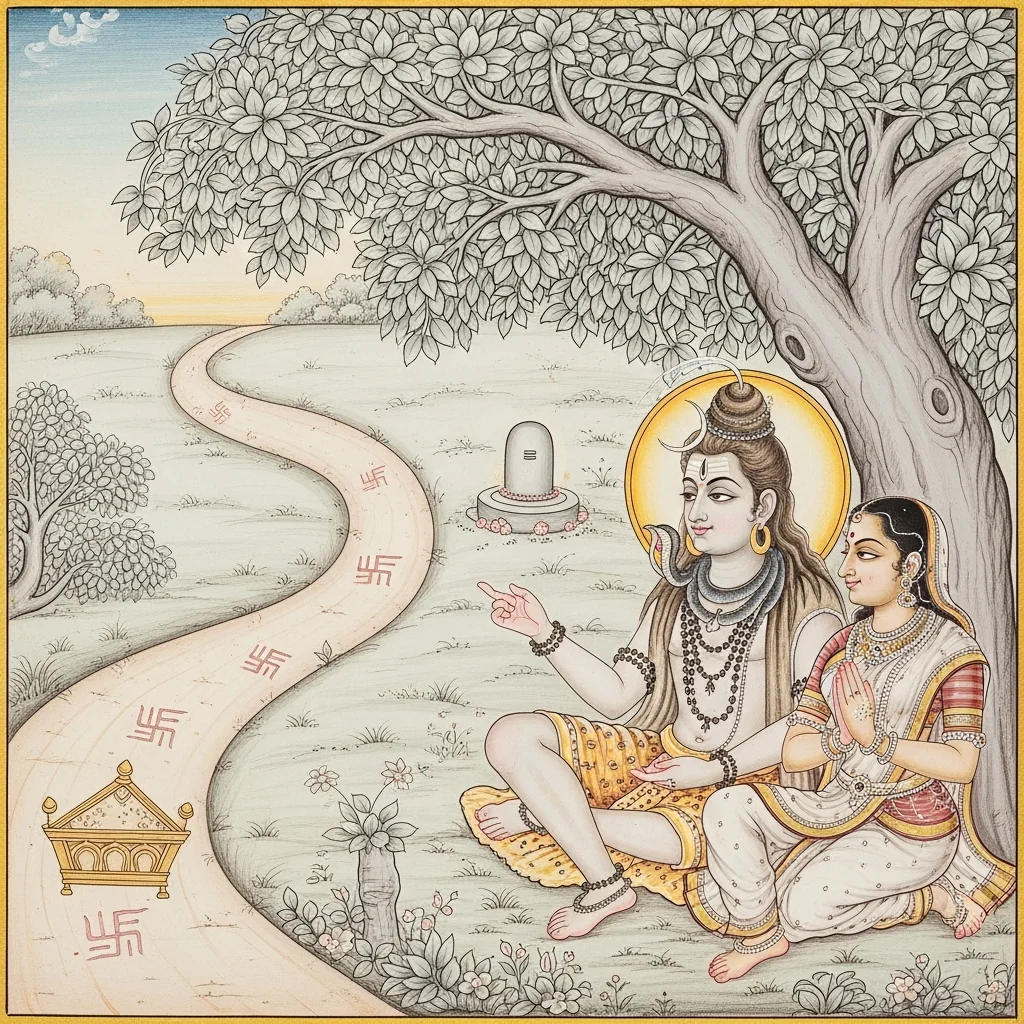
Adhyaya 27
गन्धर्वसेनेश्वरमाहात्म्यवर्णनम् | Gandharvasenīśvara: Account of the Shrine’s Greatness
In this chapter, Īśvara speaks to Devī of a liṅga established by Gandharvasenā near Gaurī. He identifies it as Vimaleśvara and praises it as the destroyer of all diseases (sarva-roga-vināśana). The teaching also marks the shrine’s place within the sacred landscape by giving a measured distance—“three bows” (dhanuṣāṃ tritaye)—and a directional cue toward the eastern section (pūrvavibhāga), serving as guidance for pilgrims. Devotional observance is implied through worship (pūjayitvā), with the third lunar day, tṛtīyā tithi, set forth as the effective ritual time. The phalaśruti declares that a woman who undertakes this practice is freed from misfortune (daurbhāgya) and attains her desired aims, including continuity of lineage (son and grandson) and the establishment of social-religious standing (pratiṣṭhā). The chapter concludes by presenting this as a vrata narrative whose hearing destroys sins (pātaka-nāśana), and by situating it in the time-frame of the Tretā-yuga, affirming Purāṇic authority in a colophon-like close.
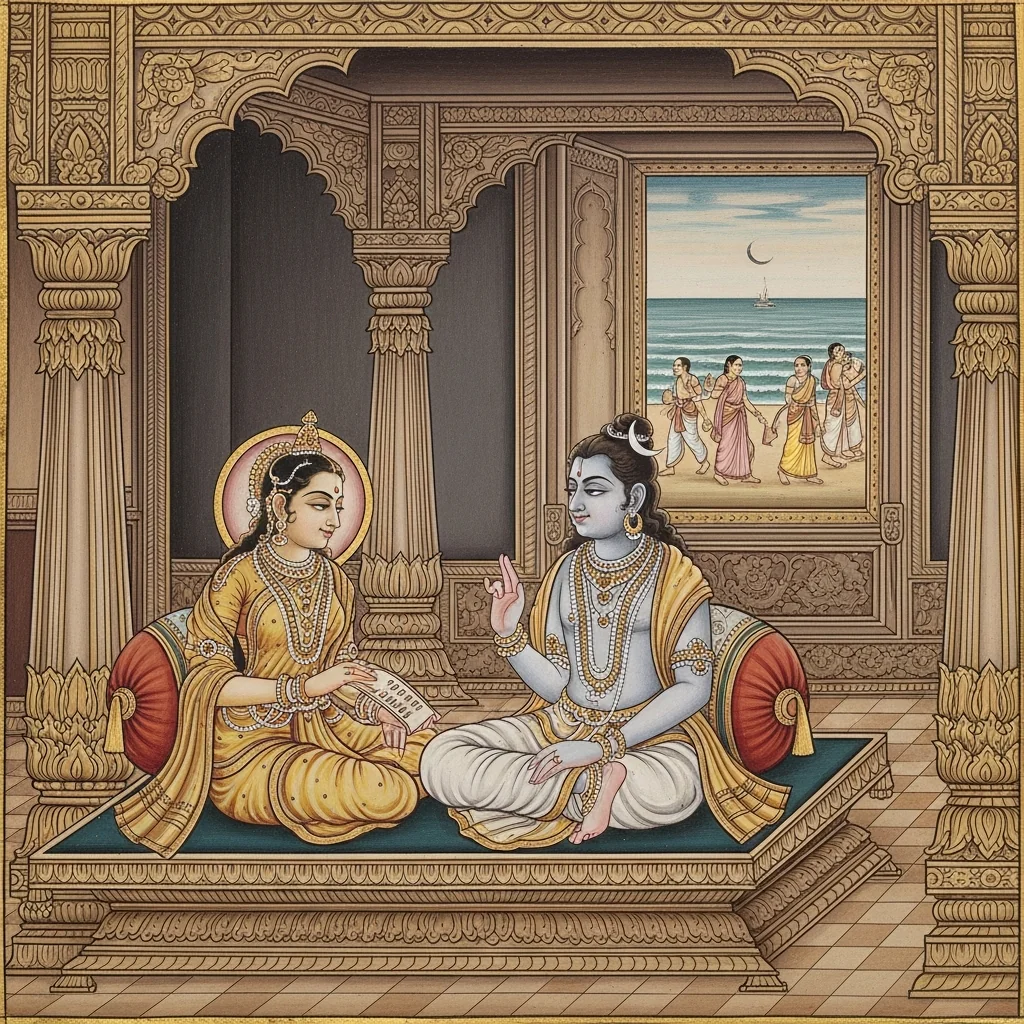
Adhyaya 28
Somnātha-yātrāvidhi, Tīrthānugamana-nyāya, and Dāna–Upavāsa Regulations (सौमनाथयात्राविधिः)
Chapter 28 begins with Devī asking Īśvara for an exact account of the Somanātha pilgrimage—its proper time, method, and disciplines. Īśvara replies that one may undertake the yātrā in various seasons whenever inner resolve arises, emphasizing that bhāva (devotional intention) is the decisive cause. He then sets out preparatory observances: inward salutation to Rudra, śrāddha as appropriate, pradakṣiṇā, silence or restrained speech, regulated diet, and the abandonment of anger, greed, delusion, envy, and related faults. A major doctrinal point follows: tīrthānugamana (pilgrimage, especially on foot) is portrayed in Kali-yuga as surpassing certain sacrificial models, and Prabhāsa is praised as unequalled among tīrthas. Results are graded by the mode and integrity of travel (walking versus vehicle), by austerity (restraint supported by bhikṣā), and by ethical purity, while warning against tainted practices such as improper acceptance of gifts (pratigraha) and the commodification of Vedic learning. The chapter also gives fasting norms by varṇa and āśrama, cautions against hypocritical pilgrimage, and provides a structured dāna calendar by lunar tithi within Prabhāsa. It concludes by affirming that even mantra-deficient or poor pilgrims who die at Prabhāsa attain Śiva’s realm, and it supplies a general tīrtha-snāna mantra sequence, leading into the next topic: which tīrtha to bathe in first upon arrival.
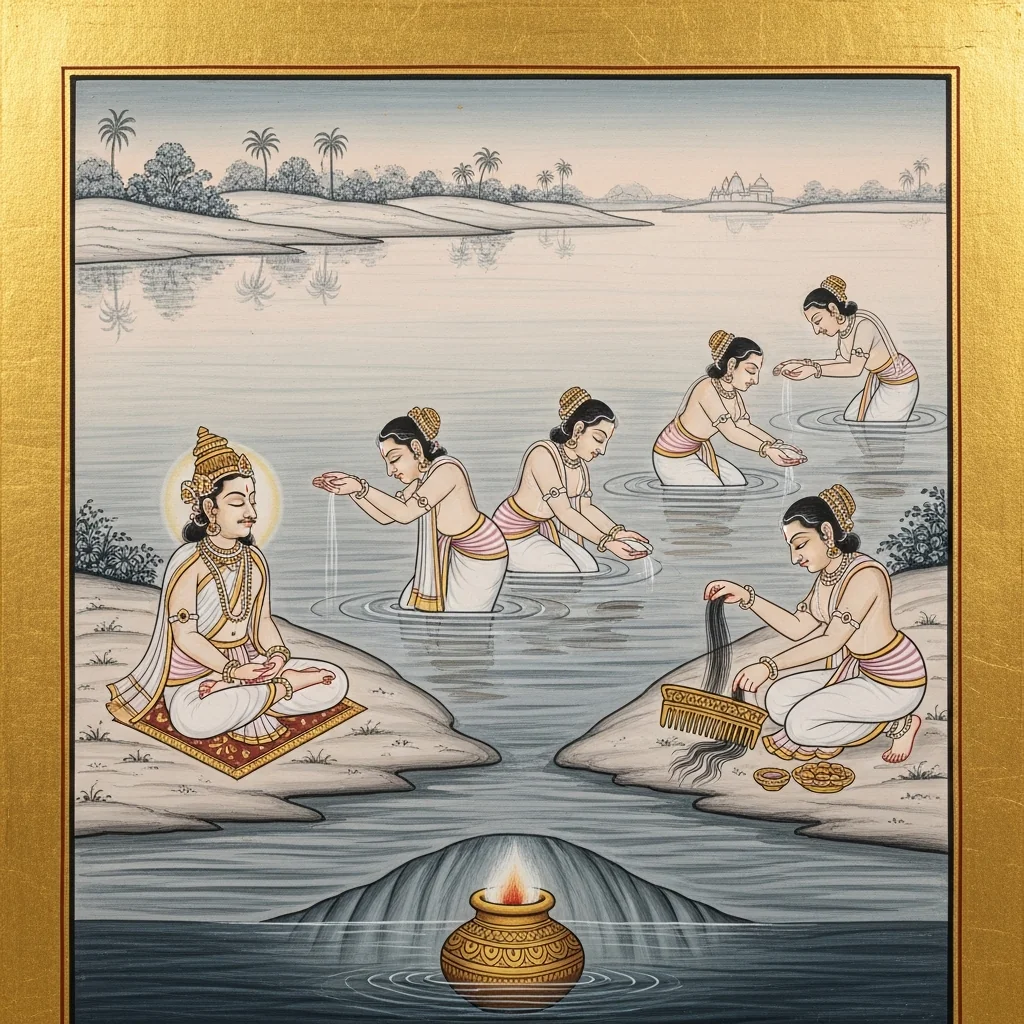
Adhyaya 29
Agnitīrtha–Padmaka Tīrtha Vidhi and the Ocean’s Curse–Boon Narrative (अग्नितीर्थ–पद्मकतीर्थविधिः सागरशापवरकथा)
This chapter unfolds in two connected movements. First, Īśvara directs the pilgrim to Agnitīrtha on the auspicious sea-shore and points out Padmaka tīrtha south of Somnātha as a world-renowned place that destroys sin. It lays down a specific discipline of snāna and vapanam (ritual hair-cutting/tonsure): inward meditation on Śaṅkara, depositing the hair at the prescribed spot, bathing again, and performing tarpaṇa with faith. It also notes gender and householder constraints, warns against improper contact with the ocean without mantra and proper festival time, and teaches mantra-forms for approaching the sea, including the offering of a gold ornament (kankaṇa) cast into the waters. Next, Devī asks how the ocean can bear “doṣa” though it receives the rivers and is associated with Viṣṇu and Lakṣmī. Īśvara recounts an ancient episode: after a long sacrifice at Prabhāsa, devas hide in the ocean to escape brahmins demanding dakṣiṇā; the ocean secretly feeds the brahmins meat, and is cursed to be “untouchable/unfit to drink” except under stated conditions. Brahmā establishes the remedy—at parva times, river confluences, Setubandha, and select tīrthas, ocean-contact becomes purifying and grants great merit, while the ocean compensates with jewels. The chapter ends by locating the Vāḍavānala (the submarine fire, like a golden pot that ‘drinks’ the waters) and praising Agnitīrtha as a guarded, high-efficacy secret whose very hearing purifies even grievous sinners.
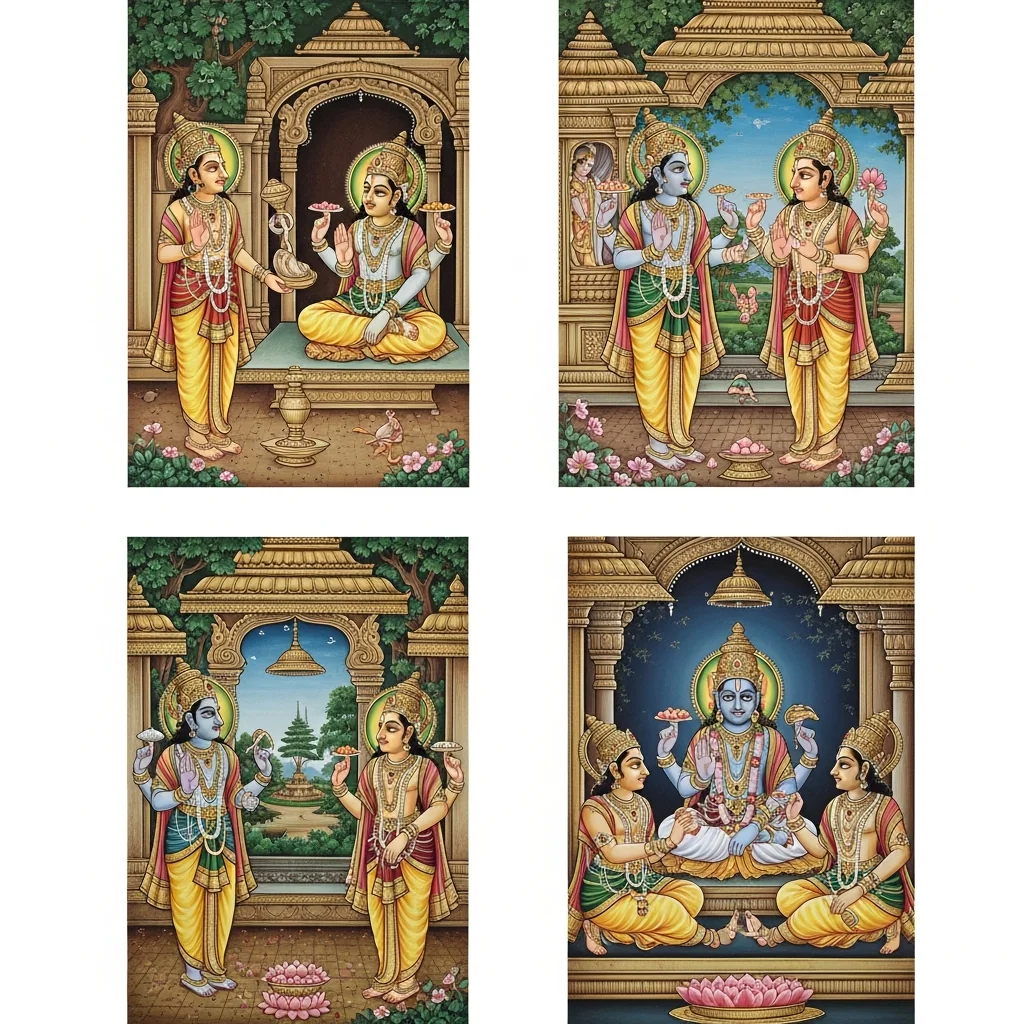
Adhyaya 30
सोमेश्वरपूजामाहात्म्यवर्णनम् | Someshvara Worship: Procedure and Merits
This adhyāya presents a ritual-theological instruction as Devī questions and Īśvara replies on how a pilgrim may secure an obstacle-free journey after bathing at the Agni-tīrthas. The prescribed order is: bathe according to vidhāna and offer arghya to the great ocean (mahodadhi); worship with fragrances, flowers, garments, and unguents; cast into the sacred waters, as one’s means allow, a gold ornament or bracelet; and perform tarpaṇa for the ancestors. Thereafter one proceeds to Kapardin (Śiva) and offers arghya with a gaṇa-related mantra, with guidance on mantra access, including mention of an eight-syllable mantra for Śūdras. One then visits Som(e)śvara, performs abhiṣeka, and recites Śatarudriya and other Rudra recensions; the deity is bathed with milk, curd, ghee, honey, and sugarcane juice, and anointed with kunkuma, camphor, vetiver, musk, and sandal. The chapter further enjoins incense, vesting, naivedya, ārātrika, music and dance, and dharma-minded viewing and recitation. Charity is to be given to twice-born ascetics, the poor, the blind, and the destitute, along with an upavāsa discipline tied to the tithi of seeing Som(e)śvara. The declared fruits are the cleansing of sins across life’s stages, uplift of one’s lineage, freedom from poverty and misfortune, and intensified devotion—especially amid the moral difficulty of Kali-yuga.
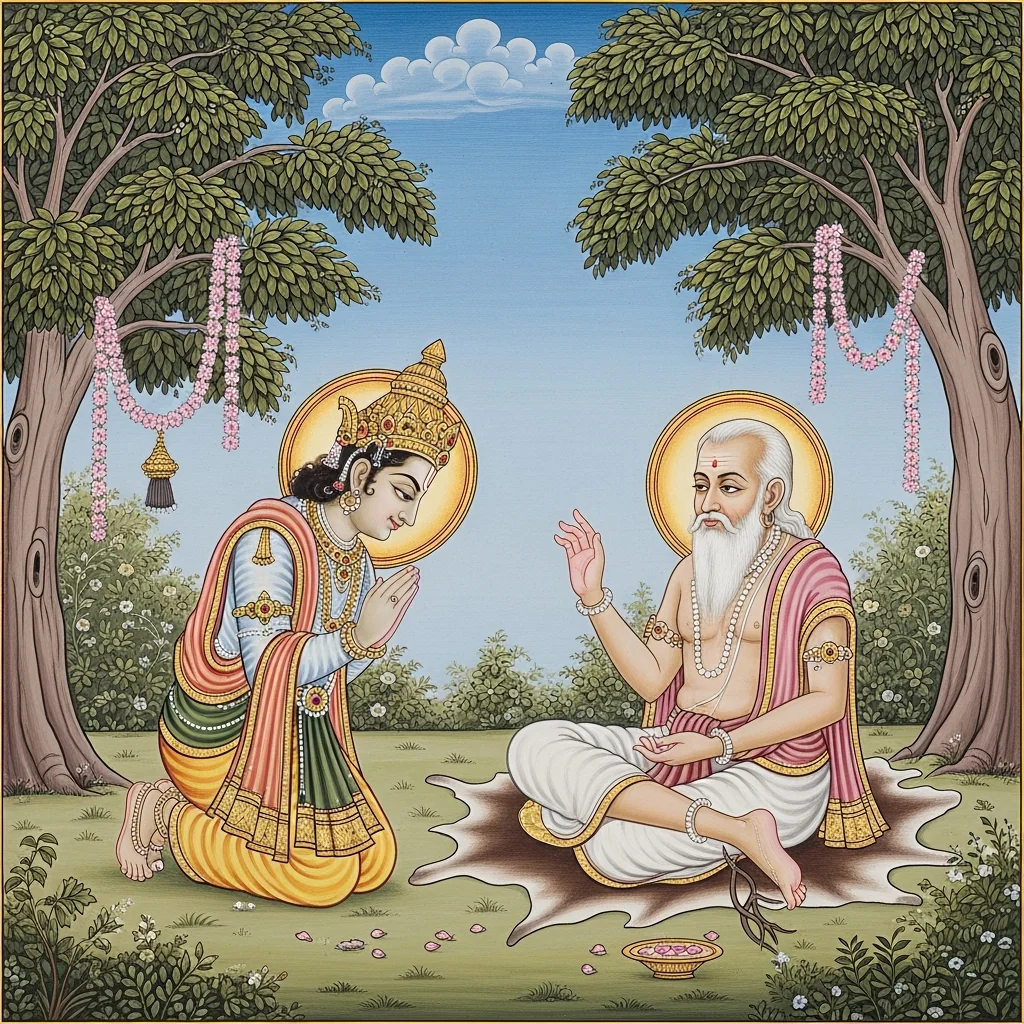
Adhyaya 31
वडवानलोत्पत्तिवृत्तान्ते दधीचिमहर्षये सर्वदेवकृतस्वस्वशस्त्रसमर्पणवर्णनम् (Origin Account of the Vādavānala and the Devas’ Deposition of Weapons with Maharṣi Dadhīci)
Chapter 31 is framed as a Devī–Īśvara dialogue seeking the causes behind (1) the previously taught “sa-kāra-pañcaka,” (2) Sarasvatī’s presence and manifestation in the sacred kṣetra, and (3) the origin and timing of the vādavānala motif. Īśvara explains that Sarasvatī manifests at Prabhāsa as a purifying power, spoken of through five names: Hiraṇyā, Vajriṇī, Nyaṅku, Kapilā, and Sarasvatī. The account then turns to an origin-episode: when a deva–asura conflict subsides due to a Soma-related cause, Candra returns Tārā at Brahmā’s command. The devas look down to earth and behold a heaven-like āśrama—Maharṣi Dadhīci’s renowned hermitage, rich with seasonal blossoms and fragrant plants. With reverent restraint they approach in humanlike manner, are received with arghya and pādya honors, and take their seats. Indra requests the sage to accept the devas’ weapons for safekeeping; Dadhīci first advises them to return to heaven, but Indra insists the arms must be retrievable in time of need. Dadhīci consents, promising to return them in wartime; Indra, trusting the ṛṣi’s truthfulness, deposits the weapons and departs. A concluding phalaśruti verse declares that one who hears this narrative with disciplined attention gains victory in battle and is blessed with worthy offspring, along with dharma, artha, and fame.
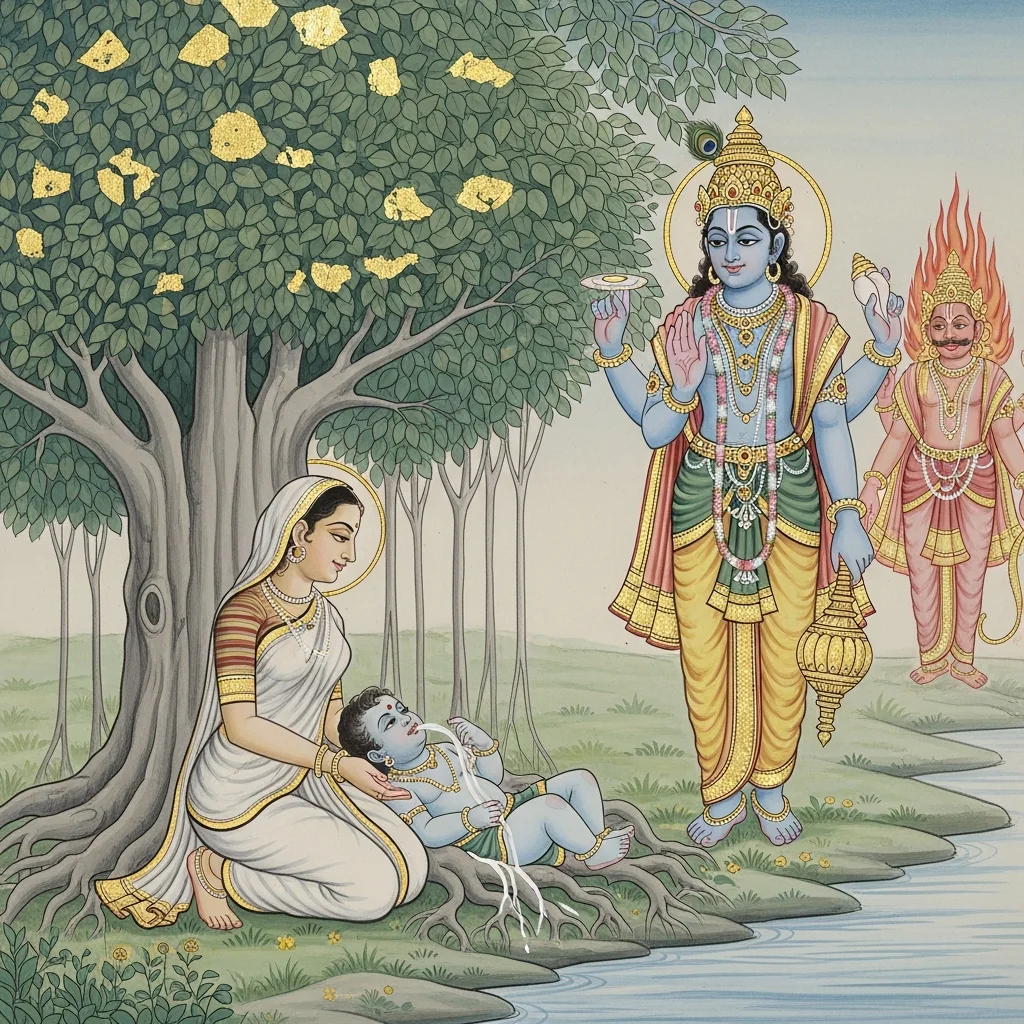
Adhyaya 32
दधीच्यस्थि-शस्त्रनिर्माणम्, पिप्पलादोत्पत्तिः, वाडवाग्नि-प्रसंगः (Dadhīci’s Bones and the Making of Divine Weapons; Birth of Pippalāda; The Vāḍava Fire Episode)
Chapter 32 presents linked episodes weaving ascetic life, divine governance, and karmic causality. After the gods depart, the brāhmaṇa-sage Dadhīci continues his austerities, moves north, and dwells in a riverside āśrama. His attendant Subhadrā, while bathing, unknowingly encounters a discarded loincloth bearing semen and later discovers her pregnancy; ashamed, she gives birth in an aśvattha-grove and utters a conditional curse upon the unknown agent. The lokapālas and Indra then approach Dadhīci to reclaim the weapons once entrusted to him. Dadhīci explains that he has absorbed their power and proposes that new weapons be fashioned from his own bones; he willingly relinquishes his body for the divine mandate of protection. Five divine cows (Surabhīs) are brought to cleanse the remains, and a dispute results in a curse upon Sarasvatī, offering a narrative basis for certain ritual-impurity conventions. Viśvakarman subsequently forges the lokapālas’ weapons—vajra, cakra, śūla, and others—from Dadhīci’s bones. Later Subhadrā finds the child alive; the boy speaks of karmic necessity and is named Pippalāda, sustained by aśvattha sap. Learning that his father was slain for weapon-making, he vows vengeance and performs tapas to generate a destructive kṛtyā; from his thigh arises a fiery being linked with the Vāḍava fire. The devas seek refuge, and Viṣṇu intervenes with a regulated mitigation—consumption one by one—turning catastrophic wrath into ordered cosmic function. The chapter ends with a phala-claim: attentive hearing dispels fear of transgression and supports knowledge and liberation.
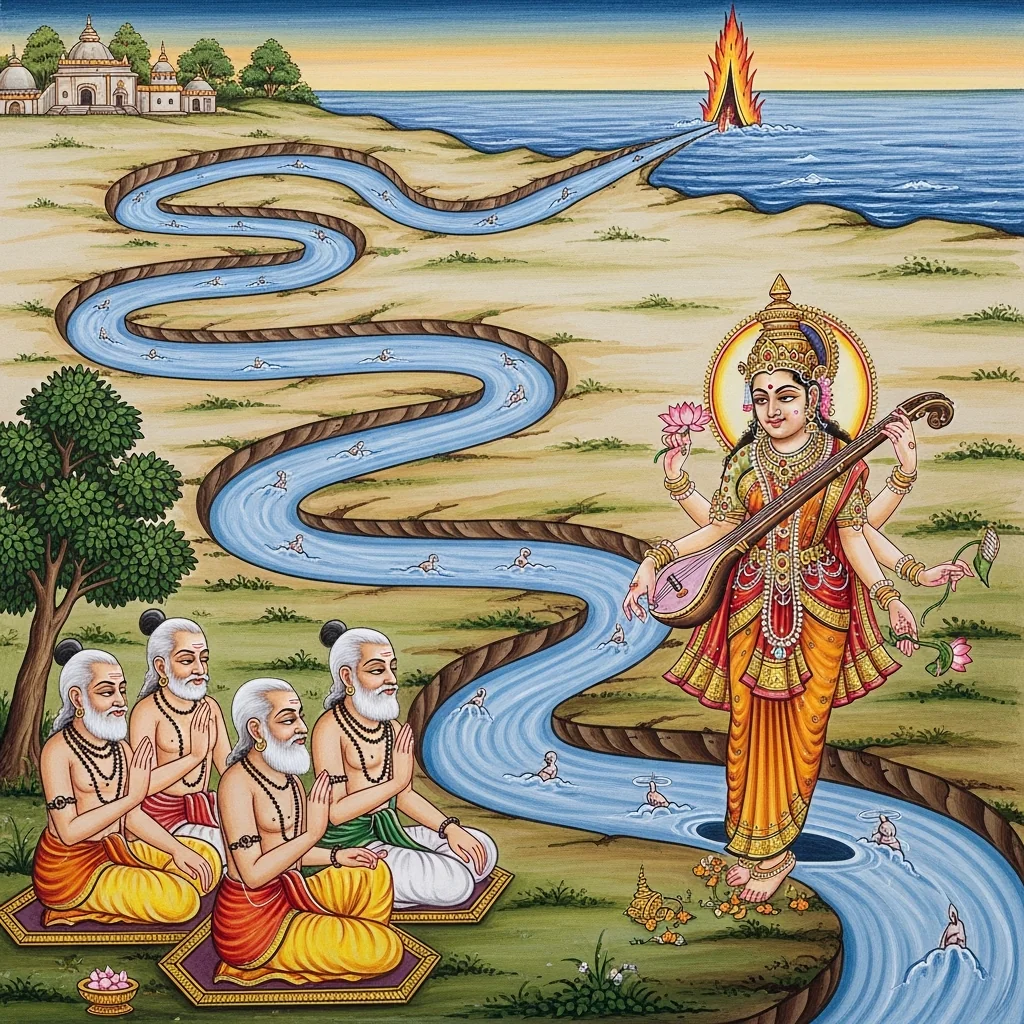
Adhyaya 33
वाडवानल-नयनम् तथा पञ्चस्रोता-सरस्वती-प्रादुर्भावः (Transport of the Vāḍava Fire and the Manifestation of Five-Stream Sarasvatī)
Chapter 33 begins with Devī asking about an earlier chain of events, and Īśvara explains that the gods must contain and relocate the fearsome Vāḍava fire, whose presence endangers cosmic order. Viṣṇu devises the remedy by appointing Sarasvatī as the very conveyance (yāna-bhūtā) to bear the fire and by seeking the help of the river deities; yet Gaṅgā and the others confess they cannot withstand its destructive power. Sarasvatī, bound by filial obedience and ritual restraint (not acting without her father’s command), receives Brahmā’s authorization, who prescribes an underground route and declares that when she is exhausted by the fire she will appear on earth as prācī, creating tīrtha access for devotees. The narrative then follows Sarasvatī’s auspicious departure, her river-form arising from the Himalayan region, and her repeated alternation between subterranean flow and visible manifestation. In Prabhāsa, four ṛṣis—Harina, Vajra, Nyaṅku, and Kapila—are introduced; out of compassion and to secure merit, Sarasvatī becomes pañca-srotas, bearing five names (Harīṇī, Vajriṇī, Nyaṅku, Kapilā, Sarasvatī) and establishing a purification order in which grave sins are mapped to these waters, with regulated bathing or drinking said to remove severe pāpa. An additional episode tells of the mountain Kṛtasmarā obstructing her and attempting to compel marriage; Sarasvatī cleverly asks it to hold the fire, and it is destroyed by contact, while its softened stones are explained as fit for building household shrines. At the ocean the Vāḍava fire offers a boon; guided by Viṣṇu, Sarasvatī requests that it become “needle-mouthed” (sūcī-mukha), able to drink the waters without consuming the gods. The chapter closes with a phalaśruti promising elevated spiritual attainment through hearing or reciting this account.
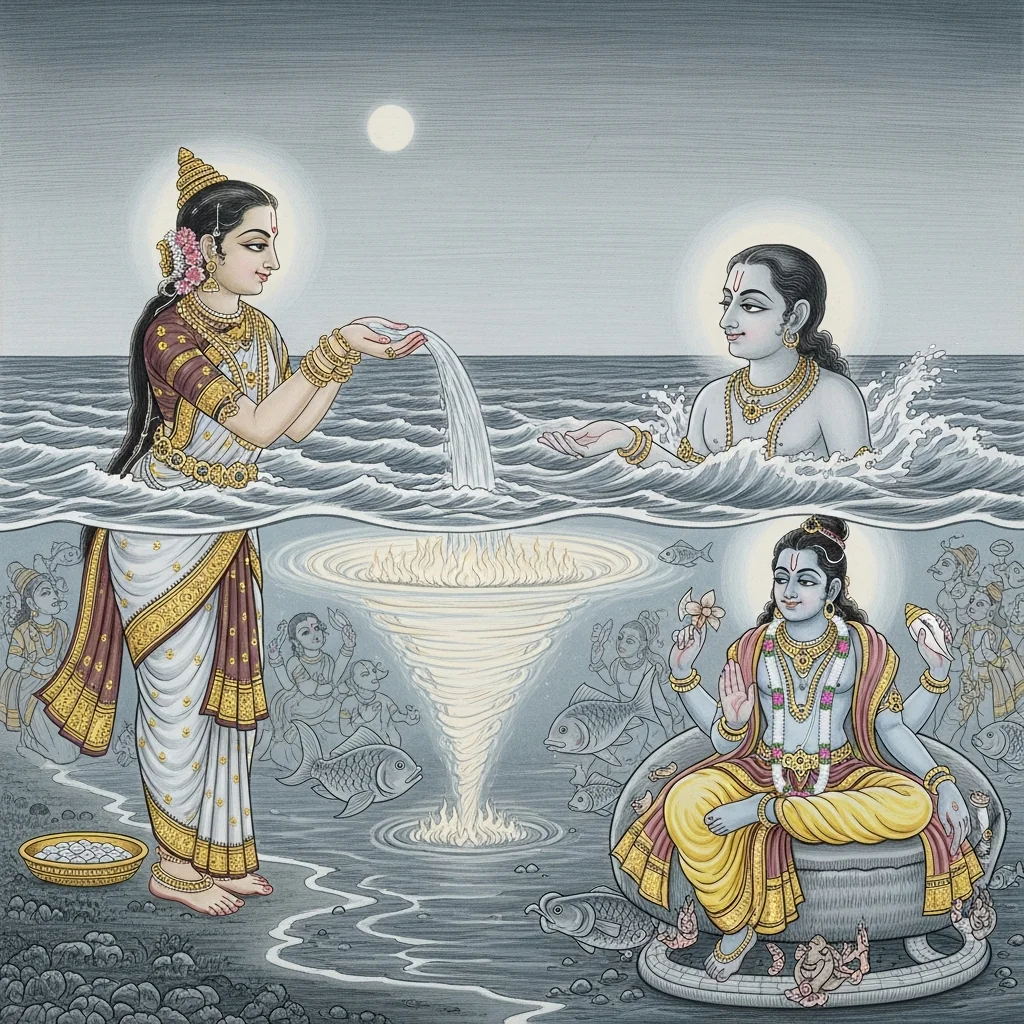
Adhyaya 34
वडवानल-निबन्धनम् (Containment of the Vaḍavānala) — Sarasvatī, the Ocean, and Prabhāsa’s Tīrtha-Order
Īśvara tells Devī a sacred episode rooted in Prabhāsa. Sarasvatī, having gained a boon connected with the Vaḍavānala (the destructive “submarine fire”), goes to Prabhāsa by divine instruction and summons the Ocean. The Ocean appears in divine splendor with attendants; Sarasvatī praises him as the primordial support of beings and asks him to receive the Vaḍava fire for the gods’ purpose. The Ocean reflects and agrees, taking in the fire; the water-creatures tremble as the blaze intensifies. Viṣṇu (Acyuta/Daitiyasūdana) arrives, reassures the aquatic beings, and commands Varuṇa/the Ocean to cast the Vaḍavānala into the deepest waters, where it remains, as though “drinking” the sea, yet held in controlled containment. When the Ocean fears depletion, Viṣṇu makes the waters inexhaustible, restoring cosmic balance. The narrative then establishes local observance: Sarasvatī enters the sea by a named route, offers arghya, and installs Arghyeśvara; she is said to stand near Somēśa in the south-east, bearing the Vaḍavānala association. It concludes with pilgrimage rites at Agnitīrtha—bathing, worship, gifting clothing and food to couples, and worship of Mahādeva—along with a note on the Cākṣuṣa and Vaivasvata manvantaras and the phala that hearing this account removes sin and increases merit and renown.
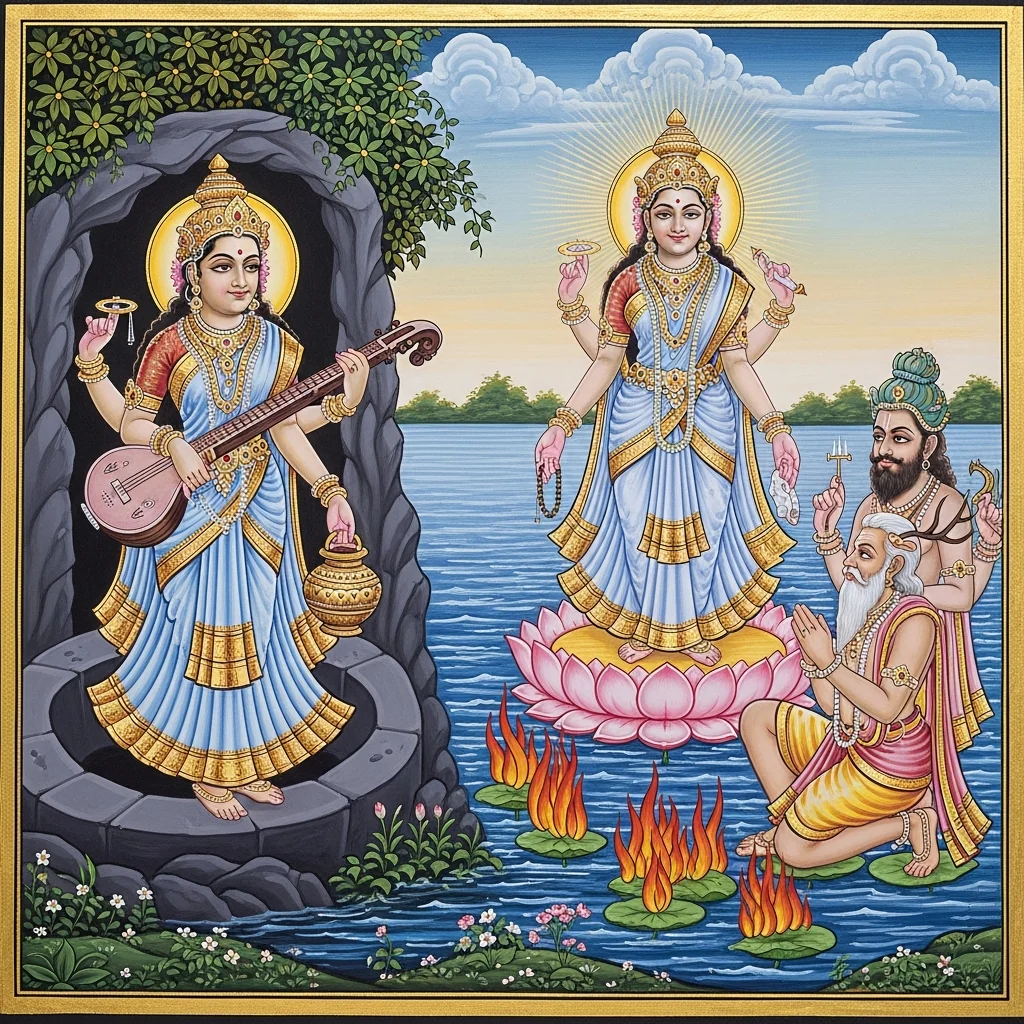
Adhyaya 35
Ādhyāya 35 — Oūrva, Vāḍavāgni, and Sarasvatī’s Tīrtha-Route to Prabhāsa (और्व-वाडवाग्नि-सरस्वतीतीर्थमार्गः)
The chapter unfolds as a theological dialogue: Devī asks how the Bhārgava sage Oūrva arose in the present Manvantara. Īśvara recounts a tale of violence and retribution—kṣatriyas slay brāhmaṇas for wealth; one woman saves a fetus by hiding it in her thigh (ūru), and from that concealment Oūrva is born. From his tapas Oūrva brings forth a fierce fire, Raudra Oūrva/Vāḍava, which threatens to consume the earth, and the gods seek refuge with Brahmā. Brahmā pacifies Oūrva and commands that the fire be directed into the ocean rather than destroying the world. Sarasvatī is appointed to carry the consecrated fire in a golden vessel, and her journey becomes a detailed tīrtha-route: through Himalayan and western regions she repeatedly disappears (antardhāna) and reappears at named wells and sacred sites—such as Gandharva-kūpa—forming a network of īśvara-shrines, sangamas, forests, fords, and ritual stations. At the sea Sarasvatī releases the Vāḍava fire into the salt waters; Agni grants a boon yet is restrained by a ring-borne command not to dry up the ocean. The chapter closes with phalaśruti on the rarity and power of Prācī Sarasvatī, the merit of Agni-tīrtha, and a worship-sequence defining the sin-destroying “Raudrī yātrā” (Sarasvatī, Kapardin/Śiva, Kedāra, Bhīmeśvara, Bhairaveśvara, Caṇḍīśvara, Someśvara, Navagrahas, Rudra-ekādaśa, and child-form Brahmā).
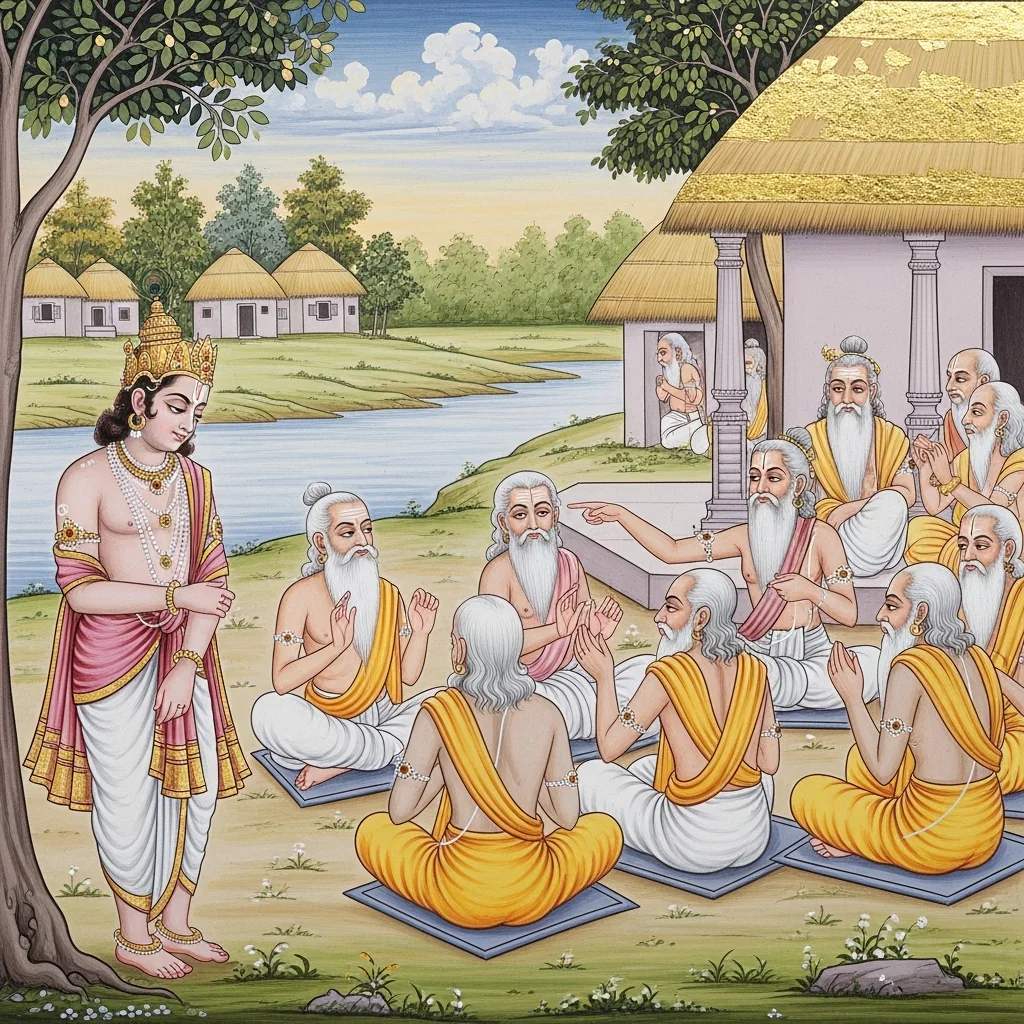
Adhyaya 36
Prācī Sarasvatī Māhātmya and Prāyaścitta of Arjuna at Prabhāsa (प्राचीसरस्वतीमाहात्म्यं तथा पार्थस्य प्रायश्चित्तकथा)
This chapter unfolds as a dialogue in which Devī asks why the Prācī Sarasvatī is so rare and so supremely purifying at Prabhāsa, even when compared with Kurukṣetra and Puṣkara. Īśvara (Śiva) affirms Prabhāsa’s heightened sanctity and praises the river as a remover of faults: one may drink and bathe without strict time restrictions, and even animals that partake are said to be uplifted. Through Sūta’s narration the teaching turns to an exemplum: after the Bhārata war, Arjuna (Kirīṭin, linked with Nara-Nārāyaṇa) is socially and morally shunned under the burden of kin-slaying. Kṛṣṇa directs him not to Gayā, the Gaṅgā, or Puṣkara, but to the Prācī Sarasvatī tīrtha. Arjuna performs a three-night fast (trirātra-upavāsa) and bathes three times daily, thereby gaining release from accumulated sin; reconciliation follows as Yudhiṣṭhira and others receive him again. The chapter then expands into ritual and ethical guidance: death near the northern bank is portrayed as “non-return,” austerities are extolled, and dāna and śrāddha at this sacred ford yield multiplied fruits for donors and ancestors, even promising uplift across many generations. It closes by reiterating Sarasvatī’s preeminence among rivers as a source of relief in this world and well-being after death.
Adhyaya 37
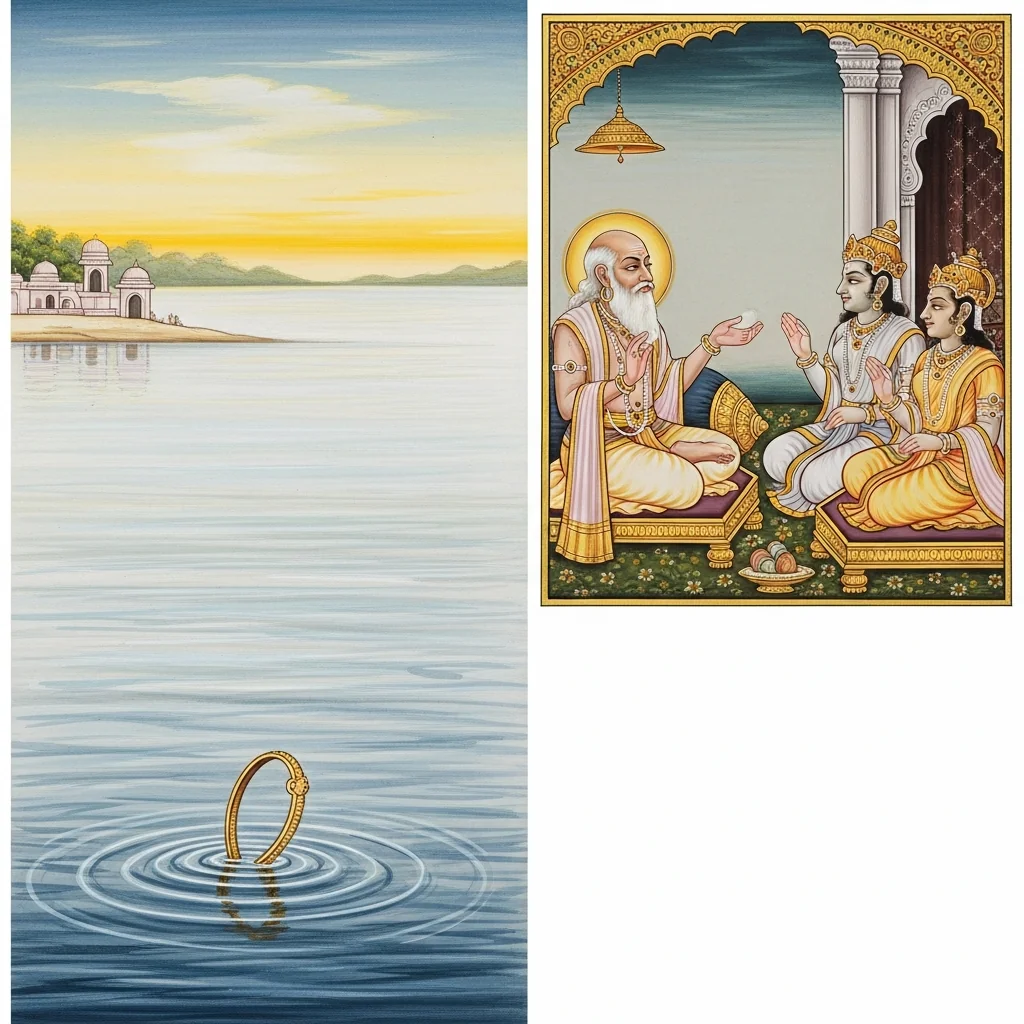
कंकणमाहात्म्यवर्णनम् / Theological Account of the Bracelet Rite
Chapter 37 unfolds as a dialogue in which the Goddess asks Īśvara why the kankana rite—casting a bracelet into the ocean at Prabhāsa in connection with Someshvara—has such power. She seeks clear guidance on mantras, vidhi (procedure), proper timing, and the story that establishes its authority. Īśvara replies with a Purāṇic exemplum: King Bṛhadratha and his virtuous queen Indumatī host the sage Kaṇva. After discourse on dharma, Kaṇva reveals Indumatī’s former birth: she had been a poor Ābhīrī woman with five husbands who went to Someshvara; while bathing in the sea she was overwhelmed by waves, lost a golden bracelet, later died, and was reborn into royal fortune. Kaṇva explains that her present prosperity did not arise from formal vrata, tapas, or dāna, but from that bracelet event and the place-specific fruit of the tīrtha. The rite is then understood and adopted as an annual practice after bathing in Someshvara’s salt waters, praised as pāpa-nāśana (destroyer of sin) and sarva-kāma-prada (bestower of all desires), teaching how a small act in a charged sacred place yields vast merit.
Adhyaya 38
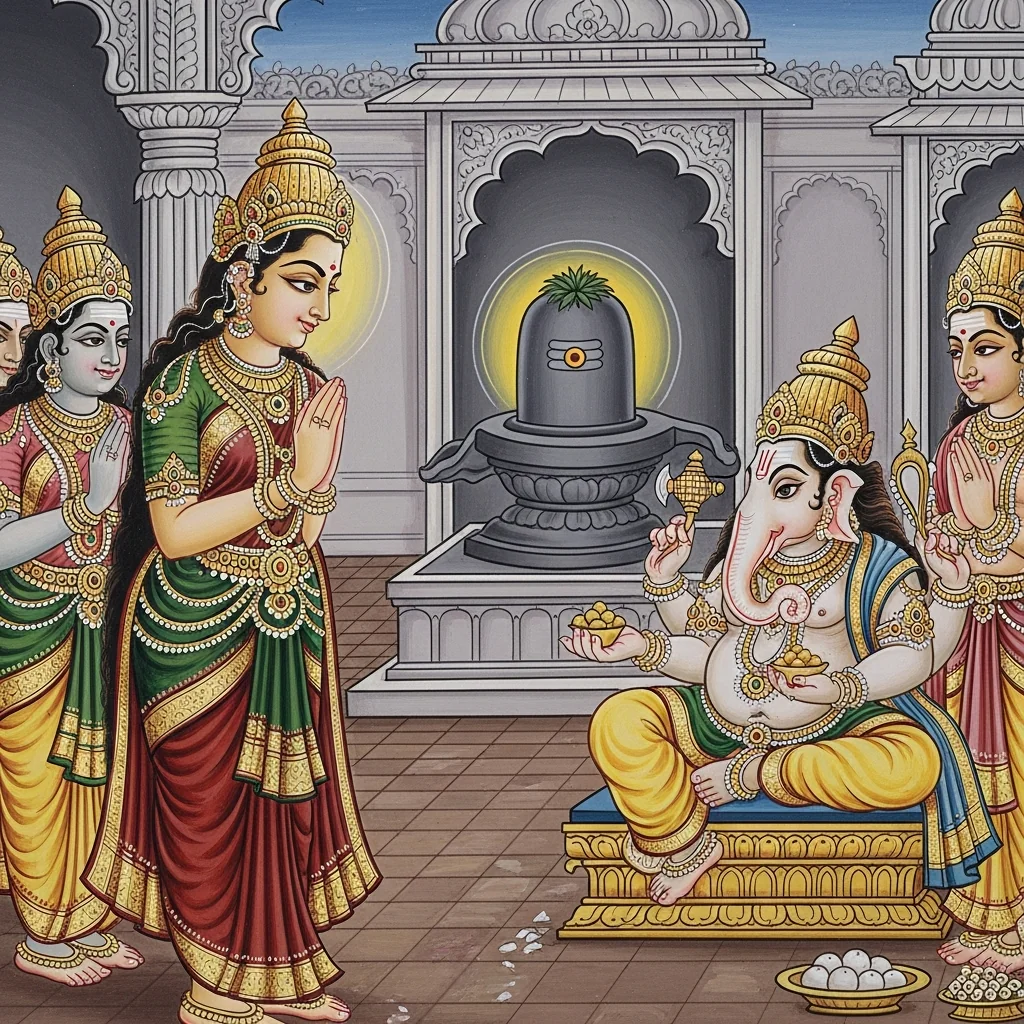
Kaparddī-Vināyaka as Prabhāsa-kṣetra Protector and the Vighnamardana Stotra (कपर्द्दी-विनायकः प्रभासक्षेत्ररक्षकः तथा विघ्नमर्दनस्तोत्रम्)
Chapter 38 is framed as a Devī–Īśvara dialogue explaining why Kaparddī (a form of Vināyaka/Gaṇeśa) must be worshiped before approaching Somēśvara in Prabhāsa-kṣetra. Īśvara declares Somēśvara to be the liṅga-form of Sadāśiva established in the Prabhāsa region, and affirms Kaparddī’s precedence as Vighneśvara, the regulator of obstacles. An avatāra scheme across the yugas is given: Heramba in Kṛta, Vighnamardana in Tretā, Lambodara in Dvāpara, and Kaparddī in Kali. A crisis then arises: the devas feel displaced because humans attain heavenly states through mere darśana of Somēśvara even without customary rites, unsettling ritual order. The devas appeal to Devī; from the “mala” produced when she compresses her body, a four-armed, elephant-faced Vināyaka manifests, commissioned to create obstacles for those who approach Somēśvara in delusion, thereby safeguarding right intention and ethical readiness. Devī appoints him protector of Prabhāsa-kṣetra and instructs him to hinder would-be pilgrims by stirring attachment to family/wealth or by illness, so that only the resolute proceed. The chapter also transmits the Vighnamardana stotra to Kaparddī, describes worship with red offerings and caturthī observance, and concludes with phala: mastery over obstacles, success within a stated timeframe, and eventual Somēśvara-darśana through Kaparddī’s grace. The name Kaparddī is further linked etymologically to his “kaparda-like” form.
Adhyaya 39
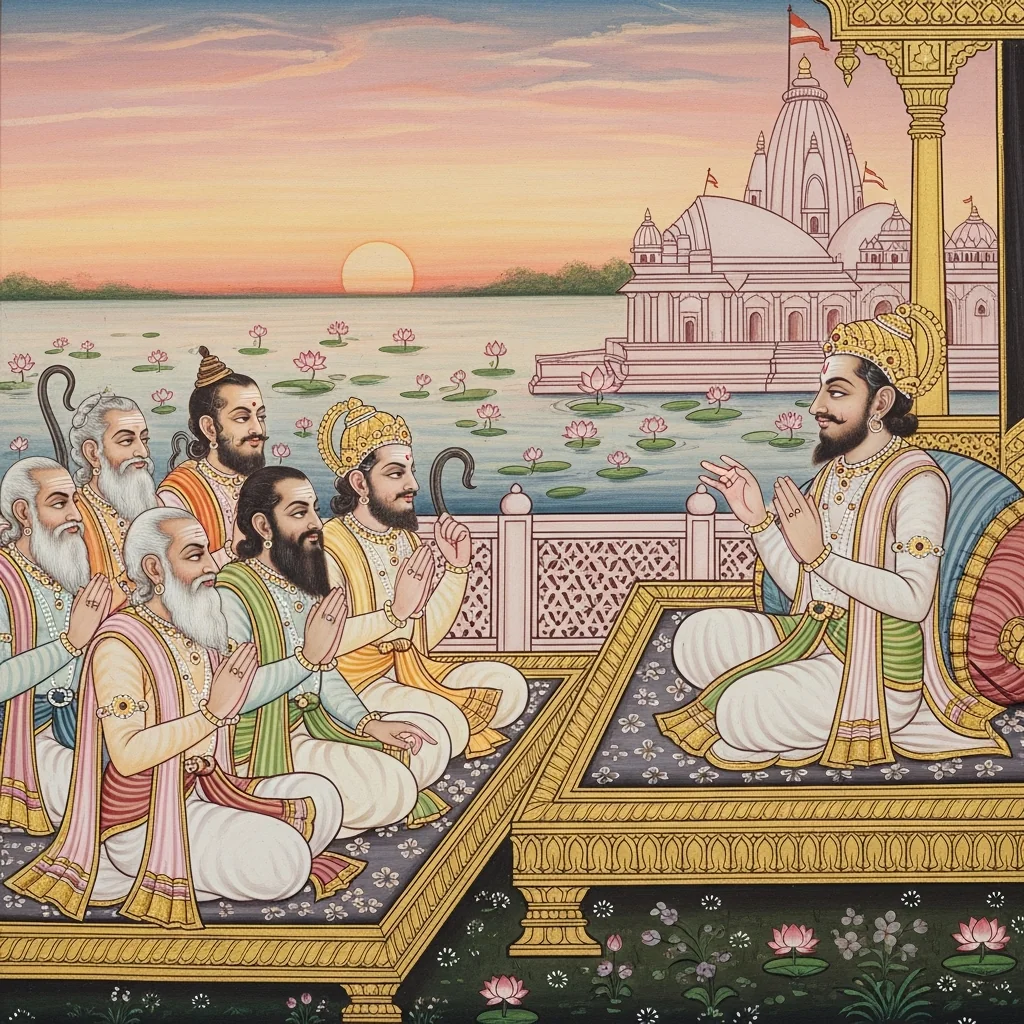
Kedāra (Vṛddhi/Kalpa) Liṅga Māhātmya and Śivarātri Jāgaraṇa: The Narrative of King Śaśabindu
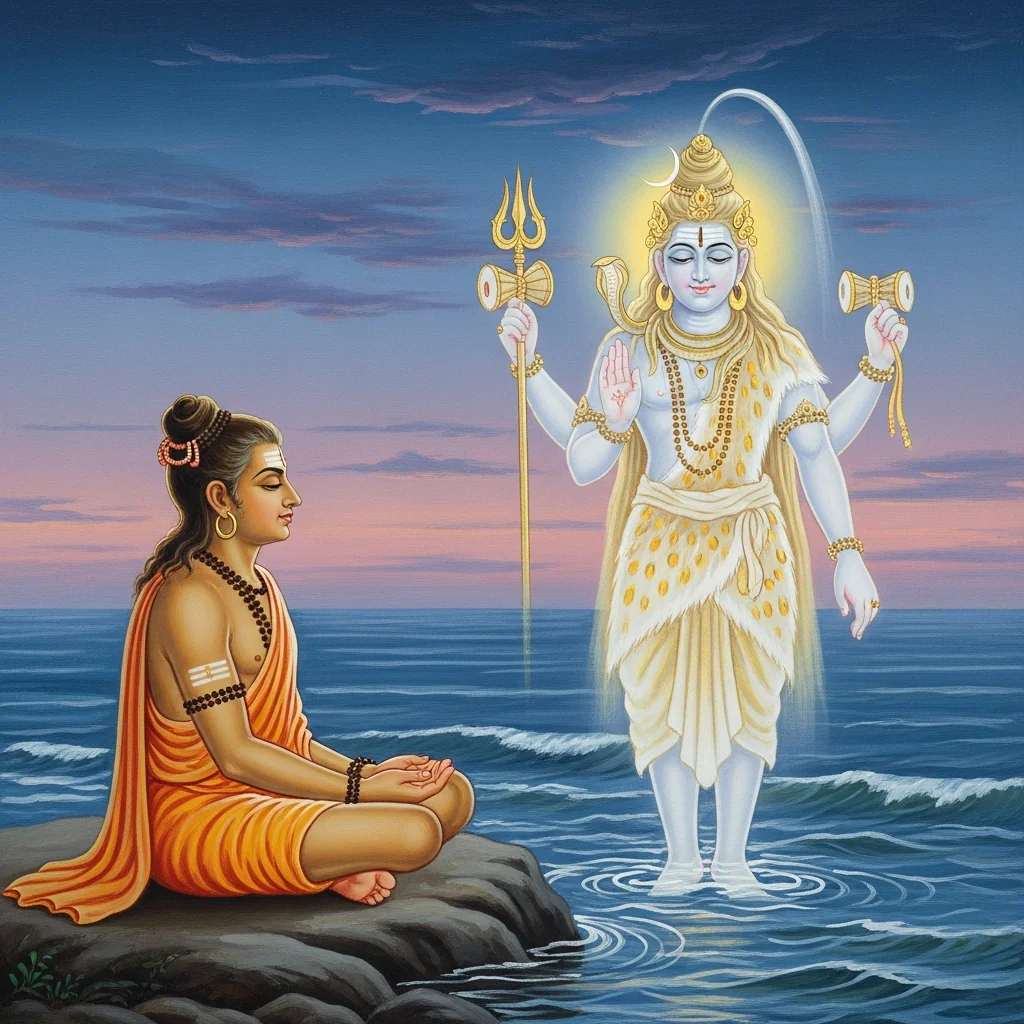
Chapter 39 presents a devotional and ritual itinerary within Īśvara’s teaching to Mahādevī. It identifies the Kedāra liṅga in Prabhāsa as self-manifest (svayaṃbhū), dear to Śiva, and situated near Bhīmeśvara. In an earlier yuga it was known as Rudreśvara; fearing defilement through contact with mlecchas, it was concealed or merged, and later became renowned on earth as Kedāra. The chapter then prescribes observance: bathing in the salt ocean and at the Padmaka tīrtha/kuṇḍa, followed by worship of Rudreśa and Kedāra, with special emphasis on caturdaśī and an all-night vigil (ekaprajāgara) on Śivarātri as a supremely meritorious vow. A long legend follows: King Śaśabindu arrives at Prabhāsa on the bright-fortnight caturdaśī, sees sages engaged in japa and homa, worships Somnātha, and proceeds to Kedāra to perform jāgaraṇa. Questioned by sages such as Cyavana, Yājñavalkya, Nārada, Jaimini, and others, he recounts a former birth as a Śūdra during famine: after gathering lotuses at Rāma-saras and failing to sell them, he encountered a Śivarātri vigil at the Vṛddha/Rudreśvara liṅga led by the courtesan Anaṅgavatī. Through unintended fasting (from lack of food), bathing, lotus-offering, and night-vigil, he gained future sovereignty and retained memory of its cause. The chapter closes with phala: worship of this liṅga is said to destroy grave sins and grant the full range of human aims; Anaṅgavatī too is uplifted by the same observance, becoming an apsaras.
Adhyaya 40
भीमेश्वरमाहात्म्यवर्णनम् / Chapter 40: The Māhātmya (Sacred Account) of Bhīmeśvara
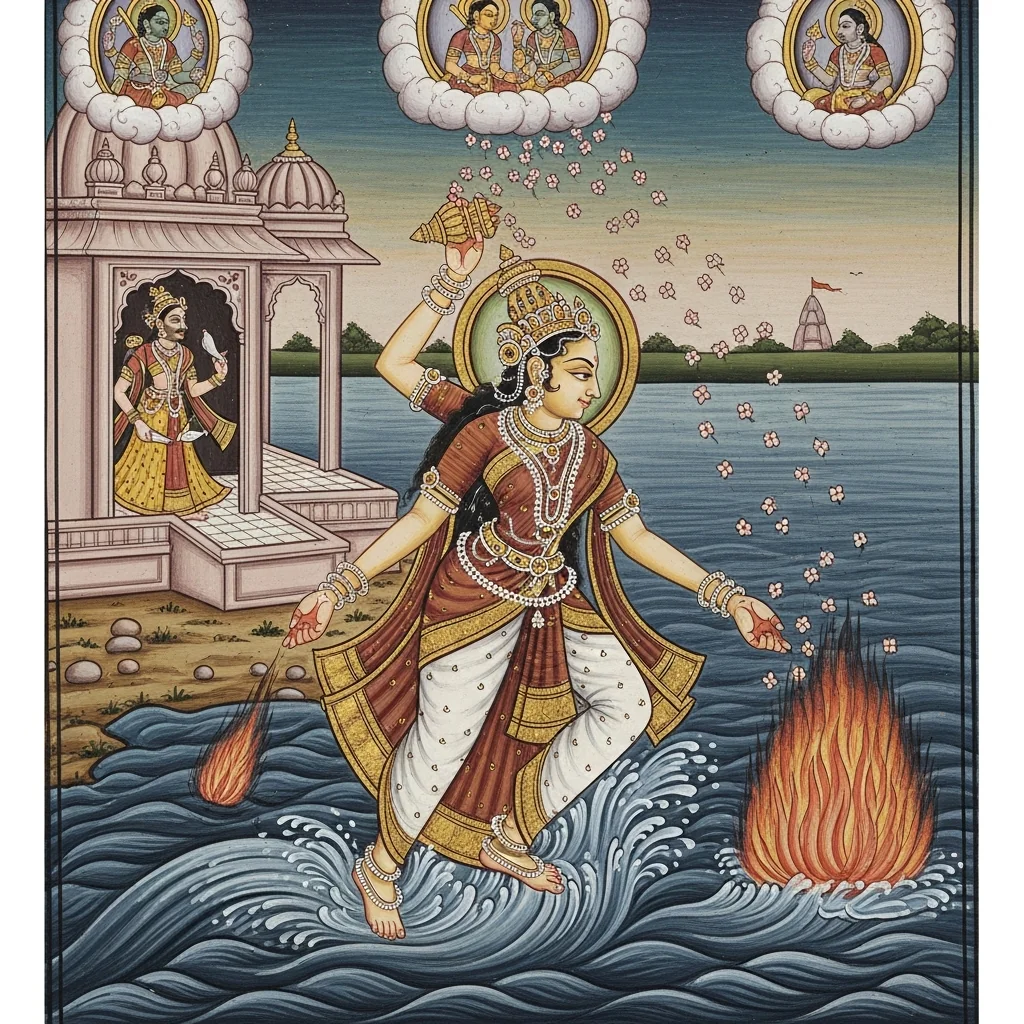
Chapter 40 unfolds as a sacred dialogue between Śiva and Devī, explaining the origin, naming, and spiritual merit of a powerful liṅga connected first with Śvetaketu and later with Bhīmasena. Īśvara directs Devī to a highly efficacious shrine founded by Śvetaketu and once worshiped by Bhīma, near Kedāreśvara; pilgrims are to worship in proper sequence—such as bathing the liṅga with milk and related rites—to gain the fruits of pilgrimage and a favorable afterlife. Devī asks how Śvetaketu’s liṅga became known and why it bears the name Bhīmeśvara. Īśvara recounts that in Tretā-yuga the royal sage Śvetaketu performed severe austerities for many years on the auspicious seashore at Prabhāsa, enduring strict disciplines through the seasons, until Śiva granted boons. Śvetaketu prays for unwavering devotion and requests Śiva’s abiding presence there; Śiva agrees, and the liṅga is known as Śvetaketvīśvara. In Kali-yuga, Bhīmasena arrives with his brothers on a tīrtha-journey and worships that liṅga, so it is newly praised as Bhīmeśa/Bhīmeśvara. The chapter concludes with a promise of purification: mere sight of the liṅga and a single act of reverence is said to destroy many sins, even those accumulated across births.
Adhyaya 41
भैरवेश्वरमाहात्म्यवर्णनम् / The Māhātmya of Bhairaveśvara
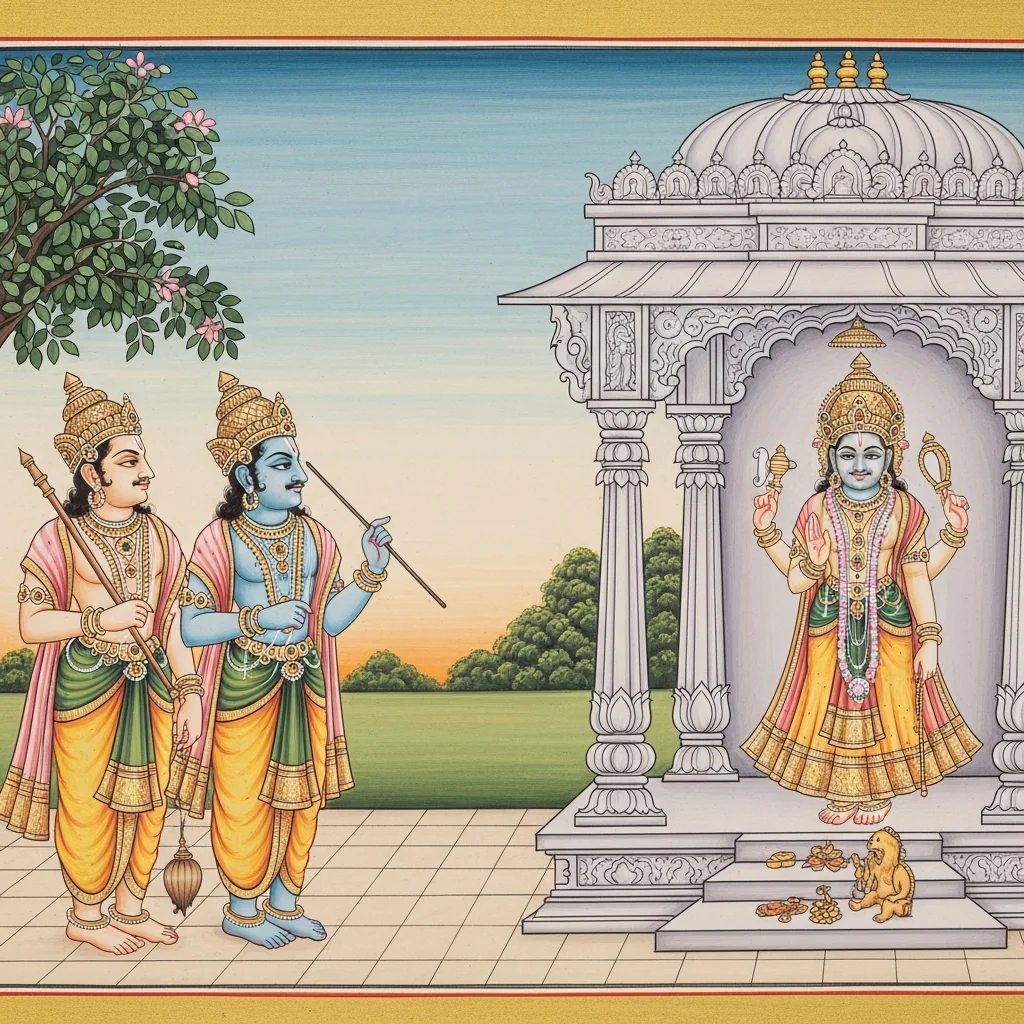
Chapter 41 recounts Īśvara’s description of a highly potent liṅga established in the eastern quarter, connected with Sarasvatī and located near the ocean. A calamity arises from the destructive vaḍavānala (submarine fire), and the Goddess intervenes: she brings the liṅga to the seashore, worships it according to proper rite, takes up the vaḍavānala, and casts it into the ocean for the welfare of the gods. The devas celebrate in ritual fashion—conch and drum resound, flowers rain down—and they bestow on the Goddess the honorific “Devamātā,” acknowledging a deed difficult even for gods and asuras. Īśvara then explains the basis of the shrine’s renown: because the Goddess established this auspicious liṅga and because Sarasvatī is praised as the foremost river and destroyer of sins, the liṅga becomes famed as “Bhairava,” that is, Bhairaveśvara. The chapter ends with prescriptions: worship of Sarasvatī and Bhairaveśvara, especially on Mahānavamī with proper bathing, removes faults of speech (vāg-doṣa). Worship of the liṅga with milk ablution and the Aghora mantra grants the full fruit of pilgrimage (yātrā-phala).
Adhyaya 42
चण्डीशमाहात्म्यवर्णनम् (Chandīśa Shrine-Glory and Ritual Protocols)
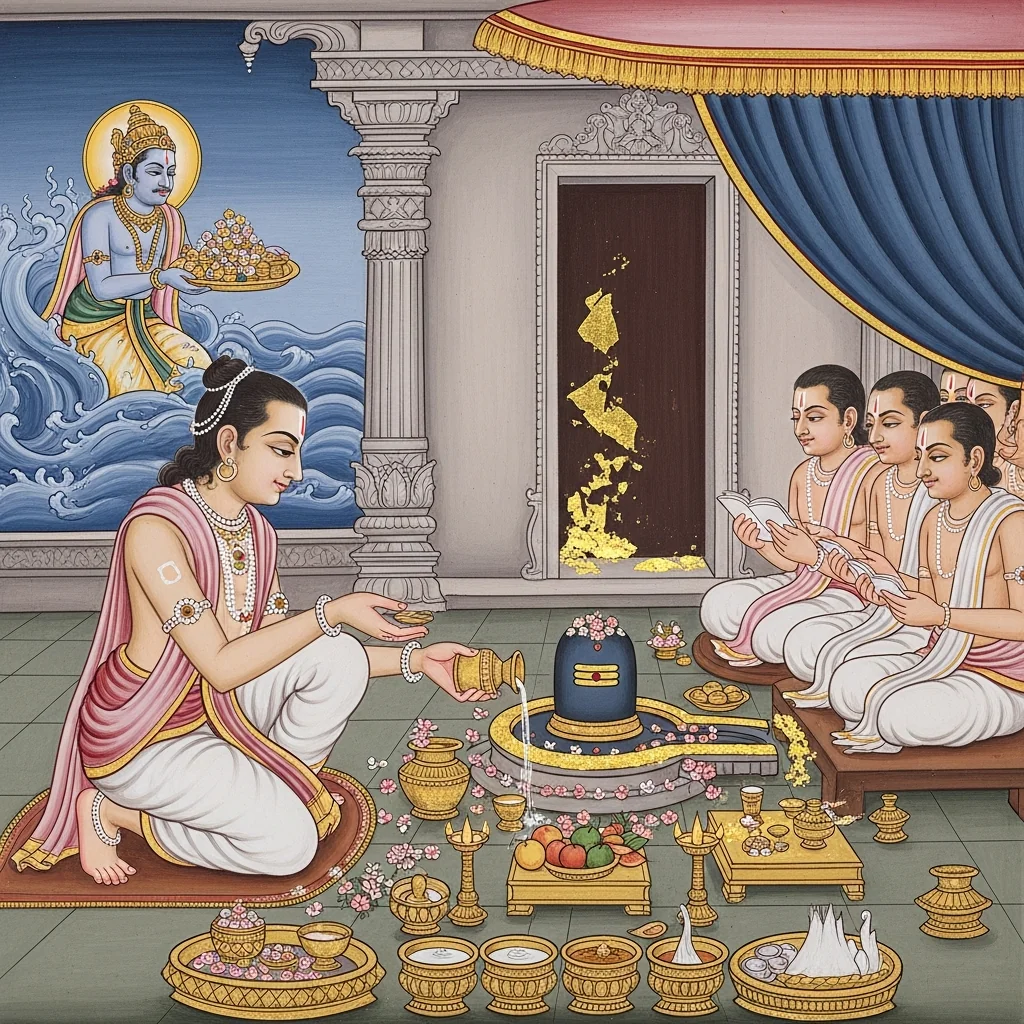
Chapter 42 records Īśvara’s guidance to Devī on how to approach and worship Chandīśa in Prabhāsa-kṣetra, identifying the shrine by directional and nearby landmarks—near Somēśa/Īśa dig-bhāga and not far south of Daṇḍapāṇi’s abode. It affirms the shrine’s sanctity by recalling that Chandā and a gaṇa, after severe tapas, earlier installed and worshiped here, giving rise to the famed Chandēśvara liṅga. The chapter then sets out an ordered pūjā: abhiṣeka with milk, curd, and ghee; anointing with honey, sugarcane juice, and saffron; fragrant unguents such as camphor, uśīra, musk essence, and sandal; offerings of flowers, incense and aguru; cloth according to one’s means; naivedya (especially paramānna) with lamps; and dāna/dakṣiṇā to dvijātis. It teaches place-specific fruits: gifts offered while facing south become inexhaustible for Chandīśa; śrāddha performed south of Chandīśa grants lasting satisfaction to the ancestors; and an uttarāyaṇa observance offering a ghṛta-kambala (ghee-blanket) is said to avert harsh rebirth. The conclusion praises pilgrimage-bhakti to Śūlin as expiatory, freeing beings from sins arising from nirmālya-related transgressions, inadvertent consumption, and other karma-born faults.
Adhyaya 43
आदित्येश्वरमाहात्म्यवर्णनम् | Adityeśvara Māhātmya (Chapter on the Glory of Adityeśvara)
This chapter records Īśvara’s directional guidance to Devī for pilgrimage, leading the seeker to a Sūrya-established liṅga lying west of Somēśa at a measured distance of “seven bows.” The liṅga is named Ādityeśvara and is praised as the destroyer of all sins (sarva-pātaka-nāśana). A remembrance of the Tretāyuga is then given: the ocean (samudra) is said to have worshiped this liṅga for a long time with jewels, grounding the shrine’s authority in mythic time. Hence the secondary name Ratneśvara, “Lord of Gems.” The prescribed rite includes bathing with pañcāmṛta, worship with five gems, and royal-style offerings (rājopacāra) performed according to proper vidhi. The phala teaching declares that such worship yields merit equal to Meru-dāna and the combined fruit of sacrifices and gifts, and it uplifts both paternal and maternal ancestral lines. Seeing Ratneśvara is said to wash away sins from childhood, youth, adulthood, and old age. The chapter also extols cow-gift (dhenu-dāna) at the site, promising salvation for ten prior and ten subsequent generations; and it states that one who, after due liṅga worship, recites the Śatarudrīya to the deity’s right is not born again. It concludes by affirming that attentive hearing itself releases one from karmic bonds.
Adhyaya 44
Someshvara-māhātmya-varṇanam (Glorification and Ritual Protocol of Someshvara)
Chapter 44, spoken by Īśvara, lays down a prescriptive theological and ritual sequence of worship. After honoring Ādityeśa, the practitioner proceeds to Someshvara and performs formal pūjā, giving special care to the fivefold limbs of devotion (pañcāṅga bhakti). The chapter emphasizes embodied reverence: full prostration (sāṣṭāṅga praṇipāta), circumambulation (pradakṣiṇā), and repeated, contemplative viewing—darśana again and again (punar-punaḥ darśana). A key doctrinal note identifies the liṅga as uniting solar and lunar principles (sūrya–candra), so the rite is framed as an agnīṣoma-oriented act that symbolically completes sacrificial intent through temple worship. From Someshvara the sacred route extends to nearby Umādevī, and then onward to another shrine station, Daityasūdana, indicating a connected pilgrimage circuit within Prabhāsa-kṣetra. The colophon concludes by naming this as the 44th adhyāya of the Someshvara-māhātmya within the Prabhāsakṣetramāhātmya of the Prabhāsa Khaṇḍa.
Adhyaya 45
अङ्गारेश्वरमाहात्म्यवर्णनम् (Aṅgāreśvara Māhātmya: The Glory of the Aṅgāreśvara Shrine)
In this adhyāya, Īśvara (Śiva) recounts the origin and ritual power of Aṅgāreśvara within the sacred realm of Prabhāsa. When Śiva, blazing with wrath, intended to burn Tripura, tears issued from his three eyes; falling to earth, that essence became Bhūmisuta, the “son of Earth,” known as Bhoma/Maṅgala (Mars). From childhood Bhoma goes to Prabhāsa and performs prolonged tapas to Śaṅkara, until Śiva is pleased and grants a boon. Bhoma asks for grahatva—status among the planetary grahas—which Śiva affirms, and he further proclaims protection for devotees who worship there with sincere bhakti. The chapter prescribes offerings and a homa discipline: red flowers, and abundant oblations mixed with honey and ghee, with the stated count of one lakh, along with careful pañcopacāra worship. The phalaśruti concludes that hearing this condensed māhātmya destroys sins and grants health; specific gifts such as coral (vidruma) are linked to desired results, and Bhoma is praised as radiant in a celestial vehicle among the grahas.
Adhyaya 46
बुधेश्वरमाहात्म्यवर्णनम् | Budheśvara Māhātmya (The Glory of Budheśvara Liṅga)
Īśvara instructs Devī to go north to a supremely powerful liṅga known as Budheśvara, praised as a destroyer of all sins through mere darśana (sacred sight). The account establishes the shrine’s sanctity by attributing its founding to Budha (Mercury), who performs prolonged austerities and worship of Sadāśiva for four yuga-like spans (“four years of ten-thousands”), until he attains a direct vision of Śiva. Pleased, Śiva grants Budha the rank of a graha, a planetary regulator. Proper worship of this liṅga—especially on Saumyāṣṭamī, the eighth lunar day associated with Budha—is said to yield merit equal to the Rājasūya sacrifice. The phalaśruti promises protection from misfortune, family ill-luck, separation from what is desired, and fear of enemies, and concludes that reverently hearing this māhātmya leads one toward the highest state (parama pada).
Adhyaya 47
वृहस्पतीश्वरमाहात्म्यवर्णनम् | The Māhātmya of Bṛhaspatīśvara (Guru-associated Liṅga)
This chapter is cast as Īśvara’s instruction to Mahādevī, guiding the pilgrim to a liṅga in the eastern sector, associated with Umā and lying within the Āgneya (southeastern) range. The liṅga is praised as a great emblem installed by Devācārya and intimately connected with Guru, Bṛhaspati. A model course of worship is taught: sustained devotion to the liṅga over a long period grants even hard-to-attain desires, followed by honor among the devas and the attainment of īśvara-jñāna (sovereign knowledge of the Lord). The narrative then turns to pilgrimage benefits—mere darśana of the Bṛhaspati-made liṅga protects from misfortune and specifically remedies afflictions attributed to Bṛhaspati. Ritual timing is stressed—Śukla Caturdaśī falling on a Thursday—and worship may be done either with full formal procedure and rājopacāra or with pure devotional intent. A bathing rite with pañcāmṛta in a large prescribed measure is said to free one from the “three debts” (ṛṇa-traya): to mother, father, and guru, leading to purification, a non-dual (nirdvandva) mind, and liberation. The phalaśruti concludes that faithful listening pleases Guru.
Adhyaya 48
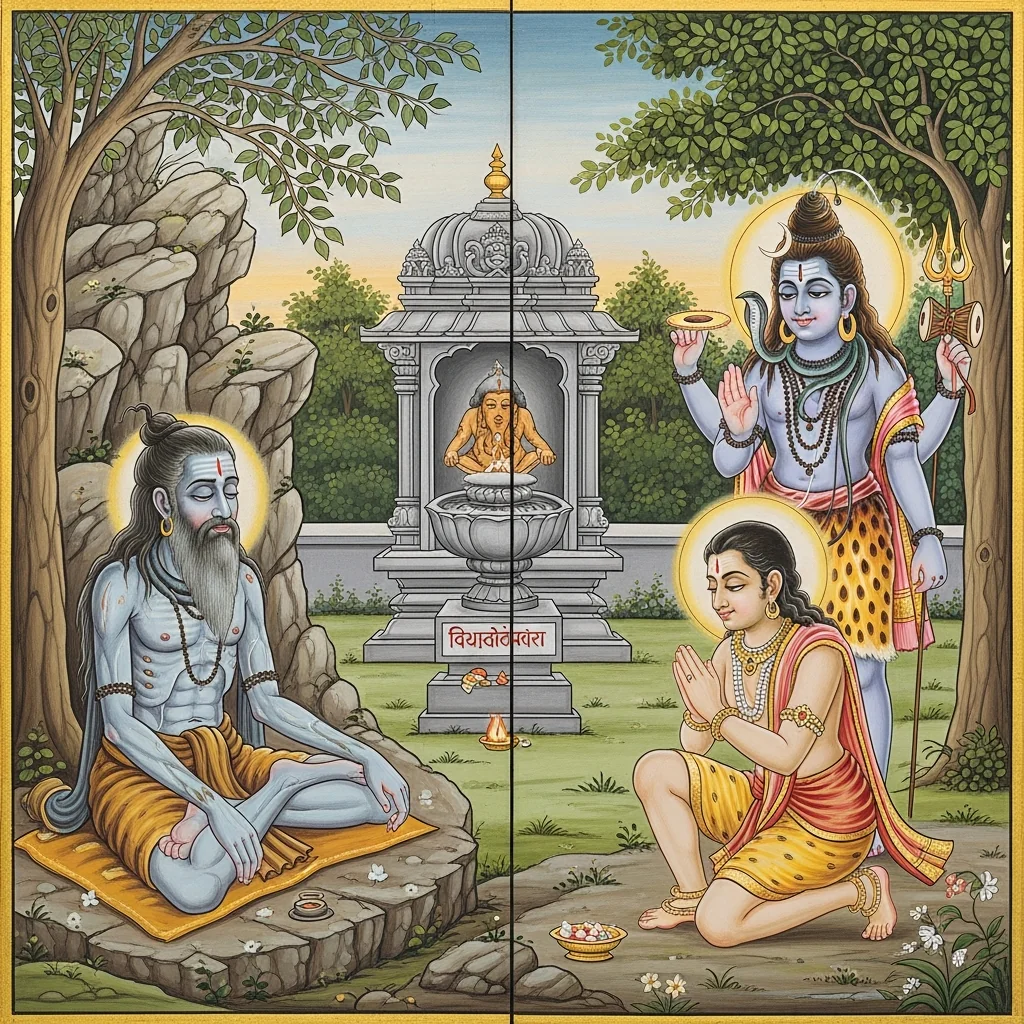
Śukreśvara-māhātmya (Glory of the Liṅga Established by Śukra)
Chapter 48 presents a local shrine tradition within Prabhāsa-kṣetra. Īśvara instructs Devī about a liṅga established by Śukra (Bhārgava), located near the western landmark Vibhūtīśvara, and praises it as pāpa-haraṇa: sins are removed through darśana (devout seeing) and sparśa (reverent touch). The narrative recalls how Śukra attained the saṃjīvanī-vidyā through Rudra’s influence and severe tapas. In a striking episode, Śaṃbhu swallows Śukra for a divine purpose; Śukra continues his austerities within the Deity until Mahādeva is pleased and releases him—an origin account for the shrine’s name and sanctity. Prescriptions then follow: worship the liṅga with steady mind, perform japa of the Mṛtyuñjaya mantra to a lakh count, offer pañcāmṛta-abhiṣeka, and worship with fragrant flowers. The promised fruits are protection from death-related fear, freedom from sins, fulfillment of desired aims, and siddhi-like prosperities (aiśvarya/maṇimā and the like), granted in accordance with unwavering devotion.
Adhyaya 49
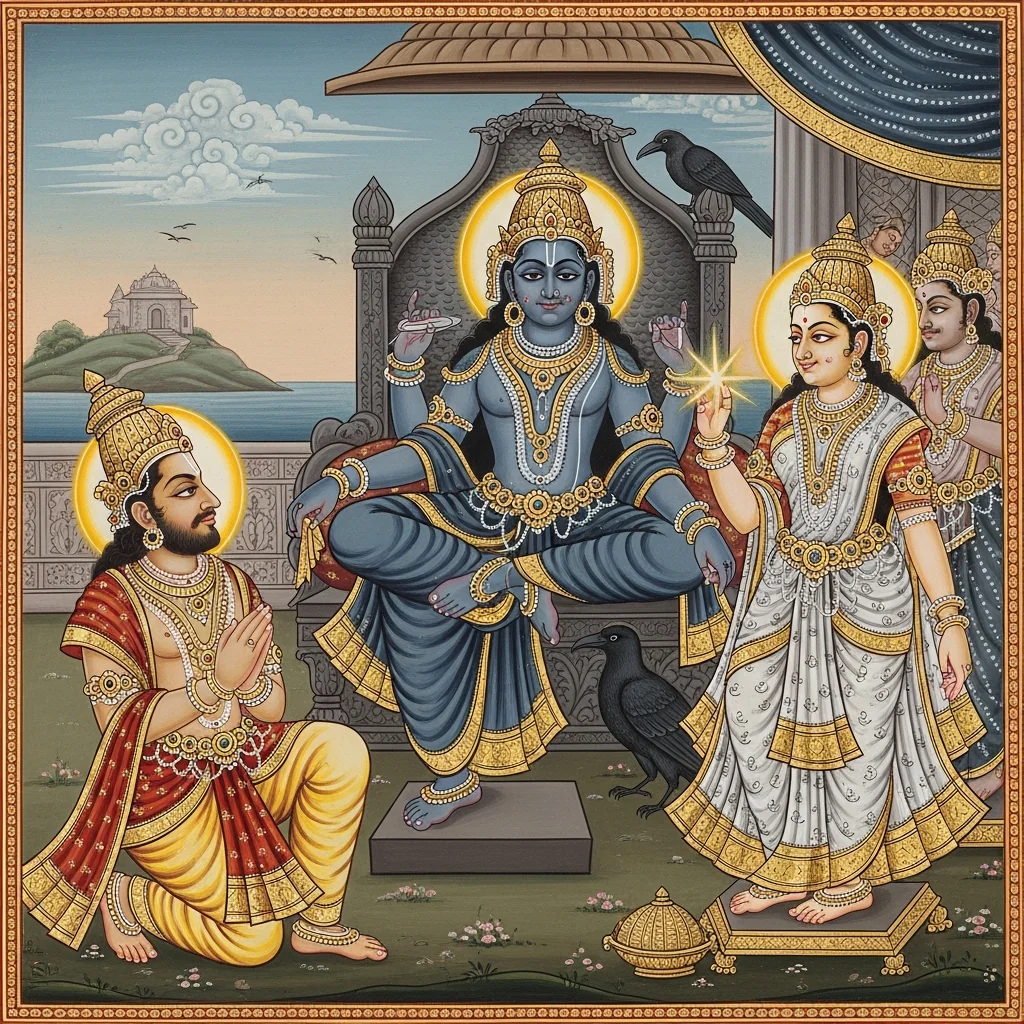
Śanaiścaraiśvara (Saurīśvara) Māhātmya and Daśaratha’s Śani-stotra | शनैश्चरैश्वरमाहात्म्यं तथा दशरथकृतशनीस्तोत्रम्
This chapter, framed as an Īśvara–Devī Śaiva discourse, first situates the great liṅga-shrine called Śanaiścaraiśvara/Saurīśvara within the sacred landscape of Prabhāsa. The liṅga is praised as a “mahāprabhā” power-center that pacifies grave wrongdoing and fear, and Śani’s exalted standing is explicitly linked to his devotion to Śambhu. It then prescribes a regulated Saturday observance: worship with śamī leaves and food-offerings (tila, māṣa, guḍa, odana), and a dāna injunction to gift a black bull to a worthy recipient. The narrative core recounts King Daśaratha’s response to an astrologically foretold crisis—Śani’s approach to Rohiṇī and the dreaded “śakaṭa-bheda” omen threatening drought and famine. Told the configuration is otherwise unresolvable, the king boldly intervenes, journeys to the stellar sphere, confronts Śani in a weapon-like stance, and wins boons through valor and austerity. Daśaratha asks that Śani not harm Rohiṇī, not break the “śakaṭa” omen, and not cause a twelve-year famine; Śani grants these requests. The chapter preserves Daśaratha’s Śani-stotra, an extended praise of Śani’s formidable form and his power to bestow or remove sovereignty, followed by Śani’s conditional assurance: those who recite the hymn with worship and folded hands are protected from Śani’s affliction and even other planetary troubles at key astrological junctures (birth-star, lagna, daśā/antardaśā). A concluding phalāśruti declares that Saturday-morning recitation and devotional remembrance relieve graha-born distress and fulfill one’s aims.
Adhyaya 50
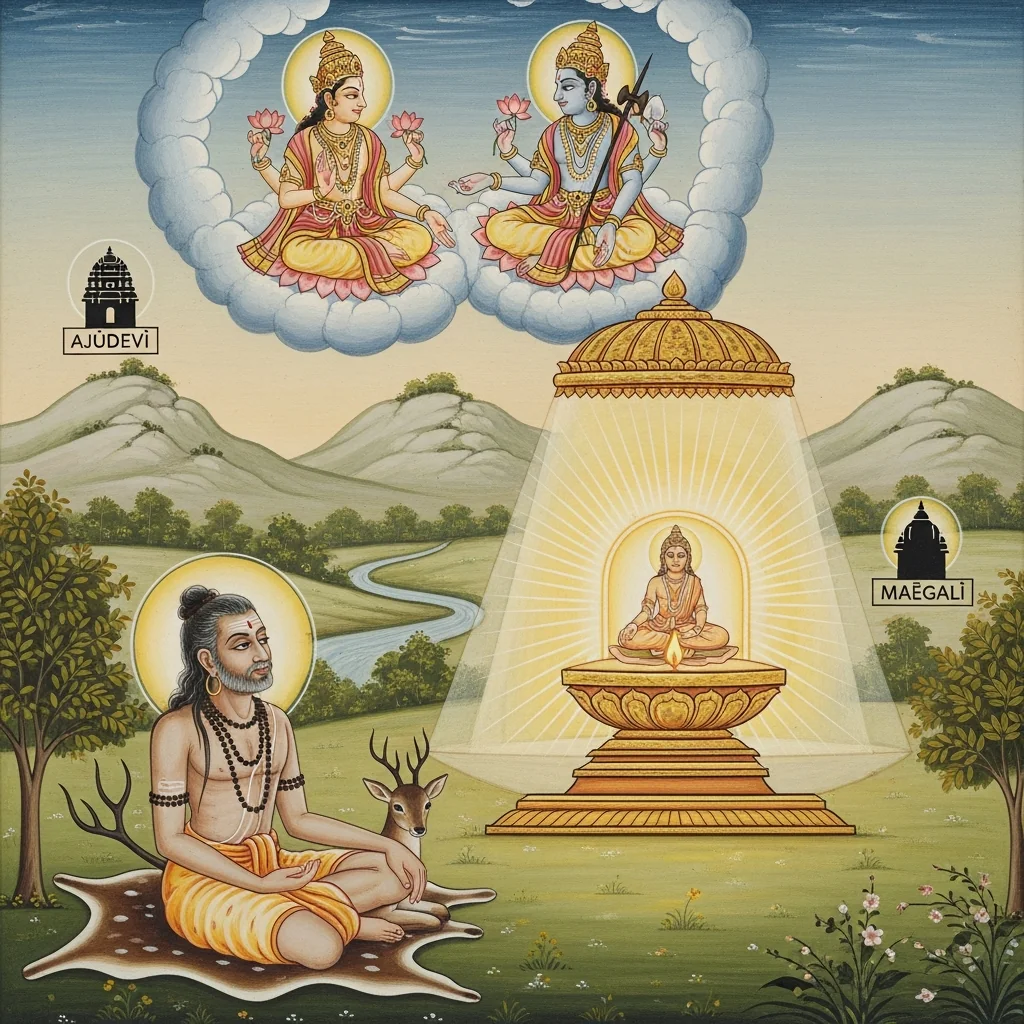
राह्वीश्वरमाहात्म्यवर्णनम् | Rāhvīśvara Māhātmya (The Glory of Rāhu-established Īśvara)
Chapter 50 records a site-centered theological dialogue in which Īśvara tells Devī of a supremely potent liṅga established by Rāhu (Svabhānu/Saiṃhikeya). The shrine is located in the vayavya (northwest) direction—near Maṅgalā, north of Ajādevī, and close to seven “dhanus” (bow) markers. Its origin is then given: the formidable asura Svabhānu performs intense tapas for a thousand years to propitiate Mahādeva, who finally manifests and is installed as a liṅga, the “lamp of the world” (jagaddīpa). The phalaśruti declares that faithful worship and proper darśana dissolve even grievous sins, including brahmahatyā-type wrongdoing, and bestow auspicious embodied results—freedom from blindness, deafness, muteness, disease, and poverty—followed by prosperity, beauty, fulfillment of aims, and deva-like enjoyment. The closing verse places the chapter within the Skanda Purāṇa’s Prabhāsa Khaṇḍa, in the Prabhāsa Kṣetra Māhātmya.
Adhyaya 51
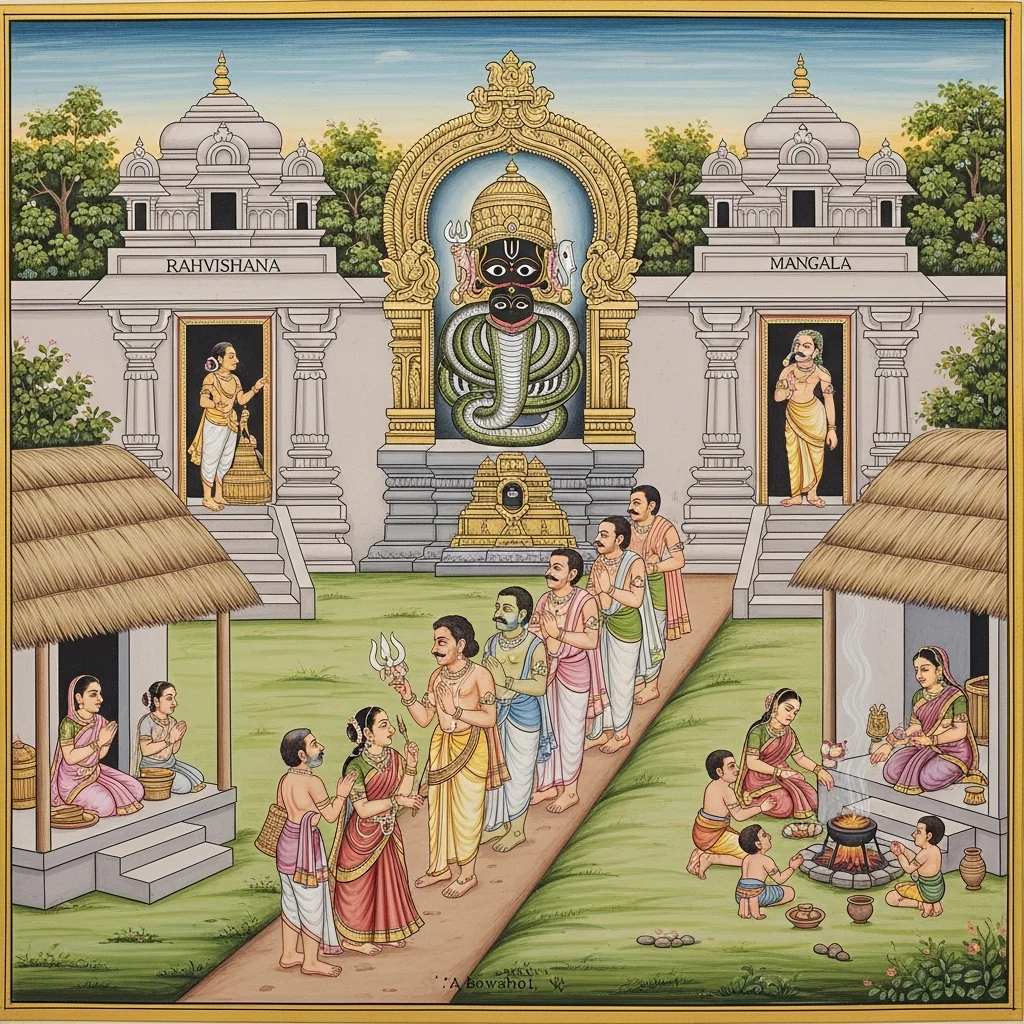
केत्वीश्वरमाहात्म्यवर्णन (Ketu-linga / Ketvīśvara Māhātmya Description)
This adhyāya gives Īśvara’s topographic and ritual account of Ketuliṅga (Ketvīśvara) in the sacred region of Prabhāsa. The shrine is located by relational geography—north of Rāhvīśāna and south of Maṅgalā—with the added measure of “a bowshot” to guide pilgrims. Ketu is then portrayed as a formidable graha with vivid iconographic traits, and his austerities for a hundred divine years are narrated, ending in Śiva’s grace and the grant of lordship over many grahas. The chapter prescribes devout worship of Ketuliṅga—especially during Ketu’s ominous rise and in severe planetary afflictions—offering flowers, fragrances, incense, and varied naivedya according to proper procedure. Its stated fruit is the pacification of planetary distress and the destruction of sins. Finally, Ketuliṅga is set within a wider framework of nine graha-liṅgas and fourteen āyatanas in all, affirming that regular darśana removes fear of affliction and supports the well-being of the household.
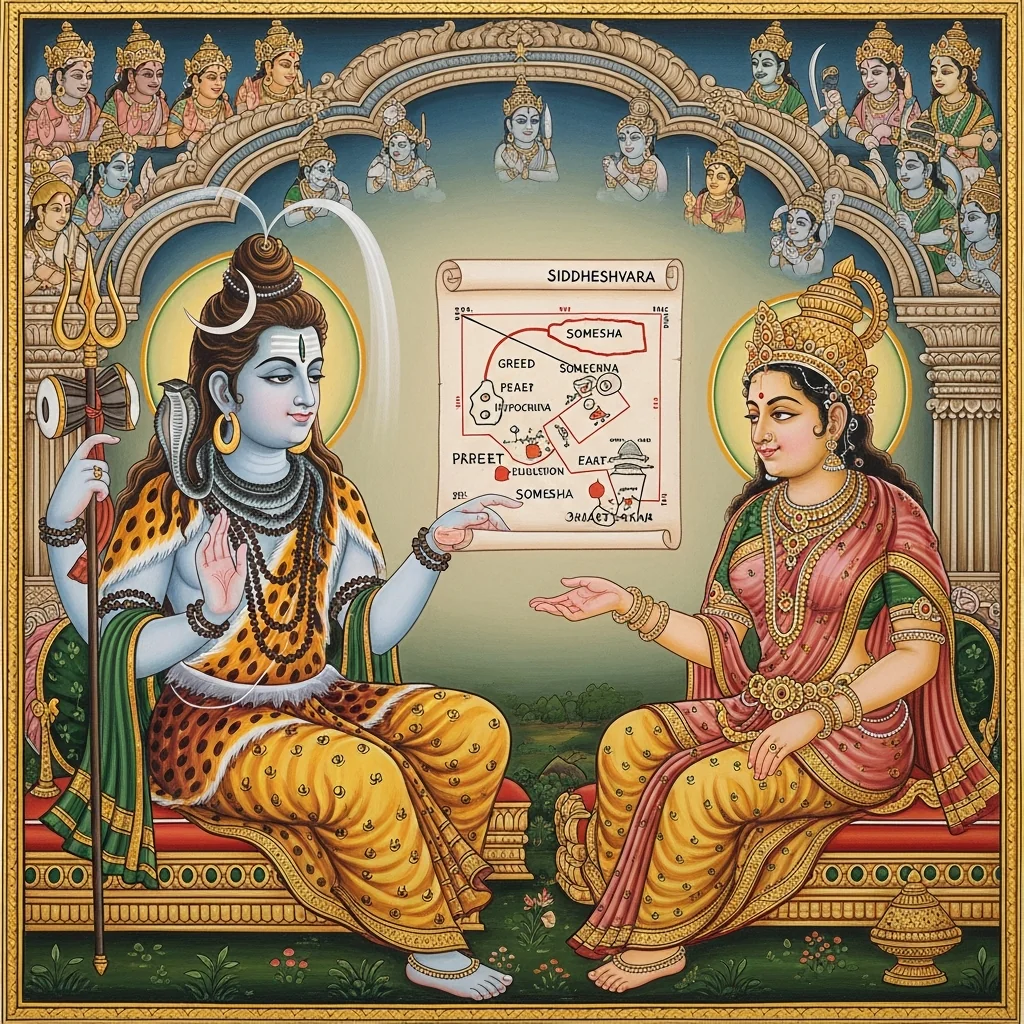
Adhyaya 52
सिद्धेश्वरमाहात्म्यवर्णनम् / The Glorification of Siddheśvara
Īśvara instructs Devī about a set of “five Siddha-liṅgas,” declaring that their darśana guarantees the successful completion of human pilgrimage (yātrā-siddhi). The chapter then identifies Siddheśvara’s location by direction—near Somēśa in a specified quarter—placing Siddheśvara in the eastern sector relative to a named landmark. Reverent approach (abhigamana) and worship (arcana) are praised as efficacious, granting aṇimā and other siddhis; the devotee is freed from sins and attains Siddha-loka. A key teaching lists inner “vighnas” (obstacles)—desire, anger, fear, greed, attachment, envy, hypocrisy, sloth, sleep, delusion, and egoism—as impediments to siddhi; worship of Siddheśvara is said to dissolve them for residents and visitors of the kṣetra, inspiring disciplined pilgrimage and steady arcana. The chapter concludes by affirming this account as a pāpa-nāśana text for hearing and as a bestower of rightful aims through devotion.
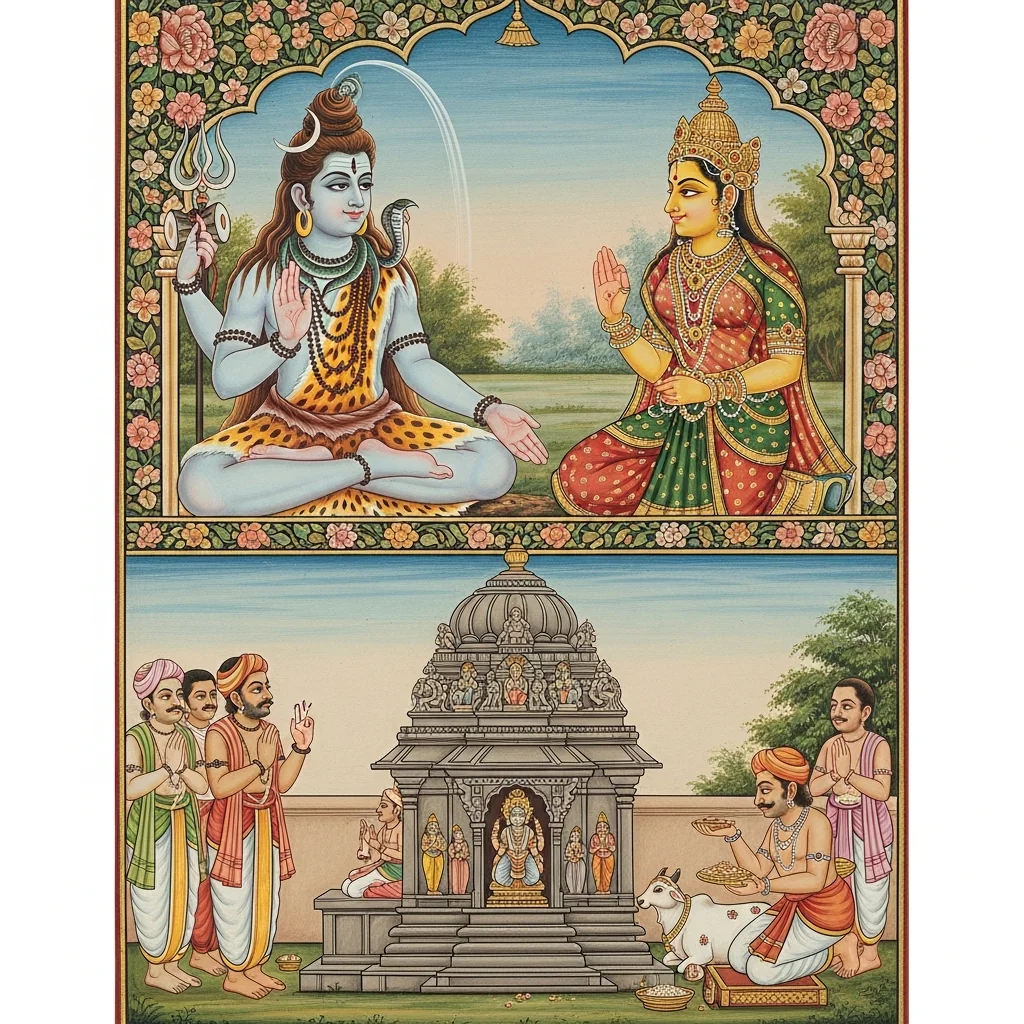
Adhyaya 53
कपिलेश्वरमाहात्म्यवर्णनम् (Kapileśvara Māhātmya—Account of the Glory of Kapileśvara)
Set within a Śiva–Devī dialogue, the chapter directs the pilgrim to Kapileśvara, an eminent liṅga situated not far to the east along the stated route. This liṅga is praised as mahāprabhāva, and it is explicitly declared that mere darśana—beholding it in reverence—destroys demerit. The shrine’s sanctity is traced to the austerities of the royal sage Kapila, who established (pratiṣṭhā) Mahādeva there and attained the highest siddhi. The text further affirms unbroken divine proximity at this liṅga (deva-sānnidhya), underscoring the site’s enduring ritual efficacy. A calendrical observance is then prescribed: on the bright fortnight’s fourteenth lunar day (śukla-caturdaśī), a disciplined devotee who beholds Soma/Someśa as Kapileśvara seven times for the welfare of all worlds gains merit equal to the gift of a cow (go-dāna-phala). Finally, one who donates a tila-dhenu—a symbolic cow made of sesame—at that tīrtha with focused attention is promised residence in heaven for as many yugas as there are sesame seeds, as the chapter’s phalaśruti and ethical incentive.
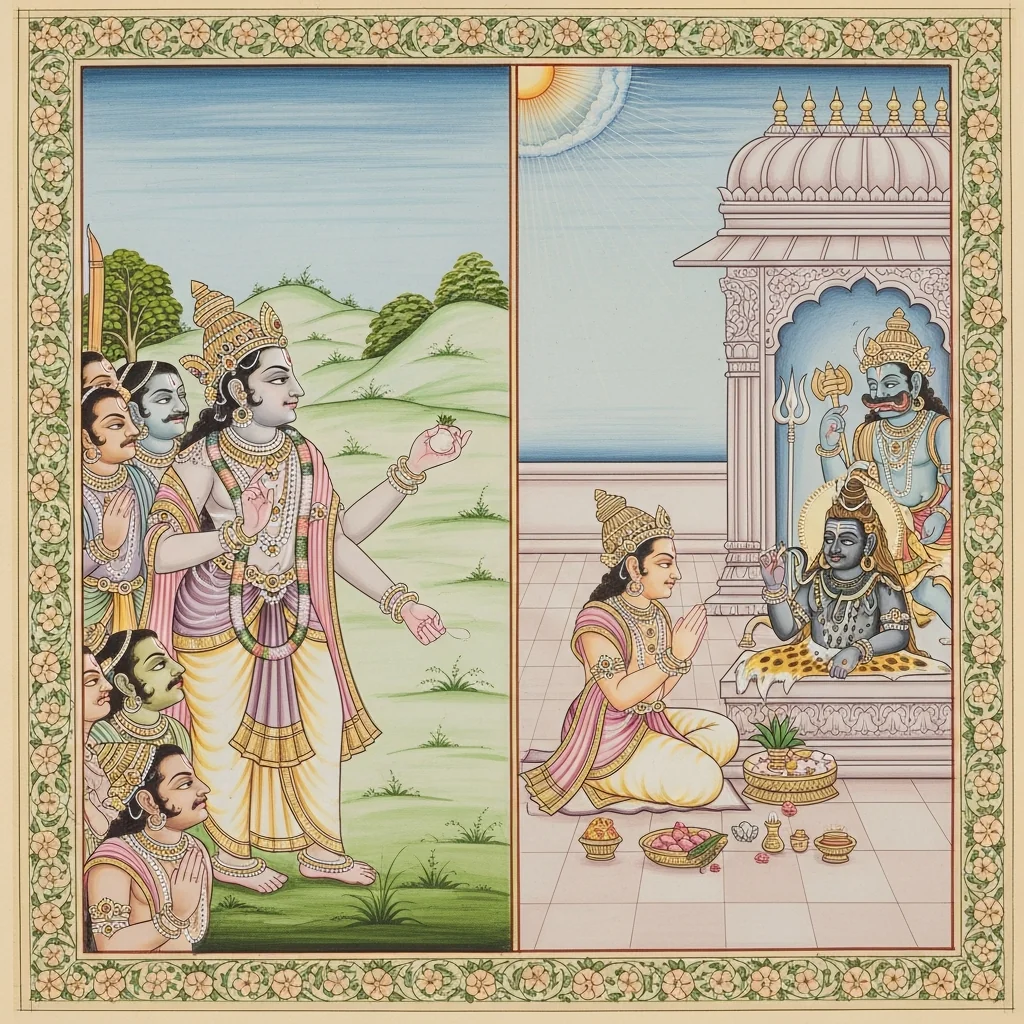
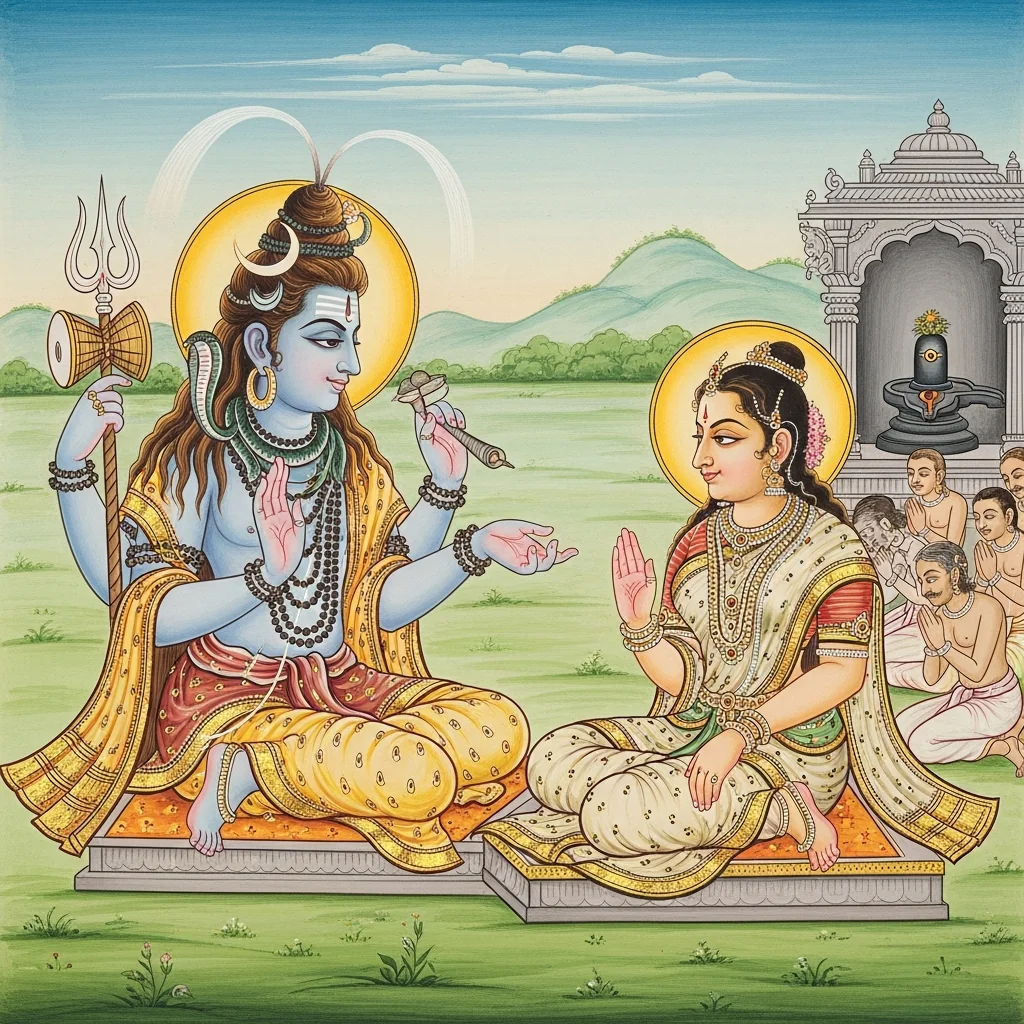
Adhyaya 54
गन्धर्वेश्वरमाहात्म्यवर्णनम् | The Māhātmya of Gandharveśvara (Ghanavāheśvara Liṅga)
Īśvara recounts to Devī the sacred account of a local shrine in Prabhāsa-kṣetra, directing pilgrims to the “excellent Gandharveśvara” situated north of the abode of Daṇḍapāṇi. The legend concerns the Gandharva king Ghanavāha and his daughter Gandharvasenā: through pride in her beauty she is cursed by Śikhaṇḍin and his gaṇa, but later Gośṛṅga Ṛṣi grants her favor and relief through a Monday vow (somavāra-vrata) and devoted worship of Soma/Śiva. After severe tapas in the kṣetra, Ghanavāha establishes a liṅga, and his daughter also establishes a liṅga there. The worshipful form is named Ghanavāheśvara, and careful adoration near Daṇḍapāṇi is said to lead the pure, disciplined devotee to Gandharva-loka. A phalaśruti follows: the place is praised as a “third” power that destroys sin and increases merit; bathing at Agni-tīrtha and worshiping the Gandharva-venerated liṅga are extolled, and nirvāṇa is especially linked with the coming of uttarāyaṇa. Hearing and honoring this māhātmya is declared to free one from great fear.
Adhyaya 55
Vimaleśvara-māhātmya (विमलेश्वरमाहात्म्य) — The Glory of Vimaleśvara
Īśvara instructs the Goddess to go to Vimaleśvara, a shrine not far away, located with reference to Gaurī and the nairṛtya (south‑western) direction. It is praised as a pāpa-praṇāśana, a sin-destroying holy locus, effective for women and men alike, even for those suffering bodily decline. Worship performed with devotion (bhakti-yukta arcana) is taught as the means: through it suffering ceases and one attains a nirmala, purified state. The chapter also explains the site’s fame by linking it to Gandharva-senā and the figure Vimalā, hence the liṅga is renowned on earth as Vimaleśvara. It concludes by marking this account as the fourth in a sequence of māhātmyas and by emphasizing its power to destroy all sins.
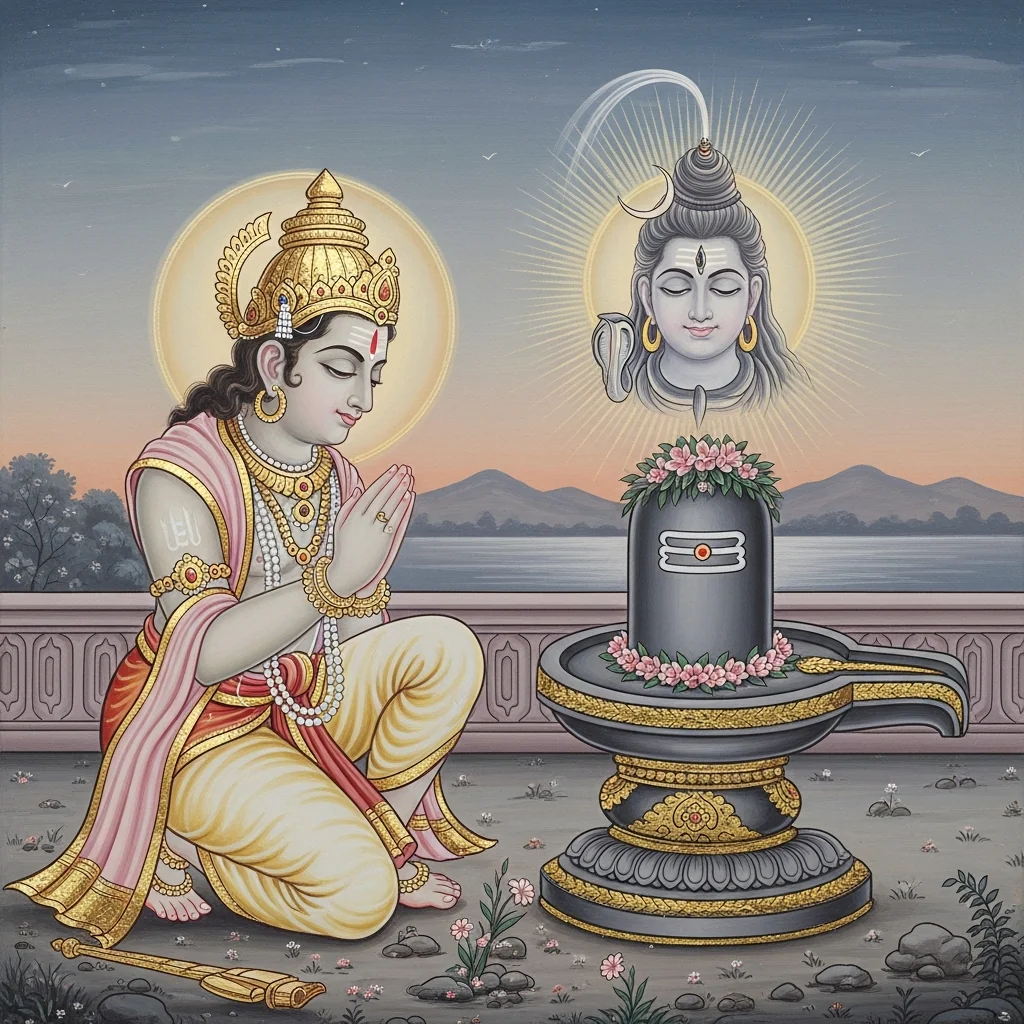
Adhyaya 56
धनदेश्वरमाहात्म्यवर्णनम् | Dhanadeśvara Māhātmya (Glory of Dhanadeśvara)
Īśvara describes a renowned siddha-liṅga called Dhanadeśvara, located in a specified sector—“to the south-west of Brahmā”—with an internal coordinate given as the sixteenth in the measure of “bows.” It is said to stand near another shrine, Rahuliṅga, and to have been established by Dhanada (Kubera), who undertook intense tapas, installed the liṅga by proper rite, and worshipped it for a long time. By Śiva’s grace Dhanada attains exalted rank and the lordship of Alakā. Remembering former conditions and recognizing the potency of Śivarātri and the sacred Prabhāsa field, he returns, perceives the site’s extraordinary power, and further confirms Śaṅkara’s manifested presence through austerity and devotion. The chapter ends with practical devotional counsel: worship with pañcopacāra and fragrant offerings is said to secure lasting prosperity in one’s lineage, grant invincibility and the humbling of enemies’ pride, and prevent the rise of poverty for those who carefully hear and honor this account.
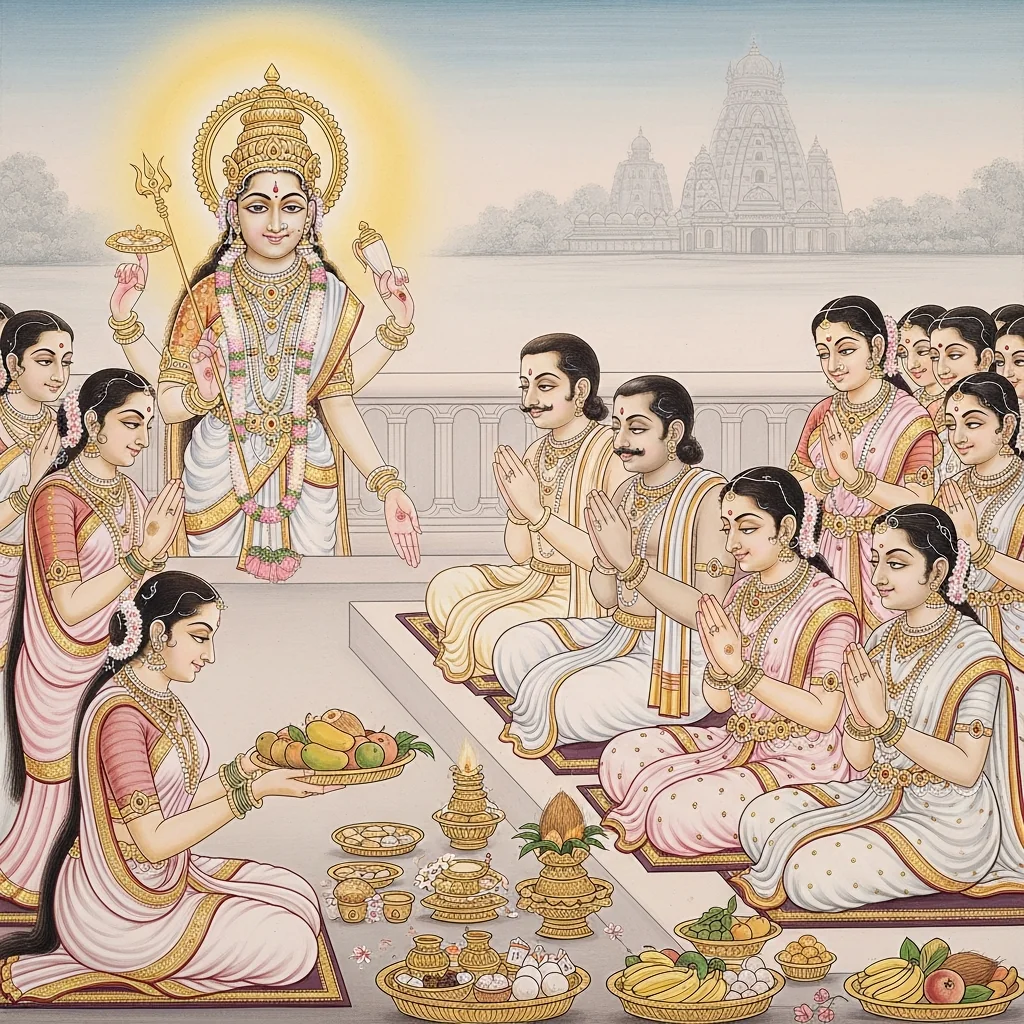
Adhyaya 57
वरारोहामाहात्म्यवर्णनम् / The Māhātmya of Varārohā (Umā as Icchā-Śakti) at Somēśvara
This chapter is framed as Īśvara’s theological instruction to Devī. Continuing the teaching on sacred liṅgas, it introduces a triad of śakti—icchā (will), kriyā (action), and jñāna (knowledge)—and lays down a ritual order: after worshipping the prescribed liṅgas according to one’s capacity, one should then worship the three śaktis. Icchā-śakti is specifically localized in Prabhāsa-kṣetra as Varārohā, associated with the Somēśvara region, and praised through a narrative on the origin of a vow. The legend tells of twenty-six wives abandoned by Soma who undertake austerities in the auspicious Prabhāsa field. Gaurī/Parvatī appears, grants boons, and establishes a remedial religious observance meant to relieve women’s misfortune. The observance is named a Gaurī-vrata to be performed on the third lunar day (tṛtīyā) in Māgha, involving darśana and worship, with a pattern of “sixteen” gifts/offerings—fruits, edible items, cooked foods—and the honoring of couples. The phalāśruti promises the removal of inauspiciousness, prosperity, and the fulfillment of desired aims, concluding that worship of Varārohā at Somēśvara destroys sins and poverty.
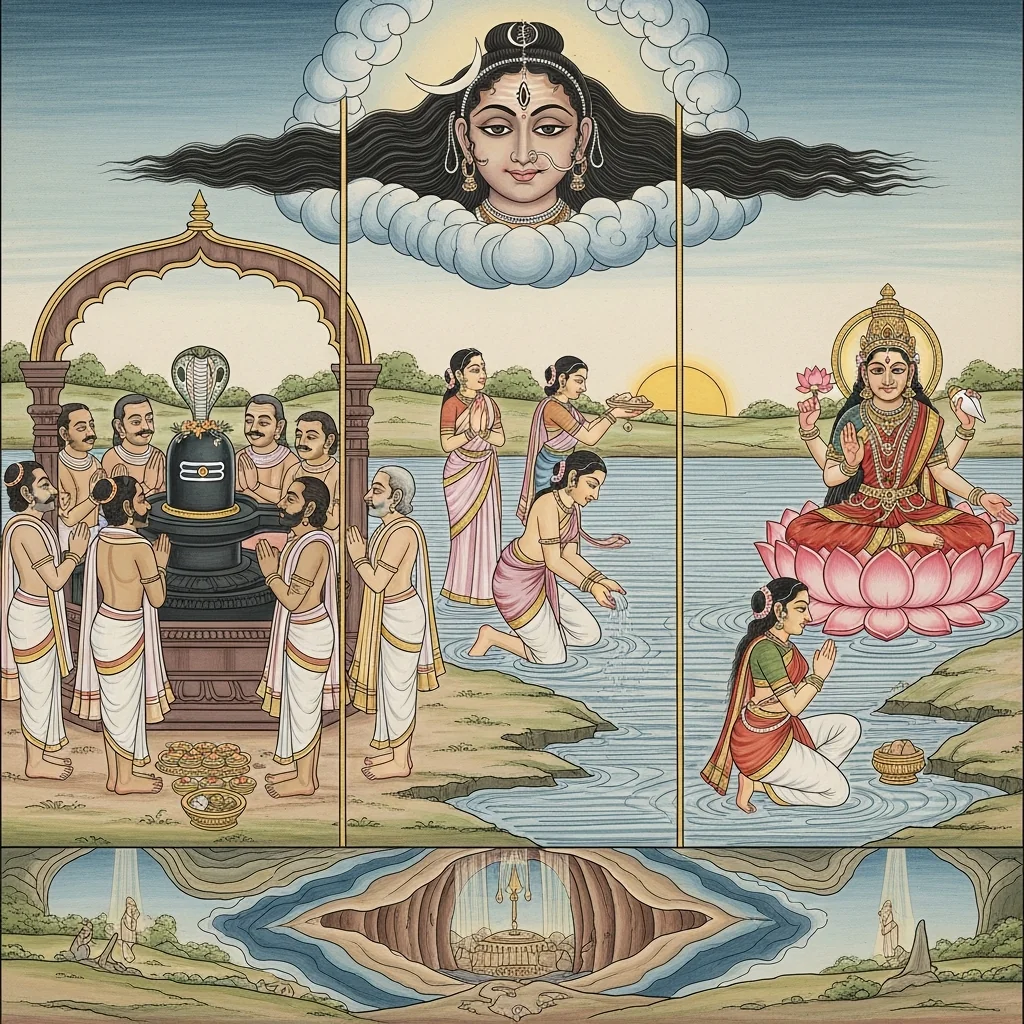
Adhyaya 58
अजापालेश्वरीमाहात्म्यवर्णनम् | Ajāpāleśvarī Māhātmya (Glorification of Ajāpāleśvarī)
Īśvara describes a second manifestation of Śakti, kriyātmikā—effective divine agency—established in Prabhāsa and pleasing to the gods. Between Somēśa and Vāyu lies a yoginī-venerated pīṭha near a great pātāla-vivara (subterranean fissure), where hidden treasures are spoken of—nidhis, divine medicines, and rasāyana—granted to devoted worshippers. The Goddess there is known as Bhairavī. In Tretā-yuga, King Ajāpāla, stricken with disease, worships Bhairavī for five hundred years. Pleased, the Devī removes all bodily ailments; the diseases depart his body in the form of goats. He is commanded to protect them, and thus his epithet Ajāpāla and the Goddess’s name Ajāpāleśvarī are established for the span of the four yugas. Ritual observances are then taught: worship on aṣṭamī and caturdaśī yields heightened prosperity. On Ashvayuk-śukla-aṣṭamī one performs three pradakṣiṇās with Somēśvara as the center, then bathes and worships the Goddess separately, gaining freedom from fear and grief for three years. Women facing infertility, illness, or misfortune are enjoined to observe a navamī vow before the Devī. The chapter extends into royal genealogy and a political myth: Ajāpāla, linked to solar lineages, becomes a mighty ruler. When Rāvaṇa subdues the deities, Ajāpāla dispatches “Jvara” (fever personified) to afflict him, forcing retreat. The conclusion affirms Ajāpāleśvarī’s power to pacify diseases and destroy obstacles, recommending worship with gandha, dhūpa, ornaments, and garments, and presenting the account as a complete alleviation of suffering and sin.
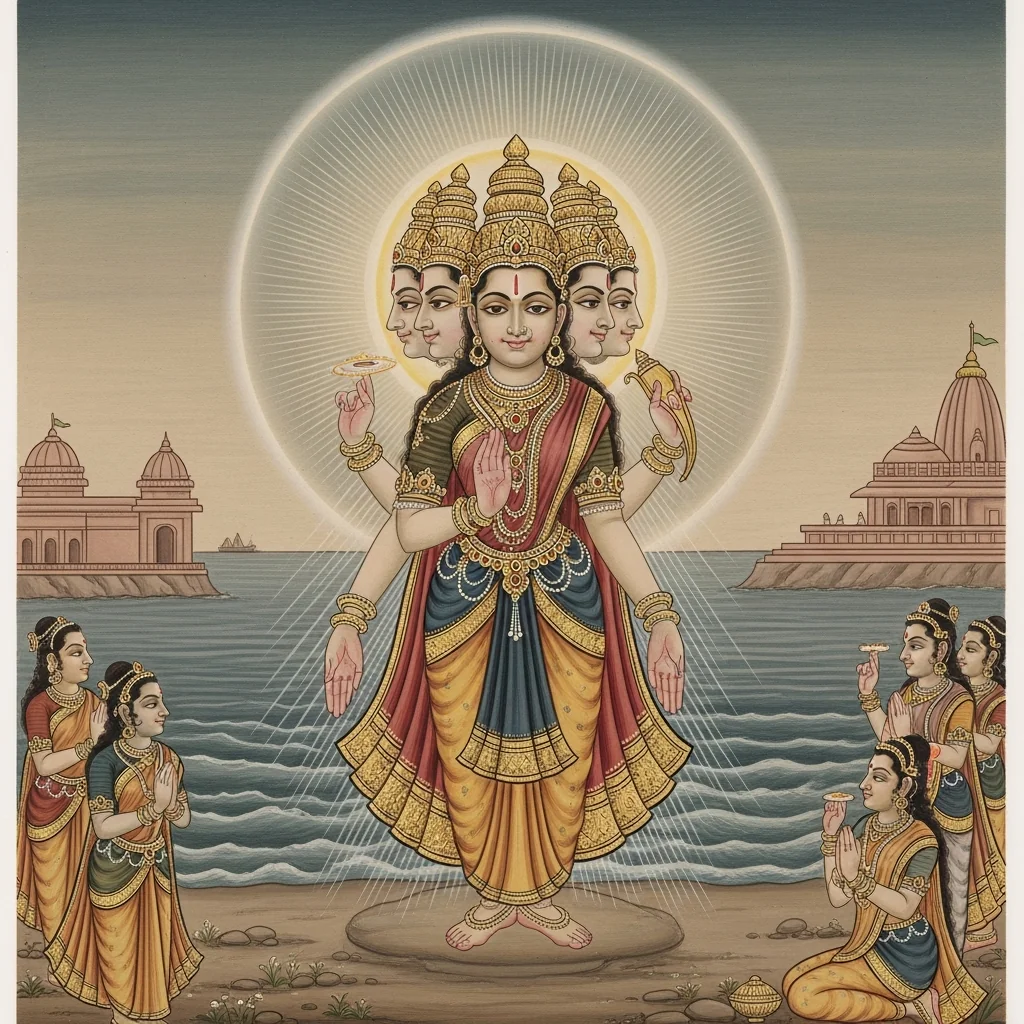
Adhyaya 59
अजादेवीमाहात्म्यवर्णनम् | The Māhātmya of Ajā Devī (Chapter 59)
This chapter unfolds as a Śiva–Devī theological dialogue, joining subtle doctrine to the sacred landscape of Prabhāsa and to ritual merit. Īśvara proclaims a “third” knowledge-power (jñāna-śakti), Śiva-pervaded and abiding in Prabhāsa, praised as a remover of poverty. The Devī then asks about Śiva’s faces: the name of the sixth face and how Ajā Devī arises from it. Īśvara discloses an esoteric account: in former times there were seven faces; the “Ajā” face is linked with Brahmā and the “Picu” face with Viṣṇu, so in the present dispensation Śiva is manifest as pañcavaktra, the five-faced Lord. From the Ajā-face, Ajā Devī appears amid the fierce battle with Andhāsura—bearing sword and shield, riding a lion, and attended by hosts of divine powers. The routed demons are driven toward the southern ocean and into Prabhāsa; after their destruction, the Devī recognizes the kṣetra’s sanctity and remains there, precisely located near Somēśa and in relation to Saurīśa. The phalaśruti follows: darśana bestows auspicious qualities across seven births; offering music and dance frees one’s lineage from misfortune; a ghee lamp with a red wick grants extended auspiciousness in proportion to the wick’s threads; and recitation or listening—especially on the lunar third day (tṛtīyā)—fulfills desired aims. The closing instruction presents worship of these Śaktis as a preparation for worship of Somēśa, for pilgrims seeking the complete fruit of their journey.
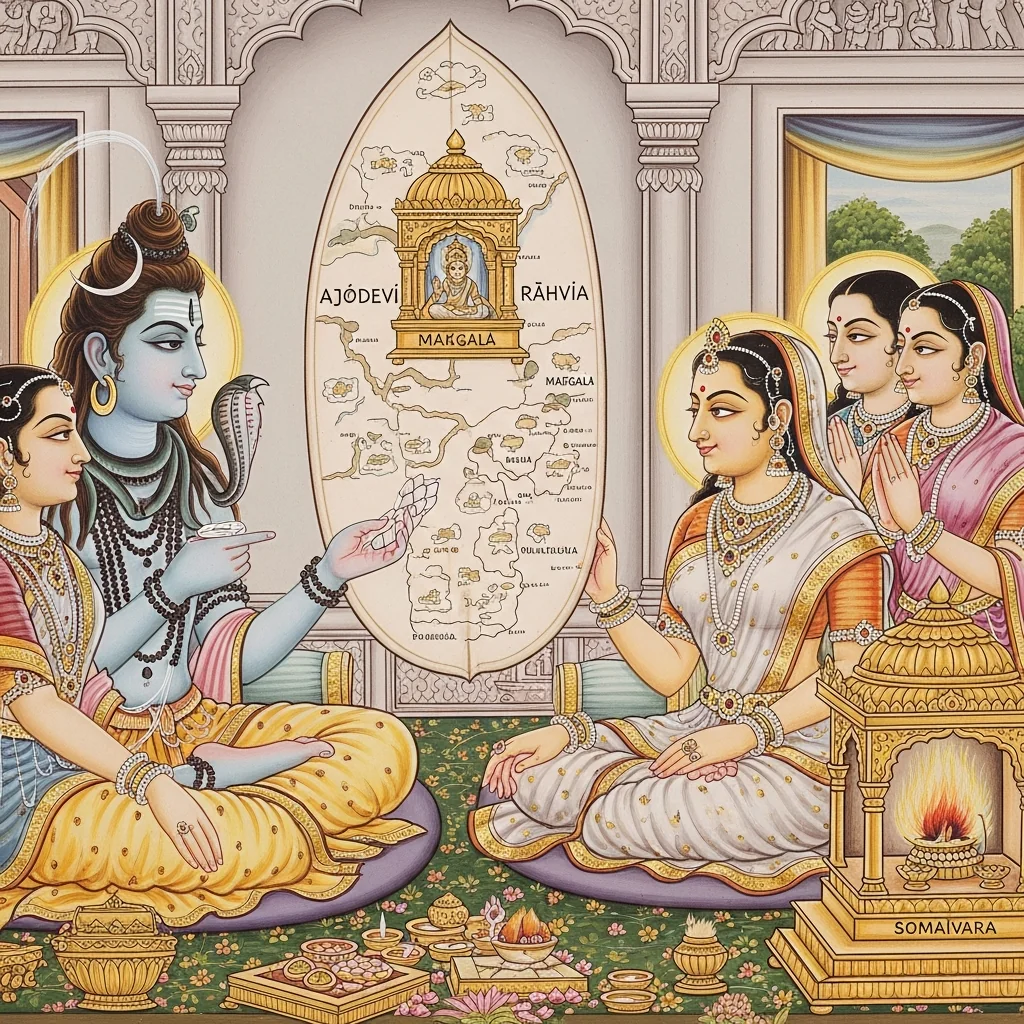
Adhyaya 60
मङ्गलामाहात्म्यवर्णनम् (Mangalā Devī Māhātmya: Account of the Glory of Mangalā)
This chapter unfolds as a question-led theological dialogue between Devī and Īśvara. Īśvara first names three Prabhāsa-kṣetra dūtīs—guardian female powers significant for pilgrims seeking the fruits of the Prabhāsa-yātrā: Mangalā, Viśālākṣī, and Catvara-devī. When Devī asks for exact details of their stations and modes of worship, Īśvara identifies them as śakti-forms: Mangalā as Brāhmī, Viśālākṣī as Vaiṣṇavī, and Catvara-devī as a Raudrī-śakti. Īśvara then anchors Mangalā’s location: north of Ajādevī and not far south of Rāhvīśa. Her name is explained through an origin account tied to Somadeva’s rite at Somēśvara, where she is said to have bestowed auspiciousness upon Brahmā and other deities; thus she is praised as Sarva-māṅgalya-dāyinī, “the giver of all auspiciousness.” A practical phala is also taught: worship on the third day (tṛtīyā) destroys inauspiciousness and sorrow. Merit-making acts are recommended—feeding a married couple (dampatī-bhojana), gifting fruits along with garments, and taking clarified butter (ghṛta) with pṛṣad as a purificatory observance. The chapter concludes by affirming Mangalā’s māhātmya as the destroyer of all sins (sarva-pātaka-nāśana).
Adhyaya 61
ललितोमाविशालाक्षी-माहात्म्यवर्णनम् (Lalitā-Umā and Viśālākṣī: Account of the Sacred Greatness)
Īśvara delivers a site-bound theological teaching set in the eastern quarter near the shrine of Śrīdaittyasūdana, where a goddess is revered as the kṣetra-dūtī (protective emissary of the sacred field) with a Vaiṣṇavī nature. The chapter recalls a conflict in which mighty daityas, driven by Viṣṇu, move southward and wage a prolonged battle with many kinds of divine weapons. Seeing how hard they are to subdue, Viṣṇu invokes Bhairavī-Śakti, praised as Mahāmāyā, the radiant power. She manifests at once; upon beholding Viṣṇu her eyes expand in a visionary way, and thus she is known as Viśālākṣī, established there as the destroyer of hostile forces. The discourse then connects this manifestation with the paired worship of Umā (Umā-dvaya) in relation to Somēśvara and Daittyasūdana, prescribing a pilgrimage order: first Somēśvara, then Śrīdaittyasūdana. A calendrical observance is emphasized—worship on the third lunar day of Māgha—granting lineage continuity (freedom from childlessness across generations) and, for the daily devotee, enduring health, happiness, and auspicious fortune. It ends with a brief phala-śruti: hearing this account removes demerit and fosters the growth of dharma.
Adhyaya 62
चत्वरादेवी-माहात्म्यवर्णनम् | The Māhātmya of Catvarā Devī (the Crossroads Goddess)
Chapter 62 gives a brief theological and sacred-geographical instruction in which Īśvara describes a third holy catvara (crossroads/courtyard node) dear to the deity, situated to the east of Lalitā at a measured distance of daśa-dhanvantara. There Īśvara installs a mighty protective Goddess—called Kṣetra-dūtī, Mahāraudrī, and Rudraśakti—for kṣetra-rakṣā, the guardianship of the sacred region. Her form is conveyed through her function: attended by multitudes of bhūtas, she moves through ruined houses, gardens, palaces, towers, roads, and every crossing, and by night patrols the center of the kṣetra. On Mahānavamī, any woman or man should worship her with varied offerings according to proper rite. The phalaśruti declares this māhātmya sin-destroying and prosperity-giving; when pleased, the Goddess grants desired aims. As a practical pilgrimage ethic, those seeking the fruit of yātrā should provide a meal for a married couple (dampatyoḥ-bhojana) at the site.
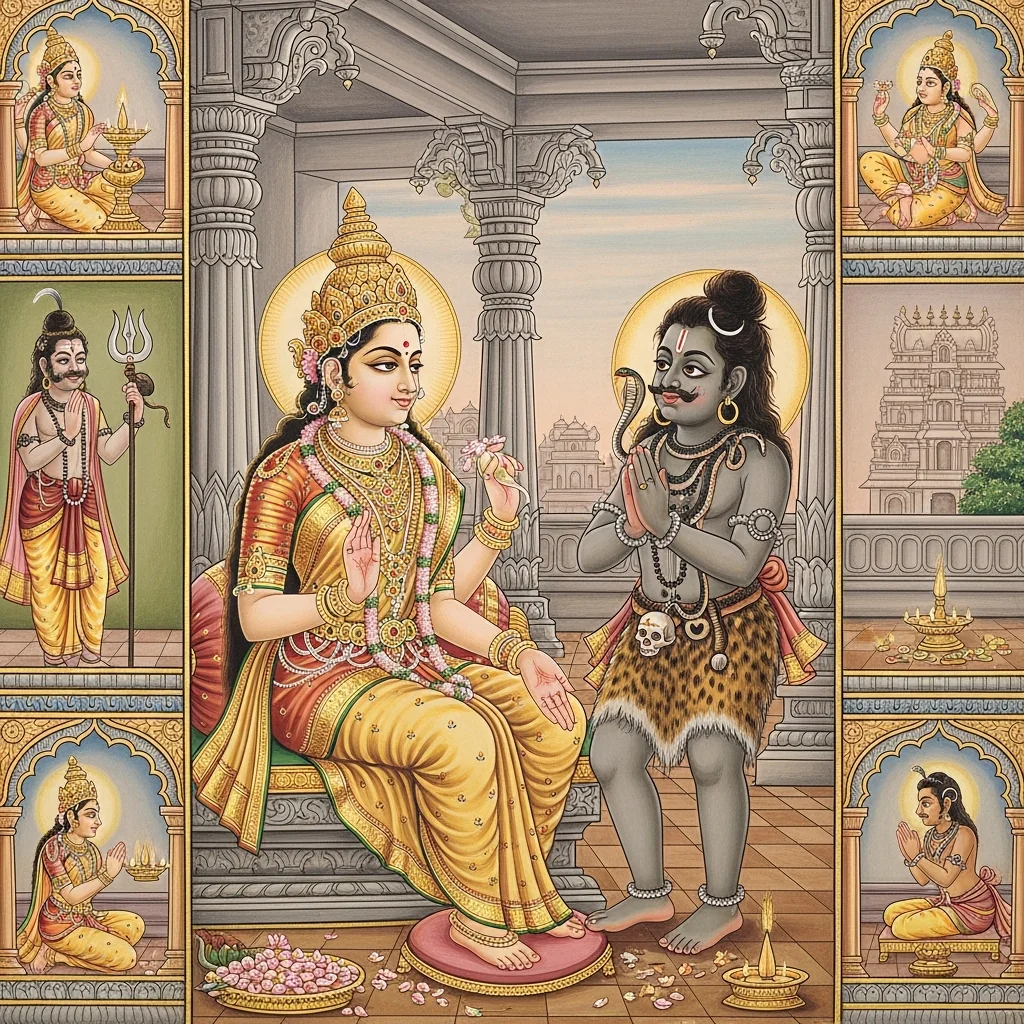
Adhyaya 63
भैरवेश्वरमाहात्म्यवर्णनम् | The Māhātmya of Bhairaveśvara (Chapter 63)
Chapter 63 records Īśvara’s instruction to Devī, directing her to the shrine of Bhairaveśvara, located not far to the south of Yogēśvarī. This liṅga is praised as removing all sins and bestowing divine prosperity and lordly power (divyaiśvarya). The sanctity of the site is grounded in an earlier myth: when Devī set out to destroy the demons, she summoned Bhairava and appointed him as her messenger (dūta). Through this appointment Devī is known as Śivadūtī, and later as Yogēśvarī, linking the Goddess’s epithets with the local landscape. Because Bhairava was commissioned there in messenger service, the liṅga became renowned as Bhairaveśvara. It is said to have been established by Bhairava and worshipped by both devas and daityas, showing its holiness acknowledged across worlds. The phalaśruti declares that one who worships it with devotion in Kārttikā according to rule, or continuously for six months, attains the desired fruit.
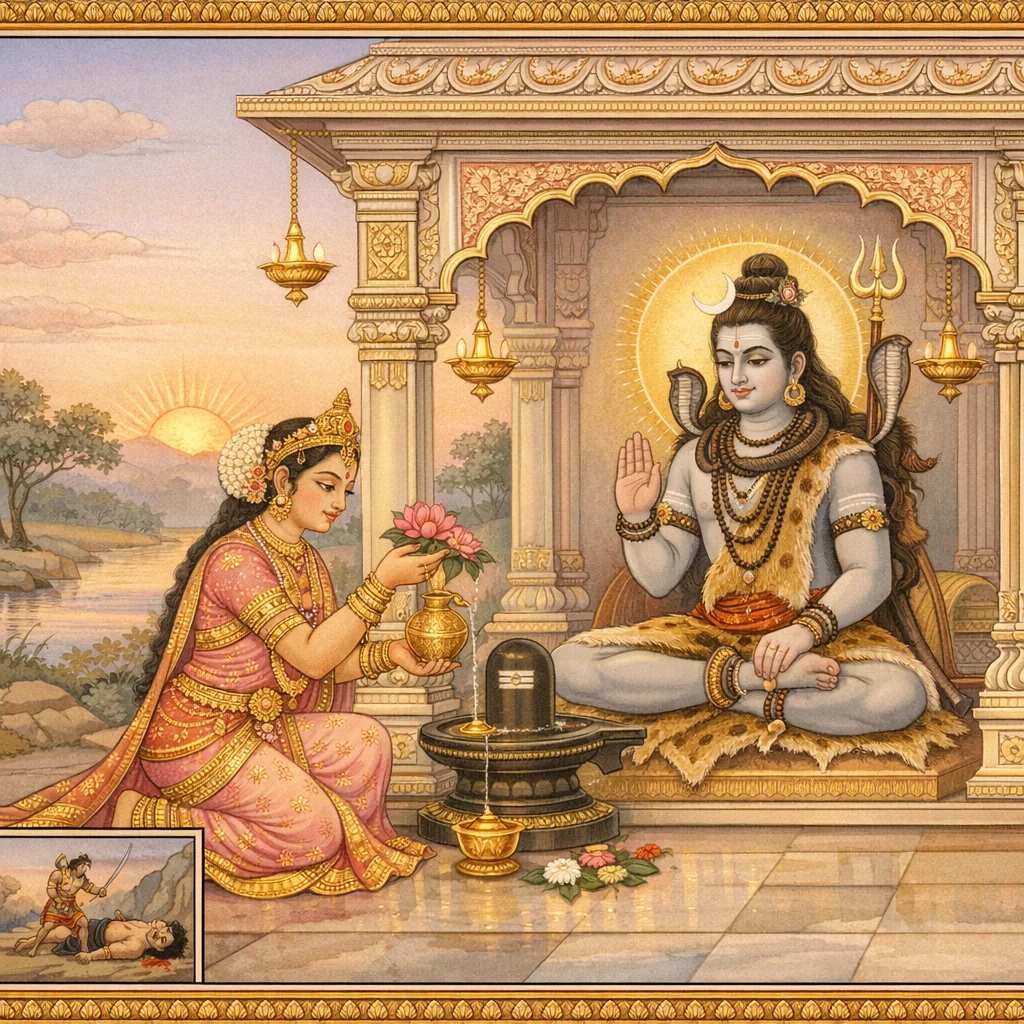
Adhyaya 64
लक्ष्मीश्वरमाहात्म्यवर्णनम् | Lakṣmīśvara Māhātmya (Account of the Glory of Lakṣmīśvara)
Chapter 64 records Īśvara’s account of a shrine in the eastern quarter of the Prabhāsa region, said to lie five dhanu away. The place is called Lakṣmīśvara and is praised as a destroyer of poverty and misfortune (dāridrya-augha-vināśana). An origin story is given: after hostile forces, the daityas, are slain, the goddess Lakṣmī is brought to this spot, and the divine name “Lakṣmīśvara” is said to have been established by the goddess herself through an act of consecration. The chapter then prescribes a devotional observance: worship of Lakṣmīśvara, performed according to proper procedure (vidhānataḥ) on Śrīpañcamī. The phalaśruti declares that Lakṣmī’s favor continues unbroken—the worshipper is not separated from Lakṣmī—for a vast, cosmically measured span, “as long as a manvantara.”
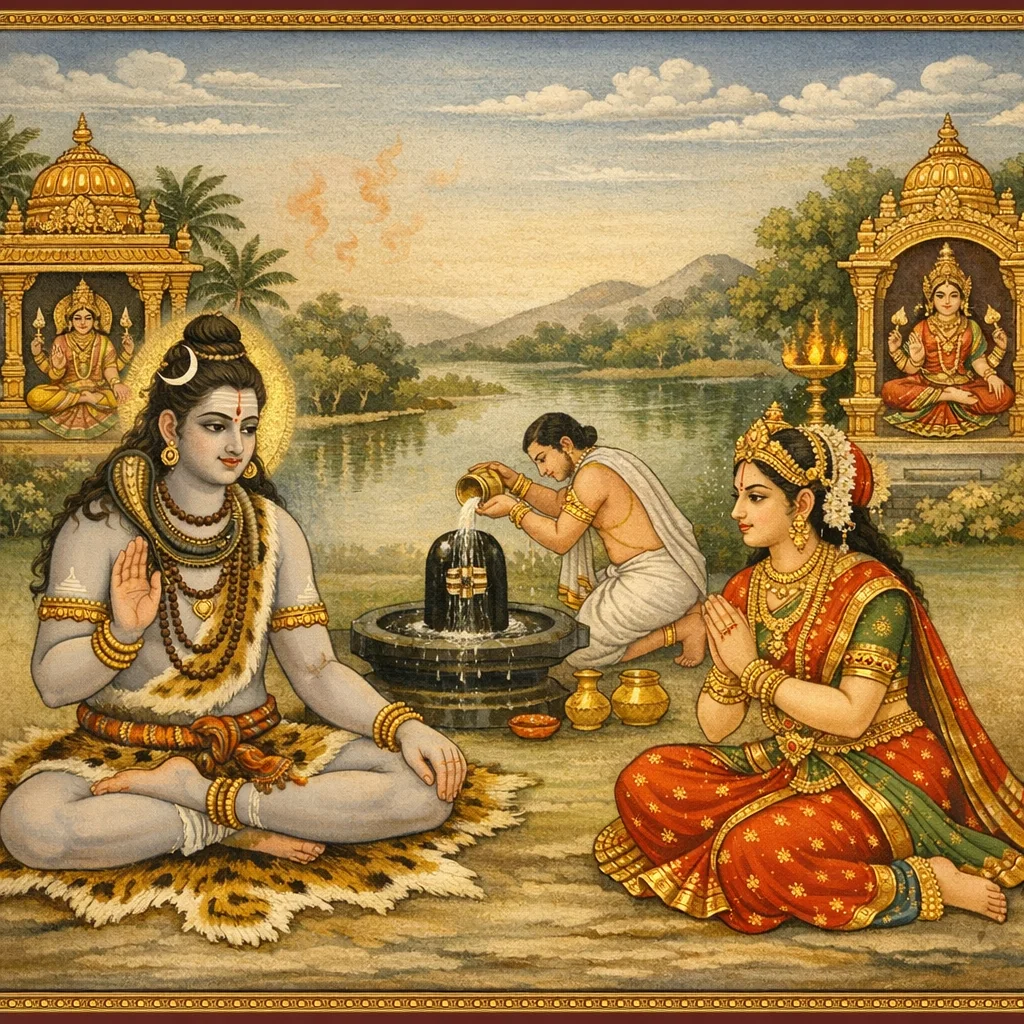
Adhyaya 65
वाडवेश्वरमाहात्म्यवर्णनम् | Vāḍaveśvara Liṅga — Description of its Māhātmya
This chapter is a brief Śaiva instruction: Īśvara speaks to Devī and directs the pilgrim to the Vāḍaveśvara-liṅga. Its position within Prabhāsa-kṣetra is given through sacred relational landmarks—north of Lakṣmīśa and south of Viśālākṣī—so the devotee may navigate the holy ground. An origin account follows: when Kāma (Kṛtasmarā) was burned, a mountain was leveled by the Vāḍavā fire, and in that setting Vāḍava installed this liṅga, marking the site as one of great power. The rite prescribed is worship according to rule, with a tenfold bathing/abhiṣeka of Śaṅkara, and a gift of curd (dadhi) to a Veda-proficient brāhmaṇa at that place. The phalaśruti promises attainment of Agni-loka and the full, properly completed fruit of pilgrimage.
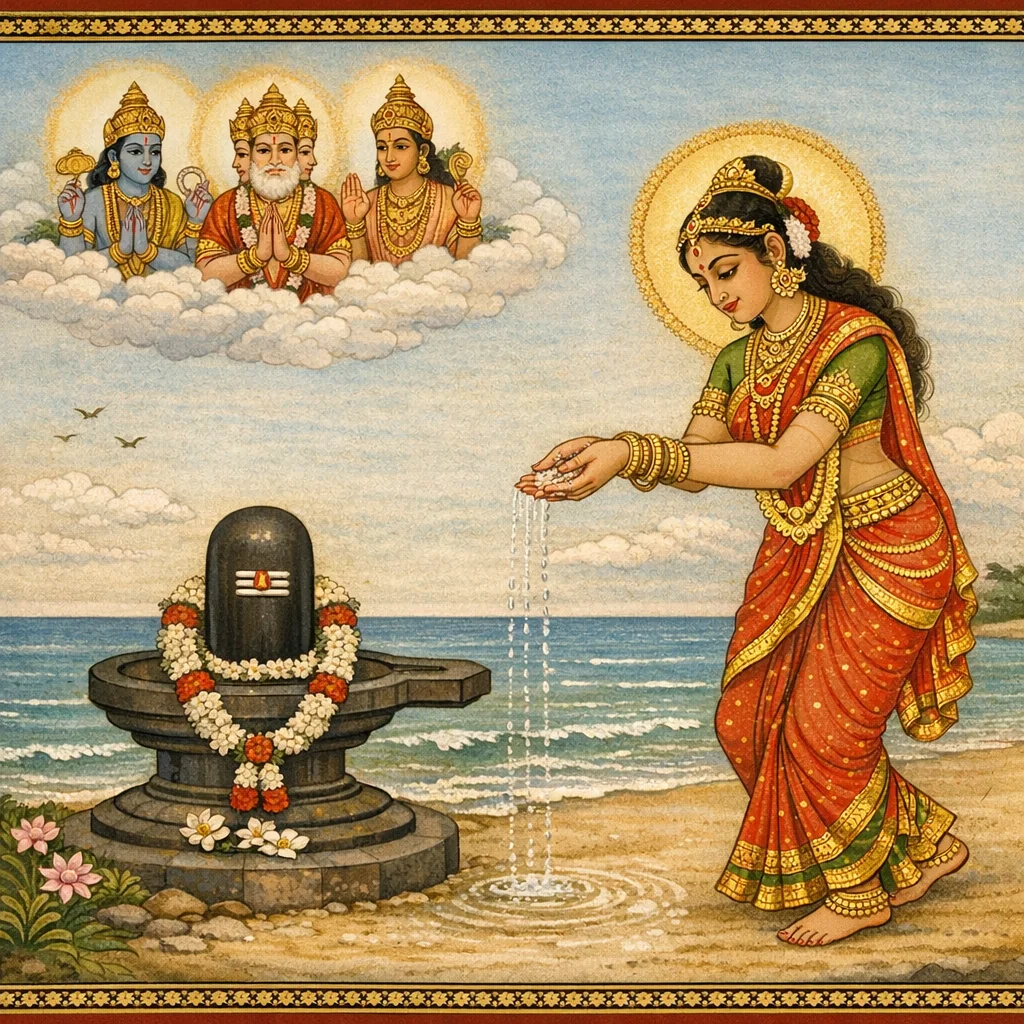
Adhyaya 66
अर्घ्येश्वरमाहात्म्यवर्णनम् (Arghyeśvara Māhātmya—Account of the Glory of Arghyeśvara)
Īśvara describes a movement within Prabhāsa-kṣetra to a potent liṅga called Arghyeśvara, situated north of Viśālākṣī and nearby. This liṅga is praised as highly efficacious and is worshipped by devas and gandharvas. The narrative recalls the Devī’s arrival, said to bear the vāḍavānala (submarine fire). Reaching Prabhāsa and beholding the great ocean (mahodadhi), she offers arghya to the ocean according to the prescribed rite (vidhi). She then establishes (pratiṣṭhāpya) a great liṅga, performs the proper worship, and afterwards enters the ocean for ritual bathing. The text explains the sacred naming: because arghya was offered first and then the Lord was established, the liṅga became known as Arghyeśa/Arghyeśvara, explicitly declared a pāpa-praṇāśana, destroyer of sin. A ritual teaching follows: one who bathes the liṅga with pañcāmṛta and worships it by rule attains vidyā across seven births, becoming a capable teacher of śāstra and a knower who resolves doubts. The colophon closes the chapter as the 66th adhyāya of this portion of the Prabhāsa Khaṇḍa.
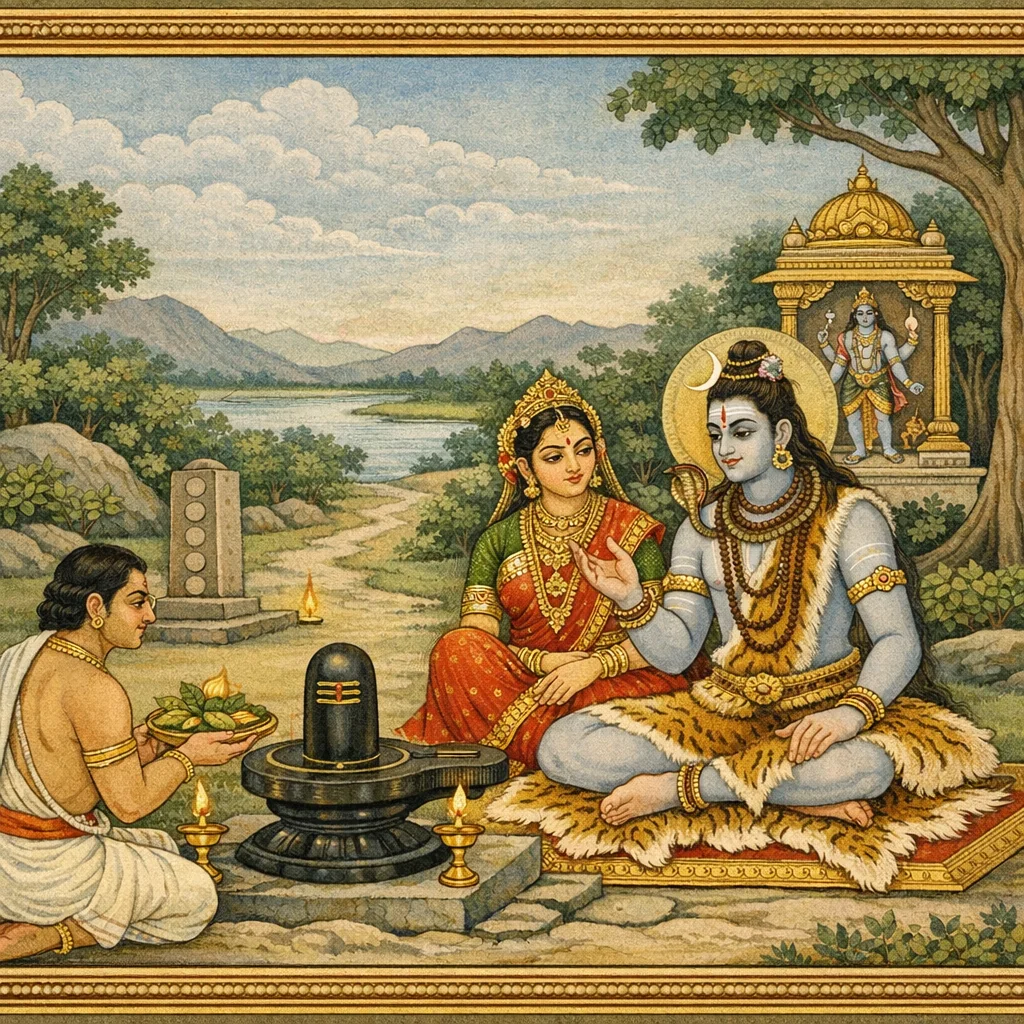
Adhyaya 67
कामेश्वरमाहात्म्यवर्णनम् | Kāmeśvara Liṅga Māhātmya (Description of the Glory of Kāmeśvara)
This chapter is Śiva’s instruction to Devī, identifying a mahāliṅga named Kāmeśvara within Prabhāsa-kṣetra. Īśvara directs the pilgrim to go to “Mahāliṅga Kāmeśvara,” formerly worshiped by Kāma, located west of Daityasūdana and within a distance of seven bow-lengths. The discourse recalls how Kāma was burned by the fire of Śiva’s third eye. Thereafter Kāma worshiped Maheśvara for a thousand years and regained a power connected with desire and creation (kāmanā-sarga), while retaining the memory of his Ananga, “bodiless,” state. This liṅga is renowned on earth, removes all sins, and grants desired fruits. A specific observance is prescribed: on the bright fortnight’s thirteenth lunar day (śukla trayodaśī) in the month of Mādhava (Vaiśākha), one should worship Kāmeśvara according to proper rite (vidhāna). The promised result is expressed in purāṇic merit language, including prosperity and the flourishing of desire/attractiveness for women.
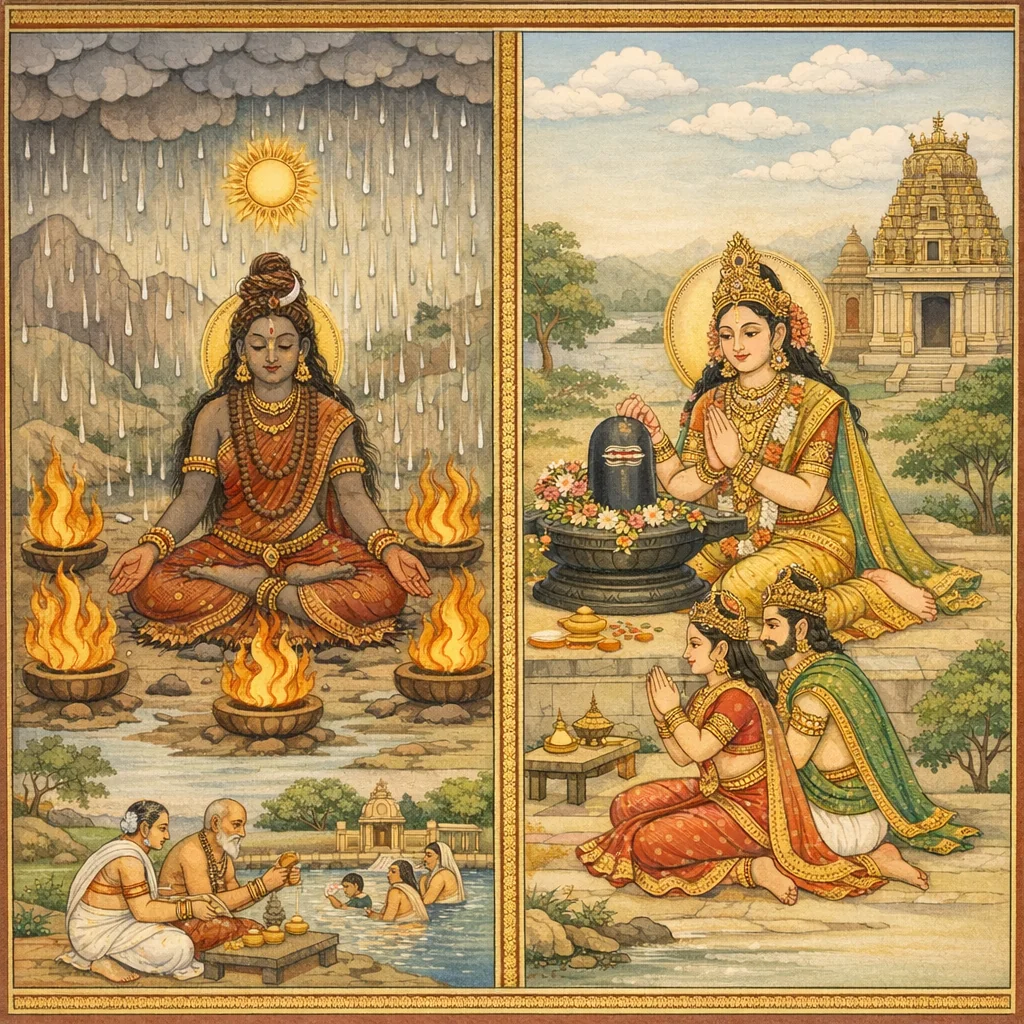
Adhyaya 68
गौरीतपोवनमाहात्म्यवर्णनम् | The Māhātmya of Gaurī’s Forest of Austerity
Chapter 68 unfolds as a Śiva–Devī dialogue praising the Māhātmya of Gaurī’s Forest of Austerity in Prabhāsa. Īśvara points out the supremely potent sacred spot east of Someśa and recounts Devī’s earlier-life tapas: once dark-complexioned and privately called “Kālī,” she vows—by the logic of vrata—to become “Gaurī” through disciplined austerity. She comes to Prabhāsa, installs and worships a liṅga famed as Gaurīśvara, and performs severe practices—standing on one foot, pañcāgni in summer, enduring rain, and winter rest in water—until her body becomes fair, portraying transformation as the fruit of steadfast bhakti. Śiva grants boons, and Devī declares the phalaśrutis: those who behold her there gain auspicious progeny and marital/lineage fortune; those who offer music and dance are freed from misfortune; and those who worship the liṅga first and then her attain the highest goal. The chapter further prescribes charity and rites—gifts to brāhmaṇas, a coconut offering for childlessness, and a ghee lamp with a red wick for lasting auspiciousness—along with a nearby tīrtha whose bath removes sins, śrāddha that benefits ancestors, and night-vigil with devotional performance. It concludes by affirming the deity’s abiding presence through seasonal change and by praising recitation and hearing of the chapter, especially on the third lunar day and in Devī’s presence, as a source of enduring благословение.
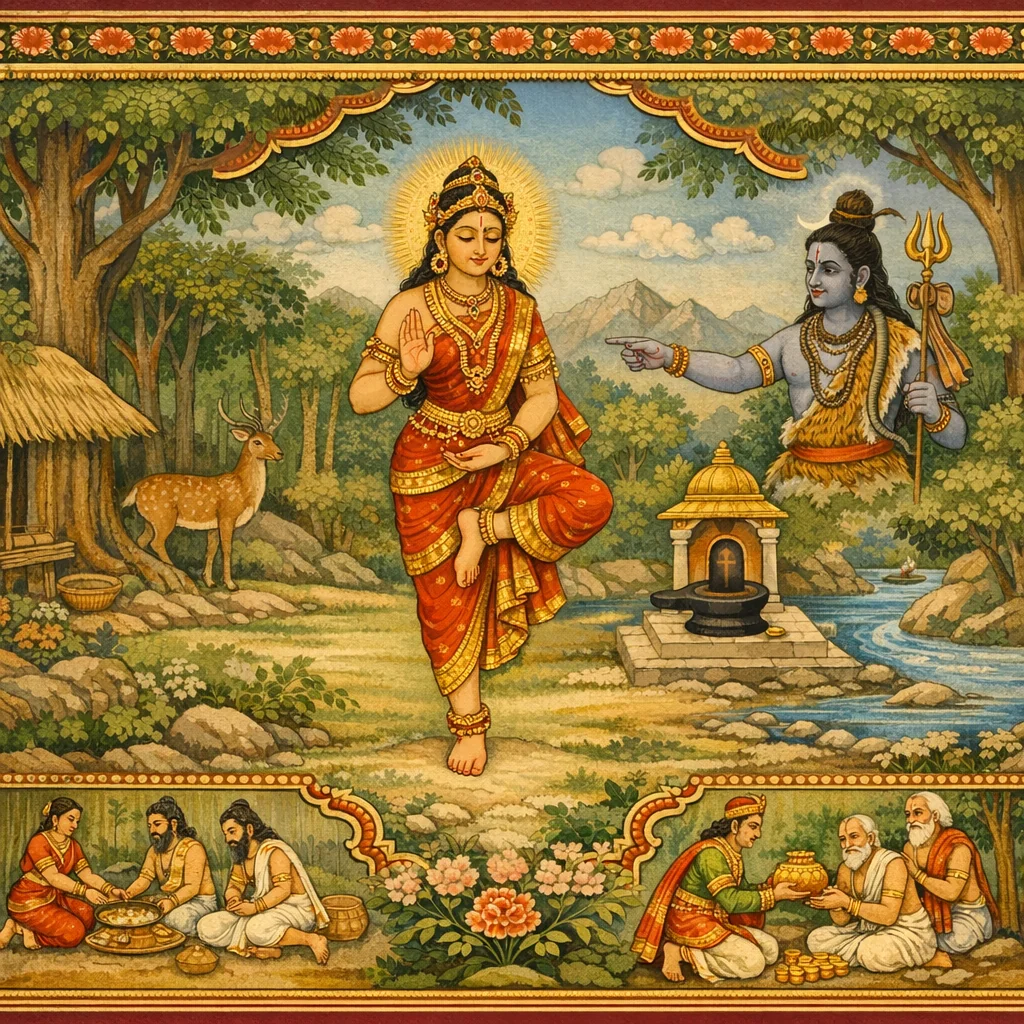
Adhyaya 69
गौरीश्वरमाहात्म्यवर्णनम् (The Glory of Gaurīśvara Liṅga)
This chapter unfolds as a theological dialogue between Devī and Īśvara on the whereabouts and merit of the famed Gaurīśvara liṅga. Devī asks where the liṅga is situated and what phala (ritual fruit) arises from its worship. Īśvara replies by presenting the account as a pāpanāśana māhātmya—glory that destroys sin—and describes a renowned tapo-vana connected with Gaurī, marked out as a circular sacred precinct measured in dhanus units. Within that holy landscape, Devī is portrayed performing one-footed austerity (ekapādā tapas), and the liṅga’s placement is given with directional precision: slightly to the north, aligned toward Īśāna (the northeast), with distance markers. The discourse then declares the rite’s efficacy: devoted worship of the liṅga, especially on Kṛṣṇāṣṭamī, frees one from sins. Ethical giving is also enjoined as part of the observance—go-dāna (gift of a cow), gold to a worthy brāhmaṇa, and above all anna-dāna (gift of food) to pacify wrongdoing. The promised fruit culminates in a strong expiatory assurance: even grievous sinners are released from pāpa through the mere darśana, the sacred sight of this liṅga.
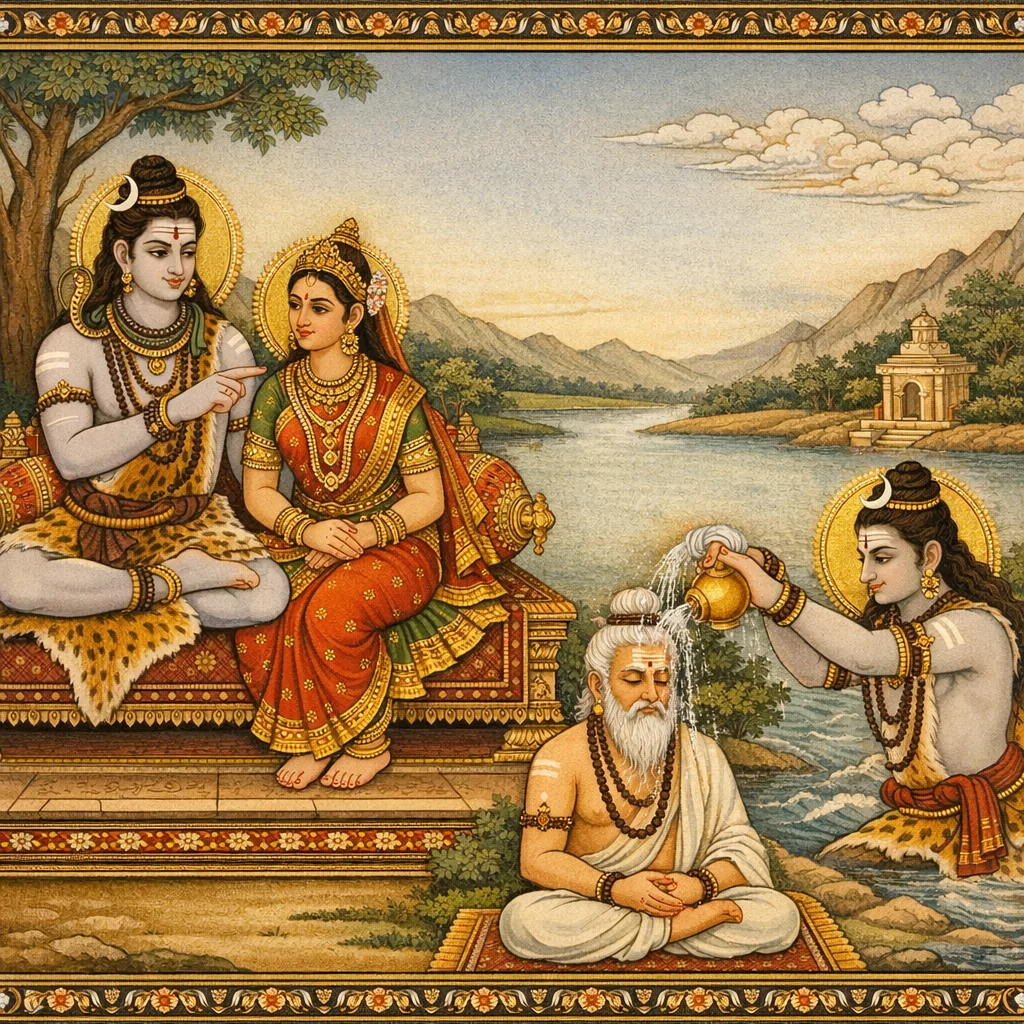
Adhyaya 70
वरुणेश्वरमाहात्म्यवर्णनम् (Varuṇeśvara Māhātmya—Account of the Glory of Varuṇeśvara)
This chapter is a sacred site-instruction set within divine dialogue. Īśvara addresses the Goddess and directs her to the renowned Varuṇeśvara-liṅga, situated in Gaurī’s tapas-grove in the south-east (āgneya) quarter, marked at a distance of about twenty dhanu. The shrine’s origin is explained through a cosmic disturbance: when Kumbhaja (Agastya) once “drank” the ocean, Varuṇa, lord of waters, was afflicted by anger and burning heat. Seeing Prābhāsika-kṣetra as the proper field for severe austerity, Varuṇa performs difficult tapas, establishes a powerful mahāliṅga, and worships it with devotion for a long span—one yuta of years. Pleased, Śiva refills the emptied ocean with his own Gaṅgā-water and grants boons; thereafter the seas remain replenished, and the liṅga is known as Varuṇeśvara. The chapter then gives phalaśruti and ritual observances: mere darśana of Varuṇeśvara is said to yield the fruit of all tīrthas. On the 8th and 14th lunar days, bathing the liṅga with curd is linked with Vedic excellence, and the saving merit is extended to many social groups and bodily conditions. Acts done there—bathing, japa, bali, homa, pūjā, stotra, and sacred dance—are declared akṣaya (imperishable). Gifts such as a golden lotus and pearls are recommended for those seeking pilgrimage-fruit and heavenly aims.
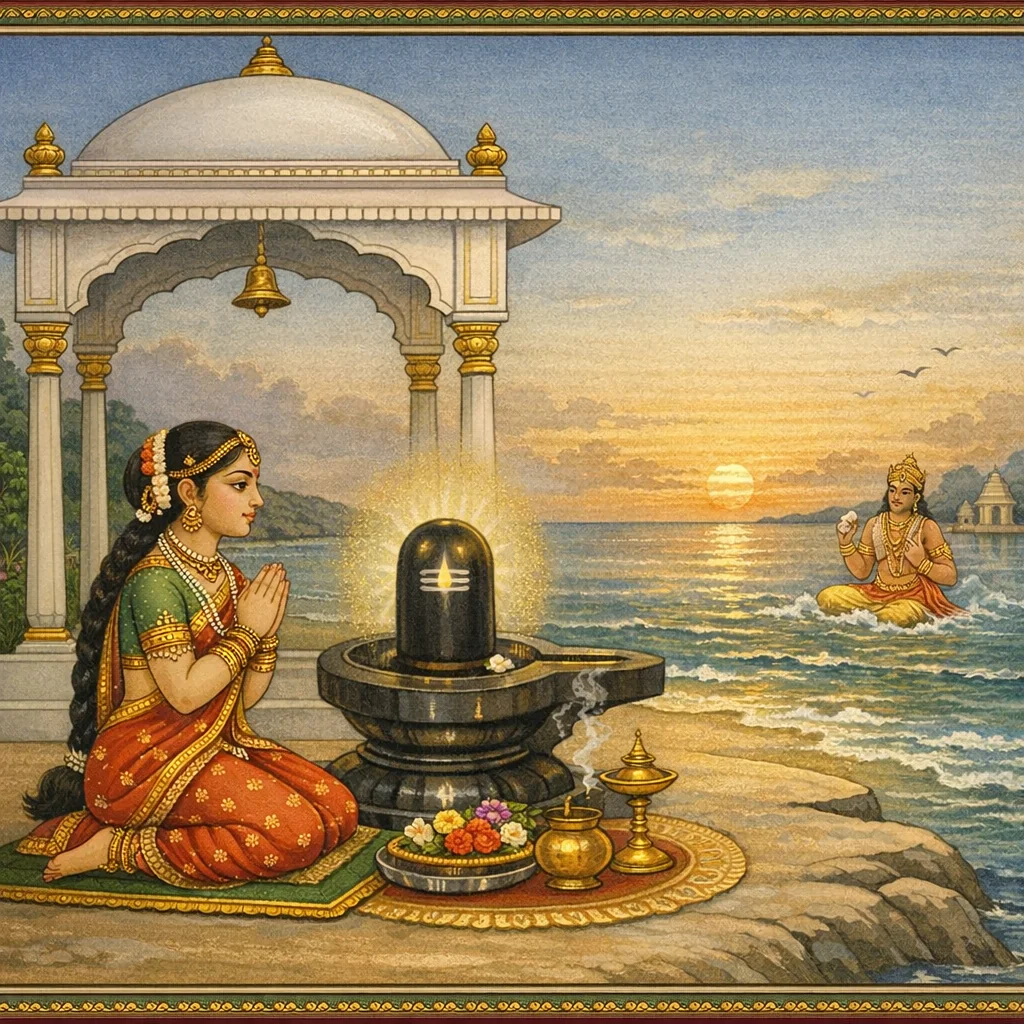
Adhyaya 71
उषेश्वरमाहात्म्यवर्णनम् | The Māhātmya of Uṣeśvara Liṅga
This adhyāya points out a liṅga within the sacred landscape of Prabhāsa-kṣetra, situated south of Varuṇeśa at a distance of three bow-lengths. It is said to have been established by Uṣā, the wife of Varuṇa, who performed exceedingly fierce austerities, distressed by sorrow connected with her husband. The installed liṅga is named Uṣeśvara and is praised as the bestower of all spiritual attainments (siddhis), revered by those who seek such fulfillment. The phalāśruti declares that devoted worship destroys sin and can lead even heavily burdened persons to the supreme goal. A further merit is emphasized for women in particular: it grants auspicious marital fortune (saubhāgya) and removes suffering and misfortune.
Adhyaya 72
Jalavāsa Gaṇapati Māhātmya (The Glory of Gaṇeśa ‘Dwelling in Water’)
This chapter gives a brief theological and ritual instruction attributed to Īśvara. The devotee is enjoined to seek the darśana of Vighneśa at that very sacred spot, known as “Jalavāsas,” Gaṇeśa who “dwells in water.” Such darśana is praised as powerful for the destruction of obstacles and for the successful completion of all undertakings (sarva-kārya-prasiddhi). As an origin account, Varuṇa is said to have worshiped the Lord with devotion using water-born offerings (jalajaiḥ), so that his tapas might proceed without hindrance (tapo-nirvighna-hetu). The practical observance is set for the fourth lunar day (caturthī): one should perform tarpaṇa and worship with fragrances, flowers, and modakas. The text stresses due proportion—offerings made “according to one’s devotion and capacity” (yathā-bhakti-anusāreṇa) are the basis of Gaṇādhipa’s satisfaction.
Adhyaya 73
कुमारेश्वरमाहात्म्यवर्णनम् | Kumāreśvara Māhātmya (Account of the Glory of Kumāreśvara)
This chapter unfolds as a Śiva–Devī theological dialogue that also serves as a brief route-guide within Prabhāsa-kṣetra. Īśvara directs Devī to the shrine of Kumāreśvara, praising its liṅga as supremely potent and able to destroy major sins (mahāpātaka-nāśana). The shrine is located through directional markers associated with Varuṇa and Naiṛta and by the landmark Gaurī-tapovana, placing it within a navigable sacred landscape. An origin account states that Ṣaṇmukha (Kumāra/Skanda) established this liṅga after performing great tapas, thereby explaining the shrine’s name and authority. The chapter then sets out a comparative calculus of merit: one day of proper worship of Kumāreśvara, performed according to vidhi, is said to yield the full merit that elsewhere would require months of worship. Ethical prerequisites are emphasized—abandoning kāma, krodha, lobha, rāga, and matsara, and adopting brahmacarya or ascetic restraint even for a single act of worship. The conclusion affirms that correct worship grants the true fruit of pilgrimage (yātrā-phala).
Adhyaya 74
Śākalyeśvara-liṅga Māhātmya (शाकल्येश्वरलिङ्गमाहात्म्य) — The Glory of Śākalyeśvara and Its Four Yuga-Names
Īśvara instructs Mahādevī to go to the eminent shrine of the Śākalyeśvara liṅga, located by the stated direction and distance-marker. The liṅga is praised as “sarvakāmadam,” the granter of all desired aims, and its sanctity is grounded in a lineage of worship: the royal seer Śākalya performs great tapas, pleases Mahādeva, and the satisfied Lord manifests/is established in liṅga form. A phalaśruti declares that mere darśana of the deity dissolves sins amassed over seven births, as darkness vanishes at sunrise. The chapter then prescribes ritual times and procedures—especially bathing Śiva with milk on Aṣṭamī and Caturdaśī, worship with sequential offerings of fragrance, flowers, and the like, and the recommendation of gifting gold for those seeking the full fruit of pilgrimage. It also lists four yuga-specific names: in Kṛta, Bhairaveśvara; in Tretā, Sāvarṇikeśvara (connected with Sāvarṇi Manu); in Dvāpara, Gālavēśvara (connected with the sage Gālava); and in Kali, Śākalyeśvara (connected with the muni Śākalya attaining aṇimā and related siddhis). The kṣetra’s sanctified boundary is set at eighteen dhanu in radius; even small creatures within it are said to be eligible for liberation; local waters are revered as Sarasvatī-like; and darśana is equated with the fruits of great Vedic sacrifices. A month-long discipline near the liṅga on Soma-parvan is taught—Aghora-japa with ghee-homa—promising “uttamā siddhi” even to heavily burdened sinners. The liṅga is further described as “kāmika,” with Aghora as the deity’s face and a prominent Bhairava presence, explaining the earlier prevalence of the name Bhairaveśvara and its present Kali-age designation, Śākalyeśvara.
Adhyaya 75
कलकलेश्वरमाहात्म्यवर्णनम् | The Māhātmya of Kalakaleśvara (Origin, Worship, and Merits)
Chapter 75 records a place-centered teaching in which Īśvara instructs Devī about the liṅga known as Śākalakaleśvara/Kalakaleśvara in Prabhāsa-kṣetra—its relative location and its renown as a remover of pāpa (sin). It also sets out a yuga-wise nāma-catuṣṭaya: the same liṅga is remembered as Kāmeśvara in Kṛta, Pulahēśvara in Tretā, Siddhinātha in Dvāpara, and Nāradeśa in Kali, while the name Kalakaleśa/Kalakaleśvara is explained through sound-based etymology. One account traces the title to the tumultuous “kalakala” sound that arose when Sarasvatī reached the sea and the celestial beings rejoiced. Another, more social-ethical narrative tells how Nārada performed severe tapas and a Pauṇḍarīka-yajña near the liṅga, summoned many ṛṣis, and then—when local brāhmaṇas came seeking dakṣiṇā—threw valuables to provoke conflict; a brawl ensued, and learned yet impoverished brāhmaṇas rebuked the conduct, becoming the causal explanation for the shrine’s name Kalakaleśvara, associated with noise and quarrel. The chapter ends with phalaśruti: bathing the liṅga and performing three pradakṣiṇās leads to Rudraloka, while worship with perfumes and flowers and gifting gold to worthy recipients grants the “supreme state.”
Adhyaya 76
Lakuleśvara-nāma Liṅgadvaya Māhātmya (near Kalakaleśvara) — Glory of the Twin Liṅgas established by Lakulīśa
Chapter 76 is a brief theological and ritual notice presented as Īśvara’s discourse. It points to a highly meritorious pair of liṅgas near Devadeva, within the Someshvara-associated sacred region, and declares that they were established (pratiṣṭhita) by Lakulīśa. This twin shrine is called “Lakuleśvara” and is praised as an anuttama, supremely excellent object of darśana. The text adds a purification assurance: mere sight is said to free one from sin up to the very boundary of the birth-and-death cycle. A specific observance is prescribed in Bhādrapada on Śukla Caturdaśī—fasting (upavāsa) and night-vigil (prajāgara). The rite proceeds by first worshipping Lakulīśa in embodied form (mūrtimant), then worshipping the two liṅgas separately in proper order with sequential stuti-mantras. The declared fruit (phalaśruti) is attainment of the supreme abode where Maheśvara dwells, closing the chapter with a soteriological promise.
Adhyaya 77
उत्तंकेश्वरमाहात्म्य वर्णनम् | The Māhātmya of Uttankeśvara (Description of Uttankeśvara’s Sanctity)
Īśvara speaks to Mahādevī and directs the course of pilgrimage toward Uttankeśvara, praised as an excellent sacred locus. The shrine is said to lie south of the previously mentioned point and not far away, marking an itinerary-based guidance within Prabhāsa-kṣetra. The installation is attributed to Uttanka, a great-souled devotee, who established it himself through devotion. The pilgrim, calm and well-composed, should behold the place (darśana) and touch it (sparśana), then worship it properly according to rite with bhakti. The promised fruit is release from all impurities and transgressions. The colophon identifies this as the seventy-seventh adhyāya of the Prabhāsa Khaṇḍa of the Skanda Mahāpurāṇa, devoted to the māhātmya of Uttankeśvara.
Adhyaya 78
वैश्वानरेश्वरमाहात्म्यवर्णनम् (Glory of Vaiśvānareśvara)
Īśvara instructs Mahādevī to go to the deity Vaiśvānareśvara in the southeast (āgneya) quarter, said to be located “within five bows.” This deity is praised as pāpa-ghna, removing sin and impurity through both darśana (sacred sight) and sparśa (touch). A teaching legend follows: a parrot (śuka) once built its nest in a palace and lived there long with its mate. Out of attachment to their nesting place—rather than explicit devotion—the pair repeatedly performed pradakṣiṇā (ritual circumambulation) and in time died. By the power of that holy site they were reborn as jātismara, remembering former births, and became renowned as Lopāmudrā and Agastya. Recalling his prior body, Agastya utters a reflective gāthā: one who properly circumambulates and beholds the Lord of Fire, Vahnīśa, attains fame, as he once did. The chapter ends with a ritual injunction: bathe the deity with ghee (ghṛta-snāna), worship according to rule, and with faith give gold to a worthy Brahmin. This grants the full fruit of pilgrimage; the devotee reaches Vahni-loka and rejoices for an imperishable time. The colophon identifies it as the 78th chapter of this section of the Prabhāsa Khaṇḍa.
Adhyaya 79
लकुलीश्वरमाहात्म्य (The Māhātmya of Lakulīśvara)
This adhyāya, spoken by Īśvara, turns attention to Lakulīśa/Lakulīśvara as a revered presence within Prabhāsa-kṣetra. It locates the deity to the west at a distance measured as “dhanusāṃ saptake,” and praises his tranquil, beneficent form—explicitly as pāpa-ghna, the remover of sin for all beings—linking the site with divine descent and manifestation in the great sacred field. It then portrays Lakulīśa as an austere ascetic and teacher: performing intense tapas, granting dīkṣā to disciples, and repeatedly instructing them in multiple śāstric systems, including Nyāya and Vaiśeṣika, culminating in parā siddhi, the supreme attainment. The chapter ends with guidance for devotees: worship should be done properly; its efficacy is heightened in Kārttika and during Uttarāyaṇa; and vidyā-dāna—gifting or imparting learning—should be offered to a qualified brāhmaṇa. The stated fruit is repeated auspicious births in prosperous brāhmaṇa lineages, marked by intelligence and prosperity.
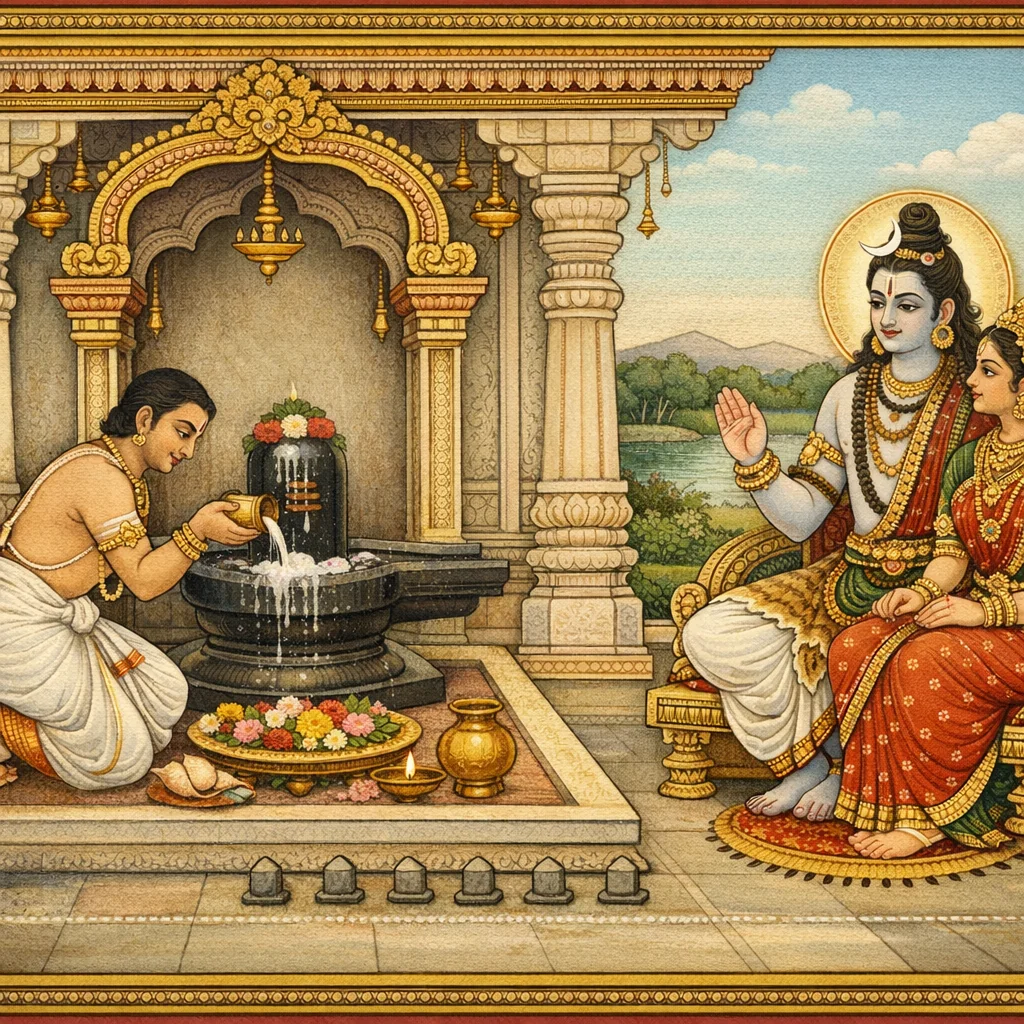
Adhyaya 80
Gautameśvara-māhātmya (गौतमेश्वरमाहात्म्य) — The Glory of the Gautameśvara Liṅga
This chapter is a brief shrine-mahātmya cast as Īśvara’s instruction to Devī. It identifies a sin-destroying liṅga named Gautameśvara in the eastern quarter, described with reference to a western marker linked to Daitya-sūdana, and specifies its range as “within five dhanus.” The shrine is praised as granting all desired aims (sarva-kāma-da). An origin note credits King Śalya of Madra, who performed intense tapas and propitiated Maheśvara, with establishing its worship; the text adds that other devotees who worship in the same manner attain supreme siddhi. A calendrical rite is prescribed: on the bright fortnight’s fourteenth day of Caitra, one should bathe (snāpana) the liṅga with milk, then worship with fragrant water and excellent flowers in a rule-based, devotional way, gaining merit equal to an aśvamedha. The phalaśruti concludes that sins of speech, mind, and body are destroyed by merely beholding this liṅga.
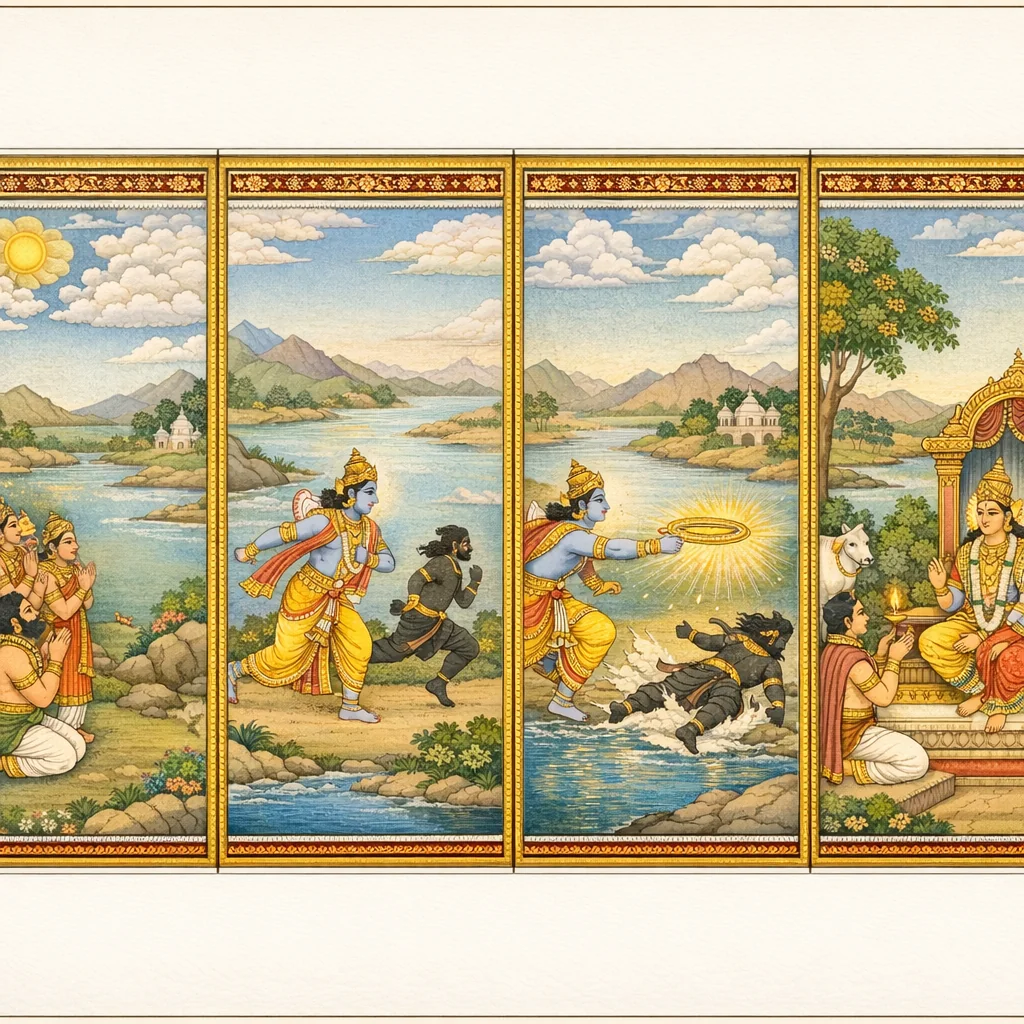
Adhyaya 81
श्रीदैत्यसूदनमाहात्म्यवर्णनम् (Glorification of Śrī Daityasūdana)
Chapter 81 unfolds as a theological dialogue in which Īśvara instructs Devī on the unique holiness of Prabhāsa-kṣetra, a Vaiṣṇava ritual land shaped like a “yava-ākāra” (barley grain) with clearly stated boundaries in the four directions. Its permanence and unrivaled potency are affirmed: death within the kṣetra, gifts, offerings, mantra-recitation, austerities, and feeding brāhmaṇas performed there are said to yield akṣaya merit enduring up to seven kalpas. The chapter then lays out devotional practice-templates—fasting (upavāsa) with faith, bathing at Cakrātīrtha, gifting gold on Kārttika-dvādaśī, lamp-offerings, pañcāmṛta ablutions, Ekādaśī night-vigil (jāgara) with devotional arts, and cāturmāsya observance. It proceeds to a name-origin legend: praised by the devas for earlier avatāra deeds, Viṣṇu vows to destroy the dānavas, pursues them to Prabhāsa, and annihilates them with the discus, thereby establishing the epithet “Daityasūdana.” The conclusion offers phalāśruti assurances that seeing or worshiping the deity in this kṣetra destroys sins and bestows auspicious outcomes in life.
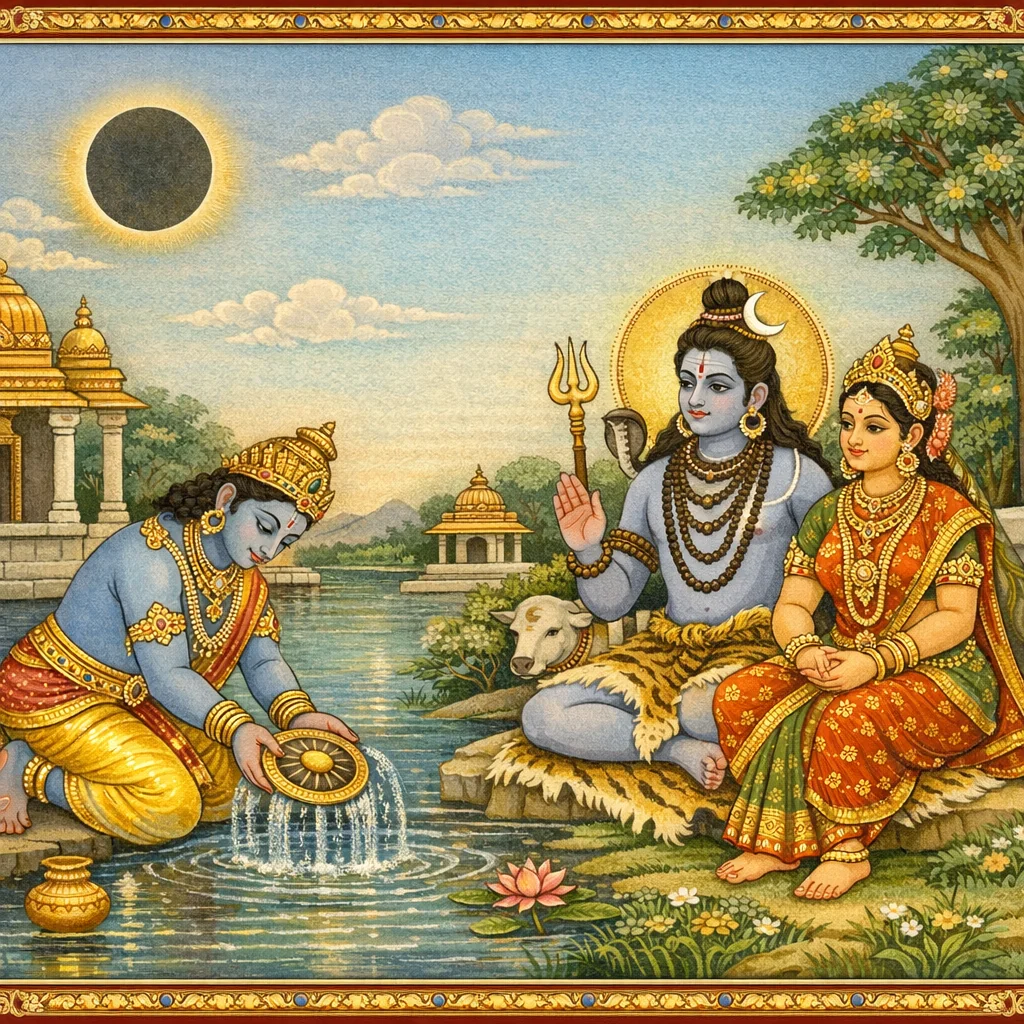
Adhyaya 82
चक्रतीर्थोत्पत्तिवृत्तान्तमाहात्म्यवर्णनम् (Origin and Glory of Cakratīrtha)
The chapter unfolds as a dialogue: Devī asks Īśvara to explain the meaning, location, and power of “Cakratīrtha.” Īśvara recounts a mythic episode from a deva–asura war: Hari (Viṣṇu), after slaying the demons, washes the blood-stained Sudarśana-cakra at a particular spot; that cleansing becomes the sanctifying act by which the tīrtha is established. He then describes the site’s inner plenitude: countless subsidiary tīrthas abide there, and its ritual potency is especially heightened on Ekādaśī and during solar and lunar eclipses. Bathing there yields the combined fruit of bathing in all tīrthas, and gifts given there are said to bear immeasurable merit. The region is declared a Viṣṇu-kṣetra with a defined extent. The chapter lists kalpa-variant names—Koṭitīrtha, Śrīnidhāna, Śatadhāra, and Cakratīrtha—and emphasizes that austerities, Vedic study, agnihotra observance, śrāddha, and expiatory vows (prāyaścitta) performed there multiply in merit beyond other places. It concludes with a broad phalāśruti: the tīrtha destroys sin, fulfills wishes, extends grace even to marginalized births, and promises an exalted destiny to those who die there.
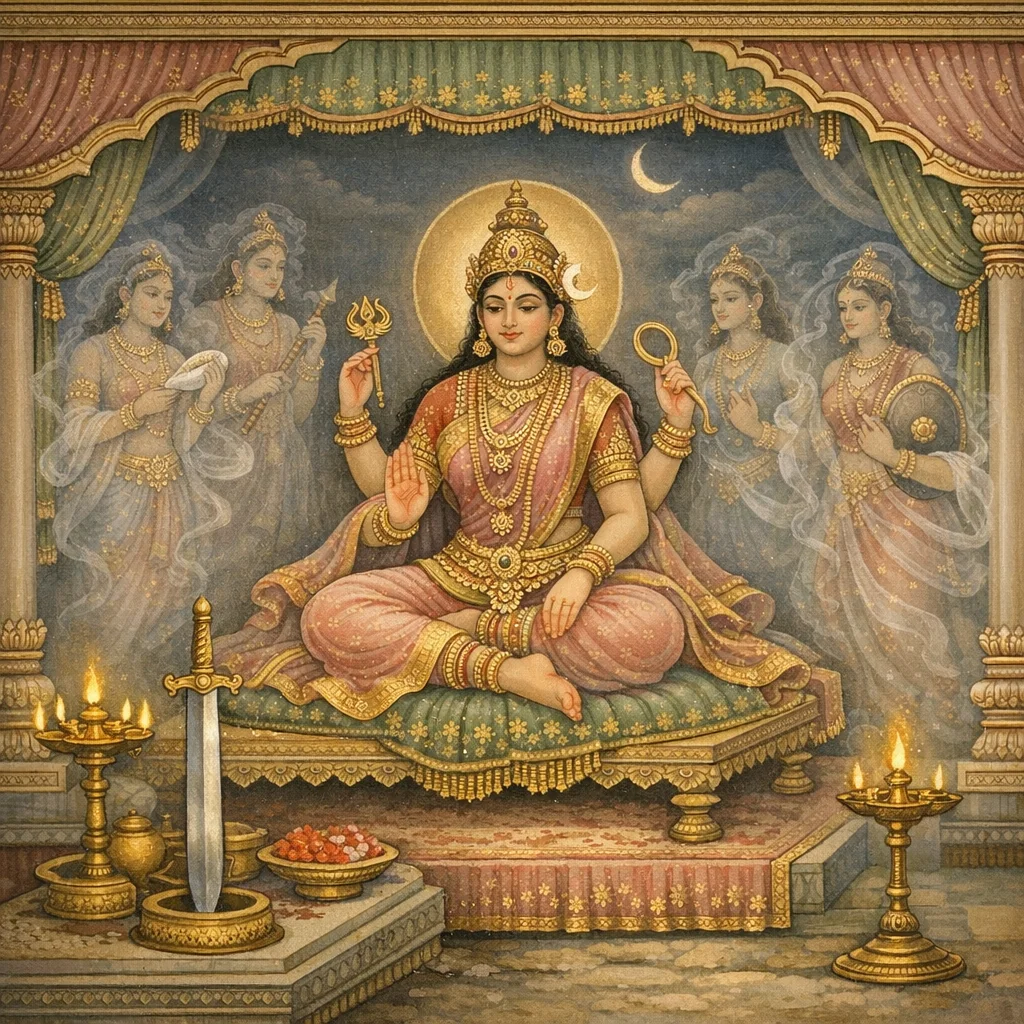
Adhyaya 83
योगेश्वरीमाहात्म्यवर्णनम् (Yogeśvarī Māhātmya—Account of Yogeśvarī’s Glory)
Īśvara tells Mahādevī the origin and ritual import of the goddess Yogeśvarī, abiding on the eastern side of the sacred Prabhāsa field. The fearsome asura Mahiṣa, empowered by shape-shifting and domination, threatens the three worlds. Brahmā creates an incomparable maiden who performs severe austerities; Nārada meets her, is captivated by her beauty, and—refused because she keeps a maiden’s vow—goes to Mahiṣa and speaks of her. Mahiṣa tries to coerce the ascetic maiden into marriage; she laughs, and from her breath arise weapon-bearing female forms that destroy his army. When Mahiṣa attacks, the climactic battle ends with the goddess subduing and killing him, even beheading him. The gods praise her with a hymn proclaiming her the universal power—vidyā/avidyā, victory, and protection—and beg her to dwell forever in this kṣetra, granting boons to worshippers. The chapter then lays down the Āśvina Śukla festival: fasting and darśana on Navamī for the destruction of sin; morning recitation for fearlessness; and an elaborate nocturnal worship of a consecrated sword (khaḍga) with mantras, pavilion, fire-rite, procession, vigil, offerings, bali to directional deities and spirits, and a royal chariot-circuit of Yogeśvarī. It concludes with assurances of protection for practitioners—especially resident Brāhmaṇas—presenting the festival as an auspicious communal rite that removes obstacles.
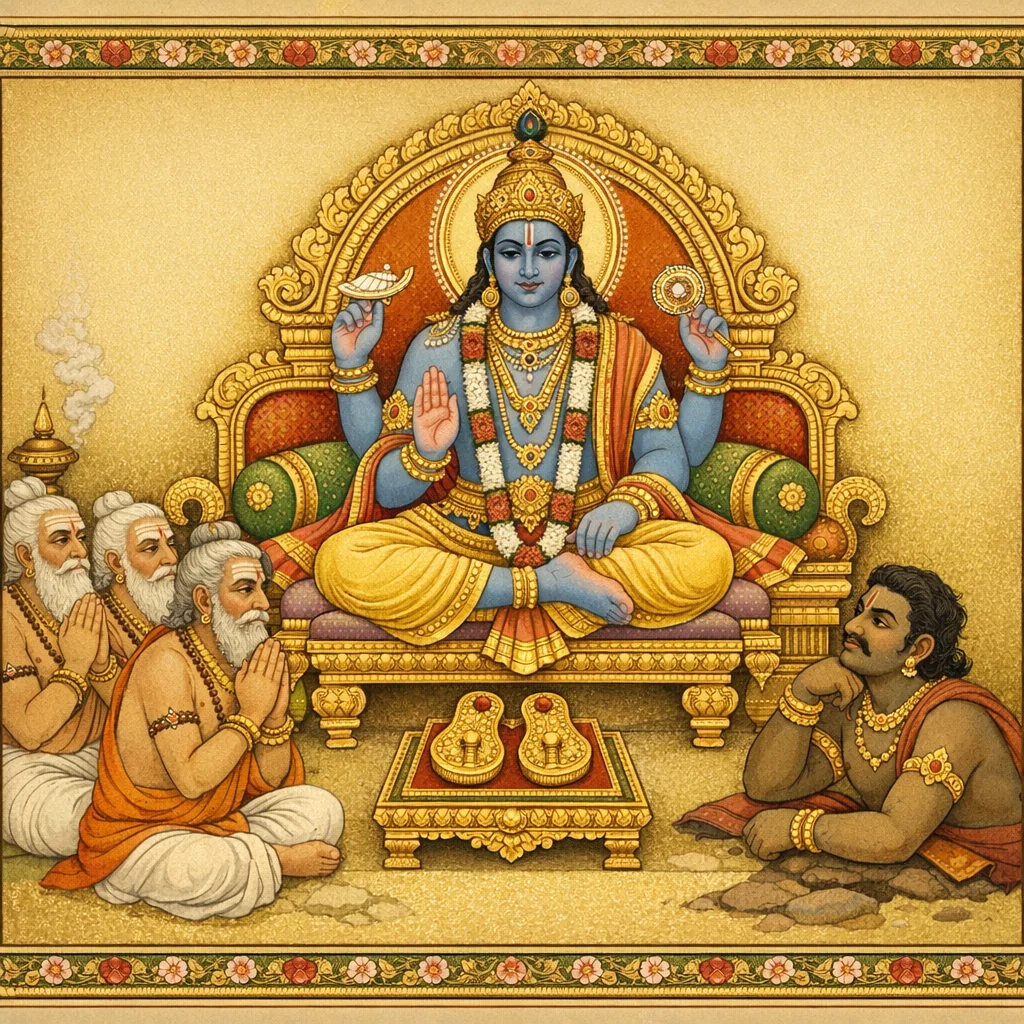
Adhyaya 84
आदिनारायणमाहात्म्यवर्णनम् (Glorification and Narrative Account of Ādinārāyaṇa)
Īśvara instructs Devī to go to Ādinārāyaṇa Hari in the eastern quarter, the universal destroyer of sins, seated upon the sacred “pādukā-āsana” (sandal-seat). The chapter then recounts a Kṛta-yuga episode: the asura Meghavāhana, made nearly invincible by a boon that he could die only by Viṣṇu’s pādukā in battle, torments the world for ages and lays waste to the ṛṣis’ āśramas. Driven out, the ṛṣis take refuge in Keśava, Viṣṇu with the Garuḍa-banner, and offer a long hymn praising him as the cosmic cause, the savior of beings, and the purifier through his Name and remembrance. Viṣṇu appears, asks their need, and is entreated to remove the demon and restore fearlessness to the cosmos. He summons Meghavāhana and strikes him in the heart with the auspicious pādukā, slaying him, and remains established there upon the pādukā-seat. Merits of observance are then declared: worship of this form on Ekādaśī yields supreme sacrificial fruit, equal to an Aśvamedha, and devoted darśana is likened to great gifts such as vast cow-donations. Finally, a Kali-yuga assurance is given: for those who enshrine Ādinārāyaṇa in the heart, suffering is lessened and spiritual benefit increases; bathing and worship on Ekādaśī—especially when it falls on a Sunday—are said to free one from “bhava-bandhana,” the bondage of worldly becoming. The concluding phalaśruti proclaims that hearing this account removes sin and destroys poverty.
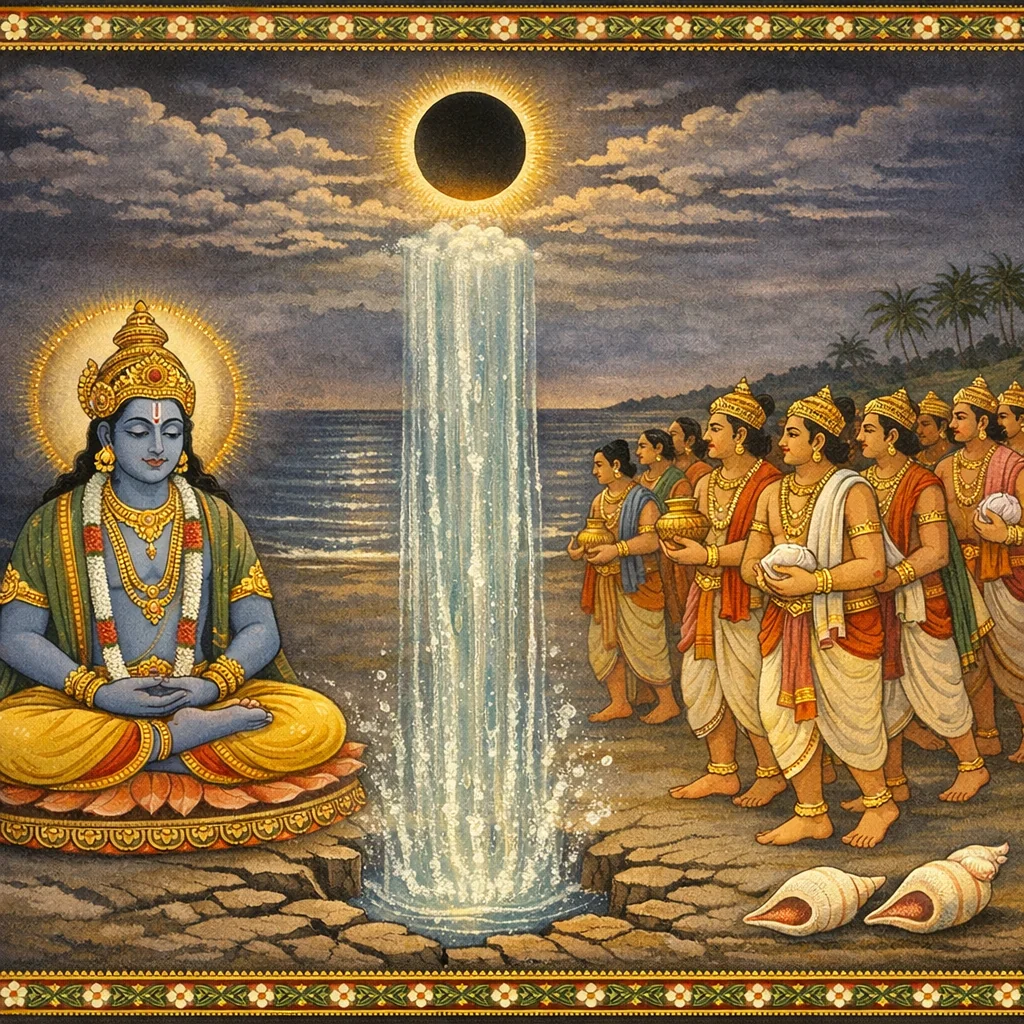
Adhyaya 85
सांनिहित्य-माहात्म्य-वर्णन (Glorification of the Sānnidhya Tīrtha)
This chapter unfolds as a Devī–Īśvara dialogue on the origin, location, and ritual power of the Sānnidhya tīrtha, a sacred water described as a mighty river-like stream. Devī asks how the revered Mahānadī of Kurukṣetra is present here and what fruits arise from bathing and allied rites. Īśvara declares the tīrtha auspicious and sin-destroying even by mere sight and touch, and places it to the west at a stated distance from Ādinārāyaṇa. The account then ties the tīrtha’s appearance to a historical-theological episode: fearing Jarāsandha, Viṣṇu relocates the Yādavas to Prabhāsa and petitions the ocean for a dwelling place. During a parva-time eclipse, when Rāhu seizes the sun, Viṣṇu reassures the Yādavas, enters samādhi, and brings forth a blessed water-current (śubhā vāridhārā) that breaks through the earth for ritual bathing. Bathing then is said to grant the full fruit of a Kurukṣetra pilgrimage. Ritual merits are further amplified: bathing there during the eclipse yields the complete fruit of an Agniṣṭoma; feeding a brāhmaṇa with the six tastes multiplies merit; homa and mantra-japa give “crore-fold” results per offering or recitation. Gold-gifting and worship of Ādideva Janārdana are commended, and the chapter ends with a phalaśruti that faithful hearing of this account removes sin.
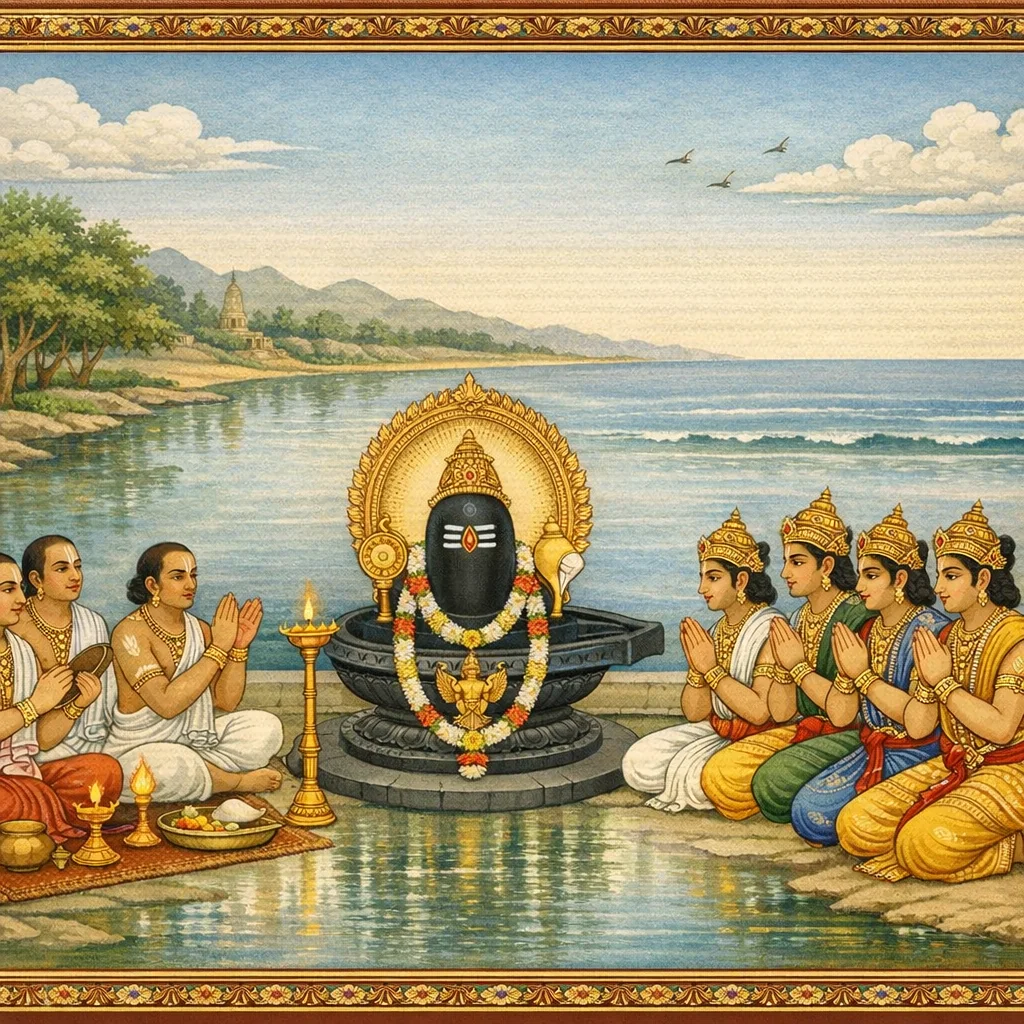
Adhyaya 86
पाण्डवेश्वरमाहात्म्यवर्णनम् | Pāṇḍaveśvara Māhātmya (Account of the Glory of Pāṇḍaveśvara)
This adhyāya identifies a renowned liṅga called Pāṇḍaveśvara in the southern part of the sacred complex and credits its installation, in sequence, to the five Pāṇḍavas. The episode is set during their time of concealed wandering and forest life, when a pilgrimage occasion brings them to Prabhāsa Kṣetra. On the calendrical observance of Somaparvan, they consecrate the liṅga on the riverbank/shore in the presence of officiating priests. Ṛṣi Mārkaṇḍeya and other eminent brāhmaṇa ṛtvijs are appointed; a Veda-recited abhiṣeka is performed, along with ritual gifting, including the donation of cattle. Pleased with the liṅga duly established, the sages proclaim a phalaśruti: worshippers of this Pāṇḍava-consecrated liṅga become honored even among devas and non-human orders, and faithful worship yields merit equal to an Aśvamedha. The text further specifies that merit is especially linked to bathing at Sannihitā Kuṇḍa and worship of Pāṇḍaveśvara, particularly throughout the month of Māgha, culminating in an exalted identification with Puruṣottama. Even mere darśana is said to multiply the destruction of sin, and the liṅga is described in Vaiṣṇava form, signaling sectarian integration within a Śaiva shrine context.
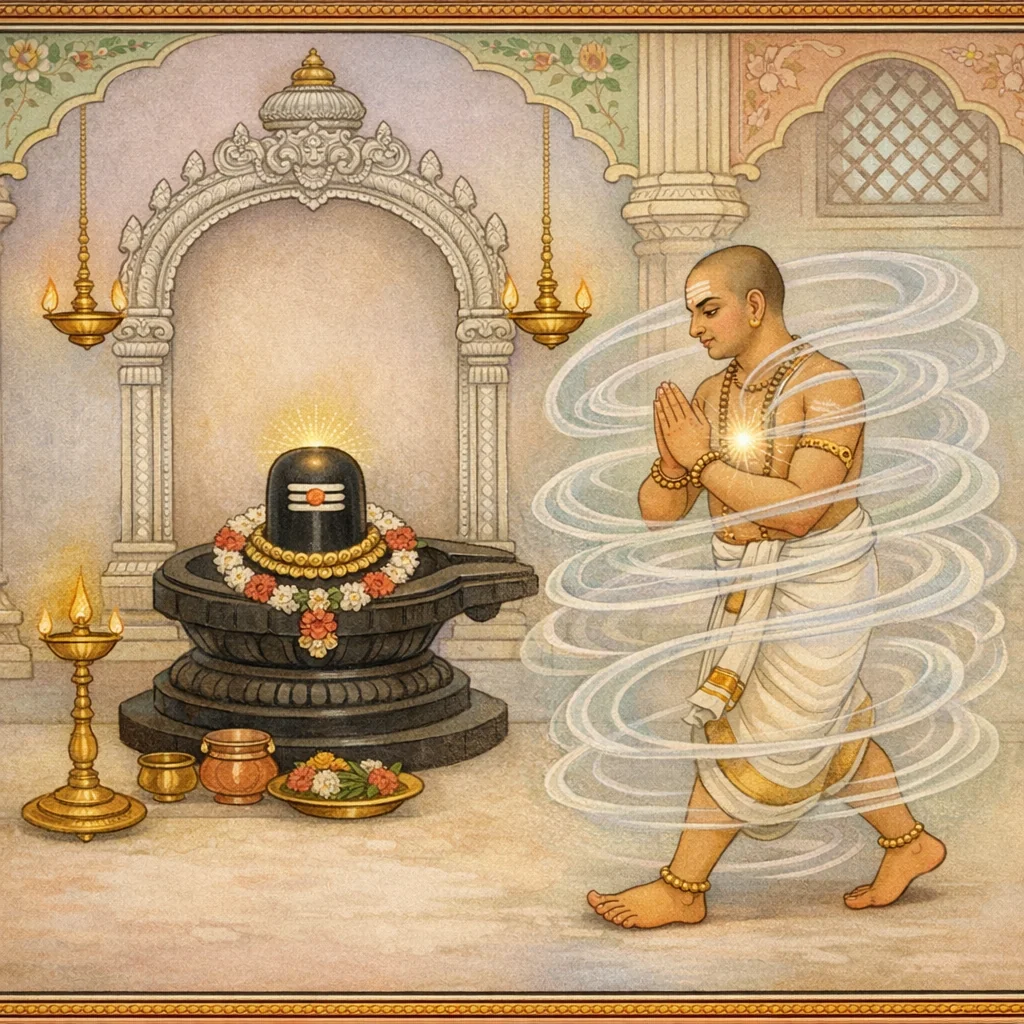
Adhyaya 87
Bhūteśvara Māhātmya and the Sequential Worship of the Eleven Rudras (एकादशरुद्र-यात्रा)
Chapter 87 lays out a technical liturgical program for a Prabhāsa pilgrimage focused on the sequential worship of the eleven Rudras. Īśvara teaches that one who has completed the yātrā with śraddhā should worship the eleven Rudras in a prescribed order, especially at sacral times such as saṅkrānti, ayana transitions, eclipses, and other auspicious tithis. Two correlated name-sets are given: an older nomenclature and a Kali-yuga nomenclature (Bhūteśa, Nīlarudra, Kapālī, Vṛṣavāhana, Tryambaka, Ghora, Mahākāla, Bhairava, Mṛtyuñjaya, Kāmeśa, Yogeśa). Devī asks for fuller procedural detail regarding the eleven-liṅga sequence, mantras, timing, and place-based distinctions. Īśvara then offers an interpretive key: ten Rudras correspond to ten vāyus (prāṇa, apāna, samāna, udāna, vyāna, nāga, kūrma, kṛkala, devadatta, dhanañjaya), while the eleventh is the ātman—linking outward ritual plurality to an inward physiological-metaphysical model. The practical route begins at Somanātha, naming the first station Bhūteśvara (with Somēśvara honored as the ādi-deva). Royal-style offerings (rājopacāra), pañcāmṛta ablution, and worship with the Sadyōjāta formula are prescribed, followed by circumambulation and prostration. The chapter also explains “Bhūteśvara” as lordship over the bhūta-jāla through a 25-tattva framework; knowledge of these tattvas is tied to liberation, and worship of Bhūteśarudra is praised as leading to imperishable release.
Adhyaya 88
नीलरुद्रमाहात्म्यवर्णनम् | Nīlarudra Māhātmya (Glory of Nīlarudra)
Adhyāya 88 records Īśvara’s instruction to Mahādevī on sacred geography, directing pilgrims to the shrine of Nīlarudra, praised as a “second” Nīlarudra. The location is given with exactness: north of Bhūteśa, at a traditional distance marker described as the “sixteenth” measure connected with the dhanuṣ (bow) standard. The chapter’s core sets out the worship sequence: ceremonial bathing of the mahāliṅga, mantra-based pūjā with the Īśa-mantra, offerings of kumuda and utpala flowers, followed by pradakṣiṇā and namaskāra. The phala declares that this observance yields merit comparable to the Rājasūya, and adds a dāna requirement—donation of a bull (vṛṣa) for those seeking the full fruit of the yātrā. In closing, the epithet “Nīlarudra” is explained through an ancient deed: the deity once slew a dark, collyrium-hued daitya named Āntaka, and is remembered as “Nīlarudra,” also in connection with women’s lamentation (rodana). This māhātmya is praised as sin-destroying and to be heard and received with śraddhā by those eager for darśana.
Adhyaya 89
कपालीश्वरमाहात्म्यवर्णनम् | The Māhātmya of Kapālīśvara (Kāpālika Rudra Shrine)
This chapter is cast as Īśvara’s theological instruction to Devī, declaring Kapālīśvara to be the “third Rudra” in the Rudra-sequence of Prabhāsa-kṣetra. Śiva recounts the mythic cause of the shrine’s name: after he severed Brahmā’s fifth head, the skull (kapāla) clung to his hand, establishing his Kāpālika identity. Śiva says he came to Prabhāsa bearing that kapāla and dwelt for a long time in the middle of the kṣetra, worshipping the liṅga across vast stretches of time, thereby sanctifying both the site and the liṅga through sustained divine observance. The chapter also guides pilgrims by locating the shrine west of Budheśvara and marking it by the measure of “seven bows” (dhanuṣāṃ saptake). For protection, Śiva appoints trident-bearing guardians and many gaṇas to keep the holy place safe from harmful dispositions. The prescribed worship includes focused faith, gifting gold to a Veda-proficient brāhmaṇa, and a mantra-procedure connected with Tatpuruṣa. The phala is proclaimed: merely beholding the liṅga removes sins accumulated from birth, with special emphasis on the power of both touch and sight. The chapter ends as a concise statement of Kapālī’s (the third Rudra’s) pāpa-nāśana māhātmya in Prabhāsa.
Adhyaya 90
वृषभेश्वर-माहात्म्यवर्णनम् (Narration of the Māhātmya of Vṛṣabheśvara Liṅga)
Chapter 90 records Īśvara’s teaching to Devī about a supremely sacred Rudra-shrine, the Vṛṣabheśvara kalpa-liṅga, auspicious and beloved of the gods. Its greatness is established through successive kalpas in which the same liṅga bears different names according to its worshippers and the fruits bestowed: it was Brahmeśvara when Brahmā worshipped long and creation followed; Raivateśvara when King Raivata gained victory and prosperity by its power; Vṛṣabheśvara when Dharma, in bull-form (Śiva’s vehicle), adored it and received the promise of nearness/union; and in the Varāha-kalpa it became associated with King Ikṣvāku, whose disciplined tri-kāla worship won sovereignty and lineage, giving the epithet Ikṣvākvīśvara. The chapter defines the kṣetra’s extent by directions in dhanu units and declares that bathing, japa, bali, homa, pūjā, and stotra performed there become imperishable. A strong phalaśruti proclaims that keeping vigil near the liṅga with brahmacarya and devotional arts, feeding brāhmaṇas, and worship on specific lunar dates (especially the night of Māgha kṛṣṇa-caturdaśī; also aṣṭamī/caturdaśī) yields great merit, equal to an embedded “tīrtha-octad”: Bhairava, Kedāra, Puṣkara, Drutijaṅgama, Vārāṇasī, Kurukṣetra, Mahākāla, and Naimiṣa. It further prescribes ancestor rites such as piṇḍa-dāna at new moon, and the ritual bathing of the liṅga with dadhi, kṣīra, ghṛta, pañcagavya, kuśa-water, and aromatics, said to cleanse even grave transgressions and confer Vedic stature. The chapter concludes that hearing this māhātmya benefits both the learned and the unlearned.
Adhyaya 91
त्र्यंबकेश्वरमाहात्म्यवर्णनम् | Trimbakeśvara: Account of the Shrine’s Glory
Īśvara instructs Devī to go to the imperishable Tr̥yambakeśvara, praised as the fifth among the Rudras and as a primordial divine form. The chapter maps the shrine within a precise sacred landscape: near Sāmbapura, with mention of Śikhāṇḍīśvara from an earlier yuga, and beside a Kapālikā-sthāna where Kapāleśvara, in liṅga form, removes wrongdoing through darśana (holy sight) and sparśana (sacred touch). Tr̥yambakeśvara is placed to the northeast at a measured distance and is lauded as universally beneficent and a giver of desired results. A sage named Guru performs intense tapas and recites the Tr̥yambaka mantra according to divinely set rules, worshiping Śaṅkara three times daily; by Śiva’s grace he attains divine lordship and establishes the shrine’s name. The phala is then declared: sins are destroyed by proximity, worship, and mantra-japa; faults are removed through devotion with the Vāmadeva mantra; and special power is gained on the night of Caitra-śukla-caturdaśī by keeping vigil with pūjā, praise, and recitation. Finally, those seeking the full fruit of pilgrimage are enjoined to gift a cow, and the māhātmya is affirmed as puṇya-producing and pāpa-destroying.
Adhyaya 92
अघोरेश्वरमाहात्म्यवर्णनम् | Aghoreśvara Liṅga Māhātmya (Glorification of Aghoreśvara)
Chapter 92 records Īśvara’s concise theological and ritual account of Aghoreśvara, hailed as the “sixth liṅga,” with Bhairava as its ‘face’ (vaktra). The shrine is placed near Tryambakeśvara and praised as a merit-bestowing center that removes the defilements of the Kali age. A graded path of devotion is taught: bathing and worship performed with bhakti yield fruits equal to great gifts such as Meru-dāna. Offerings made there in the manner of Dakṣiṇāmūrti are declared akṣaya—becoming inexhaustible in merit. The chapter further elevates ancestral rites: śrāddha performed to the south of Aghoreśvara grants long-lasting satisfaction to forebears and is extolled above the famed rites of Gayā and even the Aśvamedha. It also praises yātrā-dāna, even a minute gift of gold, and prescribes the Brahmakūrcha observance on Somāṣṭamī near Aghoreśvara as a powerful expiation (prāyaścitta). It concludes that hearing this māhātmya destroys sins and accomplishes one’s aims.
Adhyaya 93
महाकालेश्वरमाहात्म्यवर्णनम् (Narration of the Māhātmya of Mahākāleśvara)
Īśvara instructs Devī how to proceed to the Mahākāleśvara liṅga, situated slightly north of Aghoreśa and oriented toward the vāyavya (northwest), praising it as a sin-destroying holy site. The chapter then gives a yuga-linked history of names: in Kṛtayuga it is remembered as Citrāṅgadeśvara, while in Kali it is glorified as Mahākāleśvara. Rudra is portrayed as kāla-rūpa, the very form of Time, and as a cosmic principle that even consumes the sun, joining cosmology to the shrine’s theology. Ritual observances are prescribed: worship at dawn with a six-syllabled mantra; and a special vow on Kṛṣṇāṣṭamī, offering guggulu mixed with ghee in a properly performed night rite. Bhairava is said to grant broad forgiveness for offenses. Dāna is emphasized, especially dhenu-dāna (the gift of a cow), which uplifts ancestral lines, along with reciting the Śatarudrīya on the deity’s southern side to benefit both paternal and maternal lineages. Another practice is offering a ghṛta-kambala (ghee-blanket) at the northern solstice, promising mitigation of harsh rebirth. The phalaśruti concludes with prosperity, freedom from misfortune, and devotion strengthened across successive births, linking the shrine’s fame to Citrāṅgada’s earlier worship.
Adhyaya 94
भैरवेश्वरमाहात्म्य (Bhairaveśvara—Glory of the Shrine)
Chapter 94 gives a compact theological and ritual portrait of Bhairaveśvara in Prabhāsa-kṣetra. Īśvara instructs Devī to go to the eminent Bhairaveśvara shrine, locating it with careful markers—directional placement near a “fire-corner/agnikoṇa” motif and a stated, measurable distance. The liṅga is praised as a universal fulfiller of desires and as a remover of poverty and misfortune. A name-history is then given: in an earlier age it was known as Caṇḍeśvara, remembered through a gaṇa named Caṇḍa who worshipped it for a long time. The chapter stresses darśana and reverent touch—seeing and touching the liṅga with composure—as purifying acts that free one from sins and from the framing cycle of birth and death. A calendrical vrata is prescribed: on Kṛṣṇa Caturdaśī in the month of Bhādrapada, fasting and night-vigil (prajāgara) are said to lead to the supreme abode of Maheśvara. It further declares that faults of speech and mind, as well as wrongdoing in action, are destroyed by viewing the liṅga. Pilgrimage conduct is completed with guidance on dāna—sesame, gold, and garments—to a learned recipient, for removing impurities and securing the journey’s fruit. Finally, Bhairava is read cosmologically: at cosmic dissolution Rudra assumes the Bhairava-form and “withdraws” the world, grounding the shrine’s name in this cosmic function. The concluding phalaśruti promises liberation from severe wrongdoing to those who hear this māhātmya.
Adhyaya 95
मृत्युञ्जयमाहात्म्यवर्णनम् / The Glory of Mṛtyuñjayeśvara (Mṛtyuñjaya Liṅga)
Chapter 95 records Īśvara’s instruction on a particular liṅga in Prabhāsa-kṣetra known as Mṛtyuñjayeśvara (the Mṛtyuñjaya Liṅga). It first identifies the shrine by directions and measured distances (dhanu counts), praising it as pāpa-ghna—one that removes demerit through mere sight and touch. It then gives the origin account: in an earlier yuga the place was called Nandīśvara, where a gaṇa named Nandin performed intense austerities, established a mahā-liṅga, and worshiped it regularly. By sustained mantra-japa—explicitly the Mahāmṛtyuñjaya mantra—Śiva is pleased and grants gaṇeśatva (rank among Śiva’s attendants), sāmīpya (saving proximity), and liberation-oriented boons. Next the chapter prescribes a liṅga-pūjā sequence: abhiṣeka with milk, curd, ghee, honey, and sugarcane juice; application of kuṅkuma; fragrant offerings (camphor, uśīra, musk essence), sandalwood, and flowers; dhūpa and aguru; clothing offerings according to one’s means; naivedya with a lamp; and concluding prostration. It ends with dāna instruction—gold to a Veda-versed brāhmaṇa—and a phalaśruti stating that correct observance yields the “fruit of birth,” universal pāpa-kṣaya, and wish-fulfillment.
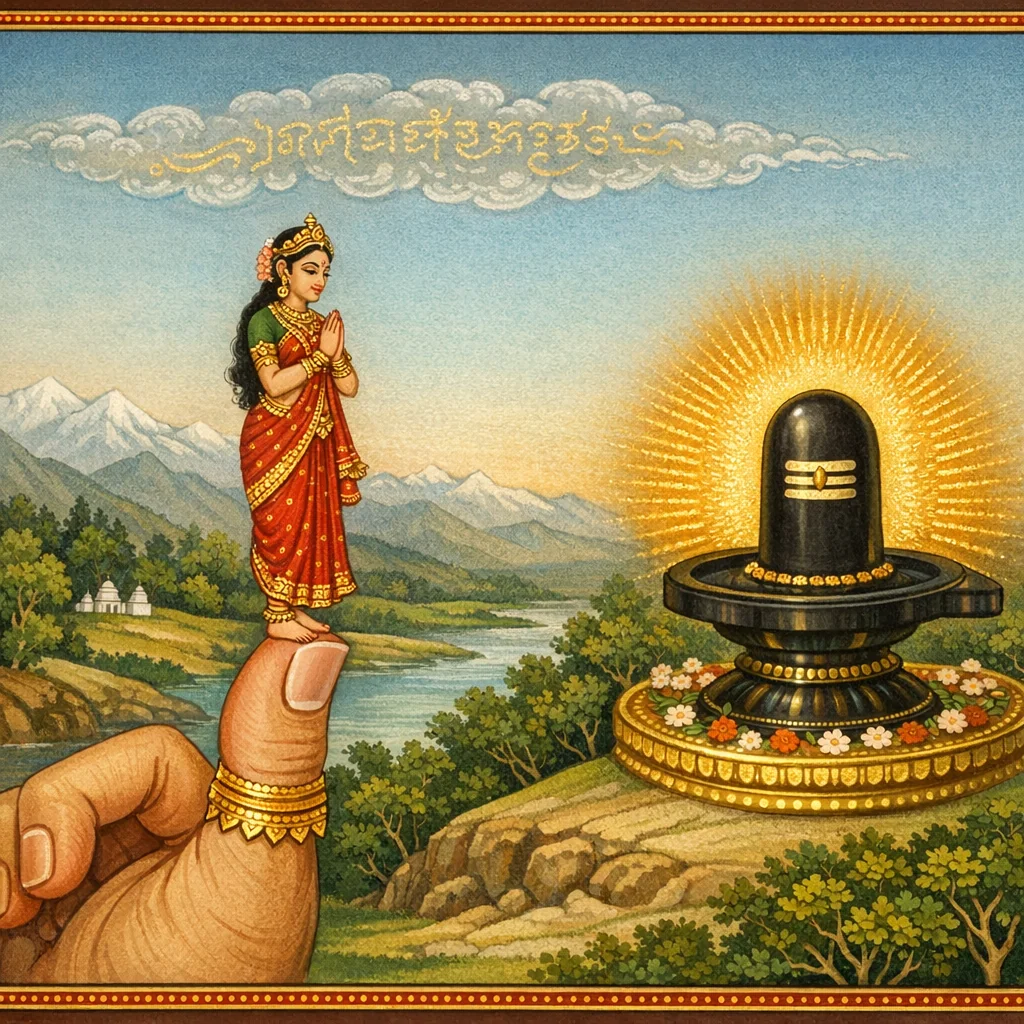
Adhyaya 96
कामेश्वर–रतीश्वरमाहात्म्यवर्णनम् | Kameśvara and Ratīśvara: Etiology and Merits of Worship
This chapter unfolds as a question-led theological dialogue between Devī and Īśvara. Īśvara first identifies Ratīśvara as lying to the north of Kāmeśvara with directional and distance markers, and declares its merit: mere darśana and worship are said to destroy the demerit of seven births and to avert disruption within the household. When Devī asks the origin of the site and the reason for the name “Ratīśvara,” Īśvara recounts the etiological legend. After Kāma (Manasija) is burned by Tripurāri (Śiva), Ratī performs prolonged tapas there—standing upon the tip of her thumb for an immense span—until a Māheśvara liṅga rises from the earth. A bodiless voice instructs her to worship it and promises reunion with Kāma; through Ratī’s intense devotion Kāma is restored, and the liṅga becomes known as Kāmeśvara. Ratī then proclaims a general merit: future worshippers, by the liṅga’s grace, attain desired accomplishments and an auspicious destiny. The chapter closes with a calendrical observance, stating that worship on the thirteenth day of the bright fortnight in Caitra bestows auspiciousness and fulfillment of desire, in a neutral phalāśruti tone.
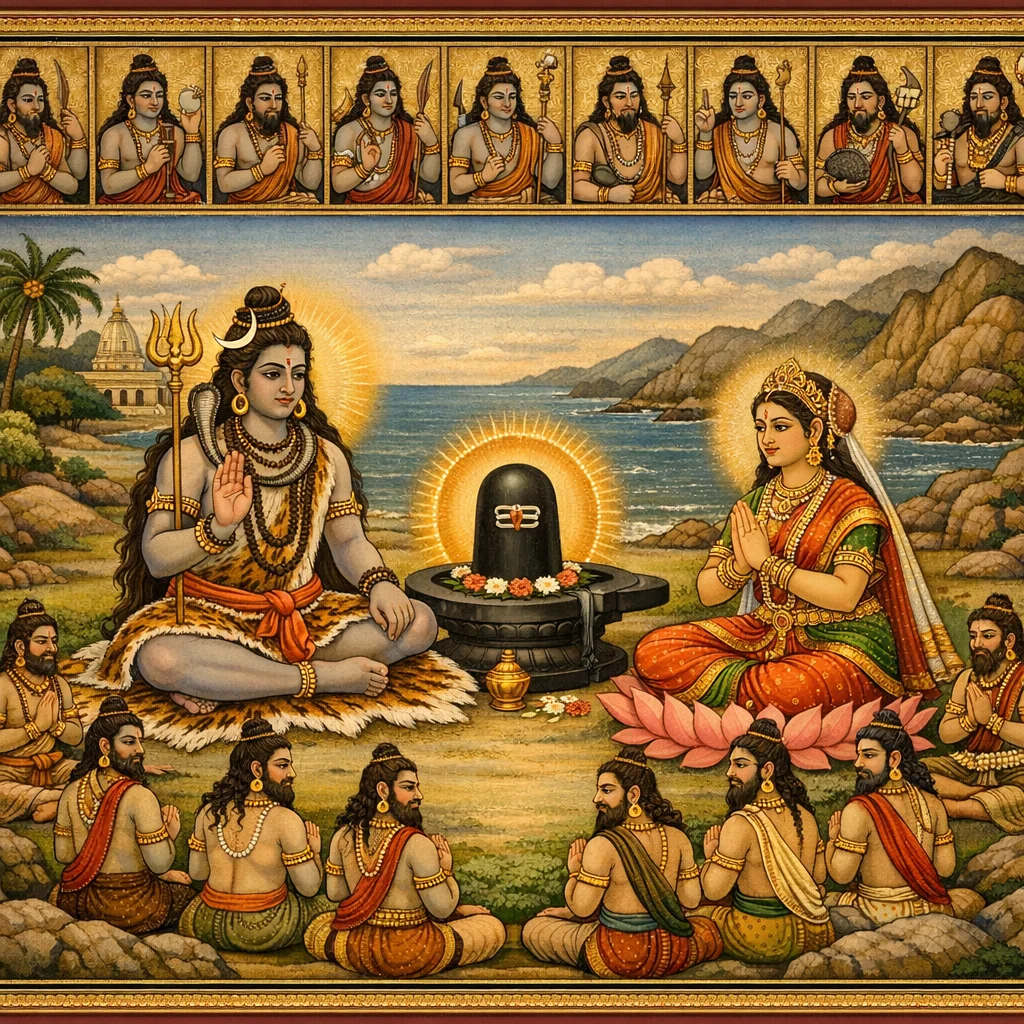
Adhyaya 97
योगेश्वरमाहात्म्यवर्णनम् (Glorification of Yogeśvara Liṅga)
Īśvara instructs Mahādevī about a supremely efficacious liṅga called Yogeśvara, situated in Prabhāsa-kṣetra in a specified direction (in the Vāyu portion near Kāmeśa, within the measure of “seven bows”). This liṅga is praised as mahāprabhāva, and it is stated that mere darśana—devout beholding—destroys sin. In an earlier age it was known as Gaṇeśvara; its origin is told through the coming of innumerable mighty gaṇas who, knowing Prabhāsa to be a Māheśvara field, performed severe tapas with yogic discipline for a thousand divine years. Pleased with their ṣaḍaṅga-yoga, Vṛṣadhvaja (Śiva) bestowed the name Yogeśvara and declared it a giver of yogic fruits. One who worships Yogeśa with proper ritual procedure and bhakti attains yoga-siddhi and heavenly joy; such worship is proclaimed superior even to extravagant gifts, hyperbolically likened to giving a golden Meru and the whole earth. A further rite is added for completeness of results: the gift of a bull (vṛṣabha-dāna). The discourse then turns to the “eleven Rudras” abiding in Prabhāsa, who must always be worshiped and revered by seekers of the kṣetra’s fruits. A phalaśruti promises that hearing the account of Rudra-ekādaśa yields the full merit of the sacred field, while ignorance of these Rudras is censured. Finally, a concise instruction is given: after worshiping Someśvara, one should recite the Śatarudrīya; thereby one gains the merit of all the Rudras. This teaching is called a “secret” (rahasya), pacifying sin and increasing merit.
Adhyaya 98
पृथ्वीश्वर-माहात्म्यवर्णनम् (Glorification of Pṛthvīśvara and the Origin of Candreśvara)
This chapter unfolds as a dialogue: Devī asks why a certain liṅga is called Pṛthvīśvara and later becomes known as Candreśvara. Īśvara replies with a sin-destroying, purificatory account set across cosmic time, declaring that the liṅga has been renowned since earlier yugas and manvantaras and is established in the Prabhāsa region with clear directional and distance markers. The narrative then tells of the Earth, oppressed by the burden of daityas, assuming the form of a cow and wandering until she reaches Prabhāsa-kṣetra. There she vows to install a liṅga and performs fierce austerities for a hundred years; Rudra is pleased, assures her that Viṣṇu will remove the daityas, and proclaims the liṅga famous as Dharitrī/Pṛthvīśvara. The phalaśruti adds that worship on Bhādrapada kṛṣṇa tṛtīyā yields merit equal to vast sacrifices; the surrounding tract is a liberating field, and even an inadvertent death within it leads to the “supreme state.” In the second arc, set in the Varāha-kalpa, the Moon—afflicted by Dakṣa’s curse—falls to earth, reaches Prabhāsa by the ocean, and worships Pṛthvīśvara for a thousand years. He regains brilliance and purification, and the liṅga becomes known as Candreśvara. The chapter concludes that hearing this māhātmya removes impurities and supports health.
Adhyaya 99
Cakradhara–Daṇḍapāṇi Māhātmya (Establishment of Cakradhara near Somēśa and the Pacification of Kṛtyā)
Īśvara tells Devī a sacred place-legend explaining why Cakradhara (Viṣṇu bearing the discus) and Daṇḍapāṇi (a Śaiva guardian) are stationed together at Prabhāsa. It begins with the deluded king Pauṇḍraka Vāsudeva, who imitates Viṣṇu’s insignia and challenges Kṛṣṇa to abandon the cakra and other emblems. Viṣṇu answers with a sharp reversal: he will “cast away” the cakra in Kāśī—by wielding it to defeat the pretender and expose the false claim. Viṣṇu slays Pauṇḍraka and Kāśirāja. Kāśirāja’s son propitiates Śaṅkara and receives a destructive kṛtyā that advances toward Dvārakā. Viṣṇu releases Sudarśana to neutralize it; the kṛtyā flees to Kāśī and seeks Śaṅkara’s protection. Śaṅkara’s intervention escalates the clash of divine weapons until Viṣṇu reaches Prabhāsa near Somēśa/Kālabhairava, where Daṇḍapāṇi urges restraint, warning that further release of the cakra could bring widespread harm. Viṣṇu accepts the injunction and remains there as Cakradhara beside Daṇḍapāṇi. The chapter ends with worship instructions and phalaśruti: devotees who honor Daṇḍapāṇi first and then Hari are freed from “sin-cuirasses” and attain auspicious destinations. Specific lunar days and fasts are praised for removing obstacles and gaining merit oriented toward liberation.
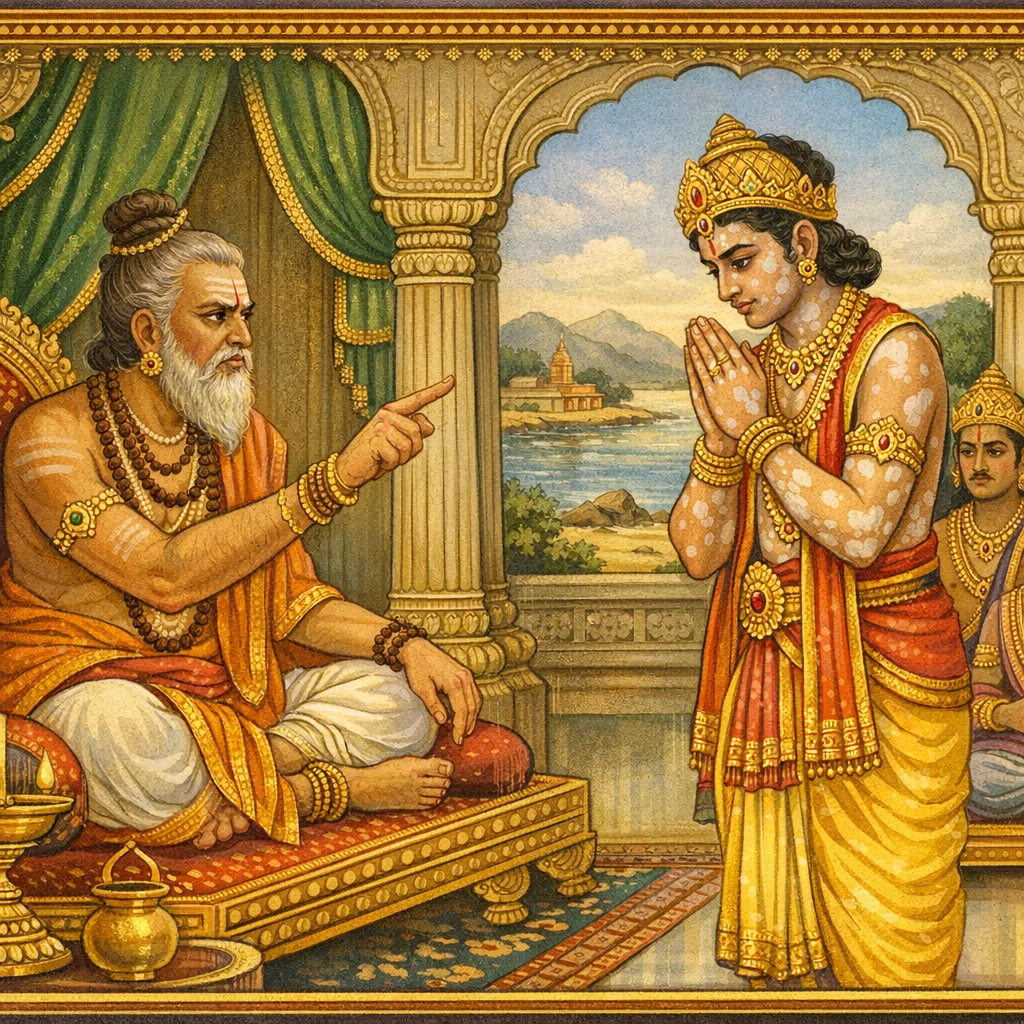
Adhyaya 100
सांबाय दुर्वाससा शापप्रदानवर्णनम् — Durvāsas’ Curse upon Sāmba and the Origin-Frame of Sāmbāditya
Chapter 100 is a sacred Śiva–Devī dialogue that opens the Sāmbāditya-māhātmya within the Prabhāsa pilgrimage setting. Īśvara points Devī to the northern and vāyavya (northwest) quarters and introduces Sāmbāditya as a solar manifestation established by Sāmba. He notes three chief Sūrya sites in the region, including Mitravana and Muṇḍīra, with Prabhāsakṣetra presented as the third locus. The narrative then turns from place to moral causality. Devī asks who Sāmba is and why a city bears his name. Īśvara explains that Sāmba is the mighty son of Vāsudeva (here linked to the Āditya line), born of Jāmbavatī, who fell under a paternal curse and was afflicted with kuṣṭha (leprosy). The cause is specified: the sage Durvāsas arrives in Dvāravatī, and Sāmba—proud of youth and beauty—mocks the ascetic through disrespectful gestures and demeanor. Enraged, Durvāsas pronounces that Sāmba will soon be seized by leprosy. Thus the chapter teaches humility before holy ascetics and prepares for Sāmba’s later refuge in solar worship and the establishment of Sūrya’s presence at his city for the benefit of all.
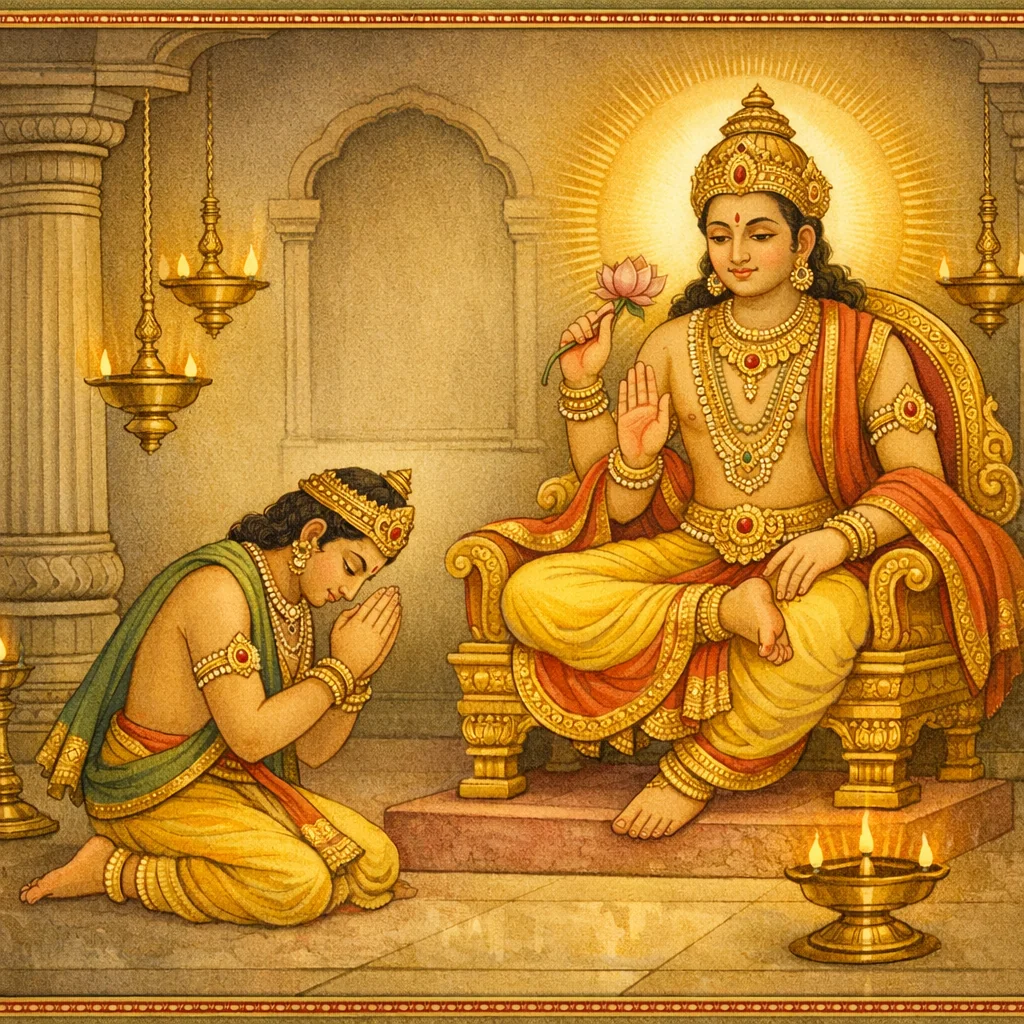
Adhyaya 101
सांबादित्यमाहात्म्यवर्णनम् | The Māhātmya of Sāmba-Āditya (Sun Worship at Prabhāsa)
This chapter presents a theological and ethical episode that links conduct with karmic consequence and shows devotion as the remedy. Nārada comes to Dvāravatī and observes the courtly life of the Yādavas; Sāmba’s irreverence becomes the spark. Nārada raises the unsettling theme that attention becomes unstable under intoxication and social pressures, and Kṛṣṇa responds thoughtfully as events unfold like a test. On a pleasure outing, Nārada summons Sāmba before Kṛṣṇa and the women of the inner apartments; in agitation and loss of restraint—heightened by drink—disorder arises. Kṛṣṇa utters a curse as an ethical warning about diverted attention, social vulnerability, and the karmic cost of negligence: some women are said to fall from promised destinations and later be seized by bandits, while the principal queens are protected by their steadiness. Sāmba too is cursed with leprosy, turning the narrative toward expiation. Sāmba performs severe austerities at Prabhāsa, installs and worships Sūrya (the Sun-god) with a prescribed hymn, and receives a boon of healing along with restraints on conduct. The chapter then gives doctrinal and ritual catalogues: Sūrya’s twelve names, the twelve Ādityas aligned with the months, and a vrata sequence (notably in Māgha’s bright fortnight from the fifth to the seventh day) with offerings such as karavīra flowers and red sandal, worship procedures, feeding of brāhmaṇas, and promised fruits. The concluding phalāśruti declares that hearing this account removes sins and grants health.
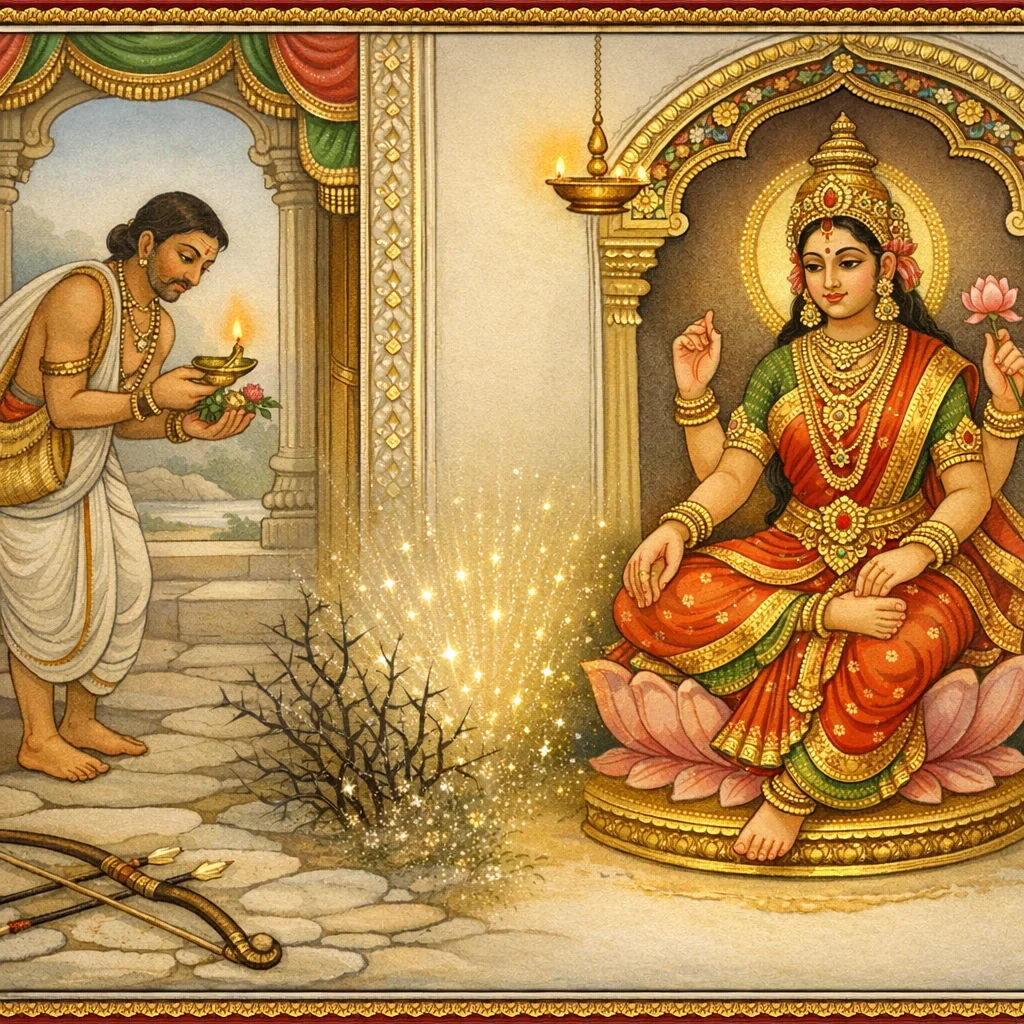
Adhyaya 102
कंटकशोधिनीदेवीमाहात्म्य (Glory of the Goddess Kaṇṭakaśodhinī)
This adhyāya gives a brief tīrtha-focused instruction concerning the Devī Kaṇṭakaśodhinī, “Remover of Thorns/Obstacles.” Her shrine is located by directional description: the devotee is to go to the northern sector, at a distance of “two dhanus” (a traditional bow-length measure). She is praised with protective, martial epithets—Mahīṣaghnī (slayer of the buffalo-demon), great-bodied, and worshipped by Brahmā and the devarṣis—affirming her exalted place in Purāṇic devotion. A mythic purpose is stated: across successive ages she purifies and removes the “thorns,” the demonic forces called devakantaka who afflict the gods. The chapter prescribes worship on the bright-fortnight Navamī of Āśvayuja, with paśu offerings and floral oblations, along with fine lamps and incense. The phalaśruti promises the worshipper freedom from enemies for a year; and, when beheld with sincere devotion, the goddess protects the devotee like a son, whether one comes on a special visit or regularly. The closing frames this as a short, sin-destroying māhātmya whose very hearing is supremely protective.
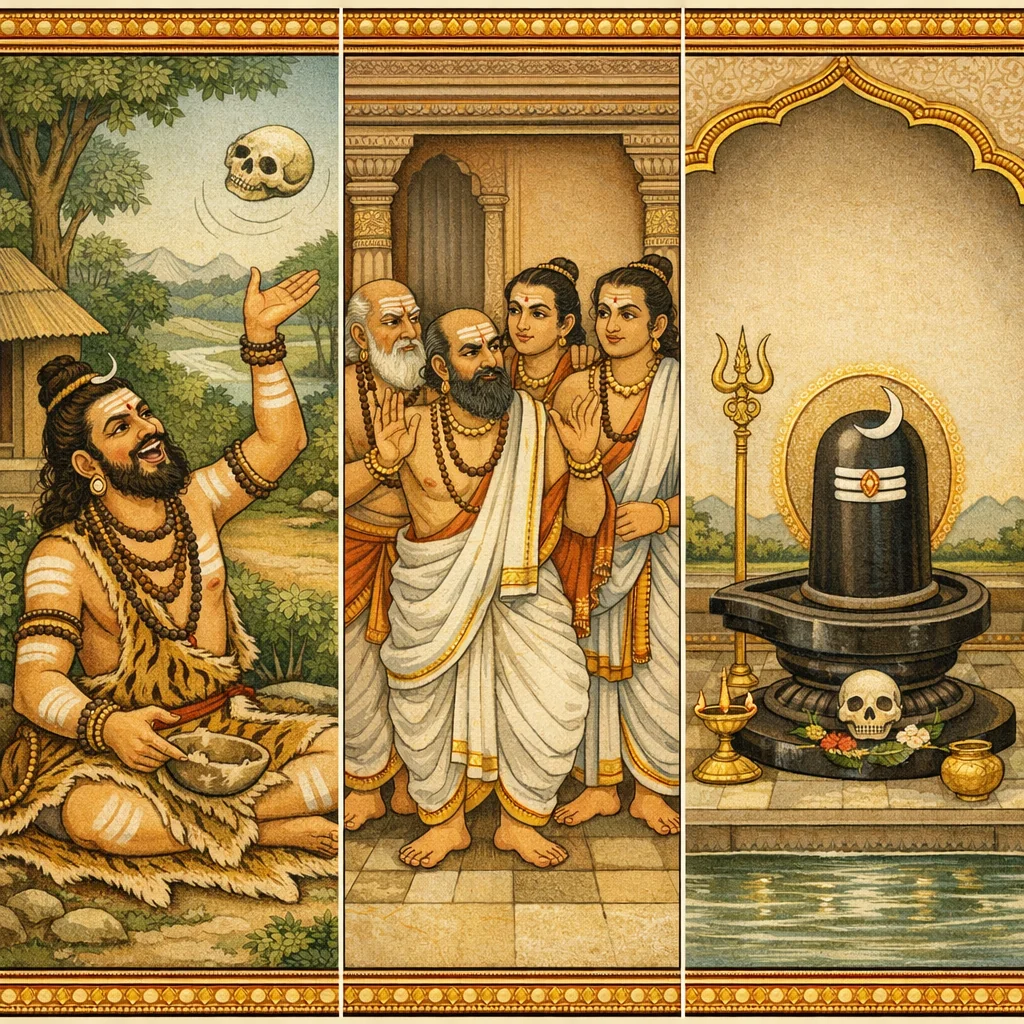
Adhyaya 103
कपालेश्वरमाहात्म्यवर्णनम् | The Māhātmya of Kapāleśvara (Origin and Merit of the Shrine)
Chapter 103 gives an origin-legend for the sanctity and name of Kapāleśvara in Prabhāsa-kṣetra. Īśvara tells Devī that one should go to the eminent Kapāleśvara shrine to the north, revered even by the divine beings. At Dakṣa’s sacrifice, brāhmaṇas see a dust-covered ascetic carrying a skull (kapāla) and, in ritual indignation, drive him away as unfit for the yajña ground. The figure—implicitly Śaṅkara—laughs, hurls the skull into the sacrificial arena, and vanishes; yet the skull keeps reappearing even when thrown out. Astonished, the sages conclude that only Mahādeva could cause such a marvel, and they propitiate Śiva with hymns and fire-offerings, including Śatarudrīya recitations, until Śiva manifests directly. Granted a boon, the brāhmaṇas ask Śiva to abide there as a liṅga named Kapāleśvara, so called because innumerable skulls recur at that spot. Śiva consents, the sacrifice resumes, and the text declares the merit of darśana: equal to the fruit of an Aśvamedha and cleansing of sins, even those from prior births. It also notes manvantara-based name changes (later Tattveśvara) and reiterates Śiva’s disguised form as the means by which the place is sacralized.
Adhyaya 104
कोटीश्वरमाहात्म्यवर्णनम् | Kotīśvara Liṅga: Account of its Sacred Greatness
Īśvara instructs Devī on a directional order of pilgrimage: the seeker should go to the exalted Kotīśvara, and to its north the place is also known as Koṭīśa. The chapter explains the sanctity of the site through an earlier event near Kapāleśvara. Pāśupata ascetics—ash-smeared, matted-haired, wearing muñja-girdles, self-controlled and anger-conquering brāhmaṇa Śiva-yogins—performed intense tapas while ranging through the kṣetra in all four directions. Numbering a “koṭi” (a crore) and devoted to mantra-japa, they duly established a liṅga near Kapāleśa and worshiped it with devotion. Pleased, Mahādeva granted them mukti; and since a koṭi of ṛṣis attained siddhi there, the liṅga became renowned on earth as Kotīśvara. The text also states merit-equivalences: devoted worship of Kotīśvara yields the fruit of koṭi mantra-japa; gifting gold to a Veda-versed brāhmaṇa at this site yields merit comparable to koṭi homas, affirming the pilgrimage as truly fruitful.
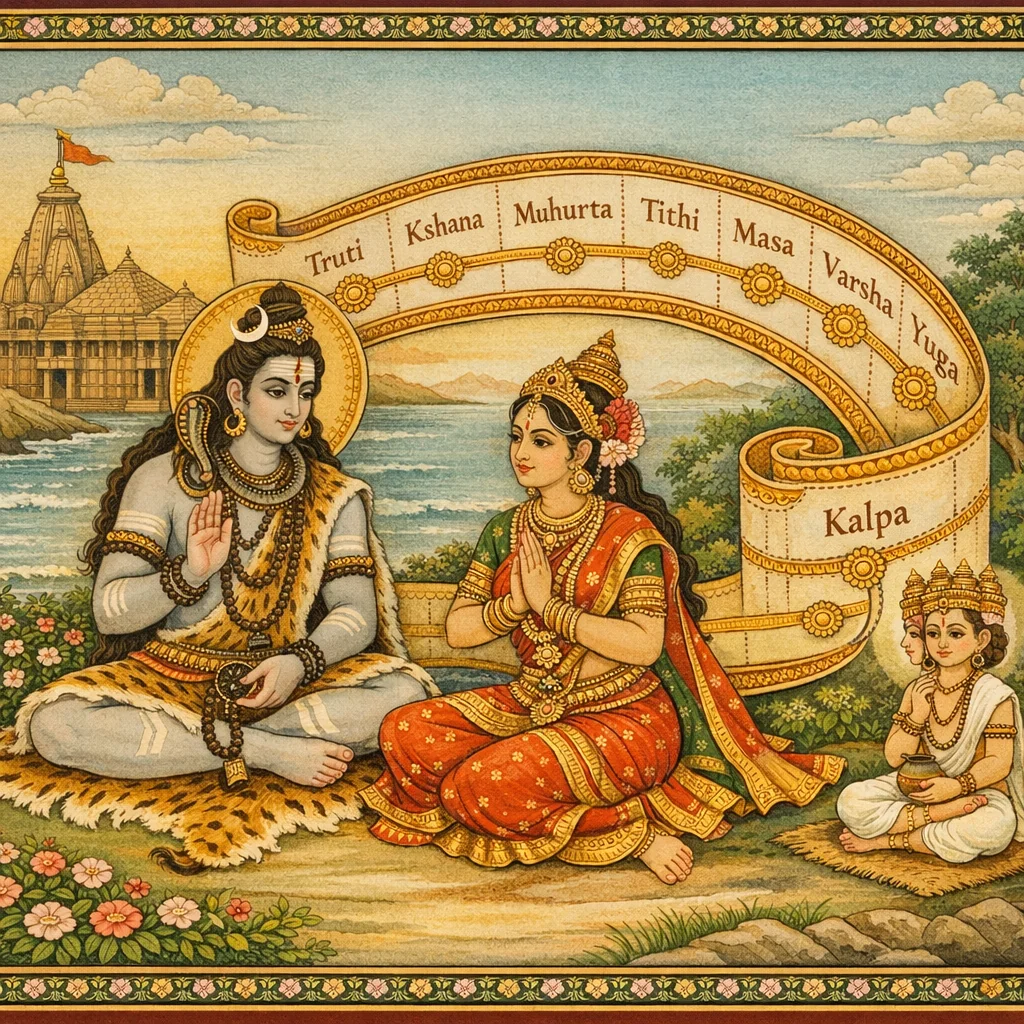
Adhyaya 105
ब्रह्ममाहात्म्यवर्णनम् (Brahmā-Māhātmya: Theological Discourse on Brahmā’s Sanctity at Prabhāsa)
Īśvara reveals within Prabhāsa-kṣetra a “secret, excellent place” said to purify all, then names the eminent divine presences abiding in that sacred field. He declares that mere darśana there can free one from heavy stains—grave sins and birth-born impurities. Devī asks why Brahmā is here described as “child-formed” (bāla-rūpī) though elsewhere he appears aged, and requests the place, proper time, rules of worship, and the order of pilgrimage. Īśvara explains that Brahmā’s supreme station lies to the Īśānya (northeast) of Somnātha amid associated landmarks; Brahmā arrives at eight years of age, performs severe tapas, and joins in the establishment and installation of the Somnātha liṅga with vast ritual support. The chapter then sets out a technical cosmological reckoning of time—from truṭi up to muhūrta, through months and years, yugas and manvantaras—naming Manus and Indras and listing the kalpas that form Brahmā’s month, identifying the present kalpa as Varāha. It concludes by integrating Brahmā–Viṣṇu–Rudra and affirming an advaita-leaning unity: divine powers differ in function yet are ultimately one; therefore pilgrims seeking the true fruit of yātrā should honor Brahmā first and avoid sectarian hostility.
Adhyaya 106
ब्राह्मणप्रशंसा-वर्णनम् (Praise of Brahmins and Conduct in Prabhāsa-kṣetra)
The chapter unfolds as a theological Q&A. Devī asks how the non-dual Brahman—manifest at Prabhāsa as Pitāmaha (Brahmā) in a child-form—is to be worshiped, which mantras and ritual rules apply, and what kinds of Brahmins dwell in the kṣetra and how their residence yields the kṣetra’s fruit. Īśvara answers by recasting worship in social-ethical ritual terms: Brahmins are proclaimed a direct earthly manifestation of the divine, and honoring them is treated as equal to—and in some statements greater than—honoring iconic forms. The text sternly forbids testing, insulting, or harming Brahmins, including those who are poor, sick, or physically impaired, and declares severe consequences for violence or humiliation. Offering food and drink is emphasized as a primary act of reverence. It then presents a typology of kṣetra-resident Brahmin livelihoods and disciplines (multiple named categories) with brief behavioral markers such as vows, austerities, and modes of subsistence. The chapter concludes that disciplined, Veda-engaged Brahmins in Prabhāsa are the proper worshipers of the child-form Pitāmaha, while those barred for major transgressions should not approach that worship.
Adhyaya 107
बालरूपी-ब्रह्मपूजाविधानम्, रथयात्रा-विधिः, नामशत-स्तोत्र-माहात्म्यम् (Bālarūpī Brahmā Worship Procedure, Chariot-Festival Protocol, and the Merit of the Hundred Names)
This adhyāya is a ritual and doctrinal manual framed as Īśvara’s instruction. It first classifies bhakti as mental (mānasī), verbal (vācikī), and bodily (kāyikī), and further distinguishes worldly (laukikī), Vedic (vaidikī), and inward/contemplative (ādhyātmikī) orientations. It then lays out a Prabhāsa-specific procedure for worshiping Brahmā in child-form (Bālarūpī): bathing at the tīrtha; pañcagavya and pañcāmṛta ablutions with mantra recitation; a mapped nyāsa across the body; sanctifying offerings; rites of flowers, incense, lamp, and naivedya; and honoring Vedic corpora and abstract virtues as objects of reverence. The chapter also introduces a Kārttika ratha-yātrā (especially around Pūrṇimā), describing civic roles, ritual cautions, and promised outcomes for participants and onlookers. A long catalog of place-linked names and manifestations of Brahmā functions as a theological geography index, followed by phalāśruti asserting that stotra-recitation and correct observance remove wrongdoing and yield great merit, with rare calendrical yogas such as Padmaka-yoga at Prabhāsa highlighted. It concludes by recommending dāna (including land-gift and specified items) and recitation practices for resident brāhmaṇas during major festivals.
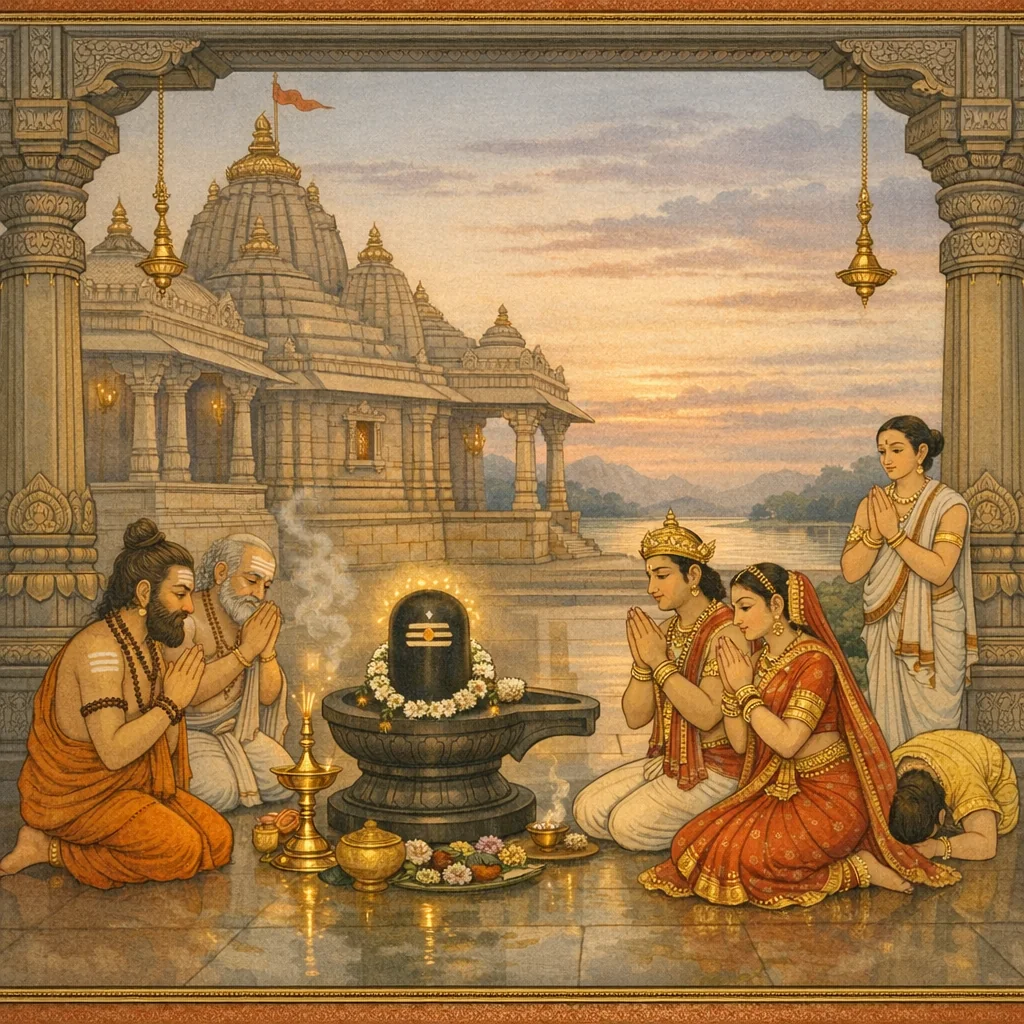
Adhyaya 108
प्रत्यूषेश्वरमाहात्म्यवर्णनम् / The Māhātmya of Pratyūṣeśvara
Īśvara instructs Devī to go to an eminent liṅga of the Vasus, situated in the Somnātha/Īśāna directional sector at a measured distance. This four-faced liṅga, beloved of the gods, is called Pratyūṣeśvara and is praised as a remover of great sins; mere darśana is said to destroy sins accumulated across seven births. When Devī asks who Pratyūṣa is and how the liṅga was established, Īśvara recounts the lineage: Dakṣa, son of Brahmā, gives his daughters (including Viśvā) in alliance to Dharma; Viśvā bears eight sons—the eight Vasus: Āpa, Dhruva, Soma, Dhara, Anala, Anila, Pratyūṣa, and Prabhāsa. Desiring a son, Pratyūṣa comes to Prabhāsa, recognizes it as a wish-fulfilling sacred kṣetra, installs Mahādeva, and performs tapas for a hundred divine years with concentrated meditation. Pleased, Mahādeva grants him a son, Devala, lauded as a foremost yogin; hence the liṅga becomes known as Pratyūṣeśvara. The chapter also gives ritual assurances: the childless who worship here gain enduring continuity of lineage; worship at dawn (pratyūṣa) with steady devotion destroys even severe sins, including those connected with brahmahatyā. For full pilgrimage fruit it prescribes gifting a bull (vṛṣa-dāna) and keeping a Māgha kṛṣṇa caturdaśī night vigil (jāgaraṇa), said to yield the merit of all gifts and sacrifices.
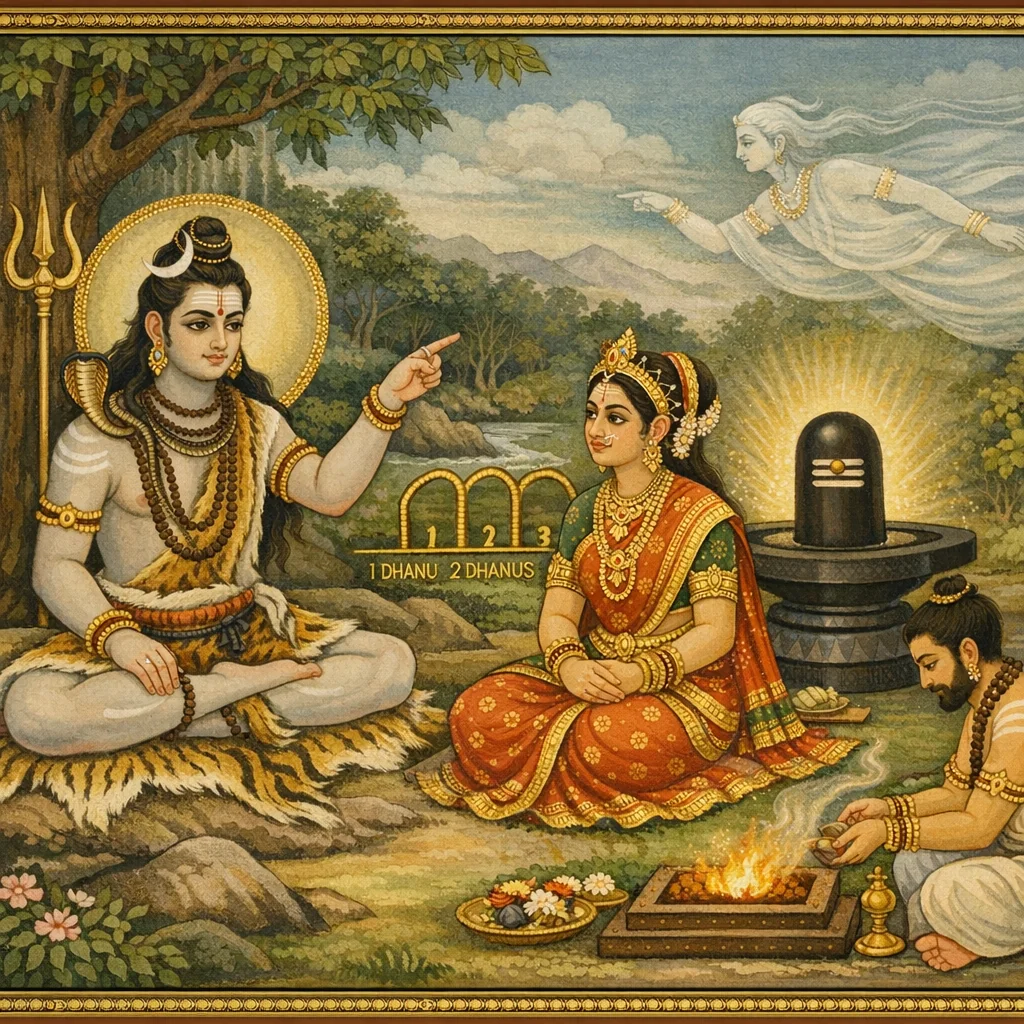
Adhyaya 109
अनिलेश्वरमाहात्म्यवर्णनम् (Anileśvara Māhātmya—Description of the Glory of Anileśvara)
Īśvara instructs Mahādevī to proceed to the eminent sacred place of Anileśvara. It lies in the northern quarter, precisely marked as three dhanus away, and its liṅga is praised as of great power (mahāprabhāva), destroying sin through mere darśana. The account links Anila with the Vasus, naming him the fifth Vasu. Anila worshipped Mahādeva, made Śiva manifest before him (pratyakṣīkṛta), and with proper śraddhā established the liṅga. By Īśa’s power, Anila’s son Manojava becomes strong and exceedingly swift, his movement impossible to trace—an example of divine favor. Those who behold the form and the site are said to gain protection and auspiciousness: freedom from affliction, and the absence of disability and poverty. Even a minimal offering—placing a single flower upon the liṅga—bestows happiness, fortune, and beauty. The chapter ends with a phalāśruti: hearing and approving this sin-destroying māhātmya leads to the fulfillment of one’s aims.
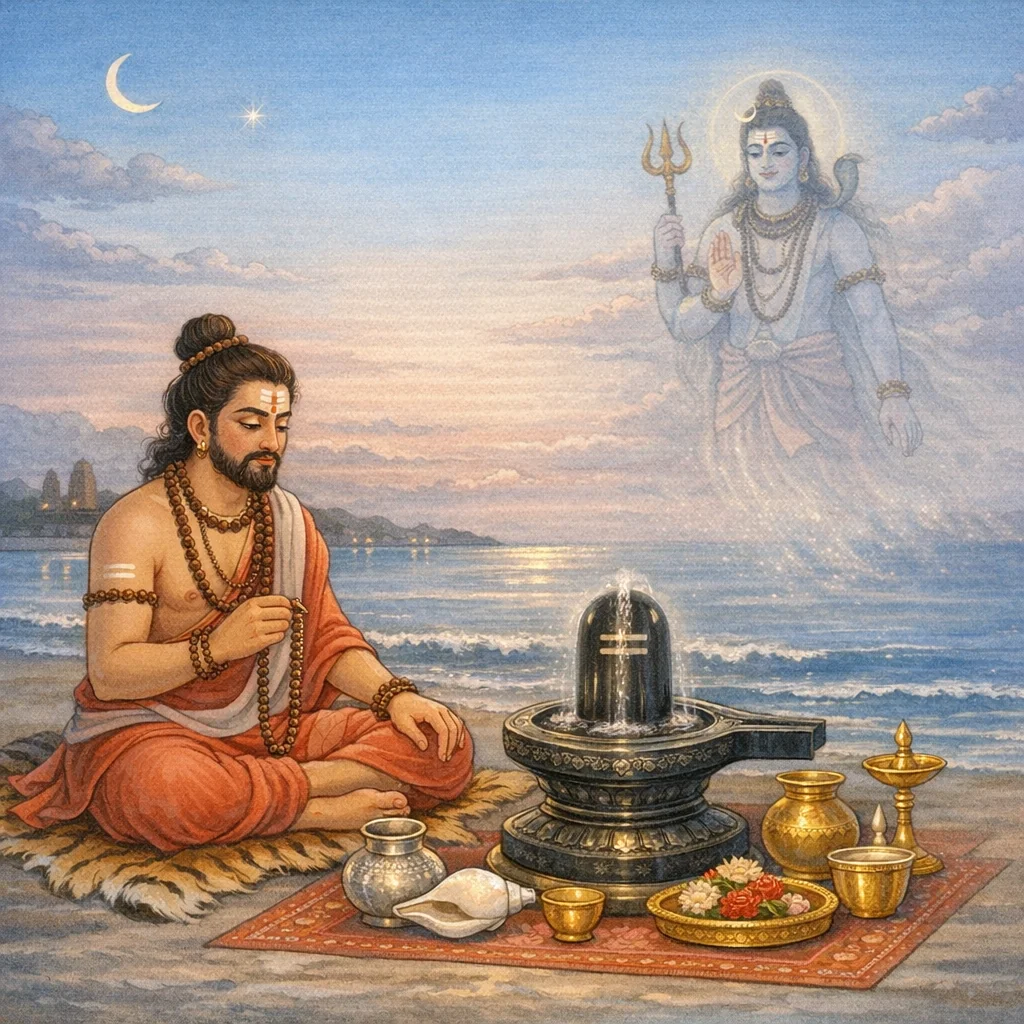
Adhyaya 110
प्रभासेश्वरमाहात्म्यवर्णनम् | The Māhātmya of Prabhāseśvara (Installation, Austerity, and Pilgrimage Observance)
Īśvara instructs Devī to go west from Gaurī-tapovana to the eminent Prabhāseśvara, marking its location within a radius of seven bow-lengths and declaring the great liṅga there to have been established by the eighth Vasu, Prabhāsa. The narrative recounts Prabhāsa’s desire for progeny, his installation of the mahāliṅga, and his long “Āgneyī” austerity for a hundred divine years, by which Rudra is pleased and grants the sought boon. A genealogical aside names Bhuvanā (Bṛhaspati’s sister) as Prabhāsa’s consort and links their line with Viśvakarmā, the cosmic artisan-creator, and with the mighty Takṣaka. The chapter ends with a pilgrim’s observance: in Māgha, on the fourteenth lunar day, bathe at the ocean confluence, perform Śatarudrīya japa, practice restraint (earth-bed and fasting), bathe the liṅga with pañcāmṛta, worship according to rule, and optionally gift a bull—promising purification and complete prosperity as the fruit.
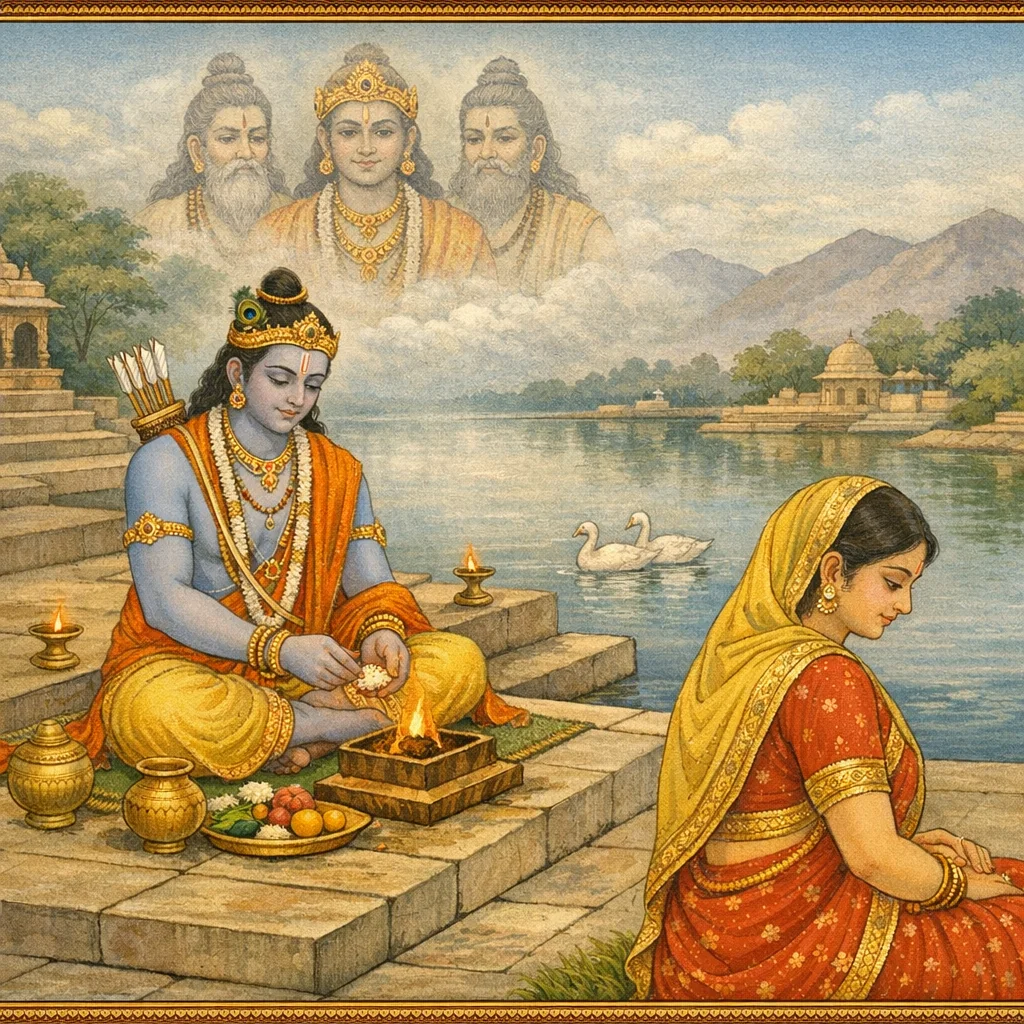
Adhyaya 111
रामेश्वरक्षेत्रमाहात्म्यवर्णन — Rāmeśvara Kṣetra Māhātmya (at Puṣkara)
Īśvara tells Devī a local māhātmya focused on a kuṇḍa near Puṣkara called “Aṣṭapuṣkara,” hard to reach for the undisciplined yet praised as a remover of sins. There stands a liṅga named Rāmeśvara, said to have been established by Rāma; mere worship is taught as expiatory, freeing one even from the grave sin of brahmahatyā. At Devī’s request for detail, Īśvara recounts how Rāma, with Sītā and Lakṣmaṇa, came there and installed the liṅga, setting it within Rāma’s life-story: born to destroy Rāvaṇa and later driven into forest exile through a sage’s curse. While traveling they reach Prabhāsa; after resting, Rāma dreams of Daśaratha and consults brāhmaṇas, who read the dream as ancestral communication and prescribe śrāddha at the Puṣkara tīrtha. Rāma invites worthy brāhmaṇas, sends Lakṣmaṇa to gather fruits, and Sītā prepares the offerings. During the rite Sītā, after a vision of her paternal ancestors “present” among the brāhmaṇas, withdraws modestly; Rāma is briefly angered by her absence, but she explains, and the episode is linked to the founding of the Rāmeśvara liṅga near Puṣkara. The phalaśruti concludes that devotional worship grants the supreme goal; śrāddha on dvādaśī and on certain special conjunctions involving caturthī/ṣaṣṭhī yields immeasurable fruit; ancestral satisfaction endures for twelve years; and gifting a horse is equated with the merit of an Aśvamedha.
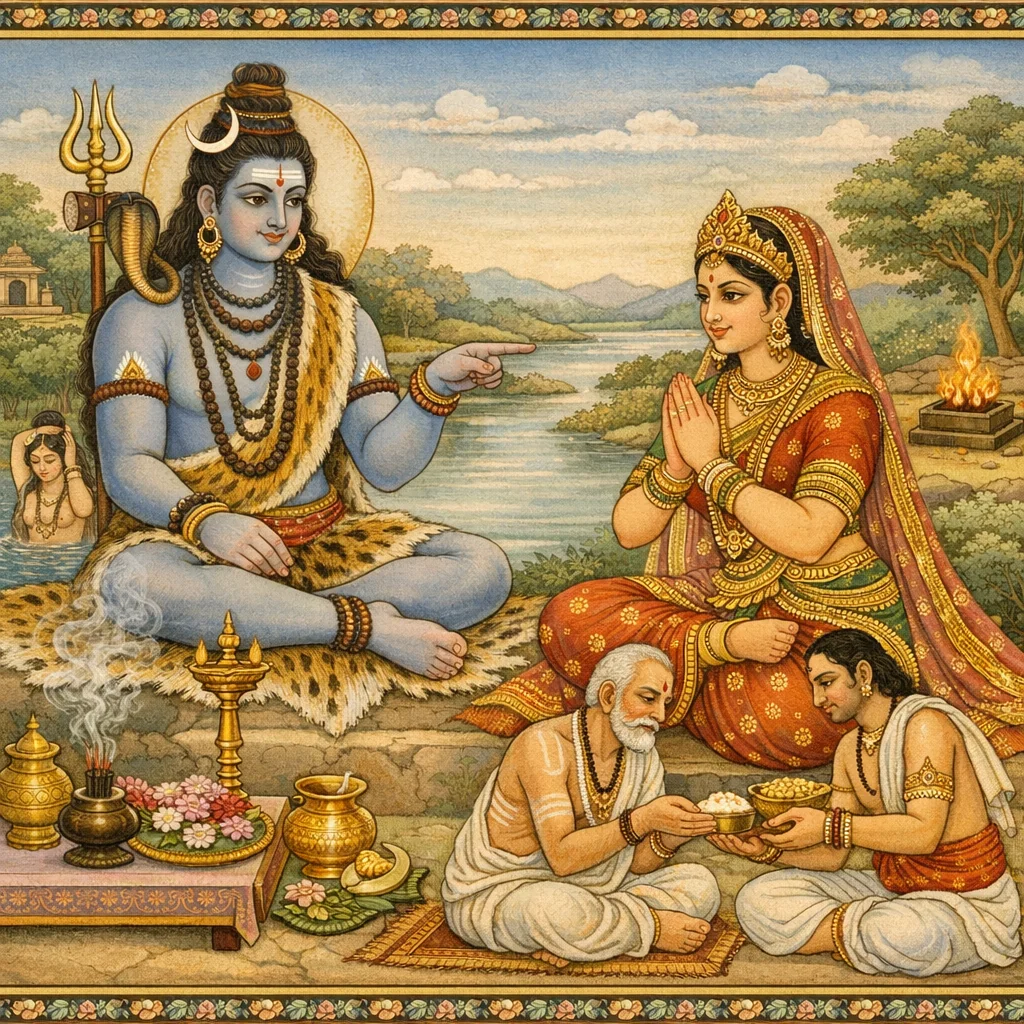
Adhyaya 112
लक्ष्मणेश्वरमाहात्म्यवर्णनम् (Lakṣmaṇeśvara Māhātmya—Account of the Glory of Lakṣmaṇeśvara)
Chapter 112 has Īśvara instruct Devī in an itinerary-like manner, directing her to the eminent shrine of Lakṣmaṇeśvara, situated east of Rāmeśa at a specified distance of thirty dhanus. The liṅga there is said to have been installed by Lakṣmaṇa during his pilgrimage journey; it is praised as a remover of great sins and as worshipped by the gods. The chapter lays down modes of devotion: worship with dance, song, and instrumental music, along with homa and japa, while the devotee remains established in meditative absorption, culminating in the promise of “paramā gati,” the supreme goal. It also codifies dāna procedure: after honoring the deity with sequential offerings such as fragrance and flowers, one should give food, water, and gold to a qualified dvija. A calendrical emphasis follows—worship on kṛṣṇa-caturdaśī (the fourteenth day of the dark fortnight) in Māgha is singled out, with bathing, gifting, and japa declared akṣaya, imperishable in result. The closing colophon places the chapter within the Prabhāsa Khaṇḍa and the Prabhāsakṣetramāhātmya framework.
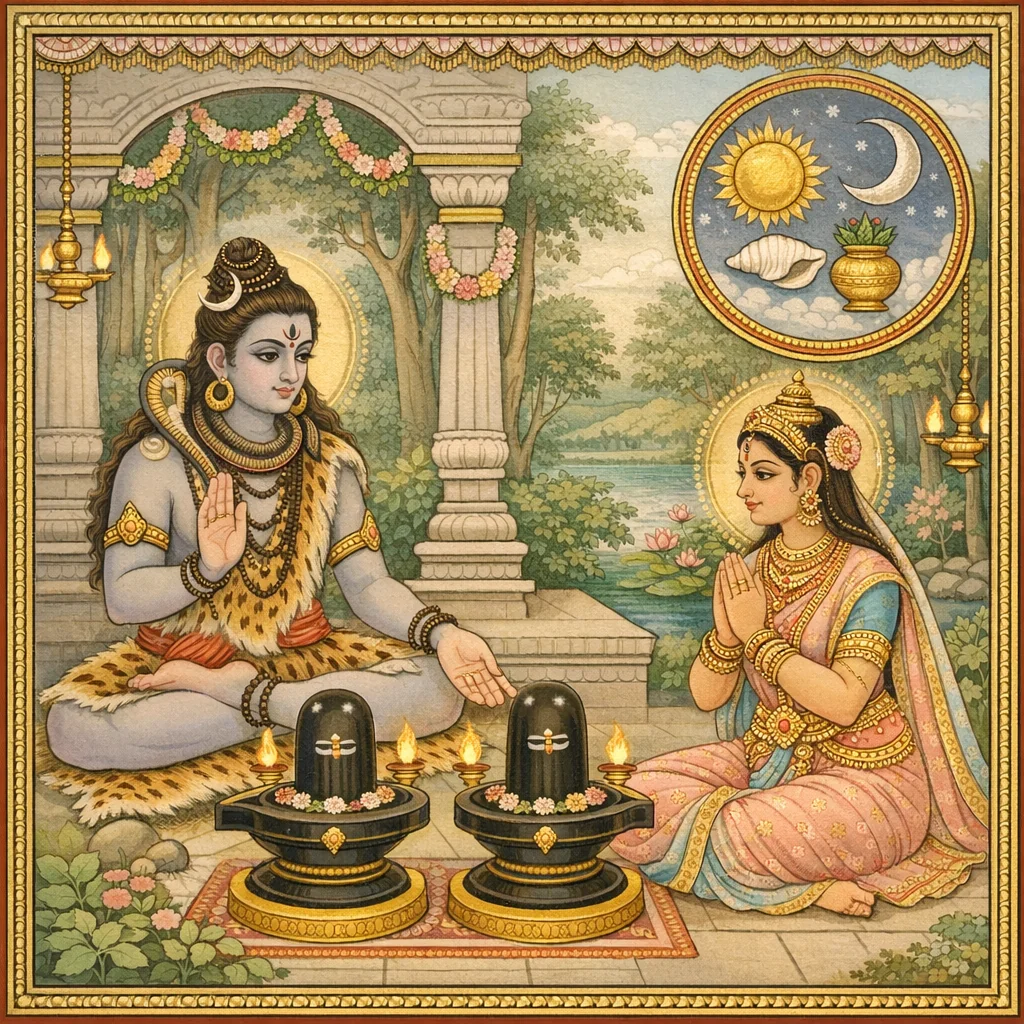
Adhyaya 113
जानकीश्वरमाहात्म्यवर्णनम् (Jānakīśvara Māhātmya: Account of the Glory of Jānakīśvara)
In this chapter, Īśvara speaks to Devī and points to an eminent liṅga named Jānakīśvara, situated in the south‑western (naiṛta) quarter near Rāmeśa/Rāmeśāna. The site is praised as pāpa-hara, a destroyer of sins for all beings, and as the liṅga once specially worshipped by Jānakī (Sītā). The text explains its sacred names through time: it was formerly called Vasiṣṭheśa, became renowned as Jānakīśa in the Tretā-yuga, and later gained the epithet Siddheśvara when sixty thousand Vālakhilya sages attained siddhi there. In the Kali-yuga it is described as a powerful “yuga-liṅga” (dual liṅga), whose mere sight frees devotees from suffering born of misfortune. Devotional pūjā is prescribed for women and men alike, including bathing/ablution of the liṅga; a higher observance enjoins worship after bathing at Puṣkara-tīrtha with regulated conduct and diet for an unbroken month, promising daily merit surpassing the Aśvamedha. A specific time is also given: a woman’s worship on the third lunar day in Māgha removes grief and ill-luck even from her lineage. The concluding phalaśruti declares that hearing this māhātmya destroys sins and bestows auspiciousness.
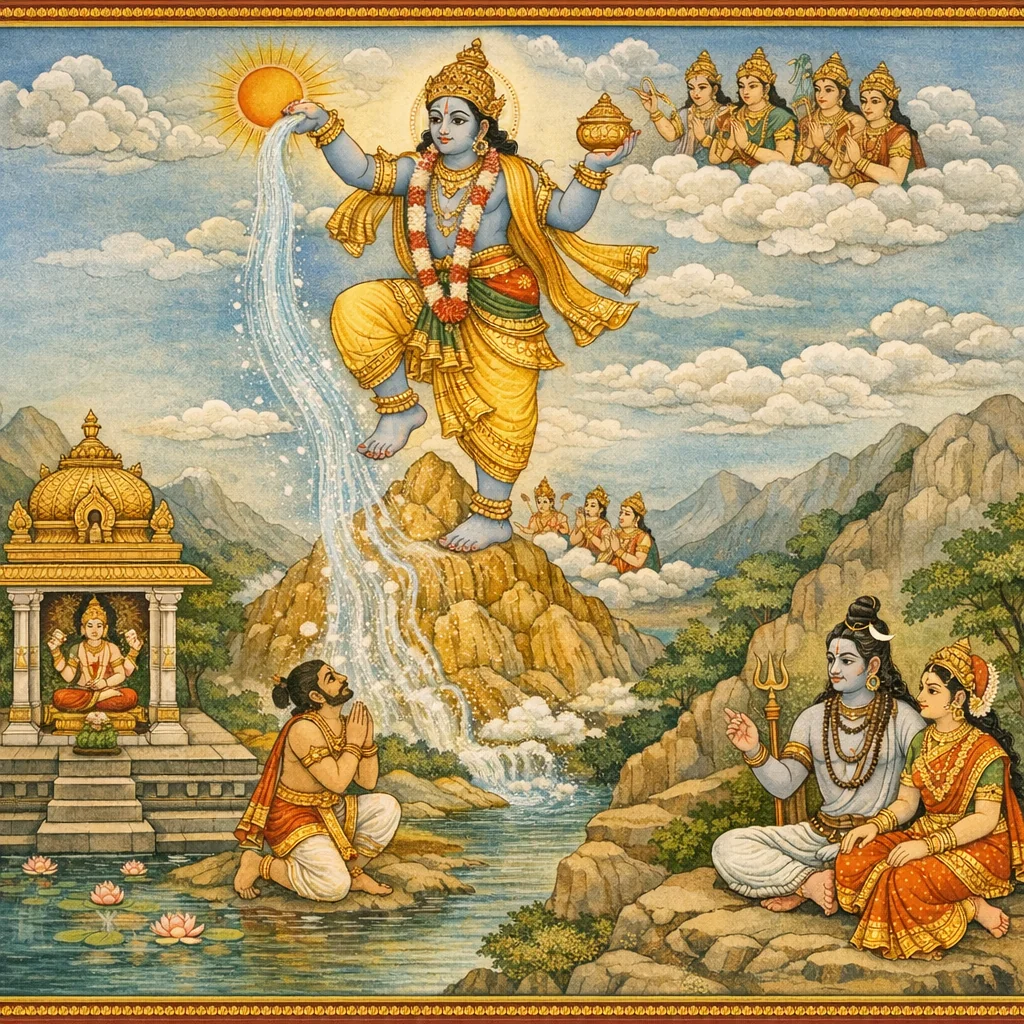
Adhyaya 114
वामनस्वामिमाहात्म्यवर्णनम् | Vāmana-Svāmin Māhātmya (Glorification of Vāmana Svāmin)
Īśvara instructs Devī to proceed to a Viṣṇu holy place called Vāmana Svāmin, praised as a remover of sins (pāpa-praṇāśana) and a destroyer of all major transgressions (sarva-pātaka-nāśana). The chapter locates this tīrtha near the south‑western quarter of Puṣkara and presents it as a sanctified confluence connected with Prajāpati. It then recounts the binding of Bali by Viṣṇu through the Lord’s three strides: first, the right foot is set down at this very spot; second, upon the summit of Meru; and third, in the sky. When the cosmic boundary is breached, waters issue forth and are identified as the river Gaṅgā, called Viṣṇupadī, arising from Viṣṇu’s footprint. Puṣkara itself is explained etymologically through meanings of “sky” and “water,” further establishing its holiness. Ritual fruits are specified: bathing and beholding Hari’s footprint leads to Hari’s supreme abode; offering piṇḍa grants long satisfaction to the ancestors; and gifting footwear to a disciplined brāhmaṇa is lauded as merit that brings honored conveyance in Viṣṇu’s world. A supporting gāthā attributed to Vasiṣṭha is cited to confirm the tīrtha’s purificatory power.
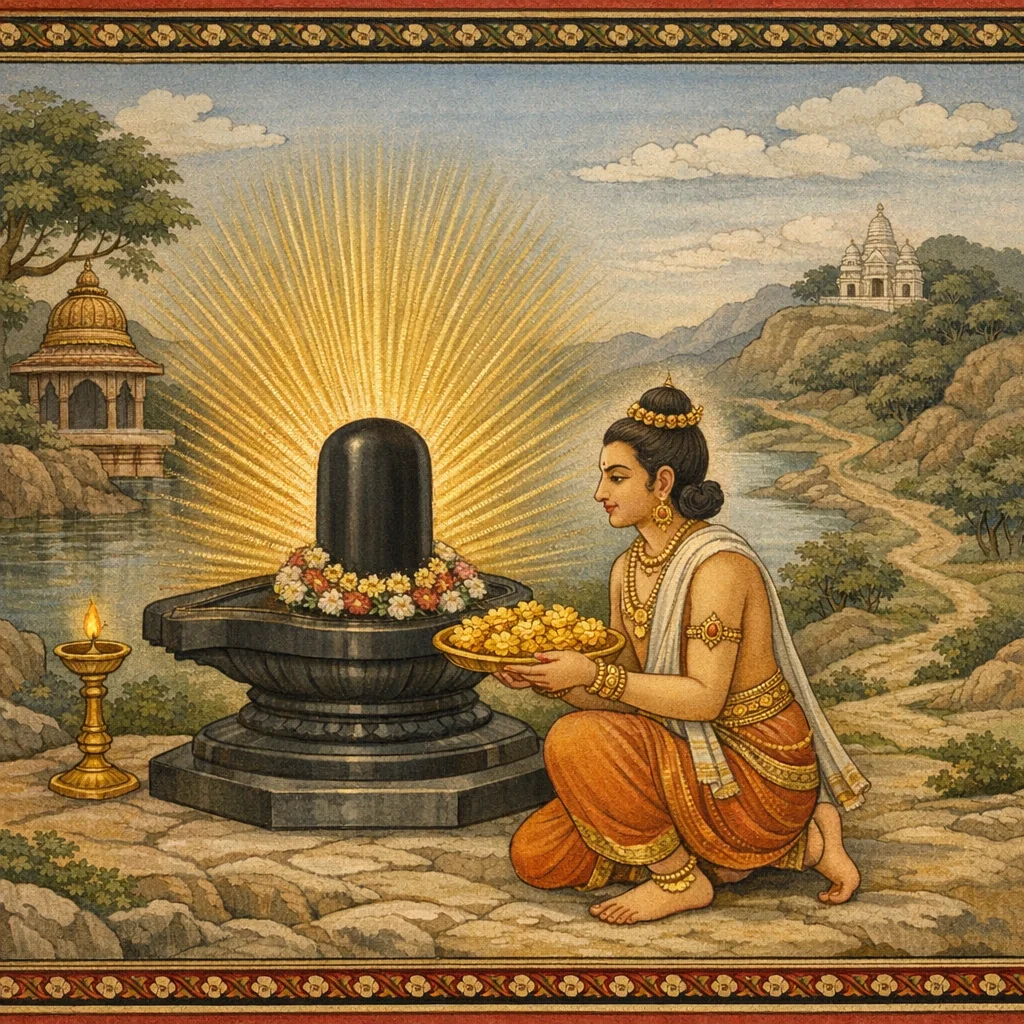
Adhyaya 115
Puṣkareśvaramāhātmya-varṇana (Glorification of Puṣkareśvara)
Īśvara instructs Mahādevī on the proper pilgrimage sequence within Prabhāsa-kṣetra: first one should go to the eminent Puṣkareśvara, and then to Jānakīśvara situated to its south. He declares the Puṣkareśvara-liṅga to be exceedingly powerful, its sanctity confirmed by exemplary worship—Brahmaputra (a son of Brahmā) and the sage Sanatkumāra adored it in the prescribed manner, offering golden puṣkara-flowers—thereby explaining the shrine’s name and renown. The chapter then teaches a practical principle of ritual efficacy: devotional worship with offerings such as gandha (fragrance) and puṣpa (flowers), performed sequentially and correctly, is counted as completing the Puṣkarī-yātrā. A fruit is proclaimed: the place is famed as sarva-pātaka-nāśana, the destroyer of all sins, presenting pilgrimage as ethical purification and a disciplined itinerary of bhakti.
Adhyaya 116
शंखोदककुण्डेश्वरीगौरीमाहात्म्य (Glory of Śaṅkhodaka Kuṇḍa and Kuṇḍeśvarī/Gaurī)
Īśvara speaks to Devī and points to a goddess-site called Kuṇḍeśvarī, praised as a giver of saubhāgya (auspicious good fortune) and as one who removes sin and poverty. The shrine is located with clear directions and distance markers, and a nearby water-body, Śaṅkhodaka Kuṇḍa, is introduced as a destroyer of all pāpaka (sins). An origin-legend is then told: Viṣṇu once slew a being named Śaṅkha; carrying the great conch-like body to Prabhāsa, he washed it and established there a powerful tīrtha. Drawn by the conch’s sound, the Goddess arrives and asks the cause; from this encounter arise the names Kuṇḍeśvarī (the Goddess of the kuṇḍa) and Śaṅkhodaka (the conch-associated water). A calendrical rule follows: worship on the third lunar day (tṛtīyā) of the month of Māgha is said to lead devotees—men or women—to attain gaurīpada, the state/abode of Gaurī. The chapter also teaches pilgrimage ethics through giving: feeding a couple (dampatī), gifting a garment (kañcuka), and feeding women revered as Gaurī (gourīṇī), for those who seek the fruits of pilgrimage.
Adhyaya 117
भूतनाथेश्वरमाहात्म्यवर्णनम् (Glorification of Bhūtanātheśvara)
Chapter 117 is a Śaiva glorification of a sacred site, spoken by Īśvara to Mahādevī. It first gives a ritual locator: the devotee is directed to Bhūtanātheśvara–Hara near Kuṇḍeśvarī’s Īśa-bhāga, marked by a “twenty-bow” distance interval. The liṅga is declared timeless (anādi-nidhana) as the Kalpa-liṅga, and its yuga-based names are explained: in Tretā it is remembered as Vīrabhadreśvarī, while in Kali it is known as Bhūteśvara/Bhūtanātheśvara. A brief origin account adds that at a Dvāpara turning-point innumerable bhūtas attained supreme success through the liṅga’s power, establishing the shrine’s name on earth. A focused observance is prescribed for the night of Kṛṣṇa-caturdaśī: after worshipping Śaṅkara, one should face south and worship Aghora with self-control, fearlessness, and meditative concentration, gaining whatever siddhi is available in the terrestrial realm. The chapter also recommends gifts of tilā (sesame) and gold, and piṇḍa offerings to the pitṛs for release from preta-status. The closing phalaśruti says that faithful reading or hearing of this glory destroys accumulated sin and supports purification.
Adhyaya 118
गोप्यादित्यमाहात्म्यवर्णनम् | The Māhātmya of Gopyāditya (Sun consecrated by the Gopīs)
Īśvara instructs Devī to go to a greatly praised solar sacred site called Gopyāditya within the Prabhāsa region, its location indicated by directions and distances. The place is extolled as a powerful pāpa-nāśana locus that destroys sin and bestows auspiciousness. He then recounts the shrine’s origin: Kṛṣṇa arrives at Prabhāsa with the Yādavas, with the gopīs and Kṛṣṇa’s sons also present. During a long stay, the community establishes many Śiva-liṅgas, each with its own name, creating a shrine-dense holy field adorned with banners, palatial structures, and emblematic markers. The chapter names sixteen “primary” gopīs and interprets them as śaktis/kala-s aligned with lunar phases; Kṛṣṇa is presented as Janārdana/Paramātman, while the gopīs are framed as his powers. With ṛṣis such as Nārada and local residents, the gopīs consecrate a solar icon through proper pratiṣṭhā; gifts and donations follow, and the deity becomes renowned as Gopyāditya, granting welfare and removing sin. Finally, it gives prescriptions: devotion to Gopyāditya is said to equal the fruits of austerities and richly endowed sacrifices; Māgha-saptamī morning worship is recommended, bringing benefit to one’s ancestors. It also lists conduct and purity restrictions—especially prohibitions concerning contact with oil and wearing blue/red garments—along with expiations, as ethical-ritual safeguards for practitioners.
Adhyaya 119
बलातिबलदैत्यघ्नीमाहात्म्यवर्णनम् (Māhātmya of the Goddess who Slays Bala and Atibala)
The chapter unfolds as a structured theological dialogue. Devī asks why a local Goddess is renowned as “Bālātibala-daityaghnī,” and requests the full account. Īśvara narrates a purificatory legend: Bala and Atibala, sons of Raktāsura, defeat the devas and impose an oppressive rule, upheld by named commanders and vast armies. The devas, joined by devarṣis, seek refuge in the Goddess and offer an extended stotra that proclaims her epithets across Śākta–Śaiva–Vaiṣṇava traditions, praising her as cosmic power and shelter. She manifests in a fearsome martial form—lion-mounted, many-armed, weapon-bearing—wages a cataclysmic battle, and destroys the asura hosts “with ease,” restoring order. The victory is then linked to Prabhāsa-kṣetra: Ambikā abides there, becomes famed as the slayer of Bala and Atibala, and is associated with a retinue of sixty-four yoginīs. At Devī’s request, Īśvara lists the yoginī names and concludes with practice-guidance: devoted praise of Caṇḍikā, fasting and regulated worship on specific lunar days (notably caturdaśī, aṣṭamī, navamī), and festivals for prosperity and protection, framed as ethical discipline. The chapter ends by declaring this māhātmya to be pāpa-praṇaśana and sarvārtha-sādhaka for devotees of the Prabhāsa-based Goddess.
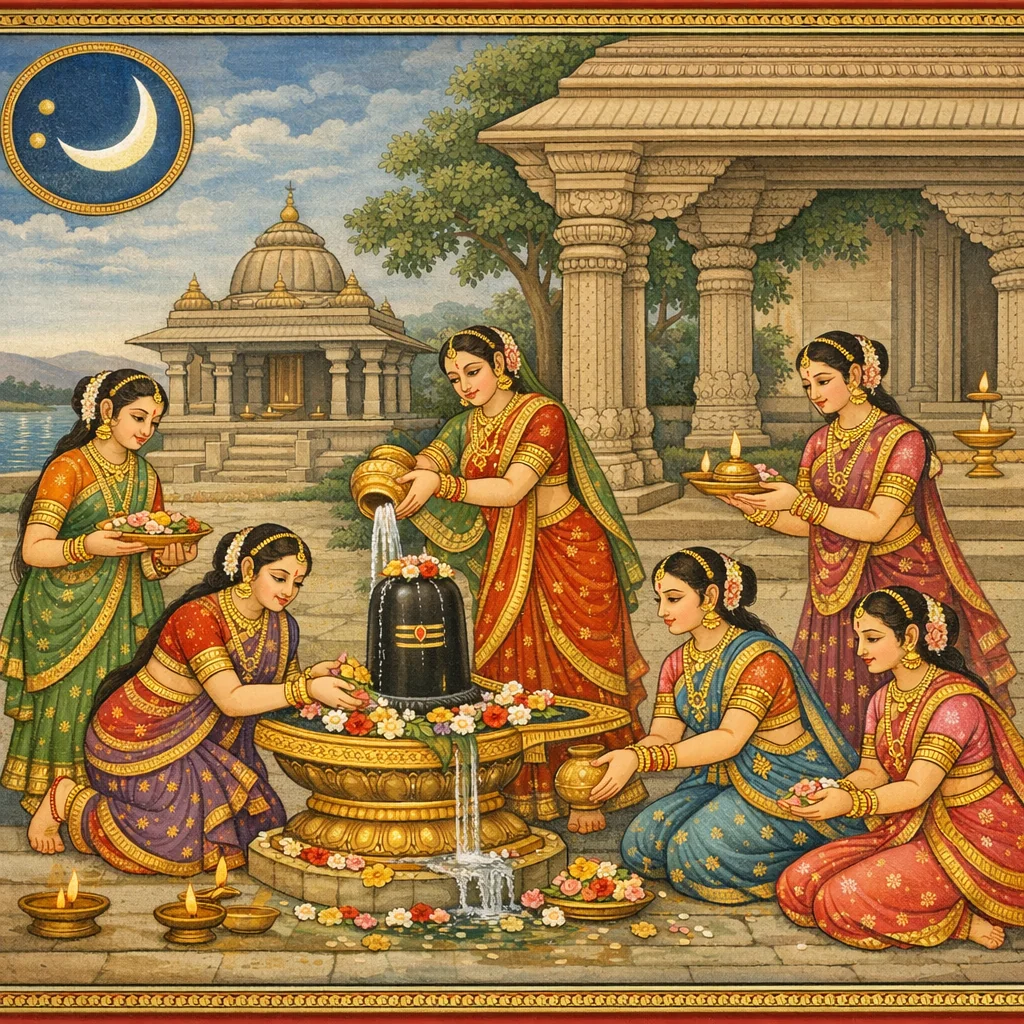
Adhyaya 120
गोपीश्वरमाहात्म्यवर्णनम् | Gopīśvara Māhātmya (Account of the Glory of Gopīśvara)
This adhyāya is spoken as a Śaiva theological instruction, with Īśvara addressing Mahādevī and directing the pilgrim to proceed to the shrine of Gopīśvara—praised as “unsurpassed”—lying to the north, with a locational cue of about “three bows” distance. The shrine is extolled as pāpa-śamana, removing sin and impurity, and its local sanctity is grounded in the installation legend that the gopīs themselves established and consecrated it (pratiṣṭhita). A concise ritual regimen is then given: worship Mahādeva/Maheśvara for the sake of progeny (putra-hetu), for the Lord grants all desired aims to humans and is especially famed as santati-prada, the bestower of offspring and continuity. A calendrical rule follows: worship on the bright third lunar day of Caitra (Caitra-śukla-tṛtīyā), with fragrances, flowers, and offerings, yields the sought fruit. The chapter closes by stating that this is a compressed account of Gopīśvara’s purificatory māhātmya in Prabhāsa-kṣetra.
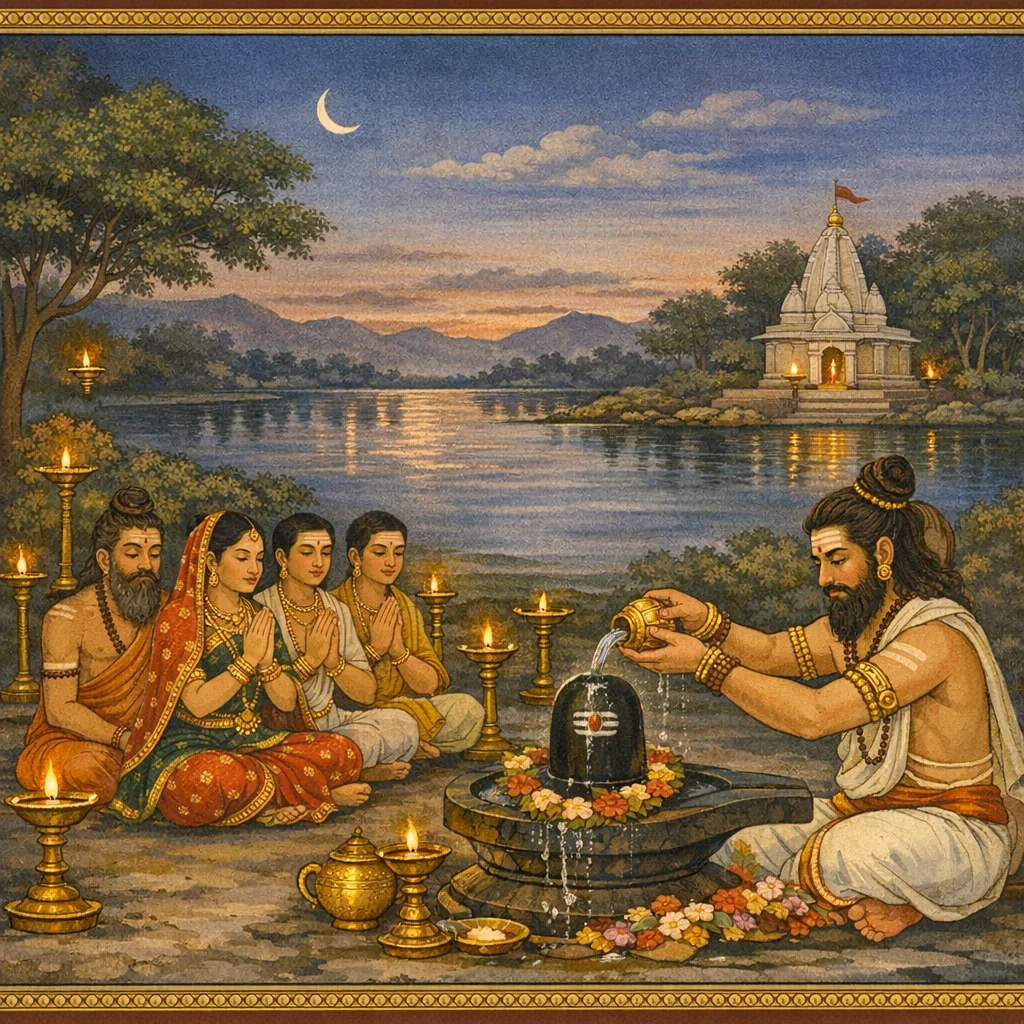
Adhyaya 121
जामदग्न्येश्वरमाहात्म्य (Glory of Jāmadagnyēśvara Liṅga)
This chapter gives a Śaiva sacred-place legend on the origin and merit of the Jāmadagnyēśvara liṅga in Prabhāsakṣetra. Īśvara outlines a pilgrimage sequence leading to Rāmeśvara, said to have been established by Rāma Jāmadagnya (Paraśurāma), and points out a potent, sin-destroying liṅga near Gopīśvara, marked with a stated distance. The narrative recalls Paraśurāma’s grave moral crisis—killing his mother at his father’s command—followed by remorse and the appeasement of Jamadagni, culminating in the boon that restores Reṇukā to life. Even after receiving this grace, Paraśurāma performs extraordinary tapas at Prabhāsa, installs Mahādeva (Śaṅkara), and gains divine satisfaction and the rewards he seeks, with Mahēśvara abiding there. It then summarizes his later campaign against the kṣatriyas, his ritual observances (with references to Kurukṣetra and pañcanada), the settling of ancestral obligations, and finally the gifting of the earth to brāhmaṇas. The phalaśruti declares that worship of this liṅga frees even a sinner from all faults and leads to Umāpati’s realm; keeping vigil on the dark-fortnight caturdaśī yields fruit likened to an aśvamedha and heavenly rejoicing.
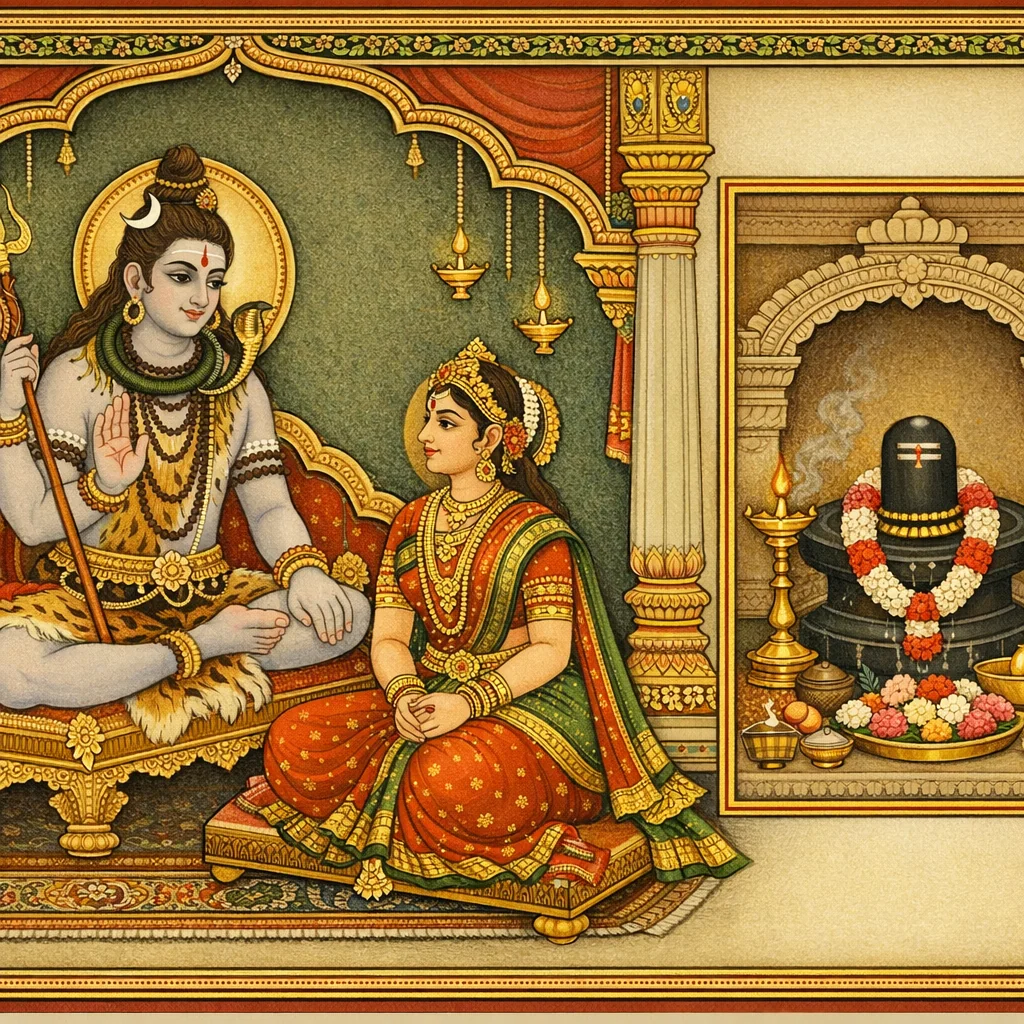
Adhyaya 122
चित्राङ्गदेश्वरमाहात्म्यवर्णनम् | The Māhātmya of Citrāṅgadeśvara
This chapter is a concise instruction in which Īśvara (Śiva) speaks to Devī and points her to a Prabhāsa-kṣetra liṅga called Citrāṅgadeśvara. It supplies pilgrim-like directions: the liṅga lies in the south‑western quarter, about twenty bows away, fitting the itinerary style of the section. The shrine’s origin is ascribed to Citrāṅgada, a lord of the gandharvas. Recognizing the site’s purity, he performed intense austerities, propitiated Maheśvara, and installed the liṅga there. The text then states the fruit of worship: adoration done with bhāva—devotional, heartfelt intention—grants access to the gandharva realm and companionship with gandharvas. A calendrical rule is added: on śukla-trayodaśī one should bathe Śiva according to proper procedure and worship in sequence with various flowers, fragrances, and incense. The promised result is complete fulfillment of desired aims, grounded in correct observance and inner devotion.
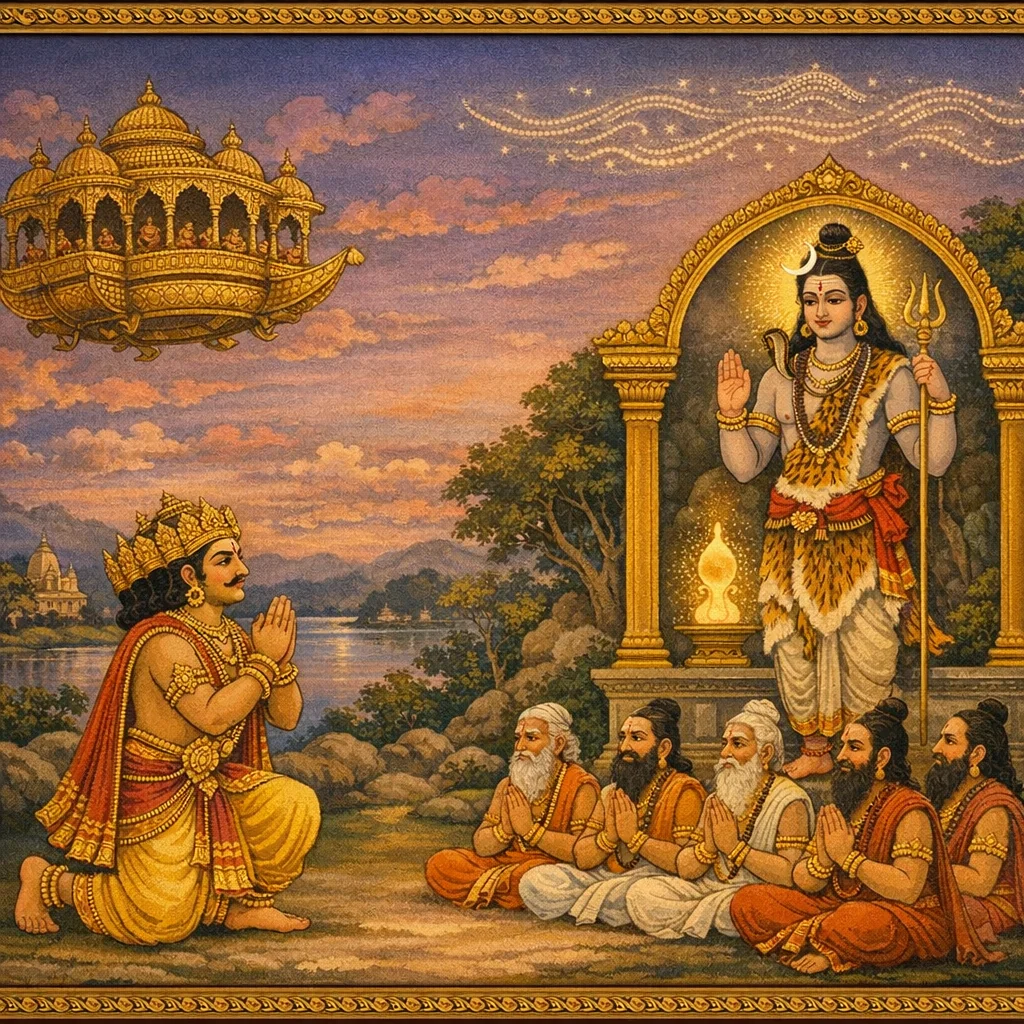
Adhyaya 123
रावणेश्वरमाहात्म्यवर्णनम् | The Māhātmya of Rāvaṇeśvara (Foundation Narrative of the Rāvaṇeśvara Liṅga)
Īśvara tells Devī a place-centered theological account set in Prabhāsa, explaining the origin and merit of Rāvaṇeśvara. Rāvaṇa, bent on conquering the three worlds, travels in the Puṣpaka vimāna, but it suddenly becomes motionless in the sky, revealing the binding power of the kṣetra. He sends Prahasta to inquire, who beholds Somēśvara (Śiva) praised by hosts of devas and attended by ascetic communities (like Vālakhilya-type sages), and reports that the vimāna cannot pass because Śiva’s presence is unsurpassable. Rāvaṇa descends and worships with devotion and offerings, while the local people flee in fear, leaving the area around the deity seemingly empty. An incorporeal voice issues an ethical command: do not obstruct the Lord’s yātrā season, for dvijāti pilgrims come from afar and must not be endangered. The voice further declares that mere darśana of Somēśvara can wash away faults accrued in childhood, youth, and old age. Rāvaṇa then establishes a liṅga named Rāvaṇeśvara, undertakes upavāsa and a night vigil with music, and receives a boon: Śiva’s abiding presence there, worldly ascendancy, and the promise that worshippers of this liṅga become difficult to defeat and attain siddhi. Rāvaṇa departs to resume his ambitions, while the chapter chiefly sacralizes the shrine and defines its ritual-phala logic.
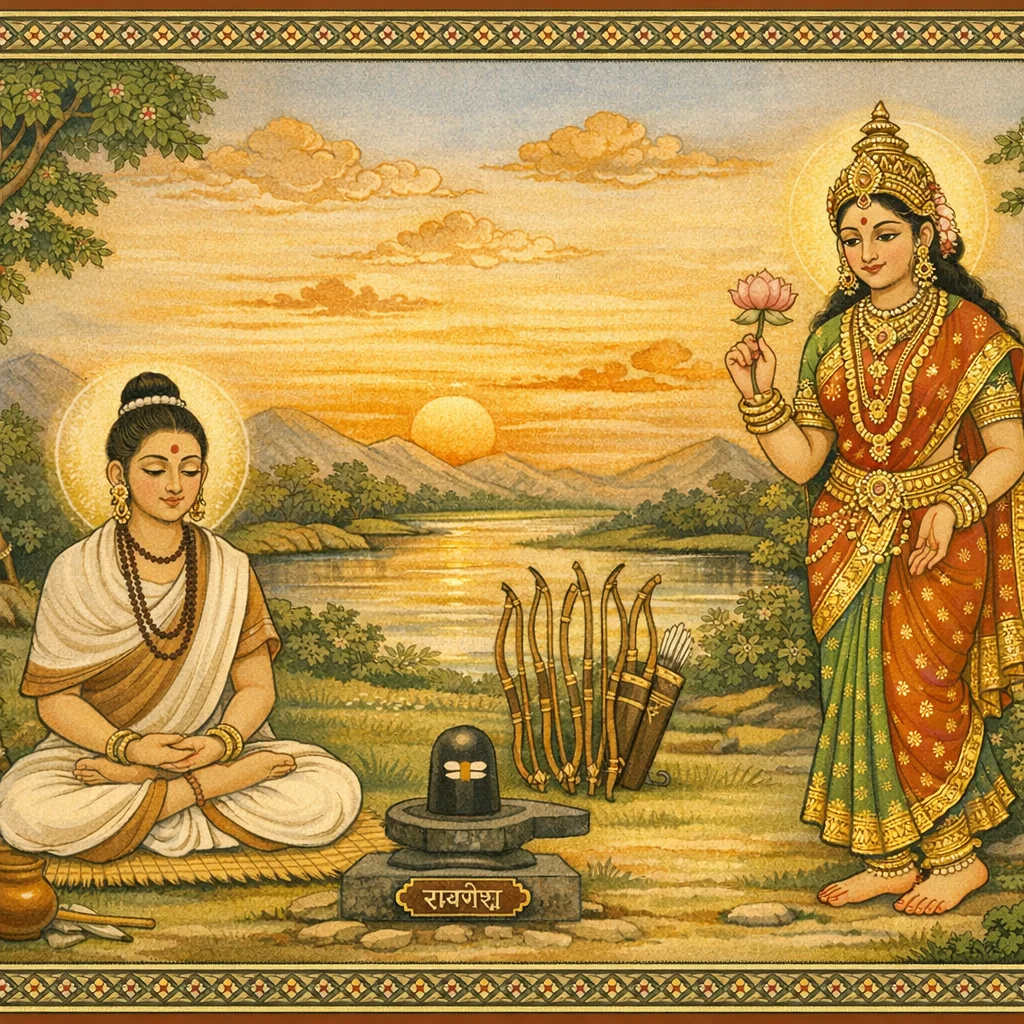
Adhyaya 124
सौभाग्येश्वरीमाहात्म्यवर्णनम् (Glory of Saubhāgyeśvarī / The Saubhāgya-Granting Gaurī Shrine)
Set within a Śiva–Devī dialogue, the chapter points the listener to a western shrine where Gaurī is worshiped as Saubhāgyeśvarī, the bestower of saubhāgya—auspicious marital fortune, well-being, and blessed prosperity. The deity’s location is indicated through directional and contextual markers, including an association with Rāvaṇa as “Rāvaṇeśa” and a reference to a “set of five bows” as a local place-name detail. An etiological exemplum follows: Arundhatī is said to have performed intense tapas there, desiring saubhāgya and devoted to Gaurī’s worship, and to have attained supreme accomplishment through the Goddess’s power. The text notes the bright-fortnight third lunar day (tṛtīyā) in Māgha as especially significant. The phalaśruti states plainly that one who worships this deity with devotion gains saubhāgya, with the assurance extending even into future births.
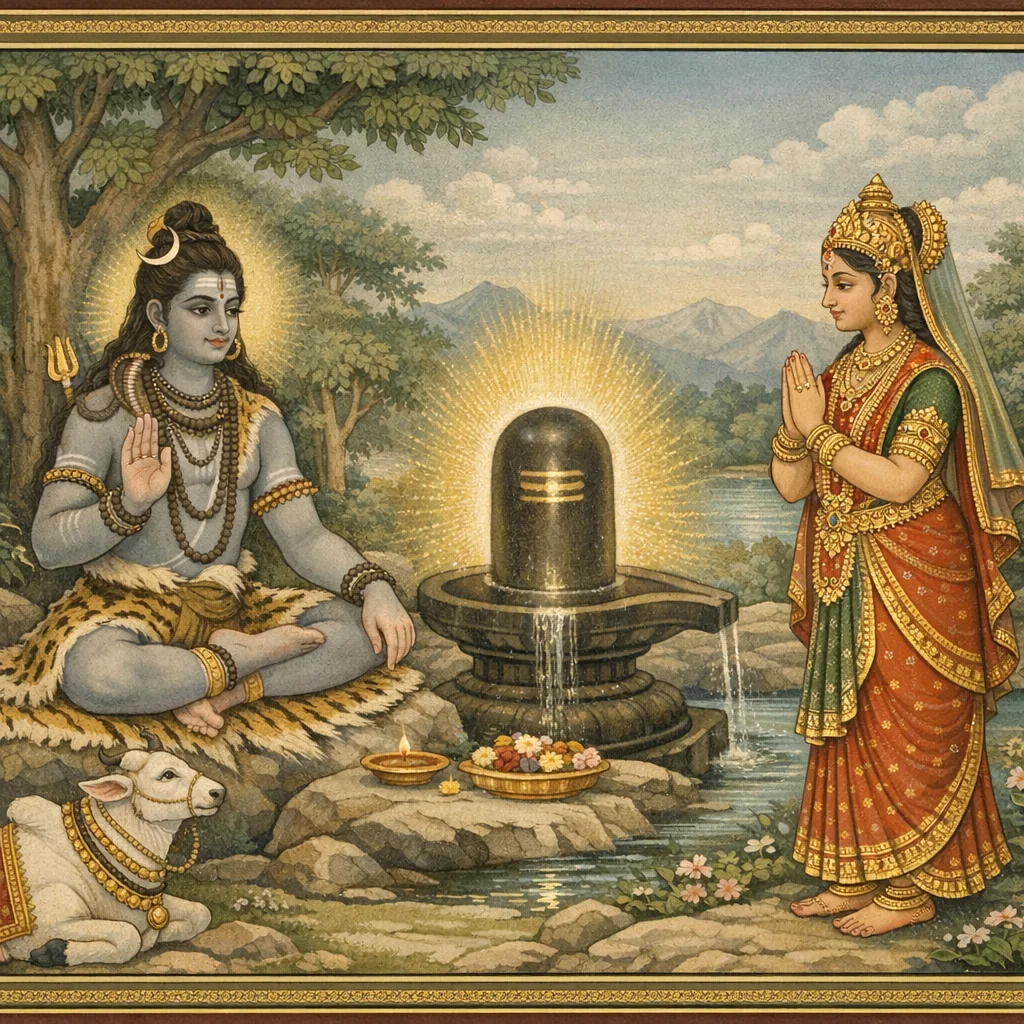
Adhyaya 125
पौलोमीश्वरमाहात्म्यवर्णनम् | Paulomīśvara Māhātmya (Glorification of the Paulomīśvara Liṅga)
The chapter is cast as Īśvara’s guidance on sacred geography and worship, pointing to a revered liṅga called the “Mahāliṅga,” beloved of the gods, located in a specified direction and measured interval. This liṅga is praised as kāma-prada (granting desired aims) and sarva-pātaka-nāśana (destroying grave impurities), and is known as Paulomīśvara, said to have been established by Paulomī. A mythic account follows: in the conflict with Tāraka the gods are routed, and Indra is overcome by sorrow and fear. Indrāṇī, seeking Indra’s victory, propitiates Śambhu; Mahādeva replies with a prophecy that a mighty six-faced son (Ṣaṇmukha) will arise and slay Tāraka. The text then gives a devotional assurance—whoever worships this liṅga becomes Śiva’s gaṇa and attains closeness to him. It ends with Indra settling there and being freed from grief and dread, affirming the shrine as a ritual refuge and a field of merit.
Adhyaya 126
Śāṇḍilyeśvara-māhātmya (Glory of Śāṇḍilyeśvara)
Īśvara instructs Devī to go to the eminent Śāṇḍilyeśvara liṅga, describing its location with reference to Brahmā’s western sector and giving distance markers. This liṅga is praised as supremely efficacious: mere darśana (sacred sight) is declared pāpa-nāśana, destroying impurity and sin. The chapter then introduces the Brahmarṣi Śāṇḍilya—Brahmā’s charioteer, a radiant ascetic established in knowledge and self-control. He comes to Prabhāsa, performs intense tapas, installs a great liṅga north of Somēśa, and worships it personally for a hundred divine years, thereby attaining his desired goal and becoming fulfilled. By Nandīśvara’s favor he is endowed with aṇimā and other yogic excellences. The text concludes that whoever beholds Śāṇḍilyeśvara is immediately purified, and that sins committed in childhood, youth, or old age—knowingly or unknowingly—are destroyed by that darśana.
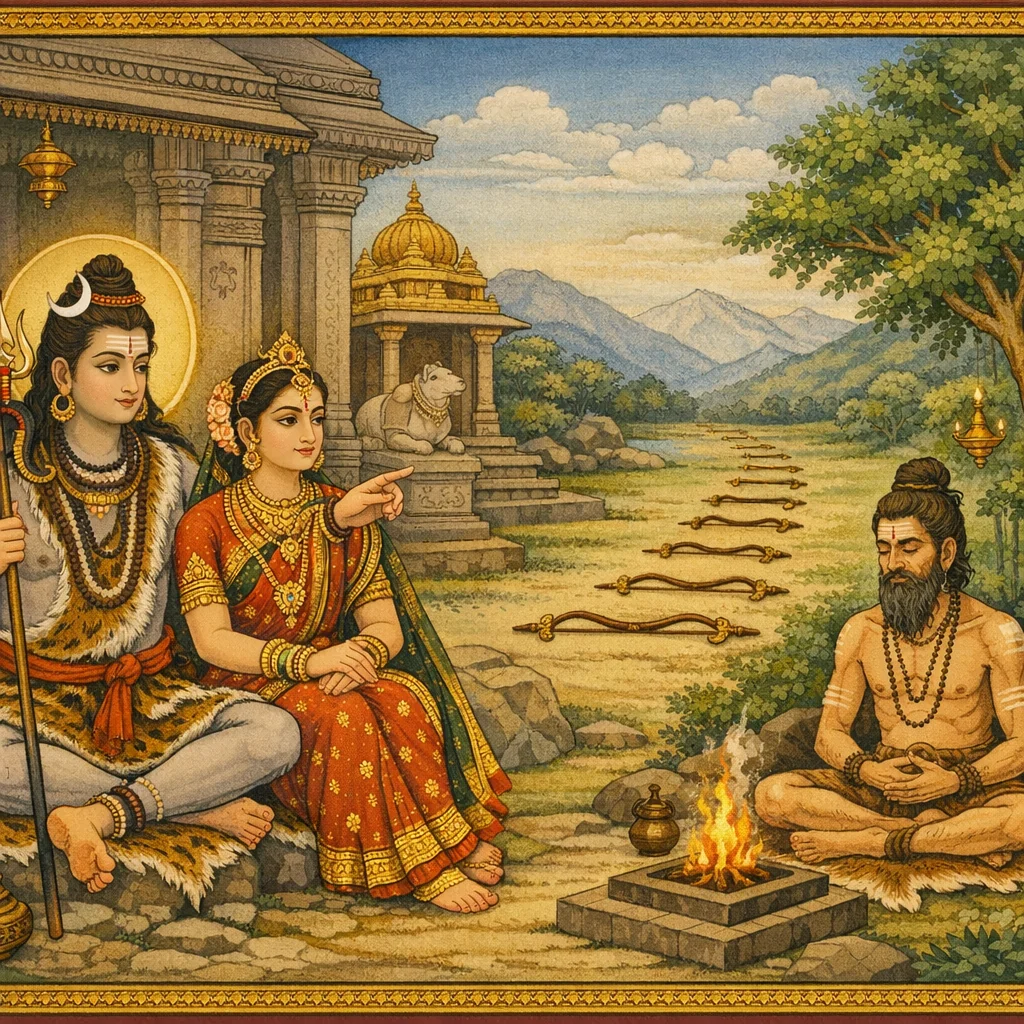
Adhyaya 127
Kṣemakareśvara-liṅga Māhātmya (क्षेमंकरॆश्वरलिङ्गमाहात्म्य) — Glory of Kṣemeśvara/Kṣemakareśvara
Chapter 127 presents a brief theological and geographical instruction: Īśvara speaks to Devī and points to an eminent liṅga named Kṣemeśvara, also praised under the māhātmya of Kṣemakareśvara. The shrine is located by relational markers—at the northern corner relative to Kapāleśa, within Kapāleśa’s ritual/visible range, and at a distance of “fifteen bows.” This liṅga is declared mahāprabhāva (highly efficacious) and explicitly sarva-pātaka-nāśana, the destroyer of all sins. An origin legend follows: a powerful king, Kṣemamūrti, performed long tapas there and, with devotion and focused resolve, established the liṅga. Mere darśana brings kṣema (welfare and auspicious stability), success in completing undertakings, prosperity of desired aims across births, and saubhāgya. The text equates simply seeing the liṅga with the merit of gifting a hundred cows, and urges seekers of kṣetra-fruit to take continual refuge in this liṅga.
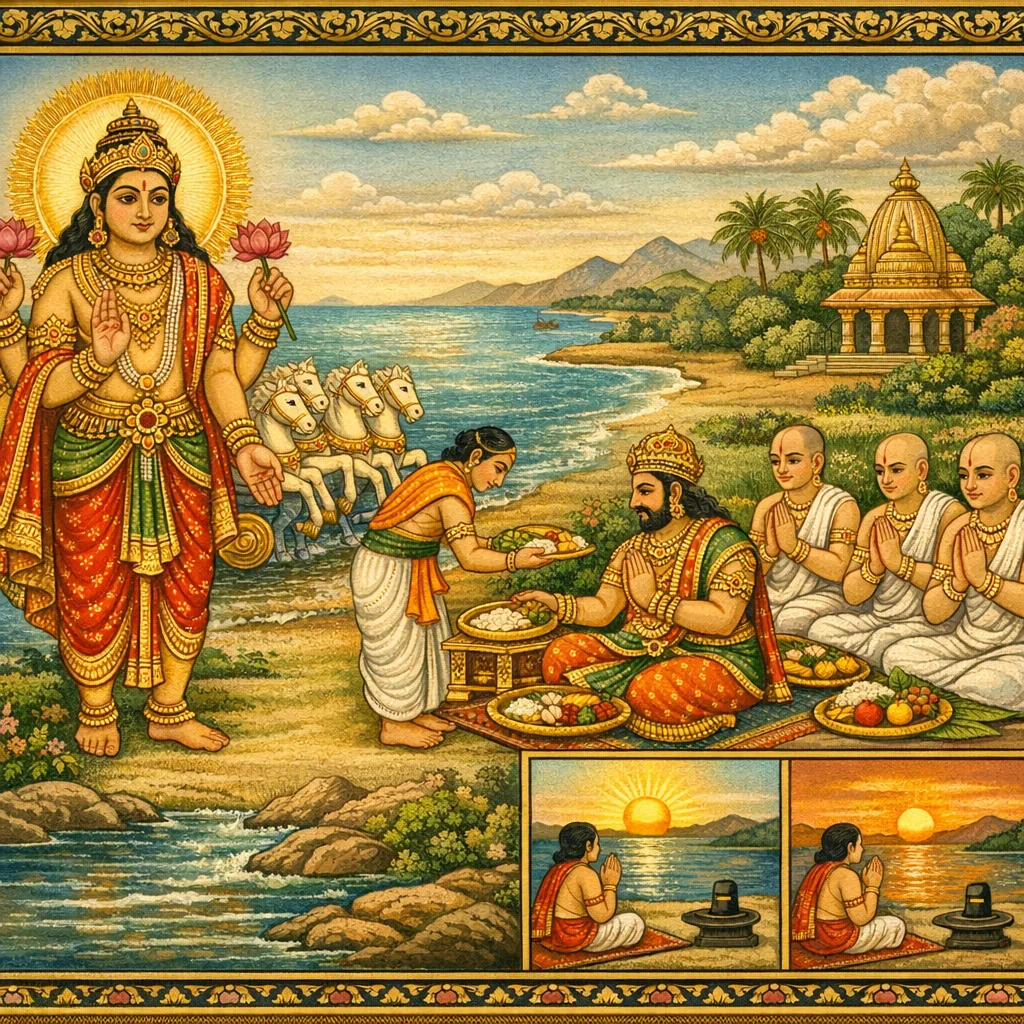
Adhyaya 128
सागरादित्यमाहात्म्यवर्णनम् | Sāgarāditya Māhātmya (Glory of Sāgara’s Solar Shrine)
Īśvara instructs Devī about a renowned solar shrine called Sāgarāditya in Prabhāsa-kṣetra, locating it by directional markers among nearby sacred spots (west of Bhairaveśa; near Kāmeśa toward the southern/agneya quarter). The shrine’s sanctity is affirmed through royal precedent: King Sagara, famed in Purāṇic tradition, is said to have worshiped Sūrya there, and the vast sea and its naming are invoked to deepen the site’s mythic-historical significance. The chapter then gives practical observance for Māgha in the bright fortnight: maintain restraint and purity, fast on the sixth lunar day, sleep near the deity, rise on the seventh for devotional worship, and feed Brahmins with honest, untainted giving. Sūrya is praised as the foundation of the three worlds and the supreme divine principle, with meditation taught through seasonal color-forms of the Sun. Finally, a concise stava of twenty-one secret and pure epithets is taught as an alternative to a full thousand-name recitation; chanting it at dawn and sunset grants release from sins, prosperity, and attainment of the solar realm. Hearing this māhātmya is said to relieve suffering and destroy even great sins.
Adhyaya 129
उग्रसेनेश्वरमाहात्म्यवर्णनम् / The Māhātmya of Ugraseneśvara (formerly Akṣamāleśvara)
Chapter 129 offers a shrine-centered theological account of a Prabhāsa liṅga, explaining its origin, renaming, and saving fame. Īśvara points out its location—at a directional corner near the sea and the sun, with a stated distance—and declares it a sin-quelling “yugaliṅga,” once called Akṣamāleśvara and later renowned as Ugraseneśvara. When Devī asks why it bore the earlier name, Īśvara begins a narrative on dharma in times of distress. In a famine, hungry ṛṣis approach an antyaja (Caṇḍāla) household that has stored grain, despite purity rules against accepting and eating lower-status food. The antyaja cites the prohibitions and their dire consequences, but the ṛṣis answer with crisis-ethics precedents—Ajīgarta, Bharadvāja, Viśvāmitra, Vāmadeva—arguing that survival may be upheld in emergency. A conditional settlement follows: Vasiṣṭha agrees to marry the antyaja’s daughter Akṣamālā, who through her conduct and association with the sages comes to be recognized as Arundhatī. In Prabhāsa she discovers a liṅga in a grove and, through remembrance and sustained worship, helps manifest its renown as a remover of wrongdoing. At the Dvāpara–Kali transition, Ugrasena (son of Andhāsura) worships the same liṅga for fourteen years and gains a son, Kaṃsa; thereafter the shrine is popularly called Ugraseneśvara. The chapter ends with phala: mere darśana or touch is said to lessen grave transgressions; worship on Bhādrapada Ṛṣi-pañcamī frees one from fear of infernal states; and gifts of cows, food, and water are praised for purification and post-mortem well-being.
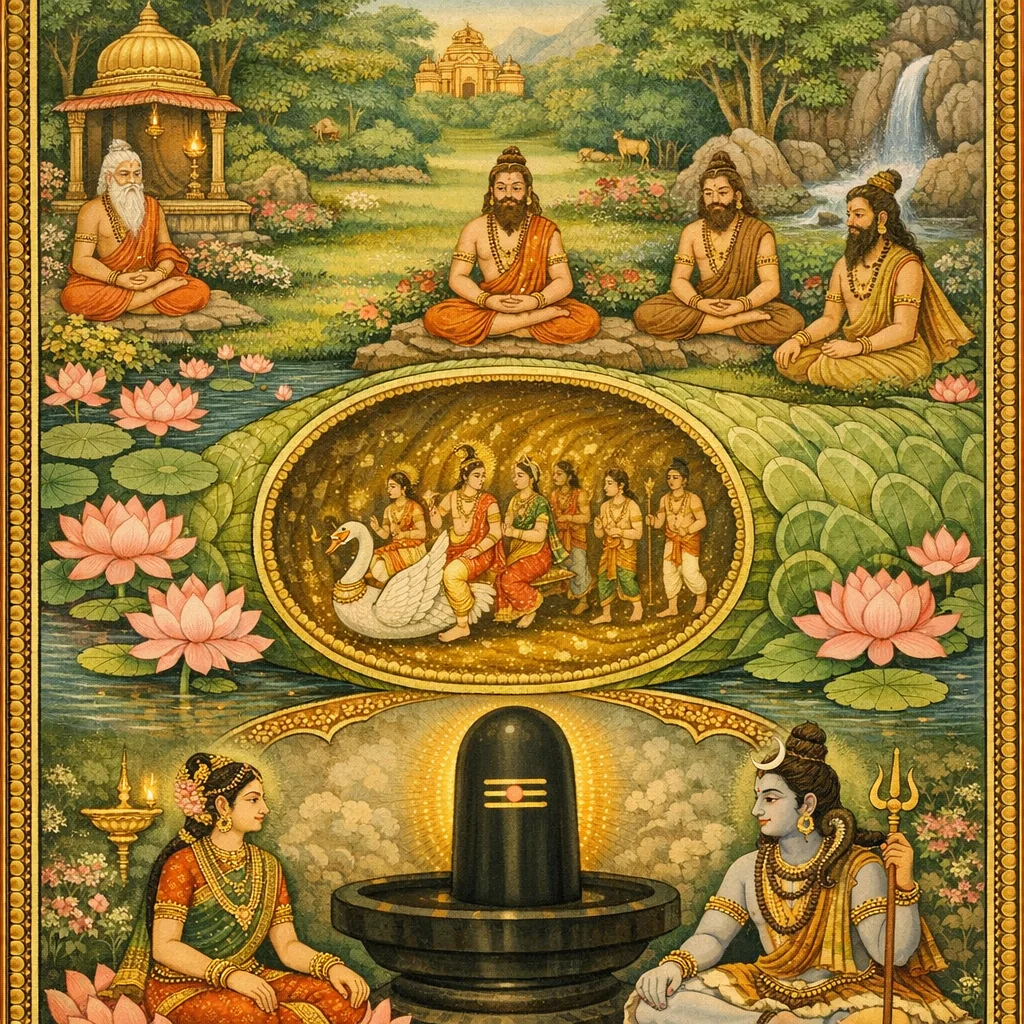
Adhyaya 130
पाशुपतेश्वरमाहात्म्यवर्णनम् | The Māhātmya of Pāśupateśvara (and Anādīśa) at Prabhāsa
Chapter 130, cast as a dialogue, sets out a structured theological account of Prabhāsa’s Pāśupata-linked shrine network and the liṅga revered as Santoṣeśvara/Anādīśa/Pāśupateśvara. Īśvara locates the shrine among Prabhāsa’s sacred landmarks and praises it as sin-destroying and wish-fulfilling through mere darśana, a siddhi-sthāna, and a “medicine” for those afflicted by moral and spiritual disease. A company of perfected sages is connected with the liṅga, and the nearby Śrīmukha forest is portrayed as Lakṣmī’s abode, supportive of yogic practitioners. Devī asks for clarification on Pāśupata yoga and vow, the deity’s various names, proper ritual honor, and the report of yogins attaining heavenly states with their bodies. The narrative then turns to Nandikeśvara’s mission to summon the ascetics to Kailāsa and to the lotus-stalk (padma-nāla) episode: by yogic power the yogins enter the stalk in subtle form and travel within it, displaying siddhi and “free movement” (svacchanda-gati). Devī’s response introduces a curse motif, followed by pacification and an origin-explanation: the fallen stalk becomes the Mahānāla liṅga, later linked with Dhruveśvara in the Kali age, while the primary shrine is affirmed as Anādīśa/Pāśupateśvara. The chapter closes with phala statements: worship—especially continuous devotion in Māgha—yields the fruit of sacrifices and gifts; the site is upheld as a locus of siddhi and mokṣa, with added ritual-ethical notes on bhasma (sacred ash) observances and Pāśupata identity marks.
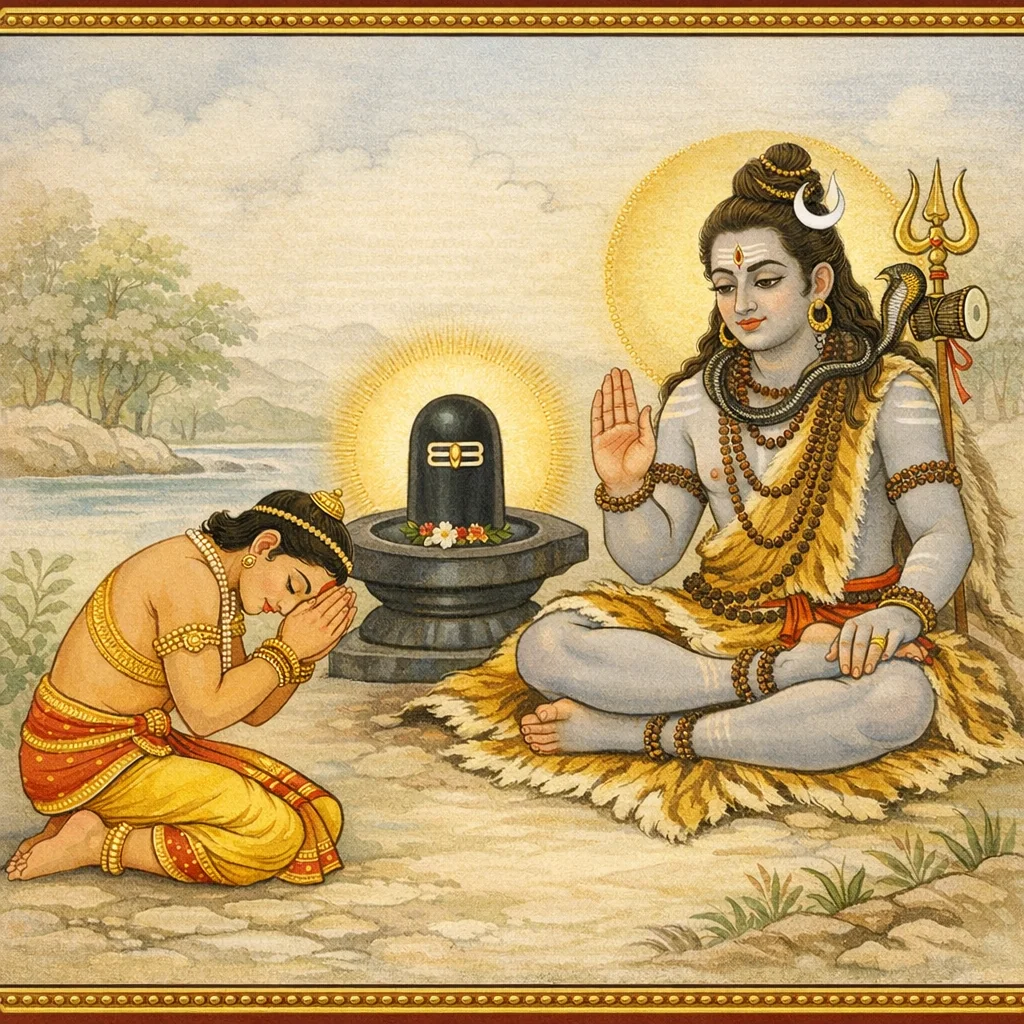
Adhyaya 131
ध्रुवेश्वरमाहात्म्यवर्णनम् | Dhruveśvara Māhātmya (The Glory and Origin Account of Dhruveśvara)
The chapter unfolds as a theological dialogue: Śrī Devī asks how the liṅga called “Nāleśvara” is also known as “Dhruveśvara,” and Īśvara recounts its māhātmya, the origin-and-glory narrative. Dhruva, son of King Uttānapāda, comes to the eminent Prabhāsa-kṣetra, performs fierce austerities, establishes Mahādeva, and worships with unwavering devotion for a thousand divine years. Īśvara then imparts Dhruva’s stotra, shaped by repeated refuge-formulas—“taṃ śaṃkaraṃ śaraṇadaṃ śaraṇaṃ vrajāmi”—praising Śiva’s cosmic sovereignty and famed deeds. A phalaśruti declares that disciplined, pure recitation of the hymn leads to attainment of Śiva-loka. Pleased, Śiva grants Dhruva divine vision and offers boons reaching to the highest cosmic stations; Dhruva refuses status-based rewards and asks only for pure bhakti and Śiva’s abiding presence in the installed liṅga. Īśvara confirms the gift, links Dhruva’s “fixed” station with a supreme abode, and prescribes worship on specific lunar dates (Śrāvaṇa amāvāsyā or Āśvayuja paurṇamāsī), promising Aśvamedha-equivalent merit and varied worldly and otherworldly fruits for worshippers and listeners.
Adhyaya 132
सिद्धलक्ष्मीमाहात्म्यवर्णनम् | The Māhātmya of Siddhalakṣmī (Prabhāsa)
In this chapter, Īśvara speaks to Devī and points to an eminent Vaiṣṇavī śakti located near Prabhāsa in the Somēśa/Īśa-directional sector. The presiding deity of that pīṭha is Siddhalakṣmī, and Prabhāsa is praised as the “first pīṭha” in the cosmic order, filled with yoginīs—earthly and aerial—who move freely with Bhairava, revealing the mythic potency of pīṭha-energy. A list of major pīṭhas is then given—Jālaṃdhara, Kāmarūpa, Śrīmad-Rudra-Nṛsiṃha, Ratnavīrya, Kāśmīra, and others—and knowledge of these sacred seats is linked with mantra-competence (mantravit). The text further identifies a foundational “supporting” pīṭha in Saurāṣṭra called Mahodaya, where Kāmarūpa-like knowledge is said to remain active; there the Goddess is also lauded as Mahālakṣmī, who pacifies sin and grants auspicious success. Ritual instruction follows: worship on Śrīpañcamī with fragrances and flowers removes fear of alakṣmī (misfortune). Near Mahālakṣmī’s presence, facing north, one should undertake mantra-practice with prior dīkṣā and ritual bathing, complete a lakṣa-japa, and perform a tenth-part fire offering (daśāṃśa-homa) using tri-madhu and śrīphala. The phalaśruti declares that Lakṣmī will manifest and bestow the desired siddhi in this world and the next; tṛtīyā, aṣṭamī, and caturdaśī are also marked as especially efficacious times of worship.
Adhyaya 133
महाकालीमाहात्म्यवर्णनम् | Mahākālī Māhātmya (Glorification of Mahākālī)
The chapter is cast as Īśvara instructing Devī about the mighty goddess-manifestation Mahākālī, said to abide at a great pīṭha marked by an opening to the underworld (pātāla-vivara). Mahākālī is praised as the one who pacifies suffering and destroys hostility. It then lays out a ritual and ethical discipline: Mahākālī is to be worshipped on the night of Kṛṣṇāṣṭamī with prescribed offerings—fragrances, flowers, incense, and bali. A women-centered observance (vrata) is indicated, to be undertaken with focused resolve, including regulated worship for a full year during the bright fortnight and the rule-bound gifting of fruits to a brāhmaṇa. Dietary restraints are specified while maintaining the Gaurī-vrata, with certain pulses and grains to be avoided at night. The phalaśruti promises household prosperity—wealth and grain that do not diminish—and relief from misfortune across many births. The chapter concludes by extolling the site as a pīṭha that grants mantra-siddhi, recommending a vigil on the ninth day of the bright half of Āśvina, with night japa performed in a calm, steady mind for the attainment of one’s desired goal.
Adhyaya 134
पुष्करावर्तकानदीमाहात्म्यवर्णनम् (Māhātmya of the Puṣkarāvartakā River)
Īśvara instructs Devī about a river called Puṣkarāvartakā, lying north of Brahmakuṇḍa and not far away, and establishes it as an important ritual center within Prabhāsa-kṣetra. A woven-in legend recalls an earlier sacrificial setting connected with Soma, when Brahmā comes to Prabhāsa in relation to the founding of Somnātha and prior obligations. Concern arises about proper ritual timing: Brahmā is understood to be proceeding to Puṣkara for sandhyā observance, and sacred time-knowers (daiva-cintaka/daivajña) stress that the present moment is auspicious and must not be missed. With a concentrated mind, Brahmā causes multiple Puṣkara manifestations to appear on the riverbank; three āvarta (bends/whorls)—senior, middle, and junior—arise, forming a triadic sacred landscape. Brahmā names the river Puṣkarāvartakā and declares that, by his favor, it will be renowned in the world. The chapter states the ritual fruits: bathing there and devotionally offering pitṛ-tarpaṇa to the ancestors yields merit equal to “Tri-Puṣkara,” and it prescribes Śrāvaṇa month, bright fortnight, third lunar day as a special time that grants long-lasting ancestral satisfaction, expressed as an immense duration.
Adhyaya 135
दुःखान्तकारिणी–लागौरीमाहात्म्य (Duhkhāntakāriṇī / Lāgaurī Māhātmya) — Śītalā as the Ender of Afflictions
This chapter sets forth the theological and ritual portrait of a protective Goddess: known in the Dvāpara-yuga as Śītalā, and in the Kali-yuga re-identified as Kaliduḥkhāntakāriṇī, “the one who ends the sufferings of Kali.” Īśvara describes her abiding presence at Prabhāsa and teaches a practical devotional regimen to relieve childhood illnesses and eruptive disorders (visphoṭa), while calming the disturbances that accompany them. A clear sequence of observances is prescribed: behold the Devī in her shrine-space; prepare a measured pacifying offering of crushed masūra (lentils); place it before Śītalā for the welfare of children; and perform supporting rites such as śrāddha and feeding brāhmaṇas. Fragrant offerings—camphor, flowers, musk, and sandal—are detailed, along with ghṛta-pāyasa (ghee rice-pudding) as naivedya. The observance concludes with the instruction that a husband and wife should don the offered items (paridhāpana). Finally, on the bright ninth (śukla-navamī), offering a sacred bilva-garland is said to bestow “all accomplishments” (sarva-siddhi), serving as the chapter’s ritual culmination and implied fruit.
Adhyaya 136
लोमशेश्वरमाहात्म्यवर्णनम् (The Māhātmya of Lomaśeśvara)
This chapter is cast as Īśvara’s instruction to Devī, directing her—and thereby pilgrims—to proceed to the eminent shrine of Lomaśeśvara. It lies east of the place known as Duḥkhāntakāriṇī, within a sacred cluster described as a “sevenfold bow-range.” The sage Lomaśa is said to have performed exceedingly difficult austerities and, within a cave, established a great liṅga. A cosmic motif of longevity follows: the number of Indras is likened to the hairs on the body, and as Indras perish one after another, corresponding hair-fall occurs; by Īśvara’s grace Lomaśa attains extraordinary long life, enduring across the lifespans of many Brahmās. The chapter ends with a devotional assurance: whoever worships with bhakti the liṅga honored by Lomaśa gains long life, freedom from illness, and abides in comfort and happiness.
Adhyaya 137
कंकालभैरवक्षेत्रपालमाहात्म्यवर्णनम् | The Māhātmya of Kaṅkāla Bhairava as Kṣetrapāla
This chapter, spoken in an Īśvara-authorized voice, proclaims Kaṅkāla Bhairava as the eminent kṣetrapāla (guardian) of the sacred territory, appointed by Bhairava to protect the kṣetra and to restrain or counter the harmful intentions of beings of perverted disposition. It then sets the proper times for worship—Śrāvaṇa, bright fifth lunar day, and Āśvina, bright eighth—along with a simple offering order: bali and flowers presented with devotion. For devotees dwelling within the kṣetra, this worship is said to remove obstacles (nirvighna) and grant a protective care likened to tending one’s own child, embedding a local ritual protocol within the wider sacred geography of pilgrimage guardianship.
Adhyaya 138
Tṛṇabindvīśvara Māhātmya (तृणबिन्द्वीश्वरमाहात्म्य) — Glory of the Shrine of Tṛṇabindvīśvara
This adhyāya, spoken in a Śaiva revelatory voice (Īśvara uvāca), places the shrine of Tṛṇabindvīśvara in the western part of the Prabhāsa kṣetra, describing it as lying within a measure of five dhanus. In this way it serves as a brief māhātmya, marking the site and affirming its sacred potency. It then grounds the shrine’s holiness in the ascetic career of the sage Tṛṇabindu. For many years he performed severe tapas, following a monthly discipline of drinking only a single drop of water from the tip of kuśa grass, embodying restraint and intense devotion. Through sustained worship and propitiation of Īśvara, he attains the supreme siddhi in the auspicious Prābhāsika field, establishing both the shrine’s glory and an ethical model of ascetic bhakti.
Adhyaya 139
चित्रादित्यमाहात्म्यवर्णनम् / The Māhātmya of Citrāditya (and the Stotra of the 68 Names of Sūrya)
Īśvara teaches that one should go to Citrāditya near Brahmakuṇḍa, a sacred spot famed for destroying poverty. A tradition is then told: Mitra, a dharmic kāyastha devoted to the welfare of beings, has two children—Citra (son) and Citrā (daughter). After Mitra’s death and the wife’s self-immolation, the children are protected by sages and later perform austerities in the Prabhāsa region. Citra installs and worships Bhāskara (Sūrya) with offerings and a stotra handed down in tradition, enumerating sixty-eight secret/ritual names that connect Sūrya with many holy sites across India. The text proclaims the fruits of reciting or hearing these names: freedom from sins, fulfillment of aims (kingdom, wealth, children, happiness), healing, and release from bondage. Pleased, Sūrya grants Citra maturity in action and knowledge; Dharmarāja then appoints him as Citragupta, the cosmic recorder of deeds. The chapter ends with a worship rule (especially on the seventh lunar day) and prescribed gifts—horse, sword with scabbard, and gold to a brāhmaṇa—to obtain the merit of the pilgrimage.
Adhyaya 140
चित्रपथानदीमाहात्म्यवर्णनम् | The Māhātmya of the Citrāpathā River
This adhyāya proclaims the māhātmya of the Citrāpathā River in Prabhāsa Kṣetra and sets forth its ritual power. Devī is instructed to go to a river near Brahmakūṇḍa, situated in relation to Citrāditya. A legend is told: a man named Citra is seized by Yamadūtas under Yama’s command. His sister, overwhelmed with grief, becomes the river Citrā and flows into the ocean while seeking her kinsman; thereafter the dvijas name the river Citrāpathā. The फल (fruit) is declared: one who bathes (snāna) in this river and beholds (darśana) Citrāditya attains a supreme station connected with the solar divinity Divākara. In Kali-yuga the river is said to be hidden and to appear only rarely, especially in the rainy season; yet whenever it is seen, mere sight itself is authoritative, not dependent on calendrical timing. The chapter also links the place to pitṛ-loka: the ancestors in heaven rejoice at the river’s appearance and await the descendants’ śrāddha, which grants lasting satisfaction. It concludes by recommending snāna and śrāddha there for the destruction of pāpa and for pitṛ-prīti, affirming Citrāpathā as a merit-generating feature of Prabhāsa’s sacred landscape.
Adhyaya 141
कपर्दिचिन्तामणिमाहात्म्यवर्णनम् (Kapardī–Chintāmaṇi Māhātmya: Description of the Sacred Efficacy)
Chapter 141 gives a brief theological and ritual instruction attributed to Īśvara. It first guides the pilgrim by sacred geography: one should go to the place where Kapardī is established, and then to a nearby spot to the north where a deity known as “Chintitārthaprada,” the giver of contemplated aims, is revered like a second wish-fulfilling jewel, Chintāmaṇi. It then prescribes the proper time and procedure: on the fourth lunar day (caturthī), especially when it falls on Aṅgāraka (Tuesday), the devotee should bathe/ablute the deity (snāna), perform complete worship (pūjā), and offer auspicious varieties of naivedya. The chapter concludes that this observance pleases Vighnarāja (Gaṇeśa, lord of obstacles) and grants the attainment of “all desires” through disciplined practice.
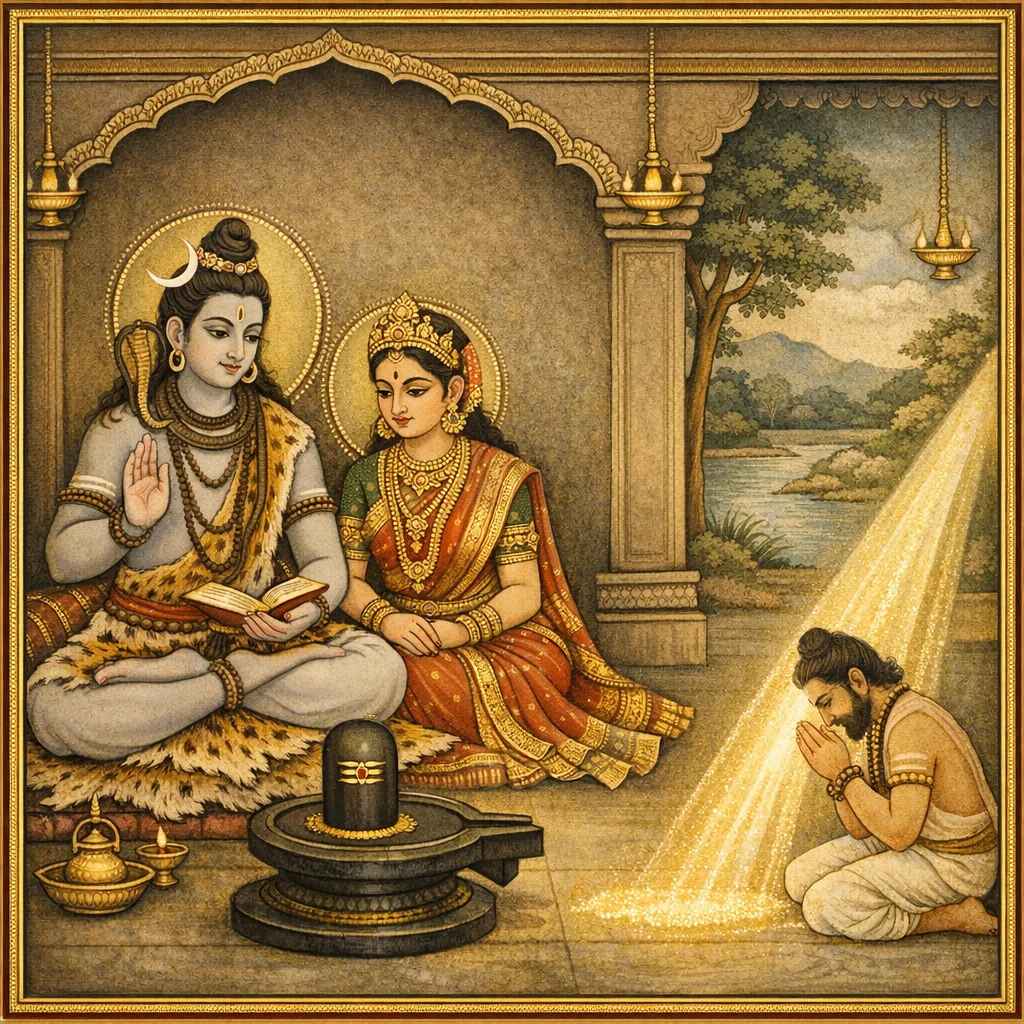
Adhyaya 142
चित्रेश्वरमाहात्म्यवर्णनम् (Citreśvara Māhātmya—Account of the Glory of Citreśvara)
In this chapter, Īśvara speaks to Devī and points to an eminent liṅga named Citreśvara, described as lying by a local marker at a distance of seven bow-lengths, on the āgneya (southeast) side. He praises it as mahāprabhāva, of great potency, and explicitly declares it sarva-pātaka-nāśana, the destroyer of all sins. Worship (pūjā) of Citreśvara is taught as a protective observance: the devotee is freed from fear of naraka. Sin is further portrayed as something Citra (Citreśvara) can “wipe clean” (mārjayati), indicating that sustained devotion functions as purification. Īśvara concludes by urging wholehearted worship of Citreśa, with a phalaśruti that even one burdened with sin does not behold naraka.
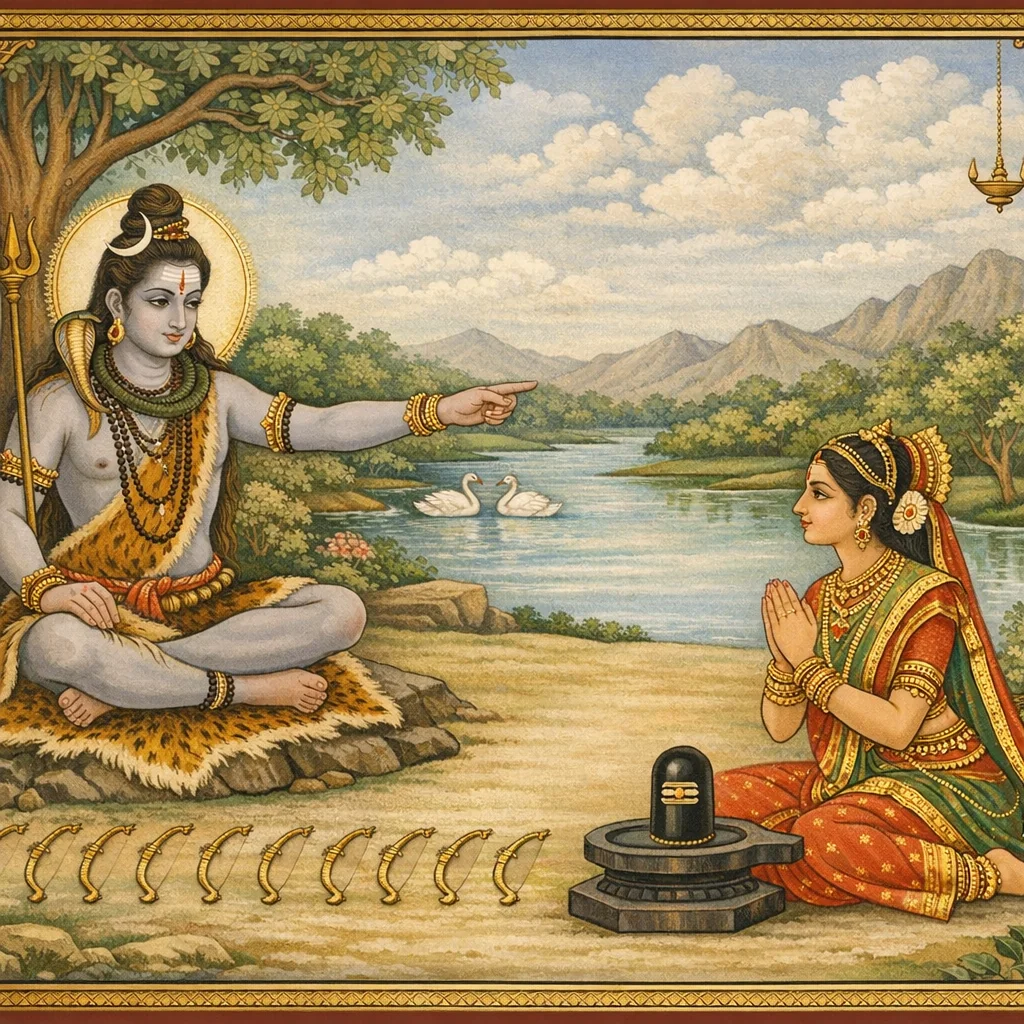
Adhyaya 143
विचित्रेश्वरमाहात्म्यवर्णनम् | The Māhātmya of Vicitreśvara
Īśvara instructs Mahādevī on the pilgrimage to Vicitreśvara, an eminent liṅga. Its location is given with careful sacred geography: in the eastern sector of that region, slightly within the southeast (āgneya) range, about ten bow-lengths away. The chapter then relates its origin: the great liṅga is said to have been established by Vicitra, described as Yama’s “scribe” (lekhaka), after performing exceedingly severe austerities (suduścara tapas). It concludes with a clear phala: mere darśana of the liṅga, when joined with worship, removes all sins; and worship done according to proper rite (vidhāna) ensures the devotee is not afflicted by suffering.
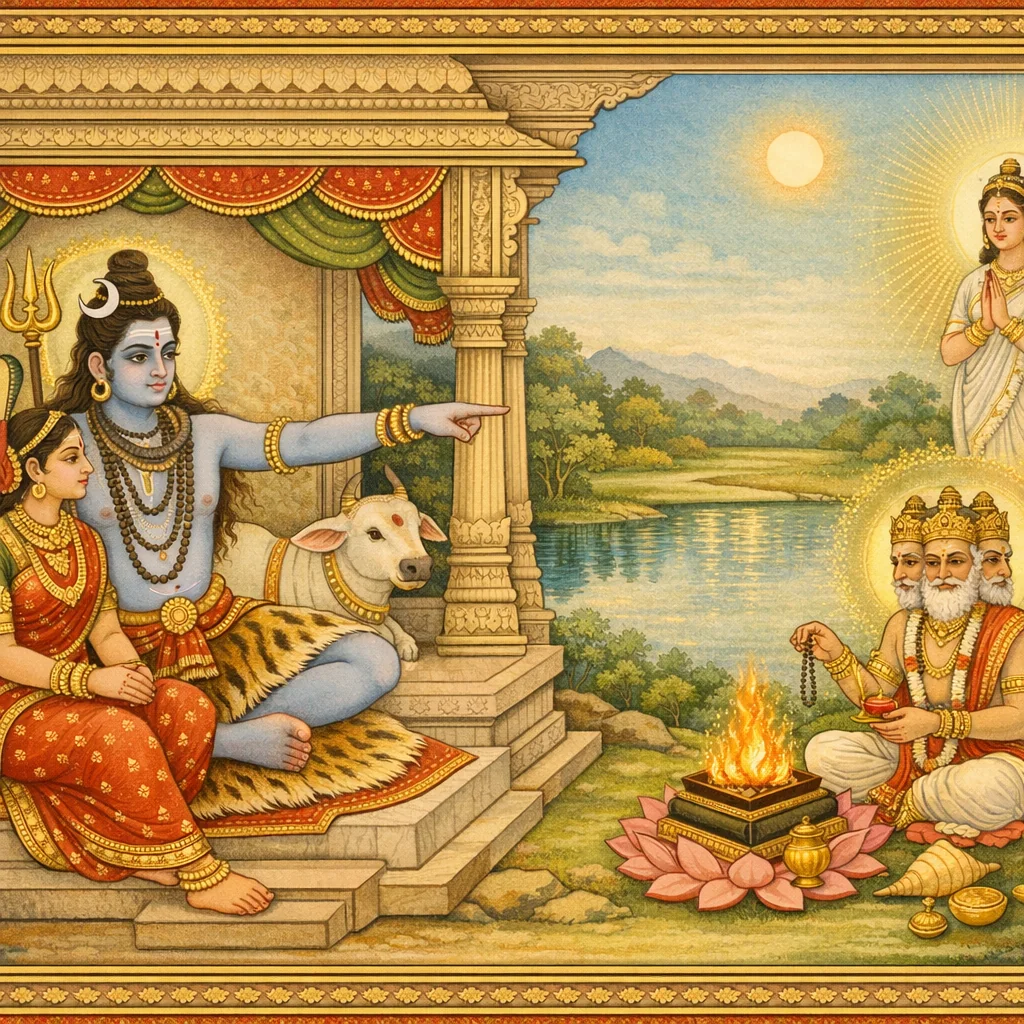
Adhyaya 144
पुष्करकुण्डमाहात्म्य (Puṣkara-kuṇḍa Māhātmya) — The Glory of Puṣkara Pond
Īśvara instructs Mahādevī to proceed to the “third great Puṣkara,” and points out that in its eastern quarter, near the Īśāna direction, there is a smaller pond remembered by the name Puṣkara. The tīrtha’s authority is grounded in an archetypal precedent: at midday Brahmā worshipped there, and Sandhyā—revered as the “mother of the three worlds”—is linked with sacred establishment and grounding (pratiṣṭhā). A focused rite is prescribed: one who bathes there with composure on the full-moon day (pūrṇamāsī) is said to have duly completed the bath at the locus of Ādi-Puṣkara. An accompanying ethical act is required—giving gold in charity (hiraṇya-dāna)—explicitly for the removal of all wrongdoing. The closing phalaśruti presents this as a concise māhātmya: hearing it dispels sin and grants desired aims, establishing the chapter as both ritual instruction and a means of merit through sacred listening.
Adhyaya 145
गजकुंभोदरमाहात्म्यवर्णनम् (The Māhātmya of Gajakumbhodara: Vighneśa at the Kuṇḍa)
Chapter 145 gives a concise theological and ritual notice focused on Vighneśa (Gaṇeśa) in Prabhāsa-kṣetra. Īśvara points out a local icon-form called Gajakumbhodara, described with elephantine features and praised as the remover of obstacles and the destroyer of wrongdoing. It then prescribes a specific observance: a pilgrim should bathe in the associated kuṇḍa on the fourth lunar day (caturthī), with disciplined intent (prayatātmā), and worship the deity with devotion (bhakti). Right devotion and proper timing please the Lord (tuṣyati), implying the clearing of impediments and the ripening of auspicious results. The closing colophon places the passage within the Skanda Purāṇa’s compilation and identifies it as the description of the Gajakumbhodara-māhātmya.
Adhyaya 146
यमेश्वर-प्रतिष्ठा तथा पापविमोचन-उपदेशः (Yameśvara Installation and Guidance on Release from Demerit)
Chapter 146 tells how Dharma-rāja Yama, tormented by a curse connected with Chāyā, loses his foot and suffers grievously. He performs tapas in Prabhāsa-kṣetra and establishes a Śiva-liṅga of Śūlin, which becomes known as Yameśvara. Śiva appears in person and bids Yama ask a boon. Yama seeks the restoration of his fallen foot, and further prays that all beings who behold the liṅga with devotion may gain pāpa-vimocana—release from demerit and sin. Śiva grants these requests and departs; Yama, made whole, returns to heaven. The chapter then gives practical pilgrimage guidance: at the conjunction of Bhātr̥-dvitīyā one should bathe in the pond and take darśana of Yameśvara near the shrine. It prescribes offerings to Yama—sesame in a vessel (tila-pātra), a lamp (dīpa), cows (gāḥ), and gold (kāñcana)—promising freedom from all sins (sarva-pātaka). The teaching stresses an ethical theology: divine judgment is tempered through devotion, austerity, and disciplined rites, easing fear without denying moral causality.
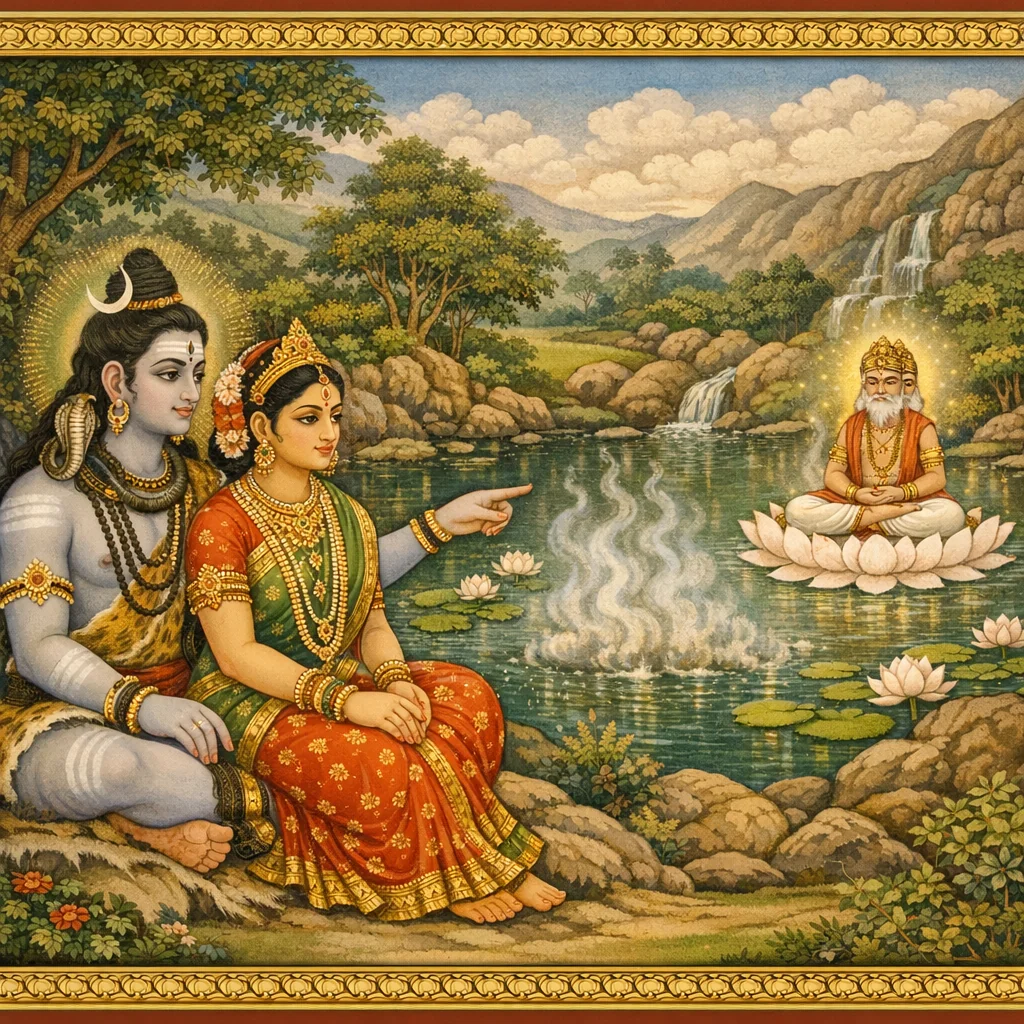
Adhyaya 147
ब्रह्मकुण्डमाहात्म्य (Brahmakuṇḍa Māhātmya) — The Glory of Brahmakuṇḍa at Prabhāsa
This adhyāya unfolds as a Śiva–Devī dialogue. Īśvara directs Devī to Brahmakuṇḍa at Prabhāsa, an unsurpassed tīrtha said to have been created by Brahmā. Its origin is placed in the time when Somnātha was established by Soma/Śaśāṅka and the devas assembled for the consecration. Asked to provide a self-manifest sign of the deity’s installation, Brahmā enters focused meditation and, by tapas, ritually draws together all tīrthas—of heaven, earth, and the nether realms—into this one basin, hence the name “Brahmakuṇḍa.” The discourse then lists ritual uses and promised results: bathing and pitṛ-tarpaṇa here yield Agniṣṭoma-like merit and heavenly mobility; gifts to learned brāhmaṇas are urged for the removal of sins. Sarasvatī is said to bathe here on pūrṇimā and pratipad, marking the site’s calendrical sanctity. The waters are praised as siddha-rasāyana, a perfected elixir displaying many colors and fragrances—an awe-inspiring wonder (kautuka)—yet their efficacy is conditioned by Mahādeva’s satisfaction. Practical observances are taught—preparing a vessel, heating, and repeated infusion—along with long-term vows: multi-year snāna with mantra-japa and worship of Hiraṇyeśa, Kṣetrapāla (the guardian), and Bhairaveśvara to gain health, longevity, eloquence, and learning. The chapter culminates in expansive phala: diverse sins are destroyed, merit accrues through pradakṣiṇā, fulfillment comes through pūjā, and the phalaśruti promises that faithful listeners are freed from sins and ascend to Brahmaloka.
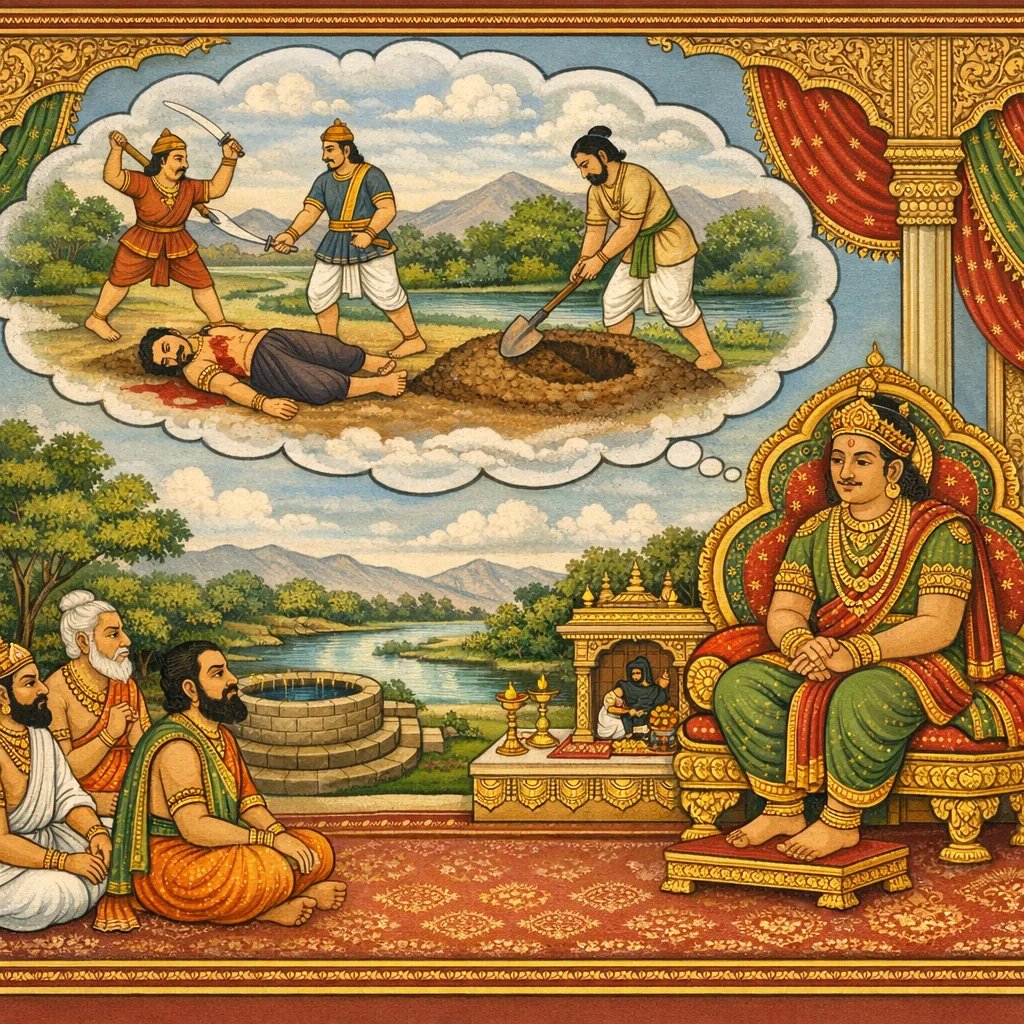
Adhyaya 148
Kūpa–Kuṇḍala-janma-kathā and Śivarātri-phala (The Well of Kundala and the Fruit of Śivarātri)
This chapter unfolds as a theological dialogue between Śiva and Devī. It first identifies a well (kūpa) north of Brahmakunda near Brahmatīrtha and proclaims its powerful purificatory virtue: bathing there frees one from the demerit of theft. It also extols Śivarātri as an especially auspicious time for rites such as piṇḍadāna, performed for the welfare of those violently slain and even those burdened with moral guilt. When Devī asks how the place became renowned, Īśvara relates an origin legend. King Sudarśana recalls a former birth connected with keeping vigil on Śivarātri at Prabhāsa: in that earlier life he was a thief who, attempting wrongdoing during the night of communal wakefulness, was killed by royal guards and buried north of Brahmatīrtha. Through his unintended association with Śivarātri wakefulness and the potency of the kṣetra, he gains a transformative fruit, culminating in rebirth as the righteous King Sudarśana. The narrative then points to a visible sign—gold being discovered—bringing public verification, and links this to the arising/naming of the Citrāpathā river. It prescribes that in the month of Śrāvaṇa, bathing at that well, performing śrāddha according to rule, and worshipping Citrāditya lead to honor in Śiva’s realm. The chapter ends with a phalaśruti promising purification and esteem in Rudra-loka to those who recite or listen.
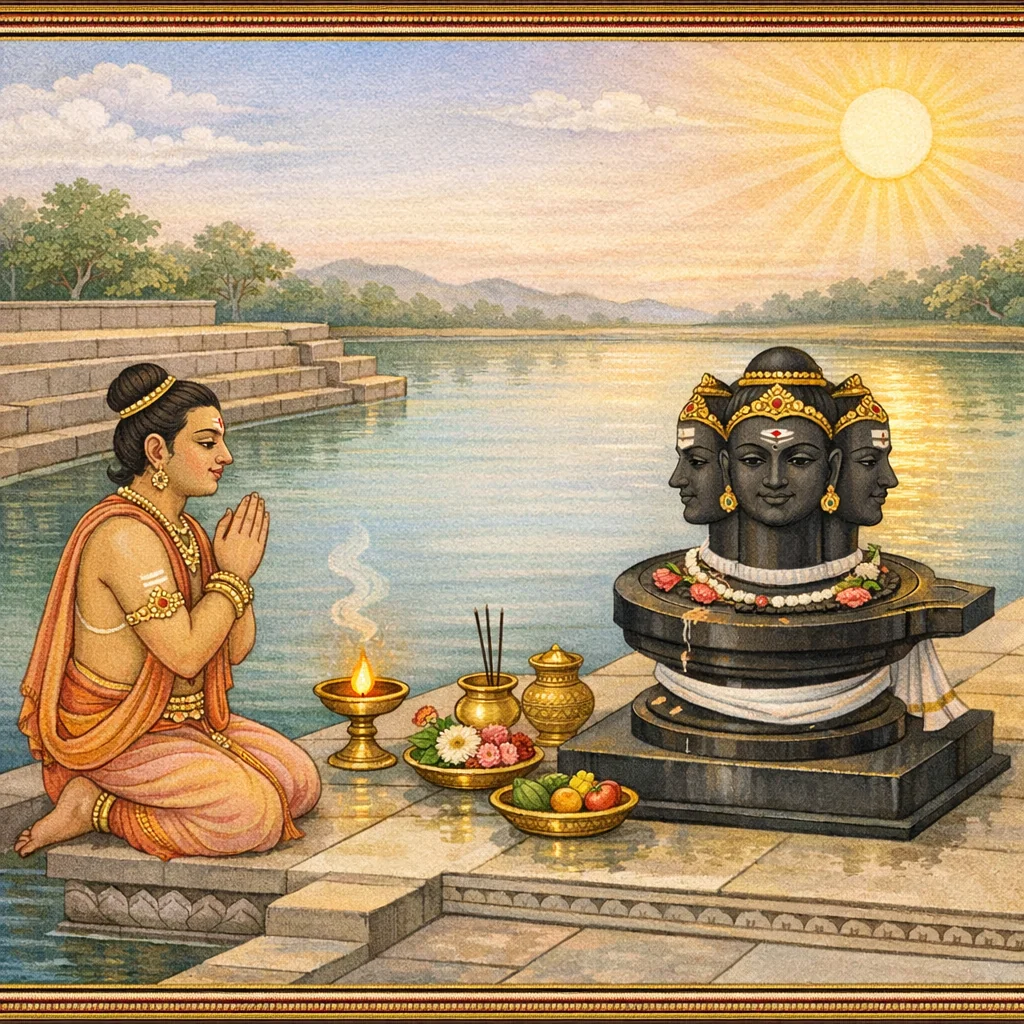
Adhyaya 149
Bhairaveśvara at Brahmakuṇḍa (भैरवेश्वर-ब्रह्मकुण्ड-माहात्म्यम्)
Īśvara speaks to Devī and directs the pilgrim-seeker to Bhairaveśvara, an eminent manifestation abiding in the Īśāna (northeast) quarter of Brahmakuṇḍa. He is praised as the destroyer of sin and the guardian of the tīrtha, appearing as four-faced (caturvaktra), signifying protective presence and ritual authority within the sacred terrain. The chapter lays down a simple pilgrimage rite: bathe in the great kuṇḍa, then worship with devotion through the fivefold upacāra, restraining the senses. A strong phalaśruti follows: the worshipper is said to “deliver” (tārayet) past and future lineages, and is assured that no loss or destruction will befall the devotee. The reward is cast in celestial imagery—radiant vimānas, ceaseless movement in sun-like brilliance, and divine enjoyment—culminating in the claim that even the mere sight of this four-faced liṅga frees one from all sins.
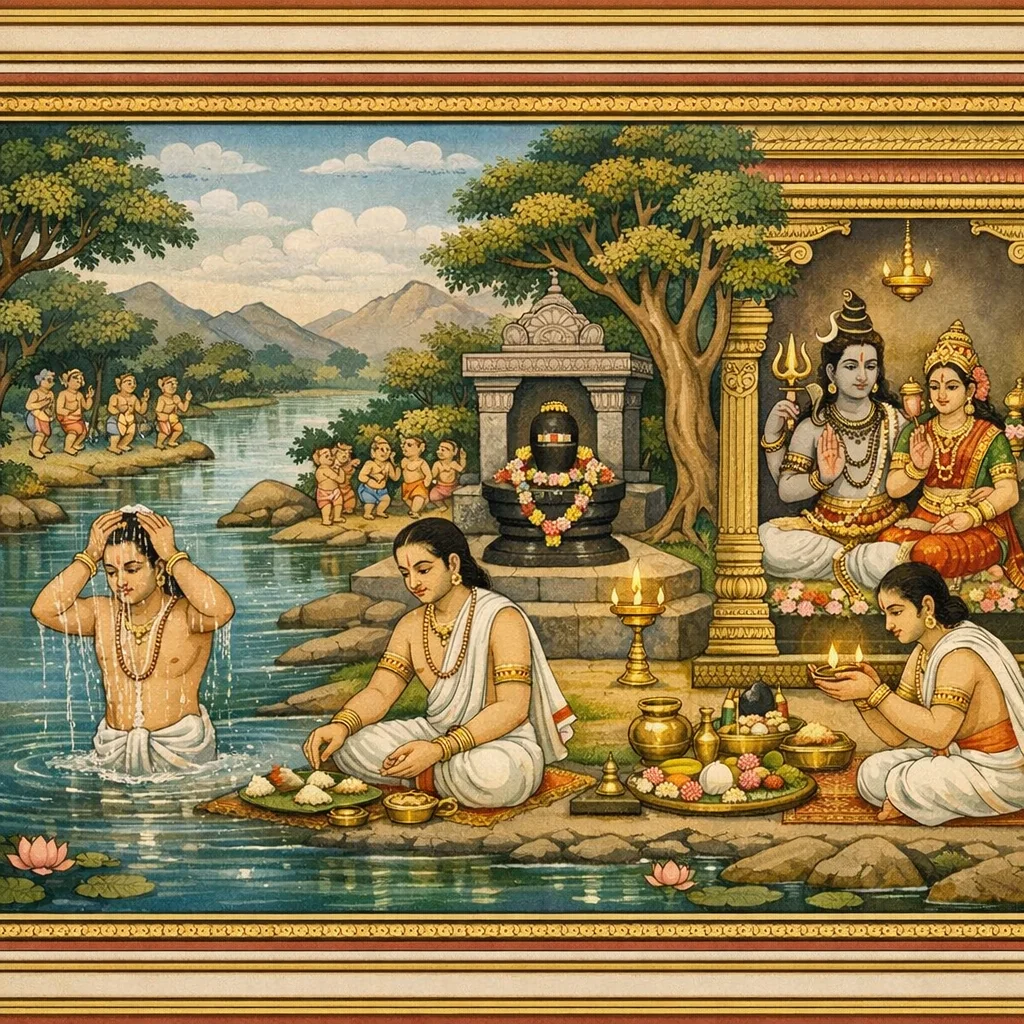
Adhyaya 150
ब्रह्मकुण्डसमीपस्थ-ब्रह्मेश्वरमाहात्म्यवर्णनम् (Glory of Brahmeśvara near Brahma-kuṇḍa)
This chapter is cast as Īśvara’s instruction on a Śaiva shrine called Brahmeśvara, located south of the previously established Brahma-kuṇḍa. It proclaims the shrine’s fame across the three worlds and its guardianship by Śiva’s gaṇas, thereby affirming its authority within the Prabhāsa pilgrimage landscape. A precise ritual order is then given: the pilgrim should approach Brahmeśvara, bathe at the spot—especially on caturdaśī and most especially on amāvāsyā—perform śrāddha according to proper procedure, and thereafter worship Brahmeśvara. The dāna element follows, recommending the gift of gold to brāhmaṇas as an act pleasing to Śaṅkara. The concluding phala statement links these observances to the “fruit of birth” (janma-phala), the spread of great renown (vipulā kīrti), and a rejoicing associated with Brahmā’s favor, uniting rite, ethical giving, and promised outcomes in one teaching.
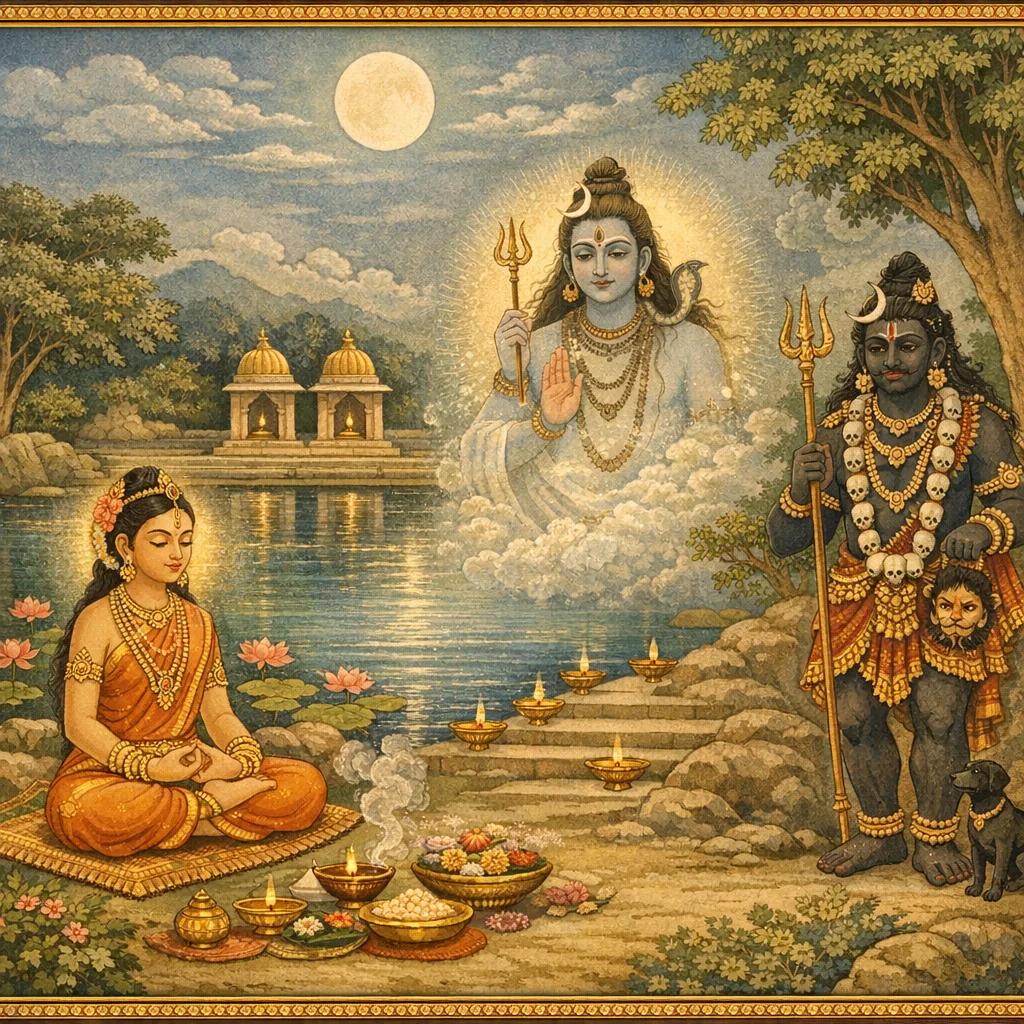
Adhyaya 151
Sāvitrīśvara-bhairava-māhātmya (सावित्रीश्वरभैरवमाहात्म्य)
Chapter 151 is a focused tīrtha-māhātmya set around the vicinity of Brahma-kuṇḍa in Prabhāsa-kṣetra. Īśvara speaks of a third Bhairava in the southern part of the area, near Brahma-kuṇḍa, where Sāvitrī is linked with a Śaiva स्थापना. Sāvitrī performs severe devotional austerity—marked by restraint and strict discipline—to propitiate Śaṅkara. Pleased, Śiva grants a boon framed as a ritual rule and its fruit: one who bathes in the kuṇḍa and worships “my liṅga” on the full-moon day (pūrṇimā), offering fragrance and flowers in proper order, attains the desired auspicious results. The phalaśruti heightens the salvific promise: even a person burdened with major transgressions is freed from faults and gains fulfillment of aims under the protection of Vṛṣabhadhvaja (Śiva). The chapter ends with Śiva’s disappearance, Sāvitrī’s departure to Brahma-loka after establishing the Śaiva presence, and the assurance that the discerning hearer is released from faults.
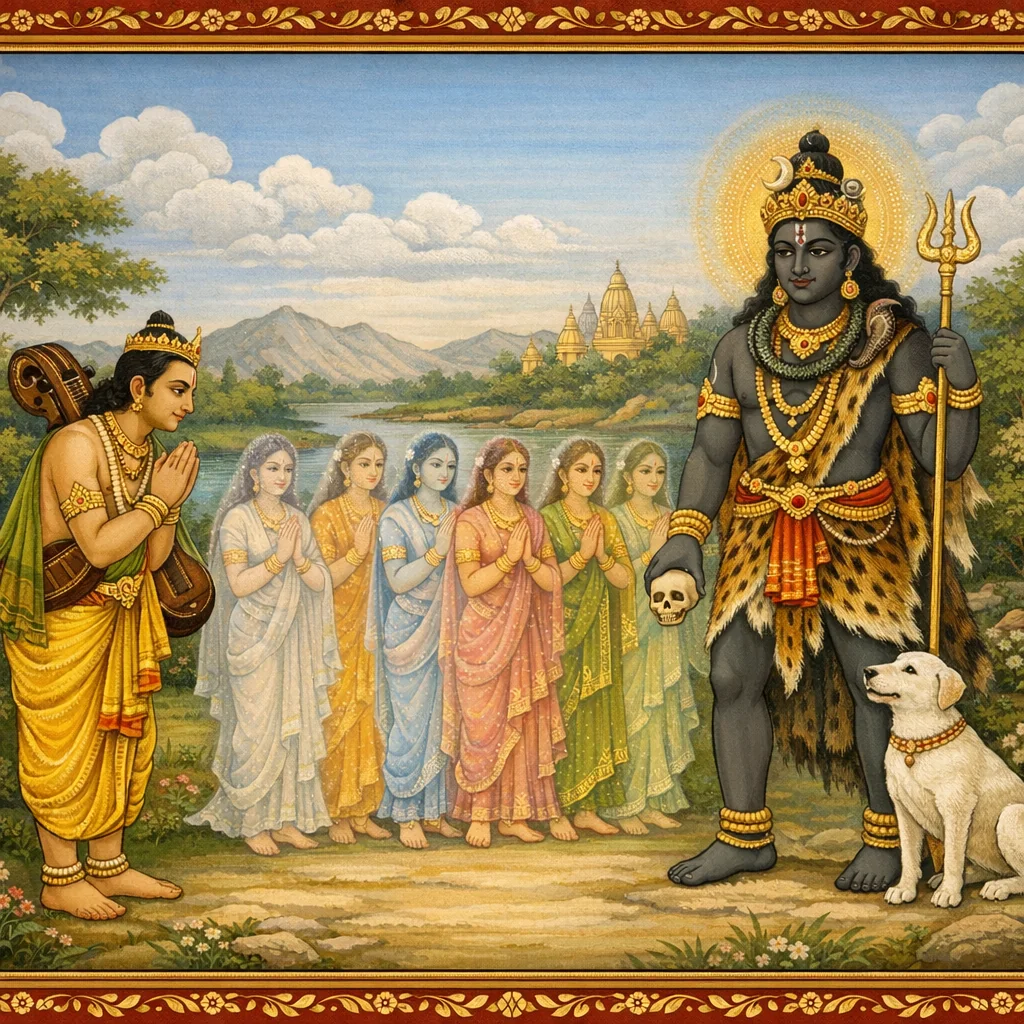
Adhyaya 152
नारदेश्वरभैरवप्रादुर्भावः (Naradeśvara Bhairava: Origin and Merit)
Īśvara describes a succession of Bhairava manifestations and points out a fourth Bhairava-site to the west of Brahmeśa, its location given with exact measurements in bow-lengths. There stands the liṅga called Naradeśvara, established by the sage Nārada, famed for removing all sins and granting desired aims. A framed legend tells how Nārada, once in Brahmaloka, encountered a radiant vīṇā associated with Sarasvatī. Out of curiosity he played it improperly; the resulting notes—understood as the seven svaras—are narrated as “fallen brāhmaṇas.” Brahmā declares this a grave fault born of ignorant performance, equal to harming seven brāhmaṇas, and commands Nārada to go at once on pilgrimage to Prabhāsa to propitiate Bhairava for purification. Nārada reaches Brahmakuṇḍa and worships Bhairava for a hundred divine years, becoming purified and attaining mastery in song. The chapter concludes by proclaiming Naradeśvara Bhairava as world-renowned for destroying major transgressions, prescribing that those who handle vīṇā and notes in ignorance should go there to be cleansed. An observance is added: in Māgha, with a controlled diet, worship three times daily; the devotee attains an auspicious and delightful heavenly state.
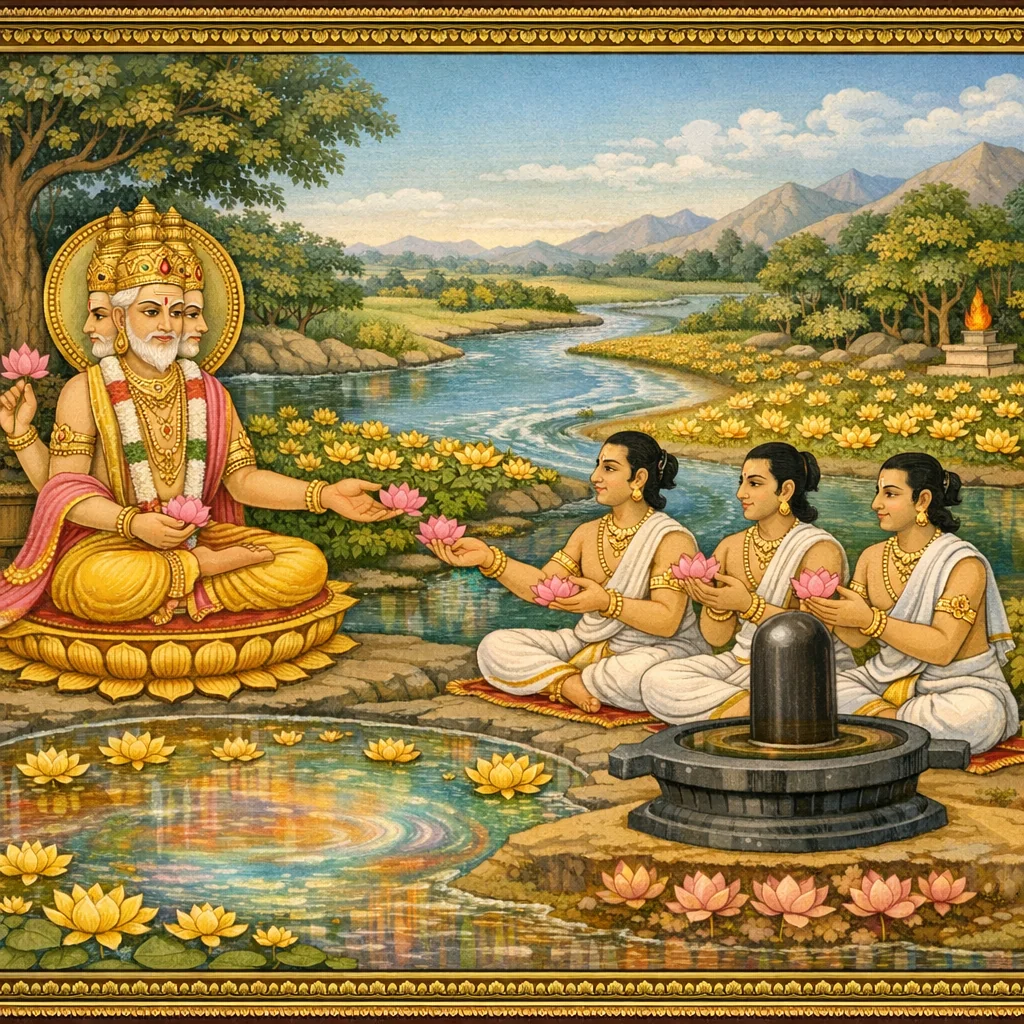
Adhyaya 153
Hiraṇyeśvara-māhātmya (हिरण्येश्वरमाहात्म्य) — The Glory of Hiraṇyeśvara near Brahmakuṇḍa
Īśvara tells Devī of Hiraṇyeśvara’s location and saving power: a supreme liṅga set northwest of Brahmakuṇḍa, near Kṛtasmarā, Agnitīrtha, Yameśvara, and the northern oceanic region. It belongs to the wider sacred landscape around Brahmakuṇḍa, where the renowned “five Bhairavas” are also mentioned. Brahmā performed fierce tapas on the liṅga’s eastern side and began an excellent yajña. Devas and ṛṣis arrived to claim their allotted shares, but the sacrifice stalled when the dakṣiṇā (honorarium and gifts for the priests) proved insufficient. Brahmā appealed to Mahādeva; by divine prompting Sarasvatī was invoked for the gods’ welfare and became kāñcana-vāhinī, the gold-bearing stream. Flowing westward, she produced countless golden lotuses, filling the land up to Agnitīrtha. Brahmā distributed these golden lotuses as dakṣiṇā, completed the yajña, and hid the remaining lotuses beneath the earth, installing the liṅga above them—hence the name Hiraṇyeśvara, worshipped with divine golden lotuses. The chapter adds tīrtha lore: Brahmakuṇḍa’s water appears multi-colored and, because of the submerged lotuses, is said to turn gold-like for a moment. The phalaśruti concludes that seeing or worshipping Hiraṇyeśvara removes wrongdoing and dispels poverty; worship on Māgha caturdaśī equals honoring the entire cosmos; and hearing or reciting this account with devotion leads to devaloka and freedom from sins.
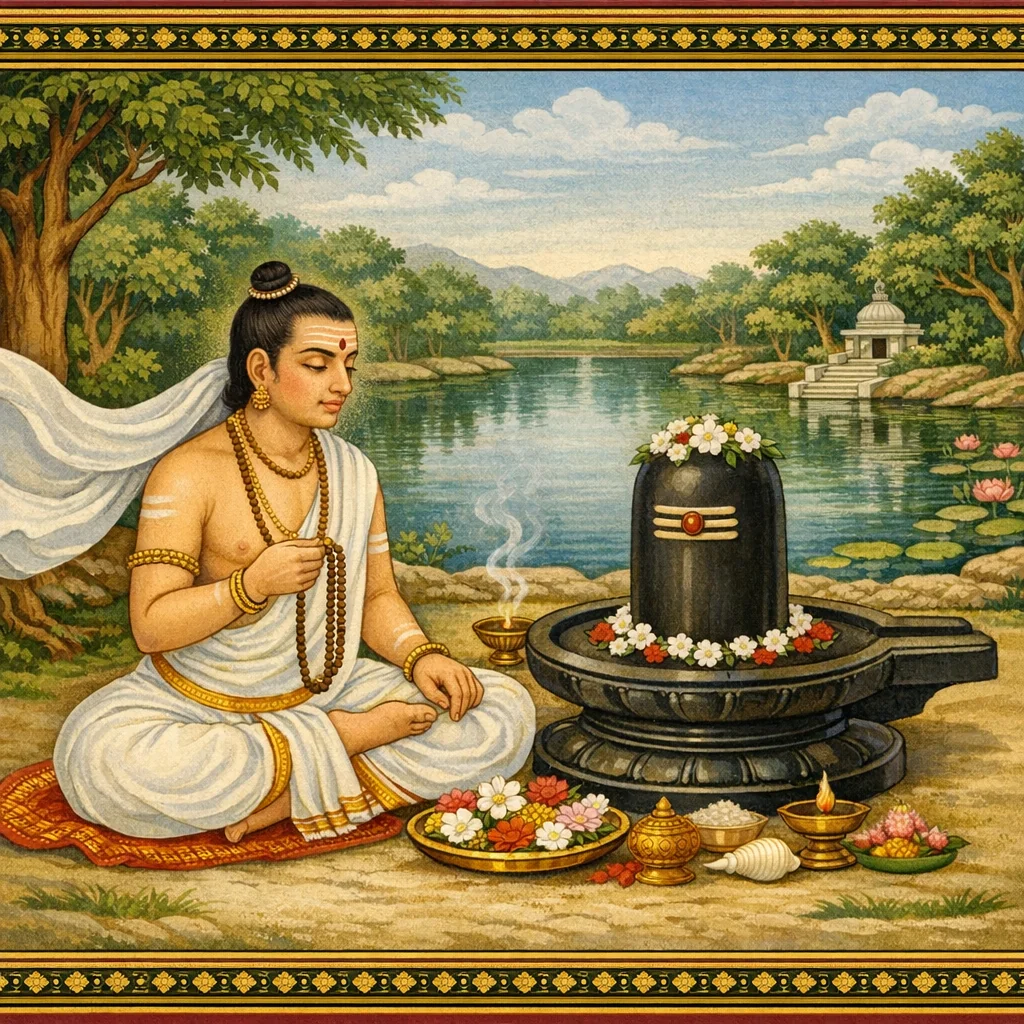
Adhyaya 154
गायत्रीश्वरमाहात्म्यवर्णनम् (Glory of Gayatrīśvara Liṅga)
Īśvara speaks to Devī and directs the pilgrim to a pāpa-vimocana liṅga, a sin-removing emblem, located in the Hiraṇyeśvara area in the Vāyavya quarter. It is described as being “three bow-lengths” away, and as pāpaghna for all beings through both darśana (beholding) and sparśana (reverent touch). The chapter identifies it as an “ādi-liṅga,” established through the power and tradition of the Gāyatrī mantra (gāyatrī-saṃpratiṣṭhita). A practitioner—especially a brāhmaṇa who has become śuci (ritually pure)—who reaches this liṅga and performs Gāyatrī-japa is freed from the fault of duṣpratigraha (improper acceptance of gifts). Further, on the full moon of Jyeṣṭha, one who feeds a married couple and clothes them according to one’s means is released from misfortune (daurbhāgya); and worship on Paurṇamāsī with fragrance, flowers, and offerings is said to bestow “brāhmaṇya” for seven births. The account concludes as a most concentrated essence (sārāt sāratara), made available by the grace of Brahma-kuṇḍa.
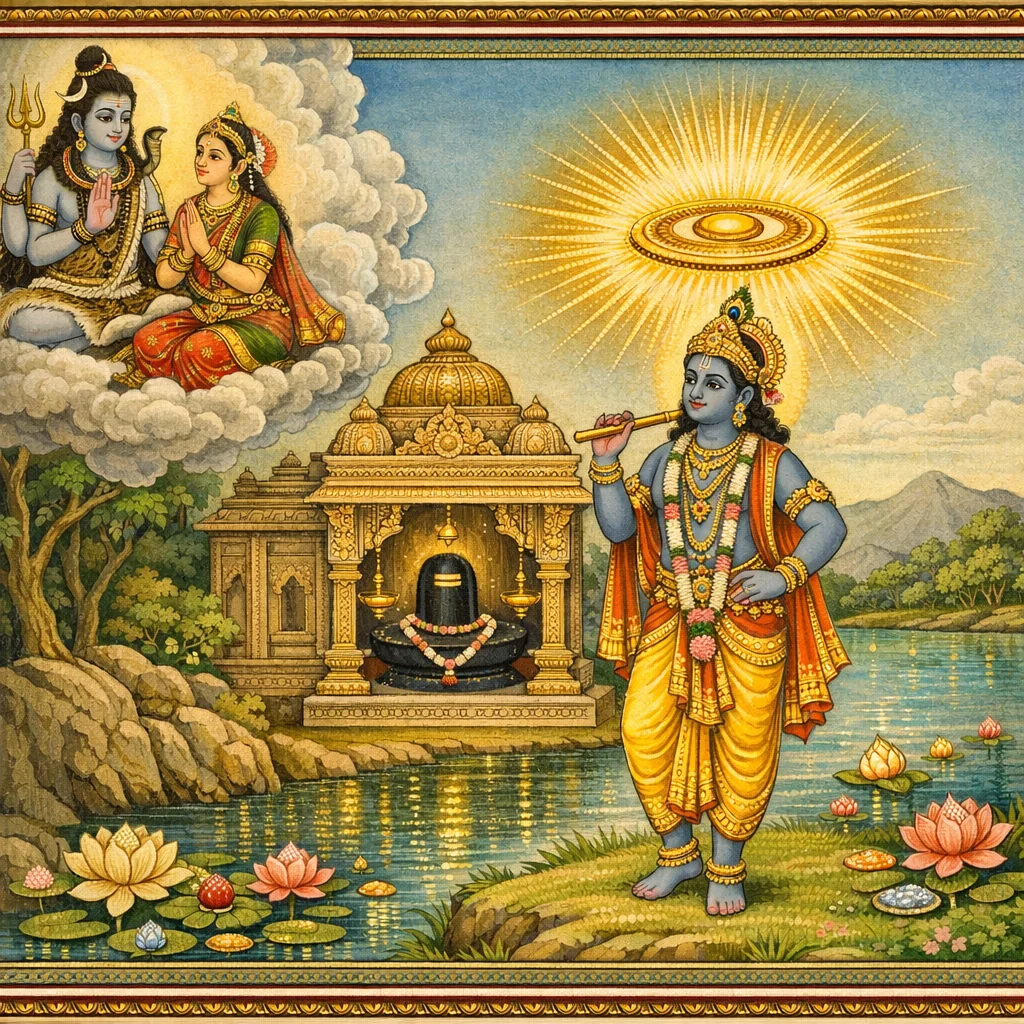
Adhyaya 155
Ratneśvara-māhātmya (रतनॆश्वरमाहात्म्य) — Sudarśana Kṣetra and the Merit of Ratnakuṇḍa Worship
This chapter is cast as a theological dialogue in which Īśvara speaks to Devī, guiding her—and thereby the pilgrim—toward Ratneśvara, praised as an unsurpassed shrine. It declares that Viṣṇu, mighty and pre-eminent, performed tapas there and established a liṅga that grants every desired aim. A practical ritual path is then given: bathing in Ratnakuṇḍa and continually worshiping the deity with complete offerings and heartfelt devotion yields the sought fruit. The site’s mythic glory is further affirmed by stating that Kṛṣṇa, of immeasurable radiance, undertook severe austerities there and obtained the Sudarśana-cakra, the destroyer of all daityas. Īśvara proclaims the place eternally dear to him and confirms his abiding presence there even at cosmic dissolution. The kṣetra is named “Sudarśana,” its boundary measured as thirty-six dhanvantaras. The text extends its promise of liberation: even those deemed ‘low’ who die within that limit attain the supreme state; and a dāna rite—offering Viṣṇu a golden Garuḍa and yellow garments—is said to bestow the merit of pilgrimage.
Adhyaya 156
गरुडेश्वरमाहात्म्यवर्णनम् (Garudeśvara Māhātmya—Account of the Glory of Garudeśvara)
Chapter 156 gives a brief tīrtha instruction within the Ratneśvara-māhātmya, as Īśvara speaks to Devī. He identifies a particular shrine: the liṅga connected with Vainateya (Garuda), called “Vainateya-pratiṣṭhita,” located north of Ratneśvara at a distance measured in dhanus. In the Purāṇic account, Garuda, recognizing the place as Vaiṣṇava in character, installs a sin-destroying liṅga there. Īśvara prescribes worship on the fifth lunar day (pañcamī) according to proper procedure (vidhānataḥ). One who bathes the liṅga with pañcāmṛta and worships it ritually gains protection from serpent-born poison for seven births, attains all merit, and enjoys heavenly bliss.
Adhyaya 157
सत्यभामेश्वरमाहात्म्यवर्णनम् | Satyabhāmeśvara Māhātmya (Account of the Glory of Satyabhāmeśvara)
Īśvara speaks to the goddess Mahādevī and urges a pilgrimage to the auspicious shrine of Satyabhāmeśvara. He specifies its location as one bow-length south of Ratneśvara and praises it as sarva-pāpa-praśamana, a place that pacifies and removes all sins. The chapter affirms the power of tīrtha practice: bathing at this Vaiṣṇava-associated spot is said to be pātaka-nāśana, the destroyer of sin. The shrine is attributed to Satyabhāmā—Kṛṣṇa’s consort—renowned for beauty and noble dignity (rūpa–audārya). A calendrical rule is given: on the third lunar day of the month of Māgha, women and men alike may worship there; pūjā performed with bhakti grants release from sins. The phalaśruti adds that those afflicted by misfortune, sorrow, grief, and obstacles are freed from them and become “associated with Satyabhāmā” (satyabhāmānvitā), aligned in devotion with the sanctity of the shrine’s founding.
Adhyaya 158
अनंगेश्वरमाहात्म्यवर्णनम् (Māhātmya of Anangeśvara: Narrative of the Shrine’s Glory)
Chapter 158 records Īśvara’s itinerary-like guidance to Anangeśvara, said to lie a “bow-shot” in front of Ratneśvara. The liṅga there is declared to have been established by Kāmadeva (also called Viṣṇu’s son), and the shrine is portrayed as a Vaiṣṇava-associated holy place, especially potent in Kali-yuga for cleansing moral defilements. The phala is stated plainly: by seeing and worshiping Anangeśvara one gains Kāmadeva-like attractiveness and social charm, with the blessing extending even to one’s lineage, easing misfortune or a perceived lack of auspiciousness. A calendrical observance is also given—special worship through a vrata on Ananga-trayodaśī—praised as a cause of “birth-fulfillment” (janma-sāphalya). The chapter completes the pilgrimage’s ethical economy by prescribing śayyā-dāna (the gift of a bed) to a virtuous brāhmaṇa, with greater merit when the recipient is a Viṣṇu-bhakta, thus linking shrine visitation to disciplined generosity and worthy recipients.
Adhyaya 159
रत्नकुण्ड-माहात्म्य (Ratnakuṇḍa Māhātmya) / The Glory of Ratna-Kuṇḍa near Ratneśvara
Īśvara instructs Mahādevī about a supremely holy water-site called Ratnakuṇḍa, lying south of Ratneśvara at the traditional measure of seven bows’ distance. It is praised as a cleanser of grave sins and is said to have been established by Viṣṇu. The chapter then declares that Kṛṣṇa gathered countless tīrthas, earthly and celestial, and deposited them here; a divine retinue (gaṇa) guards the place, making it hard to approach for the undisciplined in the Kali-yuga. A ritual rule is given: bathing here in the proper manner yields an exalted sacrificial fruit, multiplying the merit of an Aśvamedha. Ekādaśī is highlighted as the chief time to offer piṇḍa to the ancestors, granting them inexhaustible satisfaction, and night-vigil (jāgaraṇa), performed with firm faith, is taught as a means to obtain desired results. For dāna, the text recommends gifting yellow garments and a milch cow, dedicating them to Viṣṇu so that the pilgrimage bears its full fruition. Finally, it sets out the yuga-wise names—Hemakuṇḍa in Kṛta, Raupya in Tretā, Cakrakuṇḍa in Dvāpara, and Ratnakuṇḍa in Kali—and adds that subterranean streams of the Gaṅgā are present, so bathing here equals bathing at all tīrthas.
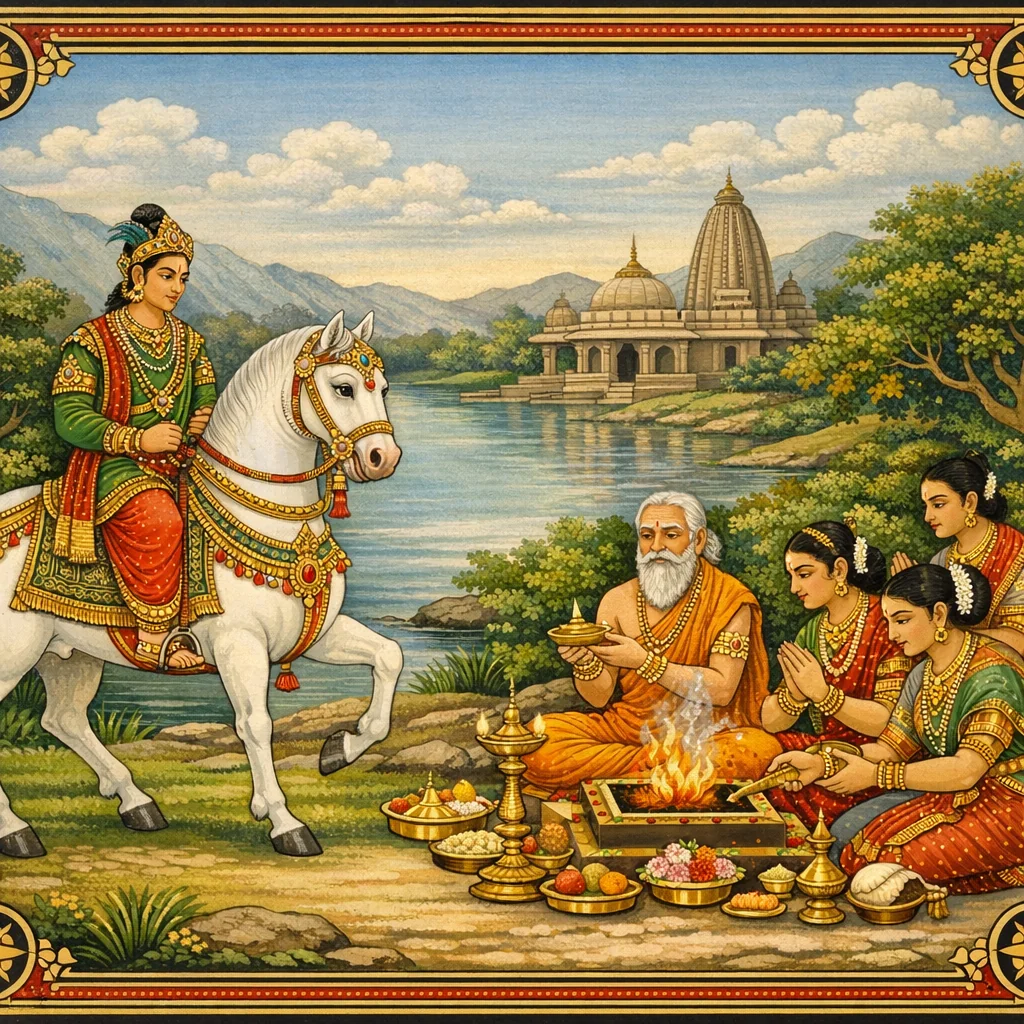
Adhyaya 160
रैवंतकराजभट्टारकमाहात्म्यवर्णनम् | The Māhātmya of Raivanta Rājabhaṭṭāraka
The chapter records Īśvara’s instruction to Devī on a particular pilgrimage and worship sequence in Prabhāsa-kṣetra, centered on Raivanta Rājabhaṭṭāraka. He is praised as the son of Sūrya, mounted on a horse, possessed of great strength, and stationed within the sacred field near Sāvitrī, facing the south-west (Nairṛta). It then declares the fruits of darśana and pūjā: mere sight of him frees one from all adversities. A precise observance is prescribed—worship on a Sunday that coincides with the seventh lunar day (saptamī)—together with the promise that poverty will not arise even in the worshipper’s lineage. The teaching concludes with an ethical and practical exhortation to worship with full effort, so that one may dwell in the kṣetra without obstacles and also attain royal or worldly aims such as the increase of horses, presenting devotion as both liberating and socially efficacious.
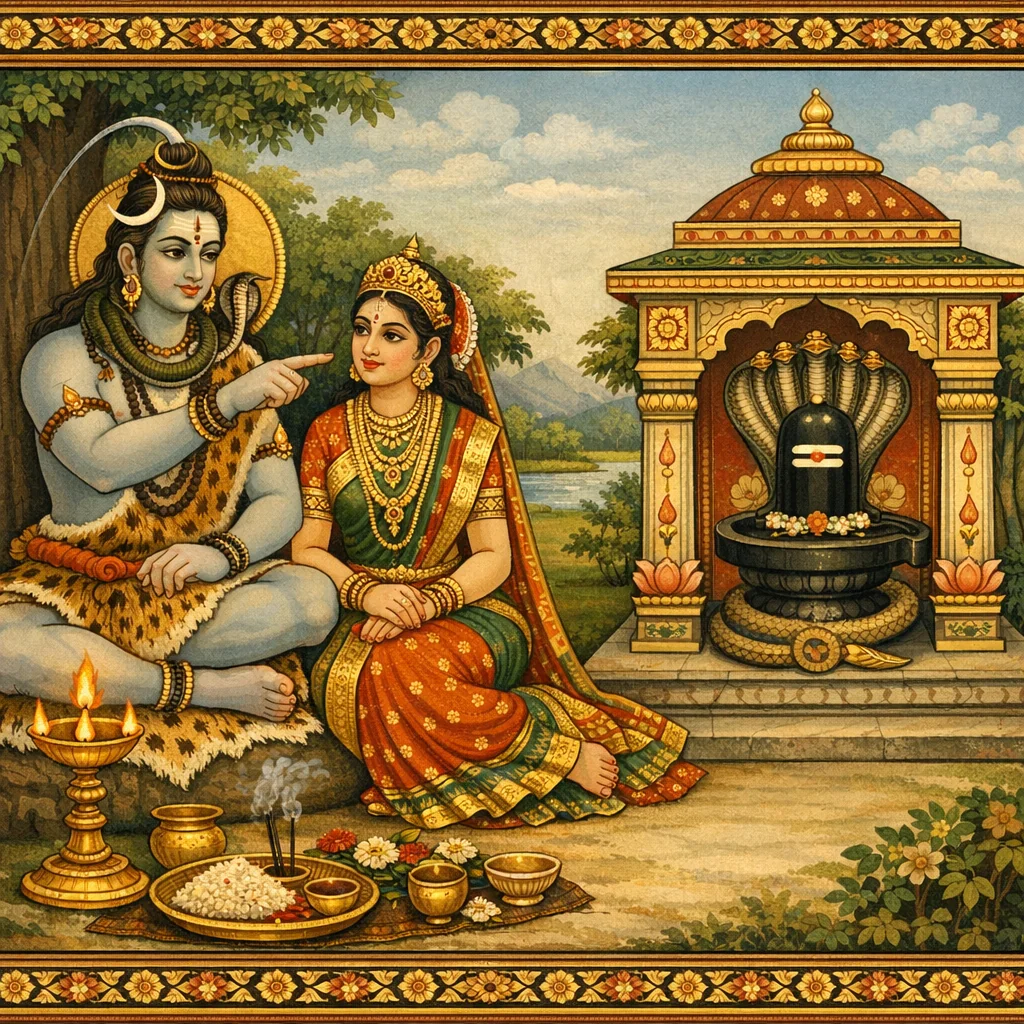
Adhyaya 161
अनन्तेश्वरमाहात्म्यवर्णनम् | Ananteśvara Māhātmya (Glorification of Ananteśvara)
This chapter records Īśvara’s directional guidance within Prabhāsa-kṣetra, placing Ananteśvara to the south of a referenced shrine at a short distance measured in bow-lengths. The liṅga is named “Ananteśvara,” said to have been established by Ananta and associated with the Nāga-king, thereby affirming nāga guardianship within the site’s sanctity. A disciplined mode of worship is prescribed: on the bright-fortnight pañcamī of Phālguna, one who restrains diet and senses should adore the deity by the pañcopacāra (five-offering) method. The phalaśruti promises protection from serpent-bite and that poison will not advance for the stated period, encouraging steadfast observance. The chapter further teaches the performance of an “Ananta-vrata,” with offerings of honey and sweet rice-milk (madhu-pāyasa), and the feeding of a brāhmaṇa with honey-mixed pāyasa, presenting dāna and hospitality as integral extensions of shrine worship.
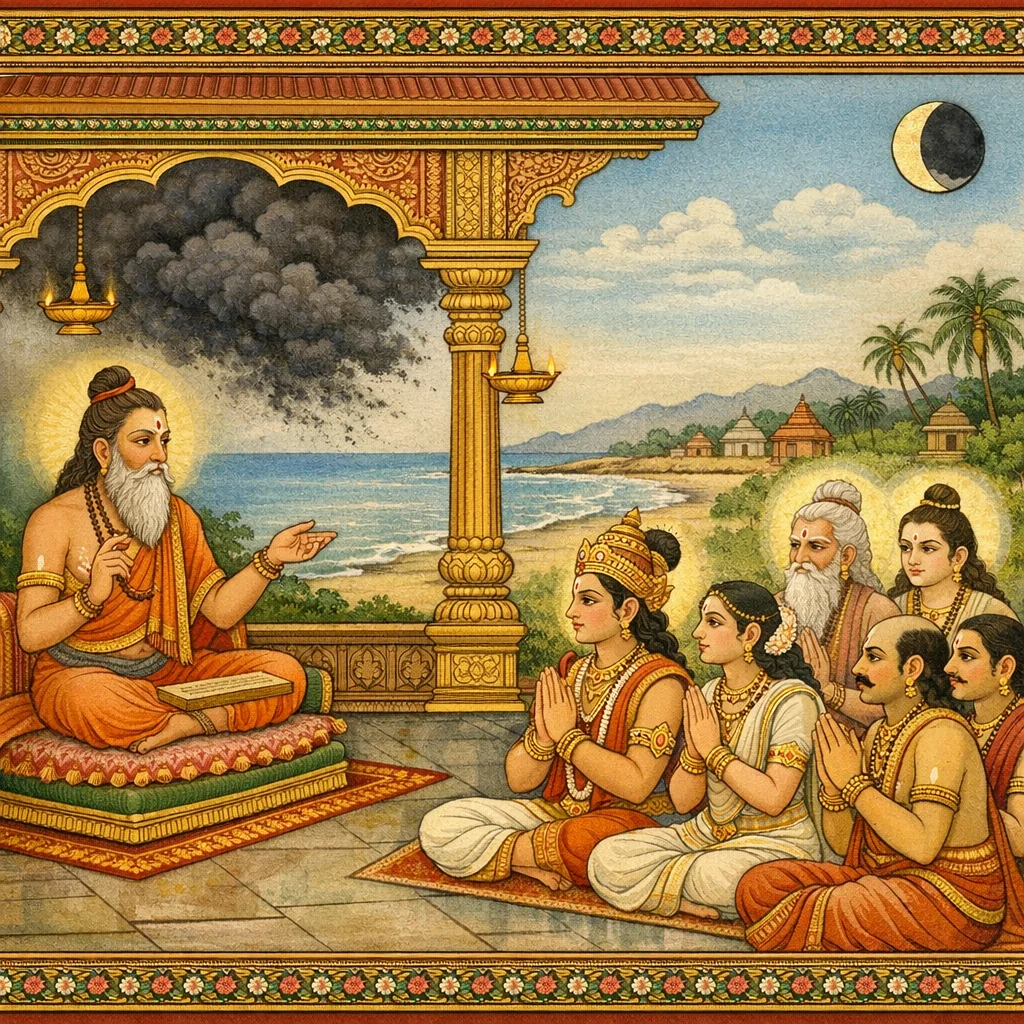
Adhyaya 162
Aṣṭakuleśvara-māhātmya (अष्टकुलेश्वरमाहात्म्य) — The Glory of Aṣṭakuleśvara Liṅga
Chapter 162 is framed as Śiva’s instruction to Devī, placing the Aṣṭakuleśvara liṅga within the sacred landscape of Prabhāsa. Its location is given by direction: it lies to the south of the referenced point and to the east of Lakṣmaṇeśa. Śiva extols Aṣṭakuleśvara as the pacifier of all sins (sarva-pāpa-praśamana) and the destroyer of grievous afflictions, including the peril of “great poison” (mahā-viṣa). Its sanctity is affirmed by the worship of siddhas and gandharvas, and it is said to grant desired aims (vāñchitārtha-prada). A specific observance is prescribed: worship on Kṛṣṇāṣṭamī according to the proper rite (vidhānataḥ). The phalaśruti promises release from grave transgressions and honor in Nāga-loka, a distinct post-mortem merit tied to this vow and shrine.
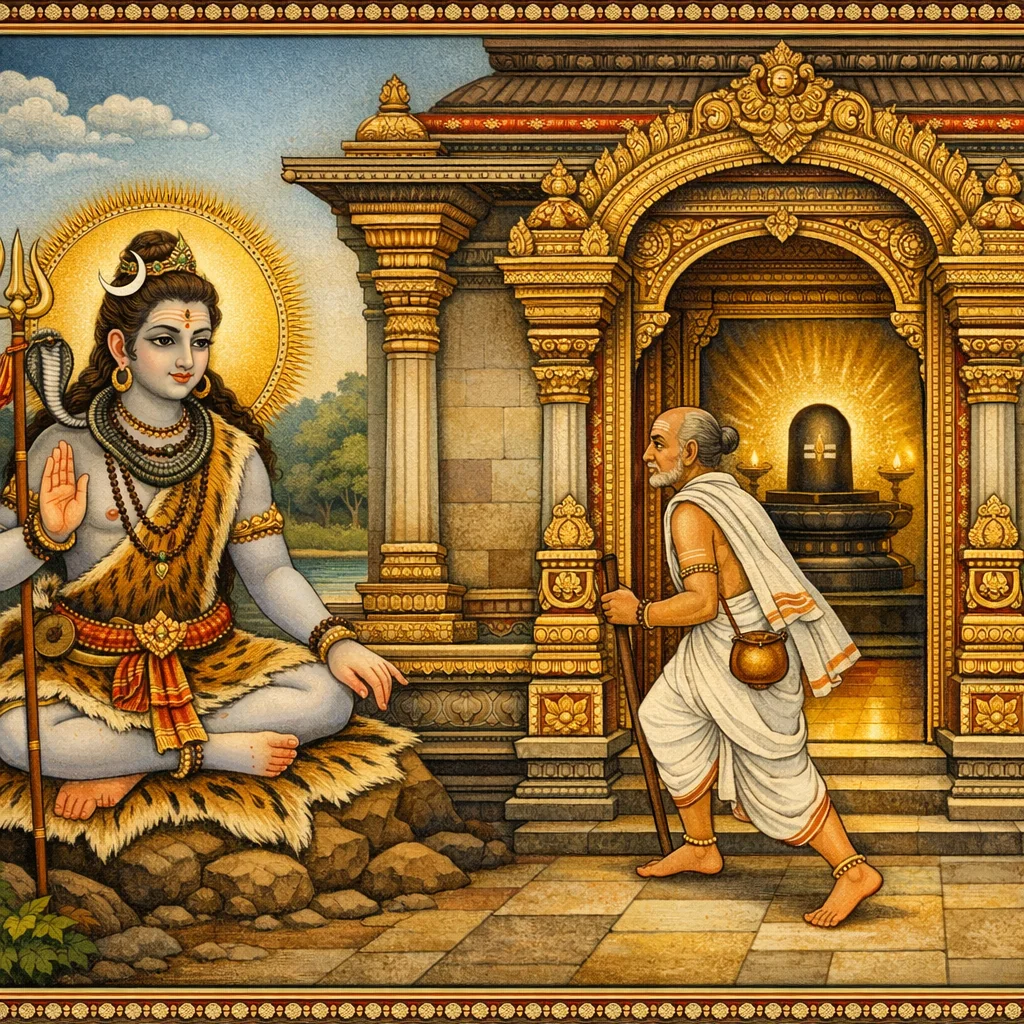
Adhyaya 163
नासत्येश्वराश्विनेश्वरमाहात्म्यवर्णनम् (The Māhātmya of Nāsatyeśvara and Aśvineśvara)
This adhyāya is cast as Īśvara’s instruction (“Īśvara said”), guiding the seeker to a shrine lying to the east of the indicated point. There a liṅga named Nāsatyeśvara is identified and praised as a great remover of kalmaṣa—moral and ritual defilement—bestowing purification upon the pilgrim. The closing colophon places the chapter within the 81,000-verse Skanda Purāṇa, in the seventh division (Prabhāsa Khaṇḍa) and the first subsection (Prabhāsakṣetramāhātmya), and states its topic as the māhātmya narration of Nāsatyeśvara and Aśvineśvara. The chapter thus serves as a concise unit of sacred-geographic indexing, linking direction of pilgrimage, shrine nomenclature, and the promise of cleansing in the manner of sthala-māhātmya literature.
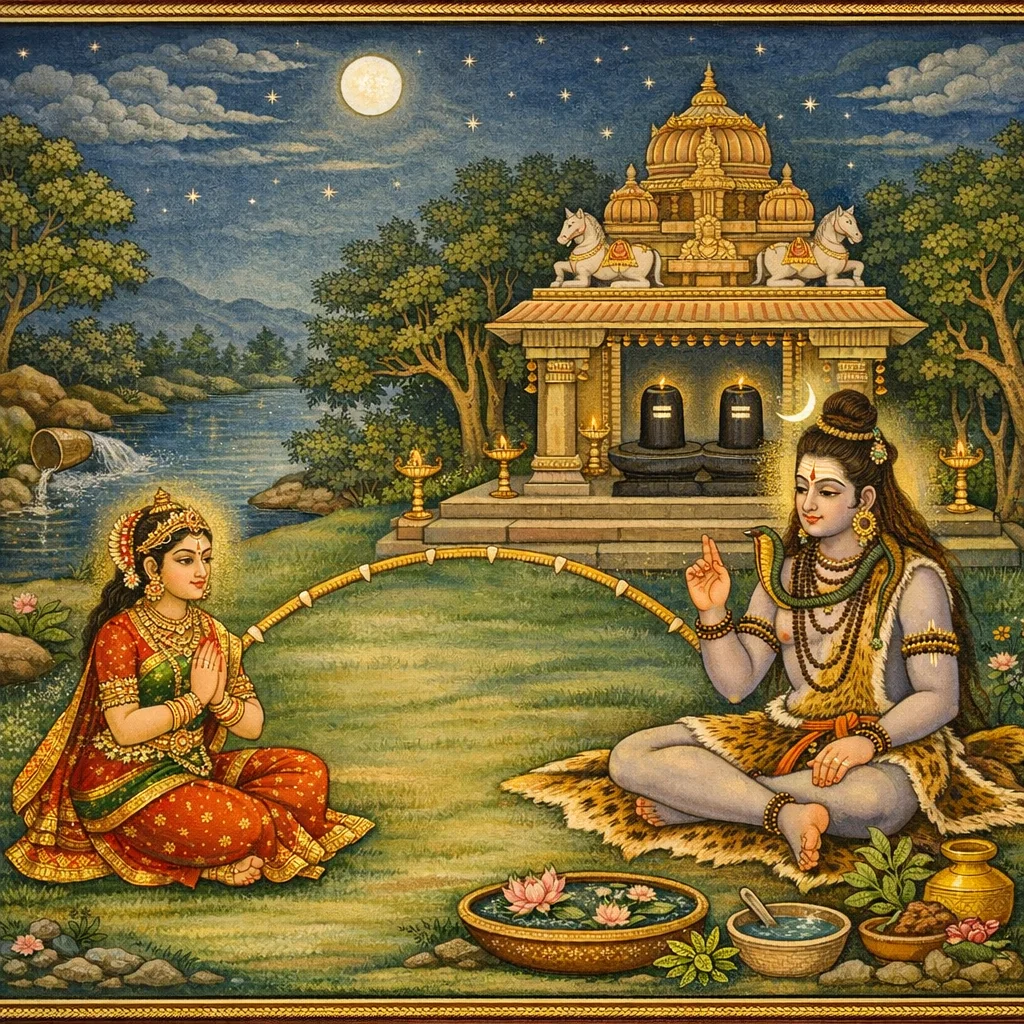
Adhyaya 164
अश्विनेश्वरमाहात्म्यवर्णनम् (The Māhātmya of Aśvineśvara)
Īśvara speaks to Devī, directing her to go eastward to the revered sacred spot called Aśvineśvara, said to lie “within five bows” in measured distance. Worship there is praised as pacifying great accumulations of sin (mahāpāpaugha-śamana) and granting all desired aims (sarva-kāma-da). A strong healing theme is introduced: the darśana of the liṅga is declared to quell every disease (sarva-roga-praśamana), making the place a great remedy for those afflicted by illness. The chapter also heightens its value through a calendrical note—darśana on the second lunar day (dvitīyā) of the month of Māgha is said to be difficult to obtain, and thus especially auspicious. In conclusion, the text identifies a liṅga-dvaya, two liṅgas established by the “Sun’s son” (Sūrya-putra). A self-restrained, disciplined person (saṃyata-ātmā) is advised to undertake the darśana on that very day, uniting devotion, sacred timing, and ethical self-control in a single pilgrimage instruction.
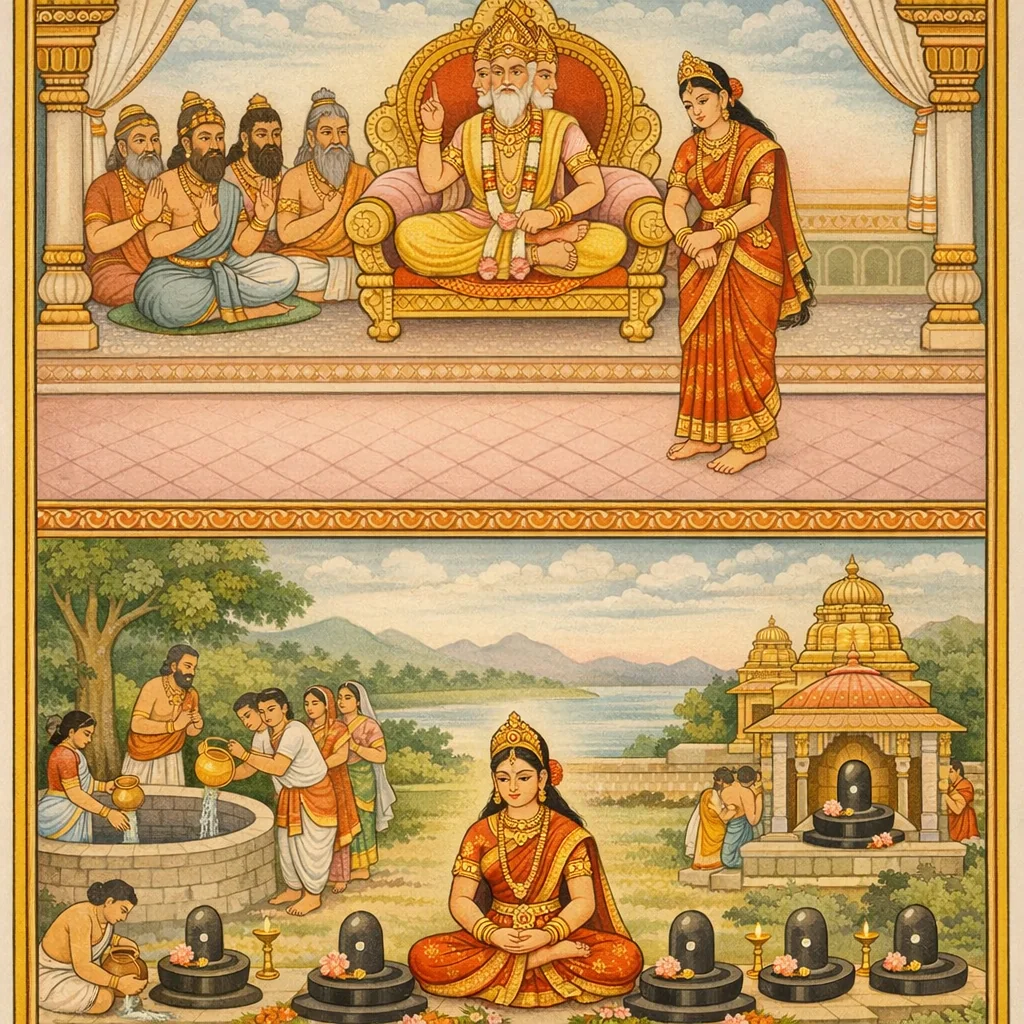
Adhyaya 165
Savitrī’s Departure to Prabhāsa and the Ritual-Political Crisis of Brahmā’s Yajña (सावित्री-गायत्री-विवादः प्रभासप्रवेशश्च)
This adhyāya unfolds as a Śiva–Devī dialogue, explaining Savitrī’s bond with Prabhāsa Kṣetra and showing how ritual urgency can create ethical and theological strain. Śiva recounts Brahmā’s resolve to perform a great yajña at Puṣkara, where dīkṣā and homa require a patnī (ritual spouse). Delayed by household duties, Savitrī is absent; Indra brings a suitable pastoral maiden who becomes Gāyatrī, and the sacrifice proceeds. Savitrī then arrives with other goddesses, confronts Brahmā before the assembly, and utters a sequence of śāpas (curses): upon Brahmā (restricted annual worship, notably in Kārtikī), upon Indra (future humiliation and bondage), upon Viṣṇu (suffering of spouse-separation in a mortal incarnation), upon Rudra (conflict in the Daruvana episode), and upon Agni and various ritual specialists—critiquing desire-driven action and procedural expediency. Viṣṇu offers a formal stuti to Savitrī; she grants countervailing boons and permits the yajña to be completed, while Gāyatrī affirms the efficacy of japa, prāṇāyāma, dāna, and the mitigation of ritual faults, especially in Prabhāsa and Puṣkara. The chapter concludes by locating Savitrī at Prabhāsa near Someshvara and prescribing local observances: worship over a fortnight, bathing at Pāṇḍu-kūpa with darśana of five Pāṇḍava-installed liṅgas, and recitation of Brahma-sūktas near Savitrī’s site on the Jyeṣṭha full moon. The promised fruit is release from sin and attainment of the highest state.
Adhyaya 166
सावित्रीव्रतविधि–पूजनप्रकार–उद्यापनादिकथनम् (Sāvitrī-vrata: procedure, worship method, and concluding observances)
This chapter unfolds as a Devī–Īśvara dialogue: it first recounts the Sāvitrī tradition at Prabhāsa and then reshapes it into a precise ritual guide. At Devī’s request for the vow’s itihāsa and fruits, Īśvara tells how King Aśvapati, while on pilgrimage at Prabhāsa, performs the Sāvitrī-vrata at the Sāvitrī-sthala, gains divine favor, and is blessed with a daughter named Sāvitrī. The narrative then summarizes the famed Sāvitrī–Satyavān episode: despite Nārada’s warning of Satyavān’s imminent death, Sāvitrī chooses him, follows him into the forest, confronts Yama, and wins boons—restoring Dyumatsena’s sight and kingdom, securing progeny for her father and herself, and bringing back her husband’s life. The second half is prescriptive, detailing the Jyeṣṭha-month observance beginning on the 13th with three nights of fasting and niyama, along with bathing rules and special merit from Pāṇḍukūpa and mustard-infused water on the full moon. It instructs the making and gifting of a Sāvitrī image (gold/clay/wood) draped in red cloth, mantra-based worship (hailing her as vīṇā-and-book-bearing and praying for avaidhavya—protection of auspicious married status), night vigil with recitation and music, and a ritual “marriage” worship of Sāvitrī with Brahmā. It further sets out feeding sequences for couples and Brāhmaṇas, dietary restraints (avoid sour/alkaline, favor sweets), gifts and honors of dismissal, and a discreet household śrāddha element. The chapter closes by framing the udhyāpana as purifying and merit-bestowing, safeguarding women’s marital auspiciousness, and promising broad worldly welfare to pilgrims who perform—or even hear—this procedure.
Adhyaya 167
भूतमातृकामाहात्म्यवर्णनम् (The Māhātmya of Bhūtamātṛkā: Origin, Residence, and Worship Protocols)
Adhyāya 167 presents a theological dialogue between Īśvara and Devī. Seeing disruptive, trance-like public behavior arising from acclaim of “Bhūtamātā,” Devī asks whether such conduct is scripturally warranted, how Prabhāsa’s residents should worship this deity, why she came there, and when her chief festival should be observed. Īśvara replies with an origin account: in a mythic interval, from Devī’s bodily effusion arises a fearsome female form adorned with skull-garlands and martial emblems, accompanied by brahma-rākṣasī-like allies and vast retinues. Īśvara assigns her functions and restraints—especially nocturnal predominance—and appoints Prabhāsa in Saurāṣṭra as her long-term abode, marked by astral and local signs. The chapter then turns to applied ethics, listing household and social conditions that invite bhūta/pīśāca presence—neglect of liṅgārcana, japa, homa, purity, daily duties, and persistent domestic discord—while noting protected homes where divine names and ritual order are maintained. A calendrical rule follows: worship from Vaiśākha pratipadā through caturdaśī, with a major observance tied to amāvasyā/caturdaśī timing (as stated), including offerings of flowers, incense, sindūra, and neck-threads, watering the deity beneath a tree (the siddha-vata motif), feeding rites, and public street performances (preraṇī–prekṣaṇī) that are humorous yet edifying. The phalaśruti promises protection of children, household well-being, freedom from afflictive entities, and general auspiciousness for those who honor Bhūtamātā with disciplined devotion.
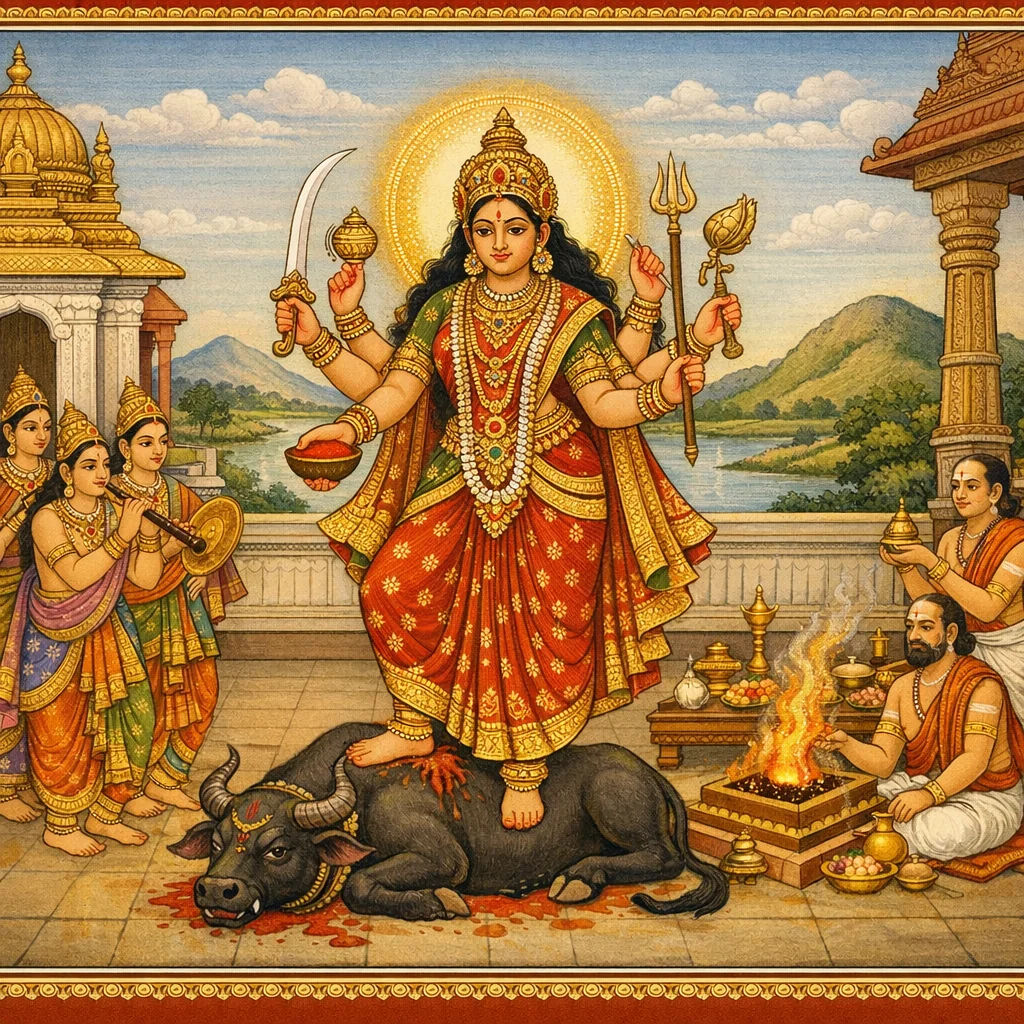
Adhyaya 168
Śālakaṭaṅkaṭā Devī Māhātmya (शालकटंकटा देवी माहात्म्यम्) — Glory of the Goddess Śālakaṭaṅkaṭā
This chapter is a shrine-focused māhātmya spoken as an utterance of Īśvara, directing the devotee to the Goddess Śālakaṭaṅkaṭā in the sacred Prābhāsika region. It fixes her place within the pilgrimage landscape by locating her south of Sāvitrī and east of Raivatā, linking her worship to an already known grid of holy sites. Śālakaṭaṅkaṭā is praised as the remover of great sins and the destroyer of all suffering, revered by gandharvas, and portrayed with a fearsome form and flashing fangs (sphurad-daṃṣṭrā). Her installation is connected with Poulastya, and she is celebrated as a mighty slayer of formidable foes, including the “mahiṣaghnī” motif of killing the buffalo-demon. A calendrical rule follows: worship on the fourteenth lunar day (caturdaśī) in the month of Māgha grants prosperity, intelligence, and continuity of the family line. Finally, a dāna-centered rite is taught—pleasing her through paśu-pradāna and offerings such as bali, pūjā, and upahāra brings freedom from enemies—forming the chapter’s principal phalaśruti.
Adhyaya 169
Vaivasvateśvara-māhātmya (Glorification of Vaivasvateśvara)
This adhyāya is framed as a sacred dialogue between Īśvara and Devī, setting forth a ritual itinerary within Prabhāsa kṣetra. Īśvara instructs Devī to proceed to the liṅga called Vaivasvateśvara, situated in the southern sector of the Goddess’s directional quarter, at a distance measured in dhanu units. The liṅga is said to have been installed (pratiṣṭhā) by Vaivasvata Manu and is praised as bestowing all desired aims (sarva-kāma-da). Near the shrine lies a wondrous devakhāta, a divinely excavated water-site, where one performs the preparatory bath. The chapter then prescribes a disciplined order of worship: bathing, pūjā according to rule (vidhi) with five offerings (pañcopacāra), undertaken with devotion and restraint of the senses (jite-indriya). Finally, it enjoins recitation of a stotra by the aghora-vidhi, promising attainment of siddhi, and concludes with its colophonic placement in the Prabhāsa Khaṇḍa and the Prabhāsakṣetramāhātmya.
Adhyaya 170
Mātṛgaṇa–Balādevī Māhātmya (Glorification of the Mother-Hosts and Balādevī)
Chapter 170 is cast as Īśvara’s instruction to Mahādevī, guiding the discerning practitioner (sudhī) to go to the place of the mātṛgaṇas and to worship Balādevī situated nearby. Its core teaching is calendrical and procedural: Balādevī should be worshipped in the month of Śrāvaṇa, on the Śrāvaṇī observance, with offerings such as pāyasa (sweet milk-rice), honey (madhu), and divine flowers (puṣpa). The phalaśruti concludes that successful worship ensures the devotee’s year passes in comfort, well-being, and sukha (happiness).
Adhyaya 171
दशरथेश्वरमाहात्म्यवर्णनम् (Daśaratheśvara Māhātmya—Account of the Glory of Daśaratheśvara)
Īśvara addresses Devī, pointing out the nearby goddess-site Ekallavīrikā, and then relates an origin-legend set in Prabhāsa-kṣetra, praising the sanctity and efficacy of that sacred ground. King Daśaratha of the Solar dynasty comes to Prabhāsa and performs severe tapas. He establishes a liṅga and worships Śaṅkara to please Him, then prays for a mighty son. The Lord grants a son named Rāma, renowned in the three worlds; celestial beings, gods, daityas/asuras, and sages—including Vālmīki—are said to sing his fame. The chapter ends with ritual guidance and a phalaśruti: by the power of that liṅga the king attains great renown, and likewise anyone who worships it in the month of Kārttika—especially on the Kārttikā observance—according to proper procedure, with lamp-worship and offerings, gains yaśas, illustrious fame. Thus place (Prabhāsa), object (liṅga), time (Kārttika), and fruit (renown) are bound together in a compact sacred narrative and rite.
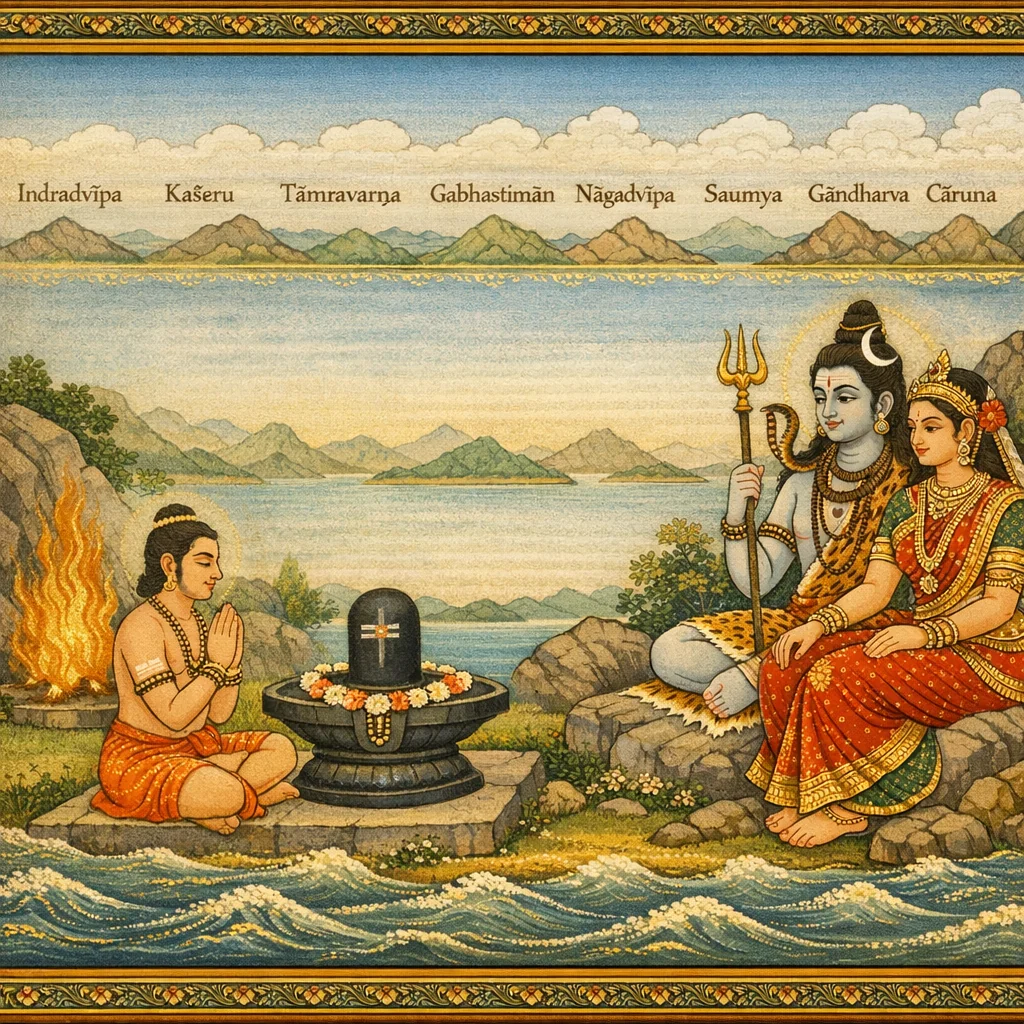
Adhyaya 172
भरतेश्वरमाहात्म्यवर्णनम् (The Glory of Bharateśvara Liṅga)
Īśvara instructs Devī to go to the liṅga called Bharateśvara, situated slightly to the north. The chapter explains its origin: King Bharata, famed as Agnīdhra’s son, performs severe tapas in this sacred kṣetra and establishes (pratiṣṭhā) Mahādeva to obtain progeny. Pleased, Śaṅkara grants him eight sons and one illustrious daughter. Bharata then divides his realm into nine portions and assigns them to his children; the corresponding dvīpas are named—Indradvīpa, Kaśeru, Tāmravarṇa, Gabhastimān, Nāgadvīpa, Saumya, Gāndharva, Cāruṇa—and the ninth, linked with the daughter, is called Kumāryā. The text notes that eight dvīpas were later flooded by the ocean, while the Kumāryā-named one remains, and it adds measurements in yojanas (south–north extent and breadth), joining mythic partition to spatial description. Bharata’s ritual eminence is affirmed through mention of many Aśvamedhas and his renown in the Gaṅgā–Yamunā regions; by Īśvara’s grace he rejoices in heaven. The phalaśruti declares that worship of the liṅga established by Bharata yields the fruit of all sacrifices and gifts, and that darśana in Kārttika during Kṛttikā-yoga prevents even dream-visions of dreadful hell.
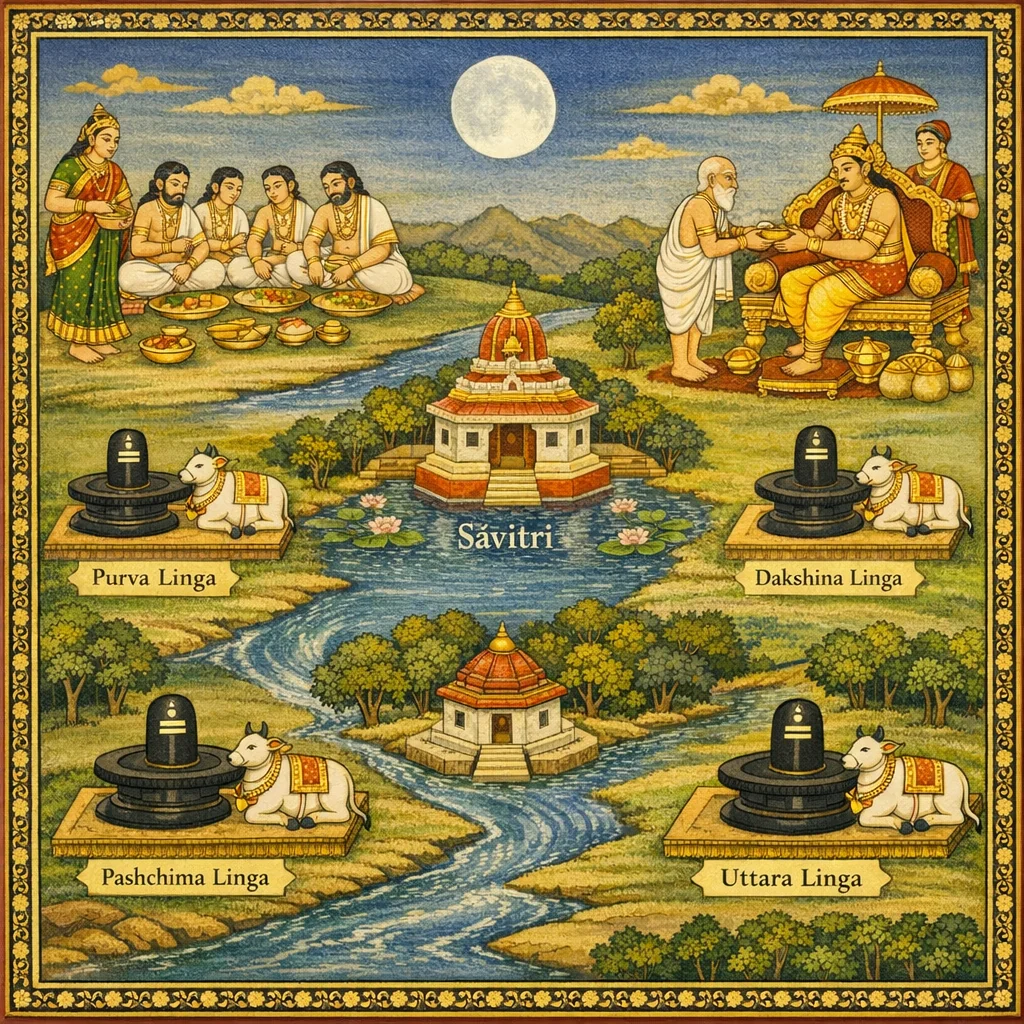
Adhyaya 173
कुशकादिलिङ्गचतुष्टयमाहात्म्यवर्णनम् | The Māhātmya of the Four Liṅgas beginning with Kuśakeśvara
In a Śaiva theological discourse, Īśvara instructs Devī in a compact pilgrimage to four liṅgas located in a single place west of Sāvitrī. The chapter marks their positions by direction—two to the east and two to the west, facing accordingly—and names them in order: Kuśakeśvara, Gargeśvara, Puṣkareśvara, and Maitreyēśvara. It declares the phala: one who beholds these liṅgas with bhakti and self-restraint is freed from sins and attains Śiva’s exalted abode. As the practical completion of the vow, it prescribes that on the fourteenth day of the bright fortnight—especially in Vaiśākha—one should bathe with effort, feed brāhmaṇas, and give gifts according to one’s means, such as gold and garments. When these duties are fulfilled, the yātrā is said to be complete, joining darśana with calendrical observance and social dharma.
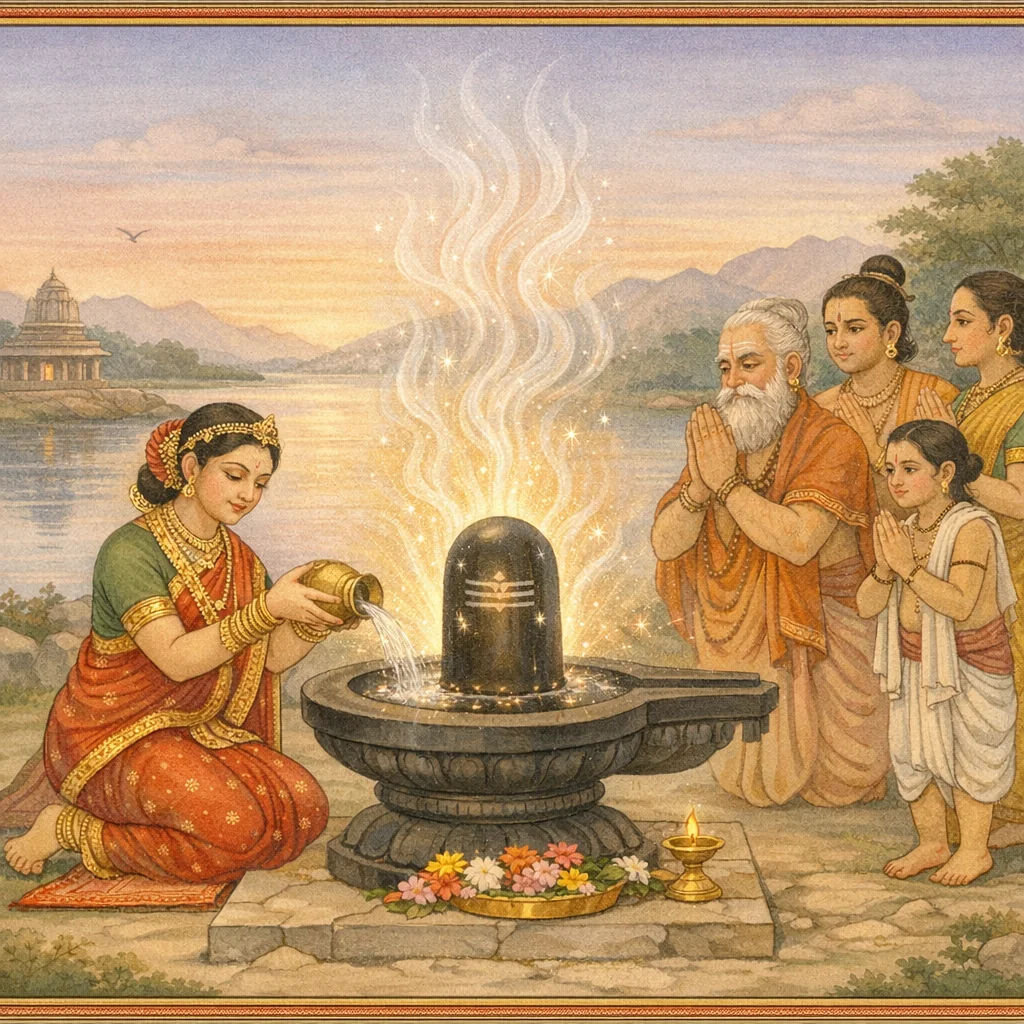
Adhyaya 174
कुन्तीश्वरमाहात्म्यवर्णनम् | Kuntīśvara Liṅga: The Glory of the Shrine
Īśvara instructs Devī about a distinguished liṅga named Kuntīśvara in the Prabhāsa kṣetra. It is described as being in the eastern sector and set within a “khāta,” a dug or recessed emplacement. The shrine’s sanctity is grounded in its founding memory: Kuntī is said to have established (pratiṣṭhita) this liṅga, and the Pāṇḍavas are recalled as having earlier come to Prabhāsa on pilgrimage together with Kuntī. The teaching then turns to phalaśruti, the declaration of spiritual fruits. Kuntīśvara is praised as removing fear of all sins, with special emphasis on worship in the month of Kārttika; one who performs pūjā then is said to attain desired aims and be honored in Rudra’s realm. Finally, the text universalizes its purifying power by stating that sins of speech, mind, and action are destroyed by the mere darśana of this liṅga, presenting reverent sight and worship as complementary means of liberation within pilgrimage ethics.
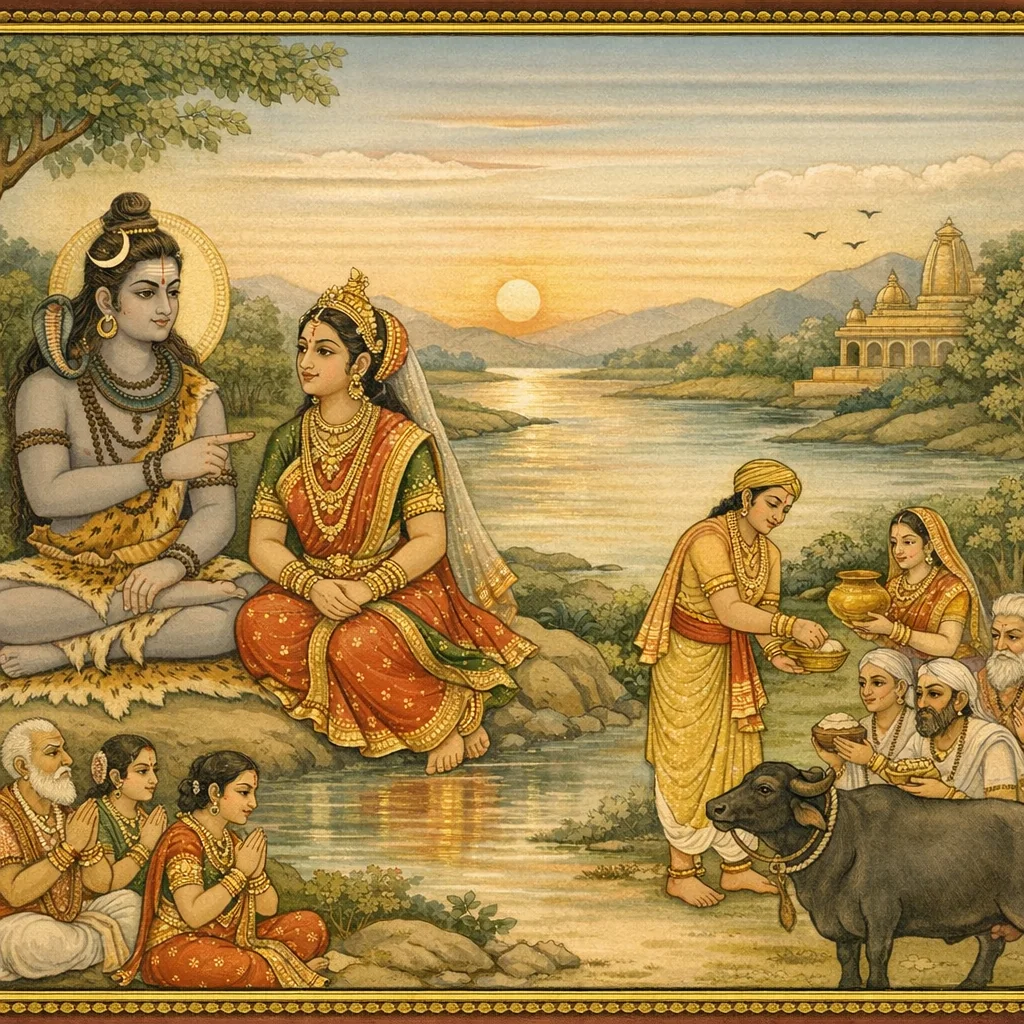
Adhyaya 175
अर्कस्थलमाहात्म्यवर्णनम् (Glorification of Arkasthala / the Sun-site)
This adhyāya is a compact instruction from Īśvara to Mahādevī, directing her attention to a highly meritorious place called Arkasthala (“the Sun-place”), situated in the Āgneya (southeastern) direction from the earlier point of reference. It is praised as “sarva-pātaka-nāśana,” the destroyer of all sins: by mere darśana (seeing/visiting), one becomes free from sorrow, and poverty is said not to arise for seven births. The text also proclaims relief in bodily afflictions—kuṣṭha (skin diseases) is destroyed with multiplied force—and equates the merit of darśana with great gifts, such as the fruit of donating a hundred cows at Kurukṣetra. A brief observance is prescribed: bathing at the tri-saṅgama tīrtha for seven Sundays, feeding Brahmins, and gifting a buffalo (mahiṣī). The phalaśruti concludes with an extended heavenly reward—dwelling and honor in heaven for a thousand divine years—thus joining sacred place, rite, and righteous charity into a single pilgrimage discipline.
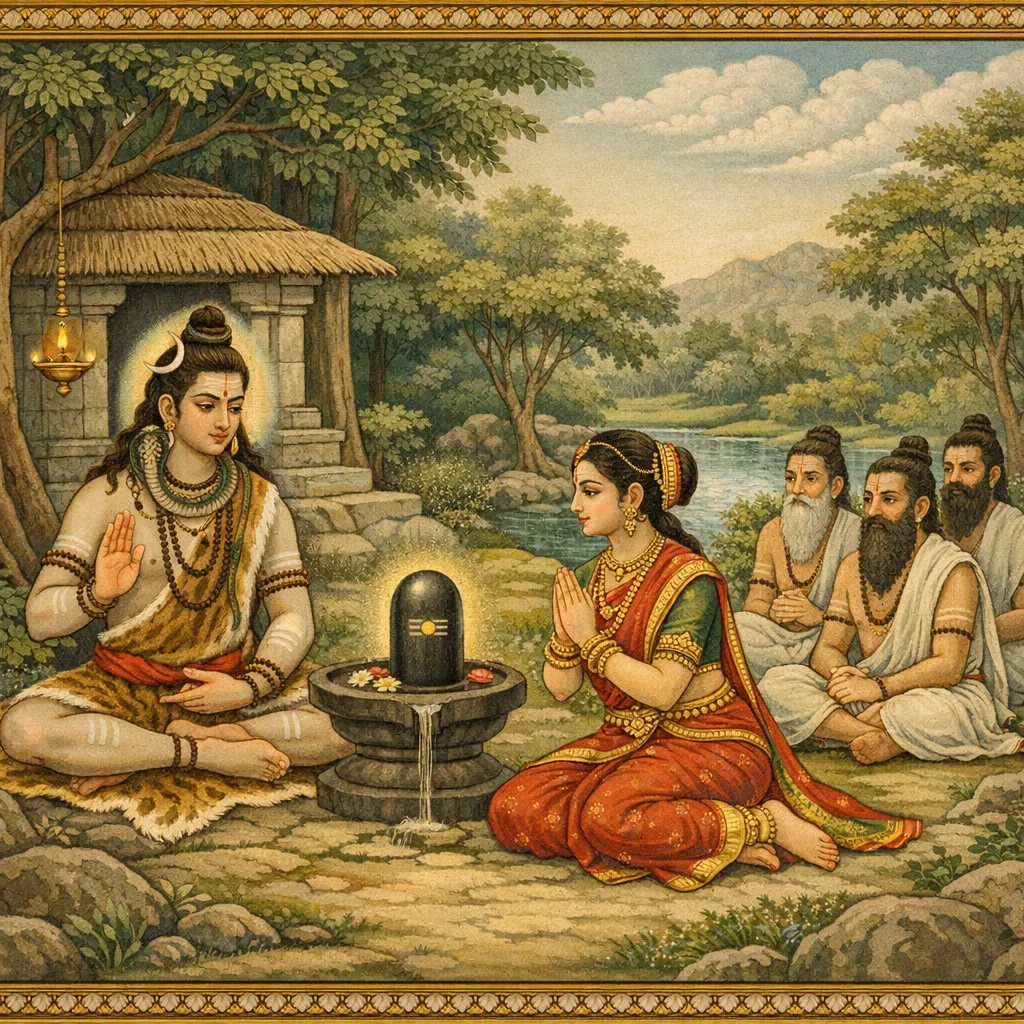
Adhyaya 176
सिद्धेश्वरमाहात्म्यवर्णनम् (Siddheśvara Māhātmya—Description of the Glory of Siddheśvara)
In this adhyāya, Īśvara speaks to Mahādevī and points out a liṅga called Siddheśvara, situated not far from Arkasthala in the Āgneya (southeastern) quarter. The reason for its name is then given: a vast host of ūrdhva-retas ṛṣis—sexually continent sages—numbering eighteen thousand, are said to have attained siddhi in connection with this liṅga; hence it is known as Siddheśvara. The chapter ends with a rule of ethical-ritual discipline: the devotee should bathe, worship with bhakti, observe upavāsa (fasting), restrain the senses, perform pūjā according to proper injunction, and give dakṣiṇā to brāhmaṇas. The phalaśruti proclaims the fulfillment of all aims (sarva-kāma-samṛddhi) and attainment of the supreme state (parama pada).
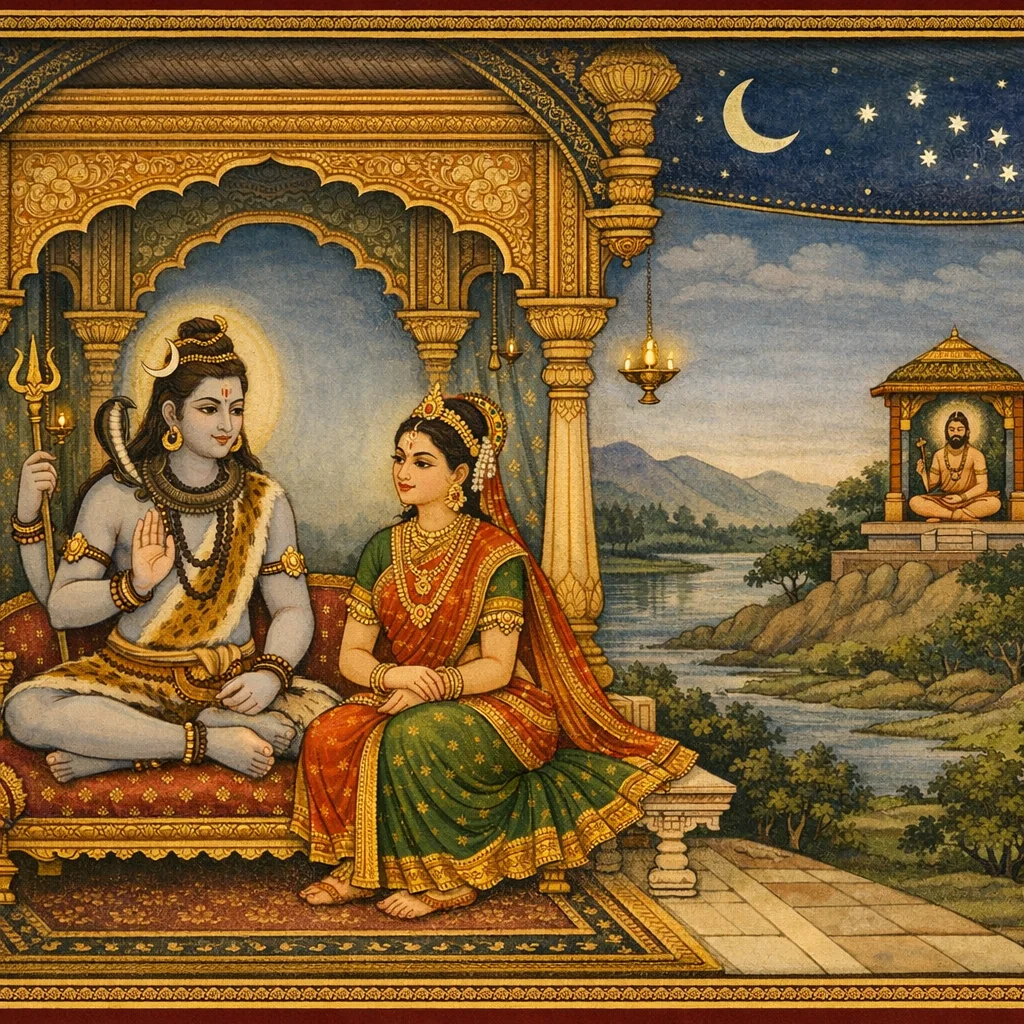
Adhyaya 177
Lakulīśa-māhātmya (लकुलीशमाहात्म्य) — Glory of Lakulīśa in the Eastern Quarter of Prabhāsa
This adhyāya is a brief Śaiva theological notice spoken by Īśvara to Devī. It places Lakulīśa—described as embodied (mūrtimān)—in the eastern quarter of the Prabhāsa kṣetra, established upon elevated ground (sthala-upari) through earlier, formidable austerity (ghora tapas). The site is explicitly framed as a place for the pacification and cleansing of sin (pāpa-śamana). A calendrical rule is then given: worship in the month of Kārttikī, especially when the Kṛttikā lunar asterism is conjoined (kṛttikā-yoga), brings extraordinary recognition. The declared fruit is social and cosmic validation: the worshipper becomes worthy of honor among all orders of beings, including devas and asuras. The chapter ends with a formal colophon locating the passage within the Skanda Purāṇa’s Prabhāsa Khaṇḍa, in the Prabhāsakṣetramāhātmya section.
Adhyaya 178
Bhārgaveśvara Māhātmya (Glorification of Bhārgaveśvara)
In this adhyāya, Īśvara speaks to Devī and directs the pilgrim’s course within Prabhāsa-kṣetra. The devotee is told to go to the southern part of the sacred region, where the shrine named Bhārgaveśvara is located. Bhārgaveśvara is praised as a holy locus that destroys all sins (sarva-pāpa-praṇāśana). The chapter then states the essential mode of worship: honoring the deity with divine flowers and offerings (divya-puṣpa-upahāraka). By this worship the devotee becomes kṛta-kṛtya—one whose religious aims are fulfilled—and prospers with the accomplishment of all desires (sarva-kāmaiḥ samṛddhimān).
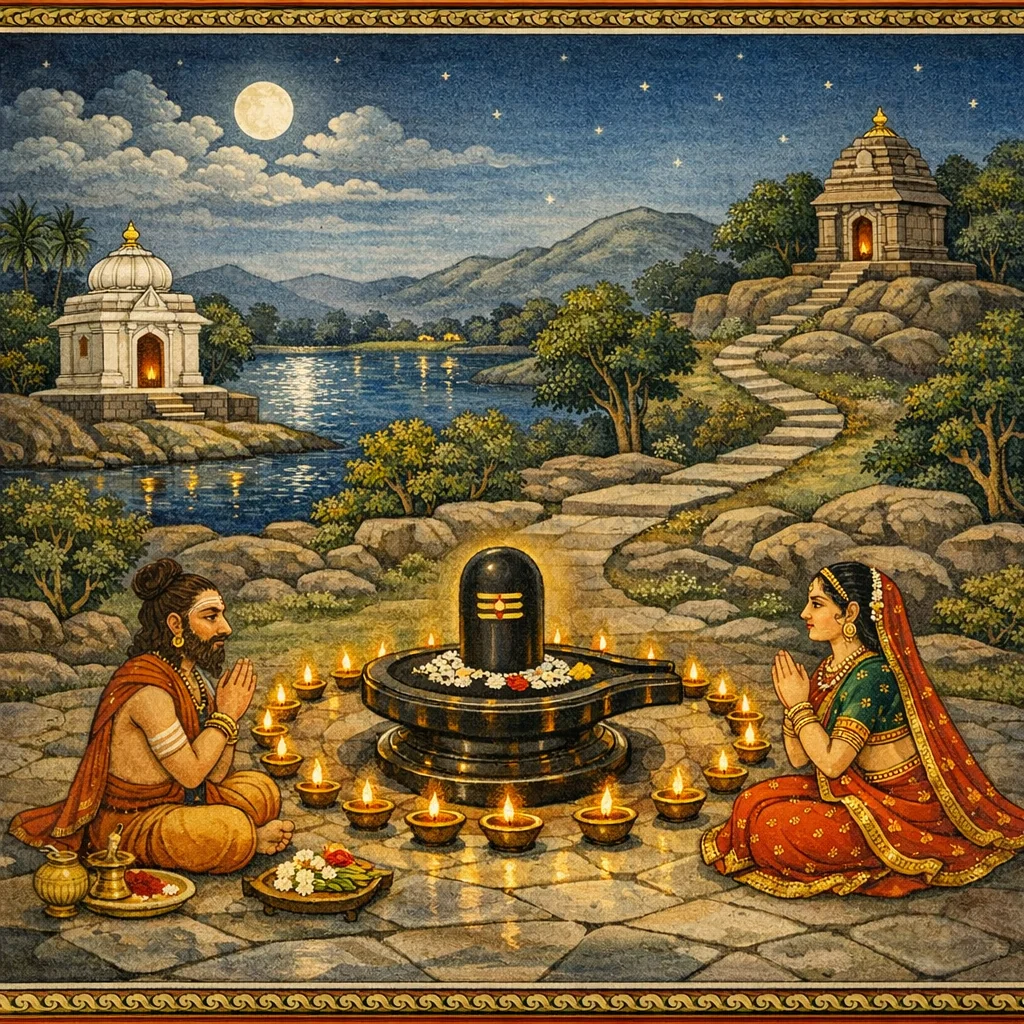
Adhyaya 179
माण्डव्येश्वरमाहात्म्यवर्णनम् | Māṇḍavyeśvara Māhātmya (Glorification of Māṇḍavyeśvara)
This adhyāya is cast as a concise theological instruction from Īśvara to Mahādevī. It identifies the sacred liṅga called Māṇḍavyeśvara, praised as a destroyer of sin and even major transgressions (mahāpātaka-nāśana), and gives its pilgrim-facing location: to the south-east/southern corner from Siddheśa, at a distance of “three bows” (dhanuṣ-tritaya). It then prescribes a time-bound observance: in the month of Māgha, on the fourteenth lunar day (caturdaśī), the devotee should perform pūjā and keep a night vigil (jāgaraṇa). The phalāśruti promises that one who undertakes this with disciplined devotion will not return to mortal existence, and the colophon notes its placement within the Prabhāsa Khaṇḍa and the Prabhāsakṣetramāhātmya section.
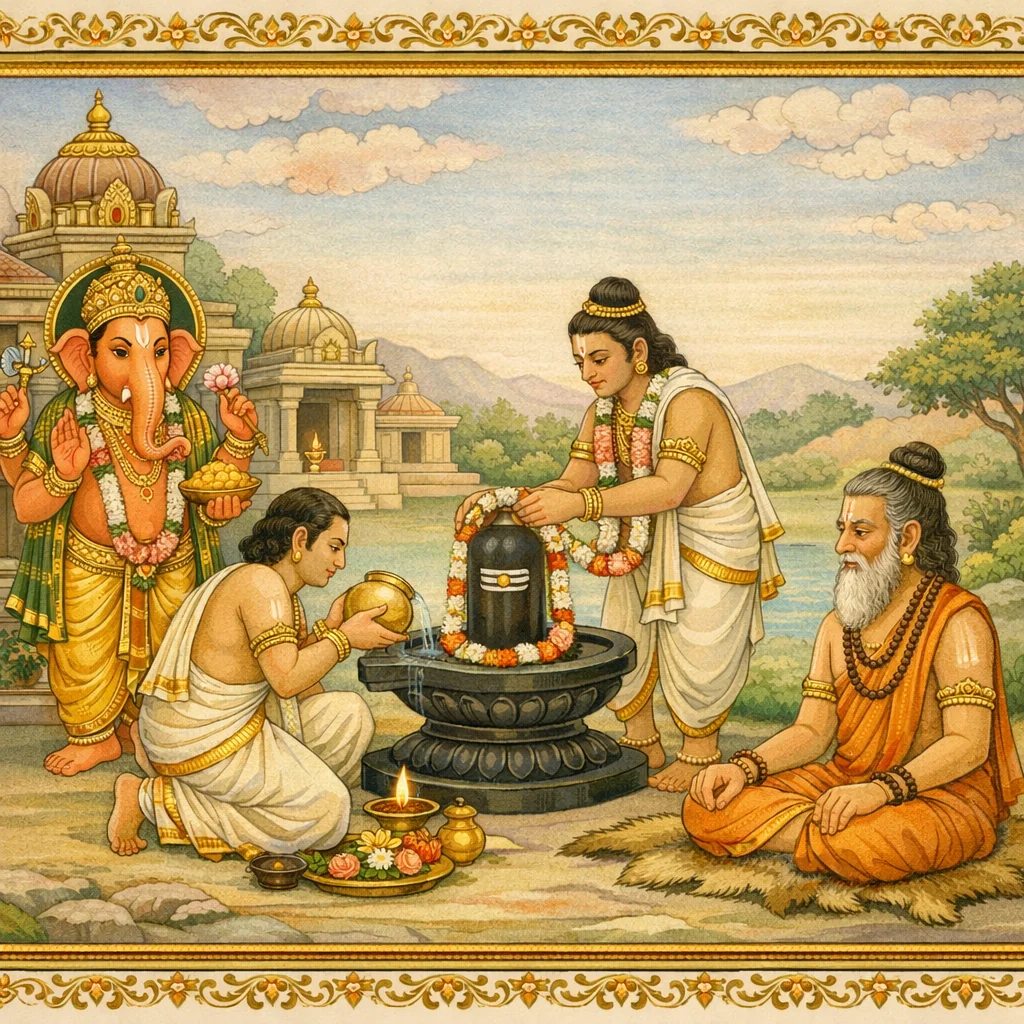
Adhyaya 180
Puṣpadanteśvara Māhātmya (पुष्पदन्तेश्वर-माहात्म्यम्) — The Glory of Puṣpadanteśvara
In this adhyāya (Īśvara uvāca), the Lord directs the pilgrim to behold an auspicious sacred site called Puṣpadanteśvara. The chapter identifies Puṣpadanteśvara as Gaṇeśa in connection with Śaṅkara, grounding the shrine’s authority in its Shaiva proximity. It declares that severe tapas was performed there, culminating in the ritual establishment (pratiṣṭhā) of a liṅga at that place. The phalaśruti states plainly that mere darśana—simply seeing this holy installation—releases a being from the bondage of repeated birth and worldly entanglement (janma-saṃsāra-bandhana), while also granting desired aims in this life and benefits in the life to come.
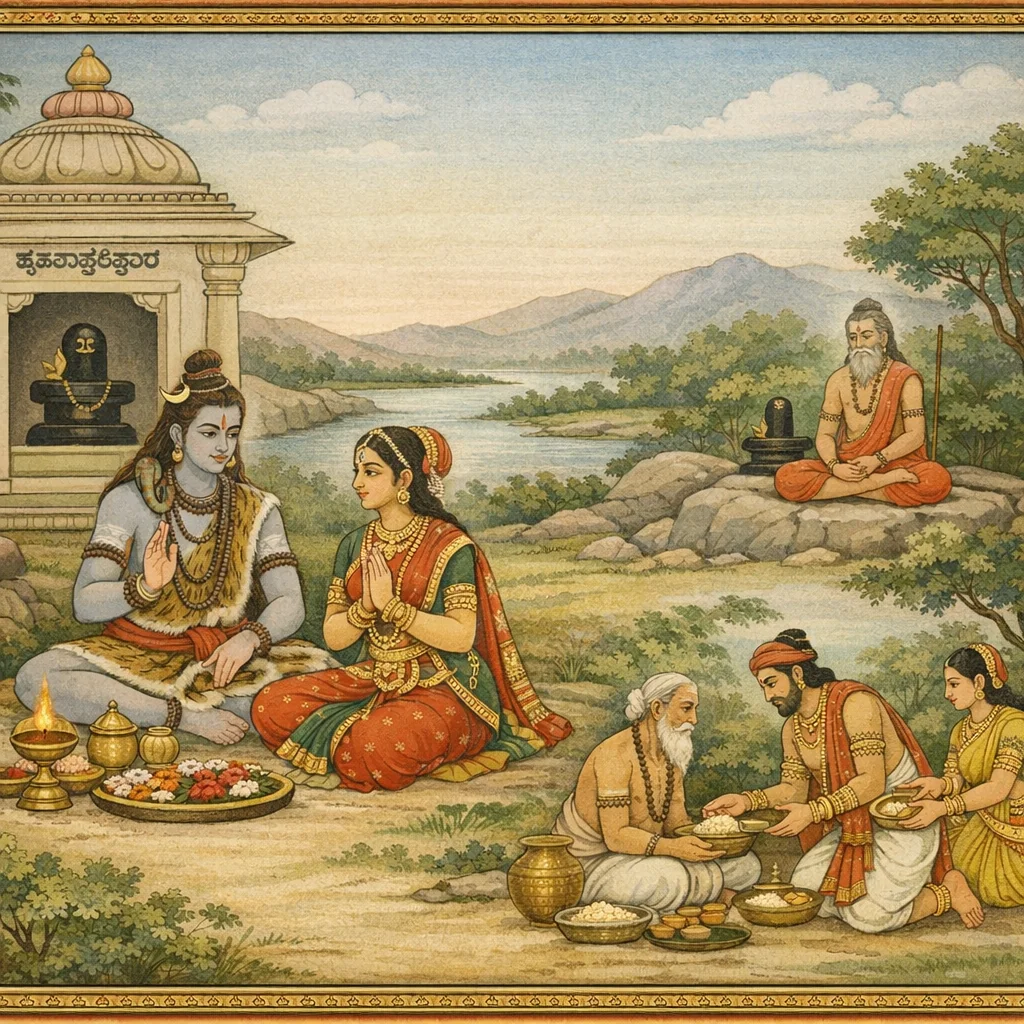
Adhyaya 181
Kṣetrapāleśvara-māhātmya (The Glory of Kṣetrapāleśvara)
Īśvara instructs Mahādevī about an excellent shrine called Kṣetrapāleśvara, situated a little to the east and near Siddheśvara. The chapter gives a practical rule for pilgrimage: one should go there, take darśana on the lunar day Śukla-pañcamī, and then worship in proper order. The pūjā is to be performed with fragrances and flowers, in reverence. The ritual and ethical teaching culminates in generosity—feeding brāhmaṇas according to one’s means with a variety of foods—thus joining personal devotion (pūjā) with communal dharma (dāna/annadāna). The closing colophon states that this is the 181st adhyāya of the Prabhāsakṣetramāhātmya within the seventh Prabhāsa Khaṇḍa of the Skanda Mahāpurāṇa, part of a systematically indexed account of sacred geography.
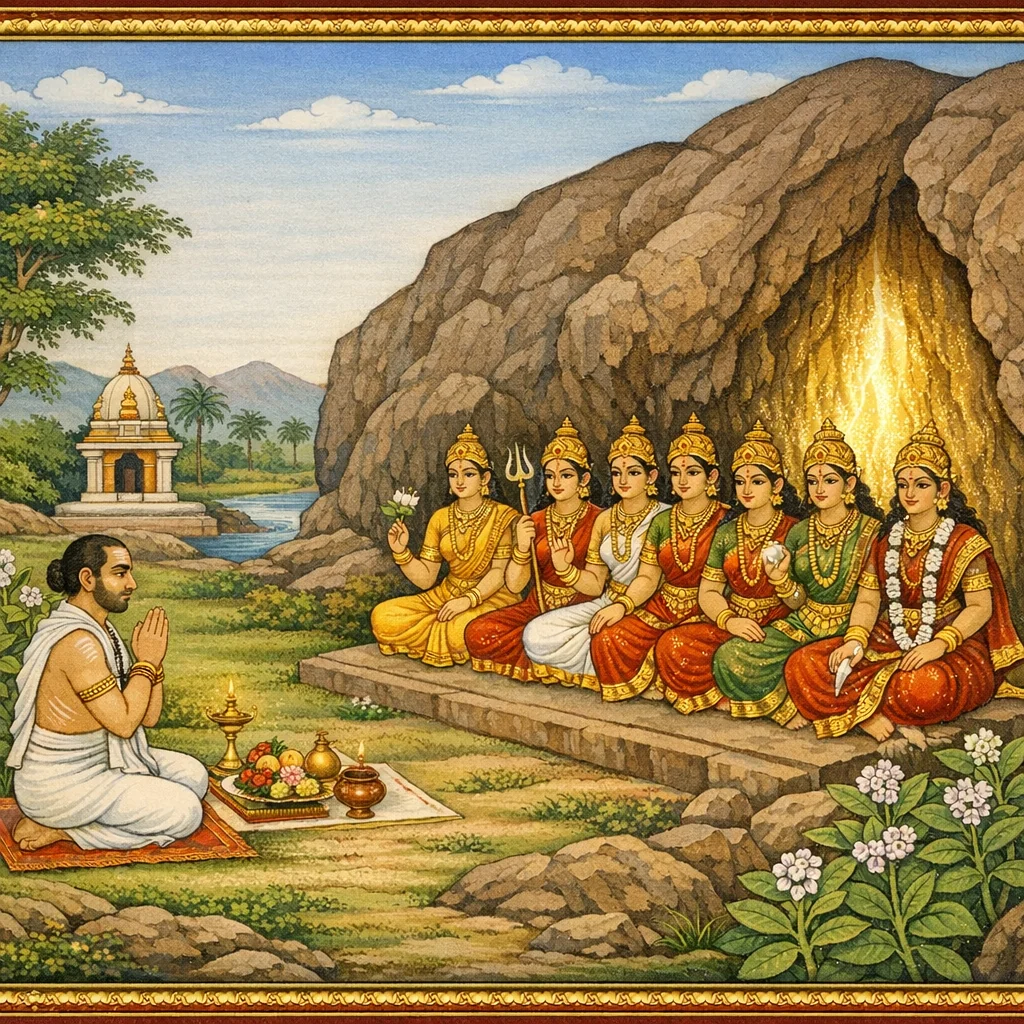
Adhyaya 182
वसुनन्दा-मातृगण-श्रीमुख-विवर-माहात्म्य (Vasunandā Mothers and the Śrīmukha Cleft: Sacred Significance)
Adhyāya 182 of the Prabhāsa Khaṇḍa gives a highly localized guide to sacred places within Prabhāsa-kṣetra. The pilgrim is directed to behold a group of Mothers (mātṛgaṇa), led by “Vasunandā,” situated near an Arka-sthala on the southern side, not far away. It then lays down a precise observance: on the bright-fortnight Navamī of the month Āśvayuja, a disciplined devotee should worship these Mothers according to proper rite (vidhi), with a calm and purposeful mind. The fruit is declared to be samṛddhi—prosperity and flourishing—hard to attain for the undisciplined. The chapter next points to a nearby micro-site, the sacred cleft or opening (vivara) associated with “Śrīmukha,” said to delight in such a cleft. Those seeking siddhi should worship it on the same day as well. The closing identifies this as the māhātmya of the Vasunandā Mothers and the Śrīmukha Vivara within the Prabhāsakṣetramāhātmya.
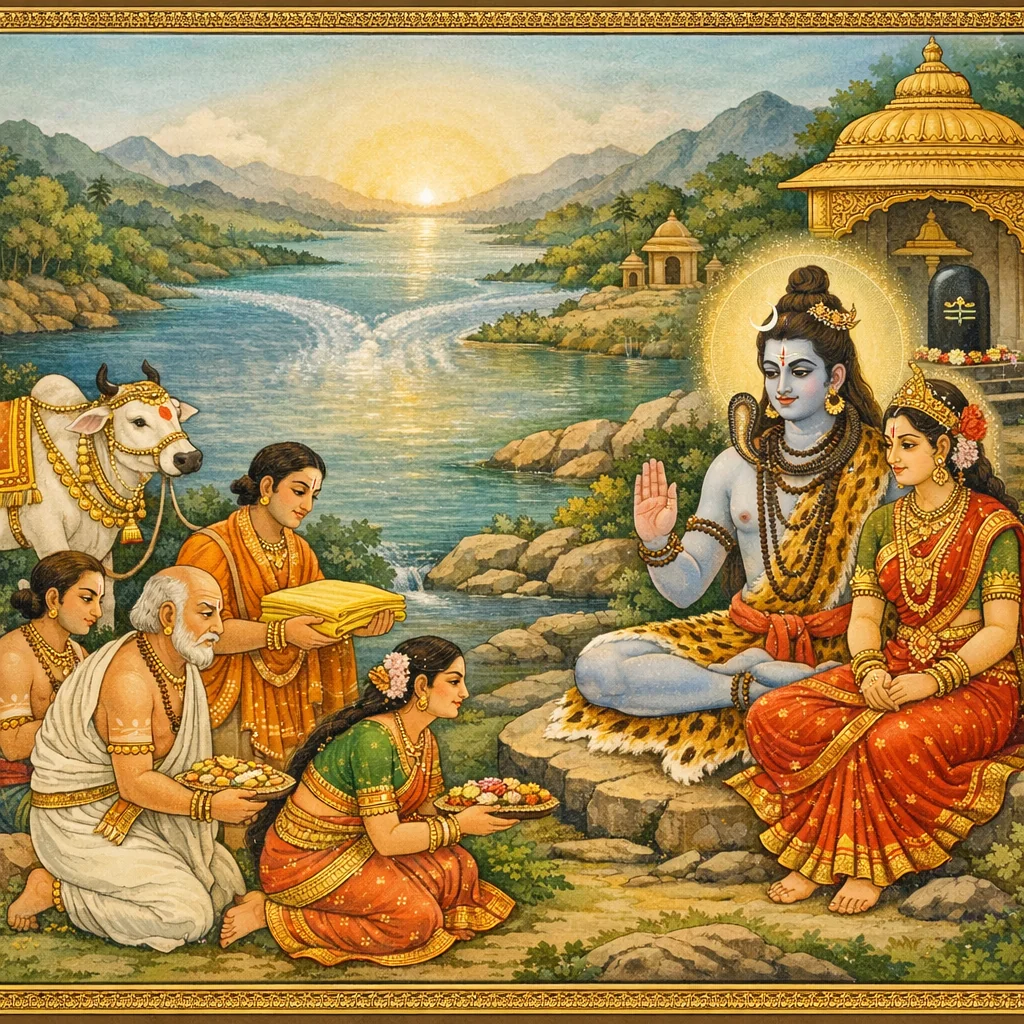
Adhyaya 183
त्रिसंगममाहात्म्यवर्णनम् | The Glory of Trisaṅgama (Threefold Confluence)
Chapter 183 records Īśvara’s instruction to Devī about the exalted Miśra-tīrtha, famed as Trisaṅgama—the threefold confluence of the Sarasvatī, the Hiraṇyā, and the ocean. The site is praised as exceedingly rare even for the gods, foremost among tīrthas, and especially supreme on solar festival occasions (sūrya-parvan), when its ritual potency is said to surpass even Kurukṣetra. The chapter teaches merit-amplification: bathing, gifting, and japa performed there yield “crore-fold” results. It also frames a sacred geography around a liṅga linked with Maṅkīśvara, stating that vast numbers of tīrthas lie within the stretch up to that landmark, and adds that even the socially marginalized attain heavenly outcomes there, revealing the place’s transformative power. For proper “yātrā-fruit,” pilgrims are advised to gift used garments, gold, and a cow to a brāhmaṇa, and to perform ancestor offerings on the fourteenth day of the dark fortnight. The chapter concludes by naming Trisaṅgama a destroyer of great sins—especially efficacious in Vaiśākha—and recommends the ceremonial release of a bull (vṛṣotsarga) for sin-removal and for pleasing the ancestors.
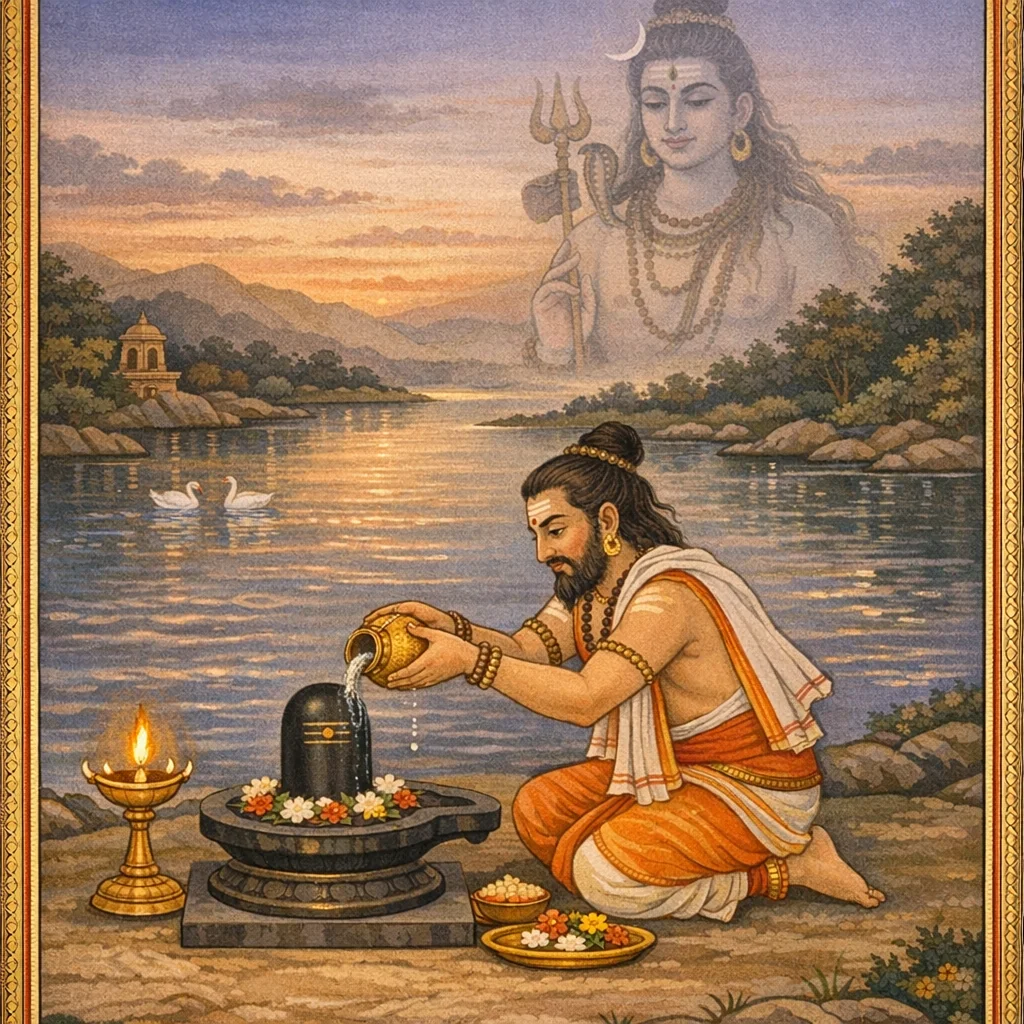
Adhyaya 184
मंकीश्वरमाहात्म्यवर्णनम् | Mankīśvara Māhātmya (Account of the Glory of Mankīśvara)
Īśvara speaks to Devī and points to an eminent shrine called Mankīśvara, situated near the Trisaṅgama, praised as a remover of sins and a purifier of pilgrims. The chapter relates the name’s founding legend: the sage Mankī, foremost among ascetics, knows Prabhāsa to be Śaṅkara’s beloved great sacred field and undertakes severe tapas, living on roots, tubers, and fruits. After a long period he establishes (pratiṣṭhāpya) Mahādeva as a liṅga. Pleased, Mahādeva grants a boon; the sage asks that Śiva remain there for vast ages as a liṅga bearing his name. Śiva agrees, becomes concealed, and thence the liṅga is known as Mankīśvara. The chapter also gives auspicious times and minimal observance: worship on the 13th or 14th lunar day in the month of Māgha with five upacāras yields desired results. Those seeking the full fruit of pilgrimage are instructed to perform go-dāna at the site.
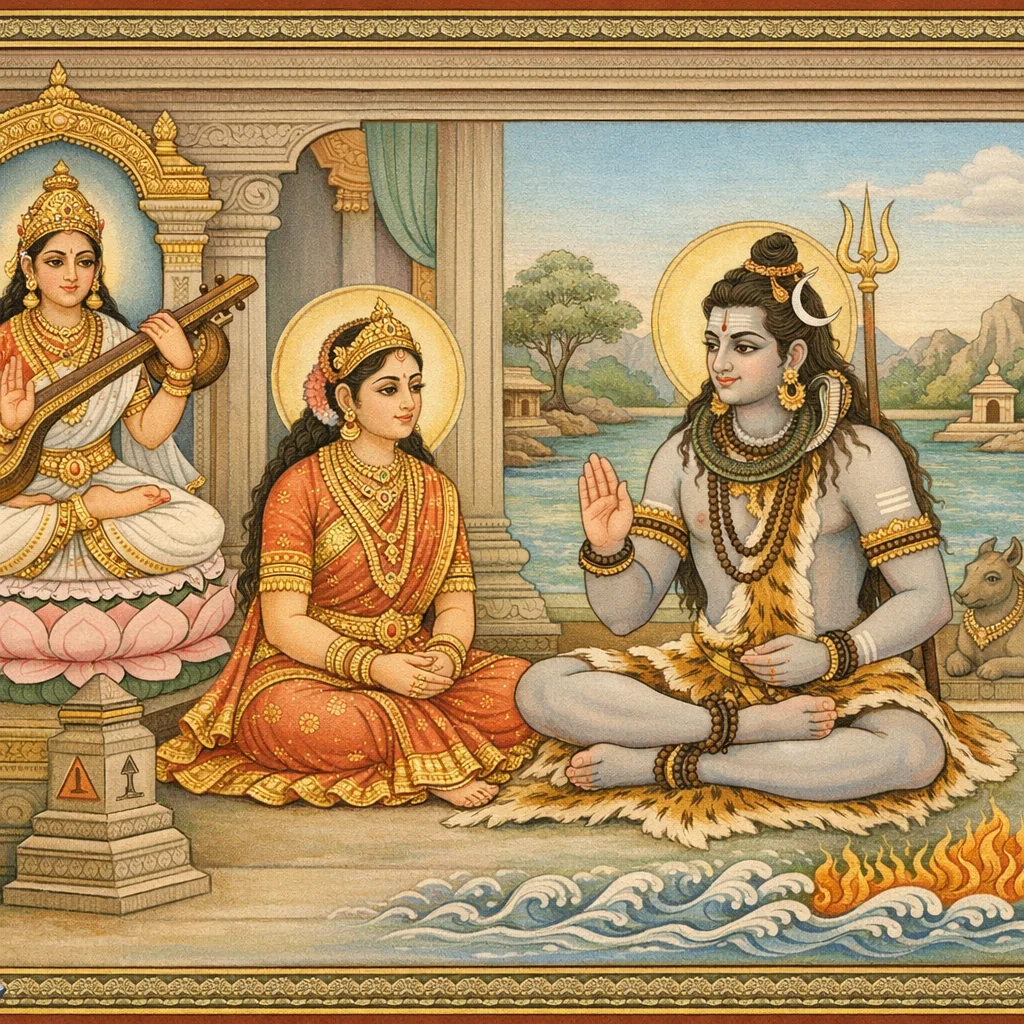
Adhyaya 185
Devamātā Sarasvatī in Gaurī-Form at the Nairṛta Quarter (Worship, Feeding, and Golden Sandal Dāna)
This adhyāya records Īśvara’s instruction to Mahādevī concerning a localized manifestation of Devamātā Sarasvatī in Prabhāsa kṣetra. She is revered as “Devamātā” (Mother of the Devas), praised in the world as Sarasvatī, abiding in the nairṛta (southwest) quarter and assuming the Gaurī-form (Gaurī-rūpa). She is described as seated in pādukāsana, with a form linked to “vaḍavā” imagery. The text explains the epithet: the devas are protected like children by a mother from the fear of the vaḍavānala, and thus the learned affirm her as Devamātā. It then gives a calendrical observance: on the tṛtīyā (third lunar day) of Māgha, a disciplined man or a restrained, virtuous woman who worships her attains desired aims. Hospitality is praised as highly meritorious: feeding a couple with sweet rice (pāyasa) with sugar and the like yields fruit comparable to a great Gaurī-feeding rite. The chapter concludes with a dāna injunction to gift golden sandals (suvarṇa-pādukā) to a well-conducted brāhmaṇa at this sacred site.
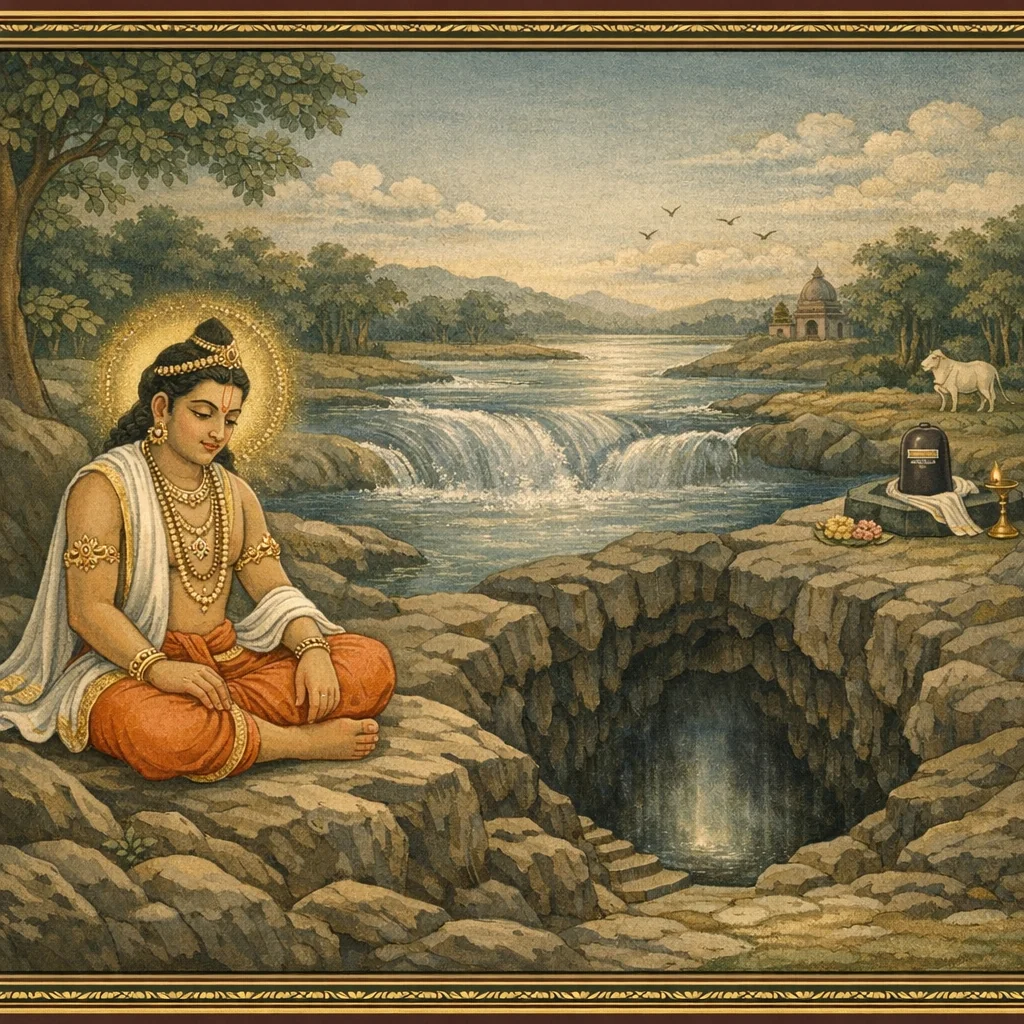
Adhyaya 186
Nāgasthāna-māhātmya (Glory of the Nāga Station at Tri-saṅgama)
Īśvara instructs Devī to go to the eminent Nāgasthāna west of Maṅkīśa, a tri-saṅgama (triple confluence) tīrtha praised as powerfully sin-destroying. The chapter then recounts Balabhadra’s legend: hearing of Kṛṣṇa’s passing, he comes to Prabhāsa, perceives the kṣetra’s extraordinary potency and the ruin of the Yādavas, and embraces renunciation. Balabhadra leaves his body in the form of Śeṣa-nāga, reaches the supreme tri-saṅgama, beholds a vast opening to pātāla like a “door,” and swiftly enters the realm where Ananta abides. Because he entered here in nāga-form, the place is called Nāgasthāna; and where he relinquished the body is famed as Śeṣasthāna (east of Nāgarāditya). The observances taught are bathing at the tri-saṅgama, worship of Nāgasthāna, fasting on the fifth lunar day (pañcamī) with restraint in eating, performing śrāddha, and giving dakṣiṇā to a Brahmin according to one’s means. The promised fruit is relief from distress and attainment of Rudra-loka; moreover, feeding a Brahmin sweet rice mixed with honey and other foods dedicated to Śeṣa-nāga is said to yield the merit of feeding “crores,” affirming dāna as a central sacred duty.
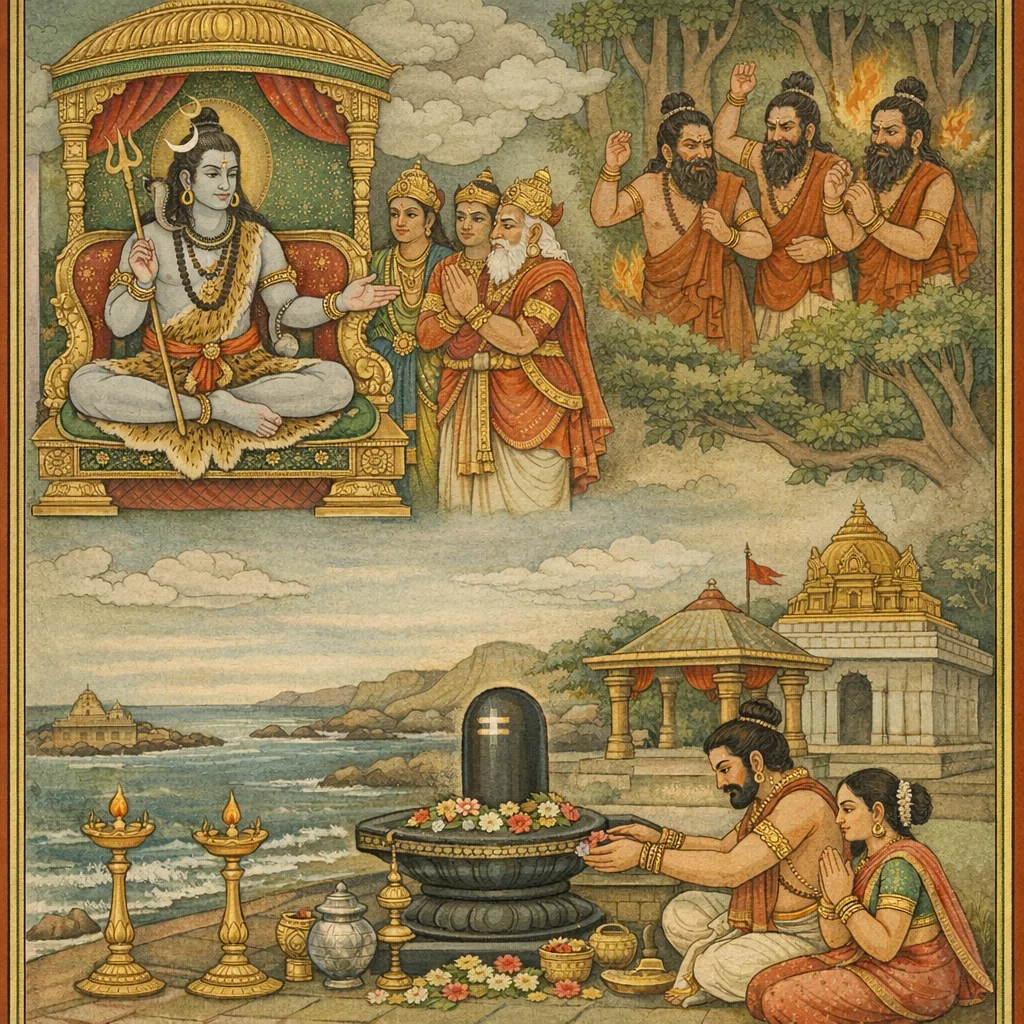
Adhyaya 187
प्रभासपञ्चकमाहात्म्यवर्णनम् | The Māhātmya of the Five Prabhāsas
This adhyāya unfolds as a Śiva–Devī theological dialogue. Īśvara first sets out the Prabhāsa-pañcaka, a pilgrimage circuit of five related tīrthas—Prabhāsa (the chief), Vṛddha-Prabhāsa, Jala-Prabhāsa, and Kṛta-smara-Prabhāsa (connected with a cremation-ground and Bhairava)—declaring that faithful visitation of the whole route leads to a “non-returning” state beyond aging and death. A ritual discipline is then prescribed: bathing in the ocean at Prabhāsa, especially on amāvāsyā and the adjoining lunar days (caturdaśī/pañcadaśī), keeping overnight observance, feeding brāhmaṇas according to one’s means, and giving gifts—above all a cow and gold—as ethical supports for pilgrimage merit. Devī asks why there are said to be five Prabhāsas when one is commonly known, and an origin-myth is narrated. Śiva, wandering in divine form, enters the Daruka forest; sages, angered by the disturbance among their households, curse him so that his liṅga falls, triggering cosmic upheaval—earthquakes, swelling oceans, and cracking mountains. The gods consult Brahmā, then Viṣṇu, and finally approach Śiva, who instructs them not to oppose the sages’ curse but to worship the fallen liṅga itself. The gods transport and install it at Prabhāsa, worship it, and proclaim its saving power; the chapter closes by noting that humans’ ascent to heaven declined due to Indra’s covering/obstruction, and by affirming Prabhāsa’s mahodaya as a universal purifier of sin and fulfiller of wishes.
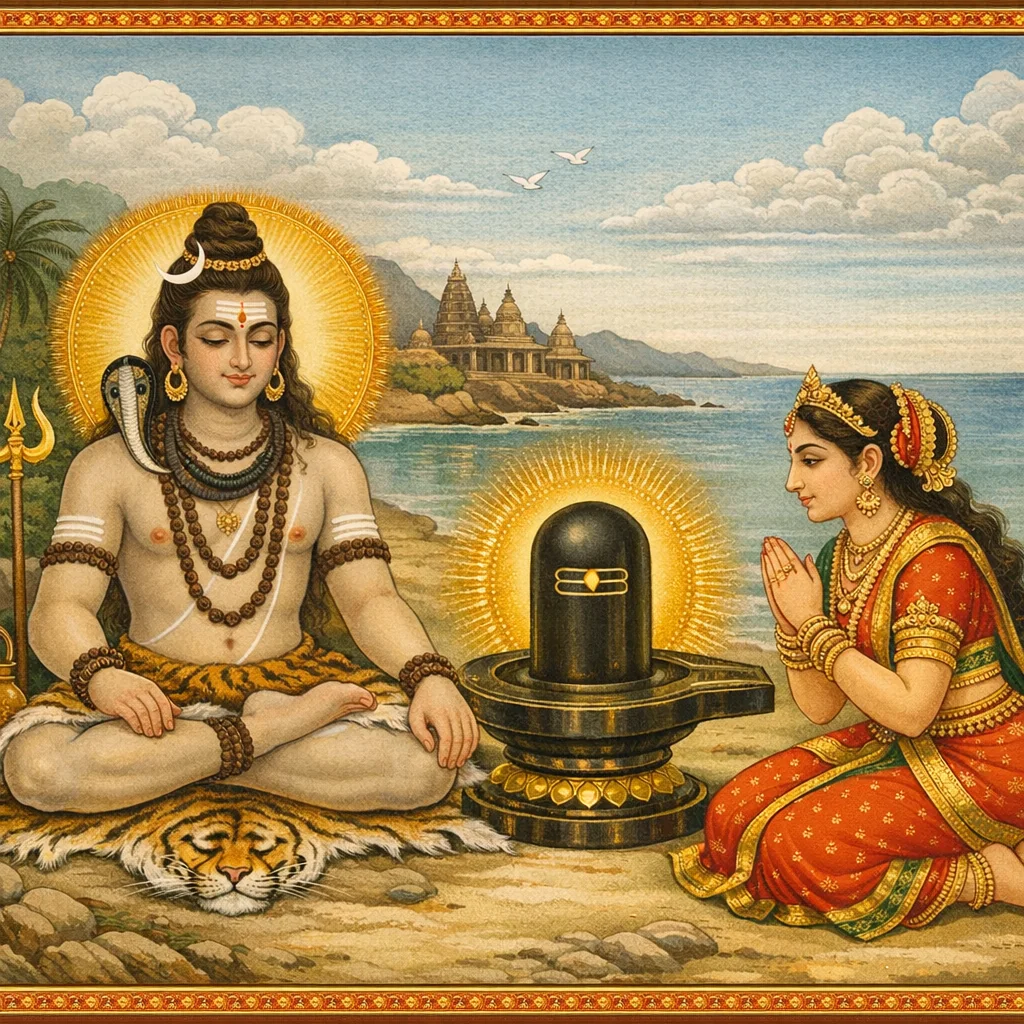
Adhyaya 188
Rudreśvaramāhātmya (Glorification of Rudreśvara)
This adhyāya gives a brief pilgrimage instruction within Prabhāsa-kṣetra. Īśvara speaks to Devī and directs her to a particular station where a svayaṃbhū liṅga named Rudreśvara stands upon the earth. The shrine is located in relation to Ādi-Prabhāsa, at a measured distance of three bow-lengths, emphasizing ritual-geographical precision. The text then explains the sacred origin of the site: Rudra, entering contemplation (dhyāna), “placed” his own tejas there, so the place’s holiness rests on divine presence rather than human construction. In closing, the phalaśruti declares that the darśana and pūjā of Rudreśvara destroy all sins and enable the devotee to attain desired aims.
Adhyaya 189
कर्ममोटीमाहात्म्यवर्णनम् — Karmamoṭī Māhātmya (Glorification of Karmamoṭī)
Chapter 189 of the Prabhāsa Khaṇḍa gives a brief, place-specific sacred account within Prabhāsa-kṣetra. Īśvara points to a shrine complex to the west, “not far,” where Caṇḍikā and Karmamoṭī abide together, accompanied by a vast host of yoginīs (koṭi-saṃyutā). The site is further proclaimed as a pīṭha-traya, a triad of primordial pīṭhas revered throughout the three worlds, thus establishing an authority that transcends the local even while being precisely located. A calendrical observance is then prescribed: on Navamī, the ninth lunar day, one should perform complete worship (saṃpūjya) of the Devī-pīṭha and the yoginī presence. The phalaśruti states that the worshipper attains all desired aims and becomes dear to celestial women in heaven—an idiom for svarga-oriented merit and auspicious fruition gained through right time and right place.
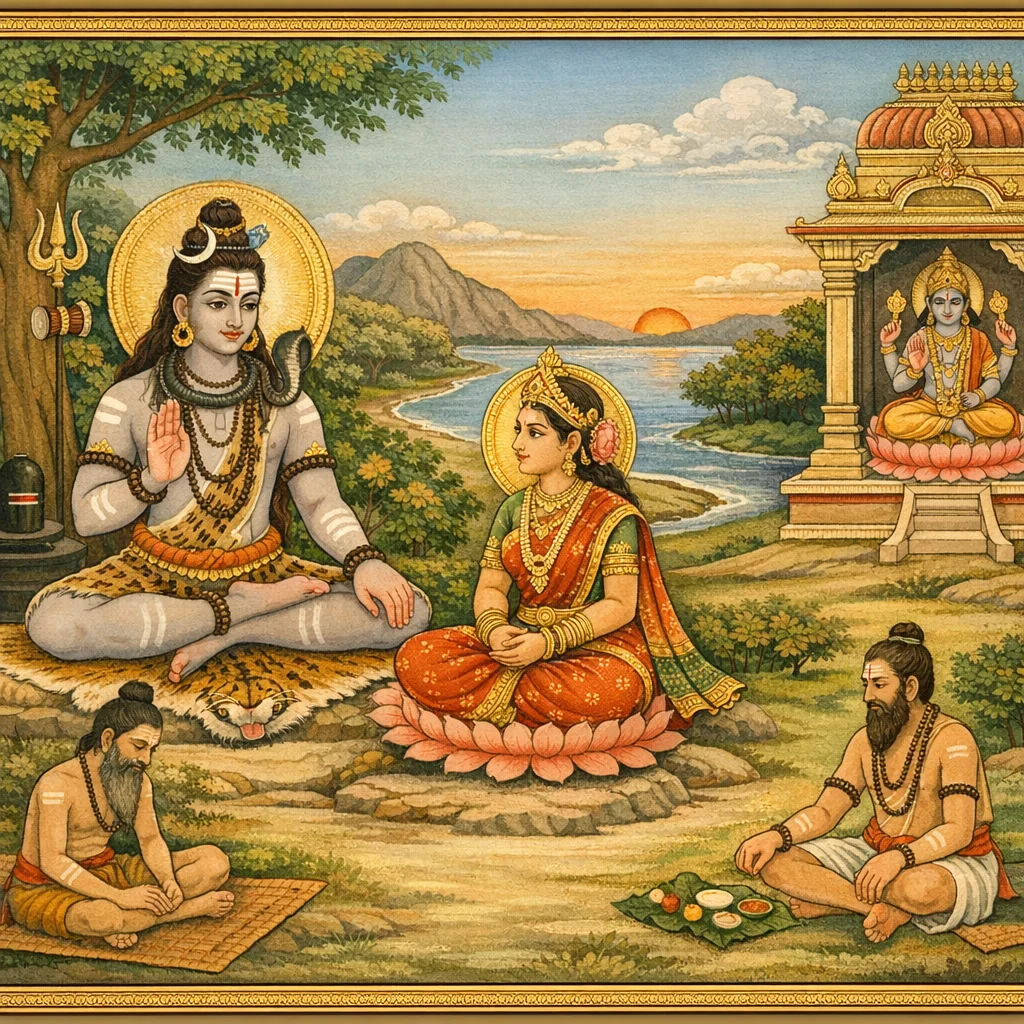
Adhyaya 190
मोक्षस्वामिमाहात्म्यवर्णनम् | The Māhātmya of Mokṣasvāmin (Liberation-Granting Hari)
Īśvara instructs Devī about Mokṣasvāmin, a liberation-bestowing form of Hari, abiding in the Prabhāsa region in the south‑western (nairṛta) quarter, not far from the principal sacred area. The chapter sets forth a disciplined observance: on Ekādaśī, a devotee who restrains food (jitāhāra) should worship there, with special emphasis on the month of Māgha. The promised reward is declared equivalent to the fruit of the Agniṣṭoma sacrifice. The teaching then extends to austerities at the same site: complete fasting (anaśana) and vows such as Cāndrāyaṇa are said to yield benefits multiplied beyond other tīrthas (koṭi-guṇa), granting desired attainments. The chapter ends with a colophon placing it within the Skanda Purāṇa’s Prabhāsa Khaṇḍa, in the Prabhāsakṣetramāhātmya.
Adhyaya 191
अजीगर्तेश्वरमाहात्म्यवर्णनम् | Ajeegarteśvara Māhātmya (Glorification of Ajeegarteśvara)
This adhyāya gives a brief instruction within the Prabhāsa pilgrimage route. Īśvara (Śiva) speaks to Devī, directing her—and thereby pilgrims—to proceed to Ajeegarteśvara, a form of Hara located near Candravāpī, the sacred water source, and close to another revered landmark. The ritual sequence is minimal: approach the shrine, perform snāna (purifying bath) in the associated waters, and worship the liṅga. The phalaśruti declares that liṅga-pūjā after bathing frees one from dreadful grave sins (ghora-pātaka) and culminates in attaining śivapada, the exalted state of Śiva. Thus the chapter links place, practice, and salvific promise into a standard devotional protocol.
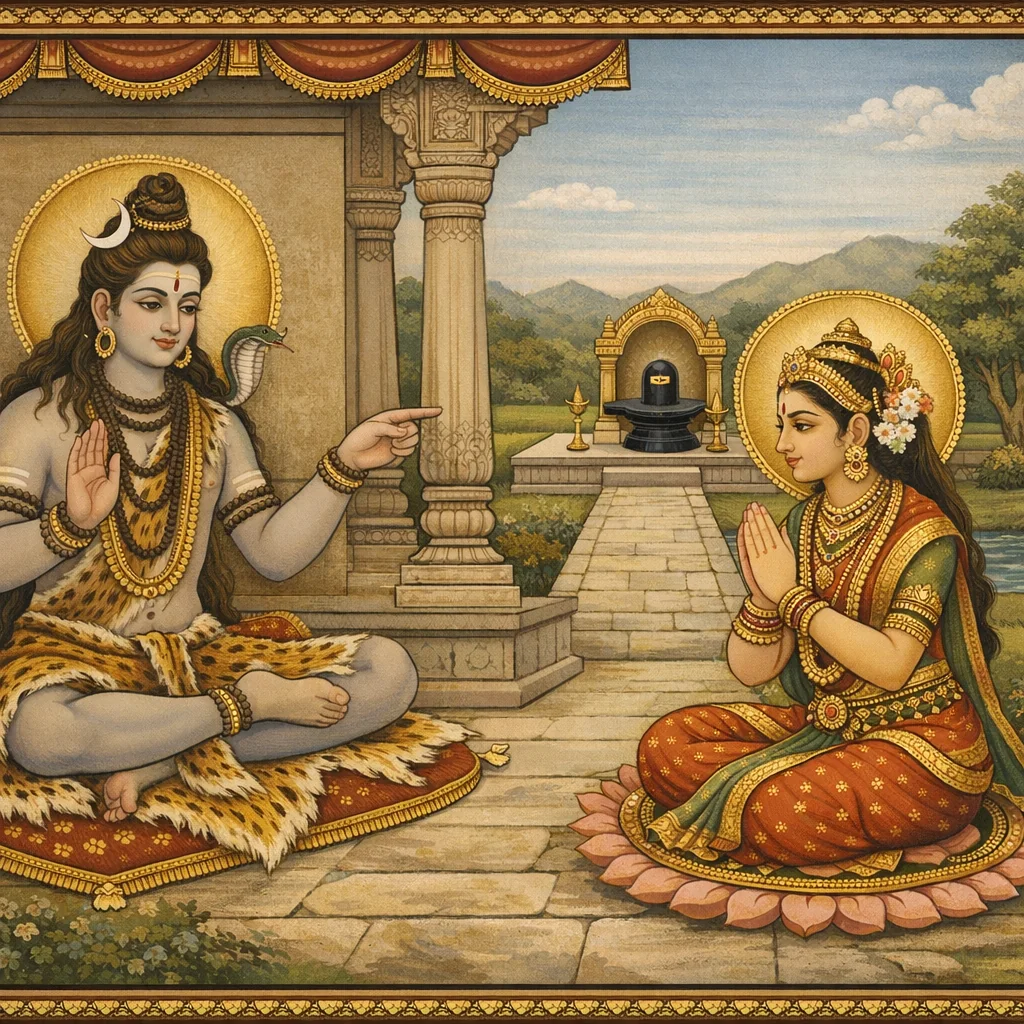
Adhyaya 192
Viśvakarmeśvara-māhātmya (विश्वकर्मेश्वरमाहात्म्य) — The Glory of Viśvakarmeśvara
This adhyāya is cast as a theological discourse in which Īśvara speaks to Devī, directing her—and thereby the pilgrim-reader—to a liṅga consecrated by Viśvakarman. The shrine is said to lie north of Mokṣasvāmin and is praised as mahāprabhāva, possessing great sacred potency. The text adds precise spatial guidance by stating that the liṅga is located within a measure of five dhanuṣ, reinforcing the itinerary character of the section. It then proclaims a darśana-centered merit: one who properly beholds the liṅga gains the fruit of pilgrimage, and misdeeds committed by speech (vācika) and by mind (mānasa) are destroyed through that holy sight. The chapter ends with a colophonic note placing it within the 81,000-verse Skanda Mahāpurāṇa, in the Prabhāsa Khaṇḍa, within the first Prabhāsakṣetramāhātmya, and naming it Viśvakarmeśvara-māhātmya.
Adhyaya 193
Yameśvara-māhātmya-varṇanam (Glorification of Yameśvara)
This adhyāya is framed as a direct theological discourse of Īśvara to Mahādevī. Īśvara instructs the pilgrim within Prabhāsa-kṣetra to proceed to Yameśvara, praised as “anuttama” (unsurpassed, most excellent). The shrine is located with directional clarity, serving as a ritual guide: it lies not far away in the nairṛta (southwestern) sector of Prabhāsa-kṣetra. Its efficacy is stated succinctly: mere darśana (sacred viewing) brings pāpa-śamana (the removal/appeasement of sin) and grants the fruit of all desired aims (sarva-kāma-phala-prada). The colophon identifies the text as part of the Skanda Mahāpurāṇa, the 81,000-verse compilation—within the seventh (Prabhāsa) khaṇḍa, the first Prabhāsa-kṣetra-māhātmya—and names this chapter as the description of Yameśvara’s māhātmya.
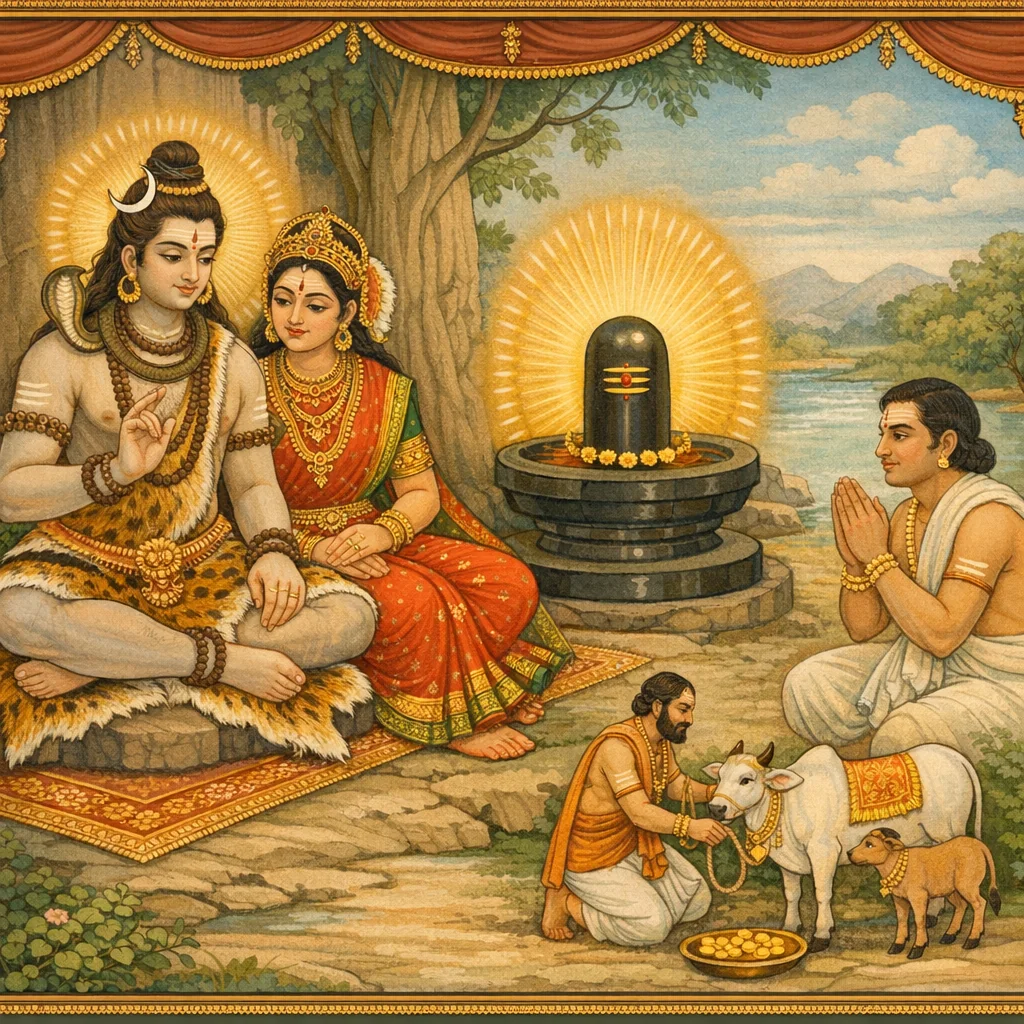
Adhyaya 194
अमरेश्वरमाहात्म्यवर्णनम् (Amareśvara Māhātmya—Description of the Glory of Amareśvara)
This adhyāya records Īśvara’s instruction to Mahādevī concerning a liṅga said to be “installed by the gods.” It declares that knowing the prabhāva (sacred potency) of this shrine brings the destruction of all sins and purification of the pilgrim. It then lays down a discipline of conduct: one should undertake intense austerity (ugra tapas) in relation to the liṅga, and the pilgrim who gains its darśana is said to become kṛtakṛtya—religiously fulfilled, with duty accomplished. The chapter also prescribes charitable giving: perform go-dāna, the gift of a cow, to a Brahmin learned in the Veda, affirming that rightly directed dāna strengthens and increases the fruit of pilgrimage (yātrā-phala).
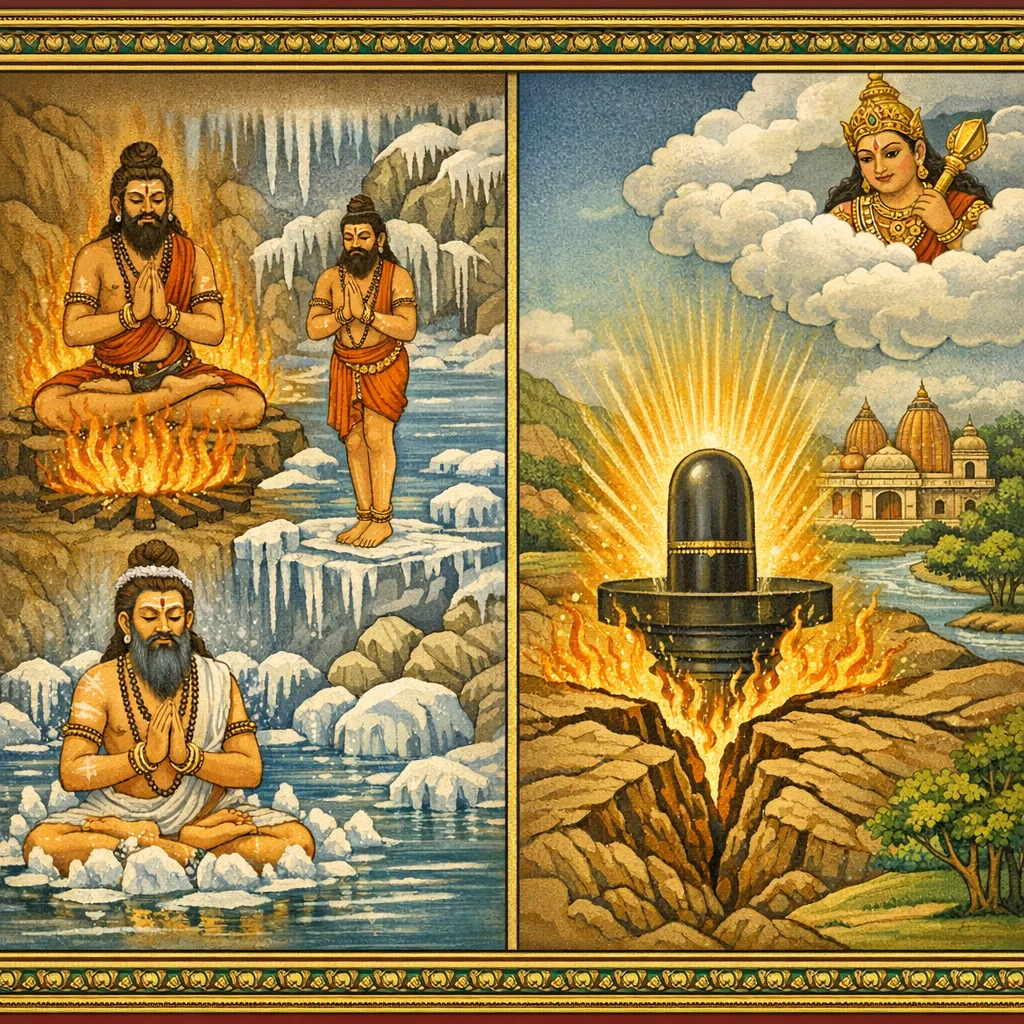
Adhyaya 195
वृद्धप्रभासमाहात्म्यवर्णनम् | The Māhātmya of Vṛddha Prabhāsa (Origin and Merit)
The chapter unfolds as a Śaiva dialogue. Īśvara instructs that a disciplined pilgrim should go to Vṛddha Prabhāsa, south of Ādi Prabhāsa, where a renowned “caturmukha” (four-faced) liṅga is praised as sin-destroying by mere sight. Śrī Devī asks how the place received its name and what fruits arise from seeing, praising, and worshipping there. Īśvara recounts an ancient episode set in a former manvantara and in Tretā-yuga: ṛṣis traveling from the north came seeking darśana at Prabhāsa but found the Śaiva liṅga concealed, connected with Indra’s vajra. Refusing to return without darśana, they performed prolonged tapas through the seasons with strict observances—brahmacarya and austerities of enduring heat and cold—until they became aged. Seeing their unwavering resolve, Śaṅkara compassionately revealed his liṅga, said to have arisen by splitting the earth. The ṛṣis, having obtained darśana, ascend to the heavenly realm; though Indra tries again to hide it, the site becomes known as Vṛddha Prabhāsa because darśana was attained in vṛddha-bhāva, advanced age. The phalaśruti declares that devoutly beholding this place yields merit equal to the Rājasūya and Aśvamedha sacrifices, and it recommends gifting a bull (ukṣā) to a brāhmaṇa for those who seek the full fruit of pilgrimage.
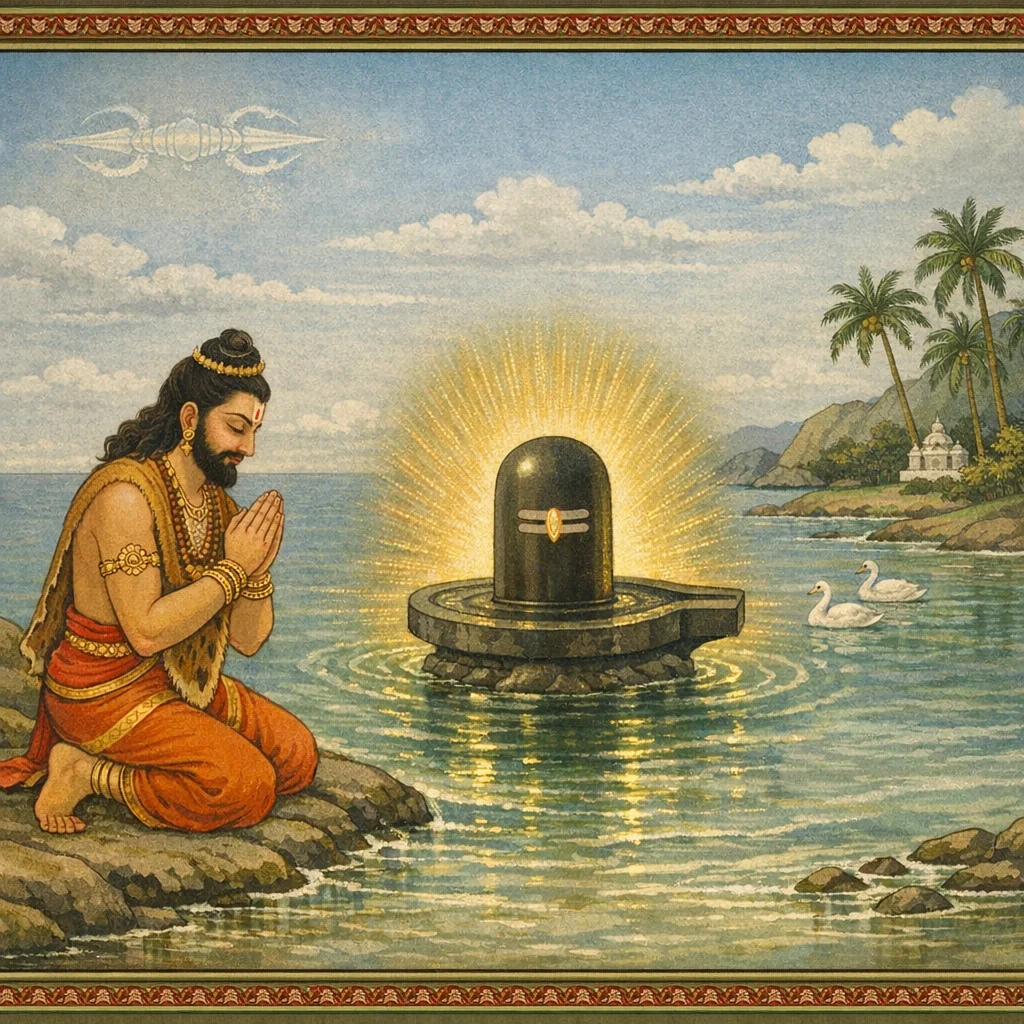
Adhyaya 196
जलप्रभासमाहात्म्यवर्णनम् | Jala-Prabhāsa: The Māhātmya of the Water-Prabhāsa Tīrtha
Īśvara directs Devī to a water-founded Prabhāsa tīrtha lying south of Vṛddha-Prabhāsa, proclaiming its “uttama” (most exalted) māhātmya. The account centers on Jāmadagnya Rāma (Paraśurāma), who, after the mass slaying of kṣatriyas, is seized by deep inner anguish and revulsion toward sin (ghṛṇā), and therefore performs years of intense tapas and worship of Mahādeva seeking relief. Śiva appears and offers a boon. Rāma asks for the vision of Śiva’s own liṅga, said to be repeatedly covered by Indra’s vajra out of fear. Śiva declines to grant direct liṅga-darśana in that form, but gives a remedy: by touch (sparśana) and by approaching a liṅga that will arise from within the sacred waters, Rāma’s distress and sin will be removed. A great liṅga then emerges from the water, and the place becomes known as Jala-Prabhāsa. The chapter ends with phalaśruti: mere contact with this tīrtha leads to Śiva-loka, and feeding even one well-conducted brāhmaṇa there is equal to feeding Śiva Himself (with Umā). The narrative is praised as pāpa-upaśamanī (sin-quelling) and sarvakāma-phalapradā (bestowing all desired fruits).
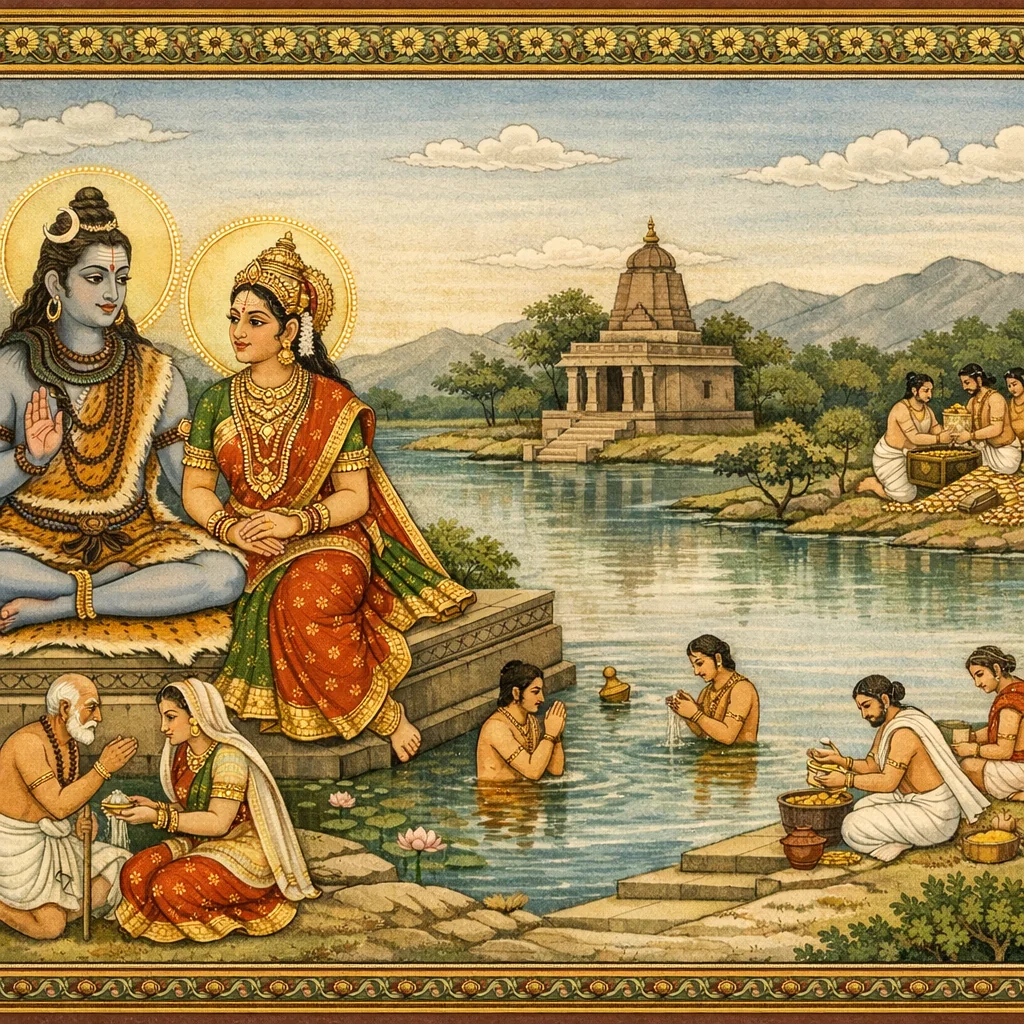
Adhyaya 197
जमदग्नीश्वरमाहात्म्यवर्णनम् | Jamadagniśvara: Account of the Sacred Merit
In this adhyāya, Īśvara instructs Devī on a pilgrimage to Jamadagniśvara Śiva, located near Vṛddha-Prabhāsa. The shrine is praised as a remover of all sins (sarva-pāpa-upaśamana), established by the sage Jamadagni, and it is said that mere darśana—beholding the Lord—releases one from the “three debts” (ṛṇa-traya) spoken of in Purāṇic ethics. The chapter then points to a particular water-site called Nidhāna-vāpī, enjoining ritual bathing (snāna) and worship (pūjā) to gain prosperity (dhana) and the fulfillment of desired aims. Its name and renown are explained through an ancient account in which the Pāṇḍavas recovered a hidden treasure (nidhāna) there, so that the place is celebrated as “venerated by the three worlds.” In the closing phalāśruti, bathing at this tīrtha is said to turn misfortune into good fortune and to grant one’s wishes, reaffirming the sacred itinerary’s theme of place-based ritual efficacy.
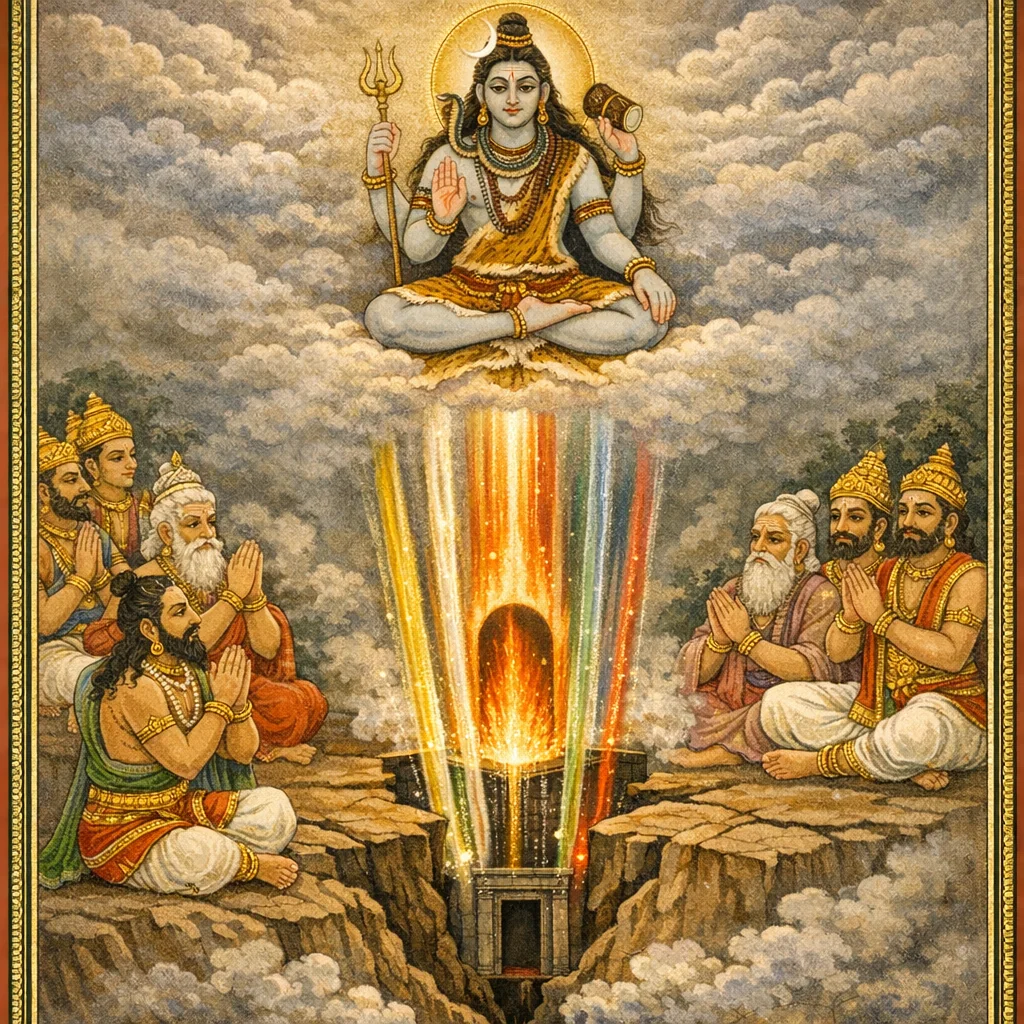
Adhyaya 198
Pañcama-prabhāsa-kṣetra-māhātmya: Mahāprabhāsa, Tejas-udbhava, and the Spārśa-liṅga Tradition
Framed as Īśvara’s discourse to Mahādevī, this chapter extols the eminent holy site Mahāprabhāsa, south of Jalaprabhāsa, said to obstruct Yama’s path—thus proclaiming a protective, liberating power. It then narrates an origin: in the Tretā-yuga a divinely radiant Spārśa-liṅga (“touch-liṅga”) granted release through mere contact. Later, Indra, arriving in fear, covered or restrained it with a vajra-like obstruction; yet fierce uṣmā/tejas burst forth uncontrollably, expanding into a vast, flame-tipped liṅga-form that shook the three worlds with smoke and fire. Gods and Veda-knowing ṛṣis praised Śiva (Śaśiśekhara) and begged that this self-burning radiance be contained lest creation collapse into dissolution. The tejas divided into five streams, breaking through the earth as a fivefold Prabhāsa manifestation. A stone gate was set at the exit-route; when the fissure was sealed, the smoke subsided and the worlds regained stability, while the radiance remained localized. At Śiva’s prompting the gods installed a liṅga there; the tejas “rested” in that place, which became famed as Mahāprabhāsa. The chapter ends with promised fruits: devoted worship with varied flowers grants an imperishable supreme state; mere sight removes sins and fulfills desired aims; and dāna—gold to a disciplined brāhmaṇa and a proper cow-gift to a twice-born recipient—yields the “fruit of birth” and merit likened to Rājasūya and Aśvamedha sacrifices.
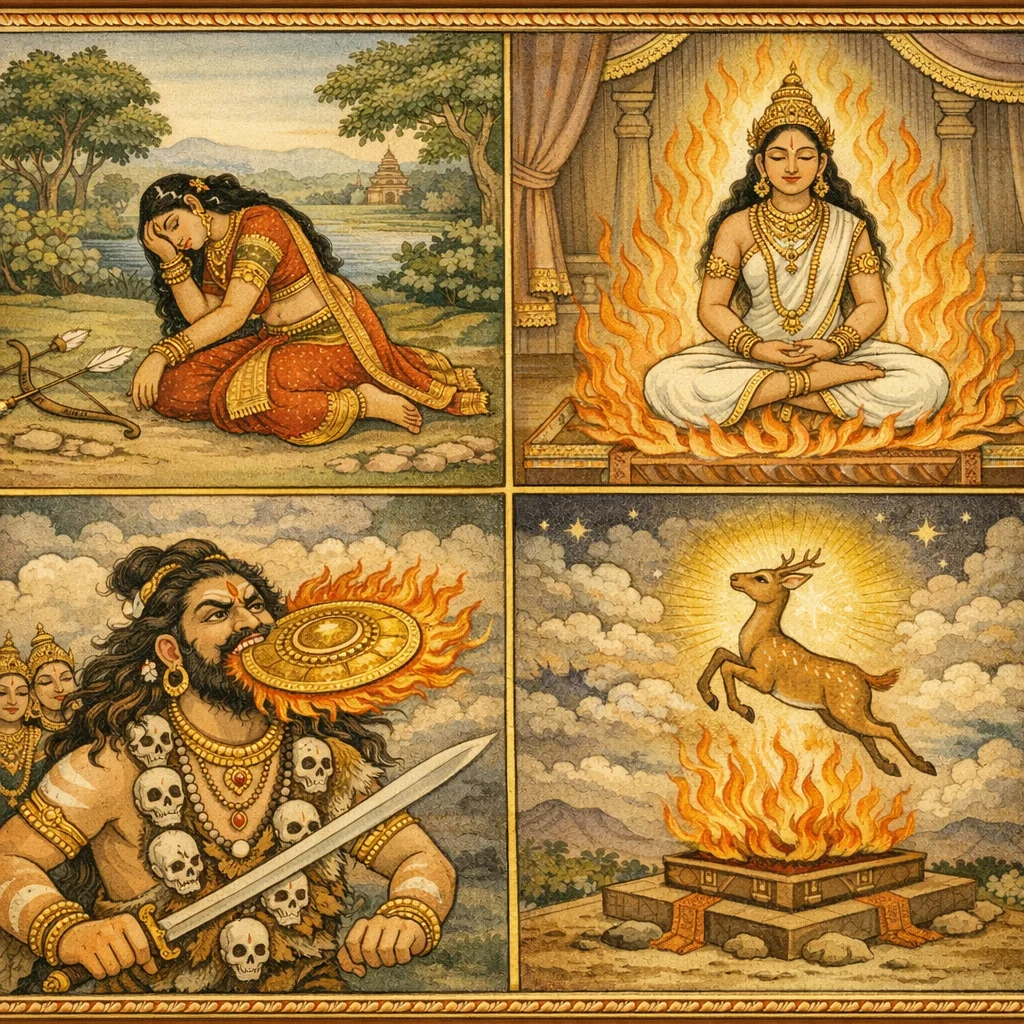
Adhyaya 199
दक्षयज्ञविध्वंसनम् (Destruction/Disruption of Dakṣa’s Sacrifice) and the Etiology of Kṛtasmaradeva
Chapter 199 unfolds as a Śiva–Devī theological dialogue within a tīrtha-guidance setting. Īśvara directs Devī to a southern shrine on the lovely bank of the Sarasvatī, revealing a self-manifest (svayaṃbhūta) deity praised as Kṛtasmaradeva, a purifier of sins. Śiva then narrates the cause and consequence of Kāma’s burning: Rati’s grief, Śiva’s consolation, and the promise of Kāma’s future restoration by divine grace. Asked why Kāma was burned and how rebirth occurs, Śiva recounts the wider mythic context of Dakṣa’s sacrifice—Dakṣa’s family arrangements and his daughters’ marriages, the grand yajña attended by devas and sages, and Śiva’s exclusion for his ascetic marks (kapāla, ash), which provokes Satī to release her body through yogic austerity. Śiva sends fierce gaṇas led by Vīrabhadra to shatter the rite; battle erupts with the devas. Viṣṇu’s Sudarśana is swallowed, and Vīrabhadra endures by Rudra’s boon. As Śiva advances with the trident, the devas withdraw; brāhmaṇas attempt protective homa with Rudra-mantras, yet the yajña is struck down. The yajña’s flight in deer-form and its lasting visibility in the sky as a star-like sign are remembered as an enduring cosmological marker.
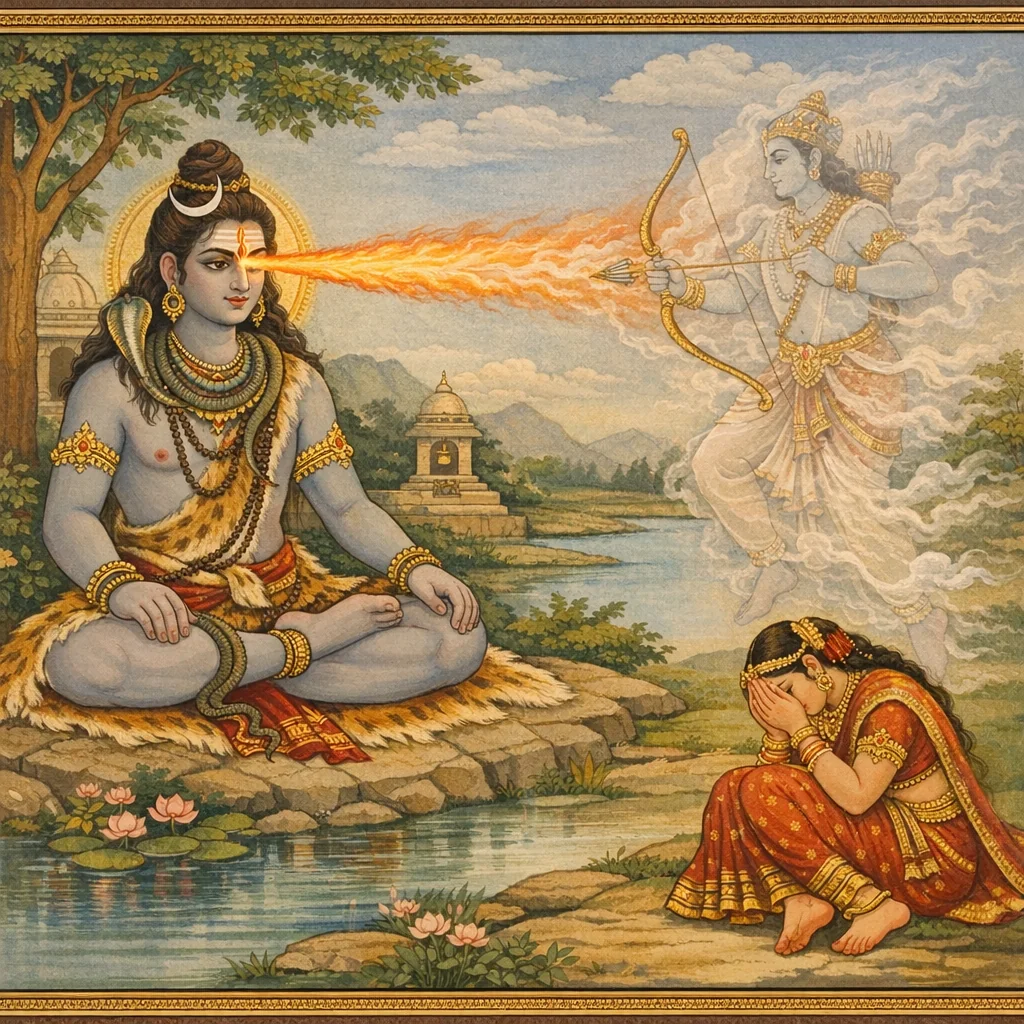
Adhyaya 200
कामकुण्डमाहात्म्यवर्णनम् | The Māhātmya of Kāma Kuṇḍa
In a theological dialogue between Śiva and Devī, this chapter recounts the aftermath of a disrupted sacrificial setting and introduces the demon Tāraka as a destabilizing power who defeats the devas and drives them from Svarga. The devas appeal to Brahmā, who declares that only Śaṅkara’s energy can end the crisis, and that Śiva’s future union with the Himālaya-born Goddess will bring forth the one destined to destroy Tāraka. To hasten that union, Kāmadeva is sent with Vasantā; yet when he approaches Śiva, Kāma is burned to ashes by the fire that issues from Śiva’s third eye. Śiva then abides in the auspicious Prābhāsika-kṣetra, sanctifying the place as a sacred memorial of the event. Rati laments, but an incorporeal voice consoles her that Kāma will return as the bodiless Ananga, preserving cosmic continuity. When the devas ask about the disruption of creation without Kāma, Śiva explains that Kāma will function without a body, and a liṅga arises on earth as a sign of the episode. The narrative connects this to the epithet Kṛtasmarā and to the later birth of Skanda, who slays Tāraka. It concludes by identifying a kuṇḍa south of Kṛtasmarā—Kāma Kuṇḍa—where bathing and regulated gifts (sugarcane, gold, cows, cloth) to Veda-knowing brāhmaṇas are prescribed, granting relief from inauspicious conditions.
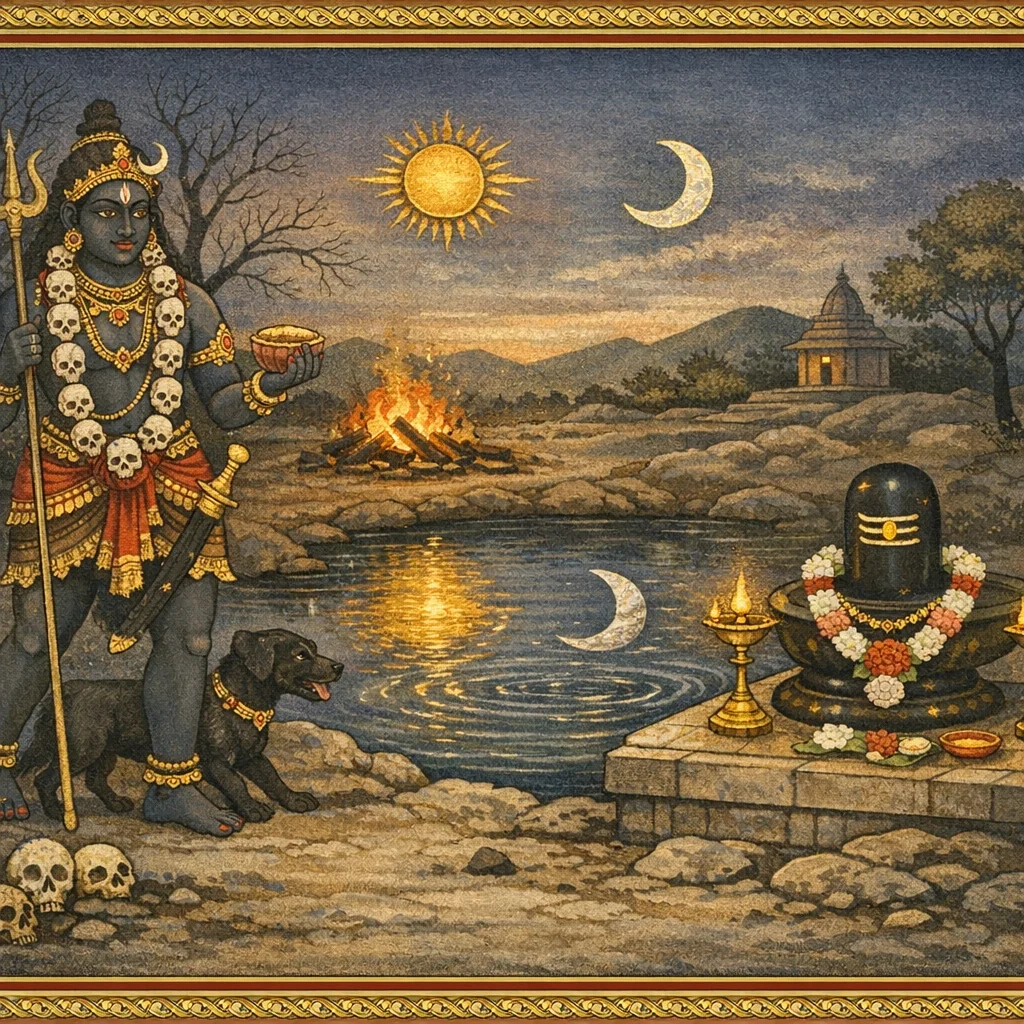
Adhyaya 201
कालभैरवस्मशानमाहात्म्यवर्णनम् (The Māhātmya of Kālabhairava’s Great Cremation-Ground)
This adhyāya sets forth a Śaiva theological discourse in which Īśvara (Śiva) points out a specific sacred locus in Prabhāsa: a great cremation-ground (śmaśāna) associated with Kālabhairava, along with the nearby Brahma-kuṇḍa. The chapter’s central claim is soteriological and place-specific, extolling the liberating power of this kṣetra. Śiva declares that beings who die there or are cremated there—even in adverse conditions or through an untimely, disordered death (kāla-viparyaya)—are said to attain mokṣa. This assurance is extended even to those classed as major transgressors in the text’s ethical taxonomy. He further connects the site’s efficacy to the presence of Maṅkīśvara and to “kṛtasmaratā” (being firmly established in remembrance), portraying the cremation-ground as an “apunarbhava-dāyaka” zone that grants freedom from rebirth. The discourse also notes the calendrical/astronomical junction called viṣuva as a meaningful temporal marker for the place’s ritual valuation. It concludes with Śiva’s proclamation of enduring attachment to this beloved kṣetra, rhetorically presented here as dearer even than Avimukta.
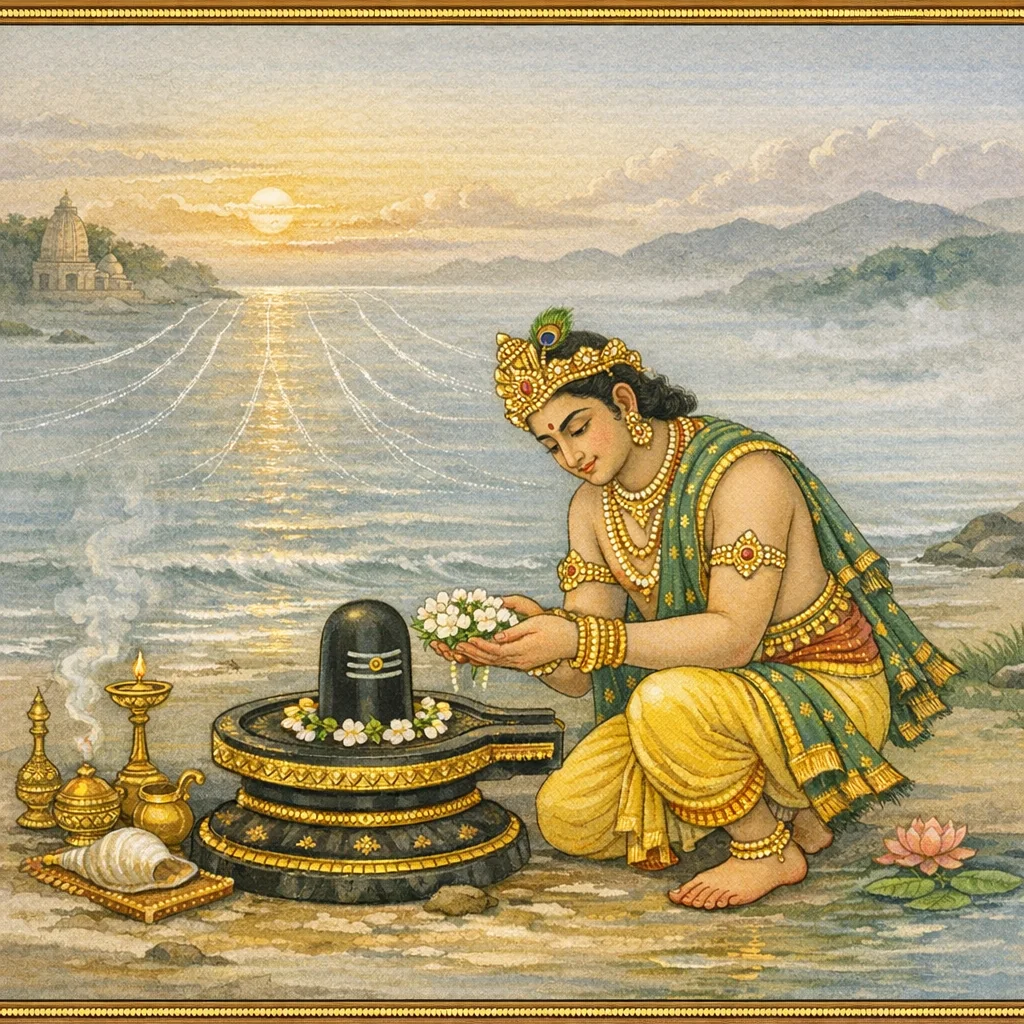
Adhyaya 202
रामेश्वरमाहात्म्य — Rāmeśvara at Prabhāsa and the Pratiloma Sarasvatī Purification
Īśvara tells Devī the place and greatness of Rāmeśvara at Prabhāsa, near the Sarasvatī. The tale recalls how Balabhadra (Rāma/Halāyudha) refused to take sides in the Pāṇḍava–Kaurava conflict and returned to Dvārakā; intoxicated, he wandered into a forest pleasure-grove. There he found learned Brahmins listening to a sūta’s recitation; in anger he struck the sūta down, then realized the deed brought a brahma-hatyā-like defilement, and he lamented its moral and bodily consequences. The chapter explains the reasoning of prāyaścitta—distinguishing intentional from unintentional harm, setting graded expiations, and emphasizing vrata observance. A bodiless voice directs Rāma to Prabhāsa, where the five-stream Pratilomā Sarasvatī is praised as destroying the five great sins, surpassing other tīrthas. Rāma performs pilgrimage rites, gives gifts, bathes at the river–ocean confluence, and establishes and worships a great liṅga, becoming purified. It ends with promised fruits: worship of the Rāmeśvara liṅga removes sin; a special observance on the eighth lunar day with the brahma-kūrcha procedure yields merit like an Aśvamedha. For those seeking the full yātrā-fruit, bathing, worship, and the gift of a cow are commended.
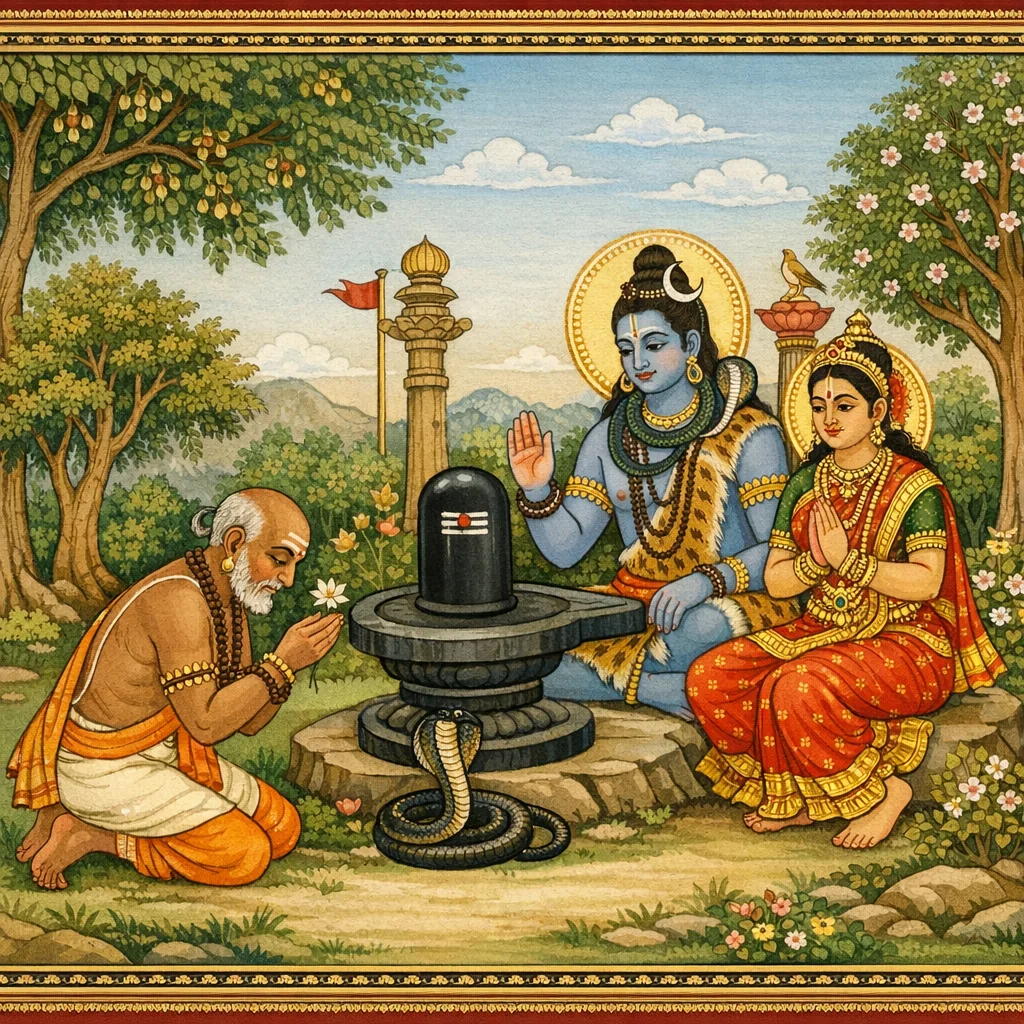
Adhyaya 203
मंकीश्वरमाहात्म्यवर्णनम् | Mankīśvara Māhātmya (Glory of the Mankīśvara Liṅga)
Īśvara tells Devī of a pilgrimage to the Mankīśvara shrine, north of Rāmeśa and near the Devamātṛ site, with further directions given from Arka-sthala and Kṛta-smara. The liṅga there is said to have been installed long ago by a brāhmaṇa named Maṅki—physically bent (kubja), yet steadfast in devotion to Śiva through sustained tapas and careful ritual worship. Though he worships for many years, Maṅki grieves that the Lord has not granted him satisfaction, and he intensifies his practice with japa and dhyāna into old age. Śiva finally appears and explains the practical difficulty: Maṅki cannot easily reach the tree-branches to gather many flowers like other ascetics, yet even a single flower offered with bhakti yields the full merit of sacrifice. The teaching expands into a ritual-theological vision: Brahmā stands to the right of the liṅga, Viṣṇu to the left, and Śiva in the center—thus liṅga-worship embraces the worship of the triad. Preferred offerings are listed—bilva, śamī, karavīra, mālatī, unmattaka, campaka, aśoka, kahlāra, and other fragrant flowers. Maṅki asks a boon that anyone who bathes and even offers only water to this liṅga should gain the fruit of all forms of worship, and that divine and earthly trees be present nearby; Śiva grants these, declares the place Nāga-sthāna for the presence of all nāgas, and disappears. Maṅki then relinquishes his body and attains Śiva’s realm. The chapter ends with a phalaśruti: hearing this account with faith removes sins.
Adhyaya 204
Sarasvatī-māhātmya and the Ritual Order of Dāna–Śrāddha at Prabhāsa (सरस्वतीमाहात्म्यं दानश्राद्धविधिक्रमश्च)
This chapter unfolds as a sacred question–answer discourse. Devī asks Īśvara for an expanded account of Sarasvatī’s māhātmya and raises precise questions on pilgrimage conduct at Prabhāsa: the merit of entering through the “mouth-gate” (mukha-dvāra), the fruits of bathing and giving (dāna), the results of immersion elsewhere, and the proper procedure of śrāddha—its rules, mantras, qualified officiants, suitable foods, and recommended gifts. Īśvara promises an orderly exposition of dāna and śrāddha and then magnifies Sarasvatī’s sanctity through layered praise. Sarasvatī-water is proclaimed supremely meritorious and, when mingled with the sea, rare even among the gods; the river is portrayed as granting worldly ease and freedom from sorrow. The text highlights the rarity of auspicious times, especially observances in Vaiśākha and vows connected with Soma. Access to Sarasvatī at Prabhāsa is said to surpass other austerities and expiations. Strong phala statements declare long residence in Viṣṇu-loka for those who remain in Sarasvatī’s waters, while those unable to perceive Sarasvatī at Prabhāsa are rhetorically likened to the spiritually impaired. Sarasvatī is also praised for beauty and for embodying expansive knowledge and pure discernment. The saṅgama of Sarasvatī with famed rivers and the ocean is presented as the pinnacle tīrtha. Bathing and gifting there yield results comparable to vast sacrificial merit, and those bathed by Sarasvatī’s waters are described as fortunate and worthy of honor.
Adhyaya 205
श्राद्धविधि-काल- पात्र- ब्राह्मणपरीक्षा (Śrāddha: timing, requisites, and examination of eligible Brāhmaṇas)
Adhyāya 205 unfolds as a theological and ritual dialogue in which Devī asks Īśvara to teach the meritorious procedure of śrāddha, with special emphasis on the proper time of day and its observance in the sacred setting of Prabhāsa/Sarasvatī. Īśvara delineates the day’s muhūrtas, exalting the kutapa-kāla around midday as especially efficacious, and warns against performing the rite in the evening. The chapter lists protective and purificatory requisites—most notably kuśa/darbha grass and black sesame (tila)—and explains the notion of svadhā-bhavana time. It praises three key “purifiers” for śrāddha (dauhitra, kutapa, tila) and commends virtues such as purity, freedom from anger, and unhurried composure. It then classifies wealth by purity (śukla/śambala/kṛṣṇa), arguing that offerings made from unjustly acquired resources divert satisfaction to inauspicious beings rather than to the ancestors. A substantial portion sets out detailed eligibility standards for recipients: learned, disciplined Brāhmaṇas are recommended, followed by extensive exclusion lists (apāṅkteya) describing disqualifying conduct, occupations, and moral conditions. The chapter closes by reiterating that improper selection undermines the fruit of the rite.
Adhyaya 206
Śrāddha-vidhi-varṇana (श्राद्धविधिवर्णन) — Procedural Discourse on Śrāddha
This adhyāya gives Īśvara’s technical teaching on śrāddha, especially the pārvaṇa system. It details invitation protocol, who is eligible and how they are seated, purity restrictions, the proper timing through muhūrta classifications, and the correct choice of vessels, fuels, flowers, foods, and ritual grasses. It warns that unethical commensality and procedural lapses can nullify ancestral reception. It also prescribes silence disciplines for specific acts (japa, eating, pitr̥-kārya, etc.), directional rules distinguishing deva rites from pitr̥ rites, and practical remedies for certain defects. The chapter catalogs auspicious and inauspicious materials (woods for samidh, flowers and foods to accept or avoid), notes regional exclusions for performing śrāddha, and clarifies calendrical issues such as malamāsa/adhimāsa constraints and proper month reckoning. It concludes with mantra sets (including a “saptārcis” praise) and explicit phala: correct recitation and performance bring purification, social-ritual validity, and benefits like prosperity, memory, and health—especially when done at Prabhāsa, at the Sarasvatī–ocean confluence.
Adhyaya 207
पात्रापात्रविचारवर्णनम् | Discernment of Worthy and Unworthy Recipients (Pātra–Apātra Vicāra)
Chapter 207 presents a prescriptive theological teaching attributed to Īśvara within the sacred setting of Prabhāsa-kṣetra. It opens by arranging śrāddha-related gifts and their stated fruits, stressing that offerings for the pitṛs (ancestors) and even the act of feeding a single dvija near the holy presence of the Sarasvatī are counted as exceptionally meritorious. The discourse then turns to an ethical and legal taxonomy of pātra–apātra (worthy and unworthy recipients): it warns against neglected observances, condemns land-theft and illicit gains, and offers an extended denunciation of veda-vikraya—the commercialization of Vedic instruction—listing its forms and karmic consequences. Alongside this, it defines social-ritual boundaries through purity rules, unsuitable livelihoods, and the danger of eating or accepting food and wealth from disapproved sources. Finally, it sets forth a structured doctrine of dāna, comparing the value of gifts, insisting on choosing a qualified recipient (śrotriya, guṇavān, śīlavān), and teaching that improper giving can nullify merit. The chapter closes by reaffirming a graded ethic of virtues—truthfulness, non-violence, service, and regulated consumption—and by describing the fruits of specific donations such as food, lamps, fragrance, clothing, and bedding, uniting ritual practice with moral instruction.
Adhyaya 208
दानपात्रब्राह्मणमाहात्म्यवर्णनम् (Glorification of Proper Giving, Worthy Recipients, and Brāhmaṇa Eligibility)
This chapter is a structured theological dialogue in which Devī asks Īśvara for a precise classification of dāna—what is to be given, to whom, and under what conditions of time, place, and recipient. Īśvara contrasts “fruitless” births and “fruitless” gifts with good birth, then sets forth the canonical sixteen great gifts (mahādāna), naming key items such as cows, gold, land, garments, grain, and a furnished house. The teaching then turns to the ethics of intention and provenance: gifts made from pride, fear, anger, or display yield delayed or diminished results, whereas gifts offered with purity of mind and from lawfully acquired wealth bear timely benefit. A major portion defines the marks of a worthy recipient (pātra-lakṣaṇa): learning, yogic discipline, calmness, Purāṇa-knowledge, compassion, truthfulness, cleanliness, and self-control. Detailed rules for cow-gifts specify desirable qualities and forbid defective or unlawfully obtained cattle, warning of harmful consequences from improper giving. The chapter also gives calendrical cautions regarding fasting, pāraṇa, and śrāddha timing, and offers an adaptable śrāddha method when resources or qualified recipients are scarce. Finally, it enjoins honoring the reciter/teacher and restricts transmission to hostile or irreverent listeners, treating right listening and patronage as part of ritual efficacy.
Adhyaya 209
मार्कण्डेयेश्वरमाहात्म्यवर्णनम् | Māhātmya of Mārkaṇḍeyeśvara (Foundation and Merit Narrative)
Chapter 209 presents a two-part discourse with Īśvara speaking to Devī. First, Devī is directed to the eminent shrine of Mārkaṇḍeyeśvara, to the north near the eastern quarter of Sāvitrī. Its sanctity is traced to the sage Mārkaṇḍeya who, by the grace of Padmayoni (Brahmā), became ageless and deathless in the Purāṇic sense. He establishes a Śiva-liṅga there and enters long dhyāna in padmāsana; after vast ages the Śaiva temple is buried by windblown dust, and on awakening he excavates it and reopens a great doorway for worship. The chapter adds a merit-fruit: whoever enters and devotionally worships Vṛṣabhadhvaja (Śiva) attains the supreme abode where Maheśvara dwells. In the second part, Devī asks how Mārkaṇḍeya can be called “immortal” when mortality is universal. Īśvara recounts an earlier kalpa: the sage Mṛkaṇḍu, son of Bhṛgu, begets a virtuous child fated to die in six months. The father performs upanayana and trains the child in daily reverent salutations. During pilgrimage the Saptarṣis bless the boy with “long life,” then fear their words may fail when they perceive his short span, and they bring the brahmacārin before Brahmā. Brahmā confirms a special destiny: the child will become Mārkaṇḍeya, equal in lifespan to Brahmā and a companion at the beginning and end of the kalpa. The chapter closes with the father’s relief and grateful devotion, affirming disciplined reverence, divine authorization, and the enduring accessibility of the kṣetra even after concealment.
Adhyaya 210
Pulastyēśvaramāhātmya (The Glory of Pulastyēśvara) | पुलस्त्येश्वरमाहात्म्यम्
This adhyāya offers a compact tīrtha-instruction, framed as Īśvara’s theological discourse to Mahādevī. The pilgrim is directed to proceed to Pulastyēśvara, praised as an ‘uttama’ (preeminent) shrine, whose location within the sacred landscape of Prabhāsa is indicated through directional wording and a measure of distance. It then lays down the devotional sequence: first darśana, and then pūjā performed vidhānataḥ—according to proper ritual procedure. The chapter concludes with a firm phalaśruti: the worshipper is freed from sins accumulated across seven births, with the assurance, “there is no doubt in this” (nātra saṃśayaḥ).
Adhyaya 211
पुलहेश्वरमाहात्म्यवर्णनम् | Pulahēśvara Māhātmya (Glorification of Pulahēśvara)
This chapter is framed as a theological instruction from Īśvara to Devī, identifying a shrine called Pulahēśvara within the sacred landscape of Prabhāsa. Its location is given by direction—toward the naiṛta (southwest) quarter—and by a distance marker measured in dhanuṣ units. Īśvara enjoins worship of Pulahēśvara grounded in bhakti (devotion) and teaches that hiranya-dāna—the gifting of gold or wealth—secures the attainment of yātrā-phala, the meritorious “fruit” of pilgrimage. Thus the chapter weaves together the spatial indexing of a tīrtha, a minimal devotional pūjā, and an ethical-economic injunction to dāna as the formal completion of pilgrimage merit. The closing colophon places the passage within the Skanda Purāṇa’s compilation, in the Prabhāsa Khaṇḍa, naming it as the 211th adhyāya of the Prabhāsakṣetramāhātmya, in praise of Pulahēśvara.
Adhyaya 212
Kratvīśvaramāhātmya (क्रत्वीश्वरमाहात्म्यम्) — The Glory of Kratvīśvara
Chapter 212 records Īśvara’s instruction to Devī about a shrine called Kratvīśvara in the Prabhāsa Khaṇḍa. Its location is given precisely: eight dhanuṣas to the southwest (nairṛta) of Pulahīśvara, serving as a brief topographical guide for pilgrims. Īśvara declares Kratvīśvara to be a bestower of “mahākratu-phala,” merit equal to that of great Vedic sacrifices, made accessible through tīrtha by darśana (reverent beholding). Whoever sees this deity gains the fruit of the Pauṇḍarīka rite, is protected from poverty for seven births, and is assured that suffering does not arise in that place.
Adhyaya 213
Kaśyapeśvara Māhātmya (काश्यपेश्वरमाहात्म्य) — Glory of the Kaśyapeśvara Shrine
This adhyāya is a brief Śaiva māhātmya framed as a dialogue in which Īśvara speaks to Devī. It identifies the Kaśyapeśvara sacred site with precise pilgrimage directions: in the eastern quarter (pūrvadigbhāga), at a distance described as “sixteen bow-lengths” (dhanuḥ-ṣoḍaśa-kāntara). It then proclaims the fruit of darśana: one who beholds the place gains prosperity and progeny, and even a person burdened with “all sins” is freed from them—stated as a certain phalaśruti, “no doubt.” A concluding colophon notes the chapter’s placement within the Skanda Purāṇa, in the Prabhāsa Khaṇḍa and the Prabhāsakṣetramāhātmya.
Adhyaya 214
कौशिकेश्वरमाहात्म्यवर्णनम् | Narrative of the Glory of Kauśikeśvara
This adhyāya is cast as a theological discourse led by Īśvara, locating the shrine of Kauśikeśvara to the īśāna (northeast) of Kaśyapeśvara at a distance of eight dhanus (a traditional spatial measure). Kauśikeśvara is praised as a powerful purifier, explicitly described as a destroyer of great sins (mahāpātaka-nāśana). A brief origin-legend explains the name: Kauśika, having slain the sons of Vasiṣṭha—an act presented as a grave transgression—establishes a liṅga at that spot and, through consecration and worship, becomes freed from sin. The chapter ends with a concise phalaśruti: those who behold (darśana) and worship (pūjā) the liṅga obtain their desired fruits (vāñchita-phala).
Adhyaya 215
कुमारेश्वरमाहात्म्यवर्णनम् / The Māhātmya of Kumāreśvara
Īśvara directs Devī to the shrine of Kumāreśvara, a short distance south of Mārkaṇḍeśvara, known as a liṅga established by Svāmī, a devoted worshiper, within the sacred terrain. The chapter presents this spot as a place of expiation: intense tapas connected with Kārttikeya is taught to destroy sins born of transgressive desire, especially wrongdoing involving another’s spouse. A paradigmatic devotee installs the liṅga and is said to be freed from impurity, regaining through renunciation a renewed state of “kaumāra,” youthful purity. A second exemplum speaks of Sumāli, who, after the grave act of killing his ancestors, worships here and is released from the sin of violence against father/forebears. The text also marks a well before the deity: bathing there and worshiping Svāmī’s liṅga removes faults and grants access to the great divine city, Svāmīpura. Finally, a rule of gifting is given: donating, in Svāmī’s name, a “tāmracūḍa” item made of high-purity śātakaumbha gold to a twice-born (dvijāti) yields the fruit of pilgrimage.
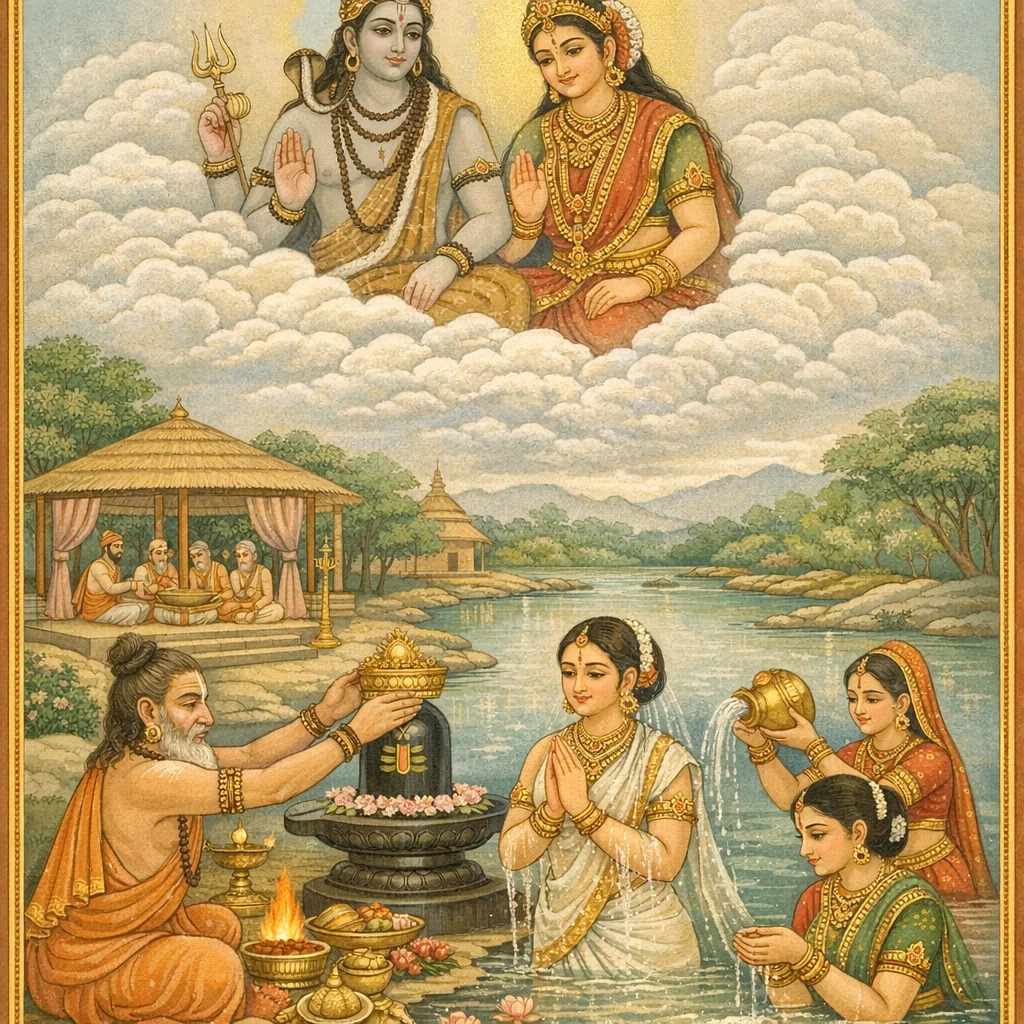
Adhyaya 216
Gautameśvara-māhātmya (गौतमेश्वरमाहात्म्य) — The Glory of Gautameśvara Liṅga
This adhyāya is a brief Śaiva tīrtha account spoken by Īśvara to Devī. It identifies an eminent liṅga named Gautameśvara, situated north of Mārkaṇḍeśvara at a distance of fifteen dhanus. The shrine is presented as a place of expiation: the sage Gautama, burdened by sin and grief after killing his guru, establishes (pratiṣṭhā) the liṅga there and is freed from that moral weight. A merit-bearing discipline is then prescribed for pilgrims—bathing in the river according to proper rite, worshipping the liṅga with ritual correctness, and giving a kapilā (tawny cow) as dāna. The declared fruit is release from the five great sins (pañca-pātaka), portraying the site as a sacred meeting point of repentance, right action, and purification.
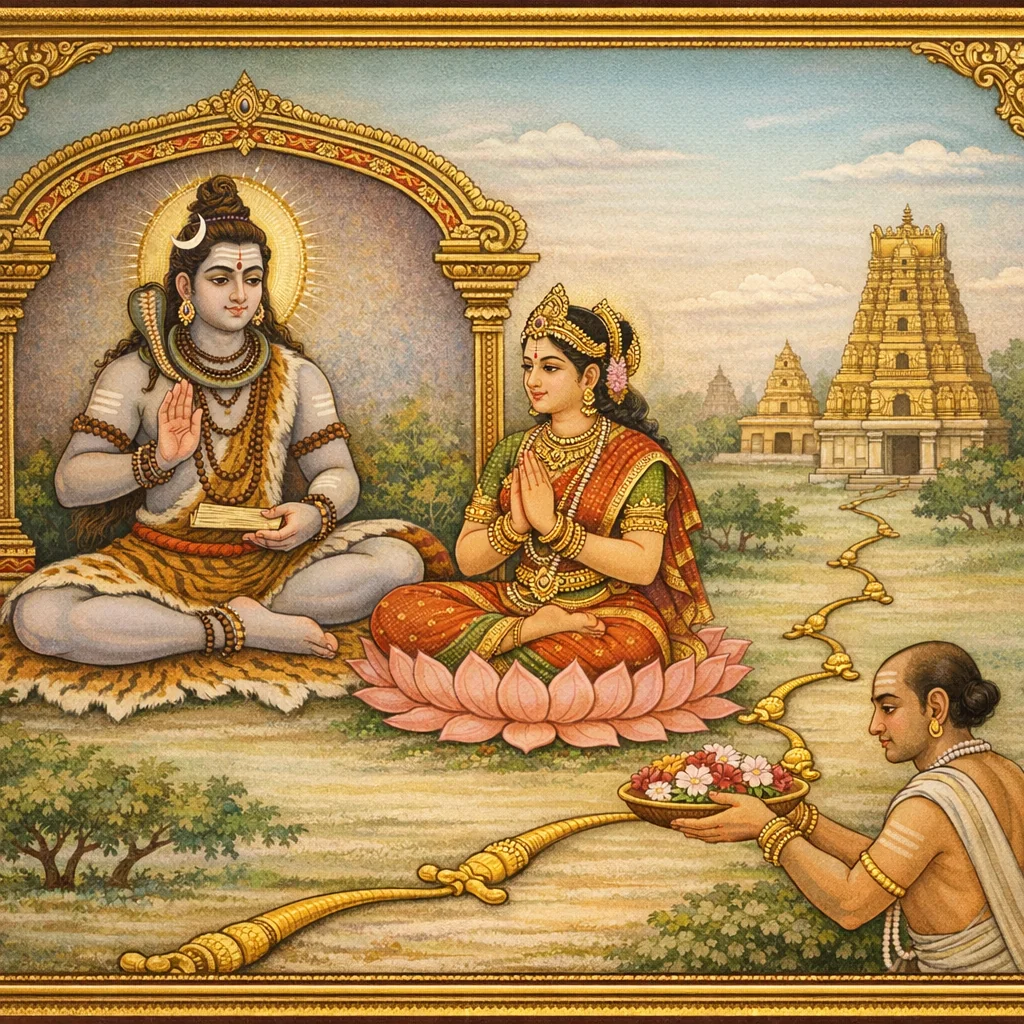
Adhyaya 217
Devarājeśvara-māhātmya (Glorification of Devarājeśvara)
This adhyāya is a brief shrine-glory teaching spoken by Īśvara to Devī. It locates Devarājeśvara to the west, not far from Gautameśvara, at a distance of sixteen dhanu (a traditional bow-based measure). It then states the cause-and-fruit: by establishing the liṅga (sthāpanā), the doer is freed from pāpa (moral fault). As guidance for future devotees, it declares that any person who worships that liṅga with a calm, concentrated mind (samāhita-manas) is likewise released from sins arising from human embodiment (mānava-sambhūta pātakāni). The closing colophon identifies the text as the Skanda Mahāpurāṇa, within the 81,000-verse compilation, in the seventh division (Prabhāsa Khaṇḍa), first section (Prabhāsakṣetramāhātmya), and names this as the 217th chapter.
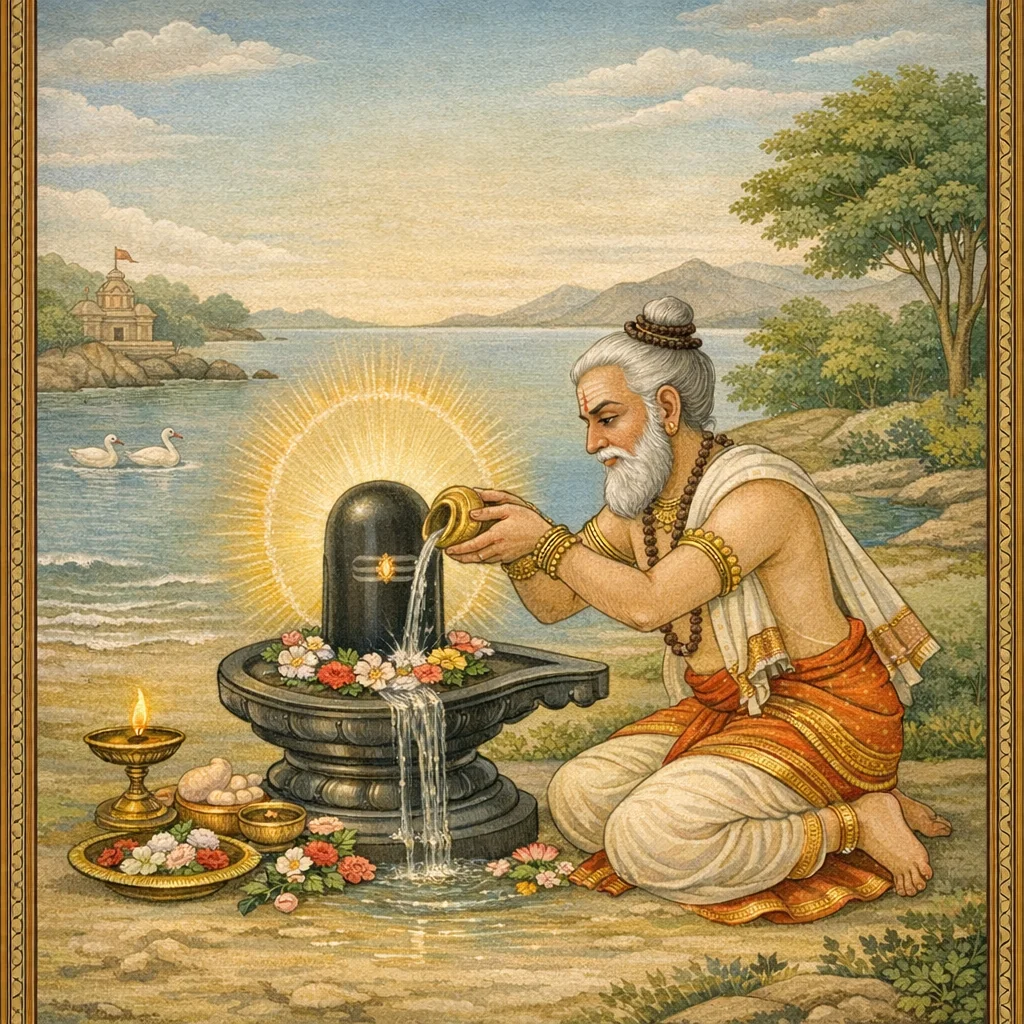
Adhyaya 218
Mānaveśvara Māhātmya (The Glory of Mānaveśvara) | मानवेश्वरमाहात्म्य
This chapter is framed as a brief theological instruction spoken by Īśvara. It introduces a sacred liṅga at Prabhāsa-kṣetra called the “Mānava-liṅga,” which was installed and consecrated by Manu. Burdened by the demerit of killing his own son, Manu recognizes that place as pāpa-hara, a remover of sin. He performs the rites of consecration and establishes Īśvara there, and is thus described as freed from that moral weight. The teaching then extends the promise to all: any human devotee who worships the Mānava-liṅga is said to be released from sins. The chapter ends with a formal colophon identifying it as Skanda Mahāpurāṇa, within the Prabhāsa Khaṇḍa, Prabhāsakṣetramāhātmya, naming this as the 218th adhyāya on the glory of Mānaveśvara.
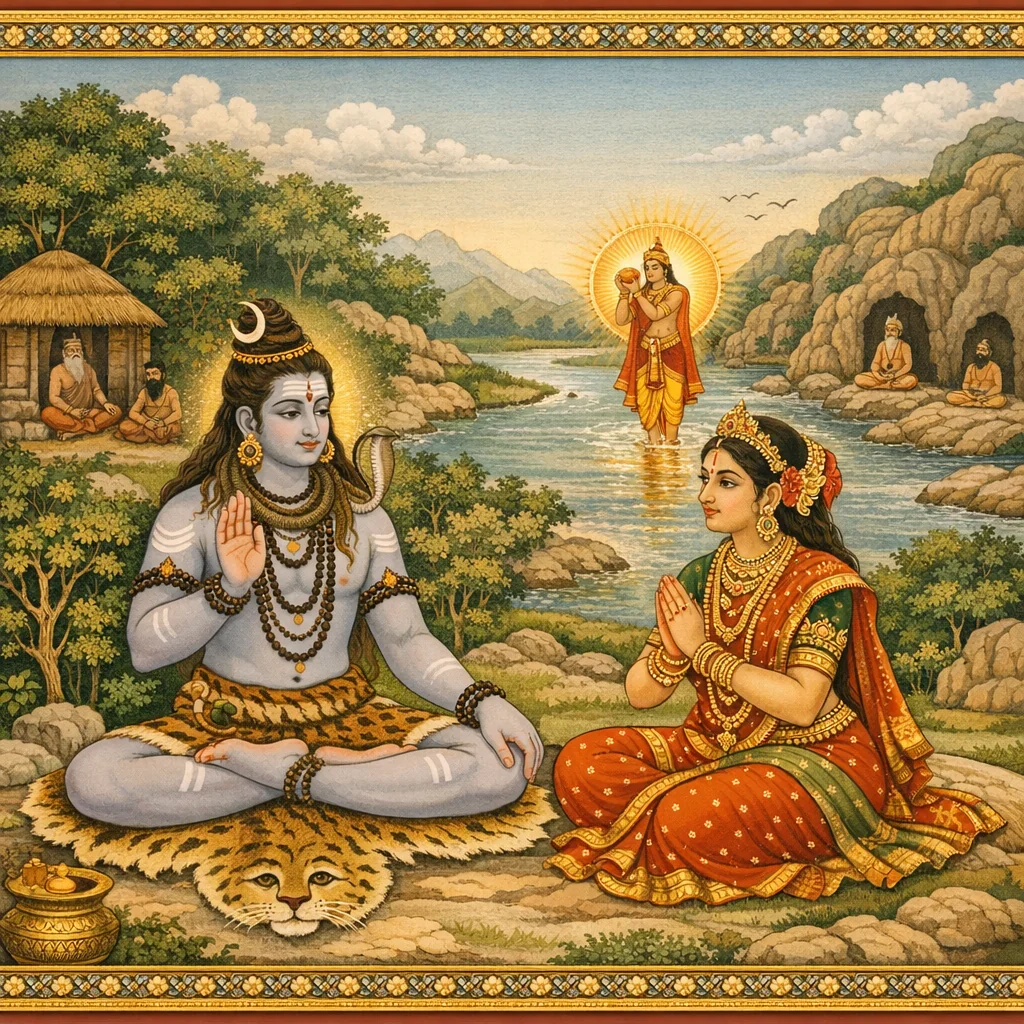
Adhyaya 219
मार्कण्डेयेश्वरमाहात्म्यवर्णनम् (Glorification of Mārkaṇḍeyeśvara and associated liṅgas near Mārkaṇḍeya’s āśrama)
This chapter is a Śaiva teaching in which Īśvara speaks to Devī, mapping a local cluster of sacred sites in the āgneya (southeastern) quarter near Mārkaṇḍeya’s āśrama. It first points to the famed shrine Guhāliṅga—also called Nīlakaṇṭha—said to have been worshiped by Viṣṇu in former times and praised as the “destroyer of all remaining sin.” The discourse then links bhakti-filled worship with tangible blessings—prosperity, children, cattle, and contentment—and broadens the sacred landscape by noting visible hermitages and ascetics’ caves, many connected with liṅgas. A key injunction follows: installing a liṅga near Mārkaṇḍeya is said to uplift extensive lineages, presenting the act as a socially expansive religious means. Its theology is universalizing: “all worlds are Śiva-formed; all is established in Śiva,” and thus the learned seeker of prosperity should worship Śiva. Through exempla of devas, kings, and humans, liṅga worship and liṅga-installation are normalized and held forth as remedies even for grave transgressions through “Śiva’s radiance.” Brief origin-notes—Indra after Vṛtra, the Sun at confluences, Ahalyā’s restoration, and others attaining higher states—serve as narrative proofs, and the chapter closes by reaffirming the essence of Prabhāsa-kṣetra in relation to Mārkaṇḍeya’s āśrama.
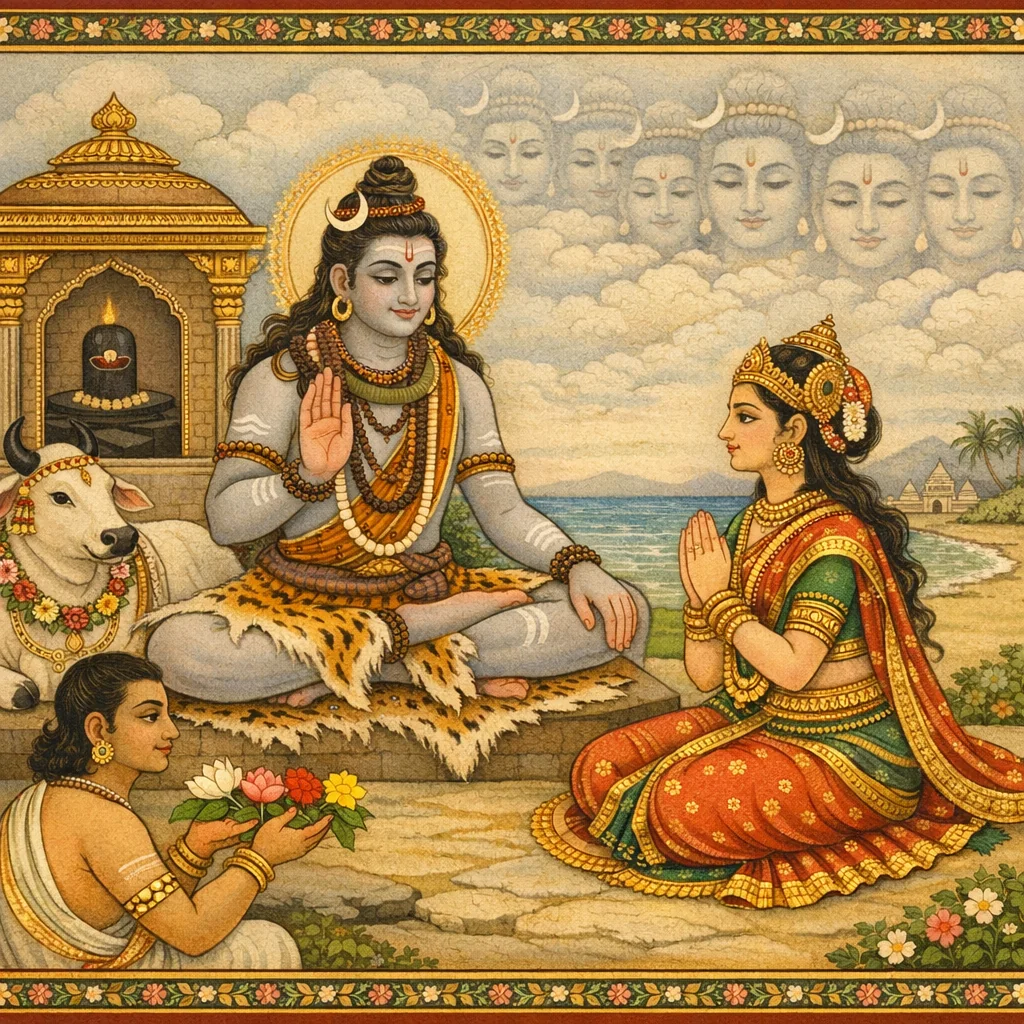
Adhyaya 220
वृषध्वजेश्वरमाहात्म्यवर्णनम् | Vṛṣadhvajeśvara Māhātmya (Glorification of Vṛṣadhvajeśvara)
This chapter is a Śaiva theological instruction in which Īśvara teaches the Goddess. The pilgrim is directed to the deity Vṛṣadhvajeśvara—“worshiped in the three worlds” (triloka-pūjita)—located to the south within the sacred shrine-map of Prabhāsa. The text then describes Śiva as akṣara and avyakta (imperishable, unmanifest), with no higher principle beyond Him, attainable through yoga, and omnipresent as the cosmic Being whose hands, feet, eyes, heads, and mouths are everywhere. A line of exemplary kings (Pṛthu, Marutta, Bharata, Śaśabindu, Gaya, Śibi, Rāma, Ambarīṣa, Māndhātṛ, Dilīpa, Bhagiratha, Suhotra, Rantideva, Yayāti, Sagara) is cited to establish precedent: having come to Prabhāsa and worshiped Vṛṣadhvajeśvara with sacrifices, they attain heaven. Repeated reminders of saṃsāra—birth, death, affliction, and aging—press an ethical and ascetic urgency, declaring Śiva-arcana the “essence” amid a world deemed insubstantial. Steadfast bhakti is praised as prosperity-bearing, granting abundance likened to the cintāmaṇi and kalpadruma, even making Kubera as a servant. Ritual simplicity is exalted: worship with merely five flowers yields the fruit of ten aśvamedhas. Finally, a specific gift is prescribed—donating a bull near Vṛṣadhvaja—for the destruction of sins and for those who seek the full fruit of pilgrimage.
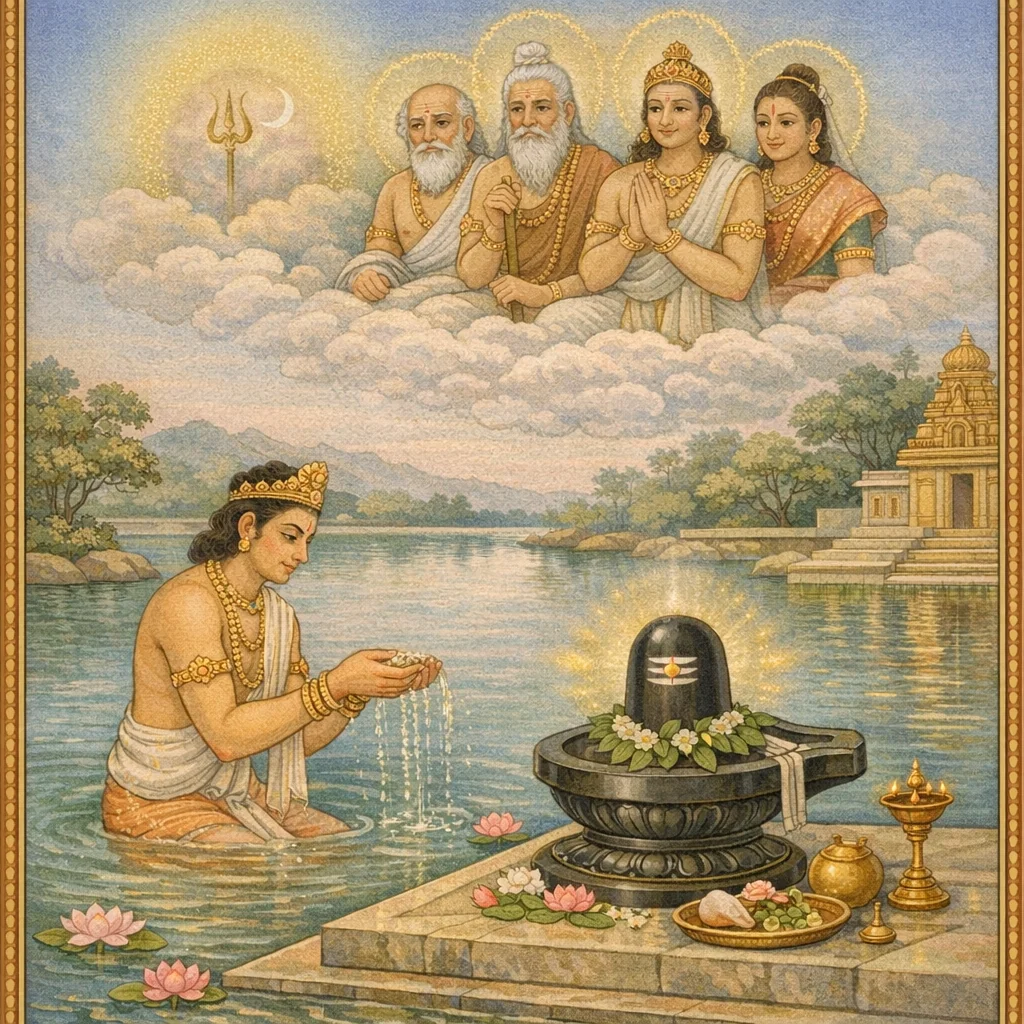
Adhyaya 221
ऋणमोचनमाहात्म्यवर्णनम् (R̥ṇamocana Māhātmya—Theological Account of Debt-Release at Prabhāsa)
This adhyāya is cast as Īśvara’s discourse on a sacred locus at Prabhāsa centered on the deity/liṅga named R̥ṇamocana (“Debt-Release”). It declares that the darśana of R̥ṇamocana itself nullifies the debt arising from one’s maternal and paternal lineages—ancestral debt. A host of Pitṛs is then described as having performed long tapas at Prabhāsa and, in devotion, established a liṅga. Pleased, Mahādeva appears and invites them to ask a boon. The Pitṛs request a lasting vṛtti—an efficacious religious provision—for beings of the divine, ṛṣi, and human orders: that those who come in faith be freed from ancestral debt and moral taint; and that even ancestors who died irregular deaths (by serpents, fire, poison) or whose post-death rites were incomplete—lacking sapīṇḍīkaraṇa, ekoddiṣṭa/ṣoḍaśa offerings, vṛṣotsarga, or proper śauca—may attain a higher course when propitiated here. Maheśvara replies that humans devoted to pitṛ-bhakti who bathe in the sacred water and perform pitṛ-tarpaṇa gain immediate deliverance; even heavy sin does not bar His grace, for He is varapradā, the boon-giver. The chapter’s prescription links snāna and worship of the Pitṛ-installed liṅga to release from ancestral debt, explaining the name: since one is freed from ṛṇa by its darśana, it is called R̥ṇamocana. It adds that bathing after placing gold upon the head yields merit equal to gifting a hundred cows, and concludes by urging śrāddha there with full effort and worship of the pitṛ-liṅga, beloved of the gods.
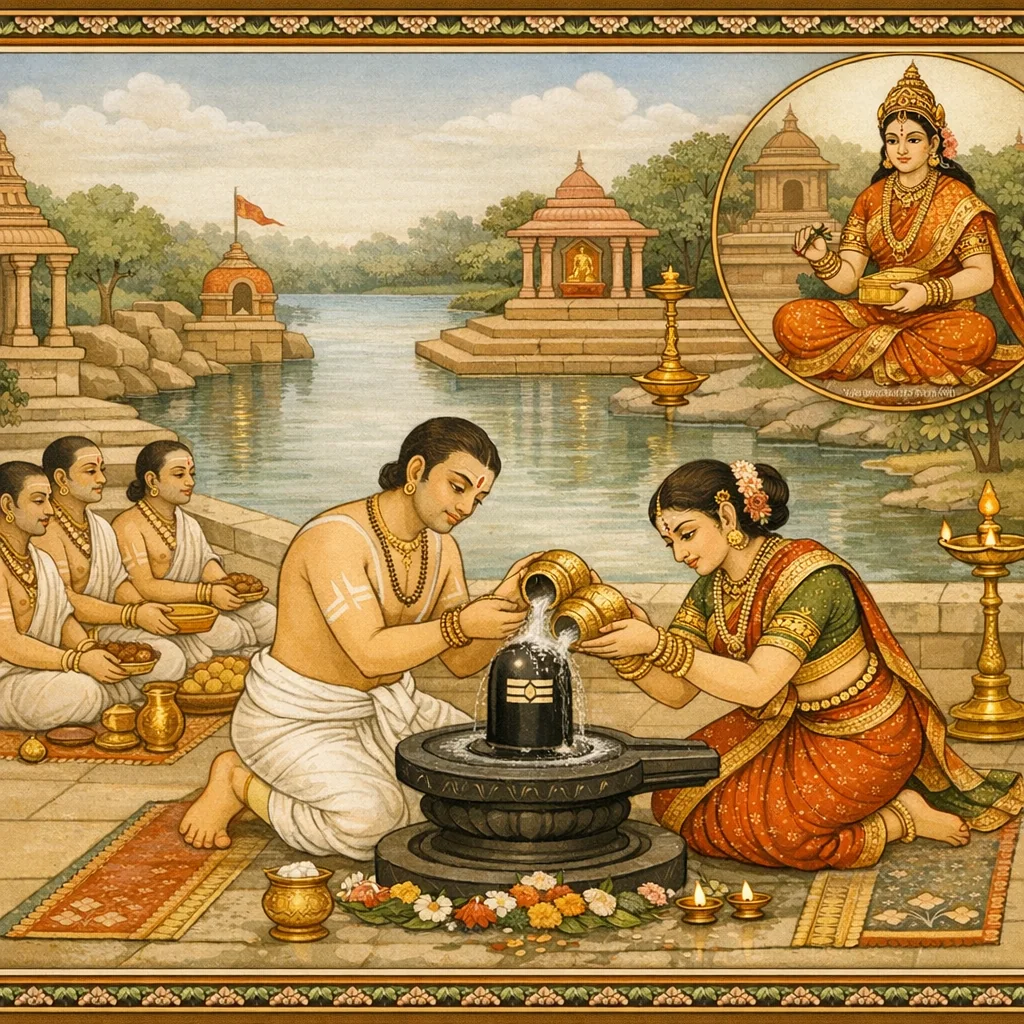
Adhyaya 222
रुक्मवतीश्वरमाहात्म्यवर्णनम् | Rukmavatīśvara Māhātmya (Account of the Glory of Rukmavatīśvara)
This adhyāya is a brief theological and ritual instruction spoken in divine voice (“Īśvara said”). It points to a liṅga established by Rukmavatī and proclaims its glory as universally pacifying—destroying sins and granting worshippers the results they desire. It then lays down a practical pilgrimage order: bathe at the connected mahātīrtha, carefully perform the liṅga’s ritual bathing and abhiṣeka (samplāvana), and complete the observance with dāna—gifts of wealth to brāhmaṇas as the text’s normative recipients. In this way, place (tīrtha), icon (liṅga), disciplined action (snāna and abhiṣeka), and regulated generosity (dāna) are joined into a single soteriological logic: purification from transgressions and the attainment of aims through devoted practice.
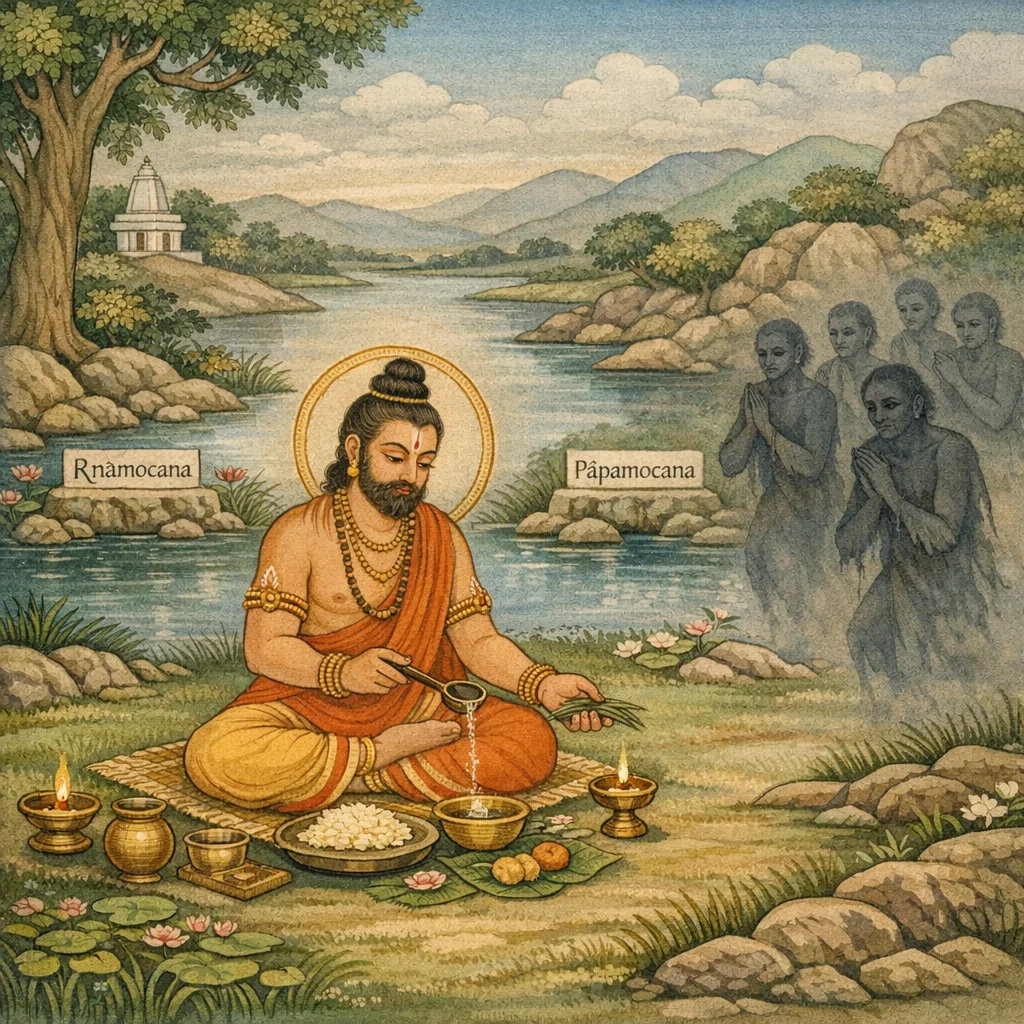
Adhyaya 223
Puruṣottama-tīrtha and Pretatīrtha (Gātrotsarga) Māhātmya — पुरुषोत्तमतीर्थ-प्रेततीर्थ(गात्रोत्सर्ग)माहात्म्य
Īśvara instructs Devī on approaching a liṅga revered in the three worlds and the adjoining tīrtha later called Gātrotsarga (known as Pretatīrtha in the Kṛta-yuga). He describes the sacred site’s inner layout near Ṛṇamocana and Pāpamocana, declaring that death there or ritual immersion brings remission of sins and faults. The chapter then affirms a Vaiṣṇava presence: Puruṣottama is said to abide there, and worship of Nārāyaṇa, Balabhadra, and Rukmiṇī grants release from a triad of sins. Śrāddha rites and piṇḍa offerings are praised for freeing ancestors from preta-status and bestowing long-lasting satisfaction. In a framed legend, the sage Gautama meets five dreadful pretas barred from the holy precinct. They explain their names as moral labels born of past misconduct (refusing requests, betrayal, harmful informing, negligent giving), describe impure food-sources for pretas, and list deeds leading to preta-birth—falsehood, theft, violence against cow or Brāhmaṇa, slander, polluting waters, and neglecting rites—along with practices that prevent it: pilgrimage, deity worship, devotion to Brāhmaṇas, scriptural listening, and service to the learned. Gautama performs individualized śrāddha to liberate them; the fifth, Paryuṣita, requires an additional śrāddha at uttarāyaṇa (the northern solstice). The freed being grants a boon that the place will be famed as Pretatīrtha and that descendants of those who perform śrāddha there will not fall into preta-existence; the phalaśruti concludes that hearing and visiting yield vast sacrificial merit.
Adhyaya 224
इन्द्रेश्वरमाहात्म्यवर्णनम् (Indreśvara Māhātmya: The Glory of Indra’s Liṅga)
This adhyāya gives a theological and ritual account in which Īśvara speaks to Devī and points to a liṅga established by Indra to the south of Puruṣottama, renowned as “Pāpamocana” (the remover of sin). It recalls Indra’s slaying of Vṛtra and the ensuing burden of brahmahatyā-like impurity, made visible through bodily discoloration and a foul odor that diminishes vitality and radiance. Sages and divine beings, including Nārada, counsel Indra to go to Prabhāsa, praised as a pāpa-hara kṣetra. There Indra installs and worships the liṅga of the trident-bearing Lord with incense, fragrance, and unguents; the expiatory power is shown by his transformation as the odor and discoloration cease and his form becomes excellent. Indra proclaims an enduring boon: whoever worships this liṅga with devotion attains the destruction of grave sins, even brahmahatyā. The chapter ends with practical guidance—gift of a cow (go-dāna) to a Veda-versed brāhmaṇa and performance of śrāddha at the site—as supportive acts for removing brahmahatyā-related affliction.
Adhyaya 225
Narakeśvara-darśana and the Catalogue of Narakas (Ethical-Theological Discourse)
Īśvara points out a sacred northern site connected with Narakeśvara, praised as a sin-destroying liṅga, and then relates an exemplum from Mathurā. A brāhmaṇa named Devaśarman (of Agastya-gotra), oppressed by poverty, is caught in a bureaucratic mistake when Yama’s messenger is sent to seize a different Devaśarman. Yama corrects the error and declares his office as Dharma-rāja: death does not come before the proper time, even amid injury, and no being dies “out of season.” The brāhmaṇa asks for a technical account of the visible hell-realms (narakas): their number and the karmic causes that lead to them. Yama enumerates the narakas (said to be twenty-one) and links them to ethical breaches—betrayal of trust, false testimony, harsh and deceitful speech, adultery, theft, harming vow-keepers, violence toward cows, hostility to devas and brāhmaṇas, misappropriating temple/brāhmaṇa property, and other social-religious transgressions. The discourse culminates in a preventive soteriology: Yama states that one who reaches Prabhāsa and devotionally beholds Narakeśvara will not behold naraka. The liṅga is said to have been established by Yama through Śiva-bhakti and is to be preserved as a guarded teaching. The chapter closes with ritual application and phalaśruti: lifelong worship brings “supreme attainment”; śrāddha on Kṛṣṇa Caturdaśī in Āśvayuja yields Aśvamedha-like merit; and gifting a black deer-skin to a Veda-knowing brāhmaṇa grants heavenly honor in proportion to the number of sesame seeds (tila).
Adhyaya 226
मेघेश्वरमाहात्म्यवर्णनम् | Meghēśvara Māhātmya (Glorification of Meghēśvara)
This adhyāya conveys Īśvara’s instruction regarding a shrine called Meghēśvara, located in the earlier part of the kṣetra toward the nairṛta (southwest). The place is praised as a remover of sin (pāpa-mocana) and a destroyer of grave transgressions (sarva-pātaka-nāśana). The discourse then turns to a practical communal crisis—the fear of drought and absence of rain (anāvṛṣṭi-bhaya)—and prescribes a pacificatory rite (śānti) to be performed there. Learned brāhmaṇas are to conduct the śānti, and the earth is to be ritually consecrated with water (udaka) in the vāruṇī manner associated with Varuṇa, indicating a rain-invoking and order-restoring ceremony. It further declares that where the liṅga “established with clouds” is worshiped regularly, the fear of drought does not arise. Thus Meghēśvara is presented as a sacred assurance of ecological and social stability through disciplined devotion.
Adhyaya 227
बलभद्रेश्वरमाहात्म्य (Glory of Balabhadreśvara Liṅga)
In this chapter, Īśvara instructs Devī to proceed to the liṅga established by Balabhadra. This liṅga is praised as a remover of great sin (mahāpāpa-hara) and as a “mahāliṅga” bestowing the great fruit of spiritual accomplishment (mahāsiddhi-phala); its installation is explicitly credited to Balabhadra, performed according to proper rite (vidhinā) for the sake of purification from sin (pāpa-śuddhi). A devotional procedure is then set forth: worship with sequential offerings such as fragrance and flowers (gandha-puṣpādi). Observed during the third Revati-yoga, the devotee is said to attain “yogeśa-pada,” an exalted yogic state. The colophon identifies this as the 227th chapter of the first section (Prabhāsakṣetramāhātmya) within the Prabhāsa Khaṇḍa of the Skanda Mahāpurāṇa.
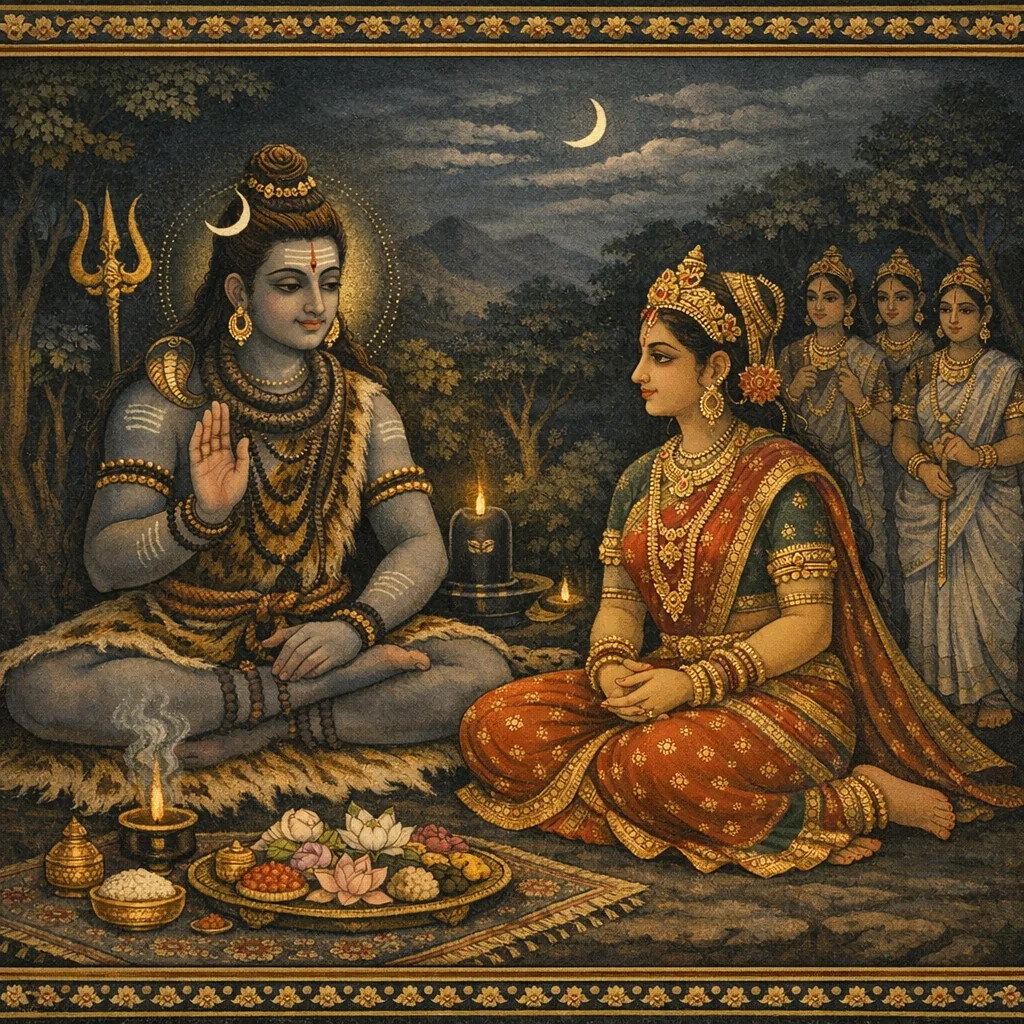
Adhyaya 228
भैरवेश-मातृस्थान-विधानम् | Rite of Bhairaveśa at the Supreme Mothers’ Shrine
Chapter 228 records Īśvara’s instruction to Mahādevī, identifying an eminent mātṛ-sthāna (sanctuary of the Mothers) called Bhairaveśa, praised as sarva-bhaya-vināśana, the remover of all fear. The shrine is presented as a potent sacred refuge for devotees. It then sets the ritual timing: on the caturdaśī tithi of the kṛṣṇa-pakṣa, a disciplined, self-controlled practitioner (yatātmavān) should worship with gandha (fragrance), puṣpa (flowers), and excellent bali offerings (tathā uttamaiḥ). The chapter closes with an assurance that the Yoginīs and the Mothers protect the devotee on earth “like a son.” In theme, it unites kṣetra-specific procedure, fear-removal as a religious aim, and self-restraint as the ethical prerequisite for efficacious worship.
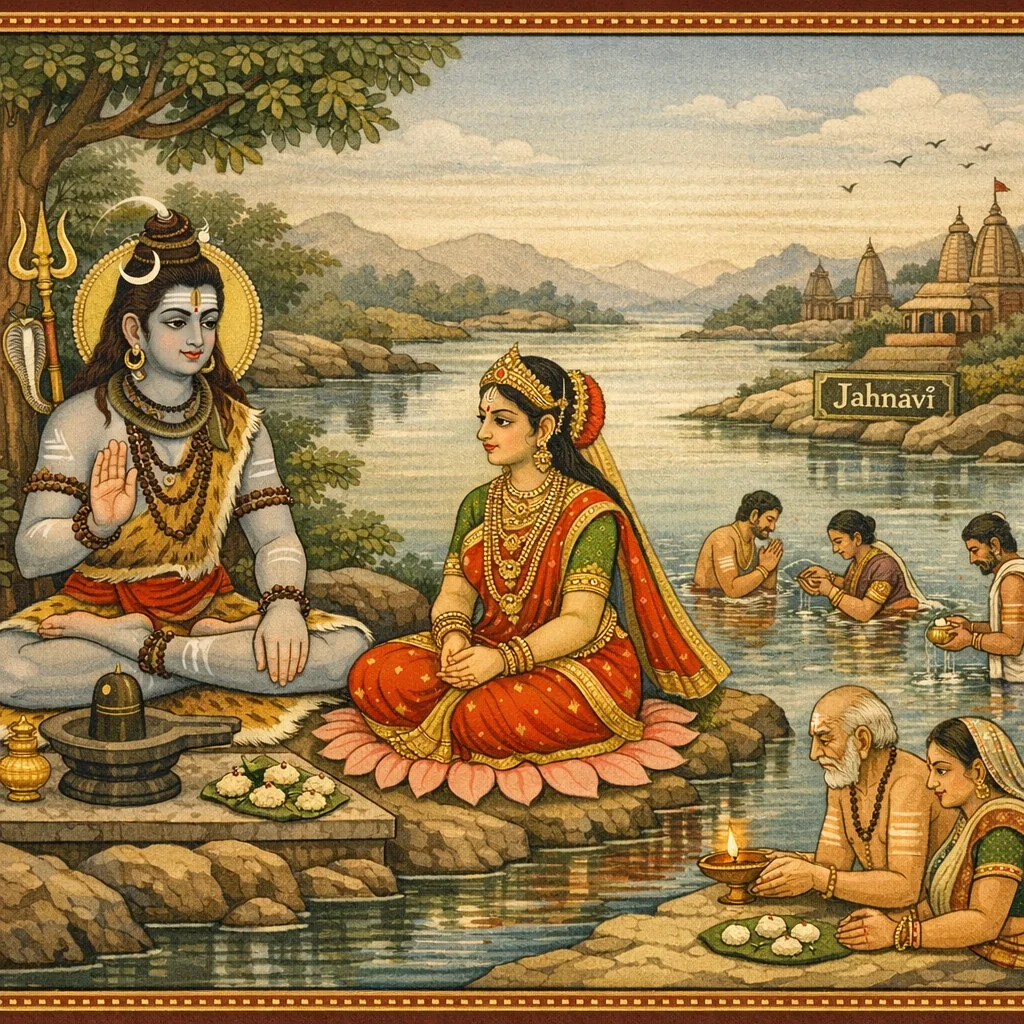
Adhyaya 229
गंगामाहात्म्यवर्णनम् (Gaṅgā-māhātmya: Discourse on the Glory of the Gaṅgā at Prabhāsa)
Chapter 229 records Īśvara’s instruction to Mahādevī, drawing her attention to the tri-path-going Gaṅgā (tripathagāminī) in the Īśānya (northeast) direction. This Gaṅgā is praised as svayaṃbhū, self-manifest, and also as the sacred stream once brought forth from the earth’s depths by Viṣṇu for a saving purpose—connected with the Yādavas and with the universal pacification of sin. A ritual and ethical sequence follows: bathing (snāna) at this place, even when attained through accumulated merit, and performing śrāddha according to proper procedure (vidhāna), grants a state free from remorse over deeds done or left undone. The text then declares an equivalence of merit: the puṇya of gifting the entire cosmos (brahmāṇḍa) is said to be matched by bathing in Jāhnavī’s waters during Kārttikī. Finally, it notes that in Kali-yuga such darśana becomes harder to obtain, thereby heightening the value of snāna–dāna at Prabhāsa in Gaṅgā/Jāhnavī waters.
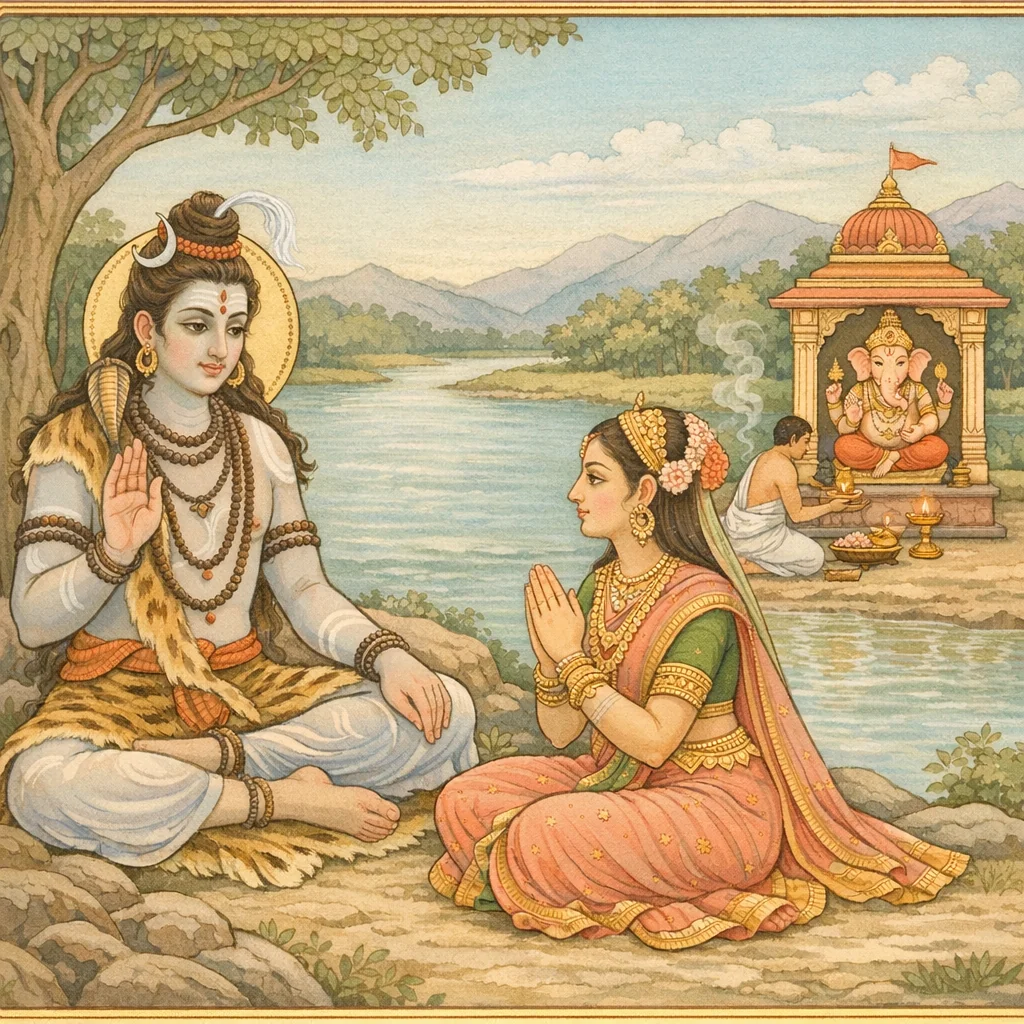
Adhyaya 230
गणपतिमाहात्म्यवर्णनम् | Gaṇapati-Māhātmya (Account of Gaṇeśa’s Glory in Prabhāsa)
Īśvara instructs the Devī about a Gaṇapati beloved of the gods, whom Īśvara Himself has appointed to dwell at Prabhāsa. The deity is said to be situated on the southern side of the Gaṅgā and is portrayed as ever active in safeguarding the sacred kṣetra. A calendrical observance is prescribed: worship on kṛṣṇa-caturdaśī (the 14th lunar day of the dark fortnight) in the month of Māgha. The offerings are given in concise ritual terms—divine modaka as naivedya, along with flowers, incense, and other upacāras performed in proper order. The promised fruit is protective and practical: for the worshiper, no obstacles (vighna) arise, with the assurance explicitly tied to the condition of remaining within or residing in the kṣetra. The chapter ends with a colophon identifying it as the 230th adhyāya of the Prabhāsa Khaṇḍa’s first division, Prabhāsakṣetramāhātmya, titled “Gaṇapati-māhātmya-varṇana.”
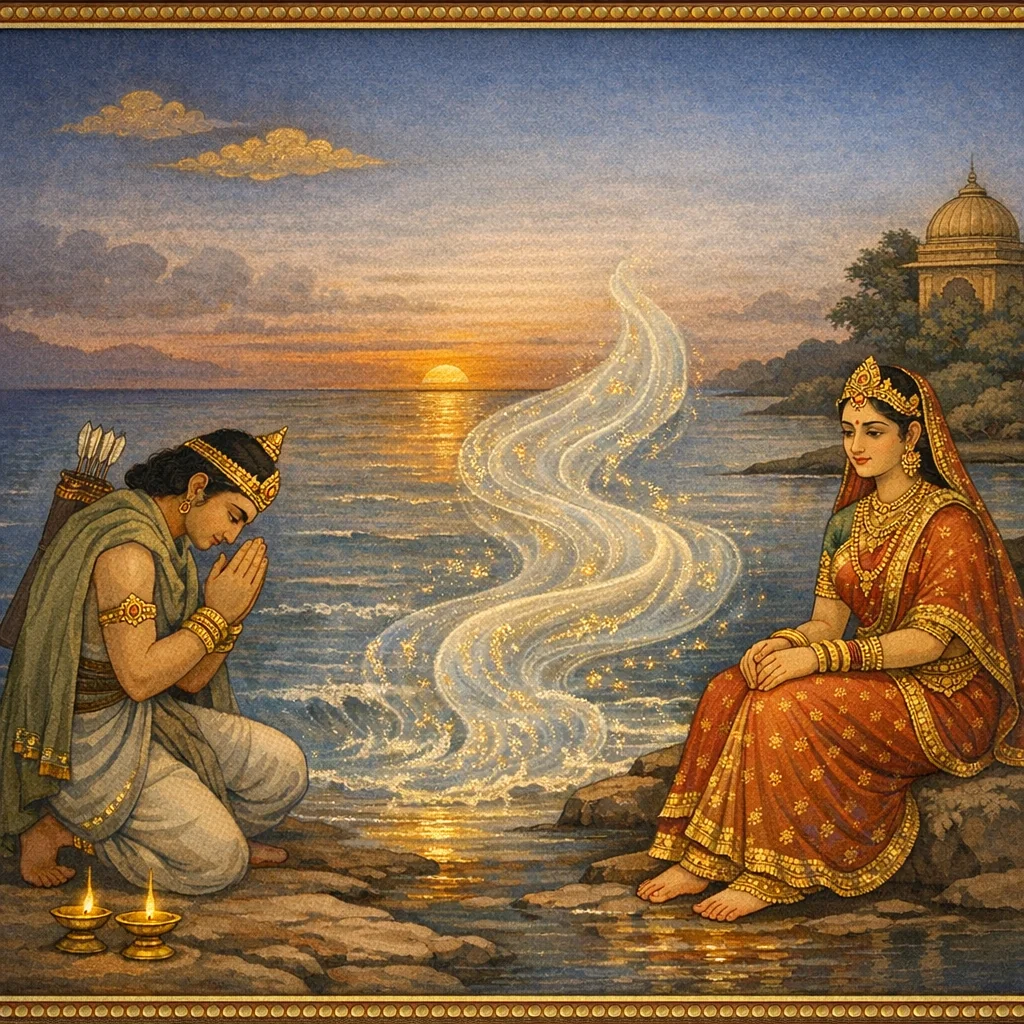
Adhyaya 231
जांबवतीतीर्थमाहात्म्यम् / The Māhātmya of the Jāmbavatī Tīrtha
Īśvara speaks to Devī and points to a sacred locale connected with the Jāmbavatī river, identified with Jāmbavatī herself—remembered in Purāṇic tradition as a beloved consort of Viṣṇu. In a dialogue, Jāmbavatī questions Arjuna about current events; Arjuna, overwhelmed with grief, reports catastrophic outcomes that have struck leading Yādava figures, including Baladeva and Sātyaki, and the wider Yādava community, marking the episode as a moral and historical rupture. On hearing of her husband’s death, Jāmbavatī performs self-immolation on the bank of the Gaṅgā, gathers the cremation ash, and then, through a mythic transformation, becomes a river flowing to the ocean—thereby sanctifying that watercourse as a tīrtha. The chapter declares its fruit: women who bathe there with devotion—and even women in their lineage—are said not to suffer widowhood, while any practitioner, man or woman, who bathes with full effort is promised the supreme spiritual end (paramā gati).
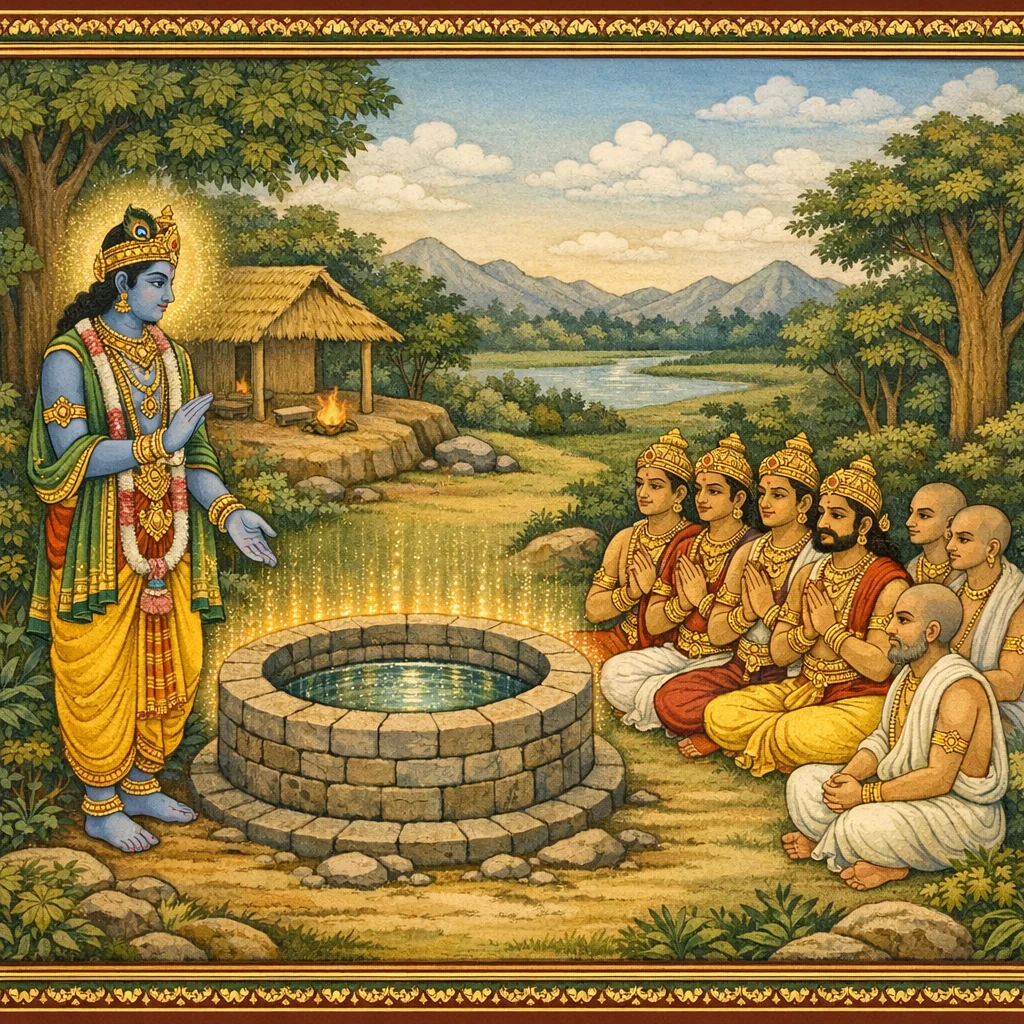
Adhyaya 232
Pāṇḍava-kūpa-pratiṣṭhā and Vaiṣṇava-sānnidhya at Prabhāsa (पाण्डवकूप-प्रसङ्गः)
Chapter 232 is a place-authorizing theological discourse narrated by Īśvara, establishing the sanctity of Prabhāsa. During their forest wandering, the Pāṇḍavas arrive at Prabhāsa and stay for a time near an āśrama in a composed state. A practical ritual difficulty arises: hosting large numbers of brāhmaṇas is hindered because water is far away. At Draupadī’s urging, the Pāṇḍavas dig a well (kūpa) near the āśrama to provide a nearby water-source. The narrative then turns to Kṛṣṇa’s arrival from Dvārakā with Yādava companions, including Pradyumna and Sāmba. In a formal exchange, Kṛṣṇa asks Yudhiṣṭhira what boon he desires. Yudhiṣṭhira requests Kṛṣṇa’s perpetual proximity (nitya-sānnidhya) at the well and proclaims a bhakti-based soteriology: those who bathe there with devotion attain a Vaiṣṇava destination through Kṛṣṇa’s grace. Īśvara affirms the boon, and Kṛṣṇa departs. The chapter concludes with prescriptive phalaśruti: śrāddha performed at that site yields merit like an Aśvamedha; tarpaṇa and snāna grant proportional benefits; special observance on the Jyeṣṭha full moon with Savitrī worship leads to the “supreme state.” For those seeking the full fruit of pilgrimage, go-dāna is recommended.
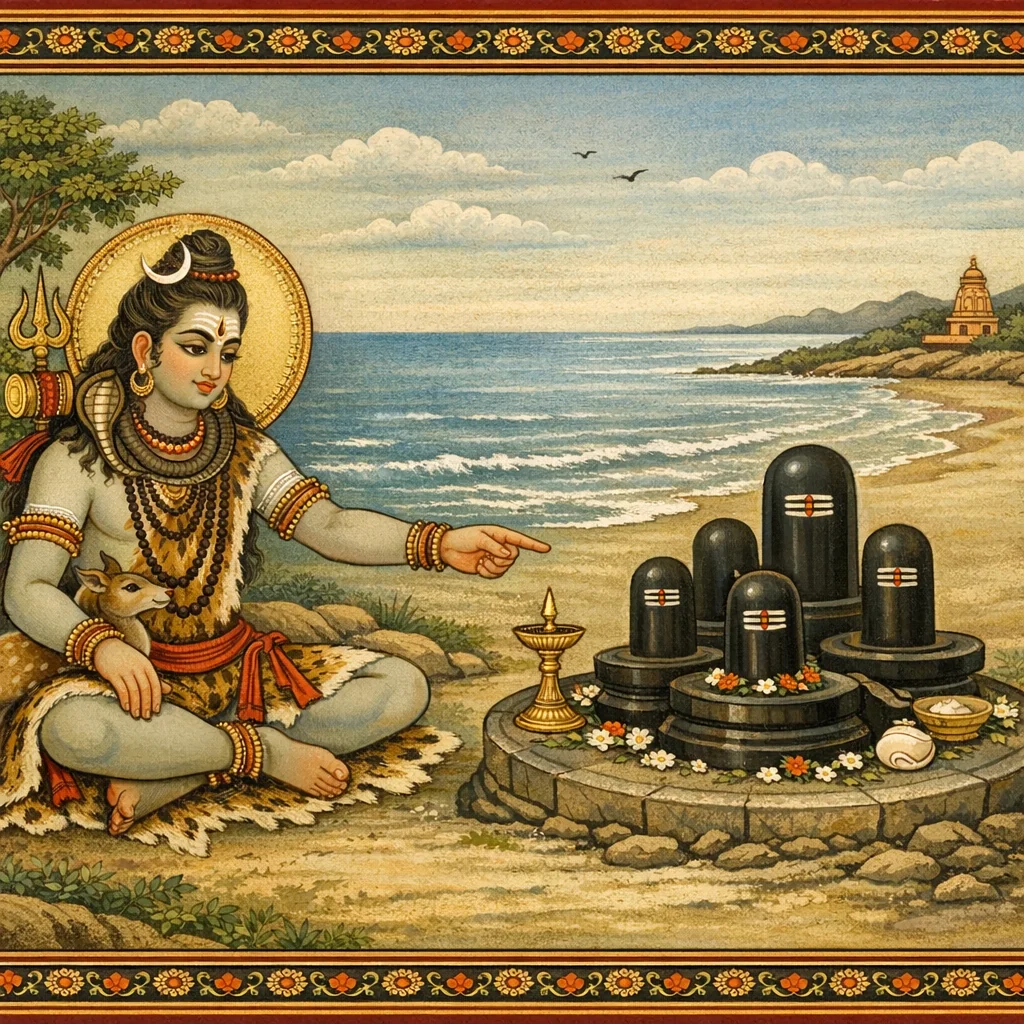
Adhyaya 233
पाण्डवेश्वरमाहात्म्यवर्णनम् (Pandaveśvara Māhātmya—Account of the Glory of Pāṇḍaveśvara)
This adhyāya is a concise theological instruction in which Īśvara speaks to Devī about a cluster of five liṅgas established at Prabhāsa-kṣetra. It declares that these liṅgas were consecrated and firmly installed (pratiṣṭhita) by the great-souled Pāṇḍavas, thereby linking the shrine to epic lineage memory and strengthening the authority of its worship. The discourse then states its phalaśruti plainly: whoever worships these liṅgas with devotion (bhakti) is freed from sins (pātaka). The chapter’s focus is the saving efficacy of bhakti-infused liṅga-pūjā at an authenticated sacred site, with the Pāṇḍava association serving as legitimizing sacred history rather than extended narrative action.
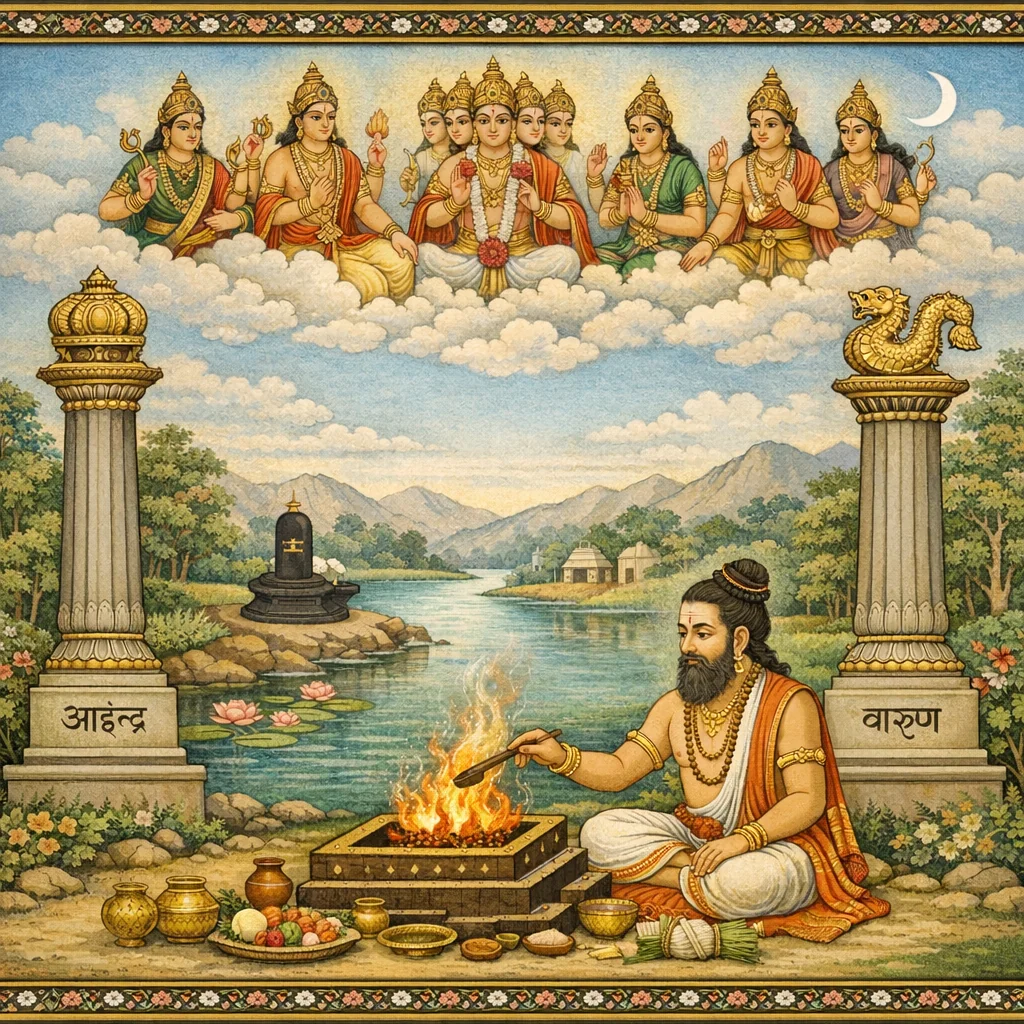
Adhyaya 234
दशाश्वमेधिकतीर्थमाहात्म्य (Māhātmya of the Daśāśvamedhika Tīrtha)
Chapter 234 is a māhātmya of the tīrtha called Daśāśvamedhika, as Īśvara recounts to Devī its origin and merits. The pilgrim is directed to a “three-world-renowned” spot that destroys even great sins. King Bharata is said to have performed ten aśvamedha sacrifices there, recognizing the place as unsurpassed. Pleased by the sacrificial offerings, the devas grant him a boon; Bharata asks that any devotee who bathes there receive the auspicious fruit equal to ten aśvamedhas. The devas affirm the tīrtha’s name and fame on earth, and Īśvara declares that from then on it is widely known as Daśāśvamedhika, powerful for the eradication of sins. The site is located between the Āindra and Vāruṇa markers, identified as a Śiva-kṣetra and a station within great clusters of tīrthas. The phalaśruti extends beyond death: dying there brings joy in Śiva’s world, and even beings in non-human births are said to rise to a higher state. Ancestor offerings of tila-udaka satisfy the pitṛs until cosmic dissolution. The chapter also recalls Brahmā’s earlier sacrifices, Indra’s attainment of devarāja status through worship there, and Kartavīrya’s hundred sacrifices, concluding with apunarbhava (non-return) for those who die there and heavenly exaltation through vṛṣotsarga in proportion to a bull’s hairs.
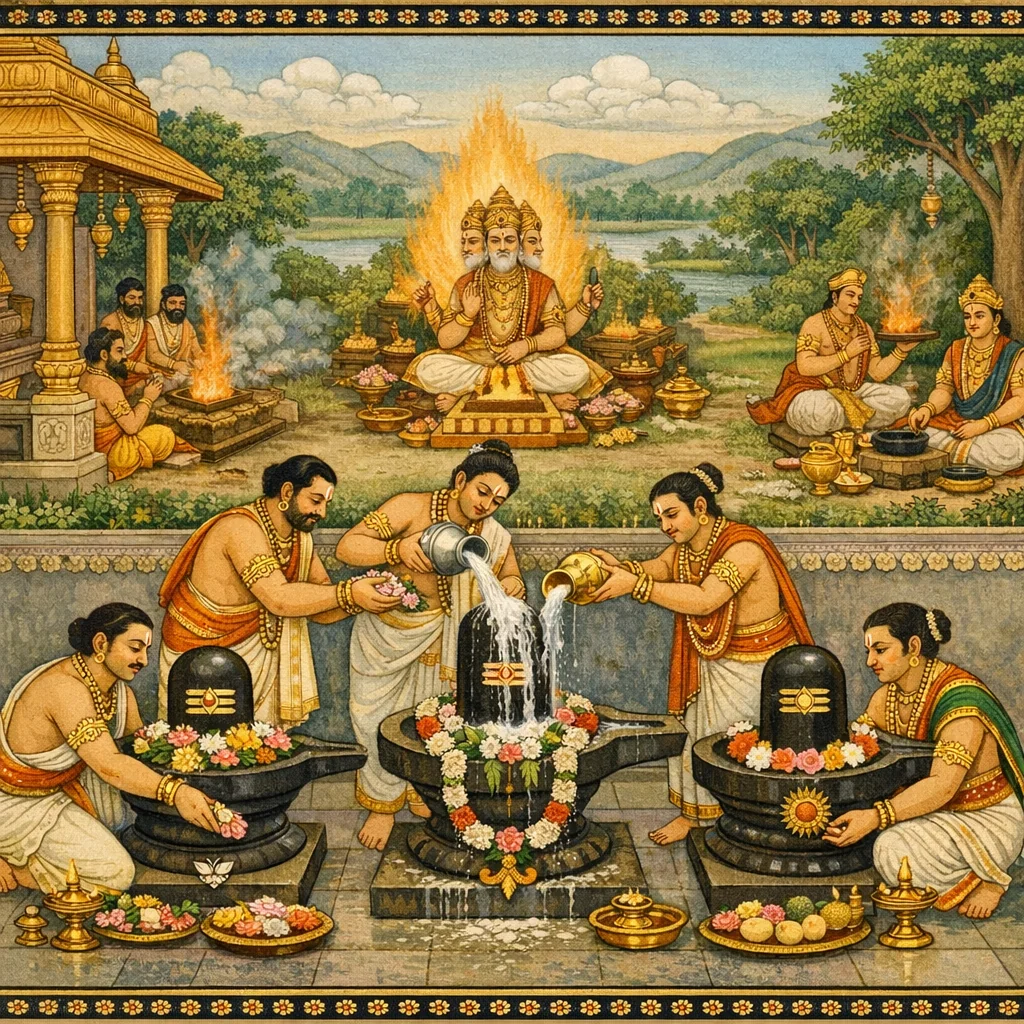
Adhyaya 235
Śatamedhādi Liṅgatraya Māhātmya (Glory of the Three Liṅgas: Śatamedha, Sahasramedha, Koṭimedha)
In this adhyāya, Īśvara instructs Devī to behold an “unsurpassed triad of liṅgas” in Prabhāsa-kṣetra, each bearing a sacrificial epithet and set in its proper direction. The southern liṅga is called Śatamedha, said to bestow the fruit of a hundred sacrifices and linked to Kārtavīrya’s earlier performance of a hundred yajñas; its installation is declared to destroy every burden of pāpa. The central liṅga is famed as Koṭimedha, connected with Brahmā’s innumerable (koṭi) excellent sacrifices and with the establishment of Mahādeva as “Śaṅkara, benefactor of worlds.” The northern liṅga is Sahasrakratu (Sahasramedha), associated with Śakra/Indra, who is said to have performed a thousand rites and installed the great liṅga as the primordial divinity of the gods. The chapter further describes worship with gandha and puṣpa, and abhiṣeka with pañcāmṛta and water, affirming that devotees gain fruits corresponding to the liṅga-names. It recommends go-dāna for those seeking the full pilgrimage reward, and concludes that “ten million tīrthas” abide there, with the tri-liṅga sanctuary at the center praised as universally sin-destroying.
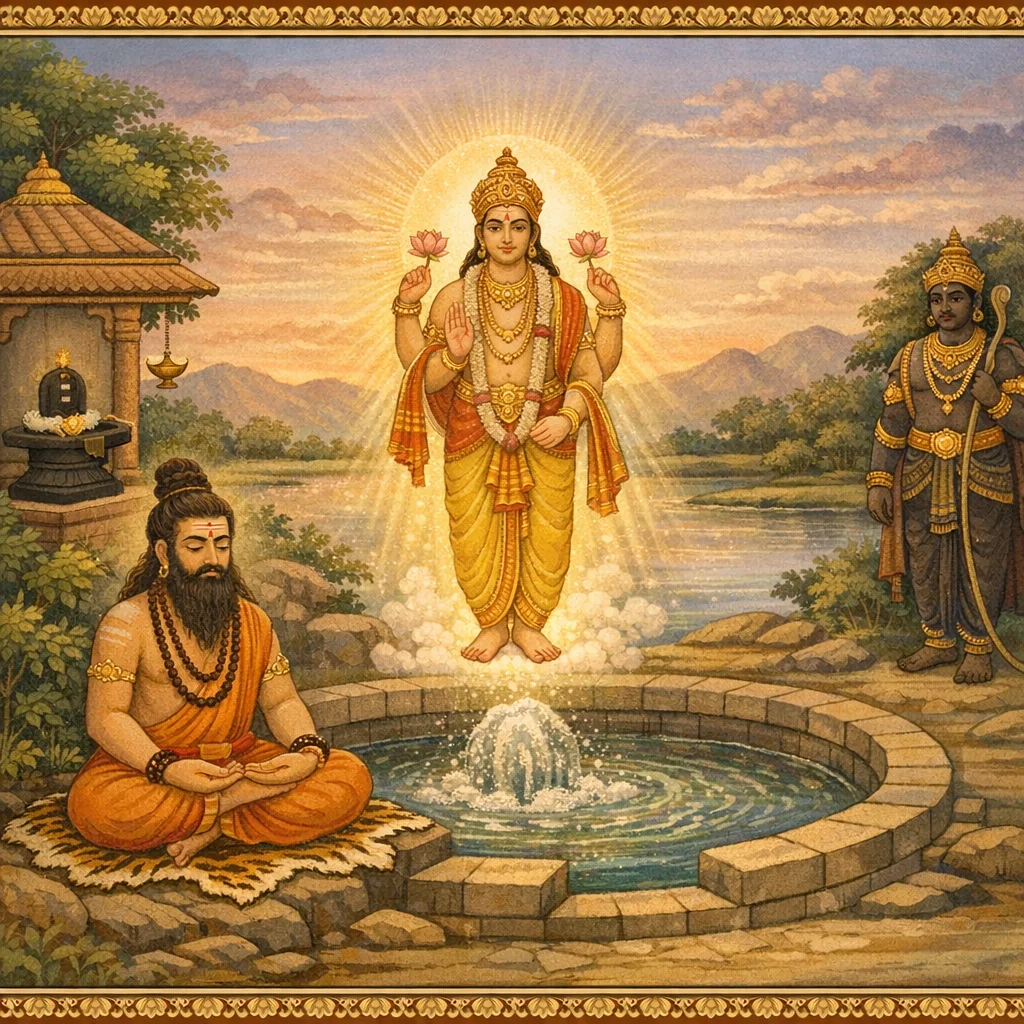
Adhyaya 236
दुर्वासादित्यमाहात्म्यवर्णनम् | The Māhātmya of Durvāsā-Āditya (Sūrya) at Prabhāsa
Adhyāya 236 recounts the founding and praised efficacy of the Durvāsā-Āditya (Sūrya) shrine within Prabhāsa-kṣetra. Pilgrims are instructed to approach this holy place where the sage Durvāsas performed a thousand-year tapas, marked by strict restraint and worship of Sūrya. Sūrya appears and offers a boon; Durvāsas asks that the deity abide there perpetually as long as the earth endures, that the site gain renown, and that divine proximity remain with the installed image. Sūrya grants the request. Sūrya then summons Yamunā (as a river-form) and Dharma-rāja Yama to take part in the sacred order of the kṣetra, assigning protective and regulatory roles—especially the safeguarding of devotees and householding brāhmaṇas. The chapter situates the sacred landscape: Yamunā’s emergence by an underground course, mention of a kuṇḍa and the “Dundubhi”/Kṣetrapāla connection, and the ritual fruits of bathing and offerings to ancestors. The latter portion prescribes calendrical observances: worship of Durvāsā-arka on Māgha śukla saptamī, bathing in the Mādhava month with Sūrya-pūjā, and recitation of Sūrya’s thousand names near the shrine. Its phalaśruti promises multiplied merit, relief from grave faults, fulfillment of aims, protection, health, and prosperity. The chapter concludes with boundary and eligibility rules, defining the sacred extent as half a gavyūti and excluding those devoid of Sūrya-bhakti.
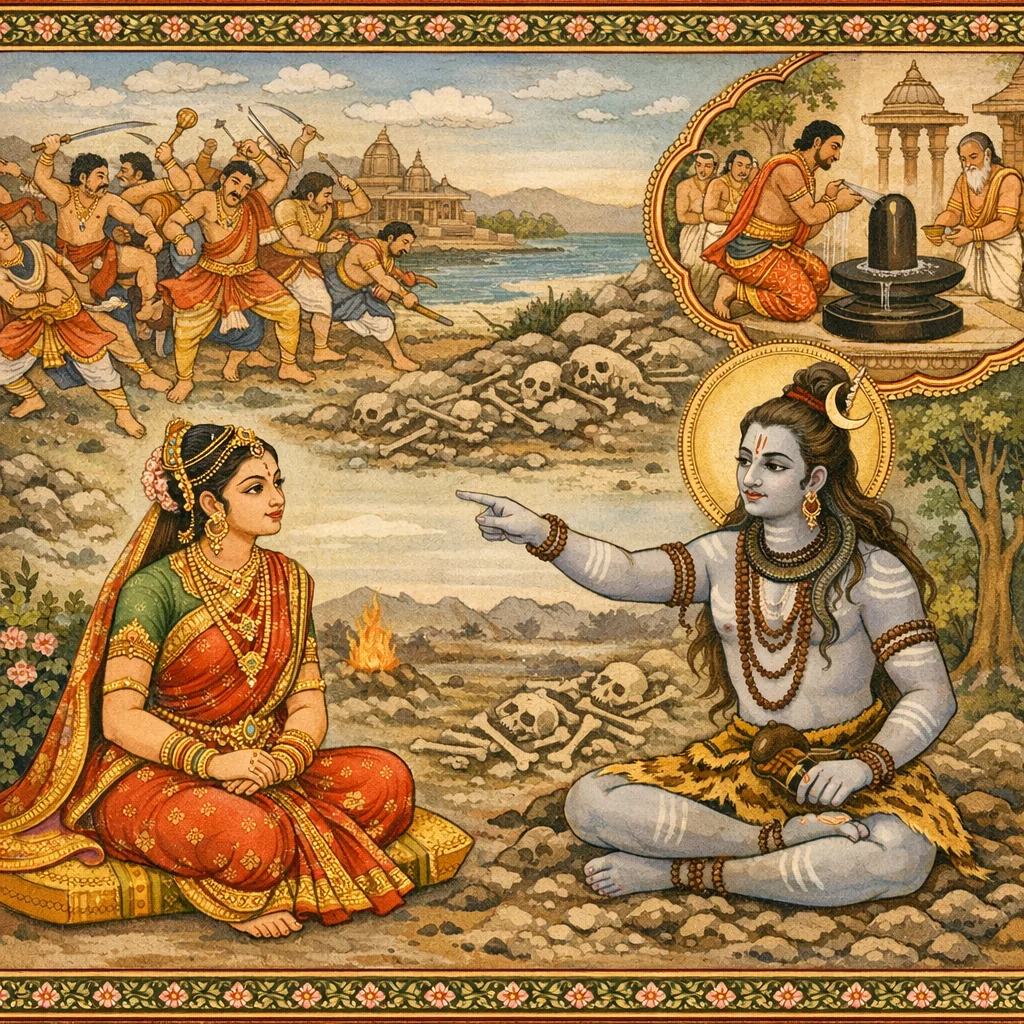
Adhyaya 237
यादवस्थलोत्पत्तौ वज्रेश्वरमाहात्म्यवर्णनम् | Origin of Yādava-sthala and the Māhātmya of Vajreśvara
Chapter 237 unfolds as a sacred Śiva–Devī dialogue that anchors epic aftermath in the holy landscape of Prabhāsa. Īśvara points Devī to Yādava-sthala, the ground where vast Yādava hosts perished, and Devī asks why the Vṛṣṇis, Andhakas, and Bhojas were destroyed before Vāsudeva’s eyes. Īśvara recounts the curse: Sāmba, in disguise, mocks sages such as Viśvāmitra, Kaṇva, and Nārada; the offended ṛṣis declare that Sāmba will “produce” an iron muśala (club) for the clan’s ruin. Though the wording seems to spare Rāma and Janārdana at once, it still signals the inescapable decree of Kāla (Time). The muśala is born, ground to powder, and cast into the sea, yet ominous portents fill Dvārakā—social inversion, uncanny sounds, animal anomalies, ritual failures, and terrifying dreams—serving as moral warning. Kṛṣṇa then commands a pilgrimage to Prabhāsa. The Yādavas arrive, and amid intoxication their inner enmity flares; violence erupts (notably between Sātyaki and Kṛtavarman) and ends in mutual slaughter with reeds transformed into vajra-like clubs—understood as the working of the sages’ brahma-daṇḍa and Kāla. Cremation grounds and heaps of bones mark the terrain as “Yādava-sthala.” In the closing episode, Vajra, a surviving heir, comes to Prabhāsa, installs the Vajreśvara-liṅga, and attains siddhi through tapas under Nārada’s guidance. The chapter concludes with rites and fruit: bathing (e.g., in Jāmbavatī-jala), worship of Vajreśvara, feeding brāhmaṇas, and a symbolic ṣaṭkoṇa offering, yielding pilgrimage merit likened to great gifts such as the fruit of donating a thousand cows.
Adhyaya 238
Hiraṇyā-nadī-māhātmya (हिरण्यानदीमाहात्म्य) — The Glory of the Hiraṇyā River
This adhyāya conveys Īśvara’s instruction on the Hiraṇyā River, praised as sacred water that purifies and destroys sin (pāpanāśinī), generates merit (puṇyā), fulfills all aims (sarvakāmapradā), and ends poverty (dāridryāntakāriṇī). It sets out a compact pilgrimage discipline: approach the river, bathe according to the prescribed rite (vidhānena snāna), perform piṇḍodaka-related offerings for the ancestors, and then practice regulated generosity and hospitality. Done correctly, it grants the pilgrim imperishable realms (akṣayān lokān) and uplifts the ancestors from sin. A distinctive theme of merit-equivalence appears: feeding even one qualified brāhmaṇa is rhetorically likened to feeding vast numbers of dvija, stressing intention, the recipient’s worthiness, and ritual context. The chapter also enjoins gifting a “golden chariot” (hemaratha-dāna) to a Veda-proficient brāhmaṇa, dedicated to Śiva, with fruit compared to the merit of extensive pilgrimages (yātrā).
Adhyaya 239
नागरादित्यमाहात्म्यम् | The Māhātmya of Nāgarāditya (Nagarabhāskara)
Īśvara tells Devī of the holiness of a solar icon called Nāgarāditya/Nāgarabhāskara, set near the sacred waters of Hiranyā. He first relates its origin: Satrājit, a Yādava king, undertakes a great vow and austerities to please Bhāskara (the Sun) and receives the Syamantaka jewel, which yields gold each day. When asked to choose a boon, Satrājit requests the Sun’s perpetual presence in the local hermitage; a radiant image is installed, and Brahmins and the city’s people are charged with guarding it—hence the shrine’s name, Nāgarāditya. The phalaśruti then proclaims that mere darśana of Nāgarārka equals major gifts at Prayāga. The deity is praised as the remover of poverty, sorrow, and disease, the true “physician” of afflictions. Prescribed observances include bathing with Hiranyā-water, worship of the icon, and keeping the bright-fortnight Saptamī connected with solar transition (saṅkramaṇa), when the efficacy of all rites is multiplied. The chapter ends with a compact 21-name stotra of the Sun (e.g., Vikartana, Vivasvān, Mārtaṇḍa, Bhāskara, Ravi), called a “stavarāja” that increases bodily health; recited at dawn and sunset, it grants desired fruits and culminates in reaching Bhāskara’s abode.
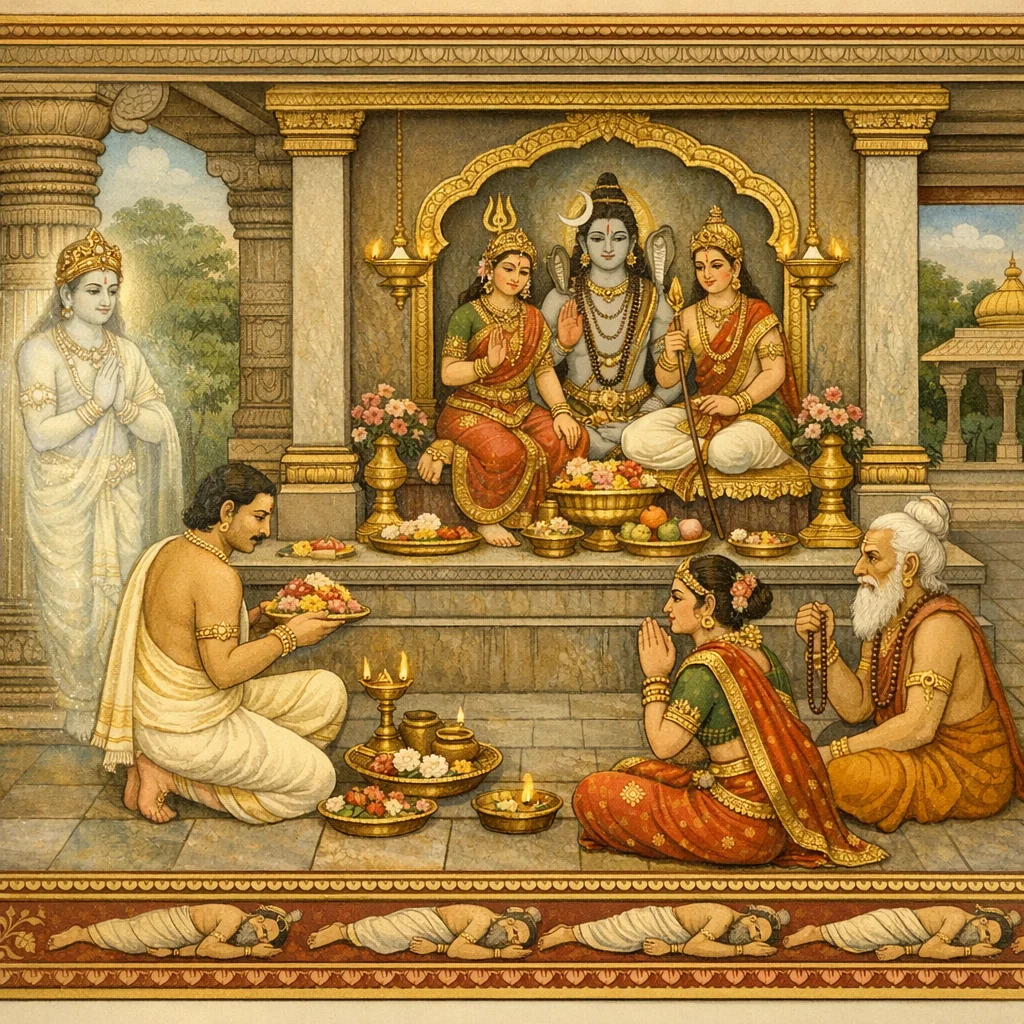
Adhyaya 240
बलभद्र-सुभद्रा-कृष्ण-माहात्म्यवर्णनम् (The Māhātmya of Balabhadra, Subhadrā, and Kṛṣṇa)
This adhyāya is spoken in an Īśvara-centered voice (“Īśvara uvāca”), turning devotion toward the triad of Balabhadra, Subhadrā, and Kṛṣṇa, praised as spiritually potent. Kṛṣṇa is explicitly hailed as “sarva-pātaka-nāśana,” the destroyer of all sins. Their greatness is then grounded in kalpa-memory: in a former cosmic cycle Hari relinquished the body at this very place, and in the present kalpa a similar gātrotsarga (bodily relinquishment) is remembered. The chapter concludes with a clear pilgrimage fruit: those who perform pūjā to Balabhadra, Subhadrā, and Kṛṣṇa in the presence (saṃnidhi) of Nāgarāditya are declared svarga-gāmin—destined for heaven.
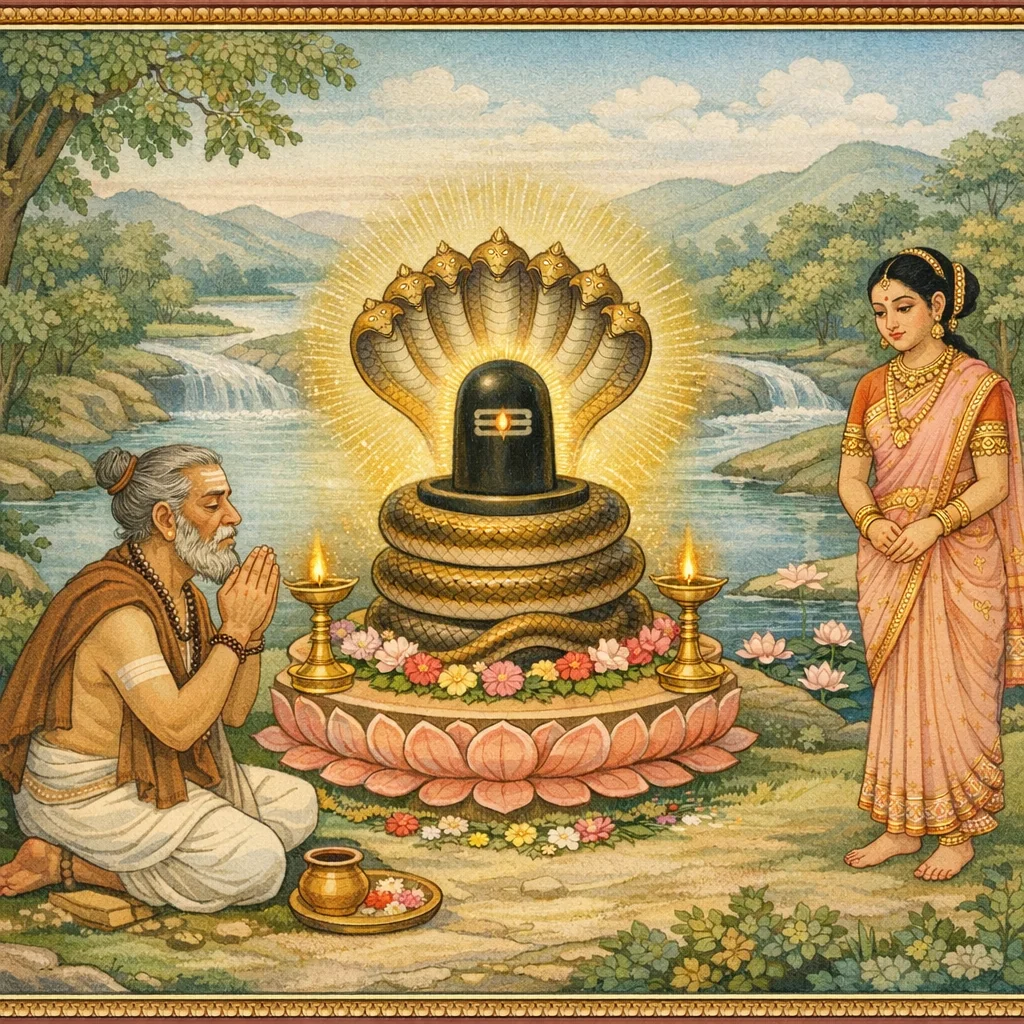
Adhyaya 241
शेषमाहात्म्यवर्णनम् (The Māhātmya of Śeṣa at Mitra-vana)
Chapter 241 records Īśvara’s account of a shrine in Prabhāsa-kṣetra connected with Balabhadra, identified as Śeṣa in serpent form. The place lies within Mitra-vana, said to extend for two gavyūtis, and is linked to a tīrtha at a tri-saṅgama reached by the mythic “pātāla-path.” The shrine is described as liṅgākāra and of great radiance (mahāprabha), renowned as “Śeṣa” together with Revatī. A local legend follows: a siddha named Jarā, a weaver (kaulika) and, in the narrative idiom, a “slayer of Viṣṇu,” attains dissolution (laya) at this spot; thereafter the site becomes widely known by the name Śeṣa. Worship is prescribed on Caitra-śukla-trayodaśī (the bright thirteenth of Caitra), promising household welfare—children and grandchildren, livestock—and a year of well-being, along with protection for children from eruptive illnesses such as masūrikā and visphoṭaka. The chapter concludes by noting the shrine’s popularity among all social groups and declaring that Śeṣa is quickly pleased by offerings of animals, flowers, and varied bali, with the theological assurance that he destroys accumulated sin.
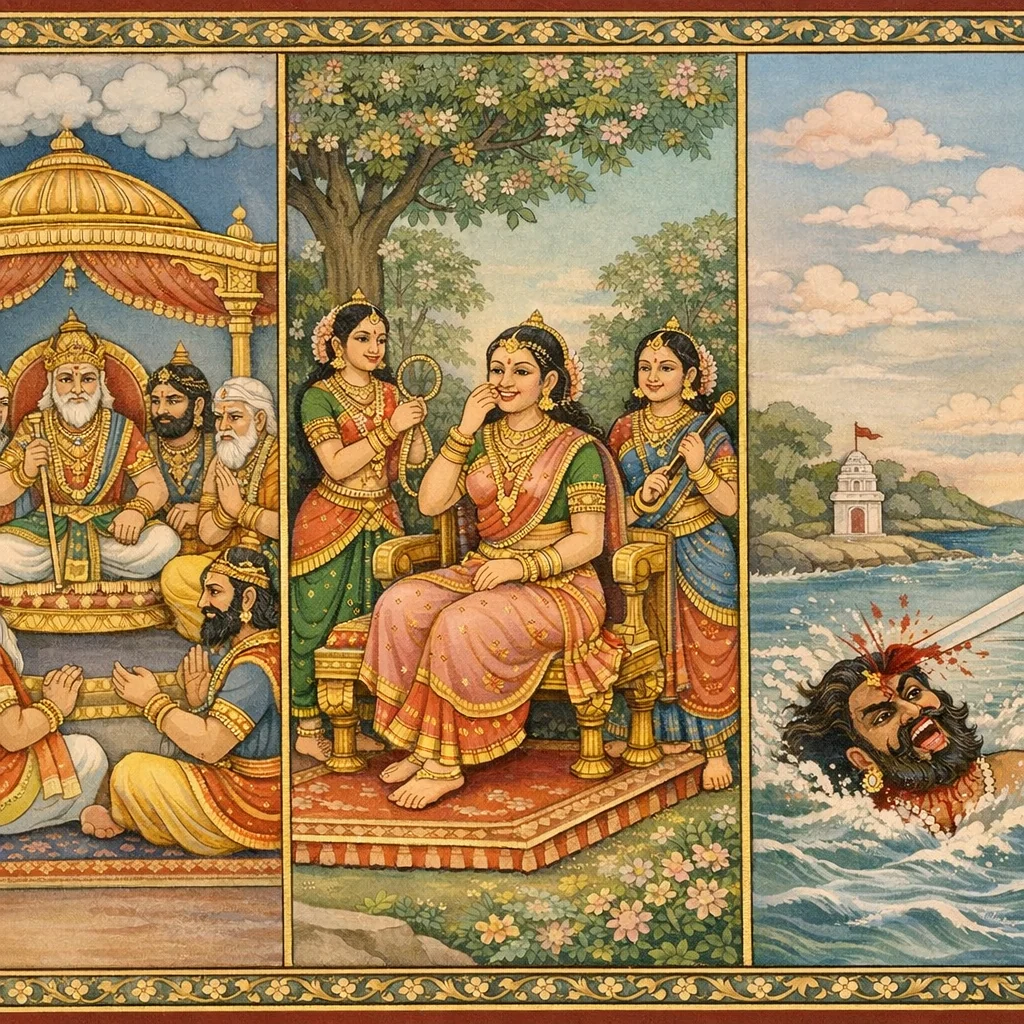
Adhyaya 242
कुमारीमाहात्म्यवर्णनम् (Kumārī Māhātmya—The Glory of the Maiden Goddess)
Īśvara tells Mahādevī of a protective episode near the sacred seat of the Maiden-Goddess, Devī Kumārikā, marking the eastern direction as a cue within the holy landscape. In a former aeon (Rathantara kalpa) the great asura Ruru rises as a terror to the worlds, harassing devas and gandharvas, slaying ascetics and dharma-practitioners, and bringing about the decline of svādhyāya, the vaṣaṭ calls, and the celebrations of yajña upon the earth. Devas and great ṛṣis deliberate on how to kill him; from their collective bodily emanation (sweat) a lotus-eyed divine maiden manifests. Asked to end the crisis, she laughs, and from that laughter arise attendant maidens bearing pāśa and aṅkuśa, who rout Ruru’s forces in battle. Ruru casts a dark (tāmasī) illusion, but the Devī remains unconfused; she pierces him with śakti, and when he flees toward the sea she pursues, enters the oceanic realm, and beheads him with a sword, emerging as Cārma-Muṇḍa-dharā, bearing skin and severed head. Returning to Prabhāsa with a radiant, multi-formed retinue, she receives hymns from astonished devas who praise her as Cāmuṇḍā, Kālarātri, Mahāmāyā, Mahākālī/Kālikā, and other fierce, protective names. She grants boons: the devas ask that she remain established in this kṣetra, that her stotra bestow fruits on reciters, and that devotees who hear her origin with bhakti attain purification and the higher goal (parā gati). Worship in the bright fortnight—especially on Navamī in the month of Āśvina—is declared auspicious; the chapter ends with the Devī abiding there and the devas returning to heaven, their enemies defeated.
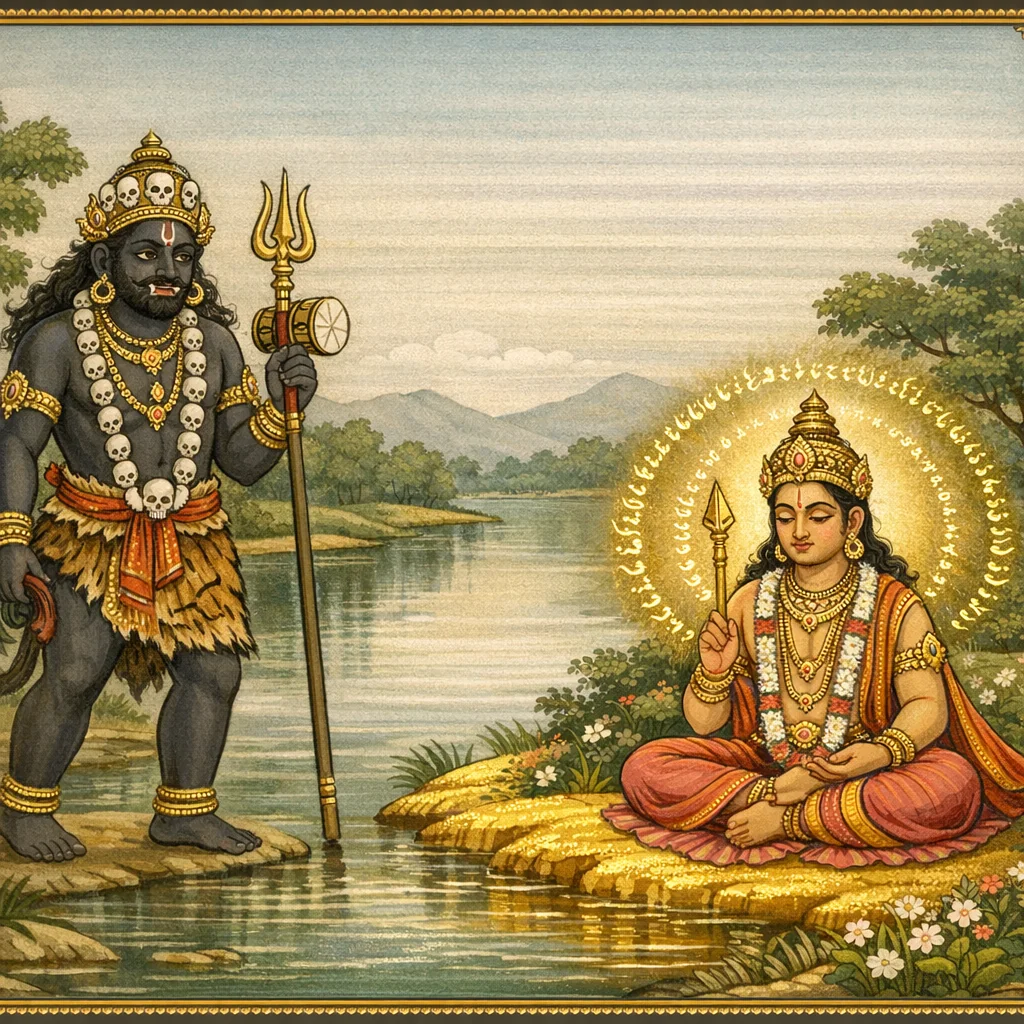
Adhyaya 243
मंत्रावलिक्षेत्रपालमाहात्म्यवर्णनम् / The Māhātmya of the Mantrāvalī Kṣetrapāla
In this chapter, Īśvara instructs Devī on how to approach a mighty kṣetrapāla (guardian of the sacred precinct) stationed in the Īśāna, the northeastern direction, and described as adorned with a mantramālā, a garland-like series of mantras. He is said to stand in protection near a golden bank (hiraṇya-taṭa), safeguarding a sub-region called hīraka-kṣetra, a “diamond” or jewel-like field. The text then prescribes a calendrical observance: on trayodaśī, the thirteenth lunar day of the dark fortnight (kṛṣṇa-pakṣa), the worshipper should honor the kṣetrapāla with fragrances, flowers, offerings, and bali (ritual presentations/oblations). The concluding phalaśruti declares that, when properly worshipped, the deity becomes sarva-kāma-prada, the giver of all desired aims, presenting this devotion as both protective and wish-fulfilling within the ethical discipline of tīrtha practice.
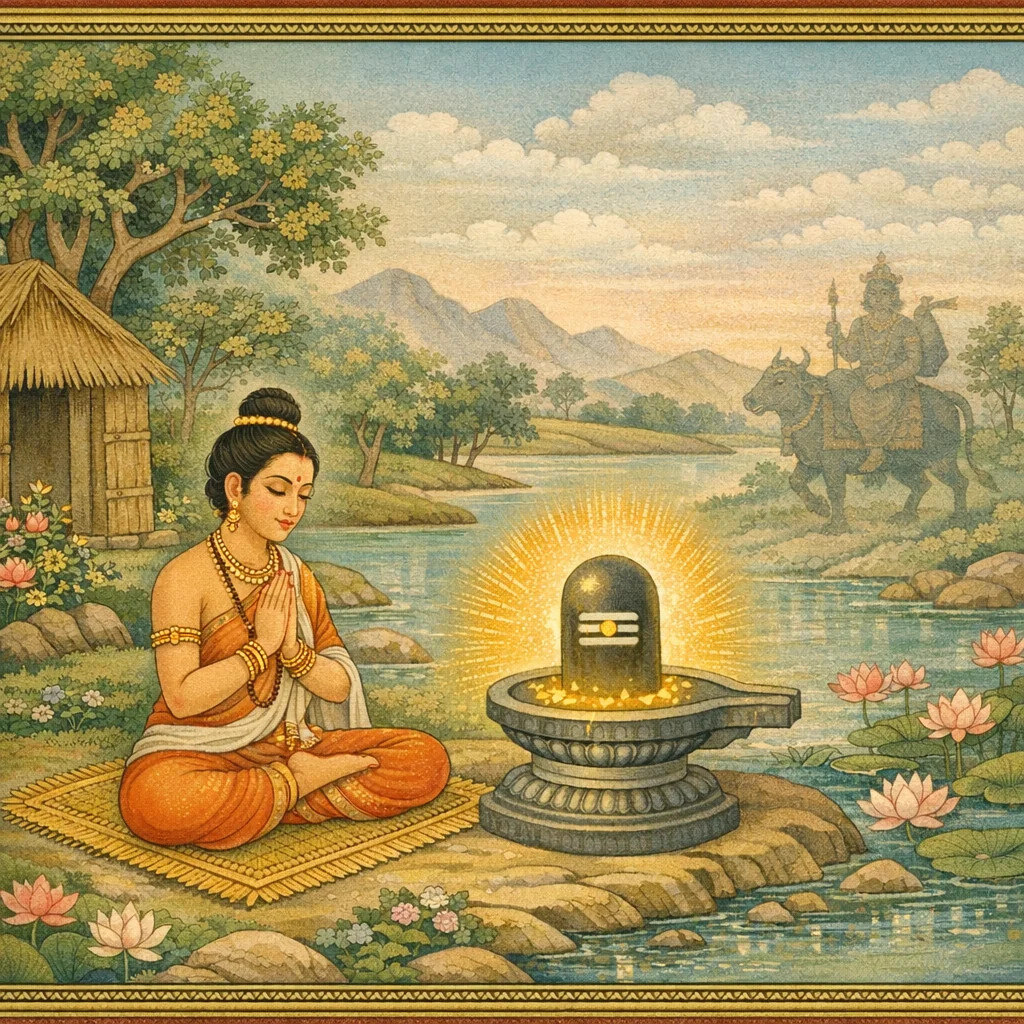
Adhyaya 244
Vicitreśvaramāhātmya (विचित्रेश्वरमाहात्म्य) — The Glory of Vicitreśvara
Īśvara instructs Devī to go to the eminent shrine called Vicitreśvara, situated on the Hiraṇyā-tīra and praised as a destroyer of great sins (mahāpātaka-nāśana). Within the pilgrimage ethos of Prabhāsa-kṣetra, it is upheld as a place of purification and sacred merit. The chapter traces the shrine’s origin to Vicitra, a scribe associated with Yama, who undertakes intense austerities. By the power of that tapas, a fierce and awe-inspiring liṅga (mahāraudra) is established there. In an explicit phalaśruti, it is promised that one who beholds this liṅga will not behold Yama’s realm. Thus darśana is presented as both a protective act and a means toward liberation in the Prabhāsa pilgrimage tradition.
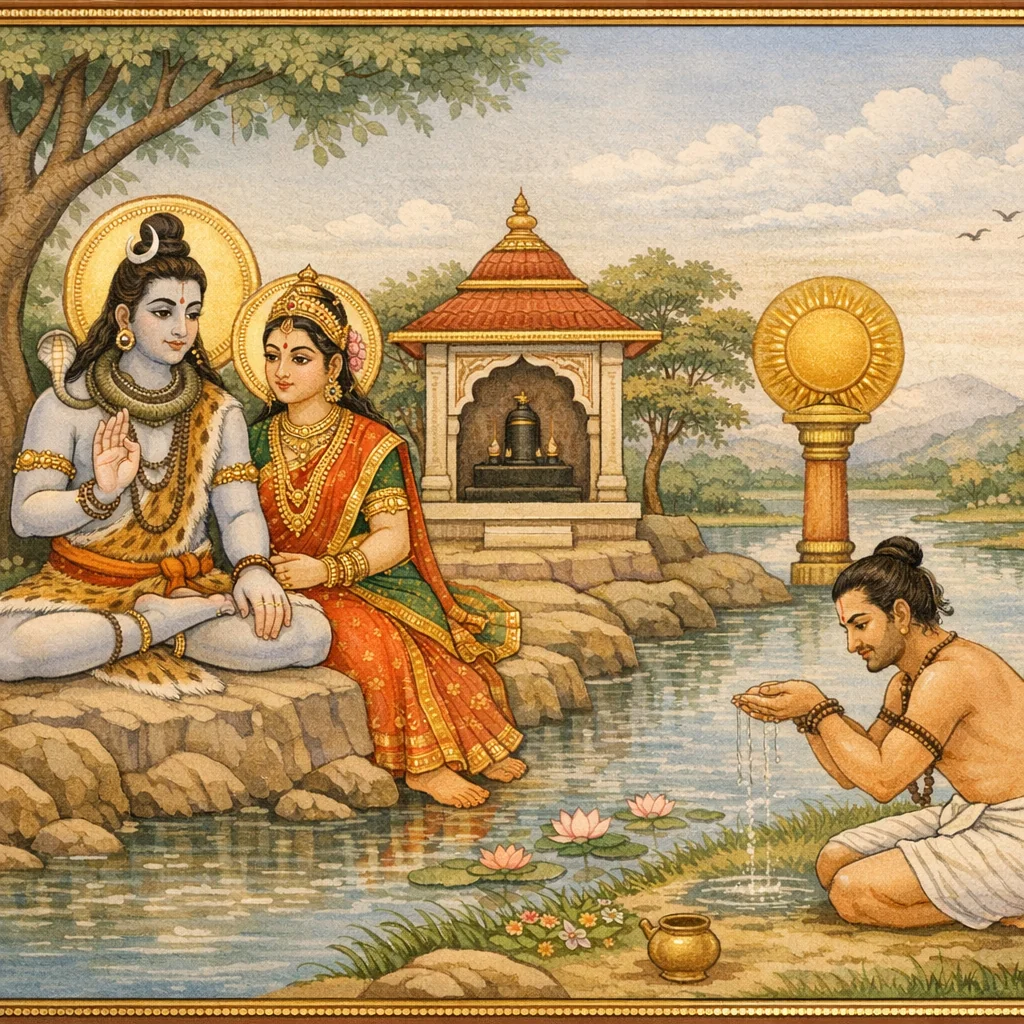
Adhyaya 245
ब्रह्मेश्वरमाहात्म्यवर्णनम् | Brahmeśvara Māhātmya (Account of the Glory of Brahmeśvara)
This adhyāya is framed as a divine instruction: Īśvara speaks to Devī and directs her (and thereby pilgrims) to proceed to a particular shrine within the same sacred region. The site is on the bank of the Sarasvatī, described by relative markers—near/above, and to the west of a landmark associated with Pārṇāditya. There a renowned liṅga is identified, established in ancient times by Brahmā and named Brahmeśvara. Its glory is stated plainly: it destroys all sins (sarva-pātaka-nāśana). On the second lunar day, dvitīyā, one should bathe there, observe fasting (upavāsa), restrain the senses (jitendriya), and worship the Lord of the gods by the name “Brahmeśvara.” The teaching also includes duty to the ancestors: offer tarpaṇa and perform śrāddha for the pitṛ, with the declared aim of attaining an enduring, eternal state or abode (śāśvataṃ padam).
Adhyaya 246
Piṅgā-nadī-māhātmya (Glorification of the Piṅgā River)
Īśvara instructs Devī to go to Piṅgalī—the sin-destroying Piṅgā River—situated west of Ṛṣi-tīrtha and flowing into the ocean. He sets forth its power in ritual gradations: mere sight (sandarśana) yields merit equal to a great ancestral rite; bathing (snāna) doubles it; tarpaṇa makes it fourfold; and śrāddha bestows immeasurable fruit. An older episode explains the river’s name. Sages who came longing for Somēśvara’s darśana—described as southern and dark-complexioned/ill-formed—bathe at an excellent āśrama by the river and witness their forms turn beautiful, “kāma-sadṛśa” (like the ideal of attractiveness). Amazed, they declare that since they attained “piṅgatva” (a tawny, golden-toned quality), the river shall henceforth be called Piṅgā. A social-ethical assurance follows: those who bathe here with supreme devotion will not have ugly descendants in their lineage. The chapter ends with the sages spreading along the riverbank and establishing tīrthas, marked by austere simplicity—wearing only the yajñopavīta—affirming that sanctity is founded through disciplined presence and ritual naming.
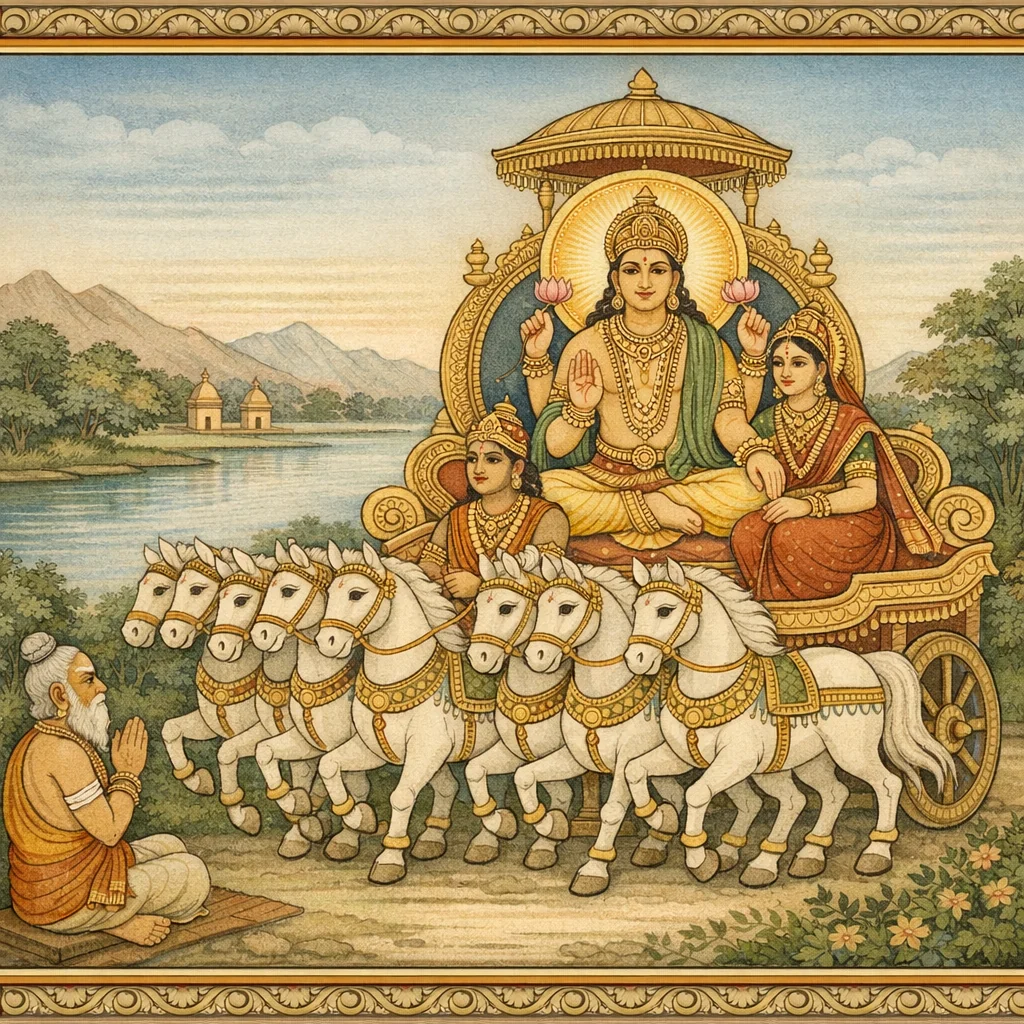
Adhyaya 247
पिंगलादित्य–पिंगादेवी–शुक्रेश्वरमाहात्म्यवर्णनम् (Māhātmya of Piṅgalāditya, Piṅgā Devī, and Śukreśvara)
This chapter takes the form of a theological discourse from Īśvara to Devī, listing the key darśana sites within Prabhāsa-kṣetra and linking specific observances to stated fruits. It first directs the pilgrim to behold the sin-destroying presence of Sūrya there, presenting solar darśana as an act of purification. It then identifies Piṅgalā Devī as a manifestation in the form of Pārvatī, bringing goddess worship into the same sacred circuit. A distinctive fast on the third lunar day (tṛtīyā) is prescribed, promising fulfillment of aims and auspicious gains such as wealth and progeny. Finally, Śukreśvara (a named liṅga/shrine) is introduced; its darśana is praised as freeing one from all faults and sins (sarva-pātaka), underscoring that right pilgrimage—seeing, fasting, and devotion—functions as an ethical-ritual means within the kṣetra.
Adhyaya 248
Brahmeśvara-māhātmya (ब्रह्मेश्वरमाहात्म्य) — Origin and Merit of the Brahmeśvara Liṅga
Īśvara instructs Mahādevī to go to a previously mentioned sacred place, once worshipped by Brahmā, on the bank of the Sarasvatī and west of Parnāditya. He then relates its origin: before Brahmā created the fourfold aggregate of beings, an extraordinary woman of indescribable kind appeared, portrayed with the customary Purāṇic marks of beauty. Overcome by desire, Brahmā begged for sexual union with her; as an immediate consequence of this fault, his fifth head fell and became donkey-like, and the deed is presented as instant moral transgression. Realizing the gravity of desire arising toward his own “daughter,” Brahmā came to Prabhāsa seeking purification, for it is said that bodily and moral purity cannot be attained without immersion in a tīrtha. After bathing in the Sarasvatī, Brahmā established a Śiva-liṅga of Devadeva Śūlin and was freed from defilement, returning to his abode. The phalaśruti concludes: one who bathes in the Sarasvatī and beholds that liṅga is released from all sins and honored in Brahmaloka; and seeing it on the bright fourteenth of Caitra grants access to the supreme station associated with Maheśvara.
Adhyaya 249
संगमेश्वरमाहात्म्यवर्णनम् | Sangameśvara Māhātmya (Glory of the Lord of the Confluence)
Īśvara instructs Devī to go to the deity called Saṅgameśvara, also known as “Golaka,” famed as a destroyer of sins. The narrative identifies the sacred site at the saṅgama, the confluence of the Sarasvatī and Piṅgā, and introduces the sage Uddālaka, an accomplished ascetic performing austerities there. As Uddālaka undertakes intense tapas, a liṅga manifests before him, serving as a radiant confirmation of devotion. A disembodied voice (aśarīriṇī vāk) proclaims the Lord’s permanent presence at that spot and establishes the shrine-name “Saṅgameśvara,” since the liṅga arose at the confluence. The chapter states the phala: those who bathe at the renowned confluence and behold Saṅgameśvara attain the highest destiny. Uddālaka worships the liṅga unceasingly and, at life’s end, reaches the abode of Maheśvara—an exemplar of tīrtha-centered devotion culminating in liberation.
Adhyaya 250
Gaṅgeśvara Māhātmya (गंगेश्वरमाहात्म्य) — The Glory of Gaṅgeśvara Liṅga
Īśvara speaks to Devī and points out a renowned liṅga called Gaṅgeśvara, famed throughout the three worlds and located to the west of Saṅgameśvara. The chapter recalls a mythic moment when Gaṅgā was summoned by Viṣṇu (named with epithets such as Prabhaviṣṇu/Prabhavaviṣṇu) for an abhiṣeka at a critical time. Afterward Gaṅgā beholds that kṣetra as exceedingly meritorious—visited by ṛṣis and crowded with liṅgas and the āśramas of ascetics—and, out of Śiva-bhakti, she establishes the liṅga there. The phalaśruti declares that mere darśana of this shrine grants the fruit of bathing in the Gaṅgā, and that one gains merit equal to a thousand Aśvamedha sacrifices.
Adhyaya 251
Śaṅkarāditya-māhātmya (The Glory of Śaṅkarāditya)
In a brief discourse between Īśvara and Devī, the pilgrim is directed to worship the shrine called Śaṅkarāditya, said to lie east of Gaṅgeśvara and to have been established by Śaṅkara. The auspicious time for this worship is the sixth lunar day (ṣaṣṭhī) of the bright fortnight (śukla pakṣa). The rite is specified: offer arghya in a copper vessel (tāmra-pātra), prepared with red sandalwood (rakta-candana) and red flowers (rakta-puṣpa), performing it with concentrated attention (samāhita). The promised fruits are both transcendent and worldly—attainment of the supreme realm associated with Divākara (the Sun), higher accomplishment (parā siddhi), and freedom from falling into poverty (daridratā). The chapter concludes by urging full effort in that kṣetra to worship Śaṅkarāditya as the bestower of the fruits of all desired aims (sarva-kāma-phala-prada).
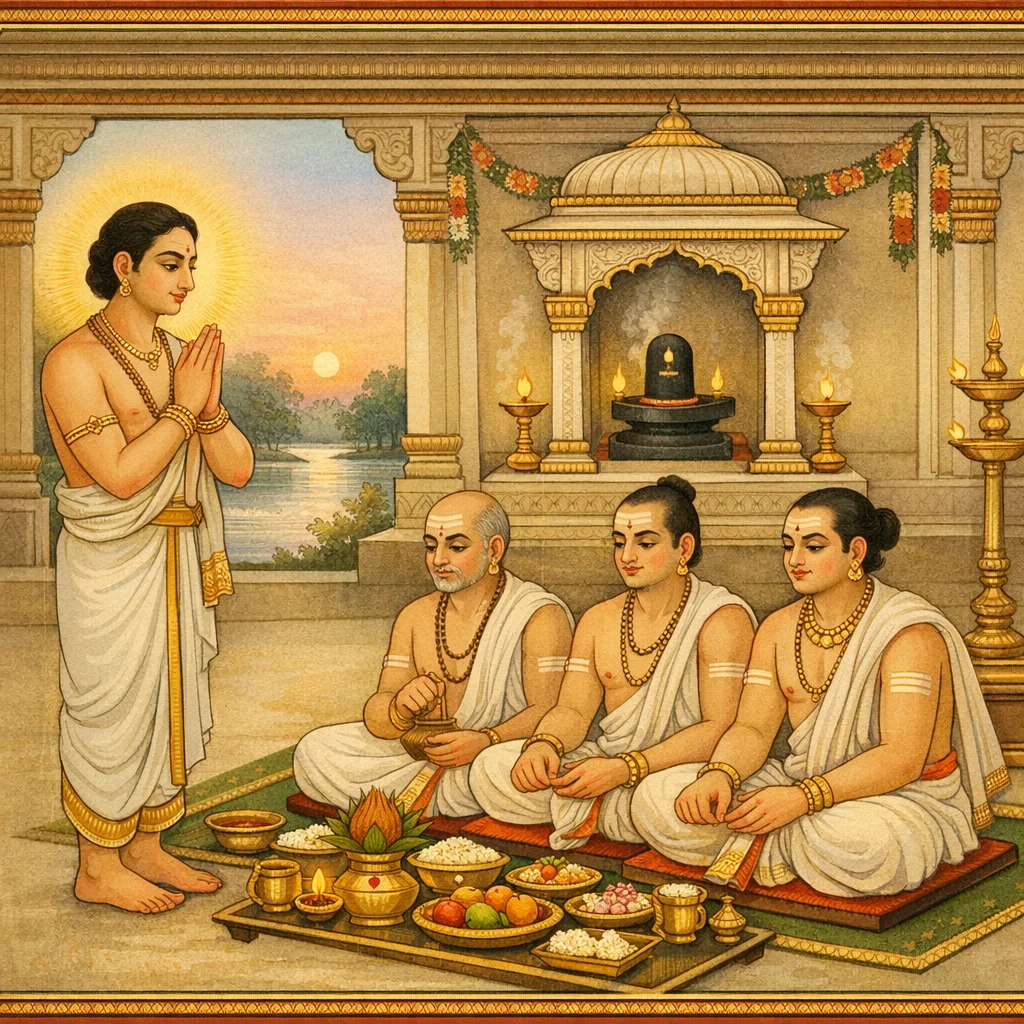
Adhyaya 252
शङ्करनाथमाहात्म्यवर्णनम् (Śaṅkaranātha Māhātmya—Account of the Glory of Śaṅkaranātha)
Īśvara speaks to Devī and directs the pilgrimage sequence toward the famed liṅga called Śaṅkaranātha, renowned in the three worlds and praised as a remover of sin. The chapter credits Bhānu (the Sun) with installing this liṅga: after performing great austerities, he established the shrine and set the sacred emblem in place. It then lays down a compact discipline of ethical-ritual acts—worship of Mahādeva with fasting, feeding Brahmins, performing śrāddha with control of the senses, and gifting gold and garments according to one’s means. The teaching ends with a clear phala: the practitioner attains the supreme abode, presented as a decisive outcome within the chapter’s theological frame.
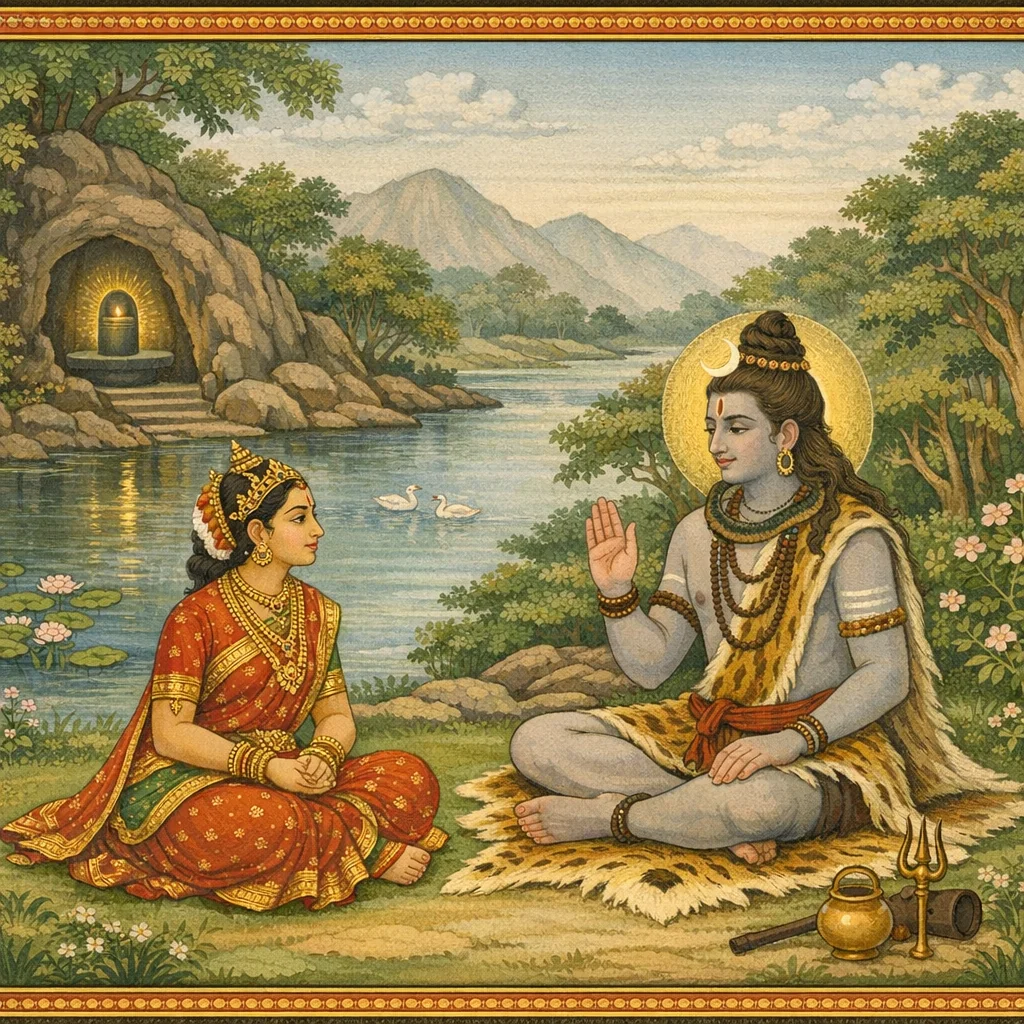
Adhyaya 253
गुफेश्वरमाहात्म्यवर्णनम् | Gufeśvara Shrine-Māhātmya (Description of the Glory of Gufeśvara)
This chapter is cast as a divine instruction: Īśvara speaks to Mahādevī and directs the pilgrim’s route to an eminent shrine called Gufeśvara. Situated in the northern part of Hiranyā, it is praised as “unsurpassed” and explicitly as a “destroyer of all sins.” The theological focus rests on darśana as a transformative act: merely seeing the deity at Gufeśvara is said to erase even the most extreme demerit, expressed through a hyperbolic phalaśruti that it dispels “crores of killings.” In this way, the chapter serves as a concise node in the Prabhāsa-kṣetra sacred map—naming the shrine, locating it within the regional holy geography, and affirming its soteriological power through a strong claim of purification in keeping with tīrtha-māhātmya convention.
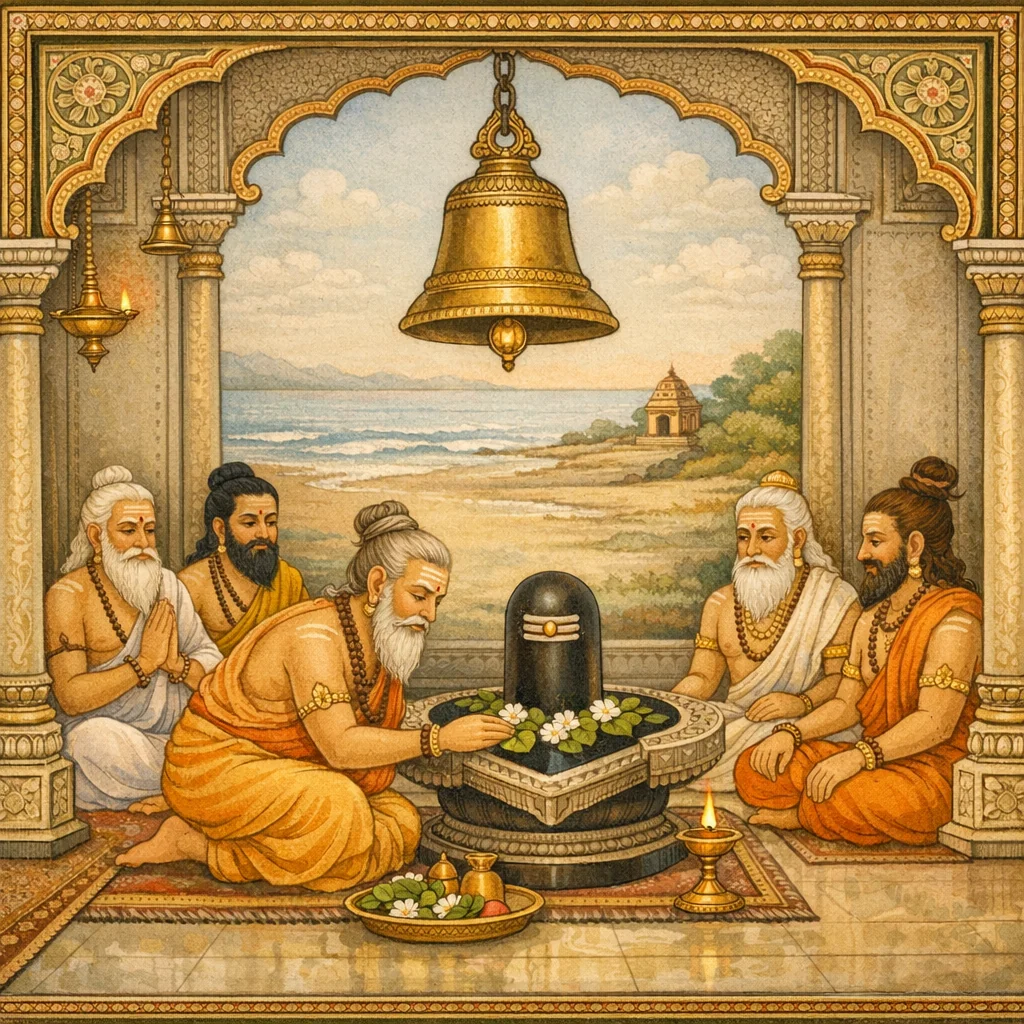
Adhyaya 254
घण्टेश्वरमाहात्म्यवर्णनम् | Ghanteśvara Shrine-Māhātmya (Description of the Glory of Ghanteśvara)
This adhyāya is a compact māhātmya passage spoken as Īśvara’s instruction. It declares that at Prabhāsa there is a sacred presence called Ghanteśvara, praised as the destroyer of all sins (sarva-pātaka-nāśana) and worthy of reverence by both devas and dānavas. The shrine is said to have been worshipped by ṛṣis and siddhas and to grant wished-for results (vāñchitārtha-phala-prada). A calendrical observance is then given: a human devotee who worships Ghanteśvara on the eighth lunar day (aṣṭamī) when it falls on Monday (Soma-vāra) attains desired aims and is described as freed from sin. The chapter ends with a colophon placing it in the Skanda Purāṇa’s Prabhāsa Khaṇḍa, within the Prabhāsakṣetramāhātmya, and naming it as the 254th adhyāya.
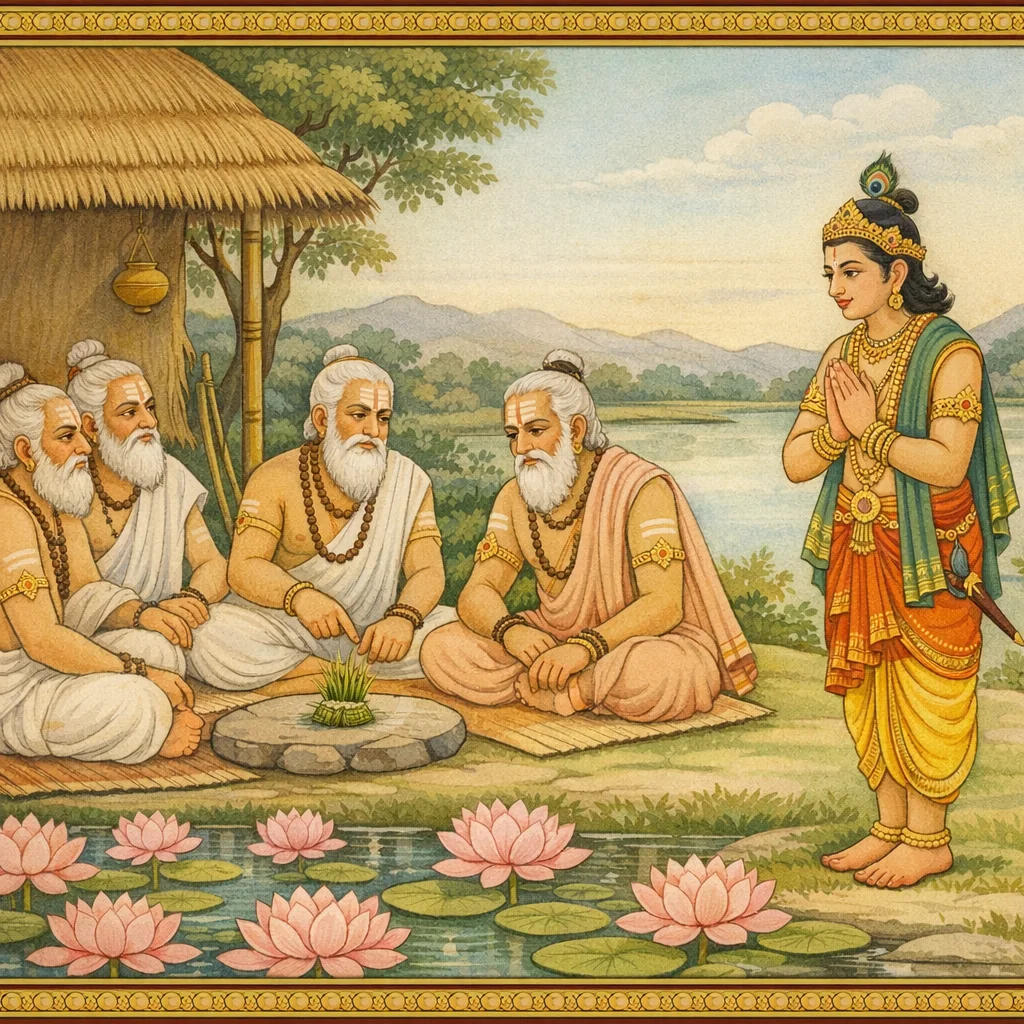
Adhyaya 255
ऋषितीर्थमाहात्म्य (The Māhātmya of Ṛṣi-tīrtha / Rishi Tirtha)
Īśvara describes a renowned tīrtha near Prabhāsa, especially its western tract sanctified by the presence of many great sages. The account names ṛṣis such as Aṅgiras, Gautama, Agastya, Viśvāmitra, Vasiṣṭha with Arundhatī, Bhṛgu, Kaśyapa, Nārada, Parvata, and others, who perform extraordinary austerities with restraint and deep concentration to attain the eternal Brahma-world. A fierce drought and famine arise. King Uparicara offers grains and valuables, claiming that accepting gifts is a blameless livelihood for brāhmaṇas; yet the sages refuse, warning of the ethical peril of royal gifts and the spiritual decline born of greed. They denounce accumulation (sañcaya) and craving (tṛṣṇā), praising contentment and the refusal of improper patronage. The king’s agents scatter “golden-embryo” treasures near udumbara trees, but the sages reject them again and depart. Reaching a great lotus-filled lake, they bathe and gather lotus-stalks (bīsa) for food. A wandering ascetic, Śunomukha, takes the bīsa to provoke a dharma inquiry; oaths and curses are exchanged defining the moral degradation of a thief. Śunomukha then reveals himself as Purandara (Indra), extolling their non-greed as the foundation of imperishable worlds. The sages request a rite for that place: whoever comes there, remains pure, fasts for three nights, bathes, offers tarpaṇa to the ancestors, and performs śrāddha gains merit equal to that of all tīrthas, avoids a lower destiny, and enjoys divine companionship.
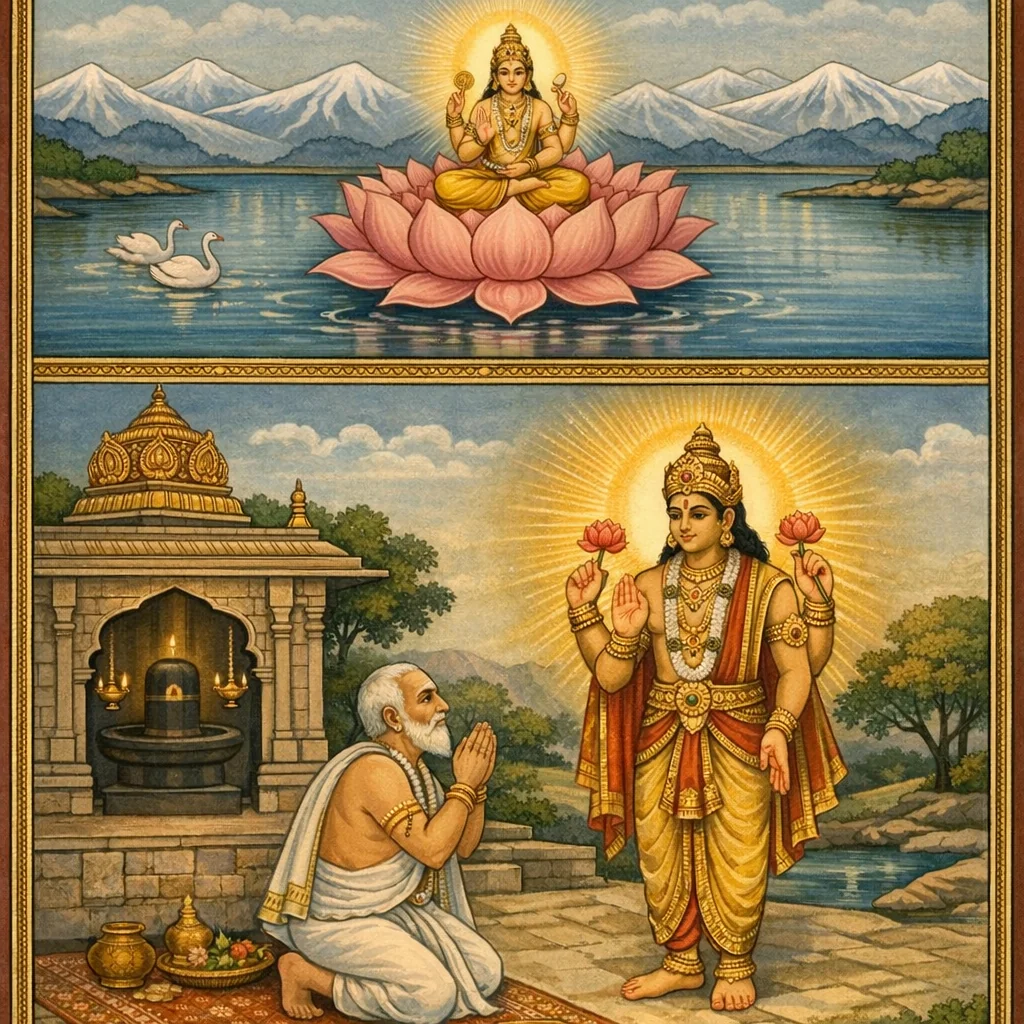
Adhyaya 256
नन्दादित्यमाहात्म्यवर्णनम् (The Māhātmya of Nandāditya)
This adhyāya is framed as a divine exposition, with Īśvara speaking to Devī, affirming a solar shrine within Prabhāsa-kṣetra. It opens with the instruction to approach Nandāditya, the Sun-form installed by King Nanda. Nanda is praised as an exemplary ruler whose realm enjoys well-being, yet by a karmic reversal he becomes afflicted with severe leprosy. Seeking the cause, the narrative turns to an earlier event: traveling in a celestial vimāna granted by Viṣṇu, Nanda reaches the heavenly Mānasarovar and beholds a rare “Brahma-born lotus,” within which shines a thumb-sized radiant Puruṣa. Desiring prestige, he orders the lotus seized; at the touch a dreadful sound arises and he is struck down at once. Sage Vasiṣṭha explains that the lotus is supremely sacred, that the intent to display it publicly is a moral fault, and that the indwelling deity is the solar principle (Pradyotana/Sūrya). Vasiṣṭha prescribes propitiation of Bhāskara at Prabhāsa. Nanda installs and worships Nandāditya with offerings; Sūrya grants immediate cure, promises enduring presence, and declares that those who behold the deity on Saptamī falling on a Sunday attain the highest state. The chapter concludes with phalaśruti benefits: bathing, śrāddha, and gifting—especially a kapilā cow or a ghee-cow—at this tīrtha yield incalculable merit and support liberation.
Adhyaya 257
त्रितकूपमाहात्म्य (Glory of the Trita Well)
Īśvara tells Devī of Ātreya, a learned figure of Saurāṣṭra, and his three sons—Ekata, Dvita, and the youngest, Trita. After Ātreya’s death, Trita, virtuous and Veda-versed, assumes leadership and prepares to perform a yajña, inviting learned officiants and invoking the deities. Seeking dakṣiṇā, he travels with his brothers toward Prabhāsa to gather cattle, and because of his learning he is honored with hospitality and gifts. On the way, the elder brothers grow envious and plot against him. A terrifying tiger appears and the cattle scatter; near a dreadful dry well they seize the moment, cast Trita into the waterless pit, and depart with the herd. In the well Trita does not despair; he performs a mānasa-yajña, recites sūktas, and offers a symbolic sand-homa. Pleased by his śraddhā, the devas speak to him and arrange for Sarasvatī to fill the well with water, enabling his escape; the place becomes known as Tritakūpa. The chapter ends with injunctions: bathing there in purity, performing pitṛ-tarpaṇa, and gifting sesame (tila) with gold are praised. The tīrtha is said to be beloved of the pitṛs (including the Agniṣvātta and Barhiṣad classes), and even the mere sight of it is declared to free beings from sins until life’s end, urging pilgrims to bathe there for their welfare.
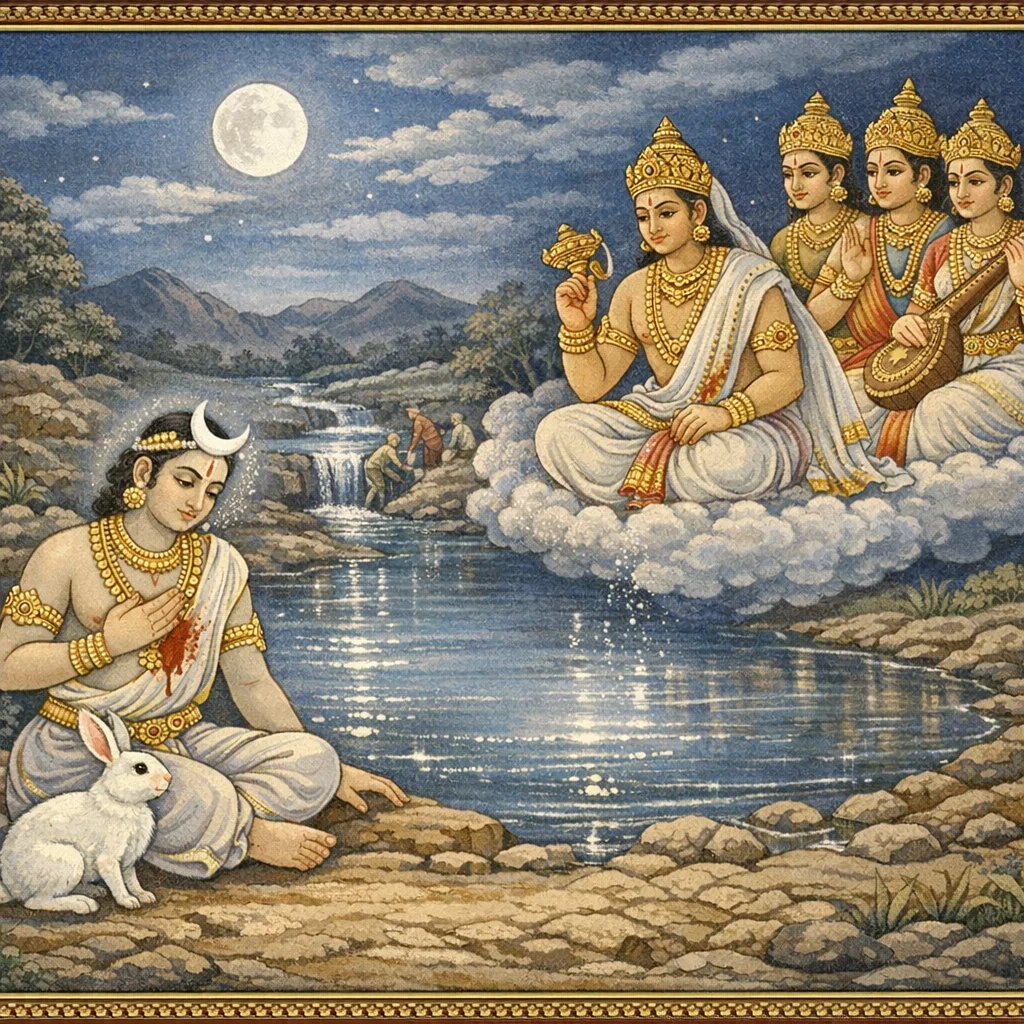
Adhyaya 258
शशापानतीर्थप्रादुर्भावः (Origin of the Śaśāpāna Tīrtha) / The Emergence of Shashapana Tirtha
Īśvara tells Devī the origin of a sin-destroying tīrtha situated south of the place remembered as Śaśāpāna. After the devas obtain amṛta from the churning of the ocean, countless drops fall upon the earth. A thirsty hare (śaśaka) enters the water; because the reservoir is infused with amṛta, the hare becomes linked with it and attains an extraordinary condition. Fearing that humans might drink the fallen amṛta and become immortal, the devas deliberate in anxiety. The Moon (Niśānātha/Candra), struck by a hunter and unable to move, asks for amṛta; the devas direct him to drink from that reservoir, saying much amṛta has fallen there. Candra drinks the water “together with the hare,” becomes nourished and radiant, and the hare remains visibly present as a sign of contact with amṛta. The devas then excavate the dried basin until water springs forth again, and the place is named Śaśāpāna (“drinking with/through the hare”) because Candra drank the water connected with the hare. The phalaśruti concludes: devotees who bathe there attain the supreme destination associated with Maheśvara; those who feed Brahmins gain the fruit of all sacrifices. Later Sarasvatī is said to arrive with the Vadavāgni, further purifying the tīrtha and reaffirming the injunction to bathe there with full effort.
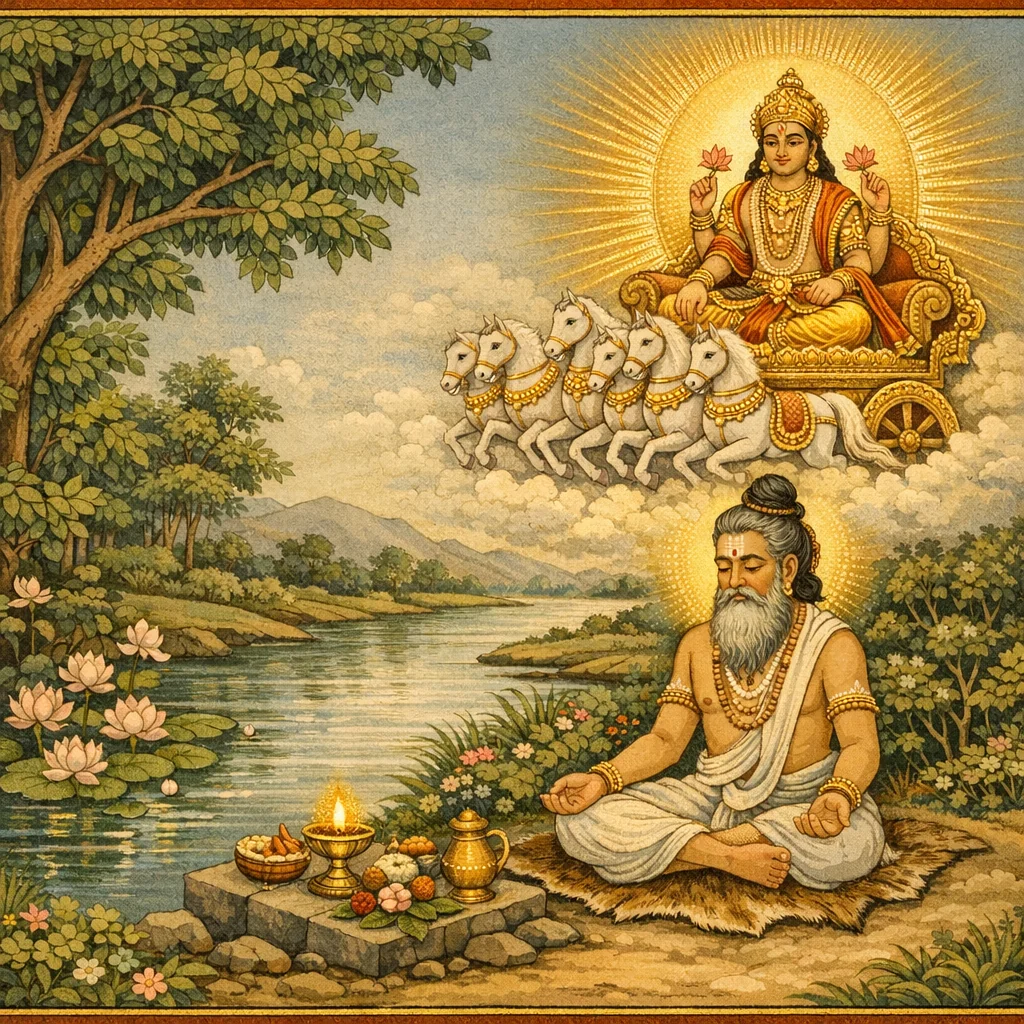
Adhyaya 259
पर्णादित्यमाहात्म्यवर्णनम् | The Māhātmya of Parnāditya (Sun Shrine) on the Prācī Sarasvatī
This chapter, cast as Īśvara’s instruction to Mahādevī, directs the pilgrim to Parnāditya, a solar divinity on the northern bank of the Prācī Sarasvatī. It then recounts a legend from Tretā-yuga: a brāhmaṇa named Parnāda comes to Prabhāsa-kṣetra and performs severe tapas, sustaining unbroken devotion day and night. Worshipping Sūrya with incense, garlands, unguents, and Veda-aligned hymns of praise, he pleases the Sun, who appears and offers a boon. The devotee asks first for the rare grace of direct darśana, and next that the Sun remain permanently established there. Sūrya agrees, promises him access to the solar realm, and withdraws. The chapter ends with pilgrimage guidance and phala: bathing on the sixth lunar day (ṣaṣṭhī) in Bhādrapada and beholding Parnāditya wards off suffering; the merit of such darśana equals the fruit of properly gifting a hundred cows at Prayāga. It also cautions that those afflicted with grave diseases who fail to recognize Parnāditya are portrayed as lacking discernment, underscoring the value of informed pilgrimage and devotional understanding.
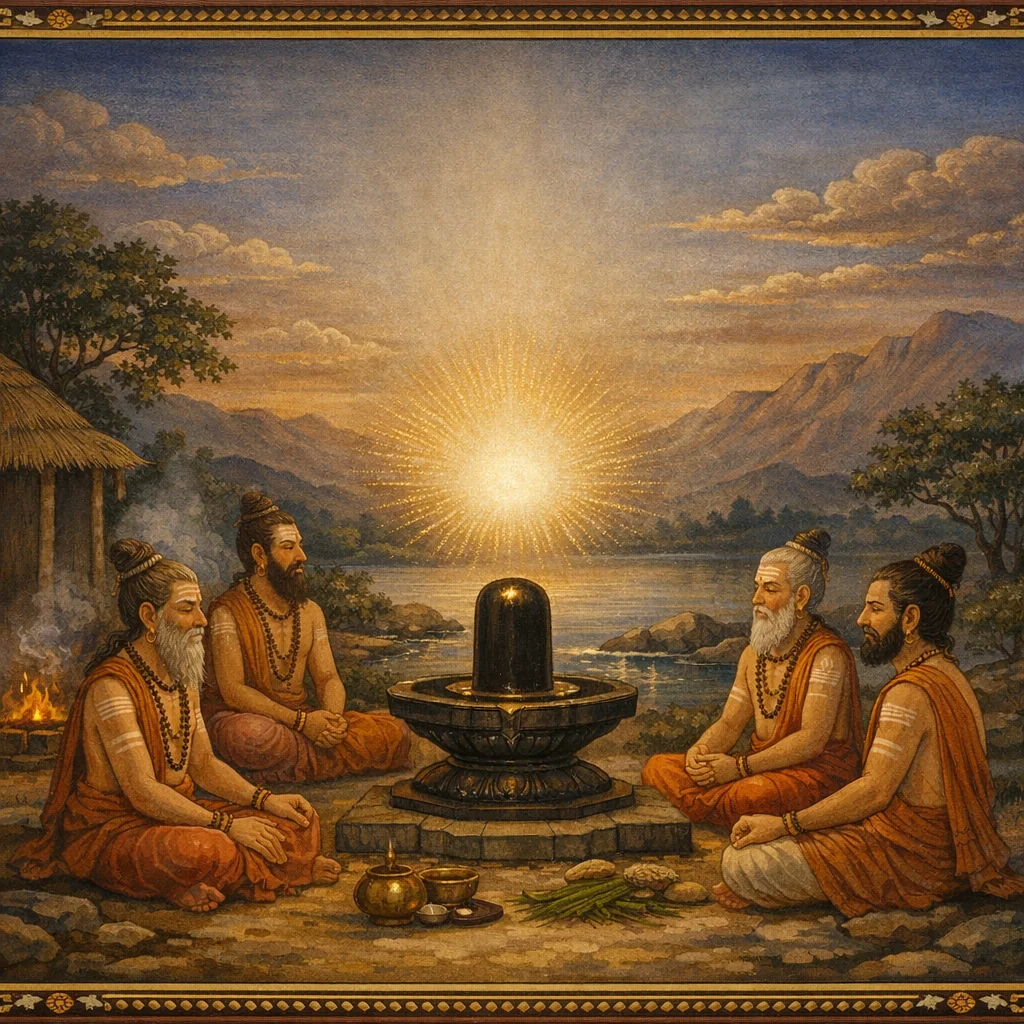
Adhyaya 260
Siddheśvara-māhātmya (Glorification of Siddheśvara)
Īśvara (Śiva) speaks to Devī and directs her to Siddheśvara, a supreme divine form situated in the western part of the region, first established by the siddhas. The siddhas—divine beings—arrive and consecrate a liṅga, expressly seeking siddhi, success and perfection in all undertakings. Pleased by their intense tapas (austerity), Śiva grants them extraordinary powers such as aṇimā and other aiśvarya (sovereign divine capacities), and proclaims his perpetual nearness at that holy site (nitya-sānidhya). A sacred observance is then given: whoever worships Śiva there on the bright fourteenth day (śukla-caturdaśī) of the month of Caitra attains the supreme state by Śiva’s grace. Śiva then vanishes from sight while the siddhas continue their worship; and a general injunction concludes that devoted veneration of Siddheśvara brings remarkable accomplishment and desired fruits, therefore it should be honored continually.
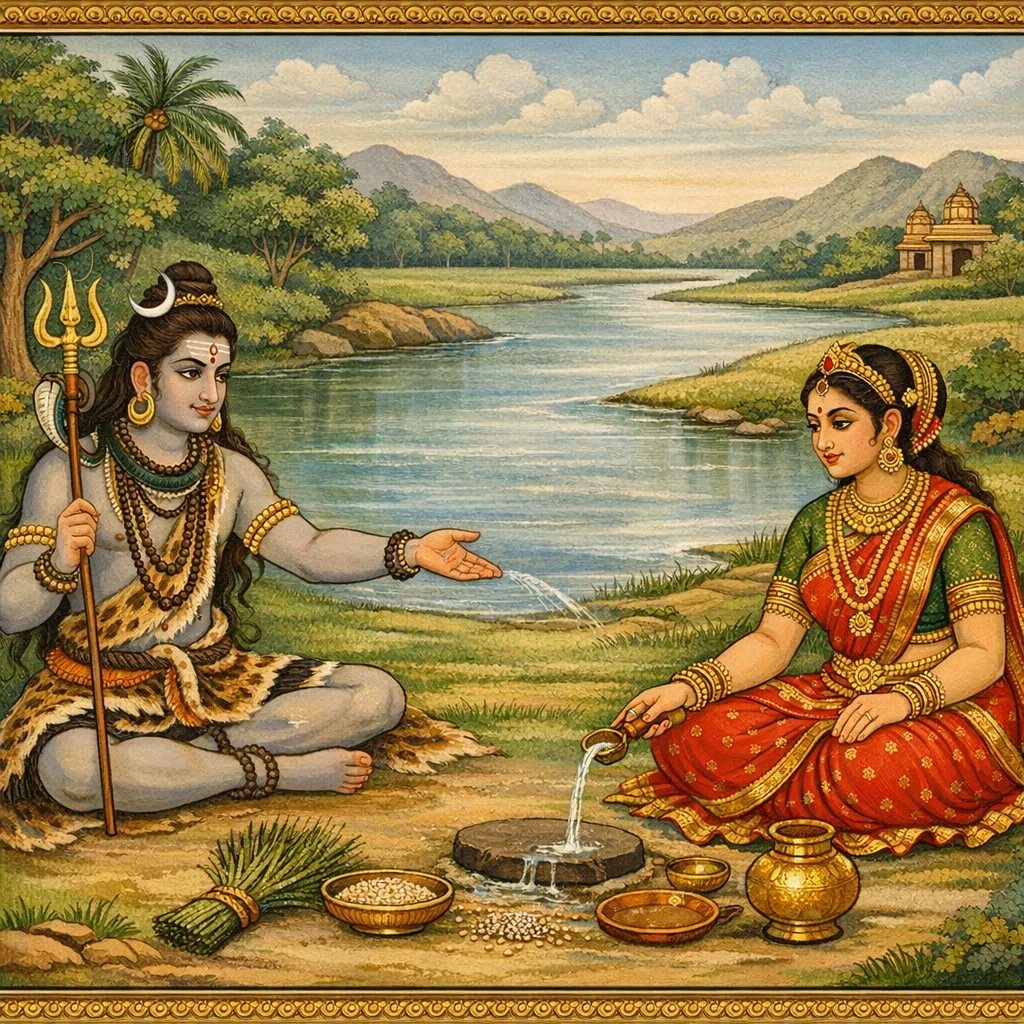
Adhyaya 261
न्यंकुमतीमाहात्म्यवर्णनम् | Nyankumatī River Māhātmya (Glorification of the Nyankumatī)
This adhyāya is framed as Īśvara’s theological instruction to Devī, directing her to the Nyankumatī River, said to have been placed by Śambhu under a sacred maryādā (boundary and ordained order) for the pacification of the holy field (kṣetra-śānti). It then points to a southern sacred spot famed for complete destruction of sin, where proper bathing (snāna) followed by śrāddha is declared to free one’s ancestors from infernal conditions. A calendrical rule is given: in the month of Vaiśākha, in the bright fortnight, on the third lunar day (śukla-tṛtīyā), one should bathe and offer tarpaṇa with sesame, darbha grass, and water. Such śrāddha is praised as equal in merit to that performed at the Gaṅgā, compactly joining sacred geography, ritual precision, and ancestral liberation into a tīrtha protocol.
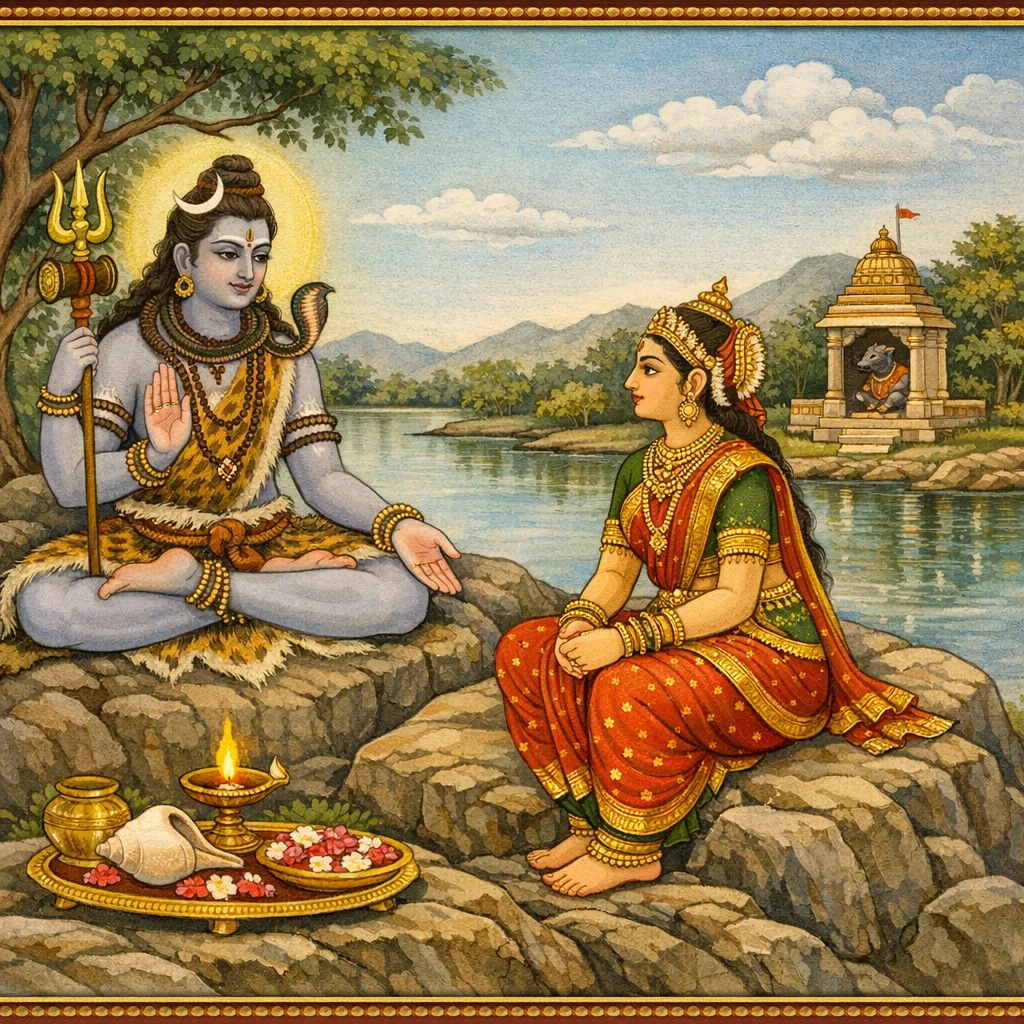
Adhyaya 262
वराहस्वामिमाहात्म्यवर्णनम् (Varāha Svāmī Māhātmya—Account of the Glory of Varāha Svāmī)
This chapter is cast as a brief theological instruction from Īśvara to Mahādevī. It gives a clear ritual and directional mandate: one should go to the shrine of Varāha Svāmī, located south of Goṣpada, a spot praised as “pāpa-praṇāśana,” where wrongdoing and impurity are dissolved. It then states the most efficacious time: worship (pūjā) performed on Ekādaśī in the bright fortnight (śukla pakṣa) is especially powerful. The phalāśruti is explicit and salvific—by such devotion one is freed from all pāpaka and attains “Viṣṇu-pada,” the exalted saving state associated with Viṣṇu—thus linking place, time, prescribed act, and promised fruit in a compact ritual-ethical teaching.
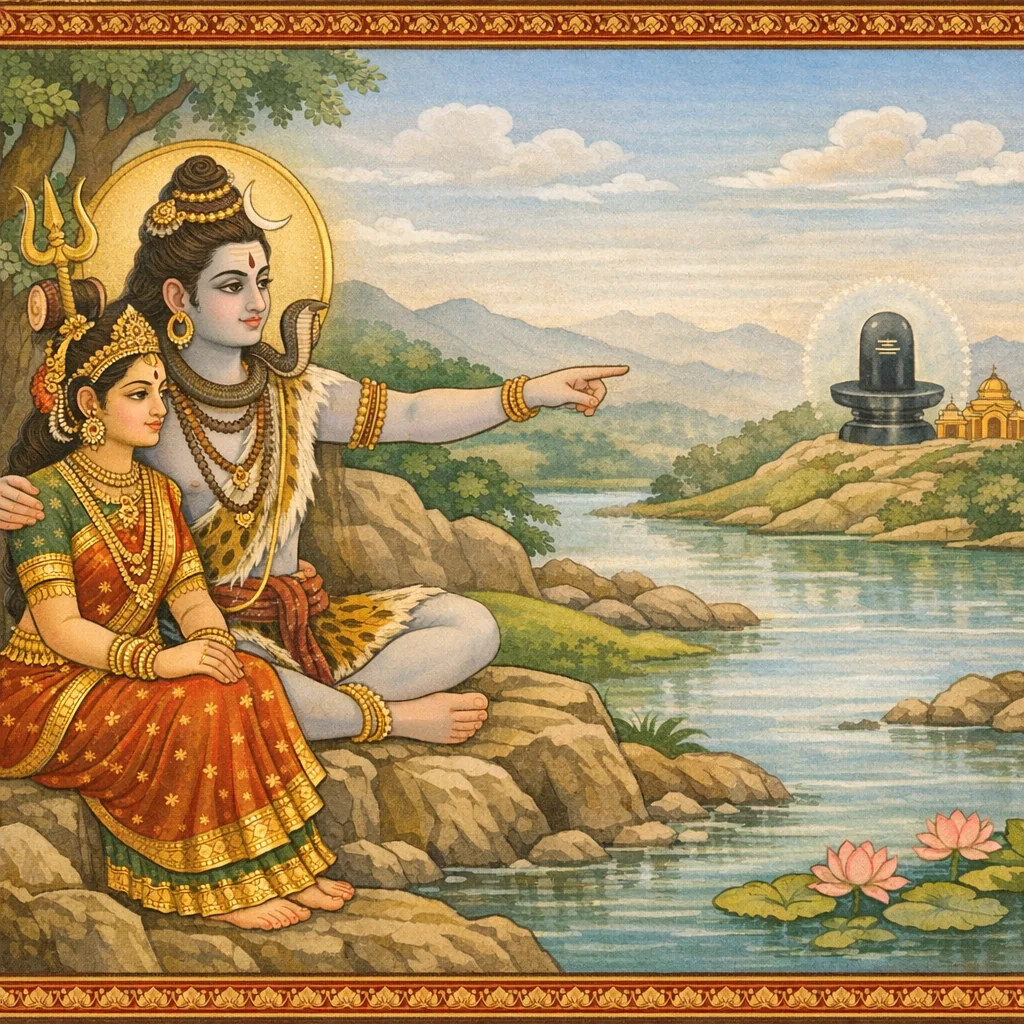
Adhyaya 263
छायालिङ्गमाहात्म्यवर्णनम् | The Māhātmya of Chāyā-liṅga (Shadow Liṅga)
In this chapter, Īśvara speaks to Devī and directs her attention to a particular liṅga known as Chāyā-liṅga, the “Shadow Liṅga.” The sacred site is located with a clear directional marker—north of Nyanku(m)atī—thus placing holiness within a landscape that can be sought and found. Following the standard māhātmya pattern, the text (1) names and situates the shrine, (2) proclaims its extraordinary power and “great fruit,” and (3) declares purification for the devotee who gains its darśana, the reverent vision of the liṅga. A contrasting point is added: those burdened with heavy demerit are said not to perceive it, making visibility itself both a ritual act and a moral-spiritual qualification. The closing colophon identifies the passage as part of the Skanda Purāṇa’s Prabhāsa Khaṇḍa, within the Prabhāsakṣetra-māhātmya sequence, and labels it as the narration of the Chāyā-liṅga māhātmya.
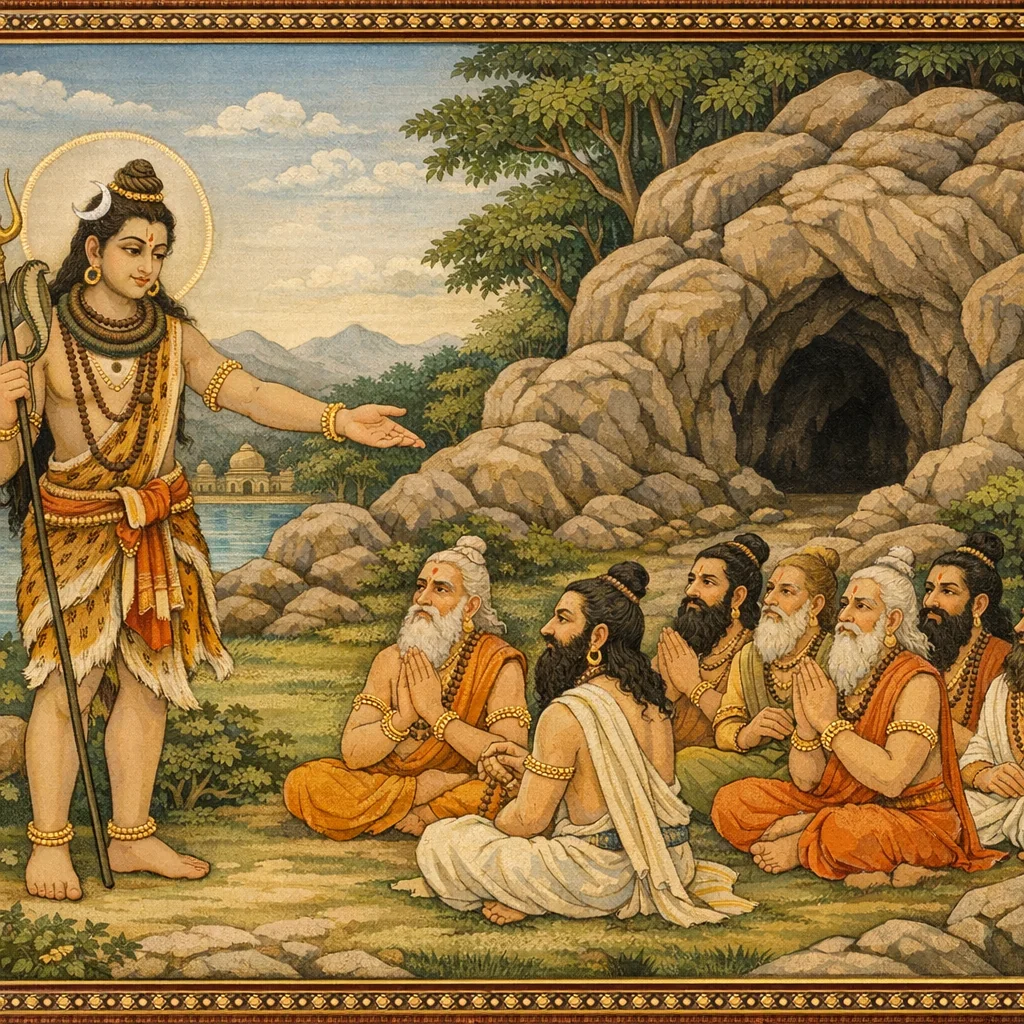
Adhyaya 264
नंदिनीगुफामाहात्म्यवर्णनम् / The Māhātmya (Sacred Account) of Nandinī Cave
This adhyāya presents a brief Śaiva dialogue between Īśvara and the Devī, in which Īśvara describes the Nandinī Cave in Prabhāsa-kṣetra as inherently purifying and sin-destroying (pātaka-nāśinī). It is portrayed as a dwelling or meeting-place of meritorious ṛṣis and siddhas, thereby establishing it as a sanctified point within the section’s ritual geography. The teaching centers on darśana: one who goes there and beholds the cave is freed from all sins and gains the fruit of the Cāndrāyaṇa observance, a recognized expiatory and disciplinary vrata. Thus the chapter identifies the site, confirms its holiness through association with perfected beings, and declares a phalāśruti equating pilgrimage-darśana with a formal rite of penitence.
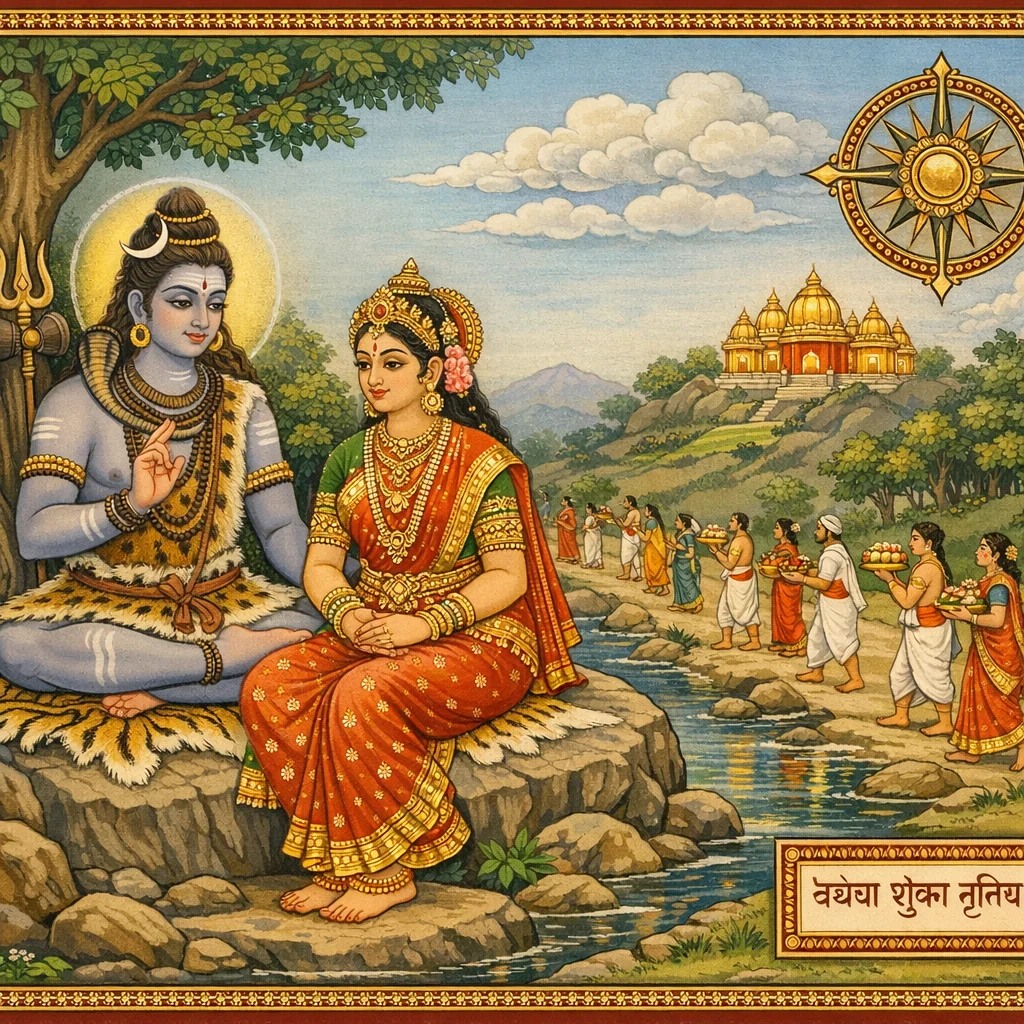
Adhyaya 265
कनकनन्दामाहात्म्यवर्णनम् (Glorification of Goddess Kanakanandā)
This adhyāya is framed as a concise Śaiva-Śākta instruction: Īśvara speaks to Mahādevī and points to a particular deity-site—the goddess Kanakanandā, situated in the Īśānya (northeastern) direction. It gives an itinerary and procedure: it identifies the shrine, praises the goddess as the giver of the fruits of all desires (sarva-kāma-phala-pradā), and prescribes a calendrical observance—undertaking a yātrā in the month of Caitra on the Śukla tṛtīyā tithi, to be performed according to rule (vidhānataḥ). The teaching integrates place (kṣetra), time (tithi/māsa), and regulated devotion (vidhi) as an ethical guide for pilgrimage. The phalāśruti states plainly that the disciplined pilgrim attains desired aims (sarva-kāma-avāpti) through correctly performed sacred travel and worship.
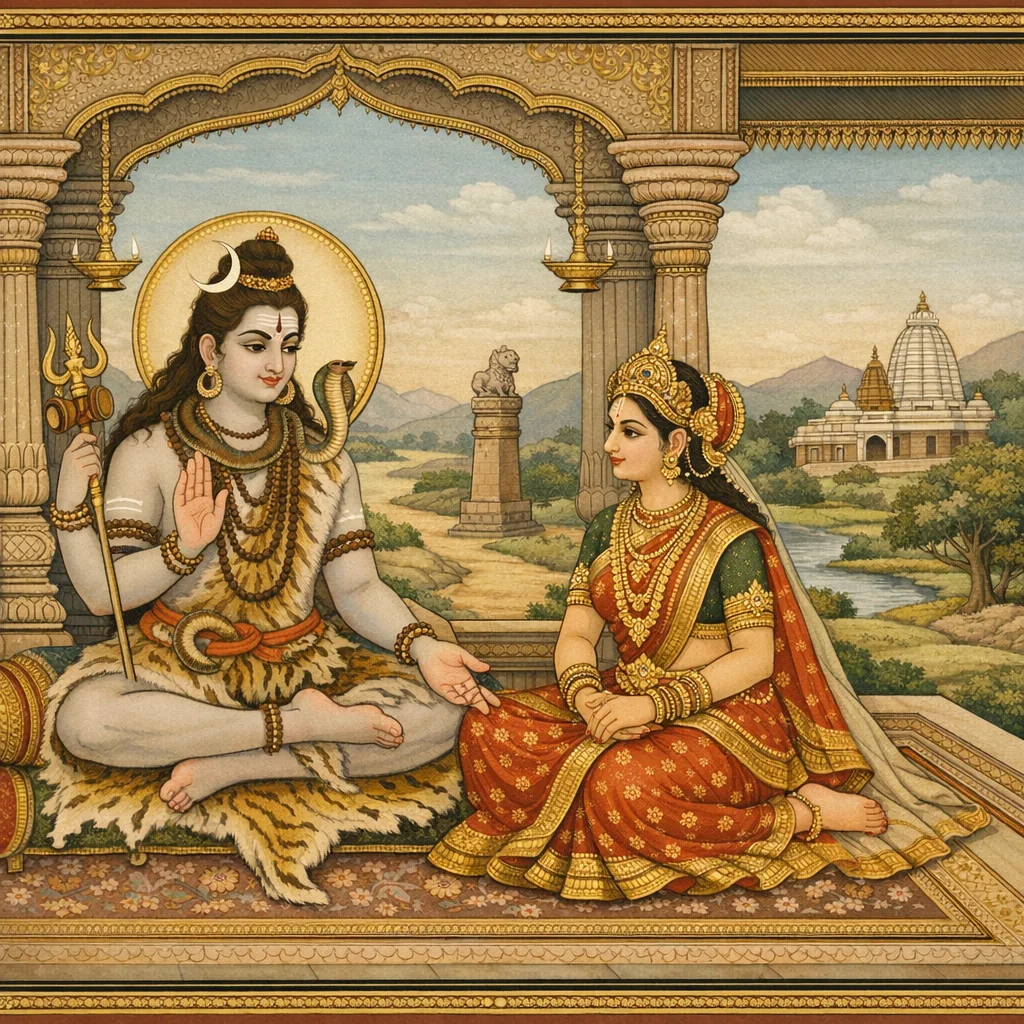
Adhyaya 266
Kumbhīśvara Māhātmya (कुम्भीश्वरमाहात्म्य) — The Glory of Kumbhīśvara
This adhyāya is framed as Īśvara’s instruction to Mahādevī, directing her attention to the shrine of Kumbhīśvara—praised as “unsurpassed”—located a short distance to the east of Śarabhasthāna. Its central movement is both topographic and salvific: it places the shrine within the Prabhāsa pilgrimage landscape and clarifies its sacred standing. A brief phalaśruti then declares the chapter’s key promise: mere darśana, the reverent sight of Kumbhīśvara, frees a person from all sins (sarva-pātaka). Sacred geography is thus presented as an ethical and ritual means of purification and release. The closing colophon identifies the text as part of the Skanda Mahāpurāṇa of 81,000 verses, within the Prabhāsa-khaṇḍa, first Prabhāsakṣetra-māhātmya, and names this as the 266th chapter.
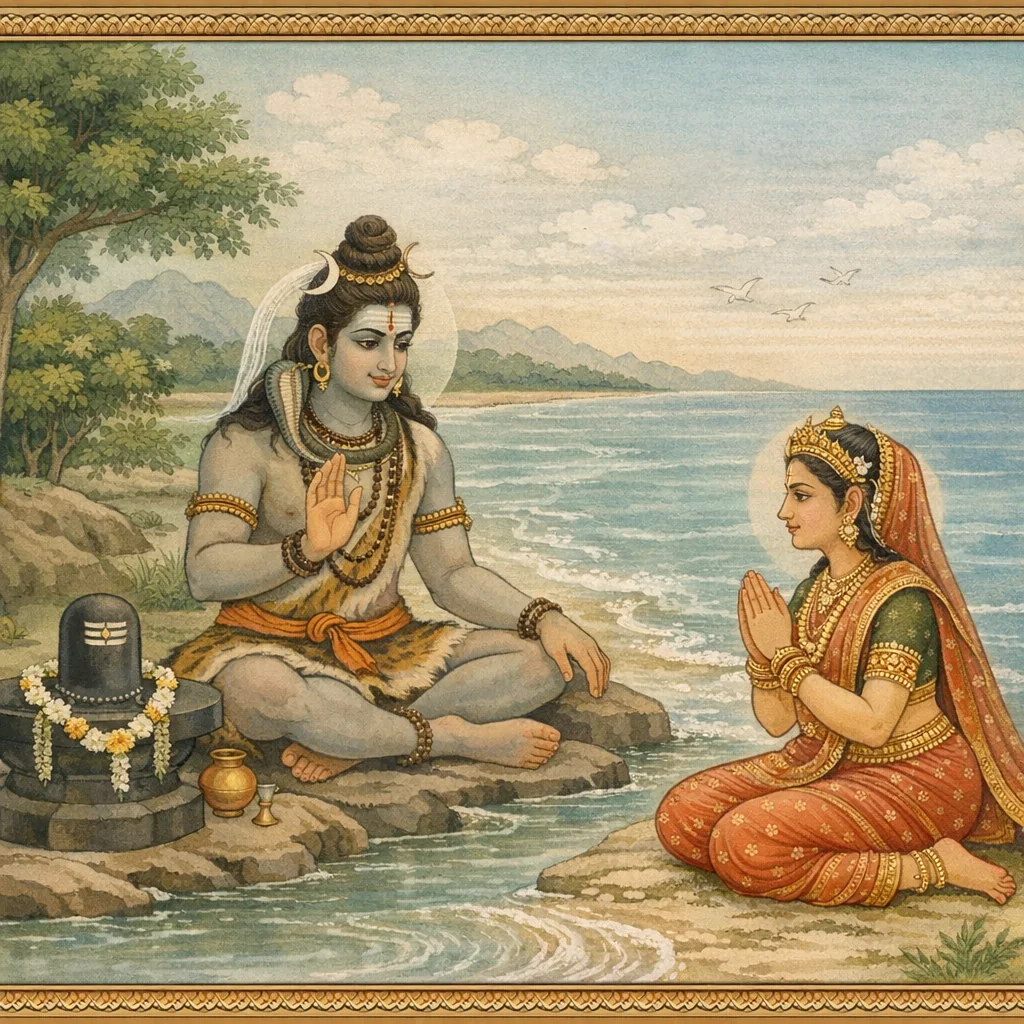
Adhyaya 267
गङ्गापथ-गङ्गेश्वर-माहात्म्यवर्णनम् | Glory of Gaṅgāpatha and Gaṅgeśvara
Chapter 267 offers a brief tīrtha instruction within a Śaiva dialogue. Īśvara speaks to Devī and points to the sacred place called Gaṅgāpatha, graced by the great-flowing Gaṅgā and by a Śiva manifestation revered as Gaṅgeśvara. Gaṅgā is praised as sea-bound (samudragāminī), sin-destroying (pāpanāśinī), and famed on earth as “Uttānā,” an ornament of the three worlds. The prescribed observance is to bathe there and worship Gaṅgeśa; the phalaśruti declares that the devotee is freed from grievous sins and gains merit equal to performing vast numbers of Aśvamedha sacrifices. The chapter closes with a colophon placing it in the Skanda Mahāpurāṇa, Prabhāsa Khaṇḍa, Prabhāsakṣetramāhātmya, under the glory of Gaṅgāpatha–Gaṅgeśvara.
Adhyaya 268
चमसोद्भेदमाहात्म्य (Camasodbheda Māhātmya: The Glory of the Camasodbheda Tīrtha)
In this adhyāya, Īśvara speaks to Devī and directs the pilgrim to an eminent tīrtha called Camasodbheda. The origin of the name is explained: Brahmā is said to have performed a prolonged satra (extended sacrificial session), and the devas along with great seers drank soma from camas, ritual cups—hence the place became known on earth as Camasodbheda. The chapter then prescribes the rite in order: bathe in the Sarasvatī connected with the site, and afterwards perform piṇḍadāna, the ancestral offering. The promised fruit (phalavāda) is praised as merit “equal to a crore of Gayā” (gayā-koṭi-guṇa), with special emphasis on the month of Vaiśākha as a supremely auspicious time. It concludes with a colophon placing the chapter within the Prabhāsa Khaṇḍa and the Prabhāsakṣetramāhātmya.
Adhyaya 269
विदुराश्रम-माहात्म्यवर्णनम् (Glorification of Vidura’s Hermitage)
In this adhyāya, Īśvara speaks to Mahādevī and points her toward a great sacred destination: Vidura’s renowned āśrama. There Vidura—praised as dharma embodied (dharmamūrtimān)—performed fierce “raudra” austerities, making the hermitage a seat of profound sanctity. The holiness of the kṣetra is tied to a foundational Śaiva deed: the establishment (pratiṣṭhā) of a Mahādeva-liṅga known as Tribhuvaneśvara, a local manifestation of universal lordship. The text declares the practical fruit of devotion: whoever gains darśana of this liṅga attains desired aims and finds the pacification of sin (pāpopaśānti). The place, called Vidurāṭṭālaka, is attended by gaṇas and gandharvas and described as a “twelve-station” (dvādaśasthānaka) sacred complex, difficult to reach without great merit; it is also marked by the unusual sign that no rain falls there.
Adhyaya 270
Prācī Sarasvatī–Maṅkīśvara Māhātmya (प्राचीसरस्वतीमंकीश्वरमाहात्म्य)
This chapter is framed as a Śaiva theological teaching in which Īśvara (Śiva) instructs Devī about the liṅga at the flow of the Prācī Sarasvatī, famed as Maṅkīśvara. It first recounts the origin legend: the ascetic ṛṣi Maṅkaṇaka performs long tapas with disciplined diet and study; when a plant-sap-like fluid accidentally oozes from his hand, he mistakes it for extraordinary siddhi and dances in rapture. His dance shakes the cosmos—mountains shift, oceans churn, rivers turn aside, and the heavenly bodies lose their alignment—so the devas led by Indra, with Brahmā and Viṣṇu, appeal to Tripurāntaka (Śiva) to restrain the upheaval. Śiva arrives disguised as a brāhmaṇa, questions the cause, and displays a greater marvel by producing ash from his thumb, correcting the ascetic’s delusion and restoring order. Maṅkaṇaka acknowledges Śiva’s supremacy and asks that his tapas not be diminished; Śiva grants its continued increase and establishes enduring presence at that sacred spot. The latter half turns to tīrtha-vidhi and phalaśruti, praising the Prācī Sarasvatī as exceptionally meritorious, especially at Prabhāsa. Death on the northern bank is said to prevent return to rebirth and to yield abundant merit likened to an aśvamedha. The text lists observances and fruits: disciplined bathing brings supreme siddhi and Brahman’s highest station; even a small gift of gold to a worthy brāhmaṇa gives Meru-like results; śrāddha benefits extend through many generations; a single piṇḍa offering and tarpaṇa uplift ancestors from adverse states; anna-dāna is linked to the path of mokṣa; gifts such as curd and woolen coverings lead to specific loka attainments; and bathing to remove impurity is equated with the fruit of go-dāna. It highlights bathing on kṛṣṇa-pakṣa caturdaśī and declares the river rare and hard to reach for the unmeritorious, with mentions of Kurukṣetra, Prabhāsa, and Puṣkara. The chapter closes with Śiva’s withdrawal after establishing his presence, and a verse attributed to Viṣṇu advising Dharma’s son to prefer the Prācī Sarasvatī over other renowned tīrthas.
Adhyaya 271
Jvāleśvara Māhātmya (ज्वालेश्वरमाहात्म्य) — The Glory of the Jvāleśvara Liṅga
This chapter recounts the origin of a liṅga named Jvāleśvara, situated near the central sacred zone of Prabhāsa. Īśvara (Śiva) explains that it is remembered as “Jvāleśvara” because the Pāśupata weapon (śara/astra, divine force) associated with Tripurāri—Śiva as the destroyer of Tripura—was cast down at that very spot, appearing as a blazing, radiant power. Thus a mythic martial-theological event is anchored to a lasting object of worship, turning myth into sacred geography. The practical teaching is brief: mere darśana of this liṅga is said to purify and free a human devotee from all pāpaka (sins). The framing notes place it within the Skanda Mahāpurāṇa, in the Prabhāsa Khaṇḍa and the first Prabhāsakṣetramāhātmya unit, formally as the 271st adhyāya.
Adhyaya 272
त्रिपुरलिंगत्रयमाहात्म्यम् | The Māhātmya of the Three Tripura Liṅgas
This adhyāya is framed as a theological discourse spoken by Īśvara. He directs the pilgrim to behold, within the same sacred region, an eastern (prācī) spot near the Goddess’s presence (devyāḥ saṃnidhi). There a triad of liṅgas (liṅga-traya) is identified as belonging to the great-souled Tripura figures—Vidyunmālī, Tāraka, and Kapola. The chapter’s instruction links spatial orientation (the eastward location), shrine recognition (the three liṅgas), and ethical-ritual fruit: mere darśana, the reverent sight of the installed liṅga(s), is declared to free one from sin (pāpaiḥ pramucyate). The colophon places this chapter in the 81,000-verse Skanda Mahāpurāṇa, within the seventh Prabhāsa Khaṇḍa, first section Prabhāsakṣetramāhātmya, as the māhātmya of the three Tripura liṅgas.
Adhyaya 273
शंडतीर्थ-उत्पत्ति तथा कपालमोचन-लिङ्गमाहात्म्य (Origin of Śaṇḍa-tīrtha and the Kapālamocana Liṅga)
Īśvara speaks to Devī, praising Śaṇḍa-tīrtha as an unsurpassed sacred ford that pacifies all sin and grants desired results. He then recounts its origin: in an earlier age Brahmā had five heads, and in a certain circumstance Īśvara severed one; the flowing blood and wondrous signs sanctified the spot, where great palm trees arose and the place came to be remembered as a palm-grove. The skull (kapāla) clung to Īśvara’s hand, and both he and his bull Nandin became dark in body, so they set out on pilgrimage, troubled by the transgression. No place could lift the burden until they reached Prabhāsa and beheld the east-facing Sarasvatī. When the bull bathed, it instantly turned white; at the same moment Īśvara was freed from the sin of killing (hatyā). Then the kapāla fell from his hand, and the site was established as the Kapālamocana liṅga. The chapter further enjoins śrāddha offerings near Prācī Devī (Sarasvatī), declaring great satisfaction for the ancestors—especially when performed on the Kṛṣṇa-pakṣa Caturdaśī of Āśvayuja with proper procedure, worthy recipients, and gifts such as food, gold, curds, and blankets. The naming of Śaṇḍa-tīrtha is explained through the bull’s transformation.
Adhyaya 274
Sūryaprācī-māhātmya (Glory of Sūryaprācī)
This adhyāya gives a brief tīrtha instruction within Prabhāsa-kṣetra. Īśvara speaks to Mahādevī, directing her—and thereby pilgrims—to proceed to Sūryaprācī, praised as radiant and exceedingly powerful. The site is framed as purificatory, “pacifying all sins,” and also as a place that grants the fruits of rightful desires within the Purāṇic ethic of disciplined pilgrimage. The central rite is bathing (snāna) at the tīrtha, with the promised result being release from the pañca-pātakas, the five major transgressions of dharma. The colophon identifies this as the Sūryaprācī-māhātmya in the Skanda Mahāpurāṇa, Prabhāsa-khaṇḍa.
Adhyaya 275
त्रिनेत्रेश्वरमाहात्म्यवर्णनम् | The Māhātmya of Trinetreśvara (Three-Eyed Śiva)
This chapter gives concise guidance on the sacred site of Trinetreśvara, Śiva in his three-eyed form, connected with a tīrtha near Ṛṣi-tīrtha. Īśvara speaks to Mahādevī, directing pilgrims to approach and worship the three-eyed Lord at a place described as north of the bank of Nyanku-matī, long revered by sages. The water there is praised as crystal-clear, and a distinctive aquatic mark—evoked through fish imagery—identifies the tīrtha. Its central doctrinal-ritual claim is purification: bathing at this spot is said to free one from the sin-category of brahmahatyā. The text then prescribes a calendrical vrata: on the caturdaśī of the kṛṣṇa-pakṣa in Bhādrapada, one should fast and keep a night vigil. At dawn, one performs śrāddha and worships Śiva in the proper manner. The phalaśruti promises the reward of prolonged residence in Rudra-loka, expressed in a large, formulaic span of time. In this way, correct tīrtha practice and ritual observance are linked to postmortem merit within a Śaiva soteriological frame.
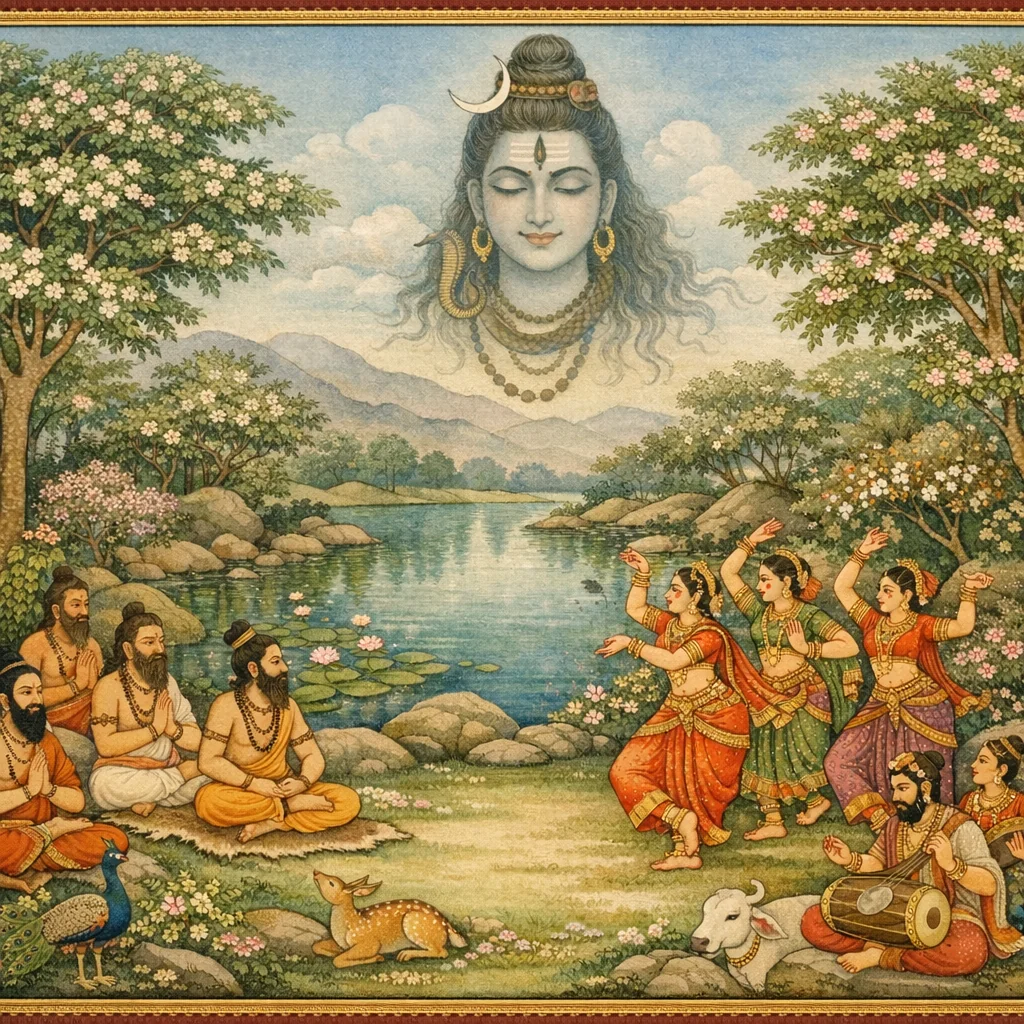
Adhyaya 276
Devikā-tīra Umāpati-māhātmya (देविकायामुमापतिमाहात्म्यवर्णनम्) — The Glory of Umāpati at the Devikā Riverbank
This adhyāya records Īśvara’s instruction to Devī, describing a pilgrimage toward Ṛṣi-tīrtha and a supremely esteemed kṣetra on the auspicious bank of the Devikā. It paints an ornate ecological-and-cosmic vision of the siddha-forest Mahāsiddhivana—flowering and fruiting trees, birdsong, animals, caves, and mountains—expanding into a vast assembly of beings: devas, asuras, siddhas, yakṣas, gandharvas, nāgas, and apsarases. Their praise, dance, music, flower-rain, meditation, and ecstatic gestures reveal the site as a sacred liturgical landscape. Īśvara then establishes a permanent divine station named “Umāpatīśvara,” declaring his continual presence through yugas, kalpas, and manvantaras, and his special attachment to Devikā’s blessed shore. The chapter prescribes śrāddha on the new-moon day (amāvāsyā) in the month of Puṣya; its phalāśruti proclaims the offering’s merit imperishable and says that mere darśana removes even the gravest sins, including “a thousand brahmahatyās.” It further recommends dānas of cows, land, gold, and garments, extolling the performer of ancestral rites there as uniquely meritorious. Finally, it explains that the river is called “Devikā” because the gods assembled there for bathing, and thus it is pāpa-nāśinī, the destroyer of sin.
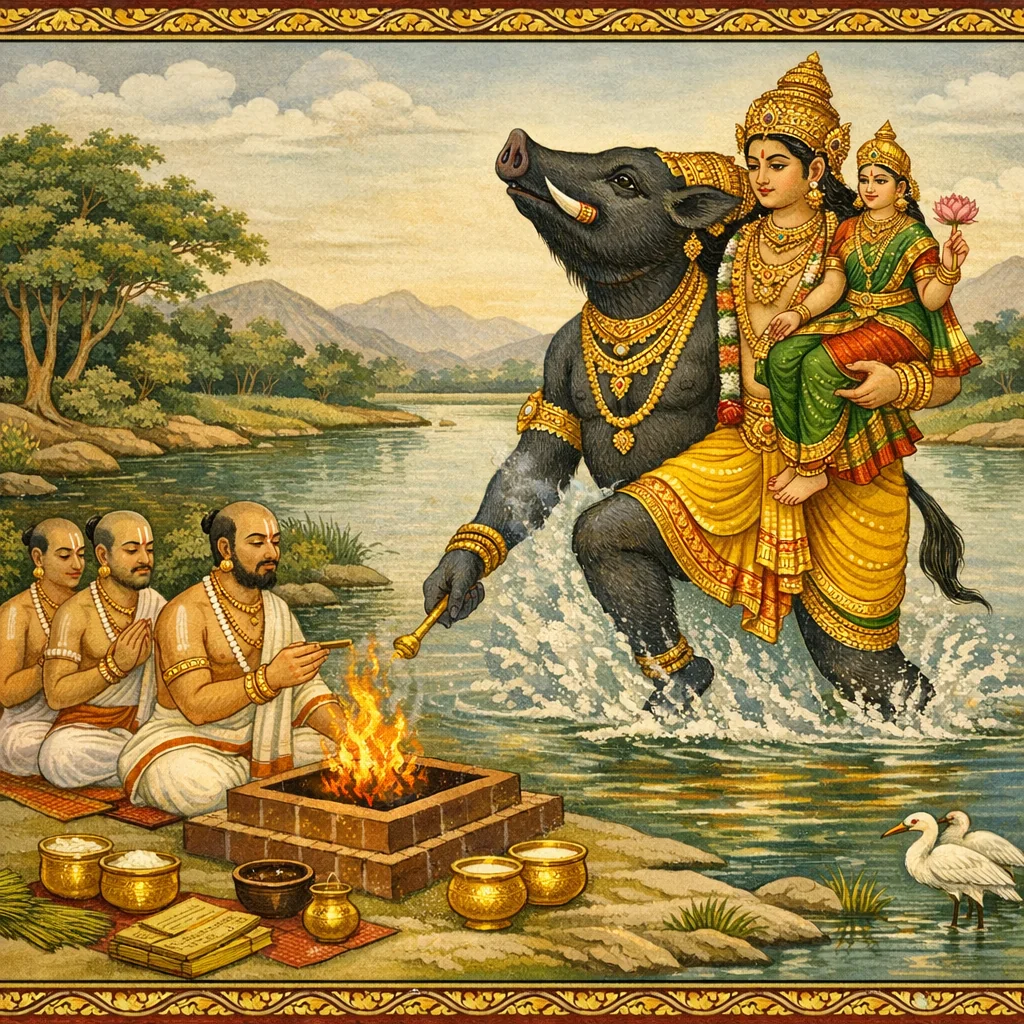
Adhyaya 277
Bhūdhara–Yajñavarāha Māhātmya (भूधरयज्ञवराहमाहात्म्य)
The chapter points out a sacred spot on the bank of the Devikā where Bhūdhara is to be beheld and visited, and explains the name through a mythic and ritual logic. Varāha, the divine Boar who raised up the Earth, is invoked, and the place is read as an extended allegory of yajña. A chain of epithets maps Varāha’s body onto Vedic sacrificial elements—Veda as the feet, the yūpa as the tusks, sruva/sruc as mouth and face, Agni as the tongue, darbha as the hair, and Brahman as the head—thus fusing cosmology with the structure of sacrifice. The latter portion prescribes a Pitṛ‑oriented śrāddha according to calendrical markers (Puṣya month, amāvāsyā, ekādaśī, seasonal setting, and the Sun’s entry into Kanyā/Virgo), detailing offerings such as pāyasa and havis with jaggery, consecratory invitations, specific mantras for ghee, curd, milk, and other foods, followed by feeding learned vipras and performing piṇḍa‑dāna. The phala declares that śrāddha properly done here satisfies the ancestors for a vast cosmic duration and yields the same merit as Gayā‑śrāddha without traveling to Gayā, exalting the salvific power of this local tīrtha.
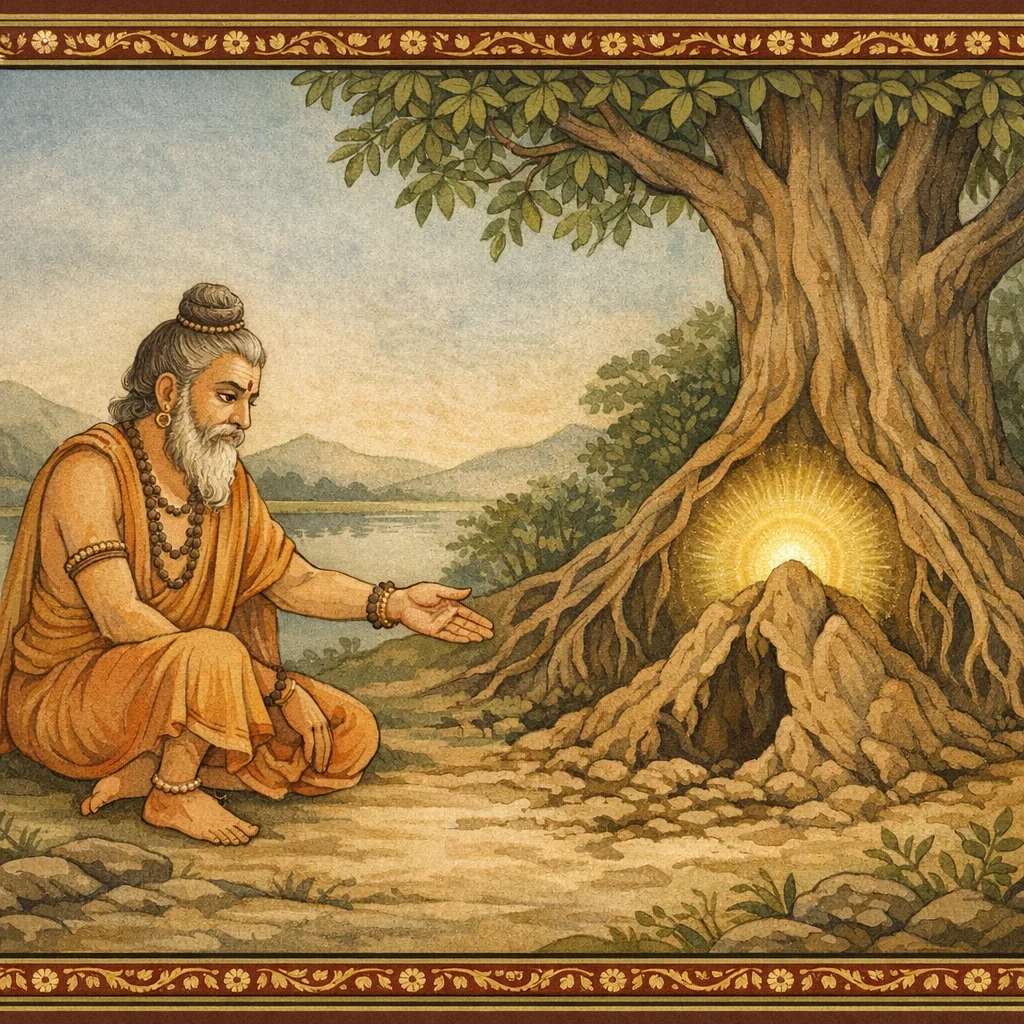
Adhyaya 278
देविकामाहात्म्य–मूलस्थानमाहात्म्यवर्णनम् (Devikā Māhātmya and the Glory of Mūlasthāna/Sūryakṣetra)
The chapter unfolds as a sacred dialogue between Śiva and Devī. Īśvara points to a famed holy station near the pleasant bank of the Devikā river, described as a place connected with Bhāskara (Sūrya, the Sun). Devī asks how Vālmīki became a “siddha,” and why the Seven Sages were once robbed. Īśvara recounts an earlier life of a brāhmaṇa-born man (named Vaiśākha/Viśākha in the narrative frame) who turns to theft to support his aged parents and household. Meeting the Seven Sages on pilgrimage, he threatens them, yet they remain serene. Aṅgiras then presses a moral question: who will share the karmic burden of wealth gained through wrongdoing? When the thief consults his parents and later his wife, all refuse to share the sin, declaring that the doer alone bears the fruit of action. Struck by this truth, he renounces, confesses, and seeks a way to withdraw from violence. The sages prescribe a four-syllable mantra, “झाटघोट,” said to destroy sin and grant liberation when practiced with one-pointed mind and in alignment with the guru. Through prolonged japa and absorption he becomes steady; time passes until his body is covered by an anthill (valmīka). The sages return, excavate the mound, recognize his attainment, name him Vālmīki, and foretell inspired speech and the composition of the Rāmāyaṇa. The narrative then anchors sacred geography: beneath the root of a nimba tree Sūrya abides as the site-deity; the place is called Sūryakṣetra and Mūlasthāna. Pilgrimage fruits are stated—snāna, tarpaṇa with sesame-water, and śrāddha that uplifts ancestors; even animals benefit by contact with the water. Rites on a specified calendrical occasion are said to relieve certain skin diseases. The chapter closes by commending darśana of the deity and hearing this account as means to remove major faults.
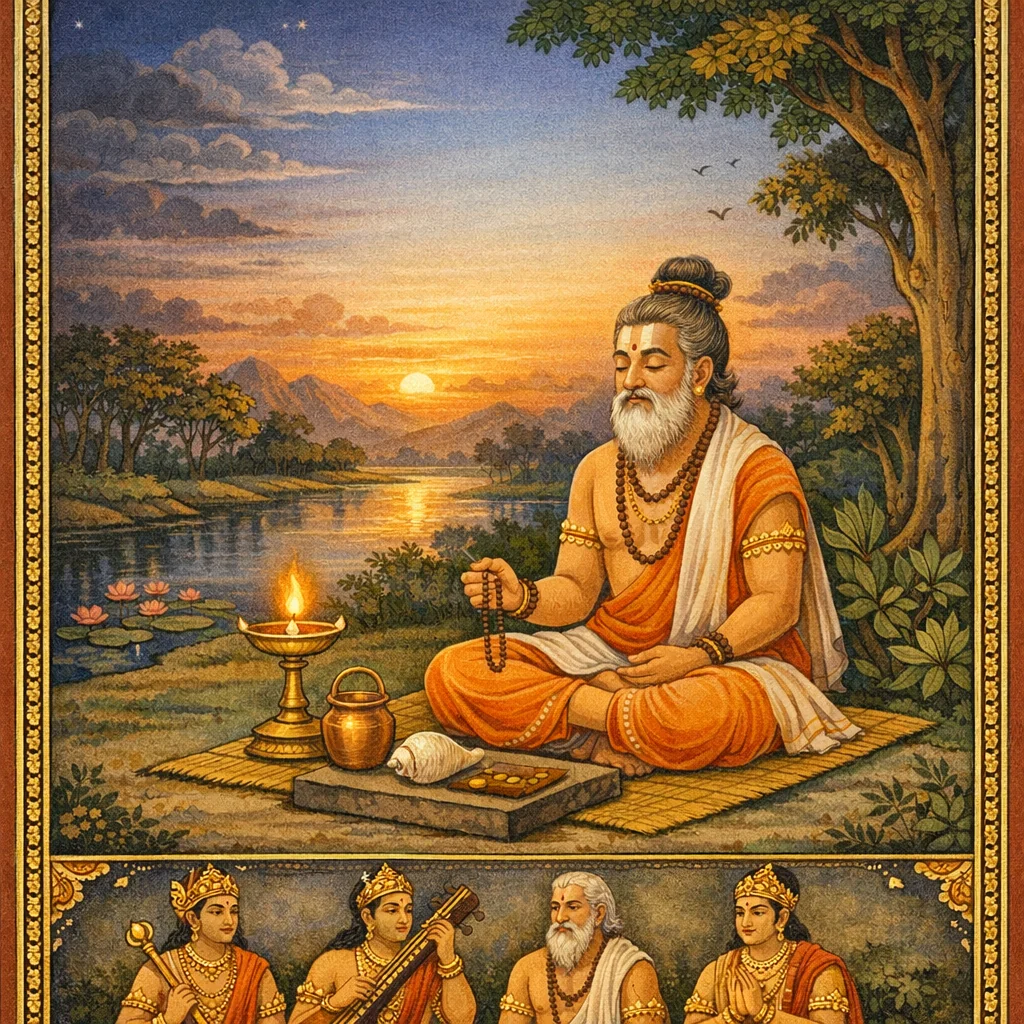
Adhyaya 279
च्यवनादित्यमाहात्म्य—सूर्याष्टोत्तरशतनाम-माहात्म्यवर्णनम् (Cāvanāditya Māhātmya—The Glory of Sūrya’s 108 Names)
This chapter presents devotional ritual instruction within a sacred place narrative. Īśvara speaks to Devī, directing the devotee to the eminent solar shrine called Cāvanārka in the eastern region of Hiraṇyā, established by the sage Cyavana. On the seventh lunar day (saptamī), the worshipper is enjoined to praise Sūrya with disciplined procedure, purity, and focused attention, and to recite the aṣṭottaraśata-nāma—the Sun’s 108 names. The ensuing name-list expands Sūrya’s identity through cosmic equivalences: units of time (kalā, kāṣṭhā, muhūrta, pakṣa, māsa, ahorātra, saṃvatsara), major deities (Indra, Varuṇa, Brahmā, Rudra, Viṣṇu, Skanda, Yama), and functions such as dhātṛ, prabhākara, tamonuda, and lokādhyakṣa. The discourse also states a clear transmission lineage: the hymn was taught by Śakra, received by Nārada, then by Dhaumya, and finally by Yudhiṣṭhira, who attained his desired aims. The closing phalaśruti declares that daily recitation—especially at sunrise—bestows prosperity (wealth and gems), progeny, strengthened memory and intellect, freedom from grief, and fulfillment of intentions, as blessed fruits of disciplined devotion.
Adhyaya 280
च्यवनेश्वरमाहात्म्यवर्णनम् | The Māhātmya of Cyavaneśvara
Chapter 280 is a sacred dialogue between Śiva and Devī introducing the liṅga of Cyavaneśvara in Prabhāsa-kṣetra, praised as “sarva-pātaka-nāśana,” the destroyer of all sin. It then recounts the earlier life of the Bhārgava sage Cyavana: arriving at Prabhāsa, he performs fierce tapas, becomes motionless like a “sthāṇu,” and is gradually covered by an anthill, creepers, and ants. King Śaryāti comes on pilgrimage with a vast retinue and his daughter Sukanyā. While roaming with companions, Sukanyā finds the anthill and, mistaking the sage’s eyes for shining objects, pierces them with a thorn. Cyavana’s wrath manifests as a punitive affliction upon the king’s army—described as a disabling blockage of excretory function—leading to inquiry and confession. Sukanyā admits her deed and the king begs forgiveness; Cyavana pardons on the condition that Sukanyā be given to him in marriage, and the king agrees. The chapter ends by praising Sukanyā’s exemplary service to her ascetic husband—discipline, hospitality, and devotion—linking the shrine’s glory with ethical teachings on accountability, restitution, and faithful service.
Adhyaya 281
च्यवनेश्वर-माहात्म्यवर्णनम् (Chyavaneśvara Māhātmya—Narration of the Glory of Chyavana’s Lord/Shrine)
Īśvara recounts an episode about Sukanyā, daughter of Śaryāti and wife of the sage Cyavana. The Aśvinīkumāras (the Nāsatya twins), divine physicians, meet her in the forest and try to persuade her to abandon her aged husband, praising her beauty and pointing to Cyavana’s frailty. Sukanyā firmly upholds marital fidelity and refuses. The Aśvins then offer a remedy: they will restore Cyavana to youth and handsomeness, after which Sukanyā may choose her husband from among them. She conveys this to Cyavana, and the sage consents. Cyavana and the Aśvins enter the waters of a ritual pond and soon emerge in equally youthful, radiant forms, indistinguishable from one another. By discernment, Sukanyā selects Cyavana as her rightful spouse. Pleased, Cyavana promises to grant the Aśvins what they seek. They ask for the right to drink Soma and to receive a share in yajña rites—privileges said to have been denied by Indra. Cyavana agrees to establish their entitlement; the Aśvins depart satisfied, and Cyavana and Sukanyā return to a restored household life, exemplifying fidelity, healing within dharma, and sage authority in ritual status.
Adhyaya 282
Chyavanena Nāsatyayajñabhāga-pratirodhaka-vajra-mocanodyata-śakra-nāśāya Kṛtyodbhava-Madonāma-mahāsurotpatti-varṇanam (Chyavaneśvara Māhātmya)
The chapter recounts a ritual-theological clash at the āśrama of the Bhārgava ṛṣi Cyavana. King Śaryāti, delighted to hear of Cyavana’s renewed vigor and prosperity, arrives with his retinue and is honorably received. Cyavana offers to officiate a yajña for the king, and an exemplary sacrificial arena is prepared. At the time of soma distribution, Cyavana takes a soma-graha for the Aśvins (Nāsatyas). Indra objects, claiming that the Aśvins—physicians and attendants who move among mortals—are not entitled to soma like the other devas. Cyavana rebukes Indra, affirms the Aśvins’ divine status and beneficence, and proceeds with the offering despite Indra’s warning. Indra then raises the vajra to strike, but Cyavana, by ascetic power, immobilizes Indra’s arm. As the confrontation escalates, Cyavana performs a mantra-based oblation to generate a kṛtyā; from his tapas arises a terrifying being named Mada, described in cosmic, world-covering proportions, roaring as it rushes toward Indra with intent to devour him. The episode highlights ritual entitlement, the authority of the officiant, and the ethical limits of divine coercion within the sacred setting of sacrifice.
Adhyaya 283
च्यवनेश्वरमाहात्म्यवर्णनम् | The Māhātmya of Chyavaneśvara (Glory of the Chyavana-installed Liṅga)
This chapter sets forth the origin and ritual charter of the liṅga called Chyavaneśvara in Prabhāsa-kṣetra. Spoken in Īśvara’s voice, it recalls a tense confrontation in which Śakra (Indra) is seized with fear before a formidable presence, while the Bhārgava ṛṣi Chyavana stands forth as the decisive ascetic authority. The narrative links the Aśvins’ rights and Soma-entitlements to Chyavana’s deeds, stressing that the outcome was not accidental but arranged to make manifest (prakāśana) the ṛṣi’s power and to establish lasting renown for Sukanyā and her lineage. Chyavana is then said to have sported (vijahāra) with Sukanyā in this forested sacred tract and to have installed here a sin-destroying liṅga. A clear injunction follows: proper worship of this liṅga yields merit equal to an Aśvamedha. The chapter also points to Candramas-tīrtha, frequented by Vaikhānasa and Vālakhilya sages, and prescribes a calendrical śrāddha: on the full-moon day (pauṇamāsī), especially in the month of Aśvin, one should perform śrāddha by rule and feed brāhmaṇas separately, gaining the fruit of “koṭi-tīrthas.” The closing phalaśruti declares that hearing this sin-destroying account frees one from accumulated sins across many births.
Adhyaya 284
सुकन्यासरोमाहात्म्यवर्णनम् (Glorification of Sukanyā-saras)
In this adhyāya, Īśvara speaks to Mahādevī and points to Sukanyā-saras, an eminent lake within Prabhāsa-kṣetra. The well-known episode of Sukanyā, the sage Cyavana, and the Aśvin twins is situated here: the Aśvins are said to have immersed in this lake with Cyavana, and by the tīrtha’s power Cyavana is transformed, attaining a form comparable to the Aśvins. The text then explains the name: Sukanyā’s wish is fulfilled through the potency of bathing in the lake (saras-snāna-prabhāva), and thus it is remembered as “Kanyā-saras.” A phalaśruti follows, stressing especially the merit for a woman who bathes there—particularly on the third lunar day (tṛtīyā): protection from disruption of the household across vast cycles of rebirth, and avoidance of spouses marked by poverty, disability, or blindness, as traditional merit-statements tied to tīrtha observance.
Adhyaya 285
अगस्त्याश्रम-गंगेश्वर-माहात्म्यवर्णनम् (Agastya’s Āśrama and the Glory of Gaṅgeśvara)
Chapter 285 unfolds as a Śiva–Devī theological dialogue set within a tīrtha itinerary. Īśvara directs Devī to the Nyanku-matī River and its sacred stations: performing Gayā-śrāddha at the renowned tīrtha Goṣpada, beholding Varāha, proceeding to Hari’s abode, honoring the Mothers (Mātṛs), and bathing at the river–ocean confluence. The account then turns eastward to the divine āśrama of Agastya on the pleasant bank of Nyanku-matī, praised as a “hunger-removing” place (kṣudhā-hara) and a destroyer of sins. Asked why Vātāpi was subdued and what stirred Agastya’s wrath, Īśvara recounts the Ilvala–Vātāpi episode: the demon brothers, through deceptive hospitality, repeatedly killed brāhmaṇas, who sought Agastya’s protection. At Prabhāsa, Agastya confronts the asuras, consumes Vātāpi prepared in the form of a ram, nullifies the resurrection ruse, and reduces Ilvala to ashes. He then grants the recovered, wealth-filled place to the brāhmaṇas, giving rise to the site-name associated with the removal of hunger. Since eating a demon is said to produce a specific impurity, Gaṅgā is invoked to purify Agastya; she becomes established there, and the shrine is named Gaṅgeśvara. The chapter concludes with a tīrtha promise: seeing Gaṅgeśvara and practicing snāna, dāna, and japa frees one from the sin of “forbidden consumption,” through the power of place, rite, and sacred remembrance.
Adhyaya 286
बालार्कमाहात्म्यवर्णन (Bālārka Māhātmya — Account of the Glory of Bālārka)
The chapter is framed as Īśvara’s instruction to Devī during a pilgrimage itinerary through Prabhāsa-kṣetra. Īśvara directs the pilgrim to Bālārka, praised as pāpa-nāśana, the destroyer of sin, and places it a short distance north of Agastya’s āśrama. It then explains the name’s origin: the site is called Bālārka because, in ancient times, the Sun (Arka) in a youthful, childlike form (bāla) is said to have performed austerities (tapas) there. A phala is also declared for darśana on Sunday (ravivāra): the devotee will not be afflicted with kuṣṭha (a class of skin disease), and children’s sufferings born of illness are said not to arise. Thus the unit weaves sacred geography, theological etiology, and a health-focused phalaśruti tied to calendrical devotion.
Adhyaya 287
अजापालेश्वरीमाहात्म्यम् | Ajāpāleśvarī Māhātmya (Glory of Ajāpāleśvarī)
Īśvara speaks to Devī and points out a highly auspicious shrine named Ajāpāleśvarī, situated not far from Agastya-sthāna. The place is praised as a sacred seat that destroys sin and relieves disease. The chapter credits its establishment to King Ajāpāla, a distinguished ruler of the Raghu lineage, who worships the Goddess as the remover of sin and illness. As an etiological account, it links the king with the management or easing of ailments metaphorically described as “goat-form” (ajā-rūpa) diseases, and says he installed the deity under his own name so that she might abide there as a sin-destroying presence. A brief phalaśruti concludes the chapter: worship performed with devotion on the third lunar day (tṛtīyā), according to proper procedure, bestows strength, intellect, fame, learning, and good fortune. Thus the māhātmya weaves together sacred geography, royal patronage, and tithi-based ritual timing into a compact instruction.
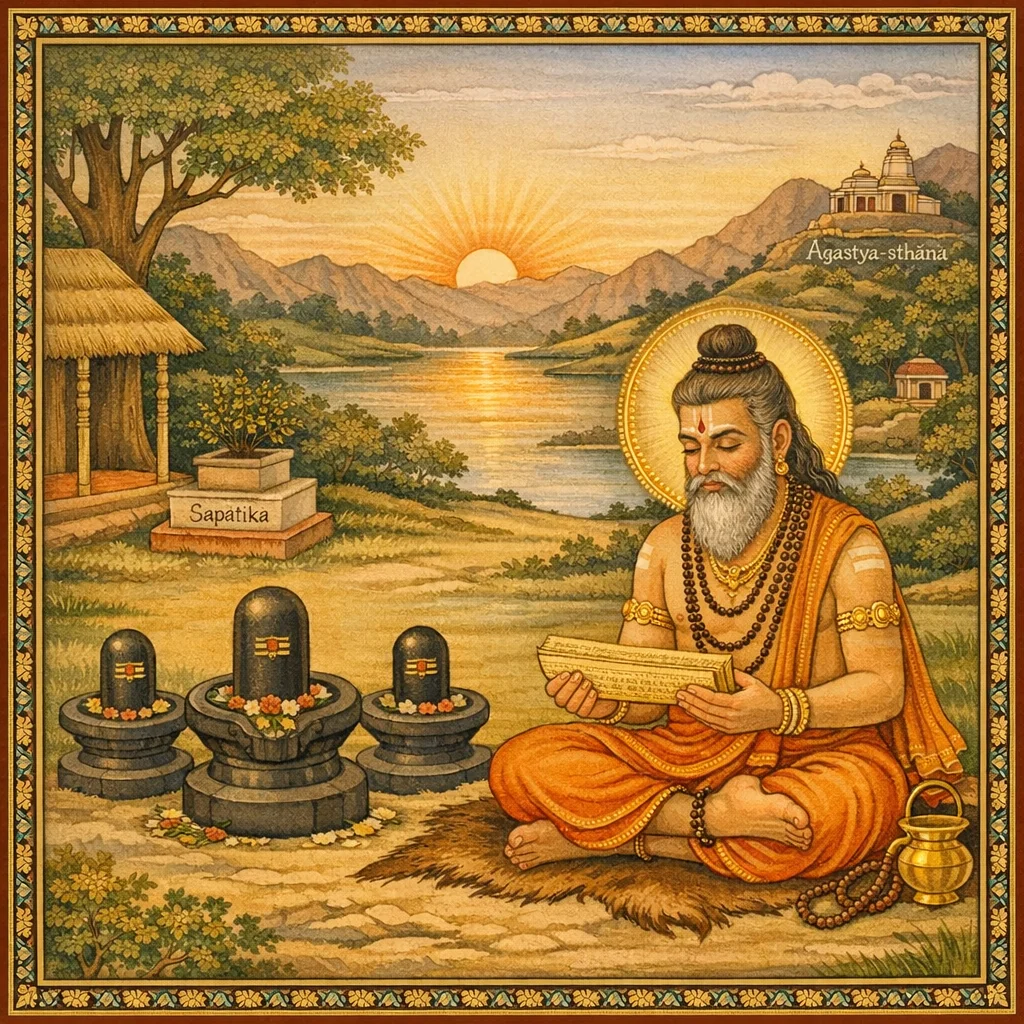
Adhyaya 288
बालार्कमाहात्म्यवर्णनम् | The Māhātmya of Bālārka (the ‘Child-Sun’ Shrine)
Īśvara (Śiva) speaks to Devī and gives route-like pilgrimage directions to the sacred spot called Bālāditya/Bālārka, said to lie east of Agastya’s place and marked by distance measures (gavyūti). The chapter also names nearby local features, including a place connected with Sapāṭikā, and affirms the shrine’s renown. It then relates an origin legend: the sage Viśvāmitra worships Vidyā (sacred learning) there, establishes a triad of liṅgas, and installs the solar form, Ravi. Through disciplined sādhana he gains siddhi from the Sun, and the deity becomes celebrated as Bālāditya/Bālārka. The discourse ends with a clear phalaśruti: whoever beholds (darśana) this Bhāskara—praised as a “thief of sins”—will not suffer poverty for as long as they live, highlighting the merit of sacred sight within the Prabhāsa pilgrimage.
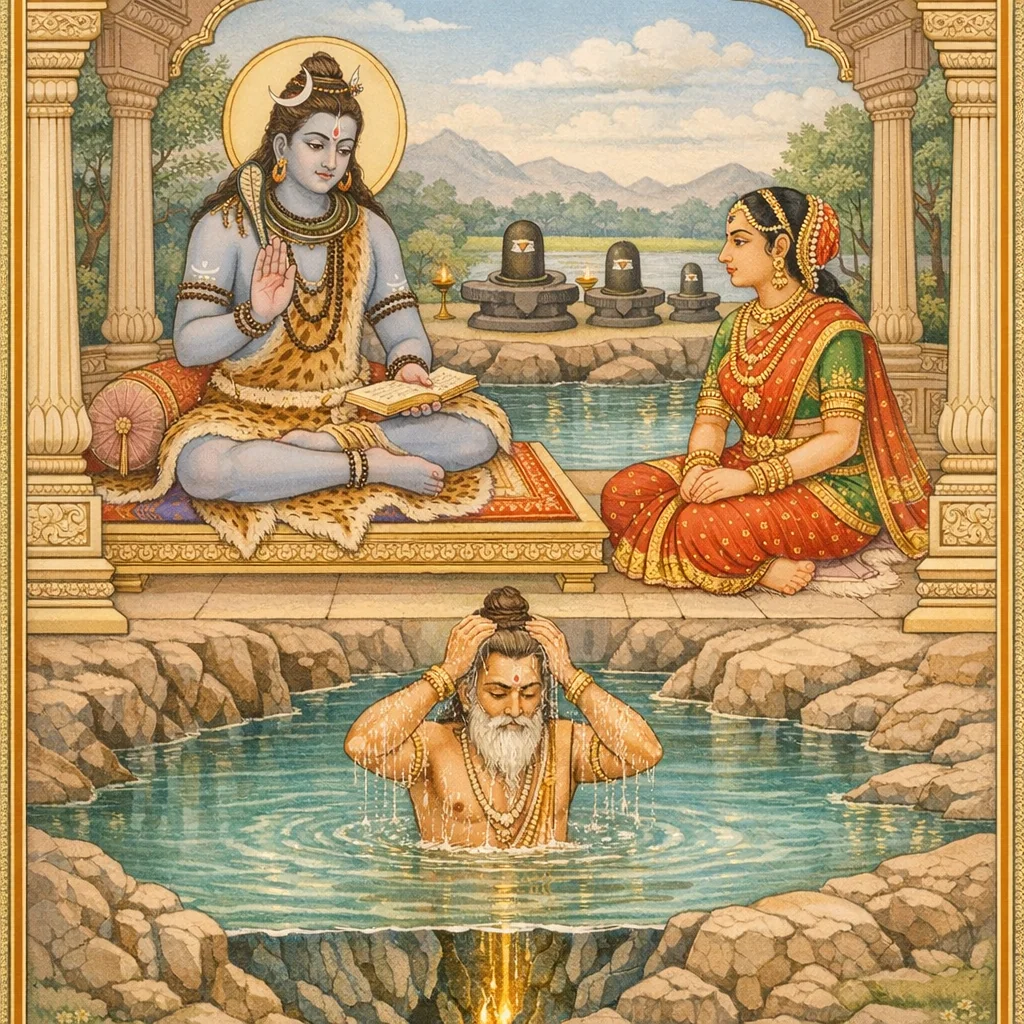
Adhyaya 289
पातालगंगेश्वर–विश्वामित्रेश्वर–बालेश्वर लिङ्गत्रयमाहात्म्य (Glory of the Three Liṅgas: Pātāla-Gaṅgeśvara, Viśvāmitreśvara, and Bāleśvara)
In this adhyāya, Īśvara speaks to Devī and points out a purifying tīrtha to the south, at a short distance measured in gav-yūti. The place is marked by a manifestation of Gaṅgā described as pātāla-gāminī—descending and connected with the subterranean realm—and is explicitly praised as pāpa-nāśinī, the destroyer of sin. The narrative associates the site with the great sage Viśvāmitra, who invoked Gaṅgā for ritual bathing (snāna); it is declared that bathing there frees one from all sins. The chapter then names three liṅgas—Gaṅgeśvara, Viśvāmitreśvara, and Bāleśvara—and affirms that their darśana grants the fulfillment of desired aims, following the tīrtha-māhātmya pattern of location, sacred authorization, and prescribed acts with promised fruits.
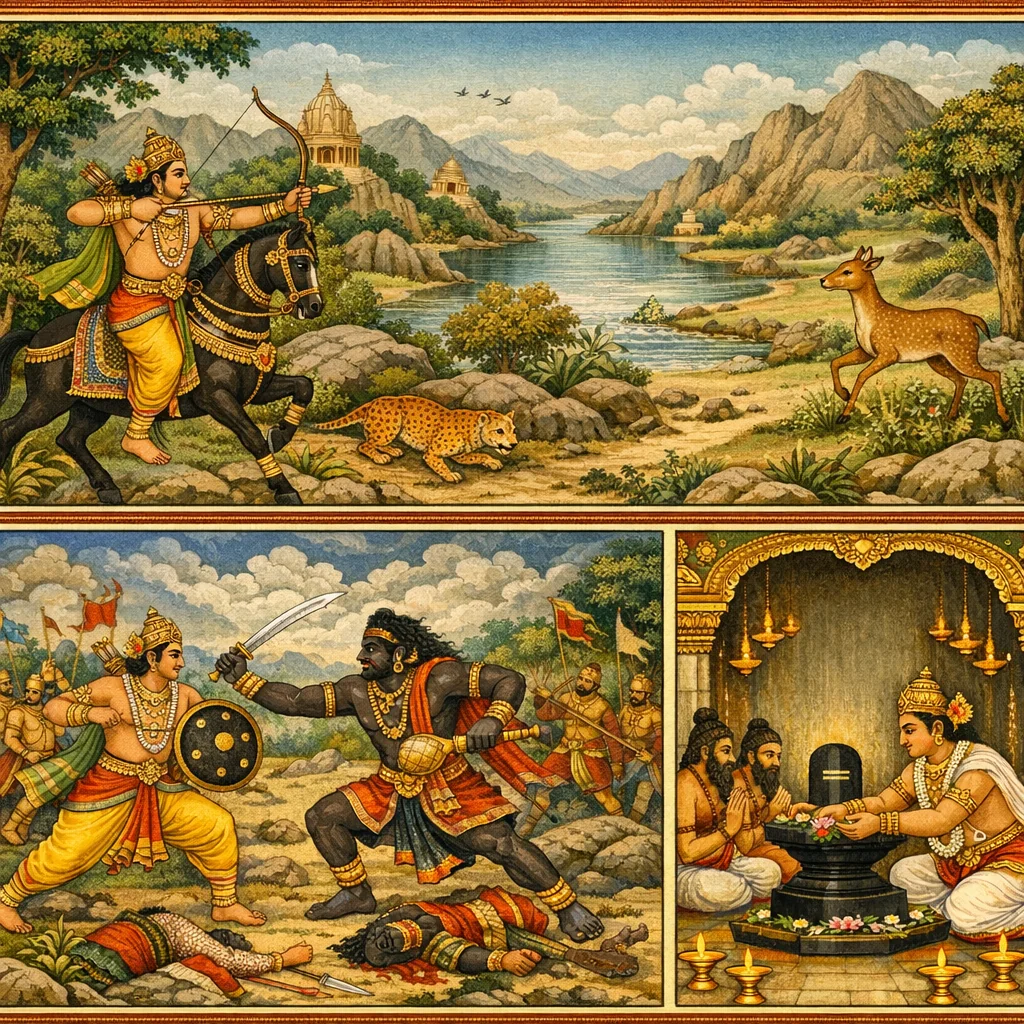
Adhyaya 290
Kuberanagarotpatti and Kubera-sthāpita Somanātha Māhātmya (Origin of Kuberanagara and the Glory of the Somanātha Liṅga Installed by Kubera)
This chapter unfolds as a dialogue between Śiva and Devī. Śiva points to an excellent sacred spot connected with Kubera, where Kubera once attained the rank of Dhanada, lord of wealth. Devī asks how a brāhmaṇa could fall into thief-like conduct and yet later become Kubera. Śiva recounts the former life of a brāhmaṇa, Devaśarman, who lived at Prabhāsa on the bank of the Nyanku-matī: absorbed in household concerns, he abandons home out of greed to seek riches; his wife is portrayed as morally unstable, and their son Duḥsaha is born amid misfortune, later sinking into vice and social rejection. Duḥsaha attempts theft in a Śiva temple, but through his dealings with a nearly extinguished lamp and its wick he inadvertently performs a kind of lamp-service (dīpa-sevā). Discovered by a temple-servant, he flees in fear and is later violently slain by guards. Reborn in Gandhāra as the notorious king Sudurmukha, he remains ethically compromised, yet continues a habitual, non-mantric worship of a hereditary liṅga, frequently offering lamps. While hunting, driven by prior impressions (pūrva-saṃskāra), he comes to Prabhāsa, is killed in battle on the Nyanku-matī bank, and through Śiva worship his sins are said to be destroyed. He is then reborn as the radiant Vaiśravaṇa (Kubera), installs a liṅga near the Nyanku-matī, and offers an extended stotra to Mahādeva. Śiva appears and grants boons—friendship, the office of a Dikpāla, and lordship over wealth—declaring the place renowned as Kuberanagara. The liṅga installed to the west is remembered as Somanātha (here linked with Umānātha). A concluding phalaśruti states that worship performed properly on Śrīpañcamī bestows enduring Lakṣmī (prosperity) for up to seven generations.
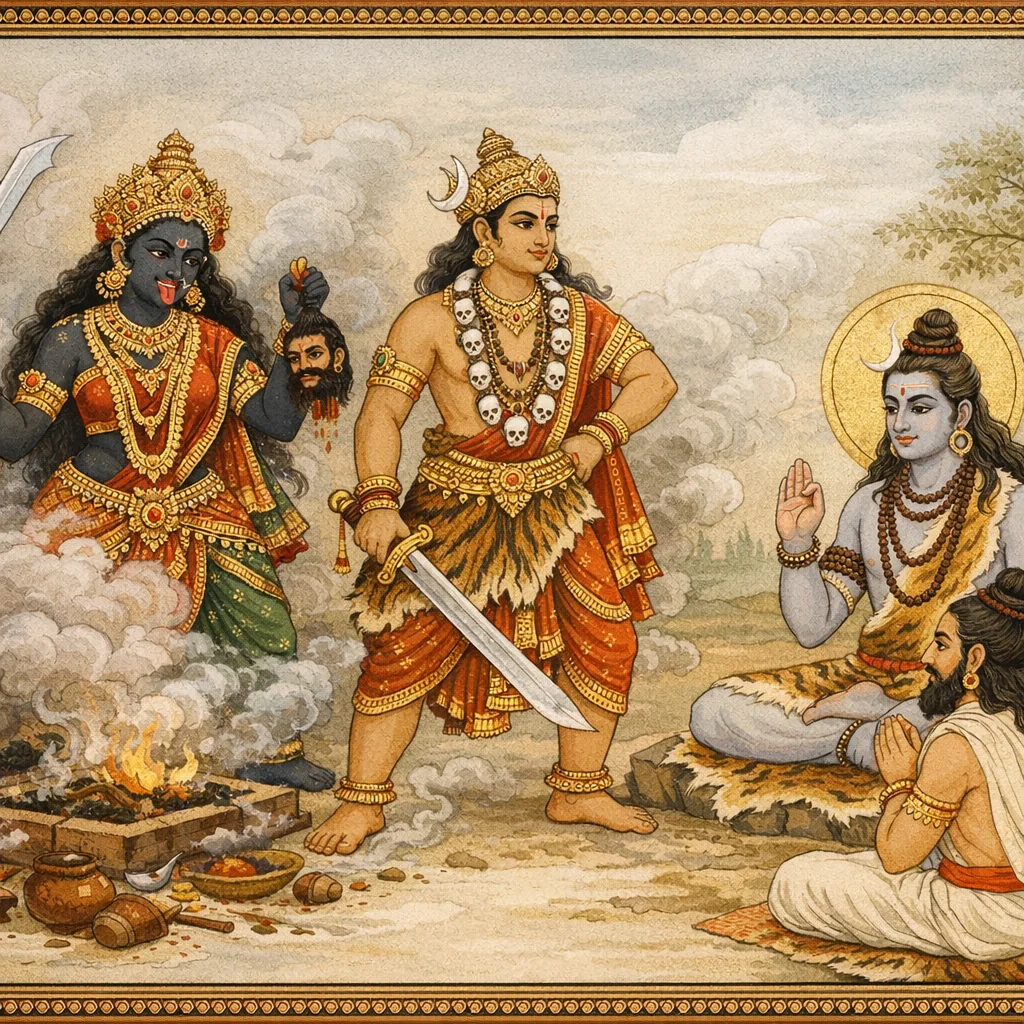
Adhyaya 291
भद्रकालीमाहात्म्यवर्णनम् (Bhadrakālī Māhātmya Description)
This chapter is a brief theological notice in which Īśvara points out a shrine of Bhadrakālī situated to the north of the place called “Kaubera-sañjñaka,” a locale associated by name with Kubera. Bhadrakālī is praised as the bestower of desired aims (vāñchitārtha-pradāyinī) upon devotees. She is explicitly connected with the disruption of Dakṣa’s sacrifice: accompanied by Vīrabhadra, she is described as an agent in the destruction of Dakṣa’s yajña. A calendrical directive follows, recommending worship of the Goddess on the third lunar day (tṛtīyā) of the month of Caitra. A phala (fruit) statement adds that extensive veneration of Cāmuṇḍā manifestations brings auspicious results—good fortune (saubhāgya), victory (vijaya), and the abiding presence of Lakṣmī (prosperity). Thus the adhyāya serves as a localized ritual index, binding mythic authority to a specific place-marker and a specific date, and turning narrative memory into practical instruction for worship.
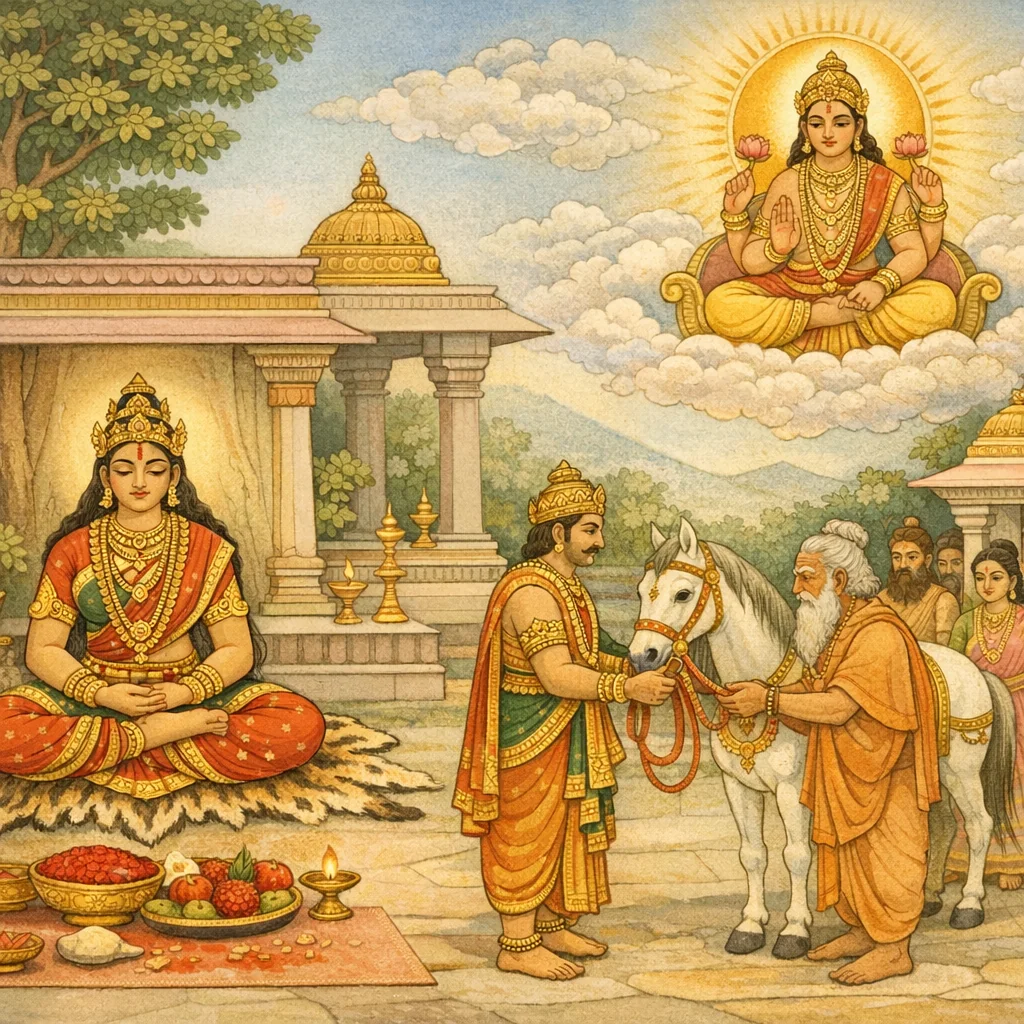
Adhyaya 292
भद्रकालीबालार्कमाहात्म्यवर्णनम् | The Māhātmya of Bhadrakālī and Bālārka (Solar Installation)
This adhyāya records Īśvara’s account of a sacred spot in the northern region beyond the place known as Kaurava-sañjñaka. There the Goddess Bhadrakālī undertakes intense tapas, and afterward, with supreme devotion, she establishes (saṃsthāpayāmāsa) Ravi/Sūrya. A ritual time is specified: Sunday (ravivāra) when it coincides with the seventh lunar day (saptamī). Offerings are highlighted—red flowers and red unguents/anointments—and a phalāśruti declares that worship performed with bhakti yields merit equal to the fruit of “a crore of sacrifices” (koṭi-yajña-phala), bringing release from vāta- and pitta-born ailments and other grave diseases. The chapter concludes with an injunction on giving: those who seek the full merit of pilgrimage should donate a horse (aśva-dāna) at that very place, joining shrine-worship, calendrical observance, and dāna into a single integrated sacred discipline.
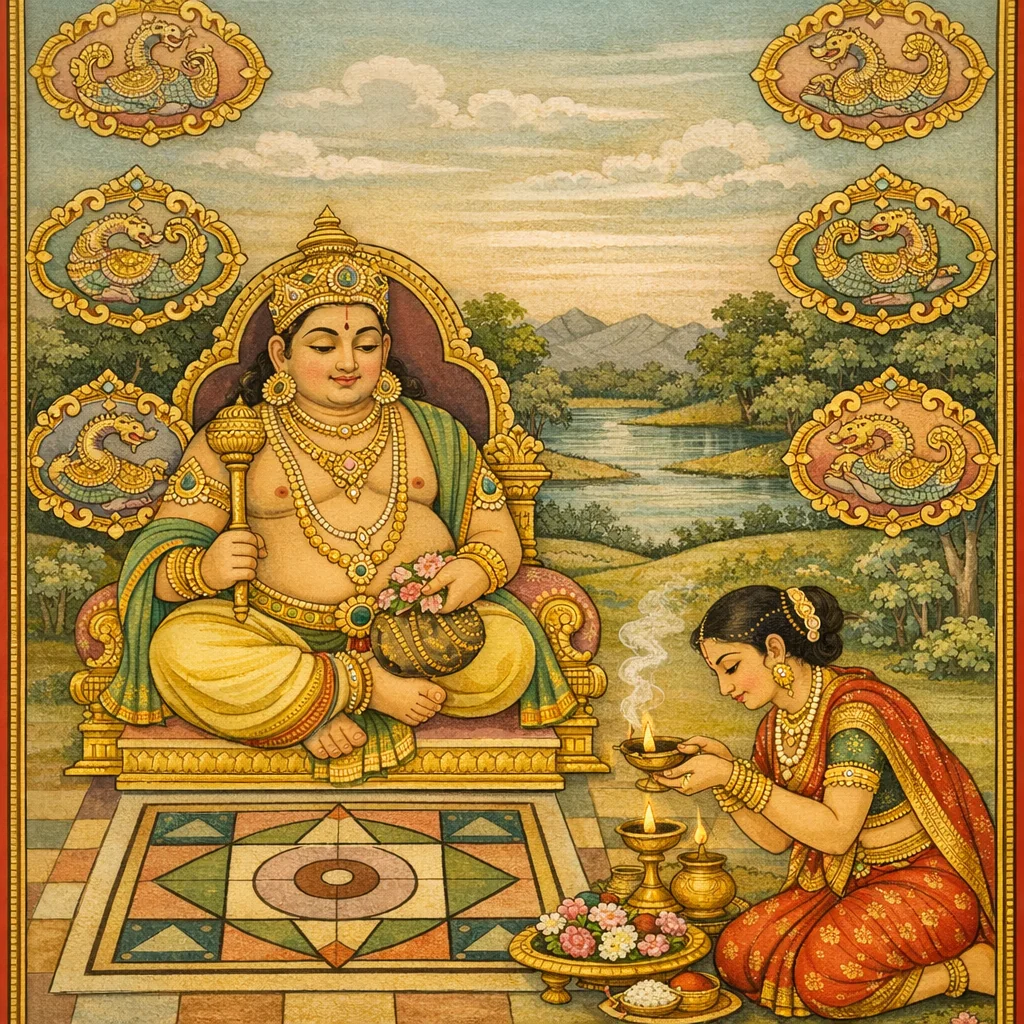
Adhyaya 293
कुबेरस्थानोत्पत्तौ कुबेरमाहात्म्यवर्णनम् (Origin of Kubera’s Station and its Māhātmya)
This adhyāya is framed as Īśvara’s theological discourse on a sacred station of Kubera. It places the “Kubera-sthāna” in the nairṛtya (southwestern) quarter of the mapped holy field and declares Kubera’s self-manifest presence there as the destroyer of all poverty (sarva-dāridrya-nāśana). It then prescribes a focused act of devotion: on the pañcamī tithi one should worship with gandha (fragrance), puṣpa (flowers), and anulepana (unctuous, fragrant applications). The site is described as adorned with eight makara-associated nidhānas—treasures or treasure-depots. By linking ritual timing, material offerings, and the power of the place-deity, the phalaśruti promises the fruit: attainment of incomparable wealth/treasure (nidhāna-prāpti) without obstruction (nirvighna). Thus the chapter functions as a compact unit of sacred geography and rite, oriented toward a clear result.
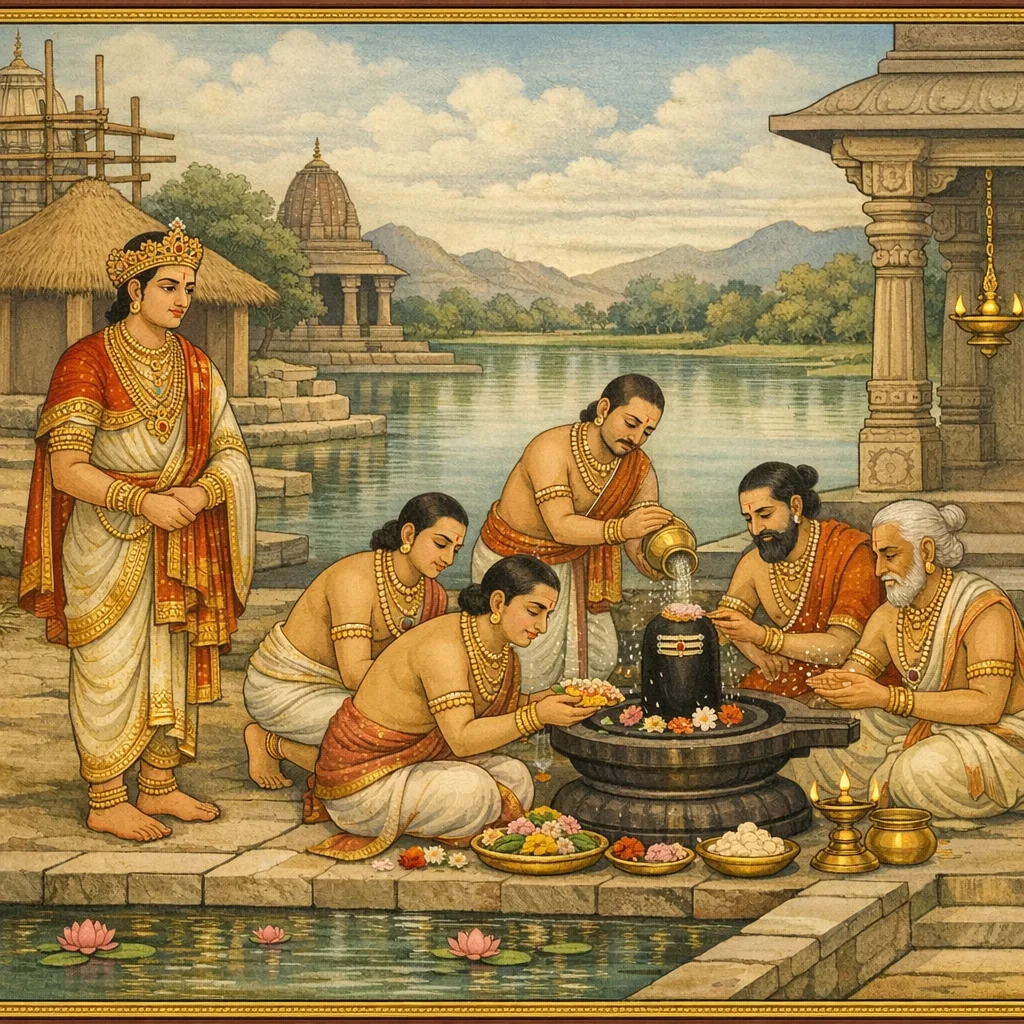
Adhyaya 294
Ajogandheśvara-māhātmya (अजोगन्धेश्वरमाहात्म्य) — The Glory of Ajogandheśvara at Puṣkara
The chapter unfolds as a dialogue between Śiva and Devī. Īśvara points Devī to a sacred Puṣkara tīrtha lying east of Kubera’s quarter, and Devī asks how a fisherman (kaivarta)—a wrongdoer and killer of fish—could attain spiritual success. Śiva recounts an earlier incident: in the cold month of Māgha the fisherman entered Puṣkara carrying a wet net and saw a Śaiva temple structure overgrown with creepers and trees. Seeking warmth, he climbed the prāsāda and spread his net atop the flagstaff to dry in the sun; through stupor and heedlessness he fell and died suddenly within Śiva’s kṣetra. The net remained fastened, as though binding the temple flag and making it auspicious; by the māhātmya of the flag he was reborn as the Avanti king Ṛtadhvaja, who ruled, traveled widely, and enjoyed royal pleasures. In time he became jāti-smara, returned to Prabhāsa-kṣetra, built or renovated the Ajogandha shrine-complex, and installed or honored the great liṅga Ajogandheśvara near a kuṇḍa, worshipping with long devotion. The text prescribes pilgrimage rites: bathe in Puṣkara’s western kuṇḍa called pāpataskara, remember Brahmā’s ancient sacrifices, invoke the tīrthas, worship the Ajogandheśvara liṅga, and offer a golden lotus to an eminent brāhmaṇa. The phalaśruti declares that worship with gandha, flowers, and akṣata frees one from sins accumulated even across seven births.
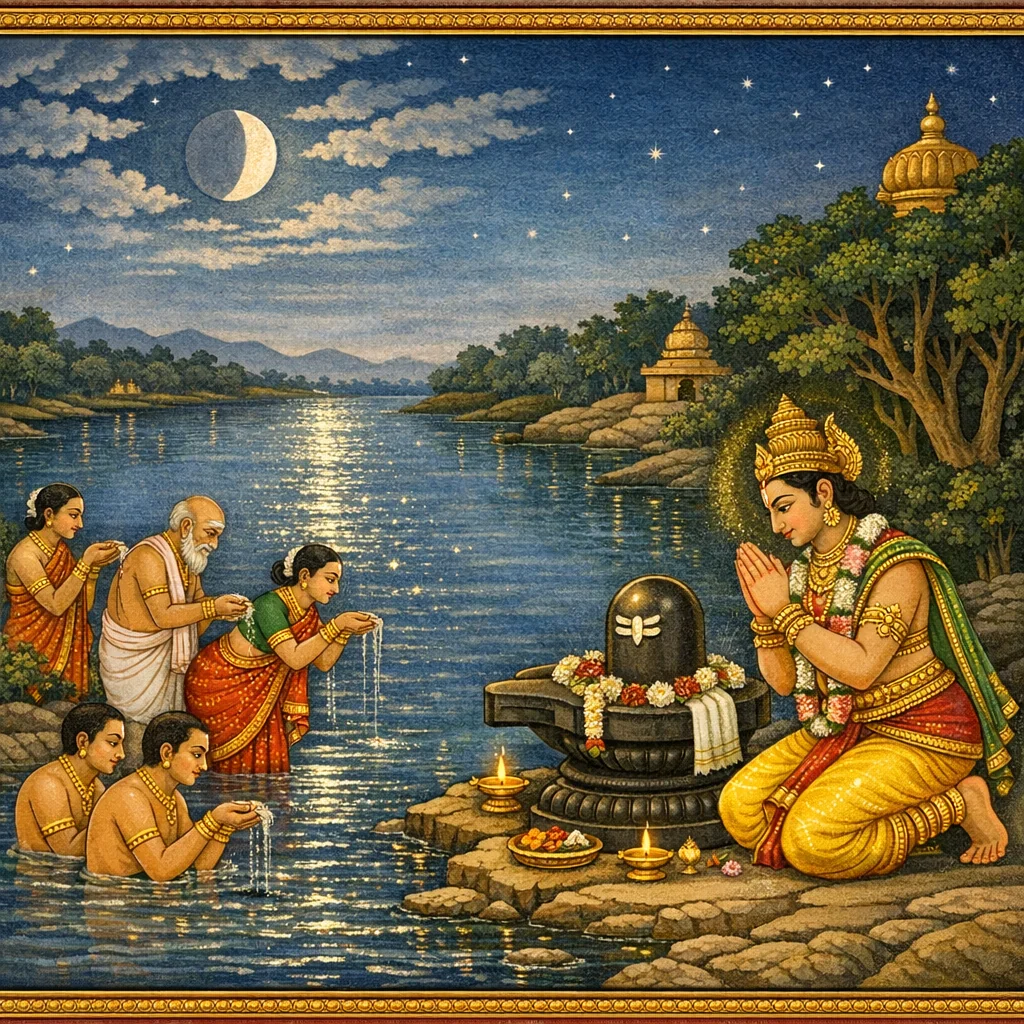
Adhyaya 295
चन्द्रोदकतीर्थमाहात्म्य–इन्द्रेश्वरमाहात्म्यवर्णनम् (Glory of Candrodaka Tīrtha and the Indreśvara Shrine)
Īśvara tells Devī of a sacred complex in the Īśāna (northeast) direction: an excellent Indra-sthāna at a measured gavyūti distance, connected with Candrasaras and the Candrodaka waters. Those waters are praised for remedial power, easing jarā (decay/aging) and dāridrya (poverty). The tīrtha waxes with the waxing moon and wanes with the waning moon, yet remains perceptible even in a sinful age (pāpa-yuga). A phala is then assured: bathing there is a decisive act of expiation, requiring little deliberation even for one burdened with many wrongs. The narrative recalls Indra’s earlier ritual response to a grave moral crisis involving Ahalyā and Gautama’s curse: Indra worships with abundant gifts and installs Śiva for a thousand years. That installed form is called Indreśvara, famed as the destroyer of all transgressions. The chapter ends with a practical pilgrimage order: bathe at Candratīrtha, offer to satisfy the pitṛs and the deities, worship Indreśvara, and without doubt become freed from sin.
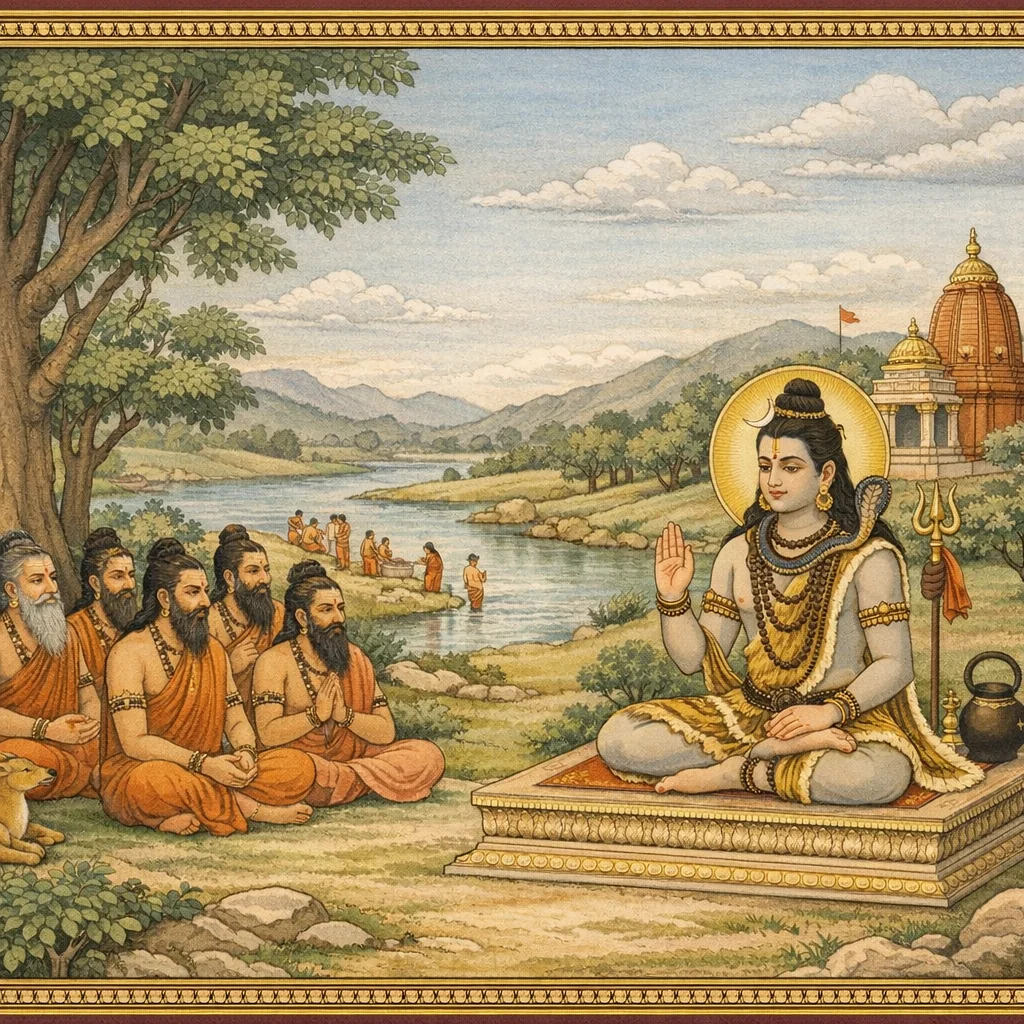
Adhyaya 296
ऋषितोयानदीमाहात्म्यवर्णन (Māhātmya of the Ṛṣitoyā River)
This adhyāya records Īśvara’s theological account of a sacred site called Devakula, situated in the āgneya (southeast) direction at a distance measured in gavyūti. Devakula’s holiness is traced to primordial gatherings of devas and ṛṣis and to the earlier स्थापना of a liṅga, from which the place gains its authoritative name. The narrative then turns westward to the Ṛṣitoyā River, “beloved of the sages,” praised as a remover of all sins. Ritual instruction is given: a pilgrim who bathes properly and offers rites to the pitṛs (ancestors) is said to bring lasting satisfaction to the forefathers. The chapter further teaches the ethics of giving: gifts such as gold, ajina (animal hide), and kambala (blankets) offered on the new-moon day of Āṣāḍha increase in merit up to sixteenfold, growing until the full moon. The concluding phalaśruti declares freedom from sins—even those amassed over seven births—through these acts within this sacred geography.
Adhyaya 297
ऋषितोयामाहात्म्यवर्णनम् (The Māhātmya of Ṛṣitoyā at Mahodaya)
Devī asks Īśvara to explain the origin and renown of the sacred water called Ṛṣitoyā, and how it came to the auspicious Devadāruvana. Īśvara relates that many ascetic ṛṣis, displeased that the local waters did not kindle ritual joy like the great rivers, went to Brahmā in Brahmaloka and praised him with hymns as creator, protector, and dissolver. Granting their request for a sin-destroying river fit for consecratory bathing (abhiṣeka), Brahmā surveys the embodied river-deities—Gaṅgā, Yamunā, Sarasvatī, and others—gathers them into his kamaṇḍalu, and compassionately releases them toward the earth. Those waters become known as Ṛṣitoyā, beloved of the ṛṣis and said to remove all pāpa; they reach Devadāruvana and are guided by Veda-knowing sages onward to the ocean. The chapter further notes that Ṛṣitoyā is generally accessible, yet hard to obtain at three specific loci—Mahodaya, Mahātīrtha, and near Mūlacāṇḍīśa. It also sets a time-based equivalence of river-flows (Gaṅgā in the morning, Yamunā in the evening, Sarasvatī at midday, etc.) to order bathing and śrāddha observance, concluding with a brief phala: it removes sins and grants desired results.
Adhyaya 298
गुप्तप्रयागमाहात्म्यवर्णनम् | The Māhātmya of Gupta-Prayāga (Hidden Prayāga)
The chapter unfolds as a dialogue in which Pārvatī asks how Prayāga—the king of tīrthas—and the rivers Gaṅgā, Yamunā, and Sarasvatī can be present in Prabhāsa near the shrine of Saṅgāleśvara. Īśvara replies that in an earlier divine assembly connected with a liṅga-related episode, countless tīrthas gathered, and Prayāga concealed itself among them, thus becoming “Gupta” (hidden). It then maps the sacred landscape: three chief bathing tanks—Brahma-kuṇḍa to the west, Vaiṣṇava-kuṇḍa to the east, and Rudra/Śiva-kuṇḍa in the middle—along with a fourth area called Tri-saṅgama, where Gaṅgā and Yamunā meet while Sarasvatī is described as subtle and hidden between them. The text specifies auspicious calendrical times and teaches graded purification: successive baths remove faults of mind, speech, body, relationships, secret sins, and minor transgressions; repeated bathing and kuṇḍa-abhisheka are said to cleanse even major impurities. Devotional duties are prescribed: honoring the Mātṛs (Divine Mothers) with offerings—especially on Kṛṣṇa-pakṣa Caturdaśī—to allay fear from their many attendant beings. Ancestor rites (śrāddha) are praised for uplifting both paternal and maternal lineages, and the gift of a bull is recommended for pilgrims seeking the full fruit of the journey. The chapter ends with a phalaśruti, declaring that hearing and affirming this māhātmya leads toward Śaṅkara’s abode.
Adhyaya 299
माधवमाहात्म्यवर्णनम् | Mādhava Māhātmya (Glorification of Mādhava at Prabhāsa)
Īśvara describes a Mādhava shrine situated slightly to the south within the sacred precinct of Prabhāsa, identifying the deity’s form as the bearer of conch, discus, and mace (śaṅkha-cakra-gadā). The chapter lays down a disciplined observance for the bright fortnight’s ekādaśī: one who fasts (upavāsa), restrains the senses (jitendriya), and worships with sandal and fragrances, flowers, and unguents is said to attain the “supreme abode,” defined as freedom from rebirth (apunarbhava). A confirming gāthā attributed to Brahmā links the rite to Viṣṇukuṇḍa, declaring that bathing there and worshiping Mādhava leads directly to the realm where Hari abides “by himself,” as the ultimate refuge. The discourse ends with a concise phala statement: this Vaiṣṇava māhātmya grants all aims and destroys all sins, serving as both theological sanction and ritual guide.
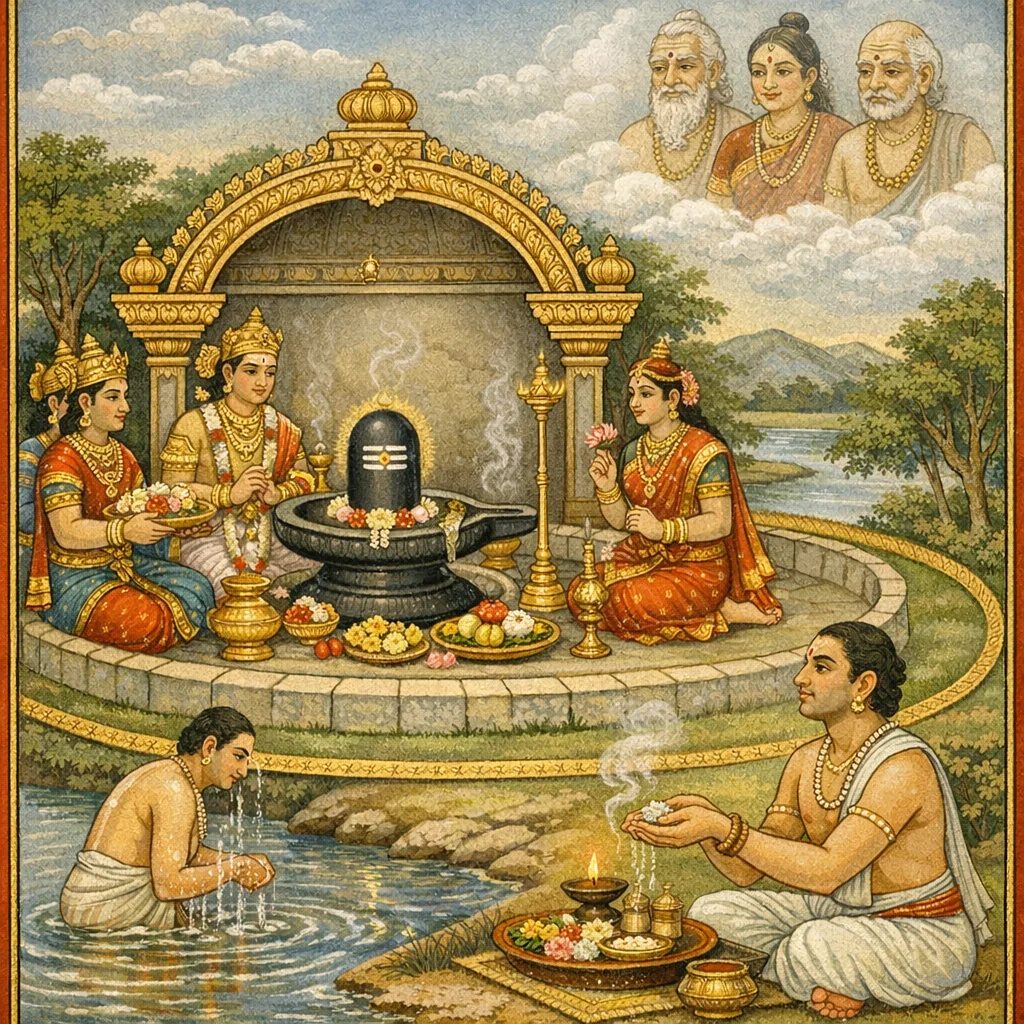
Adhyaya 300
संगालेश्वरमाहात्म्यवर्णनम् (Sangāleśvara Māhātmya—Account of the Glory of Sangāleśvara)
This chapter places the Sangāleśvara liṅga in the northern part of Prabhāsa-kṣetra, aligned to the vāyavya (northwest) quarter, and proclaims it “sarva-pātaka-nāśana,” the destroyer of all sins. Īśvara relates that Brahmā, Viṣṇu, Indra (Śakra), and other Lokapālas—together with the Ādityas and Vasus—worshipped the liṅga there, and then explained its name: since assemblies of devas gathered and established the worship, the shrine would be known on earth as Sangāleśvara. A series of merit-statements follows: human worship of Sangāleśvara brings prosperity to one’s lineage, especially freedom from poverty, and mere darśana is said to equal the fruit of gifting a thousand cows at Kurukṣetra. The text prescribes bathing on Amāvāsyā and then performing śrāddha without anger, promising long-lasting satisfaction for the ancestors. The kṣetra’s extent is defined as a circumferential “half-krośa,” described as wish-fulfilling and sin-destroying. Any being who dies within this field—whether “uttama” or “madhyama”—attains a higher destiny; those who fast unto death are said to merge into Parameśvara. Even deaths normally deemed ritually troubling (violent, accidental, suicide, snakebite, death without purity) are, in this mahāpuṇya tīrtha, reinterpreted as capable of granting apunarbhava (non-return). Liberation is further linked to rites such as sixteen śrāddhas, vṛṣotsarga, and proper feeding of brāhmaṇas, and the chapter closes with a brief phalaśruti: hearing this māhātmya removes sins, sorrow, and grief.
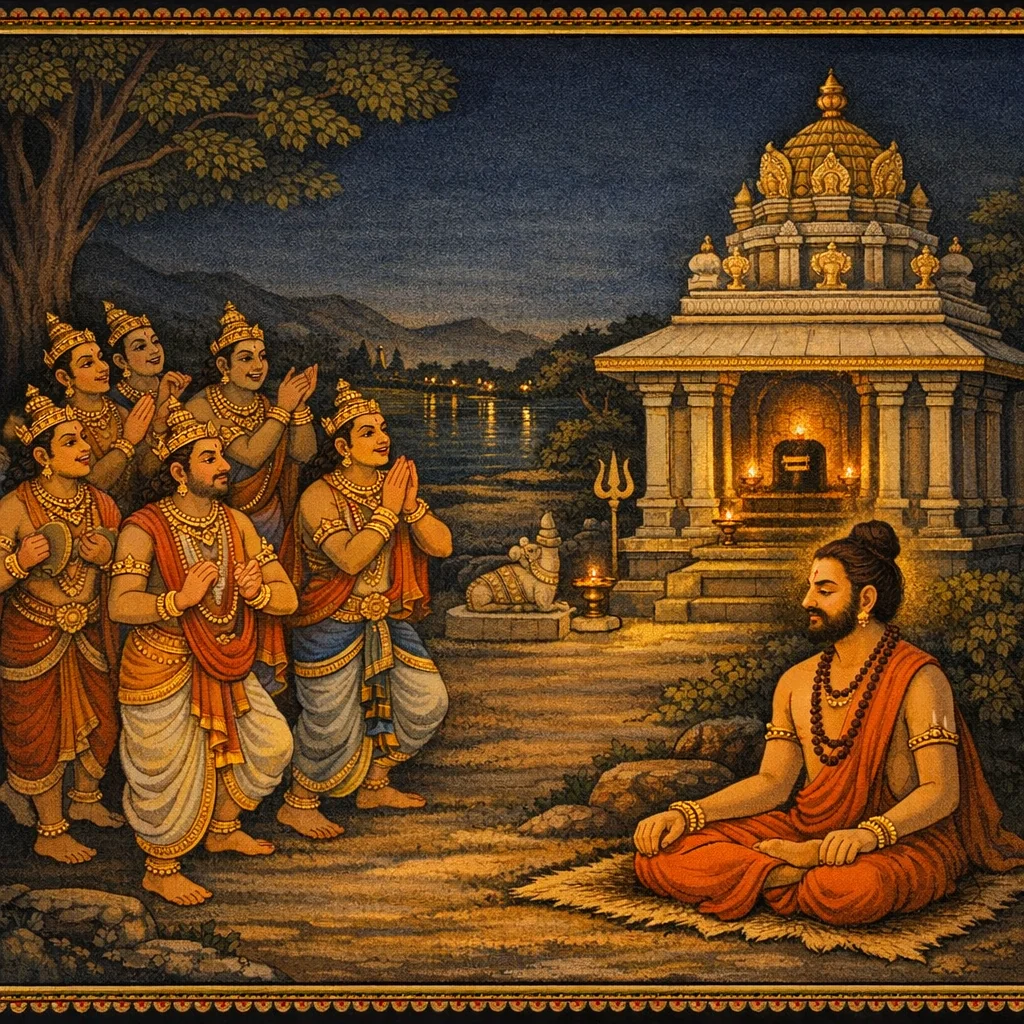
Adhyaya 301
Siddheśvara-māhātmya (Glory of Siddheśvara)
This chapter is a concise theological dialogue between Īśvara and Devī that places Siddheśvara among the Prabhāsa sacred sites as a preeminent liṅga, specifying its nearby location and directional setting. It then recounts the origin of the shrine: the devas swiftly consecrated a Śiva-liṅga called Saṅgāleśvara, and later the siddha-gaṇas installed and praised Siddheśvara as the bestower of all attainments. Śiva grants a boon that one who comes there, bathes according to rule, worships Siddhanātha, and performs japa—especially the Śatarudrīya, the Aghora mantra, and the Gāyatrī addressed to Maheśvara—gains siddhi and aṇimā-like powers within six months. The merit is heightened on the great night of the caturdaśī in the dark fortnight of Āśvayuja, when a fearless and steady practitioner is said to obtain success. The chapter ends with a phalaśruti declaring this account to be sin-destroying and a giver of the fruits of all desires.
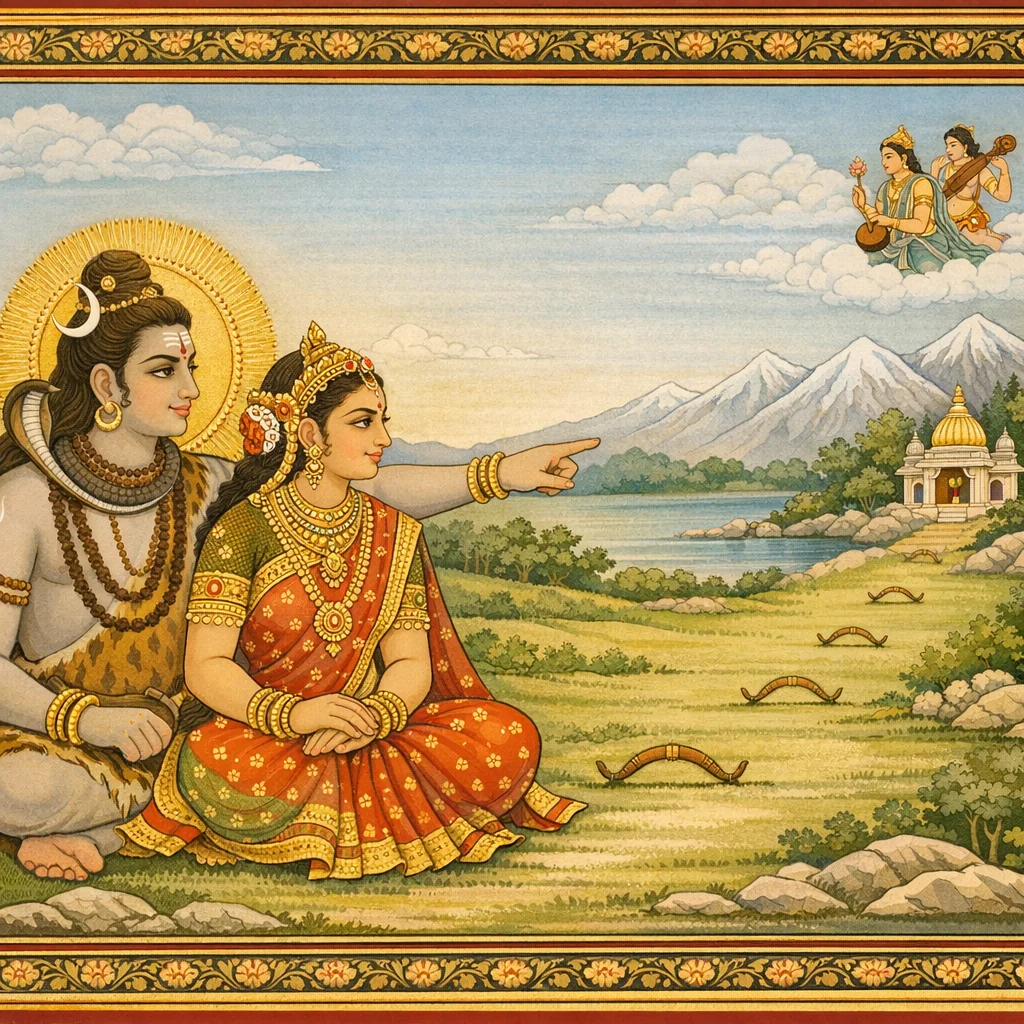
Adhyaya 302
गन्धर्वेश्वरमाहात्म्यवर्णनम् | Gandharveśvara—Account of the Shrine’s Glory
Īśvara speaks to Devī and instructs her—thereby guiding the pilgrim-reader as well—to proceed to the eminent shrine called Gandharveśvara within Prabhāsa-kṣetra. The chapter also gives a precise cue for finding it: the liṅga lies in the northern sector (uttara-dik-bhāga), at a distance of five dhanus, serving as a brief sacred itinerary. The teaching links darśana (beholding the shrine) with embodied transformation: the one who sees it becomes rūpavān, endowed with beauty and attractiveness. It is said that the liṅga was established by the Gandharvas, sanctifying its origin, and a minimal yet complete rite is prescribed—bathe (snātvā) and then perform one proper act of worship (sampūjayet sakṛt). The phalaśruti promises the attainment of all desires (sarvān kāmān avāpnoti) and the auspicious mark raktakaṇṭha (“red-throated”), gained through engagement with the site’s ritual merit.
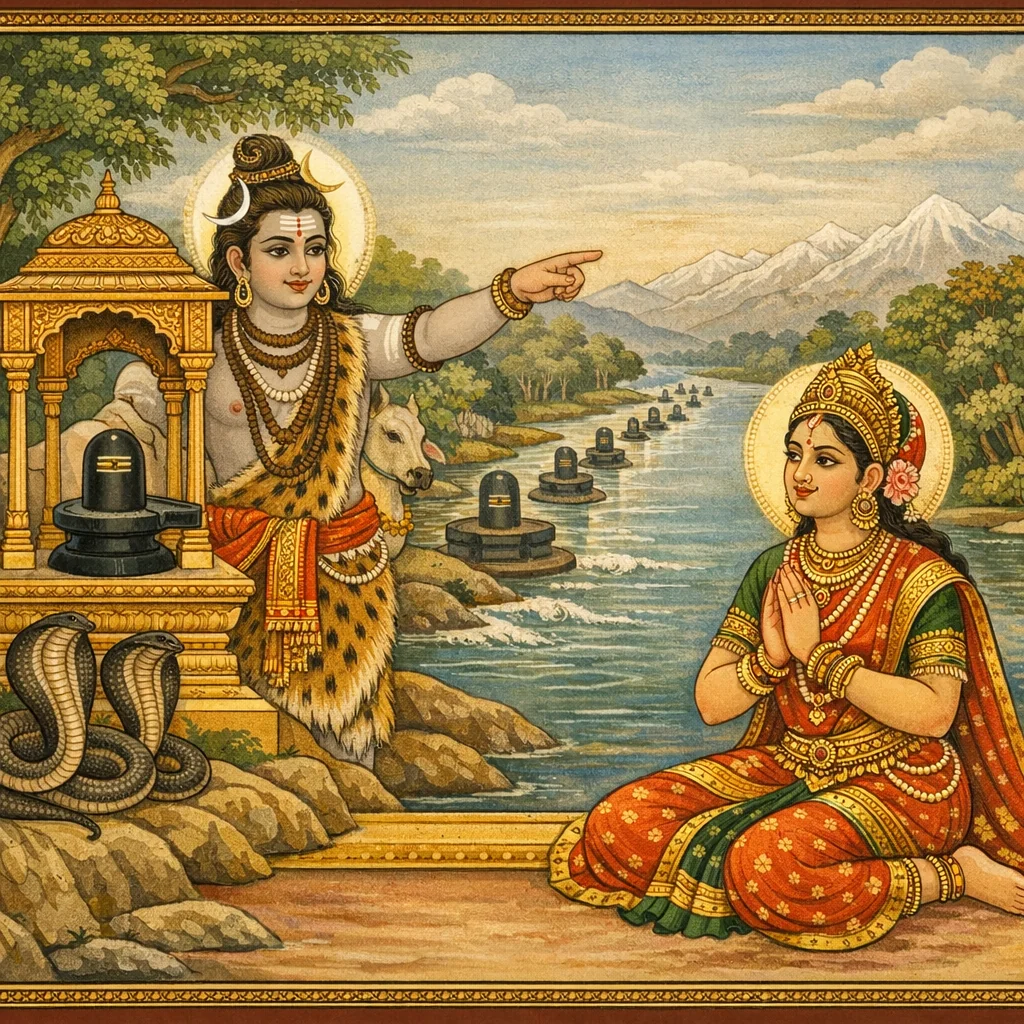
Adhyaya 303
Sangāleśvara–Uttareśvara Māhātmya (संगालेश्वरमाहात्म्य–उत्तरेश्वरमाहात्म्यवर्णनम्)
The chapter records Īśvara’s instruction to Devī to proceed northward to an excellent deity whose worship is praised as destroying the gravest sins (mahāpātaka-nāśana). It then points out that to the west of that deity stands a still superior liṅga, established after intense tapas by the nāgas led by Śeṣa. Its emphasis is protective devotion: one who worships the nāga-venerated deity is said to remain unharmed by poison throughout life, and serpents become favorably disposed and refrain from injury. Hence the practical injunction that people should worship that liṅga with full effort. The chapter also notes a wider sacred landscape: on the highly meritorious western bank of the Gaṅgā, many liṅgas were installed by ṛṣis. Darśana and pūjā of these liṅgas are declared to free one from all sins and to yield merit equal to a thousand Aśvamedha sacrifices, in phalaśruti fashion exalting pilgrimage.
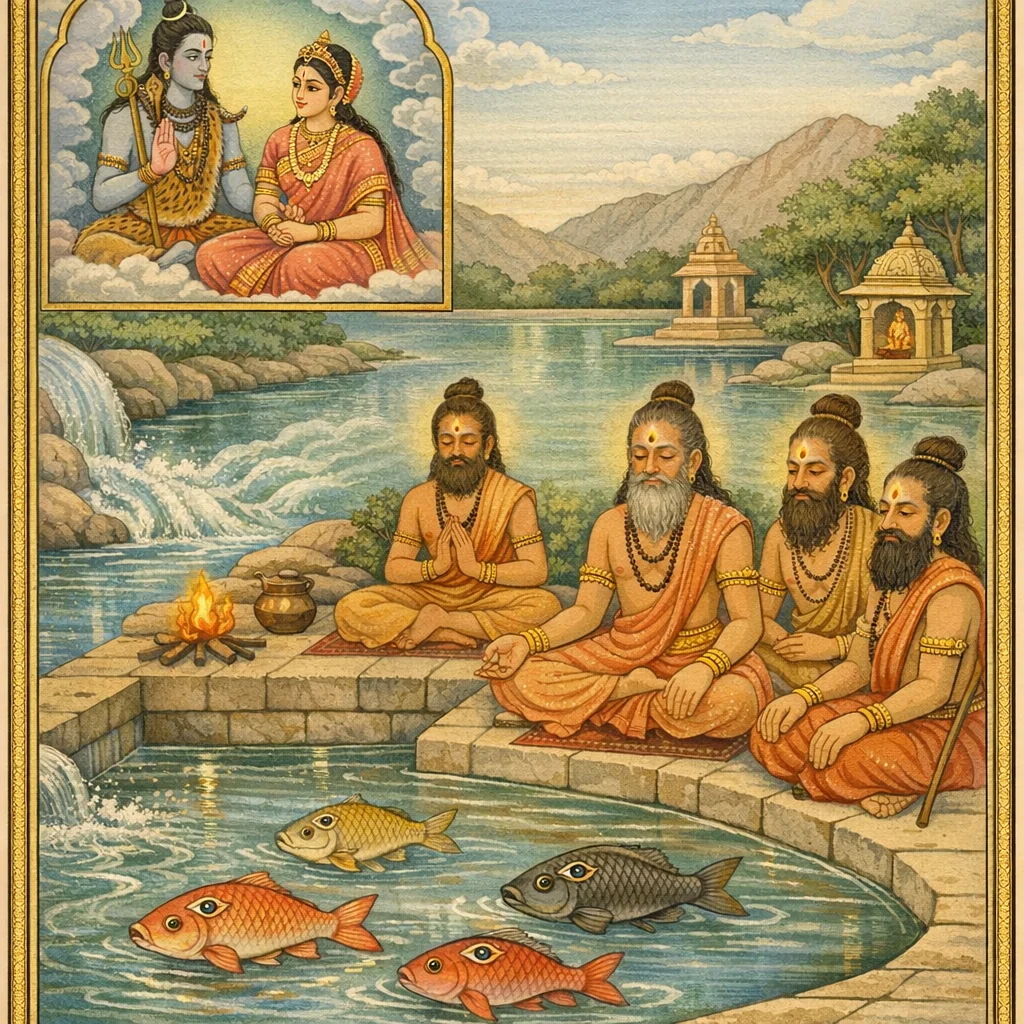
Adhyaya 304
गंगामाहात्म्यवर्णनम् (Gaṅgā-Māhātmya near Saṅgāleśvara)
The chapter unfolds as a framed dialogue: Sūta introduces the account, and Īśvara explains to Pārvatī how Gaṅgā, the Tripathagāminī, manifests near Saṅgāleśvara in Prabhāsa. Pārvatī asks about two wonders—how Gaṅgā comes to that place, and why three-eyed fish (trinetra-matsya) are found there. Īśvara relates the origin story: sages once involved in a curse episode connected with Mahādeva repent and perform intense tapas and worship at Saṅgāleśvara. Through sustained devotion they receive a “three-eyed” mark as a nidarśana for the world, and Śiva, pleased, grants their request to bring Gaṅgā for abhiṣeka. Gaṅgā appears at once, accompanied by fish; when the sages behold them, the fish too become “three-eyed” by divine favor. The text then states the practice and its fruits: bathing in the kuṇḍa frees one from the five great sins (pañca-pātaka). Further, on amāvāsyā, one who bathes and gives gold, cows, cloth, and sesame to a brāhmaṇa is said to become “three-eyed,” a symbolic sign of Śiva’s grace. The narration concludes by praising even the hearing of this account as meritorious and as granting desired outcomes.
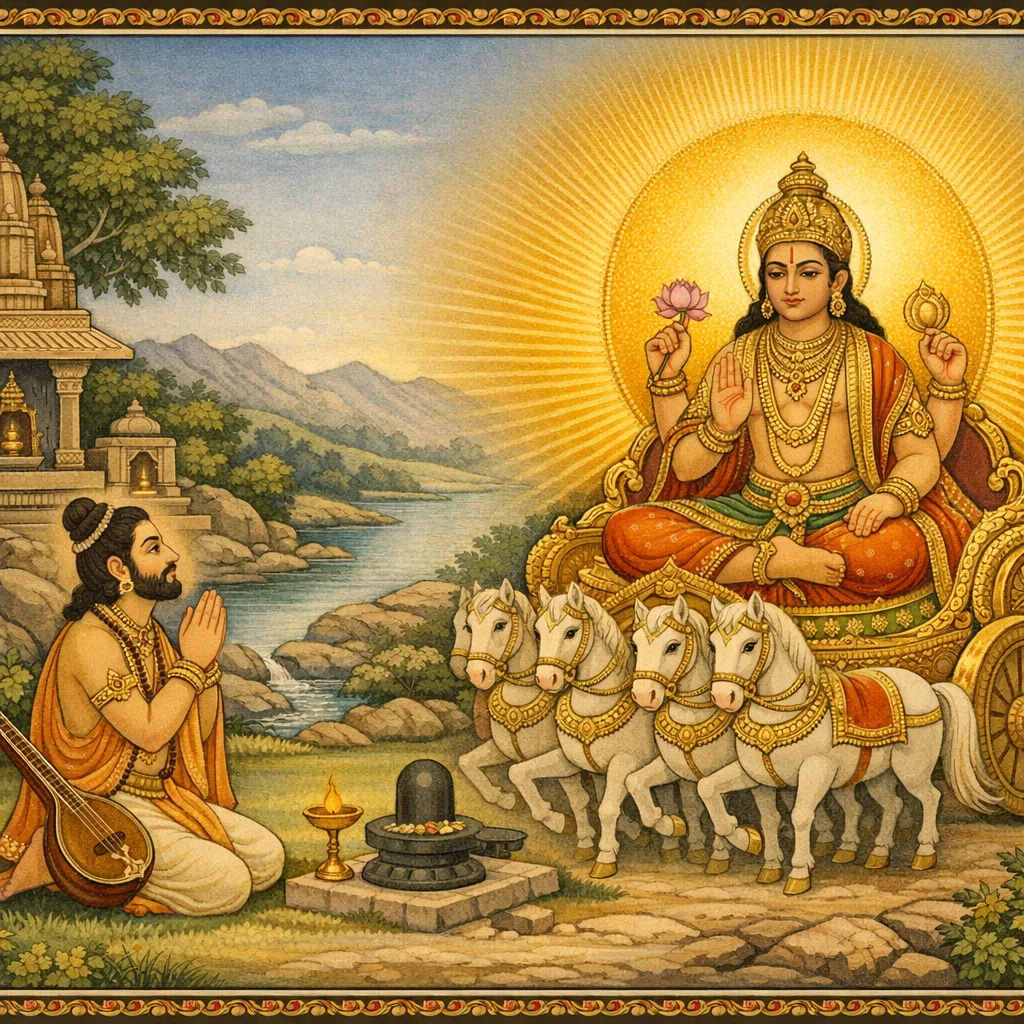
Adhyaya 305
Nārada-Āditya Māhātmya (Glory of Nāradaāditya)
This adhyāya unfolds as a Śiva–Devī theological dialogue. It first identifies a solar shrine called Nāradaāditya in the Prabhāsa region and declares its saving efficacy: the removal of old age (jarā) and poverty (dāridrya). Devī then asks how the sage Nārada could ever become afflicted by old age. Śiva recounts an episode in Dvāravatī: Sāmba, son of Kṛṣṇa, fails to show proper respect and is admonished by Nārada. Sāmba retorts by criticizing ascetic life and, in anger, curses Nārada to be subject to jarā. Stricken, Nārada withdraws to a pure, secluded place, installs a beautiful image of Sūrya praised as the “destroyer of all poverty,” and offers a series of stotras lauding the Sun as Vedic form (Ṛk/Sāman), pure light, all-pervading cause, and remover of darkness. Pleased, Sūrya appears and grants a boon: Nārada regains youthful embodiment. A public benefit is also taught as a rule of darśana—whoever beholds Sūrya on a Sunday that coincides with the seventh lunar day (ravivāra-saptamī) is promised freedom from fear of disease. The chapter ends with a phalāśruti affirming the shrine’s power to destroy pāpa (sin).
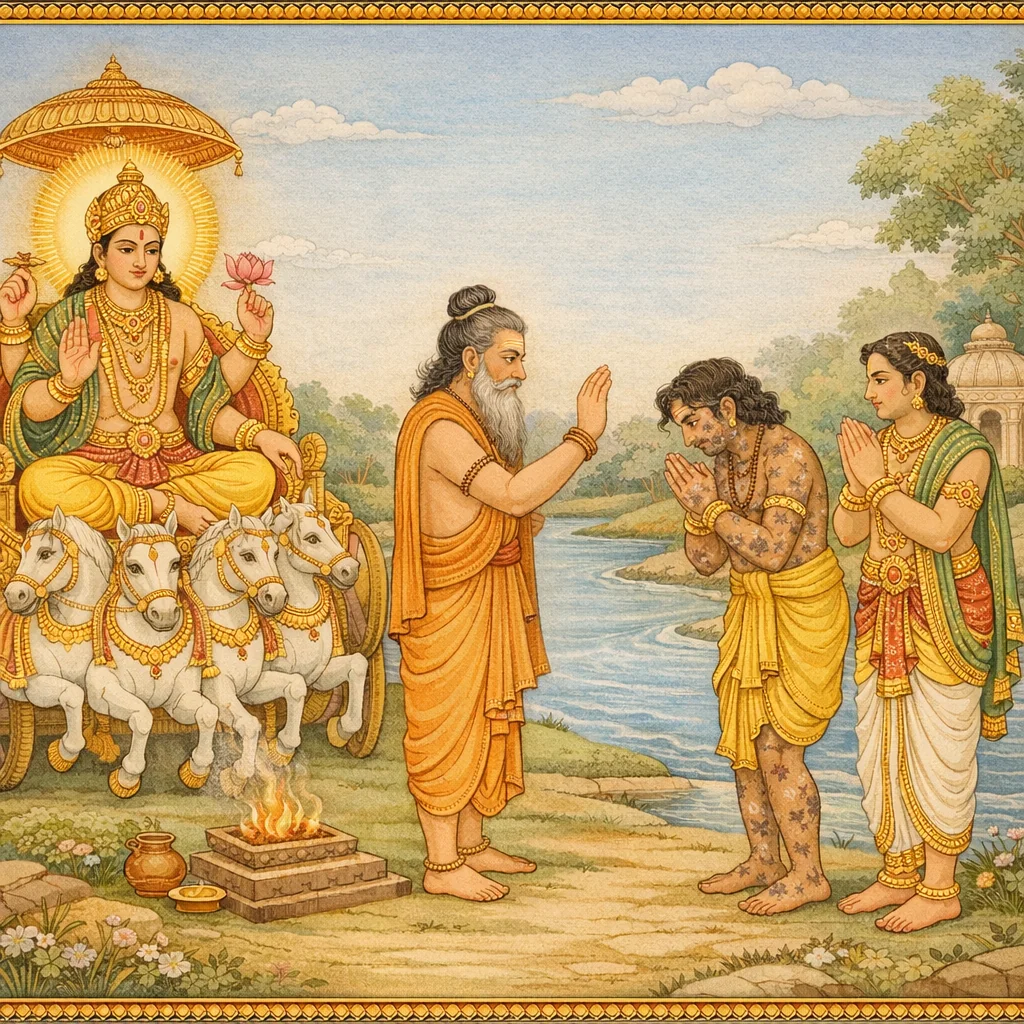
Adhyaya 306
सांबादित्यमाहात्म्यवर्णनम् (The Māhātmya of Sāmbāditya: Sāmba’s Sun-Worship at Prabhāsa)
Īśvara recounts a place-centered teaching on Sāmbāditya, a sin-destroying sacred locus in the northern part of Prabhāsa. The legend tells how Sāmba, son of Jāmbavatī, cursed by his father in anger, seeks relief by worshipping Viṣṇu. Viṣṇu directs him to Prabhāsa-kṣetra—especially Brahmabhāga near the lovely bank of the Ṛṣitoyā, graced by Brahmins—promising a boon there in the form of Sūrya. Reaching the auspicious site, Sāmba praises Bhāskara with many hymns and is guided to the Ṛṣitoyā shore where Nārada performs austerities. Local Brahmins affirm Brahmabhāga’s sanctity and approve his resolve; Sāmba then undertakes regular worship and tapas. Viṣṇu reflects on divine functions—Rudra granting lordship, Viṣṇu liberation, Indra heaven, water/earth/ashes purification, Agni transformation, Gaṇeśa obstacle-removal—and concludes that Divākara uniquely bestows ārogya, perfect health. Because the old curse blocks ordinary boons, Viṣṇu manifests as Sūrya, purifies Sāmba, and frees him from leprosy. Sāmba asks for the deity’s perpetual presence at the spot; Sūrya agrees and prescribes a vrata: when Saptamī falls on a Sunday, fast and keep night vigil. The text promises that leprosy and sinful diseases will not arise in the devotee’s lineage, and that devoted bathing, Sunday worship of Sāmbāditya, and śrāddha with Brahmin-feeding at a nearby sin-removing kuṇḍa grant health, wealth, progeny, fulfilled desires, and honor in Sūrya-loka.
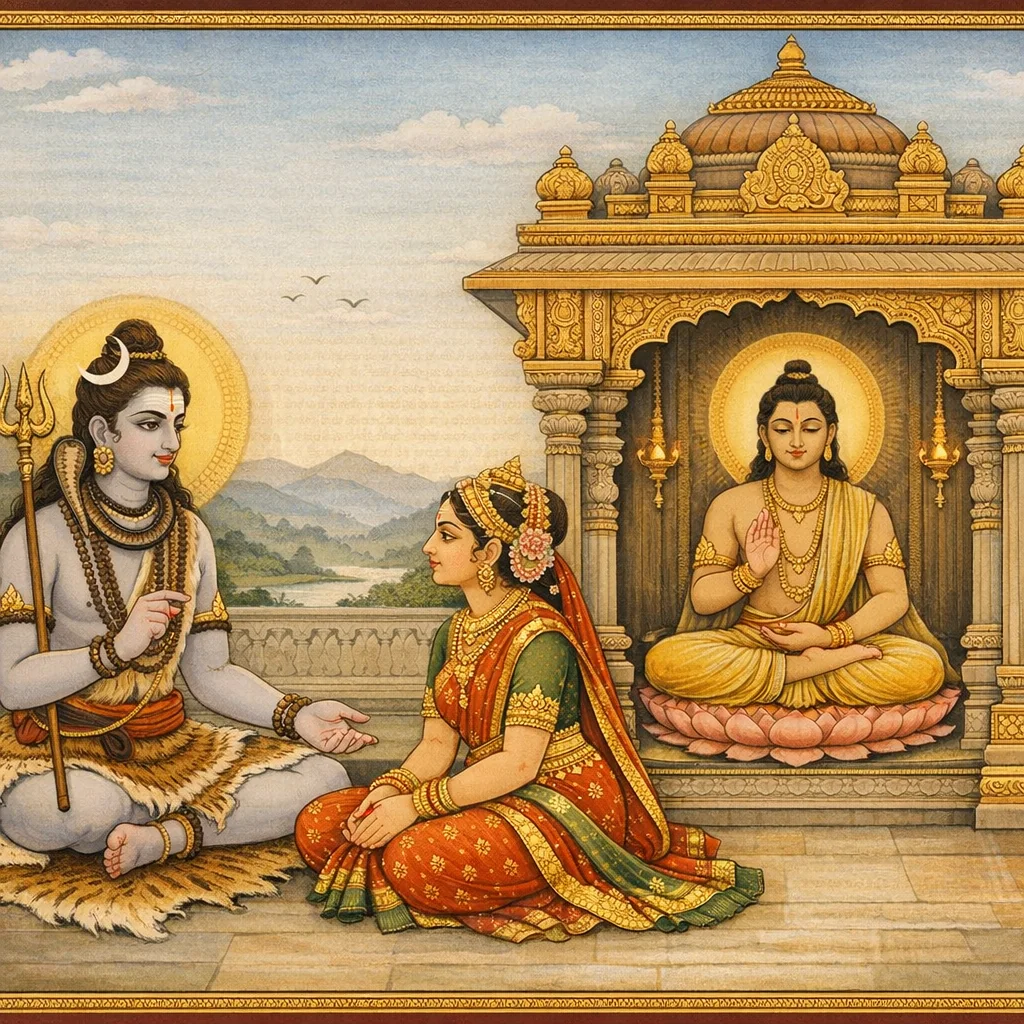
Adhyaya 307
अपरनारायणमाहात्म्यवर्णनम् (The Māhātmya of Apara-Nārāyaṇa)
Chapter 307 records Īśvara’s account of a sacred shrine or divine presence called Apara-Nārāyaṇa, located somewhat to the east of Sāmbāditya. The deity is identified as Viṣṇu in a solar mode: Sūrya is declared to be Viṣṇu-svarūpa, and the Lord assumes an “other/further” (apara) form in order to grant boons—hence the name “Apara.” The teaching then turns from the origin of the epithet to ritual prescription: one should worship Puṇḍarīkākṣa there, according to rule (vidhānataḥ), especially on Ekādaśī in the bright fortnight (śukla) of Phālguna. The phalaśruti states the fruit plainly—destruction of sins and the attainment of all desired aims.
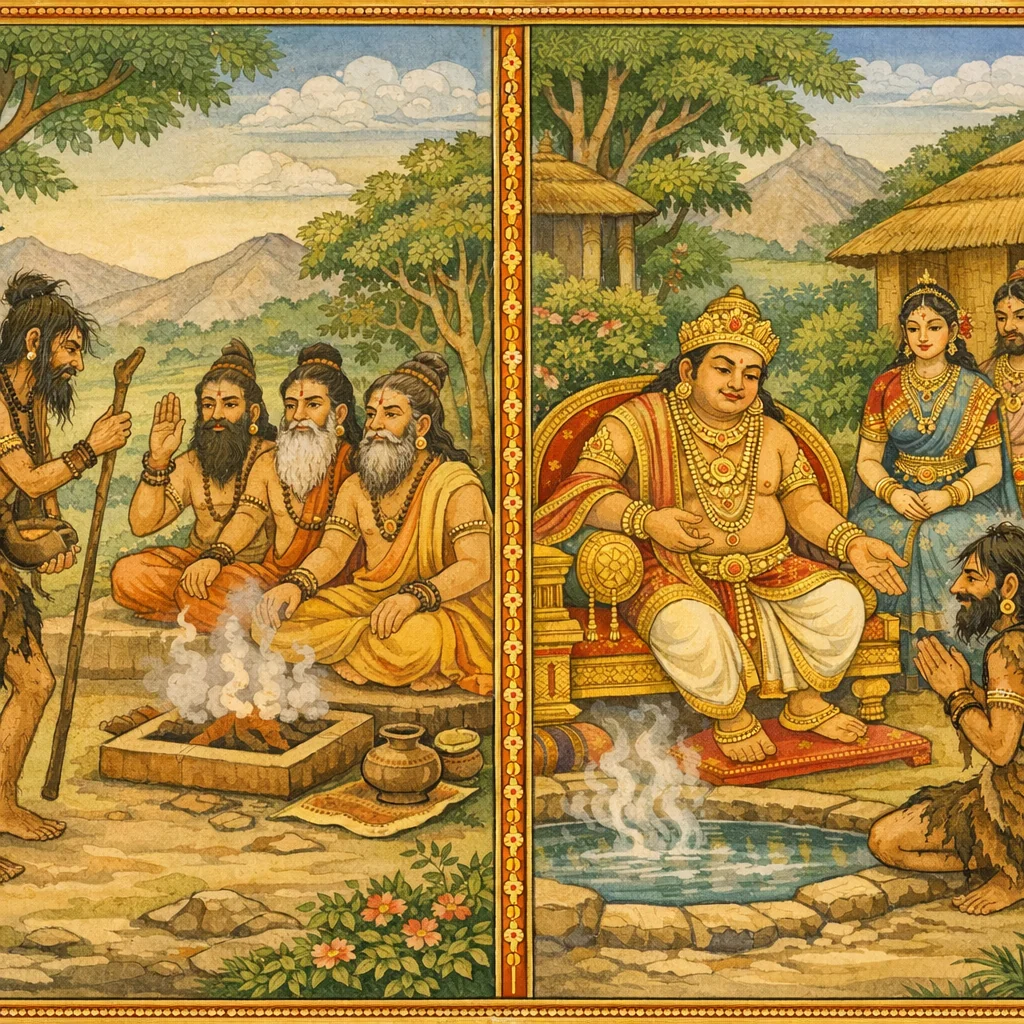
Adhyaya 308
मूलचण्डीशोत्पत्तिमाहात्म्यवर्णनम् (Origin-Glory of Mūla-Caṇḍīśa and the Taptodaka Kuṇḍa)
Īśvara tells Devī how the liṅga called Mūla-Caṇḍīśa became renowned in the three worlds. In an earlier episode at Devadāruvana, Īśvara assumes the provocative guise of an ascetic-beggar (Ḍiṇḍi), unsettling the sages; in anger they utter a curse, and the prominent liṅga falls. Grieved at the loss of auspiciousness, the sages seek Brahmā’s counsel, and he directs them to approach Rudra, who is present in an elephant form near Kubera’s āśrama. On the way, compassionate Gaurī provides gōrasa (milk) and brings about an excellent bathing place. Its waters become heated and are known as Taptodaka, relieving weariness. The sages finally meet Rudra, reconcile through praise and apology, and pray for the restoration of welfare for all beings. Rudra agrees; the liṅga is raised and re-established (linked with the sense of “Unnata,” the uplifted). The chapter states the phalāśruti: darśana of Mūla-Caṇḍīśa grants merit surpassing even great waterworks, and prescribed dānas are recommended. Worship after bathing at Taptodaka is said to bestow spiritual potency and worldly eminence in Purāṇic idiom. It concludes by explaining the name and etymology—Caṇḍīśa as “lord of Caṇḍī,” and Mūla as the “root” liṅga where it fell—and by listing associated tīrthas such as Sangameśvara, Kuṇḍikā, and Taptodaka.
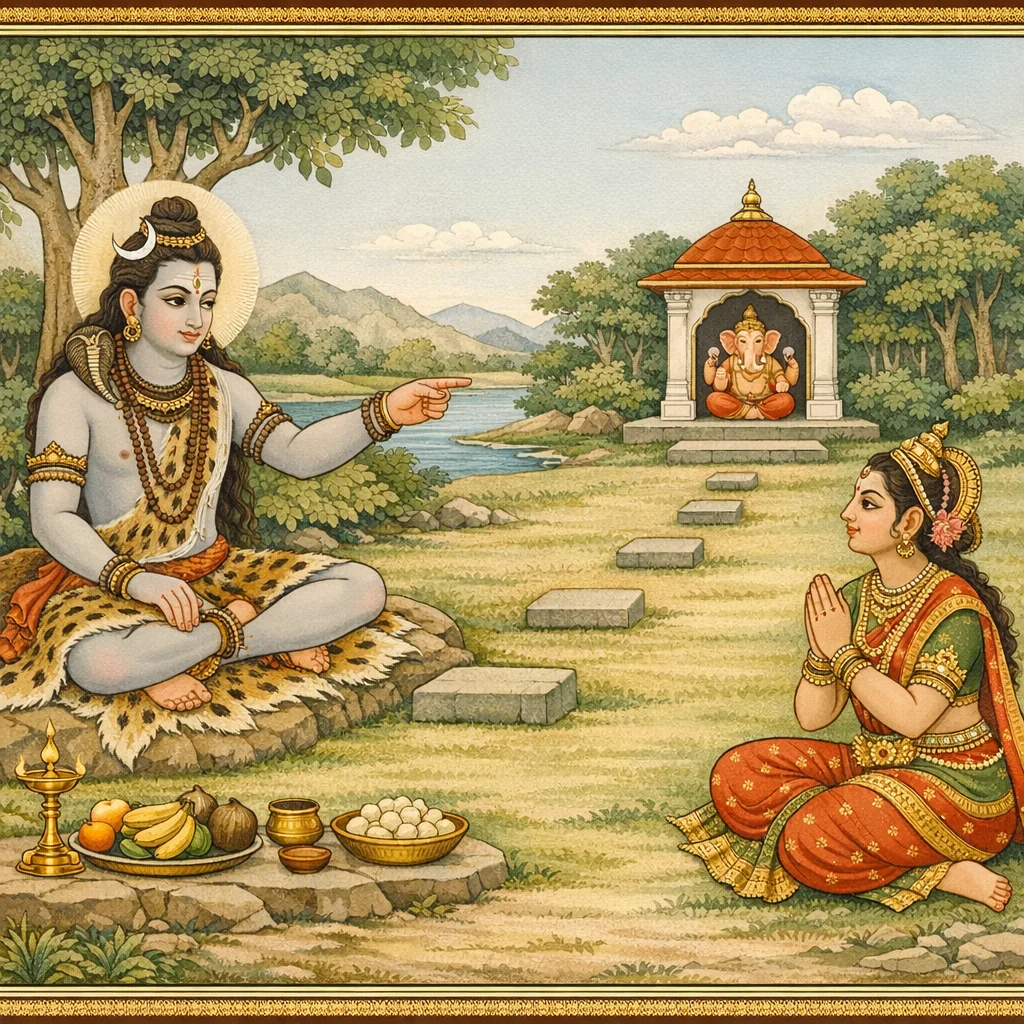
Adhyaya 309
Caturmukha-Vināyaka Māhātmya (Glory of Four-Faced Vināyaka)
This chapter gives a brief ritual and sacred-geographical instruction spoken by Īśvara to Mahādevī. The pilgrim is directed to the eminent Vināyaka shrine called Caturmukha, located north of Caṇḍīśa, approached toward the Īśāna (northeast) quarter at a measured distance of four dhanus. It then prescribes the mode of worship: perform pūjā with deliberate care and disciplined effort (prayatna), offering fragrance (gandha), flowers (puṣpa), and food offerings (bhakṣya, bhojya), including modaka. Worship on the fourth lunar day (caturthī) is declared the key observance, granting siddhi (accomplishment) and removing vighna (obstacles), so that religious aims are successfully fulfilled.
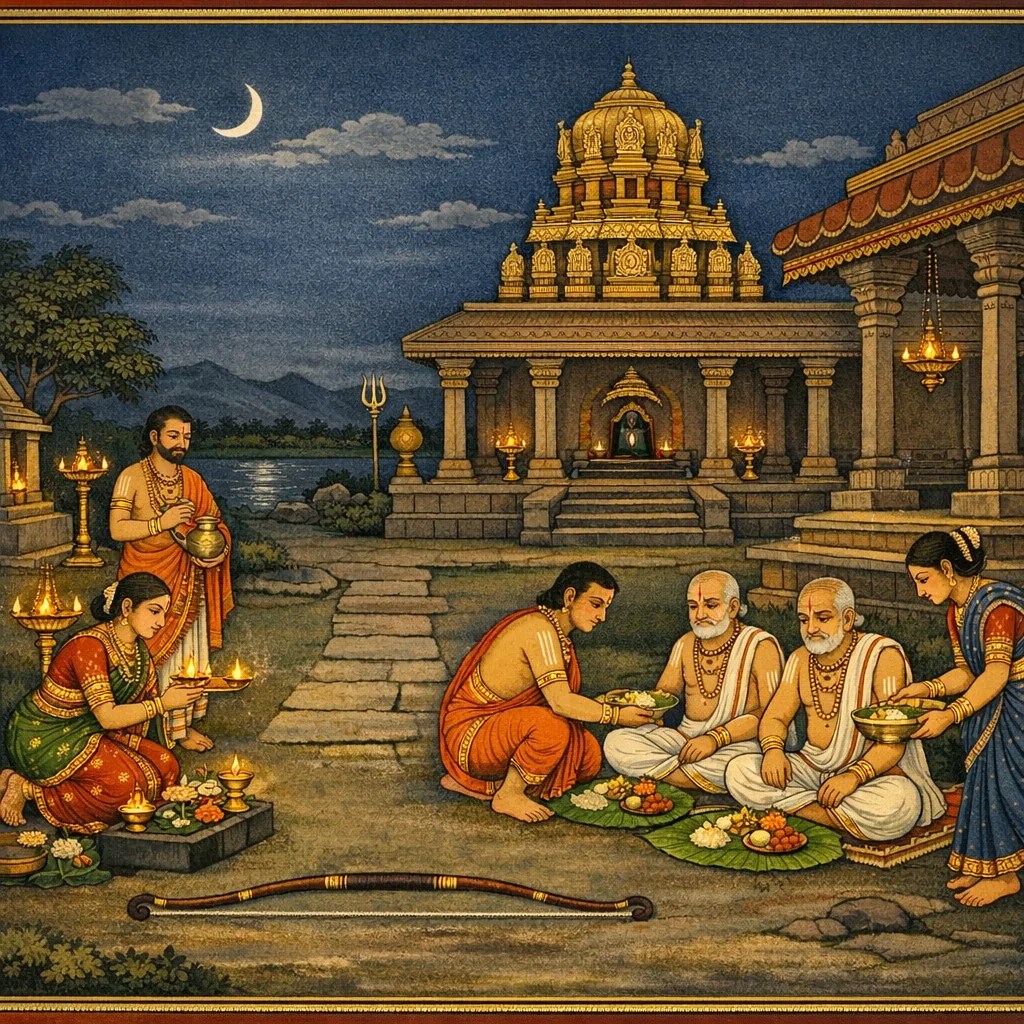
Adhyaya 310
कलंबेश्वरमाहात्म्य (Kalambeśvara Māhātmya) — The Glory of Kalambeśvara
Chapter 310, spoken in Īśvara’s voice, locates the shrine of Kalambeśvara within Prabhāsa-kṣetra by a clear directional marker: it stands in the vāyavya (northwest) sector, at a distance described as “two bow-lengths” (dhanus-dvitaya). The teaching ties sacred place to practice: mere darśana (beholding) and pūjā (worship) of Kalambeśvara are said to purify one from all kilbiṣas (moral impurities) and to destroy every sin (sarva-pātaka-nāśana). A special merit-enhancing time is specified—Somavāra (Monday) when it coincides with Amāvāsyā (new moon). As an ethical injunction alongside the rite, seekers of merit are instructed to perform dāna through hospitality by providing bhojana (food) to vipras (Brahmins) there. The chapter ends by identifying itself as the Kalambeśvara-māhātmya within the Prabhāsakṣetramāhātmya of the Prabhāsa Khaṇḍa.
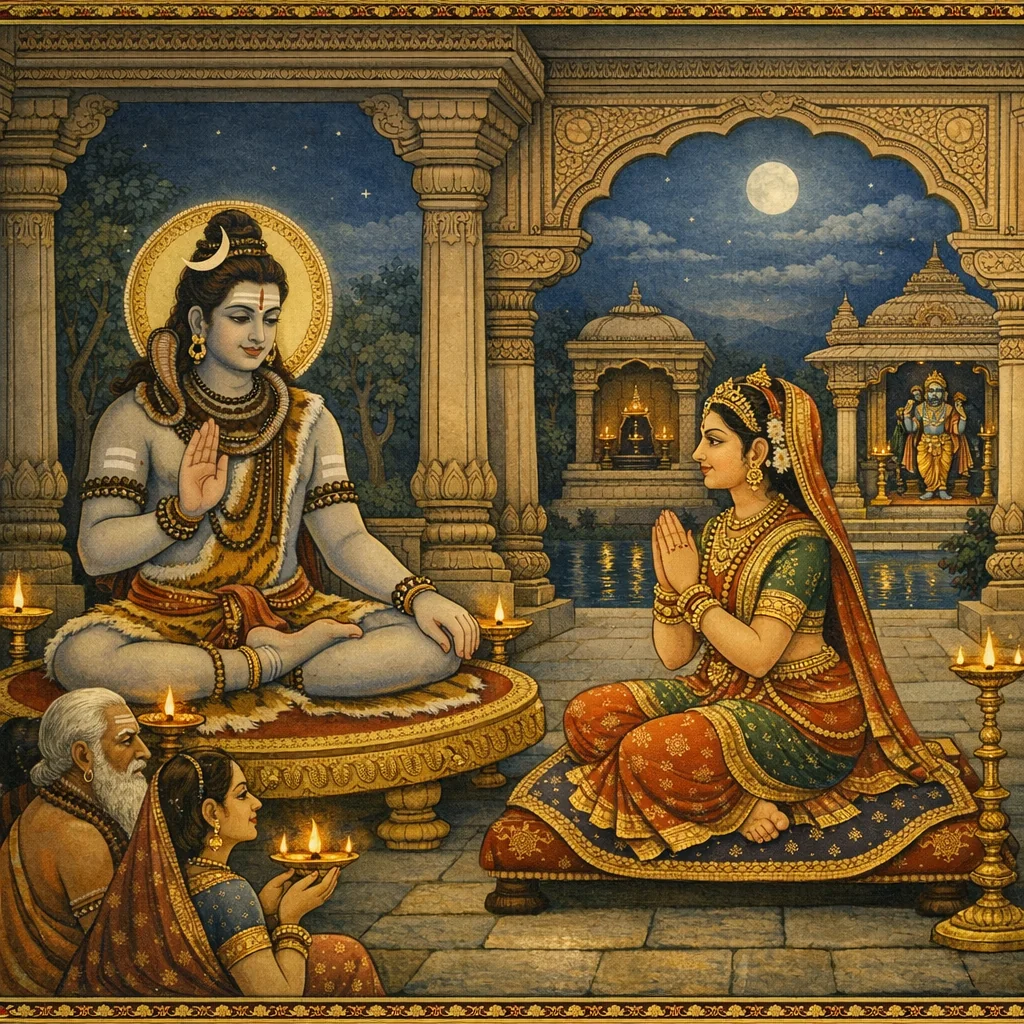
Adhyaya 311
गोपालस्वामिहरिमाहात्म्यवर्णनम् (The Māhātmya of Gopāla-svāmin Hari)
This adhyāya presents a brief theological instruction. Īśvara directs Mahādevī to go to the shrine of Hari Gopāla-svāmin, giving a precise location: east of Caṇḍīśa, at a distance of twenty dhanu (bows). It then declares the shrine’s Purāṇic saving power: by darśana and pūjā there, all sins are pacified and the waves of poverty are destroyed. Worship is especially commended in the month of Māgha, with pūjā and jāgaraṇa (night vigil). One who performs these observances is promised attainment of the “supreme state” (paraṃ padam), making the shrine both a sacred destination and a disciplined path of devotion.
Adhyaya 312
Bakulsvāmi-Sūrya Māhātmya (बकुलस्वामिमाहात्म्यवर्णनम्) — The Glory of Bakulsvāmin as Sūrya
This chapter, framed as Īśvara’s discourse, gives a brief instruction on the sacred site and its observance. It first places the shrine of Bakulsvāmin—identified with Sūrya—in the northern sector, at a measured distance of “eight bows,” and praises the darśana of this solar form as a destroyer of sorrow and affliction (duḥkha-nāśana). It then prescribes a specific vow: when Sunday (ravivāra) coincides with the seventh lunar day (saptamī), one should keep an all-night vigil (jāgaraṇa). The stated fruit is the fulfillment of desired aims and the gaining of honor or exaltation in Sūrya-loka. The colophon notes the setting within the Skanda Mahāpurāṇa, Prabhāsa Khaṇḍa, in the Prabhāsakṣetramāhātmya section, naming the chapter as the narration of Bakulsvāmin’s glory.
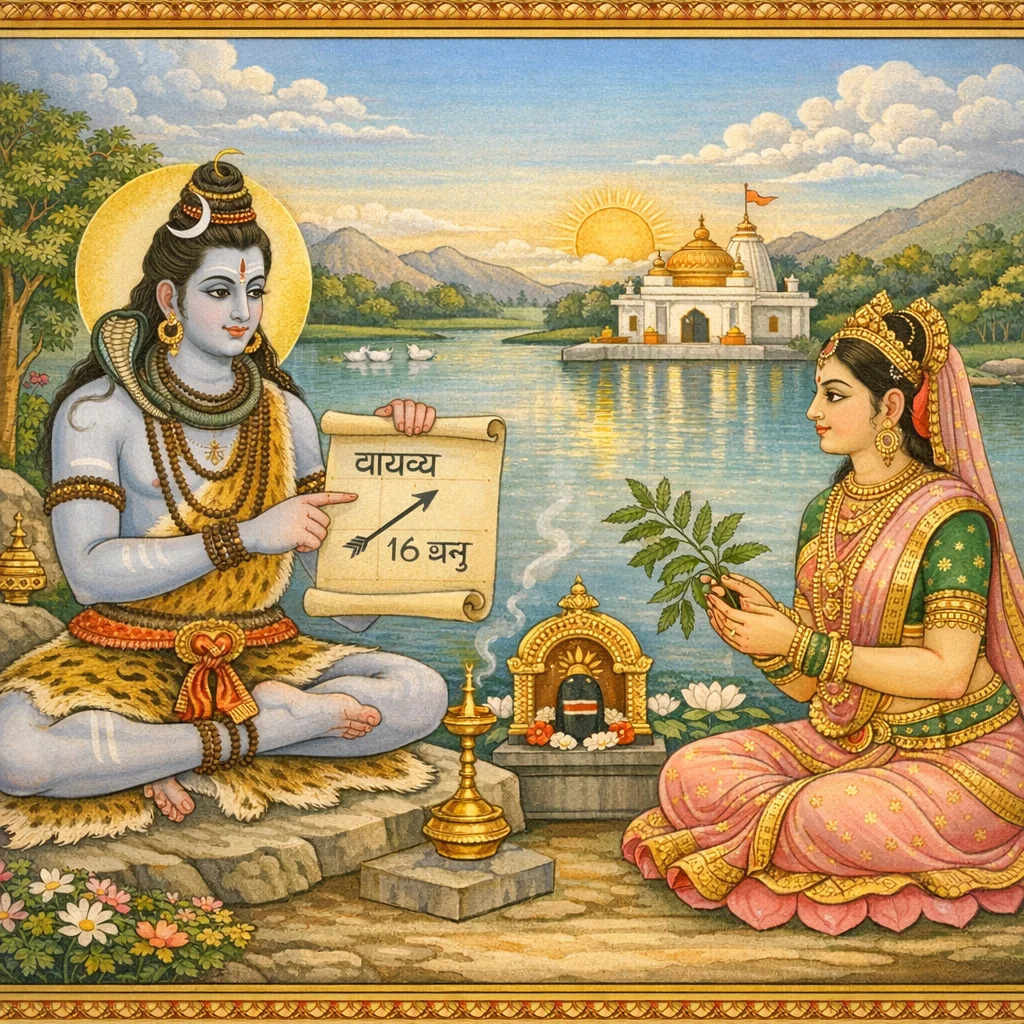
Adhyaya 313
उत्तरार्कमाहात्म्यवर्णनम् (Uttarārka Māhātmya—Description of the Glory of Uttarārka)
In this adhyāya, spoken as an authoritative theological instruction (Īśvara uvāca), a named sacred sub-site called “Uttarārka” is located within the Prabhāsa Khaṇḍa. It is placed in the vāyavya (northwestern) directional sector, at a stated distance of sixteen dhanu, in a prescriptive, result-focused manner that identifies and names the place. The text praises the site as “sadyah pratyaya-kāraka,” granting immediate confirmatory results to the practitioner. It explicitly connects the observance of Nimba-saptamī (a seventh-day vow/rite associated with nimba, the Neem) with the promised fruit of release from “all diseases,” presenting a Purāṇic phalaśruti of healing and well-being.
Adhyaya 314
ऋषितीर्थसंगममाहात्म्यवर्णनम् (Glorification of the Ṛṣi-tīrtha Confluence)
In a dialogue where Īśvara speaks to Devī, this chapter points to an eminent pilgrimage site called Ṛṣi-tīrtha, located on the seashore in a region connected with Devakula (devakulāgneiyyāṃ gavyūtyāṃ). It is praised as supremely beautiful and spiritually powerful. A striking feature is that sages (ṛṣi) abide there in stone-like forms (pāṣāṇākṛtayaḥ), still “seen” by human beings, and the text explicitly declares that this place destroys all sins. The chapter then lays down a calendrical and ritual observance: on the new-moon day (amāvāsyā) of the month Jyeṣṭha, devotees endowed with śraddhā should bathe and, above all, perform piṇḍa-dāna, offerings for the ancestors. At the confluence of the waters called Ṛṣitoya, bathing and the performance of śrāddha are described as rare and highly efficacious. The text further commends go-pradāna (the gift of a cow) and instructs that brāhmaṇas be fed according to one’s capacity, joining pilgrimage with charity and ritual hospitality.
Adhyaya 315
मरुदार्यादेवीमाहात्म्यवर्णनम् (Mārudāryā Devī Māhātmya—Glorification of the Goddess Mārudāryā)
This chapter gives a brief kṣetra-instruction within a Śiva–Devī dialogue. Īśvara directs Mahādevī to go to a radiant place called Mārudāryā, situated toward the western quarter at a measured distance of half a krośa. The goddess there is said to be worshipped by the Maruts and to grant the “fruit of all desires” (sarva-kāma-phala). The teaching then turns to time and procedure: the practitioner is enjoined to worship with care especially on Mahānavamī, and also on Saptamī, using customary offerings such as fragrance and flowers (gandha-puṣpa-ādi). The chapter highlights the Purāṇic linkage of place, calendar, and ritual method—where, when, and how—as a disciplined devotional means for attaining desired aims and religious merit.
Adhyaya 316
क्षेमादित्यमाहात्म्यवर्णनम् / The Māhātmya of Kṣemāditya (Solar Shrine of Welfare)
This chapter is a compact tīrtha entry that identifies the installation of the deity Kṣemāditya in relation to Devakula, giving the measured distance of pañca-gavyūti and placing it within/near Śambara-sthāna. It functions as a sacred locator for pilgrims. It declares the fruit of darśana: one who beholds the deity attains kṣemārtha-siddhi, success oriented toward welfare and well-being. It further prescribes a time-bound rule of worship: pūjā performed on the seventh lunar day (saptamī) when it coincides with Sunday (ravivāra) is proclaimed sarva-kāma-da, granting desired aims. The passage closes by classifying this as tīrtha-situated instruction at Devakula, stating where the shrine is, what to do, when to do it, and the promised result.
Adhyaya 317
कंटकशोषिणीमाहात्म्यवर्णनम् (The Māhātmya of Goddess Kaṇṭakaśoṣiṇī)
Īśvara narrates to Devī the origin of a goddess connected with a particular sacred spot in Prabhāsa, identified through directional markers. On a sanctified riverbank, eminent ṛṣis assemble to perform an elaborate Vedic yajña amid resonant Vedic recitation, ritual music, incense, offerings, and learned officiants. Powerful daityas, skilled in illusion, arise to disrupt the sacrifice, spreading panic and scattering the participants. An adhvaryu remains steady, safeguards the rite, and offers a protective oblation; from that consecrated act a radiant Śakti manifests, armed and formidable, destroys the disturbers, and restores ritual order. The sages praise the goddess, and she grants a boon. They ask her to dwell there forever for the welfare of ascetics and the continuance of sacrifice; thus she receives the name Kaṇṭakaśoṣiṇī, “she who dries up thorns/afflictions,” as one who neutralizes harmful forces. The chapter ends with a worship guideline for the 8th or 9th lunar day and a phalaśruti promising freedom from fear of rākṣasas and piśācas and the attainment of supreme siddhi.
Adhyaya 318
ब्रह्मेश्वरमाहात्म्यवर्णनम् | Brahmeśvara Liṅga: Account of Its Sacred Efficacy
This adhyāya is a brief theological notice embedded in the mapping of Prabhāsa-kṣetra. Īśvara points out a highly efficacious liṅga located “in the eastern quarter, not far” from the reference spot, stressing its power of pāpa-kṣaya—the removal or attenuation of sin. The liṅga is named Brahmeśvara and is said to have been established by brāhmaṇas, affirming the legitimacy of its pratiṣṭhā lineage. A ritual sequence is implied: first bathe in the sacred waters of Ṛṣitoya-jala, then worship the liṅga. The promised fruit is both socio-religious and cognitive: the devotee becomes a veda-vid (knower of the Veda), a qualified brāhmaṇa, and is freed from jāḍya-bhāva—dullness and mental inertia. Thus the chapter links geography (eastward placement), ritual order (snāna → pūjā), and a phalaśruti of ethical purification and knowledge-centered transformation.
Adhyaya 319
उन्नतस्थानमाहात्म्यवर्णनम् | The Māhātmya of Unnata-Sthāna (The ‘Elevated Place’)
In an Īśvara–Devī dialogue, Śiva leads Devī to an auspicious northern tract near the Ṛṣitoyā riverbank and reveals the sacred site called Unnata. Devī asks the meaning of the name, how Śiva came to “forcibly” grant the place to brāhmaṇas, and what its boundaries are. Śiva explains layered reasons for “Unnata”: the liṅga is ‘raised’/manifest at Mahodaya, an ‘elevated gate’ is linked with Prabhāsa, and the site is exalted by the superior tapas and vidyā of sages. A narrative follows: countless ascetic ṛṣis perform long austerities; Śiva appears as a mendicant and is recognized, yet in the end they behold only the liṅga, Mūlacandīśa. Those who gain its darśana ascend to heaven, drawing more arrivals, until Indra (Śatakratu) covers the liṅga with a vajra and blocks others’ vision. Śiva calms the enraged sages, teaches the impermanence of heaven, and directs them to accept a splendid settlement where agnihotra, yajña, pitṛ-pūjā, hospitality, and Vedic study continue—promising liberation at life’s end through his grace. Viśvakarmā is summoned to build but warns that householders should not dwell permanently in the immediate liṅga-zone; therefore Śiva orders construction at Unnata on the Ṛṣitoyā bank. The chapter defines the wider sacred district (including “Nagnahara,” with directional markers and an eight-yojana measure) and gives Kali-yuga assurances: Mahākāla as guardian; Unnata as Vighnarāja/Gaṇanātha and giver of wealth; Durgāditya as giver of health; Brahmā as bestower of aims and liberation. It culminates in establishing Sthalakeśvara, with yuga-specific descriptions of the shrine and a special Māgha lunar-14 observance featuring night vigil (jāgara).
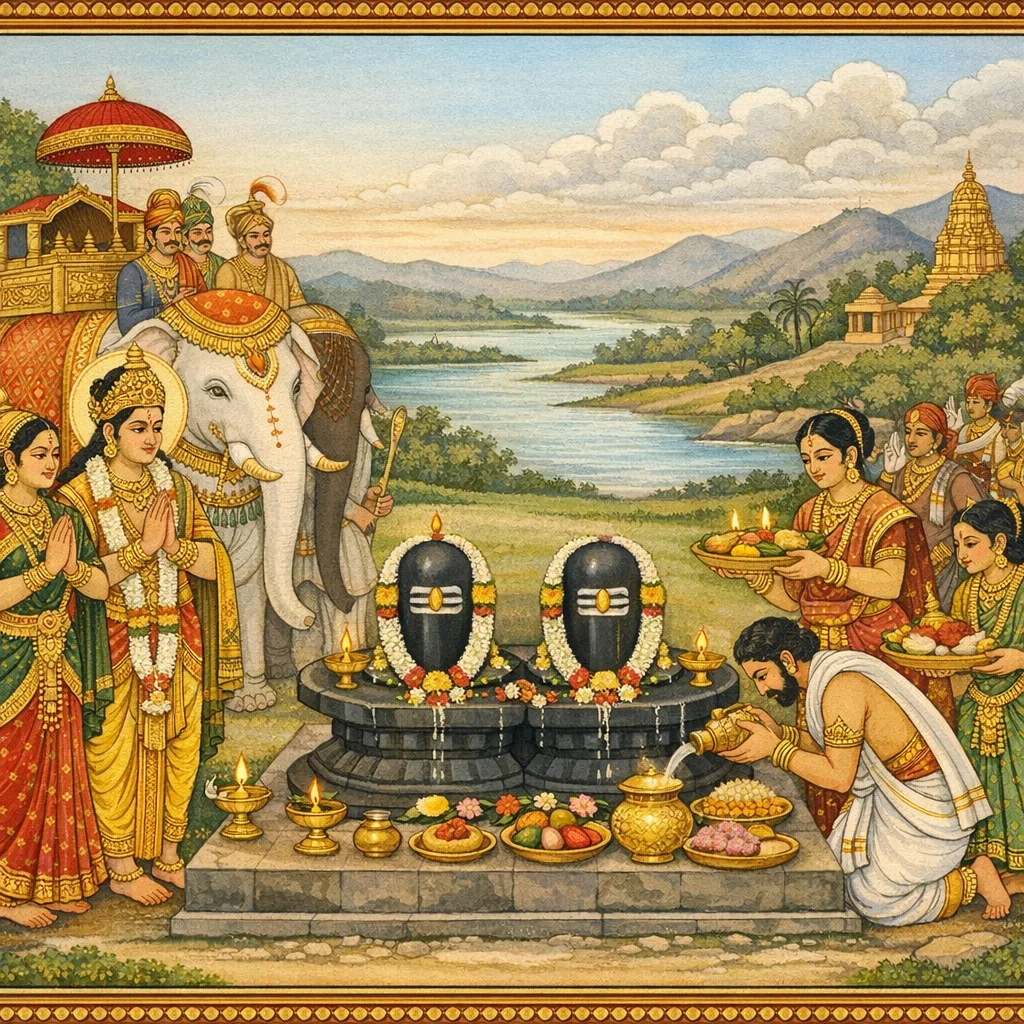
Adhyaya 320
लिंगद्वयमाहात्म्यवर्णनम् | The Māhātmya of the Pair of Liṅgas
In a theological dialogue from Īśvara to Devī, this chapter identifies a highly meritorious pair of liṅgas situated in the southeastern vicinity of the sacred region. Their establishment is attributed to Viśvakarmā, and their presence is linked to Tvaṣṭṛ’s arrival for city-building: after Mahādeva is installed, a city is constructed, and the liṅga(s) are (re-)established, highlighting the mutual bond between civic order and sacred iconography. The chapter then turns from origin-legend to practical rite, prescribing worship of the liṅga pair at the beginning and end of undertakings (karmādau/karmānte), especially for journeys and marriage-processions, as a worship that yields immediate efficacy. It concludes by setting standards for offerings—fragrant substances, amṛta-like liquids, and varied naivedya—framed as an ethical discipline of careful, intentional devotion rather than mere formality.
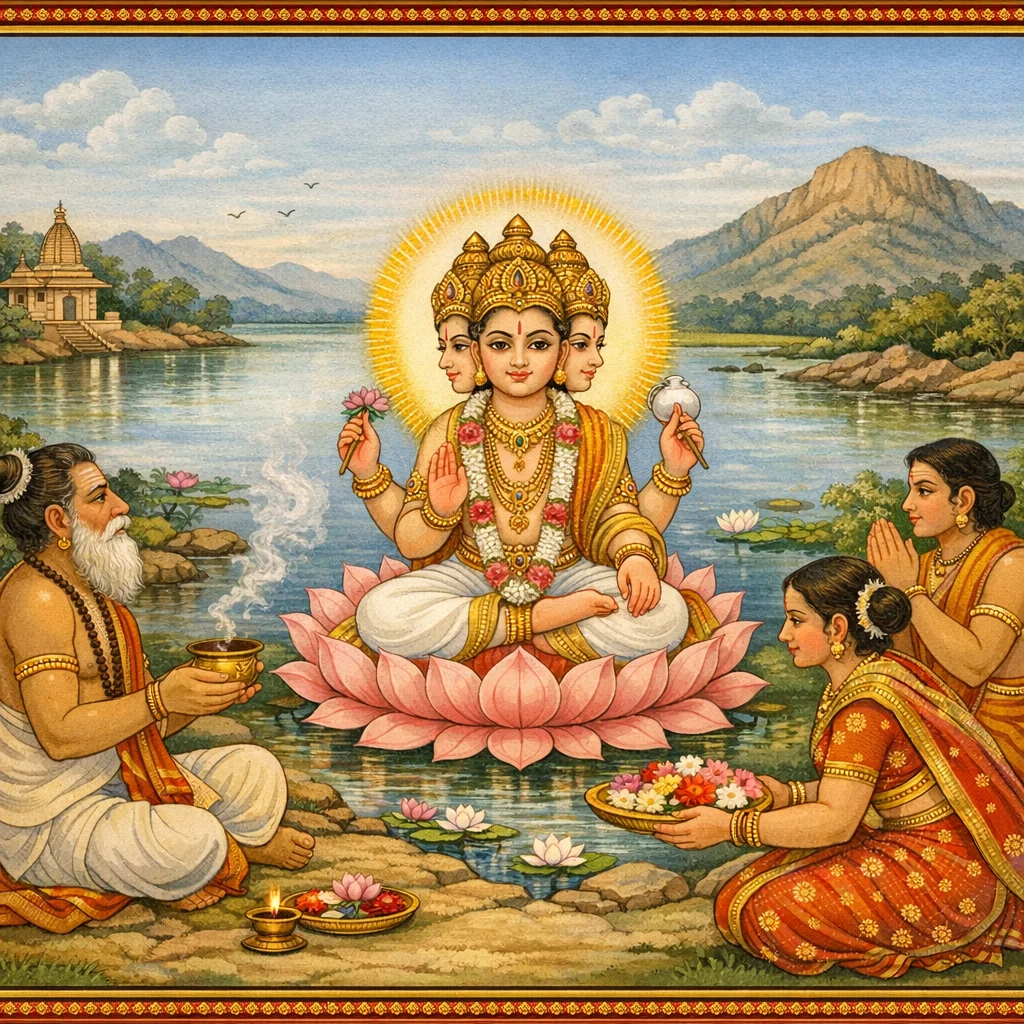
Adhyaya 321
उन्नतस्थाने ब्रह्ममाहात्म्यवर्णनम् (The Glorification of Brahmā at Unnata-sthāna)
This chapter unfolds as a dialogue between Śiva and Devī. Īśvara proclaims a secret, superior sacred place that destroys human sin and then sets forth the māhātmya of Brahmā connected with the elevated site called Unnata-sthāna. Devī questions how Brahmā can be “child-formed” here when elsewhere he is depicted as aged, and she asks the site’s location, the reason for Brahmā’s presence, and the proper manner and time of worship. Īśvara replies that Brahmā’s principal seat lies near the Ṛṣitoya river and describes a triad of worship-sites within Prabhāsa: Brahmā on the auspicious riverbank, Rudra at Agnitīrtha, and Hari (Dāmodara) on the pleasing Raivataka hill. The narrative adds that Soma petitioned Brahmā, who arrived at Unnata-sthāna in the form of an eight-year-old; mere darśana is said to free devotees from sins. A doctrinal encomium follows: no deity, teacher, knowledge, or austerity equals Brahmā, and release from worldly suffering depends on devotion to Pitāmaha. The chapter concludes by prescribing a preliminary bath at Brahma-kuṇḍa and then worship of child-form Brahmā with flowers, incense, and related offerings.
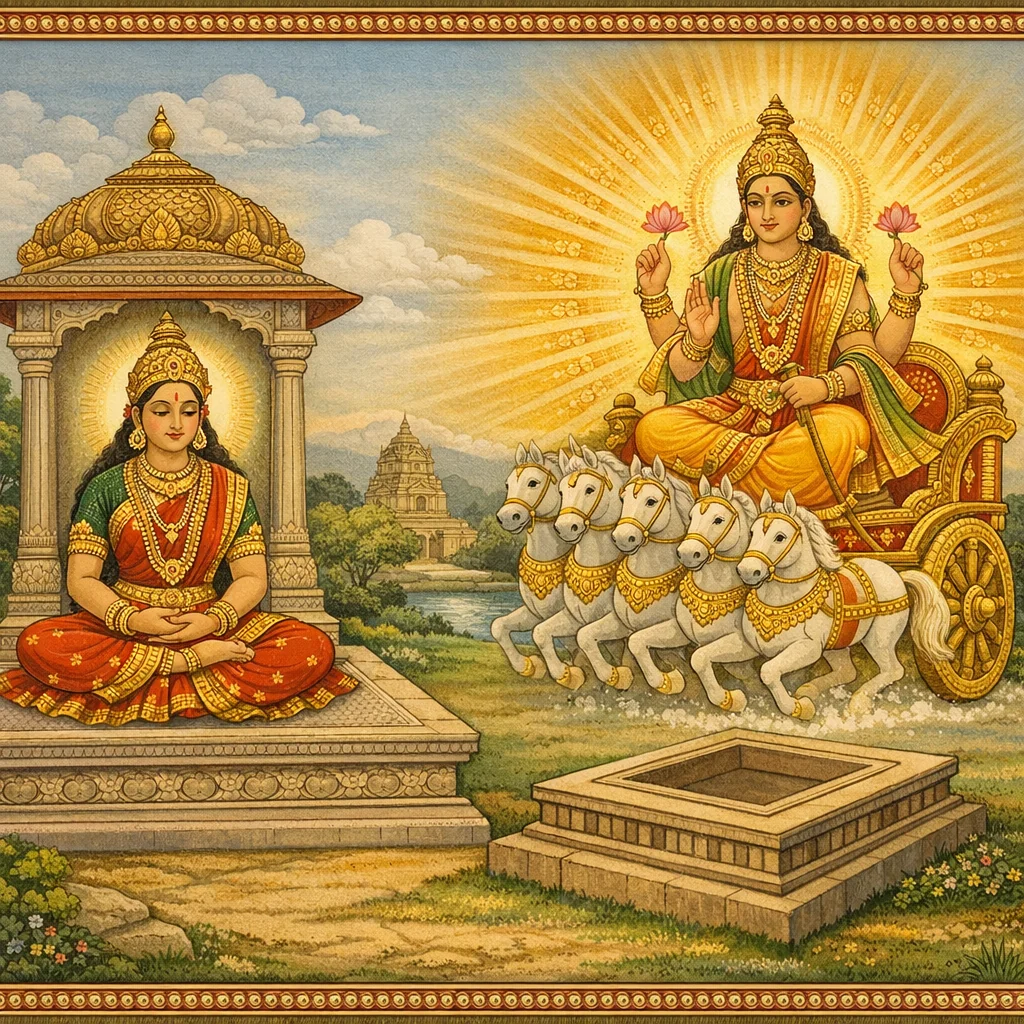
Adhyaya 322
दुर्गादित्यमाहात्म्यवर्णनम् (Durgāditya Māhātmya—Account of the Glory of Durgāditya)
This chapter is cast as a theological discourse in which Īśvara tells Mahādevī of a southern sacred site called “Durgāditya,” renowned as a remover of all sins. Its origin-legend is then related: when Durgā, the destroyer of suffering, was herself seized by distress, she propitiated Sūrya through prolonged tapas to obtain relief. After long austerities, Divākara, the Sun-god, grants her an audience and offers a boon. Durgā asks for the destruction of her suffering, and Sūrya gives a prophetic assurance that, before long, Bhagavān Tripurāntaka (Śiva) will establish an excellent liṅga in a lofty, auspicious place. He further declares that at this locale his name will be “Durgāditya,” and then disappears. The chapter ends with a practical observance: worship Durgāditya on Saptamī when it falls on a Sunday. The phalaśruti states that through this worship all afflictions subside, and various skin diseases—including kuṣṭha—are alleviated.
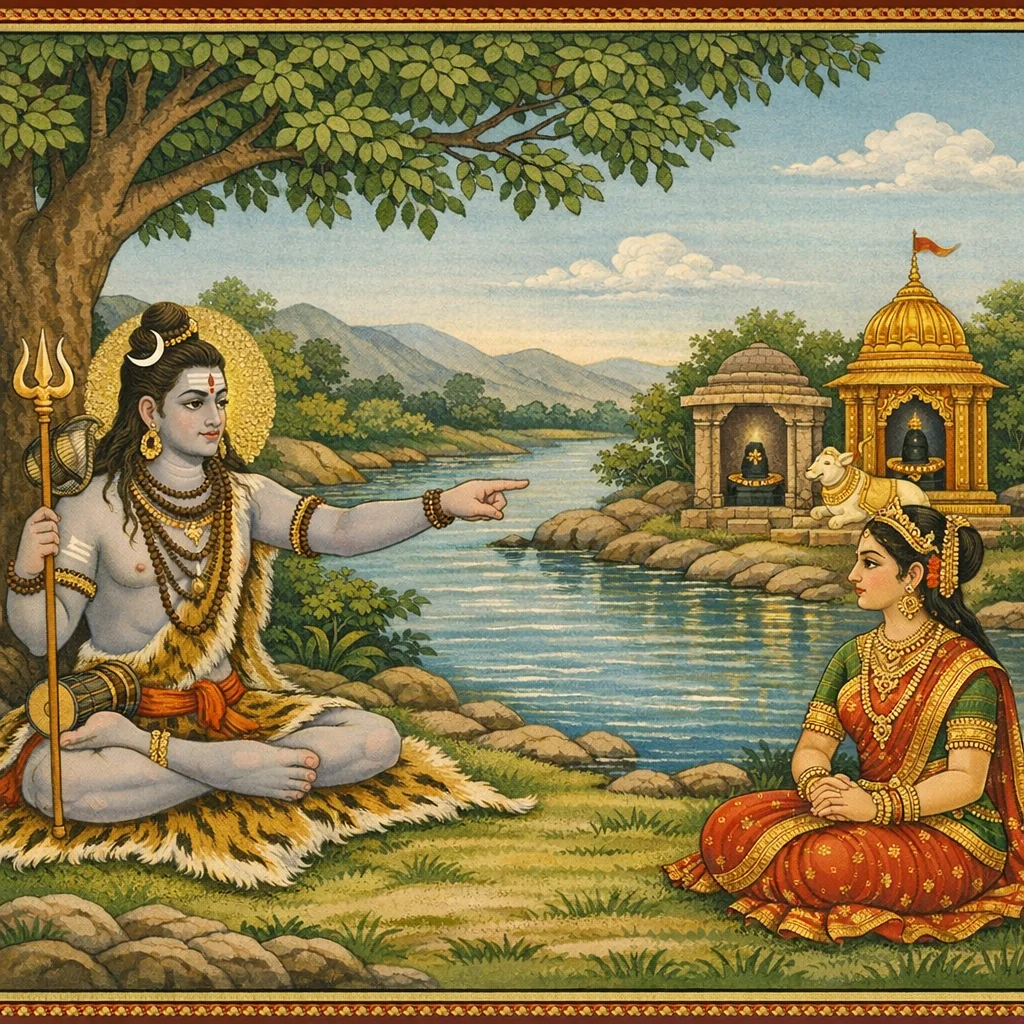
Adhyaya 323
Kṣemeśvara Māhātmya (क्षेमेश्वरमाहात्म्य) — The Glory of Kṣemeśvara
In an instructive dialogue between Śiva and Devī, Īśvara directs Devī’s gaze to a shrine lying “to the south” of the previously mentioned sacred spot, on the bank of the Ṛṣitoya river. The place is identified as Kṣemeśvara, and the account preserves its names across time: formerly it was called Bhūtīśvara, while in the Kali age it is proclaimed as Kṣemeśa/Kṣemeśvara. The chapter’s practical teaching is brief and pilgrimage-centered: mere darśana (sacred sight) followed by pūjā (worship) of this deity is said to release the devotee from all kilbiṣa—moral and ritual impurities. The closing colophon classifies it within the 81,000-verse recension of the Skanda Mahāpurāṇa, in the seventh division (Prabhāsa Khaṇḍa), first subsection (Prabhāsakṣetramāhātmya), under the title “Kṣemeśvaramāhātmya-varṇana”.
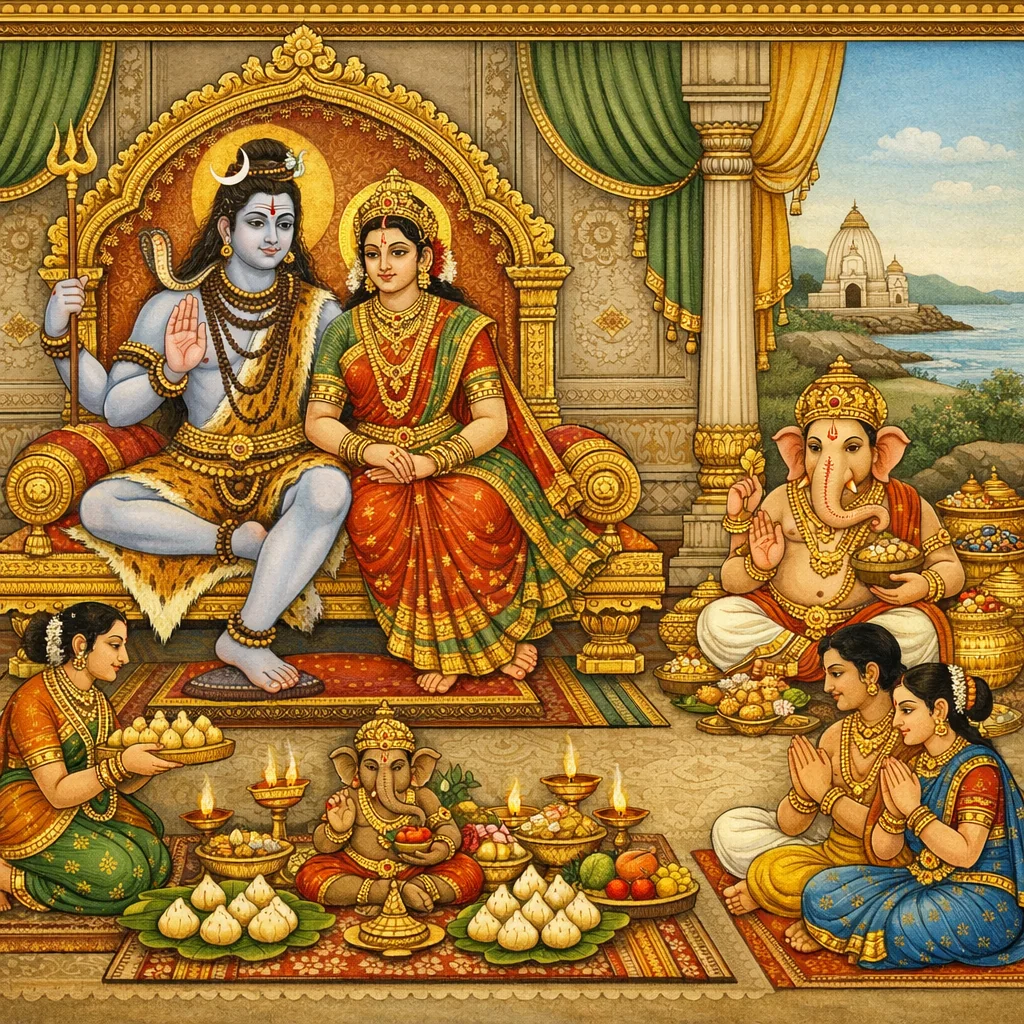
Adhyaya 324
गणनाथमाहात्म्यवर्णनम् (Glorification and Ritual Protocol of Gaṇanātha/Vināyaka at Prabhāsa)
This adhyāya records Īśvara’s instruction to Devī about a Vināyaka (Gaṇanātha) shrine in the northern part of Prabhāsa, specifically within the vāyavya (northwest) sub-direction. That Vināyaka is praised as the giver of “all siddhis,” granting success to beings. The text also presents a syncretic identification: one formerly known as a companion connected with Dhanada (Kubera) is now present in Gaṇanātha-form, guarding treasures (nidhis) in order to bestow accomplishment. A brief ritual rule is then given by calendrical timing: worship on the fourth lunar day (caturthī) when it coincides with Tuesday (bhauma-vāra), offering edible gifts—bhakṣya, bhojya—and modakas. The chapter ends with a phalāśruti-style assurance that proper worship brings certain success (dhruva-siddhi).
Adhyaya 325
उन्नतस्वामिमाहात्म्यवर्णनम् (Uṇṇatasvāmi Māhātmya—Description of the Glory of Unnatasvāmi)
In this chapter, Īśvara instructs Devī to proceed to an eminent Vināyaka shrine on a beautiful riverbank, connected with ṛṣi-toya—waters sanctified by sages. There the deity is revealed as Gaṇeśa/Gaṇanātha, leader of the divine hosts, and identified with the cosmic power that destroys Tripura, thus exalting his stature within a Śaiva theological vision. His iconography is specified: he abides in an exalted gaja-rūpa (elephant form) in the great sacred field of Prabhāsa, surrounded by countless gaṇas. Pilgrims are explicitly directed to worship with full effort so that their journey becomes free of obstacles, offering daily gifts such as flowers and incense. The chapter further enjoins communal observance on caturthī (the fourth lunar day): city-dwellers should repeatedly hold a mahotsava (great festival) on caturthī for the welfare and security of the realm (rāṣṭra-kṣema) and for the attainment of siddhi (successful accomplishment).
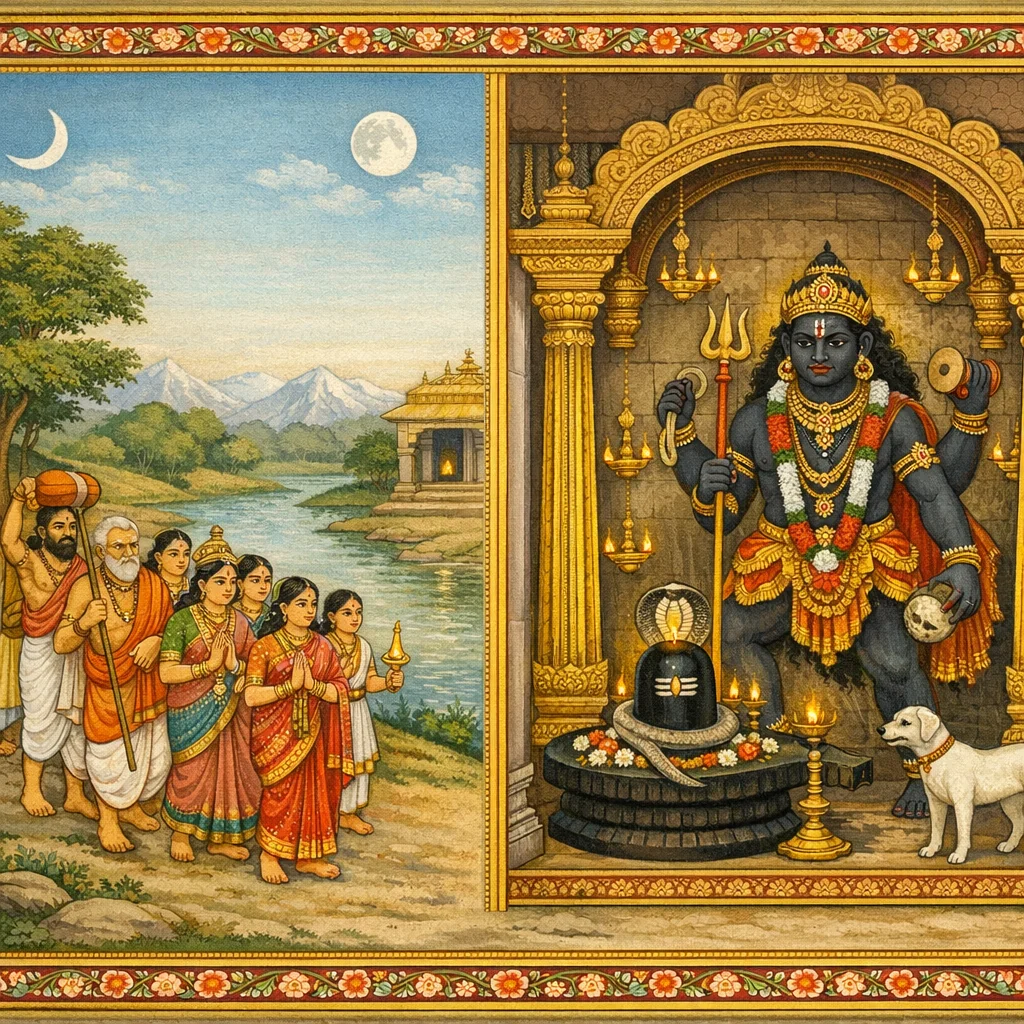
Adhyaya 326
Mahākāla-māhātmya (महाकालमाहात्म्य) — The Glory of Mahākāleśvara
This adhyāya gives Īśvara’s directional guidance within the sacred itinerary of Prabhāsa, leading the devotee to a northern site where Mahākāleśvara abides, praised as the supreme protector, sarva-rakṣā-kara. It names Bhairava, in a Rudra-form, as the presiding guardian of the city or settlement connected with this shrine, linking the shrine’s power to a protective Śaiva theology. A ritual discipline is prescribed: on darśa (new moon) and pūrṇimā (full moon) one should arrange a “great worship” (mahā-pūjā). The phalaśruti declares that one who bathes at the auspicious time called mahodaya and then beholds Mahākāla gains worldly prosperity and wealth across an extended karmic span—hyperbolically said to be “seven thousand births”—as a Purāṇic incentive for devotion and observance.
Adhyaya 327
महोदयमाहात्म्यवर्णनम् | The Glorification of Mahodaya Tīrtha
This adhyāya records Īśvara’s instruction concerning Mahodaya, a tīrtha located in the Īśāna (northeastern) direction. The pilgrim is enjoined to go there, bathe according to proper procedure (vidhi), and perform tarpaṇa offerings to the pitṛs and the deities. Mahodaya is praised for a distinctive power: it remedies faults incurred through ethically sensitive dealings, especially the “defects arising from accepting gifts” (pratigraha-kṛta doṣa), and it is said that fear does not arise for the practitioner. It is a source of great joy for the twice-born (dvija), yet its liberation-oriented promise extends even to those attached to sense-objects and to those entangled in gift-acceptance. North of Mahākāla, the Mātṛs are stationed to protect the sacred site; after bathing, one should worship these Mātṛs. The chapter concludes by extolling Mahodaya as sin-destroying and liberation-giving through abhiṣeka, noting its approximate extent as a half-krośa perimeter, with the center lauded as an ever-cherished abode of sages.
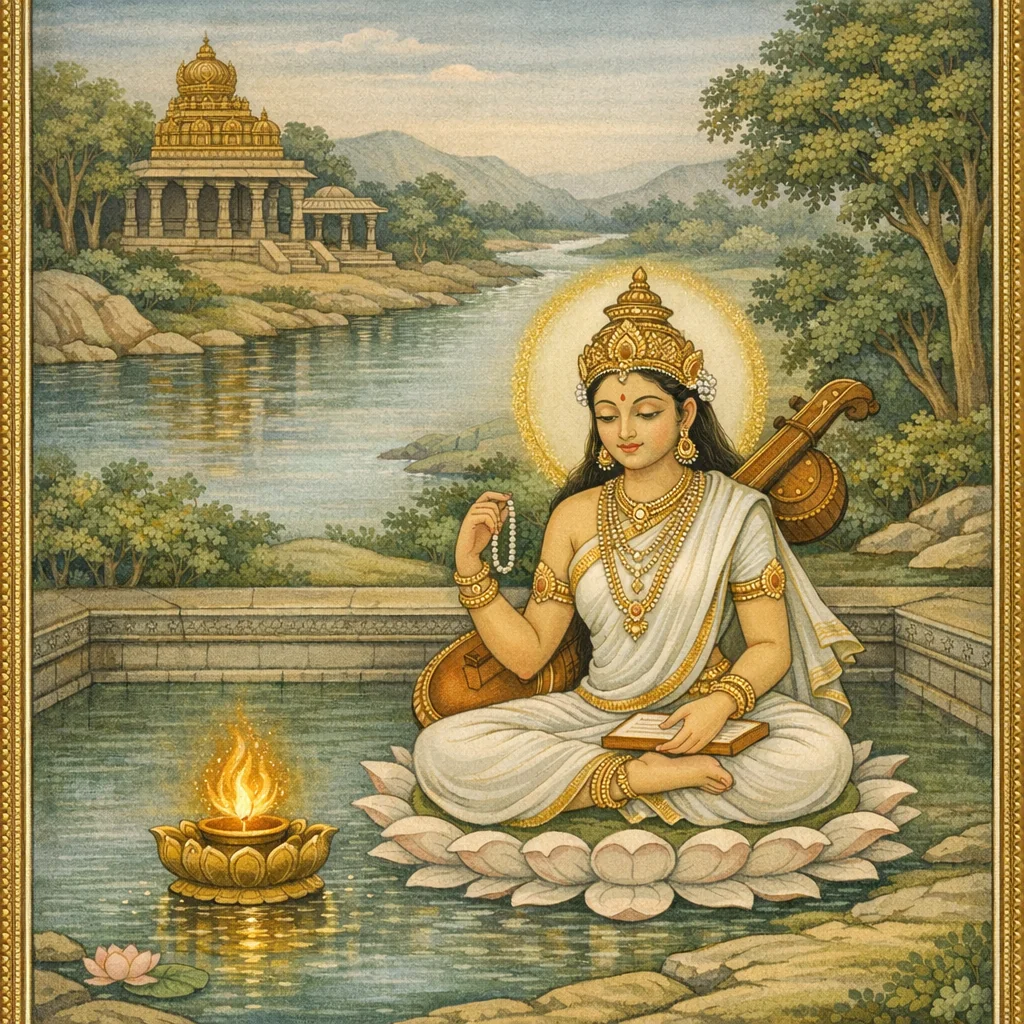
Adhyaya 328
संगमेश्वरमाहात्म्यवर्णनम् / Description of the Glory of Saṅgameśvara
This chapter presents a concise theological and ritual injunction spoken by Īśvara. Saṅgameśvara is proclaimed a sin-destroying Śaiva holy place in the vāyavya (northwestern) quarter, famed as a meeting-ground of ṛṣis, thereby affirming its authority and sanctity. Īśvara then indicates a nearby eastern area where the sacred pool Kuṇḍikā is praised as pāpa-nāśinī (sin-removing) and linked with the presence of Sarasvatī, depicted as arriving joined with a fiery potency (vaḍavānala). The prescribed observance is sequential: bathe in Kuṇḍikā and then worship Saṅgameśvara. The phalaśruti promises enduring auspiciousness—no separation from prosperity and beloved offspring across many births—and a sweeping removal of sins from birth to death, uniting ethical purification with devotional consolidation.
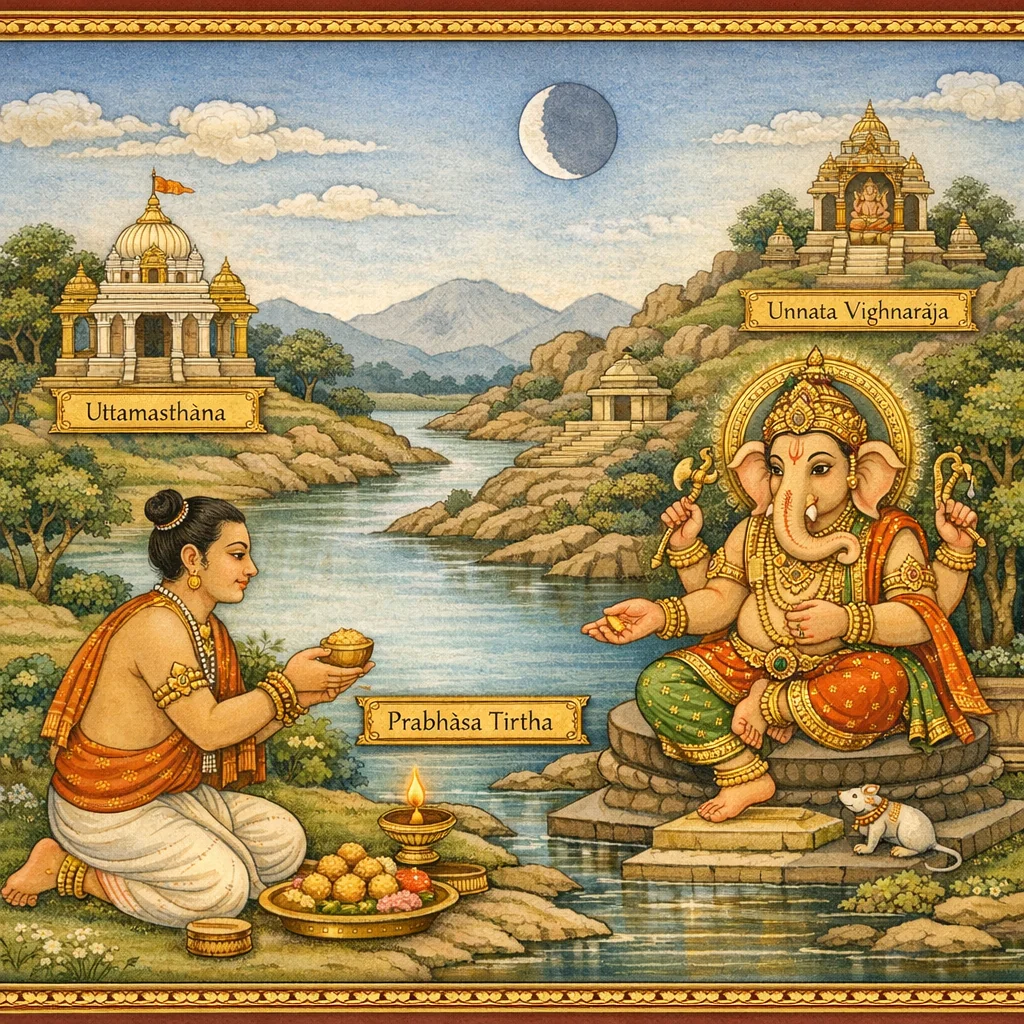
Adhyaya 329
उन्नतविनायकमाहात्म्यवर्णनम् | The Māhātmya of Unnata-Vināyaka (the Exalted Gaṇeśa)
In this adhyāya, spoken by Īśvara, a renowned sacred spot in the Prabhāsa region is identified as “Uttamasthāna,” situated to the north of a referenced divine precinct, with its distance given in local measures. Further north, at a stated interval of twelve dhanu, stands Unnata Vighnarāja—an exalted form of Gaṇeśa—praised as the destroyer of all obstacles (sarva-pratyūha-nāśana). Worship is enjoined on the fourth lunar day (caturthī) with fragrant substances, fruits, and sweet offerings. The promised fruit is the granting of desired aims (vāñchita-kāma) and “victory across the three worlds,” offered as a phalaśruti-style assurance within the shrine-catalog of the section.
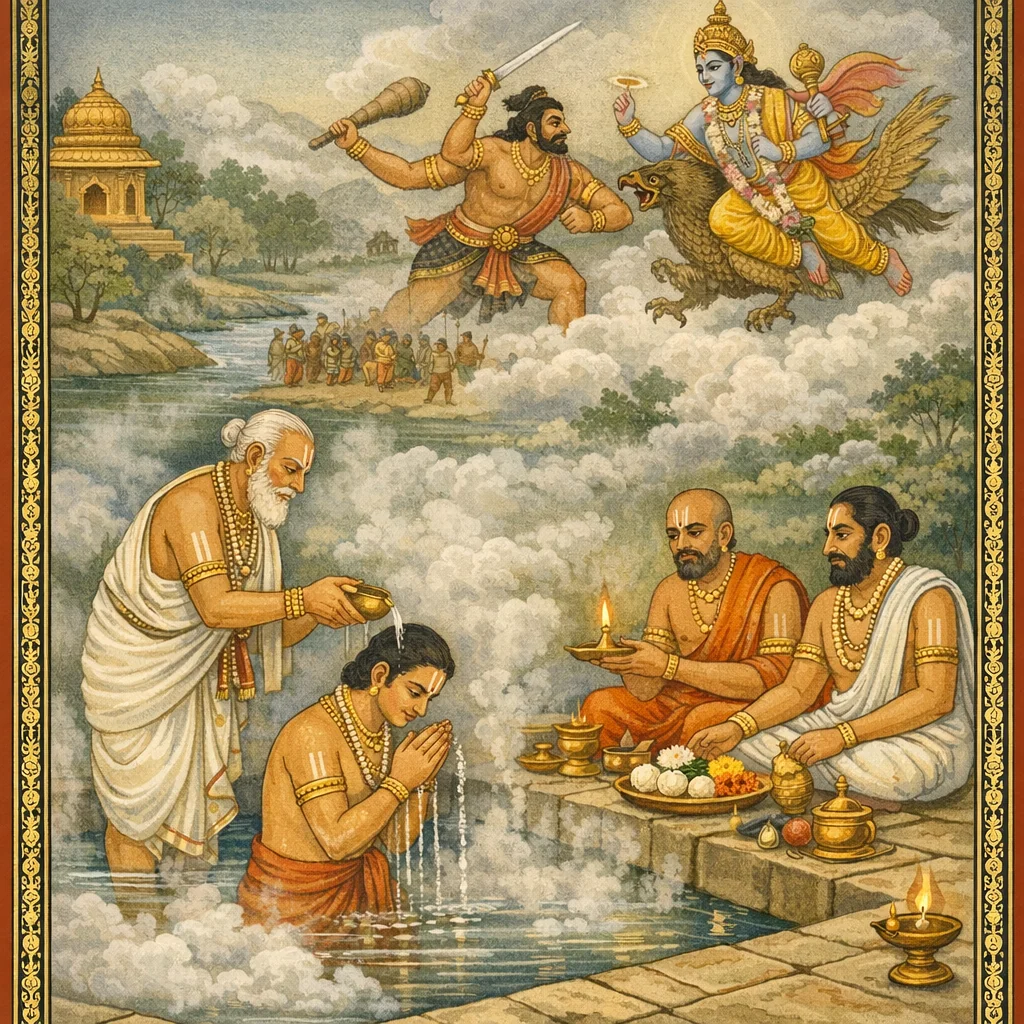
Adhyaya 330
तलस्वामिमाहात्म्यवर्णनम् | The Glory of Taptodaka-Talāsvāmin (Talāsvāmi Māhātmya)
This chapter is framed as Īśvara’s theological discourse, locating a sacred spot about three yojanas north of an elevated landmark. The place is identified with Taptodaka, a thermally potent water source, and with the deity Talāsvāmin. It recalls an earlier mythic battle in which Talāsvāmin—described as a leader among the daityas—was slain by Viṣṇu after a prolonged conflict. That remembrance becomes a rule of pilgrimage: one should bathe in the Taptakuṇḍa, worship Talāsvāmin, and perform piṇḍa-pradāna, the ancestral offering. The phala passage promises greatly increased merit, said to equal the fruit of a “koṭi-yātrā,” a hyperbolic measure of immense pilgrimage reward. Thus the chapter binds together spatial direction, mythic legitimation, and ritual procedure into a single, clearly identifiable tīrtha unit.
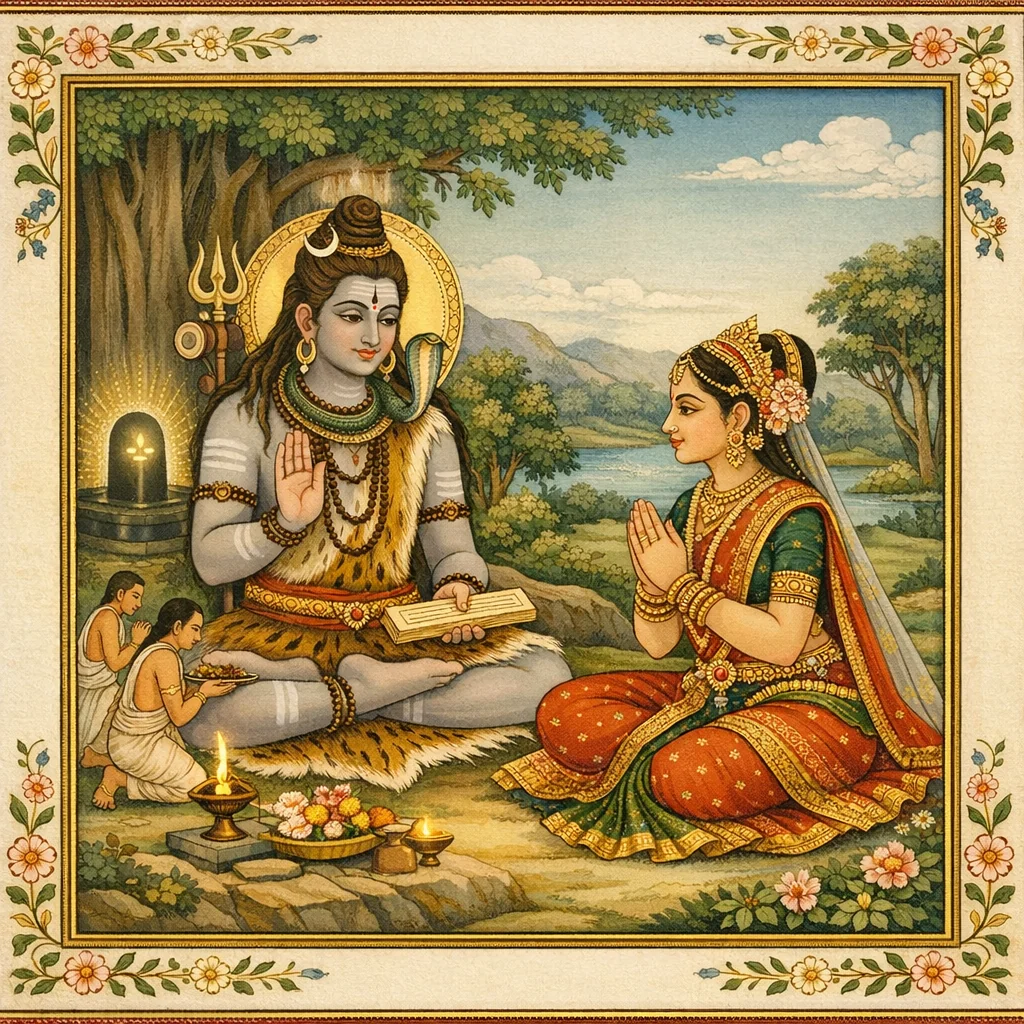
Adhyaya 331
कालमेघमाहात्म्यवर्णनम् (The Māhātmya of Kāla-Megha)
This chapter is cast as Īśvara’s instruction to Mahādevī concerning the revered sacred place called Kāla-Megha. The devotee is directed to go to Kāla-Megha, and it is stated that in the eastern quarter there is a kṣetrapa (guardian/presiding power) manifested in liṅga form. Worship is then prescribed by the lunar calendar: people should honor that liṅga with bali offerings, especially on the eighth (aṣṭamī) or the fourteenth (caturdaśī) lunar day. The promised fruit is stated succinctly—this deity grants desired aims (vāñchitārtha-prada) and is praised as a “wish-fulfilling tree” for the Kali age, showing that spiritual benefit remains accessible in later times through regulated devotion. The colophon notes that this is the 331st chapter of the first Prabhāsa-kṣetra-māhātmya within the Prabhāsa Khaṇḍa of the Skanda Mahāpurāṇa.
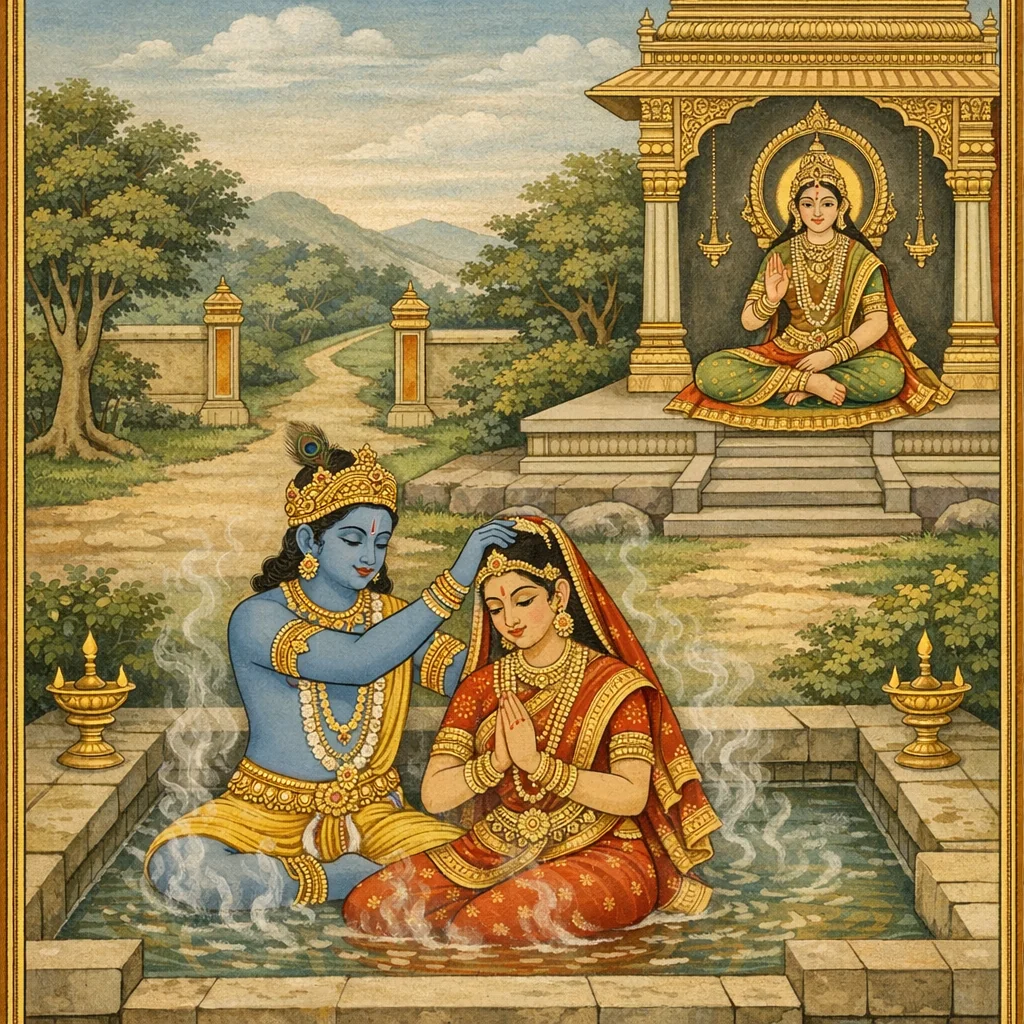
Adhyaya 332
रुक्मिणीमाहात्म्यवर्णनम् | Rukmiṇī Māhātmya (Glorification of Rukmiṇī and the Hot-Water Kuṇḍa)
This adhyāya is framed as a theological instruction led by Īśvara, identifying two linked sacred features within Prabhāsa-kṣetra: a set of hot-water ponds (taptodaka-kuṇḍa) to the south at a measured distance, and the eastward placement of the goddess Rukmiṇī at a specified interval. The hot-water kuṇḍa is established as a locus of purification, explicitly said to destroy even the most extreme sin, described as “koṭi-hatyā-vināśana.” A sequential rite is prescribed: first perform snāna (sacred bathing) in the hot-water kuṇḍa, then offer saṃpūjā (complete worship) to Rukmiṇī, praised as the remover of all sins and the bestower of auspiciousness. The phalaśruti adds a social-ethical promise aimed at household stability: for women, disruption or breaking of the marital home (gṛha-bhaṅga) is said not to arise for seven births. Thus pilgrimage practice is presented as a moral economy of merit bound to place, rite, and devotion.
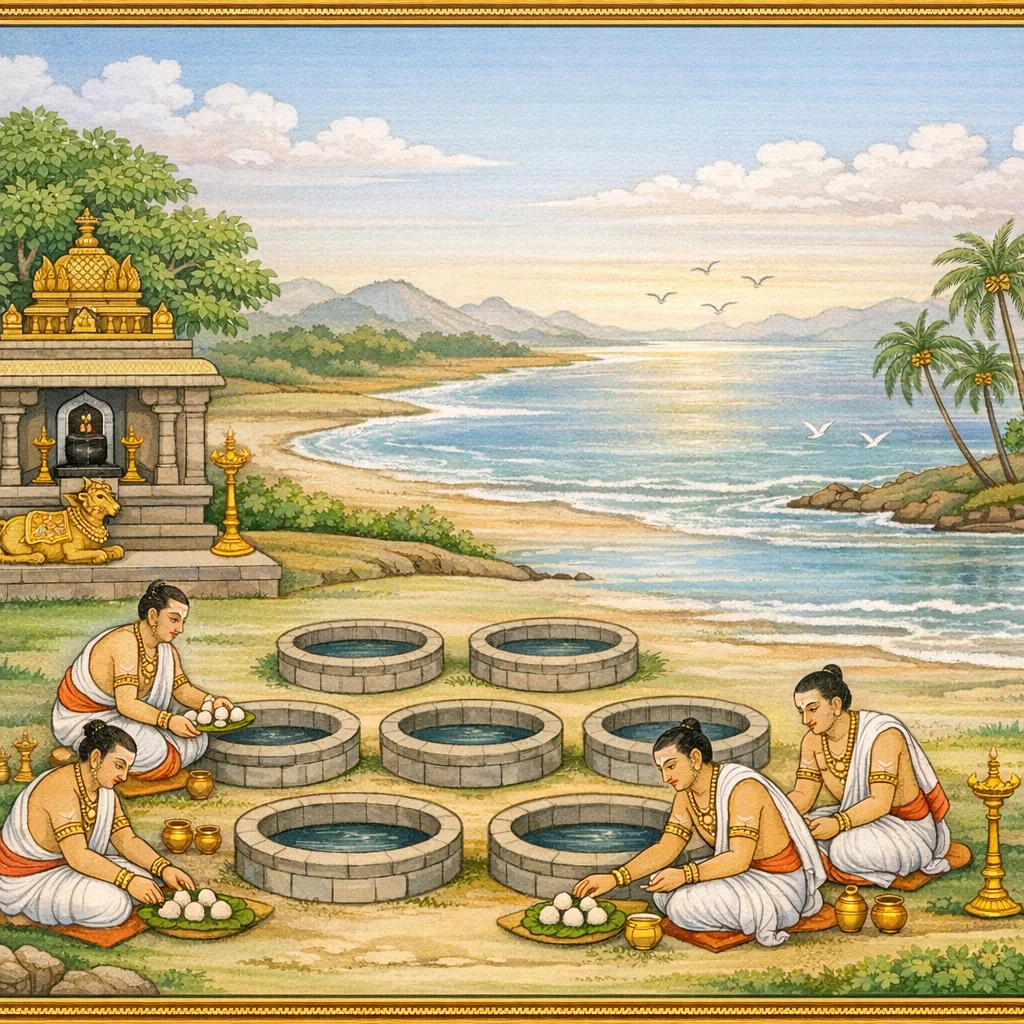
Adhyaya 333
मधुमत्यां पिङ्गेश्वर-भद्रा-सङ्गम-माहात्म्यवर्णनम् (Glorification of Pingeshvara and the Bhadrā Confluence at Madhumatī)
Īśvara describes a sequence of sacred sites in Prabhāsa-kṣetra, arranged around the Bhadrā river and the nearby seacoast. A renowned liṅga called Durvāseśvara is praised for powerful sin-purifying efficacy and for bestowing happiness; bathing on the new-moon day (amāvāsyā) and offering piṇḍa to the ancestors are said to bring them extensive satisfaction. He further states that many liṅgas were installed by ṛṣis, and that pilgrims are freed from faults by seeing, touching, and worshiping them. The chapter marks the kṣetra’s boundary localities: a perimeter place named Madhumatī, and to the south-west a site called Khaṇḍaghaṭa. Near the seashore stands Pingeshvara, and seven wells are mentioned where, on festival occasions, the ancestors’ “hands” are said to be visible—underscoring the power of śrāddha here. Performing śrāddha at this place is declared to yield merit multiplied beyond Gayā. Finally, the Bhadrā confluence (framed east–west) is identified, and its sanctity is equated with Gaṅgā–Sāgara, weaving local geography into pan-Indic ritual esteem.
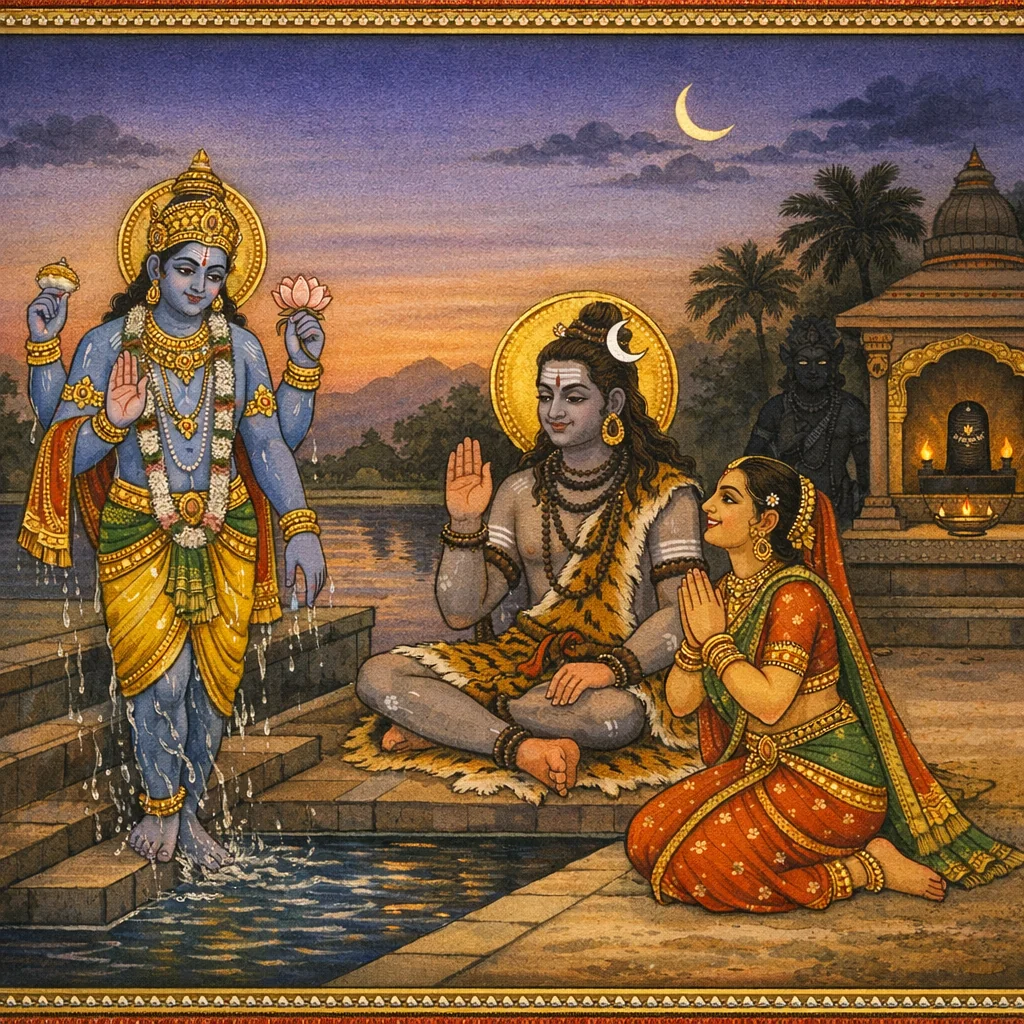
Adhyaya 334
तलस्वामिमाहात्म्यवर्णनम् (Talasvāmi Māhātmya: Origin Legend and Pilgrimage Rite)
This chapter unfolds as a theological dialogue: Devī asks Īśvara about the earlier-mentioned “fall” of Tala and why Talasvāmi is renowned. Īśvara reveals a secret origin: the fierce dānava Mahendra performs long austerities, conquers the devas, and demands a ruinous duel. From Rudra’s embodied fiery energy a being named Tala arises; empowered by Rudra-vīrya, Tala slays Mahendra and then dances in triumph, shaking the three worlds, darkening the sky, and filling beings with fear. The devas appeal to Rudra, but Rudra declares Tala inviolable as his “son” and directs them to Hṛṣīkeśa (Viṣṇu) at Prabhāsa, near the Taptodaka-kuṇḍa and the shrine linked with the name Stutisvāmi. Viṣṇu wrestles Tala in malla-yuddha, grows weary, and asks Rudra to restore the heat of the Taptodaka waters to remove fatigue; Rudra heats the kuṇḍa with his third eye, Viṣṇu bathes and regains strength, and then defeats Tala. Tala laughs, saying that despite impure intent he has attained Viṣṇu’s supreme state; Viṣṇu offers a boon. Tala asks that his fame endure and that those who behold Viṣṇu with devotion on the bright ekādaśī of Mārgāśīrṣa have their sins destroyed. The chapter concludes by praising the tīrtha’s powers—sin-destruction, fatigue-removal, and expiation even of grave faults—mentioning Nārāyaṇa’s presence and a Śaiva kṣetrapāla form called Kāla-megha, and prescribing a pilgrimage rite: remember Viṣṇu as Talasvāmi, recite mantras (including the Sahasraśīrṣa), bathe, offer arghya, perform pūjā with scents, flowers, and cloth, apply unguents, present naivedya, listen to dharma, keep night vigil, give gifts (a bull, gold, cloth) to a qualified Vedic brāhmaṇa, fast, and revere Rukmiṇī. A phalaśruti proclaims wide-ranging merits, uplift of ancestors, and multi-birth benefits from Talasvāmi-darśana and bathing in the kuṇḍa.
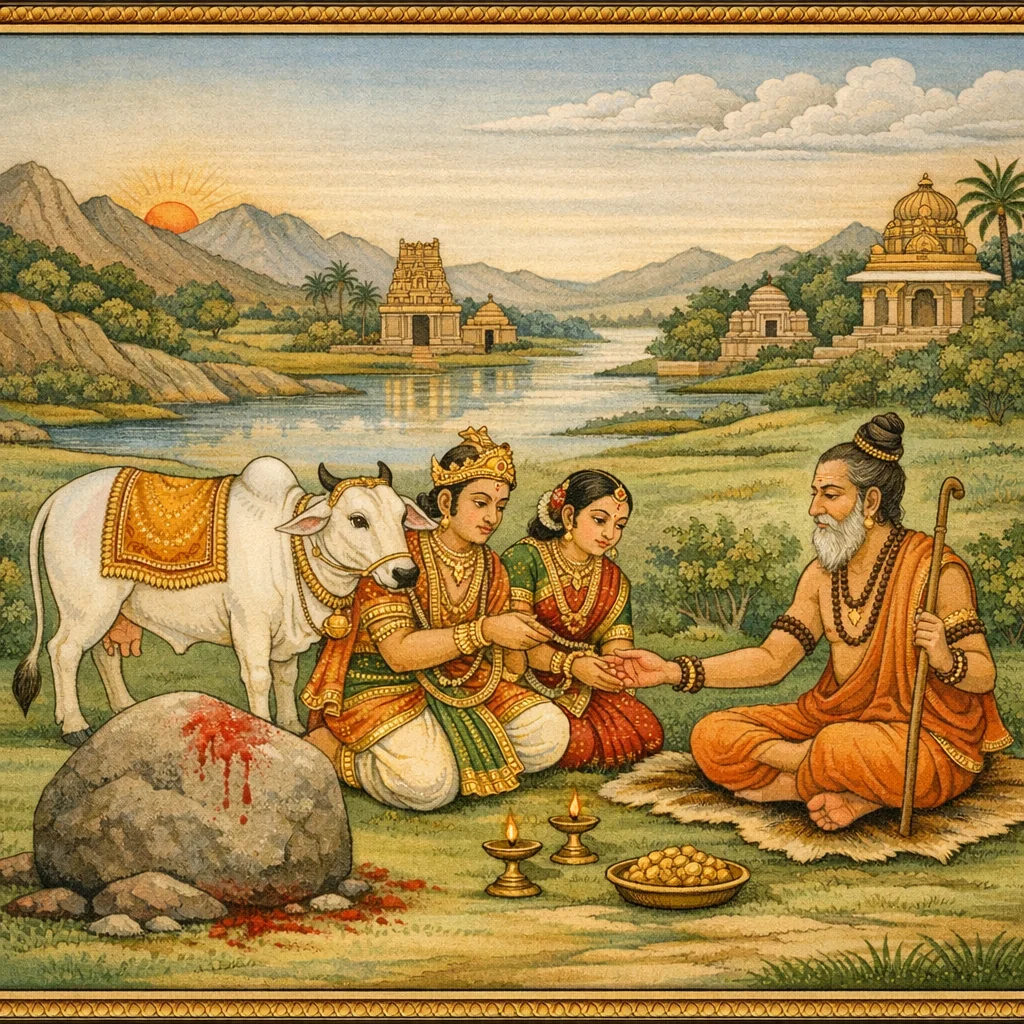
Adhyaya 335
शंखावर्त्ततीर्थमाहात्म्यवर्णनम् (The Māhātmya of Śaṅkhāvartta Tīrtha)
Chapter 335 records Īśvara’s geographically precise guidance to Devī: the pilgrim should go west to an auspicious bank of the Nyankumatī River, then proceed south to the “great” tīrtha called Śaṅkhāvartta. The place is marked by a distinctive image-bearing stone (citrāṅkitā śilā) linked to a self-manifest presence (svayaṃbhū) described as “red-wombed” (raktagarbhā); even after being “cut,” a visible redness remains, showing that sanctity endures in the very landscape. The chapter declares the site a Viṣṇu-kṣetra and connects its origin to an older episode in which Viṣṇu slays “Śaṅkha,” portrayed as a stealer of the Vedas (vedāpahārī). The water-body is said to be “śaṅkha-shaped,” giving a morphological explanation for the tīrtha’s name and authority. A phala statement follows: bathing here frees one from the burden of brahmahatyā, and even a Śūdra is said to attain successive births as a brāhmaṇa. The route then continues eastward to Rudragayā, where those seeking the full fruit of pilgrimage are instructed to perform cow-gifting (godāna), uniting purification, merit, and righteous giving in a single sacred itinerary.
Adhyaya 336
गोष्पदतीर्थमाहात्म्यवर्णनम् (The Glory of Goṣpada Tīrtha)
Chapter 336 is a theological dialogue between Īśvara and Devī revealing a hidden yet supremely efficacious pilgrimage site in Prabhāsa: Goṣpada Tīrtha, near the Nyanku-matī river system and connected with a “preta-śilā” associated with ancestral release. The text proclaims that śrāddha performed here yields merit “sevenfold of Gayā,” and illustrates this through King Pṛthu’s śrāddha, by which the sinful King Vena is uplifted from an impure birth. Devī asks for the site’s origin, the rite’s procedure, mantras, and qualified officiants; Īśvara stresses that this is a secret teaching (rahasya) to be shared only with the faithful. A structured ritual itinerary follows: disciplines of purity (brahmacarya, śauca, āstikya), avoidance of nāstika company, preparation of śrāddha materials, bathing in Nyanku-matī, and tṛpaṇa to devas and pitṛs. Invocation-mantras summon pitṛ-deities such as Agniṣvātta, Barhiṣad, and Somapā, and expansive piṇḍa-offerings are prescribed for known and unknown ancestors, including those in difficult post-mortem states and even non-human births. Offerings include pāyasa, madhu, saktu, piṣṭaka, caru, grains, roots/fruits, along with dāna (notably go-dāna and dīpa-dāna), circumambulation, dakṣiṇā, and immersion of the piṇḍas. The itihāsa section recounts Vena’s adharmic rule, his death at the hands of ṛṣis, the emergence of Niṣāda and Pṛthu, Pṛthu’s kingship and the motif of “milking the earth,” and Pṛthu’s effort to redeem Vena. Ordinary tīrthas recoil from Vena’s sin, but celestial instruction directs Pṛthu to Prabhāsa and specifically Goṣpada, where the rite succeeds and Vena attains release. The chapter ends by reaffirming the site’s flexible timing with minimal calendrical restriction, listing auspicious occasions, and restricting transmission of this sacred secret to sincere practitioners.
Adhyaya 337
न्यंकुमतीमाहात्म्ये नारायणगृहमाहात्म्यवर्णनम् | Narāyaṇa-gṛha: Glory and Observances near Nyankumatī
Īśvara speaks to Devī and directs the pilgrim to a supreme shrine called Narāyaṇa-gṛha, on the auspicious seashore south of the place known as Goṣpada, near Nyankumatī, praised as a remover of sins. He declares that Keśava (Hari) abides there enduringly across cosmic cycles (kalpāntara-sthāyī), making this divine “house” renowned in the world. After destroying hostile forces and for the uplift of ancestors in the fierce Kali age, Hari remains in this “house” for repose. The chapter gives yuga-wise names—Janārdana in Kṛta, Madhusūdana in Tretā, Puṇḍarīkākṣa in Dvāpara, and Nārāyaṇa in Kali—presenting the site as a stable center for the ordering of dharma through all four ages. It then teaches observances: on Ekādaśī, one who fasts completely (nirāhāra) and beholds the deity is said to gain a vision of Hari’s “endless” supreme state. Pilgrimage rites such as bathing and śrāddha are prescribed, and yellow garments are to be given in dāna to an exemplary brāhmaṇa. The closing phalāśruti states that hearing or reciting this account grants sadgati and auspicious spiritual attainment.
Adhyaya 338
Jāleśvara-liṅga-prādurbhāvaḥ (Origin and Glory of Jāleśvara at the Devikā Riverbank)
Īśvara describes a highly revered liṅga on the bank of the Devikā River, known as Jāleśvara, worshiped by nāga maidens and radiant in splendor; mere remembrance of it is said to destroy the grave sin of brahmahatyā. Devī asks how the name arose and what merits come from connection with that sacred place. Īśvara recounts an ancient itihāsa: the sage Āpastamba was performing austerities in Prabhāsa when fisherfolk cast a great net and, unintentionally, pulled the meditating sage up from the water. Stricken with remorse, they begged forgiveness. Āpastamba reflected on compassion and the dharma of benefiting suffering beings, wishing that his merit aid others and that their fault accrue to him. King Nābhāga arrived with ministers and priest and tried to compensate the fisherfolk with money as the sage’s “value,” but the sage rejected worldly measures. At Lomasha’s counsel, a cow was deemed the fitting price; Āpastamba accepted it, praising the sanctity of cows, the purifying pañcagavya, and the duty to protect and honor cows daily. The fisherfolk offered the cow, and the sage blessed them to ascend to heaven along with the fish they had lifted from the water, emphasizing intention and welfare. Nābhāga extolled the worth of saintly association, was instructed against royal arrogance, and requested the rare boon of dharma-intelligence. Īśvara concludes that the liṅga was established by the sage and named Jāleśvara because the sage fell into a net (jāla). The chapter ends with pilgrimage guidance: bathe and worship at Jāleśvara, hear the māhātmya, and make offerings—especially piṇḍa-dāna on Śukla Trayodaśī of Caitra and go-dāna to a Veda-knowing brāhmaṇa—as acts of great merit.
Adhyaya 339
Huṁkāra-kūpa Māhātmya (The Glory of the Well Filled by the Huṁkāra)
Īśvara tells Mahādevī of a celebrated well on the lovely bank of the Devikā River, famed as “triloka-viśruta” (renowned in the three worlds). There the sage Taṇḍī, dwelling by Devikā, performs tapas with unwavering Śiva-bhakti. A blind, aged deer falls into a deep, waterless pit. Moved by compassion yet keeping ascetic restraint, the muni repeatedly utters the sacred huṁkāra; by the power of that sound the pit fills with water, and the deer escapes with difficulty. The deer then assumes human form and questions the sage in wonder at the karmic fruit revealed. The transformed being explains that its fall into deerhood and return to human state occurred here through the potency of this tīrtha. Taṇḍī again pronounces the huṁkāra and the well fills as before; he performs snāna and pitṛ-tarpaṇa, recognizes the place as a supreme tīrtha, and attains a higher state (parā gati). The phalaśruti declares that even now, when huṁkāra is made there, a stream of water arises. A devotee who visits—though formerly sinful—does not gain another human birth on earth. One who bathes, becomes pure, and performs śrāddha is freed from all sins, honored in pitṛloka, and said to uplift seven lineages, past and future.
Adhyaya 340
चण्डीश्वरमाहात्म्यवर्णनम् (Glorification of Caṇḍīśvara)
Chapter 340 is a brief instruction in which Īśvara speaks to Devī, directing her attention to a particular shrine: Caṇḍīśvara, praised as a great liṅga (mahāliṅga) that destroys all sins and transgressions (sarva-pātaka-nāśana). He then lays down a calendrical rite: on the fourteenth lunar day of the bright fortnight (śukla-caturdaśī) in the month of Kārttika, one should observe fasting (upavāsa) and keep a night vigil (prajāgara). The chapter ends with a phalaśruti promise that such observance leads to the “supreme station” of Maheśvara, presenting the vow as both moral purification and a path toward liberation. The closing colophon places it in the Skanda Purāṇa, Prabhāsa Khaṇḍa, within the Prabhāsakṣetramāhātmya section, as the 340th chapter.
Adhyaya 341
आशापूरविघ्नराजमाहात्म्यवर्णनम् (The Māhātmya of Āśāpūra Vighnarāja)
Chapter 341 records Īśvara’s theological account of the shrine of Āśāpūra Vighnarāja, situated in the Vāyavya (northwest) direction, praised as akalmaṣa (untainted) and as vighna-nāśana, the remover of obstacles. The title Āśāpūraka—“fulfiller of hopes and desires”—is explained as arising from the deity’s power to grant aspirations. The shrine’s potency is affirmed through exemplary acts of worship: Rāma, Sītā, and Lakṣmaṇa are said to have revered Gaṇeśa/Vighneśa there and attained their sought aim. Candra (the Moon) likewise worshiped Gaṇādhipa and received the wished-for boon, explicitly including the destruction of all kuṣṭha (skin disease) as a healing result. A ritual prescription is given: on the bright fortnight’s fourth lunar day (śukla-caturthī) in Bhādrapada, one should worship the deity and feed brāhmaṇas with modakas (sweet offerings). The phala declares that desired success is gained by Vighnarāja’s grace, and the chapter closes by stating that Īśvara appointed this deity to protect the kṣetra and to remove obstacles for travelers.
Adhyaya 342
Chandreśvara–Kalākuṇḍa Tīrtha Māhātmya (चंद्रेश्वरकलाकुण्डतीर्थमाहात्म्य)
Chapter 342 records Īśvara’s guidance about a pāpa-hara (sin-removing) liṅga, said to have been self-established by Soma/Candra (the Moon) a short distance away in the south–nairṛtya (southern–southwestern) direction. Nearby is a sacred water-body called Amṛta-kuṇḍa, also known as Kalā-kuṇḍa. The chapter stresses ritual order: first perform snāna (sacred bathing) in the kuṇḍa, then worship “Candreśa/Chandreśvara.” The promised fruit is stated in ascetic measure—the devotee gains the merit of a thousand years of tapas. It also notes a tank (taḍāga) built by Candra, sixteen bow-lengths in extent and aligned east–west in relation to Chandreśa, functioning as a navigable sacred map. The colophon places the unit in the Prabhāsa Khaṇḍa, within the Prabhāsakṣetra-māhātmya, under the Aśāpūra-māhātmya stream.
Adhyaya 343
कपिलधाराकपिलेश्वरमाहात्म्ये कपिलाषष्ठीव्रतविधानमाहात्म्यवर्णनम् (Kapiladhārā–Kapileśvara Māhātmya and the Procedure/Glory of the Kapilā-Ṣaṣṭhī Vrata)
This chapter unfolds as a Śiva–Devī dialogue. It first identifies Kapileśvara and the Kapila-kṣetra through directions and tīrtha-based sacred geography, then establishes the site’s sanctity through a mythic precedent: the sage Kapila’s long tapas and the installation of Maheśvara there. Kapiladhārā is described as a holy river-current connected with the sea, perceptible to those of merit. The main teaching is the Kapilā-Ṣaṣṭhī vrata, defined by a rare calendrical conjunction, and taught through a clear sequence: bathing (in the kṣetra or at a sun-associated spot), japa, offering arghya to Sūrya with prescribed substances, circumambulation (pradakṣiṇā), and worship near Kapileśvara. A concluding donation rite is prescribed—arranging a kumbha with solar symbolism and gifting it to a Veda-knowing brāhmaṇa—followed by an expansive phalaśruti promising expiation of accumulated wrongdoing and extraordinary merit, likened to great sacrifices and to gifts made at many sacred places.
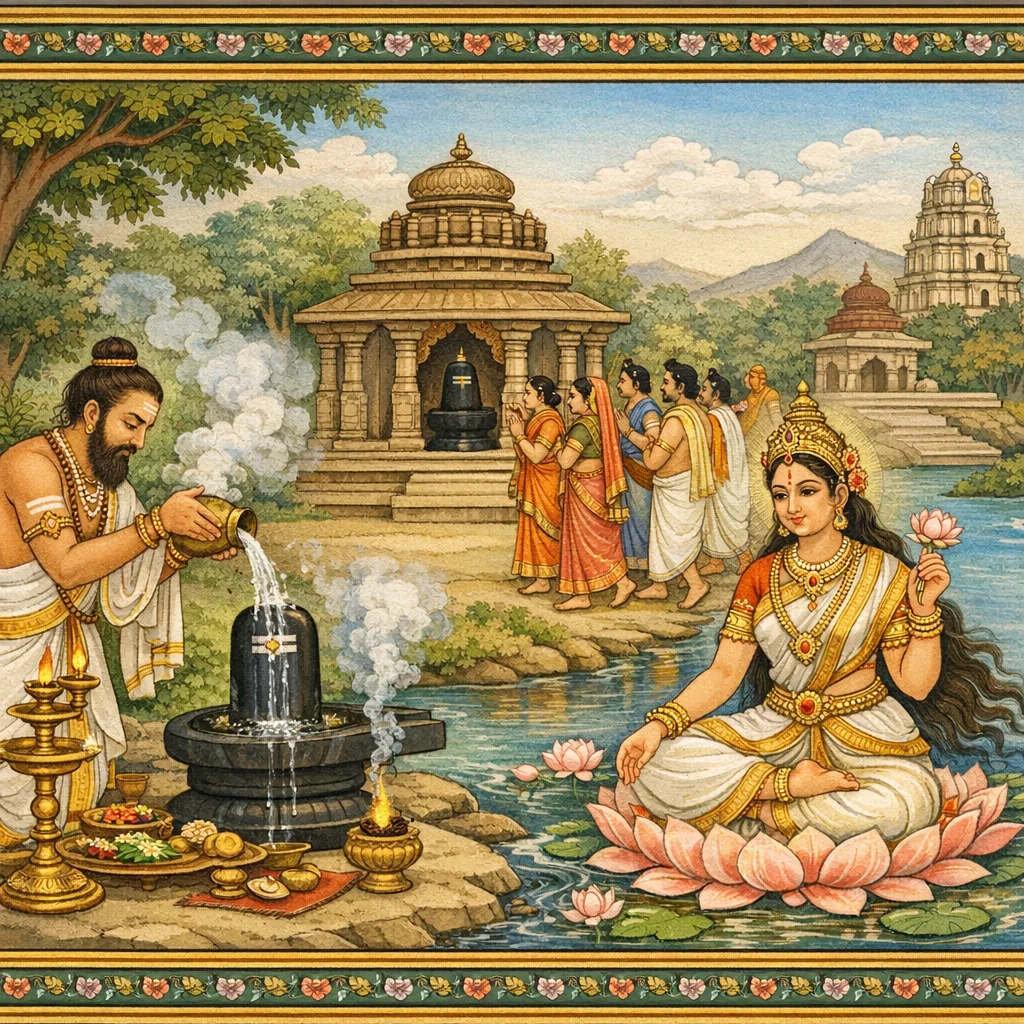
Adhyaya 344
जरद्गवेश्वरमाहात्म्यवर्णनम् | Jaradgaveśvara Māhātmya (Glorification of Jaradgaveśvara)
The chapter records Īśvara’s guidance to Devī regarding a sacred spot within Prabhāsa-kṣetra. Pilgrims are directed to a sin-destroying liṅga called Jaradgaveśvara, said to have been established by Jaradgava and located in a specified directional relation to Kapileśvara. Worship there is declared to remove grave sins, including brahmahatyā and allied transgressions. At the same place is the river-goddess Aṃśumatī; one should bathe according to proper rite and then perform piṇḍa-dāna (ancestral offering). The stated fruit is long-lasting satisfaction of the ancestors, and the text recommends gifting a bull (vṛṣabha) to a Veda-learned Brāhmaṇa. Devotional observance is detailed through offerings of gandha and puṣpa, pañcāmṛta ablution, and guggulu incense, along with continual praise, prostration, and circumambulation. Feeding Brāhmaṇas with varied foods is upheld as social-ritual duty, with a claim of manifold merit. The tīrtha is also remembered by yuga-names: Siddhodaka in Kṛta-yuga and Jaradgaveśvara-tīrtha in Kali-yuga.
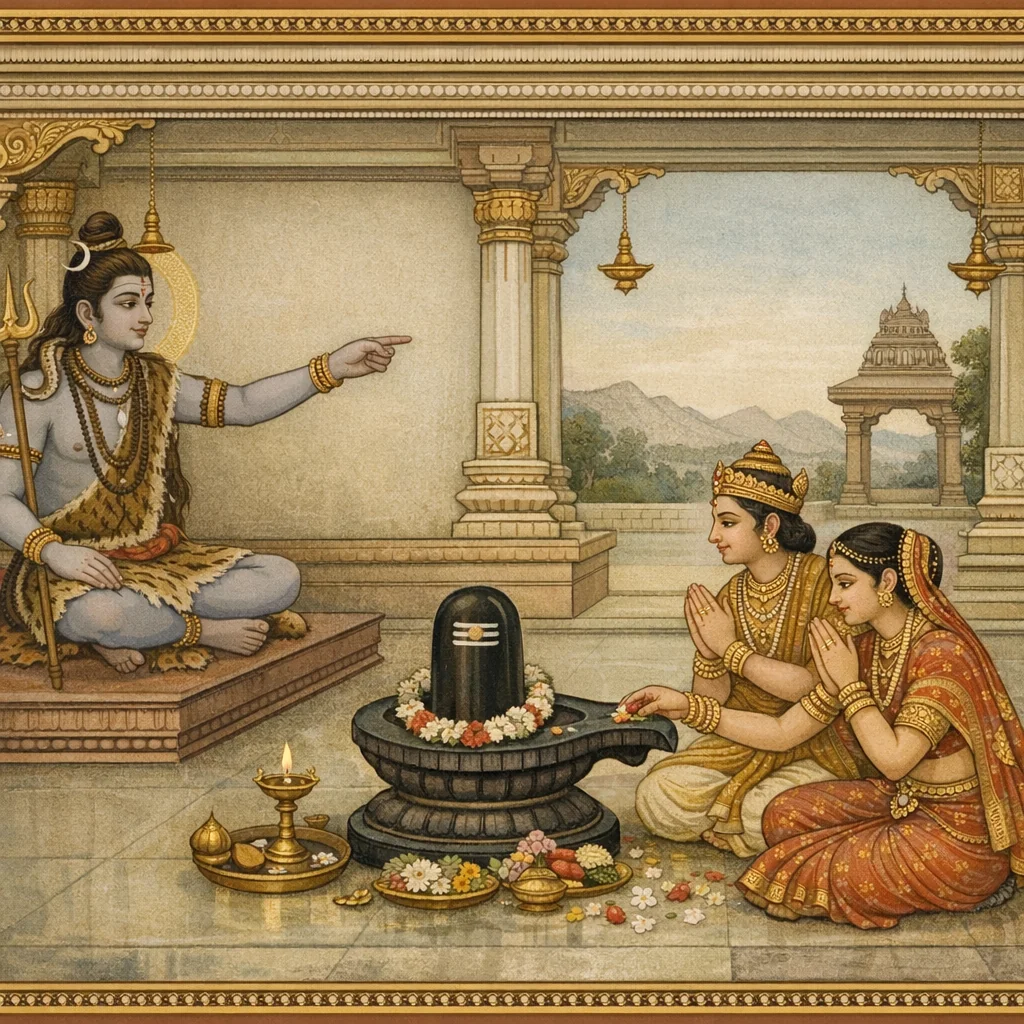
Adhyaya 345
नलेश्वरमाहात्म्यवर्णनम् (Naleśvara Māhātmya—Account of the Glory of Naleśvara)
This adhyāya is a brief site-glory (māhātmya) within the sacred field of Prabhāsa. It describes the liṅga called Hāṭakeśvara and, to its eastern side, the shrine known as Naleśvara. Īśvara speaks to Devī, giving directional guidance and a specific distance measure so the shrine may be located within the kṣetra. The text states that Naleśvara was established by King Nala together with Damayantī, grounding the shrine’s authority in the exemplary royal pair’s recognition of the kṣetra’s excellence. In the phalaśruti it is declared that one who beholds and worships the liṅga according to proper rite is freed from the afflictions of the Kali age (“kali” afflictions) and is also promised victory in dicing/gambling (dyūta), a distinctive worldly boon linked to devotion at this place.
Adhyaya 346
कर्कोटकार्कमाहात्म्यवर्णनम् — Karkoṭakārka Māhātmya (Account of the Glory of the ‘Karkoṭaka Sun’)
This adhyāya is cast as Īśvara’s instruction, locating a sacred solar manifestation called Karkoṭaka-ravi in the Āgneya (southeastern) quarter of Prabhāsa-kṣetra. It declares that mere darśana of this form delights all the deities, so that one localized epiphany becomes a meeting-point of pan-divine approval. It then lays down a brief ritual rule: worship according to vidhi on saptamī (the seventh lunar day) when it coincides with Sunday (ravivāra), offering dhūpa (incense), gandha (fragrance), and anulepana (unguents). The practical doctrinal lesson is purification: right timing and proper offerings grant release from sarva-kilbiṣa, all moral and ritual taint. The colophon places it in the Skanda Mahāpurāṇa of 81,000 verses, within the seventh Prabhāsa Khaṇḍa, in the Prabhāsakṣetramāhātmya section, as chapter 346.
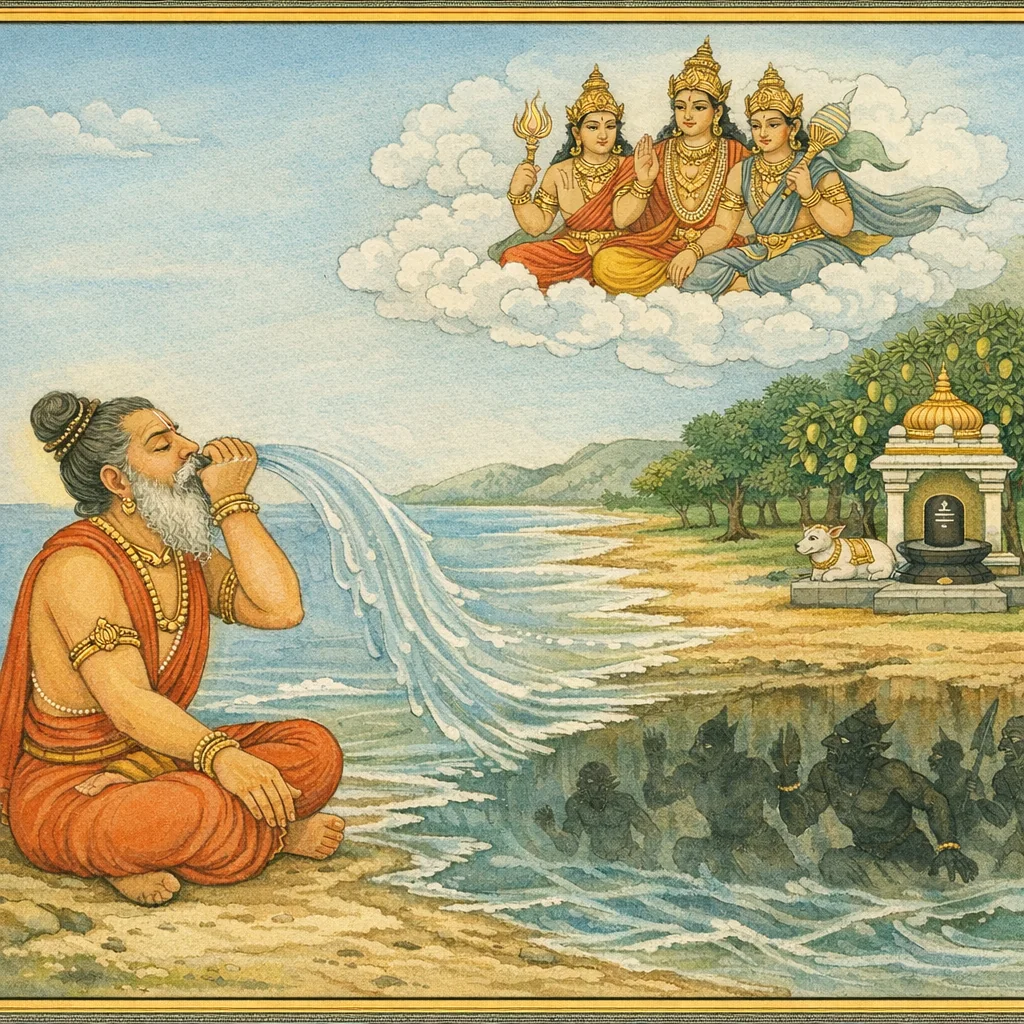
Adhyaya 347
हाटकेश्वरमाहात्म्यम् (Hāṭakeśvara Māhātmya: The Glory of Hatakeśvara Liṅga and Agastya’s Āśrama)
Īśvara tells Devī of the place and sanctity of Hāṭakeśvara-liṅga, situated near Naleśvara and the grove called Agastyāmra-vana, where the sage Agastya formerly performed austerities. An origin-legend follows: after Viṣṇu destroys the fierce Kālakeya daityas, some remnants hide in the ocean and begin nightly raids in the Prabhāsa region, devouring ascetics and shattering the culture of yajña and dāna, so that the marks of dharma—svādhyāya, the vaṣaṭ-cry, and ritual continuity—collapse. The distressed devas approach Brahmā, who identifies the Kālakeyas and directs them to seek Agastya at Prabhāsa. Agastya goes to the sea and drinks it like a single mouthful (gandūṣa), exposing the daityas to be defeated; some flee to pātāla. Asked to restore the ocean, he says the water has become “aged/impure” and foretells that Bhāgīratha will later bring the Gaṅgā to fill it again. The chapter ends with Agastya’s boons: worship and bathing near his āśrama and Hāṭakeśvara yield lofty spiritual fruits, with certain rites assigned specific merits; and the phalaśruti declares that faithful hearing of this account instantly frees one from sins incurred by day and by night.
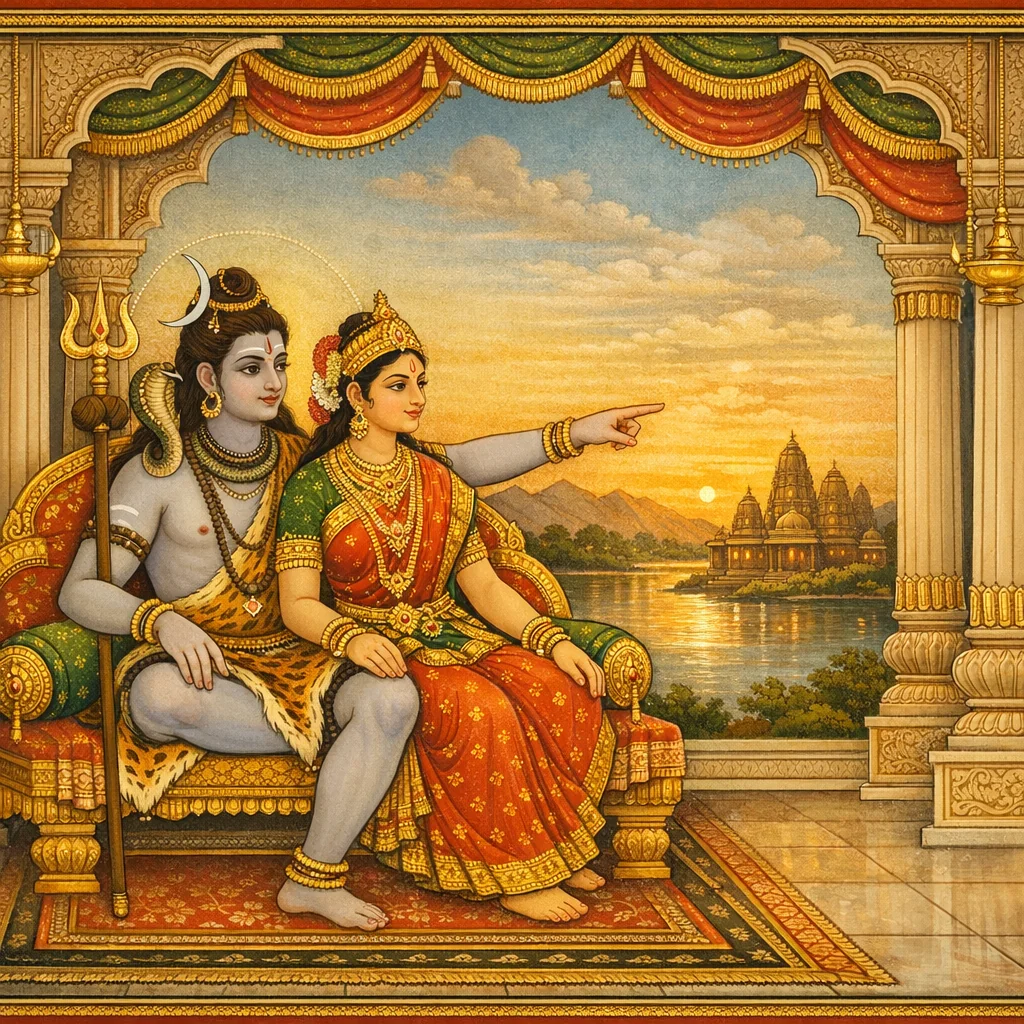
Adhyaya 348
नारदेश्वरीमाहात्म्यवर्णनम् | Nāradeśvarī Māhātmya (Glorification of Nāradeśvarī)
This adhyāya gives a brief yet prescriptive tīrtha instruction, framed as Īśvara’s discourse. The devotee, reverently addressing Mahādevī, is directed to go westward to the shrine of Nāradeśvarī, whose immediate presence (sānnidhya) is praised as the destroyer of all misfortune (sarva-daurbhāgya-nāśinī). A specific devotional rule is taught: a woman who worships the Goddess with composed mind on the third lunar day (tṛtīyā) establishes a protective merit, so that in her lineage women will not be marked by misfortune. Thus the chapter serves as a micro-māhātmya—stating the place, the ritual time, and the promised fruit of eradicating and preventing daurbhāgya—concluding by identifying itself as the Nāradeśvarī-māhātmya within the Prabhāsakṣetramāhātmya.
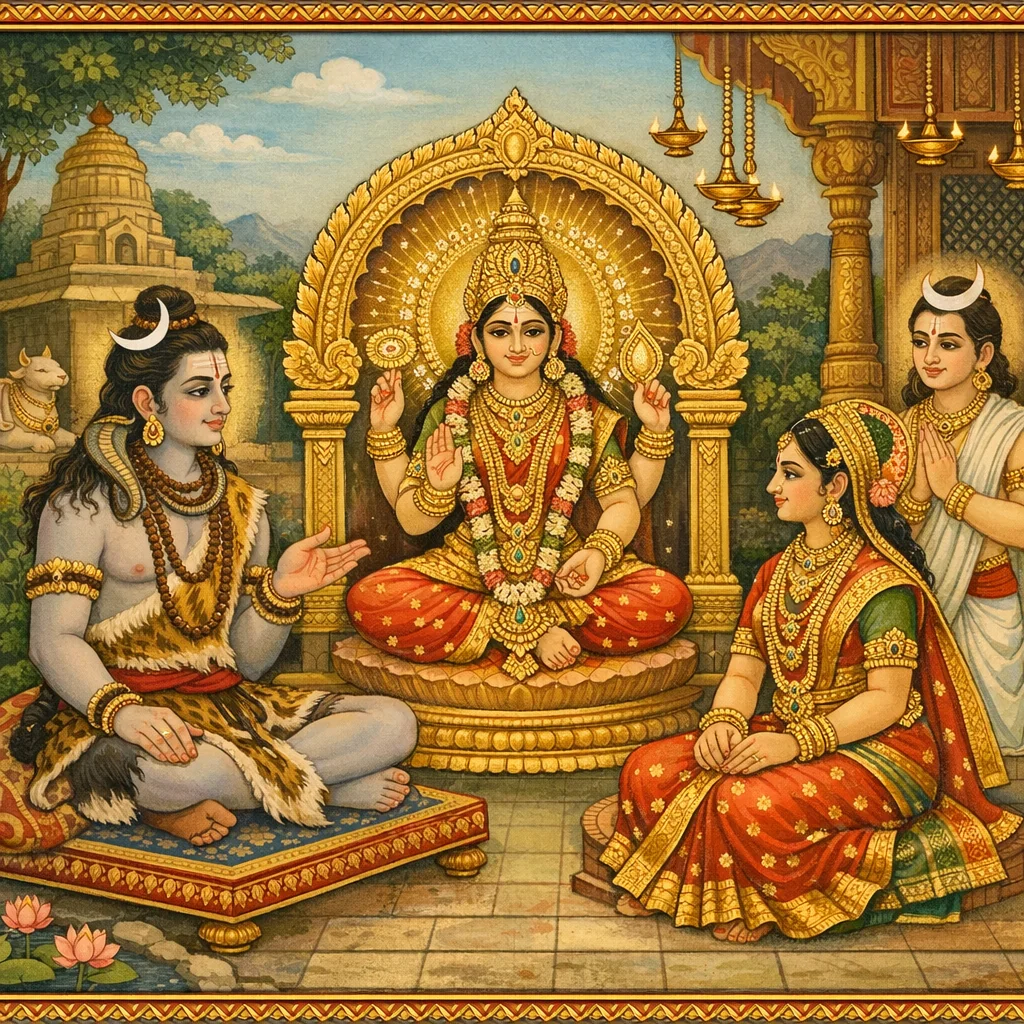
Adhyaya 349
मन्त्रविभूषणागौरी-माहात्म्यवर्णनम् (Glorification of Mantravibhūṣaṇā Gaurī)
This adhyāya is cast as Īśvara’s instruction to Devī, directing her attention to a particular goddess-form, “Devī Mantravibhūṣaṇā,” enshrined near Bhīmeśvara and said to have been worshipped in former times by Soma, the lunar deity. In this way, the chapter links the sacred geography of the site with an inherited lineage of devotion. Its main thrust is prescriptive and calendrical: it declares that any woman who worships this Devī in the month of Śrāvaṇa, according to proper rite, especially on the third lunar day (tṛtīyā) of the bright fortnight (śukla-pakṣa), is freed from all sorrows. Thus the chapter compactly unites shrine-location, Soma’s prior worship, and vrata-timing into a fruit-oriented (phala) theological instruction.
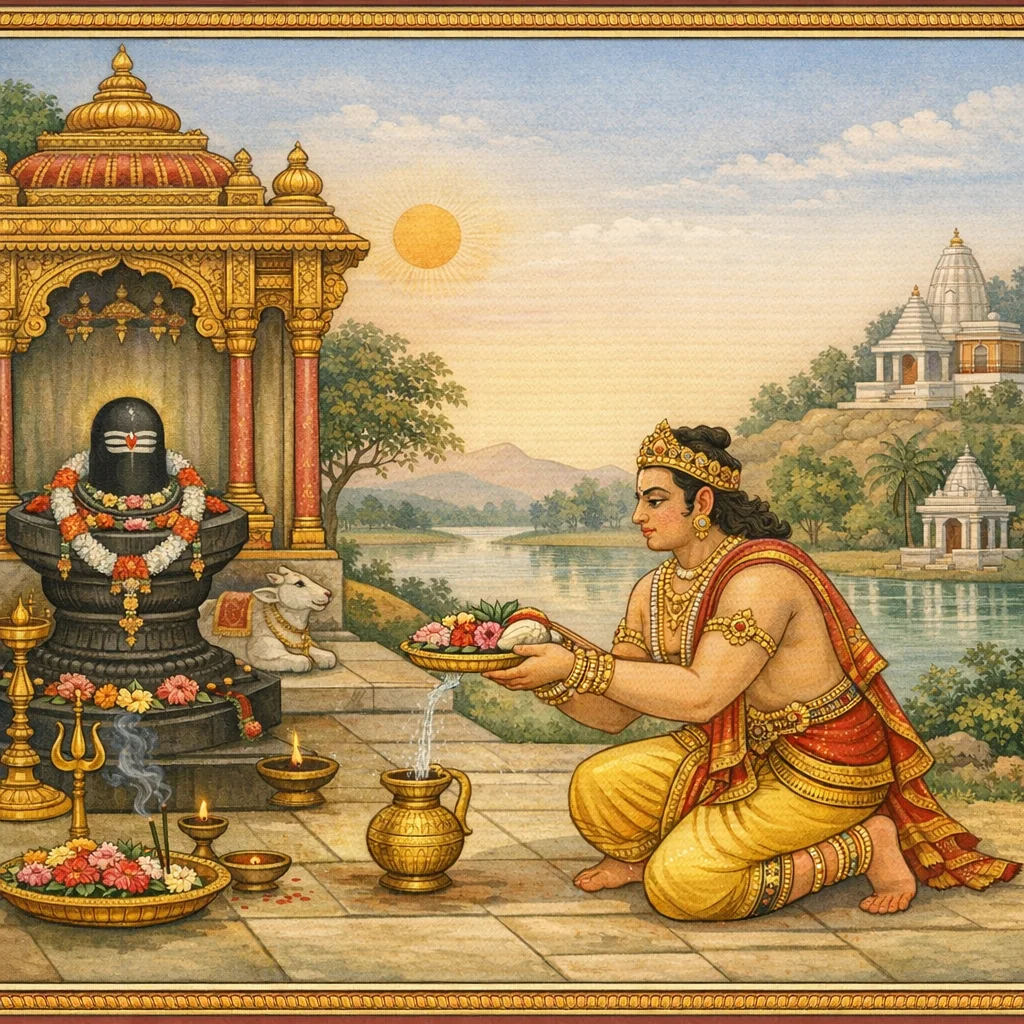
Adhyaya 350
दुर्गकूटगणपतिमाहात्म्यवर्णनम् | The Māhātmya of Durgakūṭa Gaṇapati (Glorification Narrative)
This adhyāya, spoken in Īśvara’s voice, first gives a precise micro-topographical guide to Viśveśa at Durgakūṭaka: it lies east of Bhallatīrtha and south of the Yoginīcakra, directing the pilgrim to the sacred spot. It then offers an exemplary precedent—Bhīma’s successful propitiation—thereby affirming the shrine’s power as “sarvakāmaprada” (the giver of desired aims) when worship is performed according to rule. The chapter fixes the proper time as Phālguna month, bright fortnight (śukla pakṣa), on the fourth lunar day (caturthī), with simple offerings of fragrance, flowers, and water. The phala statement concludes that the worshipper, without doubt, attains a full year of obstacle-free living (nirvighna), underscoring the Purāṇic principle that correct timing and orthodox simplicity yield assured results.
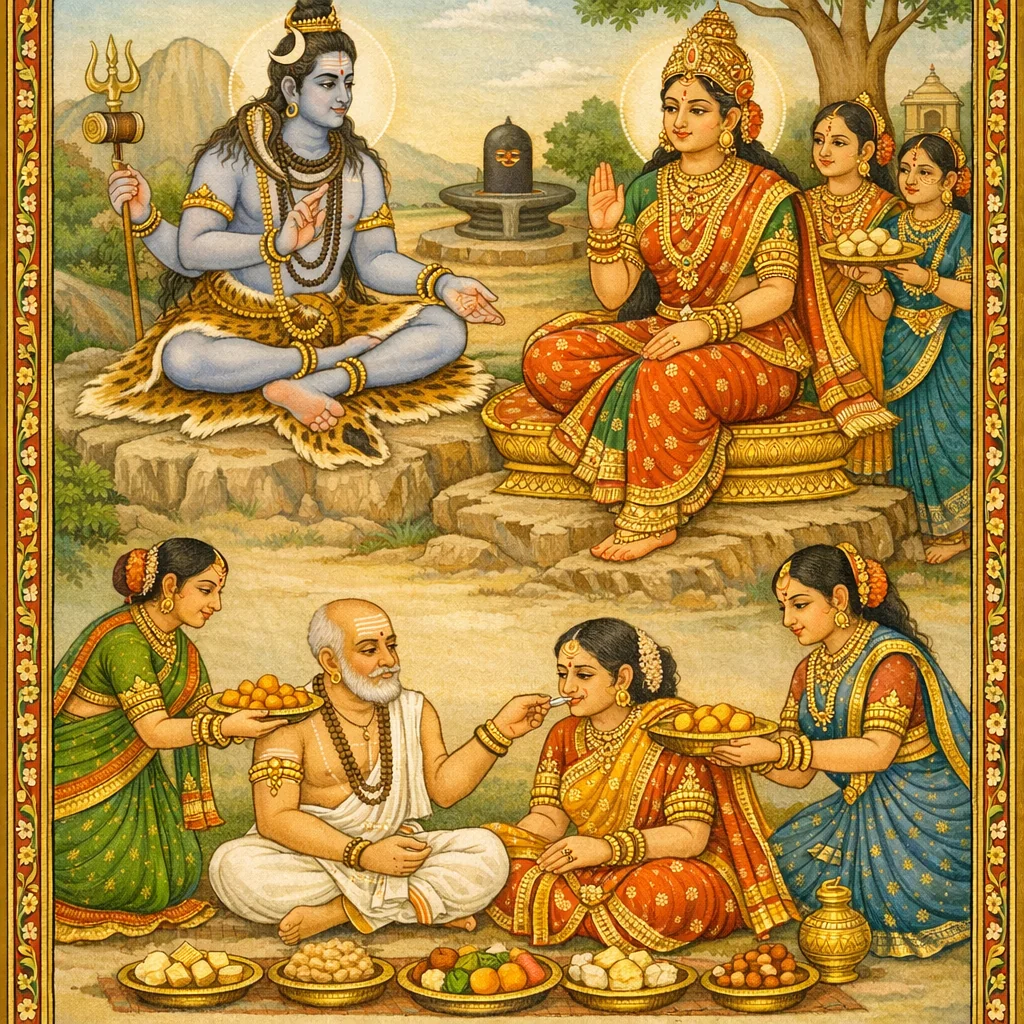
Adhyaya 351
कौरवेश्वरीमाहात्म्यवर्णनम् | The Māhātmya of Kauraveśvarī (Protectress of the Kṣetra)
This adhyāya records Īśvara’s instruction to Mahādevī to go to the goddess Kauraveśvarī, whose name is bound to Kurukṣetra through earlier propitiation (ārādhanā). She is praised as a protective power who guards the sacred kṣetra, and it is recalled that Bhīma once worshiped her after taking up the duty of protecting that holy field. A calendrical rule is given: worship performed with earnest effort on Mahānavamī is said to be especially fruitful. The chapter also teaches hospitality and regulated ritual giving (dāna): food should be offered particularly to married couples, including offerings of divine-quality fare and well-prepared sweet dishes. Such acts delight the goddess, who, when praised, is said to protect the devotee like a son.
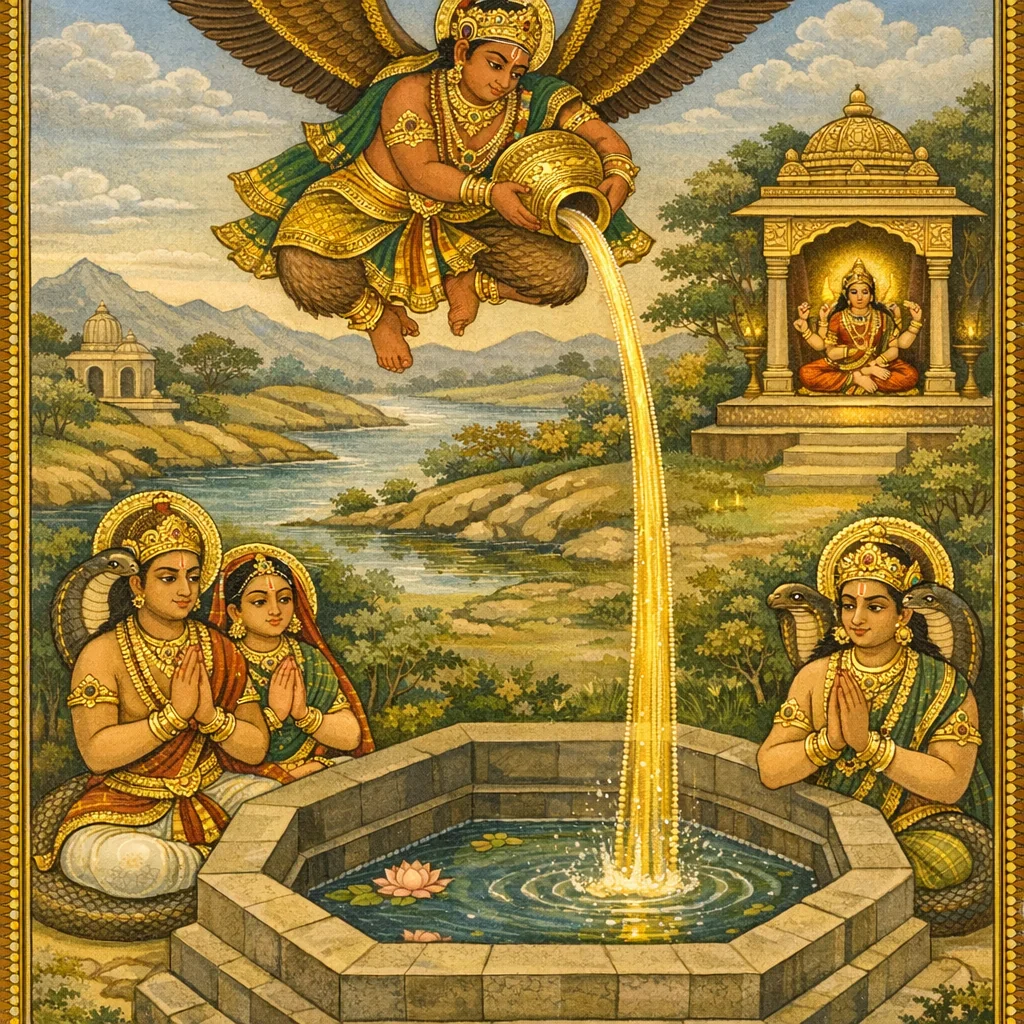
Adhyaya 352
सुपर्णेलामाहात्म्यवर्णनम् (Supārṇelā Māhātmya—Account of the Glory of Supārṇelā)
Īśvara instructs Devī in a direction-based pilgrimage route to Supārṇelā and the associated Bhairavī sacred spot, said to lie south of Durga-kūṭa at a measured distance. The chapter then explains the site’s origin: once Garuḍa (Supārṇa) brought amṛta up from Pātāla and released it there before the nāgas; watched and guarded by the nāgas, the place became famed on earth as Supārṇelā. The ground is identified as “Ilā” established by Supārṇa, and the very name Supārṇelā is explicitly connected with the destruction of pāpa (sin). A practical observance is laid down—bathe at Supārṇa-kuṇḍa, worship at the holy place, and perform dāna and anna-dāna by honoring and feeding brāhmaṇas. The phala-śruti is specific: protection from fatal dangers and auspicious household results, including a woman becoming jīva-vatsā (her children living) and being adorned with offspring through proper pilgrimage conduct.
Adhyaya 353
भल्लतीर्थमाहात्म्यवर्णनम् | Bhallatīrtha Māhātmya (Glorification of Bhallatīrtha)
Īśvara speaks to Devī, pointing out an eminent tīrtha called Bhallatīrtha, near Bhallā-tīrtha in the western region by the grove of Mitravana. The chapter proclaims it a Vaiṣṇava ‘ādi-kṣetra’, where Viṣṇu is said to abide in a distinctive way through all yugas, and where Gaṅgā’s presence is described as manifest for the welfare of beings. Ritual timing is stressed: on Dvādaśī (in connection with Ekādaśī discipline) a pilgrim should bathe according to rule, give dāna to worthy brāhmaṇas, perform pitṛ-tarpaṇa/śrāddha with devotion, worship Viṣṇu, keep night vigil, and offer lamp-gifts—acts praised as purifying and merit-bestowing. An origin legend follows: after the Yādavas are withdrawn, Vāsudeva enters meditation by the seashore; a hunter, Jarā, mistaking Viṣṇu’s foot for a deer, releases a bhalla arrow. Realizing the divine form, he begs forgiveness; Viṣṇu declares the deed completes the ending of an earlier curse, grants the hunter ascent, and promises that all who come, behold, and practice bhakti here will attain Viṣṇu’s realm. The tīrtha takes its name from the arrow incident and is also identified as Harikṣetra in earlier cosmic cycles. The chapter closes with ethical boundary-marking: neglect of Vaiṣṇava observances—especially Ekādaśī restraint—is censured, while Dvādaśī worship near Bhallatīrtha is lauded for protective household merit. Those seeking the full fruit of pilgrimage are advised to give gifts such as cloth and cows to leading brāhmaṇas.
Adhyaya 354
Kardamālā-tīrtha Māhātmya and the Varāha Uplift of Earth (कर्दमालतीर्थमाहात्म्यं तथा वाराहोद्धारकथा)
This adhyāya is cast as Īśvara’s theological instruction to Devī on the tīrtha called Kardamālā, famed in the three worlds as a remover of all pāpa. Set against cosmic dissolution (pralaya, ekārṇava), the earth lies submerged and the luminaries are said to be in ruin; Janārdana (Viṣṇu) assumes the Varāha form, raises the earth upon his tusk, and restores her to her proper place. Viṣṇu then proclaims his sustained, regulated presence at this sacred spot. The tīrtha’s power is tied to ancestral rites: tarpaṇa at Kardamālā is said to satisfy the pitṛs for a full kalpa, and śrāddha performed even with simple offerings—greens, roots, fruits—is declared equal to śrāddha at all tīrthas. A phalāśruti extols bathing and darśana here as leading to higher destinies and release from lower rebirths. A miracle follows: a terrified herd of deer, driven by hunters, enters Kardamālā and immediately attains human status; the hunters abandon their weapons, bathe, and are freed from sins. Asked for origins and boundaries, Īśvara reveals a “secret” account: Varāha is described at length in yajña-symbolic anatomy, with Vedic limbs and ritual components forming his body. The tusk-tip (daṃṣṭrāgra) is identified as mud-smeared in the Prabhāsa field—hence the name Kardamālā. The chapter also names a great pond (mahākuṇḍa) and a water-source likened to a vast Gaṅgā-abhiṣeka, defines the measure of Viṣṇu’s sacred territory, and concludes with strong claims about the merit of seeing the boar-form and the unique accessibility of liberation in Kali Yuga through this “Saukara” kṣetra.
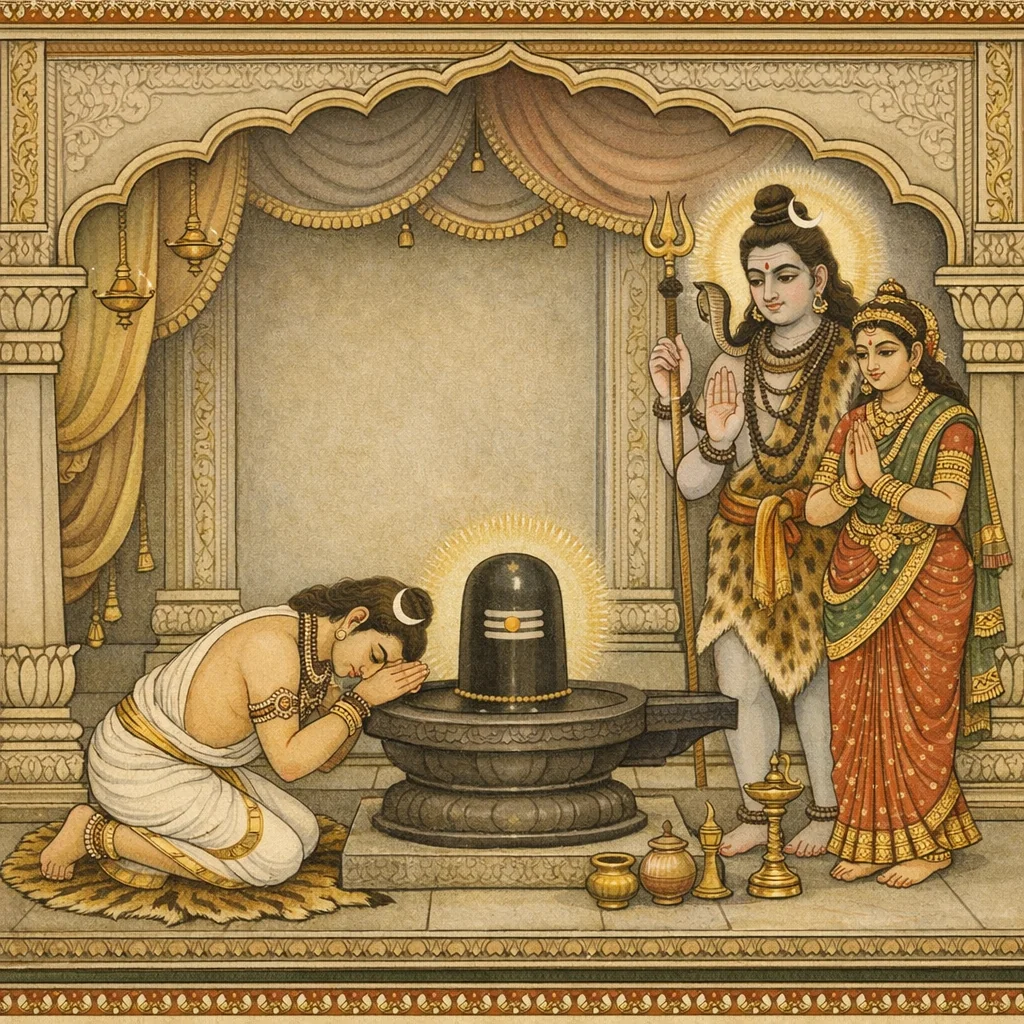
Adhyaya 355
Guptēśvara-māhātmya (गुप्तेश्वरमाहात्म्य) — The Glory of Guptēśvara
Īśvara instructs Devī to go to Devaguptēśvara in Prabhāsa-kṣetra, indicating that it lies toward the west–northwest. The chapter frames the shrine through the legend of Soma (the Moon), who, ashamed of a leprosy-like skin affliction (kūṣṭha) and bodily wasting (kṣaya), remains hidden there and undertakes severe austerities. After a long period of ascetic practice—one thousand divine years—Śiva manifests directly. Pleased, he removes Soma’s wasting condition and frees him from the disease. Soma then establishes a great liṅga, revered alike by gods and asuras. The name Guptēśvara is explained as arising from Soma’s “hidden” (gupta) austerities. The text proclaims the liṅga’s remedial power: mere sight or touch dispels skin disease, and Monday worship (Somavāra) is especially praised, with the promise that within the worshipper’s lineage none will be born with leprosy. The closing colophon identifies this chapter as the Guptēśvara-māhātmya within the Prabhāsakṣetramāhātmya of the Prabhāsakhaṇḍa.
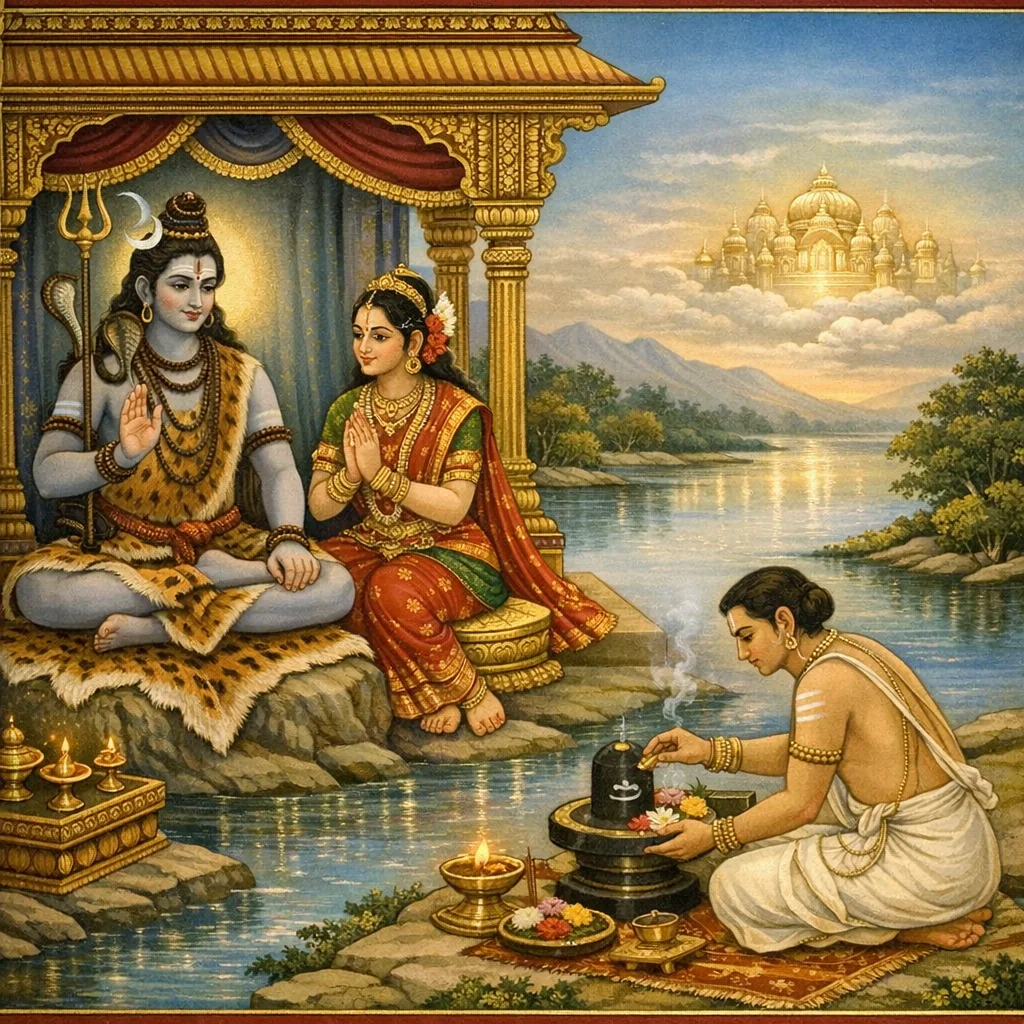
Adhyaya 356
बहुसुवर्णेश्वरमाहात्म्यवर्णनम् | Bahusuvarṇeśvara Māhātmya (Glory of Bahusuvarṇeśvara)
Īśvara instructs the Goddess to go to the deity/liṅga called Bahusuvarṇaka or Bahusuvarṇeśvara, situated in the eastern sector (hiraṇyā-pūrva-dik-bhāga) of the sacred Prabhāsa landscape. The chapter explains the site’s holiness through an earlier precedent: Dharmaputra is said to have performed an exceedingly difficult yajña there and to have established a powerful liṅga named Bahusuvarṇa. That liṅga is also known as “Sarveśvara,” the giver of the fruits of all sacrifices (sarva-kratu-phala-da), and is described as ritually complete through its association with the waters of Sarasvatī. Bathing there and offering piṇḍadāna are taught to uplift vast ancestral lines (kula-koṭi) and to confer honor in Rudra’s realm. Sadāśiva further affirms that worship offered with fragrance and flowers according to rule yields the merit of “crore-fold” worship (koṭi-pūjā-phala).
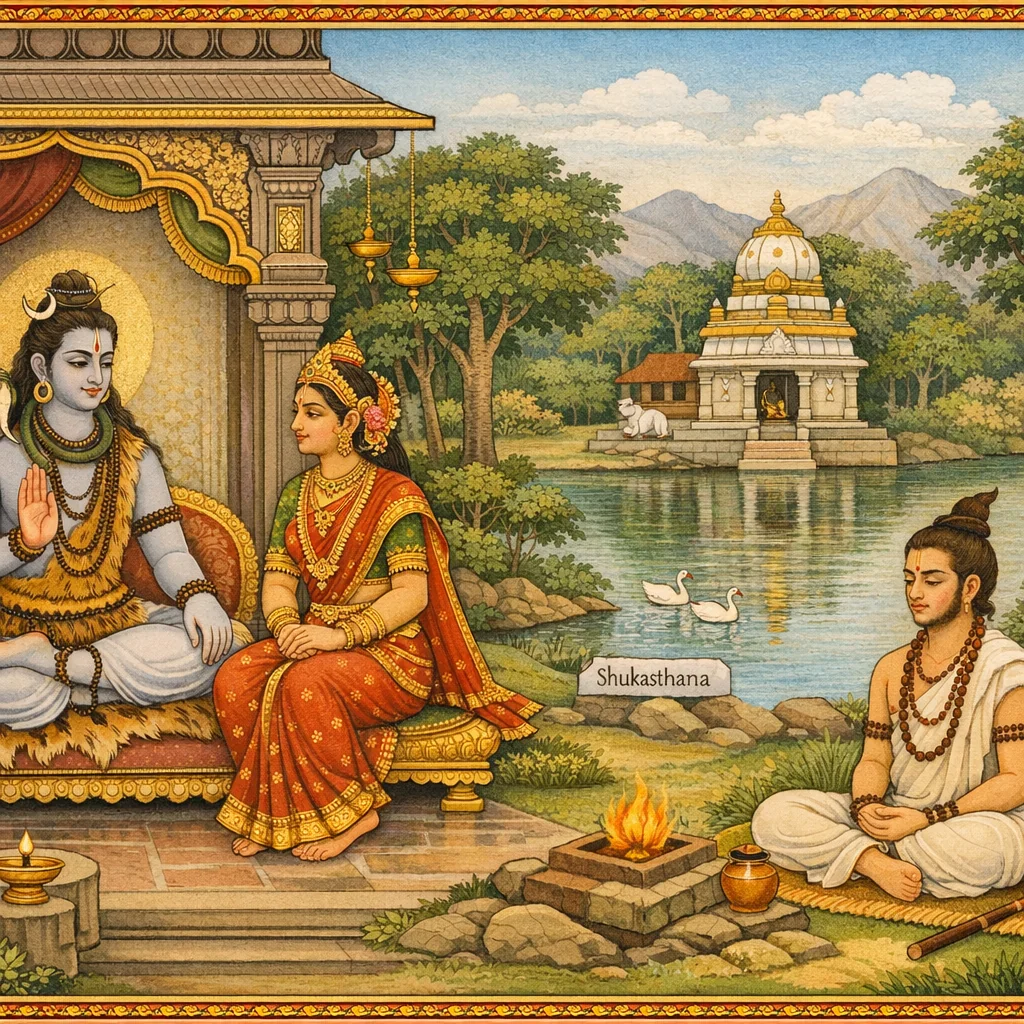
Adhyaya 357
शृंगेश्वरमाहात्म्यवर्णनम् | Śṛṅgeśvara Māhātmya (Account of the Glory of Śṛṅgeśvara)
Introduced with “Īśvara uvāca,” this adhyāya directs Devī to the shrine of Śṛṅgeśvara, praised as “anuttama” (unsurpassed) and located near Śukastḥāna (Śuka’s place). It lays out a clear ritual course: one should go there, perform the sacred bath (snāna) at the site, and worship Śṛṅgeśa in the proper manner (vidhivat pūjā). The chapter teaches the Purāṇic link between correct pilgrimage practice and moral-spiritual purification. Śṛṅgeśvara is proclaimed “sarva-pātaka-nāśana” (the destroyer of all sins), and the promised fruit is release from every sin; Ṛṣyaśṛṅga’s earlier purification and liberation are cited as a precedent and model. The colophon places it within the Skanda Mahāpurāṇa: in the seventh (Prabhāsa) khaṇḍa, first subdivision (Prabhāsakṣetramāhātmya), as chapter 357, titled “Śṛṅgeśvaramāhātmyavarṇana.”
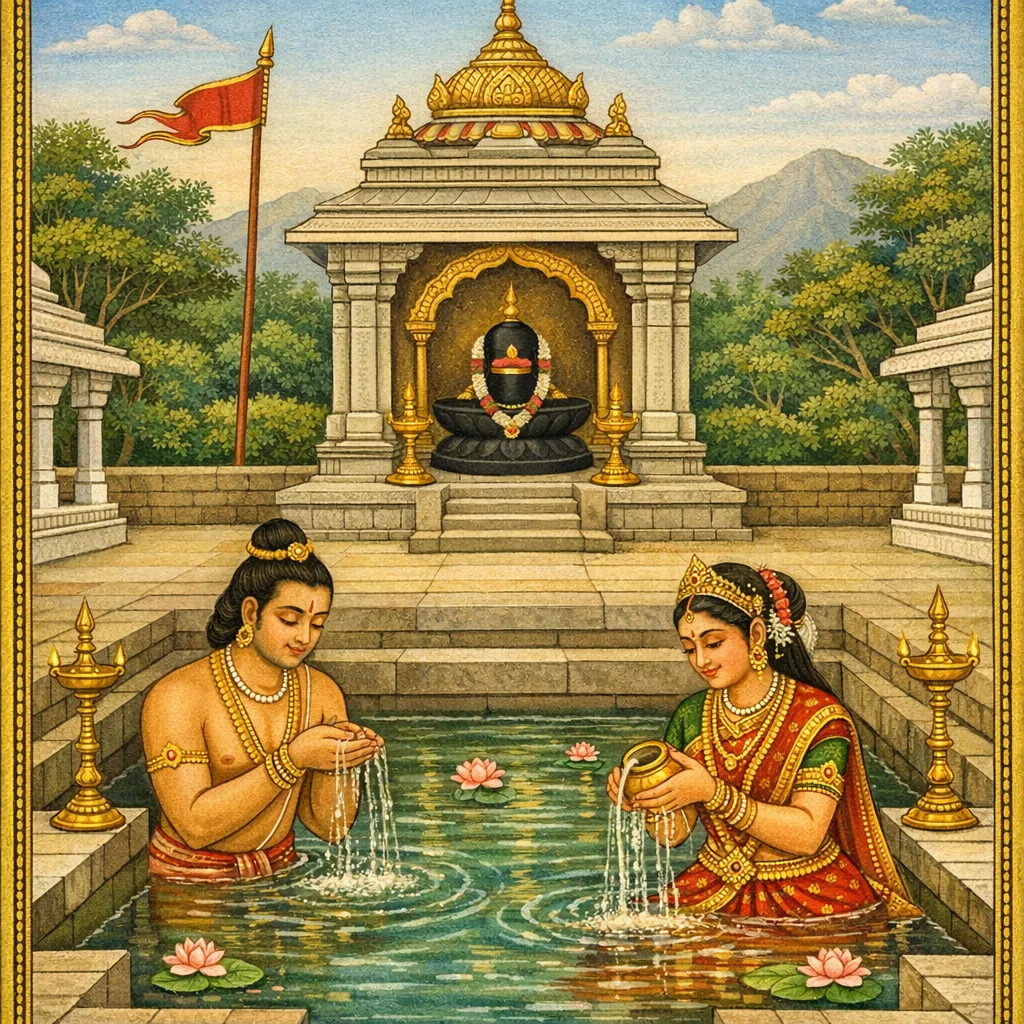
Adhyaya 358
कोटीश्वरमाहात्म्यवर्णनम् | Description of the Māhātmya of Koṭīśvara
This chapter gives a concise sacred site-description and phalaśruti focused on the Koṭīśvara Mahāliṅga. Introduced with “Īśvara uvāca,” it places Koṭinagara in the Īśāna (northeast) direction and locates the Koṭīśvara liṅga to its south, at a distance of one yojana. It then sets forth the rite: after bathing according to rule (vidhānena snātvā), one should worship the liṅga (liṅga-pūjā). The promised fruit is twofold—freedom from all sins (sarva-pātaka-mukti) and the merit equal to a koṭi-yajña, the reward of a crore of sacrifices (koṭi-yajña-phala). The colophon identifies it within the Skanda Purāṇa’s Prabhāsa Khaṇḍa, in the Prabhāsakṣetramāhātmya section, as the narration of Koṭīśvara-māhātmya.
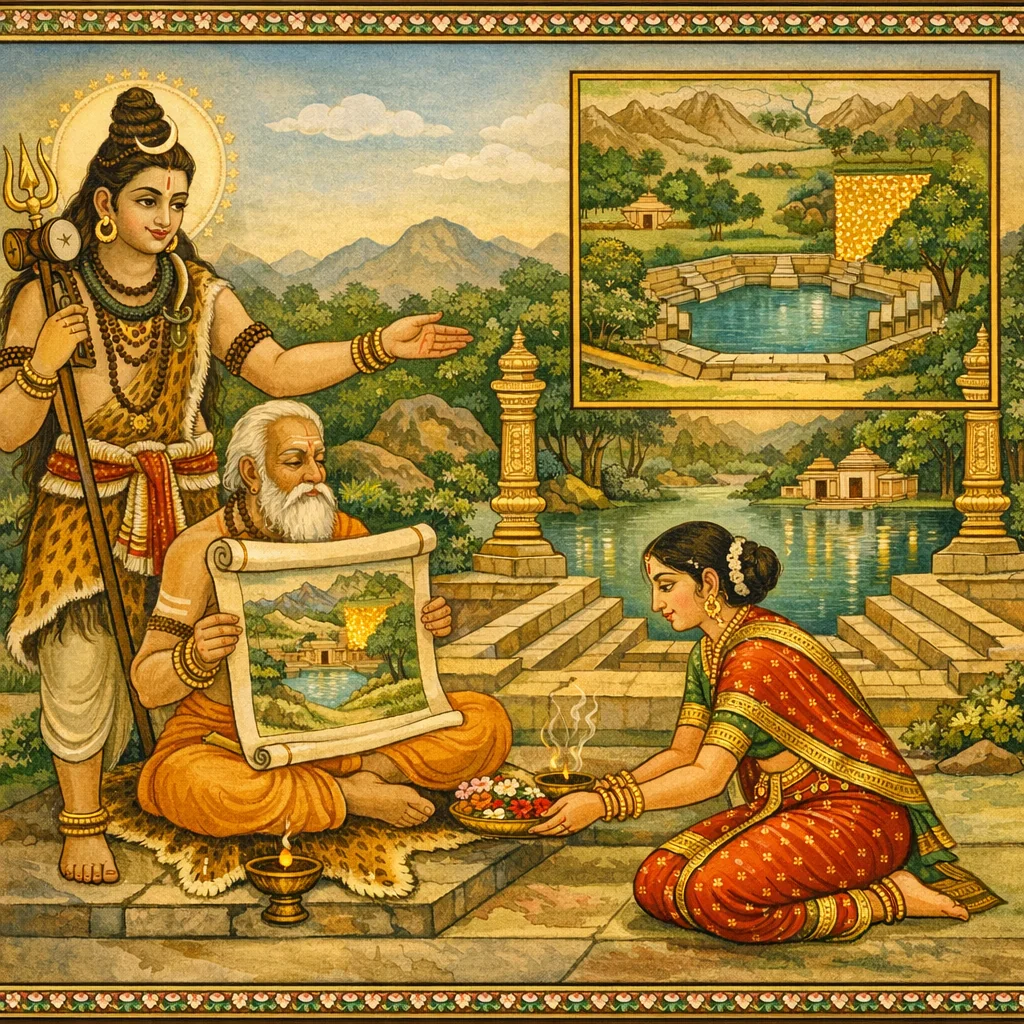
Adhyaya 359
Nārāyaṇa-tīrtha-māhātmya (Glory of Nārāyaṇa Tīrtha)
This chapter is cast as Īśvara’s instruction to Mahādevī, guiding the pilgrim onward to a tīrtha named Nārāyaṇa. It gives a clear spatial marker: in the Īśāna (northeast) quarter of that tīrtha is a vāpī (stepwell/pond) called Śāṇḍilyā. The rite is set out in order: bathe there according to vidhi, then worship Ṛṣi Śāṇḍilya. The observance is anchored to Ṛṣi-pañcamī, and it is declared that for a pativratā woman, keeping the rule concerning (non-)contact surely removes fear of rajo-doṣa (menstrual/ritual impurity). The closing colophon places the passage in the Skanda Purāṇa, Prabhāsa Khaṇḍa, and names it the “Nārāyaṇa-tīrtha-māhātmya” narration.
Adhyaya 360
Śṛṅgāreśvara Māhātmya (Glory of Śṛṅgāreśvara at Śṛṅgasara)
In this chapter, Īśvara speaks to Mahādevī and points to the sacred place called Śṛṅgasara. There abides a resident deity-liṅga known as Śṛṅgāreśvara, and the holiness of the site is traced to an earlier divine episode: Hari, accompanied by the gopīs, is said to have performed śṛṅgāra there, thus giving the shrine its name and epithet. The teaching then turns to practical devotion: worship of Bhava (Śiva) at this very spot, performed according to the prescribed vidhāna, is praised as destroying the amassed multitude of sins (pāpaugha-nāśana). The concluding phalaśruti declares that a devotee afflicted by poverty and sorrow will not meet such conditions again, establishing Śṛṅgasara as an authorized locus for remedial worship and faithful ethical-ritual observance.
Adhyaya 361
मार्कण्डेश्वरमाहात्म्यवर्णनम् | The Glory of Mārkaṇḍeśvara (Narrative Description)
Chapter 361 gives a brief tīrtha-instruction within a dialogue between Īśvara and Devī. The seeker is directed to go to Hiranyātaṭa and to recognize a particular stop called Ghaṭikāsthāna, formerly connected with a siddha-rṣi. The chapter explains the sanctity of that spot through the yogic attainment of Mṛkaṇḍu: by dhyāna-yoga—said to bear fruit within a single nāḍī-unit—he establishes a liṅga there. This liṅga is named Mārkaṇḍeśvara, and its saving efficacy is emphasized: mere darśana and pūjā are declared to bring sarva-pāpa-upaśamana, the pacification and removal of all sins. Thus the text links ascetic inwardness (meditative discipline) with public devotional access at a named shrine, mapping Prabhāsa-kṣetra into a practical pilgrimage route.
Adhyaya 362
Koṭihrada–Maṇḍūkeśvara Māhātmya (कोटिह्रद-मण्डूकेश्वरमाहात्म्य)
Īśvara instructs Devī on a step-by-step pilgrimage within Prabhāsa-kṣetra. He first directs the pilgrim to Maṇḍūkeśvara, pointing out a liṅga established in association with Māṇḍūkyāyana. The account then names the nearby sacred water as Koṭihrada and identifies Koṭīśvara Śiva as the presiding form, with the Mātṛgaṇa stationed there to grant desired fruits. The rite is set forth: bathe in the Koṭihrada tīrtha, worship the liṅga, and also worship the Mātṛs; the promised result is freedom from duḥkha and śoka—suffering and grief. Next, it indicates another site one yojana to the east, Tritakūpa, praised as pure and as a destroyer of all sins, where the efficacy of many tīrthas is said to be gathered and “situated.” The colophon states that this is the 362nd adhyāya in this portion of the Prabhāsa Khaṇḍa.
Adhyaya 363
एकादशरुद्रलिङ्गमाहात्म्यवर्णनम् | The Māhātmya of the Eleven Rudra-Liṅgas
In this chapter, Īśvara speaks to Devī and instructs her—thus guiding the pilgrim as well—to go north from the place called Goṣpada to the renowned sacred spot Valāya, marking the distance as two gav-yūti as a practical measure for pilgrimage. There, a cluster of the “eleven Rudras” is indicated through their associated sthāna-liṅgas (site-liṅgas). Representative names such as Ajāikapād and Ahirbudhnya are mentioned, implying a recognized Rudra list embodied in local shrines. The central directive is ritual: one should worship these liṅgas in due manner (vidhivat), and the declared fruit is complete purification—release from all sins (sarva-pātaka). The colophon preserves the text’s identity as Skanda Mahāpurāṇa, Prabhāsa Khaṇḍa, Prabhāsakṣetramāhātmya section, chapter 363.
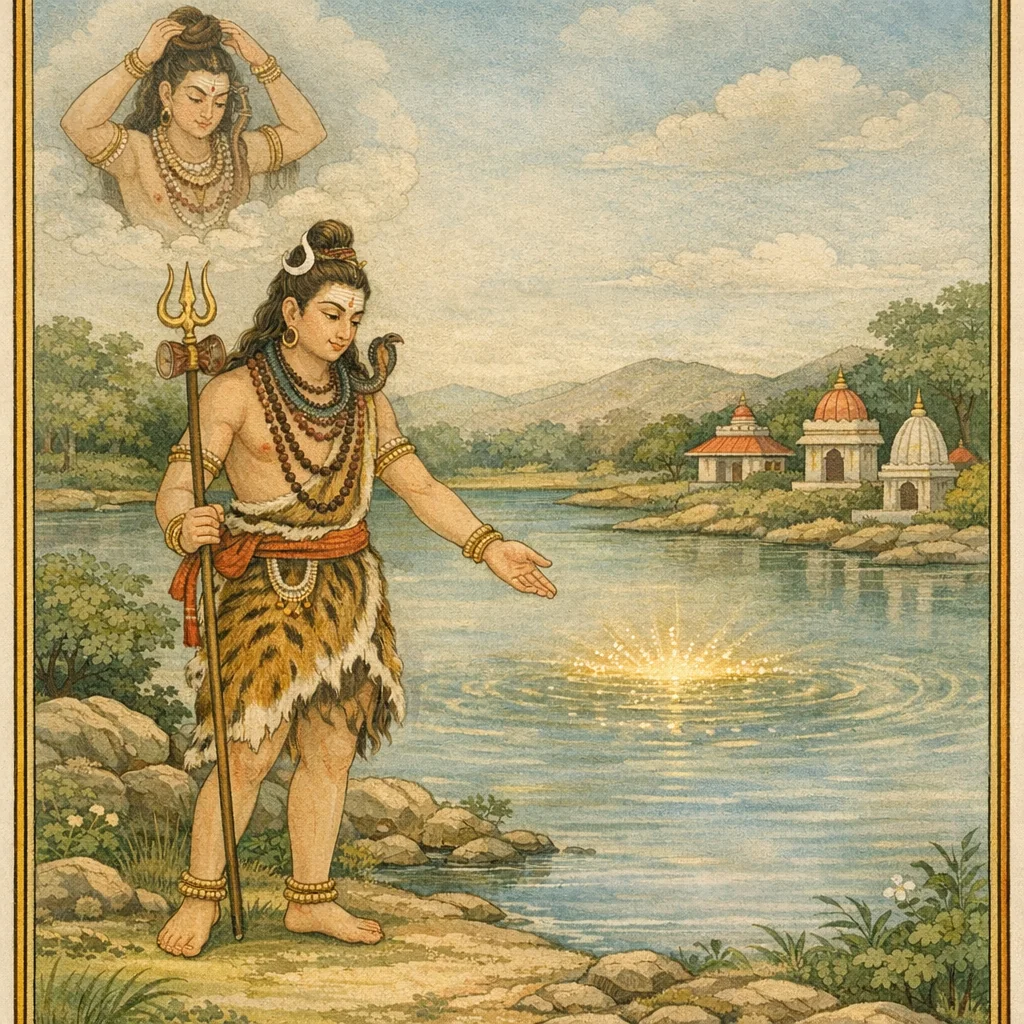
Adhyaya 364
Hiraṇya-taṭa–Tuṇḍapura–Gharghara-hrada–Kandeśvara Māhātmya (हिरण्यातुण्डपुर-घर्घरह्रद-कन्देश्वर माहात्म्यम्)
Īśvara (Śiva) speaks to Mahādevī and sets forth an itinerary to a spot on Hiraṇya-taṭa, where the place called Tuṇḍapura lies, connected with the sacred water-body known as Gharghara-hrada. He then declares that the presiding deity of this locale is Kandeśvara. Śiva authorizes the sanctity of the site through a mythic remembrance: it is here, he says, that his jaṭā were bound, thereby establishing the tīrtha’s sacred standing. The implied observance is to approach the place, bathe (snāna) at the tīrtha, and perform proper worship (pūjā) of Kandeśvara. The promised fruit is ethical and salvific: release from dreadful grave sins (ghora-pātaka) and attainment of an auspicious “śāsana”—understood as divine ordinance and protection, or a sanctioned blessing in Purāṇic idiom.
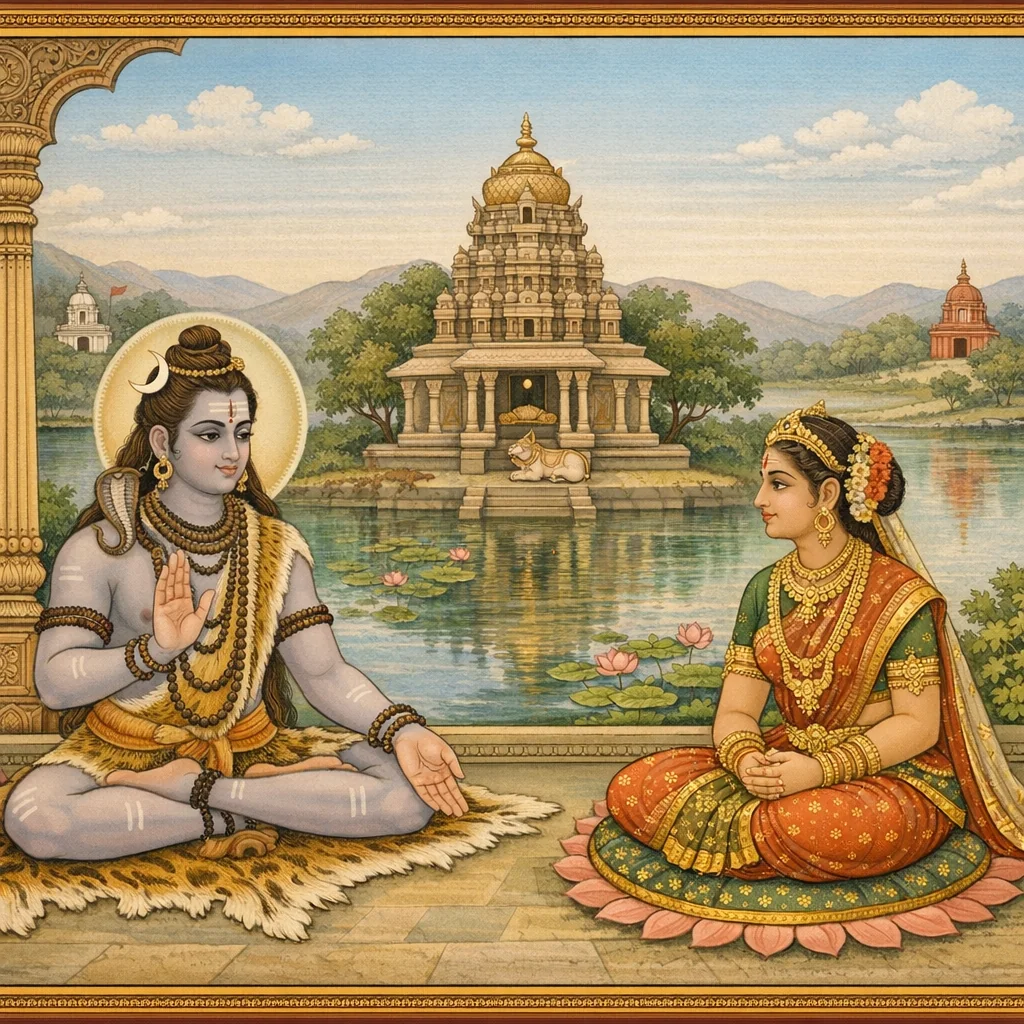
Adhyaya 365
संवर्तेश्वरमाहात्म्यवर्णनम् | Saṃvarteśvara Māhātmya (Glorification of Saṃvarteśvara)
This adhyāya is framed as Īśvara’s instruction to Devī, guiding the pilgrim-seeker to the shrine of Saṃvarteśvara, praised as “uttama” (eminent). It gives clear wayfinding: Saṃvarteśvara lies west of Indreśvara and east of Arkabhāskara, placing the shrine within a connected sacred landscape. A minimal rite is then prescribed: first, darśana of Mahādeva, and next, bathing (snāna) in the water of a puṣkariṇī. The phalaśruti proclaims that one who performs these acts gains merit equal to ten aśvamedha sacrifices, exalting local pilgrimage into supreme spiritual reward. The colophon notes its place in the Skanda Purāṇa—Prabhāsa Khaṇḍa, first division of Prabhāsakṣetramāhātmya—as the 365th adhyāya, titled Saṃvarteśvara-māhātmya-varṇana.
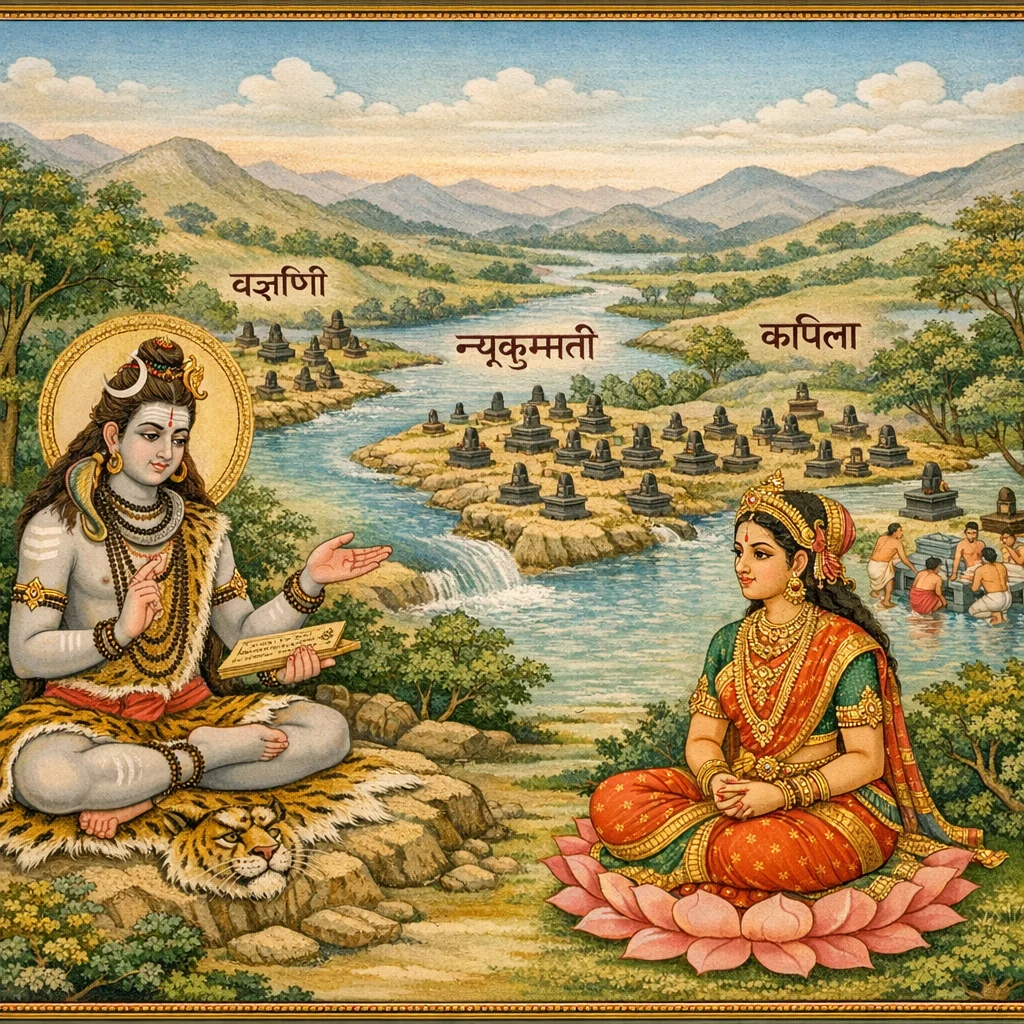
Adhyaya 366
प्रकीर्णस्थानलिङ्गमाहात्म्यवर्णनम् — Discourse on the Māhātmya of Liṅgas in Dispersed Sacred Sites
Īśvara instructs Mahādevī to go north of Hiraṇyā to the regions known as siddhi-sthānas, abodes of perfected sages. The chapter then turns to a sacred, quantitative mapping: liṅgas are countless, yet key tallies are given—over a hundred prominent liṅgas in one cluster; nineteen on Vajriṇī’s bank; more than 1,200 on Nyaṅkumatī’s bank; sixty superior liṅgas on Kapilā’s bank; and an uncountable multitude connected with Sarasvatī. Prabhāsa is further defined through Sarasvatī’s five streams (pañca-srotas), whose courses mark out a holy field of twelve yojanas. Water is said to arise everywhere in tanks and wells; it should be recognized as “Sārasvata,” and drinking it is praised. Bathing anywhere in the region with proper faith yields the fruit of Sārasvata-snāna. The chapter concludes by identifying the “Sparśa-liṅga” as Śrī-Somēśa, and declaring that worship of any central liṅga of the kṣetra—when known as Somēśa—is truly worship of Somēśa himself, unifying dispersed shrines under a single Śaiva referent.
FAQs about Prabhasa Kshetra Mahatmya
Prabhāsa is presented as a spiritually efficacious kṣetra where tīrtha-contact, devotion, and disciplined listening to purāṇic discourse are said to remove fear of saṃsāra and confer elevated destinies.
Merits are framed in yajña-like terms: purification, removal of sins, freedom from afflictions, and attainment of higher states—often conditioned by faith (śraddhā), tranquility, and proper eligibility.
The opening chapter emphasizes transmission-legends (Śiva → Pārvatī → Nandin → Kumāra → Vyāsa → Sūta) and the Naimiṣa inquiry setting, establishing Prabhāsa’s māhātmya within an authoritative purāṇic lineage.