Adhyaya 293
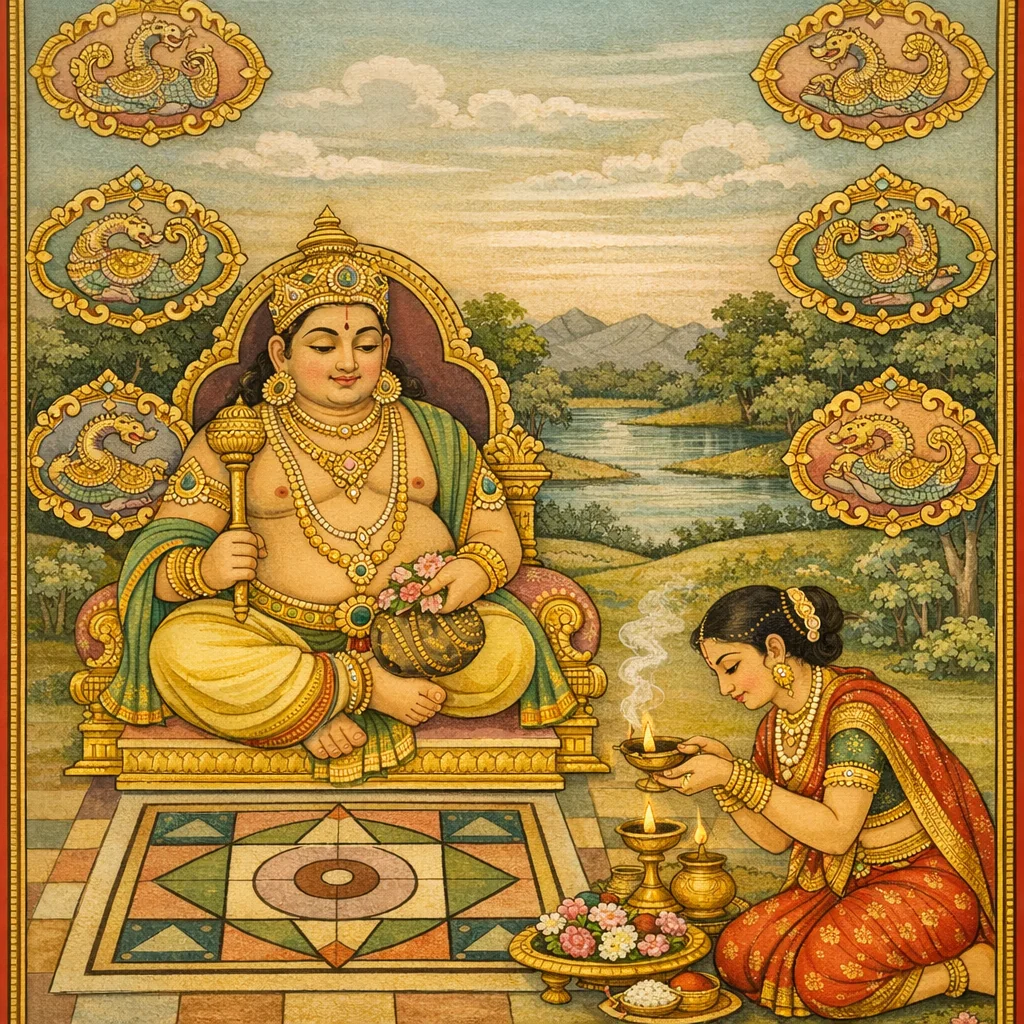
This adhyāya is framed as Īśvara’s theological discourse on a sacred station of Kubera. It places the “Kubera-sthāna” in the nairṛtya (southwestern) quarter of the mapped holy field and declares Kubera’s self-manifest presence there as the destroyer of all poverty (sarva-dāridrya-nāśana). It then prescribes a focused act of devotion: on the pañcamī tithi one should worship with gandha (fragrance), puṣpa (flowers), and anulepana (unctuous, fragrant applications). The site is described as adorned with eight makara-associated nidhānas—treasures or treasure-depots. By linking ritual timing, material offerings, and the power of the place-deity, the phalaśruti promises the fruit: attainment of incomparable wealth/treasure (nidhāna-prāpti) without obstruction (nirvighna). Thus the chapter functions as a compact unit of sacred geography and rite, oriented toward a clear result.
Shlokas
Verse 1
ईश्वर उवाच । तस्माद्वैश्रवण स्थानान्नैरृत्यां वरवर्णिनि । स्वयं स्थितः कुबेरस्तु सर्वदारिद्र्यनाशनः
Īśvara said: “From that place of Vaiśravaṇa (Kubera), to the southwest, O fair one, Kubera himself abides there—the destroyer of all poverty.”
Verse 2
मकरादिनिधानैस्तु अष्टाभिः परिभूषितः । पञ्चम्यां पूजयेद्भक्त्या गन्धपुष्पानुलेपनैः । निधानप्राप्तिरतुला निर्विघ्ना तस्य जायते
Adorned with the eight treasures beginning with Makara, one should worship Kubera with devotion on the fifth lunar day (Pañcamī), offering fragrances, flowers, and unguents. For him, incomparable attainment of treasure arises, free from obstacles.
Verse 293
इति श्रीस्कान्दे महापुराण एकाशीतिसाहस्र्यां सहितायां सप्तमे प्रभासखण्डे प्रथमे प्रभामक्षेत्रमाहात्म्ये न्यंकुमतीमाहात्म्ये कुबेरस्थानोत्पत्तौ कुबेरमाहात्म्यवर्णनंनाम त्रिनवत्युत्तरद्विशततमोऽध्यायः
Thus ends the two-hundred-and-ninety-third chapter, called “The Description of the Greatness of Kubera, in the Account of the Origin of Kubera’s Place,” in the Prabhāsa Khaṇḍa of the Śrī Skanda Mahāpurāṇa, in the Ekāśītisāhasrī Saṃhitā—within the Prabhāsakṣetra Māhātmya, in the Nyaṅkumatī Māhātmya.