Adhyaya 96
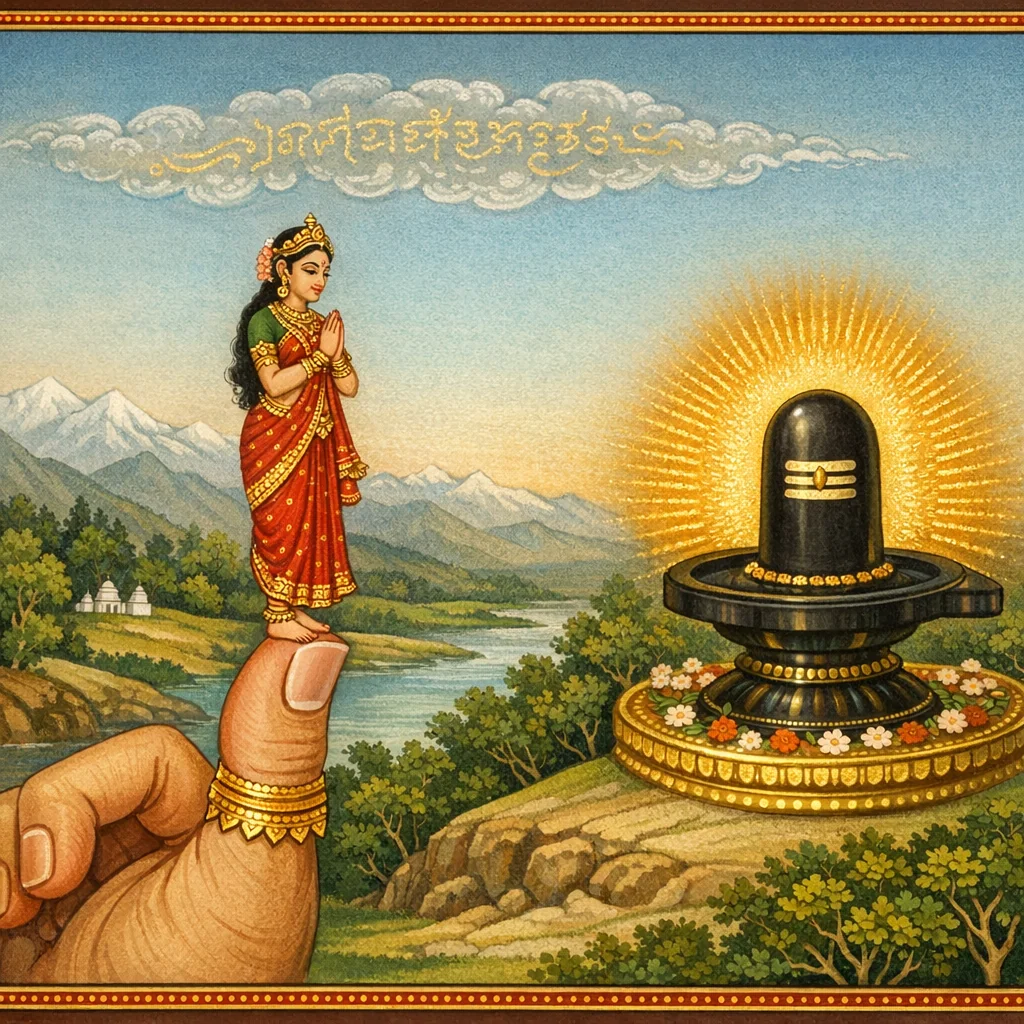
This chapter unfolds as a question-led theological dialogue between Devī and Īśvara. Īśvara first identifies Ratīśvara as lying to the north of Kāmeśvara with directional and distance markers, and declares its merit: mere darśana and worship are said to destroy the demerit of seven births and to avert disruption within the household. When Devī asks the origin of the site and the reason for the name “Ratīśvara,” Īśvara recounts the etiological legend. After Kāma (Manasija) is burned by Tripurāri (Śiva), Ratī performs prolonged tapas there—standing upon the tip of her thumb for an immense span—until a Māheśvara liṅga rises from the earth. A bodiless voice instructs her to worship it and promises reunion with Kāma; through Ratī’s intense devotion Kāma is restored, and the liṅga becomes known as Kāmeśvara. Ratī then proclaims a general merit: future worshippers, by the liṅga’s grace, attain desired accomplishments and an auspicious destiny. The chapter closes with a calendrical observance, stating that worship on the thirteenth day of the bright fortnight in Caitra bestows auspiciousness and fulfillment of desire, in a neutral phalāśruti tone.
Shlokas
Verse 1
ईश्वर उवाच । ततोगच्छेन्महादेवि कामेश्वरमिति स्मृतम् । तस्यैवोत्तरदिग्भागे धनुषां त्रितये स्थितम् । रतीश्वरमिति ख्यातं त्रेतायां तत्सुरे श्वरि
Īśvara said: “Then, O Great Goddess, one should go to the shrine known as Kāmeśvara. In its northern quarter, at a distance of three bow-lengths, stands the deity famed as Ratīśvara—so renowned since the Tretā Yuga, O Queen of the Gods.”
Verse 2
यस्मिन्दृष्टे मनुष्याणां पूजिते तु वरानने । नश्येच्च सप्तजन्माघं गृहभंगश्च नो भवेत्
O fair-faced Goddess, by merely beholding it—and especially by worshipping it—seven lifetimes’ sins of human beings are destroyed, and ruin of one’s household does not occur.
Verse 3
देव्युवाच । केनायं स्थापितो देव कस्मात्प्रोक्तो रतीश्वरः । दर्शनेनास्य किं श्रेयः सर्वं विस्तरतो वद
The Goddess said: “O Lord, by whom was this established? Why is he called Ratīśvara? What benefit comes from his darśana? Tell me everything in detail.”
Verse 4
ईश्वर उवाच । शृणु देवि प्रवक्ष्यामि कथां पापप्रणाशिनीम् । रतिर्नामाभवत्साध्वी कामपत्नी यशस्विनी
Īśvara said: “Listen, O Goddess; I shall narrate a sin-destroying account. There was a virtuous lady named Rati, the illustrious wife of Kāma.”
Verse 5
दग्धे मनसिजे पूर्वं देवेन त्रिपुरारिणा । तदर्थाय तपस्तेपे तस्मिन्देशे रतिः किल
Formerly, when Manasija (Kāma) was burned by the god Tripurāri (Śiva), Rati indeed performed austerities in that very region, seeking that purpose (his restoration).
Verse 6
अंगुष्ठाग्रेण तिष्ठन्त्या यावद्युगचतुष्टयम् । आराधितो महादेवः शांतेन मनसा प्रिये
Standing upon the tip of her thumb for as long as four yugas, she worshipped Mahādeva with a tranquil mind, O beloved.
Verse 7
कस्मिंश्चिदथ काले तु निर्भिद्य धरणीतलम् । तदग्रतः समुत्तस्थौ लिगं माहेश्वरं प्रिये
Then, at a certain time, piercing through the surface of the earth, a Māheśvara Liṅga rose up before her, O beloved.
Verse 8
एतस्मिन्नेव काले तु वागुवाचाशरीरिणी । आह्लादयंती सहसा तस्याश्चित्तं वरानने
At that very moment, a bodiless voice spoke, suddenly delighting her heart, O fair-faced one.
Verse 9
यस्मान्माहेश्वरं लिंगं त्वद्भक्त्या सहसोत्थितम् । पूजयेस्तन्महाभागे ततः कांतमवाप्स्यसि
Since this Māheśvara Liṅga has arisen at once through the power of your devotion, O most fortunate one—worship that Liṅga; then you shall attain your beloved.
Verse 10
एतच्छुत्वा तु सा साध्वी देवदूतस्य भाषितम् । तल्लिंगं पूजयामास स भक्त्या परमया युता
Hearing these words spoken by the divine messenger, that virtuous lady worshipped that Liṅga, endowed with supreme devotion.
Verse 11
ततः कामः समुत्तस्थौ सुप्तोत्थित इव प्रिये । ततः प्रभृति तल्लिंगं कामेश्वरमिति श्रुतम्
Then Kāma arose again, as if awakened from sleep, O beloved. From that time onward, that Liṅga became renowned by the name ‘Kāmeśvara’.
Verse 12
ततः सा कामदयिता वाक्यमेतदुवाच ह । प्रहृष्टा कामदेवाप्त्या पुरतः पुष्पधन्वनः
Then the beloved of Kāma spoke these words, rejoicing at having regained Kāmadeva, while Puṣpadhanvan (Kāma, “he whose bow is flowers”) stood before her.
Verse 13
पूजयिष्यंति ये चान्ये लिंगमेतत्समाहिताः । एवं ते वांछितां सिद्धिं भूयो यास्यंति सद्गतिम्
And others too—who, with concentrated minds, will worship this Liṅga—thus shall they attain their desired success and, further, reach the good path, the blessed destiny.
Verse 14
मनोऽभीष्टं तथा सर्वं यद्यपि स्यात्सदुर्ल्लभम् । तत्प्राप्स्यंति न संदेहो लिंगस्यास्य प्रसादतः
Whatever the heart desires—even if it be exceedingly hard to obtain—people will attain it without doubt, through the grace of this Liṅga.
Verse 15
एवमुक्त्वा गता साध्वी रतिः कामेन संयुता । स्वस्थाने पूर्णकामा सा प्रहृष्टेनांतरात्मना
Having spoken thus, the virtuous Rati departed, reunited with Kāma. Reaching her own abode, she was fully satisfied, her inner self filled with delight.
Verse 16
एनं चैत्रत्रयोदश्यां शुक्लायां यः समर्चति । सकामवद्भवेन्नृणां श्रुतं सौभाग्यदायकम्
Whoever worships Him on the bright (waxing) thirteenth day of the month of Caitra becomes one whose desires are fulfilled; it is heard to be a giver of good fortune for people.
Verse 96
हृति श्रीस्कांदेमहापुराण एकाशीतिसाहस्र्यां संहितायां सप्तमे प्रभासखण्डे प्रथमे प्रभासक्षेत्रमाहात्म्य एकादशरुद्रमाहात्म्ये कामेश्वरमाहात्म्यवर्णनंनाम षण्णवतितमोऽध्यायः
Here ends the ninety-sixth chapter, entitled “The Description of the Greatness of Kāmeśvara,” in the Prabhāsa Khaṇḍa—within the Prabhāsa Kṣetra Māhātmya, in the Ekādaśa-Rudra Māhātmya—of the Śrī Skanda Mahāpurāṇa, in the Saṃhitā of eighty-one thousand verses.