Adhyaya 29
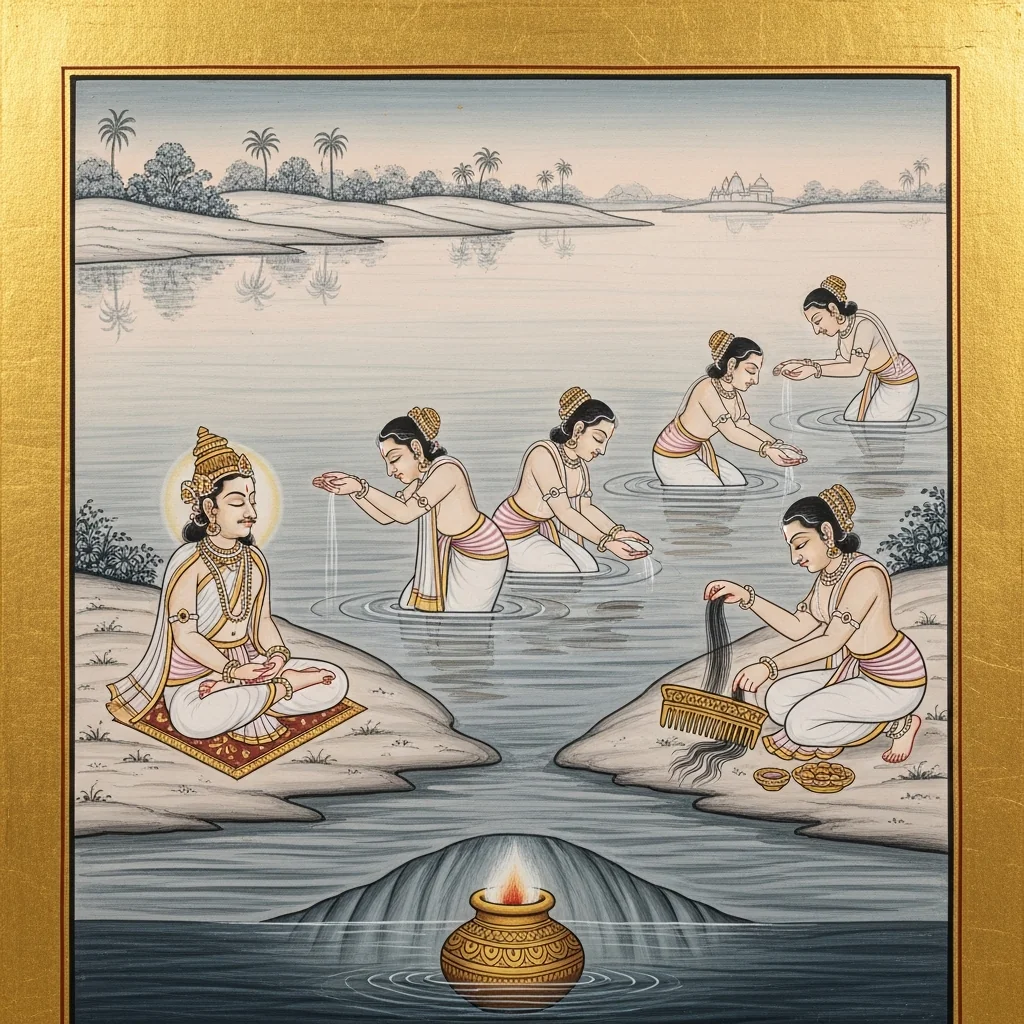
This chapter unfolds in two connected movements. First, Īśvara directs the pilgrim to Agnitīrtha on the auspicious sea-shore and points out Padmaka tīrtha south of Somnātha as a world-renowned place that destroys sin. It lays down a specific discipline of snāna and vapanam (ritual hair-cutting/tonsure): inward meditation on Śaṅkara, depositing the hair at the prescribed spot, bathing again, and performing tarpaṇa with faith. It also notes gender and householder constraints, warns against improper contact with the ocean without mantra and proper festival time, and teaches mantra-forms for approaching the sea, including the offering of a gold ornament (kankaṇa) cast into the waters. Next, Devī asks how the ocean can bear “doṣa” though it receives the rivers and is associated with Viṣṇu and Lakṣmī. Īśvara recounts an ancient episode: after a long sacrifice at Prabhāsa, devas hide in the ocean to escape brahmins demanding dakṣiṇā; the ocean secretly feeds the brahmins meat, and is cursed to be “untouchable/unfit to drink” except under stated conditions. Brahmā establishes the remedy—at parva times, river confluences, Setubandha, and select tīrthas, ocean-contact becomes purifying and grants great merit, while the ocean compensates with jewels. The chapter ends by locating the Vāḍavānala (the submarine fire, like a golden pot that ‘drinks’ the waters) and praising Agnitīrtha as a guarded, high-efficacy secret whose very hearing purifies even grievous sinners.
Shlokas
Verse 1
ईश्वर उवाच । अग्नितीर्थं ततो गच्छेत्सागरस्य तटे शुभे । यत्राऽसौ वाडवो मुक्तः सरस्वत्या वरानने
Īśvara said: “Thereafter one should go to Agnitīrtha on the auspicious shore of the ocean—O fair-faced one—where that Vāḍava, the submarine fire, was released by Sarasvatī.”
Verse 2
दक्षिणे सोमनाथस्य सर्वपापप्रणाशनम् । तीर्थं त्रैलोक्यविख्यातं पद्मकं नाम नामतः
To the south of Somanātha is a tīrtha that destroys all sins, renowned throughout the three worlds, known by name as Padmaka.
Verse 3
धन्वंतरशते प्रोक्तं सोमेशाज्जलमध्यगम् । कुण्डं पापहरं प्रोक्तं शतहस्तप्रमाणतः । तत्र स्नानं प्रकुर्वीत विगाह्य निधिमंभसाम्
Counted among Dhanvantari’s hundred tīrthas is a sin-removing pool (kuṇḍa) lying amid the waters near Someśa (Somanātha), measuring a hundred hands. Immersing oneself in that treasure of waters, one should perform the ritual bath there.
Verse 4
आदौ कृत्वा तु वपनं सोमे श्वरसमीपतः । शंकरं मनसा ध्यायन्केशांस्तत्र परित्यजेत् । समुत्तार्य ततः केशान्भूयः स्नानं समाचरेत्
First, having performed tonsure near Someśvara, and meditating in the mind upon Śaṅkara, one should leave the hair there. Then, after gathering and removing the hair, one should again perform the ritual bath.
Verse 5
यत्किंचित्कुरुते पापं मनुष्यो वृत्तिकर्शितः । तदेव पर्वतसुते सर्वं केशेषु तिष्ठति
Whatever sin a person commits—pressed by the hardships of livelihood—O Daughter of the Mountain, all of that is said to abide in the hair.
Verse 6
तस्मात्सर्वप्रयत्नेन केशांस्तत्र विनिक्षिपेत् । तदेव सोमनाथाग्रे कृत्वा तु द्विगुणं फलम्
Therefore, with every effort one should deposit the hair there; and doing that very act before Somanātha yields a double reward.
Verse 7
अग्नितीर्थसमीपस्थं कपर्द्दिद्वारमध्यगम् । तत्रैव द्विगुणं ज्ञेयमन्यत्रैकगुणं स्मृतम्
At Kaparddi-dvāra, near Agnitīrtha, the merit is to be known as twofold; elsewhere it is remembered as single.
Verse 8
क्षुरकर्म न शस्तं स्याद्योषितां तु वरानने । सभर्तृकाणां तत्रैव विधिं तासां शृणुष्व मे
O fair-faced one, shaving with a razor is not considered proper for women. Now hear from me the particular rule to be followed there for women who have husbands.
Verse 9
सर्वान्केशान्समुद्धृत्य च्छेदयेदंगुलद्वयम् । ततो देवान्विधानेन तर्प्पयेत्पितृदेवताः
Having gathered up all the hair, one should cut it to the length of two fingers; thereafter, according to the prescribed rite, one should offer satisfaction (tarpaṇa) to the gods and to the ancestral deities.
Verse 10
मुण्डनं चोपवासश्च सर्वतीर्थेष्वयं विधिः
Tonsure (ritual shaving) and fasting—this is the prescribed observance at all sacred bathing-places (tīrthas).
Verse 11
गंगायां भास्करे क्षेत्रे मातापित्रोर्गुरौ मृते । आधाने सोमपाने च वपनं सप्तसु स्मृतम्
Shaving (vapana) is taught as appropriate on seven occasions: at the Gaṅgā, in the Bhāskara-kṣetra, upon the death of one’s mother or father or teacher, at the rite of consecrating the sacred fire (ādhāna), and at the Soma-drinking rite.
Verse 12
अश्वमेधसहस्राणां सहस्रं यः समाचरेत् । नासौ तत्फलमाप्नोति वपनाद्यच्च लभ्यते
Even if one were to perform a thousand times a thousand Aśvamedha sacrifices, one would not attain the fruit gained from the prescribed shaving-rite at the tīrtha.
Verse 13
विना मन्त्रेण यस्तत्र देवि स्नानं समाचरेत् । समाप्नोति क्वचिच्छ्रेयो मुक्त्वैकं पर्ववासरम्
O Devī, one who bathes there without the mantra may at times gain some benefit; but on the sacred parvan festival day, even that is forfeited.
Verse 14
विना मंत्रं विना पर्व क्षुरकर्म विना नरैः । कुशाग्रेणापि देवेशि न स्प्रष्टव्यो महोदधिः
Without mantra, without the proper parvan occasion, and without the shaving-rite performed by men, O Lady of the Gods, one should not touch the great ocean—not even with the tip of a kuśa blade.
Verse 15
एवं स्नात्वा विधानेन दत्त्वाऽर्घ्यं च महोदधौ । संपूज्य पुष्पगंधैश्च वस्त्रैः पुण्यानुलेपनैः
Thus, having bathed according to rule and offered arghya to the great ocean, one should worship it fully with flowers, fragrances, cloth, and auspicious unguents.
Verse 16
हिरण्मयं यथाशक्त्या निक्षिपेत्तत्र कंकणम्
According to one’s ability, one should place there a golden bracelet as an offering.
Verse 17
एवं कृत्वा विधानं तु स्पर्शयेल्लवणोदधिम् । मन्त्रेणानेन देवेशि ततः सांनिध्यतां व्रजेत्
Thus, having completed the prescribed rite, one should touch the salt-ocean; with this mantra, O Lady of the Gods, one then attains sāṃnidhya—divine proximity.
Verse 18
ॐ नमो विष्णुगुप्ताय विष्णुरूपाय ते नमः । सांनिध्ये भव देवेश सागरे लवणाम्भसि
“Oṃ. Salutations to Viṣṇugupta; salutations to You who are of Viṣṇu’s form. O Lord of the Gods, be present—grant sāṃnidhya—in this sea of salty waters.”
Verse 19
अग्निश्च रेतो मृडया च देहो रेतोधा विष्णुरमृतस्य नाभिः । एतद्ब्रुवन्पार्वति सत्यवाक्यं ततोऽवगाहेत्तु पतिं नदीनाम्
“Agni is the seed; the body is formed by the gracious power of Śiva; Viṣṇu bears that seed and is the navel of immortality (amṛta).” Speaking these true words, O Pārvatī, one should then enter the waters—the lord of rivers—for the purifying bath.
Verse 20
ॐ नमो रत्नगर्भाय मन्त्रेणानेन भामिनि । कंकणं प्रक्षिपेत्तत्र ततः स्नायाद्यदृच्छया
“Oṃ, homage to Ratnagarbha (the Jewel-wombed One)!”—with this mantra, O radiant lady, one should cast a bracelet there, and then bathe as the rite enjoins.
Verse 21
ततश्च तर्पयेद्देवान्मनुष्यांश्च पितामहान् । तिलमिश्रेण तोयेन सम्यक्छ्रद्धासमन्वितः
Then, endowed with proper faith, one should duly offer tarpaṇa—libations of water—to the gods, to human beings, and to the forefathers, using water mixed with sesame seeds.
Verse 22
आजन्मशतसाहस्रं यत्पापं कुरुते नरः । सकृत्स्नात्वा व्यपोहेत सागरे लवणाम्भसि
Whatever sin a person commits over hundreds of thousands of births—by bathing just once in the ocean with its salty waters, he casts it off.
Verse 23
वृषभस्तत्र दातव्यः प्रवृत्ते क्षुरकर्मणि । आत्मप्रकृतिदानं च पीतवस्त्रं तथैव च
There, when the shaving-rite is undertaken, a bull should be given in charity; likewise one should give gifts according to one’s means, and also a yellow garment.
Verse 24
अनेन विधिना तत्र सम्यक्स्नानं समाचरेत् । स्पर्शयेद्वाडवं तेजश्चान्यथा दोषभाग्भवेत्
By this procedure, one should properly perform the bath there. One should (ritually) touch the Vāḍava-fire’s energy; otherwise one incurs fault.
Verse 25
वरः शापश्च तस्यायं पुरा दत्तो यथा द्विजैः
Such were the boon and the curse that were formerly bestowed upon it, as the brahmin sages did.
Verse 26
देव्युवाच । कुत्र कुत्र महादेव जलस्नानाद्विशुध्यति । किमर्थं सागरे दोषः प्राप्यते कौतुकं महत्
The Goddess said: ‘O Mahādeva, in what places does one become purified by bathing in water? And why is a fault said to be incurred in the ocean? This is a great wonder to me.’
Verse 27
यत्र गंगादयः सर्वा नद्यो विश्रांतिमागताः । यत्र विष्णुः स्वयं शेते यत्र लक्ष्मीः स्वयं स्थिता
Where Gaṅgā and all the other rivers have come to rest; where Viṣṇu himself reclines; where Lakṣmī herself stands present—
Verse 28
किमर्थं वरशापं तु तस्य दत्तं द्विजैः पुरा । सर्वं विस्तरतो ब्रूहि महान्मे संशयोऽत्र वै
For what reason were that boon and that curse formerly bestowed upon it by the brahmin sages, the twice-born? Tell me everything in full detail; for here a great doubt has indeed arisen in me.
Verse 29
ईश्वर उवाच । दीर्घसत्रं पुरा देवि प्रारब्धं सुरसत्तमैः । प्रभासं तीर्थमासाद्य सम्यक्छ्रद्धा समन्वितैः
Īśvara said: “O Devī, long ago the best among the gods began a prolonged sacrificial session (dīrgha-satra). Reaching the sacred tīrtha of Prabhāsa, they undertook it with perfect faith and reverence.”
Verse 30
ततः सत्रावसाने तु दत्त्वा दानमनेकधा । सर्वस्वं ब्राह्मणेन्द्राणां प्रभासक्षेत्रवासिनाम्
Then, at the conclusion of that sacrificial session, they bestowed gifts in many ways—indeed, all that they possessed—upon the foremost brāhmaṇas dwelling in the sacred field of Prabhāsa.
Verse 31
तावदन्ये द्विजास्तत्र दक्षिणार्थं समागताः । देशीयास्तत्र वास्तव्याः शतशोऽथ सहस्रशः
Meanwhile, other twice-born priests gathered there seeking dakṣiṇā, the sacrificial fee—locals of that region, dwelling there, arriving by the hundreds and even by the thousands.
Verse 32
प्रार्थनाभङ्गभीताश्च ततो देवाः सवासवाः । प्रणष्टास्तान्सुरान्दृष्ट्वा ब्राह्मणाश्चानुवव्रजुः
Fearing that the brāhmaṇas’ petitions would be thwarted, the gods—together with Indra—vanished. Seeing those gods disappear, the brāhmaṇas followed after them.
Verse 33
खेचरत्वं पुरा देवि ह्यासीदग्रभुवां महत् । तेन यांति द्रुतं सर्वे यत्र यत्र सुरालयाः
O Devī, in ancient times the foremost beings possessed great power to move through the sky. By that ability they could swiftly go wherever the abodes of the gods might be.
Verse 34
एवं सर्वत्रगामित्वं तेषां वीक्ष्य दिवौकसः । प्रविष्टाः सागरं भीता ऊचुर्वाक्यं च तं पुनः
Seeing their ability to go everywhere, the dwellers of heaven (the gods), frightened, entered the ocean; and again they spoke these words to him (the Ocean).
Verse 35
शरणं ते वयं प्राप्ता ब्राह्मणेभ्यो भयं गताः । नास्ति वित्तं च दानार्थं तस्माद्रक्ष महोदधे
We have come to you for refuge, seized with fear of the brāhmaṇas. We have no wealth left for giving; therefore protect us, O great ocean.
Verse 36
एकतः क्रतवः सर्वे समाप्तवरदक्षिणाः । एकतो भयभीतस्य प्राणिनः प्राणरक्षणम् । विशेषतश्च देवानां रक्षणं बहुपुण्यदम्
On one side stand all the sacrifices, complete with excellent gifts; on the other stands the saving of the life of a creature terrified by danger. And, in particular, protecting the gods bestows abundant merit.
Verse 37
समुद्र उवाच । ब्राह्मणेभ्यो न भीः कार्या कथंचित्सुरसत्तमाः । अहं वो रक्षयिष्यामि प्रविशध्वं ममोदरे
The Ocean said: “O best among the gods, do not fear the brāhmaṇas in any way. I shall protect you—enter into my belly, into my depths.”
Verse 38
ततस्ते विबुधाः सर्वे तस्य वाक्येन हर्षिताः । प्रविष्टा गह्वरां कुक्षिं तस्यैव भय वर्ज्जिताः
Then all those gods, delighted by his words, entered his deep, cavern-like belly, and there they became free from fear.
Verse 39
समुद्रोऽपि महत्कृत्वा निजरूपं च भूरिशः । जलजाञ्जीवसंघातान्धृत्वा तीरसमीपतः
Even the Ocean, greatly enlarging his own form, gathered multitudes of aquatic creatures and held them close to the shore.
Verse 40
ततश्चक्र उपायं स ब्राह्मणानां निपातने । मत्स्यानामामिषं पक्त्वा महान्नेन च गोपितम्
Then he devised a stratagem to bring about the downfall of the brāhmaṇas: he cooked fish-flesh and concealed it beneath a great quantity of rice-food.
Verse 41
अथोवाच द्विजान्सर्वान्प्रणिपत्य कृतांजलिः । प्रसादः क्रियतां विप्रा मुहूर्त्तं मम सांप्रतम्
Then, bowing to all the twice-born with hands folded, he said: “O venerable brāhmaṇas, be gracious to me now—grant me this moment.”
Verse 42
आतिथ्यग्रहणादेव दीनस्य प्रणतस्य च । युष्मदर्थं मया सम्यगेतत्पाकं समावृतम् । क्रियतां भोजनं भूयो गंतव्यमनु नाकिनाम्
By merely accepting the hospitality of one who is poor and bowed down in reverence, I have duly prepared this meal for your sake. Please partake of the food; thereafter you should proceed along with the gods.
Verse 43
अथ ते ब्राह्मणा मत्वा समुद्रं श्रद्धयान्वितम् । बाढमित्येव तं प्रोच्य बुभुजुः स्वर्णभाजने
Then those brāhmaṇas, considering the Ocean to be endowed with faith, replied, “So be it,” and ate from golden vessels.
Verse 44
न व्यजानंत तन्मांसं गुप्तं स्वादु क्षुधार्द्दिताः
Afflicted by hunger, they did not recognize that hidden meat, for it tasted pleasant.
Verse 45
ततस्तृप्ताश्च ते विप्रा ब्राह्मणा विगतक्षुधः । आशीर्वादं ददुः सर्वे ब्राह्मणाः शंसित व्रताः
Then those brāhmaṇas, satisfied and freed from hunger, all bestowed blessings—brāhmaṇas renowned for their vows and discipline.
Verse 46
भोजनांतो ब्राह्मणानां प्राणांतः क्षत्रजन्मनाम् । आशीविषाणां सर्पाणां कोपो ज्ञेयो मृतावधिः । प्रेरयामास देवान्वै गम्यतामित्युवाच तान्
‘The end of a brāhmaṇa’s meal is like the end of life for those born in the kṣatriya line; and the wrath of venomous serpents should be known to last until death.’ Thus he urged the gods, saying to them, “Let us depart.”
Verse 47
ततो देवाः सगंधर्वा गच्छंतः शीघ्रगा वियत् । गच्छतस्तांस्ततो दृष्ट्वा ब्राह्मणास्तत्र वंदिता
Then the gods, together with the gandharvas, sped swiftly through the sky; seeing them depart, the brāhmaṇas there offered reverent salutations.
Verse 48
दक्षिणार्थं समुत्पेतुः सुरानुद्दिश्य पृष्ठतः
They rose up behind, turning toward the gods, intending to approach them for the sake of receiving the dakṣiṇā (honorarium, sacred gift).
Verse 49
ततः प्रपतिता भूमौ द्विजास्ते सहसा पुनः । अभक्ष्यभक्षणात्ते वै ब्राह्मणा मांसभक्षणात्
Then those twice-born brāhmaṇas suddenly fell down again upon the ground—because they had eaten what is forbidden, having consumed meat.
Verse 50
निष्कृतिं तां परिज्ञाय समुद्रस्य रुषान्विताः । ददुः शापं महादेवि रौद्रं रौद्रवपुर्द्धराः
Recognizing that the supposed ‘expiation’ was in fact the Ocean’s doing, they—filled with anger, O Mahādevī—pronounced a fierce curse, assuming a wrathful form.
Verse 51
यस्मादभक्ष्यं मांसं वै ब्राह्मणानां परं स्मृतम् । त्वयोपहृतमस्माकं सुगुप्तं भक्ष्यसंयुतम्
For meat is indeed remembered as utterly forbidden for brāhmaṇas; yet you brought it to us—well concealed, mixed among edible foods.
Verse 52
एकतः सर्वमांसानि मत्स्यमांसं तथैकतः । एकतः सर्वपापानि परदारास्तथैकतः
On one side are all kinds of flesh, and on the other side fish-flesh alone; on one side are all sins, and on the other the sin of approaching another’s wife alone.
Verse 53
एवं वयं विजानन्तो यदि मांसस्य दूषणम् । तथापि वंचिताः सर्वे अपरीक्षितकारिणः
Though we knew well the fault in eating meat, still we were all deceived—acting without proper examination.
Verse 54
यस्मात्पापमते क्रूरं त्वया वै वञ्चिता वयम् । मांसस्य भक्षणात्तस्मादपेयस्त्वं भविष्यसि
Since, O cruel one of sinful intent, we were indeed deceived by you, therefore—because of this meat-eating—you shall become ‘not fit to be drunk’ (your waters unfit for drinking).
Verse 55
अस्पृश्यस्त्वं द्विजेंद्राणामन्येषां च नृणां भुवि । तवोदकेन ये मर्त्त्याः करिष्यंति कुबुद्धयः
You shall be untouchable to the best of the twice-born, and to other men on earth as well. Those foolish-minded mortals who will make use of your water—
Verse 56
स्नानं ते नरकं घोरं प्रयास्यंति न संशयः । कृतघ्नानां च ये लोका ये लोकाः पापकर्मिणाम्
By bathing in you they will go to a dreadful hell—of this there is no doubt—(to) those realms that belong to the ungrateful and those realms of evildoers.
Verse 57
तांस्तवोदक संस्पर्शाल्लप्स्यंते मानवा भुवि
By contact with your sacred water, people on earth will attain those very same destinies.
Verse 58
ईश्वर उवाच । एवं शप्तः समुद्रस्तैर्ब्राह्मणैर्वरवर्णिनि । ततो वर्षसहस्रं तु ह्यस्पृश्यः संबभूव ह
Īśvara said: “Thus, cursed by those brāhmaṇas, O fair-complexioned lady, the Ocean indeed became untouchable for a thousand years.”
Verse 59
ततस्त्रासाकुलो भूत्वा सर्वांस्तानिदमब्रवीत् । देवकार्यमिदं विप्रा मया कृतमबुद्धिना
Then, seized with fear and agitation, he said to them all: “O brāhmaṇas, this was a deed for the sake of the gods—yet I did it foolishly, without right discernment.”
Verse 60
बुभूषता परं धर्मं शरणागतसंभवम् । कामात्क्रोधाद्भयाल्लोभाद्यस्त्यजेच्छरणागतम्
For one who wishes to uphold the highest dharma—born of protecting those who seek refuge—whoever, out of desire, anger, fear, or greed, abandons a suppliant is to be condemned.
Verse 61
सत्याद्वापि स विज्ञेयो महापातककारकः । युष्मद्भीत्या समायाताः स्वर्गिणः शरणं मम
Even if it were for the sake of truth, such a person should be known as a perpetrator of a great sin—if he forsakes those who, frightened of you, have come seeking my protection, though they are denizens of heaven.
Verse 62
ते मया रक्षिताः सम्यग्यथाशक्त्या ह्युपायतः । शोषयिष्येऽहमात्मानं यस्माच्छप्तः प्रकोपतः
“I have duly protected them, by fitting means and to the best of my power. Yet, because I was cursed in anger, I shall now dry up my own being.”
Verse 63
भवद्भिर्नोत्सहे स्थातुं जनस्पर्शविनाकृतः । एवमुक्त्वा ततो देवि समुद्रः सरितांपतिः । आत्मानं शोषयामास दुःखेन महता स्थितः
“I cannot remain in your presence, deprived of contact with living beings.” Having spoken thus, O Goddess, the Ocean—the lord of rivers—began to dry up himself, abiding in immense sorrow.
Verse 64
ततो देवगणाः सर्वे स्थलाकारं महार्णवम् । शनैःशनैः प्रपश्यंतो भयेन महताऽन्विताः
Then all the hosts of gods, slowly and slowly, beheld the great ocean taking on the form of dry land—filled with overwhelming fear.
Verse 65
ऊचुर्गत्वा तु लोकेशं देवदेवं पितामहम् । अस्मत्कृते द्विजैः शप्तः सागरो ब्राह्मणोत्तमैः
Going to the Lord of the worlds—Pitāmaha, the God of gods—they said: “For our sake, the Ocean has been cursed by the best of brāhmaṇas.”
Verse 66
स शोषयति चात्मानं दुःखेन महतान्वितः । समुद्राज्जलमादाय प्रवर्षंति बलाहकाः
“He is drying up himself, afflicted with great sorrow. And the rain-clouds, taking water from the ocean, pour it down as rain.”
Verse 67
ततः संजायते सस्यं सस्याद्यज्ञा भवंति च । यज्ञैः संजायते तृप्तिः सर्वेषां त्रिदिवौकसाम्
From that rain, crops arise; from crops, sacrifices (yajñas) come to be. And from sacrifices arises the satisfaction of all the dwellers of heaven.
Verse 68
एवं तस्य विनाशेन नाशोऽस्माकं भविष्यति । तस्मात्त्वं रक्ष तं गत्वा यथा शोषं न गच्छति
Thus, by his destruction, our own destruction will come about. Therefore, go and protect him, so that he does not proceed to complete drying up.
Verse 69
यथा तुष्यंति विप्रास्ते तथा नीतिर्विधीयताम्
Let the proper course of conduct be established in such a way that those brāhmaṇas are fully satisfied.
Verse 70
देवानां वचनाद्ब्रह्मा गत्वा सागरसन्निधौ । समुद्रार्थे ययाचे तान्ब्राह्मणान्क्षेत्रवासिनः
At the command of the gods, Brahmā went to the shore of the ocean and, for the ocean’s sake, petitioned those brāhmaṇas who dwelt in the holy region.
Verse 71
ब्रह्मोवाच । प्रसादः क्रियतामस्य सागरस्य द्विजोत्तमाः । यथा पवित्रतां याति मद्वाक्यात्क्रियतां तथा
Brahmā said: ‘O best of the twice-born, grant your favor to this ocean—act in such a way that, by my request, it attains purity.’
Verse 72
प्रदास्यति स युष्मभ्यं रत्नानि विविधानि च
He will bestow upon you many kinds of jewels as well.
Verse 73
यूयं भविष्यथात्यंतं भूमिदेवा इति क्षितौ । नाम्ना मद्वचनान्नूनं सत्यमेतन्मयोदितम्
Upon the earth you shall indeed be known as ‘gods upon the land’; by my word this is certain—this truth I declare.
Verse 74
ब्राह्मणा ऊचुः । नान्यथा कर्तुमिच्छामस्तव वाक्यं जगत्पते । न च मिथ्याऽत्मनो वाक्यं प्रमाणं चात्र वै भवान्
The brāhmaṇas said: “O Lord of the world, we do not wish to act otherwise than your word. One’s own word should not be false—and here, indeed, you yourself are the authority.”
Verse 76
तन्नो वाक्यात्सुरश्रेष्ठ हितं वा यदि वाहितम् । परं स्याज्जगतां श्रेयः सर्वेषां च दिवौकसाम् । तथा कुरु जगन्नाथ अस्माकं हितकारणम्
O best among the gods, if from our statement some benefit is to be brought about, then let it become the highest welfare for the worlds and for all the dwellers in heaven. O Lord of the universe, act accordingly—for our good as well.
Verse 77
नान्यथा शक्यते कर्त्तुं द्विजानां वचनं हि तत् । ब्राह्मणाः कुपिता नूनं भस्मीकुर्युः स्वतेजसा
It cannot be done otherwise—for such is the word of the twice-born. If brāhmaṇas become angered, they would surely reduce (all) to ashes by their own spiritual radiance.
Verse 78
देवान्कुर्युरदेवांश्च तस्मात्तान्नैव कोपयेत् । यस्मादेव तव स्पर्शस्त्रिधा मेध्यो भविष्यति
They could turn gods into non-gods; therefore one should not provoke them. For it is precisely by your touch that the ocean will become thrice-purifying and fit for sacred rites.
Verse 79
पर्वकाले च संप्राप्ते नदीनां च समागमे । सेतुबंधे तथा सिंधौ तीर्थेष्वन्येषु संयुतः
When festival times arrive, and at the confluences of rivers—at Setubandha, at the ocean, and in other sacred fords as well—(he/it is found) associated there.
Verse 80
इत्येवमादिसर्वेषु मध्येऽन्यत्र न कर्मणि । यत्फलं सर्वतीर्थेषु सर्वयज्ञेषु यत्फलम् । तत्फलं तव तोयस्य स्पर्शादेव भविष्यति
Thus, among all such holy observances, there is no other act like this: whatever merit is gained in all sacred fords and whatever merit is gained in all sacrifices— that very merit will arise merely by the touch of your waters.
Verse 81
गयाश्राद्धे तु यत्पुण्यं गोग्रहे मरणेन च । तत्फलं तव तोयस्य स्पर्शादेव भविष्यति
Whatever merit is obtained from performing śrāddha at Gayā, and whatever merit is obtained by dying at Go-graha— that same fruit will come merely from the touch of your waters.
Verse 82
अपेयस्त्वं तथा भावि स्वादमात्रेण केवलम् । गंडूषमपि पीतं च तोयस्याशुभनाशनम्
You will also be regarded as not fit to be drunk—only to be tasted. Yet even a mouthful sipped as a rinse of that water becomes a destroyer of inauspiciousness.
Verse 84
यावत्त्वं तिष्ठसे लोके यावच्चद्रार्कतारकाः । तवोदकामृतैस्तृप्तास्तावत्स्थास्यंति पूर्वजाः
As long as you abide in the world, and as long as the moon, the sun, and the stars endure, so long shall your ancestors remain sustained—satisfied by your water, like nectar.
Verse 86
यात्रायामथवान्यत्र पर्वकाले शशिग्रहे । अत्र स्नास्यति यः सम्यक्सागरे लवणांभसि । अश्वमेधसहस्रस्य फलं प्राप्स्यति मानवः
Whether on pilgrimage or at another time—on festival days or at a lunar eclipse—whoever bathes here properly in the ocean’s salty waters will obtain merit equal to a thousand Aśvamedha sacrifices.
Verse 87
श्रीसोमेशसमुद्रस्य अंतरे ये मृता नराः । पापिनोऽपि गमिष्यंति स्वर्गं निर्धूतकल्मषाः
Those who die within the sacred expanse of the sea of Śrī Someśa—even if sinful—will go to heaven, their defilements shaken off.
Verse 88
एवं भविष्यति सदा तव मद्वचनाद्विभो । प्रयच्छस्व द्विजेंद्राणां रत्नानि विविधानि च
So it shall ever be, O mighty one, by my word. Therefore, grant to the best of the twice-born various jewels as sacred gifts.
Verse 89
माघे मासि च यः स्नायान्नैरंतर्येण भावितः । पौंडरीकफलं तस्य दिवसेदिवसे भवेत्
And whoever bathes in the month of Māgha with uninterrupted regularity and devotion—for him the fruit of the Pauṇḍarīka, the great merit, arises day after day.
Verse 90
ईश्वर उवाच । पितामहवचः श्रुत्वा बाढमित्येव सागरः । ब्राह्मणेभ्यः सुरत्नानि ददौ श्रद्धा समन्वितः
Īśvara said: Having heard the words of Pitāmaha (Brahmā), the Ocean replied, “So be it,” and, filled with faith, bestowed excellent jewels upon the brāhmaṇas.
Verse 91
ब्राह्मणैर्ब्रह्मणो वाक्यमशेषं समनुष्ठितम् । क्षुरकर्म तथा कृत्वा स्नानं सर्वेऽपि चक्रिरे
The brāhmaṇas carried out Brahmā’s instruction in full; and, having performed the shaving rite (kṣura-karma), all of them then undertook the sacred bath.
Verse 92
एवं पवित्रतां प्राप्तस्तीर्थत्वं लव णोदधिः । तस्य मध्ये महादेवि लिंगानां पंचकोटयः
Thus the Salt Ocean attained purity and became a tīrtha, a sacred ford. And within it, O Great Goddess, there are five crores of Śiva-liṅgas.
Verse 93
भविष्यति नृणां लोके तव सौख्यविवर्द्धनम् । पितॄणां तव तोयेन यः करिष्यति तर्पणम् । पूर्वोक्तेन विधानेन तस्य पुण्यफलं शृणु
In the world of men it shall increase your happiness. Whoever, using your waters, performs tarpaṇa for the Pitṛs according to the method stated earlier—hear now the merit that he gains.
Verse 94
मध्ये तु प्रावृतं सर्वमस्मिन्मन्वंतरे प्रिये । चक्रमैनाकयोर्मध्ये दिशि दक्षिणमुच्यते
Beloved, in this Manvantara it is said that everything in the middle is covered and enclosed. Between Cakra and Maināka, that direction is spoken of as the southern quarter.
Verse 95
शातकुम्भमये कुम्भे धनुषायुतविस्तृते । तत्र कुंभस्य मध्यस्थो वडवानलसंज्ञितः
In a golden jar (kumbha), spread over ten thousand bow-lengths, there—stationed in the very middle of that jar—is what is known as the Vaḍavānala, the “mare-fire”.
Verse 96
सूचीवक्त्रो महाकायः स जलं पिबते सदा । एतदंतरमासाद्य अग्नितीर्थं प्रचक्षते
Needle-mouthed and huge-bodied, it continually drinks the waters. Reaching this interval or region, it is proclaimed as the Agni-tīrtha, the sacred ford of Fire.
Verse 97
तस्य मध्ये महासारं वाडवं यत्र वै मुखम् । श्रीसोमेशाद्दक्षिणतो धन्वंतरशतावधि । उत्तरान्मानसात्पूर्वं यावदेव कृतस्मरम्
In its midst lies the mighty essence—the place where indeed is the mouth of the Vaḍava, the submarine fire. It is south of Śrī-Someśa by a distance of a hundred dhanvantara; and from Mānasā to the north, it extends eastward up to Kṛtasmarā.
Verse 98
एतद्गोप्यं वरारोहे न देयं यस्य कस्यचित् । ब्रह्मघ्नोपि विशुध्येत श्रुत्वैतन्नात्र संशयः
This is a secret, O fair-hipped one; it should not be given to just anyone. Even a slayer of a brāhmaṇa would be purified by hearing this—of that there is no doubt.
Verse 99
एवं शापो वरो दत्तः सागरस्य यथा द्विजैः । पूर्वं रुष्टैस्ततस्तुष्टैस्तत्सर्वं कथितं मया
Thus, as the twice-born first became angered and later pleased, a curse and a boon were granted to the Ocean—this entire account has been told by me.