Adhyaya 130
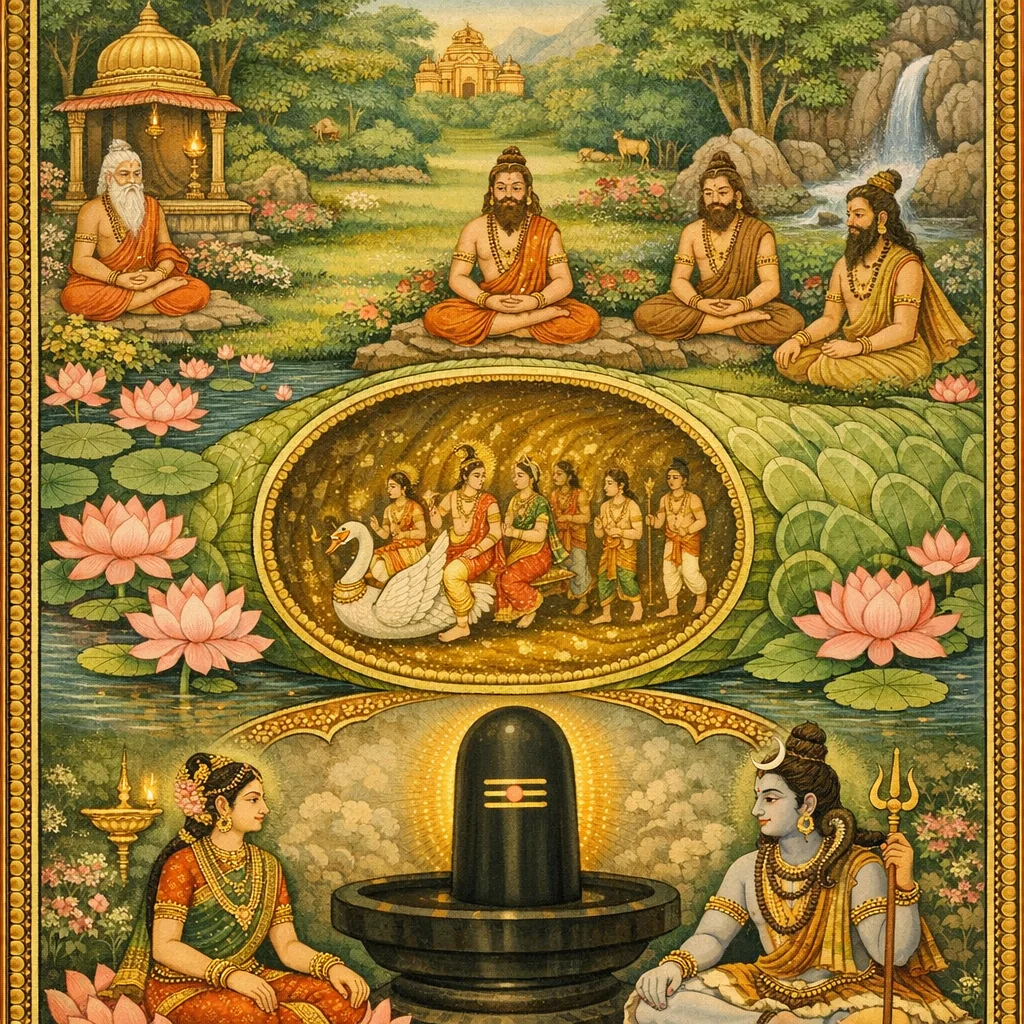
Chapter 130, cast as a dialogue, sets out a structured theological account of Prabhāsa’s Pāśupata-linked shrine network and the liṅga revered as Santoṣeśvara/Anādīśa/Pāśupateśvara. Īśvara locates the shrine among Prabhāsa’s sacred landmarks and praises it as sin-destroying and wish-fulfilling through mere darśana, a siddhi-sthāna, and a “medicine” for those afflicted by moral and spiritual disease. A company of perfected sages is connected with the liṅga, and the nearby Śrīmukha forest is portrayed as Lakṣmī’s abode, supportive of yogic practitioners. Devī asks for clarification on Pāśupata yoga and vow, the deity’s various names, proper ritual honor, and the report of yogins attaining heavenly states with their bodies. The narrative then turns to Nandikeśvara’s mission to summon the ascetics to Kailāsa and to the lotus-stalk (padma-nāla) episode: by yogic power the yogins enter the stalk in subtle form and travel within it, displaying siddhi and “free movement” (svacchanda-gati). Devī’s response introduces a curse motif, followed by pacification and an origin-explanation: the fallen stalk becomes the Mahānāla liṅga, later linked with Dhruveśvara in the Kali age, while the primary shrine is affirmed as Anādīśa/Pāśupateśvara. The chapter closes with phala statements: worship—especially continuous devotion in Māgha—yields the fruit of sacrifices and gifts; the site is upheld as a locus of siddhi and mokṣa, with added ritual-ethical notes on bhasma (sacred ash) observances and Pāśupata identity marks.
Shlokas
Verse 1
ईश्वर उवाच । ततो गच्छेन्महादेवि देवं पाशुपतेश्वरम् । उग्रसेनेश्वराद्देवि पूर्वभागे व्यवस्थितम्
Īśvara said: Then, O Great Goddess, one should go to the divine Pāśupateśvara, situated to the east of Ugraseneśvara.
Verse 2
गोपादित्यात्तथाग्नेय्यां ध्रुवेशाद्दक्षिणां श्रितम् । सर्वपापहरं देवि पूर्वभागे व्यवस्थितम्
From Gopāditya, toward the southeast, and to the south of Dhruveśa, it is located—O Goddess—standing in the eastern quarter, and it removes all sins.
Verse 3
गोपादित्यात्तथा लिंगं दर्शनात्सर्वकामदम् । अस्मिन्युगे समाख्यातं संतोषेश्वरसंज्ञितम्
And from Gopāditya is that Liṅga; by its mere darśana it grants all desired aims. In this age it is renowned by the name Saṃtoṣeśvara.
Verse 4
संतुष्टो भगवान्यस्मात्तेषां तत्र तपस्विनाम् । तेन संतोषनाम्ना तु प्रख्यातं धरणीतले
Because the Lord there was pleased with those ascetics, that place is therefore renowned upon the earth by the name “Saṃtoṣa.”
Verse 5
युगलिंगं महादेवि सिद्धिस्थानं महाप्रभम् । स्थानं पाशुपतानां च भेषजं पापरोगिणाम्
O Great Goddess, it is a “Yuga-Liṅga,” a mighty and splendid seat of siddhis; a holy station for the Pāśupatas, and a medicine for those afflicted by the disease of sin.
Verse 6
चत्वारो मुनयः सिद्धास्तस्मिंल्लिंगे यशस्विनि । वामदेवस्तु सावर्णिरघोरः कपिलस्तथा । तस्मिंल्लिंगे तु संसिद्धा अनादीशे निरंजने
At that glorious Liṅga, O renowned one, four sages attained perfection—Vāmadeva, Sāvarṇi, Aghora, and Kapila. Indeed, at that very Liṅga, in the presence of the Beginningless Lord, the Stainless One, they became fully accomplished.
Verse 7
तस्य देवस्य सामीप्ये वने श्रीमुखसंज्ञितम् । लक्ष्मीस्थानं महादेवि सिद्धयोगैस्तु सेवितम्
Near that God there is a forest known as Śrīmukha. O Mahādevī, it is a seat of Lakṣmī, revered and frequented by perfected yogins.
Verse 8
तत्र पाशुपताः श्रेष्ठा मम लिंगार्चने रताः । तेषां चैव निवासार्थं तद्देव्या निर्मितं वनम्
There dwell the foremost Pāśupatas, devoted to the worship of my Liṅga. And for their very residence, that forest was fashioned by the Goddess.
Verse 9
तस्य मध्ये तु सुश्रोणि लिंगं पूर्वमुखं स्थितम् । तस्मिन्पाशुपताः सिद्धा अघोराद्या महर्षयः । अनेनैव शरीरेण गतास्ते शिवमन्दिरम्
In its midst, O fair-hipped one, stands a Liṅga facing the east. There the Pāśupata great seers—Aghora and the rest—became perfected, and with this very body they went to Śiva’s abode.
Verse 10
तत्र प्राभासिके क्षेत्रे सुरसिद्धनिषेविते । रोचते मे सदा वासस्तस्मिन्नायतने शुभे । सर्वेषामेव स्थानानामतिरम्यमतिप्रियम्
In that Prābhāsika holy region, frequented by gods and siddhas, my dwelling there always delights me—in that auspicious sanctuary, exceedingly beautiful and supremely dear among all places.
Verse 11
तत्र पाशुपता देवि मम ध्यानपरायणाः । मम पुत्रास्तु ते सर्वे ब्रह्मचर्येण संयुताः
There, O Goddess, the Pāśupatas are wholly devoted to meditation upon me. All of them are as my sons, endowed with the discipline of brahmacarya.
Verse 12
दान्ताः शांता जितक्रोधा ब्राह्मणास्ते तपस्विनः । तल्लिंगस्य प्रभावेन सिद्धिं ते परमां गताः
Self-controlled, tranquil, and conquerors of anger—those brahmin ascetics, by the potency of that Liṅga, attained the highest perfection.
Verse 13
तस्मात्तं पूजयेन्नित्यं क्षेत्रवासी द्विजोत्तमः
Therefore, the best of the twice-born who dwells in that sacred region should worship him daily.
Verse 14
देव्युवाच । भगवन्देवदेवेश संसारार्णवतारक । प्रभासे तु महाक्षेत्रे त्वदीयव्रतचारिणाम्
Devī said: “O Blessed Lord, God of the gods, who ferries beings across the ocean of saṃsāra—within Prabhāsa, that great sacred region, for those who observe your vows…”
Verse 15
स्थानं तेषां महत्पुण्यं योगं पाशुपतं तथा । कथयस्व प्रसादेन लिंगमाहात्म्यमुत्तमम्
By your grace, tell me of their supremely meritorious abode, and also of the Pāśupata yoga; indeed, explain the excellent greatness of the Liṅga.
Verse 16
किमादिनाम देवस्य कथं पूज्यो नरोत्तमैः । कथं पाशुपतास्तत्र सदेहाः स्वर्गमागताः
“Why is that Deity known by the name ‘Ādi’? How is He to be worshipped by the best among men? And how did the Pāśupata devotees there attain heaven with their very bodies?”
Verse 17
एतत्कथय देवेश दयां कृत्वा मम प्रभो
“O Lord of the gods, tell me this—out of compassion, O my Lord.”
Verse 18
ईश्वर उवाच । यस्त्वया पृछ्यते भद्रे योगः पाशुपतो महान् । तेषां चैव प्रभावो यस्तथा लिंगस्य सुव्रते
Īśvara said: “O auspicious one, the great Pāśupata discipline you ask about—and the power of those devotees, as well as the majesty of that Liṅga—I shall explain, O you of noble vows.”
Verse 19
अनादीशस्य देवस्य आदिनाम महाप्रभे । तस्मिंल्लिंगे तु ये देवि मदीयव्रतमाश्रिताः
The Deity is the Lord without beginning; yet He bears the name “Ādi” (the First), O greatly radiant one. And, O Devī, those who take refuge in my vow in relation to that Liṅga…
Verse 20
चिरं नियोगं सुश्रोणि व्रतं पाशुपतं महत् । धारयंति यथोक्तं तु मम विस्मयकारकम् । तेषामनुग्रहार्थाय मम चित्तं प्रधावति
For a long time, O fair-hipped one, they uphold the great Pāśupata vow under strict discipline, exactly as prescribed—something that fills me with wonder. For the sake of granting them grace, my mind hastens toward them.
Verse 21
सूत उवाच । हरस्य वचनं श्रुत्वा देवी विस्मयमागता । उवाच वचनं विप्राः सर्वलोकपतिं पतिम्
Sūta said: Hearing Hara’s words, the Goddess became astonished. Then, O brāhmaṇas, she spoke to her Lord, the ruler of all worlds.
Verse 22
ममापि कौतुकं देव किमकार्षीत्ततो भवान् । तद्ब्रूहि मे महादेव यद्यहं तव वल्लभा
I too am curious, O God—what did you do then, and why? Tell me that, O Mahādeva, if indeed I am dear to you.
Verse 23
तस्यास्तद्वचनं श्रुत्वा महादेवो जगाद ताम् । शृणु देवि प्रवक्ष्यामि मम भक्तविचेष्टितम्
Hearing her words, Mahādeva said to her: “Listen, O Devī; I shall tell you of the deeds and conduct of my devotees.”
Verse 24
दृष्ट्वा चैव तपोनिष्ठां तेषामाद्यः सुरेश्वरः । उवाच वचनं देवः प्रणतान्पार्श्वतः स्थितान्
Seeing their unwavering steadfastness in austerity, the primordial Lord of the gods spoke divine words to those standing nearby with heads bowed in reverence.
Verse 25
ईश्वर उवाच । गच्छ शीघ्रं नन्दिकेश यत्र ते मम पुत्रकाः । चरंति च व्रतं घोरं मदीयं चातिदुष्करम्
Īśvara said: “Go quickly, O Nandikeśa, to where those sons of mine—under your charge—are practicing my vow, a fierce and exceedingly difficult observance.”
Verse 26
तत्क्षेत्रस्य प्रभावेन भक्त्या च मम नित्यशः । तेन ते मुनयः सिद्धाः स्वशरीरेण सुव्रताः
By the mighty spiritual potency of that sacred field (Prabhāsa), and by their constant devotion to Me, those sages of noble vows have become perfected, attaining siddhi within their very own bodies.
Verse 27
तस्मान्मद्वचनान्नन्दिन्गच्छ प्राभासिकं शुभम् । आमन्त्रय त्वं तान्सर्वान्कैलासं शीघ्रमानय
Therefore, O Nandin, at my command go to the auspicious Prābhāsa. Invite all those sages, and quickly bring them to Kailāsa.
Verse 28
इदं पद्मं गृहाण त्वं सनालं कलिकोज्ज्वलम् । लिंगस्य मूर्ध्नि दत्त्वेदं पद्मनालमिहानय
Take this lotus, complete with its stalk, radiant with fresh buds. Place it upon the top of the Liṅga, and then bring back here the lotus-stalk.
Verse 29
मुक्तस्तदा स वै नन्दी देवदेवेन शंभुना । कैलासनिलयात्तस्मात्प्रभासं क्षेत्रमागतः
Then Nandin, dispatched by Śambhu, the God of gods, set forth from Śiva’s abode on Kailāsa and arrived at the sacred kṣetra of Prabhāsa.
Verse 30
दृष्ट्वा चैव पुनर्लिङ्गं देवदेवस्य शूलिनः । दृष्ट्वा तांश्चैव योगीन्द्रान्परं विस्मयमागतः
Seeing once again the Liṅga of the Trident-bearing Lord, the God of gods—and seeing those foremost yogins—Nandin was filled with profound wonder.
Verse 31
केचिद्ध्यानरतास्तत्र केचिद्योगं समाश्रिताः । केचिद्व्याख्यां प्रकुर्वन्ति विचारमपि चापरे
Some there were absorbed in meditation; some had taken refuge in yogic discipline. Some were giving teachings and explanations, while others were engaged in subtle inquiry and reflection.
Verse 32
कुर्वन्त्यन्ये लिंगपूजां प्रणामं च तथाऽपरे । प्रदक्षिणं प्रकुर्वन्ति साष्टांगं प्रणमन्ति च
Others perform worship of the Liṅga; some offer reverent salutations. They make pradakṣiṇā (circumambulation), and they bow down in full aṣṭāṅga prostration.
Verse 33
केचित्स्तुतिं प्रकुर्वन्ति भावयज्ञैस्तथा परे । केचित्पूजां च कुर्वन्ति अहिंसाकुसुमैः शुभैः
Some offer hymns of praise; others worship as an inner yajña of devotion. Some also worship with auspicious “flowers of ahiṃsā”—pure acts born of harmlessness.
Verse 34
भस्मस्नानं प्रकुर्वंति गण्डुकैः स्नापयन्ति च । एवं व्याकुलतां यातं तपस्विगणमण्डलम्
They bathe with sacred ash, and they also bathe the Liṅga with water-vessels. Thus the circle of ascetics was stirred into intense activity.
Verse 35
तत्तादृशमथालोक्य नन्दी विस्मयमागतः । चिन्तयामास मनसा सर्वं तेषां निरीक्ष्य च
Seeing them engaged in such ways, Nandin was struck with wonder. Observing everything they were doing, he reflected deeply within his mind.
Verse 36
आगतोऽहमिमं देशं न कश्चिन्मां निरीक्षते । न केनचिदहं पृष्टोऽभ्यागतः कुत्र कस्य च
“I have come to this place, yet no one even looks at me. No one asks me at all—‘From where have you come, and to whom do you belong?’”
Verse 37
अहंकारावृताः सर्वे न वदन्ति च मां क्वचित् । एवं मनसि संधाय लिंगपार्श्वमुपागतः
“All of them are veiled by ego; they do not speak to me at all. Thinking thus within my mind, I went to the side of the Liṅga.”
Verse 38
दत्तं लिंगस्य तत्पद्मनालं छित्त्वा तु नन्दिना । अर्चयित्वा तु तन्नन्दी लिंगं पाशुपतेश्वरम् । नालं गृहीत्वा यत्नेन ऋषीन्वचनमब्रवीत्
Having cut off the lotus-stalk that had been placed upon the Liṅga, Nandin then worshipped that Liṅga—Pāśupateśvara. Taking the stalk carefully in his hand, he addressed the sages with words.
Verse 39
नन्दिकेश्वर उवाच । शासनाद्देवदेवस्य भवतां पार्श्वमागतः । आज्ञापयति देवेशस्तपस्विगणमण्डलम्
Nandikeśvara said: “By the command of the God of gods, I have come into your presence. The Lord of the gods issues an order to this assembly of ascetics.”
Verse 40
युष्माभिस्तत्र गन्तव्यं यत्र देवः सनातनः । युष्मान्सर्वान्समादाय गमिष्यामि भवालयम्
“You must go there—where the Eternal God is. Taking all of you together, I shall lead you to Bhava’s abode.”
Verse 41
उत्तिष्ठताशु गच्छामः कैलासं पर्वतोत्तमम् । तूष्णींभूतास्ततः सर्वे प्रोचुस्ते संज्ञया द्विजाः । गम्यतामग्रतो नन्दिन्पश्चादेष्यामहे वयम्
“Rise quickly; let us go to Kailāsa, the best of mountains.” Then all those twice-born sages, having fallen silent, spoke only by gesture: “Go on ahead, O Nandin; we shall follow behind.”
Verse 42
एवमुक्तस्तु मुनिभिर्नन्दी शीघ्रतरं गतः । कथयामास तत्सर्वं कुपितेनान्तरात्मना
Thus addressed by the sages, Nandin went away even more quickly. With anger in his heart, he reported all of it (to his Lord).
Verse 43
नन्दिकेश्वर उवाच । देव तत्र गतोऽहं वै यत्र ते योगिनः स्थिताः । सन्तोषितो न चैवाहं केनचित्तत्र संस्थितः
Nandikeśvara said: “O Lord, I indeed went there—where your yogins are stationed. Yet I was not at all satisfied by anyone who was present there.”
Verse 44
न मां देव निरीक्षन्ते नालपंति कथंचन । पद्मं तत्र मया देव स्थापितं लिंग मूर्धनि
“O Lord, the gods do not even look upon me; they do not speak to me in any way. There, O Lord, I placed a lotus upon the crown of the Liṅga.”
Verse 45
उक्तं देव मया तेषां योगीन्द्राणां महेश्वर । आज्ञप्ता देवदेवेन इहागच्छत मा चिरम्
“O Lord, O Maheśvara, I told those lordly yogins: ‘You have been commanded by the God of gods—come here without delay.’”
Verse 46
एतच्छ्रुत्वा वचः स्वामिन्सर्वे तत्र महर्षयः । आगमिष्याम इति वै पृष्ठतो गच्छ मा चिरम्
Hearing these words, O Lord, all the great sages there said, “We shall come at once.” “Go on ahead,” they added, “do not delay.”
Verse 47
इत्युक्ते तैस्तथा देव अहं शीघ्रमिहागतः । शृणु चेमं गृहाण त्वं यथेष्टं कुरु मे प्रभो
When they had spoken thus, O God, I quickly came here. Now listen and accept this; do as you wish, O Lord.
Verse 48
एकं मे संशयं देव च्छेत्तुमर्हसि सांप्रतम् । मया विना महादेव आगमिष्यंति ते कथम् । संशयो मे महादेव कथयस्व महेश्वर
One doubt of mine, O God, you should dispel just now. Without me, O Mahādeva, how will those sages arrive? This is my doubt—tell me, O Maheśvara.
Verse 49
ईश्वर उवाच । शृणु नंदिन्यथाश्चर्यं तेषां वै भावितात्मनाम् । न दृश्यन्त इमे सिद्धा मां मुक्त्वाऽन्यैः सुरैरपि
Īśvara said: Listen, O Nandin, to the wonder of those perfected, self-disciplined souls. These siddhas are not seen even by other gods—except by me.
Verse 50
मद्भावभावितास्ते वै योगं विंदंति शांकरम् । पश्यैतत्कौतुकं नंदिन्दर्शयामि तवाधुना
Absorbed in my own nature, they indeed attain Śaṅkara’s yoga. Look at this marvel, O Nandin—I shall show it to you now.
Verse 51
आनीतं यत्त्वया नालं तस्मिन्नाले तु सूक्ष्मवत् । प्रविश्य चागताः सर्वे योगैश्वर्यबलेन च
That reed-stalk which you brought—entering into that very stalk as though subtle, they have all arrived by the power of yogic lordship and strength.
Verse 52
एवमुक्तस्तदा नंदी विस्मयोत्फुल्ललोचनः । अपश्यन्नालमध्यस्थान्महर्षीन्परमाणुवत्
Thus addressed, Nandin—his eyes wide with astonishment—saw the great sages situated within the middle of the reed-stalk, like atoms.
Verse 53
यथार्करश्मिमध्यस्था दृश्यन्ते परमाणवः । एवं तन्नालमध्यस्था दृश्यंत ऋषयः पृथक्
Just as atoms are seen when suspended in the midst of sunbeams, so too the sages—each distinct—were seen situated within that reed-stalk.
Verse 54
एवं दृष्ट्वा तदा नंदी विस्मयोत्फुल्ललोचनः । आश्चर्यं परमं गत्वा किञ्चिन्नेवाब्रवीत्पुनः
Seeing this then, Nandin—his eyes blossoming wide with wonder—entered into the highest astonishment, and again spoke, only a little.
Verse 55
एवं तत्कौतुकं दृष्ट्वा देवी वचनमब्रवीत् । किं दृश्यते महादेव हृष्टः कस्मान्महेश्वर
Having seen that marvel, the Goddess spoke: “What is it that is seen, O Mahādeva? Why are You pleased, O Maheśvara?”
Verse 56
इत्युक्ते वचने देव्या प्रोवाचेदं महेश्वरः
When the Goddess had spoken thus, Maheśvara replied with these words.
Verse 57
ईश्वर उवाच । योगयुक्ता महात्मानो योगे पाशुपते स्थिताः । एते मां च समाराध्य प्रभासक्षेत्रवासिनम् । ईदृशीं सिद्धिमापन्नाः स्वच्छंदगतिचारिणः
Īśvara said: “These great souls are united with Yoga and established in the Pāśupata Yoga. Having duly worshipped Me who abides in Prabhāsa-kṣetra, they have attained such perfection—moving freely according to their will.”
Verse 58
इत्युक्तवति देवेश ऋषयस्ते महाप्रभाः । पद्मनालाद्विनिःसृत्य सर्वे वै योगमायया । प्रदक्षिणां प्रकुर्वंति देवं देव्या बहिष्कृतम्
When the Lord of gods had spoken thus, those radiant great ṛṣis—emerging from the lotus-stalk by the power of yogic māyā—began to perform pradakṣiṇā, circumambulating the Deva, while the Goddess remained unseen to them.
Verse 59
देव्युवाच । किमर्थं मां न पश्यंति दुराचारा इमे द्विजाः । विस्मयोऽयं महादेव कथयस्व प्रसादतः
The Goddess said: “For what reason do these ill-conducted twice-born not behold me? This is a marvel, O Mahādeva—tell me, out of grace.”
Verse 60
ईश्वर उवाच । प्रकृतित्वान्न पश्यंति सिद्धा ह्येते महातपाः । एवमुक्ता तु गिरिजा देवेदेवेन शूलिना
Īśvara said: “Because you are in your natural, manifest form, they do not see you; for these great ascetics are siddhas.” Thus Girijā was addressed by the God of gods, the Trident-bearer.
Verse 61
चुकोप तेषां सुश्रोणी शशाप क्रोधितानना । स्त्रीलौल्येन दुराचारा नाशमेष्यथ गर्विणः
Then the fair-hipped Goddess grew wrathful toward them; her face aflame with anger, she cursed: “Through lust for women, you ill-conducted and arrogant ones shall come to ruin.”
Verse 62
राजप्रतिग्रहासक्ता वृत्त्या देवार्चने रताः । भविष्यथ कलौ प्राप्ते लिंगद्रव्योपजीविनः
“Clinging to gifts received from kings, and taking deity-worship merely as a livelihood, when the age of Kali arrives you will become those who live off the goods of the liṅga (temple property).”
Verse 63
वेश्यासक्ताश्च संभ्रांता सर्वलोकबहिष्कृताः । देवद्रव्यविनाशाय भविष्यथ कलौ युगे
“Attached to courtesans and morally bewildered, cast out by all people, in the age of Kali you will become agents for the ruin of sacred property.”
Verse 64
इति दत्ते तदा शाप ऋषीणां च महात्मनाम् । गौरीं प्रसादयामासुस्ते च सर्वे सुरेश्वराः
Thus, when that curse was pronounced upon the great-souled ṛṣis, all those lords among the gods sought to appease Gaurī.
Verse 65
देवदेवस्य वचनात्प्रसन्ना साऽभवत्पुनः । नालं देवोऽपि संगृह्य दक्षिणाशां समाक्षिपत्
At the word of the God of gods, she became gracious again. Then the Deva too, taking hold of the lotus-stalk, cast it toward the southern direction.
Verse 66
पतितं तच्च वै नालं प्रभासक्षेत्रमध्यतः । तदेव लिंगं संजातं महानालेति विश्रुतम्
That very tubular shaft (nāla) fell in the midst of the sacred field of Prabhāsa; from it there arose a liṅga, renowned thereafter by the name Mahānāla.
Verse 67
कलौ युगे च संप्राप्ते तद्ध्रुवेश्वरसंज्ञितम् । संस्थितं चोत्तरेशाने तस्मात्पाशुपतेश्वरात्
When the age of Kali arrives, that very liṅga is known as Dhruveśvara, and it abides to the north-east of Pāśupateśvara.
Verse 68
पुराऽनादीशनामेति पश्चात्पाशुपतेश्वरः । प्रभासे तु महाक्षेत्रे स्थितः पातकनाशनः
In ancient times he was known as Anādīśa; later, as Pāśupateśvara. In the great sacred field of Prabhāsa he stands as the destroyer of sins.
Verse 69
इदं स्थानं परं श्रेष्ठं मम व्रतनिषेवणम् । इदं लिंगं परं ब्रह्म अनादीशेति संज्ञितम्
This place is supremely excellent—here my sacred vow (vrata) is duly observed. This liṅga is the highest Brahman, known by the name Anādīśa.
Verse 70
अत्र सिद्धिश्च मुक्तिश्च ब्राह्मणानां न संशयः । अनेनैव शरीरेण षड्भिर्मासस्तु सिद्ध्यति
Here, for brāhmaṇas, both attainment (siddhi) and liberation (mukti) are certain, without doubt. Indeed, with this very body, fulfillment is accomplished within six months.
Verse 71
संसारस्य विमोक्षार्थमिदं लिंगं तु दृश्यताम् । दुर्लभं सर्वलोकानामिदं मोक्षप्रदं परम् । इदं पाशुपतं ज्ञानमस्मिंल्लिंगे प्रतिष्ठितम्
For release from the bondage of saṃsāra, let this liṅga be beheld. It is rare for all beings, and it is supreme—bestowing liberation. The Pāśupata knowledge is established in this very liṅga.
Verse 72
यश्चैनं पूजयेद्भक्त्या माघे मासि निरंतरम् । सर्वेषां वै क्रतूनां च दानानां लभते फलम्
Whoever worships him with devotion continuously during the month of Māgha obtains the fruit of all sacrifices and all acts of charity.
Verse 73
हिरण्यं तत्र दातव्यं सम्यग्यात्राफलेप्सुभिः
Those who desire the full fruit of the pilgrimage should give gold there as charity.
Verse 74
इत्येतत्कथितं देवि माहात्म्यं पापनाशनम् । पशुपाशविमोक्षार्थं सम्यक्पाशुपतेश्वरम्
Thus, O Goddess, this sin-destroying greatness has been declared—fully concerning Pāśupateśvara, for the release of beings from the bonds of bondage.
Verse 75
चतुर्णामपि वर्णानां पूज्यो ब्राह्मण उच्यते । तस्य चैवाधिकारोऽस्ति चास्मिन्पाशुपतेश्वरे
Among all the four social orders, the brāhmaṇa is declared worthy of honor; and he indeed has rightful authority (adhikāra) in this worship of Pāśupateśvara.
Verse 76
यद्देवतानां प्रथमं पवित्रं विश्वव्रतं पाशुपतं बभूव । अयं पन्था नैष्ठिको वै मयोक्तो येन देवा यांति भुवनानि विश्वा
That Pāśupata observance which became the foremost purifier among the gods, and a universal vow—this is the steadfast path declared by me, by which the gods attain all the worlds.
Verse 77
सुरां पीत्वा गुरुदारांश्च गत्वा स्तेयं कृत्वा ब्राह्मणं चापि हत्वा । भस्मच्छन्नो भस्मशय्याशयानो रुद्राध्यायी मुच्यते पातकेभ्यः
Even having drunk liquor, approached the wife of one’s guru, committed theft, or even slain a brāhmaṇa—one who is covered with sacred ash, who lies upon a bed of ash, and who recites and contemplates Rudra is freed from sins.
Verse 78
अग्निरित्यादिना भस्म गृहीत्वांगानि संस्पृशेत् । गृह्णीयात्संयते चाग्नौ भस्म तद्गृहवासिनाम्
Taking ash with the mantra beginning “Agni…”, one should touch one’s limbs with it. And from a well-tended sacred fire, one should take that ash for the residents of the household.
Verse 79
अग्निरिति भस्म वायुरिति भस्म जलमिति भस्म स्थलमिति भस्म सर्वं ह वा इदं भस्माभवत् । एतानि चक्षूंषि नादीक्षितः संस्पृशेत्
“Agni is ash; Vāyu is ash; water is ash; earth is ash—indeed, all this has become ash.” These are the “eyes” (sacred formulae/insights); one who has not received dīkṣā should not touch or employ them.
Verse 80
ब्राह्मणैश्च समादेयं न तु शूद्रैः कदाचन । नाधिकारोऽस्ति शूद्रस्य व्रते पाशुपते सदा
This observance is to be undertaken by brāhmaṇas, but never by śūdras. A śūdra has no entitlement to the Pāśupata vow at any time.
Verse 81
ब्राह्मणेष्वधिकारोऽस्ति व्रते पाशुपते शुभे । ब्राह्मणीं तनुमास्थाय संभवामि युगेयुगे
Eligibility for the auspicious Pāśupata observance belongs to brāhmaṇas. Assuming the body of a brāhmaṇa woman, I manifest age after age, yuga after yuga.
Verse 82
चण्डालवेश्मन्यथ वा स्मशाने राज्ञश्च मार्गेश्वथ वर्त्ममध्ये । करीषमध्ये निःसृता नराधमाः शैवं पदं यांति न संशयोऽत्र
Whether in a caṇḍāla’s dwelling, or in a cremation ground, or on the king’s roads, or in the midst of the highway—even if they are wretches, as though emerging from heaps of dung—they attain the Śaiva state; of this there is no doubt.
Verse 130
इति श्रीस्कांदे महापुराण एकाशी तिसाहस्र्यां संहितायां सप्तमे प्रभासखण्डे प्रथमे प्रभासक्षेत्रमाहात्म्ये पाशुपतेश्वरमाहात्म्यवर्णनंनाम त्रिंशदुत्तरशततमोध्यायः
Thus ends the one-hundred-and-thirtieth chapter, called “The Description of the Greatness of Pāśupateśvara,” in the first part, the Prabhāsa-kṣetra Māhātmya, within the Prabhāsa Khaṇḍa of the revered Skanda Mahāpurāṇa, in the Ekāśīti-sāhasrī Saṃhitā.