Adhyaya 123
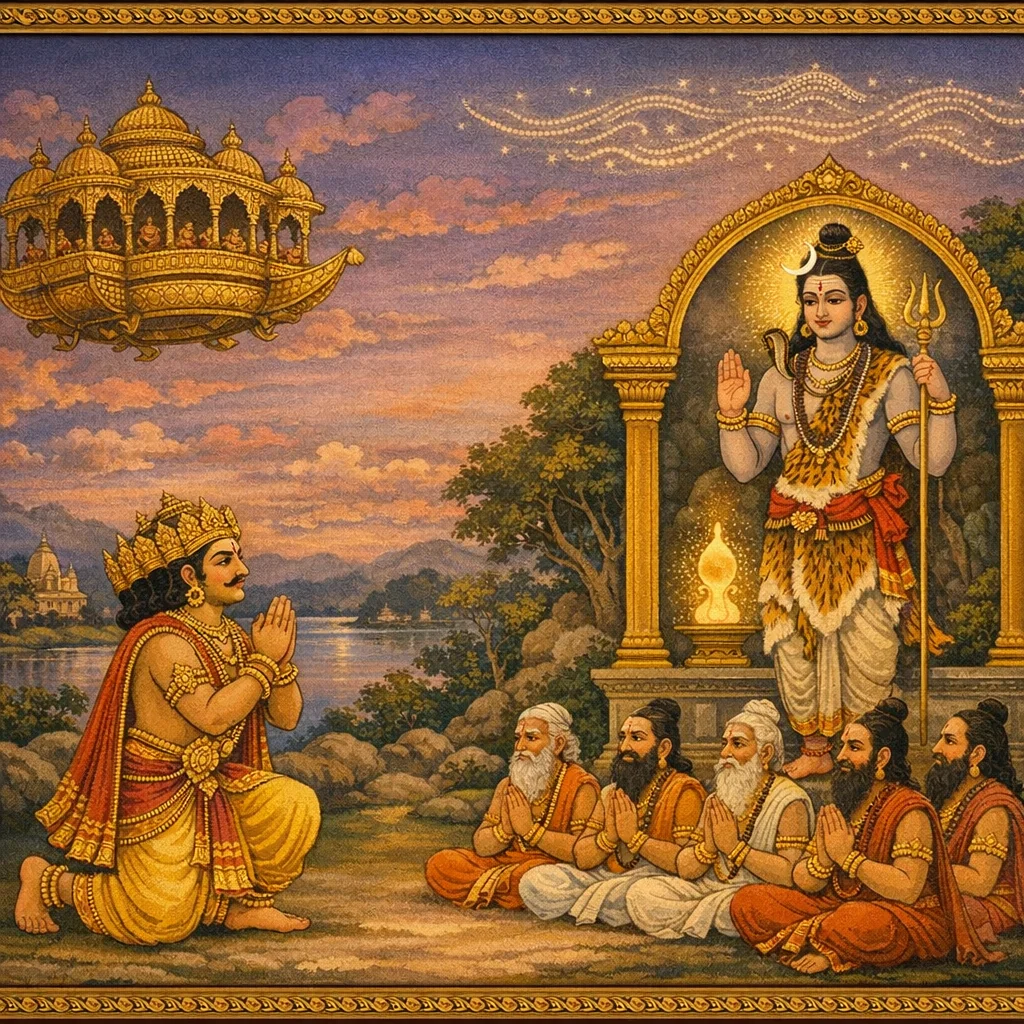
Īśvara tells Devī a place-centered theological account set in Prabhāsa, explaining the origin and merit of Rāvaṇeśvara. Rāvaṇa, bent on conquering the three worlds, travels in the Puṣpaka vimāna, but it suddenly becomes motionless in the sky, revealing the binding power of the kṣetra. He sends Prahasta to inquire, who beholds Somēśvara (Śiva) praised by hosts of devas and attended by ascetic communities (like Vālakhilya-type sages), and reports that the vimāna cannot pass because Śiva’s presence is unsurpassable. Rāvaṇa descends and worships with devotion and offerings, while the local people flee in fear, leaving the area around the deity seemingly empty. An incorporeal voice issues an ethical command: do not obstruct the Lord’s yātrā season, for dvijāti pilgrims come from afar and must not be endangered. The voice further declares that mere darśana of Somēśvara can wash away faults accrued in childhood, youth, and old age. Rāvaṇa then establishes a liṅga named Rāvaṇeśvara, undertakes upavāsa and a night vigil with music, and receives a boon: Śiva’s abiding presence there, worldly ascendancy, and the promise that worshippers of this liṅga become difficult to defeat and attain siddhi. Rāvaṇa departs to resume his ambitions, while the chapter chiefly sacralizes the shrine and defines its ritual-phala logic.
Shlokas
Verse 1
ईश्वर उवाच । ततो गच्छेन्महादेवि रावणेश्वरमुत्तमम् । तस्माद्दक्षिणनैरृत्ये धनुषां षोडशे स्थितम्
Īśvara said: “Then, O Mahādevī, one should go to the excellent Rāvaṇeśvara. From the previous shrine, it lies to the south–southwest, at a distance of sixteen dhanu measures.”
Verse 2
प्रतिष्ठितं दशास्येन सर्वपातकनाशनम् । पौलस्त्यो रावणो देवि राक्षसस्तु सुदारुणः
O Devī, that sacred installation was established by Daśāsya (Rāvaṇa) as a destroyer of all sins. This Rāvaṇa, descended from Pulastya, was indeed a rākṣasa most fierce and terrible.
Verse 3
त्रैलोक्यविजयाकाङ्क्षी पुष्पकेण चचार ह । कस्यचित्त्वथ कालस्य विमानं तस्य पुष्पकम्
Longing to conquer the three worlds, he roamed about in the Puṣpaka, the aerial car. And at a certain time, that very Puṣpaka served as his vimāna, his celestial vehicle.
Verse 4
व्रजद्वै व्योममार्गेण निश्चलं सहसाऽभवत् । स्तंभितं पुष्पकं दृष्ट्वा रावणो विस्मयान्वितः
As it moved along the path of the sky, it suddenly became motionless. Seeing the Puṣpaka brought to a standstill, Rāvaṇa was filled with astonishment.
Verse 5
प्रहस्तं प्रेषयामास किमिदं व्रज मेदिनीम् । अहताऽस्य गतिर्यस्मात्त्रैलोक्ये सचराचरे
He dispatched Prahasta, saying, “What is this? Go down to the earth and find out.” For its course had never before been checked anywhere in the three worlds, among all beings moving and unmoving.
Verse 6
तत्कस्मान्निश्चलं जातं विमानं पुष्पकं मम । अथाऽसौ सत्वरो देवि जगाम वसुधातले
“Why then has my Puṣpaka vimāna become motionless?” Then, O Devī, he hurried down to the surface of the earth.
Verse 7
अपश्यद्देवदेवेशं श्रीसोमेशं महाप्रभम् । स्तूयमानं सुरगणैः शतशोऽथ सहस्रशः
He beheld the Lord of the gods, the glorious Someśa of great splendor, being praised by hosts of devas—by hundreds and by thousands.
Verse 8
तं दृष्ट्वा राक्षसे न्द्राय तत्सर्वं विस्तरात्प्रिये । प्रहस्तः कथयामास यद्दृष्टं क्षेत्रमध्यतः
Having seen that, O beloved, Prahasta described everything in detail to the lord of the rākṣasas—what he had witnessed in the very midst of the sacred kṣetra.
Verse 9
प्रहस्त उवाच । राक्षसेश महाबाहो शिवक्षेत्रं निजं प्रभो । प्रभासेति समाख्यातं गणगन्धर्वसेवितम्
Prahasta said: “O lord of the rākṣasas, mighty-armed master—this is Śiva’s own sacred domain. It is renowned as ‘Prabhāsa’ and is attended by Śiva’s gaṇas and by gandharvas.”
Verse 10
तत्र सोमेश्वरो देवः स्वयं तिष्ठति शङ्करः । अब्भक्षैर्वायुभक्षैश्च दंतोलूखलिभिस्तथा । ऋषिभिर्वालखिल्यैश्च पूज्यमानः समंततः
There the god Someśvara—Śaṅkara himself—abides in person. On every side he is worshipped by ascetics who live on water, by those who live on air, by the Daṃtolūkhalis, and by the Vālakhilya sages.
Verse 11
प्रभावात्तस्य देवस्य नेदं गच्छति पुष्पकम् । न स प्रालंघ्यते देवो ह्यलंघ्यो यः सुरासुरैः
By the power of that Deity, this Puṣpaka does not move forward. That God cannot be overstepped, for he is truly unassailable even by devas and asuras.
Verse 12
ईश्वर उवाच । तस्य तद्वचनं श्रुत्वा विस्मयोत्फुल्ललोचनः । अवतीर्य धरापृष्ठं सोमेशं समपश्यत
Īśvara said: Hearing those words, with eyes widened in wonder, he descended to the surface of the earth and beheld Somēśa (Lord Someśvara).
Verse 13
पूजयामास देवेशि भक्त्या परमया युतः । रत्नैर्बहुविधैर्वस्त्रैर्गन्धपुष्पानुलेपनैः
O Goddess, endowed with supreme devotion, he worshipped the Lord with many kinds of jewels, garments, fragrances, flowers, and unguents.
Verse 14
अथ पौरजना दृष्ट्वा रावणं राक्षसेश्वरम् । सर्वदिक्षु वरारोहे भयाद्भीताः प्रदुद्रुवुः
Then, O fair-hipped Lady, the townspeople, seeing Rāvaṇa—the lord of the rākṣasas—fled in fear in all directions.
Verse 15
शून्यं समभवत्सर्वं तत्र देवो व्यवस्थितः । एतस्मिन्नेव काले तु वागुवाचाशरीरिणी
There, everything became deserted, yet the Deity remained present. At that very moment, a bodiless voice spoke.
Verse 16
दशग्रीव महाबाहो अयने चोत्तरे तथा । यात्राकाले तु देवस्य सर्वपापप्रणाशने
“O Daśagrīva, mighty-armed one! Especially at the northern solstice, and at the time of the Lord’s yātrā—His sin-destroying pilgrimage procession—…”
Verse 17
दूरतः समनुप्राप्ता भूरिलोका द्विजातयः । राक्षसानां भयाद्भीताः प्रयांति हि दिशो दश
Many people—especially the twice-born—had come from far away; yet, frightened by the rākṣasas, they indeed departed toward the ten directions.
Verse 18
भयान्मा त्वं राक्षसेन्द्र यात्राविघ्नकरो भव । बाल्ये वयसि यत्पापं वार्द्धक्ये यौवनेऽपि च । तत्सर्वं क्षालयेन्मर्त्यो दृष्ट्वा सोमेश्वरं प्रभुम्
“Therefore, O lord of rākṣasas, do not, out of fear, become an obstacle to the yātrā. Whatever sin a mortal has accrued in childhood, youth, or old age—by beholding Lord Somēśvara, all of it is washed away.”
Verse 19
ततोऽसौ राक्षसेन्द्रस्तु गत्वैकान्ते सुगह्वरे । लिंगं च स्थापयामास भक्त्या परमया युतः
Then that lord of rākṣasas went to a secluded, excellent cave-glen and, endowed with supreme devotion, established a liṅga.
Verse 20
ततस्तन्निरतो भूत्वा सर्वैस्तै राक्षसेश्वरः । पूजयामास देवेशि उपवासपरायणः
Thereafter, wholly intent upon that worship with all those offerings, the lord of the Rākṣasas, O Goddess, adored the Lord of the Devas, steadfast in the vow of fasting.
Verse 21
चकार पुरतस्तस्य गीतवाद्येन जागरम् । ततोऽर्धरात्रसमये वागुवाचाशरीरिणी
He kept vigil before Him with song and the playing of instruments. Then, at the hour of midnight, the bodiless voice spoke again.
Verse 22
दशग्रीव महाबाहो परितुष्टोऽस्मि तेऽनघ । मम प्रसादात्त्रैलोक्यं वशगं ते भविष्यति । अत्र संनिहितो नित्यं स्थास्याम्यहमसंशयम्
O Daśagrīva (Rāvaṇa), mighty-armed and blameless, I am pleased with you. By My grace, the three worlds shall come under your sway. And here, ever present, I shall surely abide—without doubt.
Verse 23
ये चैतत्पूजयिष्यंति लिंगं भक्तियुता नराः । अजेयास्ते भविष्यंति शत्रूणां राक्षसेश्वर
And those men who, endowed with devotion, shall worship this liṅga—O lord of the Rākṣasas—shall become unconquerable by their enemies.
Verse 24
यास्यंति परमां सिद्धिं मत्प्रसादादसंशयम् । एवमुक्त्वा वरारोहे विरराम वृषध्वजः
They shall attain the highest perfection by My grace, without doubt. Having spoken thus, O fair-hipped lady, Vṛṣadhvaja (Śiva) fell silent.
Verse 25
रावणोऽपि स संतुष्टो भूयोभूयो महेश्वरम् । पूजयित्वा च तल्लिंगं समारुह्य च पुष्पकम् । त्रैलोक्यविजयाकांक्षी इष्टं देशं जगाम ह
Rāvaṇa too, delighted, worshipped Maheśvara and that liṅga again and again. Then, mounting the aerial car Puṣpaka, longing to conquer the three worlds, he departed for the place of his choosing.
Verse 123
इति श्रीस्कांदे महापुराण एकाशीतिसाहस्र्यां संहितायां सप्तमे प्रभासखण्डे प्रथमे प्रभासक्षेत्रमाहात्म्ये रावणेश्वरमाहात्म्यवर्णनंनाम त्रयोर्विशत्युत्तरशततमोऽध्यायः
Thus ends the one-hundred-and-twenty-third chapter, entitled “The Description of the Greatness of Rāvaṇeśvara,” in the Prabhāsa Khaṇḍa of the Śrī Skanda Mahāpurāṇa, in the Ekāśītisāhasrī Saṃhitā, within the Prabhāsakṣetra-māhātmya.