Adhyaya 85
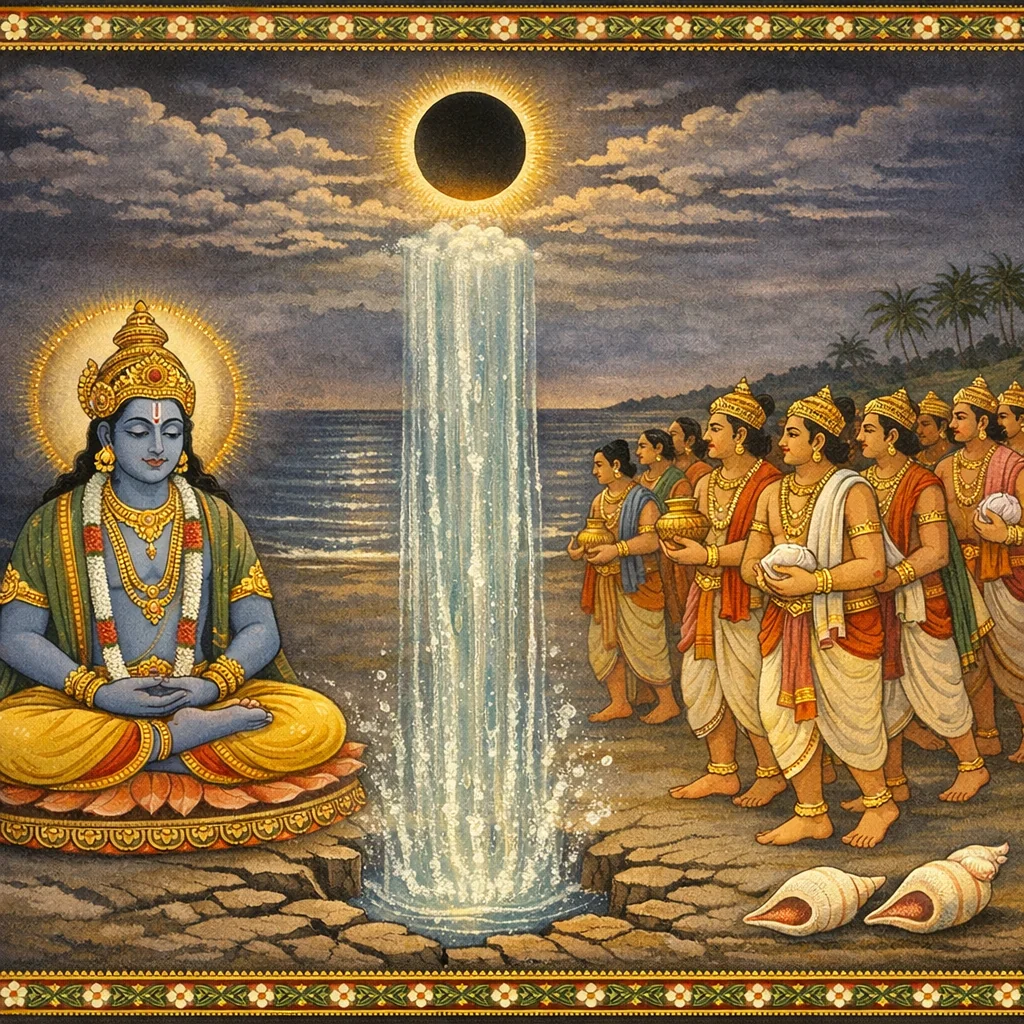
This chapter unfolds as a Devī–Īśvara dialogue on the origin, location, and ritual power of the Sānnidhya tīrtha, a sacred water described as a mighty river-like stream. Devī asks how the revered Mahānadī of Kurukṣetra is present here and what fruits arise from bathing and allied rites. Īśvara declares the tīrtha auspicious and sin-destroying even by mere sight and touch, and places it to the west at a stated distance from Ādinārāyaṇa. The account then ties the tīrtha’s appearance to a historical-theological episode: fearing Jarāsandha, Viṣṇu relocates the Yādavas to Prabhāsa and petitions the ocean for a dwelling place. During a parva-time eclipse, when Rāhu seizes the sun, Viṣṇu reassures the Yādavas, enters samādhi, and brings forth a blessed water-current (śubhā vāridhārā) that breaks through the earth for ritual bathing. Bathing then is said to grant the full fruit of a Kurukṣetra pilgrimage. Ritual merits are further amplified: bathing there during the eclipse yields the complete fruit of an Agniṣṭoma; feeding a brāhmaṇa with the six tastes multiplies merit; homa and mantra-japa give “crore-fold” results per offering or recitation. Gold-gifting and worship of Ādideva Janārdana are commended, and the chapter ends with a phalaśruti that faithful hearing of this account removes sin.
Shlokas
Verse 1
देव्युवाच । तत्र संनिहिता प्रोक्ता या त्वया वृषभध्वज । कथं देव समायाता कुरुक्षेत्रान्महानदी । किं प्रभावा तु सा प्रोक्ता फलं स्नानादिकेन किम्
The Goddess said: “O Bull-bannered Lord, you spoke of the river called Saṃnihitā being present there. How did that great river come from Kurukṣetra, O God? What is her power, and what fruit is gained by bathing and the like?”
Verse 2
ईश्वर उवाच । शृणु देवि प्रवक्ष्यामि यत्र संनिहिता शुभा । पापघ्नी सर्वजंतूनां दर्शनात्स्पर्शनादपि
Īśvara said: “Listen, O Goddess, I shall explain where that auspicious Saṃnihitā is present—she destroys the sins of all creatures even by mere sight and touch.”
Verse 3
आदिनारायणाद्देवि पश्चिमे धनुषां त्रये । संस्थिता सा महादेवी सरिद्रूपा महानदी
O Devī, three bow-lengths to the west of Ādinārāyaṇa stands that Mahādevī—the great river, assuming the form of a sacred stream.
Verse 4
कथयामि समासेन तदुत्पत्तिं शृणु प्रिये । जरासंधभयाद्देवि विष्णुः परिजनैः सह
I shall tell you briefly of her origin—listen, my beloved. O Devī, out of fear of Jarāsandha, Viṣṇu, together with his attendants…
Verse 5
गृहीत्वा यादवान्सर्वान्बालवृद्धवणिग्जनान् । स शून्यां मथुरां कृत्वा प्रभासं समुपागतः
Gathering all the Yādavas—children, the elderly, and the merchant folk—he left Mathurā deserted and then arrived at Prabhāsa.
Verse 6
समुद्रं प्रार्थयामास स्थानं संवासहेतवे । एतस्मिन्नेव काले तु देवदेवो दिवाकरः
He entreated the Ocean for a place suitable for dwelling. And at that very time, the god of gods—the Sun—…
Verse 7
संग्रस्तो राहुणा देवि पर्वकाले ह्युपस्थिते । तं दृष्ट्वा यादवाः सर्वे विषादं परमं गताः
O Devī, at the time of the parvan (the eclipse occasion), the Sun was seized by Rāhu. Seeing that, all the Yādavas fell into profound sorrow.
Verse 8
अप्राप्ताः संनिहित्यायां तानुवाच जनार्द्दनः । मा विषादं यदुश्रेष्ठा व्रजध्वं मयि संस्थिते
Before they reached Saṃnihitī, Janārdana spoke to them: “Do not grieve, O best of the Yadus; go forward, with your minds resting in me.”
Verse 9
दृश्यतां मत्प्रभावोऽद्य धर्मा र्थमिह भूतले । आनयिष्याम्यहं सम्यक्पुण्यं सांनिहितं सरः
“Let my power be witnessed today, for the sake of dharma upon this earth. I shall surely bring forth the meritorious Sāṃnihita lake (tīrtha).”
Verse 10
एवमुक्त्वा स भगवान्समाधिस्थो बभूव ह । एवं संध्यायतस्तस्य विष्णोरमिततेजसः
Having spoken thus, that Blessed Lord entered samādhi. As that Viṣṇu of immeasurable splendor meditated in this manner—
Verse 11
प्रादुर्भूता ततस्तस्य वारिधाराऽग्रतः शुभा । बिभेद्य धरणीपृष्ठं स्नानार्थं चासुरद्विषः
Then, before him, an auspicious stream of water manifested, splitting open the surface of the earth—so that the foe of the asuras might provide a place for bathing.
Verse 12
तत स्ते यादवाः सर्वे रामसांबपुरोगमाः । चक्रुः स्नानं महादेवि राहुग्रस्ते दिवाकरे
Then all those Yādavas—led by Rāma and Sāmba—performed the sacred bath, O Mahādevī, while the Sun was seized by Rāhu (during the eclipse).
Verse 13
प्राप्तपुण्या बभूवुस्ते संनिहित्यासमुद्भवम् । कुरुक्षेत्रस्य यात्रायाः प्राप्य सम्यक्फलं हि ते
They were endowed with merit arising from Saṃnihitī; indeed, they obtained in full the fruit of the pilgrimage to Kurukṣetra.
Verse 14
एवं तत्समनुप्राप्तं पुण्यं सान्निहितं सरः । तत्र स्नात्वा महादेवि राहुग्रस्ते दिवाकरे । अग्निष्टोमस्य यज्ञस्य फलं प्राप्नोत्यशेषतः
Thus the meritorious lake of Sānn̄ihita was attained. O Mahādevī, bathing there when the Sun is seized by Rāhu, one gains—without remainder—the fruit of the Agniṣṭoma sacrifice.
Verse 15
यस्तत्र भोजयेद्विप्रं षड्रसं विधिपूर्वकम् । एकेन भोजितेनैव कोटिर्भवति भोजिता
Whoever in that sacred place feeds a brāhmaṇa, duly and ritually, with the six tastes—by feeding but one, the merit becomes as though a koṭi had been fed.
Verse 16
यस्तत्र कारयेद्धोमं संनिहित्यासमीपतः । एकैकाहुतिदानेन कोटिहोमफलं लभेत्
Whoever causes a homa to be performed there, near Saṃnihityā—even by offering each single oblation—gains the fruit of a koṭi homas.
Verse 17
मन्त्रजाप्यं तु कुरुते तत्र स्थाने स्थितो यदि । एकैकमंत्रजाप्येन कोटिजाप्यफलं लभेत्
If one remains in that place and performs mantra-japa there, then by each single repetition of the mantra one obtains the fruit of a koṭi repetitions.
Verse 18
सुवर्णदानं दातव्यं तत्र यात्राफलेप्सुभिः । स्नात्वा संपूजनीयश्च आदिदेवो जनार्द्दनः
Those who seek the full fruit of pilgrimage there should offer the gift of gold; and, after bathing, they should duly worship Janārdana, the primal Lord.
Verse 19
इति वै कथितं सम्यक्फलं सांनिहितं तव । श्रुतं पापहरं नृणां सम्यक्छ्रद्धावतां प्रिये
Thus the true fruit of Saṃnihityā has been properly told to you. Heard with genuine faith, O beloved, it becomes a remover of sins for people.
Verse 85
इति श्रीस्कांदे महापुराण एकाशीतिसाहस्र्यां संहितायां सप्तमे प्रभासखण्डे प्रथमे प्रभासक्षेत्रमाहात्म्ये संनिहित्यामाहात्म्यवर्णनंनाम पंचाशीतितमोऽध्यायः
Thus ends the eighty-fifth chapter, called “The Description of the Greatness of Saṃnihityā,” in the first part of the Prabhāsakṣetra Māhātmya, within the seventh, the Prabhāsa Khaṇḍa, of the venerable Skanda Mahāpurāṇa, in the Ekāśīti-sāhasrī Saṃhitā.