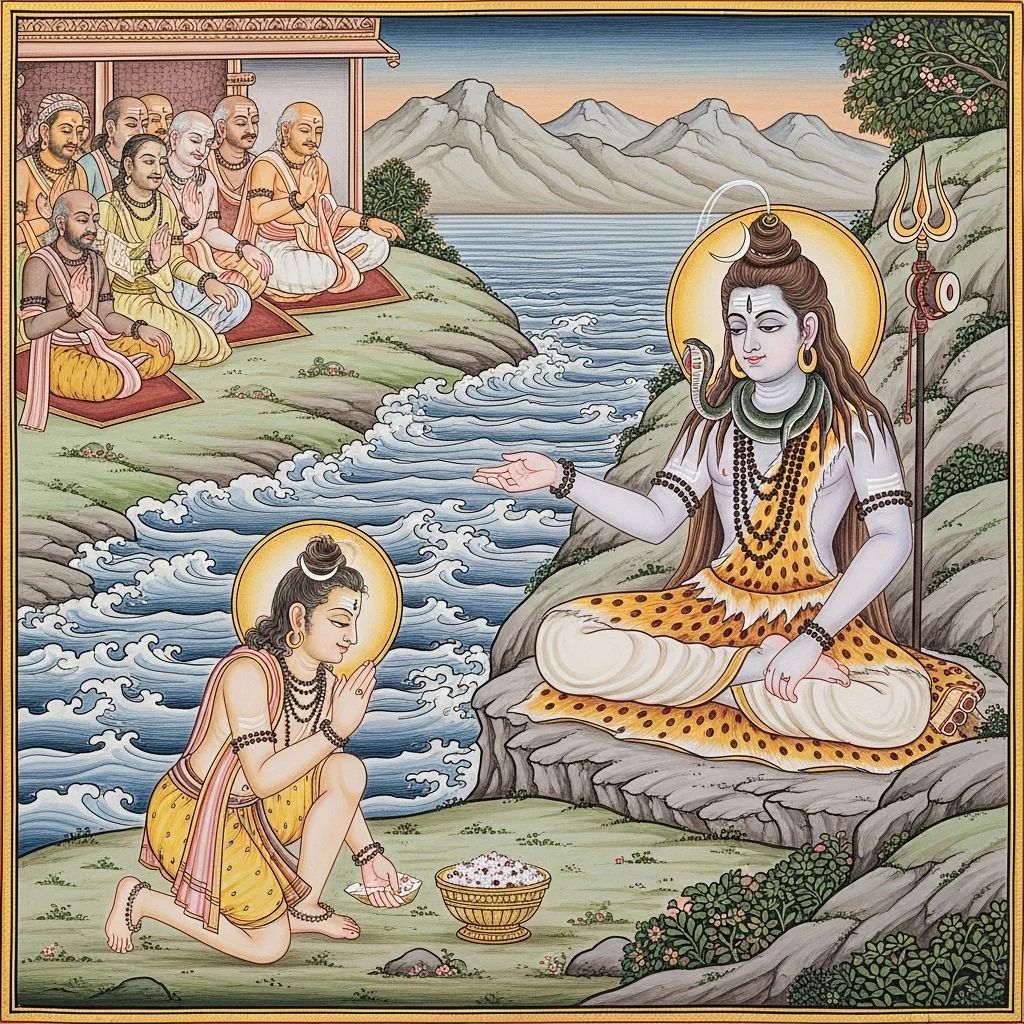
Adhyaya 22
Chapter 22 traces Soma’s (the Moon’s) passage from affliction to restoration within the sacred ritual landscape of Prabhāsa. Though granted Dakṣa’s permission, Soma remains grief-stricken, reaches Prabhāsa, and beholds the renowned Mount Kṛtasmar(a), portrayed with auspicious flora, birds, celestial musicians, and gatherings of ascetics and Vedic experts. Turning to devotional discipline, Soma repeatedly circumambulates and worships with focused mind near the sea at a liṅga associated with “Sparśa” (touch/encounter). Living on fruits and roots, he performs prolonged tapas and offers a structured hymn praising Śiva’s transcendent nature and many epithets, including a doctrinal sequence of divine names across cosmic ages. Pleased, Śiva grants a boon: Soma’s waning and waxing will alternate by fortnights, preserving Dakṣa’s spoken curse while softening its severity. A lengthy ethical excursus affirms brahminical authority as vital to cosmic stability and ritual efficacy. The chapter ends with directions about a liṅga concealed in the ocean and its installation, and explains “Prabhāsa” as the place where radiance (prabhā) is restored to Soma, once bereft of luster.
Shlokas
Verse 1
ईश्वर उवाच । दक्षेणैवमनुज्ञातः शोचन्कर्म स्वकं तदा । दुःखशोकपरीतात्मा प्रभासं क्षेत्रमागतः
Īśvara said: Thus permitted by Dakṣa, he then lamented his own deed; with his heart overwhelmed by sorrow and grief, he came to the sacred field (kṣetra) of Prabhāsa.
Verse 2
स गत्वा दक्षिणं तीरं सागरस्य समीपतः । ददर्श पर्वतं तत्र कृतस्मरमिति श्रुतम्
Having gone to the southern shore near the ocean, he beheld there a mountain renowned by the name “Kṛtasmarā”.
Verse 3
यक्षविद्याधराकीर्णं किन्नरैरुपशोभितम् । चंदनागुरुकर्पूरैरशोकैस्तिलकैः शुभैः
It was thronged with Yakṣas and Vidyādharas, and beautified by Kinnaras—fragrant with sandal, agaru, and camphor, and adorned with auspicious aśoka and tilaka trees.
Verse 4
कल्हारैः शतपत्रैश्च पुष्पितैः फलितैः शुभैः । आम्रजम्बूकपित्थैश्च दाडिमैः पनसैस्तथा
It was adorned with auspicious plants—water-lilies and hundred-petalled lotuses—beautiful in blossom and fruit; and with mango, rose-apple, wood-apple, pomegranate, and jackfruit trees as well.
Verse 5
निंबुजम्बीरनागैश्च कदलीखंडमंडितैः । क्रमुकैर्नागवल्ल्याद्यैः शालैस्तालैस्तमालकैः
It was further beautified with citron and lemon trees, with clusters of banana plants, with areca palms and creepers such as betel, and with śāla trees, palmyras, and tamāla trees.
Verse 6
बीजपूरकखर्जूरैर्द्राक्षामधुरपाटलैः । बिल्वचंपकतिंद्वाद्यैः कदंबककुभैस्तथा
It was also filled with bījapūraka (citron) trees and date-palms, with grapevines, sweet trees, and pāṭala blossoms; with bilva and campaka, with tiṃdu and other trees, and likewise with kadamba and kubha trees.
Verse 7
धवाशोकशिरीषाद्यैर्नानावृक्षैश्च शोभितम् । कामं कामफलैर्वृक्षैः पुष्पितैः फलितैः शुभैः
It was adorned with many kinds of trees—dhava, aśoka, śirīṣa, and others—indeed with wish-fulfilling trees, auspicious, flowering and laden with fruit.
Verse 8
हंसकारंडवाकीर्णं चक्रवाकोपशोभितम् । कोकिलाभिः शुकैश्चैव नानापक्षिनिनादि तम्
It was thronged with swans and kāraṇḍava birds, beautified by cakravāka pairs, and resounding with the calls of cuckoos, parrots, and many other kinds of birds.
Verse 9
जातिस्मराः पक्षिणश्च व्याजह्रुर्मानुषीं गिरम् । गंधर्वकिंनरयुगैः सिद्धविद्याधरोरगैः
There were birds endowed with memory of former births, who uttered human speech; and it was frequented by pairs of Gandharvas and Kiṃnaras, by Siddhas, Vidyādharas, and Nāgas.
Verse 10
क्रीडद्भिर्विविधैर्दिव्यैः शोभितं पर्वतोत्तमम् । देवगंधर्वनृत्यैश्च वेणुवीणानिनादितम्
That excellent mountain was beautified by many kinds of divine revelers; it was graced by the dances of Devas and Gandharvas, and filled with the music of flutes and vīṇās.
Verse 11
वेदध्वनितघोषेण यज्ञहोमाग्निहोत्रजैः । समावृतं सर्वमाज्यगंधिभिरुच्छ्रितम्
Everything there was enveloped by the reverberating sound of Vedic recitation; arising from sacrifices, homas, and agnihotra rites, it was pervaded by the fragrance of ghee.
Verse 12
शोभितं चर्षिभिर्दिव्यैश्चातुर्विद्यैर्द्विजोत्तमैः । अत्रिश्चैव वसिष्ठश्च पुलस्त्यः पुलहः क्रतुः
That place was adorned by divine seers—excellent twice-born masters of the fourfold sacred knowledge—such as Atri, Vasiṣṭha, Pulastya, Pulaha, and Kratu.
Verse 13
भृगुश्चैव मरीचिश्च भरद्वाजोऽथ कश्यपः । मनुर्यमोंऽगिरा विष्णुः शातातपपराशरौ
And also Bhṛgu and Marīci, Bharadvāja and Kaśyapa; Manu and Yama, Aṅgiras and Viṣṇu, as well as Śātātapa and Parāśara were present there.
Verse 14
आपस्तंबोऽथ संवर्तः कात्यः कात्यायनो मुनिः । गौतमः शंखलिखितौ तथा वाचस्पतिर्मुनिः
There too were Āpastamba and Saṃvarta; Kātya and the sage Kātyāyana; Gautama; Śaṅkha and Likhita; and the sage Vācaspati as well.
Verse 15
जामदग्न्यो याज्ञवल्क्य ऋष्यशृंगो विभांडकः । गार्ग्यशौनकदाल्भ्याश्च व्यास उद्दालकः शुकः
Jāmadagnya (Paraśurāma) was there, and Yājñavalkya; Ṛṣyaśṛṅga and Vibhāṇḍaka; as well as Gārgya, Śaunaka, and Dālbhyā; and Vyāsa, Uddālaka, and Śuka.
Verse 16
नारदः पर्वतश्चैव दुर्वासा उग्रतापसः । शाकल्यो गालवश्चैव जाबालिर्मुद्गलस्तथा
Nārada and Parvata were there, and Durvāsā, the fierce ascetic; likewise Śākalya and Gālava, and also Jābāli and Mudgala.
Verse 17
विश्वामित्रः कौशिकश्च जह्नुर्विश्वावसुस्तथा । धौम्यश्चैव शतानन्दो वैशंपायनजिष्णवः
There were Viśvāmitra and Kauśika; Jahnu and also Viśvāvasu; and Dhaumya, Śatānanda, and Vaiśaṃpāyana, together with Jiṣṇu.
Verse 18
शाकटायनवार्द्धिक्यावग्निको बादरायणः । वालखिल्या महात्मानो ये च भूमण्डले स्थिताः
There were Śākaṭāyana, Vārddhikya, Avagnika, and Bādarāyaṇa; and the great-souled Vālakhilyas, and other exalted ones who dwell upon the earth.
Verse 19
ते सर्वे तत्र तिष्ठंति पर्वते तु कृतस्मरे । तेजस्विनो ब्रह्मपुत्रा ऋषयो धार्मिकाः प्रिये
All of them dwell there, upon the mountain called Kṛtasmara—radiant sages, born of Brahmā, steadfast in dharma, O beloved.
Verse 20
ज्वलंतस्तपसा सर्वे निर्द्धूमा इव पावकाः । मासोपवासिनः केचित्केचित्पक्षोपवासिनः
All of them blazed with austerity, like smokeless fires. Some observed fasts for an entire month, and some observed fasts for a fortnight.
Verse 21
त्रैरात्रिकाः सांतपना निराहारास्तथा परे । केचित्पुष्प फलाहाराः शीर्णपर्णाशिनस्तथा
Some undertook three-night observances; some performed the Sāṃtapana austerity; others remained without food. Some lived on flowers and fruits, and others ate only fallen leaves.
Verse 22
केचिद्गोमयभक्षाश्च जलाहारास्तथा परे । साग्निहोत्राः सुविद्वांसो मोक्षमार्गार्थचिन्तकाः
Some even ate dried cow-dung, while others lived on water alone. Keeping the Agnihotra, those learned sages contemplated the meaning of the path to liberation (mokṣa).
Verse 23
इति हासपुराणादिश्रुतिस्मृतिविशारदाः । एते चान्ये च बहवो मार्कंडेयपुरोगमाः
Thus were those sages—expert in the Itihāsas and Purāṇas, and skilled in Śruti and Smṛti. These and many others, led by Mārkaṇḍeya, were present there.
Verse 24
प्रभासं क्षेत्रमासाद्य संस्थिता कृतपर्वते । एवं कृतस्मरस्तत्र सर्वदेवनिषेवितः । मन्वंतरेस्मिन्यो देवि निर्दग्धो वडवाग्निना
Having reached the sacred field of Prabhāsa, he took his stand upon the holy mountain Kṛtapārvata. There, revered and attended by all the gods, he became “restored in consciousness”; and in this very Manvantara, O Goddess, he had been burned by the mare-faced submarine fire, Vaḍavāgni.
Verse 25
तं दृष्ट्वा पर्वतं रम्यं दृष्ट्वा चैव महोदधिम् । प्रदक्षिणं ततश्चक्रे सप्तकृत्वो निशाकरः । गिरेः प्रदक्षिणां कृत्वा गतो यत्र महेश्वरः
Seeing that lovely mountain and also beholding the great ocean, Niśākara (the Moon) then performed pradakṣiṇā seven times. Having completed the mountain’s circumambulation, he went to the place where Maheśvara was.
Verse 26
समीपे तु समुद्रस्य स्पर्शलिंगस्वरूपवान् । प्रसादयामास विभुं प्रसन्नेनांतरात्मना
Near the ocean, taking the form of (worshipping) the Sparśa-liṅga, he sought to propitiate the all-pervading Lord, with an inward self made calm and pure.
Verse 27
मरणं वेति संध्याय शरणं वा महेश्वरम् । वरं शापाभिघातार्थं मृत्युं वा शंकरान्मम
Reflecting, “Is it death—or should I take refuge in Maheśvara?”, he concluded: “For me, even death from Śaṅkara is better, if it brings the blow of the curse to an end.”
Verse 28
इति सोमो मतिं कृत्वा तपसाऽराधयञ्छिवम् । यावद्वर्षसहस्रं तु फलमूलाशनोऽभवत्
Thus Soma, having formed his resolve, worshipped Śiva through austerity; and for a full thousand years he lived on fruits and roots alone.
Verse 29
पूर्णे वर्षसहस्रे तु चतुर्थे वरवर्णिनि । तुतोष भगवान्रुद्रो वाक्यं चेदमुवाच ह
When the fourth thousand-year period was completed, O fair one, the Blessed Rudra was pleased and spoke these words.
Verse 30
परितुष्टोऽस्मि ते चंद्र वरं वरय सुव्रत । किं ते कामं करोम्यद्य ब्रूहि यत्स्यात्सुदुर्ल्लभम्
“I am fully pleased with you, O Candra. Choose a boon, O you of noble vow. What desire of yours shall I fulfill today? Speak—even that which is most difficult to obtain.”
Verse 31
एवं प्रत्यक्षमापन्नं दृष्ट्वा देवं वृषध्वजम् । प्रणम्य तं यथाभक्त्या स्तुतिं चक्रे निशाकरः
Seeing the god Vṛṣadhvaja (Śiva, whose banner bears the bull) thus become manifest before him, Niśākara bowed down with due devotion and composed a hymn of praise.
Verse 32
चंद्र उवाच । ॐ नमो देवदेवाय शिवाय परमात्मने । अप्रमेयस्वरूपाय ब्यक्ताव्यक्तस्वरूपिणे
Candra said: “Oṃ—homage to Śiva, the God of gods, the Supreme Self; whose nature is immeasurable, who is of the form both manifest and unmanifest.”
Verse 33
त्वं पतिर्योगिनामीश त्वयि सर्वं प्रतिष्ठितम् । त्वं यज्ञस्त्वं वषट्कारस्त्वमोंकारः प्रजापतिः
“You are the Lord of yogins, O Īśa; in You all things stand established. You are the sacrifice itself; You are the vaṣaṭ-call; You are the Oṃkāra; You are Prajāpati.”
Verse 34
चतुर्विंशत्यधिकं च भुवनानां शतद्वयम् । तस्योपरि परं ज्योतिर्जागर्ति तव केवलम्
“Beyond the two hundred worlds—indeed, beyond them by twenty-four more—there shines, above all, the supreme Light; that Light alone is awake as You.”
Verse 35
कल्पांत आदिवाराहमुक्तब्रह्मांडसंस्थितौ । आधारस्तंभभूताय तेजोलिंगाय ते नमः
“Salutations to You, the Tejo-liṅga—the pillar of fiery splendor—who stands as the supporting column when the cosmic egg is released by the Primeval Boar at the end of an aeon.”
Verse 36
नमोऽनामयनाम्ने ते नमस्ते कृत्तिवाससे । नमो भैरवनाथाय नमः सोमेश्वराय ते
“Homage to You whose name is Anāmaya; homage to You, Kṛttivāsa. Homage to Bhairavanātha; homage to You, Someśvara.”
Verse 37
इति संज्ञाभिरेताभिः स्तुत्याभिरमृतेश्वरः । भूतैर्भव्यैर्भविष्यैश्च स्तूयसे सुरसत्तमैः
Thus, by these very titles and hymns, O Amṛteśvara, You are praised—by the most excellent among the gods—by those of the past, the present, and the future.
Verse 38
आद्यो विरंचिनामाभूद्ब्रह्मा लोकपितामहः । मृत्युञ्जयेति ते नाम तदाऽभूत्पार्वतीपते
In the first age, when Brahmā was known as Virañci, the grandsire of the worlds, then—O Lord of Pārvatī—Your name became “Mṛtyuñjaya”, the Conqueror of Death.
Verse 39
द्वितीयोऽभूद्यदा ब्रह्मा पद्मभूरिति विश्रुतः । तदा कालाग्निरुद्रेति तव नाम प्रकीर्तितम्
In the second phase, when Brahmā was famed as Padmabhū (Lotus-born), then Your name was proclaimed as “Kālāgnirudra”—Rudra as the Fire of Time.
Verse 40
तृतीयोऽभूद्यदा ब्रह्मा स्वयंभूरिति विश्रुतः । अमृतेशेति ते नाम कीर्तितं कीर्तिवर्द्धनम्
In the third phase, when Brahmā was renowned as Svayaṃbhū (Self-born), then Your name was sung as “Amṛteśa”—a name that increases fame and auspicious renown.
Verse 41
चतुर्थोऽभूद्यदा ब्रह्मा परमेष्ठीति विश्रुतः । अनामयेति देवेश तव नाम स्मृतं तदा
In the fourth phase, when Brahmā was famed as Parameṣṭhī, then—O Lord of the gods—Your name was remembered as “Anāmaya”, the One free from affliction.
Verse 42
पंचमोऽभूद्यदा ब्रह्मा सुरज्येष्ठ इति श्रुतः । कृत्तिवासेति ते नाम बभूव त्रिपुरांतक
In the fifth phase, when Brahmā was heard of as Surajyeṣṭha, then Your name became “Kṛttivāsa”—O Tripurāntaka, destroyer of the three cities.
Verse 43
षष्ठश्चाभूद्यदा ब्रह्मा हेमगर्भ इति स्मृतः । तदा भैरवनाथेति तव नाम प्रकीर्तितम्
And in the sixth phase, when Brahmā was remembered as Hemagarbha, then Your name was proclaimed as “Bhairavanātha”, the Lord Bhairava.
Verse 44
अधुना वर्त्तते योऽसौ शतानंद इति श्रुतः । आदिसोमेन यश्चासौ वामनेत्रोद्भवेन ते
“That one who exists even now is renowned as Śatānanda; and he is the very Ādi-Soma, born from your left eye.”
Verse 45
प्रतिष्ठार्थं तु लिंगस्य आनीतश्चाष्टवार्षिकः । बालरूपी तदा तेन सोमनाथेति कीर्तितम्
“For the consecration of the liṅga, an eight-year-old was brought; in the form of a child, it was then proclaimed by him as ‘Somnātha.’”
Verse 46
सहस्रद्वितयं चैव शतं चैव षडुत्तरम्
“Two thousand, and a hundred, plus six more.”
Verse 47
सप्तमोऽहं महादेव आत्रेय इति विश्रुतः । प्राचेतसेन दक्षेण शप्तस्त्वां शरणं गतः । रक्ष मां देवदेवेश क्षयिणं पापरोगिणम्
O Mahādeva, I am the seventh among them, renowned as Ātreya. Cursed by Dakṣa, son of Pracetas, I have come to you for refuge. Protect me, O Lord of the gods—wasting away, afflicted by the disease of sin.
Verse 48
इति संस्तुवतस्तस्य चंद्रस्य करुणाकरः । तुतोष भगवान्रुद्रो वाक्यं चेदमुवाच ह
Thus, as Candra praised him, the compassionate Lord Rudra was pleased, and he spoke these words.
Verse 49
परितुष्टोऽस्मि ते चंद्र वरं वरय सुव्रत । कि ते कामं करोम्यद्य ब्रूहि यत्स्यात्सुदुर्ल्लभम्
I am fully pleased with you, O Candra. Choose a boon, O well-vowed one. What desire shall I fulfill for you today? Speak—even that which is most difficult to obtain.
Verse 50
मम नामानि गुह्यानि मम प्रियतराणि च । पठिष्यंति नरा ये तु दास्ये तेषां मनोगतम्
Those who recite my secret names—names most dear to me—I shall grant them the desires held in their hearts.
Verse 51
अतीता ये चंद्रमसो भविष्यंति च येऽधुना । तेषां पूज्यमिदं लिंगं यावदन्योऽष्टवार्षिकः
For the Candras who have passed, for those who will come, and for those who exist now—this liṅga is to be worshipped by them, until another eight-year-old manifestation appears.
Verse 52
आः परं चतुर्वक्त्रो ब्रह्मा यो भविता यदा । प्राणनाथेति देवस्य तदा नाम भविष्यति
And further: when the four-faced Brahmā comes into being, then the Deva’s name shall be “Prāṇanātha,” Lord of the vital breath.
Verse 53
प्राणास्तु वायवः प्रोक्तास्तदाराधननाम तत् । प्राणनाथेति संप्रोक्तं मेऽधुना तद्भविष्यति
The prāṇas are spoken of as the vital airs; that indeed becomes the name of worship. Declared as “Prāṇanātha”—from now on, that shall be my worship-name.
Verse 54
तस्मादग्नीशनामेति कालरुद्रेत्यनंतरम् । तारकेति ततो नाम भविष्यत्येव कीर्तितम्
Therefore His name shall be celebrated as “Agnīśa”; next as “Kālarudra”; and thereafter as “Tāraka”—thus is the future sequence of names proclaimed.
Verse 55
मृत्युञ्जयेति देवस्य भविता तदनंतरम् । त्र्यंबकेशस्त्वितीशेति भुवनेशेत्यनन्तरम्
After that, the Deity will be known as “Mṛtyuñjaya”; then as “Tryambakeśa”; then as “Itīśa”; and thereafter as “Bhuvaneśa”.
Verse 56
भूतनाथेति घोरेति ब्रह्मेशेत्यथ नामकम् । भविष्यं पृथिवीशेति आदिनाथेत्यनंतरम्
Then His name will be “Bhūtanātha”; then “Ghore”; then “Brahmeśa”. In the future He will be called “Pṛthivīśa”, and thereafter “Ādinātha”.
Verse 57
कल्पेश्वरेति देवस्य चंद्रनाथेत्यनन्तरम् । नाम देवस्य यद्भावि सांप्रतं ते प्रकाशितम्
Then the Deity will be called Kalpeśvara, and thereafter Candranātha. The names of the Lord that are yet to come have now been revealed to you.
Verse 58
इत्येवमादि नामानि स्वसंख्यातानि षोडश । गतानि संभविष्यंति कालस्यानंतभावतः
Thus, beginning in this manner, sixteen names—each in its own ordained count—have passed and will yet arise, because Time is endless in its nature.
Verse 59
एकैकं वर्तते नाम ब्रह्मणः प्रलयावधि । ततोन्यज्जायते नाम यथा नामानुरूपतः
Each single name endures until the end of a Brahmā-era, up to dissolution; then another name arises, in accordance with the character implied by that name.
Verse 60
अथ किं बहुनोक्तेन रहस्यं ते प्रकाशितम् । वत्स यत्कारणेनेह तपस्तप्तं त्वयाऽखिलम् । तन्मे निःशेषतो ब्रूहि दास्ये तुष्टोऽस्मि ते वरम्
But what is the use of saying more? The secret has been disclosed to you. Dear child—tell Me fully for what reason you performed such complete austerity here; I am pleased and will grant you a boon.
Verse 61
चन्द्र उवाच । अहं शप्तस्तु दक्षेण कस्मिंश्चित्कारणांतरे । यक्ष्मणा च क्षयं नीतस्तस्मात्त्वं त्रातुमर्हसि
Candra said: I was cursed by Dakṣa on account of a certain cause, and I have been brought to wasting away by consumption (yakṣmā). Therefore you ought to save me.
Verse 62
शंभुरुवाच । अधुना भोः समं पश्य सर्वास्ता दक्षकन्यकाः । क्षयस्ते भविता पक्षं पक्षं वृद्धिर्भविष्यति
Śaṃbhu said: Now, O one, behold all these daughters of Dakṣa with equal regard. For you there shall be waning in one fortnight and waxing in the next—fortnight after fortnight.
Verse 63
पूर्वोचितां प्रभां सोम प्राप्स्यसे मत्प्रसादतः । प्राचेतसस्य दक्षस्य तपसा हतपाप्मनः
O Soma, by My grace you shall regain the radiance that was once yours—through the tapas of Dakṣa, son of Prācetas, whose sins have been burned away by austerity.
Verse 64
तस्यान्यथा वचः कर्तुं शक्यं नान्यैः सुरैरपि । ब्राह्मणाः कुपिता हन्युर्भस्मीकुर्युः स्वतेजसा
Not even the other gods can make his word turn out otherwise. If Brāhmaṇas grow wrathful, they can strike down and reduce one to ashes by their own tejas, their spiritual radiance.
Verse 65
देवान्कुर्युरदेवांश्च नाशयेयुरिदं जगत् । ब्राह्मणाश्चैव देवाश्च तेज एकं द्विधा कृतम्
They could make gods into non-gods, and they could even destroy this world. Brāhmaṇas and gods indeed share one single tejas, divided into two forms.
Verse 66
प्रत्यक्षं ब्राह्मणा देवाः परोक्षं दिवि देवताः । न विना ब्राह्मणा देवैर्न देवा ब्राह्मणैर्विना
Brāhmaṇas are the visible gods upon the earth; the deities in heaven are the invisible gods. Gods are not fulfilled without Brāhmaṇas, nor are Brāhmaṇas without the gods.
Verse 67
एकत्र मन्त्रा स्तिष्ठन्ति तेज एकत्र तिष्ठति । ब्राह्मणा देवता लोके ब्राह्मणा दिवि देवताः । त्रैलोक्ये ब्राह्मणाः श्रेष्ठा ब्राह्मणा एव कारणम्
In one place the mantras abide; in one place the tejas, the sacred radiance, abides. In this world Brāhmaṇas are the deities; in heaven too Brāhmaṇas are deities. In the three worlds Brāhmaṇas are supreme—Brāhmaṇas alone are the decisive cause of sacred order.
Verse 68
पितुर्नियुक्ताः पितरो भवंति क्रियासु दैवीषु भवंति देवाः । द्विजोत्तमा हस्तनिषक्ततोयास्तेनैव देहेन भवंति देवाः
When appointed by the father—through filial duty and rite—the Pitṛs, the Ancestors, become present as recipients. In the divine rites the gods become manifest. The best of the twice-born, holding water in his hands for offering, by that very body becomes, in ritual function, as it were the gods.
Verse 69
षट्क र्मतत्त्वाभिरतेषु नित्यं विप्रेषु वेदार्थकुतूहलेषु । न तेषु भक्त्या प्रविशंति घोरं महाभयं प्रेतभवं कदाचित्
Those who, with devotion, rely upon Brāhmaṇas ever intent on the principles of the six duties and eager for the meaning of the Veda, never enter that dreadful great fear—the state of becoming a preta, a restless wandering spirit.
Verse 70
यद्ब्राह्मणाः स्तुत्यतमा वदन्ति तद्देवता कर्मभिराचरंति । तुष्टेषु तुष्टाः सततं भवन्ति प्रत्यक्षदेवेषु परोक्षदेवाः
Whatever the most praise-worthy Brāhmaṇas declare, that the deities accomplish through their deeds. When the visible gods—Brāhmaṇas—are pleased, the invisible gods are ever pleased.
Verse 71
यथा रुद्रा यथा देवा मरुतो वसवोऽश्विनौ । ब्रह्मा च सोमसूर्यौ च तथा लोके द्विजोत्तमाः
Just as there are the Rudras, the Devas, the Maruts, the Vasus, and the Aśvins, so too in this world are the dvijottamas, the best of the twice-born, comparable in dignity to those divine hosts.
Verse 72
देवाधीनाः प्रजाः सर्वा यज्ञाधीनाश्च देवताः । ते यज्ञा ब्राह्मणाधीनास्तस्माद्देवा द्विजोत्तमाः
All beings depend upon the gods, and the gods depend upon yajña, the sacrifice. Those sacrifices depend upon the Brāhmaṇas; therefore the Brāhmaṇas—true devas upon the earth—are the foremost among the twice-born.
Verse 73
ब्राह्मणानर्चयेन्नित्यं ब्राह्मणांस्तर्पयेत्सदा । ब्राह्मणास्तारका लोके ब्राह्मणात्स्वर्गमश्नुते
One should worship the Brāhmaṇas daily and ever gladden them with honor and offerings. The Brāhmaṇas are guiding stars in the world; through the Brāhmaṇas one attains heaven.
Verse 75
शक्यं हि कवचं भेत्तुं नाराचेन शरेण वा । अपि वज्र सहस्रेण ब्राह्मणाशीः सुदुर्भिदा
A coat of mail can indeed be pierced—by a steel-pointed arrow or by a sharp shaft; but a Brāhmaṇa’s blessing is exceedingly hard to break, even with a thousand vajras, thunderbolts.
Verse 76
हुतेन शाम्यते पापं हुतमन्नेन शाम्यति । अन्नं हिरण्यदानेन हिरण्यं ब्राह्मणाशिषा
Sin is pacified by offerings cast into the sacred fire; and what is offered as food is likewise made auspicious. Food is sanctified by the gift of gold, and gold itself is sanctified by a Brāhmaṇa’s blessing.
Verse 77
य इच्छेन्नरकं गंतुं सपुत्रपशुबांधव । देवेष्वधिकृतं कुर्याद्ब्राह्मणेषु च गोषु च
Whoever wishes to go to hell—along with his sons, cattle, and kinsmen—should commit wrongdoing against the gods, against the Brāhmaṇas, and against cows.
Verse 78
ब्राह्मणान्द्वेष्टि यो मोहाद्देवान्गाश्च मखान्यदि । नैव तस्य परो लोको नाऽयं लोको दुरात्मनः
One who, out of delusion, hates the Brāhmaṇas and scorns the gods, the cows, and the sacrifices, has neither the next world nor even this world; such a one is truly wicked.
Verse 79
अभेद्यमच्छेद्यमनादिमक्षयं विधिं पुराणं परिपालयन्ति । महामतिस्तानभिपूज्य वै द्विजान्भवेदजेयो दिवि देवराडिव
They preserve the ancient ordinance—unbreakable, uncuttable, beginningless, and imperishable. A wise man, having duly honored the twice-born, becomes unconquerable in heaven, like Indra, king of the gods.
Verse 80
अग्रं धर्मस्य राजानो मूलं धर्मस्य ब्राह्मणाः । तस्मान्मूलं न हिंसीत मूले ह्यग्रं प्रतिष्ठितम्
Kings are the foremost visible face of dharma, but Brāhmaṇas are dharma’s root. Therefore one should not harm the root, for upon the root the foremost part is established.
Verse 81
फलं धर्मस्य राजानः पुष्पं धर्मस्य ब्राह्मणाः । तस्मात्पुष्पं न हिंसीत पुष्पात्संजायते फलम्
Kings are the fruit of dharma; Brāhmaṇas are dharma’s flower. Therefore one should not harm the flower, for from the flower the fruit is born.
Verse 82
राजा वृक्षो ब्राह्मणास्तस्य मूलं पौराः पर्णं मन्त्रिणस्तस्य शाखाः । तस्माद्राज्ञा ब्राह्मणा रक्षणीया मूले गुप्ते नास्ति वृक्षस्य नाशः
The king is a tree; Brāhmaṇas are its roots; citizens are its leaves; ministers are its branches. Therefore the king must protect the Brāhmaṇas—for when the root is guarded, the tree does not perish.
Verse 83
आसन्नो हि दहत्यग्निर्दूराद्दहति ब्राह्मणः । प्ररोहत्यग्निना दग्धं ब्रह्मदग्धं न रोहति
Fire burns when one is near, but a Brāhmaṇa’s sacred power burns even from afar. What is burnt by fire may sprout again; but what is burnt by brahman, the holy might, does not grow back.
Verse 84
ब्राह्मणानां च शापेन सर्वभक्षो हुताशनः । समुद्रश्चाप्यपेयस्तु विफलश्च पुरंदरः
By the curse of Brāhmaṇas, even Fire becomes a devourer without discernment; the ocean turns undrinkable; and even Purandara (Indra) becomes powerless, his efforts bearing no fruit.
Verse 85
त्वं चन्द्र राजयक्ष्मी च पृथिव्यामूषराणि च । सूर्याचन्द्रमसोः पातः पुनरुद्धरणं तयोः
You are the Moon, royal fortune and splendor, and even the barren tracts upon the earth. You are the downfall of the Sun and the Moon—and again, their restoration.
Verse 86
वनस्पतीनां निर्यासो दानवानां पराजयः । नागानां च वशीकारः क्षत्रस्योत्सादनं तथा । देवोत्पत्ति विपर्यासो लोकानां च विपर्ययः
From it arise the sap and exudations of trees; the defeat of the Dānavas; the subduing of Nāgas; likewise the overthrow of an arrogant kṣatriya power; inversion even in the very birth of the gods—and upheaval among the worlds.
Verse 87
एवमादीनि तेजांसि ब्राह्मणानां महात्मनाम् । तस्माद्विप्रेषु नृपतिः प्रणमेन्नित्यमेव च
Such, and many other, are the powers of great-souled Brāhmaṇas. Therefore a king should bow to the vipras (Brāhmaṇas)—always, indeed.
Verse 88
परा मप्यापदं प्राप्तो ब्राह्मणान्न प्रकोपयेत् । ते ह्येनं कुपिता हन्युः सद्यः सबलवाहनम्
Even when one has fallen into the gravest calamity, one should not provoke the brāhmaṇas; for if they are angered, they can destroy him at once—together with his army and mounts.
Verse 89
प्रणीतश्चाप्रणीतश्च यथाग्निर्दैवतं महत् । एवं विद्वानविद्वान्वा ब्राह्मणो दैवतं महत्
Just as fire is a great divinity whether kindled with rites or not, so too a brāhmaṇa—learned or unlearned—is a great divinity.
Verse 90
श्मशानेष्वपि तेजस्वी पावको नैव दुष्यति । हूयमानश्च यज्ञेषु भूय एवाभिवर्द्धते
Even in cremation grounds the radiant Fire is not defiled; and when offerings are poured into it in sacrifices, it only increases all the more.
Verse 91
एवं यद्यप्य निष्टेषु वर्त्तते सर्वकर्मसु । सर्वेषां ब्राह्मणः पूज्यो दैवतं परमं महत्
Thus, even if he moves amid improper acts in every kind of work, for all people a brāhmaṇa is to be honored—as the supreme, great divinity.
Verse 92
क्षत्रस्यातिप्रवृद्धस्य ब्राह्मणानां प्रभावतः । ब्राह्मं हि परमं पूज्यं क्षत्रं हि ब्रह्मसंभवम्
Even when royal power (kṣatra) becomes excessively swollen, it is through the influence of the brāhmaṇas. For the brahman-principle is supremely worthy of honor, and kṣatra itself arises from brahman.
Verse 93
अद्भ्योऽग्निर्ब्रह्मतः क्षत्रमश्मनो लोहमुत्थितम् । तेषां सर्वत्रगं तेजः स्वासु योनिषु शाम्यति
From waters arises fire; from Brahman arises kṣatra; from stone is born iron. Yet the radiance that can pervade everywhere grows still when it returns to its own source.
Verse 94
यान्समाश्रित्य तिष्ठन्ति देवलोकाश्च सर्वदा । ब्रह्मैव वचनं येषां को हिंस्यात्ताञ्जिजीविषुः
Those upon whom even the worlds of the gods continually rely—whose very speech is Brahman—who, wishing to live, would dare to harm them?
Verse 95
म्रियमाणोऽप्याददीत न राजा ब्राह्मणात्करम् । न च क्षुधा ऽस्य संसीदेद्ब्राह्मणो विषये वसन्
Even if he were dying, a king should not take tax from a Brāhmaṇa; and a Brāhmaṇa living within the king’s realm should never be allowed to languish from hunger.
Verse 96
यस्य राज्ञश्च विषये ब्राह्मणः सीदति क्षुधा । तस्य तच्छतधा राष्ट्रमचिरादेव सीदति
In whatever king’s realm a Brāhmaṇa falls into misery through hunger, that king’s kingdom quickly falls into ruin a hundredfold.
Verse 97
यद्राजा कुरुते पापं प्रमादाद्यच्च विभ्रमात् । वसन्तो ब्राह्मणा राष्ट्रे श्रोत्रियाः शमयन्ति तत्
Whatever sin a king commits through negligence or delusion, the learned Brāhmaṇas—śrotriyas grounded in sacred hearing and tradition—dwelling in the kingdom pacify and neutralize it.
Verse 98
पूर्वरात्रांतरात्रेषु द्विजैर्यस्य विधीयते । स राजा सह राष्ट्रेण वर्धते ब्रह्मतेजसा
That king for whom the twice-born perform the rites in the early and middle watches of the night—he prospers, together with his realm, through the radiance of Brahmanic spiritual power.
Verse 99
ब्राह्मणान्पूजयेन्नित्यं प्रातरुत्थाय भूमिपः । ब्राह्मणानां प्रसादेन दीव्यन्ति दिवि देवताः
Rising early each morning, the king should constantly honor the Brāhmaṇas; by the grace and satisfaction of the Brāhmaṇas, even the gods rejoice in heaven.
Verse 100
अथ किं बहुनोक्तेन ब्राह्मणा मामकी तनुः । ये केचित्सागरांतायां पृथिव्यां कीर्तिता द्विजाः । तदूपं देवदेवस्य शिवस्य परमात्मनः
But what is the use of saying much? The Brāhmaṇas are My very body. Whatever twice-born are renowned across this earth bounded by the oceans—they are the very form of Śiva, the God of gods, the Supreme Self.
Verse 101
एतान्द्विषंति ये मूढा ब्राह्मणान्संशितव्रतान् । ते मां द्विषंति वै नूनं पूजनात्पूजयन्ति माम्
Those deluded ones who hate these Brāhmaṇas of firm vows truly hate Me; and those who honor them, by that very honoring, worship Me.
Verse 102
न प्रद्वेषस्ततः कार्यो ब्राह्मणेषु विजानता । प्रद्वेषेणाशु नश्यन्ति ब्रह्मशापहता नराः
Therefore, one who understands should not harbor hatred toward the Brāhmaṇas; by hatred, men quickly perish, struck down by the curse born of Brahmanic power.
Verse 103
इत्येवं कथितश्चन्द्र ब्राह्मणानां गुणार्णवः । कुरुष्वानन्तरं कार्य्यं यद्ब्रवीम्यहमेव ते
Thus, O Candra, the ocean of the virtues of the Brāhmaṇas has been described. Now perform the next task, as I myself shall tell you.
Verse 104
शापस्यानुग्रहो दत्तो मया तव निशाकर । न चान्यथा वचः कर्त्तुं शक्यं तेषां द्रिजन्मनाम्
O Niśākara, I have granted you relief from the curse; yet the word of the twice-born (Dvijas) cannot be made to turn out otherwise.
Verse 106
क्षयस्ते भविता पक्षं पक्षं वृद्धिर्भविष्यति । अथान्यद्वचनं चन्द्र शृणु कार्यं यथा त्वया
You shall wane for a fortnight and wax again for a fortnight. And now, O Candra, listen to another command—what is to be done by you.
Verse 107
इदं यत्सागरोपांते तिष्ठते लिंगमुत्तमम् । धरामध्यगतं तच्च देवानां दृष्टिगोचरम्
This supreme Liṅga that stands on the seashore—though set within the earth—remains within the sight and awareness of the gods.
Verse 108
कुक्कुटांडसमप्रख्यं सर्पमेखलमंडितम् । ममाद्यं परमं तेजो न चान्यो वेद कश्चन
It shines like a hen’s egg and is adorned with a girdle of serpents. This is My primeval, supreme radiance—none other truly knows it.
Verse 109
इतः सागरमध्ये तु धनुषां च शतत्रये । तिष्ठते तत्र लिंगं तु सुगुप्तं लक्षणान्वितम्
From here, in the midst of the ocean—three hundred bow-lengths away—there stands a Liṅga, well concealed, yet bearing its distinctive marks.
Verse 110
आदिकल्पे महर्षीणां शापेन पतितं मम । लिंगं सागरमध्ये तु तत्त्वं शीघ्रं समानय
In the first age, by the curse of the great Ṛṣis, My Liṅga fell into the midst of the ocean. Bring that sacred reality forth quickly.
Verse 111
स्पर्शाख्यं यत्र मे लिंगं तत्र स्थाने निवेशय । निवेश्य तु प्रयत्नेन सहितो विश्वकर्मणा
Install My Liṅga in that place known as ‘Sparśa’. Having installed it with due effort—together with Viśvakarman—
Verse 112
ततो ब्रह्माणमाहूय समेतं तु मुनीश्वरैः । प्रतिष्ठां कारय विभो इष्ट्वा तत्र महामखैः
Then, summoning Brahmā—together with the lordly sages—have the consecration (pratiṣṭhā) performed, O mighty one, after worshipping there with great sacrifices.
Verse 113
एवमुक्त्वा स भगवांस्तत्रैवांतरधीयत । ततः प्रभां पुनर्लेभे रात्रिनाथो वरानने
Having spoken thus, that Blessed Lord vanished right there. Thereupon the Lord of Night—the Moon—regained his radiance, O fair-faced one.
Verse 114
ततः प्रभृति तत्क्षेत्रं प्रभासमिति विश्रुतम् । निष्प्रभस्य प्रभा दत्ता प्रभासं तेन चोच्यते
From that time onward, that sacred region became renowned as “Prabhāsa.” Since radiance was bestowed upon one who had become without radiance, it is therefore called Prabhāsa.
Verse 115
दक्षस्य तु वृथा शापो न कृतस्तेन लांछनम् । सोमः प्रभासते लोकान्वरं प्राप्य महेश्वरात् । व्यक्तीभूतः स देवेशः सोमस्यैव महात्मनः
Thus Dakṣa’s curse did not become futile, nor was it a mere stigma. Having obtained a boon from Maheśvara, Soma shines upon the worlds. And the Lord of the gods became manifest for that very great-souled Soma.
Verse 1085
शापानुग्रहदैः सर्वै देवैरपि सवासवैः । तस्माच्चन्द्र त्वया शोको नैव कार्यो विजानता
Even the gods—together with Indra—are all bestowers of both curse and grace. Therefore, O Candra, knowing this truth, you should not grieve at all.