Adhyaya 196
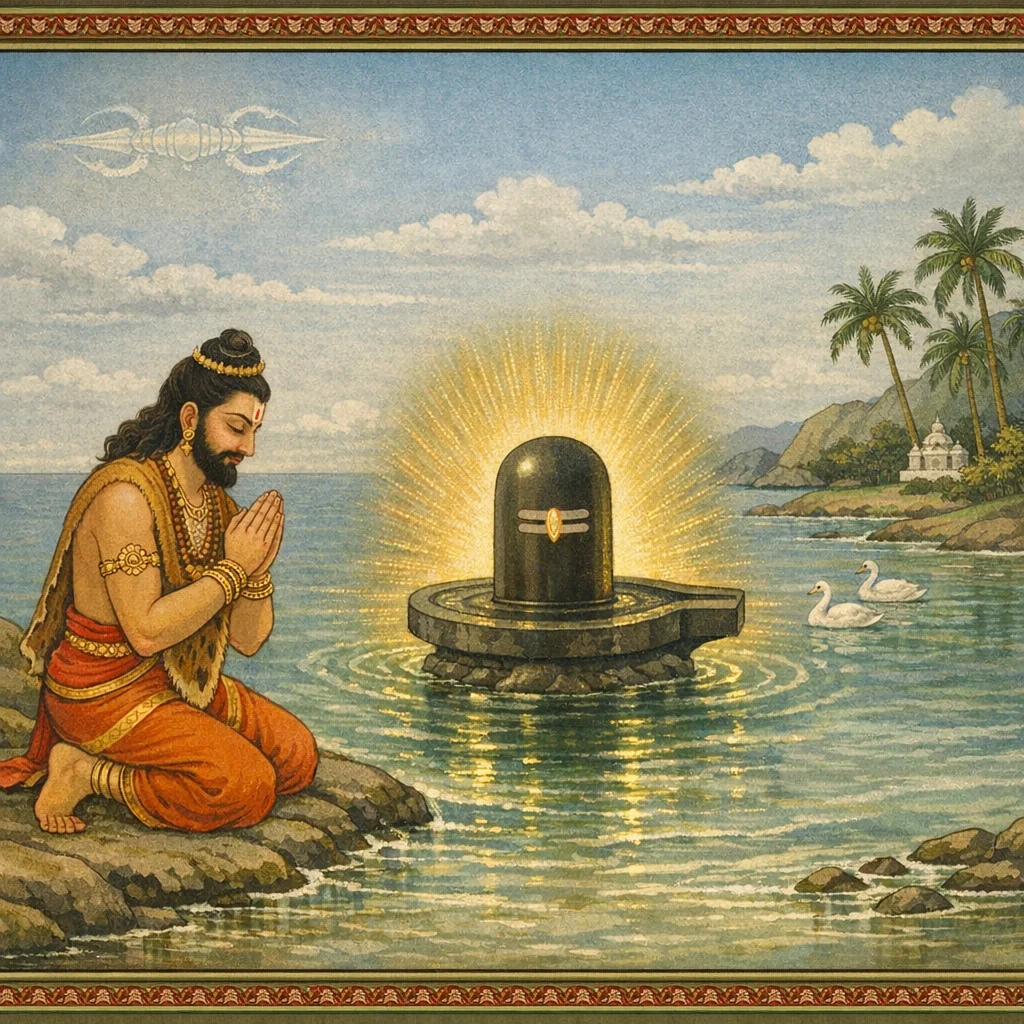
Īśvara directs Devī to a water-founded Prabhāsa tīrtha lying south of Vṛddha-Prabhāsa, proclaiming its “uttama” (most exalted) māhātmya. The account centers on Jāmadagnya Rāma (Paraśurāma), who, after the mass slaying of kṣatriyas, is seized by deep inner anguish and revulsion toward sin (ghṛṇā), and therefore performs years of intense tapas and worship of Mahādeva seeking relief. Śiva appears and offers a boon. Rāma asks for the vision of Śiva’s own liṅga, said to be repeatedly covered by Indra’s vajra out of fear. Śiva declines to grant direct liṅga-darśana in that form, but gives a remedy: by touch (sparśana) and by approaching a liṅga that will arise from within the sacred waters, Rāma’s distress and sin will be removed. A great liṅga then emerges from the water, and the place becomes known as Jala-Prabhāsa. The chapter ends with phalaśruti: mere contact with this tīrtha leads to Śiva-loka, and feeding even one well-conducted brāhmaṇa there is equal to feeding Śiva Himself (with Umā). The narrative is praised as pāpa-upaśamanī (sin-quelling) and sarvakāma-phalapradā (bestowing all desired fruits).
Shlokas
Verse 1
ईश्वर उवाच । ततो गच्छेन्महादेवि प्रभासं जलसंस्थितम् । वृद्धप्रभासाद्दक्षिणतो नातिदूरे व्यवस्थितम्
Īśvara said: “Then, O great goddess, one should go to Prabhāsa, situated by sacred waters, located not far to the south of Vṛddha‑Prabhāsa.”
Verse 2
तस्यैव देवि देवस्य शृणु माहात्म्यमुत्तमम्
“And now, O goddess, listen to the supreme māhātmya—the exalted glory—of that very deity.”
Verse 3
जामदग्न्येन रामेण यदा क्षत्त्रवधः कृतः । तदाऽस्य परमा जाता घृणा मनसि भामिनि
“When Rāma Jāmadagnya (Paraśurāma) carried out the slaying of the kṣatriyas, then, O radiant one, an intense remorse arose in his mind.”
Verse 4
ततस्त्वाराधयामास महादेवं सुरेश्वरम् । उग्रं तपः समास्थाय बहून्वर्ष गणान्प्रिये
Then he worshipped Mahādeva, the Lord of the gods; undertaking fierce austerity, O beloved, for many years.
Verse 5
ततस्तुष्टो महादेवस्तस्य प्रत्यक्षतां गतः । अब्रवीद्वरदस्तेऽहं वरं वरय सुव्रत
Then Mahādeva, pleased, became manifest before him and said: ‘I am your giver of boons—choose a boon, O steadfast one.’
Verse 6
राम उवाच । यदि तुष्टोऽसि मे देव यदि देयो वरो मम । दर्शयस्व स्वकं लिंगं यज्ञे वज्रेण छादितम्
Rāma said: “If you are pleased with me, O Lord, and if a boon is to be granted to me—then show me your own Liṅga, which in the sacrifice is covered by the thunderbolt.”
Verse 7
घृणा मे महती जाता हत्वेमान्क्षत्रियान्बहून् । दर्शनात्तव लिंगस्य येन मे नश्यते घृणा
“Great remorse has arisen in me, having slain many kṣatriyas. Through the sight of your Liṅga, may that remorse of mine be destroyed.”
Verse 8
तथा मे पातकं सर्वं प्रसादात्तव शंकर
“And likewise, O Śaṅkara, by your grace may all my sin be removed.”
Verse 9
शंकर उवाच । मम लिंगं सहस्राक्ष उत्थितं तु पुनःपुनः । वज्रेणाच्छादयत्येव भयेन महता वृतः
Śaṅkara said: “O Sahasrākṣa (Indra), my Liṅga rises again and again; yet you, encompassed by great fear, keep covering it with the vajra (thunderbolt).”
Verse 10
न तेऽहं दर्शनं यास्ये लिंगरूपी कदाचन
“I will never come into your sight in the form of the Liṅga.”
Verse 11
यन्मां वदसि घृणया वृतोऽहं पातकेन तु । तत्तेऽहं नाशयिष्यामि स्पर्शनात्तु द्विजोत्तम
“Since, out of aversion, you say that I am surrounded by impurity and sin—O best of the twice-born—by my very touch I shall destroy that sin of yours.”
Verse 12
अस्मिञ्जलाश्रये पुण्ये जलमध्ये महामते । उत्थास्यति महालिंगं तस्य त्वं दर्शनं कुरु
“In this holy water-reservoir, O great-minded one, a great Liṅga will rise up from the midst of the waters; behold it with reverence.”
Verse 13
गमिष्यति घृणा सर्वा निष्पापस्त्वं भविष्यसि । उक्त्वैवमुदतिष्ठच्च जलमध्याद्वरानने
“All your aversion will depart, and you will become sinless.” Having said so, the fair-faced one rose up from the midst of the waters.
Verse 14
जलप्रभासनामास्य ततो जातं धरातले । तस्यालं स्पर्शनाद्देवि शिवलोकं व्रजेन्नरः
From that, upon the earth’s surface, arose the tīrtha named Jalaprabhāsa. O Goddess, by merely touching it, a person goes to Śiva’s world.
Verse 15
एकं भोजयते योऽत्र ब्राह्मणं शंसितव्रतम् । भोजितोऽहं भवेत्तेन सपत्नीको न संशयः
Whoever here feeds even one Brāhmaṇa devoted to praised vows—by that act I too am fed, together with my consort; of this there is no doubt.
Verse 16
एषा जलप्रभासस्य संभूतिस्ते मयोदिता । श्रुता पापोपशमनी सर्वकामफलप्रदा
This is the origin of Jalaprabhāsa, as I have told you. When heard, it allays sins and grants the fruits of all desired aims.
Verse 196
इति श्रीस्कांदे महापुराण एकाशीति साहस्र्यां संहितायां सप्तमे प्रभासखण्डे प्रथमे प्रभासक्षेत्रमाहात्म्ये जलप्रभासमाहात्म्यवर्णनंनाम षण्णवत्युत्तरशततमोऽध्यायः
Thus, in the holy Skanda Mahāpurāṇa, in the Saṃhitā of eighty-one thousand verses, in the seventh book called Prabhāsa-khaṇḍa, within the first division, the Prabhāsa-kṣetra-māhātmya, ends the chapter entitled “Narration of the Glory of Jalaprabhāsa,” being Chapter 196.