Adhyaya 32
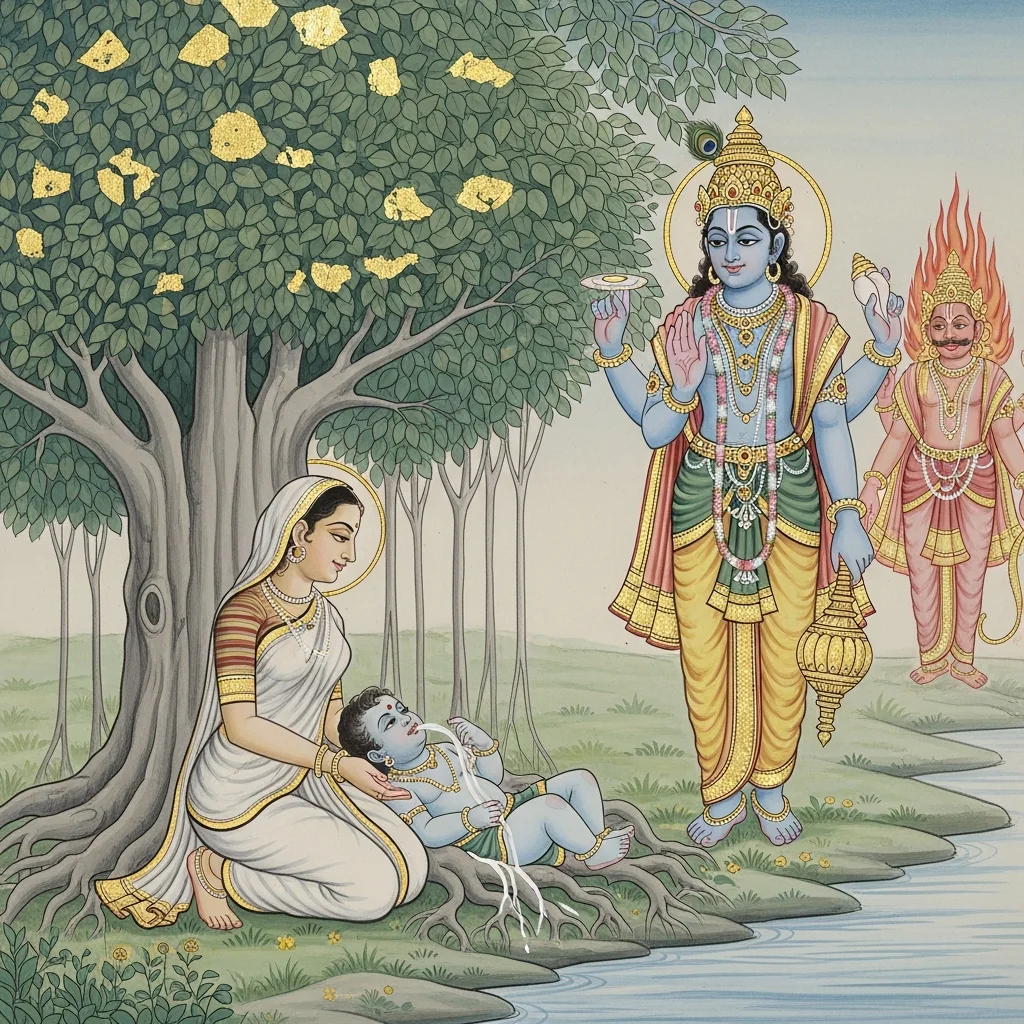
Chapter 32 presents linked episodes weaving ascetic life, divine governance, and karmic causality. After the gods depart, the brāhmaṇa-sage Dadhīci continues his austerities, moves north, and dwells in a riverside āśrama. His attendant Subhadrā, while bathing, unknowingly encounters a discarded loincloth bearing semen and later discovers her pregnancy; ashamed, she gives birth in an aśvattha-grove and utters a conditional curse upon the unknown agent. The lokapālas and Indra then approach Dadhīci to reclaim the weapons once entrusted to him. Dadhīci explains that he has absorbed their power and proposes that new weapons be fashioned from his own bones; he willingly relinquishes his body for the divine mandate of protection. Five divine cows (Surabhīs) are brought to cleanse the remains, and a dispute results in a curse upon Sarasvatī, offering a narrative basis for certain ritual-impurity conventions. Viśvakarman subsequently forges the lokapālas’ weapons—vajra, cakra, śūla, and others—from Dadhīci’s bones. Later Subhadrā finds the child alive; the boy speaks of karmic necessity and is named Pippalāda, sustained by aśvattha sap. Learning that his father was slain for weapon-making, he vows vengeance and performs tapas to generate a destructive kṛtyā; from his thigh arises a fiery being linked with the Vāḍava fire. The devas seek refuge, and Viṣṇu intervenes with a regulated mitigation—consumption one by one—turning catastrophic wrath into ordered cosmic function. The chapter ends with a phala-claim: attentive hearing dispels fear of transgression and supports knowledge and liberation.
Shlokas
Verse 1
ईश्वर उवाच । ततस्तेषु प्रयातेषु देवदेवेष्वसौ मुनिः । शतवर्षाणि तत्रस्थस्तपसे प्रस्थितो द्विजः
Īśvara said: When those gods had departed, that sage remained there; that twice-born one set forth upon tapas, practicing austerities for a hundred years.
Verse 2
आश्रमादुत्तरात्तस्माद्दिव्यां दिशमथो त्तराम् । सुभद्रापि महाभागा तस्य या परिचारिका
From the northern side of that hermitage, toward the divine northern quarter, the fortunate Subhadrā too—his attendant—turned and went.
Verse 3
अस्त्रादानेऽसमर्था सा ऋषिं प्रोवाच भामिनी । नाहं नेतुं समर्थास्मि शस्त्राण्यालभ्य पाणिना
Unable to hand over the weapons, the impassioned woman spoke to the seer: “I am not able to carry these weapons, even after taking them up in my hands.”
Verse 4
जलेन सह तद्वीर्यं पीतवान्स ऋषिस्ततः । आत्मसंस्थानि सर्वाणि दिव्यान्यस्त्राण्यसौ मुनिः । कारयित्वोत्तरामाशां जगाम तपसां निधिः
Then the seer drank that potency together with water. And that sage—treasury of austerity—caused all the divine weapons to be established within himself, and thereafter departed toward the northern direction.
Verse 5
गंगाधरं शुक्लतनुं सर्प्पैराकीर्णविग्रहम् । शिववत्सुखदं पुंसामपश्यत्स हिमाचलम्
He beheld Himālaya—bearing the Gaṅgā, white-bodied, his form adorned with serpents—granting happiness to people, like Śiva Himself.
Verse 6
तथाश्रमं ददर्शोच्चैरश्वत्थैः परिपालितम् । चंद्रभागोपकंठस्थं समित्पुष्पकुशान्वितम्
Then he beheld an āśrama, well guarded by lofty aśvattha trees, set upon the bank of the Candrabhāgā, and furnished with sacred fuel-sticks, flowers, and kuśa grass.
Verse 7
स तस्मिन्मुनिशादूलो ह्यवसन्मुनिभिः सह । सुभद्रया च संयुक्तश्चंद्रश्चंद्रिकया यथा
That tiger among sages dwelt there with other munis, joined with Subhadrā, as the moon is joined with its moonlight.
Verse 8
एकदा वसतस्तस्य सुभद्रा परिचारिका । स्नानार्थं यातुमारब्धा चतुर्थेऽह्नि रजस्वला
Once, while he was living there, Subhadrā the attendant—on the fourth day of her menstrual course—set out to go for bathing.
Verse 9
व्रजन्त्या च तया दृष्टं कौपीनाच्छादनं पुनः । परि त्यक्तं विदित्वैवं दैवयोगाद्गृहाण सा
As she went along, she again saw a kaupīna, a loincloth-covering, cast aside. Knowing it to have been discarded, she took it up—by a conjunction of fate.
Verse 10
परिधाय पुनः सा तु कौपीनं रेतसायुतम् । एकांते स्नातुमारब्धा जलाभ्याशे यथासुखम्
Putting it on again—though the kaupīna was stained with semen—she withdrew to a secluded spot and began to bathe near the water, as she pleased.
Verse 11
ततो देवी यथाकाममकस्माद्वीक्षते हि सा । स्वोदरस्थं समुत्पन्नं गर्भं गुरुभरालसा
Then the lady, as she wished, suddenly looked and saw a pregnancy arisen within her own womb; weighed down by its heaviness, she grew languid.
Verse 12
शोचयित्वात्मनात्मानमगर्भाहमिहागता । तत्केन मन्दभागिन्या ममैवं दूषणं कृतम्
Grieving within herself, she said: “I came here not pregnant. By whom has this disgrace been brought upon me—unfortunate as I am?”
Verse 13
लज्जाभिभूता सा तत्र प्रविश्याश्वत्थवाटिकाम् । तत्र तं सुषुवे गर्भमविज्ञाय कुतो ह्ययम्
Overcome with shame, she entered the aśvattha-grove. In that very place she gave birth to the child in her womb, not knowing at all, “From where has this come?”
Verse 14
पुनरेव हि सा स्नात्वा अविज्ञायात्मदुष्कृतम् । शापं दातुं समारब्धा गर्भकर्त्तरि दुःसहम्
Then again, after bathing—still unaware of her own wrongdoing—she set about pronouncing a dreadful curse upon the one who had caused the pregnancy.
Verse 15
ज्ञानाद्वा यदि वाज्ञानाद्येनेयं दूषणा कृता । सोऽद्यैव पंचतां यातु यद्यहं स्यां पतिव्रता
Whether knowingly or unknowingly—whoever has brought about this defilement—may he this very day go to death, if I am truly devoted to my husband.
Verse 16
यद्यहं मनसा वापि कामये नापरं पतिम् । एतेन सत्यवाक्येन यातु जारः स्वयं क्षयम्
If even in my mind I desire no husband other than my own—by this utterance of truth, may that adulterous lover at once go to his own destruction.
Verse 17
एवं शप्त्वा तु तं देवी ह्यज्ञात्वा गर्भकारिणम् । पुनर्यातुं समारब्धा तद्दधीचिनिकेतनम्
Having thus cursed him—though not knowing who the true begetter was—the lady then prepared to return again to the dwelling of Dadhīci.
Verse 18
तत्र चार्कप्रतीकाशं गर्भमुत्सृज्य सा तदा । प्राप्ता तपोवनं रम्यं यत्रासौ मुनिपुंगवः
Leaving there the child, radiant like the sun, she then reached the lovely forest of austerities, where that foremost of sages resided.
Verse 19
अत्रांतरे सर्वदेवा लोकपाला महाबलाः । अस्त्राणां कारणार्थाय मुनेराश्रममागताः
Meanwhile, all the gods and the mighty guardians of the worlds arrived at the sage’s hermitage, seeking the cause and means for obtaining the divine weapons.
Verse 20
उवाच तं मुनिं शक्रो न्यासो यस्तव सुव्रत । दत्तोऽस्माभिस्तु शस्त्राणां तानि क्षिप्रं प्रयच्छ नः
Śakra said to that sage: “O well-vowed one, the deposit of weapons that was entrusted to you by us—hand those weapons over to us quickly.”}]}
Verse 21
ऋषिराह पुरा यत्र स्थापि तानि ममाश्रमे । तत्रैव तानि तिष्ठंति न चानीतानि वासव
The sage replied: “O Vāsava, wherever they were once placed in my hermitage—there alone they remain; they have not been brought here.”
Verse 22
यत्तु तेषां बलं वीर्यं संग्रामे शत्रुसूदन । तन्मया पीतमखिलं सह तोयेन वासव
“But as for their strength and potency in battle, O slayer of foes—O Vāsava—I have drunk it all in, entirely, along with the water.”
Verse 23
एवं स्थिते मयाऽस्त्राणि यदि देयानि तेऽनघ । ततोस्थीनि प्रयच्छामि तदाकाराणि सुव्रत
“If, in these circumstances, my weapons are indeed to be given to you, O sinless one—then I shall offer my very bones, O you of noble vow, in those very forms.”
Verse 24
एवमुक्तः सहस्राक्षस्तमाह मुनिसत्तमम् । नान्येषु तद्बलं रौद्रं यत्तु तेषु व्यवस्थितम्
Thus addressed, Sahasrākṣa (Indra) spoke to the foremost of sages: “That fierce power which stands established in those (weapons) is not found in any others.”
Verse 25
यस्मात्तेषु विनिक्षिप्य सहस्रांशं स्वतेजसाम् । अस्माकं दत्तवान्रुद्रो रक्षार्थं जगतां शिवः
“For Rudra—Śiva, the auspicious protector of the worlds—placed within those (weapons) a thousandfold portion of his own fiery splendor and bestowed them upon us for the safeguarding of creation.”
Verse 26
तद्वयं तानि सर्वाणि गृहीत्वा च व्यवस्थिताः । लोकस्य रक्षणार्थाय संज्ञेयं तेन लोकपाः
Therefore, having taken up all those weapons and standing steadfast, ready for duty, we devote ourselves to the protection of the world; hence we are known as the Lokapālas, the guardians of the realms.
Verse 27
अमीषामपि शस्त्राणा मुत्तमं वज्रमिष्यते । तद्धारणाद्यतोऽस्माकं देवराजत्वमिष्यते
Among these weapons, the vajra is esteemed the finest. For by bearing it, our sovereignty as Devarāja—the king of the gods—is secured and acknowledged.
Verse 28
वज्रादप्युत्तमं चक्रं यत्तद्विष्णुपरिग्रहे । दैत्यदानवसंघानां तदायत्तो जयोऽभवत्
Yet superior even to the vajra is the cakra, the discus that abides in Viṣṇu’s grasp; upon it depended victory over the hosts of Daityas and Dānavas.
Verse 29
तस्मात्तानि यथास्माभिः प्राप्यते मुनिसत्तम । तथा कुरुष्व संचिन्त्य कार्यं कार्यविदां वर
Therefore, O best of sages, after due reflection act in such a way that those weapons may be obtained by us—O foremost among those who know what must be done.
Verse 30
एवमुक्ते मुनिः प्राह तं शक्रं पुरतः स्थितम् । तत्प्राप्त्यर्थमुपायं तु कथयामि तवापरम्
When this was said, the sage replied to Śakra standing before him: “I shall tell you another means by which they may be obtained.”
Verse 31
यान्येतानि ममास्थीनि यूयं तैस्तानि सर्वशः । निर्मापयध्वं शस्त्राणि तदाकाराणि सर्वशः
“Using these bones of mine, you should have all those weapons fashioned completely, making them in every respect according to those very forms.”
Verse 32
एतानि तत्समुत्थानि तेषामप्यधिकं बलम् । साधयिष्यति भवतां संग्रामे यन्ममेहितम्
“Weapons produced from these (bones) will possess strength even greater than theirs; in battle they will accomplish for you what I have intended.”
Verse 33
तमुवाच ततः शक्रो दधीचिं तपसोनिधिम् । प्राणहारं प्रकर्तुं ते नाहं शक्तो यमिच्छसि
Then Śakra (Indra) spoke to Dadhīci, that treasury of austerity: “I am not able to take away your life, as you wish me to do.”
Verse 34
न चामृतस्य तेऽस्थीनि ग्रहीतुं शक्तिरस्ति नः । तस्मात्सर्वं समालोच्य यत्कर्तव्यं तदुच्यताम्
“Nor do we have the power to take your bones—made deathless by your austerity. Therefore, having considered everything, please tell what ought to be done.”
Verse 35
एवमुक्तो मुनिः प्राह एतदेव कलेवरम् । त्यजामि स्वयमेवाहं देव कार्यार्थसिद्धये
Thus addressed, the sage said: “I myself shall abandon this very body, so that the purpose of the gods’ work may be fulfilled.”
Verse 36
अध्रुवं सर्वदुःखानामाश्रयं सुजुगुप्सितम् । यदा ह्येतत्तदा युक्तः परित्यागोऽस्य सांप्रतम्
This body is impermanent, a refuge of every sorrow, and rightly to be regarded with disgust. Since it is so, abandoning it now is indeed fitting.
Verse 37
अस्य त्यागेन मे दुःखं संसारोत्थं न जायते । यस्माज्जन्मांतरे जातो मृतोपि हि भवेत्पुनः
By abandoning it, no sorrow born of saṃsāra arises for me. For one who is born in another birth, even if dead, indeed becomes born again.
Verse 38
भार्या भगिनी दुहिता स्वकर्मफलयोजनात् । जाता तेनैव संसारे रतिकार्ये जुगुप्सिता
Through the binding of one’s own karmic results, in this very cycle of saṃsāra the same being becomes wife, sister, or daughter—an entanglement that is shameful when pursued for mere sensual ends.
Verse 39
यस्माच्च स्वयमेवैतद्वपुस्त्यजति वै ध्रुवम् । तस्मादस्य परित्यागो वरः कार्योऽचिरात्स्वयम्
And since this body certainly abandons itself on its own, therefore it is better to renounce it oneself—quickly and deliberately.
Verse 40
एवं पुरंदरस्याग्रे संकीर्त्य स महामुनिः । दधीचिः प्राणसंहारं कृतवान्सत्वरं तदा
Having thus declared his resolve before Purandara (Indra), the great sage Dadhīci then swiftly performed the withdrawal of his life-breath.
Verse 41
गतासुं तं विदित्वैवं विबुधास्तत्कलेवरम् मां । सशोणितनिर्मुक्तं कथं कार्यं व्यचिंतयन्
Knowing that he had thus departed from life, the gods pondered what should be done with his body, now freed from blood.
Verse 42
ततस्तदस्थिशुद्ध्यर्थमुवाचेदं सुरेश्वरः । गौरीणां कर्कशा जिह्वा ता एतदुत्खिदंत्विति
Then, for the purification of those bones, the Lord of the gods said: “Let the rough tongues of the Gaurīs scrape this clean.”
Verse 43
ततस्तैर्विबुधैर्नंदा यदा लोकेषु संस्थिता । ध्याता तदोपयाता सा सखीभिः परिवारिता
Then, when those gods contemplated Nandā—who was established in the worlds—she immediately approached them, surrounded by her companion cow-mothers.
Verse 44
नंदा सुभद्रा सुरभिः सुशीला सुमनास्तथा । इति गोमातरः पंच गोलोकाच्च समागताः
Nandā, Subhadrā, Surabhī, Suśīlā, and Sumanā—thus, five cow-mothers—arrived from Goloka.
Verse 45
ऊचुस्तान्विबुधान्सर्वानस्माभिर्यत्प्रयोजनम् । कर्त्तव्यं तत्करिष्यामः कथ्यतां सुविचारितम्
They said to all those gods: “Whatever purpose you have with us—whatever must be done—we shall do it. State it clearly, after due consideration.”
Verse 46
देवा ऊचुः । यदेतदृषिणा त्यक्तं स्वयमेव कलेवरम् । एतन्मांसादिनिर्मुक्तं क्रियतामस्थिपंजरम्
The gods said: “This body which the ṛṣi has cast off of his own accord—now freed from flesh and the rest—let it be fashioned into a framework of bones.”
Verse 47
तत्कृत्वा गर्हितं कर्म देवादेशात्सुदारुणम् । पुनः पितामहं द्रष्टुं गतास्ताः सुरसत्तमाः
Having done that harsh deed—censured though it was—because it was commanded by the gods, those foremost among the celestials went again to see Pitāmaha (Brahmā).
Verse 48
ततस्तु दारुणं कर्म यच्च ताभिरनुष्ठितम् । पितामहस्य तत्सर्वं समाचख्युर्यथातथम्
Then they reported to Pitāmaha, exactly as it had occurred, the severe act that had been carried out by them.
Verse 49
तच्छ्रुत्वा विबुधान्सर्वान्समाहूय पितामहः । सर्वगात्रेष्वस्पृशत सुरभीः शुद्धिकाम्यया
Hearing this, Pitāmaha summoned all the gods and, desiring purification, touched Surabhī upon all her limbs.
Verse 50
तास्तु तैर्विबुधैः स्पृष्टाः सुपूताः समवस्थिताः । मुखमेकं परं तासां न स्पृष्टमशुचि स्मृतम्
But when those cow-mothers were touched by the gods, they became thoroughly purified and stood restored; yet one part of them—the mouth—was not touched, for it was remembered as impure.
Verse 51
अपवित्रं भवेत्तासां मुखमेकं जुगुप्सितम् । शेषं शरीरं सर्वासां विशिष्टं तु सुरैः कृतम्
For them, the mouth alone is deemed impure and to be shunned; but the rest of the body of all of them was fashioned excellent and distinguished by the gods.
Verse 52
सरस्वत्या तु ताः प्रोक्ता भवंत्यो ब्रह्मघातिकाः । अन्यथा कारणात्कस्मान्न स्पृष्टममरैर्मुखम्
But Sarasvatī declared that they become “slayers of a brāhmaṇa”; otherwise, for what reason would the immortals not have touched their mouth?
Verse 53
ततस्ताभिस्तु सा प्रोक्ता देवी तत्र सरस्वती । नैतत्ते वचनं युक्तं वक्तुमेवंविधं मुखम्
Then the Goddess Sarasvatī there addressed them: “Such words are not fitting for you to speak—nor is it proper that a mouth like yours should utter speech of this kind.”
Verse 54
अस्माकमेव हृदयमनेन वचसा त्वया । निर्दग्धं येन तस्मात्त्वमचिराद्दाहमाप्स्यसि
“By these very words, you have scorched our hearts; therefore, before long you too shall meet with burning.”
Verse 55
शापं दत्त्वा ततस्तस्याः सरस्वत्यास्तु तास्तदा । गोलोकं गतवत्यस्तु सुरभ्यः सुरपूजिताः
Having thus laid a curse upon Sarasvatī, those Surabhīs—honoured by the gods—then departed for Goloka.
Verse 56
आहूय विश्वकर्माणं तक्षाणं सुरसत्तमाः । अस्माकं कुरु शस्त्राणि तमाहुर्युद्धकारणात्
Summoning Viśvakarmā, the divine craftsman, the foremost of the gods said to him: “Make weapons for us,” for the sake of the coming battle.
Verse 57
एतद्वचनमाकर्ण्य तानि पूतैर्नवैर्दृढैः । अस्त्राणि कारयामास दर्धोचेरस्थिसंचयैः
Hearing these words, he had those weapons fashioned—new, firm, and purified—out of the collected bones of Dadhīci.
Verse 58
प्रमाणाकारयुक्तानि देवानां तानि संयुगे । अजेयानि यथा चासंस्तथा चासौ विनिर्ममे
He fashioned them with proper measure and form for the gods in battle—so that they would be invincible; thus indeed he made them.
Verse 59
वज्रमिंद्रस्य शक्तिं च वह्नेर्दंडं यमस्य च । खड्गं तु निऋतेः पाशं सम्यक्चक्रे प्रचेतसः
For Indra he made the thunderbolt; for Agni the spear; for Yama the staff; for Nirṛti the sword; and for Varuṇa (Pracetas) the noose—he fashioned them all perfectly.
Verse 60
वायोर्ध्वजं कुबेरस्य गदां गुर्वीं च निर्ममे । विश्वकर्मा तथा शूलमीशानस्य च निर्ममे
For Vāyu he made a banner; for Kubera a mighty mace; and Viśvakarmā also fashioned the trident for Īśāna (Śiva).
Verse 61
गृहीत्वैतानि वै देवाः शस्त्राण्यस्त्रबलं तदा । विजेतुं च ततो दैत्यान्दानवांश्च गतास्तदा
Then the gods, taking up those weapons and the might of their astras, set forth to conquer the Daityas and the Dānavas.
Verse 62
अत्रांतरे सुभद्रापि दधीचेरौर्ध्वदैहिकम् । कृत्वा तैर्मुनिभिः सार्धमन्वेष्टुं सा गता सुतम्
Meanwhile Subhadrā too, having performed Dadhīci’s funeral rites, went with those sages to search for her son.
Verse 63
अश्वत्थवाटिकायां च तमपश्य न्मनोरमम् । दृष्ट्वा रोदिति जीवंतं मुक्त्वा बाष्पमथाचिरम्
And in the grove of aśvattha trees she saw him—charming to behold. Seeing the child alive yet weeping, she too soon burst into tears.
Verse 64
अंबेत्याभाष्य तेनोक्ता मा रोदीस्त्वं यशस्विनि । सर्वं पुराकृतस्यैतत्फलं तव ममापि हि
Addressing her as “Mother,” he said, “Do not weep, O illustrious one. All this is the fruit of deeds done before—yours, and indeed mine as well.”
Verse 65
यद्यथा यत्र येनेह कर्म जन्मांतरार्जितम् । तदवश्यं हि भोक्तव्यं त्यज शोकमतोऽखिलम्
Whatever karma has been accumulated in other births—by whomever, wherever, and in whatever manner—its fruit must surely be experienced. Therefore abandon sorrow entirely.
Verse 66
मत्परित्यागलज्जा च न ते कार्येह सुन्दरि । फलं पुराकृतस्यैतद्भोक्तव्यं तन्मयापि हि
O beautiful one, feel no shame here for having abandoned me. This is the fruit of deeds done long ago, and I too must bear it.
Verse 68
बालेनाभिहिता सा तु ध्यात्वा देवं जनार्द्दनम् । कृतांजलिरुवाचेदं कथ्यतां मे सुनिश्चितम्
Thus addressed by the child, she meditated on Lord Janārdana. With folded hands she said, “Tell me decisively what is certain—the truth of this.”
Verse 69
न विजानाम्यहं तथ्यं कस्यायं वीर्यसंभवः । तस्मात्कथय देवेश मम ते निश्चितं वचः
“I do not know the truth—by whose potency has this child been born? Therefore, O Lord of the gods, tell me your certain, decisive word.”
Verse 70
आहोक्ते मातरं कृष्णः सुभद्रां वै जनार्द्दनः । दधीचेस्तन यश्चायं भर्तुस्ते क्षेत्रसंभवः
Then Janārdana—Kṛṣṇa—spoke to his mother Subhadrā: “This child is the son of Dadhīci, and he has arisen in the sacred kṣetra connected with your husband.”
Verse 71
तस्योत्पत्तिं विदित्वैवं सुभद्रा हृष्टमानसा । बालमंके समारोप्य अरोदीदार्तया गिरा
Knowing thus the child’s origin, Subhadrā became glad at heart. Lifting the boy onto her lap, she wept, her voice trembling with emotion.
Verse 72
आह बालक उत्पन्नः शोकस्य वद कारणम् । अथोक्तः स्तन्यरहितं कथं ते जीवितं धृतम्
She said, “O child, now that you are born, tell me the cause of your sorrow.” Then she asked, “Without mother’s milk, how was your life sustained?”
Verse 73
यस्माच्चतुर्विधा सृष्टिर्जीवानां ब्रह्मणा कृता । जरायुजांडजोद्भिज्ज स्वेदजाश्च तथा स्मृताः
For Brahmā has made the creation of living beings fourfold: the womb-born, the egg-born, the earth-sprung (sprout-born), and those born of moisture—so it is remembered.
Verse 74
नरस्त्रीनपुंसकाख्याश्च जातिभेदा जरायुजाः । चतुष्पदाश्च पशवो ग्राम्याश्चारण्यजास्तथा
Men, women, and those of the third gender—diverse by birth—are all womb-born. So too are the four-footed animals, whether domesticated or living in the wild.
Verse 75
अण्डजाः पक्षिणः सर्वे मीनाः कूर्मसरीसृपाः । स्वेदजा मत्कुणा यूका दंशाश्च मशकास्तथा
All birds are egg-born; so too are fish, tortoises, and crawling reptiles. Sweat-born are bugs and lice, as well as biting insects and mosquitoes.
Verse 76
उद्भिज्जाः स्थावराः प्रोक्तास्तृणगुल्मलता दयः । अन्येऽप्येवं यथायोगमंतर्भूताः सहस्रशः
Sprout-born beings are said to be the immovables—grasses, shrubs, creepers, and the like. In this same way, thousands of other forms are included according to their proper place.
Verse 77
अण्डजाः पक्षपातेन जीवंति शिशवो भुवि । ऊष्मणा स्वेदजाः सर्वे उद्भिज्जाः सलिलेन हि
The young of egg-born creatures live upon the earth through the care of their winged parents. All sweat-born beings live by warmth, and sprout-born beings indeed live by water.
Verse 78
समुदायेन भूतानां पञ्चानामुद्भिजं भुवि । जरायुजाश्च स्तन्येन विना जीवितुमक्षमाः
Among the fivefold classes of beings taken together, the sprout-born flourish upon the earth; and the womb-born are unable to live without milk.
Verse 79
विना तेन कथं पुत्र त्वया प्राणा विधारिताः । तां तथा जननीं प्राह स च बाष्पाविलेक्षणाम्
“Without that, my son, how were your life-breaths sustained?” Thus he spoke to his mother, whose eyes were clouded with tears.
Verse 80
अश्वत्थफलनिर्यासपानात्प्राणा मया धृताः । गौणं तदा तया तस्य पिप्पलादेति कल्पि तम्
He said, “By drinking the sap-juice from the fruit of the aśvattha (pippala) tree, I sustained my life-breaths.” Therefore, she then gave him the secondary name ‘Pippalāda’.
Verse 81
नाम तेन जगत्यस्मिन्नित्यं ख्यातं महात्मनः । तत्रस्थैर्मुनिभिस्तस्य कृताः सर्वैर्यथाक्रमम्
By that name, the great-souled one became ever renowned in this world. And the sages residing there performed for him, in due order, all the rites.
Verse 82
संस्काराः पिप्पलादस्य वेदोक्ता वेद पारगैः । षडंगोपांगसंयुक्ता वेदास्तेन समुद्धृताः । तदाश्रमनिवासिभ्यो मुनिभ्यश्च सुपुष्कलाः
For Pippalāda, the sages who had crossed to the far shore of the Veda performed the Veda-ordained saṃskāras. Endowed with the six Vedāṅgas and the subsidiary disciplines, he mastered the Vedas and brought them forth; and to the munis dwelling in that āśrama he became exceedingly beneficial.
Verse 83
पुनस्तत्र स्थितश्चासौ दृष्ट्वा मुनिकुमारकान् । स्वपित्रंकगतान्प्राह जननीं तां शुचिस्मिताम्
Then, staying there again, he saw the young sage-sons seated in their fathers’ laps, and he spoke to his mother, who smiled with gentle purity.
Verse 84
पिता मे कुत्र भद्रं ते सुभद्रे कथय स्फुटम् । तदेकांतस्थितो येन बालक्रीडां करोम्यहम्
“Where is my father? Blessings upon you—O Subhadrā, tell me plainly, so that, staying there in seclusion, I may continue my childlike play.”
Verse 85
एवं सा जननी तेन यदा पृष्टा तपस्विनी । तदा रोदितुमारब्धा नोत्तरं किञ्चिदब्रवीत्
Thus, when that ascetic mother was questioned by him, she began to weep and spoke no reply at all.
Verse 86
रुदन्तीं तां समालोक्य कुद्धोऽसौ मुनिदारकः । किमसौ कुत्सितः कश्चिद्येन नाख्यासि तं मम
Seeing her weeping, that sage’s boy grew angry: “Is my father some contemptible person, that you do not tell me about him?”
Verse 87
इत्युक्ते सुतमाहैवं विबुधैस्ते पिता हतः । कोपं त्यजस्व भद्रं ते दधीचिः कथितो मया
When he had spoken thus, she said to her son: “Your father was slain by the gods. Cast away your anger—blessings upon you. I have told you: he was Dadhīci.”
Verse 88
कोपवह्निप्रदीप्तात्मा प्राह तां जननीं पुनः । किमपकृतं सुराणां मत्पित्रा कथयस्व तत्
With his heart inflamed by the fire of wrath, he again said to his mother: “What wrong did my father do to the gods? Tell me that.”
Verse 89
सुभद्रोवाच । शस्त्राणां कारणान्मूढैर्हतोऽसौ मुनिपुंगवः प्र । यच्छन्नपि चान्यानि तदाकाराणि सुव्रत
Subhadrā said: “Because of weapons, that bull among sages was slain by deluded ones. O virtuous one, though he concealed them, they sought other forms of those very weapons.”
Verse 90
श्रुत्वैतद्वचनं सोऽपि मुनिरुग्रतपास्तदा । पिता मे यो हतो देवैस्तेषां कृत्यां महाबलाम्
Hearing these words, that sage of fierce austerities then resolved: “Since my father was slain by the gods, I shall raise against them a mighty kṛtyā, a destructive rite.”
Verse 91
उत्थाप्य पातयिष्यामि मूर्द्ध्नि प्राणापहारिकाम् । पितामहमहं मुक्त्वा नैव हन्यो भवेद्यदि
“I shall raise it up and strike it down upon their heads, life-destroying; unless I spare their grandsire, none of them shall remain unharmed.”
Verse 92
अन्यान्प्रमथयिष्यामि कृत्याशस्त्रेण संगतान् । शरणं यदि यास्यंति गीर्वाणा मद्भयातुराः । तथापि पातयिष्यामि तेनैव सह संगतान्
“I shall crush the others who join together, by the weapon of the kṛtyā. Even if the gods—afflicted by fear of me—go for refuge, still I shall strike down those who unite with them as well.”
Verse 93
मत्वैवं तमृषिं कुद्धं सर्वे ते सुरसत्तमाः । ब्रह्माणं शरणं प्राप्ता भयेन महताऽर्द्दिताः
Understanding that sage to be enraged in this manner, all those foremost gods—stricken by great fear—took refuge in Brahmā.
Verse 94
तांस्तस्य शरणं प्राप्ताञ्ज्ञात्वा देवः कृपान्वितः । तत्रैव गत्वा त्वरितं प्राह देवाञ्जनार्द्दनः
Knowing that they had sought refuge with him, the compassionate Lord Janārdana went there at once and swiftly addressed the gods.
Verse 95
भवतां रक्षणोपायश्चिंतितोऽत्र मयाऽधुना । तेन तां मोहयिष्यामि कृत्यां हंतुमुपस्थिताम्
“I have now devised here the means for your protection. By that plan I shall bewilder that Kṛtyā which has come forth ready to slay.”
Verse 96
अत्रांतरे पिप्पलादः पितुर्वैरमनुस्मरन् । हंतुं सुरान्व्यवसितः प्रविवेश हिमाचलम्
Meanwhile, Pippalāda—recalling the enmity concerning his father—resolved to slay the gods and entered Himālaya.
Verse 97
श्रुत्वा तदप्रियं वाक्यं मातुर्वक्त्राद्विनिर्गतम् । पिप्पलादः पुनर्यातस्तस्मात्स्थानाद्धिमाचलम्
Hearing those unpleasant words that issued from his mother’s mouth, Pippalāda departed again from that place for Himācala.
Verse 98
स्वर्गसोपानवत्पुंसां स्थलीभूतमिवांबरम् । शेषस्याभोगसंकाशं प्राप्तोऽसौ तुहिनाच लम्
He reached Tuhinācala (the snowy mountain), where the sky seemed as though it had become solid ground—like a stairway to heaven for men—vast and spreading like Śeṣa’s coils.
Verse 99
प्रतिज्ञां कुरुते यत्र स्थितः स्थाणुरिवाचलः । हंतारो ये मम पितुस्तान्हनिष्यामि चारणात्
There, standing motionless like a pillar upon the mountain, he made a vow: “Those who slew my father—I shall kill them, one and all, without fail.”
Verse 100
कृत्याशस्त्रेण सकलानमर त्वेन गर्वितान् । तस्मिन्स्थितः प्रकुपितः शिवायतनसंसदि
Enraged, he remained there in the assembly of Śiva’s shrine, intending—by the weapon of a Kṛtyā—to strike down all those proud of their immortality.
Verse 101
अत्रस्थः साधयिष्यामि तां कृत्यां चिंतयन्हृदि । कृत्यां वा साधयिष्यामि यास्ये वा यमसादनम्
“Staying here, I shall accomplish that Kṛtyā,” he thought in his heart. “Either I shall successfully raise the Kṛtyā, or I shall go to Yama’s abode (die).”
Verse 102
निर्द्वन्द्वो निर्भयो भूत्वा निराहारो ह्यहर्निशम् । सव्येन पाणिना सव्यं निर्मथ्योरुमहं पुनः
Becoming free from hesitation and fear, fasting day and night, he again began to churn and rub his left thigh with his left hand.
Verse 103
तस्मा दुत्पादयिष्यामि महाकृत्यामिति स्थितः । संवत्सरे तस्य गते ऊरुगात्राद्विनिःसृता
Resolved, "From this I shall bring forth a great Kṛtyā,"—and when a year had passed, she emerged from his thigh.
Verse 104
वडवा गुरुभारार्त्ता वाडवेनान्विता तदा । ऊरो र्निर्गत्य सा तस्मात्सुषुवे सुमहाबलम्
Then the mare (Vaḍavā), afflicted by the heavy burden and joined with the Vaḍava-fire, came forth from his thigh; and from that she gave birth to one of exceedingly great strength.
Verse 105
वडवा स्वोदराद्गर्भं ज्वालामालासमाकुलम् । विमुच्य तमृषेस्तस्य पुरो गर्भं समुज्जवलम्
The mare released from her own belly a foetus surrounded by garlands of flames—radiant and blazing—setting that shining 'womb' before the sage.
Verse 106
पुनर्गता क्वापि तदा न ज्ञाता मुनिना हि सा । वडवानलो नरस्तस्याः स गर्भो निःसृतस्तदा
Then she went away somewhere again, and the sage did not know where she had gone. At that time, that foetus—of the nature of the Vaḍavānala—emerged as a man.
Verse 107
कल्पांत इव भूतानां कालाग्निरिव वर्चसा । विद्युत्पुञ्जप्रतीकाशं तं दृष्ट्वा पुरतः स्थितम्
Seeing him standing before him—splendid like the Time-fire at the end of an aeon, appearing like a mass of lightning—the sage beheld a terrifying radiance.
Verse 108
स चापि विस्मितोऽत्यंतं किमेतदिति चिंतयन् । ततस्तेन पुरःस्थेन वाडवेन च वह्निना
He too was utterly astonished, pondering, “What is this?” Then that Vaḍava-fire standing before him—that blazing fire—addressed him.
Verse 109
ऋषिः प्रोक्तः पिप्पलादः साधितोऽहं त्वया बलात् । इदानीं ते मया कार्यं कर्त्तव्यं यत्समाहितम्
The sage said, “I am Pippalāda. By force you have compelled and mastered me. Now I must perform a task for you—whatever you have firmly resolved.”
Verse 110
करिष्यामीह तत्सर्वम साध्यमपि साध्यताम् । स्वोरुं निर्मथ्य जनितो येन संवत्सरादहम् । तातोरुणा विहीनोऽपि करिष्ये त्वत्समीहितम्
“Here I shall do all of that; let even what seems impossible become possible. For I was produced by churning my own thigh for a whole year. Therefore, though deprived of a thigh, I shall accomplish what you desire.”
Verse 111
तच्छ्रुत्वा वचनं तस्य मुनिः कोपसमन्वितः । प्रोवाच विबुधान्सर्वान्मद्दत्तान्भक्षय स्वयम्
Hearing his words, the sage, filled with anger, said to all the gods, “Devour all the gods—those granted by me—yourself!”
Verse 112
पितुर्वधात्क्रोधकृतावधानं मत्वा सुरा रौद्रमतीव घोरम् । समेत्य सर्वे पुरुषं पुराणं समाश्रितास्ते सहसा सभार्याः
Knowing that, because of his father’s killing, his mind was seized by wrath—terribly fierce and dreadful—the gods all gathered and at once took refuge in the Primeval Person, together with their consorts.
Verse 113
स तान्समाश्वास्य सुरान्वरिष्ठं कोपानलं तत्र ययौ प्रहृष्टः । दृष्ट्वा च तं वै रविपुंजकाशमुवाच विष्णुर्वचनं वरिष्ठम्
Having reassured those gods, Viṣṇu joyfully went there, to that most intense “fire of wrath.” And seeing him, radiant like a mass of suns, Viṣṇu spoke words most excellent.
Verse 114
अहं सुरेशान तवैव पार्श्वं विसर्जितो जातभयैश्च देवैः । मत्तः शृणु त्वं वचनं हि पथ्यं यच्चारणानां भवतोऽपि पथ्यम्
O Lord of the gods, the devas—struck with fear—have sent me to your very side. Hear from me a wholesome counsel; it is beneficial both for you and for the Cāraṇas.
Verse 115
ज्ञातं बलं ते विबुधैरचिंत्यं विनाशनं चात्मवतां ह्यवश्यम् । एवं स्थिते कुरु वाक्यं सुराणामेकैकमद्धि प्रतिवासरं त्वम्
The wise know your inconceivable power—and that destruction can indeed befall even the mighty. Therefore, in this situation, heed the gods’ request: consume them one by one, day after day.
Verse 116
मुख्यानां कोटयस्त्रिंशत्सुराणां बलशालिनाम् । कथं तु भक्षणं तेषां युगपत्त्वं करिष्यसि
There are thirty crores of chief gods, mighty in strength—how could you possibly consume them all at the same time?
Verse 117
तस्मादेकैकशस्तेषां कर्त्तव्यं भक्षणं त्वया । नैकेन भवता शक्या विधातुं भक्षणक्रिया
Therefore you should consume them one by one; you cannot carry out the act of consuming them all at once.
Verse 118
तथा च पांडुरोगित्वं हुतभुक्प्राप्तवान्पुरा । अतिभक्षणं न युक्तं तस्मात्कुरु मतिं मम
Moreover, in former times the Fire-god (Hutabhuk) fell into pallor-disease; excessive consumption is not proper. Therefore, adopt my counsel.
Verse 119
तथा च युगपत्तेषु भक्षितेषु पुनस्त्वया । प्रत्यहं भक्षणोपायश्चिंतितव्यो बुभुक्षया
And if you were to consume them all at once, then—driven by hunger—you would have to devise a new means of consumption every single day.
Verse 121
तत्करिष्यायहं सर्वमाहैवं स जनार्दनः । एकैकशः स विबुधान्भक्षयिष्यति वाडवः
‘I will do all that,’ said Janārdana. Thus the Vāḍava will consume the gods one by one.
Verse 122
ततः सुराः सुरेशानं तं विष्णुममितौजसम् । प्रणम्याहुर्यथायुक्तं शोभनं भवता कृतम्
Then the gods bowed to that Viṣṇu of immeasurable splendor, and said, ‘You have done what is fitting—indeed, it is excellent.’
Verse 123
भूयोऽद्य पुनरेवास्य दोषस्योपशमक्रियाम् । कर्तुं त्वमेव शक्तोऽसि नान्यस्त्राता दिवौक साम्
Even today, once again, you alone are able to perform the remedy that will pacify this fault; for the dwellers of heaven, there is no other savior.
Verse 124
ततः पीतांबरधरः शंखचक्रगदाधरः । युष्मद्भयं हरिष्यामि तत्सुरानाह माधवः
Then Mādhava—wearing yellow garments and bearing conch, discus, and mace—said to the gods, “I shall remove your fear.”
Verse 125
श्रुत्वैतद्विबुधाः सर्वे हर्षेणोत्फुल्ल लोचनाः
Hearing this, all the gods became delighted, their eyes blooming with joy.
Verse 126
ततस्तान्विबुधान्दृष्ट्वा प्रोवाच स तु वाडवः । किमिदानीं मया कार्यं भवतां कथ्यतां हि तत्
Then, seeing those gods, Vāḍava spoke: “What should I do now? Tell me clearly what is to be done for your sake.”
Verse 127
अत्रान्तरे विश्व तनुर्महौजा विमोहयंस्तं ज्वलनं स्वबुद्ध्या । प्रोवाच पूर्वं विहिता यदापस्ता भक्षयस्वेति महानुभावः
Meanwhile, the mighty one of universal form, by his own wisdom, bewildered that blazing fire and declared: “Since the Waters were appointed earlier, consume those Waters.”
Verse 128
एतद्व्यवसितं विष्णोर्यः शृणोति समाहितः । सोऽतिचारभयान्मुक्तो ज्ञानं मुक्तिमवाप्नुयात्
Whoever, with a collected mind, hears this resolve of Viṣṇu is freed from the fear of transgression and attains spiritual knowledge and liberation.