Adhyaya 261
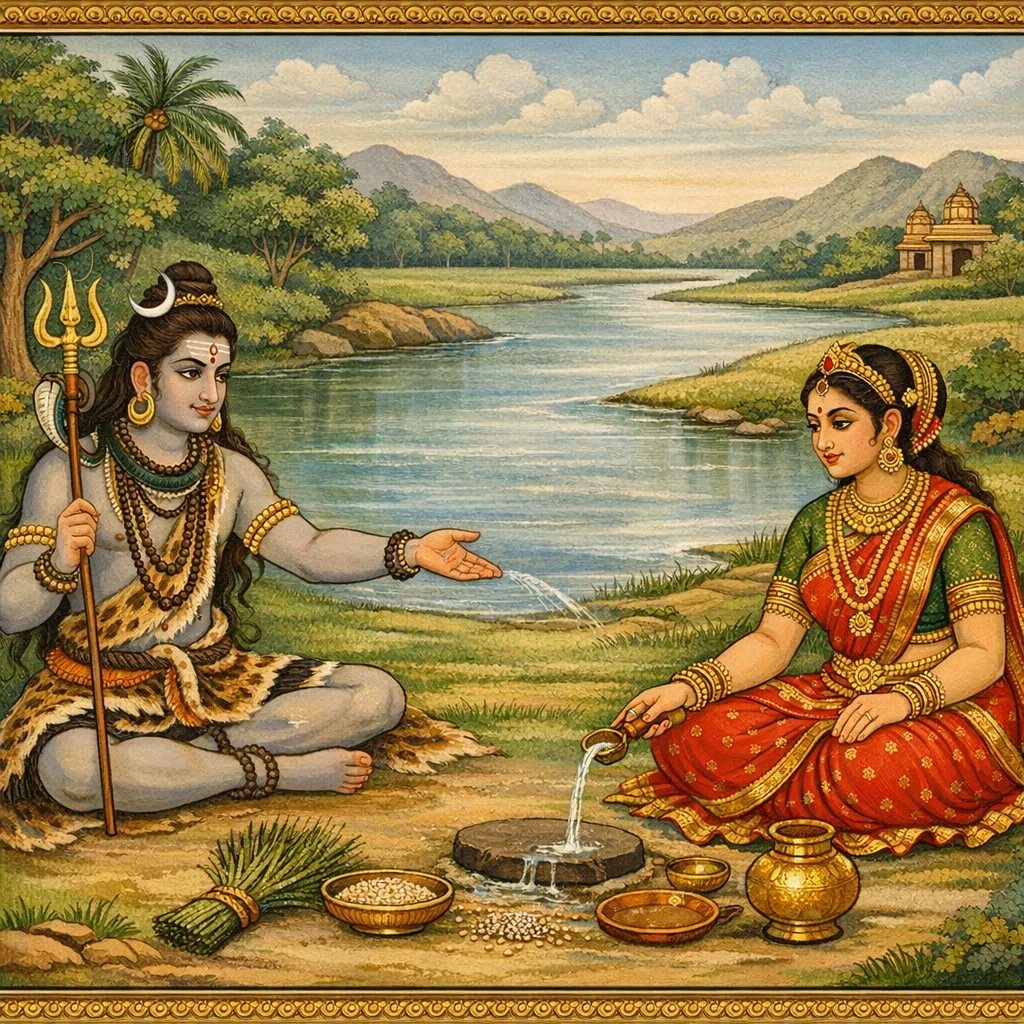
This adhyāya is framed as Īśvara’s theological instruction to Devī, directing her to the Nyankumatī River, said to have been placed by Śambhu under a sacred maryādā (boundary and ordained order) for the pacification of the holy field (kṣetra-śānti). It then points to a southern sacred spot famed for complete destruction of sin, where proper bathing (snāna) followed by śrāddha is declared to free one’s ancestors from infernal conditions. A calendrical rule is given: in the month of Vaiśākha, in the bright fortnight, on the third lunar day (śukla-tṛtīyā), one should bathe and offer tarpaṇa with sesame, darbha grass, and water. Such śrāddha is praised as equal in merit to that performed at the Gaṅgā, compactly joining sacred geography, ritual precision, and ancestral liberation into a tīrtha protocol.
Shlokas
Verse 1
ईश्वर उवाच । ततो गच्छेन्महादेवि यत्र न्यंकुमती नदी । मर्यादार्थं समानीता क्षेत्रशांत्यै च शंभुना
Īśvara said: “Then, O Great Goddess, one should go to the place where the river Nyaṅkumatī was brought by Śambhu, to serve as a sacred boundary and to secure the peace and sanctity of the holy kṣetra.”
Verse 2
तस्यैव दक्षिणे भागे सर्वपापप्रणाशिनी । तस्यां स्नात्वा च वै सम्यग्यः श्राद्धं कुरुते नरः । स पितॄंस्तारयेत्सर्वान्नरकान्नात्र संशयः
On its southern side is a place or stream that destroys all sins. Having bathed there properly, the man who performs śrāddha delivers all his ancestors from hell—of this there is no doubt.
Verse 3
वैशाखे शुक्लपक्षे तु तृतीयायां च भामिनि । स्नात्वा तु तर्पयेद्भक्त्या तिलदर्भजलैः प्रिये । श्राद्धं कृतं भवेत्तेन गंगायां नात्र संशयः
In the bright fortnight of Vaiśākha, on the third lunar day, O beloved—having bathed, one should with devotion offer tarpaṇa with sesame, darbha-grass, and water. By that act, the śrāddha is deemed performed at the Gaṅgā—of this there is no doubt.
Verse 261
इति श्रीस्कांदे महापुराण एकाशीतिसाहस्र्यां संहितायां सप्तमे प्रभासखण्डे प्रथमे प्रभासक्षेत्रमाहात्म्ये न्यंकुमतीमाहात्म्यवर्णनंनामैकषष्ट्युत्तरद्विशततमोऽध्यायः
Thus, in the Śrī Skanda Mahāpurāṇa, in the Saṃhitā of eighty-one thousand verses, in the seventh, the Prabhāsa Khaṇḍa, within the first division called the Prabhāsakṣetra Māhātmya, ends the chapter entitled “The Description of the Greatness of Nyaṅkumatī,” Chapter 261.