Adhyaya 277
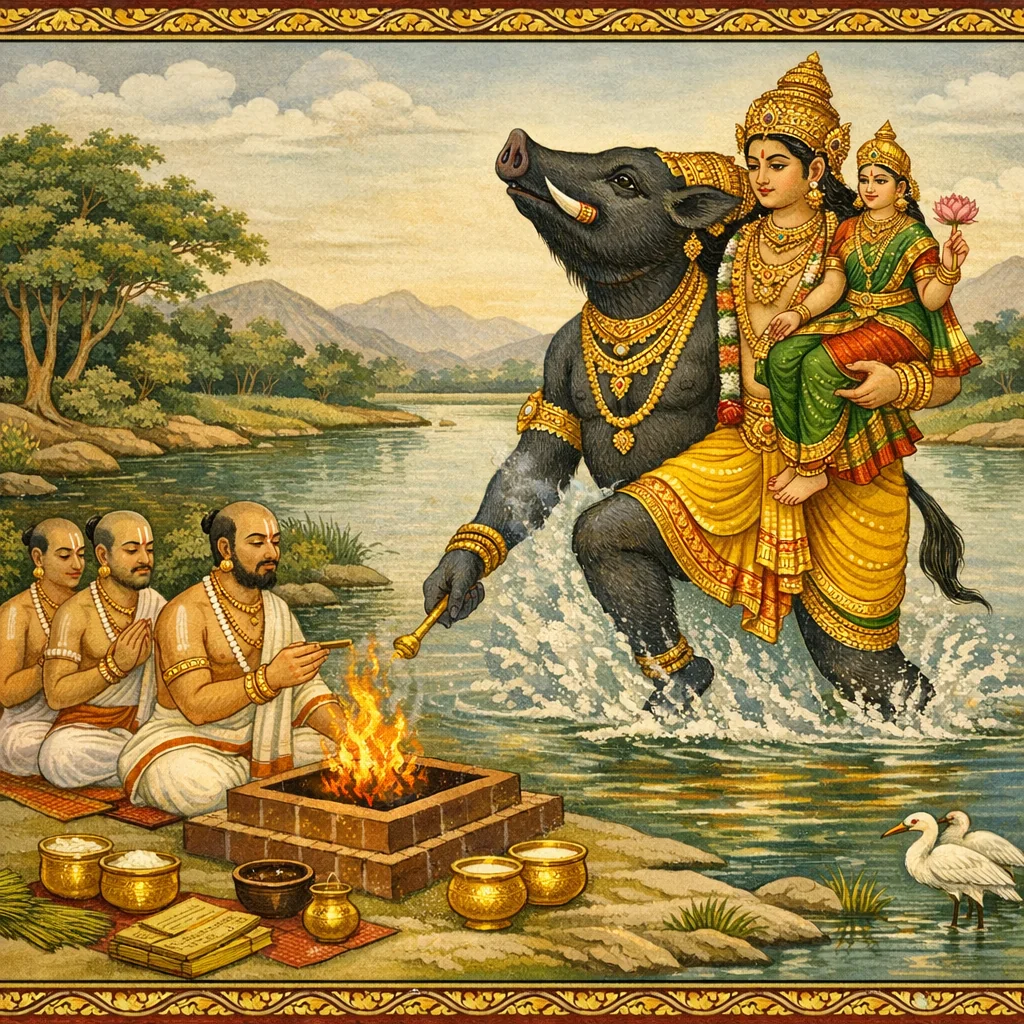
The chapter points out a sacred spot on the bank of the Devikā where Bhūdhara is to be beheld and visited, and explains the name through a mythic and ritual logic. Varāha, the divine Boar who raised up the Earth, is invoked, and the place is read as an extended allegory of yajña. A chain of epithets maps Varāha’s body onto Vedic sacrificial elements—Veda as the feet, the yūpa as the tusks, sruva/sruc as mouth and face, Agni as the tongue, darbha as the hair, and Brahman as the head—thus fusing cosmology with the structure of sacrifice. The latter portion prescribes a Pitṛ‑oriented śrāddha according to calendrical markers (Puṣya month, amāvāsyā, ekādaśī, seasonal setting, and the Sun’s entry into Kanyā/Virgo), detailing offerings such as pāyasa and havis with jaggery, consecratory invitations, specific mantras for ghee, curd, milk, and other foods, followed by feeding learned vipras and performing piṇḍa‑dāna. The phala declares that śrāddha properly done here satisfies the ancestors for a vast cosmic duration and yields the same merit as Gayā‑śrāddha without traveling to Gayā, exalting the salvific power of this local tīrtha.
Shlokas
Verse 1
तत्रैव संस्थितं पश्येद्भूधरंनाम नामतः । उद्धृत्य पृथिवीं यस्माद्दंष्ट्राग्रेण दधार सः
Right there one should behold the holy presence called Bhūdhara; for he it was who, having lifted up the Earth, bore her upon the tip of his tusk.
Verse 2
भूधरस्तेन चाख्यातो देविकातटसंस्थितः । वेदपादो यूपदंष्ट्रः क्रतुदन्तः स्रुचीमुखः
Therefore he is renowned as Bhūdhara, abiding on the bank of Devikā—whose feet are the Vedas, whose tusks are the sacrificial posts (yūpa), whose teeth are the rites (kratu), and whose mouth is the offering ladle (srucī).
Verse 3
अग्निजिह्वो दर्भरोमा ब्रह्मशीर्षो महातपाः । अहोरात्रेक्षणपरो वेदांगश्रुतिभूषणः
His tongue is Fire, his hairs are darbha grass, his head is Brahmā; a great ascetic, ever watchful through day and night, adorned with the Śrutis and the Vedāṅgas.
Verse 4
आद्यनासः स्रुवतुंडः सामघोषस्वनो महान् । प्राग्वंशकायो द्युतिमा न्नानादीक्षाविराजितः
His nose is primeval; his snout is the offering-ladle (sruva); his mighty sound is the chant of the Sāman hymns. His body is the bamboo frame of the sacrificial enclosure, radiant and splendid with manifold consecrations (dīkṣās).
Verse 5
दक्षिणाहृदयो योगी महासत्रशयो महान् । उपाकर्मोष्ठरुचकः प्रवर्ग्यावर्तभूषणः
He is a yogin whose heart is the southern rite (Dakṣiṇā); truly great, he rests as the mighty satra-sacrifice. His lips shine as the Upākarma, and he is adorned with the whorl of the Pravargya ceremony.
Verse 6
नानाच्छन्दोगतिपथो ब्रह्मोक्तक्रमविक्रमः । भूत्वा यज्ञवराहोऽसौ तत्र स्थाने स्थितोऽभवत्
His course is the many pathways of Vedic metres; his steps and strides follow the sequence spoken by Brahmā. Having become Yajñavarāha, the Boar of Sacrifice, he came to abide, firmly established in that very place.
Verse 7
पुष्यमासे ह्यमावास्यामेकादश्यामथापि वा । प्राप्ते प्रावृषि काले च ज्ञात्वा कन्यागतं रविम्
In the month of Puṣya—on the Amāvāsyā (new-moon day), or even on the Ekādaśī—and when the rainy season has arrived, knowing that the Sun has entered Kanyā (Virgo)…
Verse 8
पायसं गुडसंयुक्तं हविष्यं च गुडप्लुतम् । नमो वः पितरो रसाय अन्नाद्यमभिमंत्रयेत्
One should consecrate the food-offerings—rice-milk sweetened with jaggery, and haviṣya drenched with jaggery—reciting: “Obeisance to you, O Pitṛs (Fathers), for the granting of rasa, the nourishing essence.”
Verse 9
तेजोऽसिशुक्रमित्याज्यं दधिक्राव्णेन वै दधि । क्षीरमाज्याय मन्त्रेण व्यञ्जनानि च यानि तु
For ghee, one should recite the mantra “tejo ’si śukram”; for curd, “dadhikrāvaṇa”; for milk, the “ājya” mantra—likewise for whatever other accompaniments (vyañjanas) there may be.
Verse 10
भक्ष्यभोज्यानि सर्वाणि महानिन्द्रेण दापयेत् । संवत्स रोनियो मंत्रं जप्त्वा तेनोदकं द्विजः
He should have all kinds of foods and delicacies offered with great reverence. Having recited the “Saṃvatsara-roniya” mantra, the brāhmaṇa should then use that water, consecrated by the mantra.
Verse 11
एवं संभोज्य वै विप्रान्पिण्डदानं तु दापयेत् । इत्यनेन विधानेन यस्तत्र श्राद्धकृद्भवेत्
Thus, after duly feeding the brāhmaṇas, he should have the offering of piṇḍas (rice-balls) made. Whoever performs the śrāddha there in accordance with this procedure—
Verse 12
तस्य तृप्तास्तु पितरो यावदिंद्राश्चतुर्द्दश । गयाश्राद्धं विनापीह गयाश्राद्धफलं लभेत्
His Pitṛs (ancestors) remain satisfied for as long as fourteen Indras endure. Even without performing the Gayā-śrāddha, here he attains the very fruit of Gayā-śrāddha.
Verse 277
इति श्रीस्कांदे महापुराण एकाशीतिसाहस्र्यां सहितायां सप्तमे प्रभासखंडे प्रथमे प्रभासक्षेत्रमाहात्म्ये देविकामाहात्म्ये भूधरयज्ञवराहमाहात्म्यवर्णनंनाम सप्तसप्तत्युत्तरद्विशततमोऽध्यायः
Thus ends the two-hundred-and-seventy-seventh chapter, entitled “The Description of the Greatness of the Bhūdhara-yajña and Varāha,” in the Devikā Māhātmya, within the Prabhāsakṣetra Māhātmya, in the seventh book—the Prabhāsa Khaṇḍa—of the venerable Skanda Mahāpurāṇa, the compilation of eighty-one thousand verses.