Adhyaya 18
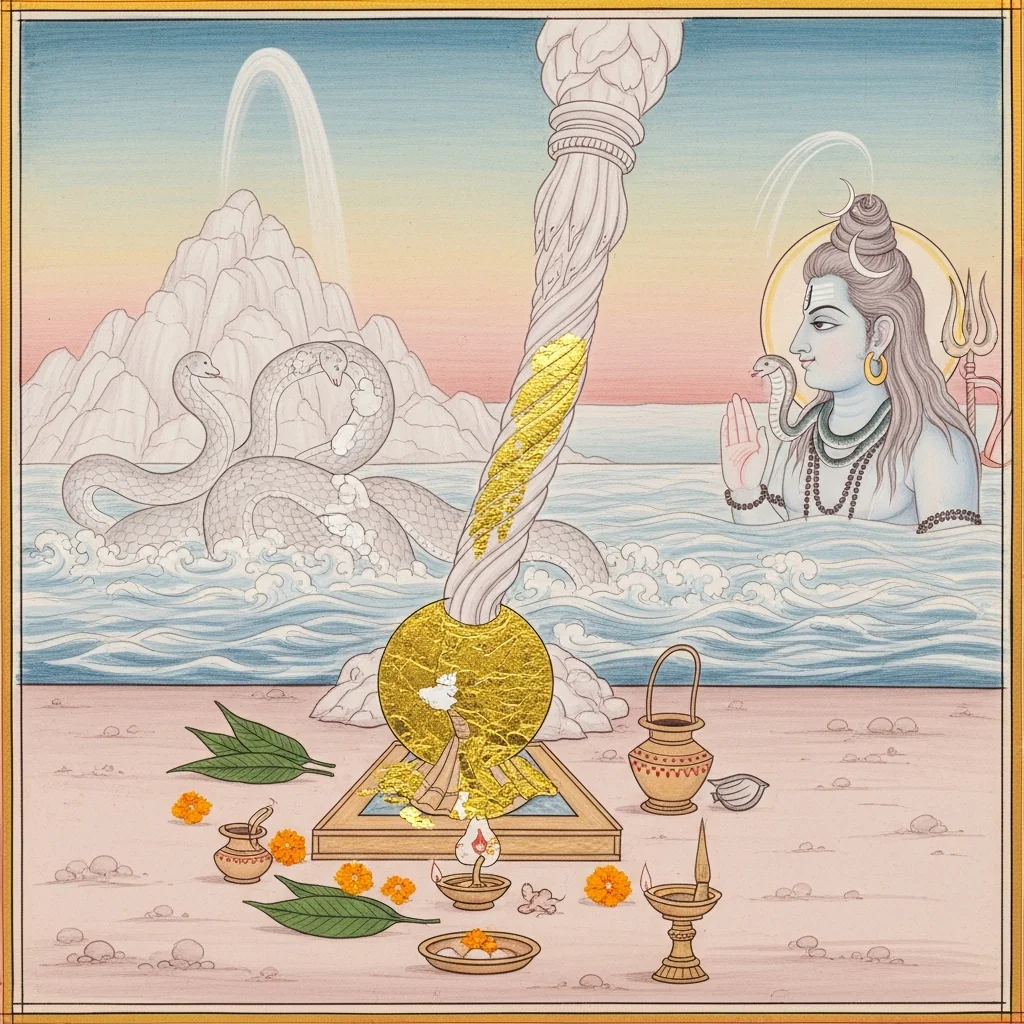
Chapter 18 continues Sūta’s framed narration. After hearing at length the greatness of Prabhāsa-kṣetra, Devī declares the saving and clarifying change she attributes to Śaṅkara’s teaching: doubt and confusion cease, the mind becomes steady in Prabhāsa, and her tapas is fulfilled. She then asks a precise question of origin: when and how did the moon (candra) that rests upon Śiva’s head arise? Īśvara answers with cosmological and calendrical setting, placing the account in the Varāha Kalpa and the early phases of creation, and linking the moon’s emergence to the churning of the Milk Ocean (kṣīroda-manthana), from which fourteen treasures appeared, the moon among them as a radiant product. Śiva affirms that he bears the moon as an ornament and connects this emblem with the episode of drinking poison (viṣa-pāna), explaining the moon-adornment as a liberation-oriented symbol. The chapter concludes by affirming Śiva’s abiding presence there as a self-manifest liṅga (svayaṃbhū), bestower of all siddhis, enduring throughout the kalpa.
Shlokas
Verse 1
सूत उवाच । इति प्रोक्ता तदा देवी शंकरेण यशस्विनी । पुनः पप्रच्छ विप्रेंद्राः क्षेत्रमाहात्म्यविस्तरम्
Sūta said: Thus addressed by Śaṅkara, the illustrious Goddess then again asked—O best of brāhmaṇas—for the detailed account of the greatness of the sacred field, Prabhāsa-kṣetra.
Verse 2
देव्युवाच । अद्य मे सफलं जन्म सफलं च तपः प्रभो । देवत्वमद्य मे जातं त्वत्प्रसादेन शंकर
The Goddess said: Today my birth has become fruitful, and my austerity too has borne fruit, O Lord. Today I have attained divine fulfillment through your grace, O Śaṅkara.
Verse 3
अद्याहं कृतकल्याणी ज्ञानदृष्टिः कृतात्वया । अद्य मे भूषितौ कर्णौ क्षेत्र माहात्म्यभूषणौ
Today I am made auspicious; by you my sight has become the sight of knowledge. Today my ears are adorned—adorned by hearing the ornament, the greatness of this sacred place.
Verse 4
अद्य मे तेजसः पिंडो जातो ज्ञानं हृदि स्थितम् । अद्य मे कुलशीलं च अद्य मे रूपलक्षणम्
Today a solid radiance has arisen in me, and knowledge stands established in my heart. Today my noble lineage and conduct are fulfilled; today my very form and auspicious marks are perfected.
Verse 5
अद्य मे भ्रांतिरुच्छिन्ना तीर्थभ्रमणसंभवा । प्रभासे निश्चलं जातं मनो मे मानिनां वर
Today my confusion—born of wandering from one pilgrimage-place to another—has been cut off. In Prabhāsa my mind has become steady, O best among the honored.
Verse 6
आराधितो मया पूर्वं तुष्टो मेऽद्य सुरेश्वरः । वह्निना वेष्टिता साहमेकपादेन संस्थिता
Formerly I worshiped with devotion, and today the Lord of the gods is pleased with me. Encircled by fire, I stood firm on a single foot in austerity.
Verse 7
तत्तपः सफलं त्वद्य जातं मे भक्तवत्सल । प्रभासक्षेत्रमाहात्म्यमद्य मे प्रकटीकृतम्
That austerity has become fruitful today, O lover of devotees. Today the greatness of Prabhāsa-kṣetra has been made manifest to me.
Verse 8
पुनः पृच्छामि देवेश याथातथ्यं वद प्रभो
I ask again, O Lord of the gods—tell me the truth exactly as it is, O Master.
Verse 9
अद्यापि संशयो नाथ तीर्थमाहात्म्यसंभवः । अन्यत्कौतूहलं देव कथयस्व महेश्वर
Even now, O Lord, a doubt remains—arising from the teachings on the greatness of holy places. And another curiosity too, O God: please explain it, O Maheśvara.
Verse 10
अयं यो वर्त्तते देव चंद्रस्ते शिरसि स्थितः । कस्यायं कथमुत्पन्नः कस्मिन्काले वद प्रभो
O God, this Moon that is seen resting upon your head—whose is it? How did it arise, and in what time did it come to be? Tell me, O Lord.
Verse 11
ईश्वर उवाच । अस्मिन्काले महादेवि वाराह इति विश्रुते । परार्द्धे तु द्वितीयेऽस्मिन्वर्तमाने तु वेधसः
Īśvara said: O Mahādevī, in this time renowned as the Vārāha (Kalpa), during the second half-span of the Creator (Vedhas, Brahmā) now in course—
Verse 12
द्वितीयमासस्यादौ तु प्रतिपद्या प्रकीर्तिता । वाराहेणोद्धृता तस्यां तथा चादौ धरा प्रिये । तेन वाराहकल्पेति नाम जातं धरातले
At the beginning of the second month, the first lunar day (Pratipad) is celebrated; on that very day, O beloved, the Earth was lifted up by Vārāha in the beginning. Therefore, upon the earth it came to be named the Vārāha Kalpa.
Verse 13
तस्मिन्कल्पे महादेवि गते संध्यांशके प्रिये । प्रथमस्य मनोश्चादौ देवि स्वायंभुवस्य हि
In that Kalpa, O Mahādevī—when the portion of twilight had passed, O beloved—at the very beginning of the first Manu, Svāyambhuva, O Devī—
Verse 14
क्षीरोदे मथ्यमाने तु दैवतैर्दानवैरपि । रत्नानि जज्ञिरे तत्र चतुर्द्दशमितानि वै
When the Ocean of Milk was churned by the gods and also by the Dānavas, fourteen treasures were indeed born there.
Verse 15
तेषां मध्ये महातेजाश्चंद्रमास्तत्त्वसंभव । सोऽयं मया धृतो देवि अद्यापि शिरसि प्रिये
Among those treasures was the Moon, of great brilliance, born from that primordial essence. That very Moon, O Devī—O beloved—I bear even now upon my head.
Verse 16
विषे पीते महादेवि प्रभासस्थस्य मे सदा । भूषणं मुक्तये देवैर्मम चंद्रः कृतः पुरा
When the poison had been drunk, O Mahādevī—for me who abides ever at Prabhāsa—the gods long ago made the Moon my ornament, as a sign of liberation (mukti).
Verse 17
शशिनाभूषितो यस्मात्तेनाहं शशिभूषणः । तत्र स्थाने स्थितोऽद्यापि स्वयंभूर्लिंगमूर्त्तिमान्
Because I am adorned with the Moon, therefore I am called Śaśibhūṣaṇa, “He whose ornament is the Moon”. And in that very place I remain even today, self-manifest, embodied as a Liṅga.
Verse 18
सर्वसिद्धिप्रदाता च कल्पस्थायी सदा प्रिये । इत्येतत्कथितं देवि किमन्यत्परिपृच्छसि
I am the giver of all attainments and endure throughout the Kalpas, O beloved. Thus it has been spoken, O Devī—what else do you wish to ask?