Adhyaya 78
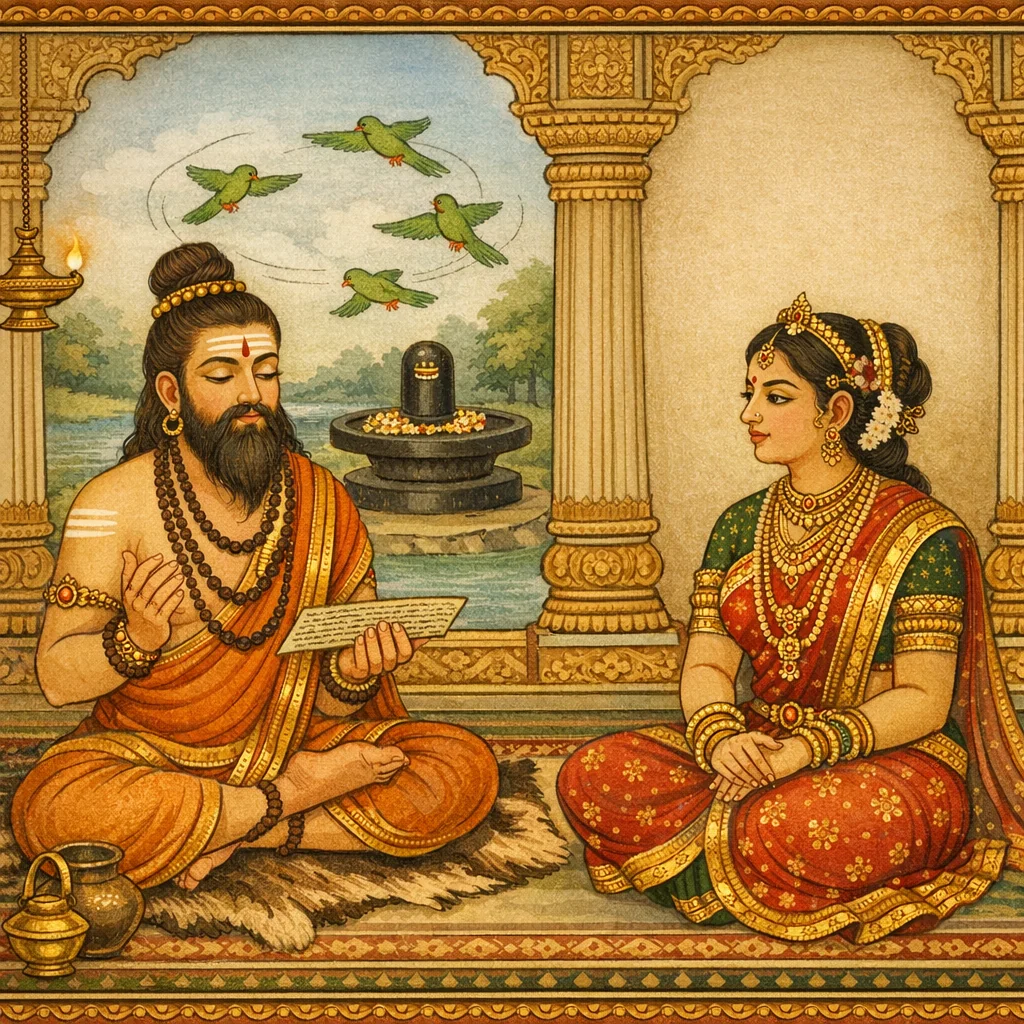
Īśvara instructs Mahādevī to go to the deity Vaiśvānareśvara in the southeast (āgneya) quarter, said to be located “within five bows.” This deity is praised as pāpa-ghna, removing sin and impurity through both darśana (sacred sight) and sparśa (touch). A teaching legend follows: a parrot (śuka) once built its nest in a palace and lived there long with its mate. Out of attachment to their nesting place—rather than explicit devotion—the pair repeatedly performed pradakṣiṇā (ritual circumambulation) and in time died. By the power of that holy site they were reborn as jātismara, remembering former births, and became renowned as Lopāmudrā and Agastya. Recalling his prior body, Agastya utters a reflective gāthā: one who properly circumambulates and beholds the Lord of Fire, Vahnīśa, attains fame, as he once did. The chapter ends with a ritual injunction: bathe the deity with ghee (ghṛta-snāna), worship according to rule, and with faith give gold to a worthy Brahmin. This grants the full fruit of pilgrimage; the devotee reaches Vahni-loka and rejoices for an imperishable time. The colophon identifies it as the 78th chapter of this section of the Prabhāsa Khaṇḍa.
Shlokas
Verse 1
ईश्वर उवाच । ततो गच्छेन्महादेवि देवं वैश्वानरेश्वरम् । तस्यैवाग्नेयकोणस्थं धनुषां पंचके स्थितम्
Īśvara said: Then, O Great Goddess, one should go to the Lord Vaiśvānareśvara. His shrine stands in the south‑eastern quarter, five bow-lengths from that place.
Verse 2
पापघ्नं सर्वजंतूनां दर्शनात्स्पर्शनादपि । तत्र कश्चिच्छुकः पूर्वं नीडं देवि चकार ह
It destroys the sins of all beings, even by mere sight or touch. There, O Goddess, once a certain parrot made its nest.
Verse 3
प्रासादे भार्यया सार्द्धं निवस न्सुचिरं स्थितः । ततस्तौ दंपती नित्यं प्रदक्षिणं प्रचक्रतुः
Dwelling for a long time in that temple-palace together with his wife, the couple thereafter performed pradakṣiṇā—reverent circumambulation—each day.
Verse 4
कुलायस्य वशाद्देवि न तु भक्त्या कथंचन । कालेन महता तौ च पंचत्वं समुपस्थितौ
O Goddess, it was by the force of their former tendencies (kulāya), not by devotion in any way; and after a long time, the two of them met with death.
Verse 5
जातौ तेन प्रभावेन उक्तौ जातिस्मरौ भुवि । लोपामुद्रागस्त्यनामप्रसिद्धिं परमां गतौ
By the power of that act, they were born on earth with remembrance of former lives; and they attained supreme renown under the names Lopāmudrā and Agastya.
Verse 6
अथ गाथा पुरी गीता अगस्त्येन महात्मना । स्मरता पूर्वदेहं तु विस्मयेनानुभूतिजा
Then the great-souled Agastya sang a complete gāthā, born of wonder and inner realization, as he remembered his former body (past life).
Verse 7
कृत्वा प्रदक्षिणं सम्यग्वह्नीशं यः प्रपश्यति । नूनं प्रसिद्धिमाप्नोति इतश्चाहं यथा पुरा
Whoever, having properly performed circumambulation, beholds Vahnīśa, the Lord of Fire, surely attains renown—just as I did here in former times.
Verse 8
एवं देवि तवाख्यातं माहात्म्यं वह्निदैवतम् । श्रुतं पापहरं नृणां सर्वकामफलप्रदम्
Thus, O Goddess, the greatness of the fire-deity (Vahnidaivata) has been proclaimed to you; when heard, it removes people’s sins and grants the fruits of all desired aims.
Verse 9
घृतेन तं तु संस्नाप्य विधिना वै समर्चयेत् । हेम दद्याच्च विप्रेंद्र सम्यक्छ्रद्धासमन्वितः
After bathing that deity with ghee and worshipping according to rule, O best of brāhmaṇas, one should also give gold, duly endowed with faith.
Verse 10
एवं कृत्वा विधानेन सम्यग्यात्राफलं लभेत् । वह्निलोकं तु संप्राप्य मोदते कालमक्षयम्
Having done thus according to the prescribed rite, one gains the full fruit of pilgrimage; and reaching the world of Fire (Vahnīloka), one rejoices for an imperishable span of time.
Verse 78
इति श्रीस्कांदे महापुराण एकाशीति साहरुया संहितायां सप्तमे प्रभासखण्डे प्रथमे प्रभासक्षेत्रमाहात्म्ये वैश्वानरेश्वरमाहात्म्यवर्णनंनामाष्टसप्तति तमोऽध्यायः
Thus ends the seventy-eighth chapter, entitled “The Description of the Glory of Vaiśvānareśvara,” in the Prabhāsa-khaṇḍa—within the Prabhāsakṣetra-māhātmya—of the Śrī Skanda Mahāpurāṇa (Ekāśīti-sāharuyā-saṃhitā).