Adhyaya 326
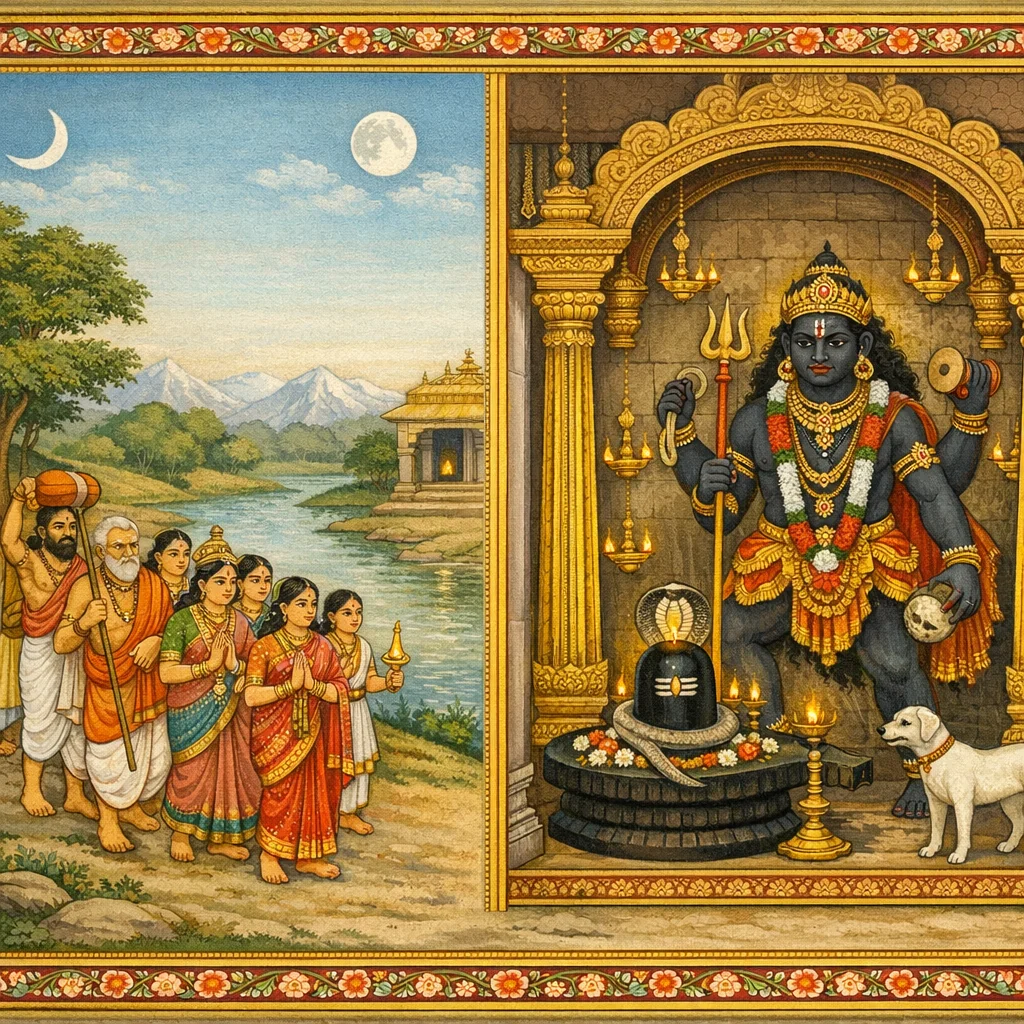
This adhyāya gives Īśvara’s directional guidance within the sacred itinerary of Prabhāsa, leading the devotee to a northern site where Mahākāleśvara abides, praised as the supreme protector, sarva-rakṣā-kara. It names Bhairava, in a Rudra-form, as the presiding guardian of the city or settlement connected with this shrine, linking the shrine’s power to a protective Śaiva theology. A ritual discipline is prescribed: on darśa (new moon) and pūrṇimā (full moon) one should arrange a “great worship” (mahā-pūjā). The phalaśruti declares that one who bathes at the auspicious time called mahodaya and then beholds Mahākāla gains worldly prosperity and wealth across an extended karmic span—hyperbolically said to be “seven thousand births”—as a Purāṇic incentive for devotion and observance.
Shlokas
Verse 1
ईश्वर उवाच । ततो गच्छेन्महादेवि तस्यैवोत्तरतः स्थितम् । महाकालेश्वरं देवं सर्वरक्षाकरं परम्
Īśvara said: Then, O Mahādevī, one should go further to the north of that very place and behold the god Mahākāleśvara—supreme, and the bestower of every protection.
Verse 2
अधिष्ठाता पुरस्यास्य भैरवो रुद्ररूपधृक् । दर्शे च पूर्णिमायां च महापूजां प्रकारयेत्
Bhairava—bearing the form of Rudra—is the presiding guardian deity of this city. On the new-moon day and on the full-moon day, one should duly perform a grand worship.
Verse 3
महोदये नरः स्नात्वा महाकालं प्रपश्यति । धनाढ्यो जायते लोके सप्तजन्मसहस्रकम्
At Mahodaya, having bathed, a man beholds Mahākāla; and in the world he becomes wealthy for seven thousand births.
Verse 326
इति श्रीस्कांदे महापुराण एकाशीतिसाहस्र्यां संहितायां सप्तमे प्रभास खण्डे प्रथमे प्रभासक्षेत्रमाहात्म्ये महाकालमाहात्म्यवर्णनंनाम षड्विंशत्युत्तरत्रिशततमोऽध्यायः
Thus ends Chapter 326, called “The Description of the Greatness of Mahākāla,” in the Prabhāsa-khaṇḍa (Book Seven) of the Skanda Mahāpurāṇa, within the Prabhāsakṣetra-māhātmya section of the Ekāśītisāhasrī Saṃhitā.