Adhyaya 97
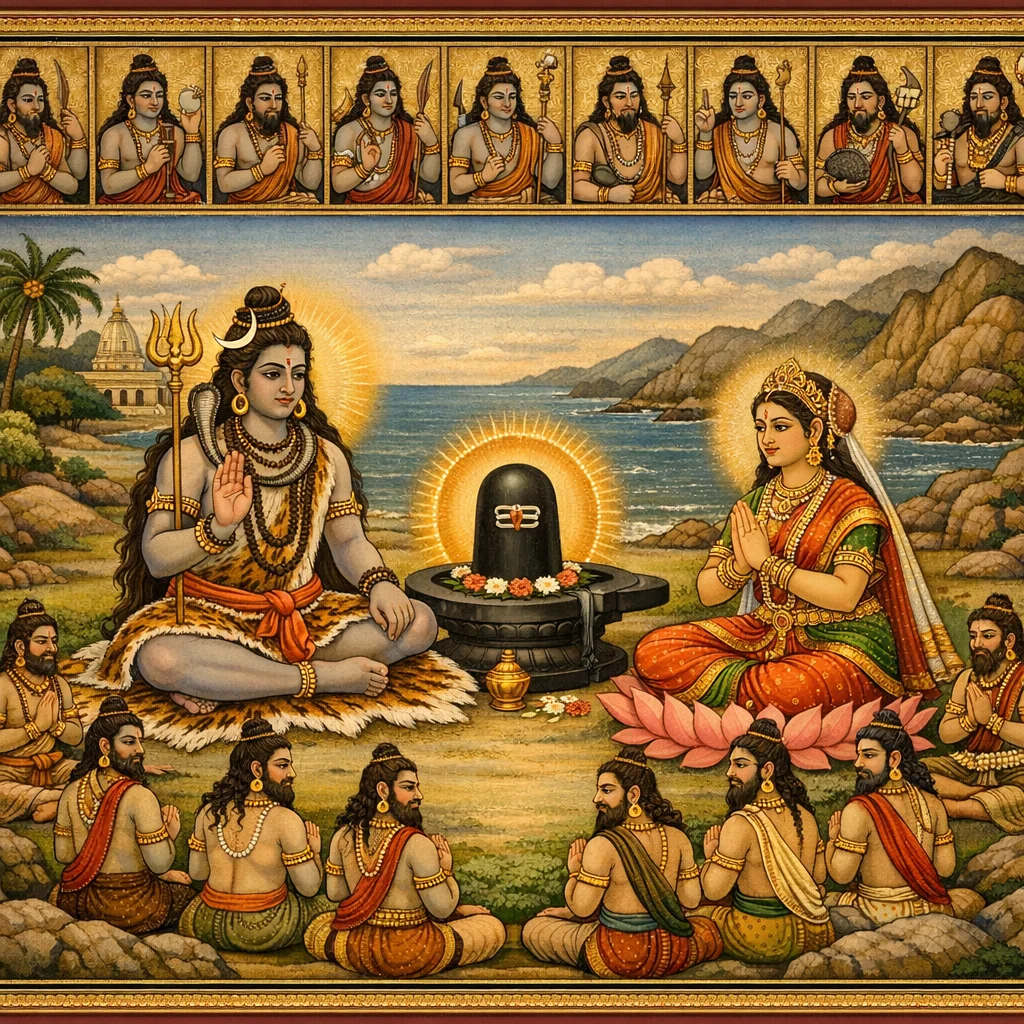
Īśvara instructs Mahādevī about a supremely efficacious liṅga called Yogeśvara, situated in Prabhāsa-kṣetra in a specified direction (in the Vāyu portion near Kāmeśa, within the measure of “seven bows”). This liṅga is praised as mahāprabhāva, and it is stated that mere darśana—devout beholding—destroys sin. In an earlier age it was known as Gaṇeśvara; its origin is told through the coming of innumerable mighty gaṇas who, knowing Prabhāsa to be a Māheśvara field, performed severe tapas with yogic discipline for a thousand divine years. Pleased with their ṣaḍaṅga-yoga, Vṛṣadhvaja (Śiva) bestowed the name Yogeśvara and declared it a giver of yogic fruits. One who worships Yogeśa with proper ritual procedure and bhakti attains yoga-siddhi and heavenly joy; such worship is proclaimed superior even to extravagant gifts, hyperbolically likened to giving a golden Meru and the whole earth. A further rite is added for completeness of results: the gift of a bull (vṛṣabha-dāna). The discourse then turns to the “eleven Rudras” abiding in Prabhāsa, who must always be worshiped and revered by seekers of the kṣetra’s fruits. A phalaśruti promises that hearing the account of Rudra-ekādaśa yields the full merit of the sacred field, while ignorance of these Rudras is censured. Finally, a concise instruction is given: after worshiping Someśvara, one should recite the Śatarudrīya; thereby one gains the merit of all the Rudras. This teaching is called a “secret” (rahasya), pacifying sin and increasing merit.
Shlokas
Verse 1
ईश्वर उवाच । ततो गच्छेन्महादेवि योगेश्वरमिति श्रुतम् । कामेशाद्वायवे भागे धनुषां सप्तके स्थितम्
Īśvara said: Then, O Mahādevī, one should go to the liṅga known as Yogeśvara, situated to the northwest of Kāmeśvara at a distance of seven dhanu (bow-lengths).
Verse 2
लिंगं महाप्रभावं हि दर्शनात्पापनाशनम् । पूर्वे युगे तु संख्यातं गणेश्वरमिति श्रुतम्
This liṅga is of immense power; merely by beholding it, sins are destroyed. In the former age, it was renowned—so it is heard—as “Gaṇeśvara.”
Verse 3
पुरा मम गणा देवि असंख्याता महावलाः । क्षेत्रं माहेश्वरं ज्ञात्वा प्रभासं समुपागमन्
Formerly, O Devī, my gaṇas—countless and of great might—knowing Prabhāsa to be a Māheśvara (Śaiva) holy field, came there.
Verse 4
तत्रस्थाश्च तपो घोरं तेपुस्ते योगमाश्रिताः । दिव्याब्दानां सहस्रं तु ततस्तुष्टो महेश्वरः
Dwelling there, they undertook fierce austerities, established in yoga. After a thousand divine years, Maheśvara became pleased.
Verse 5
यस्मा त्षडंगयोगेन तेषां तुष्टो वृषध्वजः । तेन योगेश्वरं नाम लिंगं योगफलप्रदम्
Since Vṛṣadhvaja (Śiva, whose banner bears the bull) was pleased with them through the practice of six-limbed yoga, that liṅga is therefore named “Yogēśvara,” the bestower of the fruits of yoga.
Verse 6
यस्तमर्चयते भक्त्या सम्यक्पूजाविधानतः । स योगसिद्धिमाप्नोति मोदते दिवि देववत्
Whoever worships Him with devotion, according to the proper rites of worship, attains yogic perfection and rejoices in heaven like a god.
Verse 7
यो दद्यात्कांचनं मेरुं कृत्स्नां चैव वसुन्धराम् । योगेशं पूजयेद्यस्तु स तयोरधिकः स्मृतः
Even if one were to donate a golden Meru and the entire earth, the one who worships Yogēśa is remembered as greater than both of those gifts.
Verse 8
वृषभस्तत्र दातव्यः संपूर्णफलहेतवे । एवमेकादश प्रोक्ता रुद्राः प्राभासमाश्रिताः । नित्यं पूज्याश्च वंद्याश्च क्षेत्रस्य फलमीप्सुभिः
There, a bull should be given in charity as the means to obtain complete merit. Thus the eleven Rudras are declared as abiding in Prabhāsa; those who seek the fruit of that holy field should always worship and revere them.
Verse 9
य एतां चैव शृणुयाद्रुद्रैकादशसंहिताम् । तस्य क्षेत्रफलं सर्वं प्रभासांतरवासिनः
Whoever listens to this compilation concerning the eleven Rudras obtains the entire merit of the Prabhāsa sacred field, as though dwelling within Prabhāsa itself.
Verse 10
यश्चैतान्नैव जानाति रुद्रान्प्राभासमाश्रितान् । स क्षेत्रमध्यसंस्थोऽपि नास्त्येव स पशुः स्मृतः
But whoever does not know these Rudras abiding in Prabhāsa—even if he stands in the very midst of the holy kṣetra—truly gains nothing; he is remembered as a mere beast.
Verse 11
एतेषां चैव रुद्राणां सर्वान्वाप्येकमेव वा । सोमेश्वरं पूजयित्वा जपेद्वै शतरुद्रियम् । सर्वेषां लभते पुण्यं रुद्राणां नात्र संशयः
Whether one encompasses all these Rudras or even just one of them, having worshipped Someśvara one should indeed recite the Śatarudrīya. Thereby one obtains the merit of all the Rudras—of this there is no doubt.
Verse 12
इदं रहस्यं संख्यातं माहात्म्यं तव भामिनि । रुद्राणां पापशमनं श्रुतं पुण्यविवर्द्धनम्
O radiant lady, this secret—this greatness set forth in due enumeration—has been declared to you; it is heard as a remover of sins and an increaser of merit, sacred to the Rudras.
Verse 97
इति श्रीस्कांदे महापुराण एकाशीतिसाहस्र्यां संहितायां सप्तमे प्रभासखण्डे प्रथमे प्रभासक्षेत्रमाहात्म्ये योगेश्वरमाहात्म्यवर्णनंनाम सप्तनवतितमोऽध्यायः
Thus, in the revered Skanda Mahāpurāṇa, in the compilation of eighty-one thousand (verses), in the seventh—Prabhāsa Khaṇḍa—within the first section, the Prabhāsakṣetra Māhātmya, ends the ninety-seventh chapter, entitled “The Description of the Greatness of Yogeśvara.”