Adhyaya 84
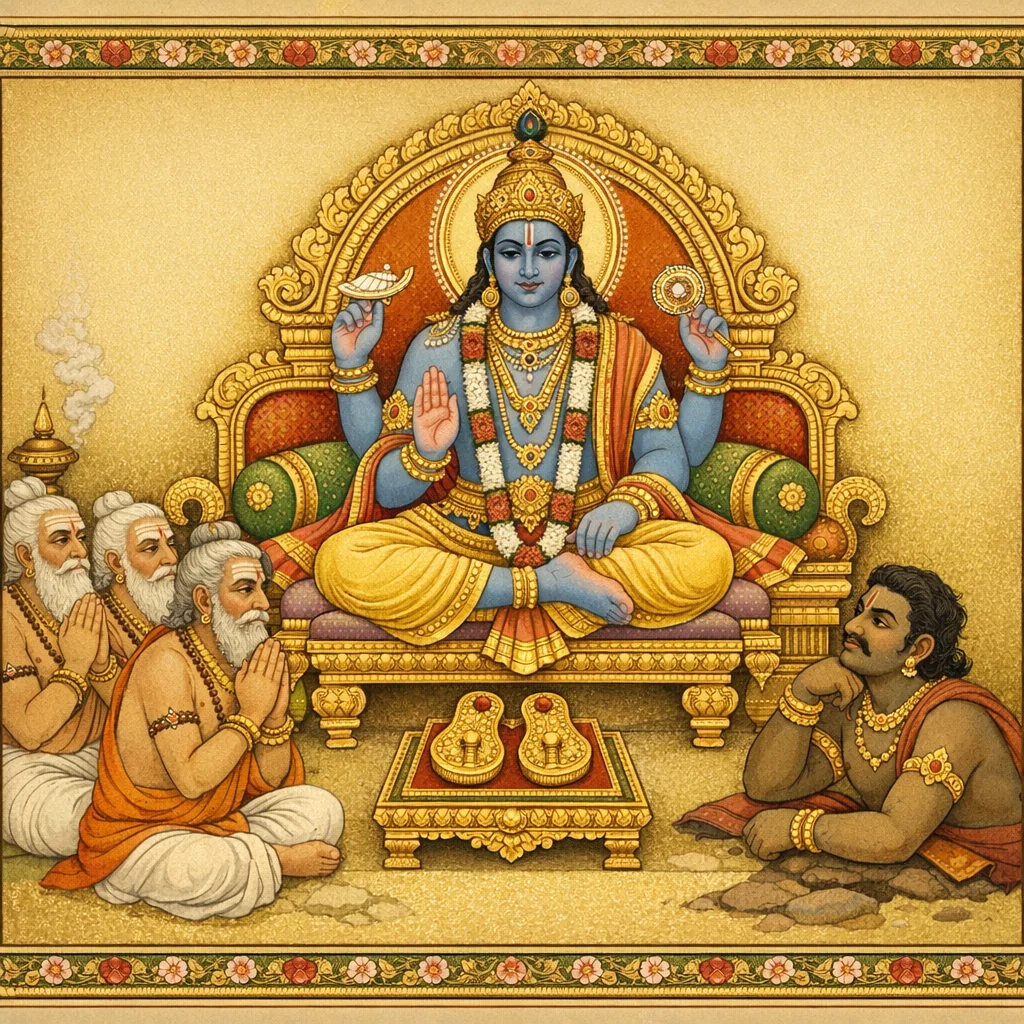
Īśvara instructs Devī to go to Ādinārāyaṇa Hari in the eastern quarter, the universal destroyer of sins, seated upon the sacred “pādukā-āsana” (sandal-seat). The chapter then recounts a Kṛta-yuga episode: the asura Meghavāhana, made nearly invincible by a boon that he could die only by Viṣṇu’s pādukā in battle, torments the world for ages and lays waste to the ṛṣis’ āśramas. Driven out, the ṛṣis take refuge in Keśava, Viṣṇu with the Garuḍa-banner, and offer a long hymn praising him as the cosmic cause, the savior of beings, and the purifier through his Name and remembrance. Viṣṇu appears, asks their need, and is entreated to remove the demon and restore fearlessness to the cosmos. He summons Meghavāhana and strikes him in the heart with the auspicious pādukā, slaying him, and remains established there upon the pādukā-seat. Merits of observance are then declared: worship of this form on Ekādaśī yields supreme sacrificial fruit, equal to an Aśvamedha, and devoted darśana is likened to great gifts such as vast cow-donations. Finally, a Kali-yuga assurance is given: for those who enshrine Ādinārāyaṇa in the heart, suffering is lessened and spiritual benefit increases; bathing and worship on Ekādaśī—especially when it falls on a Sunday—are said to free one from “bhava-bandhana,” the bondage of worldly becoming. The concluding phalaśruti proclaims that hearing this account removes sin and destroys poverty.
Shlokas
Verse 1
ईश्वर उवाच । ततो गच्छेन्महादेवि आदिनारायणं हरिम् । तस्याश्च पूर्वदिग्भागे सर्वपातकनाशनम्
Īśvara said: Then, O Great Goddess, one should proceed to Ādinārāyaṇa, Hari. And adjoining that holy place, to the east, there is a spot that destroys all sins.
Verse 2
पादुकासनसंयुक्तं सर्वदैत्यांतकारिणम् । आदौ कृतयुगे देवि दैत्योऽभून्मेघवाहनः
That place is associated with the Pādukāsana, the “Seat of the Sandal,” and is famed as a slayer of all daityas. O Goddess, in the beginning, in the Kṛta Yuga, there arose a demon named Meghavāhana.
Verse 3
महाबलो महाकायो योजनायुतविस्तरः । अजेयः सर्वदेवानां त्रैलोक्यक्षयकारकः । ब्रह्मणा तस्य तुष्टेन वरो दत्तो वरानने
He was exceedingly strong and of vast body, spreading for tens of thousands of yojanas; unconquerable to all the gods, and a cause of ruin to the three worlds. Pleased with him, Brahmā granted him a boon, O fair-faced Goddess.
Verse 4
यदा पादुकया विष्णुस्त्वां हनिष्यति संयुगे । तदैव मृत्युर्भविता नान्यथा मरणं तव
When Viṣṇu strikes you in battle with the sacred sandal (pādukā), then alone shall your death occur; in no other way will you meet your end.
Verse 5
इति लब्धवरो दैत्यः संतापयति भूतलम् । युगानां कोटिमेकां तु सदेवासुरमानुषम्
Having obtained such a boon, the demon tormented the earth—indeed for a crore of yugas—afflicting gods, asuras, and humans alike.
Verse 6
संतप्य बहुधा देवि दक्षिणो दधिमागतः । तत्र विध्वंसयामास ऋषीणामाश्रमाणि वै
O Goddess, burning many beings in diverse ways, the southern one—Dadhimān—arrived there and indeed began to devastate the hermitages of the seers.
Verse 7
ततस्त ऋषयः सर्वे विध्वस्ताश्रममण्डलाः । शरणं चैव संप्राप्ता देवदेवं तु केशवम् । अजेयं तं तु संज्ञात्वा तुष्टुवुर्गरुडध्वजम्
Then all the sages—whose hermitage-grounds had been ruined—approached Keśava, the God of gods, for refuge; knowing Him to be unconquerable, they praised the Lord whose banner bears Garuḍa.
Verse 8
ऋषय ऊचुः । नमः परमकल्याणकल्याणायात्मयोगिने । जनार्द्दनाय देवाय श्रीधराय च वेधसे
The sages said: Salutations to the supremely auspicious One, the auspiciousness of all auspicious things—the Lord established in the yoga of the Self; to the divine Janārdana; to Śrīdhara; and to Vedhasa, the all-ordaining Creator.
Verse 9
नमः कमलकिंजल्कसुवर्णमुकुटाय च । केशवायातिसूक्ष्माय बृहन्मूर्ते नमोनमः
Salutations to Him whose golden crown is like the filaments of a lotus; salutations again and again to Keśava—subtler than the subtlest, yet manifest as the vast cosmic Form.
Verse 10
महात्मने वरेण्याय नमः पंकजनाभये । नमोऽस्तु मायाहरये हरये हरिवेधसे
Salutations to the great-souled, the most worthy—to the Lotus-naveled Lord. May there be salutations to Hari who removes delusion, to Hari, to Hari the supreme Ordainer.
Verse 11
हिरण्यगर्भगर्भाय जगतः कारणात्मने । अच्युताय नमो नित्यमनन्ताय नमोनमः
Salutations to Him who is the inner source even of Hiraṇyagarbha, to the One whose very nature is the cause of the world. Ever salutations to Acyuta; salutations again and again to Ananta.
Verse 12
नमो मायापटच्छन्न जगद्धात्रे महात्मने । संसारसागरोत्तार ज्ञानपोतप्रदायिने । अकुंठमतये धात्रे सर्गस्थित्यंत कर्मणे
Salutations to the great-souled Sustainer of the world, veiled by the curtain of māyā. Salutations to the Giver of the boat of knowledge that carries one across the ocean of saṃsāra; to the Ordainer of unimpeded wisdom, whose work is creation, preservation, and dissolution.
Verse 13
यथा हि वासुदेवेति प्रोक्ते नश्यति पातकम् । तथा विलयमभ्येतु दैत्योऽयं मेघवाहनः
Just as sin perishes when the name ‘Vāsudeva’ is uttered, so may this demon Meghavāhana likewise meet his destruction.
Verse 14
यथा विष्णुः स्वभक्तेषु पापमाप्नोति संस्थितम् । तथा विनाशमायातु दैत्योऽयं पापकर्मकृत्
Just as Viṣṇu removes the sin that abides in His own devotees, so may this demon—doer of sinful deeds—come to destruction.
Verse 15
स्मृतमात्रो यथा विष्णुः सर्वं पापं व्यपोहति । तथा प्रणाशमभ्येतु दैत्योऽयं मेघवाहनः
Just as Viṣṇu, merely remembered, drives away every sin, so may this demon Meghavāhana likewise meet complete ruin.
Verse 16
भवंतु भद्राणि समस्तदोषाः प्रयांतु नाशं जगतोऽखिलस्य । अभेद्यभक्त्या परमेश्वरेशे स्मृते जगद्धातरि वासुदेवे
May auspiciousness prevail; may all faults of the entire world be destroyed. For when Vāsudeva—the Supreme Lord of lords, the Upholder of the universe—is remembered with unbreakable devotion, all evil is brought to an end.
Verse 17
ये भूतले ये दिवि येऽन्तरिक्षे रसातले प्राणिगणाश्च केचित् । भवन्तु ते सिद्धियुता नरोत्तमाः स्मृते जगद्धातरि वासुदेवे
May all beings—whether on earth, in heaven, in mid-space, or in the netherworld—become perfected and noble, when Vāsudeva, the Upholder of the universe, is remembered.
Verse 18
ये प्राणिनः कुत्रचिदत्र संति ब्रह्माण्डमध्ये परतश्च केचित् । तेषां तु सिद्धिः परमास्त्वनिंद्या स्तुते जगद्धातरि वासुदेवे
Whatever living beings exist anywhere—within this cosmos or beyond it—may they attain the highest, blameless perfection when Vāsudeva, the Upholder of the universe, is praised.
Verse 19
ईश्वर उवाच । इति स्तुतस्तदा देवि आदिनारायणो हरिः । ज्ञात्वा स भावि कार्यं तत्समारुह्य च पादुकाम्
The Lord said: “Thus praised then, O Goddess, Hari—Ādinārāyaṇa—knowing the task that was to come to pass, mounted His sacred pādukā (sandals).”
Verse 20
बभूव तेषां प्रत्यक्ष ऋषीणां पापनाशनः । उवाच प्रणतान्सर्वान्किं वा कार्यं हृदि स्थितम्
The Destroyer of sin became manifest before those sages. He said to all who bowed down, “What purpose rests within your hearts?”
Verse 21
कथ्यतां तत्करिष्यामि युष्मत्स्तोत्रेण तर्पितः
“Speak it; I shall accomplish it, for I am satisfied by your hymn of praise.”
Verse 22
इत्युक्ता ऋषयः सर्वे कृतांजलिपुटाः स्थिताः । आदिदेवं हरिं प्रोचुः सर्वे नतशिरोधराः
Thus addressed, all the sages stood with hands joined in reverence. With bowed heads, they spoke to Hari, the Primeval God.
Verse 23
ऋषय ऊचुः । जानासि सर्वं त्वं देव न चास्त्यविदितं तव । इमं दैत्यं महादेव संहरस्व महाबलम् । यथेदं सकलं विश्वं निरातंकं भवेत्प्रभो
The sages said: “You know everything, O Lord; nothing is unknown to You. O Great God, destroy this mighty Daitya, so that this entire universe may become free from fear, O Master.”
Verse 24
इत्युक्तस्तैस्तदा विष्णुर्दैत्यमाहूय संयुगे । ताडयामास तं दैत्यं हृदि पादुकया शुभे
Thus addressed by them, Viṣṇu summoned the Daitya to battle and struck that demon upon the chest with the auspicious pādukā, the sacred sandal.
Verse 25
स हतः पतितो दैत्यो विगतासुर्महोदधौ । हत्वा दैत्यवरं देवस्तत्र स्थाने स्थितोऽभवत् । पादुकासनसंस्थस्तु तत्राद्यापि वरानने
Struck down, the Daitya fell into the great ocean, his life-force gone. Having slain that chief of Daityas, the Lord remained established in that very place—seated upon the pādukā-throne there even to this day, O fair-faced one.
Verse 26
यस्तं पूजयते भक्त्या एकादश्यां नरोत्तमः । सोश्ववमेधफलं प्राप्य मोदते दिवि देववत्
That best of men who worships Him with devotion on the Ekādaśī day attains the merit of an Aśvamedha sacrifice and rejoices in heaven like a god.
Verse 27
गोलक्षं ब्राह्मणे दत्त्वा यत्फलं प्राप्नुयान्नरः । तदादिदेवे गोविन्दे दृष्टे भक्त्या फलं लभेत्
Whatever reward a man would obtain by gifting a hundred thousand cows to a brāhmaṇa—he gains that very fruit by beholding Govinda, the Primordial Lord, with devotion.
Verse 28
कलौ कृतयुगं तेषां क्लेशस्तेषां सुखाधिकः । आदिनारायणो देवो येषां हृदयसंस्थितः
For those in whose heart the god Ādinārāyaṇa abides, even the Kali age becomes a Kṛta-yuga for them; their hardships diminish and their happiness becomes abundant.
Verse 29
एकादश्यां रविदिने स्नात्वा संनिहिता जले । आदिनारायणं पूज्य मुच्यते भवबन्धनात्
On Ekādaśī, when it falls on a Sunday, having bathed in the waters wherein the sacred Presence abides and worshipped Ādinārāyaṇa, one is freed from the bondage of worldly becoming.
Verse 30
इति ते कथितं देवि माहात्म्यं विष्णुदैवतम् । श्रुतं पापहरं नृणां दारिद्यौघविनाशनम्
Thus, O Goddess, I have told you the glory of this sacred account devoted to Viṣṇu; when heard, it removes the sins of people and destroys the torrents of poverty.
Verse 84
इति श्रीस्कांदे महापुराण एकाशीतिसाहस्र्यां संहितायां सप्तमे प्रभासखण्डे प्रथमे प्रभासक्षेत्रमाहात्म्य आदिनारायणमाहात्म्यवर्णनंनाम चतुरशीतितमोध्यायः
Thus ends the eighty-fourth chapter, called “The Description of the Greatness of Ādinārāyaṇa,” in the first part of the Prabhāsakṣetra Māhātmya, within the seventh Prabhāsa Khaṇḍa of the Śrī Skanda Mahāpurāṇa, in the Ekāśīti-sāhasrī Saṃhitā.