Adhyaya 248
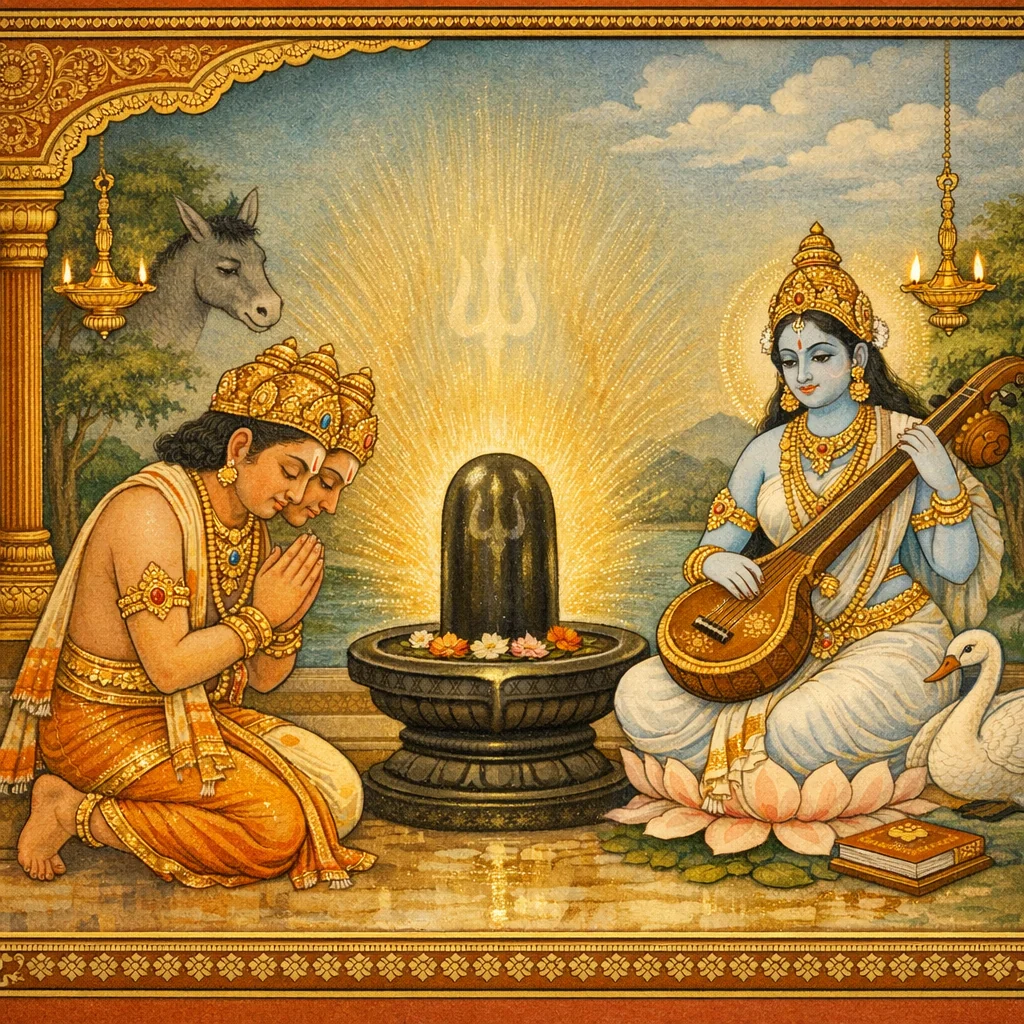
Īśvara instructs Mahādevī to go to a previously mentioned sacred place, once worshipped by Brahmā, on the bank of the Sarasvatī and west of Parnāditya. He then relates its origin: before Brahmā created the fourfold aggregate of beings, an extraordinary woman of indescribable kind appeared, portrayed with the customary Purāṇic marks of beauty. Overcome by desire, Brahmā begged for sexual union with her; as an immediate consequence of this fault, his fifth head fell and became donkey-like, and the deed is presented as instant moral transgression. Realizing the gravity of desire arising toward his own “daughter,” Brahmā came to Prabhāsa seeking purification, for it is said that bodily and moral purity cannot be attained without immersion in a tīrtha. After bathing in the Sarasvatī, Brahmā established a Śiva-liṅga of Devadeva Śūlin and was freed from defilement, returning to his abode. The phalaśruti concludes: one who bathes in the Sarasvatī and beholds that liṅga is released from all sins and honored in Brahmaloka; and seeing it on the bright fourteenth of Caitra grants access to the supreme station associated with Maheśvara.
Shlokas
Verse 1
ईश्वर उवाच । ततो गच्छेन्महादेवि पूर्वोक्तं ब्रह्मपूजितम् । सरस्वत्यास्तटे संस्थं पर्णादित्यस्य पश्चिमे
Īśvara said: Then, O great Goddess, one should go to that previously mentioned sacred spot worshipped by Brahmā, situated on the bank of the Sarasvatī, to the west of Parṇāditya.
Verse 2
तस्योत्पत्तिं प्रवक्ष्यामि शृणुष्वैकमनाः प्रिये । सृजतो ब्रह्मणः पूर्वं भूतग्रामं चतुर्विधम्
I shall declare its origin—listen with a single-pointed mind, beloved. Long ago, when Brahmā was creating the fourfold host of beings…
Verse 3
उत्पन्नाद्भुतरूपाढ्या नारी कमललोचना । कंबुग्रीवा सुकेशांता बिंबोष्ठी तनुमध्यमा
There arose a woman endowed with wondrous beauty—lotus-eyed, conch-necked, with lovely hair, with lips like the bimba fruit, and slender-waisted.
Verse 4
गंभीरनाभिः सुश्रोणी पीनश्रोणिपयोधरा । पूर्णचन्द्रमुखी सा तु गूढगुल्फा सितानना
She had a deep navel, lovely hips, and full hips and breasts; her face shone like the full moon. Indeed, she had well-formed ankles and a fair, radiant countenance.
Verse 5
न देवी न च गन्धर्वी नासुरी न च पन्नगी । यादृग्रूपा वरारोहा तादृशी सा व्यजायत
She was neither a goddess, nor a Gandharva maiden, nor an Asurī, nor a serpent-woman. Whatever form one could imagine as supremely beautiful—exactly such a noble lady was she born.
Verse 6
तां दृष्ट्वा रूपसंपन्नां ब्रह्मा कामवशोऽभवत् । अथ तां प्रार्थयामास रत्यर्थं वरवर्णिनि
Seeing her endowed with beauty, Brahmā came under the sway of desire. Then he entreated her, O fair-complexioned one, seeking sensual union.
Verse 7
अथ प्रार्थयतस्तस्य न्यपतत्पंचमं शिरः । खररूपं महादेवि तेन पापेन तत्क्षणात्
As he pleaded thus, his fifth head fell away. O great Goddess, it instantly assumed the form of a donkey, as the fruit of that sin.
Verse 8
ततो ज्ञात्वा महत्पापं दुहितुः कामसंभवम् । घृणया परया युक्तः प्रभासं क्षेत्रमागतः
Then, realizing the great sin born of lust toward his own daughter, he—filled with profound remorse—came to the sacred field of Prabhāsa.
Verse 9
न कायस्य यतः शुद्धिर्विना तीर्थावगाहनात् । स स्नातः सलिले पुण्ये सरस्वत्या वरानने
For the body is not purified without immersion in a holy tīrtha. Therefore, O fair-faced one, he bathed in the meritorious waters of the Sarasvatī.
Verse 10
लिंगं संस्थापयामास देवदेवस्य शूलिनः । ततो विकल्मषो भूत्वा जगाम स्वगृहं पुनः
He established a liṅga of Śūlin, the God of gods. Then, freed from defilement, he returned again to his own abode.
Verse 11
स्नात्वा सारस्वते तोये यस्तल्लिंगं प्रपश्यति । सर्वपापविनिर्मुक्तो ब्रह्मलोके महीयते
After bathing in the Sarasvatī’s waters, whoever beholds that liṅga is freed from all sins and is honored in Brahmā’s world.
Verse 12
चैत्रे शुक्लचतुर्दश्यां यस्तं पश्यति मानवः । स याति परमं स्थानं यत्र देवो महेश्वरः
In the month of Caitra, on the fourteenth day of the bright fortnight, the man who beholds that liṅga attains the supreme abode—where the Lord Maheśvara dwells.
Verse 248
इति श्रीस्कांदे महापुराण एकाशीतिसाहस्र्यां संहितायां सप्तमे प्रभासखण्डे प्रथमे प्रभासक्षेत्रमाहात्म्ये ब्रह्मेश्वरमाहात्म्यवर्णनंनामाष्टचत्वारिंशदुत्तरद्विशततमोऽध्यायः
Thus ends the 248th chapter, “The Description of the Greatness of Brahmeśvara,” in the first subdivision—the Māhātmya of Prabhāsa Kṣetra—within the seventh book, the Prabhāsa Khaṇḍa, of the Śrī Skanda Mahāpurāṇa (the Saṃhitā of eighty-one thousand verses).