Adhyaya 35
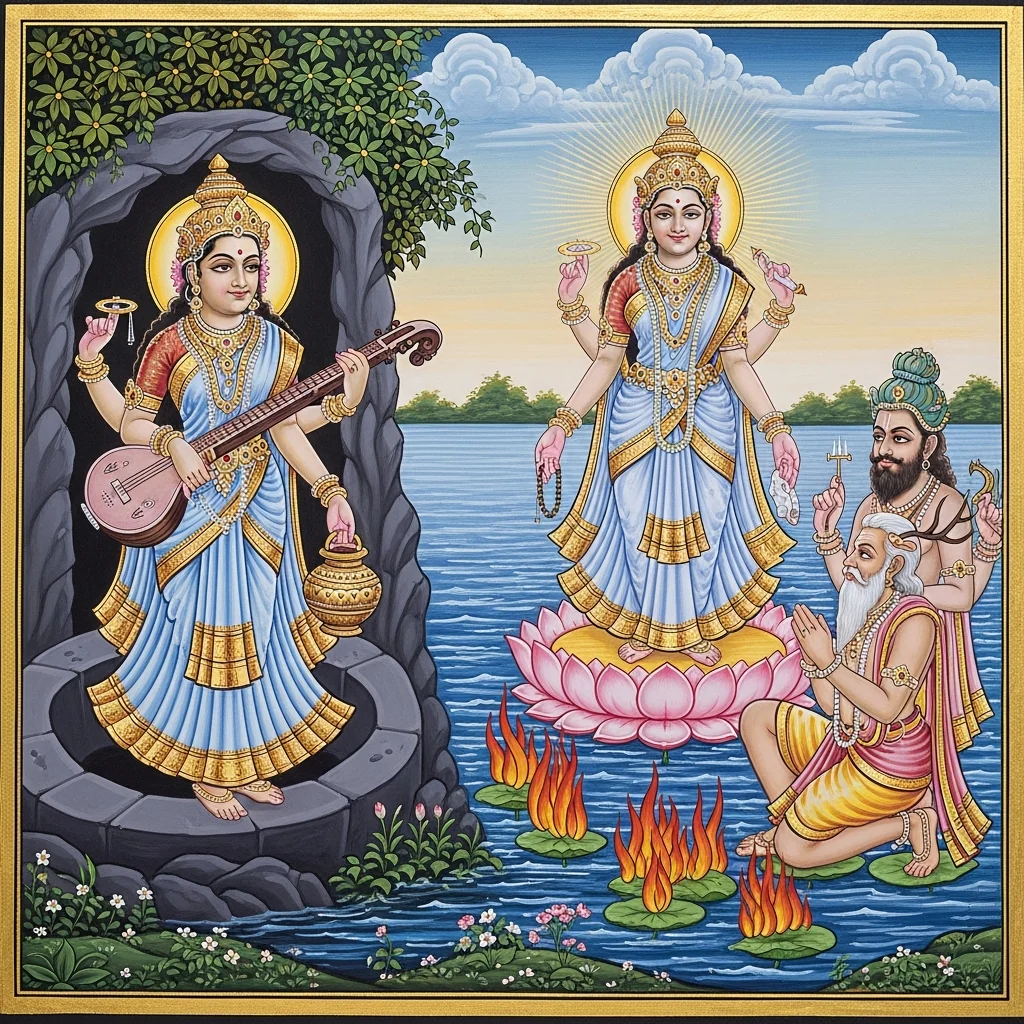
The chapter unfolds as a theological dialogue: Devī asks how the Bhārgava sage Oūrva arose in the present Manvantara. Īśvara recounts a tale of violence and retribution—kṣatriyas slay brāhmaṇas for wealth; one woman saves a fetus by hiding it in her thigh (ūru), and from that concealment Oūrva is born. From his tapas Oūrva brings forth a fierce fire, Raudra Oūrva/Vāḍava, which threatens to consume the earth, and the gods seek refuge with Brahmā. Brahmā pacifies Oūrva and commands that the fire be directed into the ocean rather than destroying the world. Sarasvatī is appointed to carry the consecrated fire in a golden vessel, and her journey becomes a detailed tīrtha-route: through Himalayan and western regions she repeatedly disappears (antardhāna) and reappears at named wells and sacred sites—such as Gandharva-kūpa—forming a network of īśvara-shrines, sangamas, forests, fords, and ritual stations. At the sea Sarasvatī releases the Vāḍava fire into the salt waters; Agni grants a boon yet is restrained by a ring-borne command not to dry up the ocean. The chapter closes with phalaśruti on the rarity and power of Prācī Sarasvatī, the merit of Agni-tīrtha, and a worship-sequence defining the sin-destroying “Raudrī yātrā” (Sarasvatī, Kapardin/Śiva, Kedāra, Bhīmeśvara, Bhairaveśvara, Caṇḍīśvara, Someśvara, Navagrahas, Rudra-ekādaśa, and child-form Brahmā).
Shlokas
Verse 1
देव्युवाच । भगवन्भार्गवे वंशे यस्त्वौर्वः कथितस्त्वया । वैवस्वतेंऽतरे चास्मिंस्तस्योत्पत्तिं वद प्रभो
The Goddess said: O Lord, you have spoken of Aaurva in the Bhārgava lineage, and in this Vaivasvata Manvantara. Tell me, O Master, how he was born.
Verse 2
ईश्वर उवाच । ब्राह्मणा निहता ये तु क्षत्रियैर्वित्तकारणात् । क्षयं नीतास्तु ते सर्वे सपुत्राश्च सगर्भतः
Īśvara said: Those Brāhmaṇas who were slain by Kṣatriyas for the sake of wealth were all brought to destruction—together with their sons, and even with the unborn in the womb.
Verse 3
म्रियमाणेषु सर्वेषु एका स्त्री समतिष्ठत । तया तु रक्षितो गर्भ ऊर्वोर्देशे निधाय च
When all were being slain, one woman stood firm. By her the embryo was protected, placing it in the region of her thigh.
Verse 4
अन्यासां चैव नारीणां सर्वासामपि भामिनि । गर्भानि पातितास्तैस्तु द्रव्यार्थं क्षत्रियाधमैः
And for the other women as well—all of them, O lovely one—their pregnancies were caused to fall by those vile Kṣatriyas, for the sake of plundered wealth.
Verse 5
कालांतरे ततो भित्त्वा कुरुदेशं महाप्रभः । निर्गतोत्तंभितशिरा ज्वलदास्योतिभीषणः
After some time, that mighty one burst forth, splitting the land of the Kurus. He emerged with head held high, his mouth blazing—most terrifying to behold.
Verse 6
तद्वैरं हृदि चाधाय ददाह वसुधातलम् । उत्पाद्य वह्निं तपसा रौद्रमौर्वं जलाशनम्
Carrying that enmity within his heart, he burned the surface of the earth. By austerity he generated a fire—Aaurva’s fierce blaze, a devourer even of the waters.
Verse 7
तमिन्द्रः प्लावयामास वृष्ट्यौघैर्वरवर्णिनि । न शशाक यदा नेतुं तदा स यतवाक्स्थितः
O fair-complexioned one, Indra tried to drown him with torrents of rain. But when he could not subdue him, he stood restrained, his speech held back in helplessness.
Verse 8
ततो देवाः सगंधर्वा ब्रह्माणं शरणं गताः । अभवन्भयसंत्रस्ताः सर्वे प्रांजलयः स्थिताः
Then the gods—together with the Gandharvas—went to Brahmā for refuge. Terrified by fear, they all stood with joined palms in supplication.
Verse 10
देवा ऊचुः । भगवन्भार्गवे वंशे जातः कोऽपि महाद्युतिः । अग्निरूपेण सर्वं स ददाह वसुधातलम् । कृतो यत्नः पुराऽस्माभिस्तद्विनाशाय सत्तम । जलेन वृद्धिमायाति ततो नो भयमागतम्
The gods said: “O Blessed One, in the Bhārgava lineage there has arisen someone of immense splendor. In the form of fire he has burned the entire surface of the earth. Formerly we made efforts to destroy him, O best of the good; yet he increases through water—therefore fear has come upon us.”
Verse 11
विनष्टे भूतले देव अग्निष्टोमादिकाः क्रियाः । उच्छिद्यते ततोऽस्माकं नाशो नूनं भविष्यति
O God, when the earth’s surface is destroyed, rites such as the Agniṣṭoma and the rest will be cut off. When they are severed, our ruin will surely follow.
Verse 12
तस्माद्यत्नं कुरु विभो त्रैलोक्यहितकाम्यया
Therefore, O mighty one, exert yourself, desiring the welfare of the three worlds.
Verse 13
ततो ब्रह्मा सुरैः सार्द्धं भार्गवैश्च मह र्षिभिः । आगत्य चाब्रवीदौर्वं किमर्थं दहसि क्षितिम्
Then Brahmā, accompanied by the gods and the great seers of the Bhārgavas, came and said to Aūrva: “For what reason do you burn the earth?”
Verse 14
विरामः क्रियतां सद्यो ममार्थं च द्विजोत्तम
“Let there be cessation at once—for my sake as well, O best of the twice-born.”
Verse 15
और्व उवाच । एष एव निवृत्तोऽहं तव वाक्येन सत्तम । एष वह्निर्मयोत्सृष्टः स विभो तव शासनात्
Aūrva said: “By your word alone, O best among the virtuous, I have truly desisted. This fire released by me—O mighty one—shall act according to your command.”
Verse 16
यथा गच्छेत्समुद्रांतं तथा नीतिर्विधीय ताम्
Arrange the course of that fire so that it may reach the ocean’s very end; let the policy be set in accordance with that.
Verse 17
समाहूय ततो देवीं स्वां सुतां पद्मसंभवः । उवाच पुत्रि गच्छ त्वं गृहीत्वाग्निं महोदधिम् । मद्वाक्यं नान्यथा कार्यं गच्छ शीघ्रं महाप्रभे
Then the Lotus-born (Brahmā) summoned the goddess—his own daughter—and said: “Daughter, go; taking this fire, proceed to the great ocean. My command must not be otherwise. Go quickly, O greatly radiant one.”
Verse 18
सरस्वत्युवाच । एषास्मि प्रस्थिता देव तव वाक्यादसंशयम् । इत्युक्ते साधु साध्वीति ब्रह्मणा समुदाहृता
Sarasvatī said: “O Deva, I set forth now, without any doubt, in accordance with your command.” Having spoken thus, Brahmā praised her again and again: “Well done, O virtuous one!”
Verse 19
ततोभिमंत्रितं वह्निं क्षिप्त्वा कुंभे हिरण्मये । प्रायच्छत सरस्वत्यै स्वयं ब्रह्मा पितामहः । आशिषो विविधा दत्त्वा प्रोवाचेदं पुनः पुनः
Then the Grandfather Brahmā himself, having consecrated the fire with mantras and placed it in a golden pot, handed it to Sarasvatī. Bestowing many blessings, he spoke these words again and again.
Verse 20
गच्छ पुत्रि न संतापस्त्वया कार्यः कथंचन । अरिष्टं व्रज पंथानं मा संतु परिपन्थिनः
“Go, my daughter; you must not grieve in any way. Travel the path in safety—may there be no obstacles or adversaries on your way.”
Verse 21
ईश्वर उवाच । एवमुक्ता तदा तेन ब्रह्मणा च सरस्वती । हिमवंतं गिरिं प्राप्य पिप्पलादाश्रमात्तदा
Īśvara said: Thus instructed by Brahmā, Sarasvatī reached the Himavat mountain and then came to the hermitage of Pippalāda.
Verse 22
उद्भूता सा तदा देवी अधस्ताद्वृक्षमूलतः । तत्कोटर कुटीकोटिप्रविष्टानां द्विजन्मनाम्
Then the Goddess manifested there from beneath the root of a tree, where multitudes of twice-born sages had entered into hollows and countless leaf-huts for their austerities.
Verse 23
श्रूयन्ते वेदनिर्घोषा सरसारक्तचेतसाम् । विष्णुरास्ते तत्र देवो देवानां प्रवरो गुरुः
There the resonant recitations of the Vedas are heard from those whose minds are lovingly absorbed in the sacred essence. In that very place dwells Lord Viṣṇu—the foremost among the gods, the revered teacher.
Verse 24
तस्मात्स्थानात्ततो देवी प्रतीच्यभिमुखं ययौ । अन्तर्द्धानेन सा प्राप्ता केदारं हिममध्यगम्
From that place, the Goddess then went facing west. By a mysterious disappearance, she reached Kedāra, situated amid the snows.
Verse 25
तत्संप्लाव्य गिरेः शृंगं केदारस्य पुरः स्थिता । तेनाग्निना करस्थेन दह्यमाना सरस्वती
After drenching the mountain peak, she stood before Kedāra. Sarasvatī, holding that fire in her hand, was scorched by it as she bore it.
Verse 26
भूमिं विदार्य तस्याधः प्रविष्टा गजगामिनी । तदंतर्द्धानमार्गेण प्रवृत्ता पश्चिमामुखी
Rending the earth, the elephant-gaited Goddess entered beneath it. Then, by that hidden subterranean path, she proceeded westward.
Verse 27
पापभूमिमतिक्रम्य भूमिं भित्त्वा विनि गता । तत्र कूपः समभवन्नाम्ना गन्धर्वसंज्ञितः
Crossing beyond a sinful tract of land, and breaking through the earth, she emerged. There a well came into being, known by the name “Gandharva.”
Verse 28
तस्मात्कूपात्पुनर्दृश्या सा बभूव महानदी । मतिः स्मृतिस्तथा प्रज्ञा मेधा बुद्धिर्गिराधरा
From that well she again became visible, manifesting as a great river. She is praised as Mati (right understanding), Smṛti (sacred memory), Prajñā (wisdom), Medhā (intelligence), and Buddhi (discernment), the very support of the earth’s spiritual life.
Verse 29
उपासिकाः सरस्वत्याः षडेताः प्रस्थितास्तदा । पुनः प्रवृत्ता सा तस्मादुद्भेदात्पश्चिमामुखी
Then the six attendant worshippers of Sarasvatī set forth. From that very bursting-forth of her stream, she flowed again, turning westward in her course.
Verse 30
भूतीश्वरं समायाता सिद्धो यत्र महामुनिः । भूतीश्वरे समीपस्थं तत्र प्राप्ता मनोरमम्
She came to Bhūtīśvara, where a great sage had attained perfection. Near Bhūtīśvara she reached a delightful and auspicious spot.
Verse 31
तस्य दक्षिणदिक्संस्थं रुद्रकोट्युपलक्षितम् । श्रीकंठ देशं विख्यातं गता सर्वौषधीयुतम्
To the south of that place she went to the famed land called Śrīkaṇṭha, marked by a Rudrakoṭi—a multitude of Rudra manifestations—and endowed with every kind of healing herb.
Verse 32
तस्मात्पुण्यतमाद्देशाच्छ्रीकण्ठात्सा मनस्विनी । संप्राप्ता वह्निना सार्द्धं कुरुक्षेत्रं सरस्वती
From that most holy region, Śrīkaṇṭha, the noble-minded Sarasvatī reached Kurukṣetra, accompanied by Vahni, the sacred Fire.
Verse 33
पुनस्तस्मात्कुरुक्षेत्राद्विराटनगरस्य सा । समुद्भूता समीपस्था अन्तर्द्धानान्मनोरमा । गोपायनो गिरिर्यत्र तत्र सा पुनरुद्गता
Again, from Kurukṣetra she arose near the city of Virāṭa—beautiful—after having disappeared. Where the mountain named Gopāyana stands, there she emerged once more.
Verse 34
गोपायिता केशवेन यत्र ते पाण्डुनन्दनाः । कुर्वंतः स्वानि कर्माणि न कैश्चिदुपलक्षिता
There the sons of Pāṇḍu were protected by Keśava (Viṣṇu), performing their own duties without being recognized by anyone.
Verse 35
तत्र कुंडे स्थिता देवी महापातकनाशिनी । पुन र्गोपायनाद्देवी क्षेत्रं प्राप्तातिशोभनम्
There, in a sacred pool, the Goddess remained—the destroyer of great sins. Then again, from Gopāyana, the Goddess reached an exceedingly splendid holy region.
Verse 36
खर्जुरीवनमापन्ना नन्दानाम्नीति तत्र सा । सरस्वती पुनस्तस्माद्वनात्खर्जूरसंज्ञितात्
She entered the Kharjurī forest, where she was known by the name Nandā. Then the goddess Sarasvatī moved on again from that forest called Kharjūra.
Verse 37
मेरुपादं समासाद्य मार्कंडाश्रममागता । यत्र मार्कंडकं तीर्थं मेरुपादे समाश्रितम्
Reaching Merupāda, she came to the hermitage of Mārkaṇḍa, where the Mārkaṇḍaka tīrtha is established at Merupāda.
Verse 38
सरस्वती पुनस्तस्मादर्बुदारण्यमाश्रिता । गता वटवनं रम्यं मार्कंडेयाश्रमाच्छुभात्
Then Sarasvatī, departing from there, took refuge in the Arbuda forest; from the auspicious hermitage of Mārkaṇḍeya she went to the delightful Banyan-grove, Vaṭavana.
Verse 39
तपस्तप्तं पुरा यत्र वसिष्ठेन समाश्रितात् । तस्माद्वटवनात्पुण्यादुदुम्बरवनं गता । मेरुपादे च तत्रैव तण्डिर्यत्रा तपत्तपः
There, in ancient times, Vasiṣṭha—having made his abode—performed austerities (tapas). From that meritorious Vaṭavana she went to the Udumbara-grove. And there itself, at Merupāda, is the place where Taṇḍi practiced his tapas.
Verse 40
ऊदुंबरवनात्तस्मात्पुनर्देवी सरस्वती । अन्तर्द्धानेन शिखरमन्यत्प्राप्ता महानदी
From that Udumbara-grove, the goddess Sarasvatī again—vanishing from sight—reached another peak; and she herself, the great river, moved onward.
Verse 41
मेरुपादं तु सुमहत्सुरसिद्धनिषेवितम् । भिन्नांजनचयाकारं गोलांगूलमिति स्मृतम्
That Merupāda is exceedingly vast, resorted to by gods and siddhas; it looks like a mass of split, collyrium-black rock, and is remembered by the name Golāṅgūla.
Verse 42
स्थानं मनोरमं तस्मादुद्गता सा सुमध्यमा । वंशस्तंबात्सुविपुला प्रवृत्ता दक्षिणामुखी
From that enchanting place she—the fair-waisted goddess—arose; issuing widely from a bamboo-stump, she began to flow facing south.
Verse 43
तत्रोद्गमवटस्तस्यास्तत्समाख्यो व्यवस्थितः । ततः प्रभृति सा देवी सुप्रभं प्रकटा स्थिता
There stands her ‘Udgamavaṭa’—the banyan named after her emergence; and from that time onward the goddess remained manifest at Suprabhā.
Verse 44
अंतर्द्धानं परित्यज्य प्राणिनामनुकम्पया । तस्यास्तटेषु रम्येषु संति तीर्थानि कोटिशः
Abandoning her hidden state out of compassion for living beings, on her lovely banks there exist tīrthas by the tens of millions.
Verse 45
तेषु तीर्थेषु सर्वेषु धर्महेतुः सरस्वती । रुद्रावतार मार्गेऽस्मिन्प्रवरं प्रथमं स्मृतम्
Among all those tīrthas, Sarasvatī is the very cause of dharma; on this path of Rudra’s manifestations, she is remembered as the foremost and the first.
Verse 46
तरत्तरंगनामाढ्यं काकतीर्थं महाप्रभम् । तत्र तीर्थं पुनस्त्वन्यत्तीर्थं धारेश्वरं स्मृतम्
The illustrious Kāka-tīrtha, famed by the name Tarattaraṅga, shines with great splendor. There, again, is another sacred ford, remembered as Dhāreśvara-tīrtha.
Verse 47
धारेश्वरात्पुनश्चान्यद्गंगोद्भेदमिति स्मृतम् । सारस्वतं तथा गांगं यत्रैकं संस्थितं जलम् । तस्मादन्यत्परं तीर्थं पुंडरीकं ततः परम्
From Dhāreśvara, again, there is another place known as Gaṅgodbheda, where the waters of Sarasvatī and Gaṅgā abide as one. Beyond that is another supreme tīrtha—Puṇḍarīka—and beyond that still (yet another).
Verse 48
मातृतीर्थं महापुण्यं सर्वातंकहरं परम् । मातृतीर्थात्पुनस्तस्मान्नातिदूरे व्यवस्थितम्
There is the Mātṛ-tīrtha, supremely meritorious and a remover of every affliction. And from that Mātṛ-tīrtha, not far away, another sacred spot is situated.
Verse 49
तीर्थं त्वनरकंनाम नरकार्ति भयापहम् । ततस्तस्मादनरकात्तीर्थमन्यत्पुनः स्थितम्
There is a tīrtha named Anaraka, which removes the fear and torment of hell. And from that Anaraka-tīrtha, yet another sacred place is situated.
Verse 50
संगमेश्वरनामाढ्यं प्रसिद्धं तन्महीतले । ततस्तस्मात्पुनश्चान्यत्तीर्थं कोटीश्वराह्वयम्
On the earth is famed that sacred place renowned as Saṅgameśvara. From there, again, another tīrtha is found, called Koṭīśvara.
Verse 51
ततस्तस्मान्महादेवि शंभुकुण्डेश्वरं स्मृतम् । तीर्थे सरस्वतीतीरे तस्मिन्सिद्धेश्वरं स्मृतम्
Then, O Great Goddess, from there Śaṃbhukuṇḍeśvara is remembered. And at that tīrtha on the bank of the Sarasvatī, Siddheśvara is recalled.
Verse 52
सिद्धेश्वरात्पुनस्तस्मात्प्रवृत्ता पश्चिमामुखी । पश्चिमं सागरं गंतुं सखीं स्मृत्वा रुरोद सा
Then, setting out again from Siddheśvara, she turned westward. Wishing to go to the western ocean, she remembered her companion and began to weep.
Verse 53
स्थित्वा पूर्वमुखा देवी हा गंगेति विना त्वया । एकाकिनी मंदभाग्या क्व गमिष्याम्यबांधवा
The Goddess, turning to face the east, cried: ‘Alas, O Gaṅgā—without you, lonely and ill-fated, where shall I go, without a kinswoman?’
Verse 54
तां विज्ञाय ततो गंगा रुदतीं शोककर्शिताम् । शीघ्रं स्वर्गात्समायाता तीर्थानां कोटिभिः सह
Recognizing her then—weeping and worn down by grief—Gaṅgā swiftly came down from heaven, accompanied by crores of tīrthas.
Verse 55
ततो दुःखं परित्यज्य तत्र प्राची सरस्वती । सर्वदेवगुणैयुक्ता एवं तत्र स्थिताऽभवत्
Then, casting off her grief, Sarasvatī—flowing eastward—remained there, endowed with the virtues of all the gods; thus she stayed in that place.
Verse 56
तत्र सिद्धवटंनाम तीर्थं पैतामहं स्मृतम् । वटेश्वरस्य पुरतः सर्वपापक्षयंकरम्
There is a tīrtha called Siddhavaṭa, remembered as “Paitāmaha” (belonging to the Grandfather, Brahmā). Standing before Vaṭeśvara, it brings about the destruction of all sins.
Verse 57
त्रिकालं यत्र रुद्रस्तु समागत्य व्यवस्थितः । तन्महालयमित्युक्तं स्थानं तस्य महात्मनः
Where Rudra comes and abides at the three times of day, that place is called “Mahālaya”—the great abode of that exalted one.
Verse 58
पिंडतारकमित्येतत्प्राचीनं तीर्थमुत्तमम् । कुम्भकुक्षिगिरिस्थं तत्पित्र्ये कर्मणि सिद्धिदम्
This most excellent ancient tīrtha is called Piṇḍatāraka. Situated on Mount Kumbhakukṣi, it grants success in ancestral rites (pitṛ-karman), especially in the offering of piṇḍas.
Verse 59
प्राचीनेश्वरदेवस्य पुरोभूतं प्रति ष्ठितम् । प्राची सरस्वती यत्र तत्र किं मृग्यते परम्
It is established before Lord Prācīneśvara. Where the east-flowing Sarasvatī is present—what higher goal need one seek beyond that place?
Verse 60
निवृत्ते भारते युद्धे तत्र तीर्थे किरीटिना । प्रायश्चित्तं पुरा चीर्णं विष्णुना प्रेरिता त्मना
After the Bhārata war had ended, at that tīrtha the Diademed One (Arjuna) once performed expiation (prāyaścitta), urged inwardly by Viṣṇu.
Verse 61
तेन तस्माद्विनिर्मुक्तः पातकात्पूर्वसंचितात् । नरतीर्थं ततः ख्यातं तत्र पापभयापहम्
By that act of expiation he was freed from sins accumulated in former times. Therefore it became renowned as Naratīrtha, a sacred ford that removes the fear born of sin.
Verse 62
नरतीर्थादन्यतीर्थं पुंडरीकमिति स्मृतम् । अर्जुनेन सहागत्य यत्र स्नातो हरिः प्रिये
Beyond Naratīrtha there is another sacred ford remembered as Puṇḍarīka. There, O beloved, Hari bathed after arriving together with Arjuna.
Verse 63
प्राचीनेशात्परं तीर्थं वालखिल्येश्वरं महत् । तत्र तस्मान्महातीर्थात्तीर्थमन्यन्महो दयम्
Beyond Prācīneśa is the great tīrtha called Vālakhilyeśvara. From that great sacred ford, there is yet another tīrtha of mighty auspiciousness.
Verse 64
गंगासमागमंनाम तीर्थमन्यन्महोदयम् । तत्रालोक्य पुनर्देवीं दीनास्यां दीनमानसाम्
Another greatly auspicious tīrtha is called Gaṅgā-samāgama. There, seeing again the Goddess—her face downcast and her heart dejected—
Verse 65
ब्रह्मासृजत्सखीं तस्याः कपिलां विपुलेक्षणाम् । हरिणीं हरिरप्याशु वज्रिणीमपि देवराट् । न्यंकुं विनोदनार्थं च सरस्वत्या ददौ हरः
Brahmā created for her a companion—Kapilā, wide-eyed. Hari too swiftly fashioned another companion, Hariṇī; and Indra, lord of the gods, made Vajriṇī as well. And Hara (Śiva) gave Sarasvatī Nyaṅku for her diversion.
Verse 66
ततः प्रहृष्टा सा देवी देवादेशात्सरस्वती । तस्माद्गन्तुं समारब्धा प्राचीना पापनाशिनी
Then the Goddess Sarasvatī, delighted by the command of the gods, set out from there to depart—she who is ancient and the destroyer of sins.
Verse 67
ईश्वर उवाच । दक्षिणां दिशमास्थाय पुनः पश्चान्मुखी तदा । सरस्वती महादेवी वडवानलधारिणी । तदुत्तरे तटे तीर्थमेकद्वारमिति स्मृतम्
Īśvara said: “Taking the southern direction, Sarasvatī Mahādevī—she who bears the submarine fire Vaḍavānala—then turned again to face west. On her northern bank, a tīrtha is renowned by the name Ekadvāra.”
Verse 68
एकद्वारेण यत्सेना स्वर्गं प्राप्ता ततो वरात् । तस्मात्तीर्थात्पुनश्चान्यत्तीर्थं यत्र गुहेश्वरः
Through the sacred ford called Ekadvāra, that host attained heaven by its boon. From that tīrtha, one should proceed again to another holy place—where Guheśvara stands.
Verse 69
गुहेन स्थापितः पूर्वं यत्र देवो महेश्वरः । गुहेश्वरान्नातिदूरे वटेश्वरमिति स्मृतम्
There, long ago, the god Maheśvara was installed by Guha. Not far from Guheśvara is a place remembered as Vaṭeśvara.
Verse 70
दिव्यं सरस्वतीतीरे व्यासेनाराधितं पुरा । आमर्द्दकी नदी यत्र सरस्वत्या सहैकताम्
On the bank of the Sarasvatī is a divine tīrtha, worshipped in ancient times by Vyāsa—where the river Āmarddakī becomes one together with the Sarasvatī.
Verse 71
संप्राप्ता तन्महातीर्थं फलदं सर्वदेहिनाम् । आमर्दकी संगमं तं नापुण्यो वेद कश्चन । संगमेश्वरनामेति तत्र लिंगं प्रतिष्ठितम्
Whoever reaches that great tīrtha gains its fruit for all embodied beings. The confluence of the Āmardakī is not known to any who lack merit. There a liṅga is established, bearing the name Saṃgameśvara.
Verse 72
मुण्डीश्वरेति च तथा प्रसिद्धिमगमत्क्षितौ । मुंडीश्वरसमीपस्थं सरस्वत्यां महोदयम्
It became renowned on earth by the name Muṇḍīśvara. Near Muṇḍīśvara, on the Sarasvatī, is a tīrtha called Mahodaya.
Verse 73
नाम्ना यत्प्राङ्मुखं तीर्थं सरस्वत्यास्तटे स्थितम् । मांडव्येश्वरनाम्ना वै यत्रेशः संप्रतिष्ठितः
There is a tīrtha called Prāṅmukha, situated on the bank of the Sarasvatī. There the Lord is established under the name Māṇḍavyeśvara.
Verse 74
पीलुकर्णिकसंज्ञं तु तीर्थमन्यत्पुनस्ततः । सरस्वतीतीरगतमृषिणा सेवितं महत्
From there, again, is another tīrtha known as Pīlukarṇikā—great, on the bank of the Sarasvatī, and frequented in devotion by a ṛṣi.
Verse 75
तस्मादन्यत्सरस्वत्यां तीर्थं द्वारवती स्मृतम् । तीर्थानां प्रवरं देवि यत्र संनिहितो हरिः
From there is another tīrtha on the Sarasvatī, remembered as Dvāravatī. O Devī, it is foremost among tīrthas, for Hari is present there.
Verse 76
ततस्तस्य समीपस्थं तीर्थं गोवत्ससंज्ञितम् । यत्रावतीर्य गोवत्सस्वरूपेणांबिकापतिः
Near that (Dvāravatī) is a tīrtha called Govatsa, where Ambikāpati descended, assuming the form of a calf.
Verse 77
स्वयं भूलिंगरूपेण संस्थितस्तेजसां निधिः । गोवत्सान्नैरृते भागे दृश्यते लोहयष्टिका
There, the treasury of divine splendor stands of itself in the form of a Bhūliṅga. To the south-west of Govatsa, an iron staff (marker) is seen.
Verse 78
स्वयंभूलिंगरूपेण रुद्रस्तत्र स्वयं स्थितः । एकविंशति वारस्य भक्त्या पिंडस्य यत्फलम्
There, Rudra Himself abides in the form of a self-manifest Liṅga (svayambhū-liṅga). Whatever merit is gained by offering piṇḍa with devotion for twenty-one days—
Verse 79
गंगायां प्राप्यते पुंसां श्राद्धेनैकेन तत्र तत् । ततस्तस्मान्महातीर्थाद्बालक्रीडनकी यथा
—that very merit is obtained by men at the Gaṅgā through a single śrāddha performed there. And from that great tīrtha onward, she moved like a young girl at play.
Verse 80
सखीभिः सहिता तत्र क्रीडताऽसौ यथेच्छया । आनुलोम्यविलोम्येन दक्षिणेनोत्तरेण च
Accompanied by her companions, she sported there at will—now moving with the current and now against it, to the south and also to the north.
Verse 81
रुल्लं प्राप्य पुनर्देवी समुद्भूता मनोरमा । रुल्लं नाम पुरं यत्र सृष्टं देवेन शंभुना
Reaching Rullā once again, the lovely Goddess manifested there. In that place stands the city called Rullā, created by the god Śambhu.
Verse 82
सह देवैस्तु पार्वत्या धारायंत्रप्रयोगकैः । एकं वर्षसहस्रं तु शंभुना तत्र रुल्लितम्
There, together with the gods and with Pārvatī, by the use of water-devices, Śambhu caused that place to be ‘rullita’ for a full thousand years.
Verse 83
रुल्लं तत्र ह्रदं नाम सरस्वत्यां महोदयम् । साक्षात्तत्र महादेव आनंदेश्वरसंज्ञितः
There is a lake there named Rullā, a great and auspicious tīrtha upon the Sarasvatī. There, manifest in person, is Mahādeva known as Ānandeśvara.
Verse 84
पश्चिमेन स्थितं तत्र शम्भोरायतनस्य तु । स मेरोर्दक्षिणे पादे नखस्तु परिकीर्तितः
To the west of Śambhu’s shrine there stands a sacred mark. It is renowned as the ‘nail’ upon the southern foot of Meru.
Verse 85
पश्यंति ये नराः सम्यक्तेऽपि पापविवर्जिताः । अश्वमेधसहस्रस्य प्राप्नुवंति फलं ध्रुवम्
Those who behold it properly become free from sin, and surely attain the fruit of a thousand Aśvamedha sacrifices.
Verse 86
परतस्तस्य कूष्मांडमुनेस्तत्राश्रमं महत् । कूष्मांडेश्वरसंज्ञं तु तीर्थं त्रैलोक्यविश्रुतम्
Beyond that lies the great hermitage of the sage Muni Kūṣmāṇḍa. The tīrtha known as Kūṣmāṇḍeśvara is renowned throughout the three worlds.
Verse 87
कोल्लादेवी स्थिता तत्र सर्वपापभयापहा । अन्तर्द्धानेन तां कोल्लां संप्राप्ता सा महानदी
There abides the Goddess Kollā, who removes all sin and fear. By an act of disappearance, the great river reached that Kollā shrine.
Verse 88
ततोऽप्यंतर्हिता भूत्वा संप्राप्ता तु मनोरमम् । सानुं मदनसंज्ञं तु क्षेत्रं सिद्धनिषेवितम्
Then, becoming invisible once again, she arrived at a delightful place—the slope called Madana—a sacred kṣetra frequented and served by perfected beings, the siddhas.
Verse 89
ततोऽप्यंतर्हिता भूत्वा पुनः प्राप्ता हिमाचलम् । खादिरामोदनामानं सर्वर्तुकुसुमोज्ज्वलम्
Again becoming invisible, she reached the Himālaya, to the place called Khādirāmoda—radiant with blossoms in every season.
Verse 90
तत्रारुह्य विलोक्याथ ददर्श सुमनोरमम । क्षारोदं पश्चिमाशास्थं घनवृंदमिवोन्नतम्
Ascending there and looking around, she beheld a most enchanting sight: the Kṣāroda, the salt ocean, lying to the west, rising high like a mass of dense clouds.
Verse 91
एवंविधं च तं तत्र सा विलोक्य महाप्रभा । हर्षात्पंचानना भूत्वा देवकार्यार्थमुद्यता
Beholding that wondrous sight there, the radiant Goddess, in joy, became five-faced and readied herself to accomplish the gods’ purpose.
Verse 92
हरिणी वज्रिणी न्यंकुः कपिला च सरस्वती । पंचस्रोताः स्थिता तत्र मुनिनोक्ता सरस्वती
There, Sarasvatī—so proclaimed by the sages—stood as five streams: Hariṇī, Vajriṇī, Nyaṃku, Kapilā, and Sarasvatī.
Verse 93
श्रमापनोदं कुर्वाणा मुनीनां यत्र संस्थिता । तत्तत्पादकमित्युक्तं तीर्थं तीर्थार्थिनां नृणाम् । सर्वेषां पातकानां च शोधनं तद्वरानने
Where she abides, removing the sages’ weariness, that place is called “Tattatpādaka,” a tīrtha for those who seek holy fords; and, O fair-faced one, it purifies all sins.
Verse 94
खादिरामोदमासाद्य तत्रस्था वीक्ष्य सागरम् । गन्तुं प्रवृत्ता तं वह्निमादाय सुरसुन्दरि
Reaching Khādirāmoda and standing there, she gazed upon the ocean; then, O celestial beauty, taking that fire with her, she set forth to go onward.
Verse 95
दग्ध्वा कृतस्मरं देवी पुनरादाय वाडवम् । समुद्रस्य समीपस्था स्थिता हृष्टत नूरुहा
Having burned Kṛtasmara, the Goddess again took up the Vāḍava, the submarine fire. Standing near the ocean, slender-limbed, she remained there, rejoicing.
Verse 96
ततः प्रविष्टा सा देवी अगाधे लवणांभसि । वाडवं वह्निमादाय जलमध्ये व्यसर्जयत्
Then the Goddess entered the deep salt-waters; taking up the Vāḍava fire, she released it into the midst of the sea.
Verse 97
ततस्तस्याः पुनः प्रीतः स्वय मेव हुताशनः । तद्दृष्ट्वा दुष्करं कर्म वचनं चेदमब्रवीत्
Then Hutaśana (Fire) himself, once more pleased with her, seeing that difficult deed, spoke these words.
Verse 98
परितुष्टोऽस्मि ते भद्रे वरं वरय सुव्रते । तत्ते दास्याम्यहं प्रीतो यद्यपि स्यात्सु दुर्लभम्
“O blessed lady of noble vows, I am wholly pleased with you. Choose a boon; delighted, I shall grant it to you—even if it be exceedingly difficult to obtain.”
Verse 99
ईश्वर उवाच । प्रगृह्य वलयं हस्तादिदं वचनमब्रवीत् । इदं मे वलयं वह्ने वक्त्रे धार्यं सदा त्वया
Īśvara said: “Taking the bracelet from his hand, he spoke these words: ‘O Fire, this bracelet of mine must always be worn upon your mouth.’”
Verse 100
अनेन शक्यते यावत्तावत्तोयं समाहर । न त्वया शोषणीयोऽयं समुदः सरितांपतिः
“With this, gather only as much water as is possible. You must not dry up the ocean—lord of rivers.”
Verse 101
बाढमित्येव चोक्त्वा स प्रविष्टो निधिमंभसाम् । एवमेषा महादेवि प्रभासे तु सरस्वती । गृहीत्वा वाडवं प्राप्ता तुष्ट्यर्थं च मनीषिणाम्
Saying, “So be it,” he entered the treasure-house of waters—the ocean. Thus, O Great Goddess, at Prabhāsa Sarasvatī took up the Vāḍava-fire and came there to bring satisfaction to the sages.
Verse 102
सा विश्रांता कुरुक्षेत्रे भद्रावर्ते च भामिनि । पुष्करे श्रीकला देवी प्रभासे च महानदी
O radiant lady, she rested at Kurukṣetra and at Bhadrāvarta. At Puṣkara she is the goddess Śrīkalā, and at Prabhāsa she is the great river.
Verse 103
देवमातेति सा तत्र संस्थिता लवणोदधौ । अस्मिन्मन्वंतरे देवि आदौ त्रेतायुगे पुरा
There, in the salt ocean, she became established under the name “Devamātā,” the Mother of the Gods. In this Manvantara, O Goddess, long ago at the beginning of the Tretā-yuga…
Verse 104
इति वृत्तं सरस्वत्या वाडवाग्नेस्तथाभवत् । मन्वन्तरे व्यतीतेऽस्मिन्भविताऽन्यस्तु वाडवः
Thus it came to pass—this account concerning Sarasvatī and the Vāḍava-fire. When this Manvantara has passed, another Vāḍava-fire will arise.
Verse 105
ज्वालामुखेति नाम्ना वै रुद्रक्रोधाद्भविष्यति । सरस्वत्यास्तथा नाम ख्यातिं ब्राह्मीति यास्यति
It will arise from Rudra’s wrath, bearing the name “Jvālāmukha.” Likewise, Sarasvatī’s name will become renowned as “Brāhmī.”
Verse 106
सरस्वतीति वै लोके वर्तते नाम सांप्रतम् । अतीतं नाम यत्तस्याः कमंडलुभवेति च । रत्नाकरेति सामुद्रं सत्यं नामांतरं पुरा
In the world today she is known by the name “Sarasvatī.” Her former name was “Kamaṇḍalubhava” (born from the water-pot), and “Ratnākara” was truly her oceanic name in ancient times.
Verse 107
अस्मिन्मन्वंतरे देवि सागरेति प्रकीर्तितम् । क्षांरोदेति भविष्यं तु नाम देवि प्रकीर्ति तम्
In this Manvantara, O Goddess, she is celebrated by the name “Sāgarā” (of the ocean). In the future, O Goddess, the name that will be proclaimed is “Kṣāṃrodā”.
Verse 108
एवं जानाति यः कश्चित्स तीर्थफलमश्नुते । स्वर्गनिःश्रेणिसंभूता प्रभासे तु सरस्वती
Whoever understands it in this way truly attains the fruit of the sacred tīrtha. For here at Prabhāsa, Sarasvatī is said to have arisen as a “stairway” leading to heaven.
Verse 109
नापुण्यवद्भिः संप्राप्तुं पुंभिः शक्या महानदी । प्राची सरस्वती देवि सर्वत्र च सुदुर्लभा । विशेषेण कुरुक्षेत्रे प्रभासे पुष्करे तथा
This great river cannot be reached by men who are devoid of merit. The ancient, eastward-flowing Sarasvatī, O Goddess, is exceedingly rare to encounter anywhere—especially at Kurukṣetra, at Prabhāsa, and likewise at Puṣkara.
Verse 110
एवंप्रभावा सा देवी वडवानल धारिणी । अग्नितीर्थसमीपस्था स्थिता देवी सरस्वती
Such is the power of that Goddess: Sarasvatī, bearing the Vaḍavānala (the subterranean fire), abides near Agnitīrtha.
Verse 111
तामादौ पूजयेद्यस्तु स तीर्थफलमश्नुते । सागरं यच्च तत्तीर्थं पापघ्नं पुण्य वर्द्धनम्
Whoever first worships her attains the full fruit of the pilgrimage. And that tīrtha by the ocean destroys sins and increases merit.
Verse 112
दर्शनादेव तस्यैव महाक्रतुफलं लभेत् । अग्निचित्कपिला सत्री राजा भिक्षुर्महोदधिः
By the mere sight of it alone, one gains the fruit of a great sacrifice. (Here are named those connected with the rite and the place:) the builder of the fire-altar, the Kapilā cow, the performer of a sattra, the king, the mendicant, and the great ocean.
Verse 113
दृष्टमात्राः पुनंत्येते तस्मा त्पश्येद्धि भावितः । अग्नितीर्थे नरः स्नात्वा पावके प्रक्षिपेत्ततः । गुग्गुलं भारसहितं सोग्निलोके महीयते
These purify merely by being seen; therefore one should behold them with a devoted mind. Having bathed at Agnitīrtha, a man should then cast guggulu (frankincense) into the sacred fire, together with its proper measure; he is honored in the world of Agni.
Verse 114
एवं संक्षेपतः प्रोक्तो ह्यग्नि तीर्थमहोदयः । सरस्वत्याश्च माहात्म्यं सर्वपातकनाशनम्
Thus, in brief, the great glory of Agnitīrtha has been told—along with the greatness of Sarasvatī, which destroys all sins.
Verse 115
स्नात्वाग्नितीर्थे विधिवत्कंकणं प्रक्षिपेततः । सुवर्णस्य महादेवि यथावित्तानु सारतः
After bathing at Agnitīrtha according to rule, O Great Goddess, one should then cast as an offering a golden bracelet, in accordance with one’s means.
Verse 116
ततः सरस्वतीं पूज्य कपर्दिनमथार्चयेत्
Then, having worshiped Sarasvatī, one should thereafter worship Kapardin (Śiva).
Verse 117
ततः केदारनामानं भीमेश्वरमतःपरम् । भैरवेश्वरनामानं चण्डीश्वरमतः परम्
Thereafter one should worship Śiva named Kedāra, and next Bhīmeśvara; after that Bhairaveśvara, and thereafter Caṇḍīśvara.
Verse 118
ततः सोमेश्वरं देवं पूजयेद्विधिवन्नरः । नवग्रहेश्वरानिष्ट्वा रुद्रैकादशकं तथा
Thereafter, one should worship Lord Someśvara according to proper rite; and, having duly worshiped the Lords of the Nine Planets, one should also worship the Eleven Rudras.
Verse 119
ततः संपूजयेद्देवं ब्रह्माणं बालरूपिणम् । एवं रौद्री समाख्याता यात्रा पातकनाशिनी
Then one should worship the god Brahmā, who is in the form of a child. Thus is the pilgrimage called ‘Raudrī’, and it is a destroyer of sins.
Verse 121
एवं कृत्वा ततो गच्छेन्महादेवीं सरस्वतीम्
Having done so, then one should proceed to Mahādevī Sarasvatī.
Verse 122
सरस्वतीवससमा कुतो गुणाः सरस्वतीवाससमा कुतो रतिः । सरस्वतीं प्राप्य दिवं गता नराः पुनः स्मरिष्यंति नदीं सरस्वतीम्
Where are virtues comparable to dwelling with Sarasvatī? Where is delight comparable to living with Sarasvatī? Men who, having reached the river Sarasvatī, attain heaven, later remember again the river Sarasvatī.