Adhyaya 114
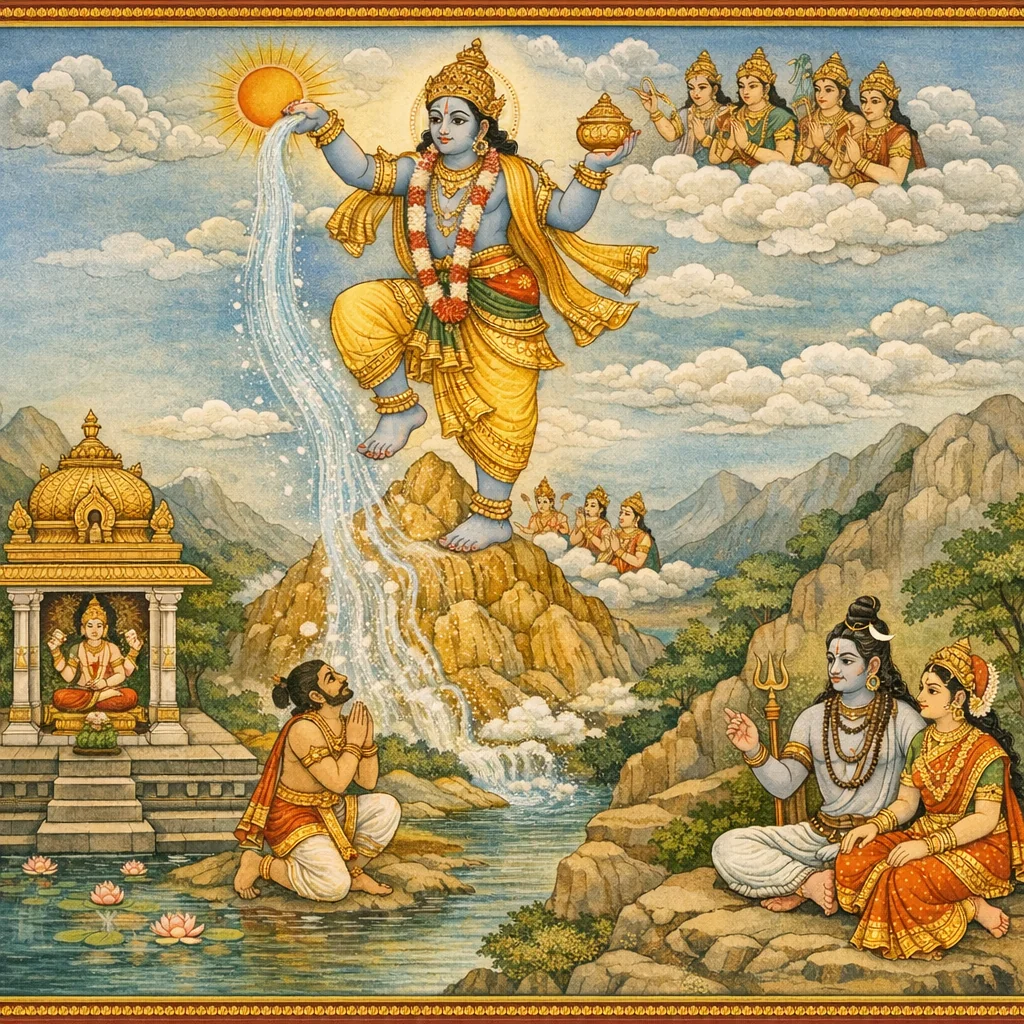
Īśvara instructs Devī to proceed to a Viṣṇu holy place called Vāmana Svāmin, praised as a remover of sins (pāpa-praṇāśana) and a destroyer of all major transgressions (sarva-pātaka-nāśana). The chapter locates this tīrtha near the south‑western quarter of Puṣkara and presents it as a sanctified confluence connected with Prajāpati. It then recounts the binding of Bali by Viṣṇu through the Lord’s three strides: first, the right foot is set down at this very spot; second, upon the summit of Meru; and third, in the sky. When the cosmic boundary is breached, waters issue forth and are identified as the river Gaṅgā, called Viṣṇupadī, arising from Viṣṇu’s footprint. Puṣkara itself is explained etymologically through meanings of “sky” and “water,” further establishing its holiness. Ritual fruits are specified: bathing and beholding Hari’s footprint leads to Hari’s supreme abode; offering piṇḍa grants long satisfaction to the ancestors; and gifting footwear to a disciplined brāhmaṇa is lauded as merit that brings honored conveyance in Viṣṇu’s world. A supporting gāthā attributed to Vasiṣṭha is cited to confirm the tīrtha’s purificatory power.
Shlokas
Verse 1
ईश्वर उवाच । ततो गच्छेन्महादेवि विष्णुं पापप्रणाशनम् । वामनस्वामिनामानं सर्वपातकनाशनम्
Īśvara said: Then, O Great Goddess, one should go to Viṣṇu, the destroyer of sin—known as Vāmanasvāmi—who removes all transgressions.
Verse 2
पुष्करान्नैरृते भागे धनुर्विशतिभिः स्मृतम् । यदा बद्धो बलिर्देवि विष्णुना प्रभविष्णुना
It is said to lie twenty dhanus to the south-west of Puṣkara. O Goddess, it was there that Bali was bound by Viṣṇu, the mighty all-pervading Lord.
Verse 3
तदा तत्र पदं न्यस्तं दक्षिणं विश्वरूपिणा । द्वितीयं मेरुशृंगे तु तृतीयं गगने प्रिये
Then the All-formed Lord set down His right foot there; His second step was upon the peak of Mount Meru, and His third step, O beloved, was in the very sky.
Verse 4
यावदूर्ध्वं चोत्क्षिपति तावद्भिन्नं सुदूरतः । पादाग्रेण तु ब्रह्माण्डं निष्क्रान्तं सलिलं ततः
As far upward as He lifted it, so far away it was cleft asunder; and by the very tip of His foot the cosmic shell was pierced, and from there water flowed out.
Verse 5
ततः स्वजानुमात्रेण संप्राप्तं पृथिवीतले । ततो विष्णुपदी गंगा प्रसिद्धिमगमत्क्षितौ
Thereafter, descending to the earth within the measure of His own knee, it reached the surface of the world. From that event the Gaṅgā became famed upon the earth as ‘Viṣṇupadī’—the river born of Viṣṇu’s Foot.
Verse 6
पूर्वं सा पुष्करे प्राप्ता पुष्करात्सा महानदी । पुष्करं कथ्यते व्योम पुष्करं कथ्यते जलम् । तेन तत्पुष्करं ख्यातं संनिधानं प्रजापतेः
First she reached Puṣkara, and from Puṣkara that mighty river flowed onward. “Puṣkara” is said to mean the sky, and “Puṣkara” is also said to mean water; therefore Puṣkara is famed as the sacred place of Prajāpati’s presence.
Verse 7
तत्र स्नानं नरः कृत्वा यः पश्यति हरेः पदम् । स याति परमं स्थानं यत्र देवो हरिः स्वयम्
Whoever, after bathing there, beholds the Footprint of Hari, attains the supreme abode—where the god Hari Himself resides.
Verse 8
तत्र पिंडप्रदानेन तृप्तिः स्यात्कोटिवार्षिकी । पितॄणां च वरारोहे ह्येतदाह हरिः स्वयम्
By offering piṇḍas there, O fair-hipped one, satisfaction comes to the ancestors for a span of ten million years—so declares Hari Himself.
Verse 9
अत्र गाथा पुरा गीता वसिष्ठेन महर्षिणा । वामनस्वामिनं दृष्ट्वा तां शृणुष्व समाहिता
In this matter, an ancient verse was once sung by the great sage Vasiṣṭha after beholding Lord Vāmanasvāmin—listen to it with a focused mind.
Verse 10
स्नात्वा तु पुष्करे तीर्थे दृष्ट्वा विष्णुपदं ततः । अपि कृत्वा महत्पापं किमतः परितप्यते
After bathing at the Puṣkara tīrtha and then beholding Viṣṇu’s Footprint, even if one has committed a great sin—why should one grieve thereafter?
Verse 11
यस्तत्रोपानहौ दद्याद्ब्राह्मणाय यतव्रतः । स यानवरमारूढो विष्णुलोके महीयते
Whoever there, self-restrained and faithful to sacred vows, gives a pair of sandals to a brāhmaṇa—he is honored in Viṣṇu’s world, as though mounted upon a splendid vehicle.
Verse 114
इति श्रीस्कांदे महापुराण एकाशीतिसाहस्र्यां संहितायां सप्तमे प्रभासखंडे प्रथमे प्रभासक्षेत्र माहात्म्ये वामनस्वामिमाहात्म्यवर्णनंनाम चतुर्दशोत्तरशततमोऽध्यायः
Thus ends the one-hundred-and-fourteenth chapter, called “The Description of the Greatness of Lord Vāmanasvāmin,” in the Prabhāsa Khaṇḍa—within the Prabhāsakṣetra Māhātmya—of the Śrī Skanda Mahāpurāṇa, in the Ekāśītisāhasrī Saṃhitā.