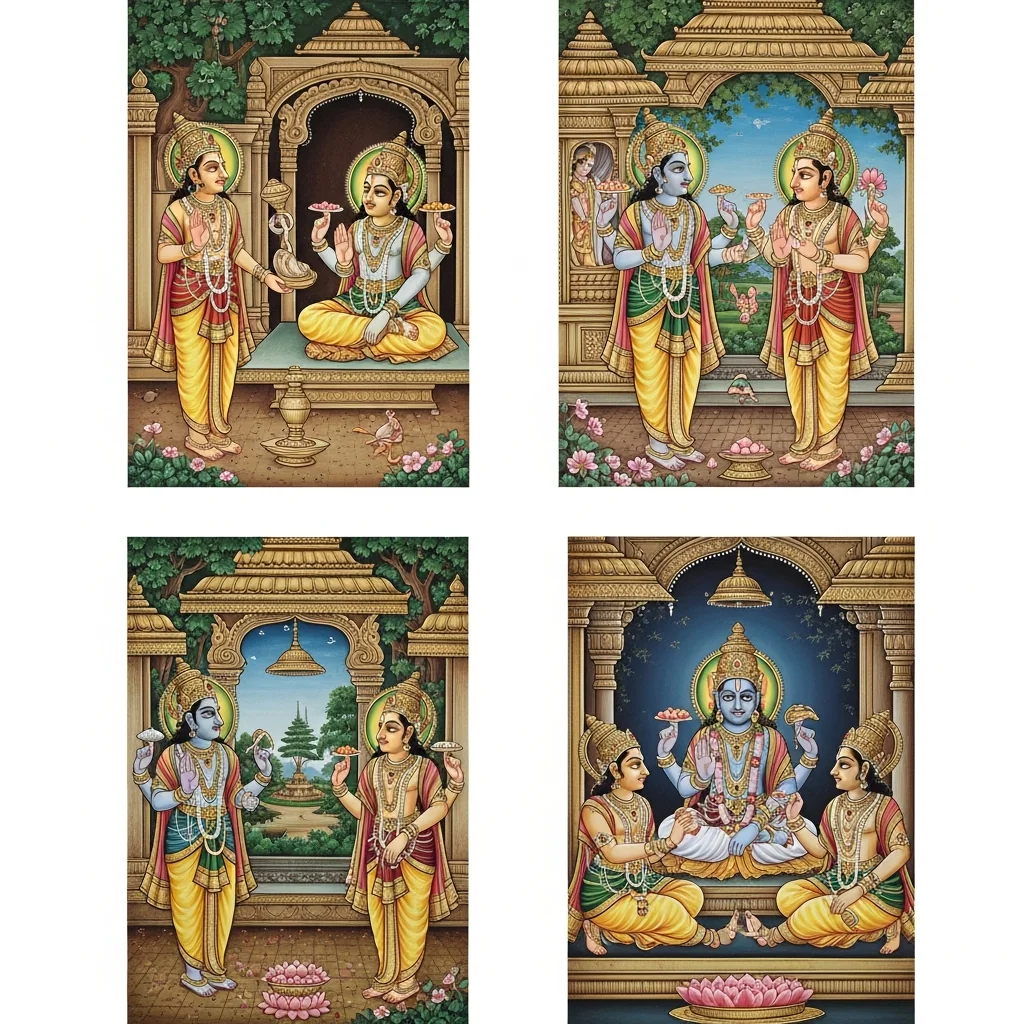
Adhyaya 30
This adhyāya presents a ritual-theological instruction as Devī questions and Īśvara replies on how a pilgrim may secure an obstacle-free journey after bathing at the Agni-tīrthas. The prescribed order is: bathe according to vidhāna and offer arghya to the great ocean (mahodadhi); worship with fragrances, flowers, garments, and unguents; cast into the sacred waters, as one’s means allow, a gold ornament or bracelet; and perform tarpaṇa for the ancestors. Thereafter one proceeds to Kapardin (Śiva) and offers arghya with a gaṇa-related mantra, with guidance on mantra access, including mention of an eight-syllable mantra for Śūdras. One then visits Som(e)śvara, performs abhiṣeka, and recites Śatarudriya and other Rudra recensions; the deity is bathed with milk, curd, ghee, honey, and sugarcane juice, and anointed with kunkuma, camphor, vetiver, musk, and sandal. The chapter further enjoins incense, vesting, naivedya, ārātrika, music and dance, and dharma-minded viewing and recitation. Charity is to be given to twice-born ascetics, the poor, the blind, and the destitute, along with an upavāsa discipline tied to the tithi of seeing Som(e)śvara. The declared fruits are the cleansing of sins across life’s stages, uplift of one’s lineage, freedom from poverty and misfortune, and intensified devotion—especially amid the moral difficulty of Kali-yuga.
Shlokas
Verse 1
देव्युवाच । स्नात्वा तत्राग्नितीर्थेषु कं देवं पूर्वमर्च्चयेत् । निर्विघ्ना जायते येन यात्रा नृणां सुरेश्वर । तन्मे यात्राविधानं तु यथावद्वक्तुमर्हसि
The Goddess said: After bathing there at the Agni-tīrthas, which deity should one worship first, O Lord of the gods, by whose grace men’s pilgrimage becomes free of obstacles? Therefore, please tell me the proper procedure of the pilgrimage, exactly as it should be performed.
Verse 2
ईश्वर उवाच । एवं स्नात्वा विधानेन दत्त्वार्घ्यं च महोदधौ । संपूज्य गंधपुष्पैश्च वस्त्रैः पुष्पावलेपनैः
Īśvara said: Having thus bathed according to the prescribed rule and offered arghya to the great ocean, one should worship fully with fragrances and flowers, with garments, and with floral unguents for anointing.
Verse 3
हिरण्मयं यथाशक्त्या प्रक्षिपेत्तत्र कंकणम् । ततः पितॄंस्तर्पयित्वा गच्छेद्देवं कपर्दिनम्
According to one’s capacity, one should offer there a golden bracelet. Then, having satisfied the Pitṛs with tarpaṇa—libations of water—one should proceed to Lord Kapardin (Śiva), the Divine One with matted, bound hair.
Verse 4
पुष्पैर्धूपैस्तथा गन्धैर्वस्त्रैः संपूज्य भक्तितः । गणानां त्वेति मन्त्रेण अर्घ्यं चास्मै निवेदयेत्
With devotion one should worship the Lord fully with flowers, incense, fragrances, and garments; and with the mantra beginning “gaṇānāṃ tv…”, one should offer to Him arghya, the respectful water-offering.
Verse 5
शूद्राणामथ देवेशि मंत्रश्चाष्टाक्षरः स्मृतः । तत्र सोमेश्वरं गच्छेद्देवं पापहरं परम्
O Goddess, for Śūdras an eight-syllabled mantra is prescribed. Then one should go there to Lord Someśvara, the supreme Deity who removes sin.
Verse 6
स्नापयित्वा विधानेन जपेच्च शतरुद्रियम् । तथा रुद्रान्सपञ्चांगास्तथान्या रुद्रसंहिताः
After bathing the Deity according to the prescribed rite, one should recite the Śatarudrīya; likewise, the Rudra mantras together with the five auxiliaries, and other compilations of Rudra texts as well.
Verse 7
स्नापयेत्पयसा चैव दध्ना घृतयुतेन च । मधुनेक्षुरसेनैव कुंकुमेन विलेपयेत्
One should bathe the Lord with milk, and also with curd mixed with ghee; with honey and sugarcane juice as well; and one should anoint Him with kunkuma (saffron).
Verse 8
कर्पूरोशीरमिश्रेण मृगनाभियुतेन च । चन्दनेन सुगन्धेन पूज्यं संपूजयेत्ततः
Then one should worship the adorable Lord with fragrant sandalwood—mixed with camphor and uśīra, and also blended with musk—and thus offer complete adoration.
Verse 9
धूपैर्बहुविधैर्देवं धूपयित्वा यथाविधि । वस्त्रैः संवेष्टयेत्पश्चाद्दद्यान्नैवेद्यमुत्तमम्
Having duly offered many kinds of incense to the Lord, one should thereafter drape Him in garments and present the finest naivedya, the food offering.
Verse 10
आरार्तिकं ततः कृत्वा नृत्यं कुर्याद्यथेच्छया । अष्टांगं प्रणिपत्यैवं गीतवाद्यादिकं ततः
Then, having performed the ārārtika, one may dance as one wishes. Thus, having prostrated with the eight limbs, one should thereafter engage in singing, instrumental music, and the like in the Lord’s honor.
Verse 11
धर्मश्रवणसंयुक्तं कार्यं प्रेक्षणकं विभोः । ततो दद्याद्द्विजातिभ्यस्तपस्विभ्यश्च शक्तितः
One should arrange a sacred offering for the Lord, joined with the hearing of dharma. Then, according to one’s means, one should give gifts to the twice-born and to ascetics.
Verse 12
दीनांधकृपणेभ्यश्च दानं कार्पटिकेषु च । वृषभस्तत्र दातव्यः प्रवृत्ते क्रूरकर्मणि । उपवासं ततः कुर्यात्तस्मिन्नहनि भामिनि
One should give charity to the poor, the blind, and the destitute, and also to needy mendicants. There, when harsh deeds arise in the world, a bull should be given in donation. Thereafter, O fair lady, one should observe a fast on that day.
Verse 13
यस्मिन्नहनि पश्येत देवं सोमेश्वरं नरः । सा तिथिर्वर्षमेकं तु उपोष्या भक्तितत्परैः
On whatever day a man beholds the god Someśvara, that lunar day (tithi) should be observed with fasting for a full year by those devoted to bhakti.
Verse 14
एवं कृत्वा नरो भक्त्या लभते जन्मनः फलम् । तथा च सर्वतीर्थानां सकलं लभते फलम्
By acting in this way with devotion, a person gains the true fruit of human birth; and likewise he obtains in full the merit of all sacred tīrthas.
Verse 15
उद्धरेत्पितृवर्गं च मातृवर्गं च भामिनि । बाल्ये वयसि यत्पापं वार्धक्ये यौवनेऽपि वा
O fair lady, he uplifts both the line of fathers and the line of mothers; and whatever sin was committed in childhood, in youth, or even in old age—
Verse 16
क्षालयेच्चैव तत्सर्वं दृष्ट्वा सोमेश्वरं नरः । न दुःखितो न दारिद्रो दुर्भगो वा न जायते
Having beheld Someśvara, a person washes away all sin. He is not born into sorrow, nor poverty, nor misfortune.
Verse 17
सप्तजन्मान्तरेणैव दृष्टे सोमेश्वरे विभौ । धनधान्यसमायुक्ते स्फीते सञ्जायते कुले
When the glorious Someśvara is beheld—even across seven births—one is born into a flourishing family endowed with wealth and grain.
Verse 18
भक्तिर्भवति भूयोऽपि सोमनाथं प्रति प्रभुम् । क्षीरेण स्नपनं पूर्वं ततो धारासमुद्भवम्
Devotion (bhakti) arises all the more toward the Lord Somanātha. First comes the ablution (abhiṣeka) with milk, and thereafter the continuous stream of offerings flows forth.
Verse 19
प्रथमे प्रथमे यामे महास्ना नमतः परम् । मध्याह्ने देवदेवस्य ये प्रपश्यन्ति मानवाः । संध्यामारार्तिकं भूयो न जायन्ते च मानुषाः
At each first watch, those who perform the great bath (mahā-snāna) and bow in reverence—who behold the God of gods at midday and again witness the evening ārati—are not born again as humans.
Verse 20
मत्वा कलियुगं रौद्रं बहुपापं वरानने । नान्येन तरते दुर्गां कर्मणा दुर्गतिं नरः
Knowing Kali-yuga to be fierce and filled with many sins, O lovely-faced one, a person cannot cross this hard passage—this wretched destiny born of karma—by any other means.
Verse 30
इति श्रीस्कांदे महापुराण एकाशीतिसाहस्र्यां संहितायां सप्तमे प्रभासखण्डे प्रथमे प्रभासक्षेत्र माहात्म्ये सोमेश्वरमाहात्म्ये सोमेश्वरपूजामाहात्म्यवर्णनंनाम त्रिंशोध्यायः
Thus ends the thirtieth chapter, called “The Description of the Greatness of Worship of Someśvara,” in the Someśvara Māhātmya within the Prabhāsakṣetra Māhātmya, in the seventh division, the Prabhāsa Khaṇḍa, of the venerable Skanda Mahāpurāṇa, in the Ekāśīti-sāhasrī Saṃhitā.