Adhyaya 14
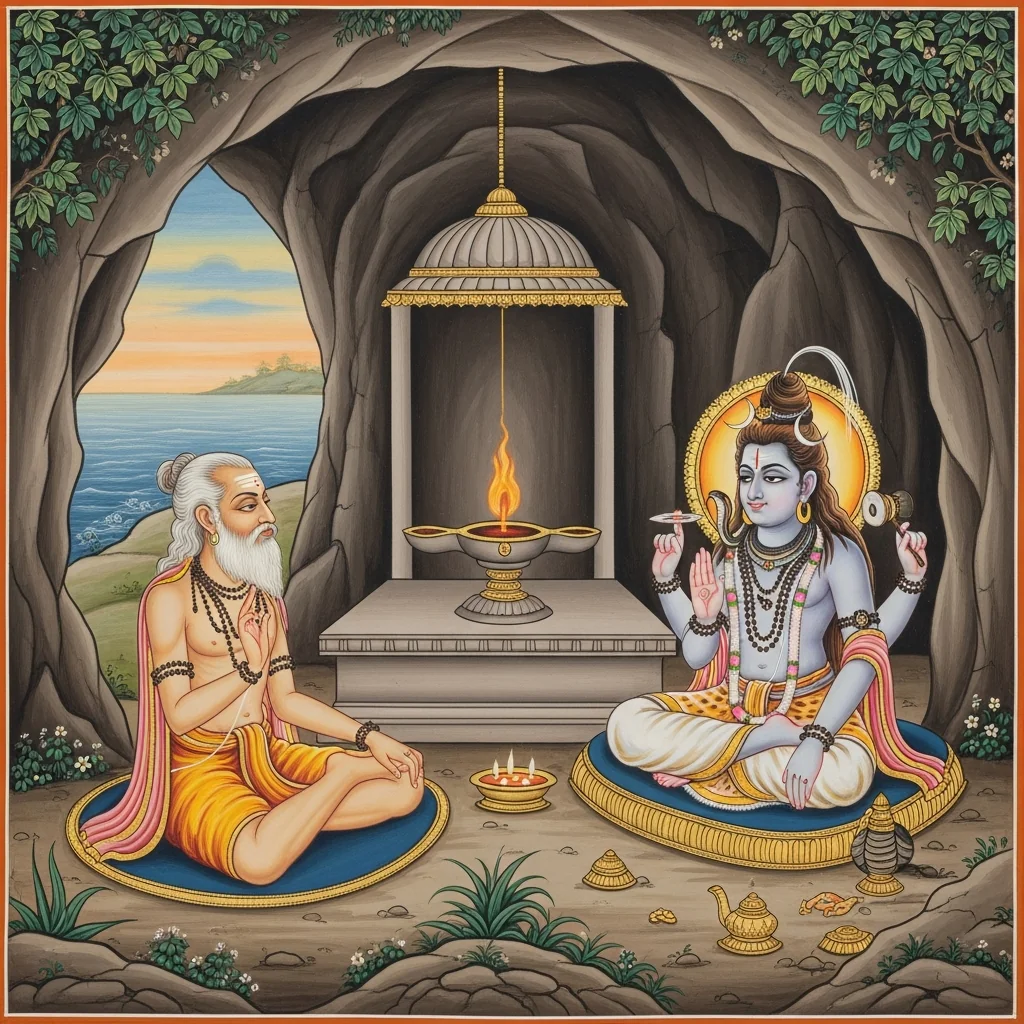
This chapter unfolds as a Devī–Īśvara dialogue, in which Devī asks for a detailed account of Prabhāsa’s Sun-linked sanctity, the origin-status of Arka-sthala as an ornament of the region, and the proper standards of worship—mantras, procedures, and festival timings. Īśvara replies by recounting an ancient precedent from the Kṛta-yuga. The sage Jaigīṣavya, son of Śatakalāka, comes to Prabhāsa and performs graded austerities across vast spans of time: living on air alone, then water alone, then a leaf-diet, and observing lunar-vow cycles. He culminates in intense ascetic discipline and devoted worship of a liṅga. Śiva appears, grants “knowledge-yoga” that severs saṃsāra, bestows ethical stabilizers—humility, forbearance, and self-control—and promises yogic sovereignty and future access to divine vision. The chapter then extends the site’s efficacy through the yugas: in the Kali-yuga the liṅga is famed as Siddheśvara; worship and yogic practice in Jaigīṣavya’s cave are said to yield swift transformative fruits, purification, and benefits for ancestors. A concluding phalaśruti proclaims that worship of the Siddha-liṅga produces extraordinary merit, praised in cosmic comparative terms.
Shlokas
Verse 1
देव्युवाच । यदेतद्भवता प्रोक्तं माहात्म्यं सूर्यदैवतम् । तन्मे विस्तरतो ब्रूहि देवदेव जगत्पते
The Goddess said: “This greatness of the Sun-deity that you have spoken—tell it to me in fuller detail, O God of gods, O Lord of the world.”
Verse 2
कथमर्कस्थलो भूतः प्रभासक्षेत्रभूषणः । पूजनीयो महादेवः सम्यग्यात्राफलेप्सुभिः
How did Mahādeva become ‘Arkasthala’—the ornament of the sacred field of Prabhāsa—and why is he to be worshipped by those who seek the true fruit of pilgrimage performed in the proper way?
Verse 3
के मंत्राः किं विधानं तु केषु पर्वसु पूजयेत् । जैगीषव्येश्वरो भूत्वा ह्यभूत्सिद्धेश्वरः कथम् । तन्मे कथय देवेश विस्तरात्सर्वमेव हि
Which mantras are to be used, what is the proper procedure, and on which sacred occasions should he be worshipped? And how did the Lord, once known as Jaigīṣavyeśvara, become Siddheśvara? Tell me all this, O Lord of gods, in full detail.
Verse 4
पाताले विवरं तत्र योगिन्यस्तत्र किं पुरा । तथा मातृगणश्चैव कथमेतदभूत्पुरा
And in former times, what was that opening there into Pātāla, the netherworld? Who were the Yoginīs there, and likewise the host of the Mātṛs—how did all this come to be in the past?
Verse 5
एतत्सर्वमशेषेण दयां कृत्वा जगत्पते । ममाचक्ष्व विरूपाक्ष यद्यहं ते प्रिया हर
O Lord of the world, out of compassion tell me all this without leaving anything. O Virūpākṣa, O Hara—if I am dear to you, then explain it to me.
Verse 6
ईश्वर उवाच । साधु पृष्टं त्वया देवि कथयामि समासतः । सिद्धेश्वरो ह्यभूद्येन जैगीषव्येश्वरो हरः
Īśvara said: Well asked, O Devī. I shall tell in brief how Hara, known as Jaigīṣavyeśvara, became Siddheśvara.
Verse 7
पूजाविधानं विस्तीर्य तन्मे निगदतः शृणु । आसीदस्मिन्कृते देवि सर्व ज्ञानविशारदः
Listen as I set forth in detail the procedure of worship. In the Kṛta age, O Devī, there lived one skilled in every kind of knowledge.
Verse 8
पुत्रः शतकलाकस्य जैगीषव्य इति श्रुतः । प्रभासक्षेत्रमासाद्य स चक्रे दुश्चरं तपः
He was the son of Śatakalāka, famed by the name Jaigīṣavya. Having reached the sacred field of Prabhāsa, he undertook austerities difficult to perform.
Verse 9
अतिष्ठद्वायुभक्षश्च वर्षाणां शतकं किल । अम्बुभक्षः सहस्रं तु शाकाहारोऽयुतं तथा
It is said that he lived on air for a hundred years; then on water for a thousand; and likewise sustained himself on greens for ten thousand years.
Verse 10
चांद्रायणसहस्रं च कृतं सांतपनं पुनः । शोषयित्वा मिताहारो दिग्वासाः समपद्यत
He performed a thousand Cāndrāyaṇa observances, and again the Sāṃtapana penance. Having emaciated his body, he lived on scant food and became digvāsā—sky-clad, with the directions as his garment.
Verse 11
पूर्वे कल्पे स्वयं भूतं महोदयमिति श्रुतम् । स लिंगं देवदेवस्य प्रतिष्ठाप्यार्चयन्नपि
In a former kalpa, it is heard, there was a self-manifest liṅga known as Mahodaya. He installed that liṅga of the Deva of devas and worshipped it in devotion.
Verse 12
भस्मशायी भस्मदिग्धो नृत्त गीतैरतोषयत् । जपेन वृषनादैश्च तपसा भावितः शुचिः
Lying upon sacred ash and smeared with ash, he delighted the Lord through dance and song. Purified and refined by japa, by the chanting of Vedic sounds, and by austerity, he became inwardly pure.
Verse 13
तमेवं तोषयाणं तु भक्त्या परमया युतम् । भगवांश्च तमभ्येत्य इदं वचनमब्रवीत्
Seeing him thus engaged in pleasing the Lord, endowed with supreme devotion, the Blessed One approached him and spoke these words.
Verse 14
जैगीषव्य महाबुद्धे पश्य मां दिव्यचक्षुषा । तुष्टोऽस्मि वरदश्चाहं ब्रूहि यत्ते मनोगतम्
“O Jaigīṣavya, great-souled and wise—behold Me with divine sight. I am pleased, and I am the giver of boons. Speak what is in your heart.”
Verse 15
स एवमुक्तो देवेन देवं दृष्ट्वा त्रिलोचनम् । प्रणम्य शिरसा पादाविदं वचनमब्रवीत्
Thus addressed by the God, he beheld the three-eyed Deva; bowing his head at the Lord’s feet, he spoke these words.
Verse 16
जैगीषव्य उवाच । भगवन्देवदेवेश मम तुष्टो यदि प्रभो । ज्ञानयोगं हि मे देहि यः संसारनिकृन्तनम्
Jaigīṣavya said: “O Blessed Lord, God of gods—if You are pleased with me, grant me the yoga of liberating knowledge, which cuts through worldly bondage.”
Verse 17
भगवन्नान्यदिच्छामि योगात्परतरं हितम् । त्वयि भक्तिश्च नित्यं मे देव्यां स्कन्दे गणेश्वरे
“O Lord, I desire nothing else—no good higher than this yoga. And may I have constant devotion to You, and also to the Goddess, to Skanda, and to Gaṇeśvara (Gaṇeśa).”
Verse 18
न च व्याधिभयं भूयान्न च तेजोऽपमानता । अनुत्सेकं तथा क्षांतिं दमं शममथापि च
“And may there be no fear of disease, nor any diminution of spiritual radiance; grant me humility, patience, self-restraint, and tranquility as well.”
Verse 19
एतान्वरान्महादेव त्वदिच्छामि त्रिलोचन
“These are the boons I seek from You, O Mahādeva, O Three-Eyed Lord.”
Verse 20
ईश्वर उवाच । अजरश्चामरश्चैव सर्वशोकविवर्जितः । महायोगी महावीर्यो योगैश्वर्यसमन्वितः
Īśvara said: “You shall be free from aging and death, untouched by all sorrow—becoming a great yogin of mighty vigor, endowed with the lordly attainments of Yoga.”
Verse 21
प्रभावाच्चास्य क्षेत्रस्य गुह्यस्य मम शाश्वतम् । योगाष्टगुणमैश्वर्यं प्राप्स्यसे परमं महत्
“And by the power of this sacred field—My eternal, secret domain—you shall obtain the supreme and vast yogic sovereignty endowed with the eightfold qualities.”
Verse 22
भविष्यसि मुनिश्रेष्ठ योगाचार्यः सुविश्रुतः
O best of sages, you shall become a renowned master-teacher of Yoga, celebrated far and wide.
Verse 23
यश्चेदं त्वत्कृतं लिगं नियमेनार्चयिष्यति । सर्वपापविनिर्मुक्तो योगं दिव्यमवाप्स्यति
And whoever, observing proper vows and discipline, worships this liṅga fashioned by you—freed from all sins—shall attain divine Yoga.
Verse 24
जैगीषव्यगुहां चेमां प्राप्य योगं करोति यः । स सप्तरात्राद्युक्तात्मा संसारं संतरिष्यति
Whoever, reaching this Jaigīṣavya Cave, practices Yoga—he, with his self harnessed in discipline for even seven nights, shall cross beyond saṃsāra.
Verse 25
मासेन पूर्वजातिं च जन्मातीतं च वेत्स्यति । एकरात्रात्तनुं शुद्धां द्वाभ्यां तारयते पितॄन् । त्रिरात्रेण व्यतीतेन त्वपरान्सप्त तारयेत्
Within a month he comes to know his former birth and what lies beyond birth. In a single night he purifies his body; in two nights he delivers his pitṛs, the ancestors; and when three nights have passed, he may deliver seven more of his forebears.
Verse 26
पुनश्च तव विप्रर्षे अजेयत्वं च योगिभिः । इच्छतो दर्शनं चैव भविष्यति च ते मम
And further, O brahmin-sage: you shall be unconquerable even by yogins; and for you, whenever you desire, my darśana—my sacred vision—shall indeed occur.
Verse 27
इति देवो वरान्दत्त्वा तत्रैवांतरधीयत । एतत्कृतयुगे वृत्तं तव देवि प्रभाषितम्
Thus the God, having granted the boons, vanished there itself. This event occurred in the Kṛta Yuga, O Goddess, as I have related to you.
Verse 28
त्रेतायुगे महादेवि द्वापरेऽपि तथैव च । कलियुगप्रवेशे तु वालखिल्या महर्षयः
In the Tretā Yuga, O great Goddess, and likewise in the Dvāpara; and at the entry of the Kali Yuga, the Vālakhilya great sages also appeared and acted there.
Verse 29
अस्मिन्प्राभासिके क्षेत्रे सूर्यस्थलसमीपतः । आराधयंतो देवेशं गुहामध्यनिवासिनम्
In this Prabhāsa holy region, near the place of Sūrya, they worshipped with devotion the Lord of gods who dwells within the cave’s interior.
Verse 30
अष्टाशीतिसहस्राणि ऋषयश्चोर्द्धरेतसः । वर्षायुतं तपस्तप्त्वा सिद्धिं जग्मुस्तदात्मिकाम्
Eighty-eight thousand sages, steadfast in brahmacarya, performed tapas for ten thousand years and attained that very siddhi (perfection) of that nature.
Verse 31
ततः सिद्धेश्वरं लिंगं कलौ ख्यातं वरानने । यदा सोमेन संयुक्ता कृष्णा शिवचतुर्दशी । तदैव तस्य देवस्य दर्शनं देवि दुर्ल्लभम्
Thereafter, O fair-faced one, that liṅga became famed in the Kali Yuga as Siddheśvara. And when the dark fortnight’s Śiva-Caturdaśī is joined with Soma (the Moon), then indeed, O Devī, the darśana of that God is exceedingly rare and supremely significant.
Verse 32
ब्रह्मांडं सकलं दत्त्वा यत्पुण्यमुपजायते । तत्पुण्यं लभते देवि सिद्धलिंगस्य पूजनात्
O Devī, the very merit that arises from gifting away the entire universe is obtained by worshipping the Siddhaliṅga.