Adhyaya 33
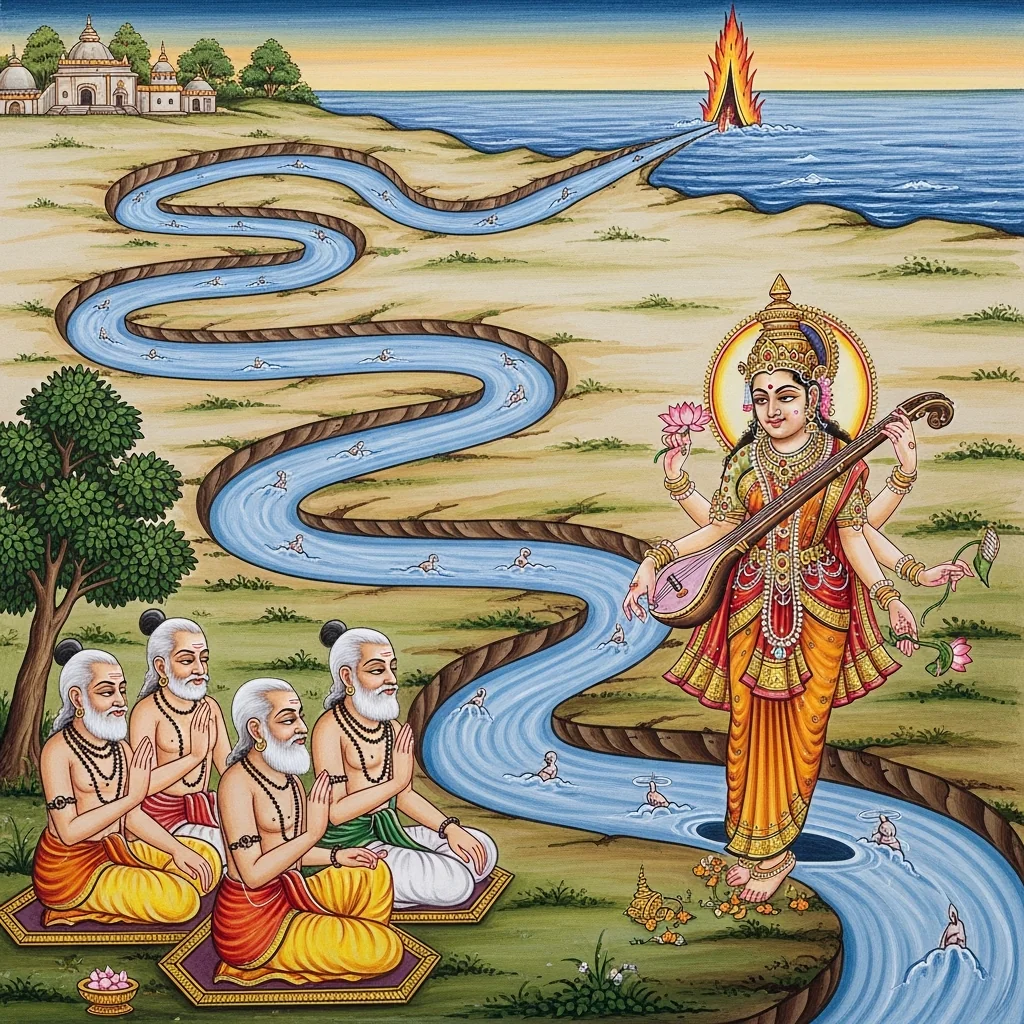
Chapter 33 begins with Devī asking about an earlier chain of events, and Īśvara explains that the gods must contain and relocate the fearsome Vāḍava fire, whose presence endangers cosmic order. Viṣṇu devises the remedy by appointing Sarasvatī as the very conveyance (yāna-bhūtā) to bear the fire and by seeking the help of the river deities; yet Gaṅgā and the others confess they cannot withstand its destructive power. Sarasvatī, bound by filial obedience and ritual restraint (not acting without her father’s command), receives Brahmā’s authorization, who prescribes an underground route and declares that when she is exhausted by the fire she will appear on earth as prācī, creating tīrtha access for devotees. The narrative then follows Sarasvatī’s auspicious departure, her river-form arising from the Himalayan region, and her repeated alternation between subterranean flow and visible manifestation. In Prabhāsa, four ṛṣis—Harina, Vajra, Nyaṅku, and Kapila—are introduced; out of compassion and to secure merit, Sarasvatī becomes pañca-srotas, bearing five names (Harīṇī, Vajriṇī, Nyaṅku, Kapilā, Sarasvatī) and establishing a purification order in which grave sins are mapped to these waters, with regulated bathing or drinking said to remove severe pāpa. An additional episode tells of the mountain Kṛtasmarā obstructing her and attempting to compel marriage; Sarasvatī cleverly asks it to hold the fire, and it is destroyed by contact, while its softened stones are explained as fit for building household shrines. At the ocean the Vāḍava fire offers a boon; guided by Viṣṇu, Sarasvatī requests that it become “needle-mouthed” (sūcī-mukha), able to drink the waters without consuming the gods. The chapter closes with a phalaśruti promising elevated spiritual attainment through hearing or reciting this account.
Shlokas
Verse 1
देव्युवाच । पितुर्वधामर्षसुजात मन्युना यद्यत्कृतं कर्म पुरा महर्षिणा । दधीचिपुत्रेण सुरप्रसाधिना सर्वं श्रुतं तद्धि मया समाधिना
The Goddess said: “All the deeds once performed by that great sage—the son of Dadhīci, who brought success to the gods—arising from the anger born of indignation at his father’s slaying, have indeed been heard by me in deep contemplation.”
Verse 2
पुनःपुनर्वै विबुधैः समानं यद्वृत्तमासी त्किमपि प्रधानम् । कार्यं हि तत्सर्वमनुक्रमेण विज्ञातुमिच्छामि कुतूहलेन
“And what was that principal matter that repeatedly occurred in common with the gods? I wish to know the entire affair in proper sequence, out of curiosity.”
Verse 3
ईश्वर उवाच । उक्तो यदासौ विबुधैः समस्तैरापः पुरा त्वं भुवि भक्षयस्व । यतोऽमराणां प्रथमं हि जाता आपोऽग्रजाः सर्वसुरासुरेभ्यः
Īśvara said: “When he was addressed by all the gods, they said long ago: ‘On earth, consume the Waters.’ For the Waters were indeed born first among the immortals—elder to all gods and demons.”
Verse 4
तेनैवमुक्तस्तु महात्मना तदा प्रदर्शयध्वं मम ता यतः स्थिताः । पीत्वा सुराः सर्वमहं पुरस्तात्कृत्यं करिष्ये सुरभक्षणं हि
Thus addressed by that great-souled one, he then said: “Show me where those Waters are situated. After drinking them all, I shall next carry out what must be done—indeed, the consuming of the gods.”
Verse 5
तत्रापि नेतुं यदि मां समर्था यत्रासते वारिचयाः समेताः । अतोऽन्यथा नाहमलीकवादी प्राणे प्रयाते मुनिवाक्यकारी
If you are able to lead me there—where the gathered masses of waters abide—then do so. Otherwise, I am not one to speak falsely; even at the cost of life, I am one who carries out a sage’s word.
Verse 6
आहोक्ते पुंडरीकाक्ष और्वं हि वाडवं तदा । त्वां प्रापयिष्ये यत्रापः केन यानेन वाडव
Puṇḍarīkākṣa then said to Vāḍava (Aurva): “I will take you to where the Waters are—but by what conveyance, O Vāḍava?”
Verse 7
वाडव उवाच । नाहं हयादिभिर्यानैर्गंतुं तत्र समुत्सहे । कुमारीकरसंपर्कमेकं मुक्त्वा मतं हि मे
Vāḍava said: “I am not willing to go there by conveyances such as horses and the like. One means alone is acceptable to me—contact with the hand of a maiden.”
Verse 8
विष्णुरुवाच । एतत्ते सुलभं यानं तां कन्यामानयाम्यहम् । या त्वां नेतुं समर्था स्यादपां स्थानं सुनिश्चितम्
Viṣṇu said: “For you, this conveyance is easily obtained. I shall bring that maiden who will be capable of leading you to the assured abode of the waters.”
Verse 9
ईश्वर उवाच । सुरभीशापसंतप्ता प्रागुपात्तदशाफला । सरस्वती यानभूता तस्य सा विष्णुना कृता
Īśvara said: “Sarasvatī—afflicted by Surabhī’s curse and bearing the result of her previously assumed condition—was made into his conveyance by Viṣṇu.”
Verse 10
ततोऽब्रवीद्विभुर्गंगां पार्श्वतः समुपस्थिताम् । एनं वह्निं महाभागे वेगान्नय महोदधिम् । नान्या शक्ता समानेतुं त्वां विना लोकपावनि
Then the Lord spoke to Gaṅgā, who stood at his side: “O blessed one, swiftly carry this fire to the Great Ocean. None other can convey it there without you, O purifier of the worlds.”
Verse 11
गङ्गोवाच । नास्ति मे भगवञ्छक्ति रौर्वं वोढुं जगत्पते । रौद्ररूपी महानेष दहत्येवानलो भृशम्
Gaṅgā said: “O Blessed Lord, O Master of the worlds, I have not the strength to bear the Raurva fire. This mighty flame, fierce in form, burns exceedingly.”
Verse 12
ततस्तु यमुनां प्राह सिन्धुं तस्या ह्यनन्तरम् । अन्या नदीश्च विविधाः पृथक्पृथगुदारधीः
Then he addressed Yamunā, and after her, Sindhu; and also other diverse rivers, each one separately, each with noble intent in her own way.
Verse 13
अशक्तास्ताः समानेतुं पृष्टाश्च सुरसत्तमैः । ततः सरस्वतीं प्राह देवदेवो जनार्द्दनः । त्वमेव वज कल्याणि प्रतीच्यां लवणोदधौ
Those rivers, when questioned by the foremost of the gods, were unable to carry it. Then Janārdana, the God of gods, spoke to Sarasvatī: “You alone, O auspicious one, go westward to the Salt Ocean.”
Verse 14
एवं कृते सुराः सर्वे भविष्यन्ति भयोज्झिताः । अन्यथा वाडवेनैते दह्यंते स्वेन तेजसा
If this is done, all the gods will be freed from fear; otherwise, they will be burned by Vāḍava through his own blazing energy.
Verse 15
तस्मात्त्वं रक्ष विबुधाने तस्मात्तुमुलाद्भयात् । मातेव भव सुश्रोणि सुराणामभयप्रदा
Therefore protect the gods from this dreadful fear. O fair-hipped one, become like a mother and grant the devas the gift of fearlessness.
Verse 16
एवमुक्ता हि सा तेन विष्णुना प्रभविष्णुना । आह नाहं स्वतन्त्रास्मि पिता मे ध्रियते चिरात्
Thus addressed by that mighty Viṣṇu, she replied: “I am not independent; my father has long held authority over me.”
Verse 17
तस्याहं कारिणी नित्यं कुमारी च धृतव्रता । कालत्रयेप्यस्वतन्त्रा श्रूयते विबुधैः सुता
“I am ever his obedient agent—ever a maiden, steadfast in vows. Even through the three times—past, present, and future—I am not independent; thus do the wise speak of the daughter.”
Verse 18
पित्रादेशं विना नाहं पदमेकमपि क्वचित् । गच्छामि तस्मात्कोऽप्यन्य उपायश्चिंत्यतां हरे
“Without my father’s command I go nowhere—not even a single step. Therefore, O Hari, let some other means be devised.”
Verse 19
तत्स्वरूपं विदित्वैवं समभ्येत्य पितामहम् । तमब्रवीद्वासुदेवो देवकार्यमिदं कुरु
Having thus understood the true situation, Vāsudeva approached Pitāmaha (Brahmā) and said: “Accomplish this task on behalf of the gods.”
Verse 20
नान्यथा शक्यते नेतुं वाडवोऽग्निर्महाबलः । अदृष्टदोषां मुक्त्वेमां कुमारीं तनयां तव
“There is no other way to carry away the mighty Vāḍava fire. Release this maiden—your daughter—who is without any seen fault.”
Verse 21
तच्छ्रुत्वा विष्णुना प्रोक्तं कुमारीं तनयां तदा । शिरस्याधाय सस्नेहमुवाच प्रपितामहः
Hearing what Viṣṇu had spoken, Prapitāmaha (Brahmā) then, placing the maiden—his daughter—upon his head with affection, spoke.
Verse 22
याहि देवि सुरान्सर्वान्रक्ष त्वं भयमागतान् । विनिक्षिप त्वं नीत्वैनं वाडवं लवणांभसि । पितुर्वाक्यं हि सा श्रुत्वा प्रोवाच श्रुतिलक्षणा
“Go, O Goddess; protect all the gods who have come into fear. Take this Vāḍava (fire) and cast it into the salty ocean.” Having heard her father’s words, she—marked by Vedic sanctity—replied.
Verse 23
सरस्वत्युवाच । एषास्मि प्रस्थिता तात तव वाक्या दसंशयम् । रौद्रोऽयं वाडवो वह्निस्तनुं मे भक्षयिष्यति
Sarasvatī said: “Father, I am setting out—without doubt—because of your command. Yet this Vāḍava fire is fierce; it will consume my body.”
Verse 24
प्राप्तं कलियुगं रौद्रं सांप्रतं पृथिवीतले । लोकः पापसमाचारः स्पर्शयिष्यति मां प्रभो
“Now the fierce Kali age has arrived upon the earth. People, given to sinful conduct, will touch me, O Lord.”
Verse 25
ततो दुःखतरं किं स्याद्यत्पापैः सह संगमः
What could be more painful than association with the sinful?
Verse 26
ब्रह्मोवाच । यदि पापजनाकीर्णं न वांछसि धरातलम् । पातालतलसंस्था त्वं नय वह्निं महोदधौ
Brahmā said: “If you do not desire the earth’s surface crowded with sinful people, then dwell in the nether regions and lead this fire into the great ocean.”
Verse 27
यदातिश्रमसंयुक्ता वह्निना दह्यसे भृशम् । तदा विभिद्य वसुधां प्रत्यक्षा भव पुत्रिके
When you are afflicted by extreme exhaustion and are fiercely scorched by fire, then cleave the earth and become manifest before all, O daughter.
Verse 28
कृत्वा वक्त्रं विशालाक्षि प्राची भव सुमध्यमे । ततो यास्यंति तीर्थानि त्वां श्रांतां चारुहासिनीम्
Turning your face to the east, O large-eyed, slender-waisted one—then the holy tīrthas will come to you as you rest, O fair-smiling one.
Verse 29
तानि सर्वाणि चागत्य साहाय्यं ते वरानने । करिष्यंति त्रयस्त्रिंशत्कोट्यो वै मम शासनात्
All those tīrthas will come and render you help, O fair-faced one—indeed, thirty-three crores of them, by my command.
Verse 30
गच्छ पुत्रि न संतापस्त्वया कार्यः कथंचन । अरिष्टं व्रज पंथानं मा सन्तु परिपंथिनः
Go, O daughter; do not grieve in any way. Travel by a path free from harm—may there be no obstacles or adversaries on your way.
Verse 31
ईश्वर उवाच । एवमुक्ता तदा तेन ब्रह्मणाथ सरस्वती । त्यक्त्वा भयं हृष्टमनाः प्रयातुं समुपस्थिता
Īśvara said: Thus addressed by Brahmā, Sarasvatī cast off fear and, with a delighted heart, prepared to depart.
Verse 32
तस्याः प्रयाणसमये शंखदुंदुभिनिःस्वनैः । मंगलानां च निर्घोषैर्जगदापूरितं शुभैः
At the time of her departure, amid the sounds of conches and dundubhi drums and the auspicious cries of benediction, the whole world was filled with sacred joy.
Verse 33
सितांबरधरा देवी सितचंदनगुंठिता । शारदांबुदसंकाशा तारहारविभूषिता
The goddess wore white garments, was anointed with white sandal paste, shone like an autumn cloud, and was adorned with a necklace of pearls.
Verse 34
संपूर्णचंद्रवदना पद्मपत्रायतेक्षणा । कीर्तिर्यथा महेंद्रस्य पूरयन्ती दिशो दश
Her face was like the full moon and her eyes like lotus petals; like the fame of mighty Indra, she filled the ten directions.
Verse 35
स्वतेजसा द्योतयंती सर्वमाभासयज्जगत् । अनुव्रजंती गंगा वै तयोक्ता वरवर्णिनि
Shining with her own splendor and illumining the whole world, Gaṅgā followed along; thus she was addressed by her: “O most fair-complexioned one.”
Verse 36
द्रक्ष्यामि त्वां पुनरहं कुत्र वै वसतीं सखि । एवमुक्ता तया गंगा प्रोवाच स्निग्धया गिरा
“O friend, where indeed shall I see you again—where will you dwell?” Thus addressed, Gaṅgā replied in a tender voice.
Verse 37
यदैव वीक्षसे प्राचीदिशि प्राप्स्यसि मां तदा । सुरैः परिवृता सर्वैस्तत्राहं तव सुवृते
Whenever you look toward the eastern quarter, at that very moment you shall attain me. There I shall be present for you, O virtuous one, surrounded by all the gods.
Verse 38
दर्शनं संप्रदास्यामि त्यज शोकं शुचिस्मिते । तामापृच्छ्य ततो गंगां पुनर्दर्शनमस्तु ते
Surely I shall grant you my darśana; abandon grief, O pure-smiling one. Then, having taken leave of Gaṅgā, may there be a meeting again for you.
Verse 39
गच्छ स्वमालयं भद्रे स्मर्त्तव्याऽहं त्वयाऽनघे । यमुनापि तथा चैवं गायत्री सुमनोरमा
“Go to your own abode, O auspicious lady; remember me, O sinless one. Remember also Yamunā, and likewise the lovely, most-delightful Gāyatrī.”
Verse 40
सावित्रीसहिताः सर्वाः सख्यः संप्रेषितास्तदा । ततो विसृज्य तां देवी नदी भूत्वा सरस्वती
Then all her companions, together with Sāvitrī, were sent away. Thereafter the Goddess, dismissing her, became a river—Sarasvatī.
Verse 41
हिमवंतं गिरिं प्राप्य प्लक्षात्तत्र विनिर्गता । अवतीर्णा धरापृष्ठे मत्स्यकच्छपसंकुला
Reaching Mount Himavat, she issued forth there from the plakṣa-tree. Descending upon the earth’s surface, she teemed with fish and tortoises.
Verse 42
ग्राहडिंडिमसंपूर्णा तिमिनक्रगणैर्युता । हसंती च महादेवी फेनौघैः सर्वतो दिशम्
Filled with the tumult of crocodiles, accompanied by hosts of timi-fish and makaras, the great Goddess moved along as if laughing, casting streams of foam in every direction.
Verse 43
पुण्यतो यवहा देवीस्तूयमाना द्विजातिभिः । वाडवं वह्निमादाय हयवेगेन निःसृता
Auspicious and merit-bestowing, the Goddess—praised by the twice-born—took up the Vāḍava fire and surged forth with the speed of a horse.
Verse 44
भित्त्वा वेगाद्धरापृष्ठं प्रविष्टाथ महीतलम् । यदायदाभवच्छ्रांता दह्यते वाडवाग्निना । तदातदा मर्त्यलोके याति प्रत्यक्षतां नदी
Breaking through the earth’s surface by her force, she entered into the ground. Whenever she grows weary and is scorched by the Vāḍava fire, at those times the river becomes manifest again in the mortal world.
Verse 45
ततस्तु जायते प्राची संतप्ता वाडवेन तु । ततो वै यानि तीर्थानि कीर्त्तितानि पुरातनैः
Thereupon the river called Prācī arises, heated by the Vāḍava fire. Then indeed the tīrthas proclaimed by the ancients draw near in sacred presence and potency.
Verse 46
दिव्यांतरिक्षभौमानि सांनिध्यं यांति भामिनि । ततश्चाश्वासिता तैः सा सरस्वती पुनर्नदी । पातालतलमा साद्य जगाम मकरालयम्
O radiant lady, the divine powers and tīrthas—celestial, atmospheric, and earthly—come into close presence. Then she, Sarasvatī, again as a river, comforted by them, reached Pātāla and went on to the abode of the makaras, the Ocean.
Verse 47
खदिरामोदमासाद्य तत्र सा वीक्ष्य सागरम् । गंतुं प्रवृत्ता तं वह्निमादाय सुरसुंदरि
Reaching the fragrant grove of khadira trees, she beheld the Ocean there. Then that divine, beautiful lady set out to go onward, taking that sacred fire with her.
Verse 48
निरूढभारमात्मानं देवादेशाद्विचिंत्य सा । प्रहृष्टा सुमनास्तस्मात्प्रवृत्ता दक्षिणामुखी
Reflecting that, by the command of the gods, her burden had been duly taken up, she became joyful and serene in mind; therefore she proceeded, facing southward.
Verse 49
एतस्मिन्नेव काले तु ऋषयो वेदपारगाः । चत्वारश्च महादेवि प्रभासं क्षेत्रमाश्रिताः
Just at that time, O great goddess, four sages—masters of the Vedas—took refuge in the sacred field (kṣetra) of Prabhāsa.
Verse 50
हरिणश्चाथ वज्रश्च न्यंकुः कपिल एव च । तपस्तप्यंति तत्रस्थाः स्वाध्यायासक्तमानसाः
Hariṇa, Vajra, Nyaṅku, and Kapila—dwelling there—performed austerities, their minds devoted to svādhyāya, the study and recitation of the Veda.
Verse 51
पृथक्पृथक्समाहूताः स्नानार्थं तैः सरस्वती । सागरः सम्मुखस्तस्याः सहसा सम्मुपस्थितः
Summoned by them, each in turn, for the sake of sacred bathing, Sarasvatī drew near—when suddenly the Ocean appeared directly before her.
Verse 52
ततः सा चिन्तयामास कथं मे सुकृतं भवेत् । शापभीता च सा साध्वी पंचस्रोतास्तदाऽभवत्
Then she reflected, “How may merit arise for me?” And that virtuous one, fearful of a curse, then became five-streamed.
Verse 53
एकैकं तोषयामास तमृषिं वरवर्णिनि । ततोऽस्याः पंच नामानि जातानि पृथिवीतले
O fair-complexioned lady, she satisfied each sage one by one; therefore, upon the earth, five names of hers came into being.
Verse 54
हरिणी वज्रिणी न्यंकुः कपिला च सरस्वती । पानावगाहनान्नृणां पंचस्रोताः सरस्वती
Hariṇī, Vajriṇī, Nyaṅku, Kapilā, and Sarasvatī herself—thus Sarasvatī became five-streamed; for men, by drinking and bathing in these waters, she bestows purification.
Verse 55
ब्रह्महत्या सुरापानं स्तेयं गुर्वंगनागमः । एषां संयोगजं चान्यन्नराणां पंचमं हि यत्
Brahmin-slaying, drinking liquor, theft, and intercourse with the guru’s wife—together with a fifth sin that arises among men from combinations of these.
Verse 56
एतत्पंचविधं पुंसां पंचधाऽवस्थिता सती । नाशयेत्पातकं घोरं सखीभिः सहिता नदी
This fivefold set of men’s sins—she, abiding in five forms—destroys dreadful transgression; the river, accompanied by her “companions” (the five streams), annihilates terrible wrongdoing.
Verse 57
ब्रह्महत्यां महाघोरां प्रतिलोमा सरस्वती । पानावगाहनान्नृणां नाशयत्यखिलं हि सा
Sarasvatī—praised here as Pratilomā—indeed destroys completely the most dreadful sin of brahmin-slaying for people, through drinking her waters and bathing in her.
Verse 58
प्रमादान्मदिरापानदोषेणोपहतात्मनाम् । तद्व्यपोहाय कपिला द्विजानां वहते नदी
For the twice-born whose souls have been harmed by the fault of drinking liquor through heedlessness, the river Kapilā flows in order to remove that stain.
Verse 59
उपवासाज्जपाद्धोमात्स्नानात्पानाद्द्विजन्मनाम् । सप्ताहान्नाशयेत्पापं तत्तद्भावेन चेतसा
By fasting, by japa, by homa, by bathing, and by drinking the sacred water, the sins of the twice-born are destroyed within seven days—when the mind is imbued with the appropriate devotional intention for each act.
Verse 60
स्वयं तेऽपि विशुध्यंति यथोक्तविधिकारिणः । न्यंकुं नदीं समासाद्य महतः पातकात्कृतात्
They themselves become purified—those who act according to the prescribed rites—upon approaching the river Nyaṃku; even the great sins they have committed are cleansed away.
Verse 61
स्नानोपासनपानेन वज्रिणी गुरुतल्पगम् । नाशयत्यखिलं पुंसां पापं भूरिभयंकरम्
By bathing, worship, and drinking its water, Vajriṇī utterly destroys for men the immensely terrifying sin of gurutalpa—violating the teacher’s bed.
Verse 62
संयोगजस्य पापस्य हरणाद्धरिणी स्मृता । नदी पुण्यजलोपेता सप्ताहमवगाहनात्
Because she removes sin born of improper association, she is remembered as Hariṇī. Endowed with holy waters, this river purifies by immersion for seven days.
Verse 63
एवमेतानि पापानि सर्वाणि सुरसुंदरि । नदी नाशयते तथ्यं पंचस्रोता सरस्वती
Thus, O fair one among the celestials, the river Sarasvatī—flowing in five streams—truly destroys all these sins.
Verse 64
ततोऽपश्यत्पुनश्चारु सा देवी पथि संस्थितम् । पर्वतं सागरस्यांते रोद्धुं मार्गमिव स्थितम्
Then again that lovely goddess beheld, standing upon her path, a mountain at the ocean’s edge—poised as though to block her way.
Verse 65
ब्रह्माण्डमानदण्डोऽयं पुरतो गिरिसत्तमः । व्रजन्त्याः सुरकार्येण मम विघ्नकरः स्थितः
This foremost mountain—like a measuring rod for the very cosmos—stands before me as an obstacle, even as I proceed on a divine errand.
Verse 66
उच्चैस्तरं महाशैलमवलोक्य सरस्वती । अथ वेगेन रुद्धेन गिरिणा विस्मिता सती
Seeing the lofty, immense mountain, Sarasvatī—her swift current checked by that peak—became astonished.
Verse 67
एवं संचिन्तयेद्यावन्मनसा तन्म हाद्भुतम् । तावन्मंगलशब्देन प्रतिबुद्धः कृतस्मरः
While she was thus reflecting in her mind on that most wondrous matter, at that very moment she was awakened by an auspicious cry; and, coming to herself, she regained full awareness.
Verse 68
गिरिशृंगद्वंद्वचरं ददर्श पुरुषं च सा । तामाह देवीं स नगो मार्गो नास्तीह सुव्रते
She then saw a man moving between twin mountain-peaks. That Mountain spoke to the Goddess: “O fair-vowed one, there is no passage here.”
Verse 69
अन्यत्र क्वापि गच्छ त्वं यत्र तेऽभिमतं शुभे । आहैवमुक्ते सा देवी नरं नगशिरःस्थितम्
“Go elsewhere—anywhere—wherever you wish, O auspicious one.” When this was said, the Goddess replied to the man stationed upon the mountain’s summit.
Verse 70
देवादेशात्समायाता न निरोध्या गिरे त्वया । एवमुक्ते गिरिः प्राह तां देवीं सुमनोरमाम्
“I have come by the command of the gods; you must not obstruct me, O Mountain.” When she spoke thus, the Mountain addressed that most charming Goddess.
Verse 71
पर्वतोऽहं त्वया भद्रे किं न ज्ञातः कृतस्मरः । त्वत्स्पर्शनान्न दोषोस्ति कुमारी त्वं यतोऽनघे
“I am a Mountain—why have you not recognized me, O noble lady? And there is no fault in my touching you, O sinless one, for you are a maiden.”
Verse 72
अतस्त्वां वरये देवि भार्या मे भव सुव्रते
“Therefore I choose you, O Goddess—be my wife, O fair-vowed one.”
Verse 73
सरस्वत्युवाच । पिता मे ध्रियते यस्मात्तेन नाहं स्वयंवरा । तव भार्या भविष्यामि मार्गं यच्छ ममाधुना
Sarasvatī said: “Because my father’s authority is upheld, I am not free to choose for myself. I shall become your wife—grant me the path now.”
Verse 74
एवमुक्तो गिरिः प्राह अनिच्छंतीं महाबलात् । उद्वाहयिष्ये त्वां भद्रे कस्त्राता स्ति तवाधुना
Thus addressed, the Mountain said—though she was unwilling—by force of his great power: “O noble lady, I shall take you in marriage. Who is there to protect you now?”
Verse 75
सा तं मनोभवाक्रान्तं मत्वा दिव्येन चक्षुषा । आह नास्ति मम त्राता त्वामेव शरणं गता
Seeing with divine sight that he was overpowered by desire, she said: “I have no protector; I have taken refuge in you alone.”
Verse 76
त्वयोद्वाह्या यद्य वश्यमहमेवं महाबल । अस्नातां नोद्वह विभो स्नानं कर्त्तुं च देहि मे
“If I must indeed be married by you, O mighty one, then do not marry me while I am unbathed, O powerful lord. Grant me leave to perform my bath.”
Verse 77
तामुवाच ततः शैलः स्वसंपदभिमानवान् । सौख्यदं पश्य सुभगे मयि संपूर्णवैभवम्
Then the mountain, proud of its own riches, spoke to her: “O auspicious lady, behold in me this complete magnificence—bestowing happiness.”
Verse 78
द्वंद्वानि यत्र गायंति किंनराणां मनोरमम् । श्रूयते च सुनिध्वानं तंत्रीवाद्यमथापरम्
There, the delightful antiphonal songs of the Kiṃnaras are sung; and one also hears sweet, resonant sounds—stringed instruments and other music besides.
Verse 79
तत्र तालास्तमालाश्च पिप्पलाः पनसास्तथा । सदैव फलपुष्पाश्चा दृश्यंते सुमनोरमाः
There are palmyra palms, tamāla trees, sacred pippalas, and jackfruit trees; ever adorned with fruits and blossoms, they are seen as exceedingly beautiful.
Verse 80
कुटजैः कोविदारैश्च कदंबैः कुरबैस्तथा । मत्तालिकुलघुष्टैश्च भूधरो भाति सर्वतः
Adorned with kuṭaja, kovidāra, kadamba, and kuraba trees, and resounding with swarms of nectar-intoxicated bees, the mountain shines on every side.
Verse 81
हरांगरागवद्भाति क्वचित्कुटजकुड्मलैः । क्वचित्तु कर्णिकारैश्च विष्णोर्वासःसमप्रभः
In some places, with kuṭaja buds, it gleams like the fragrant unguent upon Hara’s (Śiva’s) limbs; elsewhere, with karṇikāra blossoms, it shines with a radiance like Viṣṇu’s own abode.
Verse 82
तमालदलसंछन्नः क्वचिद्वैवस्वतद्युतिः । क्वचिद्धातुविलिप्तांगो गणाध्यक्षवपुर्नगः
In some parts, covered with tamāla leaves, the mountain bears the brilliance of Vaivasvata (the Sun); in other parts, smeared with mineral hues, it takes on the form and majesty of the Lord of the Gaṇas (Gaṇeśa).
Verse 83
चतुर्मुख इवाभाति हरितालवपुः क्वचित् । क्वचित्सप्तच्छदैर्विष्णोर्वपुषा भात्ययं गिरिः
In some places, tinted like haritāla, the mountain appears like the Four-faced One (Brahmā); elsewhere, amid saptacchada trees, it shines with a form akin to Viṣṇu.
Verse 84
क्वचित्कात्यायनीप्रख्यः प्रियंगुसुसमाकुलः । क्वचित्केसरसंयुक्तैरनलाभो विभात्यसौ
In some places, filled with lovely priyaṅgu blossoms, it appears like Kātyāyanī herself; in other places, adorned with kesara, it shines like a mass of fire.
Verse 85
वृत्तैः सपुलकैः स्निग्धैः स्त्रीणामिव पयोधरैः । दुष्प्राप्यैरल्पपुण्यानां क्वचिदाभाति बिल्वकैः
In some places it gleams with bilva trees—round, glossy, and bristling with fresh shoots, like the breasts of women—bilvas hard to obtain for those of little merit.
Verse 86
सिंहैर्व्याघ्रैर्मृगैर्नागैर्वराहैर्वानरैस्तथा । क्वचित्क्वचिदसौ भाति परस्परमनुव्रतैः
In various places it appears adorned with lions, tigers, deer, elephants, boars, and monkeys—each living in mutual concord and faithful accord with one another.
Verse 87
शूलिकोद्भिन्नमाकाशमिव कुर्वद्भिरुच्चकैः । एवमुक्ते प्रत्युवाच शारदा तं नगोत्तमम्
They raised a loud uproar, as though piercing the very sky with spears; when this was said, Śāradā replied to that foremost of mountains.
Verse 88
यदि मां त्वं परिणये रुदंतीमेकिकां तथा । गृहाण वाडवं हस्ते यावत्स्नानं करोम्यहम्
“If you would take me in marriage—me, weeping and alone—then hold this Vaḍava in your hand until I complete my bathing.”
Verse 89
एवमुक्ते स जग्राह त नगेद्रोऽपवर्जिम् । कृतस्मरस्तत्संस्पर्शात्क्षणाद्भस्मत्वमागतः
When she spoke thus, that lord of mountains took it in his hand; but the one called Kṛtasmara, by that very touch, in an instant was reduced to ash.
Verse 90
ततः प्रभृति ते तस्य पाषाणा मृदुतां गताः । गृहदेवकुलार्थाय गृह्यंते शिल्पिभिः सह
From that time onward, the stones of that place became soft; and artisans take them up to fashion household shrines and small chapels for the family deities.
Verse 91
दग्ध्वा कृतस्मरं देवी पुनरादाय वाडवम् । समुद्रस्य समीपे सा स्थिता हृष्टतनूरुहा
Having burned Kṛtasmara, the Goddess took back Vaḍava once more; then she stood near the sea, her body-hairs thrilled in exultation.
Verse 92
तत्रस्था सा महादेवी तमाह वडवानलम् । पश्य वाडव गर्जन्तं सागरं पुरतः स्थितम्
Standing there, the Great Goddess addressed Vaḍavānala: “Look, O Vaḍava—before you stands the ocean, roaring.”
Verse 93
गर्जंतं सोऽपि तं दृष्ट्वा प्रसर्पंतं च वीचिभिः । तामाह किमिदं भद्रे भीतो मे लवणोदधिः
Seeing that ocean too—roaring and surging forward with its waves—he said to her: “What is this, O gentle one? The salt sea seems afraid of me.”
Verse 94
प्रहस्योवाच सा बाला को न भीतस्तवानल । भक्ष्यस्ते विहितो यस्मात्तव देवैर्महाबल
Smiling, the maiden said: “O Fire, who would not fear you? For the gods themselves have appointed your food—O mighty one.”
Verse 95
स तस्यास्तद्वचः श्रुत्वा संप्रहृष्टस्तु पावकः । दास्यामि ते वरं भद्रे यथेष्टं प्रार्थयस्व नः
Hearing her words, the Fire was exceedingly delighted and said: “O gentle lady, I shall grant you a boon—ask of me whatever you desire.”
Verse 96
तेनैवमुक्ता सा देवी वाडवेनाग्निना तदा । सस्मार कारणात्मानं विष्णुं कमललोचनम्
Thus addressed by that Vāḍava-fire, the Goddess then remembered Viṣṇu—the causal Soul, lotus-eyed—calling Him to mind.
Verse 97
दृष्टोसावात्महृत्संस्थस्तया देवो जनार्द्दनः । स्मृतमात्रः सरस्वत्या परस्त्रिभुवनेश्वरः
By inner vision she beheld Lord Janārdana abiding within her own heart—the Supreme ruler of the three worlds—who appears the moment Sarasvatī merely remembers Him.
Verse 98
मनोदृष्ट्या विलोक्याह सा तमंतःस्थमच्युतम् । वाडवो यच्छति वरमहं तं प्रार्थयामि किम्
Gazing with the eye of the mind, she addressed Acyuta who dwelt within: “The Vāḍava (submarine fire) offers a boon—what indeed should I ask of him?”
Verse 99
ततस्तेन हृदिस्थेन प्रोक्ता देवी सरस्वती । प्रार्थनीयो वरो भद्रे सूचीवक्त्रत्वमादरात्
Then He who dwelt within her heart spoke to the Goddess Sarasvatī: “O auspicious one, ask as your boon—earnestly—for the state of having a needle-like mouth.”
Verse 100
ततस्त्वभिहितो देव्या यदि मे त्वं वरप्रदः । ततः सूचीमुखो भूत्वा त्वं पिबापो महाबल
Then the Goddess said to him: “If you are truly a bestower of boons to me, O mighty one, become needle-mouthed and drink up the waters.”
Verse 101
एवमुक्तेन तत्तेन सूचीवेधसमं कृतम् । घटिकापूरणं यद्वत्पपौ तद्वदनं जलम्
Thus instructed, he made his opening like a needle’s puncture; and just as water fills a clepsydra-vessel, so he drank the waters in that manner.
Verse 102
एवं स वाडवो वह्निः सुराणां भक्षणोद्यतः । वंचितो विष्णुना याति मेधामाधाय यत्नतः
In this way that Vāḍava fire—intent on consuming the gods—was outwitted by Viṣṇu, and it departed, taking its resolve into restraint through careful effort.
Verse 103
सर्गमेतं नरः पुण्यं वाच्यमानं शृणोति यः । स विष्णु लोकमासाद्य तेनैव सह मोदते
Whoever hears this holy account as it is recited attains Viṣṇu’s world and rejoices there together with Him.