Adhyaya 13
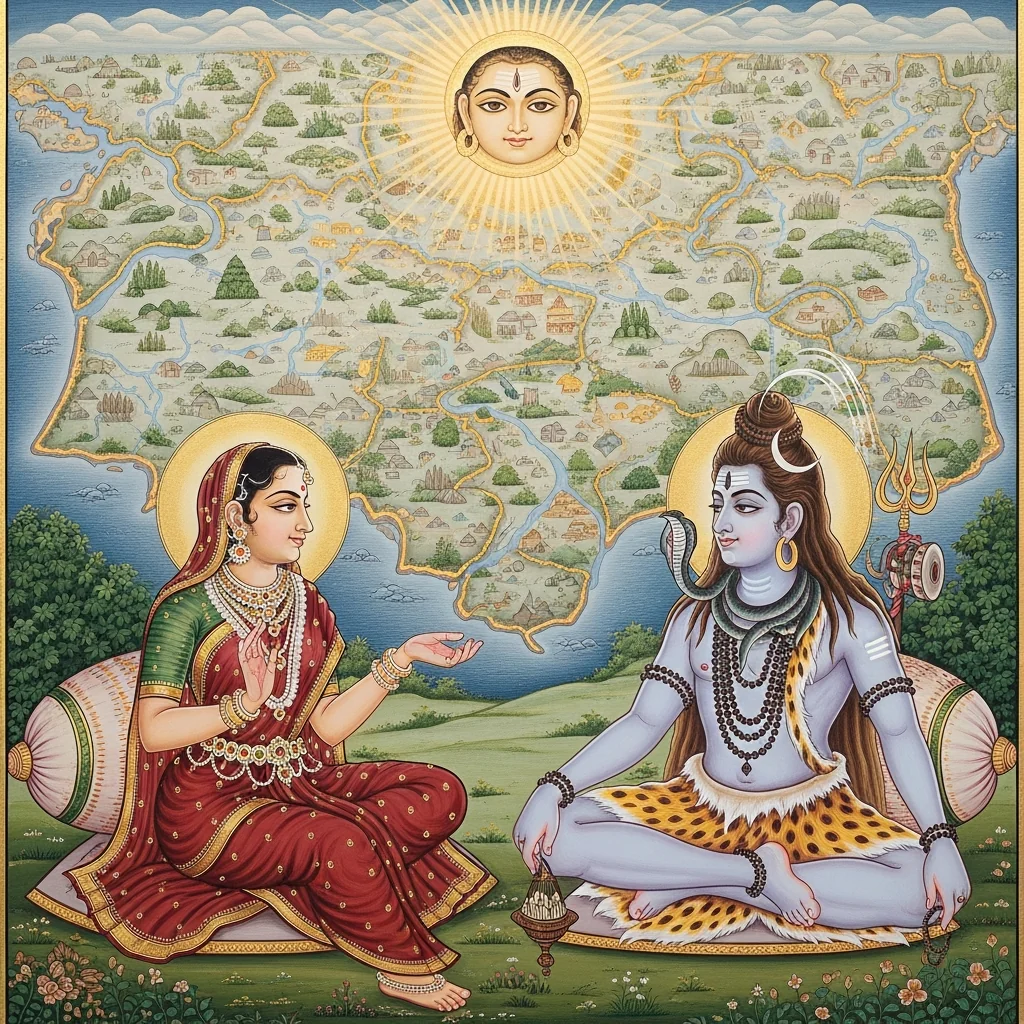
Chapter 13 is framed as a Devī–Īśvara dialogue. Devī asks about an earlier incident in which the Sun, moving in Śākadvīpa, is “pared/cut” by a razor-like edge linked with the divine father-in-law motif, and what became of the great tejas that fell at Prabhāsa. Īśvara replies by teaching an “excellent Sūrya-māhātmya,” whose hearing is said to destroy sins. He explains that the Sun’s primordial portion of radiance fell at Prabhāsa and took on a place-form (sthālākāra): first golden like jāmbūnada, later becoming mountain-like through the power of the māhātmya; there the Sun manifests in an arka-formed icon for the welfare of beings. A yuga-based naming is given—Hiraṇyagarbha (Kṛta), Sūrya (Tretā), Savitā (Dvāpara), and Arkāsthala (Kali)—and the descent is dated to the era of the second Manu, Svārociṣa. The chapter then delineates the sacred field by the spread of tejas-dust (reṇu) across measured yojanas and named boundaries (rivers and the sea), distinguishing a broader subtle radiance zone. Īśvara identifies his own abode as centered within this tejas-maṇḍala, like the pupil within the eye, and explains the prominence of “Prabhāsa” because his house is illumined by solar tejas. The phalaśruti declares that beholding the Sun in arka-form grants freedom from sins and exaltation in Sūrya-loka; such a pilgrim is equated with one who has bathed at all tīrthas and performed major sacrifices and gifts. Ethical and regulatory injunctions follow: eating upon arka-leaves at Arkāsthala is strongly condemned as bringing grave impurity and must be avoided. Pilgrimage protocol includes gifting a buffalo to a learned brāhmaṇa upon first darśana of Arkabhāskara, with mention of copper hue/red cloth and a nearby fire-corner; the Siddheśvara liṅga (famed in Kali, formerly Jaigīṣavyeśvara) is also said to bestow accomplishments upon sight. Finally, a nearby subterranean opening is described, tied to rākṣasas burned by solar radiance; in Kali it remains as a “door” guarded by yoginīs and mother-goddesses, with a Māgha kṛṣṇa caturdaśī night rite of offerings (bali, flowers, upahāra) to gain siddhi. The chapter closes by reaffirming that those who heed and practice this teaching attain the Sun’s world at life’s end.
Shlokas
Verse 1
देव्युवाच । यदा भ्रमिस्थः सविता तक्षितः क्षुरधारया । श्वशुरेण महादेव जामाता प्रीतिपूर्वकम्
The Goddess said: When Savitṛ (the Sun), stationed in Bhrami (Bhramistha), was shaved/cut by his father-in-law—O Mahādeva—with a razor’s edge, as a son-in-law, and that too affectionately,
Verse 2
तत्तेजः शातितं भूरि प्रभासे यत्पपात वै । तदभूत्किं तदा देव प्रभासात्कथयस्व मे
That great radiance, shorn away, which indeed fell at Prabhāsa—what did it become then, O Lord? Tell me about Prabhāsa.
Verse 3
ईश्वर उवाच । शृणु देवि प्रवक्ष्यामि सूर्यमाहात्म्यमुत्तमम् । यच्छ्रुत्वा मानवो भक्त्या मुच्यते सर्वपातकैः
Īśvara said: Listen, O Goddess; I shall proclaim the excellent greatness of the Sun—hearing which, a person, with devotion, is freed from all sins.
Verse 4
देहावतारो देवस्य प्रभासेऽर्कस्थलस्य च । पुराणाख्यानमाचक्षे तव देवि यशस्विनि
O illustrious Goddess, I shall recount to you the ancient account of the deity’s embodiment and of Arkasthala at Prabhāsa.
Verse 5
शाकद्वीपे महादेवि भ्रमिस्थस्य तदा रवेः । वर्षाणां तु शतं साग्रं तक्ष्यमाणे विभावसौ
In Śākadvīpa, O great Goddess, when Ravi (the Sun), stationed at Bhramistha, was being pared away, that blazing one, Vibhāvasu, endured it for a little more than a hundred years.
Verse 6
यदाद्य भागजं तेजस्तत्प्रभासेऽपतत्प्रिये । पतितं तत्र तत्तेजः स्थलाकारं व्यजायत
The portion of radiance that was first cut away, O beloved, fell at Prabhāsa; and that fallen radiance there took the form of a sacred site, a manifested ground-form.
Verse 7
जांबूनदमयं देवि तत्पूर्वमभवत्क्षितौ । तिष्यमाहात्म्ययोगेन शैलीभूतं च सांप्रतम्
O Goddess, in former times it existed on earth as wholly made of Jāmbūnada-gold; but by the power of the greatness of Tiṣya it has now become a mountain.
Verse 8
तत्र चार्कमयं रूपं कृत्वा देवो दिवाकरः । उत्पन्नः सर्वभूतानां हिताय धरणीतले
There, the god Divākara (the Sun) fashioned a form made of arka, solar radiance, and manifested upon the earth for the welfare of all beings.
Verse 9
हिरण्यगर्भनामेति कृते सूर्येति कीर्तितम् । त्रेतायां सवितानाम द्वापरे भास्करः स्मृतः
In the Kṛta age he is known by the name Hiraṇyagarbha, and in that age he is praised as Sūrya. In the Tretā he is called Savitṛ, and in the Dvāpara he is remembered as Bhāskara.
Verse 10
कलौ चार्कस्थलोनाम त्रिषु लोकेषु कीर्तितः । अवतीर्णमिदं देवि स्वयमेव प्रतिष्ठितम्
In the Kali age he is praised throughout the three worlds by the name Arkasthala. O Goddess, this manifestation descended and became established by its own power—self-founded.
Verse 11
यदा स्वारोचिषो देवि द्वितीयोऽभून्मनुः पुरा । तस्मिन्कालेऽवतीर्णोऽसौ देवस्तत्र दिवाकरः
O Goddess, long ago, when Svārociṣa—the second Manu—ruled, at that very time the god Divākara descended there.
Verse 12
भक्तिमुक्ति प्रदो देवि व्याधिदुःखविनाशकृत् । तस्य तेजोद्भवैर्व्याप्तं रेणुभिः पञ्चयोजनम्
O Goddess, he bestows devotion and liberation and destroys disease and sorrow. By the dust born of his radiance, an area of five yojanas is pervaded.
Verse 13
दक्षिणोत्तरतो देवि पञ्चपूर्वापरेण तु । उत्तरेण समुद्रस्य यावन्माहेश्वरी नदी
O Goddess, it extends five yojanas from south to north and likewise from east to west; and to the north, from the ocean up to the river called Māheśvarī.
Verse 14
न्यंकुमत्याश्चापरतो यावदेव कृतस्मरम् । एतद्व्याप्तं महादेवि तत्तेजोरेणुभिः शुभैः
And from Nyaṅkumatī toward the west, as far as Kṛtasmarā—O Great Goddess—this entire region is pervaded by those auspicious dust-particles of his radiance.
Verse 15
तस्य सूक्ष्मा प्रभा या तु आदितेजोविनिःसृता । तया व्याप्तं महादेवि यावद्द्वादशयोजनम्
But the subtle radiance that streams forth from the Sun’s splendour—by that, O Great Goddess, this region is pervaded up to twelve yojanas.
Verse 16
उत्तरे भास्करसुता दक्षिणे सरितां पतिः । पूर्वपश्चिमतो देवि रुक्मिणीद्वितयं स्मृतम्
To the north is Bhāskarasutā; to the south is Saritāṃpati, lord of rivers. To the east and west, O Goddess, the pair remembered as Rukmiṇī-dvitaya marks the boundary.
Verse 17
एतस्मिन्नन्तरे देवि सौरं तेजः प्रसर्प्पितम् । तेन पावित्र्यमानीतं क्षेत्रं द्वादशयोजनम्
In the meantime, O Goddess, a solar radiance spread forth; by that splendour this sacred region—twelve yojanas in extent—was brought into purity and sanctity.
Verse 18
तस्य मध्यस्य यन्मध्यं तद्गृहं मम सुन्दरि । तेजोमण्डलमध्यस्थं मम स्थानं महेश्वरि
And at the very centre of that centre, O Beautiful One, is My abode. Established in the heart of the circle of radiance, that is My own dwelling-place, O Maheśvarī.
Verse 19
चक्षुर्मंडलमध्ये तु यथा देवि कनीनिका । पूर्वपश्चिमतो देवि गोमुखादाऽश्वमेधिकम्
Just as, O Goddess, the pupil lies in the centre of the circle of the eye, so too—O Goddess—does this sacred tract extend from east to west, from Gomukha up to Aśvamedhika.
Verse 20
दक्षिणोत्तरतो देवि समुद्रात्कौरवेश्वरीम् । एतस्मिन्नंतरे क्षेत्रे क्षेत्रज्ञोऽहं वरानने
O Goddess, from south to north it extends from the ocean up to Kauraveśvarī. Within this sacred region, O fair-faced One, I am the Kṣetrajña—the Knower and Guardian of the kṣetra.
Verse 21
यस्मादर्कस्य तेजोभिर्भासितं मम तद्गृहम् । तस्मात्प्रभासनामेति कल्पेऽस्मिन्प्रथितं प्रिये
Because My abode is illumined by the radiant energies of Arka (the Sun), therefore, O Beloved, it has come to bear the name “Prabhāsa”, renowned in this present kalpa.
Verse 22
तत्र पश्यति यः सूर्यमर्क्करूपं नरोत्तमः । सर्वपापविनिर्मुक्तः सूर्यलोके महीयते
The best of men who beholds the Sun there in the form of Arka is freed from all sins and is honoured in the world of the Sun.
Verse 23
स स्नातः सर्वतीर्थेषु तेन चेष्टं महामखैः । सर्वदानानि दत्तानि पूर्वजास्तेन तोषिताः
He is as though he had bathed in all tīrthas, as though he had performed great sacrifices, as though he had given every kind of charity—and his ancestors are thereby satisfied.
Verse 24
अर्करूपी यतः सूर्यस्तत्र जातो महीतले । तस्मात्त्याज्यः सदा चार्को भोजनेऽत्र न संशयः
Since the Sun, in the form of Arka, manifested there upon the earth, therefore at this place Arka (the arka-plant) must always be avoided in eating—of this there is no doubt.
Verse 25
यो दृष्ट्वार्कस्थलं मर्त्त्यश्चार्कपत्रेषु भुंजति । गोमांसभक्षणं तेन कृतं भवति भामिनि
O radiant Lady, any mortal who, after beholding the Arka-site, eats upon arka-leaves is thereby deemed to have committed the sin of eating cow-flesh.
Verse 26
भक्षितो भास्करस्तेन स कुष्ठी जायते नरः । तस्मात्सर्वप्रयत्नेन चार्कपत्राणि वर्जयेत्
For him it is as though Bhāskara, the Sun, were ‘eaten’; that man becomes afflicted with leprosy. Therefore, with every effort, one should avoid arka-leaves.
Verse 27
यात्रायां प्रथमं देवि दृष्टो येनार्कभास्करः । तं दृष्ट्वा महिषीं दद्याद्ब्राह्मणाय विपश्चिते
O Goddess, when at the very outset of the pilgrimage one beholds the Sun—Arka, the radiant Bhāskara—then, having seen Him, one should gift a buffalo to a wise Brāhmaṇa.
Verse 28
ताम्रवर्णं रक्तवस्त्रं ततस्तुष्यति भास्करः । तस्य चैव तु सांनिध्ये वह्निकोणे व्यवस्थितम्
Copper-hued offerings and red garments—by these Bhāskara becomes pleased. And in His very vicinity, situated in the fire-direction (southeast), it stands.
Verse 29
नातिदूरे महाभागे सिद्धेश्वरमिति स्मृतम् । सर्वसिद्धिप्रदं देवि लिंगं त्रैलोक्यपूजितम्
Not far away, O greatly fortunate Goddess, is the liṅga remembered as Siddheśvara—bestower of every siddhi, worshiped across the three worlds.
Verse 30
जैगीषव्येश्वरंनाम पूर्वं कृतयुगेऽभवत् । कलौ सिद्धेश्वरमिति प्रसिद्धिमगमत्प्रिये
Formerly, in the Kṛta Yuga, it was called Jaigīṣavyeśvara; but in the Kali age, beloved, it has become renowned as Siddheśvara.
Verse 31
तं दृष्ट्वा मनुजो देवि सर्वसिद्धिमवाप्नुयात् । तत्रैव देवदेवेशि नातिदूरे व्यवस्थितम्
Having beheld it, O Goddess, a person may obtain every accomplishment. And right there itself, O Lady of the Lord of gods, another holy spot stands not far away.
Verse 32
सूर्यदक्षिणनैरृत्ये पातालविवरं प्रिये । मंदेहा राक्षसा यत्र तथा शालकटंकटाः
To the south–southwest of the Sun (shrine), beloved, there is a cleft leading to Pātāla. There dwell the Maṃdeha rākṣasas, and also the Śālakaṭaṃkaṭas.
Verse 33
सूर्यस्य तेजसा दग्धाः पातालमगमन्पुरा । कलौ तद्द्वारमेवास्ति न पाताले गतिः प्रिये
Burned by the Sun’s radiance, they once went down to Pātāla. In the Kali age, beloved, only that doorway remains—there is no passage into Pātāla.
Verse 34
योगिन्यस्तत्र रक्षंति ब्राह्म्याद्या मातरस्तथा । माघेकृष्णचतुर्दश्यां रात्रौ मातृगणान्यजेत् । बलिपुष्पोपहारैश्च ततः सिद्धिर्भविष्यति
There the Yoginīs guard the place, and likewise the Mothers beginning with Brāhmī. On the fourteenth night of the dark fortnight in Māgha, one should worship the host of Mothers with bali-offerings, flowers, and other oblations; then siddhi will arise.
Verse 35
इति हि सकलधर्मभावहेतोर्हरकमलासनविष्णुसंस्तुतस्य । तनुपरिलिखनं निशम्य भानोर्व्रजति दिवाकरलोकमायुषोंऽते
Thus indeed—whoever listens to this sacred account of Bhānu (the Sun), praised by Hara, lotus-seated Brahmā, and Viṣṇu, and who awakens all dharmic dispositions—at life’s end goes to the world of Divākara.