Adhyaya 143
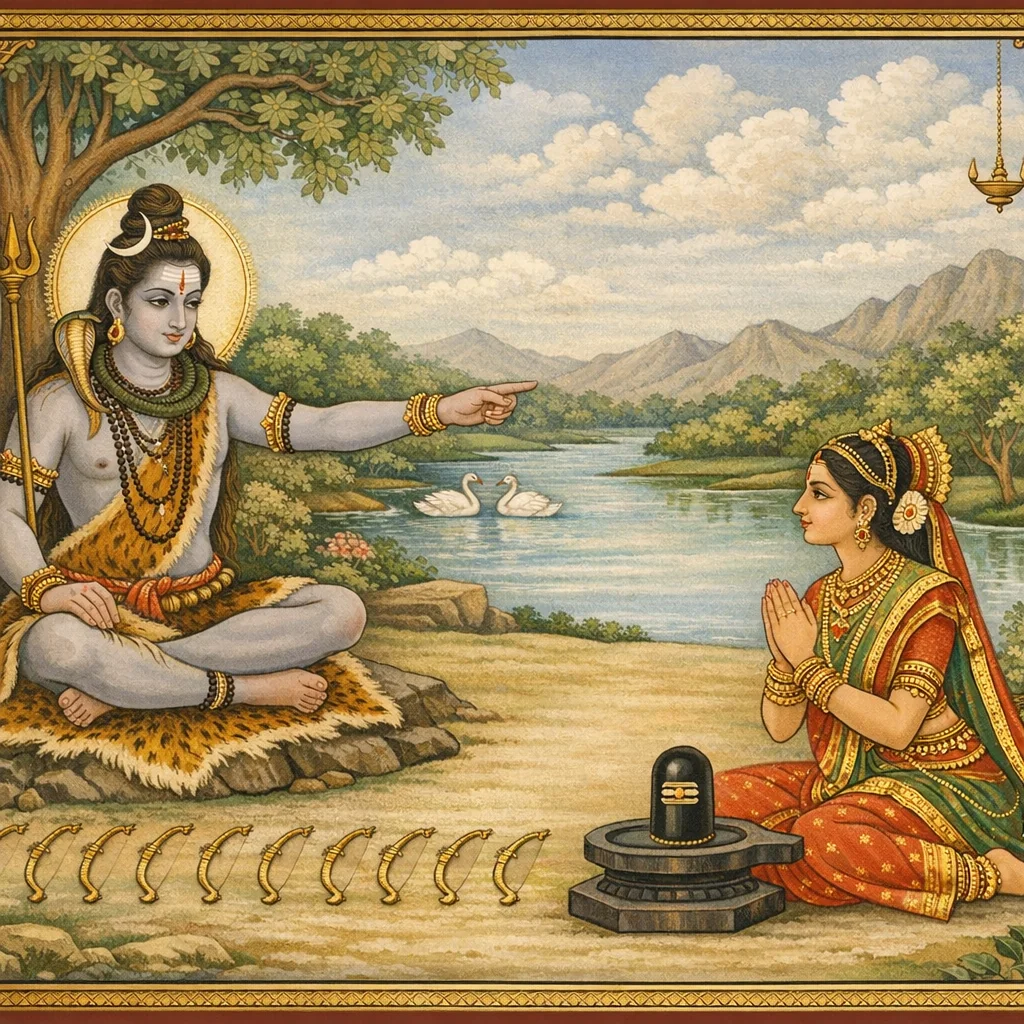
Īśvara instructs Mahādevī on the pilgrimage to Vicitreśvara, an eminent liṅga. Its location is given with careful sacred geography: in the eastern sector of that region, slightly within the southeast (āgneya) range, about ten bow-lengths away. The chapter then relates its origin: the great liṅga is said to have been established by Vicitra, described as Yama’s “scribe” (lekhaka), after performing exceedingly severe austerities (suduścara tapas). It concludes with a clear phala: mere darśana of the liṅga, when joined with worship, removes all sins; and worship done according to proper rite (vidhāna) ensures the devotee is not afflicted by suffering.
Shlokas
Verse 1
ईश्वर उवाच । ततो गच्छेन्महादेवि विचित्रेश्वरमुत्तमम् । तस्यैव पूर्वदिग्भागे किञ्चिदाग्नेयगोचरे । धनुषां दशके तत्र स्थितं पापप्रणाशनम्
Īśvara said: “Then, O Great Goddess, one should go to the excellent Vicitreśvara. In the eastern quarter from there—slightly toward the south-east—at a distance of ten bow-lengths, it stands, a destroyer of sins.”
Verse 2
विचित्रेण महादेवि लेख केन यमस्य च । स्थापितं तन्महालिंगं तपः कृत्वा सुदुश्चरम्
O Great Goddess, that great liṅga was established by Vicitra and by Lekhaka, the scribe of Yama, after performing extremely difficult austerities.
Verse 3
तं दृष्ट्वा पूजितं चैव मुक्तः स्यात्सर्वपातकैः । संपूज्य च विधानेन न दुःखी जायते नरः
Having seen Him and also having worshipped Him, a person becomes freed from all sins. And having duly worshipped according to the prescribed rites, a man is not born into sorrow.
Verse 143
इति श्रीस्कान्दे महापुराण एकाशीतिसाहस्र्यां संहितायां सप्तमे प्रभासखण्डे प्रथमे प्रभासक्षेत्र माहात्म्ये विचित्रेश्वरमाहात्म्यवर्णनंनाम त्रिचत्वारिंशदुत्तरशततमोऽध्यायः
Thus ends the one-hundred-and-forty-third chapter, called “The Description of the Greatness of Vicitreśvara,” in the Prabhāsa Khaṇḍa—within the Prabhāsa-kṣetra Māhātmya—of the venerable Skanda Mahāpurāṇa, in the Saṃhitā of eighty-one thousand verses.