Adhyaya 172
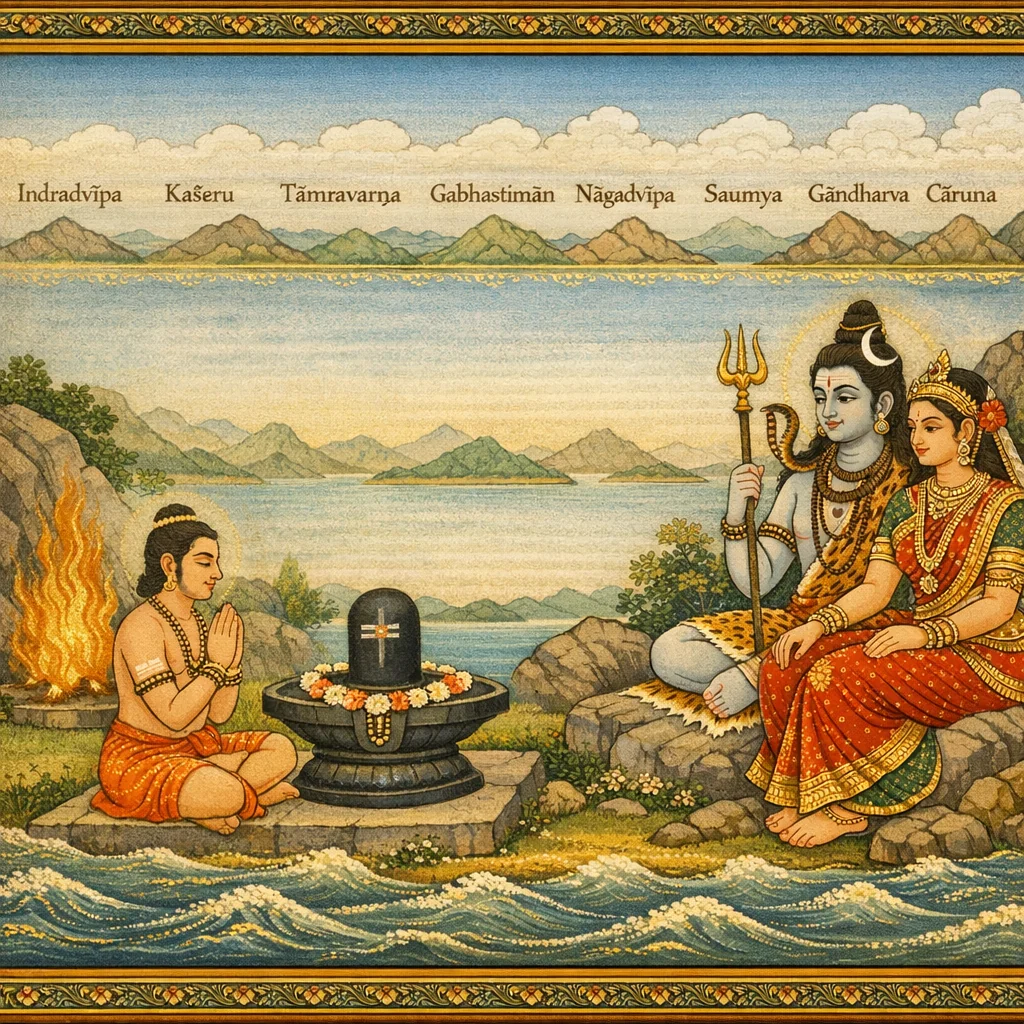
Īśvara instructs Devī to go to the liṅga called Bharateśvara, situated slightly to the north. The chapter explains its origin: King Bharata, famed as Agnīdhra’s son, performs severe tapas in this sacred kṣetra and establishes (pratiṣṭhā) Mahādeva to obtain progeny. Pleased, Śaṅkara grants him eight sons and one illustrious daughter. Bharata then divides his realm into nine portions and assigns them to his children; the corresponding dvīpas are named—Indradvīpa, Kaśeru, Tāmravarṇa, Gabhastimān, Nāgadvīpa, Saumya, Gāndharva, Cāruṇa—and the ninth, linked with the daughter, is called Kumāryā. The text notes that eight dvīpas were later flooded by the ocean, while the Kumāryā-named one remains, and it adds measurements in yojanas (south–north extent and breadth), joining mythic partition to spatial description. Bharata’s ritual eminence is affirmed through mention of many Aśvamedhas and his renown in the Gaṅgā–Yamunā regions; by Īśvara’s grace he rejoices in heaven. The phalaśruti declares that worship of the liṅga established by Bharata yields the fruit of all sacrifices and gifts, and that darśana in Kārttika during Kṛttikā-yoga prevents even dream-visions of dreadful hell.
Shlokas
Verse 1
ईश्वर उवाच । ततो गच्छेन्महा देवि लिंगं तद्भरतेश्वरम् । तस्मादुत्तरकोणस्थं नातिदूरं व्यवस्थितम्
Īśvara said: “Then, O great Goddess, one should go to the Liṅga called Bharateśvara, established not far from there in the northern quarter.”
Verse 2
भरतोनाम राजाऽभूदाग्नीध्रः प्रथितः क्षितौ । यस्येदं भारतं वर्षं नाम्ना लोकेषु गीयते
There was a king named Bharata, of the line of Āgnīdhra, renowned upon the earth; after him this land is sung of in the worlds by the name “Bhārata-varṣa.”
Verse 3
स च चक्रे तपो घोरं क्षेत्रेऽस्मिन्पार्वति प्रिये । दिव्यं वर्षसहस्रं तु प्रतिष्ठाप्य महेश्वरम्
And he performed fierce austerities in this sacred kṣetra, O beloved Pārvatī; and, having duly installed Maheśvara (Śiva) here, he continued that discipline for a thousand divine years.
Verse 4
पुत्रकामो नरश्रेष्ठः पूजयामास शंकरम् । ततस्तुष्टः स भगवान्वरं दातुं समुत्सुकः
Desiring sons, that best of men worshipped Śaṅkara. Then the Blessed Lord, being pleased, became eager to grant him a boon.
Verse 5
अष्टौ पुत्रान्ददौ तस्मै कन्यां चैकां यशस्विनीम् । स तु प्राप्याभिलषितं कृतकृत्यो नराधिपः
He granted him eight sons, and also one illustrious daughter. Having obtained what he desired, that lord of men felt his purpose fulfilled.
Verse 6
भारतं नवधा कृत्वा पुत्रेभ्यः प्रददौ पृथक् । तेषां नामांकितान्येव ततो द्वीपानि जज्ञिरे
Dividing Bhārata into nine portions, he bestowed them separately upon his sons. Thereafter, dvīpas (islands) bearing their very names came into being.
Verse 7
इन्द्रद्वीपः कसेरुश्च ताम्रवर्णो गभस्तिमान् । नागद्वीपस्तथा सौम्यो गान्धर्वस्त्वथ चारुणः
They were: Indradvīpa and Kaseru; Tāmravarṇa and Gabhastimān; Nāgadvīpa and Saumya; and then Gāndharva and Cāruṇa.
Verse 8
अयं तु नवमो द्वीपः कुमार्या संज्ञितः प्रिये । अष्टौ द्वीपाः समुद्रेण प्लाविताश्च तथापरे
But this is the ninth dvīpa, called Kumāryā, O beloved. The other eight dvīpas, however, were inundated by the ocean.
Verse 9
ग्रामादिदेशसंयुक्ताः स्थिताः सागरमध्यगाः । एक एव स्थितस्तेषां कुमार्याख्यस्तु सांप्रतम्
Furnished with villages and other settlements, they lay in the midst of the sea. But now, of them, only one remains—the one called Kumāryā.
Verse 10
बिंदुसरः प्रभृत्येव सागराद्दक्षिणोत्तरम् । योजनानां सहस्रं तु एकं विस्तीर्ण एव तु
Beginning from Bindu-saras, it extends from the ocean toward the south and the north; its breadth is said to be one thousand yojanas.
Verse 11
योजनानां सहस्राणि नव दैर्घ्यं प्रकीर्तितम् । तस्यैतज्जृम्भितं देवि भरतस्य महात्मनः
Its length is proclaimed as nine thousand yojanas. O Devī, this is the mighty expanse belonging to Bharata, the great-souled.
Verse 12
षट्पञ्चाशदश्वमेधान्गंगामनु चकार यः । यस्त्रिंशद्यमुनाप्रान्ते भरतो लोकपूजितः
Bharata, revered by the world, performed fifty-six Aśvamedha sacrifices along the Gaṅgā, and thirty upon the banks of the Yamunā.
Verse 13
स चेश्वरप्रसादेन मोदते दिवि देववत्
And by the grace of Īśvara, he rejoices in heaven like a god.
Verse 14
यस्तत्प्रतिष्ठितं लिंगं भारतं पूजयिष्यति । स सर्वयज्ञदानानां फलं प्रापयिता धुवम्
Whoever worships that established liṅga—Bharateśvara—will surely obtain the full fruit of all sacrifices and charitable gifts.
Verse 15
कार्त्तिक्यां कृत्तिका योगे यस्तं पश्यति मानवः । न स पश्यति स्वप्नेपि नरकं घोरदारुणम्
In the month of Kārttika, when the Kṛttikā conjunction occurs, the person who beholds that liṅga will not see—even in a dream—the terrifying and dreadful hell.
Verse 172
इति श्रीस्कान्दे महापुराण एकाशीतिसाहस्र्यां संहितायां सप्तमे प्रभासखण्डे प्रथमे प्रभासक्षेत्रमाहात्म्ये भरतेश्वरमाहात्म्यवर्णनंनाम द्विसप्तत्युत्तरशततमोऽध्यायः
Thus ends the one-hundred-and-seventy-second chapter, called “The Description of the Greatness of Bharateśvara,” in the first division of the Prabhāsa-kṣetra Māhātmya, within the seventh, the Prabhāsa Khaṇḍa, of the Śrī Skanda Mahāpurāṇa in the Ekāśītisāhasrī Saṃhitā.