Adhyaya 45
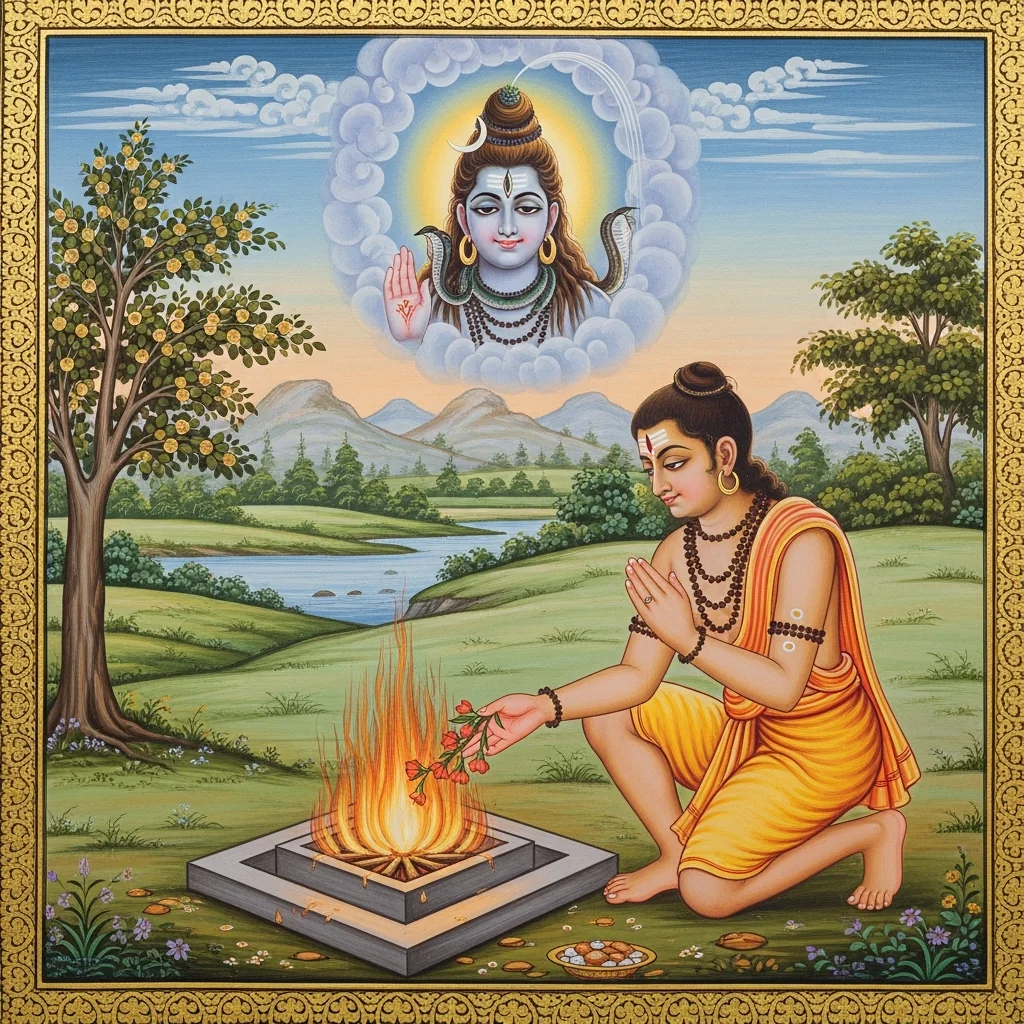
In this adhyāya, Īśvara (Śiva) recounts the origin and ritual power of Aṅgāreśvara within the sacred realm of Prabhāsa. When Śiva, blazing with wrath, intended to burn Tripura, tears issued from his three eyes; falling to earth, that essence became Bhūmisuta, the “son of Earth,” known as Bhoma/Maṅgala (Mars). From childhood Bhoma goes to Prabhāsa and performs prolonged tapas to Śaṅkara, until Śiva is pleased and grants a boon. Bhoma asks for grahatva—status among the planetary grahas—which Śiva affirms, and he further proclaims protection for devotees who worship there with sincere bhakti. The chapter prescribes offerings and a homa discipline: red flowers, and abundant oblations mixed with honey and ghee, with the stated count of one lakh, along with careful pañcopacāra worship. The phalaśruti concludes that hearing this condensed māhātmya destroys sins and grants health; specific gifts such as coral (vidruma) are linked to desired results, and Bhoma is praised as radiant in a celestial vehicle among the grahas.
Shlokas
Verse 1
ईश्वर उवाच । ततो गच्छेन्महादेवि अंगारेश्वरमुत्तमम् । स्थापितं भूमिपुत्रेण सोमेशादीश गोचरे
Īśvara said: “Then, O great Goddess, one should go to the excellent Aṅgāreśvara, established by the Earth’s son, within the sacred precinct of Someśvara, O Lady.”
Verse 2
त्रिपुरं दग्धुकामस्य पुरा मम वरानने । क्रोधादश्रु विनिष्क्रांतं लोचनत्रितयेन तु
Formerly, O fair-faced one, when I desired to burn Tripura, a tear sprang forth from my three eyes, born of wrath.
Verse 3
तच्च भूमौ निपतितं ततो भूभिसुतोऽभवत् । स प्रभासं ततो गत्वा बाल्यात्प्रभृति शंकरम्
That tear fell upon the earth, and from it the son of the Earth came into being. He then went to Prabhāsa and, from childhood onward, devoted himself to Śaṅkara.
Verse 4
तपसाऽराधयामास बहून्वर्षगणान्प्रिये । तस्य तुष्टो महादेवः सुप्रीतात्मा वरं ददौ
With austerity he worshipped (Śiva) for many years, O beloved. Pleased with him, Mahādeva—greatly satisfied in heart—granted a boon.
Verse 5
सोऽब्रवीद्यदि मे देव तुष्टोसि वृषभध्वज । ग्रहत्वं देहि सर्वेश न चान्यं वरमुत्सहे
He said: “If you are pleased with me, O God—O Bull-bannered One—grant me the status of a Graha, O Lord of all; I do not desire any other boon.”
Verse 6
स तथेति प्रतिज्ञाय पुनस्तं वाक्यमब्रवीत् । इहागत्य नरो यो मां पूजयिष्यति भक्तितः
Śiva, having vowed, “So be it,” spoke again: “Whoever comes here and worships Me with devotion…”
Verse 7
न भविष्यति वै पीडा तावकी तस्य कुत्रचित् । पुष्पाणि रक्तवर्णानि मध्वाज्याक्तानि भूरिशः
For him, nowhere shall there ever be any affliction caused by you. (Let him offer) abundant red flowers, well anointed with honey and ghee.
Verse 8
होमयिष्यति यो भक्त्या लक्षमेकं तदग्रतः । पंचोपचारविधिना त्वां तु संपूज्य यत्नतः
Whoever, with devotion, performs before that deity a homa of one lakh (one hundred thousand) oblations, and carefully worships you by the rite of the five offerings (pañcopacāra), shall attain the desired spiritual fruit.
Verse 9
तस्य जन्मावधिर्नैव तव पीडा भविष्यति । तथा विद्रुमदानेन लप्स्यते फलमीप्सितम्
For him, throughout his lifetime, your affliction shall not arise. Likewise, by gifting coral (vidruma), he will obtain the wished-for result.
Verse 10
एवमुक्त्वा स भगवानत्रैवांतरधीयन । भौमोऽपि ग्रहमध्यस्थो विमानेन विराजते
Having spoken thus, the Blessed Lord vanished there itself. And Bhauma (Mars), stationed among the planets, shines resplendent in his celestial car.
Verse 11
एवं संक्षेपतः प्रोक्तं भौममाहात्म्यमुत्तमम् । श्रुतं हरति पापानि तथारोग्यं प्रयच्छति
Thus, in brief, the excellent Māhātmya of Bhauma has been proclaimed. When heard, it removes sins and also bestows health.
Verse 45
इति श्रीस्कांदे महापुराण एकाशीतिसाहस्र्यां संहितायां सप्तमे प्रभासखण्डे प्रथमे प्रभासक्षेत्रमाहात्म्येंऽगारेश्वरमाहात्म्यवर्णनंनाम पञ्चचत्वारिंशोध्यायः
Thus ends the forty-fifth chapter, called “The Description of the Māhātmya of Aṅgāreśvara,” in the Prabhāsa Khaṇḍa—within the Prabhāsakṣetra Māhātmya—of the Śrī Skanda Mahāpurāṇa (in the eighty-one-thousand-verse recension).