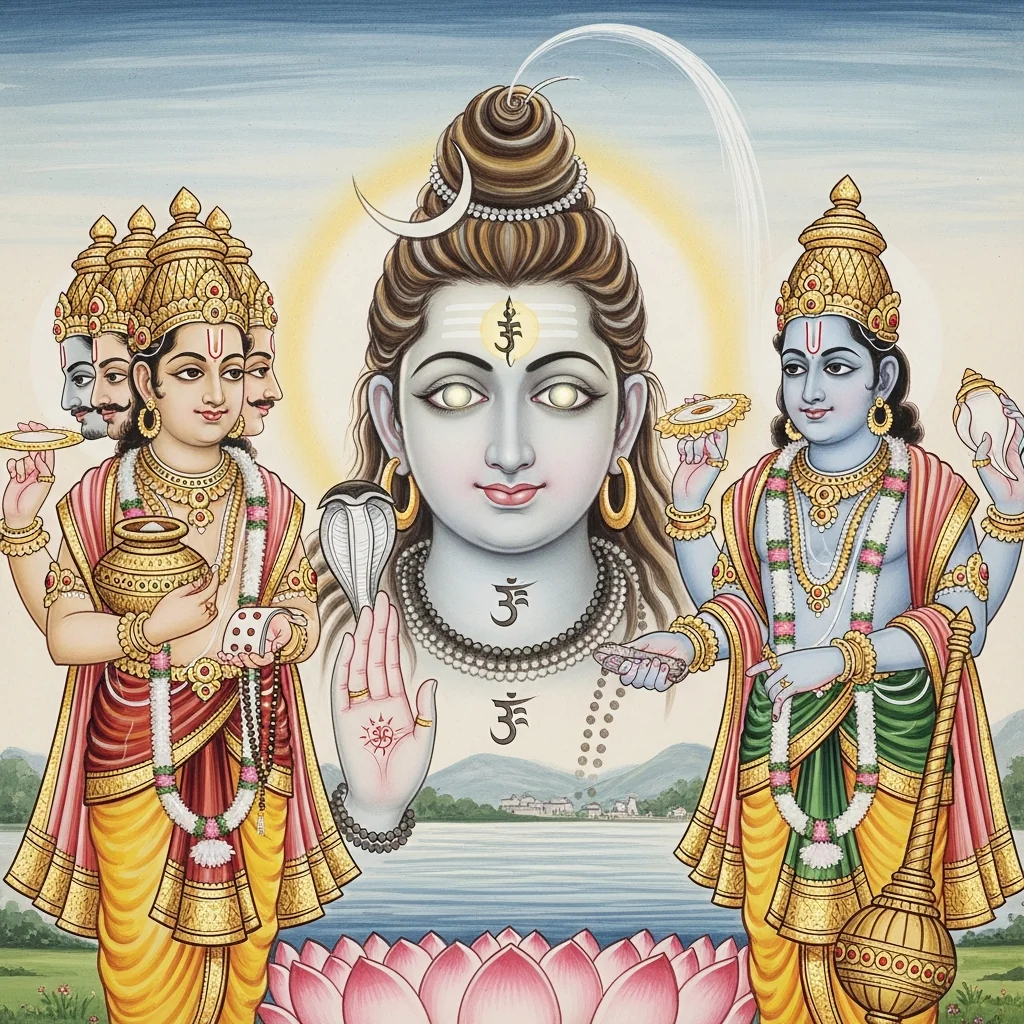
Adhyaya 9
Chapter 9 unfolds as a structured theological dialogue. Devī reverently addresses Śaṅkara at Prabhāsa, naming Somēśvara and recalling a vision of a form centered on Kālāgni. She then raises a doctrinal doubt: how the beginningless Lord, who transcends dissolution, can bear a garland of skulls. Īśvara answers with a cosmological account: innumerable cycles of creation and dissolution bring forth successive Brahmās and Viṣṇus, and the skull-garland signifies Śiva’s lordship over these recurring worlds. The chapter then iconographically describes Śiva’s Prabhāsa form—peaceful and radiant, beyond beginning–middle–end; with Viṣṇu on the left and Brahmā on the right; the Vedas within; and the cosmic luminaries as eyes—thereby resolving Devī’s doubt. Devī offers an extended hymn of praise and asks for a fuller account of Prabhāsa’s greatness, including why Viṣṇu leaves Dvārakā and meets his end at Prabhāsa, posing many questions about his cosmic roles and avatāras. Framed by Sūta’s narration, Īśvara begins the “secret” teaching: Prabhāsa surpasses other tīrthas in efficacy and uniquely unites Brahma-, Viṣṇu-, and Raudra-tattva, with explicit tattva counts (24/25/36) mapped to the presence of Brahmā, Viṣṇu, and Śiva. The chapter closes by proclaiming the fruit: death at Prabhāsa is said to grant elevated states even to beings of every social standing and species, including those burdened by grave transgressions, emphasizing the kṣetra’s purifying power.
Shlokas
Verse 1
देव्युवाच । दिव्यं तेजो नमस्यामि यन्मे दृष्टं पुरातने । कालाग्निरुद्रमध्यस्थं प्रभासे शंकरोद्भवम्
The Goddess said: I bow to that divine radiance which I beheld in ancient times—arisen from Śaṅkara at Prabhāsa, abiding in the midst of Kālāgnirudra.
Verse 2
यो वेदसंघैरृषिभिः पुराणैर्वेदोक्तयोगैरपि इज्यमानः । तं देवदेवं शरणं व्रजामि सोमेश्वरं पापविनाशहेतुम्
He who is worshipped by the hosts of the Vedas, by sages, by the Purāṇas, and also through the yogic disciplines taught in the Vedas—unto that God of gods I go for refuge: Somēśvara, the cause of the destruction of sin.
Verse 3
देवदेव जगन्नाथ भक्तानुग्रहकारक । संशयो हृदि मे कश्चित्तं भवाञ्छेत्तुमर्हति
O God of gods, Lord of the world, bestower of grace upon devotees—there is a doubt in my heart; you are worthy to cut it away.
Verse 4
ईश्वर उवाच । कः संशयः समुत्पन्नस्तव देवि यशस्विनि । तन्मे कथय कल्याणि तत्सर्वं कथयाम्यहम्
Īśvara said: What doubt has arisen in you, O illustrious Goddess? Tell it to me, O auspicious one; I shall explain it all.
Verse 5
देव्युवाच । यदि त्वं च महादेवो मुण्डमाला कथं कृता । अनादि निधनो धाता सृष्टिसंहारकारकः
The Goddess said: If you are indeed Mahādeva, how is it that you wear a garland of skulls? You are without beginning and without end—the Ordainer, the agent of creation and dissolution.
Verse 6
ततो विहस्य देवेशः शंकरो वाक्यमब्रवीत् । अनेकमुण्डकोटीभिर्या मे माला विराजते
Then, smiling, Śaṅkara—the Lord of the gods—spoke these words: “The garland that shines upon me is formed of crores upon crores of skulls.”
Verse 7
नारायण सहस्राणां ब्रह्मणामयुतस्य च कृता शिरःकरोटीभिरनादिनिधना ततः
“It has been made from the skull-bowls of thousands of Nārāyaṇas and ten-thousands of Brahmās; thus it is without beginning and without end.”
Verse 8
अन्यो विष्णुश्च भवति अन्यो ब्रह्मा भवत्यपि । कल्पे कल्पे मया सृष्टः कल्पे विष्णुः प्रजापतिः
“In each aeon there is a different Viṣṇu, and in each aeon a different Brahmā as well. In every kalpa they are brought forth by me—Viṣṇu and the Lord of progeny.”
Verse 9
अहमेवंविधो देवि क्षेत्रे प्राभासिके स्थितः । कालाग्निलिंगमूले तु मुंडमालाविभूषितः
O Goddess, such indeed am I, abiding in the sacred field of Prabhāsa—at the base of Kālāgniliṅga—adorned with a garland of skulls.
Verse 10
अक्षसूत्रधरः शान्त आदिमध्यांतवर्जितः । पद्मासनस्थो वरदो हिमकुन्देन्दुसन्निभः
Bearing a rosary, serene, free from beginning, middle, and end; seated upon a lotus-seat, granting boons, radiant like snow, jasmine, and the moon.
Verse 11
मम वामे स्थितो विष्णुर्दक्षिणे च पितामहः । जठरे चतुरो वेदाः हृदये ब्रह्म शाश्वतम्
On my left stands Viṣṇu, and on my right the Grandsire (Brahmā). In my belly abide the four Vedas; in my heart is the eternal Brahman.
Verse 12
अग्निः सोमश्च सूर्यश्च लोचनेषु व्यवस्थिताः
Agni, Soma, and Sūrya are established within my eyes.
Verse 13
एवंविधो महादेवि प्रभासे संव्यवस्थितः । आप्यतत्त्वात्समानीते मा ते भूत्संशयः क्वचित्
O great Goddess, in this very manner I am firmly established at Prabhāsa. Since this manifestation has been brought forth from the principle of water, let no doubt arise in you at any time.
Verse 14
एवमुक्ता तदा देवी हर्षगद्गदया गिरा । तुष्टाव देवदेवेशं भक्त्या परमया युता
Thus addressed, the Goddess then—her voice choked with joy—praised the Lord of the gods of gods, filled with supreme devotion.
Verse 15
देव्युवाच जय देव महादेव सर्वभावन ईश्वर । नमस्तेऽस्तु सुरेशाय परमेशाय वै नमः
The Goddess said: “Victory to you, O God, O Mahādeva, O Lord who brings forth all beings! Salutation to you—Lord of the gods; salutation indeed to the Supreme Lord.”
Verse 16
अनादिसृष्टिकर्त्रे च नमः सर्वगताय च । सर्वस्थाय नमस्तुभ्यं धाम्नां धाम्ने नमोऽस्तु ते
Salutation to you, the beginningless creator of creation; salutation to you who pervade all. Salutation to you who abide in all things; salutation to you, the very abode of all abodes.
Verse 17
षडंताय नमस्तुभ्यं द्वादशान्ताय ते नमः । हंसभेद नमस्तुभ्यं नमस्तुभ्यं च मोक्षद
Salutations to you whose reality is taught through the ‘sixfold end’; salutations to you whose culmination is the ‘twelvefold end’. Salutations to you, the discerner of the Haṃsa (the inner Self); salutations to you, the giver of liberation.
Verse 18
इति स्तुतस्तदा देव्या प्रचलच्चन्द्रशेखरः । ततस्तुष्टस्तु भगवानिदं वचनमब्रवीत्
Thus praised by the Goddess, Candraśekhara (Śiva) stirred with delight; then, being pleased, the Blessed Lord spoke these words.
Verse 19
ईश्वर उवाच । साधुसाधु महाप्राज्ञे तुष्टोऽहं व्रियतां वरः
Īśvara said: “Well done, well done, O great sage. I am pleased—choose a boon.”
Verse 20
देव्युवाच । यदि तुष्टोऽसि देवेश वरार्हा यदि वाप्यहम् । प्रभास क्षेत्रमाहात्म्यं पुनर्विस्तरतो वद
The Goddess said: “If you are pleased, O Lord of gods—and if I am worthy of a boon—then speak again, in fuller detail, the greatness of the sacred field of Prabhāsa.”
Verse 21
भूतेश भगवान्विष्णुर्दैत्यानामन्तकाग्रणीः । स कस्माद्द्वारकां हित्वा प्रभासक्षेत्रमाश्रितः
“O Lord of beings, Bhagavān Viṣṇu—the foremost destroyer of the Daityas—why did he abandon Dvārakā and take refuge in the sacred field of Prabhāsa?”
Verse 22
षष्टि तीर्थसहस्राणि षष्टिकोटिशतानि च । द्वारकामध्यसंस्थानि कथं न्यक्कृतवान्हरिः
“Within Dvārakā are established sixty thousand tīrthas, and six hundred million more besides—how did Hari deem them lesser (and prefer Prabhāsa)?”
Verse 23
अमरैरावृतां पुण्यां पुण्यकृद्भिर्निषेविताम् । एवं तां द्वारकां त्यक्त्वा प्रभासं कथमागतः
“Dvārakā is holy—surrounded by the immortals and frequented by doers of merit. Even so, how did he leave that Dvārakā and come to Prabhāsa?”
Verse 24
देवमानुषयोर्नेता द्योभुवोः प्रभवो हरिः । किमर्थं द्वारकां त्यक्त्वा प्रभासे निधनं गतः
Hari is the guide of gods and men, the source of heaven and earth. For what reason did he leave Dvārakā and attain his end at Prabhāsa?
Verse 25
यश्चक्रं वर्त्तयत्येको मानुषाणां मनोमयम् । प्रभासे स कथं कालं चक्रे चक्रभृतां वरः
He who alone sets in motion the mind-made ‘wheel’ of human affairs—how did that best of bearers of the discus pass his time at Prabhāsa?
Verse 26
गोपायनं यः कुरुते जगतः सार्वलौकिकम् । स कथं भगवान्विष्णुः प्रभासक्षेत्रमाश्रितः
How could that Blessed Lord Viṣṇu—who universally protects the entire world—be said to have taken refuge in the sacred field of Prabhāsa?
Verse 27
योंतकाले जलं पीत्वा कृत्वा तोयमयं वपुः । लोकमेकार्णवं चक्रे दृष्ट्या दृष्टेन चात्मना
He who, at the end-time, drank up the waters and assumed a body made of water—who by his very gaze and by his manifested Self made the world a single ocean—how is he to be spoken of in ordinary terms at Prabhāsa?
Verse 28
स कथं पञ्चतां प्राप प्रभासे पार्वतीपते । यः पुराणे पुराणात्मा वाराहं वपुरास्थितः
O Lord of Pārvatī, how could he meet ‘the state of the five elements’ (dissolution) at Prabhāsa—he, the Ancient Self spoken of in the Purāṇas, who assumed the body of the Boar (Varāha)?
Verse 29
उद्दधार महीं कृत्स्नां सशैलवनकाननाम् । स कथं त्यक्तवान्गात्रं प्रभासे पापनाशने
He who lifted up the entire earth—with its mountains, forests, and groves—how could he abandon his body at Prabhāsa, the destroyer of sins?
Verse 30
येन सिंहं वपुः कृत्वा हिरण्यकशिपुर्हतः । स कथं देवदेवेशः प्रभासं क्षेत्रमाश्रितः
He by whom—taking on a lion-form—Hiraṇyakaśipu was slain: how could that Lord of the gods take refuge in the sacred field of Prabhāsa?
Verse 31
सहस्रचरणं देवं सहस्राक्षं महाप्रभम् । सहस्रशिरसं वेदा यमाहुर्वै युगेयुगे
That God of a thousand feet, a thousand eyes, of great splendor—whom the Vedas, age after age, proclaim as the One with a thousand heads.
Verse 32
तत्याज स कथं देवः प्रभासे स्वं कलेवरम् । नाभ्यरण्यां समुद्भूतं यस्य पैतामहं गृहम्
How could that God cast off his own body at Prabhāsa—he whose ‘grandfather’s abode’ arose from the lotus-grove of the navel?
Verse 33
एकार्णवगते लोके तत्पंकजमपंकजम् । येनोद्धृतं क्षणेनैव प्रभासस्थः स किं हरिः
When the world had become a single ocean, that stainless lotus was raised in an instant by him—if he is present at Prabhāsa, what indeed can be said of Hari?
Verse 34
उत्तरांशे समुद्रस्य क्षीरोदस्या मृतोदधेः । यः शेते शाश्वतं योगमास्थाय परवीरहा । स कथं त्यक्तवान्देहं प्रभासे परमेश्वरः
He who lies in the ocean’s northern quarter—upon the Milk-Ocean, the deathless sea—abiding in eternal yoga, the slayer of hostile heroes: how could that Supreme Lord abandon His body at Prabhāsa?
Verse 35
हव्यादान्यः सुरांश्चक्रे कव्यादांश्च पितॄ नपि । स कथं देवदेवेशः प्रभासं क्षेत्रमाश्रितः
He who appointed the gods as receivers of havya (sacrificial offerings) and the Fathers (pitṛs) as receivers of kavya—how could that Lord of gods take refuge in the sacred field of Prabhāsa?
Verse 36
युगानुरूपं यः कृत्वा रूपं लोकहिताय वै । धर्ममुद्धरते देवः स कथं क्षेत्रमाश्रितः
He who, for the welfare of the worlds, assumes a form suited to each age and uplifts Dharma—how could that very God be confined to, or dependent upon, any single sacred place?
Verse 37
त्रयो वर्णास्त्रयो लोकास्त्रैविद्यं पाठकास्त्रयः । त्रैकाल्यं त्रीणि कर्माणि त्रयो देवास्त्रयो गुणाः । सृष्टं येन पुरा देवः स कथं क्षेत्रमाश्रितः
He by whom, of old, the triads were established—three social orders, three worlds, the threefold Vedic learning and its three reciters, the three times, the three rites, the three gods, and the three guṇas—how could that Creator-Lord be said to depend upon a single sacred region?
Verse 38
या गतिर्द्धर्मयुक्तानामगतिः पापकर्मिणाम् । चातुर्वर्ण्यस्य प्रभवश्चातुर्वर्ण्यस्य रक्षिता
He is the true refuge and final course of those established in Dharma, and for doers of sin He is refuge denied; He is the source of the fourfold social order and its protector—how could such a Lord be measured by place?
Verse 39
चातुर्विद्यस्य यो वेत्ता चातुराश्रम्यसंस्थितः । कस्मात्स द्वारकां हित्वा प्रभासे पंचतां गतः
He who knows the fourfold learning and is established in the discipline of the four āśramas—why did he forsake Dvārakā and, at Prabhāsa, attain the “state of the five,” dissolving into the five elements?
Verse 40
दिगंतरं नभोभूमिरापो वायुर्विभावसुः । चंद्रसूर्यद्वयं ज्योतिर्युगेशः क्षणदातनुः
He is the expanse of the directions, the sky and the earth; the waters, the wind, and the blazing fire; the light that is the pair of moon and sun; the Lord of the ages—whose very body is time, measured in instants.
Verse 41
यः परं श्रूयते ज्योतिर्यः परं श्रूयते तपः । यः परं परतः प्रोक्तः परं यः परमात्मवान्
He who is heard of as the Supreme Light, heard of as the Supreme Austerity; who is declared higher than the highest; who is the Supreme—endowed with the very nature of the Paramātman.
Verse 42
आदित्यादिश्च यो दिव्यो यश्च दैत्यांतको विभुः । स कथं देवकीसूनुः प्रभासे सिद्धिमीयिवान्
He who is divine—foremost like the Sun—and the mighty slayer of the Daitiyas: how did that very Lord, as Devakī’s son, attain his consummation at Prabhāsa?
Verse 43
युगांते चांतको यश्च यश्च लोकांतकांतकः । सेतुर्यो लोकसत्तानां मेध्यो यो मेध्यकर्मणाम्
He is the End at the close of an age, and the destroyer of the destroyer of worlds; he is the bridge for the beings of the worlds, and the very purity for those engaged in purifying rites.
Verse 44
वेत्ता यो वेदविदुषां प्रभुर्यः प्रभवात्मनाम् । सोमभूतस्तु भूतानामग्निभूतोऽग्निवर्त्मनाम्
He is the supreme knower among the knowers of the Veda, the Lord of those who are the very sources of power and creation; for living beings He becomes Soma, and for those who tread the path of fire—sacrificial discipline—He becomes Agni.
Verse 45
मनुष्याणां मनोभूतस्तपोभूतस्तपस्विनाम् । विनयो नयभूतानां तेजस्तेजस्विनामपि
Among humans He becomes the very mind; among ascetics He becomes austerity itself. He is humility for the disciplined, and splendor even for the radiant.
Verse 46
विग्रहो विग्रहाणां यो गतिर्गतिमतामपि । स कथं द्वारकां हित्वा प्रभासक्षेत्रमाश्रितः
He who is the very archetype of all embodied forms, and the ultimate goal even of those who have attained the highest path—how could He abandon Dvārakā and take refuge in the sacred field of Prabhāsa?
Verse 47
आकाशप्रभवो वायुर्वायुप्राणो हुताशनः । देवा हुताशनप्राणाः प्राणोऽग्नेर्मधुसूदनः । सकथं पद्मजप्राणः प्रभासं क्षेत्रमाश्रितः
From space arises wind; the life of wind is fire (Hutāśana). The gods live by fire, and the very life of fire is Madhusūdana (Viṣṇu). How then could He—who is the life of the Lotus-born (Brahmā)—take refuge in the sacred field of Prabhāsa?
Verse 48
सूत उवाच । इति प्रोक्तस्तदा देव्या शंकरो लोकशंकरः । उवाच प्रहसन्वाक्यं पार्वतीं द्विजसत्तमाः
Sūta said: Thus addressed by the Goddess, Śaṅkara—the benefactor of the worlds—smiling, spoke these words to Pārvatī, O best of the twice-born.
Verse 49
ईश्वर उवाच । शृणु देवि प्रवक्ष्यामि प्रभासक्षेत्रविस्तरम् । रहस्यं सर्वपापघ्नं देवानामपि दुर्ल्लभम्
Īśvara said: Listen, O Goddess. I shall declare in detail the greatness of Prabhāsa-kṣetra—a secret that destroys all sins and is difficult to obtain even for the gods.
Verse 50
देवि क्षेत्राण्यनेकानि पृथिव्यां संति भामिनि । तीर्थानि कोटिसंख्यानि प्रभावस्तेषु संख्यया
O Goddess, O radiant one, there are many sacred regions upon the earth; and tīrthas are counted in crores—each possessing its own measure of spiritual efficacy.
Verse 51
असंख्येय प्रभावं हि प्रभासं परिकीर्तितम् । ब्रह्मतत्त्वं विष्णुतत्त्वं रौद्रतत्त्वं तथैव च
Prabhāsa, indeed, is proclaimed to possess immeasurable spiritual power; for there abide there the principles of Brahmā, of Viṣṇu, and likewise of Rudra.
Verse 52
तत्र भूयः समायोगो दुर्ल्लभोऽन्येषु पार्वति । प्रभासे देवदेवेशि तत्त्वानां त्रितयं स्थितम्
Such a fuller confluence is rare elsewhere, O Pārvatī. In Prabhāsa, O Lady of the Lord of gods, the triad of these divine principles stands firmly established.
Verse 53
चतुर्विंशतितत्त्वैश्च ब्रह्मा लोकपितामहः । बालरूपी च नाम्नां च तत्र स्थाने स्थितः स्वयम्
There, associated with the twenty-four principles, Brahmā—the grandsire of the worlds—abides in that place himself, assuming a childlike form and bearing renowned names.
Verse 54
पंचविशतितत्त्वानाम धिपो देवताग्रणीः । तस्मिन्स्थाने स्थितः साक्षाद्दैत्यानामंतकः शुभे
The foremost among the gods, the manifest Lord of the twenty-five principles, the destroyer of the Daityas, abides openly in that very place, O auspicious one.
Verse 55
अहं देवि त्वया सार्द्धं षट्त्रिंशत्तत्त्वसंयुतः । निवसामि महाभागे प्रभासे पापनाशने
I myself, O Goddess, together with you, endowed with the full measure of the thirty-six principles, abide in Prabhāsa, the destroyer of sins, O greatly fortunate one.
Verse 56
एवं तत्त्वमयं क्षेत्रं सर्वतीर्थमयं शुभम् । प्रभासमेव जानीहि मा कार्षीः संशयं क्वचित्
Thus this sacred field is filled with ultimate Truth, auspicious, and embodying all tīrthas. Know it indeed as Prabhāsa itself—do not entertain any doubt at any time.
Verse 57
अपि कीटपतंगा ये म्रियंते तत्र ये नराः । तेऽपि यांति परं स्थानं नात्र कार्या विचारणा
Even insects and moths—and even those human beings who die there—go to the supreme abode. About this there is no need for deliberation.
Verse 58
स्त्रियो म्लेच्छाश्च शूद्राश्च पशवः पक्षिणो मृगाः । प्रभासे तु मृता देवि शिवलोकं व्रजंति ते
Women, mlecchas, śūdras, and also animals—birds and beasts—if they die at Prabhāsa, O Goddess, they go to Śiva’s world.
Verse 59
कामक्रोधेन ये बद्धा लोभेन च वशीकृताः । अज्ञानतिमिराक्रांता मायातत्त्वे च संस्थिताः
Those who are bound by desire and anger, subdued by greed, overwhelmed by the darkness of ignorance, and established in the principle of māyā—
Verse 60
कालपाशेन ये बद्धास्तृष्णाजालेन मोहिताः । अधर्मनिरता ये च ये च तिष्ठंति पापिनः
Those who are bound by the noose of Time, deluded by the net of craving, those devoted to unrighteousness, and those who persist as sinners—
Verse 61
ब्रह्मघ्नाश्च कृतघ्नाश्च ये चान्ये गुरुतल्पगाः । महापातकिनश्चापि ते यान्ति परमां गतिम्
Even slayers of brāhmaṇas, the ungrateful, and others who violate the guru’s bed—even such great sinners—attain the highest destiny.
Verse 62
मातृहंता नरो यस्तु पितृहंता तथैव च । ते सर्वे मुक्तिमायांति किं पुनः शुभकारिणः
Even a man who kills his mother, and likewise one who kills his father—all of them attain liberation; how much more, then, those who do what is good.