Adhyaya 350
This adhyāya, spoken in Īśvara’s voice, first gives a precise micro-topographical guide to Viśveśa at Durgakūṭaka: it lies east of Bhallatīrtha and south of the Yoginīcakra, directing the pilgrim to the sacred spot. It then offers an exemplary precedent—Bhīma’s successful propitiation—thereby affirming the shrine’s power as “sarvakāmaprada” (the giver of desired aims) when worship is performed according to rule. The chapter fixes the proper time as Phālguna month, bright fortnight (śukla pakṣa), on the fourth lunar day (caturthī), with simple offerings of fragrance, flowers, and water. The phala statement concludes that the worshipper, without doubt, attains a full year of obstacle-free living (nirvighna), underscoring the Purāṇic principle that correct timing and orthodox simplicity yield assured results.
Shlokas
Verse 1
ईश्वर उवाच । ततो गच्छेन्महादेवि विश्वेशं दुर्गकूटकम् । भल्लतीर्थस्य पूर्वेण योगिनीचक्रदक्षिणे
Īśvara said: “Then, O great Goddess, one should go to Viśveśa at Durgakūṭaka—east of Bhalla-tīrtha and to the south of the Yoginī-cakra.”
Verse 2
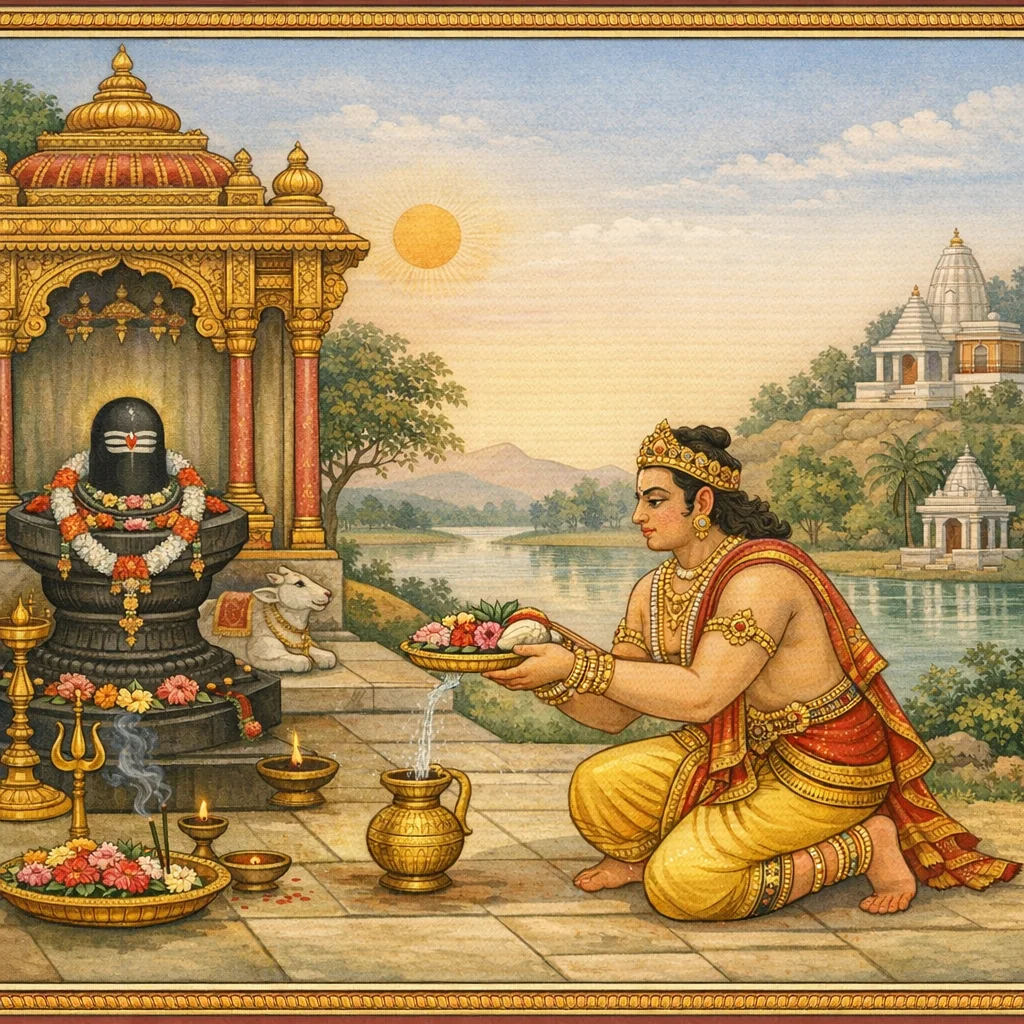
आराधितोऽसौ भीमेन सर्वकामप्रदोऽभवत् । फाल्गुनस्य चतुर्थ्यां तु शुक्लपक्षे विधानतः
Worshiped by Bhīma, that Lord became the bestower of all desired aims. According to the prescribed rite, He is to be adored on the fourth day (Caturthī) of the bright fortnight in the month of Phālguna.
Verse 3
यस्तं पूजयते देवं गन्धपुष्पैः समोदकैः । निर्विघ्नं जायते तस्य वर्षमेकं न संशयः
Whoever worships that God with fragrances and flowers, together with offerings of water, will pass a full year free from obstacles—of this there is no doubt.
Verse 349
इति श्रीस्कांदे महापुराण एकाशीतिसाहस्र्यां संहितायां सप्तमे प्रभासखंडे प्रथमे प्रभासक्षेत्रमाहात्म्ये दुर्गकूटगणपतिमाहात्म्यवर्णनंनामैकोनपञ्चाशदुत्तरत्रिशततमोऽध्यायः
Thus ends the three-hundred-and-fiftieth chapter, called “The Account of the Greatness of Gaṇapati at Durgakūṭa,” in the Prabhāsa Khaṇḍa, the seventh division of the holy Skanda Mahāpurāṇa, within the first Prabhāsakṣetra Māhātmya of the Saṃhitā of eighty-one thousand.