Adhyaya 105
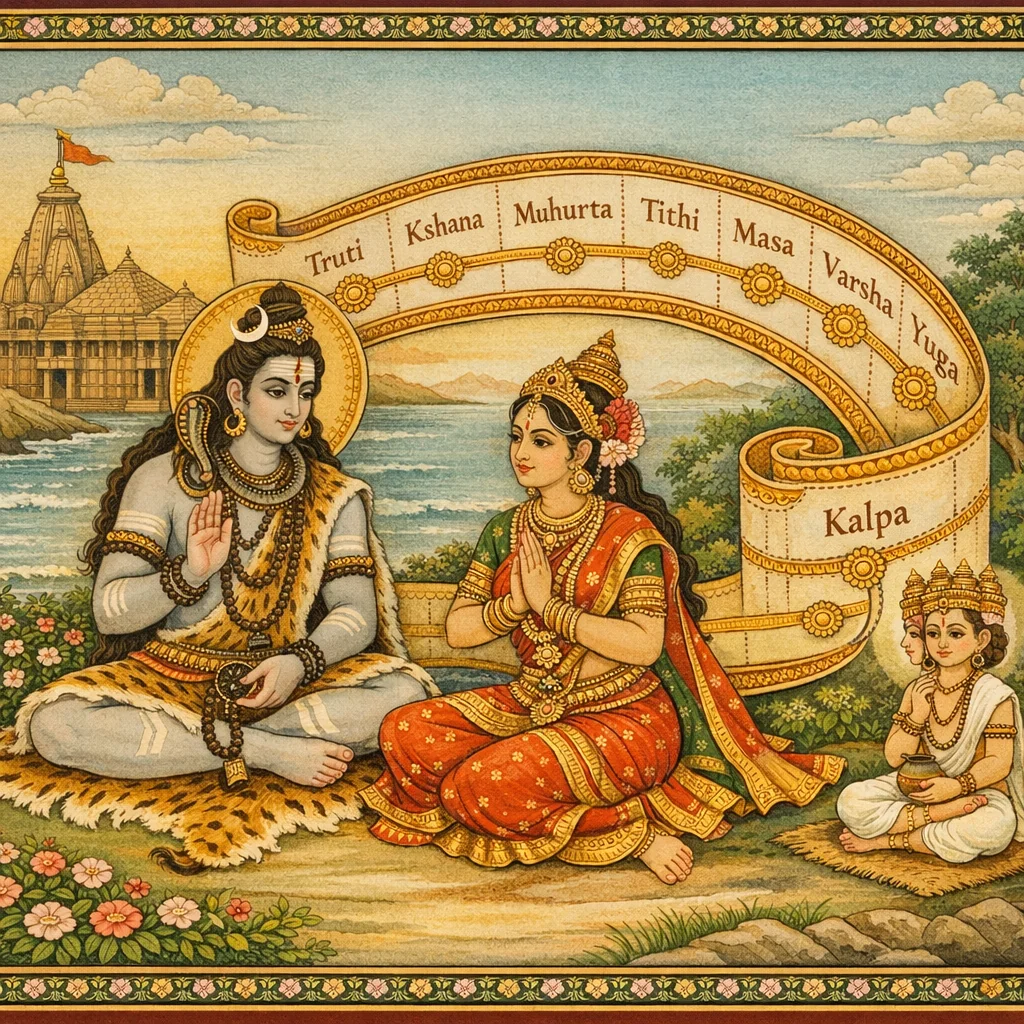
Īśvara reveals within Prabhāsa-kṣetra a “secret, excellent place” said to purify all, then names the eminent divine presences abiding in that sacred field. He declares that mere darśana there can free one from heavy stains—grave sins and birth-born impurities. Devī asks why Brahmā is here described as “child-formed” (bāla-rūpī) though elsewhere he appears aged, and requests the place, proper time, rules of worship, and the order of pilgrimage. Īśvara explains that Brahmā’s supreme station lies to the Īśānya (northeast) of Somnātha amid associated landmarks; Brahmā arrives at eight years of age, performs severe tapas, and joins in the establishment and installation of the Somnātha liṅga with vast ritual support. The chapter then sets out a technical cosmological reckoning of time—from truṭi up to muhūrta, through months and years, yugas and manvantaras—naming Manus and Indras and listing the kalpas that form Brahmā’s month, identifying the present kalpa as Varāha. It concludes by integrating Brahmā–Viṣṇu–Rudra and affirming an advaita-leaning unity: divine powers differ in function yet are ultimately one; therefore pilgrims seeking the true fruit of yātrā should honor Brahmā first and avoid sectarian hostility.
Shlokas
Verse 1
ईश्वर उवाच । अथान्यत्संप्रवक्ष्यामि रहस्यं स्थानमुत्तमम् । सर्वपापहरं नृणां विस्तरात्कथ यामि ते
Īśvara said: Now I shall proclaim another supreme, secret sacred place, which removes all sins of human beings. I will relate it to you in full detail.
Verse 2
प्रधानदेवमाहात्म्यं माहात्म्यं कल्पवासिनाम् । सोमेशो दैत्यहंता च वालरूपी पितामहः
The greatness of the principal deity, and the greatness of those who dwell there for a kalpa, are proclaimed: there are Someśa, the slayer of the Asuras, and Pitāmaha (Brahmā) in the form of a child.
Verse 3
अर्कस्थलस्तथादित्यः प्रभासः शशिभूषणः । एते षट्प्रवरा देवाः क्षेत्रे प्राभासिके स्थिताः
Arkasthala and Āditya, Prabhāsa and Śaśibhūṣaṇa—these are the six foremost deities established in the sacred field of Prābhāsika (Prabhāsa).
Verse 4
तेषां दर्शनमात्रेण कृतकृत्यः प्रजायते । मुच्यते पातकैर्घोरैराजन्मजनितैर्ध्रु वम्
By mere darśana—beholding them in reverence—one becomes fulfilled in life’s purpose; and one is surely freed from terrible sins accumulated from birth onward.
Verse 5
देव्युवाच । पूर्वेषामुक्तदेवानां माहात्म्यं कथितं त्वया । प्रभासे बालरूपीति यत्प्रोक्तं तत्कथं वचः
The Goddess said: You have described the greatness of the deities spoken of earlier. But in Prabhāsa you said that Pitāmaha is “in the form of a child”—how is that statement to be understood?
Verse 6
अन्येषु सर्व स्थानेषु वृद्धरूपी पितामहः । कथं च समनुप्राप्तो माहात्म्यं तस्य किं स्मृतम्
In all other places, Pitāmaha (Brahmā) appears in an aged form. How did he come to be present here in this manner, and what greatness of his is remembered here?
Verse 7
कथं स पूज्यो देवेश यात्रा कार्या कथं नृभिः । एतद्विस्तरतो ब्रूहि प्रसन्नो यदि मे प्रभो
O Lord of the gods, how is he to be worshipped, and how should people undertake the pilgrimage? If you are gracious to me, O Lord, explain this in detail.
Verse 8
ईश्वर उवाच । शृणु देवि प्रवक्ष्यामि माहात्म्यं ब्रह्मसम्भवम् । यस्य श्रवणमात्रेण मुच्यते सर्वपातकैः
Īśvara said: “Listen, O Devī. I shall proclaim the sacred greatness born of Brahmā; by mere hearing of it one is freed from all sins.”
Verse 9
नास्ति ब्रह्मसमो देवो नास्ति ब्रह्मसमो गुरुः । नास्ति ब्रह्मसमं ज्ञानं नास्ति ब्रह्मसमं तपः
There is no deity equal to Brahmā; no teacher equal to Brahmā. There is no knowledge equal to Brahmā, and no austerity (tapas) equal to Brahmā.
Verse 10
तावद्धमंति संसारे दुःख शोकभयप्लुताः । न भवंति सुरज्येष्ठे यावद्भक्ताः पितामहे
So long do beings wander in saṃsāra, overwhelmed by misery, grief, and fear—until they become devotees of Pitāmaha (Brahmā), the eldest among the gods.
Verse 11
समासक्तं यथा चित्तं जन्तोर्विषयगोचरे । यद्येवं ब्रह्मणि न्यस्तं को न मुच्येत बंधनात्
Just as a creature’s mind clings intensely to the field of sense-objects—if that very intensity is placed in Brahmā, who would not be freed from bondage?
Verse 12
देव्युवाच । एवं माहात्म्यसंयुक्तो यदि ब्रह्मा जगद्गुरुः । प्राभासिके महातीर्थे कस्मिन्स्थाने तु संस्थितः
Devī said: “If Brahmā, the guru of the world, is truly endowed with such greatness, then in the great tīrtha of Prabhāsa, in which place is he established?”
Verse 13
किमर्थमागतस्तत्र कस्मिन्काले सुरोत्तमः । कथं स पूज्यो विप्रेंद्रैस्तिथौ कस्यां क्रमाद्वद
“For what purpose did that best of the gods come there? At what time did he arrive? And how is he to be worshipped by the foremost of brāhmaṇas—on which tithi (lunar day)? Tell me in due order.”
Verse 14
ईश्वर उवाच । सोमनाथस्य ऐशान्यां सांबादित्याग्निगोचरे । ब्रह्मणः परमं स्थानं ब्रह्मलोक इवापरः
Īśvara said: “To the northeast of Somanātha, within the precincts of Sāmbāditya and Agni, lies Brahmā’s supreme abode—like another Brahmaloka.”
Verse 15
तिष्ठते कल्पसंस्था वै तत्र कल्पांतवासिनः । तत्र स्थाने स्थितो देवि बालरूपी पितामहः
“It endures through the span of an aeon (kalpa); there dwell those who remain until the end of the kalpa. In that place, O Devī, Pitāmaha (Brahmā) abides in the form of a boy.”
Verse 16
जगत्प्रभुर्लोककर्ता सत्त्वमूर्तिर्महाप्रभः । आगतश्चाष्टवर्षस्तु क्षेत्रे प्राभासिके शुभे
The Lord of the world, creator of the worlds, the great radiant One whose form is pure being, came to the auspicious sacred field of Prabhāsa as an eight-year-old.
Verse 17
तत्राऽकरोत्तपो घोरं दिव्याब्दानां सहस्रकम् । संस्थाप्य तु महालिंगं सिसृक्षुर्विविधाः प्रजाः
There he performed a fierce austerity for a thousand divine years; and, having established a great Liṅga, he sought to create manifold beings.
Verse 18
ततः कालांतरेतीते सोमेन प्रार्थितो विभुः । क्षयरोगविमुक्तेन सम्यक्छ्रद्धान्वितेन वै
After some time had passed, the Lord was entreated by Soma—now freed from the wasting disease and endowed with true faith.
Verse 19
लिंगप्रतिष्ठाहेतोर्वै क्षेत्रे प्राभासिके शुभे । कोटिब्रह्मर्षिभिः सार्द्धं सहितो विश्वकर्मणा । कारयामास विधिवत्प्रतिष्ठां लिंगमुत्तमम्
For the purpose of establishing the Liṅga, in the auspicious sacred field of Prābhāsa, he caused the consecration of the supreme Liṅga to be performed according to rule—together with crores of brahmarṣis and with Viśvakarman in attendance.
Verse 20
प्रतिष्ठाप्य ततो लिंगं सोमनाथं वरानने । दापयामास विप्रेभ्यो भूरिशो यज्ञदक्षिणाम्
Then, having established the Somanātha Liṅga, O fair-faced one, he had abundant sacrificial fees (dakṣiṇā) given to the brāhmaṇas.
Verse 21
एवं प्रतिष्ठितं लिंगं ब्रह्मणा लोककर्तृणा । वर्षाणि चात्र जातानि प्रभासे बालरूपिणः
Thus was the Liṅga established by Brahmā, the creator of the worlds; and here in Prabhāsa, years passed for him while he remained in the form of a child.
Verse 22
चत्वारिंशद्वयं चैव क्षेत्रमध्यनिवासिनः । एवं परार्द्धमगमत्प्रभासक्षेत्रवासिनः
Dwelling in the very heart of the sacred field, he remained there for forty-two years; thus, for the one residing in Prabhāsa-kṣetra, it is said that a ‘parārdha’—a vast half-span of Brahmā’s life—had elapsed.
Verse 23
देव्युवाच । ब्रह्मणो दिनमानं तु मासवर्षसहस्रकम् । तत्सर्वं विस्तराद्ब्रूहि यथायुर्ब्रह्मणः स्मृत म्
The Goddess said: “Brahmā’s measure of a ‘day’ is taught to comprise thousands of months and years. Explain all of that in detail, according to how Brahmā’s lifespan is taught.”
Verse 24
ईश्वर उवाच । परमायुः स्मृतो ब्रह्मा परार्द्धं तस्य वै गतम् । प्रभासक्षेत्रसंस्थस्य द्वितीयं भवतेऽधुना
Īśvara said: “Brahmā is remembered to have the supreme lifespan; of that, one parārdha has indeed passed. For Brahmā who abides in Prabhāsa-kṣetra, the second half is now proceeding.”
Verse 25
यदा प्राभासिके क्षेत्रे ब्रह्मा लोकपितामहः । आगतश्चाष्टवर्षस्तु बालरूपी तदोच्यते
When Brahmā, the grandsire of the worlds, comes to the Prābhāsika sacred field, he is then spoken of as being in child-form—eight years of age.
Verse 26
अन्येषु सर्वतीर्थेषु वृद्धरूपी पितामहः । मुक्त्वा प्राभासिकं क्षेत्रं सदैव विबुधप्रिये
At all other tīrthas the Grandsire (Brahmā) appears in the guise of an aged man; but in the sacred kṣetra of Prābhāsika it is not so, O beloved of the gods.
Verse 27
ब्रह्मांडे यानि तीर्थानि ब्रह्माणस्तेषु ये स्मृताः । तेषामाद्यो महातेजाः प्रभासे यो व्यवस्थितः
Among all the tīrthas in the universe, and among the Brahmās remembered in those holy places, the foremost—of mighty splendor—is the one established in Prabhāsa.
Verse 28
कल्पेकल्पे तु नामानि शृणु त्वं तानि वै प्रिये । स्वयंभूः प्रथमे कल्पे द्वितीये पद्मभूः स्थितः
Beloved, listen to these names as they arise in each kalpa: in the first kalpa he is called Svayaṃbhū, the Self-born; in the second he is established as Padmabhū, the Lotus-born.
Verse 29
तृतीये विश्वकर्तेति बालरूपी चतुर्थके । एतानि मुख्यनामानि कथितानि स्वयंभुवः
In the third kalpa he is called Viśvakartṛ, the Maker of the universe; in the fourth, Bālarūpī, the One of youthful form. These are proclaimed as the principal names of Svayaṃbhū (Brahmā).
Verse 30
नित्यं संस्मरते यस्तु स दीर्घायुर्नरो भवेत्
Whoever remembers these names each day, that person becomes long-lived.
Verse 31
चन्द्रसूर्यग्रहाः सर्वे सदेवासुरमानुषाः । त्रैलोक्यं नश्यते सर्वं ब्रह्मरात्रि समागमे
All the planets—moon and sun included—together with gods, asuras, and humans: the entire threefold world perishes when Brahmā’s night arrives.
Verse 32
पुनर्दिने तु संजाते प्रबुद्धः सन्पितामहः । तथा सृष्टिं प्रकुरुते यथापूर्वमभूत्प्रिये
But when the day arises again, Pitāmaha (Brahmā), awakened, sets creation in motion just as it was before, O beloved.
Verse 33
दिनमानं प्रवक्ष्यामि ब्रह्मणो लोककर्तृणः । नेत्रभागाच्चतुर्भागस्त्रुटिः कालो निगद्यते
I shall explain the measure of a day of Brahmā, the maker of worlds. A truṭi is said to be a unit of time equal to one-fourth of a portion of the eye (a very minute instant).
Verse 34
तस्माच्च द्विगुणं ज्ञेयं निमिषांतं वरानने । निमिषैः पञ्चदशभिः काष्ठा इत्युच्यते बुधैः । त्रिंशद्भिश्चैव काष्ठाभिः कला प्रोक्ता मनीषिभिः
And double that is to be known as a nimiṣa, O fair-faced one. Fifteen nimiṣas are called a kāṣṭhā by the learned; and with thirty kāṣṭhās, a kalā is declared by the wise.
Verse 35
त्रिंशत्कलो मुहूर्तः स्याद्दिनं पंचदशैस्तु तैः । दिनमाना निशा ज्ञेया अहोरात्रं तयोर्भवेत्
Thirty kalās make a muhūrta; and with fifteen of those, a day is formed. The night is to be known as equal in measure to the day; from the two arises the full day-and-night (ahorātra).
Verse 36
तैः पंचदशभिः पक्षः पक्षाभ्यां मास उच्यते । मासैश्चैवायनं षङ्भिरब्दं स्यादयनद्वयात्
With fifteen days there is a pakṣa (fortnight); by two pakṣas a month is spoken of. By six months there is an ayana (half-year); and by two ayanas there is a year.
Verse 37
चत्वारिंशद्धि लक्षाणि लक्षाणां त्रितयं पुनः । विंशतिश्च सहस्राणि ज्ञेयं सौरं चतुर्युगम्
Forty lakhs, and again three lakhs more, and twenty thousand besides—this is to be known as the solar (saura) measure of a caturyuga.
Verse 38
चतुर्युगैकसप्तत्या मन्वंतरमुदाहृतम् । ऐन्द्रमेतद्भवेदायुः समासात्तव कीर्तितम्
A Manvantara is declared to consist of seventy-one sets of the four Yugas. This, in brief, is taught to be the lifespan of an Indra—thus have I concisely explained it to you.
Verse 39
स्वायंभुवो मनुः पूर्वं मनुः स्वारोचिषस्ततः । औत्तमस्तामसश्चैव रैवतश्चाक्षुषस्ततः
First is Svāyambhuva Manu; then comes Svārociṣa Manu. After them are Auttama and Tāmasa, and then Raivata and Cākṣuṣa in due order.
Verse 40
वैवस्वतोऽर्कसावर्णिर्ब्रह्मसा वर्णिरेव च । धर्मसावर्णिनामा च रौच्यो भूत्यस्तथैव च
Then come Vaivasvata; Arka-sāvarṇi; also Brahma-sāvarṇi; Dharma-sāvarṇi by name; and likewise Raucya and Bhūtya.
Verse 41
चतुर्दशैते मनवः संख्यातास्ते यथाक्रमम् । भूतान्भविष्यानिंद्रांश्च सर्वा न्वक्ष्ये तव क्रमात्
Thus, these fourteen Manus have been counted in their proper order. Now, in sequence, I shall tell you of all the Indras—those of the past and those yet to come.
Verse 42
विश्वभुक्च विपश्चिच्च सुकीर्तिः शिबिरेव च । विभुर्मनोभुवश्चैव तथौजस्वी बलिर्बली
Viśvabhuk, Vipaścit, Sukīrti, and Śibi; also Vibhu and Manobhu; likewise Ojasvī, and Bali the mighty—
Verse 43
अद्भुतश्च तथा शांती रम्यो देववरो वृषा । ऋतधामा दिवःस्वामी शुचिः शक्राश्चतुर्दश
—Adbhuta; likewise Śāṃti, Ramya, Devavara, and Vṛṣa; Ṛtadhāmā, Divaḥsvāmī, and Śuci: these are the fourteen Śakras (Indras).
Verse 44
एते सर्वे विनश्यंति ब्रह्मणो दिवसे प्रिये । रात्रिस्तु तावती ज्ञेया कल्पमानमिदं स्मृतम्
All these pass away within the day of Brahmā, O beloved. And Brahmā’s night is to be understood as of equal measure—this is remembered as the standard of a Kalpa.
Verse 45
प्रथमं श्वेतकल्पस्तु द्वितीयो नीललोहितः । वामदेवस्तृतीयस्तु ततो राथंतरोऽपरः
The first is the Śveta Kalpa; the second is Nīla-lohita. The third is Vāmadeva; after that comes another, Rāthaṃtara.
Verse 46
रौरवः पंचमः प्रोक्तः षष्ठः प्राण इति स्मृतः । सप्तमोऽथ बृहत्कल्पः कन्दर्पोऽष्टम उच्यते
Raurava is proclaimed as the fifth; the sixth is remembered as Prāṇa. Then the seventh is the Bṛhat Kalpa, and the eighth is called Kandarpa.
Verse 47
सद्योऽथ नवमः प्रोक्तः ईशानो दशमः स्मृतः । ध्यान एकादशः प्रोक्तस्तथा सारस्वतोऽपरः
Next, Sadya is declared as the ninth; Īśāna is remembered as the tenth. Dhyāna is taught as the eleventh, and after that comes another, Sārasvata.
Verse 48
त्रयोदश उदानस्तु गरुडोऽथ चतुर्दशः । कौर्मः पंचदशो ज्ञेयः पौर्णमासी प्रजापतेः
The thirteenth (kalpa) is called Udāna; the fourteenth is Garuḍa. Know the fifteenth as Kaurma; and the full-moon day (Paurṇamāsī) is said to belong to Prajāpati.
Verse 49
षोडशो नारसिंहस्तु समाधिस्तु ततः परः । आग्नेयोऽष्टादशः प्रोक्तः सोमकल्पस्ततोऽपरः
The sixteenth (kalpa) is Nārasiṃha; after that comes the (kalpa) called Samādhi. The eighteenth is declared to be Āgneya; and thereafter is the Soma-kalpa.
Verse 50
भावनो विंशतिः प्रोक्तः सुप्तमालीति चापरः । वैकुण्ठश्चार्चिषो रुद्रो लक्ष्मीकल्पस्तथापरेः
Bhāvana is declared to be the twentieth; another is called Suptamālī. Then come Vaikuṇṭha, Ārciṣa, Rudra, and thereafter the Lakṣmī-kalpa.
Verse 51
सप्तविंशोऽथ वैराजो गौरीकल्पस्तथोंऽधकः । माहेश्वरस्तथा प्रोक्तस्त्रिपुरो यत्र घातितः
Next, the twenty-seventh is Vairāja; then comes the Gaurī-kalpa, and likewise Andhaka. The Māheśvara (kalpa) too is proclaimed—where Tripura was slain.
Verse 52
पितृकल्पस्तथांते च या कुहूर्ब्रह्मणः स्मृता । त्रिंशत्कल्पाः समाख्याता ब्रह्मणो मासि वै प्रिये
And at the end is the Pitṛ-kalpa; and Kuhu is remembered as belonging to Brahmā. Thus, O beloved, thirty kalpas are enumerated as constituting a “month” of Brahmā.
Verse 53
अतीताः कथिताः सर्वे वाराहो वर्त्ततेऽधुना । प्रतिपद्ब्रह्मणो यत्र वाराहेणोद्धृता मही
All those that have passed have been described; now the Vārāha-kalpa is current—the first day of Brahmā’s (month), in which Varāha lifted up the earth.
Verse 54
त्रिंशत्कल्पैः स्मृतो मासो वर्षं द्वादशभिस्तु तैः । अनेन वर्षमानेन तदा ब्रह्माऽष्टवार्षिकः । आनीतः सोमराजेन सोमनाथः प्रतिष्ठितः
A “month” is remembered as consisting of thirty kalpas, and a “year” of twelve such (months). By this measure of years, at that time Brahmā was eight years old; and Somarāja brought (the Lord) and established Somnātha at Prabhāsa.
Verse 55
एवं क्षेत्रे निवसतः प्रभासे बालरूपिणः । परार्द्धमेकमगमद्द्वितीयं वर्ततेऽ धुना
Thus, while (the Lord) dwelt in the sacred field of Prabhāsa in a child-like form, one parārdha elapsed; and now the second is in progress.
Verse 56
एवं महाप्रभावोऽसौ प्रभासक्षेत्रमध्यगः । ब्रह्मा स्वयंभूर्भगवान्बालत्वात्क्षेत्रमाश्रितः
Thus, of great majesty is (Brahmā) who abides in the midst of Prabhāsa-kṣetra. The Blessed, self-born Brahmā—because of his child-state—has taken refuge in this holy field.
Verse 57
स वै पूज्यो नमस्कार्यो वंदनीयो मनीषिभिः । आदौ स एव पूज्यः स्यात्सम्यग्यात्राफलेप्सुभिः
He indeed is to be worshipped, saluted, and revered by the wise. He should be worshipped first by those who desire the true fruit of pilgrimage.
Verse 58
यस्तं पूजयते भक्त्या स मां पूजयते भुवम् । यस्तं द्वेष्टि स मां द्वेष्टि योस्य पूज्यो ममैव सः
Whoever worships him with devotion truly worships Me, O Goddess, upon this earth. Whoever hates him hates Me; and whoever is worthy of worship for him—he is, in truth, worthy of worship for Me as well.
Verse 59
ब्रह्मणा पूज्यमानेन अहं विष्णुश्च पूजितः । विष्णुना पूज्यमानेन अहं ब्रह्मा च पूजितः
When Brahmā is worshipped, both I and Viṣṇu are worshipped. When Viṣṇu is worshipped, both I and Brahmā are worshipped.
Verse 60
मया पूजित मात्रेण ब्रह्मविष्णू च पूजितौ । सत्त्वं ब्रह्मा रजो विष्णुस्तमोऽहं संप्रकीर्तितः
By worshipping Me alone, Brahmā and Viṣṇu are worshipped as well. Brahmā is proclaimed as sattva, Viṣṇu as rajas, and I as tamas (in this triad of qualities).
Verse 61
वायुर्ब्रह्माऽनलो रुद्रो विष्णुरापः प्रकीर्तितः । रात्रिर्विष्णुरहो रुद्रो या संध्या स पितामहः
Brahmā is declared to be the wind; Rudra, the fire; and Viṣṇu is proclaimed as the waters. Night is Viṣṇu, day is Rudra, and the twilight junction (saṃdhyā) is that Grandfather, Brahmā.
Verse 62
सामवेदो ह्यहं देवि ब्रह्मा ऋग्वेद उच्यते । यजुर्वेदो भवेद्विष्णुः कुलाधारो ह्यथर्वणः
O Goddess, I am indeed the Sāma Veda; Brahmā is said to be the Ṛg Veda. Viṣṇu becomes the Yajur Veda; and Atharvan is the lineage-supporting foundation.
Verse 63
उष्णकालो ह्यहं देवि वर्षाकालः पितामहः । शीतकालो भवेद्विष्णुरेवं कालत्रयं हि सः
O Goddess, I am the hot season; the rainy season is the Grandfather (Brahmā); the cold season is Viṣṇu—thus, indeed, the triad of seasons is he, the one divine principle.
Verse 64
दक्षिणाग्निरहं ज्ञेयो गार्हपत्यो हरिः स्मृतः । ब्रह्मा चाहवनीयस्तु एवं सर्वं त्रिदैवतम्
Know Me as the Dakṣiṇāgni; Hari (Viṣṇu) is remembered as the Gārhapatya fire; and Brahmā is the Āhavanīya—thus everything is, indeed, the threefold divinity.
Verse 65
अहं लिंगस्वरूपस्थो भगो विष्णुः प्रकीर्तितः । बीजसंस्थो भवेद्ब्रह्मा विष्णुरापः प्रकीर्तितः
I abide in the form of the Liṅga. Viṣṇu is proclaimed as Bhaga, the Lord who allots fortune and portions. Brahmā is said to abide in the seed (bīja); and Viṣṇu is also proclaimed as the waters.
Verse 66
अहमाकाशरूपस्थ एवं तत्त्वमयं प्रभुः । आकाशात्स्रवते यच्च तद्बीजं ब्रह्मसंस्थितम् । स्वरूपं ब्राह्ममाश्रित्य ब्रह्मा बीजप्ररोहकः
I abide in the form of ākāśa, the Lord constituted of the very tattvas. Whatever flows forth from space—that is the seed established in Brahmā. Taking refuge in the Brahmic nature, Brahmā causes that seed to sprout.
Verse 67
नाभिमध्ये स्थितो ब्रह्मा विष्णुश्च हृदयांतरे । वक्त्रमध्ये अहं देवि आधारः सर्वदेहिनाम्
Brahmā is stationed in the midst of the navel, and Viṣṇu within the heart. In the middle of the mouth, O Goddess, am I—the support of all embodied beings.
Verse 68
यश्चाहं स स्वयं ब्रह्मा यो ब्रह्मा स हुताशनः । या देवी स स्वयं विष्णुर्यो विष्णुः स च चन्द्रमाः
He who is called “I” is truly Brahmā Himself; and that Brahmā is also Agni, the Fire. The Goddess too is indeed Viṣṇu; and that very Viṣṇu is also the Moon. Thus, in Prabhāsa, the divine forms are revealed as one Reality appearing through many powers.
Verse 69
यः कालः स स्वयं ब्रह्मा यो रुद्रः स च भास्करः । एवं शक्तिविशेषेण परं ब्रह्म स्थितं प्रिये
Time (Kāla) itself is truly Brahmā; and Rudra is also Bhāskara, the Sun. Thus, O beloved, through the distinct play of powers, the Supreme Brahman abides—appearing in varied forms yet remaining one.
Verse 71
एवं यो वेद देवेशि अद्वैतं परमाक्षरम् । स सर्वं वेद नैवान्यो भेदकर्त्ता नराधमः
O Goddess, whoever thus knows the non-dual Supreme Imperishable truly knows everything. But one who fashions divisions within the One is indeed the lowest of men.
Verse 72
एकरूपं परं ब्रह्म कार्यभावात्पृथक्स्थितः । यस्तं द्वेष्टि वरारोहे ब्रह्मद्वेष्टा स उच्यते
The Supreme Brahman is one in form; yet, through the conditions of manifested effects, It appears as though separate. O fair-hipped one, whoever hates That is called a “hater of Brahman.”
Verse 73
दक्षिणांगे स्थितो ब्रह्मा वामांगे मम केशवः । यस्तयोर्द्वेषमाधत्ते स द्वेष्टा मम भामिनि
Brahmā abides on My right side, and Keśava (Viṣṇu) on My left. O passionate beloved, whoever harbors hatred between those two is a hater of Me.
Verse 74
एवं ज्ञात्वा वरारोहे ह्यभिन्नेनान्तरात्मना । ब्रह्माणं केशवं रुद्रमेकरूपेण पूज येत्
Knowing thus, O fair-hipped one, with the inner Self understood as undivided, one should worship Brahmā, Keśava, and Rudra as a single form.
Verse 105
इति श्रीस्कांदे महापुराण एकाशीतिसाहस्र्यां संहितायां सप्तमे प्रभासखण्डे प्रथमे प्रभासक्षेत्रमाहात्म्ये मध्ययात्रायां ब्रह्म माहात्म्यवर्णनंनाम पञ्चाधिकशततमोऽध्यायः
Thus ends, in the Śrī Skanda Mahāpurāṇa—within the eighty-one-thousand-verse compendium—the one hundred and fifth chapter, called “The Description of Brahmā’s Greatness,” in the seventh (Prabhāsa) Khaṇḍa, in the first division, the Prabhāsa-kṣetra Māhātmya, within the section on the “Middle Pilgrimage” (Madhya-yātrā).