Adhyaya 47
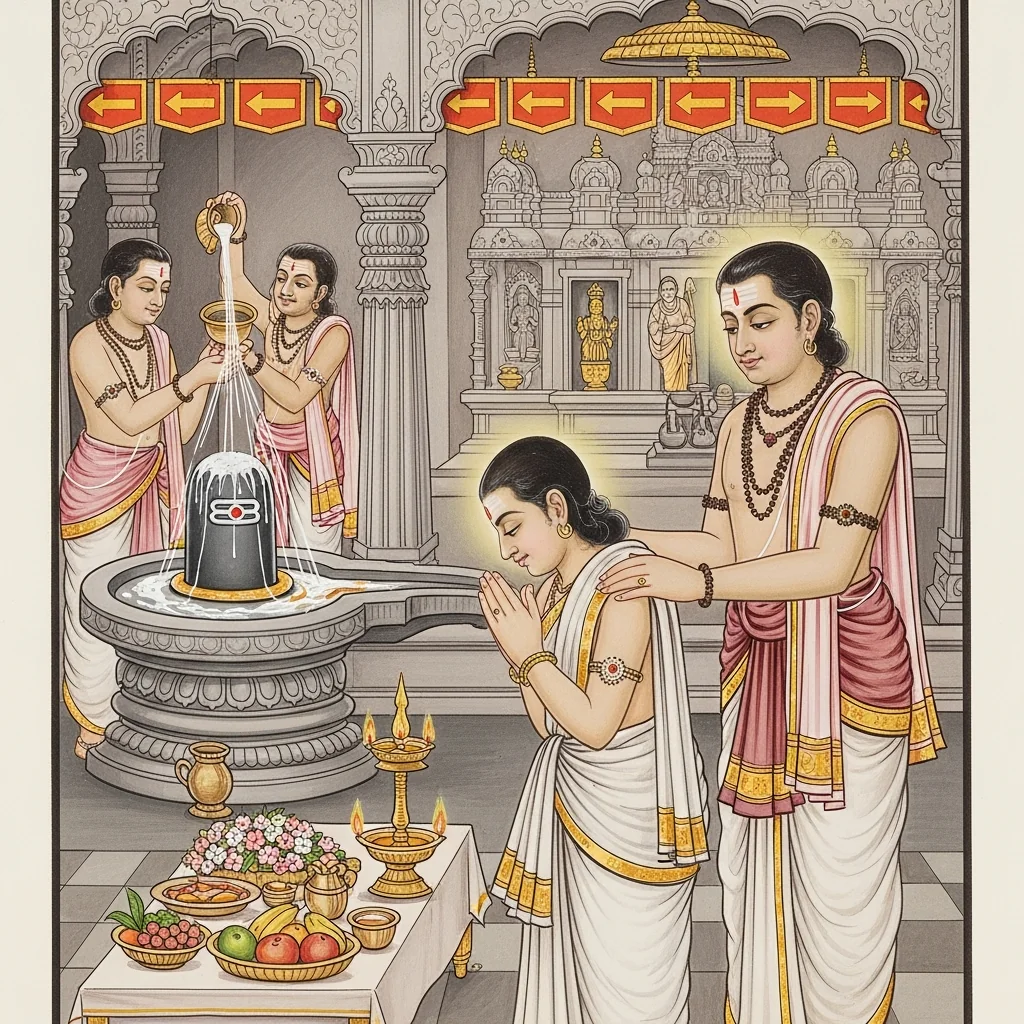
This chapter is cast as Īśvara’s instruction to Mahādevī, guiding the pilgrim to a liṅga in the eastern sector, associated with Umā and lying within the Āgneya (southeastern) range. The liṅga is praised as a great emblem installed by Devācārya and intimately connected with Guru, Bṛhaspati. A model course of worship is taught: sustained devotion to the liṅga over a long period grants even hard-to-attain desires, followed by honor among the devas and the attainment of īśvara-jñāna (sovereign knowledge of the Lord). The narrative then turns to pilgrimage benefits—mere darśana of the Bṛhaspati-made liṅga protects from misfortune and specifically remedies afflictions attributed to Bṛhaspati. Ritual timing is stressed—Śukla Caturdaśī falling on a Thursday—and worship may be done either with full formal procedure and rājopacāra or with pure devotional intent. A bathing rite with pañcāmṛta in a large prescribed measure is said to free one from the “three debts” (ṛṇa-traya): to mother, father, and guru, leading to purification, a non-dual (nirdvandva) mind, and liberation. The phalaśruti concludes that faithful listening pleases Guru.
Shlokas
Verse 1
ईश्वर उवाच । ततो गच्छेन्महादेवि देवं गुरुनिषेवितम् । उमायाः पूर्वदिग्भागे सिद्धेशाग्नेयगोचरे
Īśvara said: “Then, O great Goddess, one should go to that deity who is attended and served by the Guru. It is in Umā’s eastern quarter, within the south‑eastern precinct of Siddheśa.”
Verse 2
संस्थितं तु महल्लिंगं देवाचार्य प्रतिष्ठितम् । आराध्य परया भक्त्या लिंगं वर्षसहस्रकम्
There stands a great Liṅga, installed by Devācārya. Having worshipped that Liṅga with supreme devotion for a thousand years,
Verse 3
तोषयामास देवेशं भवं शर्वमुमापतिम् । प्राप्तवानखिलान्कामानप्राप्यानकृतात्मभिः
He satisfied the Lord of the gods—Bhava, Śarva, the consort of Umā—and obtained all desires, even those unattainable to the undisciplined in spirit.
Verse 4
देवानां चैव पूज्यत्वं प्राप्य ज्ञानमथैश्वरम् । ग्रहत्वं च तथा प्राप्य मोदते दिवि सांप्रतम्
He attained the status of being worshipworthy even among the gods, and gained spiritual knowledge and lordly power. Having likewise obtained the state of a Graha (planetary deity), he now rejoices in heaven.
Verse 5
तं दृष्ट्वा मानवो भक्त्या न दुर्गति मवाप्नुयात् । बृहस्पतिकृतं लिंगं ये पश्यंति नरोत्तमाः
A person who beholds it with devotion does not fall into an evil fate. Those best among men who see that Liṅga fashioned by Bṛhaspati
Verse 6
बृहस्पतिकृता पीडा नैव तेषां हि जायते । तत्र शुक्लचतुर्दश्यां गुरुवारे तथा प्रिये
Affliction caused by Bṛhaspati does not arise for them. And there, O beloved, on the bright fortnight’s fourteenth day, and likewise on a Thursday,
Verse 7
संपूज्य विधिवल्लिंगं सम्यग्राजोपचारतः । अथवा भक्तिभावेन प्राप्नुयात्परमं पदम्
Having duly worshipped the Liṅga according to rule, with complete royal offerings—or else even with the mere feeling of devotion—one attains the supreme state.
Verse 8
स्नानं पलसहस्रेण पंचामृतरसेन यः । करोति भक्त्या मर्त्यो वै मुच्यते स ऋणत्रयात्
Any mortal who, with devotion, performs a ritual bath using a thousand palas of the fivefold nectar (pañcāmṛta) is truly freed from the three debts.
Verse 9
मातृकात्पैतृकाद्देवि तथा गुरुसमुद्भवात् । सर्वपापविशुद्धात्मा निर्द्वंद्वो मुक्तिमाप्नुयात्
O Goddess, freed from the debts arising from the mother, from the father/ancestors, and likewise from those originating from the guru, one becomes purified of all sins; free from inner conflict, one attains liberation.
Verse 10
एवं संक्षेपतः प्रोक्तं माहात्म्यं गुरुदैवतम् । शृणुयाद्यस्तु भावेन तस्य प्रीतो गुरुर्भवेत्
Thus, in brief, the greatness of the Guru-deity has been declared. Whoever listens to it with heartfelt faith—toward that person the Guru becomes pleased.
Verse 47
इति श्रीस्कान्दे महापुराण एकाशीतिसाहस्र्यां संहितायां सप्तमे प्रभासखण्डे प्रथमे प्रभासक्षेत्रमाहात्म्ये वृहस्पतीश्वरमाहात्म्यवर्णनंनाम सप्तचत्वारिंशोऽध्यायः
Thus ends the forty-seventh chapter, entitled “The Description of the Greatness of Vṛhaspatīśvara,” in the first part, Prabhāsakṣetra Māhātmya, of the seventh division, the Prabhāsa Khaṇḍa, of the Śrī Skanda Mahāpurāṇa, within the Saṃhitā of eighty-one thousand verses.