Adhyaya 186
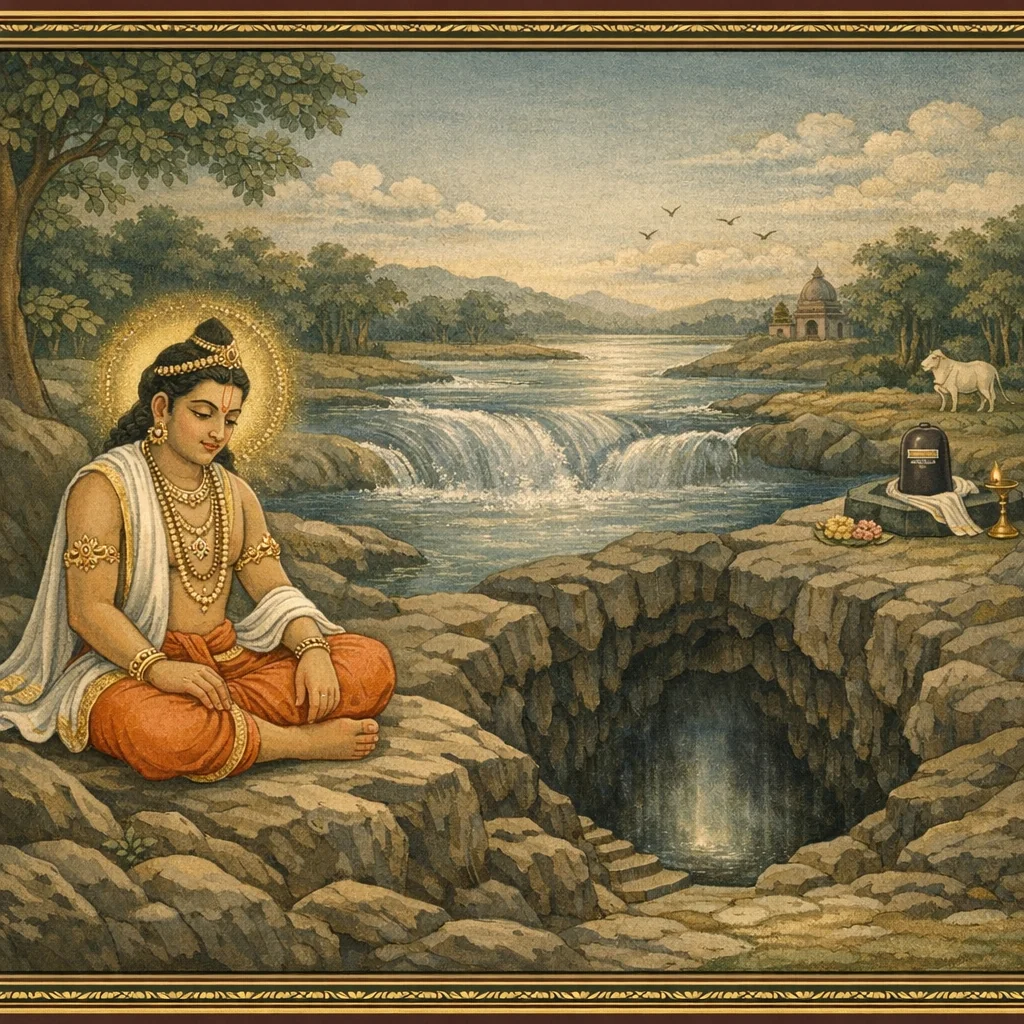
Īśvara instructs Devī to go to the eminent Nāgasthāna west of Maṅkīśa, a tri-saṅgama (triple confluence) tīrtha praised as powerfully sin-destroying. The chapter then recounts Balabhadra’s legend: hearing of Kṛṣṇa’s passing, he comes to Prabhāsa, perceives the kṣetra’s extraordinary potency and the ruin of the Yādavas, and embraces renunciation. Balabhadra leaves his body in the form of Śeṣa-nāga, reaches the supreme tri-saṅgama, beholds a vast opening to pātāla like a “door,” and swiftly enters the realm where Ananta abides. Because he entered here in nāga-form, the place is called Nāgasthāna; and where he relinquished the body is famed as Śeṣasthāna (east of Nāgarāditya). The observances taught are bathing at the tri-saṅgama, worship of Nāgasthāna, fasting on the fifth lunar day (pañcamī) with restraint in eating, performing śrāddha, and giving dakṣiṇā to a Brahmin according to one’s means. The promised fruit is relief from distress and attainment of Rudra-loka; moreover, feeding a Brahmin sweet rice mixed with honey and other foods dedicated to Śeṣa-nāga is said to yield the merit of feeding “crores,” affirming dāna as a central sacred duty.
Shlokas
Verse 1
ईश्वर उवाच । ततो गच्छेन्महादेवि नागस्थानमनुत्तमम् । मंकीशात्पश्चिमे भागे संगमत्रितयं गतम्
Īśvara said: Then, O Mahādevī, one should proceed to the unsurpassed Nāgasthāna, situated to the west of Maṃkīśa, where the triple confluence (Traisaṅgama) is found.
Verse 2
पापघ्नं सर्वजंतूनां पातालविवरं महत्
It destroys sins for all beings; it is a great opening leading to Pātāla.
Verse 3
बलभद्रः पुरा देवि श्रुत्वा कृष्णस्य पंचताम् । भल्लतीर्थे तु भल्लेन ततः प्रभासमागतः
Formerly, O Devī, Balabhadra, having heard of Kṛṣṇa’s death, came to Prabhāsa after being struck by an arrow at Bhalla-tīrtha.
Verse 4
क्षेत्रं महाप्रभावं हि ज्ञात्वा सर्वार्थसिद्धिदम् । यादवानां क्षयं कृत्वा ततो वैराग्यमेयिवान्
Knowing this kṣetra to be of immense power, bestowing success in every aim, and having brought about the destruction of the Yādavas, he thereafter entered into vairāgya—holy dispassion.
Verse 5
शेषनागेशरूपेण निष्क्रम्य च शरीरतः । गच्छन्गच्छंस्तदा प्राप्य तीर्थं त्रैसंगमं परम्
Then, emerging from the body in the form of Śeṣa, lord of the nāgas, and proceeding onward, he reached the supreme tīrtha known as Traisaṅgama.
Verse 6
पातालस्य तदा दृष्ट्वा द्वारं विवररूपकम् । प्रविष्टोऽथ जगामाशु यत्रानंतः स्वयं स्थितः
Then, seeing the entrance to Pātāla as a fissure-like opening, he entered it and swiftly went to the place where Ananta (Śeṣa) himself abides.
Verse 7
यतो नागस्वरूपेण स्थानेऽस्मिंश्च समाविशत् । तत्प्रभृत्येव देवेशि नागस्थानमिति श्रुतम्
Because he entered this very place in the form of a Nāga, O Goddess of the Lord, from that time onward it has been renowned as “Nāga-sthāna.”
Verse 8
नागरादित्यपूर्वेण यत्र कायो विसर्जितः । तदद्यापि प्रसिद्धं वै शेषस्थानमिति श्रुतम्
To the east of Nāgarāditya lies the spot where the body was relinquished; even today it is famed and known as “Śeṣa-sthāna.”
Verse 9
अतः स्नात्वा महादेवि तत्र तीर्थे त्रिसंगमे । नागस्थानं समभ्यर्च्य पञ्चम्यामकृताशनः
Therefore, O Great Goddess, having bathed at that tīrtha of the threefold confluence and duly worshipped Nāga-sthāna, one should observe the fifth day in fasting, taking no food.
Verse 10
श्राद्धं कृत्वा यथाशक्त्या दत्त्वा विप्राय दक्षिणाम् । विमुक्तः सर्वदुःखेभ्यो रुद्रलोकं स गच्छति
Having performed śrāddha according to one’s capacity and having given a brāhmaṇa the due dakṣiṇā, one is freed from all sorrows and attains Rudra’s world.
Verse 11
पायसं मधुसंमिश्रं भक्ष्यभोज्यैः समन्वितम् । शेषनागं समुद्दिश्य विप्रं यस्तत्र भोजयेत् । कोटिभोज्यं कृतं तेन जायते नात्र संशयः
Whoever, at that place, feeds a brāhmaṇa—offering pāyasa mixed with honey and accompanied by various foods—dedicating it to Śeṣa Nāga, gains the merit of feeding crores; of this there is no doubt.
Verse 186
इति श्रीस्कान्दे महापुराण एकाशीतिसाहस्र्यां संहितायां सप्तमे प्रभासखंडे प्रथमे प्रभासक्षेत्रमाहात्म्ये नाग स्थानमाहात्म्यवर्णनंनाम षडशीत्युत्तरशततमोऽध्यायः
Thus ends the one-hundred-and-eighty-sixth chapter, entitled “The Description of the Greatness of Nāga-sthāna,” in the Prabhāsa Khaṇḍa (Book Seven) of the revered Skanda Mahāpurāṇa, within the Prabhāsakṣetra Māhātmya section.