Adhyaya 257
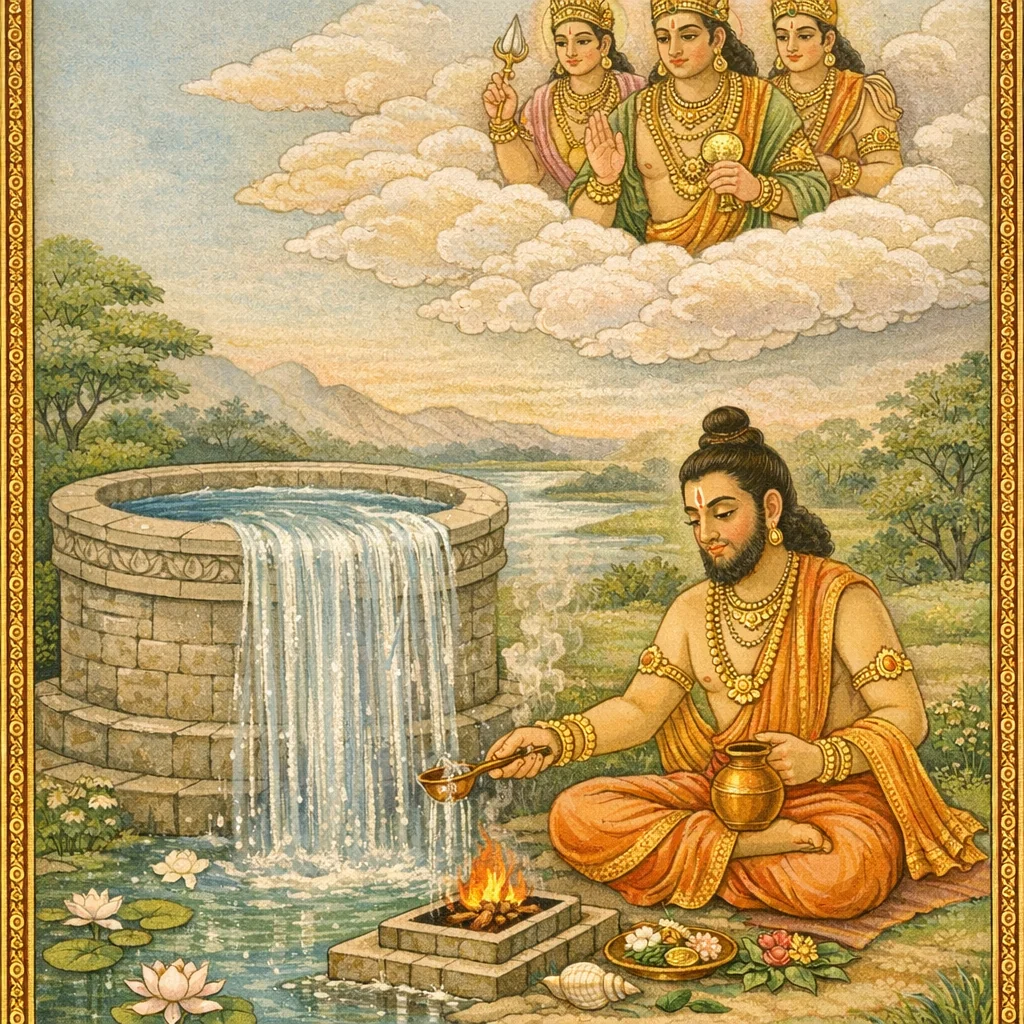
Īśvara tells Devī of Ātreya, a learned figure of Saurāṣṭra, and his three sons—Ekata, Dvita, and the youngest, Trita. After Ātreya’s death, Trita, virtuous and Veda-versed, assumes leadership and prepares to perform a yajña, inviting learned officiants and invoking the deities. Seeking dakṣiṇā, he travels with his brothers toward Prabhāsa to gather cattle, and because of his learning he is honored with hospitality and gifts. On the way, the elder brothers grow envious and plot against him. A terrifying tiger appears and the cattle scatter; near a dreadful dry well they seize the moment, cast Trita into the waterless pit, and depart with the herd. In the well Trita does not despair; he performs a mānasa-yajña, recites sūktas, and offers a symbolic sand-homa. Pleased by his śraddhā, the devas speak to him and arrange for Sarasvatī to fill the well with water, enabling his escape; the place becomes known as Tritakūpa. The chapter ends with injunctions: bathing there in purity, performing pitṛ-tarpaṇa, and gifting sesame (tila) with gold are praised. The tīrtha is said to be beloved of the pitṛs (including the Agniṣvātta and Barhiṣad classes), and even the mere sight of it is declared to free beings from sins until life’s end, urging pilgrims to bathe there for their welfare.
Shlokas
Verse 1
ईश्वर उवाच । ततो गच्छेन्महादेवि त्रितकूपमिति स्मृतम् । नंदादित्यस्य पूर्वेण योजनत्रितयेन तु
Īśvara said: “Then, O great goddess, one should go to the place known as Tritakūpa. It lies to the east of Nandāditya, at a distance of three yojanas.”
Verse 2
पुरा बभूव राजेन्द्रः सौराष्ट्रविषये सुधीः । आत्रेय इति विख्यातो वेदवेदांगपारगः
Formerly, in the land of Saurāṣṭra, there was a wise king renowned as Ātreya, accomplished in the Vedas and in the auxiliary disciplines (Vedāṅgas).
Verse 3
तस्य पुत्रत्रयं जज्ञ ऋतुकालाभिगामिनः । एकतश्चद्वितश्चैव त्रितश्चैवेति भामिनि
To him were born three sons, devoted to the dharma of approaching their wives in the proper season; they were named Ekata, Dvita, and Trita, O radiant lady.
Verse 4
त्रितस्तेषां कनिष्ठोऽभूद्वेदवेदांगपारगः । सर्वैरेव गुणैर्युक्तो मूर्खो ज्येष्ठौ बभूवतुः
Of them, Trita—the youngest—became a master of the Vedas and their auxiliaries (Vedāṅgas). Endowed with every virtue, he shone in excellence, while the two elder brothers remained foolish.
Verse 5
कस्यचित्त्वथकालस्य आत्रेयो द्विज सत्तमः । तपः कृत्वा तु विपुलं कालधर्ममुपेयिवान्
Then, after some time, Ātreya—the best among the twice-born—having performed abundant austerity, attained the law of Time and passed away.
Verse 6
ततस्तेषां त्रितो राजा बभूव गुणवत्तरः । धुरमाकर्षयामास पुत्रोऽयं तस्य या पुरा
Thereafter, among them, Trita became the ruler, surpassing the others in virtue. He took up and bore the weight of responsibility—this son, as he had been from earlier times.
Verse 7
तस्य बुद्धिः समुत्पन्ना कथं यज्ञं करोम्यहम् । सन्निमंत्र्य द्विजश्रेष्ठान्यज्ञकर्मस्वधिष्ठितान्
Then a thought arose in him: “How shall I perform the yajña?” Having duly invited the foremost brāhmaṇas, firmly established in sacrificial rites, he made ready to proceed.
Verse 8
इन्द्रादींश्च सुरान्सर्वानावाह्य विधिपूर्वकम् । दक्षिणार्थं द्विजेन्द्राणां प्रभासं स जगाम ह । गृहीत्वा भ्रातरौ ज्येष्ठौ गवार्थं प्रस्थितो द्विजः
Having, in due ritual order, invoked Indra and all the gods, he set out for Prabhāsa to procure the dakṣiṇā, the sacrificial fee, for the noble brāhmaṇas. Taking his two elder brothers with him, the twice-born departed in search of cattle.
Verse 9
यस्य यस्य गृहे याति स त्रितो वेदपारगः । तत्र तत्र वरां पूजां लेभे गाश्चैव पुष्कलाः
Whichever house that Trita, master of the Vedas, entered, there and there he received excellent honor, and abundant cows as well.
Verse 10
एवं स गोधनं प्राप्य भ्रातृभ्यां सहितस्तदा । गृहाय प्रस्थितो देवि निर्वृतिं परमां गतः
Thus, having obtained wealth in cattle and accompanied by his brothers, O Goddess, he set out for home, having attained the highest contentment.
Verse 11
त्रितस्ताभ्यां पुरो याति पृष्ठतो भ्रातरौ च तौ । गोधनं चालयंतस्ते प्रभासं क्षेत्रमागताः
Trita walked ahead, while the two brothers followed behind, driving the herd of cattle; thus they arrived at the sacred field of Prabhāsa.
Verse 12
अथ तद्गोधनं दृष्ट्वा भूरि दानार्थमाहृतम् । भ्रातृभ्यां त्रितये चेति पापा मतिरजायत
But when they saw that great herd of cattle brought for the purpose of charitable gifting, a sinful thought arose in the two brothers: “This is for Trita and for us (to seize).”
Verse 13
परस्परमूचतुस्तौ भ्रातरौ दुष्टचेतसौ । त्रितो यज्ञेषु कुशलो वेदेषु कुशलस्तथा
Then those two brothers, evil-minded, spoke to one another: “Trita is skilled in sacrifices, and likewise skilled in the Vedas.”
Verse 14
मान्यः पूज्यश्च सर्वत्र आवां मूर्खौ निरर्थकौ । एतद्धि गोधनं सर्वं त्रितो दास्यति सन्मखे
“He is honoured and worshipped everywhere, while we are fools and of no account. Indeed, Trita will give away all this wealth of cattle at the sacrifice, before the very eyes of the good.”
Verse 15
अस्माकं पितृपर्यातो यदाप्तं तत्समं भवेत् । तस्मादत्रैव युक्तोऽस्य वधो वै त्रितयज्ञिनः
“Whatever has come down to us through our forefathers would become equal to that (only if we seize it). Therefore, right here, the killing of Trita—the sacrificer—is indeed the proper course.”
Verse 16
एवं तौ निश्चयं कृत्वा प्रस्थितौ भ्रातरावुभौ । त्रितस्तु पुरतो याति निर्विकल्प ऋजुः सुधीः
Having thus made their decision, the two brothers set out. But Trita went ahead of them—calm, straightforward, and wise, free from suspicion.
Verse 17
अनु तत्र समुत्तस्थौ व्याघ्रो रौद्रतराकृतिः । व्यादितास्यो रवं देवि व्यनद्भैरवं ततः
Then, close behind them, a tiger rose up, of exceedingly ferocious form. With jaws agape, O Goddess, it let out a dreadful, terrifying roar.
Verse 18
तस्य शब्देन ता गावो नष्टा जग्मुर्दिशो दश । अन्धकूपो महांस्तत्र प्रदेशे दारुणोऽभवत्
At the sound of that roar, the cows scattered and were lost, fleeing in all ten directions. In that region there was a vast “dark well”, dreadful to behold.
Verse 19
एकतो दारुणो व्याघ्रः कूपोऽन्यत्र सुदारुणः । दृष्ट्वा ते भ्रातरः सर्वे भयोद्विग्नाः प्रदुद्रुवुः
On one side was the fearsome tiger; elsewhere, a most dreadful well. Seeing this, all the brothers—agitated with fear—ran in panic.
Verse 20
अथ ते विषमं प्राप्य तटं कूपस्य भामिनि । स्थिता यावद्गतो व्याघ्रस्ततो गंतुं मनो दधुः
Then, O Lady, reaching the uneven brink of the well, they stood there until the tiger went away; only then did they set their minds on moving on.
Verse 21
अथ ताभ्यां त्रितो देवि भ्रातृभ्यां नृपसत्तम । प्रक्षिप्तो दारुणे कूपे जीर्णे तोयविवर्जिते
Then, O Goddess—O best of kings—Trita was hurled by those two brothers into a dreadful well, old and dry, devoid of water.
Verse 22
ततस्तद्गोधनं गृह्य प्रस्थितौ हृष्टमानसौ । त्रितस्तु पतितस्तत्र कूपे जलविवर्जिते
Then, taking that wealth of cattle, the two set out with hearts made glad. But Trita lay fallen there, within a well that was bereft of water.
Verse 23
चिन्तयामास मेधावी नाहं शोचामि जीवितुम् । मयाहूता द्विजश्रेष्ठा यज्ञार्थं वेदपारगाः । इन्द्राद्याश्च सुराः सर्वे स क्रतुः स्यान्न मे त्वतः
The wise one reflected: “I do not grieve for my life. For the sake of the sacrifice I have invited the foremost brāhmaṇas, masters of the Vedas, and all the gods as well, beginning with Indra. Therefore, let not that rite fail because of me.”
Verse 24
स एवं चिन्तयामास वेदवेदांगपारगः । मानसं यज्ञमारभ्य तत्रैव वरवर्णिनि
Thus the brāhmaṇa, well versed in the Vedas and their auxiliaries, reflected within himself; and there itself, O fair-complexioned lady, he began a mental sacrifice.
Verse 25
स्वयमेव स सूक्तानि प्रोक्त्वा प्रोक्त्वा द्विजोत्तमः । कृतवान्बालुकाहोमं तेन तुष्टाश्च देवताः
That best of brāhmaṇas, reciting the sacred hymns again and again by himself, performed the bālukā-homa, an offering into fire with sand; by that act the deities were pleased.
Verse 26
श्रद्धां तस्य विदित्वा तु भूयस्तृप्तास्तु देवताः । आगत्य ब्राह्मणं प्रोचुः कूपमध्ये व्यवस्थितम्
Recognizing his faith, the deities became even more satisfied. They came and spoke to the brāhmaṇa who remained within the well.
Verse 27
देवा ऊचुः । भोभो विप्र त्वया नूनं सर्वे संतर्पिता वयम् । मानसेन तु यज्ञेन तस्माद्ब्रूहि मनोगतम्
The gods said: “O Brāhmaṇa, by your sacrifice offered in the mind, we have all indeed been satisfied. Therefore, tell us the wish that abides within your heart.”
Verse 28
ब्राह्मण उवाच । यदि देवाः प्रसन्ना मे कूपान्निष्कमणे त्वहम् । यष्टा स्वं मंदिरं गत्वा देवयज्ञं करोम्यहम्
The Brāhmaṇa said: “If the gods are pleased with me, may I be able to come out of this well. Going to my own home, I shall duly perform the deva-yajña, the sacrifice to the gods.”
Verse 29
ईश्वर उवाच । अथ देवैः समादिष्टा तस्मिन्कूपे सरस्वती । निर्गत्य वसुधां भित्त्वा पूरयामास वारिणा
Īśvara said: Then, commanded by the gods, Sarasvatī manifested within that well; breaking through the earth, she filled it with water.
Verse 30
अथ निष्क्रम्य विप्रोऽसौ यातः स्वभवनं प्रति । ततः प्रभृति देवेशि त्रितकूपः स उच्यते
Then that Brāhmaṇa came out and went toward his own home. From that time onward, O Lady of the gods, that place is called Tritakūpa.
Verse 31
स्नात्वा तत्र शुचिर्भूत्वा त्वथ संतर्पयेत्पितॄन् । अश्वमेधमवाप्नोति सर्वपापविवर्जितः
Bathing there and becoming purified, if one then offers satisfaction to the Pitṛs (the ancestral spirits), one attains the merit of an Aśvamedha sacrifice and becomes free from all sins.
Verse 32
तिल दानं तु देवेशि तत्र शस्तं सकाञ्चनम् । पितॄणां वल्लभं तीर्थं नित्यं चैव तु भामिनि
O Lady of the gods, the gift of sesame there—together with gold—is greatly praised. O radiant one, that tīrtha is ever dear to the Pitṛs.
Verse 33
अग्निष्वात्ता बर्हिषद आयंतुन इति स्मृताः । ये दिव्याः पितरो देवि तेषां सांनिध्यमत्र हि
‘Agniṣvāttas’ and ‘Barhiṣads’ are remembered with the invocation, “May they come.” O goddess, the presence of those divine ancestors is indeed found here.
Verse 34
दर्शनादपि तीर्थस्य तस्य वै सुरसत्तमे । मुच्यन्ते प्राणिनः पापादाजन्ममरणांतिकात्
O best among the gods, even by merely beholding that tīrtha, living beings are freed from sins—sins that cling from birth until the very end of life.
Verse 35
तस्मात्सर्वप्रयत्नेन तत्र स्नानं समाचरेत् । प्रभासं क्षेत्रमासाद्य यदीच्छेच्छ्रेय आत्मनः
Therefore, with every effort one should duly perform bathing there; having reached the sacred field of Prabhāsa, if one desires one’s own highest good.
Verse 257
इति श्रीस्कांदे महापुराण एकाशीतिसाहस्र्यां संहितायां सप्तमे प्रभासखंडे प्रथमे प्रभासक्षेत्रमाहात्म्ये त्रितकूपमाहात्म्यवर्णनंनाम सप्तपञ्चाशदुत्तरद्विशततमोऽध्यायः
Thus ends, in the holy Skanda Mahāpurāṇa—within the Saṃhitā of eighty-one thousand verses—within the seventh, the Prabhāsa Khaṇḍa, in the first division titled ‘Prabhāsakṣetra Māhātmya’, the chapter called ‘The Description of the Greatness of Tritakūpa Tīrtha’: the two-hundred-and-fifty-seventh adhyāya.