Adhyaya 220
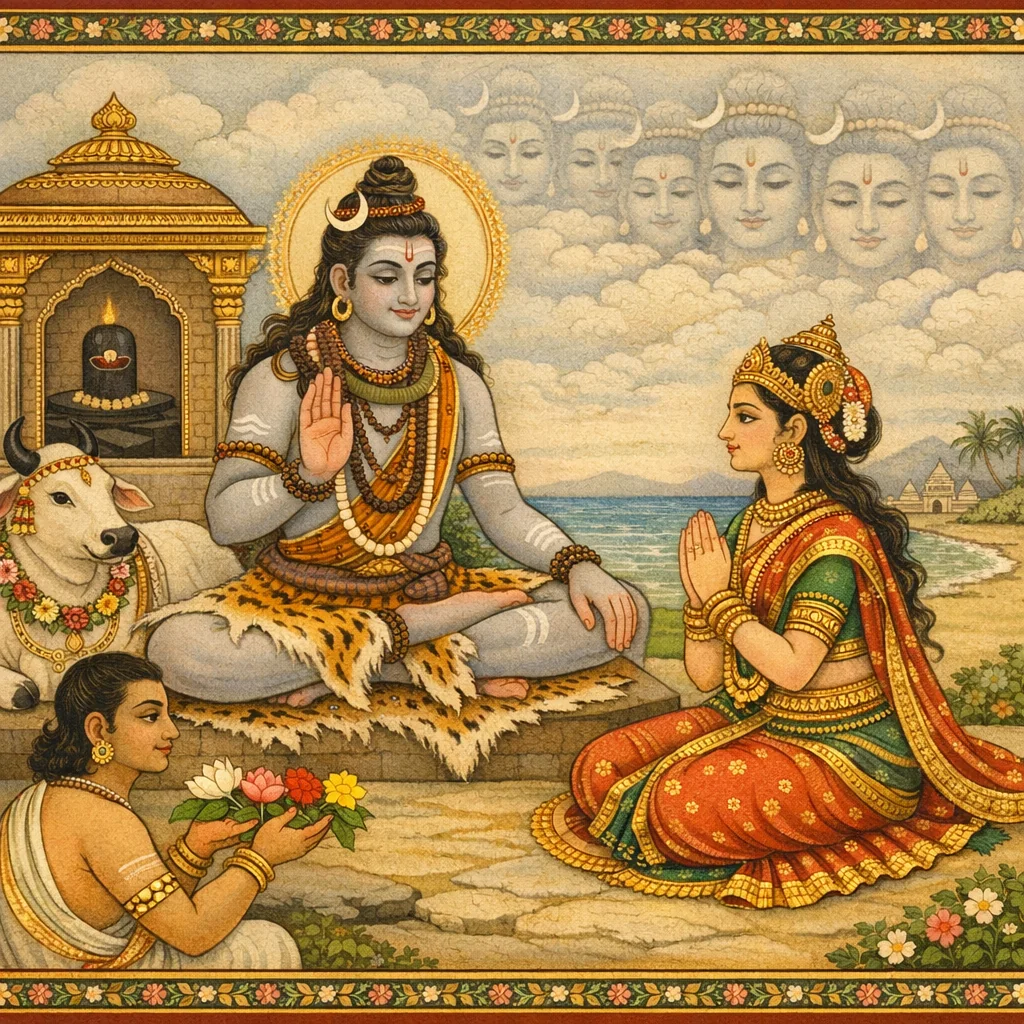
This chapter is a Śaiva theological instruction in which Īśvara teaches the Goddess. The pilgrim is directed to the deity Vṛṣadhvajeśvara—“worshiped in the three worlds” (triloka-pūjita)—located to the south within the sacred shrine-map of Prabhāsa. The text then describes Śiva as akṣara and avyakta (imperishable, unmanifest), with no higher principle beyond Him, attainable through yoga, and omnipresent as the cosmic Being whose hands, feet, eyes, heads, and mouths are everywhere. A line of exemplary kings (Pṛthu, Marutta, Bharata, Śaśabindu, Gaya, Śibi, Rāma, Ambarīṣa, Māndhātṛ, Dilīpa, Bhagiratha, Suhotra, Rantideva, Yayāti, Sagara) is cited to establish precedent: having come to Prabhāsa and worshiped Vṛṣadhvajeśvara with sacrifices, they attain heaven. Repeated reminders of saṃsāra—birth, death, affliction, and aging—press an ethical and ascetic urgency, declaring Śiva-arcana the “essence” amid a world deemed insubstantial. Steadfast bhakti is praised as prosperity-bearing, granting abundance likened to the cintāmaṇi and kalpadruma, even making Kubera as a servant. Ritual simplicity is exalted: worship with merely five flowers yields the fruit of ten aśvamedhas. Finally, a specific gift is prescribed—donating a bull near Vṛṣadhvaja—for the destruction of sins and for those who seek the full fruit of pilgrimage.
Shlokas
Verse 1
ईश्वर उवाच । ततो गच्छेन्महादेवि देवं त्रैलोक्यपूजितम् । वृषध्वजेश्वरं नाम स्थितं दक्षिणतस्तथा
Īśvara said: Then, O Mahādevī, one should go to the God worshipped in the three worlds, named Vṛṣadhvajeśvara, who is situated to the south.
Verse 2
यत्तदक्षरमव्यक्तं परं यस्मान्न विद्यते । योगगम्यमनाद्यंतं वृषभध्वज संमितम्
That supreme Reality—imperishable and unmanifest—beyond which nothing exists, attainable only through yoga, without beginning or end, is to be understood as Vṛṣabhadhvaja (Śiva).
Verse 3
सर्वाश्चर्यमयं देवि बुद्धिग्राह्यं निरामयम् । विश्वतः पाणिपादं च विश्वतोऽक्षिशिरोमुखम्
O Goddess, He is wholly wondrous—comprehensible to the purified intellect, free from all affliction—whose hands and feet are everywhere, and whose eyes, heads, and faces are on every side.
Verse 4
तं च देवं चिरं स्थाणुं वृषभध्वजसंज्ञितम् । पृथुर्मरुच्च भरतः शशबिन्दुर्गयः शिबिः
That ancient, steadfast Deity, the Immutable, known as Vṛṣabhadhvaja—Pṛthu, Marutta, Bharata, Śaśabindu, Gaya, and Śibi worshipped Him.
Verse 5
रामोंऽबरीषो मांधाता दिलीपोऽथ भगीरथः । सुहोत्रो रंतिदेवश्च ययातिः सगरस्तथा
So too Rāma, Ambarīṣa, Māndhātṛ, Dilīpa, and Bhagiratha; Suhotra, Rantideva, Yayāti, and likewise Sagara worshipped Him.
Verse 6
षोडशैते नृपा धन्याः प्रभासं क्षेत्रमाश्रिताः । वृषध्वजेशमाराध्य यज्ञैरिष्ट्वा दिवं गताः
These sixteen blessed kings, having taken refuge in the sacred field of Prabhāsa, propitiated Lord Vṛṣadhvaja; and, having performed sacrifices, they attained heaven.
Verse 7
सत्यं वच्मि हितं वच्मि सारं वच्मि पुनःपुनः । असारे दग्धसंसारे सारं तत्र शिवार्चनम्
I speak truth; I speak what is beneficial; I speak the very essence again and again: in this barren, burning saṃsāra, the true essence is the worship of Śiva.
Verse 8
पुनर्जन्म पुनर्मृत्युः पुनः क्लेशः पुनर्जरा । अहरहर्घटीन्यायो न कदाचिदपीदृशः
Again birth, again death; again suffering, again old age—this recurrence day by day, moment by moment, is never otherwise.
Verse 9
तदा श्वेतस्य संसारग्रन्थेरत्यन्तदुर्भिदः । परं निर्मूलविच्छेदि क्रियतां तद्भवार्चनम्
Therefore, let the worship of Bhava (Śiva) be performed—the supreme act that cuts the knot of saṃsāra, so hard to break, severing it from the root.
Verse 10
तस्य चिन्तामणिर्गेहे तस्य कल्पद्रुमः कुले । कुबेरः किंकरस्तस्य भक्तिर्यस्य शिवे स्थिता
For one whose devotion is firmly established in Śiva: in his home there is the wish-fulfilling gem Cintāmaṇi, in his lineage the boon-granting tree Kalpadruma, and Kubera himself becomes as a servant to him.
Verse 11
सेयं लक्ष्मीः पुरा पुंसां सेयं भक्तिः समीहिता । सेयं श्रेयस्करी मूर्तिर्भक्तिर्या वृषभध्वजे
This indeed is the true Lakṣmī for people; this is the devotion that should be sought. This is the beneficent embodiment of blessedness—devotion to Vṛṣabhadhvaja (Śiva).
Verse 12
पुष्पैः पंचभिरप्यत्र पूजयित्वा महेश्वरम् । दशानामश्वमेधानां फलं प्राप्नोति मानवः
Here, even by worshipping Maheśvara with merely five flowers, a person attains the merit equal to that of ten Aśvamedha sacrifices.
Verse 13
वृषभस्तत्र दातव्यो वृषभध्वज संनिधौ । सर्वपातकनाशार्थं सम्यग्यात्राफलेप्सुभिः
In the presence of Vṛṣabhadhvaja (Śiva), one should donate a bull there—by those who seek the full fruit of pilgrimage—for the destruction of all sins.
Verse 220
इति श्रीस्कांदे महापुराण एकाशीतिसाहस्र्यां संहितायां सप्तमे प्रभासखंडे प्रथमे प्रभासक्षेत्रमाहात्म्ये वृषभध्वजेश्वरमाहात्म्यवर्णनंनाम विंशत्युत्तरद्विशततमोऽध्यायः
Thus ends the two-hundred-and-twentieth chapter, called “The Description of the Glory of Vṛṣabhadhvajeśvara,” in the first part (Prabhāsa-kṣetra-māhātmya) of the seventh book (Prabhāsa-khaṇḍa) of the Śrī Skanda Mahāpurāṇa, in the Ekāśīti-sāhasrī Saṃhitā.