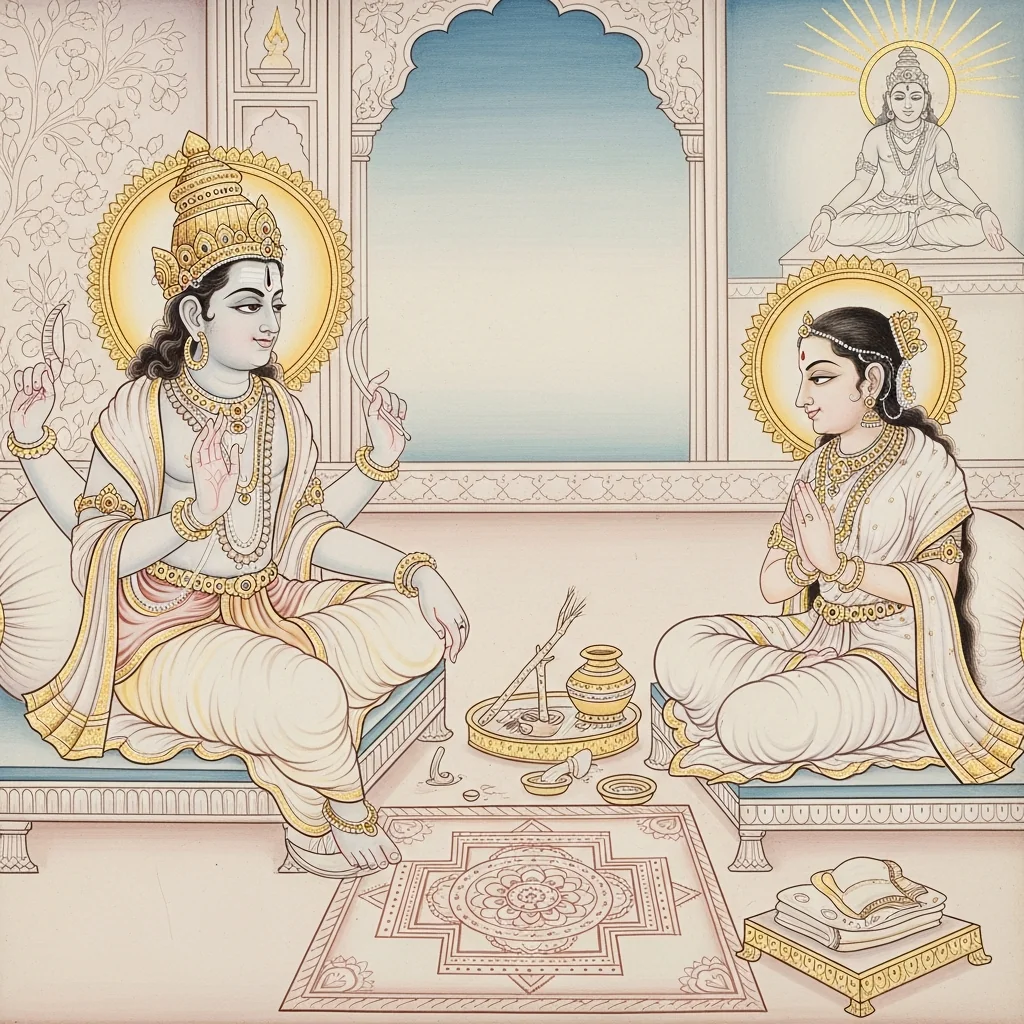
Adhyaya 17
Chapter 17 is a ritual-theological instruction in which Īśvara teaches Devī the worship-system (pūjāvidhi) for Bhāskara/Sūrya at Arkasthala in Prabhāsa. It first grounds the rite in cosmology, praising Āditya as primordial among the gods and as the sustainer, creator, and dissolver of the moving and unmoving world. A graduated discipline is then set out: preliminary purity of mouth, cloth, and body; detailed rules for dantakāṣṭha (permitted woods and their results, prohibitions, posture, tooth-cleaning mantra, and disposal); and bathing with consecrated earth and water through mantra-ordered actions. Tarpaṇa, sandhyā, and offering arghya to the Sun are explained with strong phalaśruti promises of sin-removal and multiplied merit. For those unable to perform expanded initiatory procedures, a “Veda-mārga” alternative is given, listing Vedic mantras for invocation and worship. The chapter also describes a maṇḍala-based installation with aṅga-nyāsa, placement and worship of grahas and dikpālas, and a dhyāna portrayal of Āditya’s iconography. It continues with mūrti-pūjā, naming abhiṣeka substances and sequential offerings (upavīta, cloth, incense, unguents, lamps, ārātrika), preferred flowers, fragrances, and lamps, and items that must not be offered, with ethical cautions against greed and mishandling of offerings. The conclusion explains Rahu and eclipses as occlusion rather than literal devouring, sets norms of confidentiality in transmission, and extols the merits of listening and recitation for social welfare, prosperity, and protection across communities.
Shlokas
Verse 1
ईश्वर उवाच । अथ पूजाविधानं ते कथयामि यशस्विनि । अर्कस्थलस्य देवस्य यथा पूज्यो नरोत्तमैः
Īśvara said: Now I shall tell you the procedure of worship, O illustrious one—how the Lord of Arkasthala is to be worshipped by the noblest of men.
Verse 2
सर्वेषामेव देवानामादिरादित्य उच्यते । आदिकर्त्ता त्वसौ यस्मादादित्यस्तेन चोच्यते
Among all the gods, Āditya is called the First; for he is truly the primal Maker, therefore he is named Āditya.
Verse 3
नादित्येन विना रात्रिर्न दिवा न च तर्पणम् । न धर्मो वै न चाधर्मो न संतिष्ठेच्चराचरम्
Without Āditya there would be neither night nor day, nor the rites of tarpaṇa (libation); neither dharma nor adharma would operate, and the whole world, moving and unmoving, would not endure.
Verse 4
आदित्यः पालयेत्सर्वमादित्यः सृजते सदा । आदित्यः संहरेत्सर्वं तस्मादेष त्रयीमयः
Āditya preserves all; Āditya ever creates; Āditya withdraws all—therefore he is of the very essence of the threefold Veda.
Verse 5
आराधनविधिं तस्य भास्करस्य महात्मनः । कथयामि महादेवि वेदोक्तैर्मंत्रविस्तरैः । तं शृणुष्व वरारोहे सर्वपापप्रणाशनम्
I shall declare, O Mahādevī, the method of propitiating that great-souled Bhāskara, with expansive mantras taught in the Veda. Listen, O noble lady—it is the destroyer of all sins.
Verse 6
मूर्त्तिस्थः पूज्यते येन विधानेन महेश्वरि । द्वादशात्मा यथा सूर्यस्तत्ते वक्ष्याम्यशेषतः
O Maheśvarī, I shall tell you completely the procedure by which the Sun, abiding in an icon (mūrti), is to be worshipped—he who is twelvefold in essence.
Verse 7
मुखशुद्धिं च कृत्वाऽदौ स्नानं कृत्वा विशेषतः । वस्त्रशुद्धिं देह शुद्धिं कृत्वा सूर्यं स्पृशेत्ततः
First cleanse the mouth, then bathe with particular care; having purified one’s garments and body, one should then ritually approach and touch the image of Sūrya, the Sun.
Verse 9
दन्तकाष्ठविधानं तु प्रथमं कथयामि ते । मधूके पुत्रलाभः स्यादर्के नेत्रसुखं प्रिये
First I shall tell you the ordinance concerning the tooth-stick. With a madhūka twig one gains the blessing of offspring; with an arka twig, O beloved, one gains comfort and well-being of the eyes.
Verse 10
रोगक्षयः कदम्बे तु अर्थलाभोऽतिमुक्तके । मरुतां याति सर्वत्र आटरूषकसंभवैः
By resorting to the Kadamba, disease wanes away; by serving the Atimuktaka, one gains wealth. And by the plants born of Āṭarūṣaka, one attains everywhere the realm of the Maruts—thus is the fruit declared.
Verse 11
जातिप्रधानतां जातावश्वत्थो यच्छते यशः । श्रियं प्राप्नोति निखिलां शिरीषस्य निषेवणात्
Through the Jāti, the Aśvattha grants pre-eminence among one’s people and bestows fame; and by devoted resort to the Śirīṣa one gains prosperity in its fullness.
Verse 12
प्रियंगुं सेवमानस्य सौभाग्यं परमं भवेत् । अभीप्सितार्थसिद्धिः स्यान्नित्यं प्लक्षनिषेवणात्
For one who serves Priyaṅgu, excellent good fortune arises; and by constant resort to the Plakṣa, success in one’s desired aims is ever obtained.
Verse 13
न पाटितं समश्नीयाद्दंतकाष्ठं न सव्रणम् । न चोर्द्धशुष्कं वक्रं वा नैव च त्वग्विवर्ज्जितम्
One should not use a split tooth-wood, nor one that is wounded or damaged; nor one that is half-dry, nor crooked, nor one stripped of its bark.
Verse 14
वितस्तिमात्रमश्नीयाद्दीर्घं ह्रस्वं च वर्जयेत् । उदङ्मुखो वा प्राङ्मुखः सुखासीनोऽथ वाग्यतः
One should use a tooth-stick of the measure of a vitasti (span), avoiding one that is too long or too short. One should sit comfortably, facing north or east, and remain silent.
Verse 15
कामं यथेष्टं हृदये कृत्वा समभिमन्त्र्य च । मंत्रेणानेन मतिमानश्नीयाद्दन्तधावनम्
Having formed in the heart one’s wish as desired, and having duly consecrated the tooth-stick, the intelligent person should use the tooth-cleanser while reciting this mantra.
Verse 16
वरं दत्त्वाऽभिजानासि कामं चैव वनस्पते । सिद्धिं प्रयच्छ मे नित्यं दन्तकाष्ठ नमोऽस्तु ते
O lord of the forest, you know how to grant boons and fulfil desires. Bestow on me continual success; O tooth-wood, obeisance to you.
Verse 17
त्रीन्वारान्परिजप्यैवं भक्षयेद्दंतधावनम् । पश्चात्प्रक्षाल्य तत्काष्ठं शुचौ देशे विनिक्षिपेत्
Having thus recited the mantra three times, one should use the tooth-cleanser. Afterwards, having rinsed that stick, one should place it in a clean spot.
Verse 18
दंतकाष्ठेन देवेशि न जिह्वां परिमार्जयेत् । पृथक्पृथक्तदा कार्यं यदीच्छेद्विपुलं यशः
O Goddess, one should not scrape the tongue with the tooth-stick. Rather, each act should be done separately, if one desires abundant fame.
Verse 19
अंगुल्या दंतकाष्ठं च प्रत्यक्षं लवणं च यत् । मृत्तिकाभक्षणं चैव तुल्यं गोमांसभक्षणैः
Using the finger in place of proper cleansing, misusing the tooth-stick, and openly taking salt, and also eating clay—these are declared equal in sin to eating cow-flesh.
Verse 20
मुखे पर्युषिते नित्यं भवत्यप्रयतो द्विजः । तस्माच्छुष्कमथार्द्रं वा भक्षयेद्दंतधावनम्
If the mouth remains unclean with stale residue, a twice-born person is ever considered careless in purity. Therefore, one should cleanse with a tooth-cleaning twig, dry or fresh and moist.
Verse 21
वर्जिते दिवसे चैव गडूषांश्चैव षोडश । तत्तत्पद्मसुगन्धैर्वा मुखशुद्धिं च कारयेत्
And on days when the tooth-twig is to be avoided, one should instead perform sixteen mouth-rinsings, or cleanse the mouth using fragrances such as lotus-scent preparations.
Verse 22
मुखशुद्धिमकृत्वा यो भास्करं स्पृशति द्विजः । त्रीणि वर्षसहस्राणि स कुष्ठी जायते नरः
A twice-born person who touches (or approaches in worship) Bhāskara without first purifying the mouth becomes afflicted with leprosy for three thousand years.
Verse 23
एवं वस्त्रादि संशोध्य ततः स्नानं समाचरेत् । शुचौ मनोरमे स्थाने संगृह्यास्त्रेण मृत्तिकाम्
Thus, having cleansed one’s garments and the like, one should then undertake the sacred bath. In a clean and pleasing place, one should gather the bathing earth (clay) while employing the protective «astra» mantra.
Verse 24
सानुस्वारोकारयुतो हकारः फट्समन्वितः । अनेनास्त्रेण संगृह्य स्नानं तत्र समाचरेत्
The «astra» is the syllable ha joined with the vowel o and nasalization (anusvāra, ṃ), and endowed with the exclamation phaṭ. Using this astra, one should collect the cleansing earth and perform the bath there.
Verse 25
भागत्रयं तु संशुद्धं तृणपाषाणवर्जितम् । एकमस्त्रेण चालभ्य तथान्यं भास्करेण तु
One should take three portions of well-purified clay, free from grass and stones—touching one portion with the «astra» mantra and another with the Bhāskara (Sūrya) mantra.
Verse 26
अंगैश्चैव तृतीयं तु अभिमंत्र्य सकृत्सकृत् । जप्त्वास्त्रेण क्षिपेद्दिक्षु निर्विघ्नं तु जलं भवेत्
And the third portion should be consecrated repeatedly with the aṅga-mantras (limb-mantras). Having recited the «astra», one should cast it to the directions—then the water becomes free of obstacles and inauspicious impediments.
Verse 27
सूर्यतीर्थ द्वितीयेन तृतीयेन सकृत्सकृत् । गुंठयित्वा ततः स्नायाद्रवितीर्थेन मानवः
Then, using the second and third portions, one should repeatedly apply and rub it as «Sūryatīrtha»; thereafter a person should bathe at Ravi-tīrtha.
Verse 28
तूर्यशंख निनादेन ध्यात्वा देवं दिवाकरम् । स्नात्वा राजोपचारेण पुनराचम्य यत्नतः
With the resounding of drums and conches, meditating on the god Divākara (the Sun), having bathed with royal reverence and offerings, one should again perform ācamana with care.
Verse 29
स्नानं कृत्वा ततो देवि मंत्रराजेन संयुतम् । हरेफौ बिंदु लक्ष्मीश्च तथाऽन्यो दीर्घया सह
After bathing, O Goddess, one should proceed with the “King of Mantras,” composed of ha and repha (r), endowed with bindu (nasalization) and “Lakṣmī” (śrī), together with another syllable joined to a long vowel—properly formed.
Verse 30
मात्रया रेफसंयुक्तो हकारो बिंदुना सह । सकारः सविसर्गस्तु मंत्रराजोऽयमुच्यते
The syllable “ha,” joined with “ra” (repha) and furnished with mātrā (vowel-length), together with bindu; and the syllable “sa” together with visarga—this is proclaimed as the “King of Mantras.”
Verse 31
ततस्तु तर्प्पयेन्मंत्रान्सर्वांस्तांस्तु कराग्रजैः । तुलनादूर्ध्वतो देवान्सव्येन च मुनींस्तथा । पितॄंश्चैवापसव्येन हृद्बीजेन प्रतर्पयेत्
Thereafter, using the tips of the fingers, one should offer tarpaṇa to all those mantras. From the region above the balance-point near the chest, one should satisfy the gods with the left hand, and likewise the sages; and in the apasavya manner one should satisfy the ancestors, employing the hṛd-bīja, the heart-seed.
Verse 32
यद्गीतं प्रवरं लोके अक्षराणां मनीषिभिः । एकोनविंशं मात्राया अक्षरं तत्प्रकीर्त्तितम्
That which the wise have sung as the foremost among syllables in the world is declared to be the syllable consisting of nineteen mātrās, the units of prosodic measure.
Verse 33
एवं स्नात्वा विधानेन संध्यां वंदेद्विधानतः । ततो विद्वान्क्षिपेत्पश्चाद्भास्करायोदकांजलिम्
Thus, having bathed according to rule, one should worship the Sandhyā rite in the prescribed manner. Then the wise person should afterwards offer water in joined palms to Bhāskara, the Sun.
Verse 34
जपेच्च त्र्यक्षरं मंत्र षण्मुखं च यदृच्छया । मंत्रराजेति यः पूर्वं तवाख्यातो मया प्रिये
One should also recite the three-syllabled mantra, and the six-faced (Ṣaṇmukha) mantra, as one is able. That which I earlier told you, dear one, as the ‘King of Mantras’—
Verse 35
पश्चात्तीर्थेन मंत्रास्तु संहृत्य हृदये न्यसेत् । मंत्रैरात्मानमेकत्र कृत्वा चार्घं प्रदापयेत्
Afterwards, with tīrtha-water, one should gather back the mantras and place them within the heart. Having thus unified oneself through the mantras, one should then present the arghya offering.
Verse 36
रक्तचंदनगंधैस्तु शुचिःस्नातो महीतले । कृत्वा मंडलकं वृत्तमेकचित्तो व्यवस्थितः
Purified and bathed, anointed with the fragrance of red sandalwood, upon the ground one should draw a circular maṇḍala and remain steady there with single-pointed mind.
Verse 37
गृहीत्वा करवीराणि ताम्रे संस्थाप्य भाजने । तिलतंदुलसंयुक्तं कुशगन्धोदकेन तु
Taking oleander blossoms (karavīra) and placing them in a copper vessel, one should prepare them together with sesame and rice, and with water scented by kuśa grass.
Verse 38
रक्तचंदन धूपेन युक्तमर्घ्योपसाधितम् । कृत्वा शिरसि तत्पात्रं जानुभ्यामवनिं गतः
Having duly prepared the arghya, endowed with red sandalwood and incense, one should place that vessel upon the head and, on both knees, come down to the earth in reverence.
Verse 39
मूलमंत्रेण संयुक्तमर्घ्यं दद्याच्च भानवे । मुच्यते सर्वपापैस्तु यो ह्येवं विनिवेदयेत्
One should offer to Bhānava (the Sun) the arghya empowered with the root-mantra. Whoever presents it in this manner is indeed freed from all sins.
Verse 40
यद्युगादिसहस्रेण व्यतीपातशतेन च । अयनानां सहस्रेण यत्फलं ज्येष्ठपुष्करे । तत्फलं समवाप्नोति सूर्यायार्घ्य निवेदने
Whatever merit is gained at Jyeṣṭha-puṣkara by a thousand Yugādi days, a hundred Vyatīpāta moments, and a thousand solstitial transitions (ayanas)—that same fruit is attained by offering arghya to the Sun.
Verse 41
दीक्षामंत्रविहीनोऽपि भक्त्या संवत्सरेण तु । फलमर्घेण वै देवि लभते नात्र संशयः
Even one who lacks initiation and the requisite mantras, if he performs it with devotion for a year, gains the fruit through the offering of arghya, O Goddess—of this there is no doubt.
Verse 42
यः पुनर्दीक्षितो विद्वान्विधिनार्घ्यं निवेदयेत् । नासौ संभवते भूमौ प्रलयं याति भास्करे
But the initiated and learned person who offers arghya according to rule does not come to be on the earth again; upon reaching Bhāskara (the Sun), he dissolves into final release.
Verse 43
इह जन्मनि सौभाग्यमायुरारोग्यसंपदम् । अचिराल्लभते देवि सभार्यः सुखभाजनम्
O Goddess, in this very life he soon attains good fortune, long life, and the wealth of health; together with his wife, he becomes a vessel of happiness.
Verse 44
एवं स्नानविधिः प्रोक्तः सौरः संक्षेपतस्तव । हिताय मानवेन्द्राणां सर्वपापप्रणाशनः
Thus, in brief, the solar bathing-rite has been declared to you; it is beneficial to kings among men and destroys all sins.
Verse 45
अथवा वेदमार्गेण कुर्यात्स्नानं द्विजोत्तमः । यद्येवं मन्त्रविस्तारे ह्यशक्तो दीक्षया विना
Or else, the best of the twice-born may perform the bathing according to the Vedic path, if—without dīkṣā (initiation)—he is unable to undertake the expanded range of mantras.
Verse 46
ईश्वर उवाच । अथ पूजाविधानं ते कथयामि यशस्विनि । वेदमार्गेण दिव्येन ब्राह्मणानां हिताय वै
Īśvara said: Now I shall tell you the procedure of worship, O illustrious one—by the divine Vedic path, indeed for the welfare of the Brahmins.
Verse 47
एवं संभृतसंभारः पुष्पादिप्रगुणीकृतः । तत आवाहयेद्भानुं स्थापयेत्कर्णिकोपरि
Having thus gathered the required articles and duly arranged flowers and the like, one should then invoke Bhānu (the Sun) and install him upon the central pedestal (karṇikā).
Verse 48
उपस्थानं तु वै कृत्वा मंत्रेणानेन सुव्रते । उदुत्यं जातवेदसमिति मंत्रः संपरिकीर्तितः
O virtuous one, having performed the upasthāna (devotional attendance) with this mantra, the mantra is proclaimed as: “ud utyaṃ jātavedasam”.
Verse 49
अग्निं दूतेति मंत्रेण अनेनावाह्य भामिनि । आकृष्णेन रजसा मंत्रेणानेन वाऽर्चयेत्
O radiant lady, having invoked him (āvāhana) with the mantra “agniṃ dūta”, one should then worship; and one may also worship with the mantra “ākṛṣṇena rajasā”.
Verse 50
हंसः शुचिषदिति मंत्रेणानेन पूजयेत् । अपत्येतेति मन्त्रेण सूर्यं देवि प्रपूजयेत्
With the mantra beginning “haṃsaḥ śuciṣat…”, one should perform worship. And with the mantra beginning “apatyete…”, O Goddess, one should worship Sūrya with special reverence.
Verse 51
अदृश्रमस्य चैतेन सूर्यं देवि समर्च्चयेत् । तरणिर्विश्वदर्शेति अनेन सततं जपम्
And with the mantra beginning “adṛśram asya…”, O Goddess, one should duly worship Sūrya. With the mantra beginning “taraṇir viśvadarśī…”, one should maintain continuous japa.
Verse 52
चित्रं देवानामुदेति भद्रां देवो सदार्चयेत् । विभूतिमर्च्चयेन्नित्यं येना पावक चक्षसा
With the mantra beginning “citraṃ devānām udeti…”, the worshipper should always honor the auspicious power. And daily one should worship Vibhūti with the mantra beginning “yena pāvaka-cakṣasā…”.
Verse 53
विद्यामेपिरजस्पृथ्वित्यनेन विमलां सदा । अमोघां पूजयेन्नित्यं मंत्रेणानेन सुव्रते
With the mantra beginning “vidyām ehi rajas pṛthvi…”, one should ever worship the Goddess Vimalā. And with this very mantra, O you of excellent vows, one should daily worship Amoghā.
Verse 54
सप्त त्वा हरितोऽनेन सिद्धिदां सर्वकर्मसु । विद्युतामर्चयेद्देवं सप्त त्वा हरितेन च
With the mantra beginning “sapta tvā haritaḥ…”, one should worship Siddhidā, the giver of success in all undertakings. And with “sapta tvā harita…”, one should likewise worship the deity Vidyutā.
Verse 55
नवमीं पूजयेद्देवीं सततं सर्वतोमुखीम् । मन्त्रेणानेन वै देवि उद्वयन्तमितीह वै
One should constantly worship the Goddess Navamī, the All-faced One who is present in every direction. With this mantra, O Goddess—namely the one beginning “udvayantam…”—she is indeed to be worshipped.
Verse 56
उद्यन्नद्य मित्रमहः प्रथममक्षरं जपेत् । द्वितीयं पूजयेद्देवि शुकेषु मे हरिमेति वै
One should recite the first seed-syllable with the mantra “udyann adya mitramahaḥ…”. The second, O Goddess, is to be worshipped with “śukeṣu me hariḥ…”.
Verse 57
उदगादयमादित्यो ह्यनेनापि तृतीयकम् । तत्सवितुर्वरेण्येति चतुर्थं परिकीर्तितम्
With the mantra “udagād ayam ādityaḥ…”, the third seed is likewise to be set. The fourth is declared to be with “tat savitur vareṇyam…”.
Verse 58
महाहिवो महायेति पञ्चमं परिकीर्तितम् । हिरण्यगर्भः समवर्तत षष्ठं बीजं प्रकीर्तितम्
The fifth is declared with “mahāhivo mahā…”. The sixth seed (bīja) is proclaimed with “hiraṇyagarbhaḥ samavartata….”
Verse 59
सविता पश्चातात्सविता सप्तमं वरवर्णिनि । एवं बीजानि विन्यस्य आदित्यं स्थापयेच्छुभे
With “savitā paścātāt savitā…”, O fair-complexioned one, the seventh seed is given. Thus, having arranged the seed-mantras, O auspicious lady, one should install Āditya.
Verse 60
आदित्यं स्थापयित्वा तु पश्चादङ्गानि विन्यसेत्
After first installing Āditya, one should thereafter perform the limb-placement (aṅga-nyāsa) in due order.
Verse 61
आग्नेय्यां हृदयं न्यस्य ऐशान्यां तु शिरो न्यसेत् । नैरृत्यां तु शिखां चैव कवचं वायुगोचरे
Placing the Heart mantra in the southeast (Āgneya), one should place the Head in the northeast (Aiśānya); in the southwest (Nairṛtya) one should place the Topknot (śikhā), and the Armor (kavaca) in the region of Vāyu, the northwest.
Verse 62
अस्त्रं दिशासु विन्यस्य स्वबीजेन तु कर्णिकाम् । अमोसि प्राणितेनेति अनेन हृदयं यजेत्
Having assigned the Astra (the protective “weapon” mantra) to the directions, and the central karṇikā with one’s own seed-syllable (svabīja), one should worship the Heart with the formula: “am asi, prāṇitena”—by the life-breath.
Verse 63
शिरस्तु पूजयेद्देवि आयुष्यं वर्चसेति वै । गायत्र्या तु शिखां पूज्य नैरृत्यां तु व्यवस्थिताम्
O Goddess, one should worship the Head with the mantra “āyuṣyaṃ varcase,” for longevity and radiance; and with the Gāyatrī one should worship the Śikhā, stationed in the southwest (Nairṛtya).
Verse 64
जीमूतस्येव भवति प्रत्येकं कवचं यजेत् । धन्वन्नागा धन्वनेति अनेनास्त्रं सदाऽर्चयेत्
It becomes like a rain-cloud, a sheltering cover; one should worship each kavaca (protective layer) separately. With the formula “dhanvannāgā dhanvane,” one should always adore the Astra (sacred weapon).
Verse 65
नेत्रं तु पूजयेद्देवि अश्विना तेजसेति च । ह्यतः पूर्वतः सोमं दक्षिणेन बुधं तथा
O Goddess, one should worship the Eye with the mantra “aśvinā tejasā.” Then, on the eastern side one should place and worship Soma, and likewise on the southern side Budha (Mercury).
Verse 66
पश्चिमेन गुरुं न्यस्य उत्तरेण च भार्गवम् । आग्नेय्यां मङ्गलं न्यस्य नैरृत्यां तु शनैश्चरम्
Placing Guru (Jupiter) on the western side and Bhārgava (Venus) on the northern side, one should place Maṅgala (Mars) in the southeast (Agneya) and Śanaiścara (Saturn) in the southwest (Nairṛtya).
Verse 67
वायव्यां तु न्यसेद्राहुं केतुमीशानगोचरे । आप्यायस्वेति मन्त्रेण देवि सोमं सदार्चयेत्
In the northwest (Vāyavya) one should place Rāhu, and Ketu in the domain of Īśāna (the northeast). O Goddess, with the mantra “āpyāyasva” one should always worship Soma (the Moon).
Verse 68
उद्बुध्यध्वं महादेवि बुधं तत्र सदार्चयेत् । बृहस्पतेति मन्त्रेण पूजयेत्सततं गुरुम्
“Awaken!”—O Great Goddess—there one should ever worship Budha (Mercury). With the mantra “bṛhaspate,” one should continually adore the Guru, Bṛhaspati (Jupiter).
Verse 69
शुक्रः शुशुक्वानिति च भार्गवं देवि पूजयेत् । अग्निर्मूर्द्धेति मन्त्रेण सदा मंगलमर्चयेत्
O Goddess, one should worship Bhārgava—Śukra (Venus)—with the mantra “śukraḥ śuśukvān.” With the mantra “agnir mūrdhni,” one should always adore Maṅgala (Mars).
Verse 70
शमग्निरितिमन्त्रेण पूजयेद्भास्करात्मजम् । कयानश्चित्रेतिमन्त्रेण देवि राहुं सदाऽर्चयेत्
With the mantra “śam agniḥ…,” one should worship the son of Bhāskara, the Sun—Śani (Saturn). And, O Goddess, with the mantra “kayā naś citre…,” one should always adore Rāhu.
Verse 71
केतुं कृण्वेति केतुं वै सततं पूजयेद्बुधः । बाह्यतः पूर्वतः शुक्रं दक्षिणेन यमं तथा
With the mantra “ketuṃ kṛṇv…,” the wise should continually worship Ketu. On the outer side, to the east is Śukra (Venus), and likewise to the south is Yama.
Verse 72
ऐशान्यामीश्वरं विंद्यादाग्नेय्यामग्निरुच्यते । नैऋतेति विरूपाक्षं पवनं वायुगोचरे
In the northeast one should recognize Īśvara; in the southeast, Agni is proclaimed. In the southwest is Virūpākṣa; and in the realm of Vāyu is Pavana, the Wind.
Verse 73
तमुष्टवाम इति वै ह्यनेनेन्द्रमथार्चयेत् । उदीरतामवरेति सदा वैवस्वतं यजेत्
With the formula “tamuṣṭavāma…”, one should worship Indra by this mantra. With “udīratām avar…”, one should always offer worship to Vaivasvata (Yama).
Verse 74
तत्त्वायामीति मन्त्रेण वरुणं देवि पूजयेत् । इन्द्रासोमावत इति मन्त्रेण धनदं यजेत्
With the mantra “tattvāyāmi…”, O Goddess, one should worship Varuṇa. With the mantra “indrāsomāvata…”, one should worship Dhanada (Kubera).
Verse 75
पावकं पूजयेद्देवि अग्निमीऌए पुरोहितम् । रक्षोहणं वाजिनेति विरूपाक्षं सदार्चयेत्
O Goddess, one should worship Pāvaka (Agni) with “agnim īḷe purohitam”. With “rakṣohaṇaṃ vājina…”, one should always adore Virūpākṣa.
Verse 76
वायवायाहि मन्त्रेण वायुं देवि सदार्चयेत् । यथाक्रममिमान्देवि सर्वान्वै पूजयेद्बुधः
With the mantra “vāyav āyāhi…”, O Goddess, one should always worship Vāyu. Thus, in due order, O Goddess, the wise should worship all these deities.
Verse 77
बाह्यतः पूर्वतो देवि इन्द्रादीनां समन्ततः । रक्तवर्णं महातेजं सितपद्मोपरि स्थितम्
On the outer side, to the east, O Goddess—encircled on every side by Indra and the others—(there is a form) red in hue, of great radiance, seated upon a white lotus.
Verse 78
सर्वलक्षणसंयुक्तं सर्वाभरणभूषितम् । द्विभुजं चैकवक्त्रं च सौम्यपञ्चकधृक्करम्
Endowed with every auspicious mark and adorned with all ornaments; two-armed and single-faced; holding in his hands the gentle set of five auspicious attributes.
Verse 79
वर्त्तुलं तेजबिंबं तु मध्यस्थं रक्तवाससम् । आदित्यस्य त्विदं रूपं सर्वलोकेषु पूजितम् । ध्यात्वा संपूजयेन्नित्यं स्थंडिलं मण्डलाश्रयम्
A circular orb of radiance, stationed at the center, wearing red garments—this indeed is Āditya’s form, worshiped in all worlds. Having meditated thus, one should worship daily, using a maṇḍala set upon a prepared altar (sthaṇḍila).
Verse 80
देव्युवाच । मण्डलस्थः सुरश्रेष्ठ विधिना येन भास्करः । पूज्यते मानवैर्भक्त्या स विधिः कथितस्त्वया
The Goddess said: “O best of the gods, you have explained the rite by which Bhāskara (the Sun), abiding in his sacred maṇḍala, is worshipped by human beings with devotion.”
Verse 81
पूजयेद्विधिना येन भास्करं पद्मसंभवम् । मूर्त्तिस्थं सर्वगं देवं तन्मे कथय शंकर
“Tell me, O Śaṅkara, the proper procedure by which one should worship Bhāskara—born of the lotus—who, though present in an image, is the all-pervading God.”
Verse 82
ईश्वर उवाच । साधुसाधु महादेवि साधु पृष्टोऽस्मि सुवते । शृणुष्वैकमना देवि मूर्तिथं येन पूजयेत्
Īśvara said: “Excellent, excellent, O Great Goddess; well have you asked, O noble-vowed one. Listen with one-pointed mind, O Devī, to the method by which one worships the deity present in an image.”
Verse 83
इषेत्वेति च मन्त्रेण उत्तमांगं सदार्चयेत् । अग्निमीऌएति मन्त्रेण पूजयेद्दक्षिणं करम्
With the mantra “iṣetv…”, one should ever worship the deity’s head. With the mantra “agnim īḷe…”, one should worship the right hand.
Verse 84
अग्न आयाहि मन्त्रेण पादौ देवस्य पूजयेत् । आजिघ्रेति च मन्त्रेण पूजयेत्पुष्पमालया
With the mantra “agna āyāhi…”, one should worship the feet of the deity. And with the mantra “ājighre…”, one should worship with a garland of flowers.
Verse 85
योगेयोगेति मन्त्रेण मुक्तपुष्पांजलिं क्षिपेत् । समुद्रागच्छ यत्प्रोक्तमनेन स्नापयेद्रविम्
With the mantra “yoge yoge…”, one should cast an offering of handfuls of loose flowers. With the words taught as “samudrāgaccha…”, one should bathe Ravi (the Sun).
Verse 86
इमं मे गंगेति यत्प्रोक्तमनेनापि च भामिनि । समुद्रज्येति मन्त्रेण क्षालयेद्विधिवद्रविम्
And, O lovely one, with what is taught as “imaṃ me gaṅge…”, and with the mantra “samudrajye…”, one should duly rinse and cleanse Ravi (the Sun) according to rule.
Verse 87
सिनीवालीति मन्त्रेण स्नापयेच्छंखवारिणा । यज्ञं यज्ञेति मन्त्रेण कषायैः परिरक्षयेत्
With the mantra “sinīvālī…”, one should bathe (the Sun) with water poured from a conch. With the mantra “yajñaṃ yajña…”, one should duly protect (the rite/deity) using astringent infusions.
Verse 88
स्नापयेत्पयसा देवि आप्यायस्वेति मंत्रतः । दधिक्राव्णेति वै दध्ना स्नापयेद्विधिवद्रविम्
O Devī, one should bathe the Sun with milk while reciting the mantra “āpyāyasva…”. And with curd, indeed, reciting “dadhikrāvan…”, one should bathe Ravi according to the prescribed rite.
Verse 89
इमं मे गंगेति यत्प्रोक्तमनेनापि च भामिनि । समुद्रज्येति मंत्रेण स्नानमौषधिभिः स्मृतम्
And, O lovely one, with what is taught as “imaṃ me gaṅge…”, and with the mantra “samudrajye…”, bathing with medicinal herbs is also enjoined.
Verse 90
उद्वर्तयेत्ततो भानुं द्विपदाभिर्वरानने । मानस्तोकेति मंत्रेण युगपत्स्नानमाचरेत्
Then, O fair-faced lady, one should anoint and rub (the icon of) Bhānu with the two-footed verses; and with the mantra beginning “mānastoka…”, one should perform the bathing rite together, in the proper sequence of worship.
Verse 91
विष्णोरराटमन्त्रेण स्नापयेद्गंधवारिणा । सौवर्णेन तु मंत्रेण अर्घ्यं पाद्यं निवेदयेत्
With the mantra called “Viṣṇor arāṭa…”, one should bathe the deity with scented water; and with the mantra called “Sauvarṇa…”, one should offer arghya (honor-water) and pādya (water for the feet).
Verse 92
इदं विष्णुर्विचक्रमे मंत्रेणार्घ्यं प्रदापयेत् । वेदोसीति च मंत्रेण उपवीतं प्रदापयेत्
With the mantra “idaṃ viṣṇur vicakrame…”, one should present the arghya offering; and with the mantra “vedosi…”, one should offer the sacred thread (upavīta).
Verse 93
बृहस्पतेति मंत्रेण दद्याद्वस्त्राणि भानवे । येन श्रियं प्रकुर्वाणः पुष्पमालां प्रपूजयेत्
With the mantra beginning “bṛhaspate…”, one should offer garments to Bhānu (Sūrya); then, desiring to bring forth prosperity, one should duly worship with a garland of flowers.
Verse 94
धूरसीति च मंत्रेण धूपं दद्यात्सगुग्गलम् । समिद्धोंजनमंत्रेण अंजनं तु प्रदापयेत्
With the mantra “dhūr asī…”, one should offer incense together with guggulu resin; and with the mantra “samiddhoṃjana…”, one should offer añjana (collyrium) as well.
Verse 95
युंजान इति मंत्रेण भानुं रोचनमालभेत् । आरार्त्तिकं च वै कुर्याद्दीर्घायुत्वाय वै पुनः
With the mantra beginning “yuñjāna…”, one should apply rocanā (a bright, auspicious pigment) to Bhānu; and one should also perform ārati again, for the sake of long life.
Verse 96
सहस्रशीर्षा पुरुषः सूर्यं शिरसि पूजयेत् । शंभवायेति मंत्रेण रवेर्नेत्रे परामृशेत्
With the (Puruṣa-sūkta) mantra “sahasraśīrṣā puruṣaḥ…”, one should worship Sūrya at the head; and with the mantra “śaṃbhavāya…”, one should reverently touch the eyes of Ravi.
Verse 97
विश्वतश्चक्षुरित्येवं भानोर्देहं समालभेत् । श्रीश्च ते लक्ष्मीश्चेति सर्वांगे पूजयेद्रविम्
Thus, with the mantra “viśvataś cakṣuḥ…”, one should touch and honor the body of Bhānu; and with “śrīś ca te lakṣmīś ca…”, one should worship Ravi in all his limbs.
Verse 98
ईश्वर उवाच अथ मेरोर्महादेवि अष्टशृंगस्य सुव्रते । पूजाविधानमंत्रांस्ते कथयामि समासतः
Īśvara said: Now, O Mahādevī, O virtuous one, I shall succinctly declare to you the mantras and the rite of worship for Meru’s Aṣṭaśṛṅga, the eight-peaked form.
Verse 99
अष्टशृंगं महादेवि अनेन विधिनाऽर्चयेत् । प्रथमं पूजयेन्मध्ये मंत्रेणानेन सुव्रते
O Mahādevī, Aṣṭaśṛṅga should be worshiped by this very procedure. First, O virtuous one, one should worship in the center with this mantra.
Verse 100
महाहिवोमहायेति नानापुष्पकदंबकैः । त्रातारमिंद्रमंत्रेण पूर्वशृंगं सदार्चयेत्
With clusters of many kinds of flowers, one should always worship the Eastern Peak, reciting the mantra “mahāhivo mahāyeti”; and with the Indra-mantra “trātāram indram…”, one should venerate it as the protecting Lord.
Verse 101
तमुष्टवामेति मंत्रेण पूजयेत्सुरसुन्दरि । अग्निमीऌए पुरोहितमाग्नेयं शृंगमर्चयेत्
O celestial beauty, one should worship with the mantra “tamuṣṭavām…”. And with “agnim īḷe purohitam”, one should venerate the Āgneya (southeastern) Peak.
Verse 102
आग्नेय्या चैव गायत्र्या अथवानेन पूजयेत् । यमाय त्वा मखाय त्वा दक्षिणं शृंगमर्च येत्
One should worship either with the Āgneyī Gāyatrī or with this given formula. With the mantra “yamāya tvā, makhāya tvā”, one should worship the Southern Peak.
Verse 103
उदीरतामवरेप्यथवानेन पूजयेत् । आयं गौरिति मंत्रेण नैरृत्यं शृङ्गमर्चयेत्
One should worship with the mantra “udīratām…”, or else with this given formula. With the mantra “āyaṃ gauḥ…”, one should worship the Nairṛtya (southwestern) Peak.
Verse 104
रक्षोहणं वाजिनं वा पूजयेदसुरांतिकम् । इंद्रासोमा च यो मंत्रो ह्यथवा तेन पूजयेत्
One should worship as the slayer of rākṣasas, or as the swift victorious one, or as the destroyer of the asuras. Or else, with whatever mantra begins “indrā-somā…”, one should perform the worship by that.
Verse 105
अभि त्वा सूर नोन्विति चैशानं शृंगमर्चयेत् । येनेदं भूतमिति वा अथवानेन पूजयेत्
With the mantra “abhi tvā sūra…”, one should worship the Īśāna (northeastern) Peak. Or with the mantra “yenedam bhūtam…”, or else with this given formula, one should perform the worship.
Verse 106
नमोस्तु सर्पेभ्य इति मेरुपीठं सदाऽर्चयेत् । हिरण्यगर्भः समवर्त्ततेति पुनर्मध्ये सदार्चयेत्
With the formula “namas tu sarpebhyaḥ”, one should always worship the Meru-seat (Merupīṭha). Again, in the center, one should always worship with “hiraṇyagarbhaḥ samavartata…”.
Verse 107
सविता पश्चातादिति वै पूजयेत्पुष्प मालया । त्रिकालमर्चयेद्देवि प्रदद्यादर्घ्यमादरात्
With a garland of flowers one should worship the Sun with the mantra “savitā paścātāt…”. O Goddess, one should worship at the three times of day and, with reverence, offer arghya-water.
Verse 108
माता रुद्राणां दुहिता वसूनां पूर्वाह्ने चैव पूजयेत् । मध्याह्ने पूजयेद्देवि तद्विष्णोः परमं पदम्
In the forenoon one should worship with “mātā rudrāṇāṃ, duhitā vasūnām…”. At midday, O Goddess, one should worship with “tad viṣṇoḥ paramaṃ padam…”.
Verse 109
हंसः शुचिषदिति वा अपराह्णे सदार्चयेत् । एवं भानुं ग्रहैः सार्द्ध पूजयेद्वरवर्णिनि
In the afternoon one should always worship with “haṃsaḥ śuciṣat…”. Thus, O fair-complexioned lady, one should worship Bhānu (the Sun) together with the planets.
Verse 110
देव्युवाच । यानि पुष्पाणि चेष्टानि सदा भास्करपूजने । कानि चोक्तानि देवेश कथयस्व प्रसादतः
The Goddess said: “O Lord of the gods, which flowers are held to be most desired in the constant worship of Bhāskara (the Sun)? Tell me, out of grace.”
Verse 111
ईश्वर उवाच । शृणु देवि प्रवक्ष्यामि पुष्पा ध्यायमनुत्तमम् । येन चार्कस्थले देवि शीघ्रं तुष्यति पूजितः
Īśvara said: “Listen, O Goddess. I shall teach the unsurpassed chapter concerning flowers—by which, in Arka’s sacred place, the Sun is quickly pleased when worshipped.”
Verse 112
मालतीकुसुमैः पूजा भवेत्सांनिध्यकारिका । मल्लिकायाश्च कुसुमैर्भोगवाञ्जायते नरः
Worship with mālatī blossoms brings the deity’s felt presence. By offering mallikā flowers, a person becomes endowed with enjoyments and prosperity.
Verse 113
सौभाग्यं पुंडरीकैस्तु भवत्यर्थश्च शाश्वतः । कदंबपुष्पैर्देवेशि परमैश्वर्यमश्नुते
With puṇḍarīka lotuses, good fortune arises, and lasting wealth as well. With kadamba flowers, O Lady, one attains supreme sovereignty and radiant splendor.
Verse 114
भवत्यक्षयमन्नं च बकुलै रर्चने रवेः । मदारपुष्पकैः पूजा सर्वकुष्ठविनाशिनी
By worshipping Ravi with bakula blossoms, one gains unfailing food and sustenance. Worship with madāra flowers destroys all forms of kuṣṭha (skin disease).
Verse 115
बिल्वस्य पत्रकुसुमैमहतीं श्रियमश्नुते । अर्कस्रजा भवत्यर्थः सर्वकामफलप्रदः
With bilva leaves and blossoms, one attains great prosperity. By a garland of arka, wealth arises that grants the fruit of every rightful desire.
Verse 116
प्रदद्याद्रूपिणीं कन्यां पूजितो बकुलस्रजा । किंशुकैरर्चितो देवि न पीडयति भास्करः
When the Sun is worshipped with a bakula garland, one is granted a beautiful maiden (a worthy bride). Worshipped with kiṃśuka blossoms, O Goddess, Bhāskara does not afflict the devotee.
Verse 117
अगस्तिकुसुमैस्तद्वदानुकूल्यं प्रयच्छ ति । करवीरैस्तु देवेशि सूर्यस्यानुचरो भवेत्
Likewise, with agasti blossoms, the Sun bestows favor and helpfulness. With karavīra flowers, O Lady, one becomes an attendant in the service of Sūrya.
Verse 119
शतपत्रस्रजा देवि सूर्यसालोक्यतां व्रजेत् । बकपुष्पैर्महादेवि दारिद्यं नैव जायते
O Goddess, one who offers a garland of śatapatra (hundred‑petalled flowers) attains Sūrya’s world (sālokya). With baka flowers, O Great Goddess, poverty never arises.
Verse 120
यः सूर्यायतनं भक्त्या गैरिकेणोपलेपयेत् । प्राप्नुयान्महतीं लक्ष्मीं रोगैश्चापि प्रमुच्यते
Whoever, with devotion, plasters the Sun’s shrine with red ochre (gairika) attains great Lakṣmī (prosperity) and is also freed from diseases.
Verse 121
अष्टादशेह कुष्ठानि ये चान्ये व्याधयो नृणाम् । प्रलयं यांति ते सर्वे मृदा यद्युपलेपयेत्
Here, the eighteen kinds of kuṣṭha (skin-diseases) and whatever other ailments afflict human beings are all destroyed, if one smears the body with the sacred earth (mṛd) of this place.
Verse 122
विलेपनानां सर्वेषां कुंकुमं रक्तचंदनम् । पुष्पाणां करवीराणि प्रशस्तानि वरानने
O fair-faced one, of all unguents for anointing, saffron (kuṅkuma) and red sandal are the best; and among flowers, karavīra (oleander) is especially praised.
Verse 123
नातः परतरं किंचिद्भास्वतस्तुष्टिकारकम् । यादृशं कुङ्कुमं जाती शतपत्रं तथाऽगुरुः
Nothing greater is known for pleasing Bhāsvat (the Sun) than these: saffron (kuṅkuma), jasmine (jātī), the hundred‑petalled flower (śatapatra), and likewise aguru (aloeswood).
Verse 124
किं तस्य न भवेल्लोके यश्चैभिश्चार्चयेद्रविम् । उपलिप्यालयं यस्तु कुर्यान्मंडलकं शुभम्
What in this world could be unattainable for one who worships Ravi, the Sun, with these offerings? And whoever, after smearing and purifying the shrine, fashions an auspicious maṇḍala—his merit is surely established.
Verse 125
एकेनास्य भवेदर्थो द्वाभ्यामारोग्यमश्नुते । त्रिभिस्तु सर्वविद्यावांश्चतुर्भिर्भोगवान्भवेत्
By performing one (maṇḍala/observance) he gains prosperity; by two, he attains health. By three, he becomes learned in all branches of knowledge; by four, he is endowed with enjoyments and comforts.
Verse 126
पंचभिर्विपुलं धान्यं षड्भिरायुर्बलं यशः । सप्तमण्डलतारी स्यान्मंडलाधिपतिर्नरः
By five, he gains abundant grain; by six, long life, strength, and fame. By seven, he becomes one who ‘crosses the seven circles’—a maṇḍalādhipati, lord over a region.
Verse 127
घृतदीपप्रदानेन चक्षुष्माञ्जायते नरः । कटुतैलस्य दीपेन स्वं शत्रुं जयते नरः
By gifting a lamp filled with ghee (ghṛta), a man is blessed with good eyesight. By offering a lamp of pungent oil, a man conquers his enemy.
Verse 128
तैलदीपप्रदानेन सूर्यलोके महीयते । मधूकतैलदीपेन सौभाग्यं परमं लभेत्
By donating an oil lamp, one is honored in the world of the Sun. By offering a lamp of madhūka-oil, one obtains supreme good fortune.
Verse 129
पुष्पाणां प्रवरा जाती धूपानां विजयः परः । गन्धानां कुंकुमं श्रेष्ठं लेपानां रक्तचंदनम्
Among flowers, jasmine is foremost; among incenses, “Vijaya” is supreme. Among fragrances, kunkuma (saffron) is best; and among anointing pastes, red sandal is most excellent.
Verse 130
दीपदाने घृतं श्रेष्ठं नैवेद्ये मोदकः परम् । एतैस्तुष्यति देवेशः सांनिध्यं चाधिगच्छति
For the offering of a lamp, ghee is the finest; for naivedya, the modaka is supreme. Pleased by these, the Lord of the gods grants the worshipper sānnidhya—his abiding, near presence.
Verse 131
एवं संपूज्य विधि वत्कृत्वा पितृप्रदक्षिणाम् । प्रणम्य शिरसा देवं तत्र चार्कस्थलं प्रिये
Thus, having worshipped according to the proper rite and performed the pradakṣiṇā for the Pitṛs, one should bow the head in reverence to the deity; then, O beloved, proceed there to Arkasthala, the Sun’s holy spot.
Verse 132
सुखासीनस्ततः पश्येद्रवेरभिमुखे स्थितः । एकं सिद्धार्थकं कृत्वा हस्ते पानीयसंयुतम्
Then, seated at ease and positioned facing the Sun, one should gaze in contemplation; and having prepared a single siddhārthaka (a white mustard seed) together with water, one should hold it in the hand.
Verse 133
कामं यथेष्टं हृदये कृत्वार्कस्थलसन्निधौ । पिबेत्सतोयं तद्देवि ह्यस्पृष्टं दशनैः सकृत्
In the very presence of Arkasthala, having formed in the heart one’s chosen wish, O Goddess, one should drink that water once—without letting it be touched by the teeth.
Verse 134
एवं कृत्वा नरो देवि कोटियात्राफलं लभेत् । ब्रह्मा विष्णुर्महादेवो ज्वलनो धनदस्तथा
By doing so, O Goddess, a man attains the merit equal to the fruit of a crore of pilgrimages. Brahmā, Viṣṇu, Mahādeva, Agni, and likewise Dhanada (Kubera)…
Verse 135
भानुमाश्रित्य सर्वे ते मोदन्ते दिवि सुव्रते । तस्माद्भानुसमं देवं नाहं पश्यामि कञ्चन
Depending upon Bhānu (the Sun), all those deities rejoice in heaven, O you of excellent vows. Therefore, I see no deity equal to the Sun.
Verse 136
इति कृत्वा महादेवि पुनर्भानौ प्रदक्षिणम् । कुर्यान्मन्त्रेण देवेशि सप्तकृत्वो वरानने
Having done this, O Great Goddess, one should again perform circumambulation of Bhānu (the Sun). O Lady of the gods, O fair-faced one, it should be done with a mantra—seven times.
Verse 137
तमुष्टवाम इति ऋक्प्रथमा परिकीर्तिता । एतोन्विन्द्रं स्तवामेति द्वितीया परिकीर्तिता
‘tamuṣṭavāma’—this is proclaimed as the first Ṛk-verse; and ‘etonvindraṃ stavāma’ is proclaimed as the second.
Verse 138
इंद्र शुद्धो न आगहि तृतीया परिकीर्तिता । इन्द्रं शुद्धो हि नो रयिं चतुर्थी परिकीर्तिता
‘iṃdra śuddho na āgahi’ is proclaimed as the third; and ‘indraṃ śuddho hi no rayiṃ’ is proclaimed as the fourth.
Verse 139
अस्य वामस्येति शुभे पञ्चमी परिकीर्तिता । त्रिभिष्ट्वं देव इति वै षष्ठी च परिकीर्तिता
“asya vāmasya”—this auspicious utterance is proclaimed as the fifth; and “tribhiṣṭvaṃ deva” indeed is proclaimed as the sixth.
Verse 141
तानि ते कथयाम्यद्य दश सामानि सुन्दरि । हुंकारः प्रणवोद्गीथः प्रस्तावश्च चतुष्टयम्
Today I shall tell you, O beautiful one, those ten Sāman-chants: the huṃkāra, the praṇava-udgītha, and the prastāva—these make a set of four.
Verse 142
पञ्चमं प्रहरो यत्र षष्ठमारण्यकं तथा । निधनं सप्तमं साम्नां सप्तसिद्धिमिति स्मृतम्
In that sequence, the fifth is called “Prahara”, the sixth “Āraṇyaka”, and the seventh among the Sāman-chants “Nidhana”—this is remembered as the “saptasiddhi”, the sevenfold accomplishment.
Verse 143
पञ्चविध्यमिति प्रोक्तं ह्रींकारप्रणवेन तु । अष्टमं च तथा साध्यं नवमं वामदेवकम्
This is declared to be “fivefold”, through its association with the syllable hrīṃ and the praṇava (Oṃ). The eighth is likewise said to be “Sādhya”, and the ninth “Vāmadevaka”.
Verse 144
ज्येष्ठं तु दशमं साम वेधसे प्रियमुत्तमम् । एतेषां देवि साम्नां वै जाप्यं कार्यं विधानतः
But the tenth Sāman is called “Jyeṣṭha”, supremely excellent and dear to the Creator (Vedhas). O Goddess, the japa of these Sāman-chants should indeed be performed according to proper rule.
Verse 145
ज्येष्ठसामपरं चैव द्वितीयं गदतः शृणु । न च श्राव्यं द्वितीयं तु जप्तव्यं मुक्तिमिच्छता
Now hear from me the second formula that follows upon the Jyeṣṭha-sāman. This second is not to be recited before the public; it should be chanted in secret as japa by one who longs for liberation.
Verse 146
तज्जाप्यं परमं प्रोक्तं स्वयं देवेन भानुना । जाप्यस्य विनियोगोऽस्य लक्षणं च निबोध मे । स्तोभसारं श्वासलीनमोंकारादि स्मृतं बुधैः
This japa is declared supreme, taught by Bhānu himself, the divine Sun. Learn from me its proper application and its defining marks: its essence rests in the stobha-syllables, it is merged with the breath, and it begins with Oṃ—so have the wise remembered.
Verse 147
ऊर्भानुश्च तथा धर्मं धर्मः सत्यं ह्यृत तथा । धर्मं ये धर्मवद्धर्मे धर्मे वै निधनं गताः
“Ūrbhānu”—and likewise “Dharma”; and “Dharma” is truth indeed, and also Ṛta, the cosmic order. Those established in dharma, who live by dharma and even meet their end in dharma, attain the fulfilment born of dharma.
Verse 148
यदेभिश्च यजेच्छब्दैरुचितं सामगैर्द्विजैः । जाप्यं चैतत्परं प्रोक्तं स्वयं देवेन भानुना
That which the twice-born Sāma-chanters fittingly employ in worship through these “yajet” utterances—this too is proclaimed as the supreme japa, taught by Bhānu himself, the divine Sun.
Verse 149
एतद्वै जप्यमानस्तु पुनरावर्तते न तु । सर्वरोगविनिर्मुक्तो मुच्यते ब्रह्महत्यया
Indeed, one who continually chants this as japa does not return again to rebirth. Freed from all diseases, he is released even from the sin of brahma-hatyā, the slaying of a brāhmaṇa.
Verse 150
आज्यदोहाद्यदोहेति ज्येष्ठसाम्नोऽपि लक्षणम्
“Ājyadohādyadoha”—this too is declared as a defining mark of the Jyeṣṭha-sāman.
Verse 151
इति संपूज्य देवेशं ततः कुर्यात्परां स्तुतिम् । ऋग्भिर्वे पंचभिश्चैव शृणुष्वैकमनास्तु ताः
Thus, having duly worshipped the Lord of the gods, one should then offer a supreme hymn of praise—indeed with five Ṛg-verses. Listen to them with single-pointed attention.
Verse 152
उक्षाणं पृश्निमिति वै प्रथमा परिकीर्तिता । चत्वारि वाक्परीति वै द्वितीया परिकीर्तिता
“Ukṣāṇaṃ pṛśnim” is proclaimed as the first (ṛc). “Catvāri vākparī” is proclaimed as the second (ṛc).
Verse 153
इंद्रं मित्रं तृतीया तु ऋक्चैव परिकीर्तिता । कृष्णं नियानं हि तथा चतुर्थी परिकीर्तिता
“Indraṃ mitraṃ” is proclaimed as the third ṛc; and “Kṛṣṇaṃ niyānaṃ” likewise is proclaimed as the fourth.
Verse 154
द्वादशप्रथम इति पंचमी परिकीर्तिता । यो रत्नवाहीत्यनया किरीटं योजयेद्रवेः
“Dvādaśa-prathama” is proclaimed as the fifth (ṛc). With the mantra “ratnavāhī”, one should place the crown upon Ravi (the Sun).
Verse 155
गतेहनामित्यनया अव्यंगं भास्करं न्यसेत् । अनेन विधिना देवि पूजयेद्विधिवद्रविम्
With the mantra “gatehanām,” one should install Bhāskara, free from blemish. O Goddess, by this method one should worship Ravi in proper ritual order.
Verse 156
इत्येष ते मया ख्यातः प्रतिमापूजने विधिः
Thus, this method of worshipping the sacred image has been explained to you by me.
Verse 157
अनेनविधिना यस्तु सततं पूजयेद्रविम् । स प्राप्नोत्यधिकान्कामानिह लोके परत्र च
Whoever continually worships Ravi by this method attains abundant desired aims—here in this world and also in the next.
Verse 158
पुत्रार्थी लभते पुत्रं धनार्थी लभते धनम् । कन्यार्थी लभते कन्यां विद्यार्थी वेदविद्भवेत्
One who seeks a son gains a son; one who seeks wealth gains wealth. One who seeks a daughter gains a daughter; one who seeks learning becomes a knower of the Vedas.
Verse 159
निष्कामः पूजयेद्यस्तु स मोक्षं याति वै ध्रुवम् । अस्य क्षेत्रस्य माहात्म्यादर्कसूर्यप्रभावतः
But whoever worships without desire certainly attains liberation. This is due to the greatness of this sacred region and the mighty influence of Arka—Sūrya.
Verse 160
अन्यत्र ब्राह्मणानां च कोटिना यत्फलं लभेत् । अर्कस्थले तथैकेन भोजितेन तु तत्फलम्
Whatever merit is gained elsewhere by feeding a crore of brāhmaṇas—at Arkasthala that very merit is obtained by feeding even a single one.
Verse 161
स्नानं दानं जपो होमः सूर्यपर्वणि यत्कृतम् । तत्सर्वं कोटिगुणितं सूर्यकोटिप्रभावतः
Bathing, charity, mantra-recitation, and fire-offering—whatever is done on a festival day of Sūrya is multiplied a crore-fold by the vast power of Sūrya.
Verse 162
माघमासे नरो यस्तु सप्तम्यां रविवासरे । कृष्णपक्षे महादेवि जागरं श्रद्धयाऽचरेत् । अर्कस्थलसमीपे तु स याति परमां गतिम्
O Mahādevī, in the month of Māgha, whoever on Saptamī falling on a Sunday in the dark fortnight keeps a faithful night-vigil near Arkasthala attains the supreme state.
Verse 163
गोशतस्य प्रदत्तस्य कुरुक्षेत्रे च यत्फलम् । तत्फलं समवाप्नोति तत्रार्कस्थलदर्शनात्
The merit gained by gifting a hundred cows at Kurukṣetra—one obtains that same merit there simply by beholding Arkasthala.
Verse 164
अर्कस्थलः पूजनीयस्तत्र स्थाने निवासिभिः । जपापुष्पैरर्कपुष्पै रोगिभिस्तु विशेषतः
Arkasthala should be worshipped by those who dwell in that region—offering japā (hibiscus) flowers and arka-flowers; and most especially by the sick.
Verse 165
न च पत्रोर्णकुसुमैर्न चैवोन्मत्तसंभवैः । न चाम्रातकजैः पुष्पैरर्चनीयो दिवाकरः
The Sun (Divākara) should not be worshipped with patrorṇa flowers, nor with flowers born of the unmattā plant, nor with blossoms of the āmrātaka.
Verse 166
आम्रातकस्य कुसुमं निर्माल्यमिव दृश्यते । अप्रत्यग्रं बहिर्यस्मात्तस्मात्तत्परिवर्जयेत्
The flower of the āmrātaka appears as though it were nirmālya, a discarded remnant of offering; since it does not look fresh outwardly, one should therefore avoid it.
Verse 167
नाविज्ञातं प्रदातव्यं न म्लानं न च दूषितम् । न च पर्य्युषितं माल्यं दातव्यं भूतिमिच्छता
One who seeks prosperity should not offer what is unknown, nor what is withered or tainted; nor should one offer garlands that are stale.
Verse 168
देवमुल्लोचयेद्यस्तु तत्क्षणात्पुष्पलोभतः । पुष्पाणि च सुगन्धानि भोजकेनेतराणि च
But if a Bhojaka, out of greed for flowers, plucks away the deity’s offerings, then at that very moment—even if the flowers are fragrant, and even if they are of other kinds—
Verse 169
ब्रह्महत्यामवाप्नोति भोजको लोभमोहितः । महारौरवमासाद्य पच्यते शाश्वतीः समाः
That Bhojaka, deluded by greed, incurs the sin of brahma-hatyā; and reaching the Mahāraurava hell, he is tormented for endless years.
Verse 170
हन्त ते कीर्त्तयिष्यामि धूपदानविधिं परम् । प्रदानाद्देवदेवस्य येन धूपेन यत्फलम्
Now I shall proclaim to you the supreme rite of offering incense: by presenting such incense to the God of gods, what fruit is gained thereby?
Verse 171
सदार्चने च धूपेन सामीप्यं कुरुते रविः । प्रदद्यात्सकलं कामं यद्यदिच्छति मानवः
By constant worship with incense, Ravi (the Sun) grants nearness to himself; and he bestows every desire—whatever a person may wish.
Verse 172
तथैवागुरुधूपेन निधिं दद्यादभीप्सितम् । आरोग्यार्थी धनार्थी च नित्यदा गुग्गलं दहेत्
Likewise, by offering incense of aguru (aloeswood), one gains the desired treasure. Whoever seeks health, and whoever seeks wealth as well, should daily burn guggulu as an offering.
Verse 173
पिंडातधूपदानेन सदा तुष्यति भानुमान् । आरोग्यं च स्वयं दद्यात्सौख्यं च परमं भवेत्
By the offering of piṇḍāta-incense, Bhānumān (the Sun) is ever pleased. He himself bestows health, and supreme happiness arises.
Verse 174
श्रीवासकस्य धूपेन वाणिज्यं सकलं लभेत् । रसं सर्जरसं चैव दहतोऽर्थागमो भवेत्
By incense of śrīvāsaka one gains success in every kind of trade. And for one who burns resin—especially the resin of sarja—there arises an inflow of wealth.
Verse 175
देवदारुं च दहतो भवत्यन्नमथाक्षयम् । विलेपनं कुंकुमेन सर्वकामफलप्रदम्
For one who burns devadāru, food becomes inexhaustible. And anointing with kuṅkuma (saffron) bestows the fruits of all desired aims.
Verse 176
इह लोके सुखी भूत्वा अक्षयं स्वर्गमाप्नुयात् । चंदनस्य प्रलेपेन श्रियमायुश्च विंदति
Becoming happy in this very world, one attains an imperishable heaven. By anointing with sandalwood, one gains prosperity and long life.
Verse 177
रक्तचन्दनलेपेन सर्वं दद्याद्दिवाकरः । अपि रोगशतैर्ग्रस्तः क्षेममारोग्यमाप्नुयात्
By anointing with red sandalwood, Divākara (the Sun) grants everything. Even one afflicted by hundreds of diseases attains safety and health.
Verse 178
गतिगंधं च सौभाग्यं परमं विंदते नरः । कस्तूरिकामर्दनकैरैश्वर्यमतुलं लभेत्
A man obtains a pleasing fragrance and supreme good fortune. By rubbing kastūrī (musk) as an unguent, he gains incomparable prosperity and lordship.
Verse 179
कर्पूरसंयुतैर्गंधैः क्ष्माधिपाधिपतिभवेत् । चतुःसमेन गंधेन सर्वा न्कामानवाप्नुयात्
With fragrances blended with camphor, one becomes a lord among kings. With a fourfold-balanced perfume, one attains all desires.
Verse 180
एतत्ते कथितं देवि सूर्यमाहात्म्यमुत्तमम् । सविस्तरं मया ख्यातं किमन्यत्परिपृच्छसि
O Goddess, I have told you the excellent greatness of Sūrya, and I have explained it in full detail—what else do you wish to ask?
Verse 181
देव्युवाच । यद्येवं भगवान्सूर्यः सर्वतेजस्विनां वरः । स कथं ग्रस्यते देव सैंहिकेयेन राहुणा
The Goddess said: If the blessed Sūrya is foremost among all radiant beings, then how, O Lord, is he swallowed by Rāhu, the son of Siṃhikā?
Verse 182
ईश्वर उवाच । शृणु दैवि प्रवक्ष्यामि सर्व पापप्रणाशनम् । कारणं ग्रहणस्यापि भ्रांतेर्विच्छेदकारकम्
Īśvara said: Listen, O Goddess. I shall declare that which destroys all sins—the true cause of the eclipse as well—by which delusion is cut asunder.
Verse 183
राहुरादित्यबिंबस्याधस्तात्तिष्ठति भामिनि । अमृतार्थी विमानस्थो यावत्संस्रवतेऽमृतम्
O radiant lady, Rāhu stands beneath the Sun’s disk, stationed in his celestial car, seeking amṛta—so long as the nectar continues to flow.
Verse 184
बिंबेनांतरितो देवि आदित्यग्रहणं हि तत् । न कश्चिद्ग्रसितुं शक्त आदित्यो दहति ध्रुवम्
O Goddess, when the Sun is obscured by the intervening disk, that is called a “solar eclipse.” Yet none has the power to truly swallow the Sun, for Āditya surely burns all opposition.
Verse 185
आदित्यदेहजाः सर्वे तथान्ये देवदानवाः
All the gods, and the Dānavas as well, are born from Āditya’s body—so too are the others.
Verse 186
आदिकर्त्ता स्वयं यस्मादादित्यस्तेन चोच्यते । प्रभासे संस्थितो देवः सर्वपातकनाशनः
Because he himself is the primal maker, he is therefore called ‘Āditya’. That deity, abiding at Prabhāsa, is the destroyer of every sin.
Verse 187
भुक्तिमुक्तिप्रदो देवो व्याधिदुष्कृतनाशकृत् । तत्र सिद्धाः पुरा देवि लोकपाला महर्षयः
That deity bestows both worldly enjoyment and liberation, destroying disease and evil deeds. There, in ancient times, O goddess, Siddhas, the guardians of the worlds, and great seers all attained perfection.
Verse 188
सिद्धा विद्या धरा यक्षा गंधर्वा मुनयस्तथा । धनदोऽपि तथा भीष्मो ययातिर्गालवस्तथा
Siddhas, Vidyādharas, Yakṣas, Gandharvas, and sages too—also Dhanada (Kubera), as well as Bhīṣma, Yayāti, and likewise Gālava—all are connected with that sacred place and its attainments.
Verse 189
सांबश्चैव तथा देवि परां सिद्धिमितो गताः । इदं रहस्यं देवेशि सूर्यमाहात्म्यमुत्तमम्
And Sāmba as well, O goddess, attained the highest perfection from here. O queen of gods, this is the supreme secret—the exalted greatness of the Sun.
Verse 190
न देयं दुष्टबुद्धीनां पापिनां च विशेषतः । न नास्तिकेऽश्रद्दधाने न क्रूरं वा कथंचन
This is not to be given to the wicked-minded, and especially not to sinners; not to an atheist, not to one without faith, nor to a cruel person—under any circumstance.
Verse 191
इमां कथामनुब्रूयात्तथा नाऽसूयके शिवे । इदं पुत्राय शिष्याय धर्मिणे न्यायवर्तिने
One should expound this sacred account to a devoted and non-envious Śaiva. This is to be given to a son or a disciple—one who is righteous and who abides by justice.
Verse 192
कथनीयं महाब्रह्म सूर्यभक्ताय सुव्रते । अर्कस्थलस्य देवस्य माहात्म्यमिदमुत्तमम्
O great Brahmā, this supreme account of the divine Lord of Arkasthala should be taught to a disciplined votary devoted to Sūrya.
Verse 193
यः श्राद्धे श्रावयेद्देवि ब्राह्मणान्संशितव्रतान् । तस्यानंतं भवेद्देवि यद्दानं पुरुषस्य वै
O Devī, if a man, at a Śrāddha, has disciplined Brāhmaṇas listen to this sacred account, then the merit of his gift becomes endless.
Verse 194
यातुधाना न हिंसंति तच्छ्राद्धं भयविह्वलाः
Terrified, the Yātudhānas do not harm that Śrāddha.
Verse 195
पंक्तिपावनतां यांति येऽपि वै पंक्तिदूषकाः । सुतवाञ्जन्मवांश्च स्यात्सर्वकाममनोरमः
Even those who would otherwise spoil the dining line become purifiers of the line; and one is blessed with children and a good birth, attaining delight in all desired aims.
Verse 196
प्रवासिभिर्बंधुवर्गैः संयुज्येत सदा नरः । नष्टैः संयुज्यते चार्थैरपरैश्चापि चिंतितैः
A man is ever reunited with relatives who live abroad; he is also reunited with lost wealth and with other long-thought-for gains.
Verse 197
रक्ष्यते यागिनीभिश्च प्रियैश्च न वियुज्यते । उपस्पृश्य शुचिर्भूत्वा शृणुयाद्ब्राह्मणः सदा । सर्वान्कामांश्च लभते नात्र कार्या विचारणा
He is protected by the Yāginīs and is not separated from what is dear. Having sipped water for purification (ācamana) and become pure, a Brāhmaṇa should always listen; he obtains all desires—no doubt need be raised here.
Verse 198
वैश्यः समृद्धिमतुलां क्षत्रियः पृथिवीपतिः । वणिजश्चापि वाणिज्यमखंडं शतसंख्यया । लभेयुः कीर्तनादस्याः सूर्योत्पत्तेर्वरानने
O fair-faced one, by praising this account of the Sun’s manifestation, a Vaiśya gains incomparable prosperity; a Kṣatriya becomes a ruler of the earth; and a merchant obtains unbroken trade, multiplied a hundredfold.
Verse 199
शूद्राश्चैवाभिलषितान्कामान्प्राप्स्यंति भामिनि । अपमृत्युभयं घोरं मृत्युतोऽपि महाभयम्
O radiant lady, Śūdras too obtain their desired aims; and the dreadful fear of untimely death—more terrifying than death itself—is dispelled.
Verse 200
नश्यते नात्र संदेहो राजद्वारकृतं च यत् । सर्वकामसमृद्धात्मा सूर्यलोके महीयते
Here there is no doubt: even the wrongdoing committed at the king’s gate is destroyed. One whose inner being is enriched with all desired attainments is honored in the world of Sūrya.
Verse 201
इत्येतत्कथितं देवि माहात्म्यं सूर्यदैवतम् । अर्कस्थलप्रसंगेन किमन्यच्छ्रोतुमिच्छसि
Thus, O Devī, the sacred greatness of the Sun-deity has been told in connection with Arkasthala. What else do you wish to hear?
Verse 202
स्थानं शाश्वतमोजसां गतिरपां दीपो दिशामक्षयः सिद्धेर्द्वारमपावभेदि जगतां साधारणं लोचनम् । हैमं पुष्करमंतरिक्षसरसो दीप्तं दिवः कुण्डलं कालोन्मानविभावनाक्षतलयं बिंबं रवेः पातु वः
May the radiant disc of the Sun protect you—an eternal abode of splendor; the course and refuge of the waters; the imperishable lamp of the directions; the gateway to siddhi that breaks through impurity; the common eye of all worlds. Like a golden lotus in the lake of the mid-sky, like heaven’s shining earring, and the measure by which time is known—before it, at last, even what seems unbroken is dissolved.