Adhyaya 171
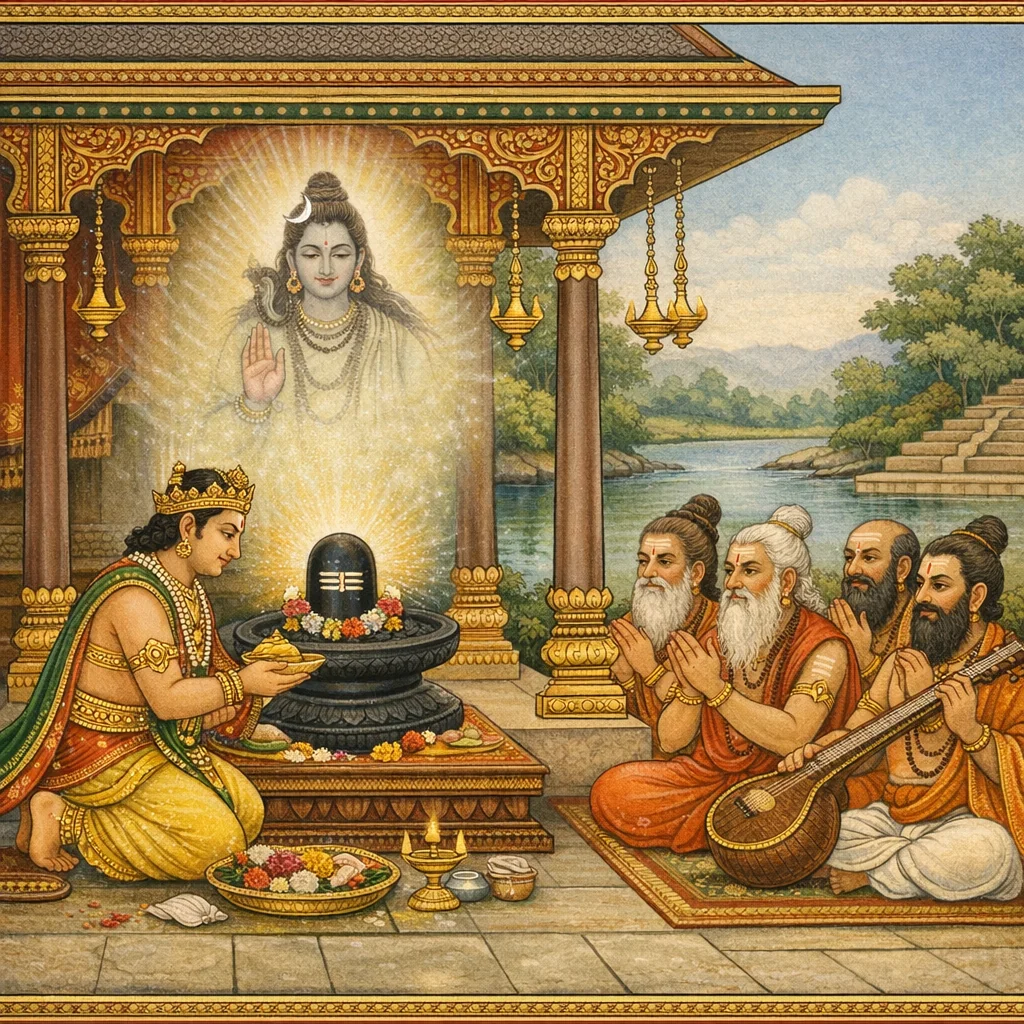
Īśvara addresses Devī, pointing out the nearby goddess-site Ekallavīrikā, and then relates an origin-legend set in Prabhāsa-kṣetra, praising the sanctity and efficacy of that sacred ground. King Daśaratha of the Solar dynasty comes to Prabhāsa and performs severe tapas. He establishes a liṅga and worships Śaṅkara to please Him, then prays for a mighty son. The Lord grants a son named Rāma, renowned in the three worlds; celestial beings, gods, daityas/asuras, and sages—including Vālmīki—are said to sing his fame. The chapter ends with ritual guidance and a phalaśruti: by the power of that liṅga the king attains great renown, and likewise anyone who worships it in the month of Kārttika—especially on the Kārttikā observance—according to proper procedure, with lamp-worship and offerings, gains yaśas, illustrious fame. Thus place (Prabhāsa), object (liṅga), time (Kārttika), and fruit (renown) are bound together in a compact sacred narrative and rite.
Shlokas
Verse 1
ईश्वर उवाच । ततो गच्छेन्महादेवि देवीमेकल्लवीरिकाम् । एकल्लवीरायाम्ये तु नातिदूरे व्यवस्थिताम्
Īśvara said: “Then, O Great Goddess, one should go to the Goddess Ekallavīrikā, who is situated not far away, to the south of Ekallavīrā.”
Verse 2
पूर्वं दशरथो योऽसौ सूर्यवंशविभूषणः । प्रभासं क्षेत्रमासाद्य तपश्चक्रे सुदुश्चरम्
Formerly, Daśaratha—an ornament of the Solar dynasty—reached the sacred field of Prabhāsa and performed austerities that were exceedingly difficult.
Verse 3
लिंगं तत्र प्रतिष्ठाप्य तोषयामास शांकरम् । स देवं प्रार्थयामास पुत्रं चैवामितौजसम्
There he established a Liṅga and gladdened Śaṅkara. Then he prayed to the Lord for a son of immeasurable splendor.
Verse 4
ददौ तस्य तदा पुत्रं देवं त्रैलोक्यपूजितम् । रामेति नाम यस्यासीत्त्रैलोक्ये प्रथितं यशः
Then the God granted him a son—divine and worshipped in the three worlds—named Rāma, whose fame became renowned throughout the three worlds.
Verse 5
यस्याद्यापीह गायन्ति भूर्भुवःस्वर्नि वासिनः । देवदैत्यासुराः सर्वे वाल्मीक्याद्या महर्षयः
Even today, the dwellers of Bhūr, Bhuvaḥ, and Svar sing of him—gods, daityas, and asuras alike, and the great sages beginning with Vālmīki.
Verse 6
तल्लिंगस्य प्रभावेन प्राप्तं राज्ञा महद्यशः । कार्तिक्यां कार्तिके मासि विधिना यस्तमर्चयेत् । दीपपूजोपहारेण यशस्वी सोऽपि जायते
By the power of that Liṅga the king attained great renown. Whoever worships it properly in the month of Kārttika—especially on the full-moon Kārttikā—with offerings of lamp-worship, that person too becomes illustrious.
Verse 171
इति श्रीस्कांदे महापुराण एकाशीतिसाहस्र्यां संहितायां सप्तमे प्रभासखण्डे प्रथमे प्रभासक्षेत्रमाहात्म्ये दशरथेश्वरमाहात्म्यवर्णनंनामैकसप्तत्युत्तरशततमोऽध्यायः
Thus ends, in the Śrī Skanda Mahāpurāṇa—within the Saṃhitā of eighty-one thousand verses—in the seventh, the Prabhāsa Khaṇḍa, and in the first division, the Māhātmya of the sacred field of Prabhāsa, the one-hundred-and-seventy-first chapter, entitled “The narration of the greatness of Daśaratheśvara.”