Adhyaya 48
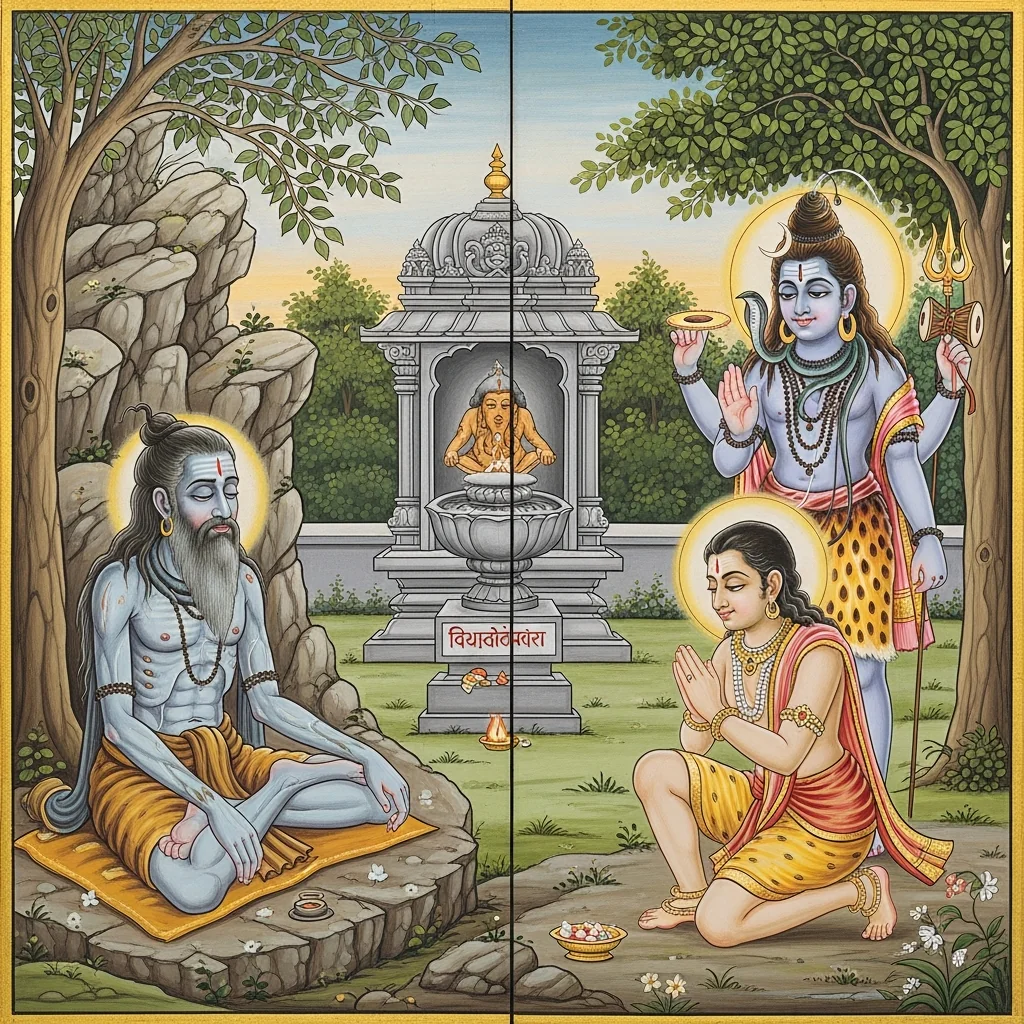
Chapter 48 presents a local shrine tradition within Prabhāsa-kṣetra. Īśvara instructs Devī about a liṅga established by Śukra (Bhārgava), located near the western landmark Vibhūtīśvara, and praises it as pāpa-haraṇa: sins are removed through darśana (devout seeing) and sparśa (reverent touch). The narrative recalls how Śukra attained the saṃjīvanī-vidyā through Rudra’s influence and severe tapas. In a striking episode, Śaṃbhu swallows Śukra for a divine purpose; Śukra continues his austerities within the Deity until Mahādeva is pleased and releases him—an origin account for the shrine’s name and sanctity. Prescriptions then follow: worship the liṅga with steady mind, perform japa of the Mṛtyuñjaya mantra to a lakh count, offer pañcāmṛta-abhiṣeka, and worship with fragrant flowers. The promised fruits are protection from death-related fear, freedom from sins, fulfillment of desired aims, and siddhi-like prosperities (aiśvarya/maṇimā and the like), granted in accordance with unwavering devotion.
Shlokas
Verse 1
ईश्वर उवाच । ततो गच्छेन्महादेवि लिंगं शुक्रप्रतिष्ठितम् । सर्वपापहरं देवि विभूतीश्वरपश्चिमे
Īśvara said: Then, O Great Goddess, one should go to the liṅga established by Śukra. O Goddess, it removes all sins and is situated to the west of Vibhūtīśvara.
Verse 2
नातिदूरे स्थितं तत्र स्वयं शुक्रेण निर्मितम् । यत्र संजीवनीं प्राप्तो विद्यां रुद्रप्रभावतः
Not far from there stands the shrine fashioned by Śukra himself—where, by Rudra’s power, he obtained the life-restoring knowledge called Saṃjīvanī.
Verse 3
संतप्य तु महाघोरं तपोवर्षसहस्रकम् । संप्रसाद्य विरूपाक्षं योऽवाप ग्रहतां सुधीः
After performing exceedingly fierce austerities for a thousand years and pleasing Virūpākṣa (Śiva), that wise one attained the status of a graha, a planetary power.
Verse 4
ग्रस्तेन शंभुना येन देवकार्यार्थसिद्धये । तत्रोदरगतेनैव तपस्तप्तं सुदुष्करम्
For the fulfillment of the gods’ purpose, Śambhu swallowed him; and even while within (Śiva’s) belly, he undertook there austerities of the utmost difficulty.
Verse 5
वर्षाणामयुतं साग्रं तुष्टिं नीतो महेश्वरः । निष्कासितस्ततः शीघ्रं शुक्र मार्गेण शंभुना
After a little more than ten thousand years, Maheśvara was brought to satisfaction; then Śambhu swiftly expelled him by the path associated with Śukra.
Verse 6
ततः शुक्रेति नामाभूद्भार्गवस्य महात्मनः । तदाराधयते लिंगं यः कृत्वा निश्चलं मनः
Thereafter, that great Bhārgava came to be known as “Śukra.” Whoever, making the mind unwavering, worships that liṅga (established by him) truly performs its propitiation.
Verse 7
मृत्युंजयं जपेल्लक्षं स समीहितमाप्नुयात्
Whoever repeats the Mṛtyuṃjaya (conquering death) mantra a hundred thousand times attains the desired goal.
Verse 8
तं दृष्ट्वा त्वथवा स्पृष्ट्वा जन्मादिमरणान्तकात् । मुच्यते पातकान्मृत्योः प्रसादात्तस्य भामिनि
O radiant one, by merely seeing that (liṅga/deity) or even touching it, a person is freed—from the beginning of birth up to death—from sins and from death itself, by that Lord’s grace.
Verse 9
मृतसंजीवनार्थं यदैश्वर्यमणिमादिकम् । प्राप्नुयान्नात्र संदेहो यस्य भक्तिः सुनिश्चला
For the sake of reviving the dead, or to seek lordly powers such as aṇimā and the rest, one whose devotion is unwavering attains them; of this there is no doubt.
Verse 10
पंचामृतेन संस्नाप्य देवं शुकप्रतिष्ठितम् । सुगन्धपुष्पैः संपूज्य शौक्रीं पीडां स नाप्नुयात्
Having bathed with pañcāmṛta the deity established by Śuka, and having worshipped with fragrant flowers, one does not suffer the affliction connected with Śukra.
Verse 11
इति सर्वं समासेन माहात्म्यं शुक्रदैवतम् । कथितं तव सुश्रोणि श्रुतं पापभयापहम्
Thus, O fair-hipped one, I have told you in brief the entire glory of the deity of Śukra; merely hearing it removes sin and fear.
Verse 48
इति श्रीस्कांदे महापुराण एकाशीतिसाहस्र्यां संहितायां सप्तमे प्रभासखण्डे प्रथमे प्रभासक्षेत्रमाहात्म्ये शुक्रेश्वरमाहात्म्यवर्णनंनामाष्टचत्वारिंशोध्यायः
Thus ends the forty-eighth chapter, called “The Description of the Glory of Śukreśvara,” in the Prabhāsa Khaṇḍa—within the Prabhāsakṣetra Māhātmya—of the venerable Skanda Mahāpurāṇa, in the Ekāśītisāhasrī Saṃhitā.