Adhyaya 195
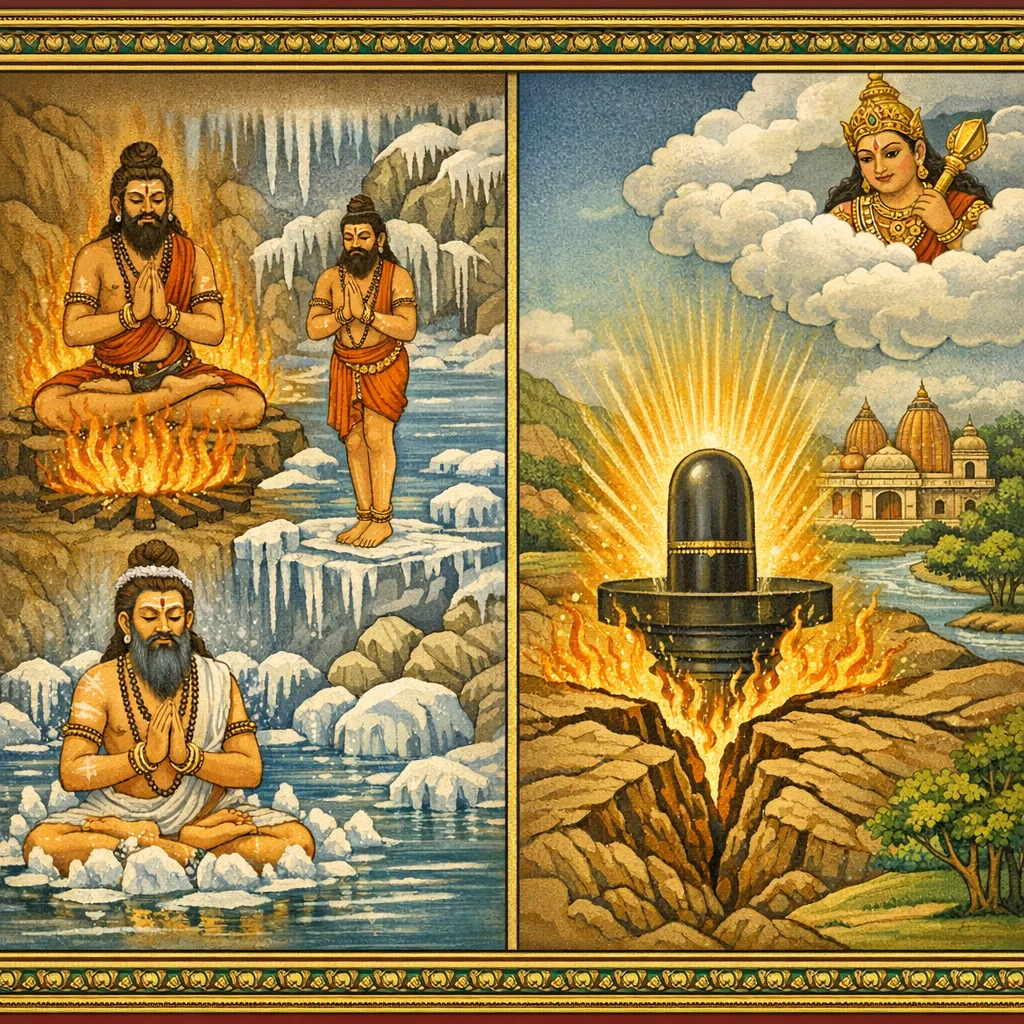
The chapter unfolds as a Śaiva dialogue. Īśvara instructs that a disciplined pilgrim should go to Vṛddha Prabhāsa, south of Ādi Prabhāsa, where a renowned “caturmukha” (four-faced) liṅga is praised as sin-destroying by mere sight. Śrī Devī asks how the place received its name and what fruits arise from seeing, praising, and worshipping there. Īśvara recounts an ancient episode set in a former manvantara and in Tretā-yuga: ṛṣis traveling from the north came seeking darśana at Prabhāsa but found the Śaiva liṅga concealed, connected with Indra’s vajra. Refusing to return without darśana, they performed prolonged tapas through the seasons with strict observances—brahmacarya and austerities of enduring heat and cold—until they became aged. Seeing their unwavering resolve, Śaṅkara compassionately revealed his liṅga, said to have arisen by splitting the earth. The ṛṣis, having obtained darśana, ascend to the heavenly realm; though Indra tries again to hide it, the site becomes known as Vṛddha Prabhāsa because darśana was attained in vṛddha-bhāva, advanced age. The phalaśruti declares that devoutly beholding this place yields merit equal to the Rājasūya and Aśvamedha sacrifices, and it recommends gifting a bull (ukṣā) to a brāhmaṇa for those who seek the full fruit of pilgrimage.
Shlokas
Verse 1
ईश्वर उवाच । ततो वृद्धप्रभासं तु गच्छेच्च नियतात्मवान् । आदिप्रभासाद्दक्षिणतो नातिदूरे व्यवस्थितम्
Īśvara said: “Then, with a disciplined mind, one should go to Vṛddha-Prabhāsa, situated not far to the south of Ādi-Prabhāsa.”
Verse 2
चतुर्मुखं महालिंगं दर्शनात्पापनाशनम्
The great four-faced Liṅga destroys sins merely by being seen.
Verse 3
श्रीदेव्युवाच । कथं वृद्धप्रभासं तु नाम तस्याभवत्प्रभो । तस्मिन्दृष्टे फलं किं स्यात्स्तुते संपूजिते तथा
The Goddess said: “O Lord, how did it come to be known by the name ‘Vṛddha-Prabhāsa’? And what fruit arises from seeing it, and likewise from praising and duly worshipping it?”
Verse 4
एतत्कथय मे देव संक्षेपान्नातिविस्तरात्
“Tell me this, O God—briefly, not at great length.”
Verse 5
ईश्वर उवाच । आदौ स्वायंभुवे देवि पूर्वमन्वन्तरे पुरा । त्रेतायुगे चतुर्थे तु प्रभासे क्षेत्र उत्तमे
Īśvara said: “In the beginning, O Goddess—long ago, in the earlier Manvantara of Svāyambhuva—during the fourth Tretā-yuga, in the supreme holy field of Prabhāsa…”
Verse 6
तस्मिन्काले महादेवि पूर्वमन्वंतरे पुरा । त्रेतायुगे चतुर्थे तु ऋषयस्तत्र संगताः
“At that time, O great Goddess—of old, in that earlier Manvantara, in the fourth Tretā-yuga—sages assembled there.”
Verse 7
दर्शनार्थं प्रभासस्य उत्तरापथगामिनः । तं दृष्ट्वाऽच्छादितं देवं वज्रेण तु महेश्वरि
“Seeking the darśana of Prabhāsa, those who had come from the northern route—O Maheśvarī—saw that Deity covered over by a thunderbolt.”
Verse 8
विषादं परमं जग्मुर्वाक्यं चेदमथाबुवन् । अदृष्ट्वा शांकरं लिगं न यास्यामो वयं गृहम्
They fell into deep sorrow and then spoke these words: “Without seeing Śaṅkara’s Liṅga, we shall not return home.”
Verse 9
स्वर्गार्थिनो वयं प्राप्ता महदध्वानमेव हि । तस्मादत्रैव तिष्ठामो यावल्लिंगस्य दर्शनम्
“Seeking heaven, we have indeed come a very long distance; therefore we shall stay right here until the Liṅga is beheld.”
Verse 10
एवं ते निश्चयं कृत्वा परस्मिंस्तपसि स्थिताः । वर्षास्वाकाशगा भूत्वा हेमंते सलिलाश्रयाः
Thus, having made their resolve, they remained steadfast in intense austerity: in the rainy season they stayed beneath the open sky, and in winter they took refuge in water.
Verse 11
पञ्चाग्निसाधना ग्रीष्मे नियता ब्रह्मचारिणः । बहून्वर्षगणान्विप्रा जराग्रस्तास्तदाऽभवन्
In summer they practiced the discipline of the five fires, living as restrained brahmacārins; after many years, those brāhmaṇa sages then became afflicted by old age.
Verse 12
एवं वृद्धत्वमापन्ना यदा ते वरवर्णिनि । छन्द्यमाना वरैस्ते तु शंकरेण महात्मना
O fair lady, when those sages had thus come to old age, the great-souled Śaṅkara offered them boons, inviting them to choose whatever they desired.
Verse 13
लिंगस्य दर्शनं मुक्त्वा न तेऽन्यं वव्रिरे वरम्
Apart from the vision of the Liṅga, they asked for no other boon.
Verse 14
तेषां तु निश्चयं ज्ञात्वा सर्वेषां वृषभध्वजः । अनुकम्पापरो भूत्वा स्वलिंगं तानदर्शयत्
Knowing the resolve of them all, the Bull-bannered Lord (Śiva), moved wholly by compassion, revealed to them His own Liṅga.
Verse 15
एतस्मिन्नेव काले तु भित्त्वा चैव वसुन्धराम् । उत्थितं सहसा लिंगं तदेव वरवर्णिनि
At that very moment, O fair lady, that very Liṅga suddenly arose, splitting the earth itself.
Verse 16
ऋषयस्ते च तं दृष्ट्वा सर्वे च त्रिदिवं गताः । अथ तेषु प्रयातेषु शक्रस्तप्तमना ह्यभूत्
Those sages, having seen it, all departed to heaven; and when they had gone, Śakra (Indra) became distressed at heart.
Verse 17
तमपि च्छादयामास वज्रेण शतपर्वणा
He (Indra) covered even that (Liṅga) with his thunderbolt, the hundred-jointed weapon.
Verse 18
वृद्धभावे यतस्तेषामृषीणां दर्शनं गतः । अतो वृद्धप्रभासं तत्कीर्त्यते वसुधातले
Because it granted darśana to those sages in their state of old age, therefore on the earth it is celebrated as ‘Vṛddha-Prabhāsa’.
Verse 19
तस्मिन्दृष्टे वरारोहे अद्यापि लभते फलम् । राजसूयाश्वमेधानां नरो भक्तिसमन्वितः
O noble lady, upon beholding that (Liṅga/spot), even today a devoted person attains the fruit of the Rājasūya and Aśvamedha sacrifices.
Verse 20
एवं तत्र समुत्पन्नं प्रभासं वृद्धसंज्ञकम् । तत्रोक्षा ब्राह्मणे देयः सम्यग्यात्राफलेप्सुभिः
Thus there arose that Prabhāsa known as “Vṛddha”; and there, those who seek the full fruit of pilgrimage should duly gift an ox to a Brāhmaṇa.
Verse 195
इति श्रीस्कांदे महापुराण एकाशीतिसाहस्र्यां संहितायां सप्तमे प्रभासखण्डे प्रथमे प्रभासक्षेत्रमाहात्म्ये वृद्धप्रभासमाहात्म्यवर्णनंनाम पञ्चनवत्युत्तरशततमोऽध्यायः
Thus ends the one-hundred-and-ninety-fifth chapter, entitled “The Description of the Greatness of Vṛddha‑Prabhāsa,” in the Prabhāsa Khaṇḍa—within the Prabhāsakṣetra Māhātmya—of the Śrī Skanda Mahāpurāṇa, in the compilation of eighty-one thousand verses.