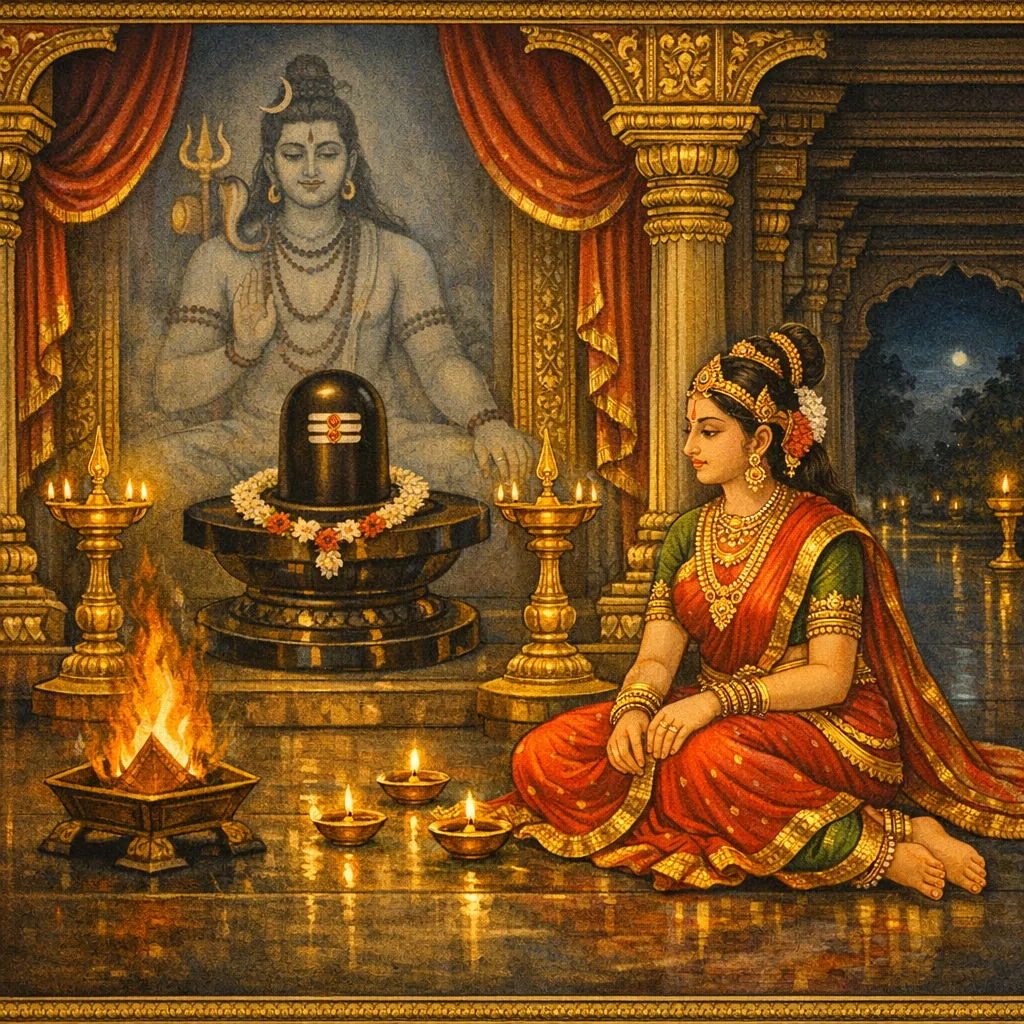
Adhyaya 94
Chapter 94 gives a compact theological and ritual portrait of Bhairaveśvara in Prabhāsa-kṣetra. Īśvara instructs Devī to go to the eminent Bhairaveśvara shrine, locating it with careful markers—directional placement near a “fire-corner/agnikoṇa” motif and a stated, measurable distance. The liṅga is praised as a universal fulfiller of desires and as a remover of poverty and misfortune. A name-history is then given: in an earlier age it was known as Caṇḍeśvara, remembered through a gaṇa named Caṇḍa who worshipped it for a long time. The chapter stresses darśana and reverent touch—seeing and touching the liṅga with composure—as purifying acts that free one from sins and from the framing cycle of birth and death. A calendrical vrata is prescribed: on Kṛṣṇa Caturdaśī in the month of Bhādrapada, fasting and night-vigil (prajāgara) are said to lead to the supreme abode of Maheśvara. It further declares that faults of speech and mind, as well as wrongdoing in action, are destroyed by viewing the liṅga. Pilgrimage conduct is completed with guidance on dāna—sesame, gold, and garments—to a learned recipient, for removing impurities and securing the journey’s fruit. Finally, Bhairava is read cosmologically: at cosmic dissolution Rudra assumes the Bhairava-form and “withdraws” the world, grounding the shrine’s name in this cosmic function. The concluding phalaśruti promises liberation from severe wrongdoing to those who hear this māhātmya.
Shlokas
Verse 1
ईश्वर उवाच । ततो गच्छेन्महादेवि भैरवेश्वरमुत्तमम् । तस्यैव वह्निकोणस्थं धनुषांदशके स्थितम्
Īśvara said: Then, O Great Goddess, one should go to the excellent Bhairaveśvara. It is situated in that very kṣetra, in the south-east (fire) quarter, at a distance of ten dhanuṣ-lengths.
Verse 2
सर्वकामप्रदं देवि दारिद्र्यौघविनाशनम् । पूर्वं चण्डेश्वरंनाम ख्यातं कृतयुगे प्रिये
O Goddess, it bestows all desired aims and destroys the torrents of poverty. Formerly, O beloved, in the Kṛta Yuga it was famed by the name Caṇḍeśvara.
Verse 3
चण्डोनाम गणो देवि तेन चाराधितं पुरा । दिव्याब्दानां सहस्रं तु तेन चण्डेश्वरं स्मृतम्
O Goddess, formerly it was worshipped by a gaṇa named Caṇḍa; and because of him, for a thousand divine years, it was remembered as “Caṇḍeśvara”.
Verse 4
तं दृष्ट्वा देवदेवेशं स्पृष्ट्वा च सुसमाहितः । मुच्यते सकलात्पापादाजन्ममरणांतिकात्
Having beheld that Lord of the gods and, with a steady collected mind, having touched Him, one is released from all sins—those that cling from birth until the very end of life.
Verse 5
तत्र कृष्णचतुर्दश्यां मासे भाद्रपदे प्रिये । उपवास परो भूत्वा यः करोति प्रजागरम् । स याति परमं स्थानं यत्र देवो महेश्वरः
There, O beloved, on the fourteenth day of the dark fortnight in the month of Bhādrapada, whoever—devoted to fasting—keeps the night-vigil, attains the supreme abode where Lord Maheśvara dwells.
Verse 6
वाचिकं मानसं पापं कर्मणा यदुपार्जितम् । तत्सर्वं नाशमायाति तस्य लिंगस्य दर्शनात्
Sins of speech and of mind—indeed whatever has been accumulated through actions—entirely perish by the mere sight of that liṅga.
Verse 7
तिला हिरण्यं वस्त्राणि तत्र देयं मनीषिणे । सर्वकिल्विषनाशार्थं सम्यग्यात्राफलेप्सुना
One who seeks the true fruit of pilgrimage should give there sesame seeds, gold, and garments to a worthy wise recipient, so that all sins may be destroyed.
Verse 8
भैरवाकारमास्थाय कल्पान्ते स हरेद्यतः । विश्वं समग्रं देवेशि तेनासौ भैरवः स्मृतः
O Lady of the Lord, because at the end of an aeon He assumes the form of Bhairava and withdraws the entire universe, therefore He is remembered as “Bhairava”.
Verse 9
अस्मिन्कल्पे महादेवि प्रभासक्षेत्रमास्थितः । बभूव भैरवो रुद्रः कल्पान्ते लिंगमूर्तिमान्
O Great Goddess, in this very aeon, abiding in Prabhāsa-kṣetra, Rudra became Bhairava—and at the end of the aeon He stands as the Liṅga embodied.
Verse 10
एवं संक्षेपतः प्रोक्तं माहात्म्यं भैरवेश्वरम् । यच्छ्रुत्वा मुच्यते जन्तुः पातकादतिभैरवात्
Thus, in brief, the greatness of Bhairaveśvara has been declared; by hearing it, a being is freed from exceedingly dreadful sin.