Adhyaya 81
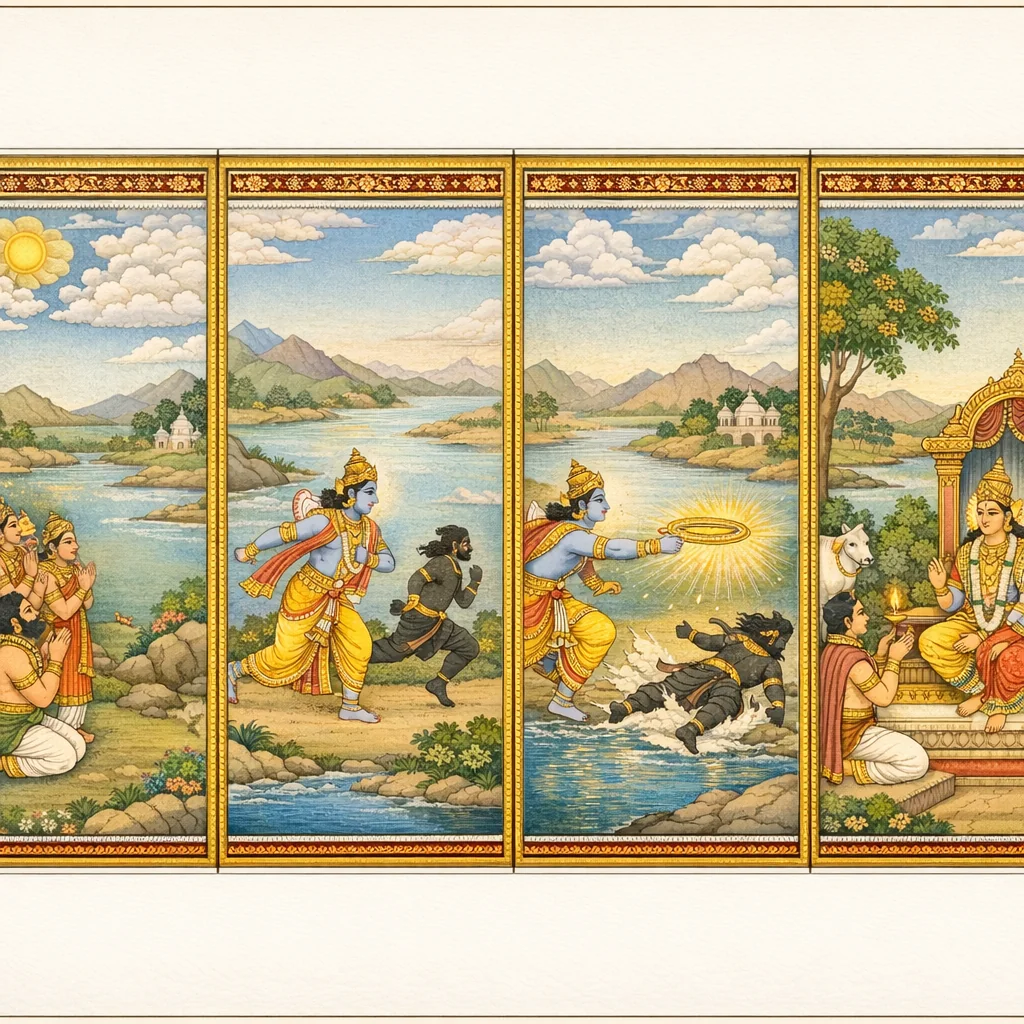
Chapter 81 unfolds as a theological dialogue in which Īśvara instructs Devī on the unique holiness of Prabhāsa-kṣetra, a Vaiṣṇava ritual land shaped like a “yava-ākāra” (barley grain) with clearly stated boundaries in the four directions. Its permanence and unrivaled potency are affirmed: death within the kṣetra, gifts, offerings, mantra-recitation, austerities, and feeding brāhmaṇas performed there are said to yield akṣaya merit enduring up to seven kalpas. The chapter then lays out devotional practice-templates—fasting (upavāsa) with faith, bathing at Cakrātīrtha, gifting gold on Kārttika-dvādaśī, lamp-offerings, pañcāmṛta ablutions, Ekādaśī night-vigil (jāgara) with devotional arts, and cāturmāsya observance. It proceeds to a name-origin legend: praised by the devas for earlier avatāra deeds, Viṣṇu vows to destroy the dānavas, pursues them to Prabhāsa, and annihilates them with the discus, thereby establishing the epithet “Daityasūdana.” The conclusion offers phalāśruti assurances that seeing or worshiping the deity in this kṣetra destroys sins and bestows auspicious outcomes in life.
Shlokas
Verse 1
ईश्वर उवाच । ततो गच्छेन्महादेवि देवेशं दैत्यसूदनम् । पापघ्नं सर्वजंतूनां प्रभासक्षेत्रवासिनाम्
Īśvara said: Then, O great Goddess, one should go to the Lord of gods, Daityasūdana, who destroys the sins of all beings dwelling in Prabhāsa Kṣetra.
Verse 2
अनादियुगसंस्थानं सर्व कामप्रदं शुभम् । संसारसागरे घोरे स्थितं नौरिव तारणे
Ancient—established from age without beginning—auspicious and granting all worthy desires, it stands in the dreadful ocean of worldly existence like a boat for crossing over.
Verse 3
अन्ये सर्वेऽपि नश्यंति कल्पांते ब्रह्मणो दिने । एतानि मुक्त्वा देवेशि न्यग्रोधं सप्त कल्पगम
All other things perish at the end of a kalpa, on Brahmā’s day. But leaving these aside, O Lady of the Lord of gods, there is the Nyagrodha (banyan) that endures through seven kalpas.
Verse 4
कल्पवृक्षं तथाऽगारं वैडूर्यं पर्वतोत्तमम् । श्रीदैत्यसूदनं देवं मार्कंडेयं महामुनिम्
The wish-fulfilling tree, and also the sacred abode; Vaiḍūrya, the best of mountains; the venerable god Daityasūdana; and Mārkaṇḍeya, the great sage—these are the revered, enduring features.
Verse 5
अक्षयाश्चाव्ययाश्चैते सप्तकल्पानि सुन्दरि । देवि किं बहुनोक्तेन वर्णितेन पुनःपुनः
These are imperishable and undecaying for seven kalpas, O fair one. O Devī, what is the use of saying more—of describing it again and again?
Verse 6
श्रीदैत्यसूदनाद्देवि नान्यास्ति भुवि देवता । यवाकारं तु तस्यैव क्षेत्रपातकनाशनम्
O Devī, on earth there is no divinity other than the venerable Daityasūdana. Even the very form and extent associated with him—called “yavākāra”—destroys the sins connected with this holy region.
Verse 7
सेवितं चर्षिभिः सिद्धैर्यक्षविद्याधरोरगैः । तस्य सीमां प्रवक्ष्यामि विष्णुक्षेत्रस्य भामिनि
Served and revered by seers and Siddhas, by Yakṣas, Vidyādharas, and Nāgas—O radiant lady, I shall now declare the boundary of that Viṣṇu-kṣetra.
Verse 8
पूर्वे यमेश्वरं यावच्छ्रीसोमेशं तु पश्चिमे । उत्तरे तु विशालाक्षी दक्षिणे सरितां पतिः
To the east the boundary extends up to Yameśvara; to the west, up to the auspicious Someśa. To the north is Viśālākṣī, and to the south is the Lord of rivers—thus is the sacred tract defined.
Verse 9
एतत्क्षेत्रं यवाकारं वैष्णवं पापनाशनम्
This sacred field is shaped like a barley-grain, is Vaiṣṇava in nature, and is a destroyer of sins.
Verse 10
अत्र क्षेत्रे मृता ये तु पापिनोऽपि नरा ध्रुवम् । स्वर्गं गच्छंति ते सर्वे संतः सुकृतिनो यथा
Even sinful men who die in this holy region, without doubt, all go to heaven—just as do the virtuous and meritorious.
Verse 11
अत्र दत्तं हुतं जप्तं तपस्तप्तं कृतं हि यत् । तत्सर्वं चाक्षयं प्रोक्तं सप्तकल्पावधि प्रिये
O beloved, whatever is given here in charity, offered in sacrifice, recited as japa, or accomplished through austerity—indeed all of it is declared imperishable, enduring up to seven kalpas.
Verse 12
तत्रैकमपि यो देवि ब्राह्मणं भोजयिष्यति । विधिना विष्णुमुद्दिश्य कोटिर्भवति भोजिता
O Goddess, there, whoever feeds even a single brāhmaṇa in due manner, dedicating it to Viṣṇu—the feeding becomes as though a crore were fed.
Verse 13
तत्रोपवासं यः कुर्यान्नरो भक्तिसमन्वितः । एकेनैवोपवासेन उपवासायुतं फलम् । चक्रतीर्थे नरः स्नात्वा सोपवासो जितेंद्रियः
There, a man who undertakes fasting (upavāsa) with devotion—by a single fast alone obtains the fruit of ten thousand fasts. Having bathed at Cakratīrtha, fasting and self-controlled, he gains that exalted merit.
Verse 14
द्वादश्यां कार्त्तिके मासि दद्याद्विप्रेषु कांचनम् । विष्णुं संपूज्य विधिवन्मुच्यते सर्वपातकैः
On Dvādaśī, the twelfth lunar day in the month of Kārttika, one should give gold to brāhmaṇas. Having duly worshipped Viṣṇu according to rule, one is freed from all sins.
Verse 15
देव्युवाच । दैत्यसूदननामेति कथं तस्य प्रकीर्तितम् । कस्मिन्काले तु देवेश तन्मे विस्तरतो वद
The Goddess said: “How did the name ‘Daityasūdana’ become renowned for him? And at what time, O Lord of gods, did this occur? Tell me that in detail.”
Verse 16
ईश्वर उवाच । शृणु देवि प्रवक्ष्यामि माहात्म्यं पापनाशनम् । दैत्यसूदनदेवस्य पुरा वृत्तं महोदयम्
Īśvara said: “Listen, O Goddess; I shall proclaim the sin-destroying greatness—the ancient, most auspicious account of the god Daityasūdana.”
Verse 17
देवि तस्यैव नामानि कल्पेकल्पे भवंति वै । अनादिनिधनान्येव संभवन्ति पुनःपुनः
O Goddess, his very names arise in each and every kalpa; beginningless and endless, they manifest again and again.
Verse 18
पूर्वकल्पे श्रिया वृत्तो वामनस्तु द्वितीयके । वज्रांगस्तु तृतीये वै तुरीये कमलाप्रियः
In the former kalpa he was known as “Śriyā-vṛtta”; in the second as “Vāmana”; in the third indeed as “Vajrāṅga”; and in the fourth as “Kamalāpriya” (the beloved of Lakṣmī).
Verse 19
पंचमे दुःखहर्त्ता च षष्ठे तु पुरुषोत्तमः । श्रीदैत्यसूदनो देवः कल्पे वै सप्तमे स्मृतः
In the fifth kalpa he is remembered as “Duḥkhahartā,” the remover of sorrow; in the sixth as “Puruṣottama,” the Supreme Person; and in the seventh kalpa as the god “Śrī-Daityasūdana,” the slayer of the Daityas.
Verse 20
तस्यैव नाम चोत्पत्तिं कथयामि यथार्थतः
Now I shall relate, in accordance with the truth, the very origin of that name as well.
Verse 21
पुरा देवासुरे युद्धे दानवैर्देवकंटकैः । निर्जिता देवताः सर्वे जग्मुस्ते शरणं हरिम् । क्षीरोदवासिनं देवमस्तुवन्प्रणताः स्थिताः
Formerly, in the war between the Devas and the Asuras, the Dānavas—thorns to the gods—defeated all the deities. Then the gods sought refuge in Hari, the Lord who dwells in the Ocean of Milk, and, standing with bowed heads, they praised him.
Verse 22
देवा ऊचुः । जय देव जगन्नाथ दैत्यासुरविमर्द्दन । वाराहरूपमास्थाय उद्धृता वसुधा त्वया
The Devas said: “Victory to you, O Jagannātha, Master of the world, crusher of Daityas and Asuras. Assuming the form of the Boar (Varāha), you lifted up the Earth.”
Verse 23
उद्धृता मत्स्यरूपेण वेदा उदधिमध्यतः । कूर्मरूपी तथा भूत्वा क्षीरोदार्णवमंथनम्
In the form of a Fish (Matsya) you rescued the Vedas from the midst of the ocean; and likewise, becoming the Tortoise (Kūrma), you supported the churning of the Milk-Ocean.
Verse 24
कृत्वा त्वया जगन्नाथ उद्धृता श्रीर्नमो ऽस्तु ते । श्रीपतिः श्रीधरो देव आर्त्तानामर्तिनाशनः
O Jagannātha, by your act Śrī (Lakṣmī/prosperity) was brought forth and raised up—salutations to you. O God, you are Śrīpati and Śrīdhara, the destroyer of the distress of the afflicted.
Verse 25
बलिर्वामनरूपेण त्वया बद्धोऽसुरारिणा । हिरण्याक्षो महादैत्यो हिरण्यकशिपुर्हतः
Bali was bound by you, the foe of the Asuras, when you assumed the form of Vāmana. The great Daitya Hiraṇyākṣa was slain, and Hiraṇyakaśipu too was killed.
Verse 26
नारसिंहेन रूपेण अन्तरिक्षे धृतस्त्वया । देवमूल महादेव उद्धृतं भुवनं त्वया
Assuming the form of Narasiṃha, you upheld all in the mid-region. O Mahādeva, very root of the gods, by you the worlds were lifted up and sustained.
Verse 27
त्वया विना जगन्नाथ भुवनं निष्प्रभी कृतम् । सूर्येणेव तु विक्रान्तं तमोभिरिव दानवैः
Without you, O Jagannātha, the world is made lusterless, overrun by the Dānavas like darkness. But by you it becomes radiant and triumphant, as by the Sun.
Verse 28
श्रुत्वा स्तोत्रमिदं देवि विष्णुः कमललोचनः । उवाच देवान्ब्रह्माद्यान्क्षीरोदार्णव बोधितः
O Goddess, having heard this hymn, lotus-eyed Viṣṇu—awakened in the Ocean of Milk—addressed the gods, beginning with Brahmā.
Verse 29
भयं त्यजध्वं वै देवा दानवान्प्रति सर्वथा । अचिरेणैव कालेन घातयिष्यामि दानवान्
“Cast off fear entirely, O gods, regarding the Dānavas. In a very short time I shall destroy those Dānavas.”
Verse 30
एवमुक्त्वाथ तैः सार्द्धमा जगाम जनार्द्दनः । दानवान्घातयामास स चक्रेण पृथक्पृथक्
Having spoken thus, Janārdana went forth together with them, and he began to slay the Dānavas—one by one—with his discus.
Verse 31
भयार्त्ता दानवाः सर्वे पलायनपरायणाः । प्रभासं क्षेत्रमासाद्य समुद्राभिमुखा भवन्
All the Dānavas, stricken with fear and intent only on flight, reached the sacred field of Prabhāsa and turned toward the sea.
Verse 32
नश्यमानास्ततो दृष्ट्वा दैत्यान्दैत्यविनाशनम् । संजघ्ने तान्स चक्रेण निःशेषान्सर्वदानवान्
Seeing the Daityas being destroyed and perishing, he struck them down with the discus, leaving no Dānava remaining.
Verse 33
हतेषु सर्वदैत्येषु देवब्राह्मणतापसैः । कल्याणमभवत्तत्र जगत्स्वस्थमनाकुलम्
When all the Daityas had been slain, there arose well-being there: the world became steady, healthy, and free from distress—for gods, brāhmaṇas, and ascetics.
Verse 34
तत्प्रभृत्येव देवस्य दैत्यसूदननाम तत् । एतन्माहात्म्यमतुलं कथितं तव सुन्दरि । दैत्यसूदनदेवस्य महाभाग्यं महोदयम्
From that time onward, that deity came to bear the name ‘Daityasūdana’. O fair one, I have told you this incomparable Māhātmya—the great fortune and exalted glory of Lord Daityasūdana.
Verse 35
तं दृष्ट्वा न जडो नांधो न दरिद्रो न दुःखितः । जायते सप्त जन्मानि सत्यंसत्यं वरानने
Having beheld him, one is not born—through seven births—dull-witted, blind, poor, or sorrowful. This is truth, truth, O fair-faced one.
Verse 36
श्रवणद्वादशीं पुण्यां रोहिण्यां चाष्टमीं शुभाम् । शयनोत्थापनीं चैव नरः कृत्वा प्रयत्नतः
A man who, with earnest effort, observes the sacred Śravaṇa-dvādaśī, the auspicious Rohiṇī-aṣṭamī, and also performs the Śayanotthāpanī—the rite of awakening the Lord from yogic sleep…
Verse 37
एकैकेनोप वासेन उपवासायुतं फलम् । लभते नात्र सन्देहो दैत्यसूदनसन्निधौ
By each single fast, one gains the fruit of ten thousand fasts—of this there is no doubt—in the very presence of Daityasūdana.
Verse 38
चण्डालः श्वपचो वापि तिर्यग्योनिगतोऽपि वा । प्राणत्यागे कृते तस्मिन्नाच्युतं लोकमाप्नुयात्
Whether one is a caṇḍāla, a dog-cooker, or even born in an animal womb—if one gives up one’s life there, one attains the imperishable realm of Acyuta (Viṣṇu).
Verse 39
कार्तिक्यां चैव वैशाख्यां मासमेकमुपोषयेत् । दैत्यसूदनमध्यस्थः सम्यक्छ्रद्धासमन्वितः
In the month of Kārttika, and likewise in Vaiśākha, let a person undertake fasting for one full month—dwelling in the presence of Daityasūdana (Viṣṇu), and endowed with proper faith.
Verse 40
एकैकेनोपवासेन कोटिकोटि पृथक्पृथक् । लभते तत्फलं सर्वं विष्णुक्षेत्रप्रभावतः
By each single fast performed there, one obtains the entire merit of those acts—each in its own right—multiplied into millions upon millions, through the extraordinary power of Viṣṇu’s sacred kṣetra.
Verse 41
दीपं ददाति यस्तत्र मासं वा पक्षमेव वा । एकैक दीपदानेन कोटिदीपफलं लभेत्
Whoever offers a lamp there—whether for a month or even for a fortnight—by each single offering of a lamp gains merit equal to that of offering crores of lamps.
Verse 42
पंचामृतेन संस्नाप्य देवदेवं चतुर्भुजम् । एकादश्यां निराहारः पूजयित्वाऽच्युतो भवेत्
Having bathed the four-armed Lord of Lords with pañcāmṛta, and worshipped Him on Ekādaśī while fasting completely, one attains the state of Acyuta, united with Him in devotion.
Verse 43
चातुर्मास्यं विधानेन दैत्यसूदनसन्निधौ । नियमेन क्षिपेद्यस्तु तस्य तुष्यति केशवः
Whoever, in the presence of Daityasūdana (Viṣṇu), duly observes the Cāturmāsya vow according to proper procedure and passes that period with disciplined restraints—Keśava is pleased with him.
Verse 44
अन्यक्षेत्रेषु यत्कृत्वा चातुर्मास्यानि कोटिशः । तत्फलं लभते सर्वं दैत्यसूदनदर्शनात्
Whatever fruit one would gain by performing crores of Cāturmāsya observances in other holy places—that entire fruit is obtained here simply by the darśana, the sacred sight of Daityasūdana (Viṣṇu).
Verse 45
ब्रह्माण्डं सकलं दत्त्वा यत्पुण्यफलमाप्नुयात् । तत्पुण्यं लभते सर्वं दैत्यसूदनदर्शनात्
Whatever merit would be gained by gifting the entire universe—one obtains all that merit here from the very darśana, the sacred sight of Daityasūdana (Viṣṇu).
Verse 46
एकादश्यां तु यस्तत्र कुरुते जागरं नरः । गीतनृत्यैस्तथा वाद्यैः प्रेक्षणीयैस्तथाविधैः । स याति वैष्णवं लोकं यं गत्वा न निवर्त्तते
But the man who keeps vigil there on Ekādaśī—engaging in devotional singing, dancing, music, and other sacred observances—goes to the Vaiṣṇava realm; having reached it, he does not return to rebirth.
Verse 47
हत्याऽयुतानीह सुसंचितानि स्तेयानि रुक्मस्य न सन्ति संख्या । निहंति केनापि पुरा कृतानि सर्वाणि भद्रा निशि जागरेण
Even tens of thousands of murders amassed here, and countless thefts of gold—sins committed long ago—are destroyed, O auspicious lady, by keeping the night-vigil, as if by some power.
Verse 48
मार्गा न ते प्रेतपुरी न दूता वनं च तत्खेचरखड्गपत्रम् । स्वप्ने न पश्यंति च ते मनुष्या येषां गता जागरणेन भद्रा
For those whose auspicious night-vigil has been fulfilled, the paths to the City of the Dead do not await them—nor do Yama’s messengers, nor that dreadful forest of sword-like leaves. Such people do not behold these terrors, not even in a dream.
Verse 49
कन्यासहस्रं विधिवद्ददाति रत्नैरलंकृत्य स्वधर्मबुद्ध्या । गवां सहस्रं कुरुजांगले तु तेषां परं जागरणेन विष्णोः
Even if one were to give, according to proper rites and with a sense of dharma, a thousand maidens adorned with jewels—or a thousand cows in Kurujāṅgala—still the fruit of Viṣṇu’s night-vigil is declared superior to those gifts.
Verse 50
कृत्वा चैवोपवासं च योऽश्नाति द्वादशीदिने । नैवेद्यं तुलसीमिश्रं हत्याकोटिविनाशनम्
One who first observes a fast and then, on the day of Dvādaśī, partakes of food offered as naivedya mixed with tulasī—such a practice destroys even millions of the gravest sins.
Verse 51
इति ते कथितं देवि माहात्म्यं पापनाशनम् । दैत्यसूदनदेवस्य किमन्यत्परिपृच्छसि
Thus, O Goddess, I have told you the sin-destroying greatness of Lord Daityasūdana. What else do you wish to ask?
Verse 52
पीतवस्त्राणि देवस्य गां हिरण्यं च दापयेत् । स्नात्वा चक्रवरे तीर्थे मुच्यते सर्वपातकात्
Let one offer the Lord yellow garments, and also give a cow and gold in charity. Having bathed at the excellent Cakra-tīrtha, one is released from all sins.
Verse 81
इति श्रीस्कांदे महापुराण एकाशीति साहस्र्यां संहितायां सप्तमे प्रभासखण्डे प्रथमेप्रभासक्षेत्रमाहात्म्ये श्रीदैत्यसूदनमाहात्म्यवर्णनंनामैकाशीतितमोऽध्यायः
Thus ends the eighty-first chapter, called “The Description of the Glory of Śrī Daityasūdana,” in the Prabhāsa Khaṇḍa—within the Prabhāsakṣetra Māhātmya—of the venerable Skanda Mahāpurāṇa, in the Ekāśīti-sāhasrī Saṃhitā.