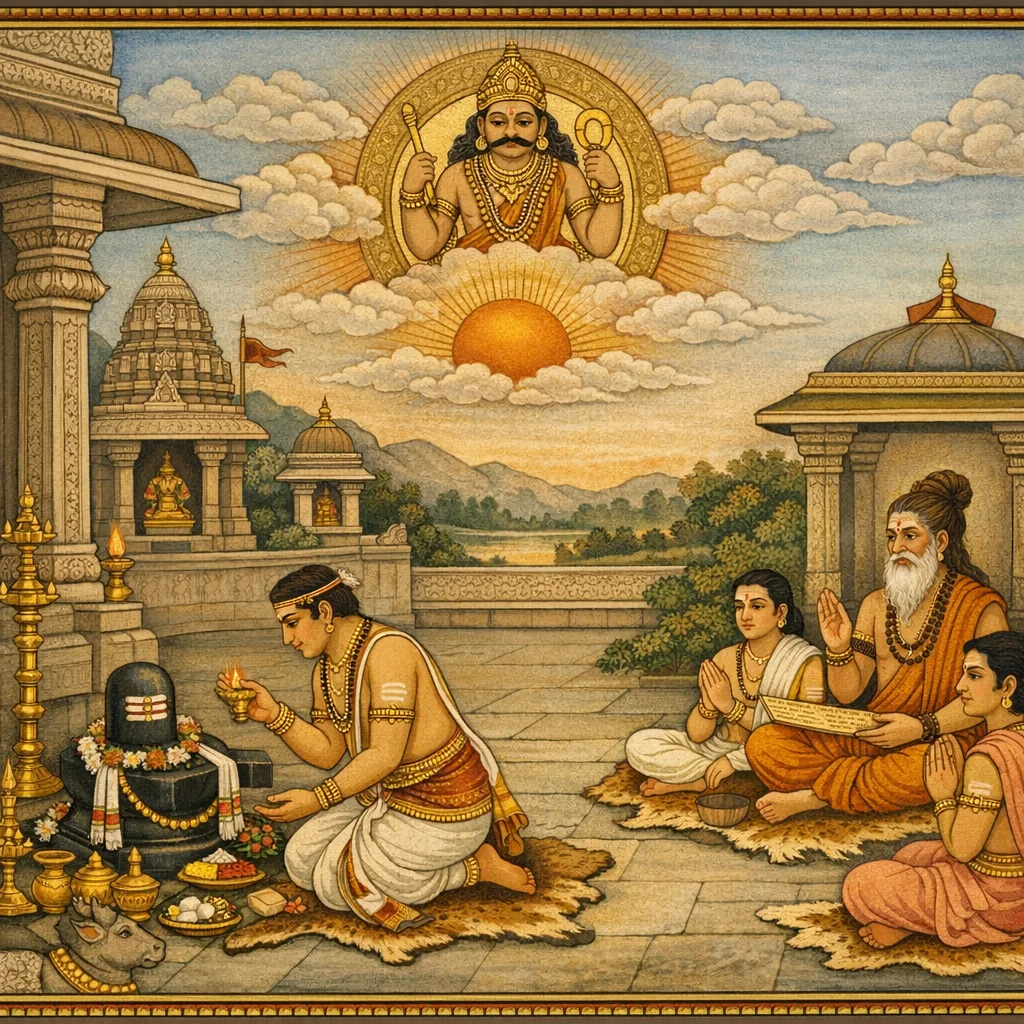
Adhyaya 93
Īśvara instructs Devī how to proceed to the Mahākāleśvara liṅga, situated slightly north of Aghoreśa and oriented toward the vāyavya (northwest), praising it as a sin-destroying holy site. The chapter then gives a yuga-linked history of names: in Kṛtayuga it is remembered as Citrāṅgadeśvara, while in Kali it is glorified as Mahākāleśvara. Rudra is portrayed as kāla-rūpa, the very form of Time, and as a cosmic principle that even consumes the sun, joining cosmology to the shrine’s theology. Ritual observances are prescribed: worship at dawn with a six-syllabled mantra; and a special vow on Kṛṣṇāṣṭamī, offering guggulu mixed with ghee in a properly performed night rite. Bhairava is said to grant broad forgiveness for offenses. Dāna is emphasized, especially dhenu-dāna (the gift of a cow), which uplifts ancestral lines, along with reciting the Śatarudrīya on the deity’s southern side to benefit both paternal and maternal lineages. Another practice is offering a ghṛta-kambala (ghee-blanket) at the northern solstice, promising mitigation of harsh rebirth. The phalaśruti concludes with prosperity, freedom from misfortune, and devotion strengthened across successive births, linking the shrine’s fame to Citrāṅgada’s earlier worship.
Shlokas
Verse 1
ईश्वर उवाच । ततो गच्छेद्वरारोहे महाकालेश्वरं हरम् । अघोरेशादुत्तरतः किंचिद्वायव्यसंस्थितम्
Īśvara said: “Then, O fair-hipped Lady, one should go to Hara known as Mahākāleśvara, situated a little to the north of Aghoreśvara, in the north-western quarter.”
Verse 2
धनुषां त्रिंशता देवि श्रुतं पातकनाशनम् । पूर्वं कृतयुगे देवि स्मृतं चित्रांगदेश्वरम्
O Goddess, within a span of thirty bow-lengths this place is famed as a destroyer of sins. Formerly, in the Kṛta Yuga, O Goddess, it was remembered by the name Citrāṅgadeśvara.
Verse 3
महाकालेश्वरं देवि कलौ नाम प्रकीर्तितम् । कालरूपी महारुद्रस्तस्मिंल्लिंगे व्यवस्थितः
O Goddess, in the Kali age it is celebrated by the name Mahākāleśvara. There, the Great Rudra—embodied as Time—abides established in that liṅga.
Verse 4
चराचरगुरुः साक्षाद्देवदानवदर्पहा । सूर्यरूपेण यत्सर्वं ब्रह्मांडे ग्रसते प्रिये
He is the manifest Guru of all that moves and stands still, the crusher of the pride of gods and demons; and in the form of the Sun, O beloved, he consumes all within the cosmic sphere.
Verse 5
स देवः संस्थितो देवि तस्मिंल्लिंगे महाप्रभः । यस्तत्पूजयते भक्त्या कल्ये लिंगं मम प्रियम् । षडक्षरेण मंत्रेण मृत्युं जयति तत्क्षणात्
O Goddess, that mighty, radiant Deity is established in that liṅga. Whoever worships with devotion that liṅga—dear to me—in the early morning, conquers death at that very moment through the six-syllabled mantra.
Verse 6
कृष्णाष्टम्यां विशेषेण गुग्गुलं घृतसंयुतम् । यो दहेद्विधिवत्तत्र पूजां कृत्वा निशागमे
Especially on Kṛṣṇāṣṭamī, whoever, after performing worship there at nightfall, duly burns guggulu resin mixed with ghee—
Verse 7
अपराधसहस्रं तु क्षमते तस्य भैरवः । धेनुदानं प्रशंसंति तस्मिन्स्थाने महर्षयः
Bhairava forgives even a thousand offenses of such a devotee. In that place, the great sages praise the gifting of a cow (dhenu-dāna).
Verse 8
धेनुदस्तारयेन्नूनं दश पूर्वान्दशापरान् । देवस्य दक्षिणे भागे यो जपेच्छतरुद्रियम्
Surely, the giver of a cow delivers ten ancestors and ten descendants. And whoever, on the deity’s southern side, recites the Śatarudrīya—
Verse 9
उद्धरेत्पितृवर्गं च मातृवर्गं च मानवः । बाल्ये वयसि यत्पापं वार्द्धके यौवनेऽपि वा । क्षालयेच्चैव तत्सर्वं दृष्ट्वा कालेश्वरं हरम्
By beholding Kāleśvara—Hara Himself—a person uplifts both the paternal and maternal lines. Whatever sin was committed in childhood, youth, or even in old age, all of it is washed away upon having the vision of Kāleśvara.
Verse 10
अयने चोत्तरे प्राप्ते यः कुर्याद्घृतकंबलम् । न स भूयोऽत्र संसारे जन्म प्राप्नोति दारुणम्
When the northern solstice arrives, whoever performs the offering called the ‘ghṛta-kambala’ (a ghee-offering/charity so named) will not again attain a dreadful birth in this cycle of worldly existence.
Verse 11
न दुःखितो दरिद्रो वा दुर्भगो वा प्रजायते । सप्तजन्मान्तराण्येव महाकालेशदर्शनात्
From the mere vision of Mahākāleśa, one is not born unhappy, impoverished, or ill-fated—for as long as seven successive births.
Verse 12
धनधान्यसमायुक्ते स्फीते सञ्जायते कुले । भक्तिर्भवति भूयोऽपि महाकालेश्वरार्चने
One is born into a flourishing lineage, endowed with wealth and abundant grain; and again and again devotion arises toward the worship of Mahākāleśvara.
Verse 13
इति संक्षेपतः प्रोक्तं महाकालेश्वरं प्रिये । चित्रांगदो गणो देवि तेन चाराधितं पुरा
Thus, in brief, O beloved, Mahākāleśvara has been described. O Goddess, in former times a gaṇa named Citrāṅgada worshipped Him with devotion.
Verse 14
दिव्याब्दानां सहस्रं तु महा कालेश्वरं हि तत् । चित्रांगदेश्वरं नाम तेन ख्यातं धरातले
For a thousand divine years, that liṅga indeed remained as Mahā-Kāleśvara; therefore, upon the earth it became renowned by the name “Citrāṅgadeśvara.”
Verse 93
इति श्रीस्कान्दे महापुराण एकाशीतिसाहस्र्यां संहितायां सप्तमे प्रभास खंडे प्रथमे प्रभासक्षेत्रमाहात्म्य एकादशरुद्रमाहात्म्ये महाकालेश्वरमाहात्म्यवर्णनंनाम त्रिणवतितमोऽध्यायः
Thus ends the ninety-third chapter, entitled “The Description of the Greatness of Mahākāleśvara,” in the Prabhāsa Khaṇḍa of the Śrī Skanda Mahāpurāṇa, within the Prabhāsakṣetra Māhātmya, in the Ekādaśa-Rudra Māhātmya section, of the eighty-one-thousand-verse recension.