Adhyaya 59
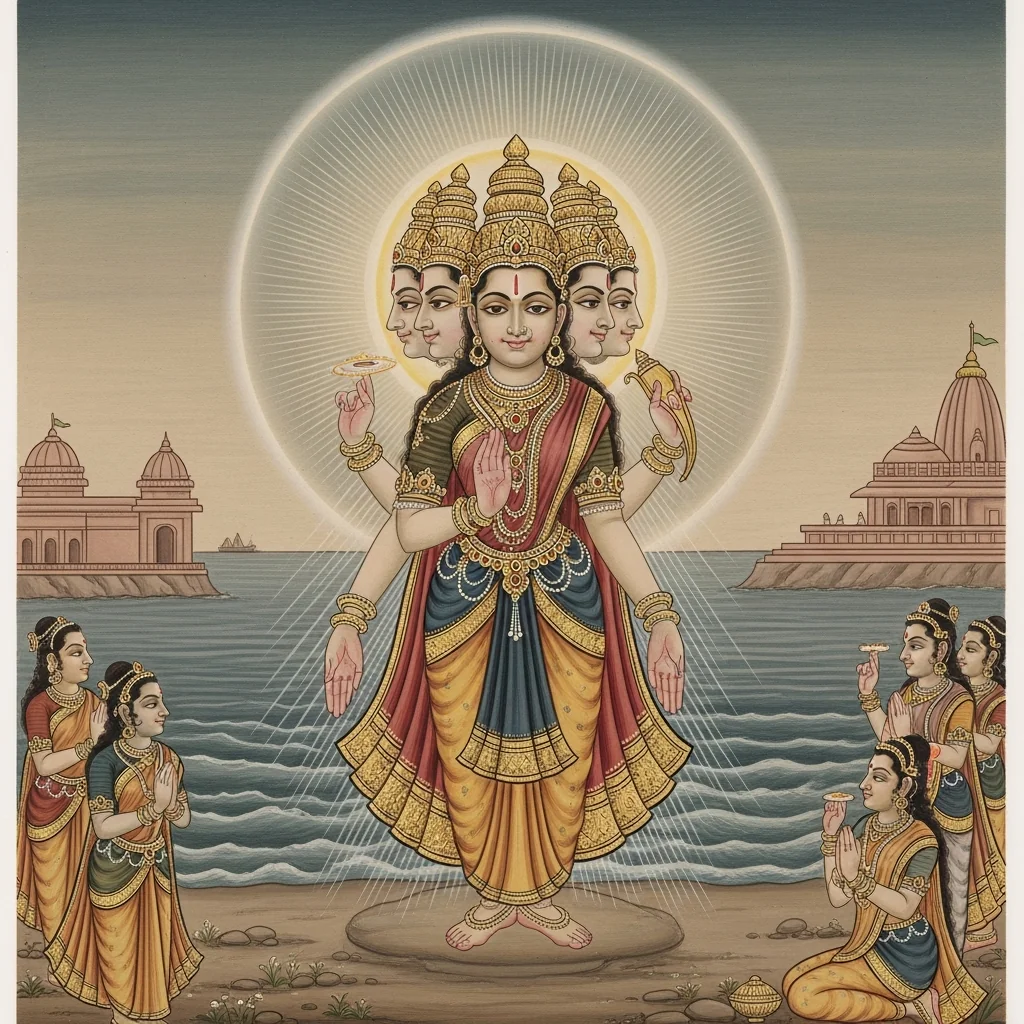
This chapter unfolds as a Śiva–Devī theological dialogue, joining subtle doctrine to the sacred landscape of Prabhāsa and to ritual merit. Īśvara proclaims a “third” knowledge-power (jñāna-śakti), Śiva-pervaded and abiding in Prabhāsa, praised as a remover of poverty. The Devī then asks about Śiva’s faces: the name of the sixth face and how Ajā Devī arises from it. Īśvara discloses an esoteric account: in former times there were seven faces; the “Ajā” face is linked with Brahmā and the “Picu” face with Viṣṇu, so in the present dispensation Śiva is manifest as pañcavaktra, the five-faced Lord. From the Ajā-face, Ajā Devī appears amid the fierce battle with Andhāsura—bearing sword and shield, riding a lion, and attended by hosts of divine powers. The routed demons are driven toward the southern ocean and into Prabhāsa; after their destruction, the Devī recognizes the kṣetra’s sanctity and remains there, precisely located near Somēśa and in relation to Saurīśa. The phalaśruti follows: darśana bestows auspicious qualities across seven births; offering music and dance frees one’s lineage from misfortune; a ghee lamp with a red wick grants extended auspiciousness in proportion to the wick’s threads; and recitation or listening—especially on the lunar third day (tṛtīyā)—fulfills desired aims. The closing instruction presents worship of these Śaktis as a preparation for worship of Somēśa, for pilgrims seeking the complete fruit of their journey.
Shlokas
Verse 1
ईश्वर उवाच । अथ वच्मि तृतीयां ते ज्ञानशक्तिं शिवात्मिकाम् । प्रभासक्षेत्रमध्यस्थां दारिद्र्यौघविनाशिनीम्
Īśvara said: Now I shall tell you of the third power—Jñānaśakti, of the very nature of Śiva—abiding in the heart of Prabhāsa Kṣetra and destroying floods of poverty.
Verse 2
अजेति नाम्नीं तां देवीं राह्वीशाद्दक्षिणे स्थिताम् । मम वक्त्राद्विनिष्क्रांता षष्ठाद्वै विष्णुपूजितात्
That Goddess is named Ajetī; she stands to the south of Rāhvīśa. She issued forth from my mouth—indeed, from the sixth face, which is worshipped by Viṣṇu.
Verse 3
देव्युवाच । पंचवक्त्राणि देवेश प्रसिद्धानि तव प्रभौ । षष्ठं यद्वदनं देव तस्य किं नाम संस्मृतम् । समुत्पन्ना कथं तस्मादजादेवीति या श्रुता
The Goddess said: O Lord of the gods, O Master—your five faces are renowned. But, O God, by what name is that sixth face remembered? And how did she arise from it, she who is heard of as Ajā Devī?
Verse 4
ईश्वर उवाच । साधु पृष्टं त्वया देवि यद्गोप्यं स्वसुतेष्वपि । तत्तेऽहं संप्रवक्ष्यामि अप्रसिद्धागमोदितम्
Īśvara said: Well asked, O Goddess—for this matter is secret even among one’s own sons. Now I shall tell it to you, as taught in the scarcely known āgamic tradition.
Verse 5
वक्त्राणि मम देवेशि सप्तासन्पूर्वमेव हि । सद्योजातादिपंचैव षष्ठं स्मृतमजेति च
O Goddess, in former times I indeed had seven faces: the five beginning with Sadyojāta, and a sixth also remembered as Aja.
Verse 6
सप्तमं पिचुनामेति सप्तैवं वदनानि मे । तेभ्योऽजं ब्रह्मणे दत्तं पिचुवक्त्रं तु विष्णवे
The seventh is named Picu—thus I had seven faces. From among them, the Aja-face was given to Brahmā, and the Picu-face to Viṣṇu.
Verse 7
तस्मादहं महादेवि पंचवक्त्रोऽधुनाऽभवम् । अजस्तु ब्रह्मा सञ्जज्ञे पिचुर्विष्णुरजायत
Therefore, O Great Goddess, I have now become five-faced. Aja became Brahmā, and Picu became Viṣṇu.
Verse 8
अजवक्त्रान्महादेवि अजा जाता महाप्रभा । अन्धासुररणे घोरे मम क्रोधेन भामिनि
O Great Goddess, from the Aja-face there arose the mighty, radiant Ajā—born, O splendid one, from my wrath in the terrible battle with Andhāsura.
Verse 9
खड्गचर्मधरादेवी सुरूपा सिंहवाहिनी । मर्द्दयन्ती महादैत्यान्देवीकोटिसमन्विता
That Goddess—bearing sword and shield, beautiful in form, lion-mounted—crushed the great Dānavas, attended by crores of goddesses.
Verse 10
तस्या भयेन ये दैत्या विद्रुता दक्षिणार्णवम् । पृष्ठतोऽनुययौ तान्वै सा देवी सिंहवाहिनी
Terrified of her, those Dānavas fled toward the southern ocean; and that lion-mounted Goddess pursued them from behind.
Verse 11
इतस्ततस्ते धावन्तो मार्यमाणाश्च तद्गणैः । प्रभास क्षेत्रसंप्राप्ता नश्यमाना महार्णवम्
Running here and there, and being slain by her attendants, they reached the holy field of Prabhāsa and perished in the great ocean.
Verse 12
केचित्तत्र हता दैत्याः केचित्पातालमाययुः । निःशेषान्निहतान्दृष्ट्वा सा देवी सिंहवाहिनी
Some demons were slain there; some went down to Pātāla. Seeing them utterly destroyed, that lion-mounted Goddess (then acted accordingly).
Verse 13
क्षेत्रं पवित्रमाज्ञाय तत्र स्थाने स्थिता शुभा । सोमेशादीशकोणस्था सौरीशादुत्तरे स्थिता
Knowing the kṣetra to be holy, the auspicious Goddess remained established at that very spot—situated in the Īśāna quarter from Someśa, and to the north of Saurīśa.
Verse 14
यस्तां तत्र स्थितां पश्येद्योषिद्वाथ नरोऽपि वा । स भूयात्सत्त्वसौभाग्यैः सप्तजन्मानि संयुतः
Whoever beholds her as she stands there—whether woman or man—will be endowed with virtue and good fortune for seven births.
Verse 15
गीतवाद्यादिकं नृत्यं यस्तत्र कुरुते नरः । तस्यान्वये न दौर्भाग्यं भूयात्तस्याः प्रसादतः
Whoever performs dance there, accompanied by song and musical instruments, for that man’s lineage misfortune will not arise—by the grace of that Goddess.
Verse 16
घृतेन दीपकं तत्र या नारी संप्रयच्छति । रक्तवर्त्या महादेवि यावंतस्तत्र तंतवः । तावज्जन्मांतराण्येव सा सौभाग्यमवाप्नुयात्
O Great Goddess, that woman who offers there a lamp fed with ghee, with a red wick—so many as are the threads in that wick, for that many future births she attains good fortune.
Verse 17
यश्चैतत्तु पठेन्नित्यं तृतीयायां विशेषतः । शृणुयाद्वाऽपि यो भक्त्या स कामानखिलाल्लंभेत्
And whoever recites this daily—especially on the third lunar day—or even listens to it with devotion, he obtains all desired aims.
Verse 18
इति संक्षेपतः प्रोक्तो रुद्रशक्तित्रयक्रमः
Thus, in brief, the ordered procedure concerning the triad of Rudra’s Śaktis has been described.
Verse 19
एताः शक्तीः पूजयित्वा सोमेशं पूजयेत्ततः । सम्यग्यात्राफलापेक्षी एकां वा वरदामथ
Having worshipped these Śaktis, one should then worship Someśa. A pilgrim who seeks the full fruit of the yātrā should do so—or else (at least) worship one of them, the boon-bestowing Goddess.
Verse 59
इति श्रीस्कांदे महापुराण एकाशीतिसाहस्र्यां संहितायां सप्तमे प्रभासखण्डे प्रथमे प्रभासक्षेत्रमाहात्म्येऽजादेवीमाहात्म्यवर्णनंनामैकोनषष्टितमोऽध्यायः
Thus ends the fifty-ninth chapter, called “The Description of the Greatness of Ajādevī,” in the first subdivision, Prabhāsakṣetra Māhātmya, within the seventh, the Prabhāsa Khaṇḍa, of the Śrī Skanda Mahāpurāṇa, in the recension of eighty-one thousand verses.