Adhyaya 83
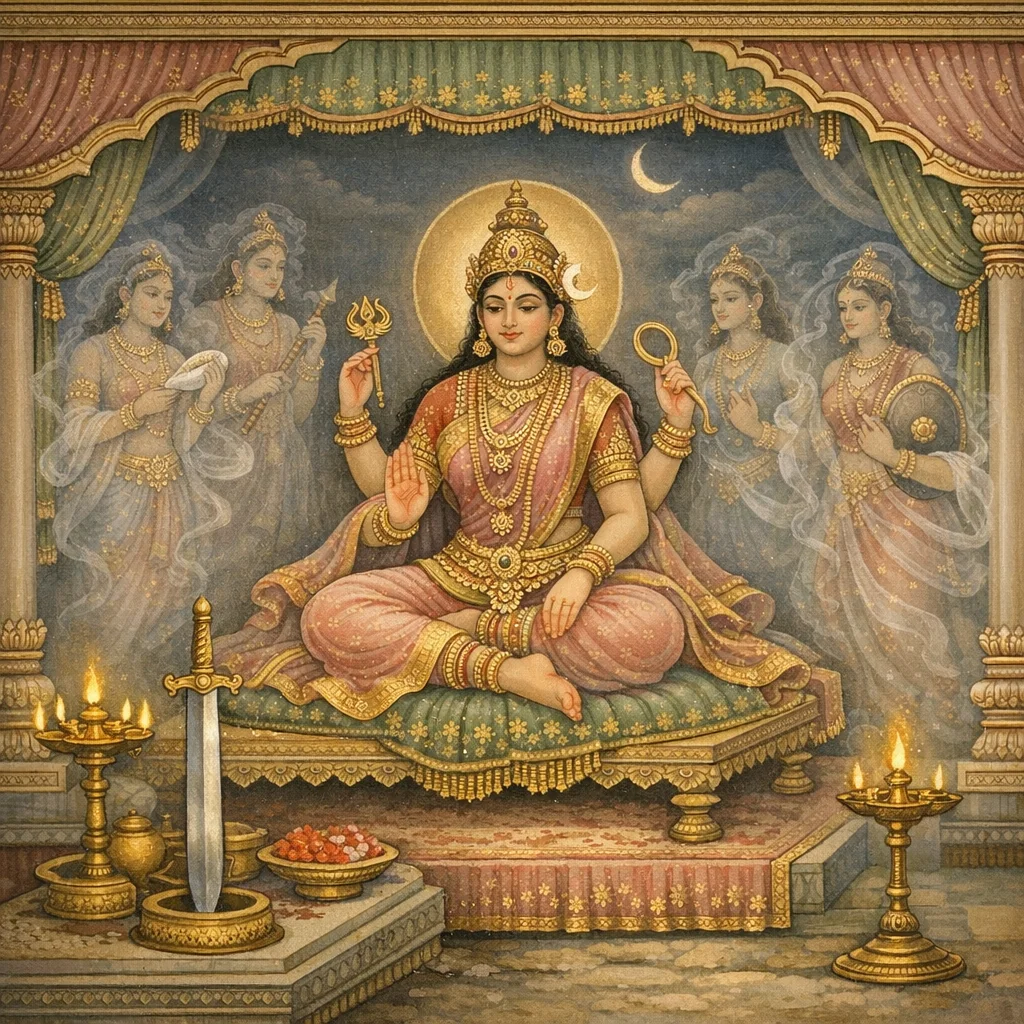
Īśvara tells Mahādevī the origin and ritual import of the goddess Yogeśvarī, abiding on the eastern side of the sacred Prabhāsa field. The fearsome asura Mahiṣa, empowered by shape-shifting and domination, threatens the three worlds. Brahmā creates an incomparable maiden who performs severe austerities; Nārada meets her, is captivated by her beauty, and—refused because she keeps a maiden’s vow—goes to Mahiṣa and speaks of her. Mahiṣa tries to coerce the ascetic maiden into marriage; she laughs, and from her breath arise weapon-bearing female forms that destroy his army. When Mahiṣa attacks, the climactic battle ends with the goddess subduing and killing him, even beheading him. The gods praise her with a hymn proclaiming her the universal power—vidyā/avidyā, victory, and protection—and beg her to dwell forever in this kṣetra, granting boons to worshippers. The chapter then lays down the Āśvina Śukla festival: fasting and darśana on Navamī for the destruction of sin; morning recitation for fearlessness; and an elaborate nocturnal worship of a consecrated sword (khaḍga) with mantras, pavilion, fire-rite, procession, vigil, offerings, bali to directional deities and spirits, and a royal chariot-circuit of Yogeśvarī. It concludes with assurances of protection for practitioners—especially resident Brāhmaṇas—presenting the festival as an auspicious communal rite that removes obstacles.
Shlokas
Verse 1
ईश्वर उवाच । ततो गच्छेन्महादेवि तस्य पूर्वेण संस्थिताम् । योगेश्वरीं महादेवीं योगसिद्धिफलप्रदाम्
Īśvara said: Then, O Great Goddess, one should go to the great Goddess Yogeśvarī, who abides to the east of that place and bestows the fruits of yogic attainments.
Verse 2
तदुत्पत्तिं प्रवक्ष्यामि शृणु श्रद्धासमन्विता । पुरा दानवशार्दूलो महिषाख्यो महाबलः
I shall now recount her origin; listen with faith. Long ago there was a tiger among the Dānavas—the mighty one named Mahiṣākha, of great strength.
Verse 3
बभूव प्रवरो देवि सर्वदेवभयंकरः । कामरूपी स लोकांस्त्रीन्वशीकृत्वाऽभवत्सुखी
He became foremost, O Goddess, terrifying to all the gods. Able to assume forms at will, he brought the three worlds under his control and dwelt in ease.
Verse 4
कस्मिंश्चिदथ काले तु ब्रह्मणा लोककारिणा । सृष्टा मनोहरा कन्या रूपेणाप्रतिमा दिवि
Then, at a certain time, Brahmā—the maker of worlds—created in heaven a captivating maiden, unmatched in beauty.
Verse 5
अतपत्सा तपो घोरं कन्या रूपवती सती । नारदेन ततो दृष्टा सा कदाचिद्वरानने
That virtuous, beautiful maiden undertook fierce austerities. Then, O fair-faced one, Nārada happened to see her at a certain time.
Verse 6
ततः स सहसा देवि विस्मयं परमं गतः । अहो रूपमहो धैर्यमहो कान्तिरहो वयः
Then he, O Goddess, was suddenly seized by the greatest wonder: “Ah, what beauty! Ah, what steadfastness! Ah, what radiance! Ah, what youthful vigor!”
Verse 7
इत्येवं चिन्तयंस्तत्र नारीं वचनमब्रवीत् । कुरुष्वात्मप्रदानं मे न मे दारपरिग्रहः । तवाहं दर्शनाद्देवि कामवाणेन पीडितः
Thinking thus, he addressed the maiden: “Give yourself to me. I seek no formal taking of a wife. O goddess-like one, from the very sight of you I am tormented by Kāma’s arrow of desire.”
Verse 8
साऽब्रवीन्न हि मे कार्यं कामधर्मेण सत्तम । कौमारं व्रतमासाद्य साधयिष्ये यथेप्सितम्
She replied: “O best of men, I have no business with the path of passion. Having undertaken the vow of maidenhood, I shall accomplish what I desire (through my vrata).”
Verse 9
न च मन्युस्त्वया कार्यो ह्यस्मिन्नर्थे कथंचन । तस्यास्तद्वचनं श्रुत्वा स मुनिर्नारदः प्रिये
“And in this matter you should not give way to anger at all.” Hearing her words, that sage Nārada (O dear one) …
Verse 10
समुद्रान्तेऽगमद्दिव्यां पुरीं महिषपालिताम् । अर्चितो हि मुनिस्तेन महिषेण महात्मना
At the ocean’s edge he went to a divine city ruled by Mahiṣa. There the sage was truly honored by that great-souled Mahiṣa.
Verse 11
पृष्ट्वा ह्यनामयं देवि दत्त्वा चार्घ्यमनुत्तमम् । सोऽब्रवीत्प्राञ्जलिर्भूत्वा किमागमनकारणम् । ब्रूहि यत्ते व्यवसितं सर्वं कर्त्तास्मि नारद
O goddess, after asking of his well-being and offering the unsurpassed arghya, he spoke with joined palms: “What is the reason for your coming? Tell what you have resolved—I shall do it all, O Nārada.”
Verse 12
अथोवाच मुनिस्तत्र महिषं दानवेश्वरम् । कन्यारत्नं समुत्पन्नं जंबूद्वीपे महासुर
Then the sage spoke there to Mahiṣa, lord of the Dānavas: “O great asura, a jewel-like maiden has arisen in Jambūdvīpa.”
Verse 13
स्वर्गे मर्त्ये च पाताले न दृष्टं न च मे श्रुतम् । तादृग्रूपमहं येन कामबाणवशीकृतः
“In heaven, on earth, or in the netherworlds—such beauty I have neither seen nor even heard of; by that form I have been brought under the sway of Kāma’s arrow.”
Verse 14
स श्रुत्वा वचनं तस्य कामस्योत्पादनं परम् । जगाम यत्र सा साध्वी क्षेत्रे प्राभासिके स्थिता
Hearing his words and being stirred to intense desire, he went to the place where that virtuous woman was dwelling—in the holy field of Prabhāsa.
Verse 15
तामेव प्रार्थयामास बलेन महता वृतः । भार्या भव त्वं मे भीरु भुंक्ष्व भोगान्मनोरमान् । एतत्तपो महाभागे विरुद्धं यौवनस्य ते
Surrounded by a mighty host, he pleaded with her alone: “Be my wife, O timid one; partake with me of delights most pleasing to the heart. O fortunate lady, this austerity runs contrary to your youth.”
Verse 16
तस्य तद्वचनं श्रुत्वा जहास वरवर्णिनी । तस्या हसंत्या देवेशि शतशोऽथ सहस्रशः
Hearing his words, the maiden of exquisite beauty laughed. And as she laughed, O queen of the gods, it resounded in hundreds—indeed in thousands—of ringing peals.
Verse 17
निश्वासात्सहसा नार्यः शस्त्रहस्ता भयानकाः । ताभिर्विध्वंसितं सैन्यं महिषस्य दुरात्मनः
From her very breath, in an instant, sprang forth terrifying warrior-women with weapons in their hands; by them the army of the wicked Mahīṣa was utterly shattered.
Verse 18
तस्मिन्निपात्यमाने तु सैन्ये दानवसत्तमः । क्रोधं कृत्वा ततः शीघ्रं तामेवाभिमुखो ययौ
As that army was being struck down, the foremost of the Dānavas, inflamed with wrath, swiftly advanced straight toward her.
Verse 19
विधुन्वन्स हि ते तीक्ष्णशृंगेऽभीक्ष्णं भयानके । तया सार्धं च सुमहत्कृत्वा युद्धं महासुरः
Shaking his sharp, dreadful horns again and again, that great asura waged a mighty battle with her.
Verse 20
शृंगाभ्यां जगृहे देवीं सा तस्योपरि संस्थिता । पद्भ्यामाक्रम्य शूलेन निहतो दैत्यपुंगवः
He seized the Goddess with his two horns; yet she stood upon him, and trampling him with her feet, slew with her spear that bull-like chief among the daityas.
Verse 21
छिन्ने शिरसि खङ्गेन तद्रूपो निःसृतः पुमान् । रौद्रोऽपि स गतः स्वर्गं दैत्यो देव्यस्त्रपातितः
When his head was severed by the sword, a man-form issued forth from that body; and though fierce, that daitya—struck down by the Goddess’s weapon—went to heaven.
Verse 22
ततो देवगणाः सर्वे महिषं वीक्ष्य निर्जितम् । महेंद्राद्याः स्तुतिं चक्रुर्देव्यास्तुष्टेन चेतसा
Then all the hosts of gods, seeing Mahīṣa defeated, beginning with Mahendra, offered hymns of praise to the Goddess with hearts filled with joy.
Verse 23
देवा ऊचुः । नमो देवि महाभागे गम्भीरे भीमदर्शने । नयस्थिते सुसिद्धांते त्रिनेत्रे विश्वतोमुखि
The gods said: O Goddess, obeisance to you—most fortunate, profound, awe-inspiring in appearance; established in righteous governance, perfect in doctrine, three-eyed, and facing all directions.
Verse 24
विद्याविद्ये जये जाप्ये महिषासुरमर्दिनि । सर्वगे सर्वविद्येशे देवि विश्वस्वरूपिणि
O Goddess—knowledge and even the power that veils it; victory and the sacred japa to be repeated; slayer of Mahīṣāsura; all-pervading, sovereign of all knowledges—O Devī whose form is the universe itself!
Verse 25
वीतशोके ध्रुवे देवि पद्मपत्रायतेक्षणे । शुद्धसत्त्वे व्रतस्थे च चण्डरूपे विभावरि
O Goddess, free from sorrow and unwavering; lotus-petal-eyed; pure in essence, steadfast in sacred vows; fierce in form—O radiant Night!
Verse 26
ऋद्धिसिद्धिप्रदे देवि कालनृत्ये धृतिप्रिये । शांकरि ब्राह्मणि ब्राह्मि सर्वदेवनमस्कृते
O Goddess, bestower of prosperity and accomplishment; the cosmic dance of Time; beloved of steadfastness—Śāṃkarī, Brāhmaṇī, Brāhmī, revered by all the gods!
Verse 27
घंटाहस्ते शूल हस्ते महामहिषमर्दिनि । उग्ररूपे विरूपाक्षि महामायेऽमृते शिवे
O Goddess, bearing the bell in one hand and the trident in another; great slayer of the mighty buffalo-demon; fierce in form, wide-eyed—O Great Illusion, O Deathless One, O auspicious Śivā!
Verse 28
सर्वगे सर्वदे देवि सर्वसत्त्वमयोद्भवे । विद्यापुराणशल्यानां जननि भूतधारिणि
O Goddess who moves everywhere, Deity of all and giver of all; who arises as the very essence of all beings; Mother of the teachings and the Purāṇas; bearer and sustainer of all creatures!
Verse 29
सर्वदेवरहस्यानां सर्वसत्त्ववतां शुभे । त्वमेव शरणं देवि विद्याऽविद्ये श्रियेऽश्रिये
O Auspicious One, you are the secret essence of all the gods and of all living beings. You alone are the refuge, O Devī—both as knowledge and as ignorance, as fortune and as misfortune.
Verse 30
एवं स्तुता सुरैर्देवि प्रणम्य ऋषिभिस्तथा । उवाच हसती वाक्यं वृणुध्वं वरमुत्तमम्
Thus praised by the gods and likewise bowed to by the sages, the Goddess—smiling—spoke these words: “Choose an excellent boon.”
Verse 31
देवा ऊचुः । स्तवेनानेन ये देवि स्तुवन्त्यत्र नरोत्तमाः । ते संतु कामैः संपूर्णा वरवर्षा निरंतरम्
The gods said: “O Devī, may those best of men who praise You here with this hymn be fulfilled in their desires, with an unceasing shower of excellent boons.”
Verse 32
अस्मिन्क्षेत्रे त्वया वासो नित्यं कार्यः शुचिस्मिते
In this sacred kṣetra, may You dwell forever, O You whose smile is pure and radiant.
Verse 33
एवमस्त्विति सा देवी देवानुक्त्वा वरानने । विसृज्य ऋषिसंघांश्च तत्रैव निरताऽभवत्
“So be it,” said the Goddess, O fair-faced one; having spoken thus to the gods and dismissing the assemblies of sages, she remained engaged right there.
Verse 34
आश्वयुक्छुक्लपक्षस्य नवम्यां यो वरानने । उपवासपरो भूत्वा तां प्रपश्यति भक्तितः । तस्य पापं क्षयं याति तमः सूर्योदये यथा
O fair-faced one, whoever on the ninth day of the bright fortnight of Āśvayuja, devoted to fasting, beholds her with devotion—his sin perishes, just as darkness vanishes at sunrise.
Verse 35
य एतत्पठति स्तोत्रं प्रातरुत्थाय मानवः । न भीः संपद्यते तस्य यावज्जीवं नरस्य वै
The man who, rising in the morning, recites this sacred hymn—fear does not befall him for as long as he lives.
Verse 36
आश्वयुक्छुक्लपक्षे या अष्टमी मूलसंयुता । सा महानामिका प्राणा येषां तस्यां गताः शुभे
O Auspicious One, the eighth day in the bright fortnight of Āśvayuja, when joined with the Mūla nakṣatra, is called “Mahānāmikā”. Blessed are those whose life-breath departs on that day.
Verse 37
तेषां स्वर्गे ध्रुवं वासो वीरास्तेऽप्सरसां प्रियाः
For those heroes, residence in heaven is assured; they become beloved of the Apsarās.
Verse 38
मन्वन्तरेषु सर्वेषु कल्पादिषु सुरेश्वरि । एष एव क्रमः प्रोक्तो विशेषं शृणु सांप्रतम्
O Lady of the gods, in all Manvantaras and in the cycles beginning with the Kalpas, this very procedure has been taught. Now hear the special details at present.
Verse 39
आश्वयुक्छुक्लपक्षे या पंचमी पापनाशिनी । तस्यां संपूजयेद्रात्रौ खड्गमंत्रैर्विभूषितम्
On the sin-destroying fifth lunar day in the bright fortnight of Āśvayuja, one should worship at night the sword, adorned and empowered with the sword-mantras.
Verse 40
मंडपं कारयेत्तत्र नवसप्तकरं तथा । प्रागुदक्प्रवणे देशे पताकाभिरलंकृतम् । योगेश्वर्याः संनिधाने विधिना कारयेद्द्विजः
There, the twice-born should have a pavilion built—of the prescribed measure—on ground sloping to the east and north, adorned with banners, and constructed according to rule in the presence of Yogeśvarī.
Verse 41
आग्नेय्यां कारयेत्कुण्डं हस्तमात्रं सुशोभनम् । मेखलात्रयसंयुक्तं योन्याऽश्वत्थदलाभया
In the southeast, one should make a beautiful fire-pit, a cubit in measure, furnished with three enclosing bands, with a yoni-shaped base and marked/adorned with aśvattha leaves.
Verse 42
शास्त्रोक्तं मन्त्रसंयुक्तं होतव्यं पायसं ततः । ततः खड्गं तु संस्नाप्य पंचामृतरसेन वै । पूजयेद्विविधैः पुष्पैर्मंत्रपूर्वं द्विजोत्तमैः
Then, as taught by scripture and accompanied by mantras, one should offer pāyasa into the fire. After that, having bathed the sword with the essence of pañcāmṛta, the best of the twice-born should worship it with various flowers, preceded by mantra-recitation.
Verse 43
अभीर्विशसनं खड्गः प्राणिभूतो दुरासदः । अगम्यो विजयश्चैव धर्माधारस्तथैव च । इत्यष्टौ तव नामानि स्वयमुक्तानि वेधसा
‘Fearless’, ‘Slaying’, ‘Sword’, ‘Living-being’, ‘Unassailable’, ‘Unapproachable’, ‘Victory’, and ‘Support of Dharma’—these are your eight names, spoken of old by the Creator himself.
Verse 44
नक्षत्रं कृत्तिका तुभ्यं गुरुर्देवो महेश्वरः । हिरण्यं च शरीरं ते धाता देवो जनार्दनः । पिता पितामहो देव स्वेन पालय सर्वदा
Your asterism is Kṛttikā; your divine teacher is Maheśvara. Your body is of gold; your sustainer is the god Janārdana. O god, with your own power protect us always—father and grandsire alike.
Verse 45
इति खड्गमन्त्रः । एवं संपूज्य विधिना तं खङ्गं ब्राह्मणोत्तमैः । भ्रामयेन्नगरे रात्रौ नान्दीघोषपुरःसरम्
Thus is the sword-mantra. Having duly worshiped that sword in this manner by the best of brāhmaṇas, one should carry it around the city at night, preceded by auspicious acclamations.
Verse 46
सर्वसैन्येन संयुक्तस्तत्र ब्राह्मणपुंगवैः । एवं कृत्वा विधानं तु पुनर्योगेश्वरीं नयेत् । उच्चार्य मन्त्रमेवं वै खङ्गं तस्यै समर्पयेत्
Accompanied by the entire army and by eminent brāhmaṇas, having thus completed the prescribed rite, one should then return to Yogeśvarī. Reciting the mantra in this manner, one should offer the sword to her.
Verse 47
अञ्जनेन समालेख्य चन्दनेन विलेपितम् । बिल्वपत्रकृतां मालां तस्यै देव्यै निवेदयेत्
Having adorned (the image) with collyrium and anointed it with sandal-paste, one should offer to that Goddess a garland fashioned from bilva leaves.
Verse 48
दुर्गे दुर्गार्तिहे देवि सर्व दुर्गतिनाशिनि । त्राहि मां सर्वदुर्गेषु दुर्गेऽहं शरणं गतः
O Durgā—O Goddess who removes the pain of distress, destroyer of every evil destiny—protect me in all dangers. O Durgā, I have come to you for refuge.
Verse 49
दत्त्वैवमर्घ्यं देवेशि तत्र खङ्गं च जागृयात् । नित्यं संपूज्य विधिना अष्टम्यां यावदेव हि
Having thus offered arghya, O Sovereign Goddess, one should then keep vigil over the sword there, worshipping it daily according to rule—up to and including the Aṣṭamī day.
Verse 50
तद्रात्रौ जागरं कृत्वा प्रभाते ह्यरुणोदये । पातयेन्महिषान्मेषानग्रतो गतकंधरान्
Keeping vigil through that night, at dawn when the horizon reddens with sunrise, one should have buffaloes and rams—set before the Deity with their necks bared—struck down as offerings.
Verse 51
शतमर्धशतं वापि तदर्धार्धं यथेच्छया । सुरासवभृतैः कुंभैस्तर्पयेत्परमेश्वरीम्
A hundred, or fifty, or even half of that again—as one wishes—using jars filled with surā and āsava (liquor and fermented drink), one should perform tarpaṇa to the Supreme Goddess, Parameśvarī.
Verse 52
कापालिकेभ्यस्तद्देयं दासीदासजने तथा । ततोऽपराह्नसमये नवम्यां स्यन्दने स्थिताम्
That offering should be given to Kāpālika ascetics, and likewise to maidservants and servants. Then, in the afternoon on Navamī, the Goddess should be placed upon a chariot.
Verse 53
योगेशीं भ्रामयेद्राष्ट्रे स्वयं राजा स्वसैन्यवान् । नदद्भिः शंखपटहैः पठद्भिर्बटुचारणैः
The king himself, accompanied by his army, should lead Yogeśī in procession throughout the realm, with resounding conches and kettle-drums, and with young students and bards reciting praises.
Verse 54
भूतेभ्यश्च बलिं दद्यान्मंत्रेणानेन भामिनि । सरक्तं सजलं सान्नं गन्धपुष्पाक्षतैर्युतम्
And to the bhūtas (spirits) one should offer bali with this mantra, O radiant one—an offering with blood, with water, with food, accompanied by fragrance, flowers, and akṣata (unbroken grains of rice).
Verse 55
त्रीन्वारांस्तु त्रिशूलेन दिग्विदिक्षु क्षिपेद्बलिम् । बलिं गृह्णन्त्विमे देवा आदित्या वसवस्तथा
Three times, with the trident, one should cast the bali into the directions and the intermediate directions. “May these gods accept the bali—likewise the Ādityas and the Vasus.”
Verse 56
मरुतोऽथाश्विनौ रुद्राः सुपर्णाः पन्नगा ग्रहाः । सौम्या भवंतु तृप्ताश्च भूताः प्रेताः सुखावहाः
May the Maruts, the Aśvins, the Rudras, the Suparṇas, the serpents, and the grahas (seizing forces) be gentle and satisfied; and may the bhūtas and pretas, being content, bring well-being.
Verse 57
य एवं कुर्वते यात्रां ब्राह्मणाः क्षेत्रवासिनः । न तेषां शत्रवो नाग्निर्न चौरा न विनायकाः । विघ्नं कुर्वंति देवेशि योगेश्वर्याः प्रसादतः
O Goddess, those brāhmaṇas who reside in this sacred kṣetra and thus perform the pilgrimage are not afflicted by enemies—nor by fire, nor by thieves, nor by obstructing forces; for by the grace of Yogeśvarī, no hindrance is able to arise for them.
Verse 58
सुखिनो भोगभोक्तारः सर्वातंकविवर्जिताः । भवन्ति पुरुषा भक्ता योगेश्वर्या निरंतरम्
They become happy, enjoyers of rightful pleasures, free from every affliction—those people who remain constant devotees of Yogeśvarī.
Verse 59
इत्येष ते समाख्यातो योगेश्वर्या महोत्सवः । पठतां शृण्वतां चैव सर्वाशुभविनाशनः
Thus has the great festival of Yogeśvarī been explained to you; and for those who recite it and those who hear it, it becomes the destroyer of all inauspiciousness.
Verse 60
शूलाग्रभिन्नमहिषासुरपृष्ठपीठामुत्खातखड्ग रुचिरांगदबाहुदंडाम् । अभ्यर्च्य पंचवदनानुगतं नवम्यां दुर्गां सुदुर्गगहनानि तरंति मर्त्याः
Mortals who, on Navamī, the ninth lunar day, duly worship Goddess Durgā—whose throne is set upon the back of the buffalo-demon Mahiṣāsura split by the tip of her trident, whose arm is adorned with a splendid armlet and who raises the sword aloft—cross beyond even the most impenetrable and perilous hardships.
Verse 83
इति श्रीस्कान्दे महापुराण एकाशीति साहस्र्यां संहितायां सप्तमे प्रभासखण्डे प्रथमे प्रभासक्षेत्रमाहात्म्ये योगेश्वरीमाहात्म्यवर्णनंनाम त्र्यशीतितमोऽध्यायः
Thus ends the eighty-third chapter, entitled “The Description of the Greatness of Yogeśvarī,” in the Prabhāsa-khaṇḍa, within the Prabhāsa-kṣetra-māhātmya, of the Śrī Skanda Mahāpurāṇa, in the Saṁhitā of eighty-one thousand verses.