Adhyaya 108
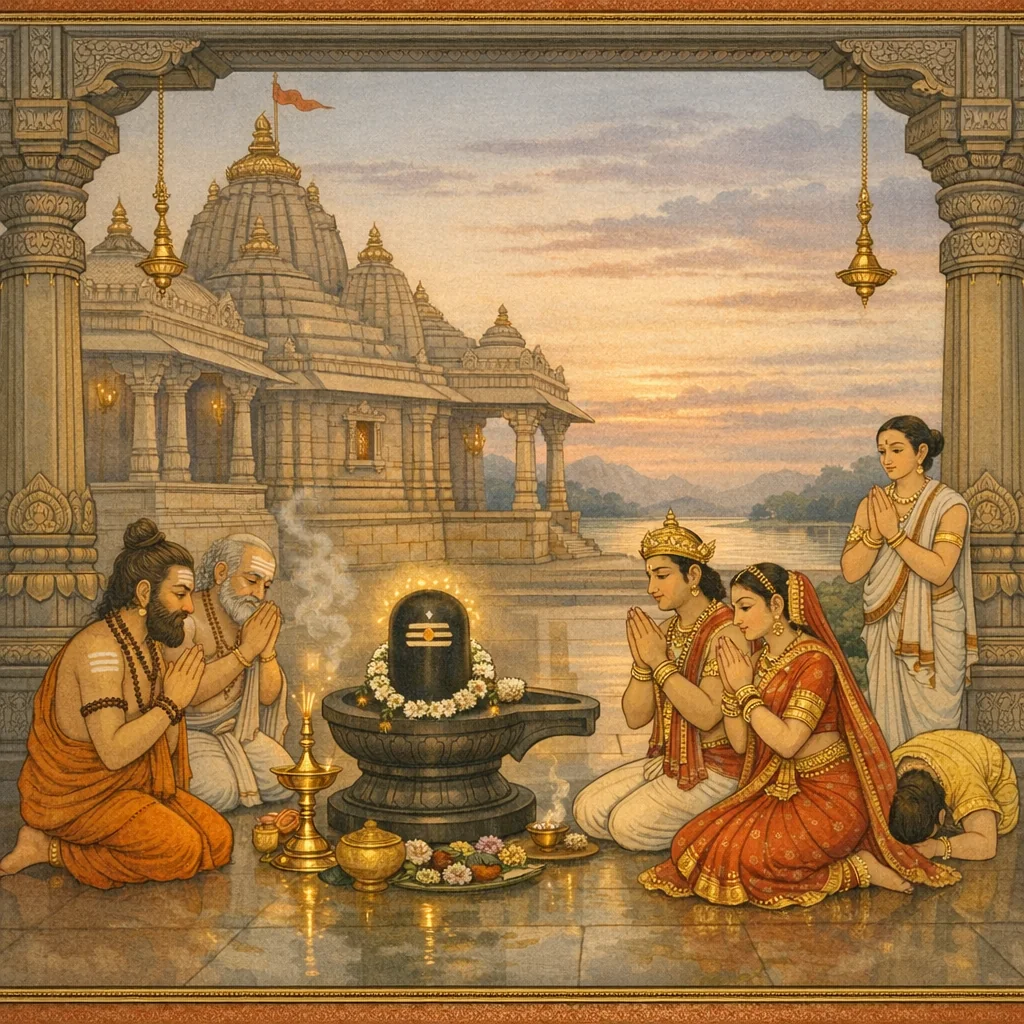
Īśvara instructs Devī to go to an eminent liṅga of the Vasus, situated in the Somnātha/Īśāna directional sector at a measured distance. This four-faced liṅga, beloved of the gods, is called Pratyūṣeśvara and is praised as a remover of great sins; mere darśana is said to destroy sins accumulated across seven births. When Devī asks who Pratyūṣa is and how the liṅga was established, Īśvara recounts the lineage: Dakṣa, son of Brahmā, gives his daughters (including Viśvā) in alliance to Dharma; Viśvā bears eight sons—the eight Vasus: Āpa, Dhruva, Soma, Dhara, Anala, Anila, Pratyūṣa, and Prabhāsa. Desiring a son, Pratyūṣa comes to Prabhāsa, recognizes it as a wish-fulfilling sacred kṣetra, installs Mahādeva, and performs tapas for a hundred divine years with concentrated meditation. Pleased, Mahādeva grants him a son, Devala, lauded as a foremost yogin; hence the liṅga becomes known as Pratyūṣeśvara. The chapter also gives ritual assurances: the childless who worship here gain enduring continuity of lineage; worship at dawn (pratyūṣa) with steady devotion destroys even severe sins, including those connected with brahmahatyā. For full pilgrimage fruit it prescribes gifting a bull (vṛṣa-dāna) and keeping a Māgha kṛṣṇa caturdaśī night vigil (jāgaraṇa), said to yield the merit of all gifts and sacrifices.
Shlokas
Verse 1
ईश्वर उवाच । ततो गच्छेन्महादेवि वसूनां लिंगमुत्तमम् । सोमेशादीशदिग्भागे पञ्चाशद्धनुषान्तरे
Īśvara said: Then, O great Goddess, one should go to the excellent Liṅga of the Vasus. It lies to the northeast of Someśa, at a distance of fifty bow-lengths.
Verse 2
स्थितं लिंगं महादेवि चतुर्वक्त्रं सुरप्रियम् । प्रत्यूषेश्वरनामानं महापातकनाशनम्
O Great Goddess, here stands a liṅga of the Great Lord—four-faced and beloved of the gods—named Pratyūṣeśvara, the destroyer of great sins.
Verse 3
दर्शनात्तस्य देवस्य सप्तजन्मान्तरोद्भवम् । पापं प्रणाशमायाति सत्यंसत्यं वरानने
By merely beholding that Lord, sin arising from seven successive births comes to destruction—this is truth, truth indeed, O fair-faced one.
Verse 4
देव्युवाच । कोऽसौ प्रत्यूषनामेति कथं लिंगं प्रतिष्ठितम् । कस्य पुत्रः स विख्यात एतन्मे वद शंकर
The Goddess said: Who is he known as Pratyūṣa? How was this liṅga established? Whose son is this celebrated one? Tell me this, O Śaṅkara.
Verse 5
ईश्वर उवाच । दक्षो ब्रह्मसुतो देवि प्रजापतिरिति स्मृतः । तस्य कन्याः पुरा षष्टिर्ददौ धर्माय वै दश
Īśvara said: O Goddess, Dakṣa—Brahmā’s son—is remembered as a Prajāpati. In ancient times, of his sixty daughters, he gave ten to Dharma.
Verse 6
तासां मध्ये महादेवि एका विश्वेति विश्रुता । सा धर्माच्च महादेवि अष्टावजनयत्सुतान्
Among them, O Mahādevī, one was famed as Viśvā; and she, by Dharma, O Mahādevī, bore eight sons.
Verse 7
आपो ध्रुवश्च सोमश्च धरश्चैवाऽनलोऽनिलः । प्रत्यूषश्च प्रभासश्च वसवोऽष्टौ प्रकीर्तिताः
Āpa, Dhruva, Soma, Dhara, Anala, Anila, Pratyūṣa, and Prabhāsa—these are proclaimed as the eight Vasus.
Verse 8
तेषां मध्ये सप्तमोऽसौ प्रत्यूष इति विश्रुतः । स पुत्रकामो देवेशि प्रभासं क्षेत्रमागतः
Among them, the seventh is renowned as Pratyūṣa. Desiring a son, O Lady of the Gods, he came to the holy field of Prabhāsa.
Verse 9
स ज्ञात्वा कामिकं क्षेत्रं प्रतिष्ठाप्य महेश्वरम् । तपश्चचार विपुलं दिव्यं वर्षशतं प्रिये । ध्यायन्देवं महादेवं शान्तस्तद्गतमानसः
Knowing this to be a wish-fulfilling sacred region, he established Maheśvara (a liṅga) and performed vast austerities for a divine hundred years, O beloved—meditating on the Great God, tranquil, with his mind absorbed in Him.
Verse 10
ततस्तुष्टो महादेवस्तस्य भक्त्या निरञ्जनः । ददौ तस्य सुतं देवि देवलं योगिनां वरम्
Then Mahādeva, stainless and pleased by his devotion, granted him a son, O Goddess—Devala, the foremost among yogins.
Verse 11
ततः प्रभृति देवेशि तल्लिंगस्य प्रभावतः । देवलो भगवान्योगी प्रत्यूषस्याऽभवत्सुतः
From that time onward, O Lady of the Gods, by the power of that liṅga, Devala—the venerable yogin—became the son of Pratyūṣa.
Verse 12
अनेन कारणेनासौ प्रत्यूषेश्वरसंज्ञितः
For this very reason, that Lord is renowned by the name Pratyūṣeśvara.
Verse 13
यश्चानपत्यः पुरुषस्तं समाराधयिष्यति । तस्यान्ववाये देवेशि संततिर्न विनश्यति
And whatever man is without offspring, if he duly worships Him—O Goddess of the Lord—then in his lineage the continuity of progeny will not perish.
Verse 14
यः प्रत्यूषे महादेवि प्रत्यूषेश्वरमुत्तमम् । पूजयिष्यति सद्भक्त्या सततं नियतात्मवान् । तस्यैष्यति क्षयं पापमपि ब्रह्मवधोद्भवम
Whoever, O Great Goddess, at daybreak worships the supreme Pratyūṣeśvara with true devotion—ever disciplined in mind—his sin is brought to destruction, even sin arising from brahma-slaughter.
Verse 15
वृषस्तत्रैव दातव्यः सम्यग्यात्राफलेप्सुभिः
Those who seek the complete fruit of the pilgrimage should, right there, gift a bull as a sacred donation.
Verse 16
माघे कृष्णचतुर्द्दश्यां जागृयात्तत्र वै निशि । सर्वेषां दानयज्ञानां फलं जागरणाल्लभेत्
On the dark fourteenth day of Māgha, one should keep vigil there through the night; by that night-vigil one gains the fruit of all gifts and sacrifices.
Verse 108
इति श्रीस्कांदे महापुराण एकाशीतिसाहस्र्यां संहितायां सप्तमे प्रभासखंडे प्रथमे प्रभाससक्षेत्रमाहात्म्ये प्रत्यूषेश्वरमाहात्म्यवर्णनंनामाष्टोत्तरशततमोऽध्यायः
Thus ends the one-hundred-and-eighth chapter, called “The Description of the Greatness of Pratyūṣeśvara,” in the first Prabhāsa Kṣetra Māhātmya, within the seventh Prabhāsa Khaṇḍa of the Śrī Skanda Mahāpurāṇa, in the eighty-one-thousand-verse Saṃhitā.