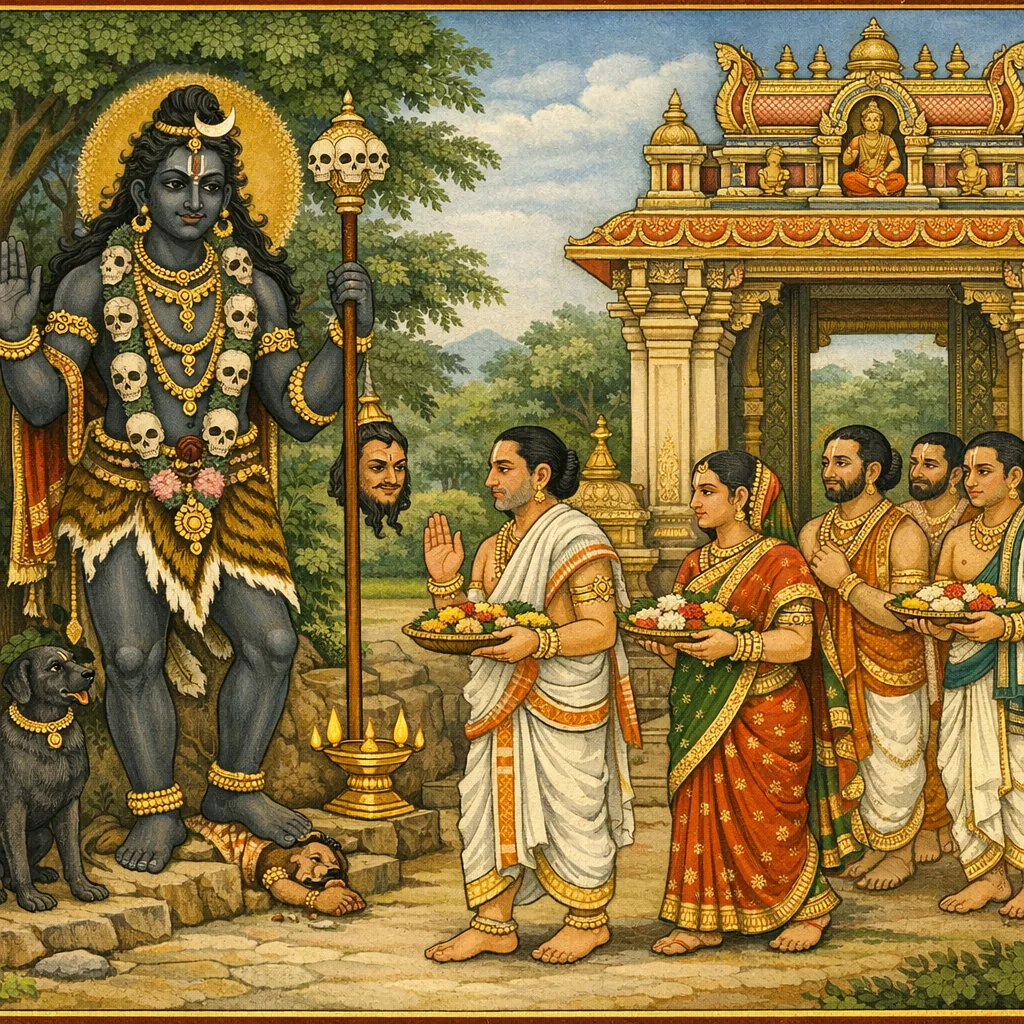
Adhyaya 137
This chapter, spoken in an Īśvara-authorized voice, proclaims Kaṅkāla Bhairava as the eminent kṣetrapāla (guardian) of the sacred territory, appointed by Bhairava to protect the kṣetra and to restrain or counter the harmful intentions of beings of perverted disposition. It then sets the proper times for worship—Śrāvaṇa, bright fifth lunar day, and Āśvina, bright eighth—along with a simple offering order: bali and flowers presented with devotion. For devotees dwelling within the kṣetra, this worship is said to remove obstacles (nirvighna) and grant a protective care likened to tending one’s own child, embedding a local ritual protocol within the wider sacred geography of pilgrimage guardianship.
Shlokas
Verse 1
ईश्वर उवाच । तत्रैव संस्थितं पश्येत्क्षेत्रपालमनुत्तमम् । कंकालभैरवंनाम भैरवेण नियोजितम् । तस्य क्षेत्रस्य रक्षार्थं प्राणिनां दुष्टचेतसाम्
Īśvara said: There itself one should behold the unsurpassed guardian of the sacred field—named Kaṃkālabhairava—appointed by Bhairava to protect that holy region from beings of wicked intent.
Verse 2
श्रावणे शुक्लपञ्चम्यामष्टम्यामाश्विनस्य च । यस्तं पूजयते भक्त्या बलिपुष्पादिभिः क्रमात्
In Śrāvaṇa on the bright fifth, and in Āśvina on the eighth as well—whoever worships him with devotion, offering bali and flowers and the like in proper order—
Verse 3
तस्य क्षेत्रे निवसतः पुष्करस्य महात्मनः । निर्विघ्नकारी भवति तथा रक्षति पुत्रवत्
For the great-souled Puṣkara dwelling in that sacred region, he becomes the remover of obstacles—and he protects him as a son.
Verse 137
इति श्रीस्कांदे महापुराण एकाशीतिसाहस्र्यां संहितायां सप्तमे प्रभास खण्डे प्रथमे प्रभासक्षेत्रमाहात्म्ये कंकालभैरवक्षेत्रपालमाहात्म्यवर्णनंनाम सप्तत्रिंशदुत्तरशततमोऽध्यायः
Thus ends the one-hundred-and-thirty-seventh chapter, called “The Description of the Greatness of Kaṃkālabhairava, the Guardian of the Sacred Field,” in the first part, the Prabhāsa-kṣetra-māhātmya, of the seventh book, the Prabhāsa Khaṇḍa, of the venerable Skanda Mahāpurāṇa (the Saṃhitā of eighty-one thousand verses).