Adhyaya 98
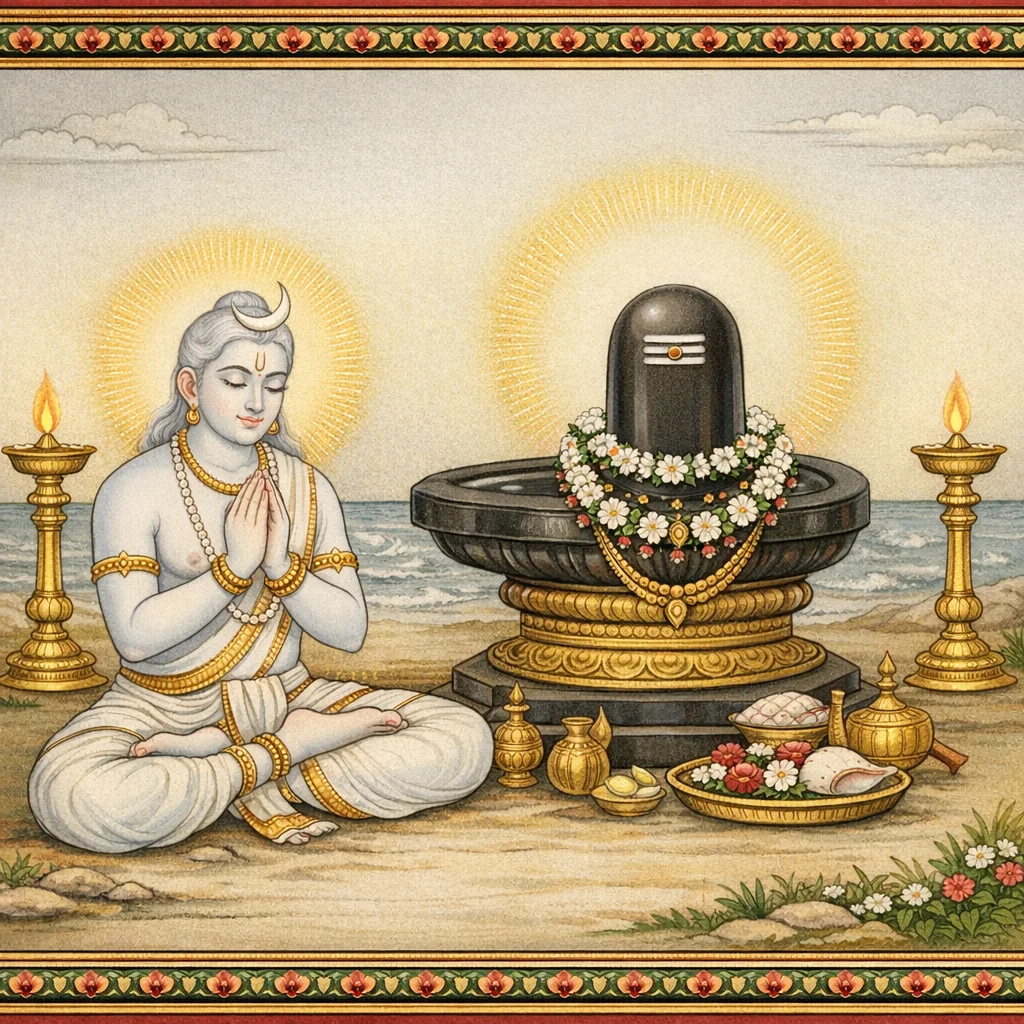
This chapter unfolds as a dialogue: Devī asks why a certain liṅga is called Pṛthvīśvara and later becomes known as Candreśvara. Īśvara replies with a sin-destroying, purificatory account set across cosmic time, declaring that the liṅga has been renowned since earlier yugas and manvantaras and is established in the Prabhāsa region with clear directional and distance markers. The narrative then tells of the Earth, oppressed by the burden of daityas, assuming the form of a cow and wandering until she reaches Prabhāsa-kṣetra. There she vows to install a liṅga and performs fierce austerities for a hundred years; Rudra is pleased, assures her that Viṣṇu will remove the daityas, and proclaims the liṅga famous as Dharitrī/Pṛthvīśvara. The phalaśruti adds that worship on Bhādrapada kṛṣṇa tṛtīyā yields merit equal to vast sacrifices; the surrounding tract is a liberating field, and even an inadvertent death within it leads to the “supreme state.” In the second arc, set in the Varāha-kalpa, the Moon—afflicted by Dakṣa’s curse—falls to earth, reaches Prabhāsa by the ocean, and worships Pṛthvīśvara for a thousand years. He regains brilliance and purification, and the liṅga becomes known as Candreśvara. The chapter concludes that hearing this māhātmya removes impurities and supports health.
Shlokas
Verse 1
ईश्वर उवाच । ततो गच्छेन्महादेवि चंडेश्वरमिति श्रुतम् । सोमेशाद्वायवे भागे धनुषां षष्टिभिः स्थितम्
Īśvara said: Then, O Great Goddess, one should go to the shrine known as Caṇḍeśvara. It is situated at a distance of sixty dhanuṣ from Someśvara, in the direction of Vāyu.
Verse 2
दिव्यं लिंगं महादेवि सर्वपातकनाशनम् । तत्पूर्वे तु युगे ख्यातं मनोः स्वायंभुवांतरे
O Great Goddess, this is a divine liṅga, the destroyer of every sin. In the former age it was renowned—during the Manvantara of Svāyambhuva Manu.
Verse 3
त्रेतायुगमुखे देवि पृथिव्या संप्रतिष्ठितम् । पूर्वमन्वंतरे चास्मिंल्लिङ्गं पृथ्वीश्वरं प्रिये
At the dawn of the Tretā-yuga, O Goddess, it was established by the Earth. And in this earlier Manvantara, beloved, the liṅga was known as Pṛthvīśvara.
Verse 4
पुनश्चंद्रेण तत्प्राप्तं लिंगं चंद्रेश्वरं प्रिये । ब्रह्महत्यादिपापानां नाशनं पुण्यवर्द्धनम्
Again, beloved, that liṅga was obtained by the Moon and became known as Candreśvara. It destroys sins beginning with brahmahatyā and increases merit.
Verse 5
तं दृष्ट्वा मानवो देवि सप्तजन्मसमुद्भवैः । मुच्यते कल्मषैः सर्वैः कृतकृत्यस्तु जायते
O Goddess, by merely beholding it, a person is freed from all impurities accumulated across seven births, and becomes one whose life’s purpose has been fulfilled.
Verse 6
देव्युवाच । कथं पृथ्वीश्वरं ख्यातं तल्लिंगं पाप नाशनम् । कथं पुनः समाख्यातं चन्द्रेश्वरमिति प्रभो । एतद्विस्तरतो ब्रूहि श्रोतुकामाहमादरात्
The Goddess said: How did that sin-destroying liṅga become famed as Pṛthvīśvara? And how again was it spoken of as Candreśvara, O Lord? Tell me this in detail—I wish to hear it with reverence.
Verse 7
ईश्वर उवाच । शृणु देवि प्रवक्ष्यामि कथा पापप्रणाशिनीम् । यां श्रुत्वा मुच्यते जंतुस्त्रिविधैः कर्मबन्धनैः
Īśvara said: Listen, O Goddess; I shall proclaim a tale that destroys sin. Hearing it, a being is freed from the threefold bonds of karma.
Verse 8
आसीत्पूर्वं महादेवि दैत्यभारार्द्दिता मही साऽधो व्रजंती सहसा गोरूपा संबभूव ह
Formerly, O Great Goddess, the Earth was crushed beneath the burden of the daityas. As she was sinking downward, suddenly she assumed the form of a cow.
Verse 9
इतस्ततो धावमाना न लेभे निर्वृतिं क्वचित् । ततो वर्षशते पूर्णे भ्रममाणा क्वचित्क्वचित्
Running here and there, she found peace nowhere at all. Then, after a full hundred years had passed, she continued to wander from place to place.
Verse 10
आससाद महाक्षेत्रं प्रभासमिति विश्रुतम् । देवदानवगंधर्वैः सेवितं पापनाशनम्
She reached the great sacred field renowned as Prabhāsa—served and honored by gods, dānavas, and gandharvas—a destroyer of sin.
Verse 11
तत्र स्थित्वा महाक्षेत्रे कृत्वा मनसि निश्चयम् । लिंगं प्रतिष्ठयामास भक्त्या परमया युता
Staying there in that great sacred region, and forming a firm resolve in her heart, she installed a liṅga, endowed with supreme devotion.
Verse 12
वर्षाणां च शतं साग्रं कृते तपसि दुश्चरे । तुतोष भगवान्रुद्रो धरित्रीं वाक्यमब्रवीत्
When a little more than a hundred years had been spent in arduous austerity, Lord Rudra was pleased and spoke words to Dharitrī, the Earth.
Verse 13
देवि विश्वंभरे सर्वं तपः सुचरितं त्वया । मा शोकं कुरु कल्याणि भविष्यति तवेप्सितम्
“Goddess, bearer of the universe, you have performed this austerity well. Do not grieve, auspicious one—what you desire shall surely come to pass.”
Verse 14
दैत्या नाशं गमिष्यंति विष्णुना निहता भुवि । भवित्री त्वं महादेवि दैत्यभारविवर्जिता
“The daityas will meet destruction, slain upon the earth by Viṣṇu. And you, great Goddess, shall be freed from the burden of the daityas.”
Verse 15
इदं त्वया स्थापितं यल्लिंगं परमशोभनम् । धरित्रीनाम्ना विख्यातं लोके ख्यातिं गमिष्यति
“This supremely radiant liṅga that you have established will become renowned in the world, celebrated by the name ‘Dharitrī’.”
Verse 16
अत्राहं संस्थितो नित्यं लिंगरूपी महाप्रभुः । स्थास्यामि कल्पेकल्पे वै नृणां पापापहारकः
“Here I am eternally established as the great Lord in the form of a liṅga. In every age, in every kalpa, I shall remain—removing the sins of human beings.”
Verse 17
मूर्त्यष्टकसमायुक्तो लिंगे ऽस्मिन्संस्थितः सदा । नृणां नाशयिता पापं पूर्वजन्मशतार्जितम्
“United with the eight divine manifestations, I am ever present in this liṅga, destroying for human beings the sins accumulated over hundreds of previous births.”
Verse 18
भाद्रे कृष्णतृतीयायां यश्चैतं पूजयिष्यति । सोऽश्वमेधसहस्रस्य फलमाप्स्यत्यसंशयम्
“Whoever worships this (liṅga) on the third lunar day of the dark fortnight in Bhādrapada will, without doubt, obtain the merit equal to a thousand Aśvamedha sacrifices.”
Verse 19
सर्वतीर्थाभिषेकस्य सर्वेषां दानकर्मणाम् । भविष्यति फलं तस्य लिंगस्यैवास्य पूजनात्
By worshipping this very Liṅga, one attains the same fruit that would arise from ritual bathing at all sacred tīrthas and from every kind of charitable gift.
Verse 20
धनुषां षोडशं यावत्समंतात्परिमंडलम् । क्षेत्रमस्य समाख्यातं प्राणिनां मुक्तिदायकम्
This sacred field is declared to extend in a circle on all sides for sixteen dhanu-lengths, and it bestows liberation upon living beings.
Verse 21
तस्मिन्मृताः प्राणिनो ये कामतो वाप्यकामतः । कृमि कीटसमा वापि ते यांति परमां गतिम्
Whatever beings die there—whether intentionally or unintentionally—even if they are like worms or insects, they go to the supreme state.
Verse 22
यो दद्यात्काञ्चनं मेरुं कृत्स्नां वाऽपि वसुन्धराम् । यः पूजयति पृथ्वीशं स तयोरधिकः स्मृतः
Even if one were to give away a golden Mount Meru, or even the whole earth, the one who worships Pṛthivīśa is remembered as greater than both.
Verse 23
ईश्वर उवाच । इति दत्त्वा वरान्देवस्तत्रैवांतरधीयत । पृथिवीश्वरनामाभूत्तत्प्रभृत्येव शंकरः
Īśvara said: “Thus, having granted the boons, the God vanished right there. From that time onward, Śaṅkara came to be known by the name Pṛthivīśvara.”
Verse 24
पुनरस्मिन्महाकल्पे वाराह इति विश्रुते । कदाचिद्दक्षशापेन क्षीणश्चन्द्रो बभूव ह
Again, in this great aeon renowned as the Vārāha Kalpa, it once happened that the Moon became diminished due to Dakṣa’s curse.
Verse 25
पपात भूतले देवि यक्ष्मणा पीडितः शशी । क्षेत्रं प्रभासमासाद्य तन्महोदधिसंनिधौ
O Goddess, afflicted by consumption (yakṣmā), the Moon fell to the earth; reaching the holy field of Prabhāsa, he remained near the great ocean.
Verse 26
दृष्ट्वा पृथ्वीश्वरं लिंगं सप्रभावं महाप्रभम् । तत्पूजानिरतो भूत्वा वर्षाणां तु सहस्रकम्
Seeing the Pṛthivīśvara Liṅga—mighty in power and of great splendor—he became devoted to its worship for a full thousand years.
Verse 27
अतपत्स तपो रौद्रं शीर्णपर्णांबुभक्षकः । यतः समभवद्दीप्त्या सर्वाह्लादकरः शशी
He performed fierce austerity, living on fallen leaves and water; through it the Moon became radiant again, bringing delight to all.
Verse 28
तल्लिंगस्यैव माहात्म्यात्ततश्चंद्रेश्वरोऽभवत् । तस्य लिंगस्य माहात्म्याच्चंद्रमा गतकल्मषः
By the greatness of that very Liṅga, he then became known as Candreśvara; and by the greatness of that Liṅga, the Moon became free from defilement.
Verse 29
अवाप सिद्धिमत्युग्रां स्पर्शलिंगप्रकाशिनीम् । सोमनाथेति यां प्राहुः प्रसिद्धां लिंगरूपिणीम्
He attained a mighty and extraordinary spiritual accomplishment—she who reveals the glory of the touch-born Liṅga, and who is renowned in the form of a Liṅga, celebrated by the name “Somanātha.”
Verse 30
इति संक्षेपतः प्रोक्तं माहात्म्यं चन्द्रदैवतम् । श्रुतं हरति पापानि तथाऽरोग्यं प्रयच्छति
Thus, in brief, the greatness of the Moon-deity has been declared. When heard, it destroys sins and also grants freedom from disease (good health).
Verse 98
इति श्रीस्कांदे महापुराण एकाशीतिसाहस्र्यां संहितायां सप्तमे प्रभासखण्डे प्रथमे प्रभासक्षेत्रमाहात्म्ये मध्ययात्रायां पृथ्वीश्वर माहात्म्यवर्णनंनामाष्टनवतितमोध्यायः
Thus ends the ninety-eighth chapter, called “The Description of the Greatness of Pṛthvīśvara,” in the Prabhāsa Khaṇḍa—within the first Prabhāsakṣetra Māhātmya, in the section on the Madhya-yātrā, of the Śrī Skanda Mahāpurāṇa, the Saṃhitā of eighty-one thousand verses.