Adhyaya 103
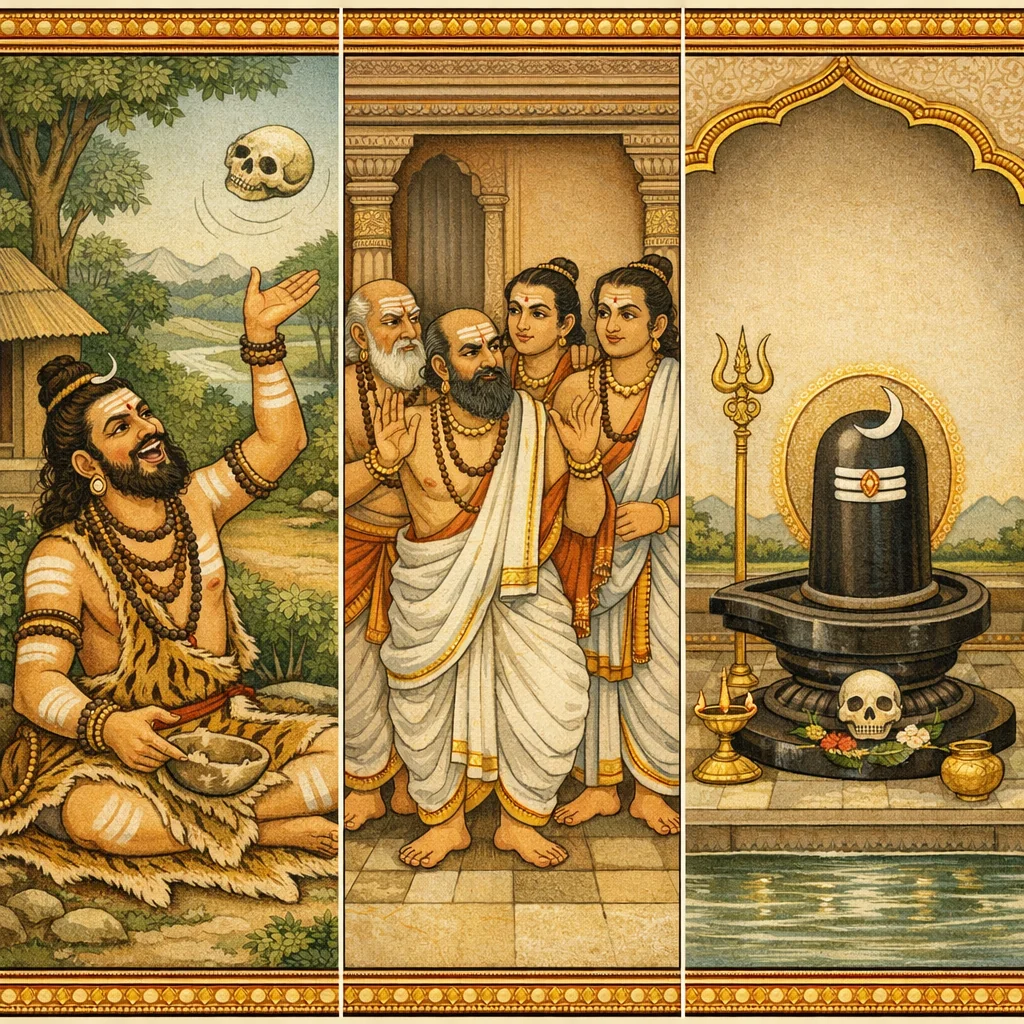
Chapter 103 gives an origin-legend for the sanctity and name of Kapāleśvara in Prabhāsa-kṣetra. Īśvara tells Devī that one should go to the eminent Kapāleśvara shrine to the north, revered even by the divine beings. At Dakṣa’s sacrifice, brāhmaṇas see a dust-covered ascetic carrying a skull (kapāla) and, in ritual indignation, drive him away as unfit for the yajña ground. The figure—implicitly Śaṅkara—laughs, hurls the skull into the sacrificial arena, and vanishes; yet the skull keeps reappearing even when thrown out. Astonished, the sages conclude that only Mahādeva could cause such a marvel, and they propitiate Śiva with hymns and fire-offerings, including Śatarudrīya recitations, until Śiva manifests directly. Granted a boon, the brāhmaṇas ask Śiva to abide there as a liṅga named Kapāleśvara, so called because innumerable skulls recur at that spot. Śiva consents, the sacrifice resumes, and the text declares the merit of darśana: equal to the fruit of an Aśvamedha and cleansing of sins, even those from prior births. It also notes manvantara-based name changes (later Tattveśvara) and reiterates Śiva’s disguised form as the means by which the place is sacralized.
Shlokas
Verse 1
ईश्वर उवाच । ततो गच्छेद्वरारोहे कपालेश्वरमुत्तमम् । तस्या उत्तरदिग्भागे सुरगंधर्वपूजितम्
Īśvara said: Then, O fair-hipped one, one should go to the excellent Kapāleśvara. In its northern quarter it is worshipped by the gods and the Gandharvas.
Verse 2
पुरा यज्ञे वर्त्तमाने दक्षराजस्य धीमतः । उपविष्टेषु विप्रेषु हूयमाने हुताशने
Formerly, when the sacrifice of the wise King Dakṣa was underway—when the Brahmins were seated and oblations were being offered into the fire—(this event occurred).
Verse 3
जीर्णकंथान्वितो देवि मलवान्धूलिधूसरः
O Devī, (he appeared) clad in tattered rags, unclean, and greyed over with dust.
Verse 4
अथ ते ब्राह्मणाः क्रुद्धा दृष्ट्वा तं जाल्मरूपिणम् । कपालधारिणं सर्वे धिक्छब्दैस्तं जगर्हिरे
Then those Brahmins, angered on seeing him in that vile guise—bearing a skull—reviled him with cries of contempt.
Verse 5
असकृत्पापपापेति गच्छगच्छ नराधम । यज्ञवेदिर्न चार्हा हि मानुषास्थिधरस्य ते
Again and again they cried, “Sin! Sin! Go away, go away, you lowest of men! The sacrificial altar is certainly not fit for one who bears human bones.”
Verse 6
अथ प्रहस्य भगवान्यज्ञवेद्यां सुरेश्वरि । क्षिप्त्वा कपालं नष्टोऽसौ न स ज्ञातो मनीषिभिः
Then the Blessed Lord, laughing, hurled a skull-bowl upon the sacrificial altar, O Queen of the gods; and in that very moment he vanished—so that even the wise could not discern where he had gone.
Verse 7
तस्मिन्नष्टे कपालं तत्क्षिप्तं मंडपबाह्यतः । अथान्यत्तत्र संजातं तद्रूपं च वरानने
When he had thus vanished, that skull which had been thrown landed outside the pavilion. Then, O lovely-faced one, another appeared there again, of the very same form.
Verse 8
क्षिप्तंक्षिप्तं पुनस्तत्र जायते च महीतले । एवं शतसहस्राणि प्रयुतान्यर्बुदानि च
Again and again, whenever it was thrown, it would arise there upon the earth. Thus it happened for hundreds of thousands—ten-thousands and even crores of times.
Verse 9
तत्र क्षिप्तानि जातानि ततस्ते विस्मयान्विताः । अथोचुर्मुनयः सर्वे निर्विण्णाश्चास्य चेष्टितम्
There, whatever was cast away kept arising again and again; thus they were filled with wonder. Then all the sages spoke, weary of fathoming his extraordinary divine sport.
Verse 10
कोऽन्यो देवान्महादेवाद्गंगाक्षालितशेखरात् । समर्थ ईदृशं कर्त्तुमस्मिन्यज्ञे विशेषतः
Who among the gods, other than Mahādeva—whose crest is purified by the Gaṅgā—could accomplish such a deed, especially in this sacrifice?
Verse 11
ततस्ते वि विधैः स्तोत्रैः स्तुवंतो वृषभध्वजम् । होमं चक्रुर्मुहुर्वह्नौ मंत्रैस्तैः शतरुद्रियैः
Then they praised the Bull-bannered Lord with many kinds of hymns, and again and again offered oblations into the fire with those Śatarudrīya mantras.
Verse 12
ततः प्रत्यक्षतां प्राप्तस्तेषां देवो महेश्वरः । ततस्ते विविधैः स्तोत्रैस्तुष्टुवुः शूलपाणिनम् । वेदोक्तमंत्रैर्विविधैः पुराणोक्तैस्तथैव च
Then Maheśvara, their God, became directly visible to them. Thereupon they praised the Trident-bearer with many hymns, using diverse mantras taught in the Vedas and likewise those declared in the Purāṇas.
Verse 13
ऋषय ऊचुः । ॐ नमो मूलप्रकृतये अजिताय महात्मने । अनावृताय देवाय निःस्पृहाय नमोनमः
The sages said: “Oṃ—salutations to the Root-Nature, to the Unconquered, the Great-Souled; salutations again and again to the Deva who is unobscured and free from desire.”
Verse 14
नम आद्याय बीजाय आर्षेयाय प्रवर्त्तिने । अनंतराय चैकाय अव्यक्ताय नमोनमः
Salutations to the Primordial, to the Seed of all, to the Sage-like Lord who sets all in motion; salutations again and again to the Infinite, the One, the Unmanifest.
Verse 15
नानाविचित्रभुजगांगदभूषणाय सर्वेश्वराय विरजाय नमो वराय । विश्वात्मने परमकारणकारणाय फुल्लारविंदविपुलायतलोचनाय
Salutations to the Supreme One adorned with wondrous serpent-armlets, to the Lord of all, the stainless and the excellent; salutations to the Soul of the universe, the Cause behind the very cause, whose wide lotus-like eyes are fully blossomed.
Verse 16
अदृश्यमव्यक्तमनादिमव्ययं यदक्षरं ब्रह्म वदंति सर्वगम् । निशाम्य यं मृत्युमुखात्प्रमुच्यते तमादिदेवं शरणं प्रपद्ये
I take refuge in that Primordial God—unseen, unmanifest, beginningless and imperishable—whom the wise declare to be the all-pervading, immutable Brahman. By beholding Him, one is released from the very mouth of Death.
Verse 17
एवं स्तुतस्तदा सर्वैरृषिभिर्गतकल्मषैः । ततस्तुष्टो महादेवस्तेषां प्रत्यक्षतां गतः । अब्रवीत्तानृषीन्देवो वृणुध्वं वरमुत्तमम्
Thus praised by all those sages, whose sins had been washed away, Mahādeva became pleased and manifested before them. The God then said to the ṛṣis: “Choose an excellent boon.”
Verse 18
ब्राह्मणा ऊचुः । यदि तुष्टोऽसि नो देव स्थानेऽस्मिन्निरतो भव । असंख्यातानि यस्माच्च कपालानि सुरेश्वर
The brāhmaṇas said: “If you are pleased with us, O God, then be devoted to this very place. For here, O Lord of the gods, there are countless skulls…”
Verse 19
पुनः पुनः प्रवृत्तानि व्यपनीतान्यपि प्रभो । अस्मिन्नसंशयं स्थाने कपालेश्वरनामभृत्
O Lord, again and again they arise—even when removed. Therefore, without doubt, in this place you should bear the name “Kapāleśvara.”
Verse 20
स्वयं तु लिंगं देवेश तिष्ठेन्मन्वंतरांतरम् । कपालेश्वरनाम्ना त्वमस्मिन्स्थाने स्थितिं कुरु
O Lord of the gods, let your self-manifest liṅga remain here through the intervals of the Manvantaras. Under the name “Kapāleśvara,” establish your abiding presence in this place.
Verse 21
येत्र त्वां पूजयिष्यंति धूपमाल्यानुलेपनैः । तेषां तु परमं स्थानं यद्देवैरपि दुर्लभम्
Those who worship you here with incense, garlands, and sacred unguents shall attain the supreme abode—one difficult to obtain even for the gods.
Verse 22
बाढमित्येवमुक्त्वाऽसौ स्थित स्तत्रमहेश्वरः । पुनः प्रवर्तितो यज्ञो निशानाथस्य भामिनि
Saying, “So be it,” Maheśvara remained established there. Then, O radiant one, the sacrifice of Niśānātha was set in motion again.
Verse 23
तस्मिन्दृष्टे लभेन्मर्त्यो वाजिमेधफलं प्रिये । मुच्यते पातकैः सर्वैः पूर्व जन्मार्ज्जितैरपि
O beloved, merely by beholding Him there, a mortal gains the fruit of an Aśvamedha sacrifice and is freed from all sins—even those accumulated in former births.
Verse 24
इदं माहात्म्यमखिलमभूत्स्वायंभुवांतरे । वैवस्वते पुनश्चान्यद्दक्षयज्ञविनाशकृत्
This entire greatness (of the sacred place) arose in the Svāyambhuva Manvantara; and again, in the Vaivasvata Manvantara, another episode occurred—connected with the destruction of Dakṣa’s sacrifice.
Verse 25
कपालीति महेशानो दक्षेणोक्तः पुरा हरः । तेन यज्ञस्य विध्वंसं कपाली तमथाकरोत् । कपालेश्वरनामेति स्थितोस्मिन्मानवान्तरे
Formerly, Hara—Maheśāna—was addressed by Dakṣa as “Kapālī.” Because of that, Kapālī brought about the destruction of that sacrifice. In this present Manvantara, he is established here under the name “Kapāleśvara.”
Verse 26
अथास्य नाम देवस्य सूर्य सावर्णिकेंऽतरे । भविष्यति वरारोहे नाम तत्त्वेश्वरेति च
And in the Manvantara of Sūrya Sāvarṇi, O fair-hipped Goddess, the name of this deity shall also be “Tattveśvara.”
Verse 27
जाल्मरूपधरो भूत्वा शंकरस्तत्र चागतः
Then Śaṅkara, assuming the form of a jālma (a lowly, disguised figure), came there as well.
Verse 103
इति श्रीस्कांदे महापुराण एकाशीतिसाहस्र्यां संहितायां सप्तमे प्रभासखण्डे प्रथमे प्रभासक्षेत्रमाहात्म्ये मध्ययात्रायां कपालेश्वरमाहात्म्यवर्णनंनाम त्र्यधिकशततमोऽध्यायः
Thus ends the one-hundred-and-third chapter—called “The Description of the Greatness of Kapāleśvara”—in the seventh book, the Prabhāsa Khaṇḍa, within the Prabhāsakṣetra Māhātmya (Madhya-yātrā) of the revered Skanda Mahāpurāṇa, in the eighty-one-thousand-verse Saṃhitā.