Adhyaya 353
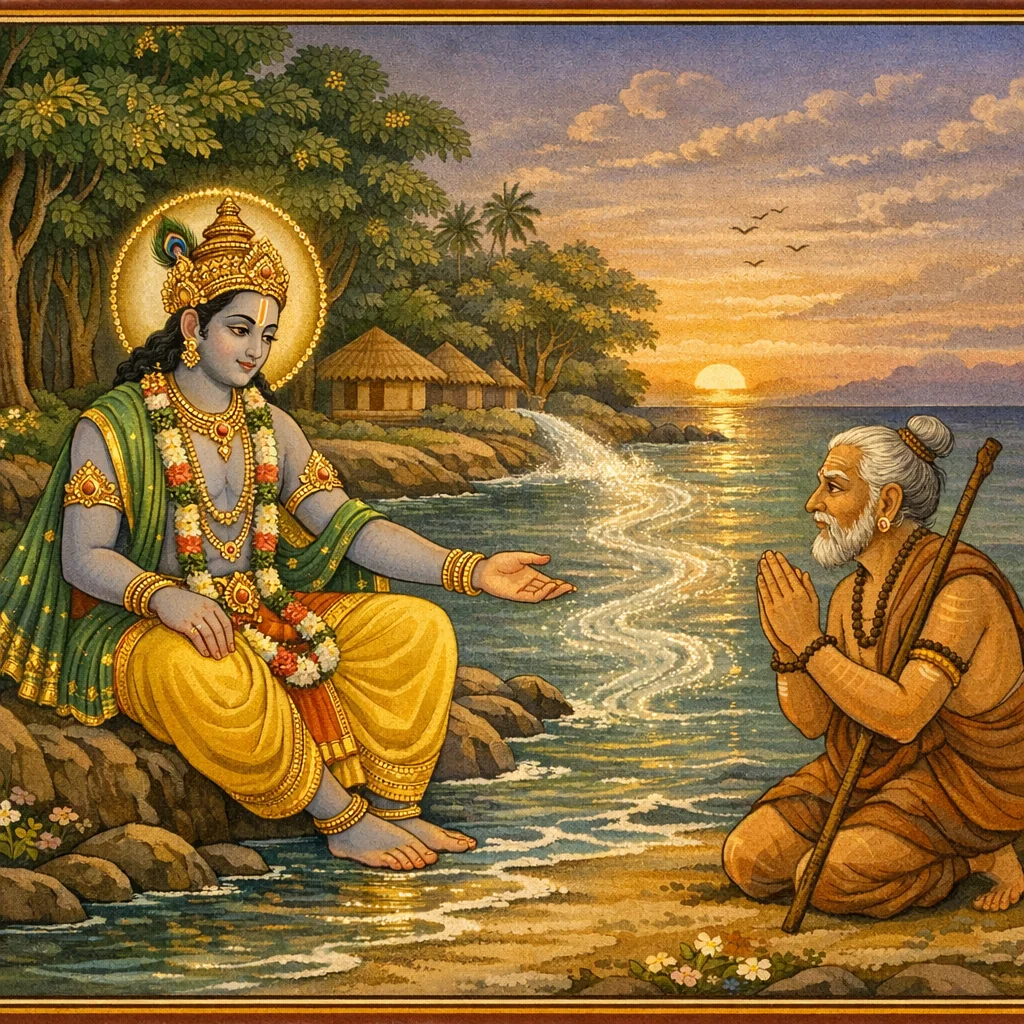
Īśvara speaks to Devī, pointing out an eminent tīrtha called Bhallatīrtha, near Bhallā-tīrtha in the western region by the grove of Mitravana. The chapter proclaims it a Vaiṣṇava ‘ādi-kṣetra’, where Viṣṇu is said to abide in a distinctive way through all yugas, and where Gaṅgā’s presence is described as manifest for the welfare of beings. Ritual timing is stressed: on Dvādaśī (in connection with Ekādaśī discipline) a pilgrim should bathe according to rule, give dāna to worthy brāhmaṇas, perform pitṛ-tarpaṇa/śrāddha with devotion, worship Viṣṇu, keep night vigil, and offer lamp-gifts—acts praised as purifying and merit-bestowing. An origin legend follows: after the Yādavas are withdrawn, Vāsudeva enters meditation by the seashore; a hunter, Jarā, mistaking Viṣṇu’s foot for a deer, releases a bhalla arrow. Realizing the divine form, he begs forgiveness; Viṣṇu declares the deed completes the ending of an earlier curse, grants the hunter ascent, and promises that all who come, behold, and practice bhakti here will attain Viṣṇu’s realm. The tīrtha takes its name from the arrow incident and is also identified as Harikṣetra in earlier cosmic cycles. The chapter closes with ethical boundary-marking: neglect of Vaiṣṇava observances—especially Ekādaśī restraint—is censured, while Dvādaśī worship near Bhallatīrtha is lauded for protective household merit. Those seeking the full fruit of pilgrimage are advised to give gifts such as cloth and cows to leading brāhmaṇas.
Shlokas
Verse 1
ईश्वर उवाच । ततो गच्छेन्महादेवि भल्लतीर्थमनुत्तमम् । तस्याश्च पश्चिमे भागे यत्र विष्णुश्चतुर्भुजः
Īśvara said: “Then, O Great Goddess, one should proceed to the unsurpassed Bhallatīrtha. On its western side is the place where four-armed Viṣṇu is present.”
Verse 2
यत्र त्यक्तं शरीरं तु विष्णुना प्रभविष्णुना । तस्मिन्मित्रवने रम्ये योजनार्द्धार्द्धविस्तृते
“It is there that Viṣṇu—Prabhaviṣṇu—relinquished his body; in that delightful Mitravana, spread across half a yojana in extent.”
Verse 3
युगेयुगे महादेवि कल्पमन्वतरादिषु । तत्रैव संस्थितिर्विष्णोर्नान्यत्र च रतिर्भवेत्
O Great Goddess, age after age—through kalpas, manvantaras, and all such cycles—Viṣṇu’s abiding station is there alone; elsewhere his delight does not arise.
Verse 4
क्षेत्राणामादिक्षेत्रं तु वैष्णवं तद्विदुर्बुधाः । तिस्रः कोट्यर्द्धकोटिश्च तीर्थानां प्रवराणि च
The wise know this Vaiṣṇava domain to be the primal sacred field among all kṣetras. Here are the foremost tīrthas—three crores and a half-crore besides.
Verse 5
दिवि भुव्यंतरिक्षे च तानि तत्रैव भामिनि । तत्र मूर्तिमती गंगा स्वयमेव व्यवस्थिता
O radiant one, those foremost tīrthas of heaven, earth, and mid-space are present there itself. There, Gaṅgā herself stands established in embodied form.
Verse 6
विष्णोः संप्लवनार्थाय प्राणिनां च हिताय वै । गंगा गया कुरुक्षेत्रं नैमिषं पुष्कराणि च
For Viṣṇu’s world-sustaining purpose, and indeed for the welfare of living beings, the powers of Gaṅgā, Gayā, Kurukṣetra, Naimiṣa, and Puṣkara are made present there as well.
Verse 7
पुरी द्वारवतीं त्यक्त्वा अत्रैव वसते हरिः । तस्यौर्ध्वदैहिकं देवि प्रकरोमि युगेयुगे
Having left the city of Dvāravatī, Hari dwells here itself. For him, O Goddess, I perform the ūrdhvadaihika—post-funeral rites—age after age.
Verse 8
नभस्ये द्वादशीयोगे तत्र गत्वा स्वयं प्रिये । करोमि तद्विधानेन तत्र ब्राह्मणपुंगवैः
In the month of Nabhasya, at the auspicious conjunction of Dvādaśī, I go there myself, O beloved, and perform it according to the prescribed rite, together with eminent Brāhmaṇas.
Verse 9
तत्र दत्त्वा तु दानानि विधिवद्वेदपारगे । तत्रैव द्वादशीयोगे स्नात्वा चैव विधानतः
There, having duly given gifts in charity to a Veda-knower according to proper rite, and having bathed there itself on the Dvādaśī observance in the prescribed manner…
Verse 10
सन्तर्प्य च पितॄन्भक्त्या मुच्यते सर्वपातकैः । तत्र विष्णुं तु संपूज्य कृत्वा जागरणं निशि
Having reverently satisfied the Pitṛs (ancestors) with devotion, one is freed from all sins. There, after duly worshipping Viṣṇu, one should keep a night-long vigil.
Verse 11
दीपादिदानं कृत्वा तु कृतकृत्योऽभिजायते
And having performed gifts such as offering lamps, one becomes fulfilled—one who has accomplished what must be done.
Verse 12
अथ तस्य प्रवक्ष्यामि पुरावृत्त महं प्रिये । संहृत्य यादवान्सर्वान्वासुदेवः प्रतापवान्
Now, O beloved, I shall tell you that ancient account: how mighty Vāsudeva, having brought all the Yādavas to their end, proceeded thereafter.
Verse 13
दुर्वाससाऽनुलिप्तेन पायसेन पदस्तले । वज्रांगभूतदेहस्तु सर्वव्यापी जनार्द्दनः
On the sole of His foot was smeared the pāyasa (rice-milk) applied by Durvāsas. Yet Janārdana, all-pervading, bore a body firm as vajra.
Verse 14
गत्वा तीरे समुद्रस्य समाधिस्थो बभूव ह । सर्वस्रोतांसि संयम्य निवेश्यात्मानमात्मनि
Going to the seashore, He entered samādhi. Restraining all currents (of senses and life-breath), He placed the Self within the Self.
Verse 15
एतस्मिन्नंतरे प्राप्तो बाणहस्तो जराभिधः । दाशपुत्रोऽतिकृष्णांगो मत्स्यघाती च पापकृत्
Just then arrived one named Jarā, bow in hand. A fisherman's son, dark of limb, he was a slayer of fish and a doer of sin.
Verse 16
तेन दृष्टस्ततो दूरान्निषादात्मसमुद्भवः । विष्णोः पदं मृगं मत्वा शरं तस्य मुमोच ह
From afar he saw Him—one sprung from the Niṣāda nature—and, mistaking Viṣṇu’s foot for a deer, he released an arrow at Him.
Verse 17
ततोऽसौ पश्यते यावद्गत्वा तस्य च संनिधौ । चतुर्बाहुं महाकायं शंखचक्रगदाधरम्
Then he looked on, and going near, beheld the vast-bodied Lord with four arms, bearing conch, discus, and mace.
Verse 18
पुरुषं नीलमेघाभं पुडरीकनिभे क्षणम् । तं दृष्ट्वा भयभीतस्तु वेपमानः कृतांजलिः । अब्रवीन्न मया ज्ञातस्त्वं विभो दिव्यरूपधृक्
He beheld that Person, dark as a blue rain-cloud, radiant like a lotus. Seeing Him, terrified and trembling, with hands folded in añjali, he said: “I did not recognize You, O Lord, bearer of a divine form.”
Verse 19
अज्ञानात्त्वं मया विद्धस्त्वत्पदाग्रे सुरोत्तम । क्षन्तुमर्हसि मे नाथ न त्वं क्रोद्धुमिहार्हसि
“Out of ignorance I struck You upon the sole of Your foot, O best of the gods. Forgive me, my Lord; You should not grow angry here.”
Verse 20
विष्णुरुवाच । शापस्यांतोद्य मे भद्र शरपातात्कृतस्त्वया । तस्मात्त्वं मत्प्रसादेन स्वर्गं गच्छ महाद्युते
Viṣṇu said: “O noble one, today, by the falling of your arrow, you have brought my curse to its end. Therefore, by my grace, go to heaven, O greatly radiant one.”
Verse 21
ये चान्ये मामिहागत्य द्रक्ष्यंति हि नरोत्तमाः । ते यास्यंति परं स्थानं यत्राहं नित्यसंस्थितः
“And other best of men who come here and behold Me will go to the supreme abode where I ever abide.”
Verse 22
भल्लेनाहं यतो विद्धस्त्वया पादतले शुभे । भल्लतीर्थमिति ख्यातं ततो ह्येतद्भविष्यति
“Because you struck Me with a bhalla-arrow upon the auspicious sole of My foot, this place will therefore become renowned as ‘Bhalla-tīrtha’.”
Verse 23
हरिक्षेत्रमिति प्रोक्तं पूर्वं स्वायंभुवेऽन्तरे
Formerly, in the Svāyambhuva Manvantara, it was proclaimed as “Hari-kṣetra”.
Verse 24
ईश्वर उवाच । इत्युक्त्वांतर्दधे विष्णुर्लुब्धकोऽपि दिवं गतः । येऽत्र स्नानं करिष्यंति भक्त्या परमया युताः । विष्णुलोकं गमिष्यंति प्रीत्या ते मत्प्रसादतः
Īśvara said: “Having spoken thus, Viṣṇu vanished from sight, and the hunter too went to heaven. Whoever bathes here, endowed with supreme devotion, shall joyfully attain Viṣṇu’s world—by my grace.”
Verse 25
येऽत्र श्राद्धं करिष्यंति पितृभक्तिपरायणाः । तृप्तिं तेषां गमिष्यंति पितरश्चैव तर्पिताः
Those who perform śrāddha here, steadfast in reverence for the ancestors, will bring satisfaction to their forefathers; indeed, the Pitṛs will be duly gratified.
Verse 26
तस्मात्सर्वप्रयत्नेन प्राप्य तत्क्षेत्रमुत्तमम् । दृश्यो देवश्चतुर्बाहुः स्नात्वा तीर्थे तु भल्लके
Therefore, with every effort one should reach that excellent sacred region. Having bathed at Bhalla-tīrtha, the four-armed Lord becomes fit to be beheld in auspicious vision.
Verse 27
मद्भक्तिबलदर्पिष्ठा मत्प्रियं न नमंति ये । वासुदेवं न ते ज्ञेया मद्भक्ताः पापिनो हि ते
Those who, puffed up by the strength of their (claimed) devotion to me, do not bow to what is dear to me—know them not as devotees of Vāsudeva; indeed, they are sinful.
Verse 28
मद्भक्तोऽपि हि यो भूत्वा भुंक्त एकादशीदिने । मल्लिंगस्यार्चनं कार्यं न तेन पापबुद्धिना
Even if one is my devotee, if he eats on the day of Ekādaśī, he should not perform worship of my liṅga—for such a one is of sinful intent.
Verse 29
या तिथिर्दयिता विष्णोः सा तिथिर्मम वल्लभा । न तां चोपोषयेद्यस्तु स पापिष्ठतराधिकः
That lunar day which is dear to Viṣṇu is also beloved to me; but whoever does not fast on that day is all the more exceedingly sinful.
Verse 30
तद्वत्स द्वादशीयोगे भल्लतीर्थस्य संनिधौ । यस्तु मां पूजयेद्भक्त्या नारी वाऽपि नरोऽपि वा । तस्य जन्मसहस्राणि गृहभंगो न जायते
Likewise, dear one, at the sacred conjunction of the Dvādaśī observance, in the very presence of Bhallatīrtha, whoever worships me there with devotion—whether woman or man—for that person, for thousands of births, the ruin and breaking of the household does not arise.
Verse 31
इत्येतत्कथितं देवि माहात्म्यं पापनाशनम् । भल्लतीर्थस्य विष्णोस्तु सर्व पातकनाशनम्
Thus, O Goddess, this greatness has been described—destroyer of sins. Indeed, the Bhallatīrtha of Viṣṇu is a destroyer of all transgressions.
Verse 32
तत्र विष्णोस्तु सांनिध्ये वायव्ये कुम्भमुत्तमम् । भल्लतीर्थं तु विख्यातं यत्र भल्लहतो हरिः
There, in the very presence of Viṣṇu, to the north-west stands an excellent kumbha, a sacred water-vessel. That place is famed as Bhallatīrtha—where Hari (Viṣṇu) was struck by a bhalla, an arrow or spear-point.
Verse 33
तत्र देयानि वासांसि पदं गावो विधानतः । देयानि विप्रमुख्येभ्यः सम्यग्यात्राफलेप्सुभिः
There one should give garments in charity, and also offer a ‘pada’ gift and cows according to proper rule. Those who seek the full fruit of pilgrimage should duly present these gifts to the foremost brāhmaṇas.
Verse 352
इति श्रीस्कांदे महापुराण एकाशीतिसाहस्र्यां संहितायां सप्तमे प्रभासखण्डे प्रथमे प्रभासक्षेत्रमाहात्म्ये भल्लतीर्थमाहात्म्यवर्णनंनाम द्विपञ्चाशदुत्तरत्रिशततमोऽध्यायः
Thus ends, in the Śrī Skanda Mahāpurāṇa—within the Ekāśītisāhasrī Saṃhitā—within the seventh, the Prabhāsa Khaṇḍa, and within the first, the Prabhāsakṣetra Māhātmya, the chapter called “The Description of the Greatness of Bhallatīrtha,” being Chapter 353.