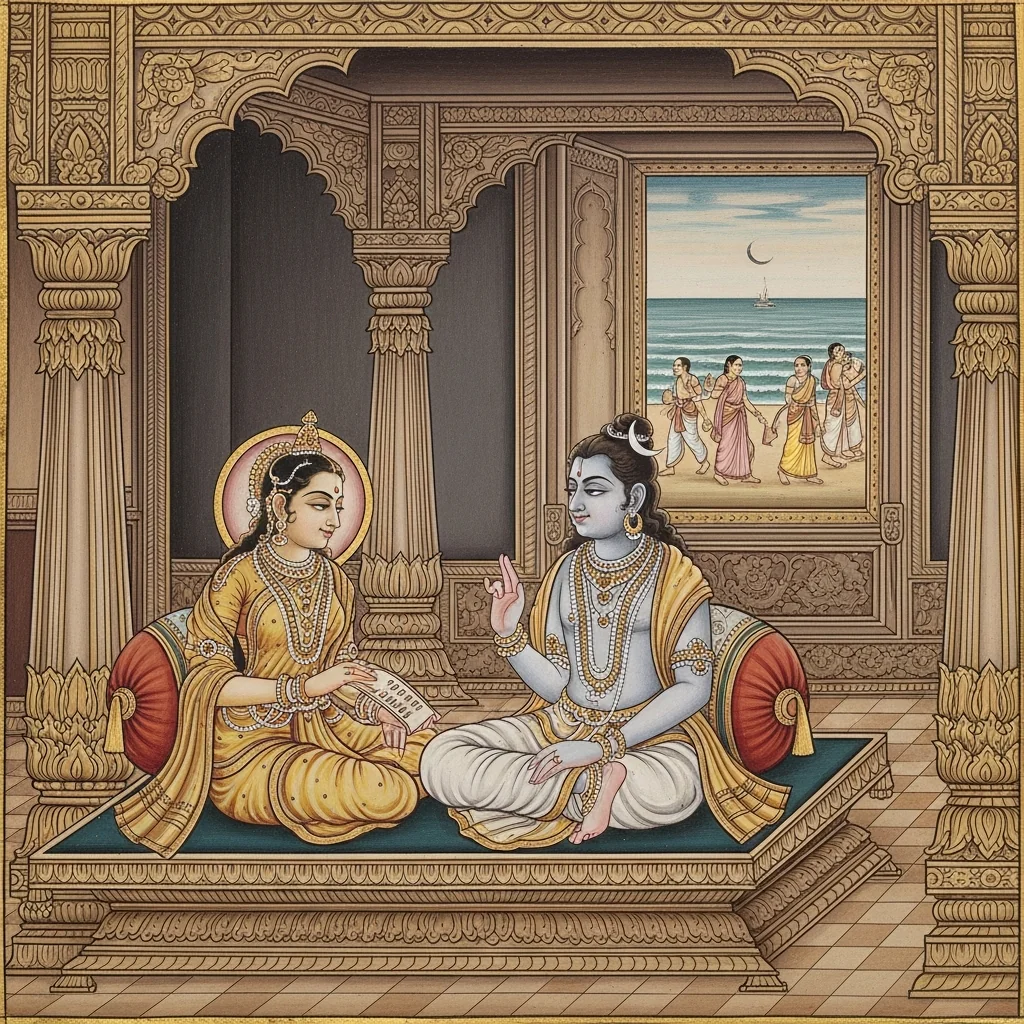
Adhyaya 28
Chapter 28 begins with Devī asking Īśvara for an exact account of the Somanātha pilgrimage—its proper time, method, and disciplines. Īśvara replies that one may undertake the yātrā in various seasons whenever inner resolve arises, emphasizing that bhāva (devotional intention) is the decisive cause. He then sets out preparatory observances: inward salutation to Rudra, śrāddha as appropriate, pradakṣiṇā, silence or restrained speech, regulated diet, and the abandonment of anger, greed, delusion, envy, and related faults. A major doctrinal point follows: tīrthānugamana (pilgrimage, especially on foot) is portrayed in Kali-yuga as surpassing certain sacrificial models, and Prabhāsa is praised as unequalled among tīrthas. Results are graded by the mode and integrity of travel (walking versus vehicle), by austerity (restraint supported by bhikṣā), and by ethical purity, while warning against tainted practices such as improper acceptance of gifts (pratigraha) and the commodification of Vedic learning. The chapter also gives fasting norms by varṇa and āśrama, cautions against hypocritical pilgrimage, and provides a structured dāna calendar by lunar tithi within Prabhāsa. It concludes by affirming that even mantra-deficient or poor pilgrims who die at Prabhāsa attain Śiva’s realm, and it supplies a general tīrtha-snāna mantra sequence, leading into the next topic: which tīrtha to bathe in first upon arrival.
Shlokas
Verse 1
देव्युवाच । इत्याश्चर्यमिदं देव त्वत्तः सर्वं मया श्रुतम् । महिमानं महेशस्य विस्तरेण समुद्भवम् । सांप्रतं सोमनाथस्य यथावद्वक्तुमर्हसि
The Goddess said: “O Lord, I have heard from you in full this wondrous account—the greatness of Maheśa, unfolded in detail. Now, explain to me rightly, as it truly is, what pertains to Somanātha.”
Verse 2
विधिना केन दृश्योसौ यात्रा कार्या कथं नृभिः । कस्मिन्काले महादेव नियमाश्चैव कीदृशाः
By what procedure should that Lord be visited and beheld? How should people undertake the pilgrimage? At what time, O Mahādeva, and what kinds of disciplines (niyamas) are to be observed?
Verse 3
ईश्वर उवाच । हेमन्ते शिशिरे वापि वसन्ते वाथ भामिनि । यदा च जायते चित्तं वित्तं वा पर्व वा भवेत्
Īśvara said: “O fair lady, whether in hemanta, in śiśira, or in vasanta—whenever the resolve arises in the heart, or resources are at hand, or an auspicious occasion occurs—”
Verse 4
तदैव यात्रा कर्त्तव्या भावस्तत्रैव कारणम् । कृत्वा तु नियमं कंचित्स्वगृहे वरवर्णिनि
—then indeed the pilgrimage should be undertaken at once; for bhāva, the inner disposition of devotion, is itself the true cause. Having adopted some observance (niyama) in one’s own home, O most excellent lady,
Verse 5
प्रणम्य मनसा रुद्रं कृत्वा श्राद्धं यथाविधि । स्थानं प्रदक्षिणं कृत्वा वाग्यतः सुसमाहितः
Having bowed to Rudra within the mind, and having performed śrāddha according to rule, having circumambulated the sacred place, remaining restrained in speech and well-composed,
Verse 6
नियतो नियताहारो गच्छेच्चैव ततः पथि । कामक्रोधौ परित्यज्य लोभमोहौ तथैव च
Disciplined, with regulated food, one should then proceed on the road—abandoning desire and anger, and likewise greed and delusion.
Verse 7
ईर्ष्यामत्सरलौल्यं च यात्रा कार्या ततो नृभिः । तीर्थानुगमनं पुण्यं यज्ञेभ्योऽपि विशिष्यते
Therefore people should undertake pilgrimage, casting off jealousy, envy, and greed. The meritorious act of following the tīrthas (going on sacred pilgrimage) is said to excel even sacrificial rites.
Verse 8
अग्निष्टोमादियज्ञैश्च इष्ट्वा विपुलदक्षिणैः । तत्तत्फलमवाप्नोति तीर्थानुगमनेन यत्
Whatever specific fruits are obtained by performing Agniṣṭoma and other sacrifices with abundant priestly gifts—those very fruits are attained through pilgrimage to the tīrthas.
Verse 9
कलेर्युगं महाघोरं प्राप्य पापसमन्वितम् । नान्येनाऽस्मिन्नुपायेन धर्म्मः स्वर्गश्च लभ्यते । विना यात्रां महादेवि सोमेशस्य न संशयः
In this exceedingly dreadful age of Kali, laden with sin, neither dharma nor heaven is gained here by any other means. Without the pilgrimage to Someśvara, O Great Goddess, there is no doubt of it.
Verse 10
ये कुर्वंति नरा यात्रां शुचिश्रद्धासमन्विताः । कलौ युगे कृतार्थास्ते ये त्वन्ये ते निरर्थकाः
Those who undertake pilgrimage with purity and faith are fulfilled in the age of Kali; but those who do otherwise are left without true purpose.
Verse 11
यथामहोदधेस्तुल्यो न चान्योऽस्ति जलाशयः । तथा प्राभासिकात्क्षेत्रात्समं तीर्थं न विद्यते
Just as no other reservoir of water equals the great ocean, so no tīrtha is found equal to the Prābhāsika sacred region (Prabhāsa-kṣetra).
Verse 12
अनुपोष्य त्रिरात्राणि तीर्थान्यनभिगम्य च । अदत्त्वा कांचनं गाश्च दरिद्रोनाम जायते
One who does not observe a three-night fast, does not visit the holy tīrthas, and does not give gold and cows in charity becomes known as ‘poor’—bereft of auspicious merit.
Verse 13
यन्यगम्यानि तीर्थानि दुर्गाणि विषमाणि च । मनसा तानि गम्यानि सर्वतीर्थगतीप्सुना
Even those tīrthas that are difficult to reach—remote and arduous—should be approached in the mind by one who longs to attain the benefit of visiting all holy places.
Verse 14
यस्य हस्तौ च पादौ च मनश्चैव सुसंयतम् । विद्या तपश्च कीर्तिश्च स तीर्थफलमश्नुते
He whose hands, feet, and mind are well-controlled—who is endowed with learning, austerity, and good repute—truly enjoys the fruit of pilgrimage.
Verse 15
नियतो नियताहारः स्नान ।जाप्यपरायणः । व्रतोपवासनिरतः स तीर्थफलमश्नुते
One who is disciplined, moderate in food, devoted to purifying bath and japa, and steadfast in vows and fasting—he attains the fruit of pilgrimage to the tīrtha.
Verse 16
अक्रोधनश्च देवेशि सत्यशीलो दृढव्रतः । आत्मोपमश्च भूतेषु स तीर्थफलमश्नुते
He who is free from anger, O Lady of the Lord, devoted to truth and firm in his vows, and who regards all beings as like himself—he attains the fruit of the tīrtha.
Verse 17
कुरुक्षेत्रादितीर्थानि रथगम्यानि यानि तु । तान्येव ब्राह्मणो यायादानदोषो न तेषु वै
Those tīrthas beginning with Kurukṣetra that are reachable by chariot—only to such sacred fords should a brāhmaṇa go; truly, there is no fault in traveling by riding there.
Verse 18
ये साधवो धनोपेतास्तीर्थानां स्मरणे रताः । तीर्थे दानाच्च योगाच्च तेषामभ्यधिकं फलम्
Those virtuous people, endowed with wealth and delighting in the remembrance of the tīrthas—through charity at the tīrtha and through yoga, disciplined practice, they obtain a fruit even greater.
Verse 19
ये दरिद्रा धनैर्हीनास्तीर्थानुगमनेरताः । तेषां यज्ञफलावाप्तिर्विनापि धनसंचयैः
Those who are poor and lacking in wealth, yet devoted to following the pilgrimage path to the tīrthas—attain the fruits of yajña even without any accumulation of riches.
Verse 20
सर्वेषामेव वर्णानां सर्वाश्रमनिवासिनाम् । तीर्थं तु फलदं ज्ञेयं नात्र कार्या विचारणा
For all the varṇas and for those abiding in every āśrama, know the tīrtha to be bestowing fruit; here no doubt or debate is to be made.
Verse 21
कार्यांतरेण यो गत्वा स्नानं तीर्थे समाचरेत् । न च यात्राफलं तस्य स्नानमात्रं फलं भवेत्
If one goes on other business and happens to bathe at a tīrtha, one does not gain the fruit of pilgrimage; the fruit is only that of bathing.
Verse 22
तीर्थानुगमनं पद्भ्यां तपःपरमिहोच्यते । तदेव कृत्वा यानेन स्नानमात्रफलं लभेत्
To follow the pilgrimage route to the tīrthas on foot is declared here the highest tapas. But if that same journey is made by conveyance, one gains only the fruit of bathing.
Verse 23
यस्यान्यः कुरुते शक्त्या तीर्थयात्रां तथेश्वरि । स्वकीयद्रव्ययानाभ्यां फलं तस्य चतुर्गुणम्
O Īśvarī, for one whose pilgrimage to the tīrtha is performed by another as able, the fruit—by offering one’s own wealth and conveyance—becomes fourfold.
Verse 24
तीर्थानुगमनं कृत्वा भिक्षाहारा जितेंद्रियाः । प्राप्नुवंति महादेवि तीर्थे दशगुणं फलम्
O Mahādevī, those who undertake pilgrimage to the tīrtha, living on alms and mastering the senses, obtain at that tīrtha a tenfold fruit.
Verse 25
छत्रोपानद्विहीनस्तु भिक्षाशी विजितेंद्रियः । महापातकजैर्घोरैर्विप्रः पापैः प्रमुच्यते
But a brāhmaṇa, without umbrella and footwear, living only on alms and having conquered the senses, is freed from the dreadful sins born of the great transgressions (mahāpātakas).
Verse 26
न भैक्षं परपाकं तु न च भैक्ष्यं प्रतिग्रहम् । सोमपानसमं भैक्ष्यं तस्माद्भैक्षं समाचरेत्
Alms should not be taken as “food cooked in another’s house” for indulgence, nor should alms be regarded as a formal “acceptance of gifts” (pratigraha). Alms-food is equal to the drinking of Soma; therefore one should practice living on alms.
Verse 27
लोकेऽस्मिन्द्विविधं तीर्थं स्वच्छ न्दैर्निर्म्मितं तथा । स्वयंभूतं प्रभासाद्यं निर्मितं दैवतैः कृतम्
In this world, tīrthas (holy fords) are of two kinds: those established by free human initiative, and those that are self-manifest—foremost among them Prabhāsa—also including those founded by the gods themselves.
Verse 28
स्वयंभूते महातीर्थे स्वभावे च महत्तरे । तस्मिंस्तीर्थे प्रतिगृह्य कृताः सर्वे प्रतिग्रहाः
At that self-manifest Great Tīrtha—naturally and supremely exalted—whatever acts of accepting gifts (pratigraha) are done there are all deemed fully valid “acceptances,” bearing their full consequence.
Verse 29
प्रतिग्रहनिवृत्तस्य यात्रादशगुणं फलम् । तेन दत्तानि दानानि यज्ञैर्देवाः सुतर्पिताः
For one who refrains from accepting gifts, the fruit of pilgrimage becomes tenfold. By the gifts he gives instead, the gods are well satisfied as though by sacrifices (yajñas).
Verse 30
येन क्षेत्रं समासाद्य निवृत्तिः परमा कृता । वस्तुलौल्याद्धि यः क्षेत्रे प्रतिग्रहरुचिस्तथा
He who, having reached this sacred kṣetra, truly practices the supreme withdrawal from grasping, attains the highest good. But one who, out of greed for possessions, develops a taste for accepting gifts in the holy place—
Verse 31
नैव तस्य परोलोको नायं लोको दुरात्मनः । अथ चेत्प्रतिगृह्णाति ब्राह्मणो वृत्तिदुर्बलः । दशांशमर्जिताद्दद्यादेवं तत्र न हीयते
For that wicked-minded man there is neither the next world nor even this one as true good. But if a brāhmaṇa, weak in livelihood, must accept a gift, he should give away a tenth of what he earns; thus, in that sacred place, he does not suffer spiritual loss.
Verse 32
विप्रवेषं समास्थाय शूद्रो भूत्वा प्रतिग्रहम् । तृणकाष्ठसमं वापि प्रतिगृह्य पतत्यधः
A śūdra who assumes the guise of a brāhmaṇa and takes to accepting gifts—even if what he receives is as worthless as grass or wood—falls downward, to ruin.
Verse 33
कुम्भीपाकादिकेष्वेवं महानरककोटिषु । यावदिंद्रसहस्राणि चतुर्द्दश वरानने
Thus, in Kumbhīpāka and other dreadful hells—among countless great hell-realms—he remains for as long as fourteen thousand Indras, O fair-faced one.
Verse 34
तस्मान्नैव प्रतिग्राह्यं किमन्यैर्ब्राह्मणैरपि । द्विप्रकारस्य तीर्थस्य कृतस्याप्यकृतस्य च
Therefore, gifts should not be accepted—how much more so by other brāhmaṇas—whether the tīrtha is of the ‘made’ kind or the ‘unmade, self-manifest’ kind.
Verse 35
स्वकीयभावसंयुक्तः संपूर्णं फलमश्नुते । लभते षोडशांशं स यः परान्नेन गच्छति
One who is joined to his own rightful state (self-reliant in spirit) enjoys the full fruit. But he who goes sustained by another’s food receives only a sixteenth share.
Verse 36
अशक्तस्य तथांधस्य पंगोर्यायावरस्य च । विहितं कारणायानमच्छिद्रे ब्राह्मणे कुतः
For the powerless, the blind, the lame, and the wandering mendicant, travel supported by a valid cause is allowed; but for a faultless brāhmaṇa, what justification could there be for such dependence?
Verse 37
स्नानखादनपानैश्च वोढृभ्यस्तीर्थसेवकः । ददत्सकलमाप्नोति फलं तीर्थसमुद्भवम्
At the holy ford (tīrtha), the devoted attendant of the tīrtha—by providing bath, food, and drink to those who carry and travel—obtains in full the merit that arises from the tīrtha itself.
Verse 38
न षोडशांशं यत्नेन लब्धार्थं यदि यच्छति । पंचमांशमथो वापि दद्यात्तत्र द्विजातिषु
If one does not offer even a sixteenth part of wealth gained through effort, then at least one should give a fifth part there, among the twice-born (dvija).
Verse 39
देवतानां गुरूणां च मातापित्रोश्च कामतः । पुण्यदः समवाप्नोति तदेवाष्टगुणं फलम्
Whoever willingly bestows merit in honor of the Devas, the teachers, and one’s mother and father attains that very fruit multiplied eightfold.
Verse 40
स्नानं दानं जपो होमः स्वाध्यायो देवतार्चनम् । पुण्यं देयं तु सर्वत्र नापुण्यं दीयते क्वचित्
Bathing, charity, mantra-recitation, fire-offering (homa), Vedic study, and worship of the Deity—these should be offered everywhere as meritorious acts; never, in any place, should one offer what is unmeritorious.
Verse 41
पितरं मातरं तीर्थे भ्रातरं सुहृदं गुरुम् । यमुद्दिश्य निमज्जेत द्वादशांशं लभेत सः
At the tīrtha, if one immerses oneself with the intention of benefiting one’s father, mother, brother, friend, or guru, that person gains a twelfth share of the merit (for them).
Verse 42
कुशैस्तु प्रतिमां कृत्वा तीर्थवारिषु मज्जयेत् । यमुद्दिश्य महादेवि अष्टभागं लभेत सः
O Great Goddess, having fashioned an effigy from kuśa grass and immersing it in the waters of the tīrtha for the sake of the intended person, one obtains an eighth share of the merit.
Verse 43
महादानानि ये विप्रा गृह्णन्ति ज्ञानदुर्बलाः । वृक्षास्ते द्विजरूपेण जायंते ब्रह्मराक्षसाः
Those Brahmins who, being weak in true understanding, accept great gifts—those become brahmarākṣasas, taking birth as trees that appear in the guise of the twice-born (dvija).
Verse 44
न वेदबलमाश्रित्य प्रतिग्रहरुचिर्भवेत् । अज्ञानाद्वा प्रमादाद्वा दहते कर्म नेतरत्
Without relying on the strength of Vedic discipline, one should not develop a taste for accepting gifts; whether from ignorance or negligence, such conduct burns one’s karma—nothing else does so in the same way.
Verse 45
चितिकाष्ठं तु वै स्पृष्ट्वा यज्ञयूपं तथैव च । वेदविक्रयिणं स्पृष्ट्वा स्नानमेव विधीयते
After touching the wood of a funeral pyre, and likewise a sacrificial post (yajña-yūpa), and after touching one who sells the Veda, bathing alone is prescribed.
Verse 46
आदेशं पठते यस्तु आदेशं तु ददाति यः । द्वावेतौ पापकर्माणौ पातालतलवासिनौ
Whoever recites an ‘ādeśa’ and whoever gives an ‘ādeśa’—both are doers of sinful acts, destined to dwell in the subterranean worlds (Pātāla).
Verse 47
आदेशं पठते यस्तु संजिघृक्षुः प्रतिग्रहम् । तीर्थे चैव विशेषेण ब्रह्मघ्नः सैव नेतरः । स्थितो वै नृपतेर्द्वारि न कुर्याद्वेदविक्रयम्
Whoever recites an ‘ādeśa’ with the intent of receiving gifts—especially at a tīrtha—is to be regarded as a slayer of a Brahmin; he is no true guide. Even at a king’s gate, one should never engage in selling the Veda.
Verse 48
हत्वा गावो वरं मांसं भक्षयीत द्विजाधमः । वरं जीवन्समं मत्स्यैर्न कुर्याद्वेदविक्रयम् । ब्रह्महत्यासमं पापं न भूतं न भविष्यति
Better that a wretched twice-born should even kill cows and eat flesh; better to live on a level with fish—than to sell the Veda. A sin equal to brahma-hatyā has never been, nor will ever be, (worse than) this.
Verse 49
वरं कुर्याच्च तद्देवि न कुर्याद्वेदविकयम् । तीर्थे चैव विशेषेण महाक्षेत्रे तथैव च
O Goddess, if one must, one may do other lesser acts—but one should not commit the selling of the Veda, especially at a tīrtha, and likewise in a great sacred kṣetra.
Verse 50
दीयमानं तु वै दानं यस्त्यजेत्तीर्थसेवकः । तीर्थं करोति तीर्थं च स पुनाति च पूर्वजान्
The tīrtha-servant who refuses a gift duly offered makes the tīrtha truly a tīrtha; and he purifies even his forefathers.
Verse 51
यदन्यत्र कृतं पापं तीर्थे तद्याति लाघवम् । न तीर्थकृतमन्यत्र क्वचिदेव व्यपोहति
Whatever sin is committed elsewhere becomes lightened when one comes to a tīrtha; but sin committed at a tīrtha is not removed anywhere at all.
Verse 52
तैलपात्रमिवात्मानं यो रक्षेत्तीर्थसेवकः । स तीर्थफलमस्कन्नं विप्रः प्राप्नोति संयतः
The tīrtha-servant who guards himself as one would guard a vessel of oil, so it does not spill, attains the undiminished fruit of the tīrtha; that disciplined brāhmaṇa truly obtains it.
Verse 53
यस्ययस्यात्ति पक्वान्नमल्पं वा यदि वा बहु । तीर्थगस्तस्य तस्यार्धं स्नातस्य विनियच्छति
Whoever eats cooked food—whether little or much—upon going to a tīrtha, should, after bathing, set aside half as an offering-share.
Verse 54
यो न क्लिष्टोपि भिक्षेत ब्राह्मण स्तीर्थसेवकः । सत्यवादी समाधिस्थः स तीर्थस्योपकारकः
That brāhmaṇa who serves the tīrtha and does not beg even when distressed—truth-speaking and established in samādhi—he is a true benefactor of the tīrtha.
Verse 55
कृते युगे पुष्कराणि त्रेतायां नैमिषं तथा । द्वापरे तु कुरुक्षेत्रं प्राभासिकं कलौयुगे
In the Kṛta Yuga, Puṣkara is supreme; in the Tretā, Naimiṣa likewise; in the Dvāpara, Kurukṣetra; and in the Kali Yuga, Prabhāsa is foremost.
Verse 56
तिष्ठेद्युगसहस्रंतुपादेनैकेन यः पुमान् । प्रभासयात्रामेको वा समं भवति वा न वा
Even if a man were to stand on a single foot for a thousand yugas—whether that could equal even one Prabhāsa pilgrimage or not—thus is the Prabhāsa-yātrā praised beyond all measure.
Verse 57
एतत्क्षेत्रं समागत्य मध्यभागे वरानने । यानानि तु परित्यज्य भाव्यं पादचरैर्नरैः
O fair-faced lady, having come to this sacred kṣetra and reached its central precinct, men should set aside their vehicles and proceed on foot.
Verse 58
लुठित्वा लोठनीं तत्र लुठिता यत्र देवताः । ततो नृत्यन्हसन्गायन्भूत्वा कार्पटिका कृतिः । गच्छेत्सोमेश्वरं देवं दृष्ट्वा चादौ कपर्द्दिनम्
There one should roll upon the ground called ‘Loṭhanī’—the very place where the deities themselves have rolled. Then, dancing, laughing, and singing, assuming the guise of a humble mendicant, one should go to Lord Someśvara, having first beheld Kapardin (Śiva, the matted-haired Lord).
Verse 59
ईदृशं पुरुषं दृष्ट्वा स्थितं सोमेश्वरोन्मुखम् । नित्यं तुष्यंति पितरो गर्जंति च पिता महाः
Seeing such a man standing with his face turned toward Someśvara, the Pitṛs are ever satisfied, and even the forefathers exult aloud.
Verse 60
अस्माकं वंशजो देवं प्रस्थितस्तारणाय नः । गत्वा सोमेश्वरं देवि कुर्याद्वपनमादितः
“A descendant of our lineage has set out to the Lord for our deliverance.” O Goddess, having gone to Someśvara, he should first perform the rite of tonsure (shaving) as the initial act.
Verse 61
तीर्थोपवासः कर्त्तव्यो यथावद्वै निबोध मे । नास्ति गंगासमं तीर्थं नास्ति क्रतुसमा गतिः
Learn from me the proper observance of fasting (upavāsa) at a tīrtha. No sacred ford equals the Gaṅgā, and no spiritual course equals that gained through sacrifice (kratu).
Verse 62
गायत्रीसदृशं जाप्यं होमो व्याहृतिभिः समः । अंतर्जले तथा नास्ति पापघ्नमघमर्षणात्
No japa equals the Gāyatrī; no homa equals that performed with the Vyāhṛtis. Likewise, within the waters there is no sin-destroyer comparable to the Aghamarṣaṇa rite.
Verse 63
अहिंसासदृशं पुण्यं दानात्संचयनं परम् । तपश्चानशनान्नास्ति तथा तीर्थनिषेवणात्
No merit equals non-violence (ahiṃsā); no accumulation is higher than giving (dāna). No austerity equals fasting; and likewise, nothing compares to devoted resort to the tīrthas.
Verse 64
तीर्थोपवासाद्देवेशि अधिकं नास्ति किञ्चन । पापानां चोपशमनं सतामीप्सितकारकम्
O Lady of the Lord (Deveśī), there is nothing higher than fasting at a tīrtha. It pacifies sins and accomplishes what the good desire.
Verse 65
उपवासो विनिर्द्दिष्टो विशेषाद्देवताश्रये । ब्राह्मणस्य त्वनशनं तपः परमिहोच्यते
Fasting is enjoined especially in places that are the abode of the Deity. For a brāhmaṇa, complete abstention from food is here declared to be the highest austerity (tapas).
Verse 66
षष्ठकालाशनं शूद्रे तपः प्रोक्तं परं बुधैः । वर्णसंकरजातानां दिनमेकं प्रकीर्तितम्
The wise declare that for a śūdra, taking food only once at the sixth time is the highest austerity. For those born of mixed varṇas, a single day of fasting is taught as the rule.
Verse 67
षष्ठकालात्परं शूद्रस्तपः कुर्याद्यथा क्वचित् । राष्ट्रहानिस्तदा ज्ञेया राज्ञश्चोपद्रवो महान्
If a śūdra, in any circumstance, undertakes austerities beyond the prescribed limit (beyond the ‘sixth time’), it should be understood as a sign of calamity for the realm and as a great affliction for the king.
Verse 68
शूद्रस्तु षष्ठकालाशी यथाशक्त्या तपश्चरेत् । न दर्भानुद्धरेच्छूद्रो न पिबेत्कापिलं पयः
But a śūdra should practice austerity according to his capacity, taking food at the ‘sixth time’. A śūdra should not pull up darbha grass, and should not drink milk from a tawny (kapilā) cow.
Verse 69
मध्यपत्रे न भुञ्जीत ब्रह्मवृक्षस्य भामिनि । नोच्चरेत्प्रणवं मंत्रं पुरोडाशं न भक्षयेत्
O fair lady, one should not eat upon the middle leaf of the sacred ‘brahma-tree’. Nor should one utter the Praṇava (Oṃ) as a mantra, and one should not partake of the puroḍāśa offering-cake.
Verse 70
न शिखां नोपवीतं च नोच्च रेत्संस्कृतां गिरम् । न पठेद्वेदवचनं त्रैरात्रं न हि सेवयेत्
Here one should keep neither śikhā nor the sacred thread (upavīta), nor utter refined Sanskrit speech. One should not recite Vedic passages, nor observe the three-night rite (trairātra) in this place.
Verse 71
नमस्कारेण शूद्रस्य क्रियासिद्धिर्भवेद्ध्रुवम् । निषिद्धाचरणं कुर्वन्पितृभिः सह मज्जति
For a Śūdra, the accomplishment of rites is surely attained through reverent obeisance (namaskāra). But one who engages in forbidden conduct sinks down together with his ancestors.
Verse 72
येनैकादशसंख्यानि यंत्रितानींद्रियाणि वै । स तीर्थफलमाप्नोति नरोऽन्यः क्लेशभाग्भवेत्
He who truly restrains the eleven faculties attains the fruit of the tīrtha. Any other person merely becomes a sharer in hardship.
Verse 73
यच्च तीर्थे पितृश्राद्धं स्नानं तत्र समाचरेत् । हितकारी च भूतेभ्यः सोऽश्नीयात्तीर्थजं फलम्
Whoever performs ancestral śrāddha at a tīrtha, bathes there as enjoined, and acts as a benefactor to living beings—he truly partakes of the fruit born of the sacred place.
Verse 74
धर्मध्वजी सदा लुब्धः परदाररतो हि यः । करोति तीर्थगमनं स नरः पातकी भवेत्
He who parades as righteous, yet is ever greedy and devoted to another’s wife—even if he goes on pilgrimage to a tīrtha, such a man still becomes a sinner.
Verse 75
एवं ज्ञात्वा महादेवि यात्रां कुर्याद्यथाविधि । तीर्थोपवासं कृत्वादौ श्रद्धायुक्तो दृढव्रतः
Knowing thus, O Mahādevī, one should undertake the pilgrimage according to the prescribed rite—first observing the fast at the tīrtha, endowed with faith (śraddhā) and steadfast in vow (vrata).
Verse 76
भोजनं नैव कुर्वीत यदी च्छेद्धितमात्मनः । परान्नं नैव भुञ्जीत तद्दिने ब्राह्मणः क्वचित्
If one seeks one’s own welfare, one should not take a meal. On that day, a Brāhmaṇa should in no case eat food prepared by others (parānna).
Verse 77
हस्त्यश्वरथयानानि भूमिगोकांचनादिकम् । सर्वं तत्परिगृह्णीयाद्भोजनं न समाचरेत्
Elephants, horses, chariots and conveyances, as well as land, cows, gold and the like—one may accept all these as gifts (dāna); but one should not accept food (from others).
Verse 78
आमाच्छतगुणं पुण्यं भुञ्जतो ददतोऽपि वा । तीर्थोपवासं कुर्वीत तस्मात्तत्र वरानने
Merit becomes a hundredfold, whether one eats there or even gives food there. Therefore, O fair-faced one, one should observe fasting at that sacred tīrtha in that place.
Verse 79
व्रती च तीर्थयात्री च विधवा च विशेषतः । परान्नभोजने देवि यस्यान्नं तस्य तत्फलम्
A vow-observer, a pilgrim, and especially a widow—O Devī—when eating another’s food: the fruit of the act belongs to the one whose food it is.
Verse 80
विधवा चैव या नारी तस्या यात्राविधिं ब्रुवे । कुंकुमं चन्दनं चैव तांबूलं च स्रजस्तथा
And for the woman who is a widow, I shall declare the proper rule of pilgrimage: she should refrain from kumkuma (saffron), sandal paste, betel, and garlands as well.
Verse 81
रक्तवस्त्राणि सर्वाणि शय्या प्रास्तरणानि च । अशिष्टैः सह संभाषो द्विवारं भोजनं तथा
She should avoid all red garments, beds and luxurious coverings; conversation with the ill-mannered; and likewise eating twice a day.
Verse 82
पुंसां प्रदर्शनं चैव हास्यं तमसि वर्जयेत् । सशब्दोपानहौ चैव नृत्यं गतिं च वर्जयेत्
She should avoid displaying herself before men, and avoid laughter in the dark. She should also avoid noisy footwear, as well as dancing and roaming about.
Verse 83
धारणं चैव केशानामंजनं च विलेपनम् । असतीजनसंसर्गं पांडित्यं च परित्यजेत्
She should avoid elaborate arranging of the hair, collyrium (anjana), and cosmetic anointing; association with immoral people; and also ostentatious display of learning.
Verse 84
नित्यं स्नानं च कुर्वीत श्वेतवस्त्राणि धारयेत् । यतिश्च ब्रह्मचारी च विधवा च विशेषतः
One should bathe daily and wear white garments—especially the renunciant (yati), the celibate student (brahmacārin), and the widow.
Verse 86
देव्युवाच । तपांसि कानि कथ्यन्ते क्षेत्रे प्राभा सिके नरैः । कानि दानानि दीयन्ते केषु तीर्थेषु वा कथम्
The Goddess said: “In the sacred kṣetra of Prabhāsa, what austerities (tapas) do people speak of? What gifts (dāna) are given—at which tīrthas—and in what manner?”
Verse 87
ईश्वर उवाच । तपः परं कृतयुगे त्रेतायां ज्ञानमिष्यते । द्वापरे यजनं धन्यं दानमेकं कलौ युगे
Īśvara said: “In the Kṛta Age, austerity (tapas) is supreme; in the Tretā, knowledge (jñāna) is enjoined; in the Dvāpara, sacrifice (yajña) is blessed; but in the Kali Age, charity (dāna) alone is the single foremost path.”
Verse 88
तपस्तप्यन्ति मुनयः कृच्छ्रचान्द्रायणादिकम् । गत्वा प्राभासिकं क्षेत्रं लोकाश्चान्ये कृते युगे
In the Kṛta Yuga, sages undertake austerities—such as the Kṛcchra and Cāndrāyaṇa vows—and other people too, having gone to the sacred region of Prābhāsa, engage in such tapas.
Verse 89
कलौ दानानि दीयन्ते ब्राह्मणेभ्यो यथाविधि । प्रभासं क्षेत्रमासाद्य तपसां प्राप्यते फलम्
In the Kali Yuga, gifts should be given to brāhmaṇas according to proper rule; and by reaching the sacred field of Prabhāsa, one attains the fruit of austerities (tapas).
Verse 90
तुलापुरुषब्रह्माण्डपृथिवीकल्पपादपाः । हिरण्य कामधेनुश्च गजवाजिरथास्तथा
The great gifts known as Tulāpuruṣa, Brahmāṇḍa, Pṛthivī, and Kalpapādapa; also the golden Kāmadhenu; and likewise elephants, horses, and chariots—these are enumerated as mighty acts of giving.
Verse 91
रत्नधेनुहिरण्याश्वसप्तसागर एव च । महाभूतघटो विश्वचक्रकल्पलताभिधः
Also (among the great gifts) are those called Ratnadhenu, Hiraṇyāśva, and Saptasāgara; and those named Mahābhūtaghaṭa, Viśvacakra, and Kalpalatā.
Verse 92
प्रभासे नृपतिर्दद्या न्महादानानि षोडश । धान्यरत्नगुडस्वर्णतिलकार्पासशर्कराः
At Prabhāsa, a king should bestow the sixteen great gifts—such as grain, jewels, jaggery, gold, sesame, cotton, and sugar.
Verse 93
सर्पिर्लवणरूप्याख्या दशैते पर्वताः स्मृताः । गुडाज्यदधिमध्वंबुसलिल क्षीरशर्कराः । रत्नाख्याश्च स्वरूपेण दशैता धेनवो मताः
Ten “mountains” are remembered—named ghee, salt, silver, and so on. Likewise there are jaggery, ghee, curd, honey, water, clear water, milk, and sugar; and in form there are also ten “cows,” regarded as jewel-cows.
Verse 94
तेषामेकतमं दानं तीर्थेतीर्थे पृथक्पृथक् । प्रदेयान्येकवारं वा सरस्वत्यब्धि संगमे
Of these, one particular gift may be offered separately at each tīrtha; or they may be given all at once at the confluence where the Sarasvatī meets the ocean.
Verse 95
तांबूलं मधु मांसं च सुरापानसमं विदुः । एतेषां वर्ज्जनाद्देवि सम्यग्यात्राफलं लभेत्
Betel (tāmbūla), honey, and meat are regarded as comparable to the drinking of liquor. O Goddess, by avoiding these, one obtains the full fruit of the pilgrimage, duly performed.
Verse 96
यत्र तीर्थे लभेल्लिंगं तीर्थं च विमलोदकम् । तत्राग्निकार्यं कृत्वादौ विशिष्टं दानमिष्यते
At whatever tīrtha one obtains a liṅga and also a tīrtha with pure waters, there—having first performed the fire-rite (agni-kārya)—an especially excellent donation is prescribed.
Verse 97
तर्पणं पितृदेवानां श्राद्धं दानं सदक्षिणम् । तीर्थेतीर्थे च गोदानं नियतः प्रकृतो विधिः
Offer tarpaṇa (libations) to the ancestors and the gods; perform śrāddha; give charity together with proper dakṣiṇā; and at each tīrtha, perform go-dāna, the gift of a cow—this is the established and prescribed procedure.
Verse 98
विशिष्टख्यातलिंगेषु वृषदानं विधीयते । स्नानं विलेपनं पूजां देवतानां समाचरेत्
At renowned and specially celebrated liṅga-shrines, vṛṣa-dāna—the gifting of a bull—is enjoined. One should also perform bathing, anointing with unguents, and worship of the deities.
Verse 99
जगतीं चार्चयेद्भक्त्या तथा चैवोपलेपयेत् । प्रासादं धवलं सौधं कारयेज्जीर्णमुद्धरेत्
With devotion one should worship the jagatī, the temple-platform, and also plaster and renew it. One should build a bright, white prāsāda, a temple-mansion, and restore whatever has become worn and dilapidated.
Verse 100
पुष्पवाटीं स्नानकूपं निर्मलं कारयेद्व्रती । ब्राह्मणानां भूरिदानं देवपूजाकराय च
A vow-observer should establish a flower-garden and a clean bathing-well. He should also give abundant gifts to Brāhmaṇas and provide the means for the performance of divine worship.
Verse 101
सर्वत्र देवयात्रायां विधिरेष प्रवर्त्तते । तीर्थमभ्युद्धरेज्जीर्णं मार्जयेत्कथयेत्फलम्
In every pilgrimage and procession to the gods, this very rule prevails: one should restore a worn tīrtha, cleanse it, and proclaim its fruit—its spiritual merit.
Verse 102
प्रसिद्धे च महादानं मध्यमे चैव मध्यमम् । गोदानं सर्वतीर्थेषु सुवर्णमथ निष्क्रयः । हिरण्यदानं सर्वेषां दानानामेव निष्कृतिः
At a renowned tīrtha one should offer a great gift; at a middling tīrtha, a middling gift. In all sacred places, the gift of a cow is praised, and gold is a redemption-offering. The gift of gold is declared the expiation and fulfillment of all gifts.
Verse 103
एवं कृत्वा नरो भक्त्या लभते जन्मनः फलम् । तीर्थेषु दानं वक्ष्यामि येषु यद्दीयते तिथौ
Having done so with devotion, a person attains the true fruit of human birth. Now I shall describe the gifts to be given at the tīrthas—what is to be donated on which lunar day (tithi).
Verse 104
प्रभासे प्रतिपद्दानं दातव्यं कांचनं शुभम् । द्वितीयायां तथा वस्त्रं तृतीयायां च मेदिनीम्
At Prabhāsa, on Pratipad (the first lunar day), auspicious gold should be given. On the second day, clothing is to be donated; and on the third day, land (medinī) is to be gifted.
Verse 105
चतुर्थ्यां दापयेद्धान्यं पंचम्यां कपिलां तथा । षष्ठ्यामश्वं च सप्तम्यां महिषीं तत्र दापयेत्
On the fourth lunar day one should give grain; on the fifth, a kapilā cow (tawny). On the sixth, a horse; and on the seventh, there at Prabhāsa, one should donate a buffalo.
Verse 106
अष्टम्यां वृषभं दत्त्वा नीलं लक्षणसंयुतम् । नवम्यां तु गृहं दद्याच्चक्रं शंखं गदां तथा
On the eighth lunar day (Aṣṭamī), one should give a blue-hued bull endowed with auspicious marks, thereby gaining merit. On the ninth (Navamī), one should give a house, and also offer the discus, conch, and mace as sacred emblems.
Verse 107
दशम्यां सर्वगंधांश्च एकादश्यां च मौक्तिकम् । द्वादश्यां सुव्रतेन्नाद्यं प्रवालं विधिवत्तथा
On the tenth lunar day (Daśamī), one should offer all kinds of fragrances; on the eleventh (Ekādaśī), pearls. On the twelfth (Dvādaśī), the disciplined votary should duly give coral and the other prescribed offerings according to rule.
Verse 108
स्त्रियो देयास्त्रयोदश्यां भूतायां ज्ञानदो भवेत् । अमावास्यामनुप्राप्य सर्वदानानि दापयेत्
On the thirteenth lunar day (Trayodaśī), when it is the Bhūtā tithi, gifts should be given to women—this becomes a bestowal of wisdom. And when Amāvāsyā, the new-moon day, arrives, one should cause every kind of charitable gift to be given.
Verse 109
एवं दानं प्रदत्त्वा तु दश कृत्वः फलं लभेत्
Having given charity in this manner, one obtains the fruit tenfold.
Verse 110
देव्युवाच । भक्तिदानविहीना ये प्रभासं क्षेत्रमागताः । स्नानमन्त्रविहीनाश्च वद तेषां तु किं फलम्
The Goddess said: “Those who come to the sacred kṣetra of Prabhāsa devoid of devotion and charity, and who even bathe without the proper bathing-mantras—tell me, what fruit do they obtain?”
Verse 111
ईश्वर उवाच । सधना निर्द्धना वापि समंत्रा मंत्रवर्जिताः । प्रभासे निधनं प्राप्ताः सर्वे यांति शिवालयम्
Īśvara said: “Whether wealthy or destitute, whether endowed with mantras or bereft of mantras—whoever meets death in Prabhāsa, all of them go to Śiva’s abode.”
Verse 112
ये मंत्रहीनाः पुरुषा धर्महीनाश्च ये मृताः । तेषामेकं विमानं तु ददामि सुमहत्प्रिये
“Even those men who are without mantras, and even those who are without dharma, if they die there—to them I grant a single, exceedingly great celestial chariot, O beloved.”
Verse 113
स्नानदानानुरूप्येण प्राप्नुवंति परं पदम् । केचित्स्नानप्रभावेन केचिद्दानेन मानवाः
In accordance with the measure of their sacred bathing and their charity, people attain the supreme state. Some do so through the power of bathing; others through the power of giving.
Verse 114
केचिल्लिंगप्रणामेन केचिल्लिंगार्च्चनेन च । केचिद्ध्यानप्रभावेन केचिद्योगप्रभावतः
Some attain it by bowing to the Liṅga; some by worship of the Liṅga. Some by the power of meditation; and some through the power of yoga.
Verse 115
केचिन्मं त्रस्य जाप्येन केचिच्च तपसा शुभे । तीर्थे संन्यसनैः केचित्केचिद्भक्त्यनुसारतः
Some reach that goal by the repetition of mantras; some, O auspicious one, by austerity. Some by renunciation undertaken at the tīrtha; and some according to the path of devotion.
Verse 116
एते चान्ये च बहव उत्तमाधममध्यमाः । सर्वे शिवपुरं यांति विमानैः सूर्यसंनिभैः
These and many others—whether the highest, the middling, or the low— all go to Śiva’s city, borne in celestial chariots radiant as the sun.
Verse 117
त्रिशूलांकितहस्ताश्च सर्वे च वृषवाहनाः । दिव्याप्सरोगणाकीर्णाः क्रीडंते मत्प्रभावतः
All of them bear hands marked with the trident, and all ride upon bulls. Surrounded by hosts of divine apsarases, they sport and rejoice—by the power of My grace.
Verse 118
एवं भक्त्यनुसारेण ददामि फलमव्ययम् । अलेपकं प्रभासं तु धर्माधर्मैर्न लिप्यते
Thus, in accordance with one’s devotion, I bestow imperishable fruit. Prabhāsa is ‘unstained’ (alepaka): it is not tainted by either merit or demerit.
Verse 119
धर्मं चरंत्यधर्मं वा शिवं यांति न संशयः
Whether they practice righteousness or unrighteousness, they attain Śiva—of this there is no doubt.
Verse 120
जन्मप्रभृति यो देवि नरो नेत्रविवर्जितः । मम क्षेत्रे मृतः सोऽपि रुद्रलोके महीयते
O Devī, even a man who has been without sight from birth—if he dies in my sacred field—he too is honored in Rudra’s world.
Verse 121
जन्मप्रभृति यो देवि श्रवणाभ्यां विवर्जितः । प्रभासे निधनं प्राप्तः स भवेन्मत्परिग्रहः
O Devī, one who has been without hearing from birth—if he meets death at Prabhāsa—becomes one accepted into my own fold, under my personal care.
Verse 122
अथातः संप्रवक्ष्यामि तीर्थानां स्पर्शने विधिम् । मन्त्रेण मंत्रितं तीर्थं भवेत्संनिहितं तथा
Now I shall explain the proper method for touching (invoking) the sacred tīrthas. A tīrtha, when consecrated by mantra, becomes truly present there as well.
Verse 123
प्रथमं चालभेत्तीर्थं प्रणवेन जलं शुचि । अवगाह्य ततः स्नायादध्यात्ममन्त्रयोगतः
First, one should take up the tīrtha with the Praṇava (Oṃ) and pure water. Having immersed, one should then bathe according to the inward (adhyātma) discipline joined with mantra.
Verse 124
ओंनमो देवदेवाय शितिकण्ठाय दंडिने । रुद्राय वामहस्ताय चक्रिणे वेधसे नमः
Oṃ—obeisance to the God of gods: to the blue-throated Lord, the wielder of the staff; to Rudra, the left-handed one; to the discus-bearing Lord; to the Creator (Vedhas)—salutations.
Verse 125
सरस्वती च सावित्री वेदमाता विभावरी । संनिधानं कुरुष्वात्र तीर्थे पाप प्रणाशिनि । सर्वेषामेव तीर्थानां मंत्र एष उदाहृतः
Sarasvatī and Sāvitrī—the Mother of the Vedas, the radiant one—establish your presence here in this tīrtha, O destroyer of sins. This mantra is declared for all tīrthas.
Verse 126
इत्युच्चार्य नमस्कृत्वा स्नानं कुर्याद्यथाविधि । उपवासं ततः कुर्यात्तस्मिन्नहनि सुव्रते
Thus, having recited this and having bowed in reverence, one should bathe according to the prescribed rite. Then, on that very day, O virtuous one, one should undertake the fast.
Verse 127
सा तिथिर्वर्षमेकं तु उपोष्या भक्तितत्परैः
That lunar day (tithi), indeed, should be observed with fasting for a full year by those devoted to bhakti.
Verse 128
देव्युवाच । कस्मिंस्तीर्थे नरैः पूर्वं प्रभासक्षेत्रमागतैः । स्नानं कार्यं महादेवि तन्मे विस्तरतो वद
The Goddess said: “When people arrive at the sacred field of Prabhāsa, in which holy tīrtha should they first perform their ritual bath, O Great Goddess? Tell me that in detail.”
Verse 129
ईश्वर उवाच । हंत ते संप्रवक्ष्यामि आद्यं तीर्थं महाप्रभम् । पूर्वं यत्र नरैः स्नानं क्रियते तच्छृषुष्व मे
Īśvara said: “Very well—I shall explain to you the first and supremely radiant tīrtha, where people perform their initial bath. Listen to me.”