Adhyaya 183
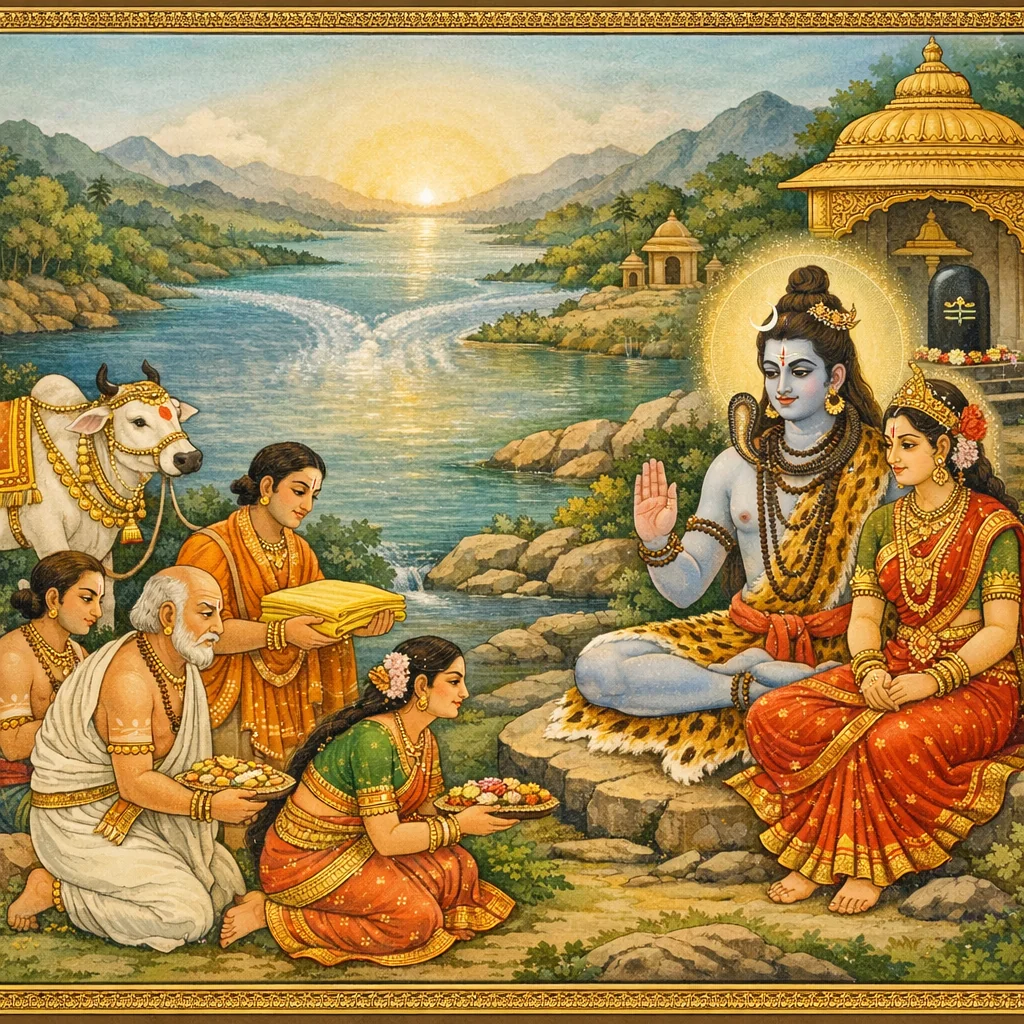
Chapter 183 records Īśvara’s instruction to Devī about the exalted Miśra-tīrtha, famed as Trisaṅgama—the threefold confluence of the Sarasvatī, the Hiraṇyā, and the ocean. The site is praised as exceedingly rare even for the gods, foremost among tīrthas, and especially supreme on solar festival occasions (sūrya-parvan), when its ritual potency is said to surpass even Kurukṣetra. The chapter teaches merit-amplification: bathing, gifting, and japa performed there yield “crore-fold” results. It also frames a sacred geography around a liṅga linked with Maṅkīśvara, stating that vast numbers of tīrthas lie within the stretch up to that landmark, and adds that even the socially marginalized attain heavenly outcomes there, revealing the place’s transformative power. For proper “yātrā-fruit,” pilgrims are advised to gift used garments, gold, and a cow to a brāhmaṇa, and to perform ancestor offerings on the fourteenth day of the dark fortnight. The chapter concludes by naming Trisaṅgama a destroyer of great sins—especially efficacious in Vaiśākha—and recommends the ceremonial release of a bull (vṛṣotsarga) for sin-removal and for pleasing the ancestors.
Shlokas
Verse 1
ईश्वर उवाच । ततो गच्छेन्महादेवि मिश्रतीर्थमनुत्तमम् । त्रिसंगमेति विख्यातं सौरं तीर्थमनुत्तमम्
Īśvara said: “Then, O great Goddess, one should go to the unsurpassed Miśra-tīrtha, famed as Trisaṅgama—an excellent solar tīrtha, unrivalled among holy places.”
Verse 2
सरस्वती हिरण्या च समुद्रश्चैव भामिनि । त्रयाणां संगमो यत्र दुष्प्राप्यो दैवतैरपि
O radiant lady, there is the confluence of three—Sarasvatī, Hiraṇyā, and the Ocean—at that place, a meeting-point difficult to attain even for the gods.
Verse 3
सर्वेषां तत्र तीर्थानां प्रधानं तीर्थमुत्तमम् । सूर्यपर्वणि संप्राप्ते कुरुक्षेत्राद्विशिष्यते
Among all the tīrthas there, this is the foremost—an excellent holy ford. When the Sun’s sacred occasion arrives, it surpasses even Kurukṣetra.
Verse 4
स्नानं दानं जपस्तत्र सर्वं कोटिगुणं भवेत्
There, bathing, charity, and japa-recitation—everything becomes multiplied a crore-fold.
Verse 5
मंकीश्वरान्महादेवि यावल्लिंगं कृतस्मरम् । एतस्मिन्नन्तरे देवि तीर्थानां दशकोटयः
O great Goddess, from Maṃkīśvara up to the liṅga known as Kṛtasmarā—within that stretch, O Goddess, there are ten crores of tīrthas.
Verse 6
कृमिकीटपतंगाश्च श्वपचा वा नराधमाः । सोऽपि स्वर्गमवाप्नोति किं पुनर्भावितात्मवान्
Even worms, insects, and birds—or dog-cookers and the lowest among men—can attain heaven there; how much more, then, one whose inner self is purified and disciplined.
Verse 7
तत्र पीतानि वस्त्राणि काञ्चनं सुरभिस्तथा । ब्राह्मणाय प्रदातव्या सम्यग्यात्राफलेप्सुभिः
There, those who desire the full fruit of pilgrimage should properly give to a brāhmaṇa yellow garments, gold, and also a good cow.
Verse 8
कृष्णपक्षे चतुर्दश्यां स्नात्वा यस्तर्पयेत्पितॄन् । तर्पिताः पितरस्तेन यावच्चन्द्रार्कतारकम्
Whoever bathes on the fourteenth lunar day of the dark fortnight and offers tarpaṇa to the ancestors—by him the Pitṛs are satisfied for as long as the moon, sun, and stars endure.
Verse 9
एतत्त्रिसंगमं देवि महापातकनाशनम् । दुर्लभं त्रिषु लोकेषु वैशाख्यां तु विशेषतः
O goddess, this Trisaṅgama destroys great sins. It is rare in the three worlds—especially in the month of Vaiśākha.
Verse 10
वृषो त्सर्गो विशेषेण तत्र कार्यो नरोत्तमैः । सर्वपापविनाशाय पितॄणां प्रीतये प्रिये
O beloved, there the best of men should especially perform the release as a gift of a bull (vṛṣotsarga), for the destruction of all sins and for the joy of the ancestors (Pitṛs).
Verse 183
इति श्रीस्कांदे महापुराण एकाशीतिसाहस्र्यां संहितायां सप्तमे प्रभासखण्डे प्रथमे प्रभासक्षेत्रमाहात्म्ये त्रिसंगममाहात्म्यवर्णनंनाम त्र्यशीत्युत्तरशततमोऽध्यायः
Thus, in the holy Skanda Mahāpurāṇa—within the Saṃhitā of eighty-one thousand verses—ends the one-hundred-and-eighty-third chapter, entitled “The Description of the Greatness of Trisaṅgama,” in the seventh book, the Prabhāsa Khaṇḍa, in the first division called the Prabhāsa-kṣetra Māhātmya.